




Abstract
Hong Kong is a metropolitan vibrant city, connecting the world through our extensive networks, expertise, learning attitude and willingness to participate in matters outside Hong Kong. Within the field of medicine, healthcare professionals of Hong Kong are reputable internationally with health statistics ranking among the best in the world. Local emergency care workers have contributed to the credit for safeguarding health of citizens of Hong Kong.
Emergency medicine (EM) is part of the emergency care (EC) spectrum. To ensure a healthy and safe community, EM should reach beyond the boundary of the hospital. International Federation for Emergency Medicine (IFEM) has recently enhanced its vision from ‘fostering the worldwide development of EM as a specialty’ to a wider scope of ‘advocating universal access to high quality emergency medical care around the world’. To achieve that vision, IFEM has three missions:
To advance the growth of high quality emergency medical care through education and standards.
To lead the collaboration and networking necessary to establish universal equality in service and care.
To promote the creation and growth of the specialty of EM in every country.
IFEM is the sole provider of professional development and expertise in EM at global level. Well-organised emergency care is recognised as among the most cost-effective public health interventions. Effective emergency care delivered by properly trained staff saves lives, improves the effectiveness of other parts of the health system and reduces costs across all settings of high-, middle- and low-income countries. Disasters and catastrophes like the COVID-19 pandemic, earthquakes and stampedes from mass gathering event testified the importance of a strong emergency care system.
IFEM was officially launched in 1991 following exchanges of emergency physicians from the four founding countries of Australia, Britain, Canada and the United States at the International Conferences on Emergency Medicine (ICEM) held in 1986 and 1988. With the growth of EM across the globe, the first non-founding member was admitted to IFEM in 1998. This first non-founding member was the Hong Kong College of Emergency Medicine (HKCEM).
The IFEM Assembly shown in the organisation chart (Figure 1) is the body representing IFEM 1 member organisations. President or their nominee from each Full Member organisation and one non-voting representative from each Affiliate and Ex-Officio Member organisation form the Assembly. Assembly meetings are held biannually at time of ICEM in June and Annual General Meeting in October.
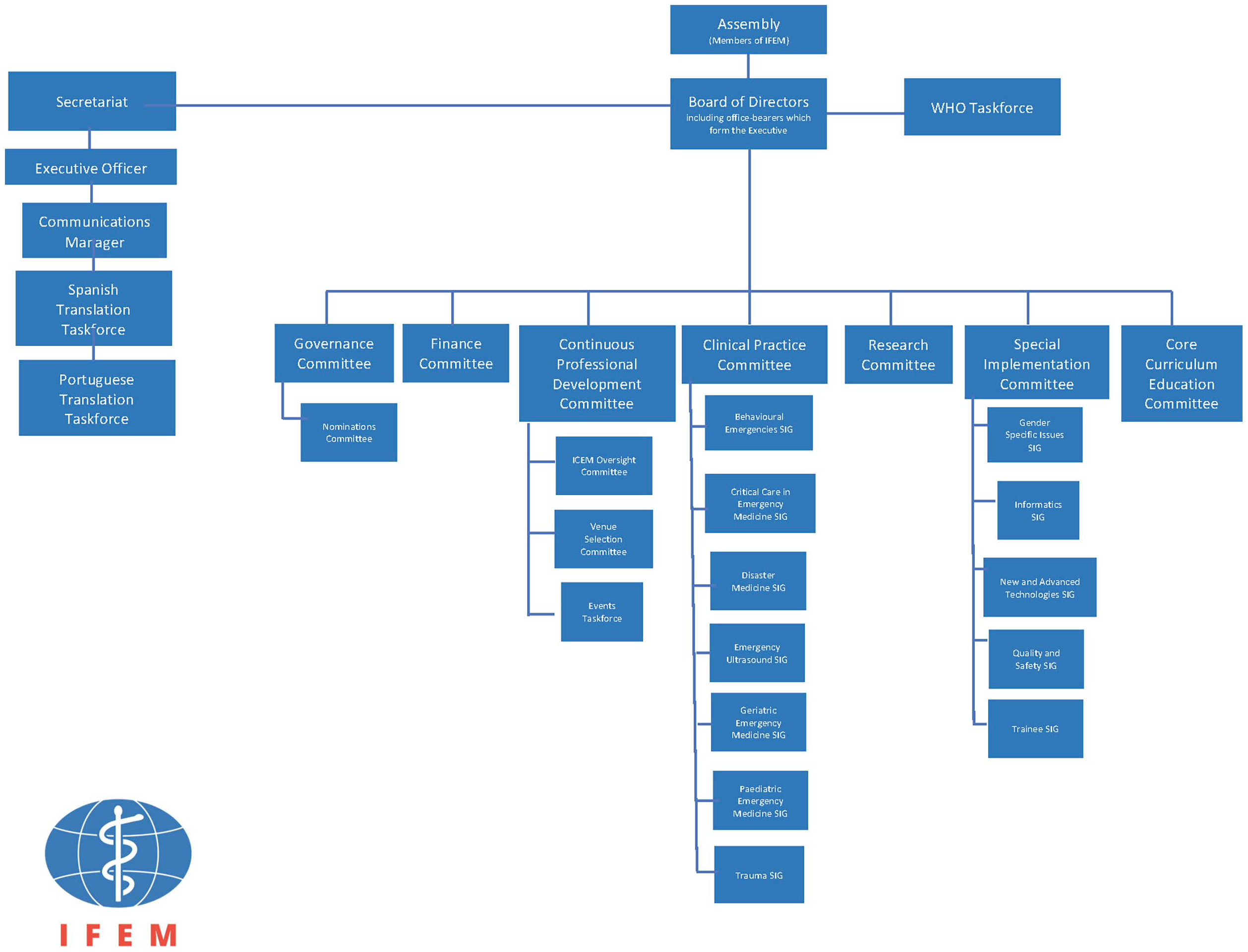
IFEM organizational chart.
Figure 2 shows the Assembly members in 2014 when ICEM was held in Hong Kong. There are 14 members in the IFEM Board of Directors ‒ 8 office-bearers of the Executives plus representatives from 6 geographic regions – Africa, Asia, Australasia, Europe, North America and Central and South America. The current regional representative of Asia is Dr Faith Mesa-Gaerlan of Philippines College of Emergency Medicine. There are 7 Standing Committees (SC), 12 Special Interest Groups (SIG) and 4 Task Forces (TF). The 13th SIG of Environmental and Public Health and the 5th TF of Emergency Department (ED) Crowding and Access Block are in the process of establishment.
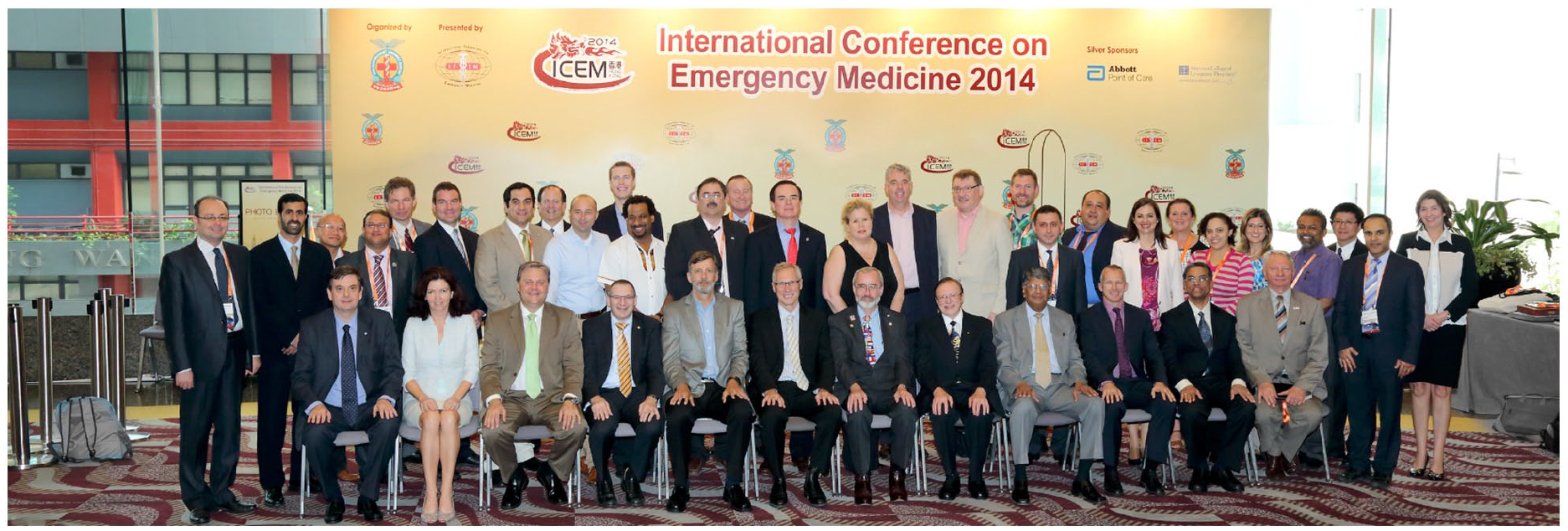
Photo of IFEM Assembly members during ICEM 2014 in Hong Kong.
Apart from our President, Dr Clara Wu, being a voting member of the Assembly and the author, Dr Paul HF Ho, being Vice-President, the following fellows of HKCEM are actively participating in IFEM affairs.
Continuing Professional Development Dr Eddie Yuen (Associate Chair), Dr Axel Siu
Core Curriculum & Education Dr Abraham Wai
Research Prof Colin Graham
Special Interest Groups
Critical Care in EM Dr Anfernee Yim
Disaster Medicine Dr Kevin Hung, Dr KK Lam
Emergency Ultrasound Dr Gordon Lee
Geriatric EM Dr Patrick Leung, Dr Paul Ho
Informatics Dr CT Lui
Paediatric EM Dr Arthur Cheung, Dr Jerome So, Dr Chamy Lok, Dr Tommy Lam
New and Advanced Technology Dr CT Lui, Dr Clara Wu
Trauma Dr Herman Lee
Trainee Dr Sam Yeung
Task Forces
ED Crowding and Access Block Prof Colin Graham, Dr Paul Ho
World Health Organization (WHO) in 2007 World Health Assembly (WHA) Resolution 60.22 ‘Health Systems: Emergency Care Systems’ called for all countries to develop effective emergency care system (ECS). WHO describes EC in the infographic below. 2
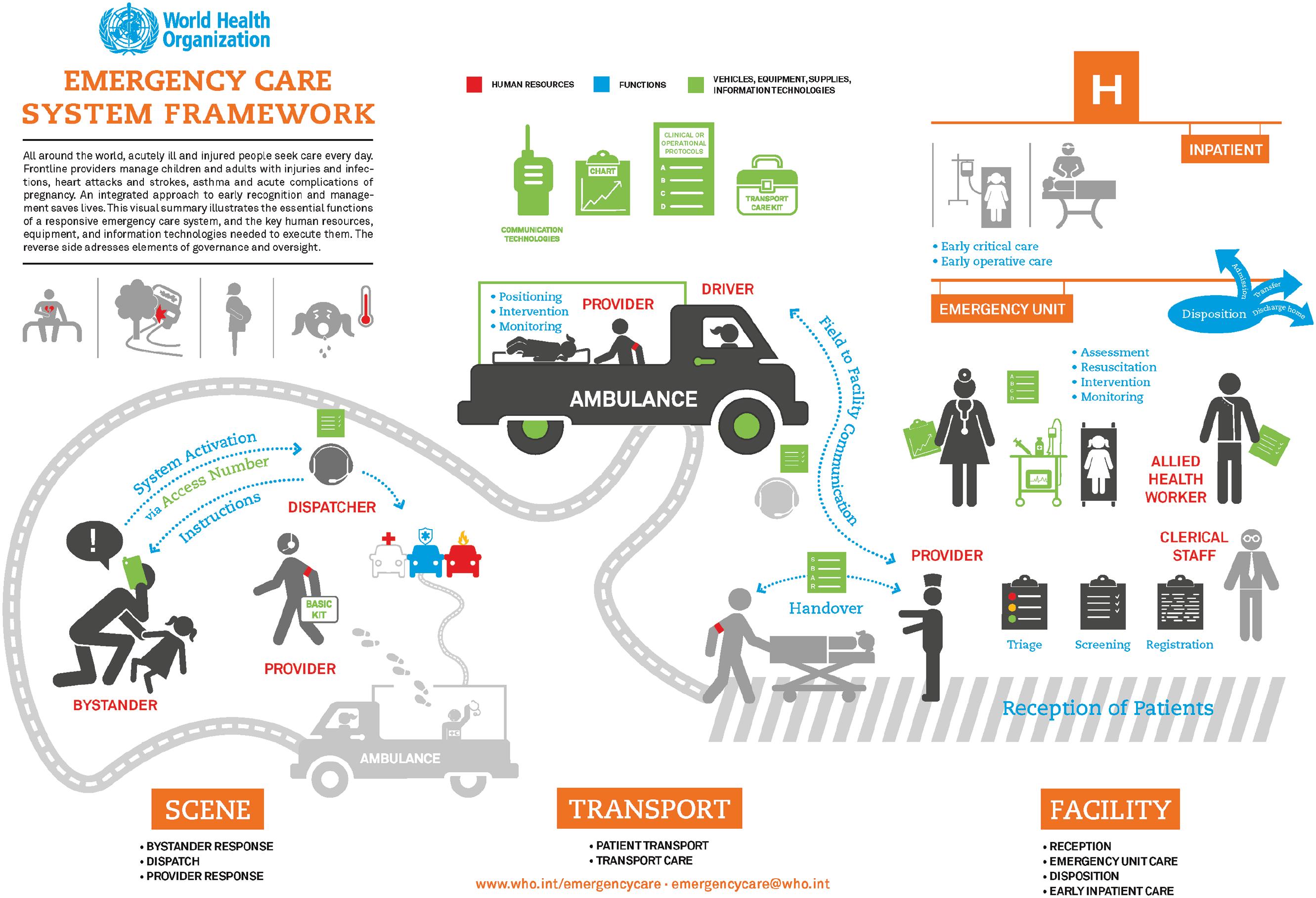
WHO emergency care system framework.
While emergency physicians and nurses work most of the time in healthcare facilities (e.g. ED), patients suffering from sudden illness or injury cannot have their health outcomes maximised without an organised ECS. ECS includes an integrated approach to recognition, call for help system, organised and safe transport to an emergency care unit providing skilled assessment, stabilisation and diagnosis. In 2019, WHA 72.16 ‘Emergency care systems for universal health coverage: ensuring timely care for the acutely ill and injured’ placed EM as a core specialty within any healthcare system.
IFEM recognises that developing solutions to global EM challenges such as ED crowding and access block is not enough. Another critical component to achieving IFEM missions is in influencing the priorities and actions of those in power, and securing the support of key decision makers, policymakers and others who can commit the necessity resources and enact necessary policies. Advocacy is a powerful tool to drive transformative change. IFEM, therefore, has a strong advocacy role to help member organisations. A recent example is assisting the Dutch Society of Emergency Physicians to gain specialty board recognition in their country governing system.
As at today, IFEM membership has more than 70 EM societies and organisations. Many resources are developed by international experts in EC. Free access to these resources is available through IFEM website www.IFEM.cc. I would like to highlight some of those resources.
Undergraduate Core Curriculum
Graduate Model Curriculum
Emergency Care Institute Emergency Procedures App
An updated framework on Quality and Safety in EM
Standards of Care for Children in ED (English, Chinese, Spanish)
Point of Care Ultrasound Curriculum Guidelines
Global Response to COVID-19 for Emergency Healthcare Systems and Providers (English, French, Portuguese and Spanish)
ED Crowding and Access Block in the COVID era and Beyond
Various White Papers (Gender Diversity, Care of Older People with Acute Illness and Injury in ED, Early Critical Services in Low-Resources Settings in LMIC, Guidelines for the Development of International Trauma Systems)
Various Position Statements (Minimum Standards for the Care of Older People in ED, Implementing a Nationwide Policy for Developing EM, Creating Sustainable Working Conditions for the Emergency Physicians)
HKCEM is celebrating her 25th anniversary in year 2022. The College has tremendous success in achieving specialty status, development of Clinical Toxicology subspecialty, growth in number of members, international liaison and networking, financial sustainability and, last but not least, community recognition. All these successes resulted not only from selfless contributions by our fellows, but also generous assistance from EM fraternity globally. It is time to repay what we have been given to brothers and sisters of ECS in other parts of the world, through IFEM. For those interested to participate in international EM, do not hesitate to contact the author through

Footnotes
Declaration of conflicting interests
The author(s) declared no potential conflicts of interest with respect to the research, authorship, and/or publication of this article.
Funding
The author(s) received no financial support for the research, authorship, and/or publication of this article.
