



Abstract
During and after the months of pandemic control measures, newly formed unions of platform and gig workers in India started leveraging electoral contests, campaigns and politics to advocate for and with laws that would regulate platform work and provide workers with social security. This signalled the adoption of direct political interventionism as a bargaining strategy for gig and platform workers’ rights. This strategy was built upon the strengths and abilities of workers to coordinate tactically and organise independently, without conforming entirely to existing political formations and ideologies – reminiscent of the historical ‘third-wave’ movements for informal workers’ legal empowerment in India. Drawing on examples of practices of ‘political and civil society’ amongst gig and platform labour organising in India, this paper demonstrates the unique ways in which new unions of gig and platform workers are both following and deviating from earlier trajectories of third-wave labour movements, as well as from gig and platform workers’ movements in the global context. We show in the paper how this is allowing unions to make greater claims for gig workers’ social protection and expand the remit of welfare politics in India. We then deliberate whether this signifies a potential movement towards a new ‘fourth wave’ of labour’s legal empowerment for workers in India under digital capitalism.
Introduction
With the decline of welfare state politics and the emergence of neoliberalism in the 1970s globally, traditional labour unions found themselves under threat and less able to respond to the crisis and contradictions of labour’s social reproduction arising from the restructuring and reorganisation of capital (Jenson, 2011). In India, during this period, however, new labour unions and associations started emerging, which started mobilising informal workers beyond the domain of employment and wage relations (see Agarwala 2006, 2008; Bonner et al., 2018; Haan and Sen, 2007). They operationalised their appeals directly through the state and utilised their power as citizens and voters to demand new legislation that ensured work regulation and welfare, through workers’ ‘welfare boards’ (Agarwala, 2008). The formal recognition that informal workers achieved from the state through ‘welfare board politics’ gradually became a further basis for them to access more social benefits, rights and entitlements. Rina Agarwala (2019) has characterised this as the ‘third wave of legal empowerment’ of informal workers in postcolonial India, which emerged after two previous waves, that had earlier extended legal protections to different formal and informal workers in India. The third wave, uniquely emphasised the notion of electoral citizenship to pressure the ruling class to enact state- and national-level legislations that addressed their social reproduction needs.
Recent struggles of platform and gig labour in India that aim to gain access to better social welfare for workers share several key features with the third-wave of informal workers movements, not least since they seek to address a similar absence of a legally enforceable employer-employee relationship in the sector. The gig and platform workers movement in India, in this sense, has built over third-wave traditions of welfare board politics and even engaged directly with the state to demand social and legal protections. This paper describes the origins and strategies of the new ‘independent’ platform and gig workers unions in India directly engaging with the government at multiple levels, influencing political leaders, election manifestos and electoral campaigns, while also proposing new welfare board legislations that expand the social policy provision by the state. The aim of these new unions is to weaken and ultimately decouple the hold that platform companies currently have over workers’ social reproduction. This paper closely examines the origins and strategies of India’s new gig and platform workers’ unions in relation to the historical trajectories of workers’ movements in the country, and also to gig and platform workers’ movements elsewhere in the world. In doing so, the paper reveals insights into the diverse impact of contemporary digital capitalism on labour organising globally, and the unique ways in which workers in the global South are repurposing the postcolonial state to enlarge its domain of social policy and welfare right. Through this, the paper foregrounds new terrains of welfare politics on which gig labour in other parts of the world can mount their struggles.
The rest of the paper is structured as follows. At first, it will provide a background to what makes India’s welfare state partial, and how this has historically impacted the large mass of its informal and non-formal workers. It then discusses how different informal workers’ movements have sought to uniquely address this gap by organising collectively, especially through the introduction of certain ‘welfare board’ legislations at the state and the national level. The section that follows examines how these special legislations were won, underlining the role of ‘political society’ by informal workers and labour organisers, to negotiate with the state directly on broader principles of electoral democracy and citizenship. The subsequent section then discusses the recent independent gig and platform workers’ struggles in India with ‘digitally organised informality’, finding parallels in how these new unions are addressing issues of gig workers’ welfare in a global and historical context combining features of both Marx-type and Polanyi-type struggles, straddling political society and civil society activism, while moving between market despotism and hegemonic production politics. The section briefly deliberates whether this hybrid politics represents a new movement of labour’s legal empowerment in India, extending Agarwala’s (2019) earlier conceptualisation of first-, second- and third-wave movements. The next section lays out the analytical methods that are drawn from research projects examining platform and gig workers’ lived experiences and their organisation in India, involving in-depth interviews with workers, activists and union leaders as well as secondary data analysis of online and news media. The empirical discussions in the section details the modified strategies and tactics of gig and platform workers' movements in India from the time of their inception, to more recent engagement with the state’s labour policy, electoral politics, and welfare board legislations. The concluding section of this paper brings together key ideas of gig and platform workers’ organisation and their contribution to welfare state expansion, reflecting on these activities and processes as potentially constituting the ‘fourth wave of legal empowerment’ in India.
Addressing the ‘partial’ welfare state: Informal workers’ movements for legal empowerment and welfare boards politics in postcolonial India
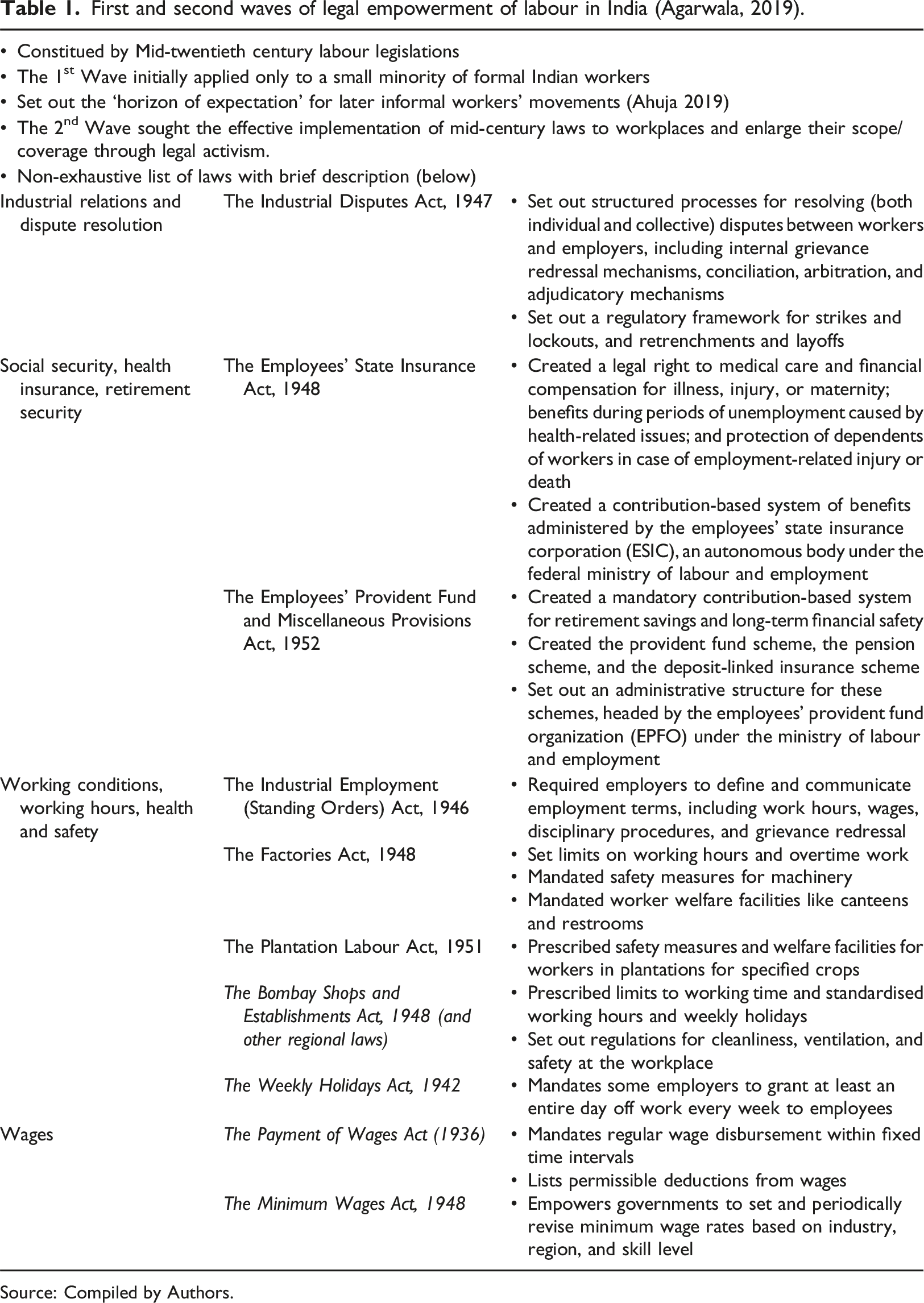
Scholars have argued that the first wave of legal protection for workers in India took place between the early 1900s and the 1970s (Agarwala, 2008, 2019; Ahuja, 2019). Straddling both the British colonial and post-independence periods, this period saw labour laws being framed through national-scale parliamentary legislation. These laws included the Industrial Disputes Act (1947), the Factories Act (1948), the Shops and Establishments Act, the Employees Provident Fund Act, and the Employees State Insurance Act (amongst others) and had a long-term impact on the nature and scope of welfare provision for labour in India. Taken together, these laws regulated the conditions of work, created a framework for negotiations between organised workers and employers, and de-commodified their labour by providing health insurance and social benefits in addition to workplace protections.
This said, the scope and reach of early and mid-twentieth century labour laws in India, as in several other countries emerging from colonisation (see Agarwala, 2019; Breman, 1999; Harriss-White, 2010), remained highly restricted for the following reasons: (i) they provided social security benefits only to a narrow slice of the nation’s working population, defined as industrial workers operating formally under registered employers, and, (ii) their enforceability and justiciability remained limited because a majority of workers remained outside the purview of formal labour legislation, since they were employed in extremely small enterprises, or in the informal sector where it was difficult to clearly establish the presence of the employer-employee relationship, or simply because the laws were not implemented (see also Papola, 2013: p. 16). In different ways, the first wave of legal empowerment of workers reflected the same contradictions that were present within India’s welfare state regime that emerged after independence, in that there were huge gaps within the social policy remit and an absence of administrative and financial capacity and political will (see Bardhan, 1984; Chibber, 2003; Leftwich, 2005). Furthermore, the postcolonial state was ultimately backed up by a constitutional system designed to keep welfare separated from the framework of basic rights, ensuring that democratic accountability of the state towards citizens remained weak (Ahuja, 2019). It is estimated that the original framework of labour laws left a vast majority of the country’s workforce, up to 95%, without basic entitlements such as to fair working conditions, fair representation, and redress against adverse decisions within the employment relationship (Breman, 1999; Satpathy, 2018).
First and second waves of legal empowerment of labour in India (Agarwala, 2019).
Source: Compiled by Authors.
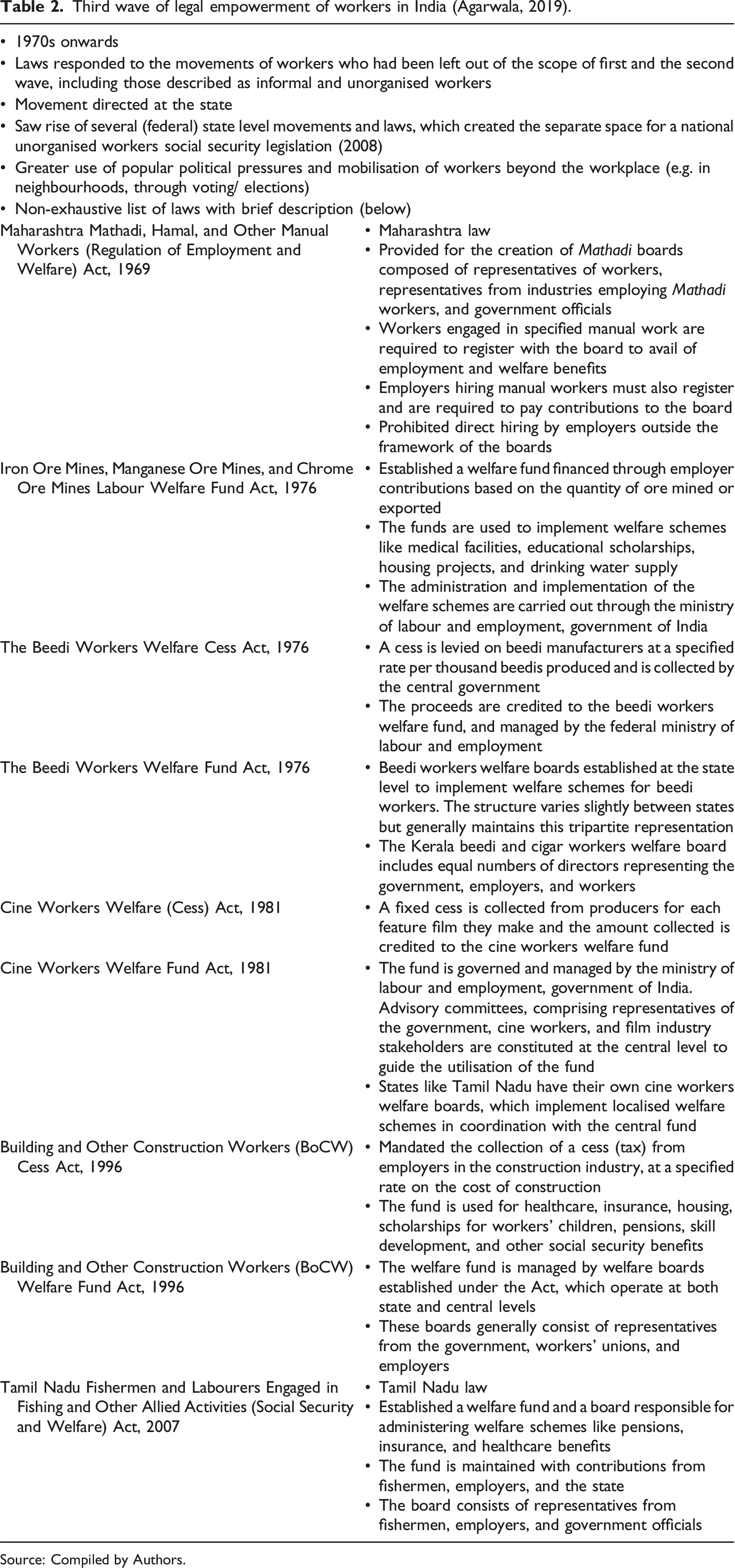
The different limitations of the first and second wave movements led to the consolidation of the ‘third wave’ of informal workers’ legal empowerment in India (Agarwala, 2019). While results of the ‘third wave’ started becoming apparent in the 1990s, its seeds were sown decades ahead. It was in the 1970s and 1980s, when certain sections of the labour movement started mobilising ‘informal’ or ‘non-formal’ workers outside of the industrial shop floor, at the neighbourhood level, building direct pressure on local and state governments directly for passing new welfare legislation for these workers, instead of seeking assurances for increase in wage-based incomes and benefits from their employers. Uniquely, rather than demand amendments to India’s formal employment-linked mid-twentieth century laws and schemes (e.g. Employees State Insurance and the Provident Fund), these movements sought welfare protections outside, through the formation of ‘special legislations and laws’ (Agarwala, 2019: pp. 409-411). Prominent among these demands for special laws were those made by informal ‘headload workers’ in India from the 1970s onwards. Those organising informal headload workers followed the lead of the earlier colonial-era Dock Workers Act (1934/1948), for the provision of social security to informally employed workers in the sector through the establishment of a workers’ welfare board (see Marshall, 2019). The Maharashtra state’s Mathadi, Hamal and Other Manual Workers (Regulation of Employment and Welfare) Act, 1974, more simply known as the ‘Mathadi (headloaders) Act’, was the first to establish a ‘Mathadi Board’, following organising of workers for fairer work and wages in the state (see Marshall, 2014, 2019). The Act mandated both informal workers and ‘users of labour’ (employers) to register with the Mathadi board. Those who wanted to hire these workers would pay the board, which in turn paid wages to individual workers based on the number of hours they worked. This board was made independent from the state and was governed by the tripartite representatives of the government, workers unions, and labour users. In addition, the board was expected to provide workers bonuses, leave wages, and medical and retirement benefits. The Mathadi board was a distinctive innovation in Indian social policy and in the wider global South context as it effectively provided a state-backed arena for the bargaining of wages and conditions of work between representatives of informal workers and capital.
The Mathadi boards inspired other movements of informal workers in India as well. In the late 1970s and early 1980s, informal construction workers began organising in unions unaffiliated to any political party. Following their sustained struggles and wins across states like Kerala (1978) and Tamil Nadu (1982), different unions of informal construction workers came together to demand a single national legislation, after which in 1996 the Indian parliament passed the ‘Building and other Construction Workers’ (Regulation of Employment and Conditions of Service) Act, 1996 or the BoCW Act. This national Act required all state governments to set up ‘welfare boards’ for construction workers, with registration of all entities employing workers for any significant building and construction project. The board is a tripartite body, meaning that it must have an equal number of people representing the state government, the employers, and the construction workers, including at least one woman. It should be noted however, that there are differences in the effectiveness of different laws, for instance, between the Mathadi Act and the BoCW Act, where the former provides greater regulation of employment relations and conditions than the latter.
Third wave of legal empowerment of workers in India (Agarwala, 2019).
Source: Compiled by Authors.
The role of ‘political society’ in expanding informal workers’ welfare in India
The enlargement of social protections for informal sector workers in India is a compelling case study that stands out in the global social policy context (Breman and Van Den Linden, 2014; Burawoy, 2010; Marshall, 2019; Tillin, 2022; Wood and Gough, 2006). While we have sketched out the differences between formal and informal workers’ movements in India through the different waves of labour’s legal empowerment based on Agarwala’s (2008) classification, we propose a broader conception of ‘political society’ (Chatterjee, 2004; 2008a; 2008b) – as central to understanding the strategies of ‘organised' informal labour and the effectiveness of their engagement with the Indian state for attaining new protections within and beyond their jobs (which does not preclude their everyday micro-political and unorganised forms of labour agency documented, for example, in Chakraborty, 2014; Rai, 2020; Ray, 2024a, 2024b). However, to do so we need to first understand the role of political society in social policy formation in postcolonial states like India, where formal welfare coverage has been limited, and is primarily geared towards maintaining the informal subsistence economy rather than transforming it (Sanyal, 2007).
‘Political society’, according to Chatterjee (2004, 2008a, 2008b), is a form of social and political engagement by such groups – who even though bearing the same civil and political rights, are ignored, kept apart from, or themselves keep a distance from the ‘civil society’. Civil society, according to Chatterjee, is that part of society which has recognition within the formal structures of the state and capitalist relations (2004, p. 28). While in theory, this includes every citizen with equal rights, Chatterjee points to the large masses of Indian people who remain outside its preview since they do not nearly enjoy the same rights as elite groups, formal unions, associations, and organisations. Yet these so-called ‘subaltern groups’ are not beyond the sphere of state politics. While the groups’ activities and practices are not always formal or legal in the strictest sense, they are necessary for their own survival, and in turn compel their interactions with the postcolonial state. The state consequently steps in to acknowledge their existence through a practice of ‘governmentality’ – constituting the ‘multiple, cross-cutting and shifting classification of the populations as targets of multiple policies, producing a necessarily heterogeneous construct of the social’ (Chatterjee, 2004: p. 36).
It is exactly in this regard that the process of organising for separate but cross-cutting labour laws and welfare boards during the ‘third-wave movements’ (Agarwala, 2008) by informal and non-formal workers hitherto kept outside the purview of the original mid-century labour laws in India, can be understood as a practice of ‘political society'. This practice responded directly to the changing social contract between the state, capital (employers) and labour under conditions of postcolonial capitalist development. As informalisation spread through sub-contracting in India, mimicking global and western trends in its own way, the state was held up by organisers as ‘directly responsible for their [informal workers] needs through the concept of citizenship’ (Ibid., p.392). Thirdwave movements also signified a key change in the state’s image, which was till then primarily seen as a ‘neutral’ mediator to settle disputes or enforce the legal contract between the employers and labour. Consequently, new unions, rather than demanding formalisation of employment contracts fromt the state, aimed to protect workers within their informal employment status.
This political society practice of informal labour organisation from the 1970s in India meant that welfare-related claim-making was increasingly led by a ‘structurally’, ‘associationally’ and ‘institutionally’ precarious set of workers. New unions directly engaged with the state on the broader issues of welfare, class-based precarity and electoral citizenship (e.g. through voting at the state and local levels), and on intersectional grounds (see for example, the Self-Employed Women’s Association, which started independently organising employed female workers employed in the textile sector in the 1970s) (see Bonner, 2010, 2017; Hill, 2010). In doing so, these informal and ‘unorganised' workers’ efforts harked back to the formative socialist and social-democratic movements in 19th and the 20th century Europe for recognition, redistribution, regulation and reformation (of institutions and laws) for social security (see Breman and Van Den Linden 2014; Burawoy 1983, 2010; Fraser, 2000; Zurn, 2005). They sought to work around the ‘cash nexus’ (to use Karl Marx’s term from the Gotha Programme - (Marx, 1875) in favour of material social benefits from the state: ‘a social wage that de-commodified labour by embodying an expanded notion of citizenship’ (Agarwal, 2008: p.392; also Esping-Andersen, 1989). India’s informal workers’ movements came to represent the new ‘southern labour’ paradigm (Webster, 2014), together with similar labour movements in other global South countries facing a continuous decline of formal work, taking on innovative legal interventionist approaches and building new global alliances and institutions such as the Women in Informal Employment: Globalizing and Organizing (WIEGO) (see also Ahmed, 2019; Bernards, 2017; Bonner, 2010, 2017).
Whereas Agarwala’s and other accounts of the third-wave movements of India’s unorganised and informal workers for social protections are deeply agentive, speaking positively of informal workers’ empowerment, several scholars and activists have expressed scepticism about their transformative potential (see Harris-White, 2003, 2010; Harriss, 2014; Roy Chowdhury, 2011; Satpathy, 2018). The scepticism stems for some from the original structural limitations to political agency inherent within informal employment conditions that ultimately impede true legal recognition for workers or make them vulnerable to ‘political clientelism’ – that is where workers’ political engagement becomes contingent upon the patronage of local leaders. This also links to the criticism often levelled by traditional labour unions who consider third-wave legal protections as merely partial, ad hoc, temporary, and in certain ways weakening formalisation by creating separate and fragmentary laws around social security and labour protections that are not work-based (see Agarwala, 2013, p.56; Webster, 2013; Harriss, 2014). Others mention that a broader platform of class-based solidarity alone cannot remedy issues of informal workers’ access to social protections in the global South – and that other systematic and entrenched social hierarchies such as gender (gender-based violence) and caste in the case of India, continue to make strategic political engagement difficult for most (see Harriss-White, 2003, 2010; Hill, 2010; Marshall, 2019).
Even as the above criticisms raise important considerations about India’s third-wave movements, however, many of these overlook the nuanced and context-specific nature of the analysis of third-wave movements which sprung up exactly because formal laws and labour unions had been unable to make progress on arresting or reversing the spread of informality and precarity amongst a vast majority of the working populations for e.g. even in Left ‘bastions' such as West Bengal (Agarwala, 2013). Furthermore, Agarwala’s scholarship, in our view, does not deny the structural and gendered barriers faced by informal workers; but rather foregrounds their agency within these constraints, demonstrating how they navigate and leverage political spaces to secure welfare benefits.
Indian gig and platform worker organising in historical and global contexts: A new movement for labour’s legal empowerment?
Due to the very specific ways in which digital platform companies have legally defined their relationship with workers as ‘freelancers’, ‘partners’, ‘independent contractors’, in countries around the globe, including in India, these countries do not bear the same duties and liabilities under most established labour laws, depriving gig and platform workers protective coverage of these laws (see Dubal, 2017; Erlich, 2021; Ray 2024b, 2024c; Wood et al., 2020, Woodcock and Graham, 2019). In other words, workers in the gig and platform economy are subject to ‘digitally organised informality’ (Ray 2024b: p. 14). This means, firstly, that there is little regulation of platforms, platform work and working conditions by the state. There is often no enforcement of a wage floor, no limits on working time, and no enforcement of health and safety conditions (Choubey, 2024). Secondly, there is no legal facilitation of the collective voice of gig and platform workers – the law does not provide a framework for the representation of workers through recognised unions in a process of collective bargaining. Thirdly, there is no legal right or entitlement for workers to work-linked social security, such as health insurance, unemployment insurance, or pensions (see Yanaka and Heeks, 2023). In this sense, platform and gig workers, in the emergent era of digital capitalism, are no different than the overwhelming majority of India’s informal workers who are not protected under the mid-twentieth-century labour laws (see ILO, 2024: p. 99). So how do current gig and platform workers’ struggles for their rights and welfare under digital capitalism in India stack up against historical third-wave informal labour movements and other global movements of the past and present?
Global labour movements, according to Beverly Silver’s classification (Silver, 2003, p. 20), can be categorised as either ‘Polanyi-type’ or ‘Marx-type’ movements: the former being movements of working classes against their ‘unmaking’; and the latter highlighting the struggles of working classes that are ‘emerging’ or ‘in the making’. Polanyi-type movements are undertaken by workers to oppose the (re) commodification of labour, while the latter are waged for its de-commodification through the provision or expansion of labour protection laws and social benefits (see also Burawoy, 2010; Katta et al., 2020; Polanyi, 1944). Busemeyer et al. (2022), while closely considering recent gig workers’ movements underway in Europe and other regions of the world, frame labour’s welfare protection to be ‘moving in cycles’, whereby new transformations in technology and economy lead to the emergence of new insecurities and therefore new struggles of workers for retaining or for expanding their basic rights and entitlements. The rise of gig and platform work signifies the latest cycle of this transformation, which has led to the emergence of new labour insecurities that have in turn reinforced workers’ preference for compensation through (both) existing or new social policies (see also Au-Yeung et al., 2024; Grabher and König, 2020). Umney et al. (2024), who recently surveyed platform and gig workers protests globally, endorse this broadening of Silver’s classification to understand not just welfare protection cycles around the globe between the late 19th and early 20th centuries, but also to identify the nature of labour unrests within specific cycles. Rather than simply being one or the other, these cycles often feature a combination of Marx-type and Polanyi-type movements depending on the historical coverage that exists in a particular society (or not).
A similar case for the application of Silver's classification of labour movements can be made in context of India’s labour movements. While India’s formal industrial workers’ movements from the 1970s onwards can be classified as ‘Polanyi-type’ – that is against the retrenchment of welfare protections from the first wave of workers’ legal empowerment, the informal workers’ movement within the same period can be identified as ‘Marx-type’ since they were (still) struggling for gaining recognition as workers, and demanding special welfare laws to protect them. The recent platform and gig workers’ struggles in India are unique in that they straddle both Marx-type and Polanyi-type demands of recognition and regulation, operating between the civil and political society (Chatterjee 2004) to move from a (market) ‘despotic’ towards a ‘hegemonic’ production politics that demands the decoupling of their social reproduction needs from the platforms (Burawoy, 1983; also Wood, 2020). This is a hybrid form of labour politics that echoes with the earlier third-wave movements’ tactics and strategies, but also moves beyond it.
As our paper will demonstrate that much like the informal labour movements of the latter-third of the twentieth century in India, new gig and platform workers associations and unions in India appear to understand that the new state’s in-ability and un-willingness to hold digital capital (-ists) responsible for labour according to early and mid-century labour laws is not fait accompli. They are therefore demanding the introduction and implementation of gig workers’ welfare boards through a modified practice of political and civil society. However, unlike third-wave movements which had struggled to operationalise welfare boards due the highly diffused and opaque nature of employer-employee relationship in the informal economy (Agarwala, 2019), new gig worker unions have drawn attention to the direct causal relationship between their precarity and the practices of large national and global platform companies such as Amazon, Uber, and Ola (Duvisac, 2022; Ray, 2019), to pressure for welfare board legislation.
Greatly expanding the purview of the emergent evidence on new union organising in the global South, this paper documents how independent gig and platform unions in India are able to simultaneously claim that they are being mis-classified as ‘partners’ instead of workers and also demand ‘special legislations’ (welfare boards) that apply exclusively to gig work and platform companies. This hybrid practice of demanding formal recognition as well as exclusive laws sets the new independent or ‘indie' unions of gig and platform workers apart from traditional industrial labour unions in India, as well as from gig workers’ movements in other parts of the world where collective bargaining is institutionally and historically more well-established. These new unions occasionally strike and interrupt work as the first resort to notify the company of their grievances, while simultaneously boosting their capacity to mobilise for sustained political interventions at the local, regional and national scales. Furthermore, by engaging in localised protests, social media-based mobilisation, electoral and legal interventions, gig and platform worker unions are creating an interesting framework for labour activism that includes political and civil society practices (reaching out to media, courts and consumers) to counter structural and organisational weaknesses under neoliberal digital governance. Through these practices, these independent unions have also influenced more established party-affiliated unions. Whether this ‘new’ push signals a distinct ‘fourth-wave movement’ for workers' legal empowerment under digital capitalism in India is an important and prescient question that we will again deliberate in the concluding (epilogue) section, after closely considering the key findings of the paper.
Data, methods and terminologies
The data for this article draws from research carried out by the authors on issues of gig and platform workers in India between 2019 and 2024. Specifically, this consisted of primary data analysis from research projects that included the following: (i) 55 semi-structured telephonic interviews carried out with individual app-based cab and delivery drivers between 2020 and 2023, lasting between 32 and 65 minutes. These interviews were part of a broader research project to examine their experiences after the lifting of the COVID-19 lockdowns across two Indian cities of Ranchi and Kolkata, in the eastern states of Jharkhand and West Bengal, respectively (see Appendix-A for detailed profile of participating drivers and Appendix-B for vehicular ownership among them). (ii) 7 semi-structured interviews, between 2021 and 2024, lasting at least 45 minutes with labour organisers and leaders affiliated with: (a) ‘Telangana Gig and Platform Workers Union’ (TGPWU) – an independent gig worker-led union that was founded in 2021 in the state of Telangana and, (b) Indian Federation of App-based Transport Workers (IFAT) – a federation of ride-sharing workers’ formed in 2019, which is affiliated to the International Transport Workers Federation that advocates for gig workers’ rights globally. (iii) To complement above interviews, authors also conducted a documentary analysis of strike actions and mobilisations by gig and transport workers' associations and unions, as well as of the coverage related to their campaigns in news media and on social platforms from 2019 onward. This provided the broader context to situate the interview narratives and allowed us to track the shifting landscapes of collective action among precarious workers in India’s urban centres.
For the combined analysis of the different interviews, we adopted a grounded constructivist methodology (Charmaz, 2006) alongside thematic analysis (Braun and Clarke, 2006). We took on a reflective and iterative approach for both gig workers as well as union leaders interviews. This first phase of codes in our analysis of interviews specifically looked for processes and experiences related to protesting or resisting and (ultimately) to organising, ‘forming a WhatsApp group’ or ‘seeking help from union (or union leader)’ or ‘contacting a local politician’. The second phase related to constructing theoretically informed understanding of different motivations and strategies of organising among both individual workers and union leaders. From this we moved to identifying the most noticeable patterns amongst differ narratives – such as increased used of digital platforms (e.g. social media message apps) for mutual support, or engagements with formal trade unions and political leaders and parties. These were grouped into thematic clusters that spoke to the broader processes of informal organising, dealing with everyday precarities, and fragmented solidarities. We also engaged in axial coding (Corbin and Strauss, 1990), exploring the relationships between different categories. We considered how certain events, conditions and contexts triggered or transformed specific responses from workers, such as seeking aid through community networks or participating in protest. This process allowed us to build a more nuanced picture of the interplay between agency and structural constraints affective lives of gig workers. We then integrated the various themes into the main narrative in the final phase of the analysis: here the key ideas of flexible participation in politico-legislative and electoral practices emerged as a core analytic category that connected the various stands of our data (from digital mutual aid, to episodic alliances with local unions and political campaigns). Finally we, also consulted our memos relating to the fieldwork in the study of platform drivers after the lifting of the COVID-19 lockdown to analyse the snowballing processes of recruitment which gave us insights into our conversations with local union leaders and/or with political workers, who had mobilised gig workers previously against platforms and the ruling state governments. Throughout this process, we remained attuned to the criteria of coherence and trustworthiness, keeping an account of the analytical decisions we were making as a team, and revisited the data to test emerging insights. This reflexive engagement was key to ensuring that our analysis was rigorous and grounded in the experiences of our participants (Lincoln et al., 2011).
Lastly, readers should note our usage of the terms such as unions, associations and federations in this paper. ‘Unions’ are a subset of ‘associations’ in India. Associations are any groups of individuals formed for any purpose; these can be informal, but unions are those associations that have been recognised as unions by the Registrar of Trade Unions. An association may be constituted for the purpose of representing workers’ interests but from the narrow legal perspective, that association is not a union until the Registrar accepts its application to be considered a trade union. The Telangana Gig and Platform Workers Union (or TGPWU), about which we discuss at length later in the paper, was recently registered as a union (October, 2022). We consider the likes of TGPWU to be ‘independent or indie unions’ unlike traditional labour unions in India that are often affiliates of political parties, for example, the Centre of Indian Trade Unions (is affiliated to CPI-Marxist) and the Bhartiya Mazdoor Sangh (is affiliated to the ruling Bhartiya Janata Party). IFAT is a ‘federation’ – meaning that its constituents are (not one but) several unions/associations. It is not totally clear whether the Sarvodaya Drivers Association (SDAD), also discussed in this paper, is an actually registered union in the state of Delhi, but it is clear that it has worked with smaller drivers and transporters unions in the state to organise protests and strikes in the past. We do not go in depth into the relationship between the new independent unions and traditional affiliate unions, as this was beyond the scope of our initial research.
Practicing ‘political society’: Platform and gig workers’ and expanding social welfare in India
The rise of ride-hailing platforms like Uber has had a profound influence on the urban transport landscape and on the rise of gig work globally. In the span of about 10 years, drivers affiliated with these services have emerged as one of the main segments of the urban transport workforce in developing nations. According to estimates, Ola had around 1 million ‘driver-partners’ in about 169 cities (IANS, 2020), with Uber reporting comparable figures in 123 cities in emerging nations like India (Business Standard, 2022). The rapid expansion of Ola and Uber cabs has however given rise to new dynamics of labour-employer relations and enabled a form of ‘digitally organised informality’ (Ray, 2024b) in the global South – with new forms of insecurities from workers, who have struggled to keep their incomes and livelihoods at earlier levels and negotiate with platforms for better working conditions and long-term growth (see also Anwar and Graham, 2021; Rani et al., 2022; Van Doorn et al., 2023).
Early strides in gig and platform workers’ organisation and politico-legislative interventions in India
The roots of gig and platform drivers organising for better working conditions are as deep as the origins of platform work in India itself. While we will discuss the recent rise of ‘independent unions’ of gig and platform workers not affiliated to any political party in the next section, it is important to note that large-scale protests of drivers associated with platform apps like Ola and Uber in India date have existed as far back as 2013 and have seen participation from traditional party-affiliated unions as well. This section underlines the early strides in gig and platform workers’ organisation made by app-based drivers – beginning with strikes that were sporadic expressions of dissatisfaction by a class ‘in-the-making’ – often aimed at local governments, traditional transport unions and law enforcement, to gain legitimacy and recognition in the sector, rather than at platform companies (see Ray, 2019). However, as the number of these app-based drivers grew and incomes faltered, including on popular food delivery-based platforms, strikes became more frequent, more unified and more organised across the country, this time challenging major platform companies, and signalling a practice of political society among these workers.
Two of the most notable strikes of app-based drivers against platform companies occurred in 2017, both called at a national level but primarily focused on actions in the Delhi-national capital region (NCR). These strikes were spearheaded by the traditional transport associations such as the Sarvodaya Drivers Association of Delhi (SDAD), which claimed to have the support of 150,000 drivers in Delhi and surrounding areas and bolstered by some local taxi and auto rickshaw unions. Another strike lasted for 13 days and succeeded in bringing the Delhi state government and the management of Ola company to the negotiating table, resulting in an agreement on improved fare pricing in the city (Ray, 2019). Similarly, in both 2018 and 2019, several coordinated strikes were observed across several major metropolitan centres, including Mumbai, New Delhi, Bengaluru, and Chennai, with an estimated one million drivers participating. In cities like Mumbai and Kolkata with a richer tradition of labour organisation and strikes because of their industrial working-class histories, Ola and Uber drivers were able garnered support from traditional unions with large membership bases. Given their overwhelming numbers, it was clear during these strikes that independent associations and unions of platform drivers had also started to seek and pull support from opposition political parties apart from traditional trade unions, in the cities and states they operated. Together they found ways to pressure the ruling governments to intervene in cases of their employment conditions – including any sudden fall in their incomes, rise in platform commission commissions, but also for regulating other aspects of algorithmic control by platforms – including arbitrary ejections from the platform (‘black-listing’) and the absence of transparency in payments.
Local informal group / (formal) labour union affiliation of drivers in Ranchi and Kolkata.
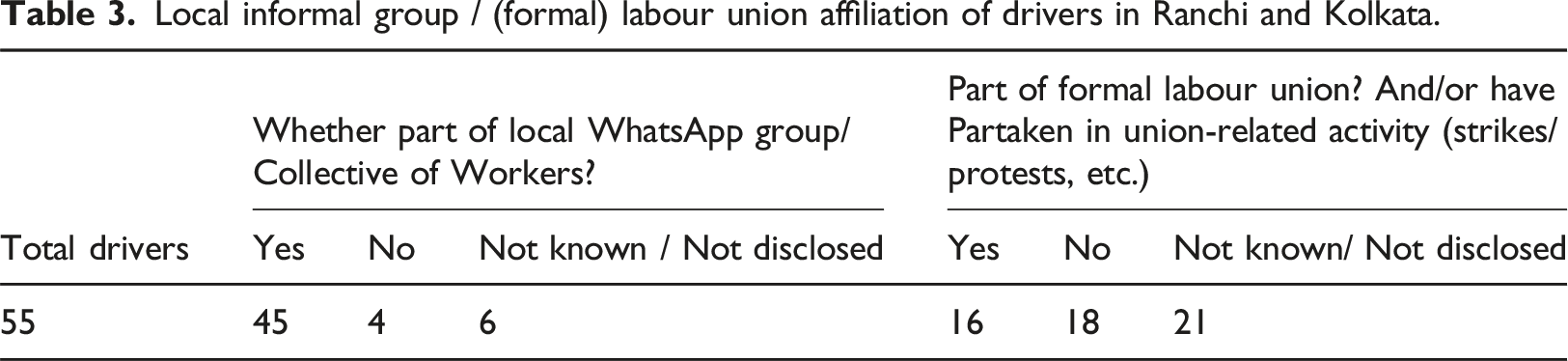
In our interview about drivers’ experiences during the COVID-19 lockdowns in Kolkata, several participants mentioned the growth in collective activity that was taking place in their cities already before the pandemic – through local social media groups and especially through WhatsApp: Most cab drivers in the city are part of local area WhatsApp group for Ola-Uber workers. Some group has leaders in it from political parties and unions. Before the pandemic these groups were very active for [protesting for] basic problems of drivers. We had several strikes outside local offices of these companies and also participated in a national strike
– (App-based cab driver in Kolkata, 2021)
Similarly, in Ranchi, drivers mentioned having been part of online groups led by local transport organisers. Some of these organisers would also double up as activists of the opposition party in the state, namely, the Bharatiya Janata Party, around elections to put pressure on the local government: ‘The ruling [JMM] government does not care about cab drivers’ rights. The leader [of the union] is also a well-known leader in the BJP. I have him on my phone. I always join the protest when I get a call’
- (App-based delivery driver in Ranchi, 2021)
Many of these online (worker) networks paused their organising activity during the COVID-19 pandemic lockdowns and became vitally important as virtual spaces to communicate with other drivers for extending help and mutual aid in terms of food, financing, hospitalisation and transport for locals and migrant workers (also De Neve et al., 2023; Medappa, 2023; Ray, 2024b). Before the pandemic, different platform driver unions and associations had also begun to talk about the lack of wider social security in their jobs beyond wage rates and incentives – joining up together the issues (or the lack) of sick leave allowance, sick pay, health, and accidental insurance. This was evident, for instance, in strike actions spanning several weeks between October 2018 and November 2018 in Maharashtra, which was led by representatives from the Maharashtra Rashtriya Rajya Kamgar Sangh (MRRKS) – a union associated with another opposition political party in the Maharashtra National Congress Party (NCP), known for its significant presence among urban and rural middle classes as well as socially backward caste groups.
While recruiting drivers for our interviews in Kolkata and Ranchi, we also found that prominent independent politicians from other parties also became vocal advocates of app-based drivers’ rights during this time, not just on issues of wages but also for their wider welfare – asking for greater government regulation and other forms of public recognition for them. Many drivers who took part in these demonstrations did not see themselves as supporters of, or affiliated to, any one or other political party or their unions. Interestingly however, most did see themselves as part of a unified, app-based workforce who shared similar qualms against the powerful platforms as well as the ruling political dispensations in their states and at the centre. Overall, Ola and Uber drivers were growing in number, and their protests provided the critical mass needed to make a significant impact across the political spectrum.
Recognising sustained pressures from popular movements of gig and platform workers across different states, in 2019, the government of India amended the Motor Vehicles Act to include, among other things, a definition of ‘aggregator’ as a ‘digital intermediary or marketplace for a passenger to connect with a driver for the purpose of transportation’ and introduced licensing requirements for this category of businesses. In 2020, the Ministry of Road Transport and Highways of the government of India also issued the Motor Vehicle (Aggregator) Guidelines. These guidelines did not automatically apply to aggregator platforms. They suggested a model for the eligibility criteria and licensing conditions that state governments may adopt while issuing licences to aggregators under the Motor Vehicles Act. It was up to the different state governments to require aggregator companies to comply with any of these conditions. The model conditions included the provisioning of insurance for drivers and maximum working times, and even induction and refresher training programmes for drivers. The state governments could in theory use these model conditions to regulate through licences, conditions of work in app-based transport work and provide for the social security of workers.
Furthermore, in 2020, the national government, as part of its root and branch reform of the country’s federal labour laws, consolidated all federal social security laws into the Code on Social Security. The law, for the first time, defined the terms ‘gig worker’ and ‘platform worker’ and envisaged an administrative system, including a national social security board, to deliver social security and welfare benefits to these categories of workers. The social security code envisaged a system of social security exclusively for gig and platform workers that is separate and distinct from the existing system of social security (including employee state insurance and the provident fund) available to workers covered under India’s mid-twentieth century labour laws (Choubey, 2024: p. 56). The code’s promise of a ‘welfare board’ with the power to distribute benefits harked back to the history of informal workers’ welfare legislations and global labour movements described earlier.
The growth and strategies of new gig worker unions in India
The COVID-19 pandemic was a key inflection point for workers in the gig economy globally and in India too, with major lockdowns and consequent declines in the demand for gig and platform services, especially in delivery and transport services. Our research exposed gig workers’ overt dependence on platforms for their incomes and livelihoods, which were compounded by the lack of social protection and welfare (Ray, 2024b). After months of pandemic control measures in India, newly formed unions and associations of platform gig workers started to leverage high-profile electoral contests in the states to advocate with and through key political figures for laws that would regulate platforms and provide for workers’ welfare. This signalled the adoption of direct political interventionism as a bargaining strategy for gig workers’ rights in India. This strategy was built upon the strength and ability of these new independent gig associations and unions to tactically coordinate and opportunistically mobilise a large mass of workers in previous years, without conforming entirely to any ruling class political formations and ideologies (Ray, 2019; also Hussain, 2023). This sub-section sets out to demonstrate the diverse ways in which these new ‘independent’ gig and platform workers’ movements have simulated political strategies of informal workers’ movements and movements elsewhere in the world, but also deviated from them, combining them with formal and organised civil society engagements with the state.
The Indian Federation of App-based Transport Workers (IFAT), set up in 2019, emerged in this period at the confluence of three currents: already existing local unions of taxi drivers responding to the changes brought about by ‘ride-hailing platforms’; already existing federations of transport workers and new formations of platform workers responding to these changes at the national and international scales; and legal changes at the federal level in India that regulated ‘motor vehicle aggregators’ and recognised ‘gig workers’ and ‘platform workers’ as distinct categories of workers with legal rights to social security. Another state level union, the Telangana Gig and Platform Workers Union (TGPWU), was formed in 2021 partly in response to the promises made in the Social Security Code, 2020 and the need for an organised movement to realise them. To extract promises of legislation and policy from state officials and political leaders, these unions looked to leverage the long election campaign leading to the general elections in 2024 and several state elections in 2023. They sought influence in these elections by forming electorally significant coalitions. Our interviews with Shaik Salauddin, the leader of TGPWU, several times between the time of its formation and until March 2024, some months after new governments had been formed in the state of Telangana, detailed how platform worker activists pursued social welfare guaranteed by legislation.
When he organised the TGPWU, Salauddin expressed his frustrations at governments and politicians who did not listen to him at first: ‘Do you know how many letters I have written to the central government? To the Labour and Transport ministries. Did they ever call and speak to me? We have given many suggestions about draft rules to the Social Security Code. We haven’t received any acknowledgement. How can this be?’ We were speaking in June 2022, during the same month in which the Niti Aayog, the central government’s in-house think-tank, had published its report, ‘India’s Booming Gig and Platform Economy: Perspectives and Recommendations on the Future of Work’ (NITI Aayog, 2022), in which it estimated that there were around 68 lakh (6.8 million) gig workers in India in 2019-20, about half of whom were concentrated in two sectors, retail trade and transportation. It projected that the number of gig workers would expand to 2.35 crore (23.5 million) by 2030. At that point, gig workers would form about 6.7% of the non-agricultural workforce and 4.1% of the total workforce (Ibid, p. 25). Just as much as it was a recognition of the sector as a growing source of work, its projections also indicated the potential of gig and platform workers to be politically influential.
TGPWU and Salauddin’s efforts to advocate regarding the Code and the Motor Vehicle Aggregator Guidelines to the governments at New Delhi and Hyderabad, however, were repeatedly frustrated. Just 5 months after he shared these frustrations with us, Salauddin was in close physical proximity with one of the country’s most significant politicians, Rahul Gandhi, the most recognisable leader of the Indian National Congress (INC) on ‘The Bharat Jodo Yatra’ or the ‘journey to unite India’, which was a political march from the south to the north of the country before important state and national elections. Two days after the march passed through Telangana, on 2nd November 2022, the TGPWU submitted a letter to Rahul Gandhi, on behalf of the Telangana Gig and Platform Workers Union: ‘You could advise the INC ruled states and other friendly state governments to take the lead in enacting and implementing these laws and guidelines. This will go a long way in telling the people of India and the working class in particular that the INC stands committed for decent work conditions for all workers, including those who are outside the realm of labour laws’. The letter included a position paper that contained 11 demands, including three that specified the ‘laws and guidelines’ that governments could enact and implement at the state level. The three demands constituted the legal terrain on which the TGPWU was initially founded – including the expansion and implementation the new social security codes (to include gig and platform drivers), and the motor vehicle aggregator guidelines that sought to regulate cab aggregators. ‘There is no law for gig and platform workers’, Salauddin mentioned in our interview in February 2023. ‘A law is essential to be able to rein in these companies. Otherwise, the companies will continue to drown us, and we will continue to drown’.
A few weeks later, the Bharat Jodo Yatra had progressed through and reached Rajasthan in northern India, another state that was scheduled to elect a new government in 2023. While he was in that state, Rahul Gandhi addressed an audience along with the Chief Minister of Rajasthan, Ashok Gehlot of the INC. Sitting in the audience of less than twenty people was Ashish Singh of the Rajasthan Gig and App-based Workers Association (RGAWA). This organisation emerged from the struggles of platform taxi drivers and today, was, like the TGPWU, affiliated to IFAT. Two days after this meeting, Gehlot told the press that platform workers were being exploited. ‘I met a Sikh man who also interacted with Rahul Gandhi’, he said, referring to Ashish Singh. ‘He had bought three cars and was operating them as taxis. He was facing ruin and that was the reason he started helping other such gig workers. He said he was in debt, and he did not want others to suffer his fate’.
‘The central government is currently not interested, so we are pursuing this through state governments’, Singh said about his campaign for a gig and platform worker welfare board and social welfare fund in July, 2023. ‘This demand has been alive since 2017’. Specifically alluding to the histories of informal worker mobilisation and the laws that had targeted welfare benefits to categories of informal workers through welfare boards he mentioned, ‘This is our base. We have learnt from Mathadi boards that have been working since 1969 for headload workers. It was built for them. We learnt from them. If they could do it, then why not us?’ For Ashish Singh, organisation was ‘about politics: local, national, and international’. He mentioned that ‘No organisation can run without politics. The means of an organisation is politics. The idea is to get justice using politics. Not for any party but for your organisation’. Similar to third-wave labour movements, RGAWA primarily targeted their demands at the state rather than the platform companies. Furthermore, much like the construction workers and headload workers movement, they demanded welfare benefits for the entire family, operationalised through industry-specific welfare boards (see Agarwala, 2006: pp. 432-434). Singh was clear that his organisation must demonstrate that meeting its demands would benefit political parties and the government. ‘I will also do politics, […] I am not in favour of individual parties, but the party that listens to us, I will listen to them’. To meet the goal of having a law passed, Singh would employ the conventional tools of electoral politics – build coalitions with electoral significance.
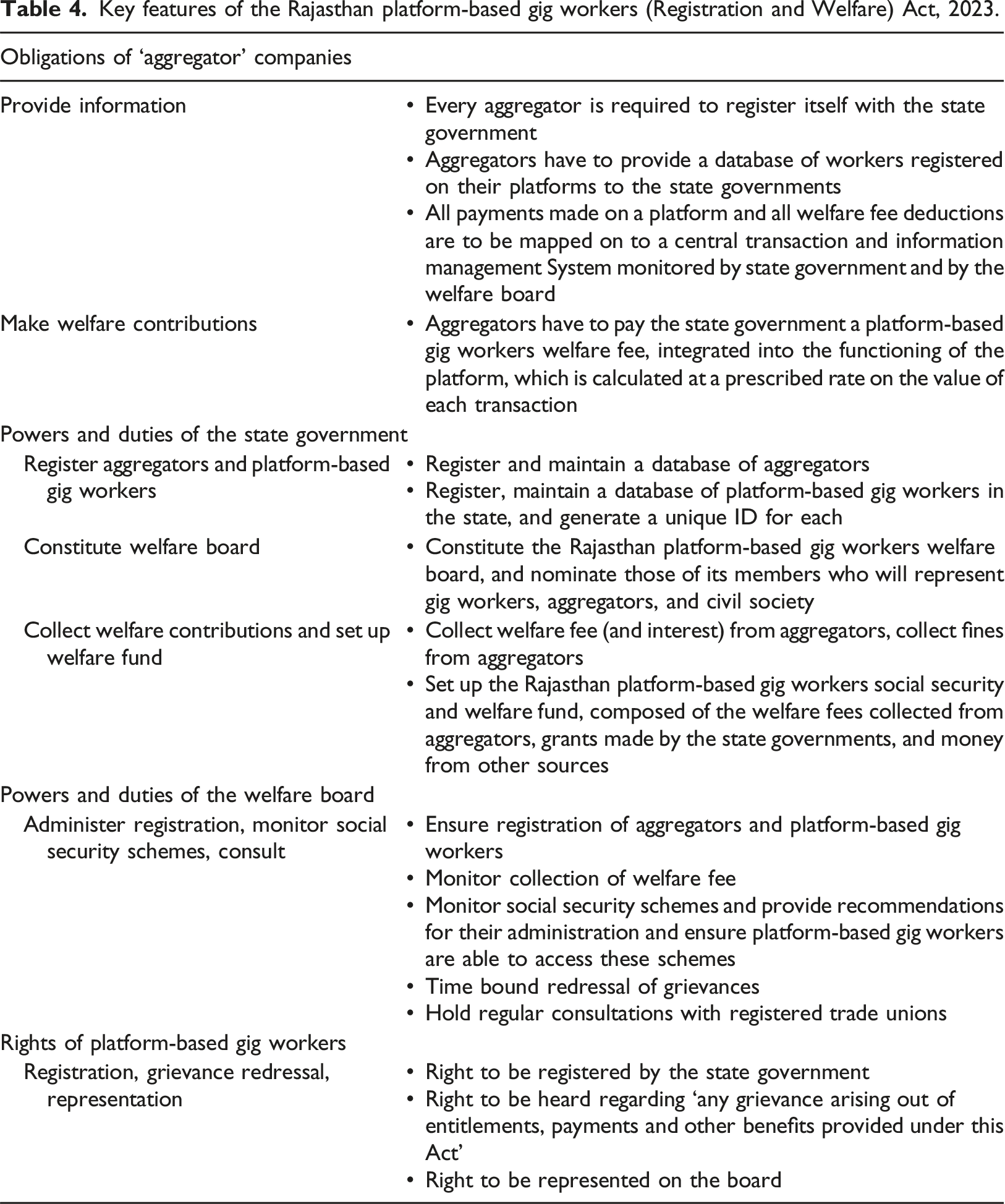
Key features of the Rajasthan platform-based gig workers (Registration and Welfare) Act, 2023.
As the Congress government legislated to guarantee social welfare benefits to gig and platform workers in Rajasthan, political parties were competing with one another to make credible promises these workers in Telangana as well. In May 2023, Telangana's Minister for IT and Industries, representing the ruling Bharatiya Rashtra Samiti party, argued for the protection of gig workers through a tripartite arrangement. He made the statement as he was inaugurating one of the new logistics facilities of a large E-commerce platform (Flipkart) in the state. ‘We should ensure that they feel secure, and their livelihoods, families are protected. It’s our duty to see to it that they are not affected by factors extraneous and beyond their control. We should build credibility, and aspiration among youngsters to work in the e-commerce sector’, he said. Shaik Salaudin welcomed this statement and added, ‘We want unions and associations to be part of the tripartite agreement. We want a law to regulate aggregator companies’. When we spoke in May 2023, again, Salauddin advocated for a law in Telangana that could serve as a model. ‘I will recommend that there should be social security, a law, and a tripartite board. There should be a model to generate revenue for social security, so we are not dependent on the government’. ‘During elections, we openly wrote to political parties’, Salauddin said in December 2023. ‘There are 420,000 workers who are gig and platform workers. [Overall] this could be a vote bank of 8 lakh (‘hundred thousand’) [including families]’.
In the second week of October 2023, the chairman of the Congress party’s manifesto committee for the elections invited the TGPWU to share its views on the measures and promises that should be included in the party’s manifesto for the elections. At that time, Salauddin demanded a social welfare legislation that was similar to the one in Rajasthan. ‘We are writing to you for a Social Security Bill for the 4.2 lakhs gig and platform workers in Telangana’, his letter began, with a nod to the electoral significance of the state’s gig and platform workers. The most recent legislative developments in Rajasthan were, of course, cited as well. Rajasthan’s gig workers law had provided a model for the development of a welfare board to provide social protection and benefits for workers. It noted and highlighted four of its key aspects: (1) a cess on all transactions that take place on platforms, (2) a tripartite board to administer welfare schemes with which workers are automatically registered, (3) a centralised tracking and monitoring system that provides detailed breakdown and analysis of each transaction, and (4) a law that ensures that these provisions are binding. The letter did not demand a broader interpretation of the country’s mid-twentieth-century labour laws so that gig and platform workers could also benefit from them. In Rajasthan, where it was in power, and in Telangana where it was seeking power, the Congress party promised it would guarantee social welfare to gig and platform workers through law.
Epilogue: Gig and platform workers’ organisation in digitalising India – A ‘fourth wave’ of labour’s legal empowerment?
Like Agarwala (2008), we have maintained in this article that every phase of economic restructuring and reorganisation effects transformations in the nature of social contract between the state, capital (employers) and labour. The advent of an online digital economy has had a similarly transformative impact on the social contract between the state, platform companies and labour, further devolving employer-employee relationships and complicating work-based labour protections.
Scholars have previously argued that even though neoliberal policies came to dominate Southern nations from the 1980s following their propagation in the global West, the deeper contradictions arising from these policies necessitated the unique expansion of an interventionist welfare state in countries like India that sought to compensate and protect workers who were suffering from their roll-out (see Rudra, 2007; Tillin, 2022). Paul Pierson (1996, p. 143) points out that the politics of welfare state retrenchment cannot be simply investigated using the same variables as welfare state expansion, because while welfare state retrenchment generally requires elected officials to ‘pursue unpopular policies that must withstand the scrutiny of both voters and well-entrenched networks of interest groups’, welfare state expansion involves the ‘enactment of popular policies in a relatively undeveloped interest-group environment’. Therefore, whereas policies of welfare retrenchment may have been common in ‘formal’ industrial sectors across both the global North and South nations, especially those that implemented the ‘Washington Consensus’, here too the impact of these processes on labour protections turned out to be spatially and temporally varied (see Rudra, 2007).
Hence, even as the state in India, following the example of other postcolonial nations in the 1980s, sought to become a more neutral player between capital and labour by deregulating even traditional formal sectors of its economy, the different sections of informal labour seized the opportunity to consolidate their ranks, using existing labour laws and forging new organisational tactics of political engagement to pressure the state to ‘step back in’. Through this they ensured the introduction and expansion of new labour regulation and social protections for a large number of informal workers. Importantly, they were successful in introducing special legislation at the state and national levels – ‘tripartite welfare boards’ that ensured the recognition of their identity, alongside their rights to work-based benefits and certain entitlements beyond their jobs. This can be viewed as a key process of welfare expansion by the Indian state through the third wave of labour’s legal empowerment, which anticipated rising insecurities in working populations and enacted policies beyond traditional or formal legal frameworks (see also Agarwala, 2013; Bonner, 2017).
The findings we have presented in this paper (in the context of the gig and platform workers’ unions and their strategic and opportunistic negotiations with the state) demonstrate a similar practice of political society for welfare state expansion, as during the third wave. However, we also find that there are slight (but important) differences in their aims and approaches which leads us to cautiously suggest that we may witness a transition to a further ‘fourth-wave politics of legal empowerment’ for labour under conditions of digital capitalism in India. We present these reasons below:
Firstly, the gig and platform workforce has become ubiquitous. This makes it more effective than to other smaller or hidden sections of organised informal workers. This is especially true for the category of ‘platform drivers’ – those working with ride-hailing and food-delivery apps. While they share the precarity of informal and insecure employment status, these ‘driver-partners’ have rapidly become one of the most visible and united workforces in India’s urban context (but also globally), and have shown keenness to come together to organise within and beyond the aegis of mainstream ideologies, political parties, and trade unions. This is also apparent in the advent of numerous online social media groups, which have played a key role in mobilising workers both informally and formally for meeting their needs and rights (Ray, 2024b; also De Neve, 2023).
Secondly, and closely connected to the previous point – one of the key issues that labour movements for informal workers have historically faced is that they do not always have a singular employer (or employer-group) to target or hold accountable. The dispersed and hidden nature of employment and vague contracts in the informal sector, for example, in the home workers sector which employs millions but also has a million employers, make it difficult to also ensure mobilisations for and implementation of new welfare legislations. On the other hand, the gig and platform unions have a handful of large digital platform companies (e.g. Uber, Amazon, Ola, Zomato) that are very visible in the public domain and often networked into global financial and venture capital flows. This fuels labour’s organisation and consolidated agency. Protesting workers know that beyond the fog of algorithmic control there is the company and management, and that they can pressure them and the state (the ruling government) to bring them to the negotiating table, even if the state’s own intentions are not always aligned with workers.
Thirdly, the organised movement of gig and platform workers combines (i) ‘political society’ practice of third-wave movements that stems from their informal ‘self-employed’ contractual status and compromised institutional and associational power vis a vis platforms and the state (see Agarwala, 2008, 2019; Katta et al., 2020; Wood and Lehdonvirta, 2019), with, (ii) recognised ‘civil society’ type practices that involve the formulation of independent unions and organisations which make interest-based political and civil coalitions, file legal challenges in courts, lobby political parties through electoral contests, get political parties to reform manifesto agendas, and finally get new welfare legislation done and implemented.
Finally, it is important to note that the impact of gig and platform workers movements seems to be changing the way traditional industrial-era unions view them and their organisation. Indeed, since the advent of competing independent unions, associations and federations of platform and gig workers like TGPWU or IFAT more generally, labour unions affiliated to traditional political parties have also started paying more attention to the sector and its workforce at large. Traditional party-affiliated labour unions like CITU affiliated to the Communist Part of India-Marxist (CPI-M) still have differences with independent unions, not least on the question of welfare boards that have been viewed as ad hoc arrangements, and in some ways counterproductive to the actual reform needed in the overarching labour law framework or new labour codes for ‘formalising’ this workforce (see John, 2023a; 2023b). Greater recognition of electoral-legal interventions and acceptance of welfare boards legislation can be a way forward to address several key problems in the gig and platform economy – including setting a wage floor, transparent regulation of the platforms, alongside broader demands of labour de-commodification.
Together, these aspects of gig and platform worker’s organisation signal an emergent ‘fourth wave’ of labour politics that is uniquely expanding the welfare state in India itself. However, we cannot quite predict the results of these efforts. Some of the recent criticism of this politics of new gig unions for separate legal rights, seems to mimic the concerns by scholars around the limited success of the ‘third-wave’ welfare board politics in providing informal workers with actual labour protections that we discussed earlier in the article (see Harriss, 2014; Harriss-White, 2010; Hill, 2010; RoyChowdhury, 2005; Webster, 2013). Indeed, the new welfare board laws for gig workers in India are seen as important but nascent – formulated only in a handful of states. There are also variations across different Indian states that do not similarly recognise or enact the labour codes. As seen in the Mathadi (‘headloaders’) Act, this could be a good sign in some states, as they can be more effective at regulating employers and working conditions than blanket national-level laws. Another issue is the justiciability of these new gig-focused legislations and whether these electoral engagements can actually ensure that the states invest in making sure these are implemented. Similarly, there are also important questions about whether new gig and platform workers' unions can empower individual workers enough to hold the state and platforms accountable if they were to shrug responsibility and not enforce the laws that guarantee basic rights and entitlements. This is a key test that earlier labour movements haven not passed with flying colours (see Satpathy, 2018). This said, the politics of gig and platform workers organising in India has no doubt paved the way for further social policy reforms, actions, and practices, not just for existing unions and governments in the country, but also in the wider world, which is facing similar issues relating to the provision of social security to the emerging digital precariat, and which could definitely learn more from such expansions of welfare to this large workforce.
Footnotes
Author note
Aju John's current affiliation is Institute für Europäische Ethnologie, Humboldt Universität zu Berlin.
Acknowledgments
We are grateful for the comments and constructive feedback we received on previous versions of this article, which have undoubtedly improved its arguments. All remaining errors and omissions are the authors' responsibility. We also thank special issue editors, Dr Lorenza Antonucci and Prof Bruno Palier, for inviting us to contribute this piece.
Declaration of conflicting interests
The author(s) declared no potential conflicts of interest with respect to the research, authorship, and/or publication of this article.
Funding
The author(s) disclosed receipt of the following financial support for the research, authorship, and/or publication of this article: This paper partially draws on data from research supported by funding from the Economic and Social Research Council, UK (grant reference: ES/T009233/1).
Data availability statement
Due to the sensitive nature of the research and to protect the confidentiality of participating workers, these data have not been made publicly available. The approach aligns with funder guidelines, which acknowledge that certain research data may be sensitive and require restricted access to safeguard participants' privacy and comply with ethical standards.
