




Abstract
The EU currently promotes a radical transition towards a green, digital and more inclusive economy, which for its realization relies on the European Investor State’s financial architecture. As the transition generates losers, not only winners, instruments like the Just Transition Mechanism (JTM) are designed to provide a compensatory function. However, our research shows that it might miss its mark of ‘leaving no one behind’. JTM is a fascinating extension of European Investor State as it seeks to service the losers through investments rather than compensations. Firstly, JTM mirrors the vision of the InvestEU program and doubles down on industrial transformation and strategic investments that rely substantially on private sector involvement. Secondly, as a process, the JTM requires local stakeholder coordination and national institutional capacity – both of which can pose additional challenges to newer member states without enhancing local capabilities. Thirdly, based on the process design, much like other EU programs, JTM has a level of complexity that leaves beneficiaries highly reliant on technical assistance. As such, investment gaps in the newer member states might be extended, and not compressed by the current compensatory financial tools of the EU. Using an in-depth case study method, we develop a multi-dimensional evaluation of the Just Transition process in the most affected region of the Jiu Valley in Romania. Through an original local stakeholder mapping, we find that while the local and national authorities have the highest influence in determining the Just Transition process in Romania, they are also very much distrusted by other local actors. Our findings reveal that it is not just the often-cited weakness in institutional capacity, but also that of poor stakeholder consensus that impede the strategic planning and implementation of new EU investment tools at the level of targeted beneficiaries.
“The European Commission stands by Romania in ensuring a just transition for local communities, especially those from Jiu Valley” (Van der Leyen 2022).
1
Introduction
While the EU pledges new investments for local development, national fiscal limitations amplify their relevance. New financial instruments try to service investment gaps (i.e. the difference between investment needs and financing available) in paving the way forward for the green transition. Since 2015, the EU has promoted a strong investment policy, through which it now targets specifically green and digital transitions. The shimmering light of the 1 trillion EUR budget of the Green Deal Investment Plan is however overshadowed by the complexity of its implementation process.
Over the past decade, the EU moved steadily beyond regulatory functions. It deploys new capacities that have expanded the scope of its action, following the logic of policy layering – from regulatory capacity to a new financing role (Prontera and Quitzow, 2023) or a ‘hidden investment state’ (Mertens and Thiemann, 2019). EU policies have complemented each other (e.g. competition and cohesion) to further specific industrial policy targets in member states and to uphold the single market, albeit reliant on sometimes limited domestic capabilities of implementation (Medve-Bálint and Šćepanović, 2020; Surubaru, 2021) or political capital for negotiation (Di Carlo and Schmitz, 2023). According to Lepont and Thiemann (in this Special Issue) the becoming of the ‘European Investment State’ means both the EU and its member states are increasingly more assertive and innovative, redefining their role in the market economy as imitators and partners of private investment funds, in pursuit of their new industrial policy goals.
On the flip side, the price for policy innovation is uncharted bureaucratic processes. EU rules and regulations for budgetary and fiscal policies have increasingly grown into a cloud of complexity and flexibility (Miro, 2021), stuffed with new conditionalities (Jacoby and Hopkin, 2020; Vanhercke and Verdun, 2022; Verdun and Zeitlin, 2018). As Miro has previously argued, complexity is the result of the European Commission’s (EC) efforts to create more flexible mechanisms given political pressures from member states (2021:1241, also in Van der Veer, 2022). This move towards political negotiation and flexibilization is sometimes referred to as ‘coordinative Europeanization’ (Ladi and Wolff, 2021; Ollerich and Simons 2023; Vanhercke and Verdun, 2022). As this paper shows, ‘coordinative Europeanization’ is not necessarily more accessible to relevant stakeholders and targeted beneficiaries.
The COVID-19 pandemic created the opportunity for the EC to enhance further its socio-economic governance architecture by building into new financial instruments like the Recovery and Resilience Fund (RRF) both sticks (i.e. reforms) and carrots (i.e. investments) (Vanhercke and Verdun, 2022). The model is perfected in the latest 50 billion EUR Facility for Ukraine proposal which ‘is designed to attract and mobilize public and private investments’, yet ‘underpinned by a set of conditions’ regarding reforms and ‘a strong system of audit and controls’. 2
EU’s interventionist approach in terms of financial instruments and governance structures is particularly forceful in climate and energy policies (Dupont et al., 2020; Prontera and Quitzow, 2022). Green transition is framed by international organizations like the World Bank or the EC as a quest for a new economic growth dynamic (Buch-Hansen and Carstensen, 2021; Copley, 2022). Before the Just Transition investments, the green growth project was not seemingly aspiring to change the question of winners and losers amongst citizens, as those employed in dirty industries would lose their jobs if subsidies stopped, while those in clean sectors such as renewable energy would be better off (Buch-Hansen and Carstensen, 2021). In response, the Just Transition Mechanism (JTM) in the EU is constructed to compensate regional losses through localized industrial policy support.
We use in this paper the Just Transition Mechanism at play in one of the critical cases of the coal-out transition in the EU: Jiu Valley, in Romania. We thus test the dysfunctionalities in the merger between the EU’s investment priorities and its new model of flexible conditionalities. The first section of this paper revisits the topic of the EU’s new investment instruments and the Just Transition process in the academic literature. The second part of the paper presents empirical evidence on how new investment instruments seek to address existent investment gaps in the EU’s periphery. We gathered empirical evidence on the Just Transition Mechanism (JTM) in Romania given that this country has the third highest allocation (i.e. approx. 2 billion EUR) from the JTM program in the EU. We specifically investigate the vertical and horizontal coordination process in Romania and its most affected region of Jiu Valley, as part of the JTM procedural requirements. Vertical coordination involves the institutional capacity to engage with the JTM process across different layers of the government in Romania and at the EU level. Horizontal coordination involves the multi-stakeholder consensus regarding the JTM process and outcomes in the affected regions and beyond. The latter is reliant on public authorities managing the process of deliberation and the extent to which local leaders are trusted by their peers and have the power to influence the policy deliberation process. As we will show, it is on these two levels and the complexities they harbour that the difficulties for this policy reside.
Literature review: European Investor State and the Just Transition
The Just Transition Mechanism (JTM) is one of the new financial instruments of the EC, created in the wake of the EU’s Green Deal plan, in 2020. It mirrors the vision of the InvestEU program and doubles down on industrial transformation and strategic investments that rely substantially on private sector involvement. As such, for the Just Transition, a variety of financial schemes – grants, loans or budgetary guarantees, are designed to leverage EU funds for additional private and public investments (EC, 2020a). Its planning and implementation process is similar and complementary to that of other recent post-Covid EU-funded programs (e.g. Recovery and Resilience Programs).
The environmental objectives of the European Green Deal involve radical changes for certain communities, as countries with coal basins are trying to achieve their carbon reduction targets and move to decommissioning mines one after another (Brauers and Oei, 2020). In this context, a Just Transition means assisting regions that are more affected, being highly reliant on extractive industries or carbon-intensive industries (EC, 2020b). At present, the EU still seems committed to footing the bill of the green transition, showcasing ‘policy entrepreneurial leadership’ (Rietig, 2021), even in the context of a mounting energy crisis and budgetary pressure after the start of the war in Ukraine.
Therefore, JTM also tries to establish a way to address the perpetuating issue of losers of the green transition. It reflects yet another move toward the operationalization of EU-led within member states redistribution (Epstein and Rhodes, 2018). As part of the EC’s 1 trillion EUR Green Deal Investment Plan, the JTM is predicted to mobilize around 55 billion EUR for 2021–2027 (EC, 2020b). JTM thus becomes a fascinating extension of the European Investor State as it seeks to service the losers through investments rather than compensations. Therefore, JTM doubles down on the focus on productive investments rather than replacing the redistributive function of the national state. This is an important novelty in the financial relationship of member states with the EC.
While most of the literature on the Just Transition focuses on its social and environmental goals (since Newell and Mulvaney, 2013), the EU’s Just Transition mechanism (JTM) targets specifically economic development strategies, industrial transition support or sector-specific investments and programs (Krawchenko and Gordon, 2021). A ‘pattern of mutually reinforcing leads involving state and markets is underway, with markets and price changes likely to reduce the costs of climate mitigation and hopefully help embolden states and climate change policy’ (Bell, 2020: 57). The key economic transformation in this process is that of the energy supply.
Previous energy transitions occurring relatively quickly in the markets showcase notable examples in both Europe and America (Kupers, 2020; Sovacool, 2016). These examples have the common denominator of effective energy and climate policies that bind together both political will, institutional capacity and public investments. This latter ingredient is ultimately the most important one, as Newell and Simms put it: ‘the need to mobilise and reallocate public and private finance to drive change in industry, infrastructures, and technology is almost a given in debates about [energy] transition’ (2020: 9).
In contrast, as this paper argues, it is important to also account for contexts in which the finances are available, which is harder to do, and yet institutional capacity or consensus on how to utilize them is not. Facing the same challenges, and having access to similar financial resources, communities still achieve different results in managing the energy transition, because they possess different local capabilities (Nicola and Schmitz, 2022).
As a process, the JTM requires local stakeholder consensus and national institutional capacity for coordination. Coal phase-out was always a trade-off, but there are intractable dilemmas in the current global economic stagnation context. While the ‘Just Transition’ should provide guarantees that the environmental policies will not be detrimental to the social or economic well-being of those dependent on the fossil fuel sector (Harrahill &Douglas, 2019; Robins et al., 2018), there are now mounting pressures on governments ‘to stimulate growth regardless of the environmental implications’ (Copley, 2022).
Coal mining regions traditionally offer limited access to other industries, and the transition of the coal sector may lead to significant social dislocation in the affected regions, partly due to the lack of an anticipatory policy to accompany the transition (Botta, 2018). The negative implications of the transition for communities living in coal basins range from harmful socio-economic repercussions (Snyder, 2018) to cultural consequences, such as loss of embedded local identity (Della Bosca and Gillespie, 2018).
Therefore, power relations between local stakeholders may alter the democratic processes required for designing the green future of a given region (O’Sullivan et al., 2020; Sovacool, 2021). Since its success is determined by issues of power, distribution and access to resources, Just Transition proves to be deeply political (Healy and Barry, 2017) and this requires even deeper reflections on why some actors or stakeholders intentionally slow down transitions to a low-carbon socio-energy regime (Geels, 2014; Sovacool et al., 2021). As Newell and Mulvaney point out, ‘who defines what is just, and for whom, will be determined by power struggles’ (2013). In the move towards a ‘coordinative Europeanization’ (Ladi and Wolff, 2021; Ollerich and Simons 2023; Vanhercke and Verdun, 2022), the apathy of the public discourse on what the Just Transition means and what it should deliver 3 is telling for the low influence that local and regional actors have in shaping their future on this path.
Just Transition does not only mean replacing one economic model with another, but a transformative process managed through a polycentric approach, by regional, national, and international authorities and institutions, combining climate, energy, social and structural policies and considering long-term effects (Oei et al., 2020). Such a multi-stakeholder engagement process has not been adequately captured in the EU public investment literature to date (see for example Mertens and Thiemann, 2019; Prontera and Quitzow, 2022).
Empirical analysis: Capacity and consensus in the case of the Just Transition process in Romania
The European Commission emphatically mentions that the Just Transition is a mechanism designed to make sure that ‘no one is left behind’, 4 but the reality is that the protracted nature of the reform implementation and the weak state capacity to enact swift action has led to a situation in which ‘no one is left’ given the massive depopulation of the affected regions.
Case selection
We focus in this paper on the Romanian case, as a critical case of large investment needs and poor capacity to engage in the process of new investment mechanisms in the EU.
The Romanian economy is highly reliant on EU public investments. EU funds make up more than two-thirds of its public investments over the past decade, and this share is expected to increase. During the pandemic, the Romanian economy contracted by only 3.9% (compared to the EU average of 6.1%) and the national authorities estimated public investment level to have played a key role in cushioning the economic shock of the pandemic (RRP Romania, 2022). With the full absorption of RRF grants, there is an expected direct impact of an additional 0.5 % GDP in Romania by the end of the program, while also considering the loan facilities, the positive impact increases to 5.2% GDP in total by 2026. But ‘quality of growth is just as important as the quantity of growth and regional investments are key here’. 5
While Romania has made substantial efforts and progress regarding the consolidation of the Rule of Law and anti-corruption efforts, bureaucratic inefficiency persists (CSR, 2020). Studies point to poor EU funding absorption capacity, poor project implementation, poor prioritization of investments and low quality of public services (World Bank 2021b). Particularly EU funds absorption limitations are linked to poor administrative capacity in the literature on Romania and other new member states (Bloom and Petrova, 2013; Incaltarau et al., 2020; Surubaru, 2017). Romania is here where the transition trajectory has the weakest strategic formulation, in comparison to similarly dependent regions on coal in Poland or the Czech Republic. 6
Furthermore, it is still the Romanian case study that benefits from one of the largest resource allocations from EU funding on the JTM – almost 2 billion EUR, but a poor track record of EU funds absorption for the new investment priorities in EU. 7 Despite this opportunity to use public subsidies for developing alternative developmental paths in the region, the transition was managed either in the logic of ‘cost-efficiency, from a purely accounting perspective’ or ‘highly political – if the Minister is from the region, he will support it’. 8
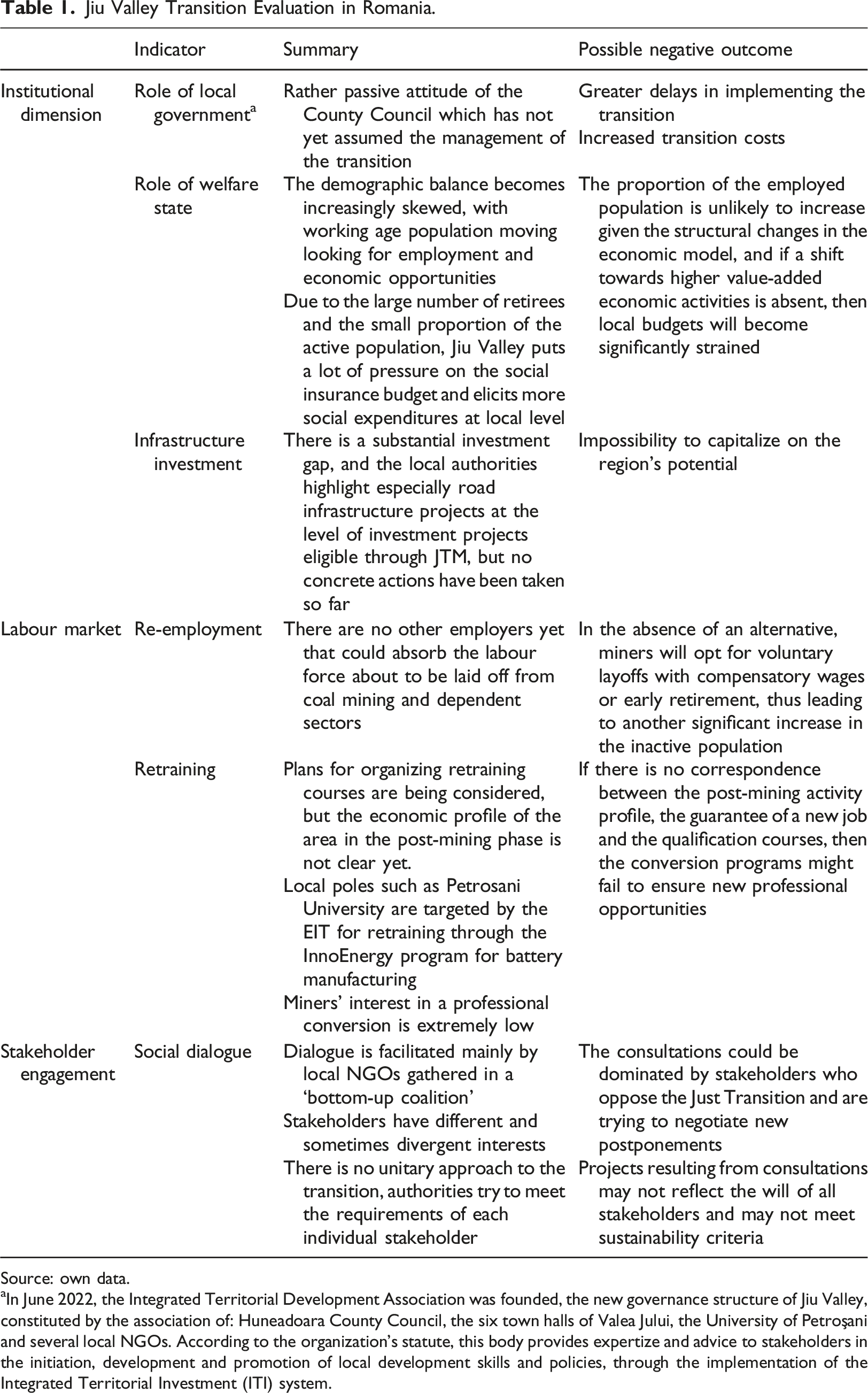
Jiu Valley Transition Evaluation in Romania.
Source: own data.
aIn June 2022, the Integrated Territorial Development Association was founded, the new governance structure of Jiu Valley, constituted by the association of: Huneadoara County Council, the six town halls of Valea Jului, the University of Petroșani and several local NGOs. According to the organization’s statute, this body provides expertize and advice to stakeholders in the initiation, development and promotion of local development skills and policies, through the implementation of the Integrated Territorial Investment (ITI) system.
While the national economic and institutional ecosystem is important for our analysis, the specificities of the Just Transition must be tested within the much narrower region where the process unfolds predominantly. All investments and policy decisions taken at different governance levels are in the end targeting local beneficiaries in the design of the Just Transition aid packages.
The Jiu Valley in Romania is a critical case for the Just Transition process, not only in Romania but also across Europe, as it represents both the historical intensity of the mining activities and the lack of economic diversification. It consists of six urban localities: Petroșani, Petrila, Lupeni, Lonea, Aninoasa and Uricani. The glory known during the communist dictatorship (Țoc and Alexandrescu, 2022), when about 45,000 people were employed in the 17 operational exploitations, was followed by a continuous contraction from the mid-90s until today when only 4000 employees work at the four mines that are still active. With a total population of approximately 132,000 inhabitants, the micro-region is currently facing uncertainty about what will happen after the closure of the last four coal mines. However, in the framework described by the European Commission as a Just Transition, Jiu Valley has, at least theoretically, the prospect of a bounce back, if local stakeholders agree upon sustainable development projects that will attract solid investments (Nicola and Schmitz, 2022).
Research design and methodology
Our paper thus engages with the existent literature on state-led economic transitions and public investments, through the in-depth assessment of the Romanian case study. To investigate whether weak institutional capacity hinders the strategic planning and implementation of the new EU investment instrument, we developed a two-tier approach.
Firstly, we developed a process mapping of institutional decision-making processes regarding EU-funded investment programs in Romania through analysis of official documents related to investment strategies and investment programs, and through 11 in-depth interviews with national and European public officials. The findings of this first set of empirical data collection are reflected in the mapping of institutional processes in the vertical coordination of the Just Transition in Romania (see Figure 1) and parts of the Just Transition evaluation for Jiu Valley. Vertical coordination on the Just Transition in Romania. Source: the authors.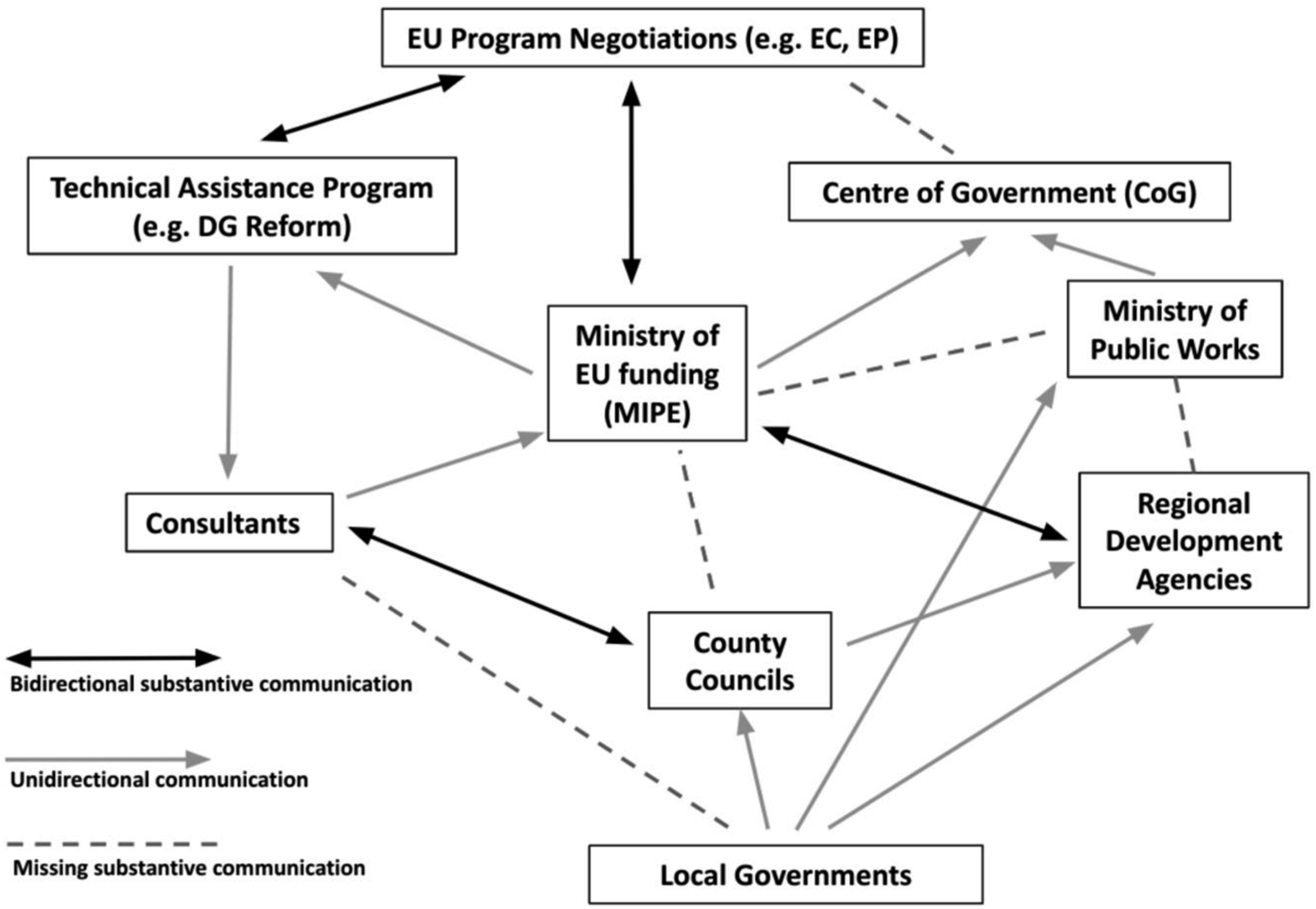
Secondly, we chose to dive into a local exploratory study in Jiu Valley using action research methods, which is reflected in the overall Just Transition evaluation for Jiu Valley (see Table 1) and the stakeholder analysis in Jiu Valley (see Figure 2). The exploratory study thus informed the horizontal coordination dimension of our analysis and the sub-national component of the vertical coordination dimension. Stakeholder analysis in Jiu Valley. Source: own data.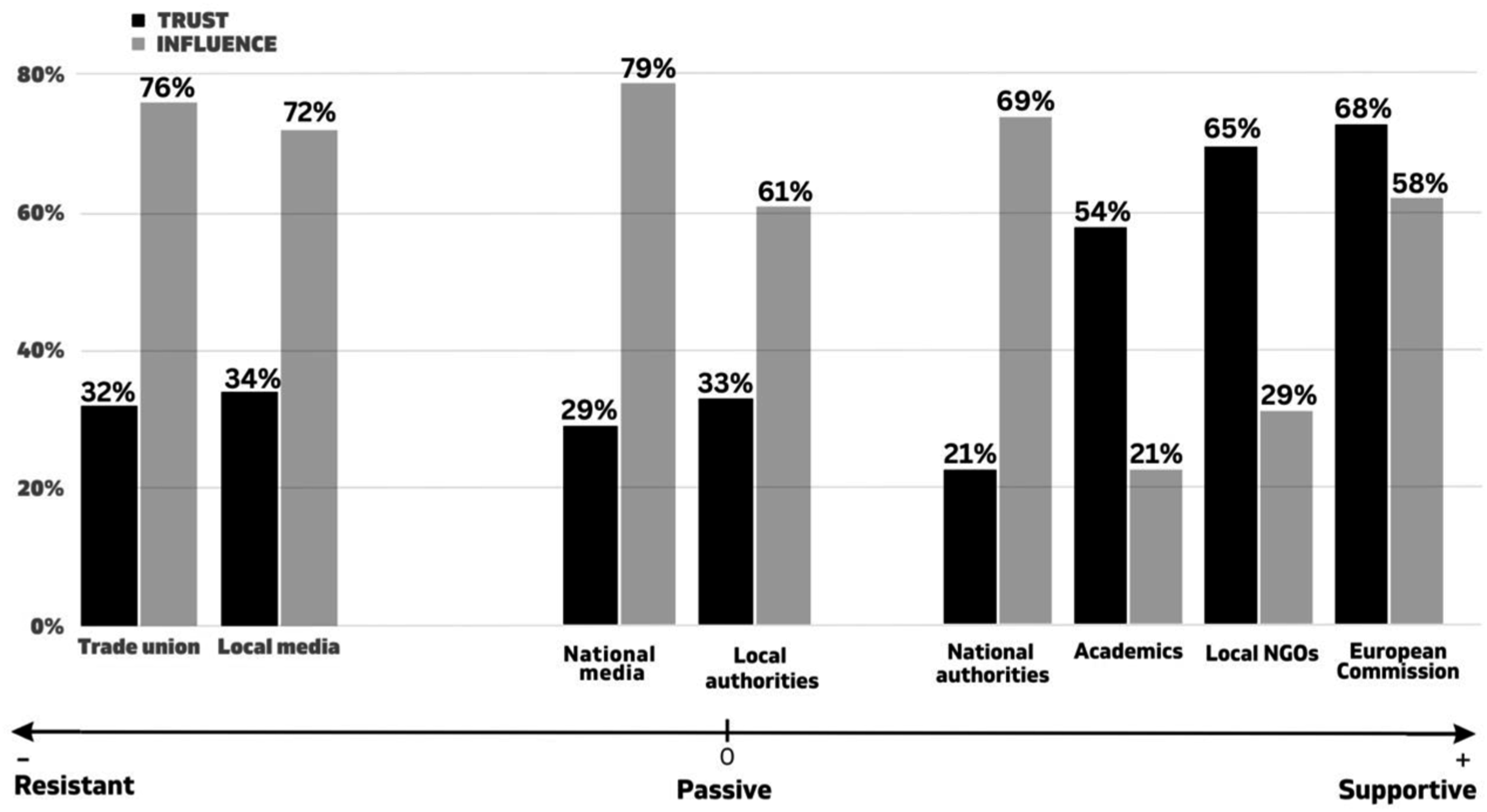
The objectives of action research are twofold: on the one hand, it aims to co-create new pieces of knowledge together with the participants; on the other hand, it facilitates more in-depth reflection on the processes, trying new methods (Schmitz and Lekane Tsobgou, 2016). Considering that the Just Transition framework requires a participatory decision-making process through the consultation of all stakeholders, the analysis of their positioning concerning the coal phase-out and the power relations between them were pivotal in answering the questions of
A three-step methodology was developed and applied between December 2020 and May 2021: (a) data collection through a purposive sampling survey and semi-structured interviews; (b) validation of the results obtained in the previous stage, by organizing two focus groups; and (c) observing consultations between stakeholders.
To develop the survey questionnaire (as well as the focus group protocol in step II), we needed benchmarks that we obtained by reviewing the pre-existing literature highlighting the attributes of a successful Just Transition (Brauers and Oei, 2020; Campbell and Coenen, 2017; Felli, 2014; Harrahill and Douglas, 2019; Kelemen, 2020; Kern and Rogge, 2018; Oei et al., 2020). The extracted data became evaluation grids guiding us in formulating questions regarding: (a) the stage of implementation of the transition; (b) the credibility and influence of the interested parties; (c) their attitudes towards the imminent closure of mines; and (d) their perceptions about viable options for new economic models replacing mining. The survey included closed-ended, open-ended, multiple-choice questions and a series of Likert-scale questions.
Purposive sampling involved the selection of participants well informed about the transition process, with different backgrounds and different visions of the future of the region. A hundred and five people between 20 and 65 years old responded to the online questionnaire, a majority of 83% were natives and still live in the region, while others were aware of the issue through their professional activities – consultants, journalists, national or European civil servants with duties in implementing or reporting Just Transition. 15 of them (considered exponential for each category of stakeholders) were recruited for the follow-up semi-structured interviews. During discussions lasting at least 45 minutes we detailed their beliefs about the need for mine closure, their reliable sources of information about the impact of the closure, and their perception regarding the influence and credibility of the other stakeholders.
The results of the survey and the one-on-one interviews led us to the grouping of stakeholders in the following categories: current mining employees (union members), local authorities, national authorities, local media, national media, academics, NGO activists and the European Commission. In March 2021, 12 men and 8 women from the participants in the previous stages responded to the invitation to participate in the focus groups. During these discussions, we informed them about the objectives of the Just Transition, presented them with our evaluation grids extracted from good practice examples, submitted to their attention the partial results obtained, and validated the following hypotheses: (1) stakeholders have different perceptions regarding who should do what in the Just Transition and they also have divergent interests, and (2) stakeholders who would like to speed up the transition and have credibility do not have enough influence on the process and vice versa.
The empirical sections unfold as follows. The first subsection presents the overall evaluation of the Just Transition in Jiu Valley across three layers – institutional, market and civil society. The second subsection picks up one of the overall evaluations of the Just Transition and presents the in-depth analysis of institutional capacity in Romania as a reflection of vertical coordination. Finally, the third subsection covers the civil society angle from the overall evaluation of the Just Transition, showcasing an in-depth analysis of stakeholder engagement as a reflection of the horizontal coordination process in Jiu Valley, Romania.
Transition evaluation in Jiu Valley
Table 1 below represents our data collected by mixed methods, structured in the ETUI 10 criteria developed by Harrahill and Douglas (2019) for Just Transition. We summarize transition indicators portraying the institutional capacity and the stakeholder engagement which reflect our vertical and horizontal coordination dimensions of analysis. Our data also allows us to highlight possible outcomes that inform stakeholders’ positions on the transition in Jiu Valley. Finally, labour market integration measures pursued in the Jiu Valley JTM policies (e.g. retraining and reconversion) require a correlation with a local industrial policy in contrast to the more conventional severance payment measures pursued in the past.
In the case of the Jiu Valley in particular, the very low absorption capacity for EU-funded infrastructure projects is contrasting to national averages, and yet a telling reflection of their local administrative and political performance (see also Ducastel et al. in this SI). While a lot of the local investment funds come through the cohesion policy, as Ducastel et al. show, it is not a need-driven process, but a capabilities-driven one, as local actors across Europe with higher capabilities to engage in the complexities of EU funding mechanisms are grabbing the lion-share of available resources. For example, Uricani municipality estimated a total financing need of 21 million EUR over the past 5 years and managed to attract only 5.5 million EUR, 11 while Petrosani, the largest city in the Jiu Valley did even worse, with an estimated 62 million EUR to cover infrastructure needs, and only 4.4 million EUR attracted. 12 Overall, Hunedoara County has a poor infrastructure endowment and with a challenging geography (i.e. mountains and hills), it is unattractive for private investors, with Jiu Valley being particularly inaccessible, even by train, as the rail infrastructure too is collapsing being used only for freight currently. 13
In terms of investment, local authorities are mainly concerned with the development of transport infrastructure. In a recent initiative, county council presidents from Gorj, Hunedoara and a third neighbouring JTM county of Dolj, signed together a letter to the prime minister titled ‘The Transition Road’. This letter asks specifically for two roads, one railway and one air infrastructure project to be included for financing through the JTM. 14 This initiative showcases coordinated action between local governments, but also a very limited vision of what type of investments could be delivered through the framework of the JTM.
The Regional Just Transition Plans involved a structured dialogue and consultation process with various local stakeholders. For Hunedoara County, the consultative group consisted of 45 representatives of local governments, decentralized agencies, local companies, university and research institutes, trade unions, local action groups and three civil society organizations. 15 The share of public sector stakeholders has been overwhelmingly larger than that of private and civil society actors.
The European industrial transition objectives require substantial upskill efforts, and it is specifically with regard to the automotive industry and energy production, as the EU needs 800,000 trained workers by 2025, and the EU Battery Academy will directly support 100,000 workers using money from universities. 16 This offers important opportunities for professional reconversion for the affected regions in the Jiu Valley and its proximity areas (i.e. Hunedoara and Gorj counties). The technical universities in the region (e.g. Petroșani University, Tg. Jiu University) provide a valuable platform for such innovation training activities.
The current EU financial instruments aimed at supporting the industrial transitions towards a sustainable economic model, especially in the automotive sector provide a ‘once in a lifetime, golden opportunity that has to be used for transformation and investments will need to be fast-tracked to achieve full and cost-efficient absorption’ 17 from such sources as the RRF, CEF and structural funds. The main takeaway from this session on the future of the automotive industry in CEE was that ‘strategic implementation in the CEE region takes too long to materialize, as evidenced by the slow rollout of e-charging infrastructure and clean tech skills agenda, and with such a large pot of EU money and short recovery timeframe, green investments need to be fast-tracked, following the Spanish and German models’. 18
Hunedoara has registered a drop in employment of up to 78% over the past decade in some of the Jiu Valley’s smaller localities like Uricani. 19 The large discrepancy of size in the local business environment in Jiu Valley makes Petrosani a likely pole of development for the entire region and according to recent evaluations, as Hunedoara County overall did manage to succeed in its economic diversification efforts, especially with the rising manufacturing sector and the exploitation of its touristic potential. A recent EIB survey data shows that in the affected cities in Jiu Valley, most people believe the largest employer in their region to be Hunedoara Energy Complex or the local retail chains, such as Lidl or Kaufland. 20
Simulating the potential mediating impact of the Green Deal investments in Romania, Hunedoara has the potential to increase employment in manufacturing, with potential jobs for operators and assemblers, but also trade workers. However, based on the same DG Reform simulations, no number of investments will be able to deliver the same number of jobs as there are currently in the Just Transition counties, and somewhat disappointingly for the local population, the report concludes, the focus should be on increasing the value-added of local economic activities, rather than on employment.
Institutional capacity and vertical coordination in the JT in Romania
Vertical integration is increasingly seen as the key ingredient in national investment planning, through a back-and-forth approach of collecting projects at the sub-national level, prioritizing them at the national level within a fiscal constraint, and then further developing in consultation with local and regional authorities and stakeholders (Manea, 2021; OECD, 2019).
Public sector organizations across different levels are now required to possess the know-how and procedures to engage with each other and other relevant stakeholders outside the institution in what concerns key investment programs. In the new European investment programs, an even larger role is granted to stakeholder coordination, as the Just Transition framework requires a participatory decision-making process through the consultation of all relevant parties. This coordination process is now part of each of the stages of European-funded public investment management – from strategic planning to implementation (Kim et al., 2020). Yet it is very challenging for Romania and its institutional silos, 21 despite almost 1 billion EUR technical assistance programming in the latest financial cycle alone. 22
Through an original systematic institutional process mapping and in-depth interviews, we have compared and contrasted the role and involvement of multiple layers of the Romanian public administration in the investment planning process for the Just Transition as a measure of institutional capacity (see Figure 1).
From a regulatory perspective, the Just Transition process is driven by EU regulations, with little coverage at the national level. Apart from being completely absent from the current Governing Program, it has been equally absent from the legislative process of the Parliament, with the National Liberal Party covering just one piece of legislation related to environmental permits for construction, and the Social Democratic Party initiating two projects related to green transportation and organic food production.
At the local level, the broader climate action dimensions that ground the Just Transition process are equally absent, with only 40% of the population in Romania covered by the Covenant of Mayors 23 in comparison to 70% of the population covered in Spain for example.
In trying to address this capacity gap at the local level, consultants have been brought in by national and European authorities to develop the necessary strategies and programs for the Just Transition. However, this too turned out to be a process that did not fill capacity gaps, just wrote over them. The Ministry of European Funding is the lead beneficiary, and the European Commission is the contracting authority for these technical assistance projects (e.g. ‘Strategy for the transition from coal of the Jiu Valley’ developed by PWC on a DG REFORM contract 24 ), and as such, much of the process mirrors closely European goals and objectives and reflects to a much lesser extent the local needs and experience. Paradoxically, this is not necessarily for lack of attention to local needs: ‘they (a.n. consultants) came to ask us what we want to do, while we expected them to tell us what we should do’. 25
The passivity of local actors reflected in our survey data (see Figure 2) is sourced from both organizational and environmental factors. Within local organizations, the acknowledgement of capacity limitations in accessing and implementing the new support tools for economic development and the long distance from decision-making centres have led to a relative numbness of local actors. 26 In terms of the local ecosystem, massive depopulation of the region contributed to a strong incumbent advantage, as ‘local leaders are re-elected by the community for several mandates, even up to 200 years in a row’. 27 While stability in office could potentially facilitate long-term investment plans, there is in fact a continuation of a very poor track record of economic development and underfinancing of investments. One of the main reasons is the poor planning capacity at the local level, poor coordination between municipalities, and there is no monitoring and enforcement of legal provisions around integrated planning (World Bank 2021a: p.111).
Overall, in Romania, over two-thirds of public investments come from EU funding, and as such, this investment gap at the local level could hardly be addressed by local or national budgets. In response to this weak local capacity, especially in smaller localities, the EU funding system has been redesigned to be centred around Regional Development Agencies (ADR) – with one established in each of Romania’s six NUTS II regions. This means that EU funding in the coming years will flow specifically through institutional bodies that have no clear administrative jurisdiction and attributes and are run by appointed, not elected officials. The resulting technocratization of the process might yield better results in terms of absorption, but there is a significant risk the process will be highly skewed in favour of leading urban centres in each region, whose political leaders will likely influence the Development Agencies’ appointments.
The sub-national level in Romania hides large developmental divides (Volintiru et al., 2018). The growth dynamics of some of the secondary cities in Romania have benefited greatly from local statecraft, and from the ability of local leaders to channel EU funding towards a regenerative local industrial policy (Ban, 2016). However, this is hardly the case in Romania’s shrinking cities seeing both their population and their GDP plummeting (World Bank, 2021a). All the Jiu Valley cities fall into the latter category.
The dedicated Operational Program for financing the Just Transition in Romania has a total allocation of over 2 billion EUR, and it could potentially make a large difference in addressing the investment gap of the 6 regions it covers: Hunedoara County – containing the Jiu Valley, alongside other 5 counties. 28 The inclusion of these six counties out of the total 41 is however disputed politically, as the opposition Social Democratic Party claims no county from Moldova (a region that is largely dominated by this party), is covered by the program, despite being eligible. 29 Still, now, out of the six counties, four are led by opposition county council presidents, while only two are led by the ruling coalition officials. 30
While politicization might be problematic for the setup of JTM investments in Romania, institutional instability is also a major liability. The institutional restructuring of the central government structures after the 2020 elections was a difficult and ‘painful’ process. 31 A particularly problematic aspect for the JTM in Romania was the restructuring of the former Ministry of Economy, Energy, and Business Environment into now three separate entities. Several months were necessary to allocate the specific attributions amongst the two newly formed entities after the split. The development of the new industrial strategy for Romania is thus pushed to an unknown date in the future. 32 In this programming vacuum, the Ministry of European Funds and Investments (MIPE) took over the JTM within its programming efforts for the dedicated operational program (POTJ). Without substantial input from relevant stakeholders in the field of industrial and energy policy, this programming exercise becomes disconnected from its end goal: to facilitate an economic transition.
So far, the way funding is structured for the Just Transition in Romania, there are no county-based lump sum allocations within the POTJ, but rather horizontal aspects relevant to all counties targeted. Public officials say that they want to avoid the situation ‘where better performing local public institutions draw out a disproportionate amount of funding compared to the other beneficiary counties’, but they are equally worried about ‘avoiding the situation where there is under-performance on funding absorption and project implementation’. 33
In conclusion, the vertical coordination process in Romania is not only affected by poor planning capacity at the local level but also by institutional instability and accountability gaps at the national level. Consolidated cooperation links – such as those between local governments and the Ministry of Public Works, have no relevance in the current programming period, while relevant cooperation links – with Ministry of EU funds or the Ministry of Energy, do not exist yet or are not well consolidated. The JTM thus tends to fall through the cracks of the current Romanian governmental roles and responsibilities and is largely hanging on technical assistance projects.
Who leads the change? Stakeholders and consensus on investments in Jiu Valley
We deployed our data collection in Jiu Valley between November 2020 and May 2021 to map the extent to which local, national and European stakeholders are perceived within the community in terms of trust and influence (Figure 2).
On April 14, 2021, one of the authors participated as an observer in consultations between stakeholders, representatives of the Romanian government, and PwC, the consulting company mandated by the European Commission to elaborate the post-mining development strategy of the Jiu Valley. Finally, the preliminary results of this research were presented and debated in a focus group session moderated by the same author. The participants reflected on the notions of Just Transition and the level of vulnerability at the community and individual levels. 12 men and 8 women aged between 19 and 55 completed or nuanced the data we have previously collected. The questions revolved around the lessons learned from the mine closure experience in the late 1990s, the consequences of the chaotic voluntary layoffs of the time, and the options the community has today by absorbing funds for Just Transition. The conclusions of the debates were corroborated with the results obtained in the previous stages and, subsequently, included in the results and conclusions delivered by this article. This empirical data was analysed in depth in another recent publication (see Nicola and Schmitz, 2022).
Among the stakeholders in the Jiu Valley, we have identified actors who support the transition and are willing to be actively involved in awareness and preparedness, such as civil society, local entrepreneurs and academics, still, as shown in the figure below, they are in an area of low influence. The local government, which should have taken over the transition management, has so far left things in an area of ambiguity, favourable to those who are resistant to change. Despite their high level of influence, national authorities have no credibility on this issue and although the Romanian government is a signatory to international agreements to reduce greenhouse gas emissions, it communicates almost nothing domestically. Consequently, the Just Transition and the subject of mining restructuring do not often catch the attention of the national media.
The mining trade unionists have so far opposed the closure of the last four mines and, periodically, they are initiating strikes. The local media, somewhat more credible than the national one, is largely perceived as favourable to the union and presenting things unilaterally. The union and the local press are the only actors identified as opposing the transition but being placed in an area of great influence.
The social dialogue is intense, facilitated especially by NGOs, but the interests of stakeholders differ substantially and are difficult to harmonize. In response to this situation, the authorities chose to approach them separately, trying to offer each stakeholder what they claimed. In doing so, the post-mining development runs the risk of being a weak sustainable one, favouring the continuation with patterns of economic activity that approximate ‘business-as-usual’.
The decision-making process is also complicated by the need for new projects to harmonize with other national programs, which in turn have delays. For example, there would be funding for a health centre in Uricani, but the project cannot start without being included in the national master plan for medical services, a plan whose development was not yet completed.
Stakeholders in Jiu Valley have opposing backgrounds and interests: some are quite optimistic and confident in the region’s adaptative capacity to change, while others want nothing to change, and they are trying to delay the transition as much as possible. We are inclined to believe that this game of power is still dominated by those who oppose change and, paradoxically, European Commission regulations work in their favour. By collecting data through interviews and validating the partial results within the focus groups we found that there is still confusion regarding who can accelerate the Just Transition in Jiu Valley.
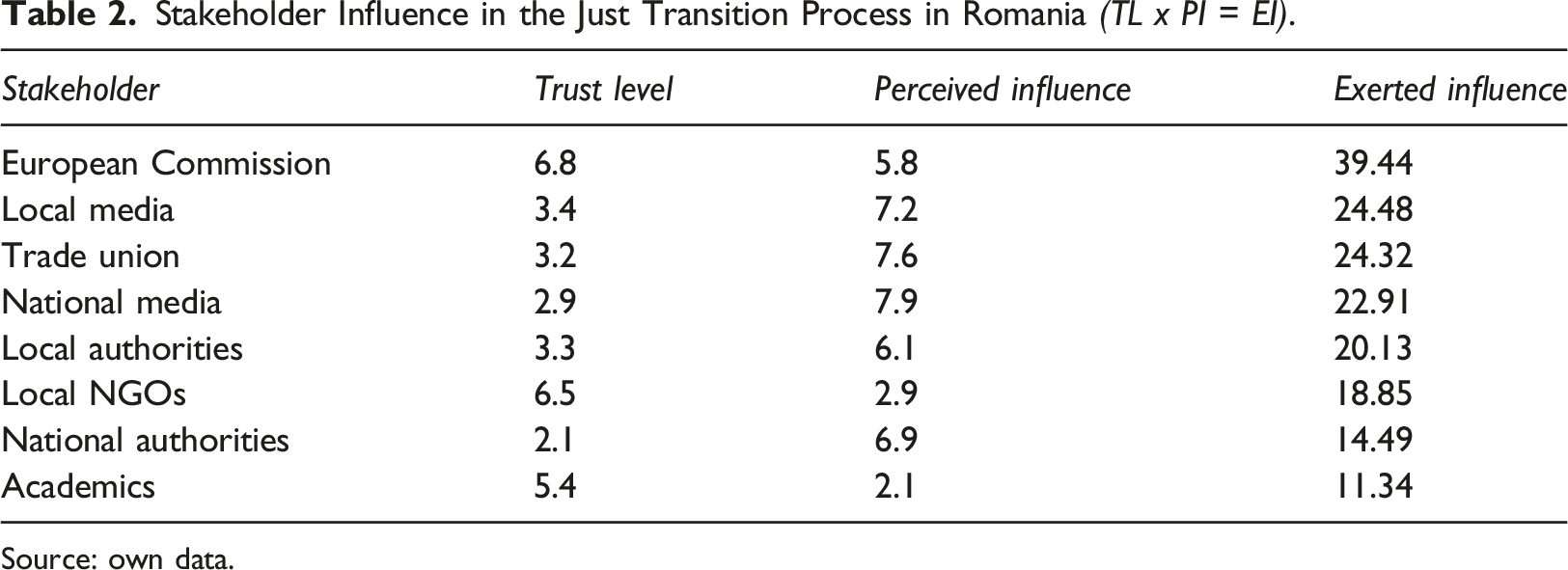
Stakeholder Influence in the Just Transition Process in Romania (TL x PI = EI).
Source: own data.
The one key actor in leading the transition in Jiu Valley is the European Commission – whose perceived influence and trust level are equally high, thus having the highest potential to exert influence. However, given the poor vertical coordination process described in the previous section, the EC is unlikely to tap into its influence potential to enact positive change, as it lacks direct capillary access in Just Transition regions like Jiu Valley. In contrast, local authorities which are supposed to lead the consensus-building efforts are not trusted by relevant stakeholders.
The empirical data on stakeholder engagement in the affected Jiu Valley shows the extent to which different categories of actors are supportive or resistant to change. As expected, there are divergent positions on the issue of the transition, which requires a horizontal coordination process for consensus building. However, our data shows that such horizontal coordination in the Jiu Valley is very limited, as key actors that hold influence (e.g. media and authorities) are neither trusted at the local level nor necessarily committed to engaging with local actors. We argue that this is a key limitation of ‘coordinative Europeanization’, as it cannot reach the local levels whose needs and will it is supposed to cater to.
Conclusions
This paper used the case study of the Just Transition process in Jiu Valley, the most affected region in Romania, to showcase how a European investment program is reliant on the multi-level institutional capacity and consensus between stakeholders. We intuitively found that local capacity in investment planning is poor and impeded by faulty vertical intergovernmental cooperation. Less intuitively though, we found that despite the high reliance on public investments in the transition region, consensus on investment priorities in the Jiu Valley remains poor. Local stakeholders’ divergence of engagement and perspective on how the transition process should unfold limit the deployment of available support instruments for an economic transition. A natural process of depopulation and economic stagnation unfolds, with growing disenchantment on the part of local actors.
The Just Transition Mechanism (JTM) is an important example of broader traits of the European Investor State. A new era of industrial policy and state-led development is ushering in, across all member states in the EU. The JTM is at the core of it. On one hand, the JTM uses its grants pillar – the Just Transition Fund (JTF) to fulfil a compensatory function and target the losers of the transition (i.e. regions with high carbon intensity activities, as well as the local workers in mining and carbon-intensive industries). On the other hand, JTM uses its other two pillars to double down on investments and support a local industrial transition. To receive this double embrace of the JTM – compensations and economic transformation, local actors must align their strategic planning process with a dense and confusing web of short- (e.g. RRF) and medium-term (e.g. MFF) EU investment programs.
Furthermore, the pursuit of stakeholder consensus that is embedded in these new EU investment programs is not only designed to mediate the interests of winners and losers of the transition as in the case of JTM, but also to mediate the interests of public and private sector investors. While conditionalities were always part of multilateral donors’ programs (e.g. IMF and World Bank), the way these are now used to enroll private sector involvement is novel and is reflected in the new literature on ‘wall street consensus’ (Gabor, 2021) and the European Investment State (Lepont and Thiemann in this SI) to which this paper contributes. Current literature like the catalytic state model (Prontera and Quitzow, 2022, 2023) misses the reliance on multi-level governance systems in the EU’s investment programs. Our paper thus contributes to the existent literature on European-funded investment programs, by showing the extent to which new financial instruments like the JTM rely on often overlooked vertical coordination between national and local authorities, as well as the horizontal coordination between different stakeholders.
We argue that the complexities of the Just Transition process strain the outcome delivery. This contradicts to a certain extent papers that show the current ‘coordinative Europeanization’ as an improvement of the ‘coercive Europeanization’ (Ladi and Wolff, 2021; Ollerich and Simons 2023; Vanhercke and Verdun, 2022). In fact, our paper shows that this shift inadvertently plays up again internal divides amongst member states, given varying degrees of domestic stakeholder coordination capacity. Our findings suggest that weaknesses in both institutional coordination capacity and stakeholder consensus impede the strategic planning and implementation of new EU investment tools at the level of targeted beneficiaries. To a certain extent, the way the EU has tried to address the former – through EU-led private consultants’ technical assistance, has diminished member states’ capabilities in forming the latter – developing a genuine stakeholder engagement in the targeted communities. Thus, as local stakeholders lack the perception of their own influence, what should be a local development process remains essentially very much a Brussels-led development process.
Footnotes
Acknowledgements
The authors are extremely grateful for all the guidance and support of the guest editors of this Special Issue – Professor Matthias Thiemann and Ulrike Lepont, as well as Professor Hulya Dagdeviren and the anonymous reviewers.
Declaration of conflicting interests
The author(s) declared no potential conflicts of interest with respect to the research, authorship, and/or publication of this article.
Funding
The author(s) disclosed receipt of the following financial support for the research, authorship, and/or publication of this article: This paper draws on the research funded by the European Union’s Horizon Europe research and innovation programme under grant agreement No. 1010611104, ESSPIN - ‘Economic, Social and Spatial Inequalities in Europe in the Era of Global Mega-Trends’, and also by the EU’s NextGenerationEU instrument through the National Recovery and Resilience Plan of Romania - Pillar III-C9-I8 - ‘Place-based Economic Policy in EU’s Periphery – fundamental research in collaborative development and local resilience. Projections for Romania and Moldova (PEPER)’, contract no. 760045/23.05.2023, code CF 275/30.11.2022. The opinions expressed in this document are the sole responsibility of the authors and do not necessarily represent the official position of the EU.
