




Abstract
As the transport sector remains the only sector in the United Kingdom (UK) in which emissions continue to rise, electric vehicles (EVs) have become an increasingly prominent political subject. This article finds that far from simply a low carbon transition, the EV transition in the UK is a means to address the attendant frailties of its economic model. Drawing upon an original empirical dataset of 33 interviews alongside a document analysis, I show that decarbonising the UK automobile sector is tied to a process of industrial and economic modernisation. These findings reveal the contested features of the transition, as the desire to capitalise on broader shifts in the global automobile market is brought into opposition with Britain’s financialised political economy. Finally, it shows that the modernisation tenet of Ecological Modernisation, which has come to be routinely neglected in the literature, should be revisited in the context of Brexit, COVID-19 and economic crises.
Introduction
The ascent of electric vehicles (EVs) up the environmental policy agenda of many polities in recent years has garnered relatively little attention in the political economy literature, save a few exceptions (Ćetković and Skjærseth, 2019; Jackson, 2023; Meckling and Nahm, 2018; Remme and Jackson, 2023). This contrasts with the rate at which EVs have been institutionalised within environmental objectives, as governments lend their signatures to international environmental agreements, from the Paris Agreement to the Sustainable Development Goals (SDGs). As a result, the literature has only tentatively considered how the transition is shaped by the unique composition of the economy in question, accounting for the idiosyncratic features, such as traditional car-producing nations, and those divorced from the ‘real economy’ (Batko, 2013; Krippner, 2005) or between environmental leaders and laggards (Borzel, 2000) that shape the EV transition as it unfolds.
Ways and means to decarbonise the transport sector are, in theory, multifaceted, comprising an array of modal solutions for different mobility purposes, from automobiles to rail, and even propositions for low carbon aviation. Such alternatives will, as they do at present, account for relative percentages of the broader national transport composition, but EVs have emerged as the main solution due to the prevailing ‘regime of automobility’ that has long since peripheralised these alternatives (Paterson, 2007; Hoffman et al., 2017). That EVs are perceived as the remedy to transport emissions is thereby a product of the very same transport paradigm. Contrary, therefore, to the long held critique of environmental scholars, who contest the primacy of automobiles, EVs are a way to ‘green’ the automobile sector (Mikler, 2009) whilst reproducing the automobile’s prominent role in contemporary society. Notwithstanding the attendant externalities associated with EVs, from the impact of lithium mining (Riofrancos, 2023), unequal distribution (Keil and Steinberger, 2023) and terraforming the natural environment (Hosseini and Stefaniec, 2023), they are pursued with the intention to retain the automobiles place within the global political economy, only in a ‘greener’ form.
Drawing together the fields of political economy and environmental politics, this article makes three contributions to the literature. First, it alights upon the reasons why the United Kingdom (UK) is an important case study in the analyses of the global EV transition, where automobiles continue to drive rising transport emissions, but also 10% of exports in a polity otherwise defined by the financial sector. Second, it provides an account of EVs to show that far from simply a process of displacing carbon-intensive vehicles with low carbon alternatives, it is a contested process of industrial preservation, or indeed, augmentation. Third, for environmental scholars, who have employed Ecological Modernisation as a foremost approach to policymaking for some decades, the UK EV transition reveals an asymmetry within this theoretical body. That is to say as scholars have become overly preoccupied with determining the ecological credentials of policy, the EV transition requires revisiting the modernisation elements of the approach.
The proceeding analysis accordingly demonstrates how the process of decarbonising the UK automobile sector became a political project intimately tied up with the objective of industrial modernisation. I combine a primary data set with an Ecological Modernisation framework to examine Britain’s EV transition, detailing the inherent tensions that arise as a result of an attempt to modernise its economic model. I find that no sooner had the industrial strategy in 2017 indicated an ambition to capitalise on the transition unfolding across the global political economy, the EV transition was obstructed by a lack of industrial capacity and appetite to meet the intense capital requirements to make such objectives a reality. The most pronounced barriers to the EV transition are products of the uneasy process of ecologically modernising its financialised accumulation strategy, as the British state’s ideological interpretations of state-market relations are confronted with the reality of automobile decarbonisation, making for an incoherent policy framework underpinned by the Treasury’s orthodox fiscal approach to environmental spending.
For this purpose, the article is organised as follows. I begin by outlining the methodological approach employed for collecting the data that informs this analysis. It outlines the mixed-method approach that yielded the empirical findings that contribute to this analysis. The Ecological/Modernisation section outlines the theoretical foundations upon which this investigation is built, detailing how it frames the EV transition as a subject of policymaking and its relationship with the empirical data. Thereafter, the section EVs as a vehicle of modernisation illustrates how the case of Britishvolt and Brexit undermines the assumptions of the literature. Finally, the driving ecological modernisation of a financialised political economy section identifies the three primary barriers, and subsequent ancillary barriers, that stand before the EV transition.
Methodology
To inform this analysis, I draw on a mixed methodology, comprised of a document analysis, a series of semi-structured interviews and an analysis of descriptive statistics. It combines qualitative and quantitative methodology, drawing upon views from a variety of experts working at various levels of the EV sector with published documents and statistics from the UK government. The objectives of this methodological approach were to determine how EV policy has been designed, implemented and situated within a broader process of economic and industrial change. My approach to gathering this data was undertaken as follows.
It began with a document analysis of strategies and accompanying documents published by several arms of the UK government, including HM Treasury, the Department for Transport (DfT) and the Department for Business, Energy, and Industrial Strategy (BEIS), since reorganised into the Department for Energy Security and Net Zero (DESNZ). The documents chosen for the analysis began from the Automotive Sector Deal, part of the Industrial Strategy, published in 2017 to the Powering up Britain strategy published in 2023. As is common in qualitative methodologies, these documents then serve as the ‘official’ account (Mason, 2002), or the ‘social facts’ (Atkinson and Coffey, 2004) of the EV transition. From these accounts, subsequent methods were used to interrogate the design and implementation of EV policy empirically and statistically.
Thereafter I conducted 33 semi-structured interviews with interviewees at various levels of the EV transition between 2021 and 2022. All interviews were conducted online, lasting, on average, 40 min each and were coded and transcribed using Nvivo. Each interviewee was asked about their experiences of the development and implementation of EV policy in the UK, their experiences of the policies in practice, and whether they achieved the desired aims. Accounting for much of the primary insights of this analysis, I interviewed various representatives of the UK government, from the DfT, the UK’s transport ministry, the Office for Low Emission Vehicles (OLEV), since renamed Office for Zero Emission Vehicles (OZEV), the government body established to facilitate the transition, as well as quasi-political actors such as the EV taskforce and the Low Carbon Vehicle Partnership (LowCVP). These interviews provided scope for interviewees to elaborate or critically reflect upon the EV policies, sometimes reflecting the account found in the document analysis and, at other times, providing critical reflections on the approach they pursued.
Alternative views to that of the government were gathered by interviewing automobile manufacturers based in the UK, such as Nissan and Renault, to incorporate the ‘industry view’ of the UK’s approach. Further interviews were held with environmental lawyers, ClientEarth, several of the UK’s prominent EV charging infrastructure providers, various local authorities and public-private partner organisations, including Carbon Trust, Energy Saving Trust and Zero Carbon Futures (see Appendix A). A far more critical perspective of the EV transition was prevalent amongst the view of those outside the government, in industry and amongst researchers, where critiques often centred around the resources committed to the EV transition, largely in terms of infrastructure, and the coherence of policy frameworks, particularly the Clean Air Zones (CAZs) from 2019.
Finally, I sought to measure the frequency and position of EV growth and CO2 emissions through descriptive statistics of the Driver and Vehicle Agency’s (DVLA) data. Statistics were ostensibly analysed to adjudge the relative effect of EV policy according to two metrics, (i) measures in terms of the percentage of EVs as a whole of the automobile sector and (ii) percentage increase over the period in question (2016-2023). Much of this data tended to conflate EVs within broader ‘plug-in’ or ultra-low emission vehicles (ULEV) categories used in the UK. 1 For the purpose of this analysis, it is important to clarify that the focus solely concerns what is often deemed ‘battery electrical vehicles’ or (BEVs) in the documents and by interviewees. Other ULEV categories, such as plug-in vehicle hybrid (PHEVs) or hydrogen fuel cell vehicles (FCEV), became decreasingly prominent in the document analysis and were rarely acknowledged by interviewees. The statistics used hereafter are therefore in reference to B/EVs with only reference to other ULEVs for comparison or context.
As further detailed in the following section, the data collected formed the basis of an empirical account of the UK as observed through the lens of Ecological Modernisation. The empirical investigation is thus a reflection of a paradigmatic approach to environmental politics, permeating through the document analysis and interviews. That is not to say that interviewees were necessarily asked questions about the theoretical foundations of Ecological Modernisation, nor were they expected to have any prior knowledge of it, though the interviewees tended to remain within its conceptual boundaries. Similarly, the document analysis did not refer to this guiding conceptual approach. But, given the approaches pre-eminence in environmental politics, the documents analysed are considered to be the epitome of the UK’s approach to environmental policy.
Ecological and/or modernisation?
Ecological Modernisation has served as the paradigmatic framework for environmental scholars since the 1980s, serving as a useful prism through which to examine the relationship between the environment and the economy, viewing environmental-economic relations as reconcilable through market-based instruments (MBIs). Often Ecological Modernisation has been used to determine the ‘weak’ or ‘strong’ governments best able to wed these competing demands (Christoff, 1996; Mol and Spaargaren, 2020). As a theory, it assumes capitalism can be greened through technological fixes to environmental problems, contrary to critical perspectives of capitalism’s relationship with nature (Hajer, 2020; Buttel, 2009). Only sparingly has it, however, been used to examine the EV transition, despite EV seemingly epitomising the promises of a technological fixed promised by Ecological Modernisation scholars, with Haas’ (2021) recent account of the German EV transition coming some years after the initial scholarship (Fudge and Rowe, 2001).
Like the EV transition, the UK has received only limited theoretical examination from the perspective of Ecological Modernisation. Barry and Paterson (2004) note that the UK began to resemble this paradigmatic approach to policymaking under New Labour, which resonates with the intervention from Gordon Brown for the UK to be at the forefront of the green car evolution (Brown, 2009). Subsequent scholars have stated that UK policymaking most clearly resembles that of a ‘weaker’ policy prescription, contingent upon economising nature through techno-administrative governance (Revell, 2005; Toke, 2022). As a case study, the UK reflects Ecological Modernisation on two counts. The first is that the ‘political modernisation’ thought to have ushered in Ecological Modernisation is attributed to the neoliberalisation of the global economy (Jänicke, 2009), a point at which the UK took on its financialised form. This is detailed further in section four. The second is that due to the UK’s perceived environmental leadership since the 2008 Climate Change Act (Dryzek et al., 2009; Carter, 2018), it typifyies the perceived successes of Ecological Modernisationists, as domestic emissions have been reduced principally by shifts in the energy mix.
Notwithstanding the extent to which Ecological Modernisation colours the paradigmatic view of environmental policymaking, inventing state-business relations in its image (Hatzisavvidou, 2020), the data gathered for this analysis, particularly the document analysis, speaks to an oversight that has become commonplace in the approach. That is the documents revealed a significant emphasis on EVs as a means to modernise aspects of the UK economy as much as a case of ecological policy, with modernisation a key aspect of the Industrial Strategy to the Green Industrial Revolution (HM GOV, 2017a, 2021a). The empirical contribution of this analysis is thereby just as much a product of the document analysis emphasising that decarbonising the economy is a question of modernising its industrial capacity as it is the interviews and statistics reflecting upon the efficacy of the design of ‘ecological’ EV policymaking.
Scholars have previously remarked upon how the ecological sphere has come to outweigh ideas of modernisation (Curran, 2009; Schlosberg and Rinfret, 2008). Several explanations have been ventured to explain this clear, yet rarely acknowledged, inclination in the literature. Initially, (Mol, 2001) stated that this ‘de-modernisation’ perspective has tended to reflect the actions of grassroots movements that reject the notion that all countries need to reach the level of industrial capacity seen in many developed economies. Mol et al.’s assertion reflected the rise of the German green movement ‘Bürgerinitiativen’ and the Dutch movement ‘man and friendly enterprises’ (MEMO) in the 1970s/80s. Should this be so then the proliferation of environmental movements, from Extinction Rebellion to Green New Deal Rising only lends credence to the de-modernisation trend (Berglund and Schmidt, 2020). Elsewhere, Mol et al. (2020) note Ecological Modernisation ushered in an age of capitalist modernity that decoupled developed economies from the most acute environmental impacts through a dematerialisation process of shifting from a goods to a service-based economies. Modernisation thereafter became a mute political subject as emissions fell in the latter 20th century.
As a lens through which to view the transformation of the economy, however, Barry and Paterson (2004) state that Ecological Modernisation is often divorced from the political context, residing too often in an abstract conceptual space. That is to say that just as political modernisation followed the advent of neoliberalism and the stagflation that afflicted the global economy in the 1970s, giving rise to a particular form of policymaking (Kynaston, 2017; Mohtadi and Arora, 1995) the ‘secular stagnation’ which unfolded after the 2008 Financial Crisis, followed by Brexit, COVID-19 and inflation pose similar questions of the environmental-economic status quo (Craig, 2020; Johnston and Newell, 2018). Modernity, and questions of modernisation, consequentially need revisiting in the present context. This has, to some degree, taken the form of industrial policy, a form of modernisation of industry that has become the subject in both the literature and document analysis undertaken here.
There is subsequently an attendant complementarity between environmental policy, whether linked explicitly to Ecological Modernisation or otherwise, and industrial policy insofar that they provide a means to integrate differing policy spheres within the same objective (Murphy and Gouldson, 2000). Indeed, this intimate reciprocity has previously been observed in the case of EVs by Graham (2021) before they came only further linked by the interventions made in the USA’s Inflation Reduction Act (IRA) and European Union’s (EU) Net Zero Industry Act. As noted by Bulfone (2022), industrial policy follows renewed calls for the state to address fragilities arising from a market-led approach. This state-led approach to economic policy, once described as a form of ‘state-planning’ (Meadowcroft, 1999), was presented as a coherent means to ecologically modernise the UK economy, particularly in the government documents, whilst seemingly at odds with business-as-usual in the UK. When accounting for the current political context then, there inevitably arise points at which the ecological and modernisation dimensions meet in a tense, even contradictory, way. The following empirical investigation is therefore concerned with where these tensions arise and what form they take.
The synergy between the theoretical and methodological approaches accordingly shapes this analysis as follows. Firstly, given the prominence of Ecological Modernisation, the ecological sphere of policymaking is reflected in the documents and the views of many interviewees. Fundamentally, this makes two principal assumptions of the EV transition, that it (i) can be achieved through MBI without the need for a profound structural reorganisation and (ii) the technological innovation embodied by EVs produces a co-benefitting ‘win-win’ scenario for the economy and environment alike (Christoff, 1996; Mol et al., 2020; Mol and Sonnenfeld, 2014). Secondly, the document analysis reinvokes the notion of modernisation often elided in the literature, as the EV transition became far more than a subject of policymaking. The following can therefore be considered, in part, a response to the de-modernisation strand that has become commonplace within the literature. By once again accounting for this feature of the approach, I turn in the following section to how this theoretical assumption was reflected, and indeed contested, by the empirical data.
EVs as a vehicle of modernisation: From environmental to industrial policy
The UK automobile sector: A just-in-time model
Unlike typical automobile manufacturing economies, such as Germany and Japan, the automobile sector accounts for around 10% of GDP in the UK, the largest export of goods (SMMT, 2021). The UK economy is instead characterised by a flexible labour market, foreign investment capital and a dominant financial sector that allows the UK to run a trade surplus in financial services (Lavery et al., 2019). Yet, rather than operating outside the orbit of the City of London or extricated from typical accounts of the UK political economy, the City of London has specialised in the financial instruments utilised by consumers to buy vehicles, as well as providing insurance schemes for both private and commercial vehicles (Interview: Energy Saving Trust, OLEV). As such, the automobile sector contributes significantly to the demand for financial services within the City as well as the export of non-financial services.
The current financialised structure of the UK political economy is directly linked to the absence of a domestic automobile sector, however. It is beyond this analysis to provide a detailed history of British Leyland, the UK’s former automobile production company, but following its decline, the UK became a net importer of automobiles from 1975 to 77 (Cowin, 2012). British Leyland was the product of a merger between Leyland Motors and British Motor Holdings with then UK brands (Cowin, 2012). Then, the creation of British Leyland was emblematic of the Keynesian post-war reconstruction, just as its subsequent decline typified the economic transition to neoliberalism during the 1970/80s (Edgerton, 2021). As a result, British Leyland symbolised the ensuing neoliberalisation, issuing corporate bonds for capital investment (Cole, 2020; Mabbett, 2021) and the shift from a stakeholder to shareholder model that unfolded across the UK.
What emerged from this industrial change was an automobile sector contingent upon foreign direct investment (FDI), particularly from Japanese manufacturers Nissan and Toyota, that compensated for the loss of traditional British ‘marques’ such as Aston Martin, Bentley, MG and Rover (Bailey and De Propris, 2017). Britain’s automobile production thus became contingent upon a Just-in-Time (JIT) model, with assembly bound up in intricate cross-border supply chains that mediate small quantities of goods in high frequencies. Itself a product of Japanese production methodology, the JIT model depends upon economies of scale moving seamlessly to and from the UK with little contingency for time delays (McCann and Ortega-Argilés, 2018). Incidentally, just as the decline of the UK automobile coincided with financialisation, EVs, in turn, became part of the response to the problems of financialisation.
The evolution of UK EV policy
The data revealed that the UK EV transition has undergone three stages, at first an environmental policy designed to address an acute environmental challenge within a broader industrial policy. Taking these stages in turn, beginning in the late 2010s, the first was fashioned out of the pre-existing fiscal framework designed around internal combustion engine (ICE) vehicles (HM GOV, 2017b). Typical of an Ecological Modernisation approach to EV policymaking, it was comprised of market incentives in the form of supply-side stimulants, from omitting EVs from Vehicle Excise Duty (road tax), exemptions from Value-added-tax (VAT) and Business-in-Kind (BIK) for vehicles procedured by private businesses (Muprhy and Gouldon, 2000; Haas, 2021). Rates of taxation have been adjusted to better incorporate emissions across all market segments and taxation bandings, as the state’s attempts at market-making have subsequently made UK EV policy a question of fiscal as much as it is environmental policy. Added to that, a demand side stimulant, the plug-in vehicle grant, was introduced to incentivise EVs in the primary (first-hand) market, de-risking private capital (2021c).
EV consumption in the UK subsequently had a relatively linear relationship with the demand side stimulant, as the post-COVID-19 automobile market saw EV demand continue despite an aggregate decline in car sales. As demonstrated in Figure 1, despite initially being allocated for both B/EVs and PHEVs, EVs soon became the primary focus of government policy over time, receiving the most fiscal support. Only PHEV (petrol) vehicles were in receipt of comparable support before dwindling amidst growing concern that the vehicles present little in the way of environmental benefit (Hosseini and Stefaniec, 2023). Growth in the EV market also continued despite ending the subsidy, beginning initially with £5, 000 per vehicle in 2011 to its cessation in 2023. Interviewees attributed this counter-market trend to the ban on ICE vehicles, as supply-side bottlenecks in the global EV market coupled with its growing residual (resale) value for present EVs owners intensified as the ban approaches
2
(Interview: EV Taskforce; National Grid; Nissan). Demand side stimulus and EV growth.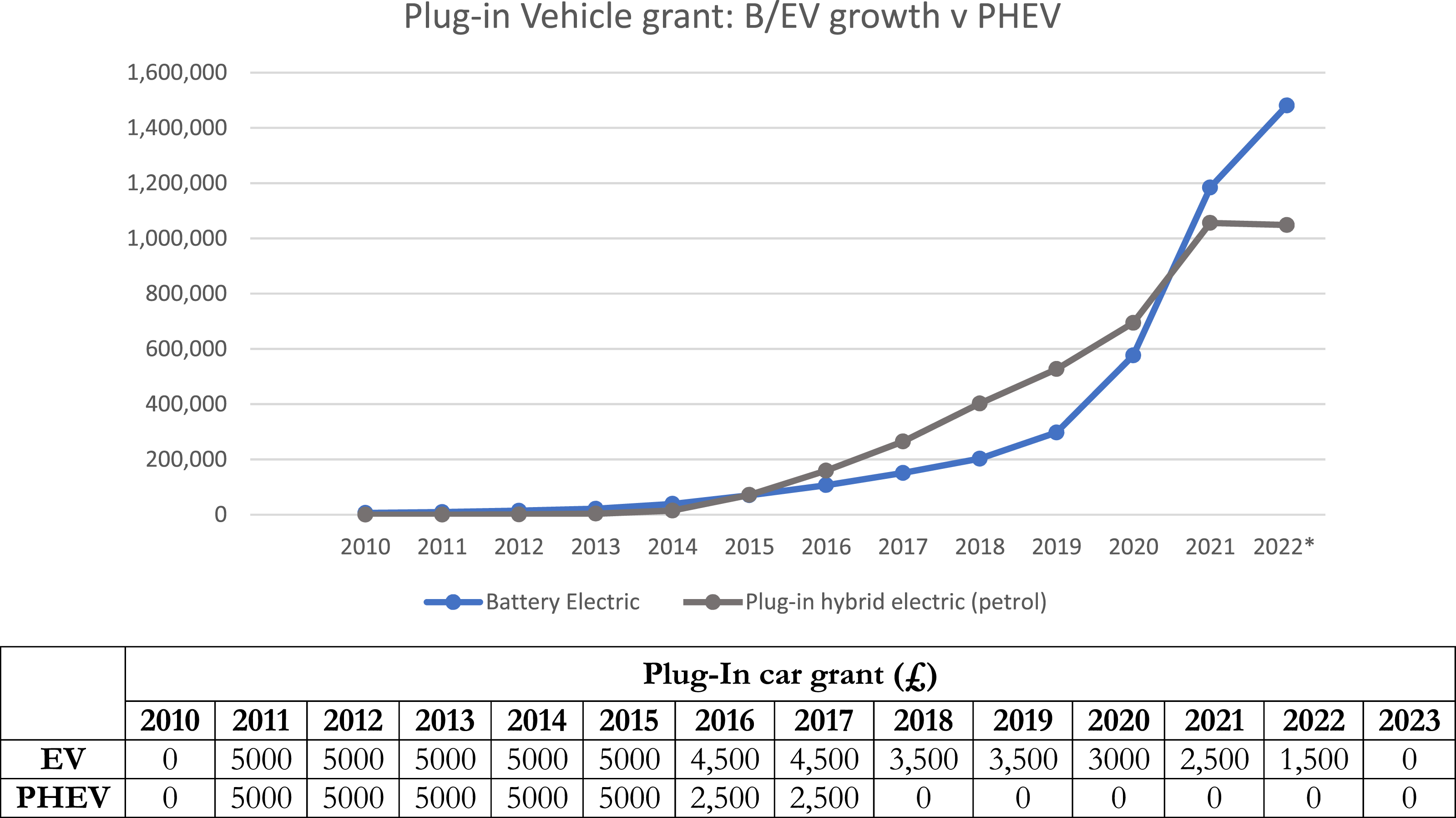
The second stage was the decision to ban ICE vehicles by 2040 following the Paris Agreement in 2015, a target brought forward to 2030 before being pushed back again to 2035. Though not a fundamental departure from the first, the ban shifts the sphere of EV policy from domestic to international. Interviewees stated that the ICE ban had implications for the international automobile market for several reasons. Initially, it sent a signal to the automobile market, and the financial actors who facilitate automobile consumption, that ICE vehicles would become stranded assets in the medium term and stressed purchases in the short-term (Interview: ClientEarth; Energy Saving Trust; EV Task Force). This in turn would require manufacturers to reorientate R&D investment from petrol and diesel engines to electric batteries (Interview: LoWCVP; Nissan). At the tail end of the automobile market, the ban incurred a repricing of manufacturers’ corporate bonds and insurance premiums, particularly those for labouring in the process (Interview: Innology; Transport Studies Unit). EV policy thereby became a question of disincentives as much as incentives, as it became an environmental policy with acute fiscal dynamics (Figure 2). UK supply-side taxation framework.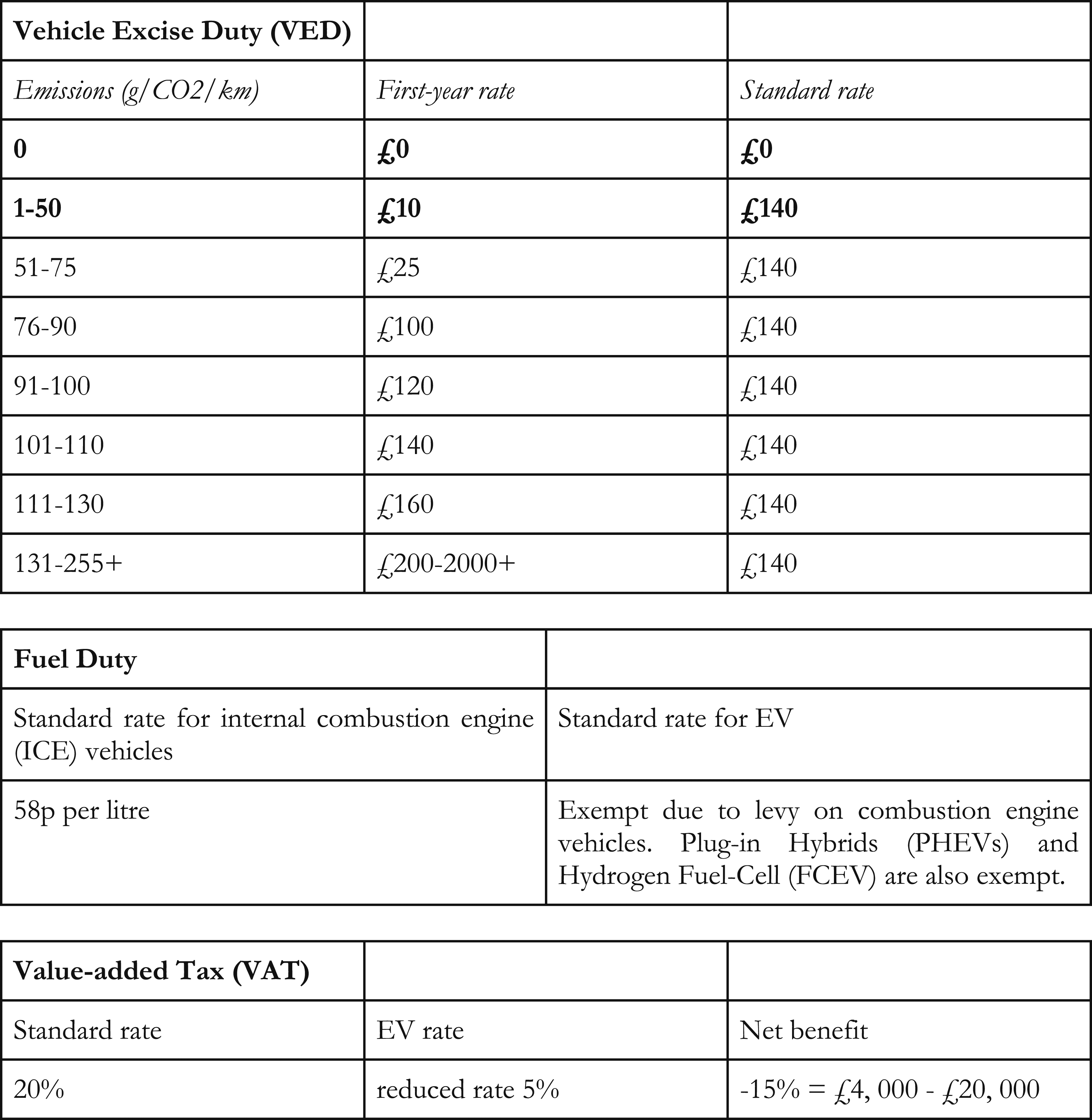
The third stage saw EVs become a subject of industrial modernisation following the Financial Crisis and the upending of British politics in the aftermath of Brexit. EVs were thus imbricated in the failure of financial services to yield pre-2008 levels of growth and the need to construct a post-Brexit vision of the UK economic model. Beginning with the publication of the Industrial Strategy and the Automotive Sector Deal in 2017, the document analysis accordingly revealed EVs were no longer simply a means to attend to transport emissions but address the four ‘grand challenges’ facing the UK economy, namely, (i) artificial intelligence and the data economy, (ii) clean growth, (iii) future mobility and (iv) an ageing society (HM GOV, 2018). Addressing at least two, if not three of these grand challenges, typically referred to as ‘design faults’ in the Ecological Modernisation literature (Mol, 2001, 2002) and departing from the ‘conventional wisdom’ of the UK economy (Berry, 2021), the Automotive Sector Deal was produced as part of the Industrial Strategy to invest 2.4% of GDP into the EV transition to ensure an increased proportion of each vehicle produced in the UK (HM GOV, 2018).
To modernise the economy, the data showed the UK government subsequently coupled the EV transition with its broader political objectives, including the 'levelling up' of infrastructure (HM GOV, 2021a), creating new jobs, upskilling the UK labour force to the required level of industrial expertise (HM GOV, 2018a; HM GOV 2017a) and augmenting domestic industry by establishing the world's first net zero industrial cluster (HM GOV, 2018). The Clean Growth Strategy (2017c) thereafter suggested that low carbon growth through investments in EVs, offshore wind and smart metres could yield four times faster growth than the broader UK economy. Capturing the prescience of the EV transition, the government stated that ‘we must take advantage of the once-in-a-generation opportunity to build a world-leading EV supply chain here in the UK’ (, p. 14).
Industrial modernisation has continued with the Green Industrial Revolution which has become one of the UK’s principal political objectives, alongside its stated plans to ‘build back greener’ from COVID-19 (HM GOV, 2021c). Comprised of a ten-point plan to ‘pioneer’ a new age of British industry (HM GOV, 2021a, p. 6), the industrial revolution once again centres on EVs as a means to deliver its Net zero commitments whilst delivering growth. Part 4 of the ten-point plan pertains to EVs, wherein it is identified that they are ‘[the] most visible incarnation of our ability to simultaneously create jobs, strengthen British industry, cut emissions, and continue travelling’ (HM GOV, 2021a, p. 14). This revolution of British industry entailed £2.8bn of investment into charging infrastructure and the UK based ‘Gigafactory’s’ for EV production and incentivise £3bn in private capital (ibid). The evolution of environmental to industrial policy thereby indicated a nascent shift in attempts to ecologically modernise, as the state adopted a more prominent role in the EV transition, but in so doing created a tension at the heart of the UK political economy.
Britishvolt: A case of blunt market-based instruments
The first prominent site of tension reached its apogee in 2019 upon the announcement that Britishvolt, a battery manufacturing start-up, would begin to augment British Gigafactory capacity. Located in the Northeast of England, Britishvolt was an attempt to enhance EV manufacturing capacity at the same time as levelling up industry outside of London. It drew support not least from the government, who supplied it initial capital alongside Glencore, Ashtead and the Treasury but also the broader institutional ensemble which the government had assembled to facilitate the EV objectives, including the Advanced Propulsion Centre (APC) and the Faraday Institute (HM GOV, 2017a). In so doing it resembled the Swedish approach to EV diffusion, which had similarly established Northvolt as the site of critical raw materials and battery production in Europe.
Britishvolt symbolised the evolution of EV policy, following stimulation of the consumer market through a combination of supply and demand side MBIs to create a pull effect. Banning combustion engines then exerted a push effect on the international automobile market to incentivise certain manufacturers and disincentivise others in equal measure (Interview: EV Task Force). Britishvolt thereafter became an attempt to cultivate a domestic industry in the traditional sense, not as a manufacturer who produces the final vehicle of the likes of Germany and Japan, but the producer of batteries for such manufacturers (Campbell et al., 2022). As a result, Britain would become embedded within the EV supply chain, particularly within Europe where it could exert a comparative advantage over European competitors such as Volkswagen who have also sought to increase their battery making capacity (Jackson, 2023). By accounting for a greater proportion of value added in the supply chain, Britain’s automobile model would lead to greater exports and thus a net benefit to its balance of payments.
Beneath the patriotic name, however, was a dearth of capital required to bridge the difference in political objectives for a post-EU economic model with greater industrial output. No sooner was Britishvolt deprived of public capital, despite the cheaper costs of historically low-interest rates, that it failed to attract the private capital routinely stated in the documents (HM GOV, 2017, HM GOV, 2021, 2021c). Britishvolt therefore not only undermined the Ecological Modernist view of modernity by attempting to reverse the trend of de-industrialisation across developed capitalist economies, but then revealed that the MBIs were poorly designed to channel capital into industrial reorganisation. Without the capacity to meet the intensive capital requirements for green technology, Britishvolt demonstrated the absence of a sufficient ‘green’ credit regime in the UK (Kedward et al., 2022), as uncertain political objectives begot equally uncertain capital investment.
Attempting to modernise the UK in this way, or perhaps more specifically, re-industrialising an economy after several decades of de-industrialisation, indicates that MBIs have become seemingly blunt economic tools and thus the brittleness of the UK’s modernisation objectives. This was by no means abstracted from the policy paradigm central to Ecological Modernisation, but a product of it. Interviewees stated that was on the one hand rooted in the incoherent policy framework approach (Interview: Advanced Propulsion Centre; Octopus Energy; OLEV) and, on the other, the lack of appetite, or indeed capability, to maintain public financing required to bring Britishvolt to fruition (Interview: APC). Britishvolt thus became a casualty of the UK government’s limited EV strategy, falling through the cracks of its ecological policymaking and falling short of a coherent modernisation project.
The Brexit win-lose: Rules of origin, emission trading and divergent frameworks
The second was brought to bear in the events following the UK’s formal departure from the European Single Market and Customs Union. Though not overtly clear in the immediate aftermath of the UK’s vote to leave the European Union, the disruptions to the automobile model caused by Brexit have shaped the EV transition in a variety of ways. Some were predicted before the vote, particularly the customs checks on goods disrupting the seamlessness of its JiT model. The Trade and Cooperation (TCA) Agreement ensured a trading agreement to allay some challenges, but introduced customs declarations that altered the terms upon which the UK could access the European Single Market (Bailey and De Ruyter, 2022). Subsequent costs in both administration and short-term mismatch in revenue have been internalised on the UK side (Interview: DfT, EV Task Force) and the longer-term uncertainty it has created for the model has precipitated a decrease in FDI, with Tesla and Build Your Dreams opting to establish factories in Europe instead of the UK.
As events unfolded, the data revealed three material impacts of Brexit on the UK EV transition. The first concerns the TCA, specifically the period beyond the 6 years ‘phase in’. There the Rules of Origin requirements will see that manufacturers and suppliers down the supply chain will incur tariffs if the UK cannot increase its production of final vehicles. Equally, the requirements state that automobiles are required not to exceed 45% of their total assembly outside of parties to the trading arrangement (Howe et al., 2021), which raises questions about the long-term capacity of the UK automobile sector to increase its percentage of domestic production. Circumventing future tariffs, therefore, requires agreeing on new Rules of Origin or augmenting the UK’s industrial capacity. However, industrial investment of this kind potentially risks infringing upon the ‘level playing field’ of open competition according to the EU’s state aid rules (Interview: Nissan; Renault), rendering the UK at an almost inevitably unavoidable disadvantage.
Second, the diverging regulatory environments, principally due to the UK now being outside the EU’s Emissions Standards for vehicles introduced in 2021, presents an acute barrier (Jackson, 2023). Ostensibly the standards serve the same purpose as the ban on ICE vehicles, by attempting to push the market in a particular direction, but with far more immediate and punitive rigour than the ban (Interview: Carbon trust, Cenex). This, as described by interviewees, would have a material impact on the UK as EVs would be ‘sucked out’ of the domestic market by European manufacturers and consumers (Interview: Innology; Nissan). Meeting the standards within the Eurozone would consequently lead to an implicit prioritisation of European countries such as France, Germany and Italy looking to meet their own objectives before exporting surpluses to the UK. This in turn would create a ‘lag’ in the supply of EVs to meet UK demand that could take years to rectify (ibid).
Third, the document analysis found that as automobile emissions became subject to caps under the EU’s revised Emissions Trading Scheme (ETS), the UK’s replacement (UK ETS) did not implement the same restrictions, focussing instead on aviation emissions (HM GOV, 2023). Conversely, the EU has introduced automobile emissions into the EU ETS, only furthering the divergence between regulatory regimes. Whilst automobile actions operating in the UK need not adhere to credit requirements in their production and trading of their vehicles, in theory providing them with a regulatory advantage, the case of Britishvolt shows that there was little appetite to invest any such proceeds in the UK EV sector.
Rather than the win-win assumed by Ecological Modernisation scholars, the economic dimension is an acute sphere of contestation between various factions seeking to fulfil the same objectives, producing losers at the same time as winners. Brexit accordingly indicates that the EV transition has been negatively impacted by international factors, directly at the UK’s expense. This empirical reality alludes to the disparity between Ecological Modernisation as an increasingly abstract paradigm, albeit one that yielded results in the latter part of the 20th century, and the contemporary context in which it is increasingly found wanting. This may, as noted by Barry (1999), be a product of the lack of attention given to understanding of political economy, particularly international political economy in the case of Brexit, within the Ecological Modernisation literature. As a consequence, the competitive tension born from polities with similar ambitions to the UK has produced an acute win-lose scenario in the case of the EV transition, as the UK’s loss became the EU’s gain. At present, automobiles still account for the UK’s biggest export in goods (Campbell et al., 2022), but for how long this may be so under its new trading conditions remains uncertain.
Driving the ecological modernisation of a financialised political economy
The preceding section concerned the barriers that emerged as a result of the internationalisation of the EV transition, of which the UK is but one polity attempting to capitalise on this profound change in the complexion of the global automobile market. Such barriers are shaped by external factors rooted in the UK’s dependency on FDI, its underdeveloped manufacturing capacity having undergone a dematerialisation from the real economy, (Revell, 2005; Sawyer, 2005; Fieldman, 2014) and now a dissociation with the economic and regulatory frameworks of the European Single Market. Other barriers impeding the UK’s EV transition are far more localised, however, for they are products of the internal contours of British capitalism. In short, they are tensions that arise during the very process of ecologically modernising a financialised political economy. In the following section, I turn to three such barriers that emerged from the data, namely, (i) the prism of state-market relations, (ii) political incoherence and (iii) the Treasury’s orthodox approach to spending. These barriers in turn create other ancillary barriers that combine to form a litany of structural issues.
The prism of state-market relations
The first barrier was the repeated shift in state-market relations, continuously moving from a state-led to a market-led focus and vice versa as the government exhibited an uneasy disposition on the subject of the EV transition. This oscillation between the state-market divide can be considered to reflect what Hatzisavvidou (2020) describes as the British government’s ideological inclination to cede emphasis to the market for environmental policymaking, by virtue of it being an ‘invention’ of neoliberalism, confronting the empirical reality that little development occurs in its absence. Beginning with the Industrial Strategy (2017a) which placed a significant role for the government, the focused returned to private actors in the Clean Growth Strategy (2017b). The Road to Zero Strategy’s (2018a) commitment to the ban on ICE vehicles again foregrounded the role of government, only for The Green Industrial Revolution (2021a) to straddle both sides of these dichotomous positions as state investment is simply intended to stimulate, or crowd in investment, from the market (Hickel, 2021). The Transport Decarbonisation Plan (2021b) returned to a state-led focus followed by the 2021c before the Powering up Britain strategy (2023a) exhibited a market-led orientation once again.
Having observed state-market dynamics through the prism of Ecological Modernisation, the UK government’s ideological commitments to a market-led approach have therefore been routinely tested by the demands of the EV transition, rendering it in an impassive state. This was shown above in the case of Britishvolt, but interviewees cited yet further problems embedded within its financialised political economy. Not least the fact that despite the implementation of EV policy, the government has continued to keep fuel duty to the £0.58 rate implemented in 2011 to avoid what it deems overly punitive measures (Interview: EV Task Force; Transport Studies Unit; HM GOV, 2023b). By the government’s own admission, the light regulatory environment associated with ICE vehicles has made the transport sector a ‘hard to reach’ area for UK environmental policy (HM GOV, 2017a). Contrary to the tightening of the regulatory environment, it is set to be made lighter still with EVs to be incorporated into VED by 2025 as the demand side stimulants have been removed.
As an invention of neoliberalism, a relative decarbonisation of the UK automobile sector has taken place (see Figure 3), but the state is too often rendered ineffectual by the manifestation of these internal contradictions. Nowhere was this clearer than when it was highlighted by an interviewee from OLEV, who stated that by now appearing to essentially implement a ‘top down’ and information-intensive transition in an economy predicated upon liberal principles for both the economy and its citizens, those same individuals become averse to any constraint on the perceived free market (Interview: Office for Low Emission Vehicles). The interviewee indicated that after years of kind of stepping back and maintaining the desire for an ‘industry-led transition’ (ibid) now introducing a ban on petrol and diesel vehicles and disincentivising individual mobility through clear air zones is a contradictory stance. In other words, polities who’ve opted to ‘row’ the economy, according to Ecological Modernisation scholars, for decades cannot now just ‘steer’ it toward its desired environmental objectives. Decarbonisation of the UK automobile sector (2001–2021).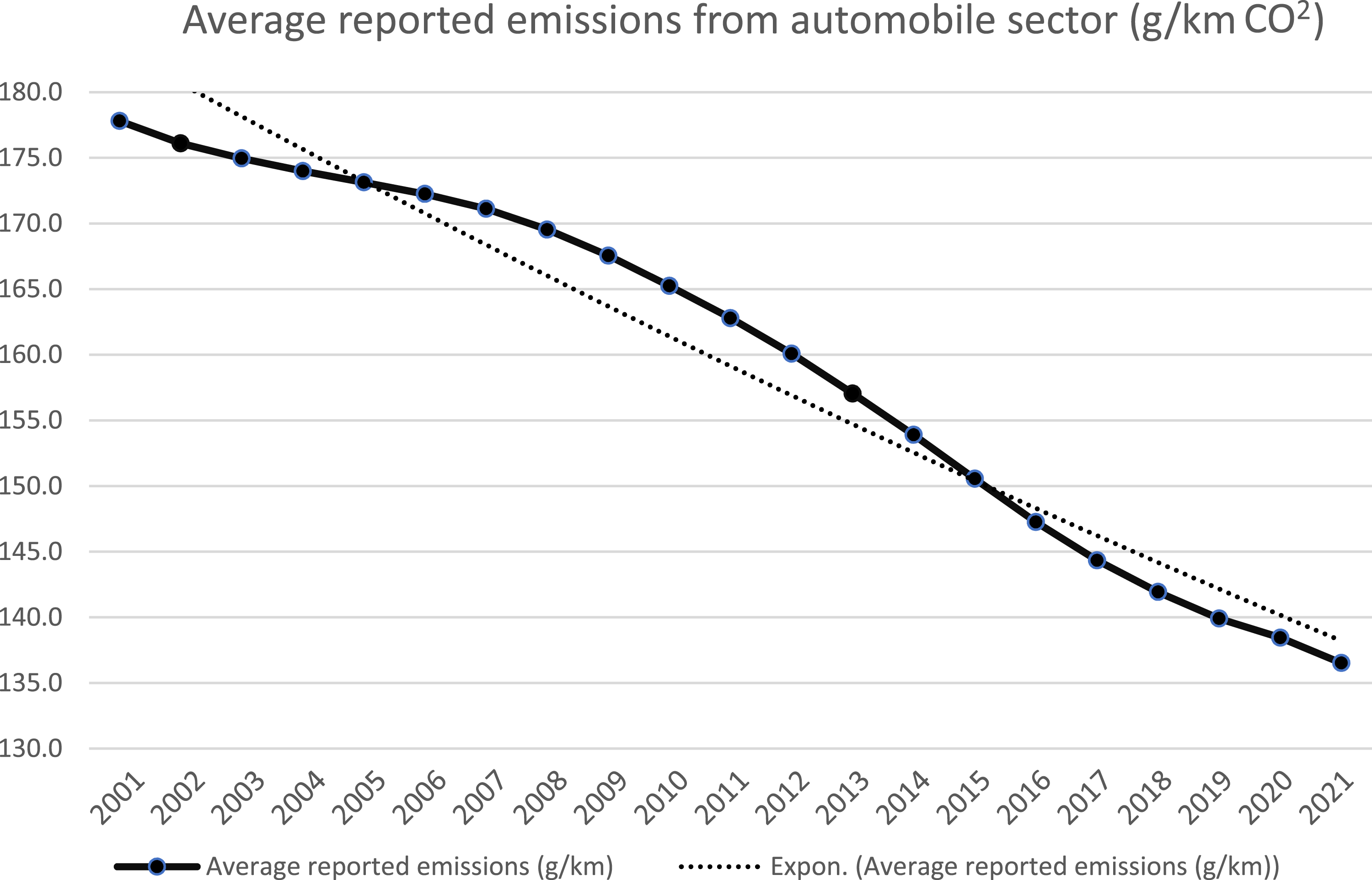
On account of the link between the City of London and ICE vehicles detailed above, the EV transition has broader implications for economic policy than that which can only be linked to ideological interpretations of the state. Indeed, the transition, as is commonly understood, will produce less aggregate economic activity than ICE vehicles as they require fewer elements for their production, have fewer moving parts, fewer faults, require less maintenance and thus require far less financial insurance against unwanted outcomes (Interview: Carbon Trust; Cenex). And whilst these features of EVs have produced many of its exponents, this was also cited as a problem, as the industry was all too aware of the economic reality of the transition (Interview: GreenTV; Zap Map). An interviewee who works with manufacturers such as Nissan and Renault in the UK consequently indicated that the absence of economic incentives for EVs was disincentivising their sales (Interview: Innology). The impact the EV transition might have on the UK, in terms of the financial flows for vehicles parts, the insurance and/or loans the City of London provides to consumers across primary and secondary markets leads to the UK needing to prolong the life of ICE vehicles (Interview: ClientEarth). Paradoxically, the net benefits of EVs, from an environmental perspective could become a net loss from an alternative economic view.
Policy incoherence
The second barrier, ostensibly a product of the first, is the incoherent approach to EV policy. Contrary to what one might assume that the frequency at which the UK government published strategic documents would have crystalised their EV objectives, interviewees stated that the UK still lacks an overarching roadmap, or trajectory, for the EV transition. The absence of a coherent EV policy was even acknowledged by an interviewee from the DfT, who stated that ‘there’s not a government strategy that says this is the best approach’ to develop an EV market domestically (Interview: Department for Transport). The lack of clarity expressed by the DfT consequently indicated that despite the publication of many documents making for a ‘dense’ strategic output, the UK government’s focus lacks technical detail, or an ‘intensity’ to its objectives (Burns et al., 2019).
In addition, the 10-year freeze in fuel duty price undermines, if not contradicts the policy orientated around EVs, for it ultimately acts as a disincentive to EVs (Interview: Electric Blue; Energy Saving Trust; Zap Map). Adopting an irresolute approach to the robustness of policy equally inhibited the implementation of Ultra/Low emission Zones (U/LEZ) across almost all the largest British cities. Whereas the government could have provided a clear, transferable policy blueprint for the implementation of emissions zones to coordinate them across the country, the UK government has tried to absolve itself from implementing the measure by instead passing the emphasis onto the local government (Interview: Client Earth; LowCVP; Nottingham City Council; Transport for Greater Manchester). The uneven implementation of ULEZs across spatial areas has seen them incoherently implemented, as category Bs, for example, can be less stringent than category Cs (Interview: LowCVP). What is more, instead of a robust design, it has produced a regulatory race-to-the-bottom, as local authorities look to gain a competitive advantage through lighter regulation (ibid).
Finally, the incoherency of policy was observed in the government’s approach to its fleet procurement, being the vehicles used for ministerial and other official duties. The government performs a crucial role in the domestic automobile market as a proportion of spending is allocated for the procurement of first-hand vehicles, the largest such consumer in the economy (Interview: LowCVP; Nissan). As a consequence, the government is instrumental in diverting vehicles to second and third-hand markets, thus mediating the flow of vehicles through the economy. In 2021, the government stated its objective to decarbonise the government car and van fleet by 2027, reaching 25% in 2023 (DfT, 2023). What is not quantified in these figures is the lag it creates in disseminating EVs to secondary markets, as the government can procure at a scale greater than at present. Such incrementalism undermines the immediacy of the task at hand, as the private sector is unlikely to move at a greater pace but follow the government’s lead.
Treasury orthodoxy: A Green Book for non-green spending
The third barrier was located within the institutional architecture of the British state itself, specifically the Treasury, whose impact on the UK EV transition is nowhere more discernible than in the Green Book. It serves as the Treasury’s appraisal framework by which cost-benefit analyses of infrastructure are undertaken. Interviewees, particularly those working within the government, cited the Treasury as a barrier (Interview: DfT; OLEV), though the institutionalisation of state investment through the Green Book has garnered relatively little attention in the literature (Craig, 2020). However, where it has been put under an analytical lens, several charges have been levelled at the Green Book’s methodology.
Firstly, due to its ‘economic philosophy’, it has often failed to integrate environmental considerations and negative externalities into the cost or benefits (Coyle and Sensier, 2020; Eddington, 2006). Second, the narrow parameters of cost and benefit are also determined by the minimum input for maximum output criteria, thereby leading investments to disproportionately fund regions and projects which already benefit from investment, particularly London (Graham and Van Dender, 2010). Such fiscal determinism was echoed by the interview from the DfT, who noted that within the Treasury's investment criteria ‘It’s still far easier to get funding for a bypass than it is for some sort of, you know, more sustainable green travel’ (Interview: Department for Transport).
The Treasury’s appraisal of the UK’s environmental objectives, of which the EV transition is a significant part, has concluded that the fiscal implications of decarbonising the economy are uncertain and thus potentially limitless. Moreover, the Treasury asserts that aside from the benefits of such investment, the ultimate net effect of decarbonising the economy could lead to a reduced fiscal intake, as many taxes are leveraged on carbon-intensive industries (HM GOV, 2021c). Transitioning from ICE to EV vehicles thereby comes with fiscal implications given that carbon-intensive vehicles account for the largest proportion of the UK transport sector, and the tax raised from the production, exchange and driving of automobiles provides the UK with a fiscal surplus (Interview: National Grid). Taxes levied on vehicles are subsequently used to address deficits elsewhere in the fiscal budget, from health and social care to education (OBR, 2022). As such, continuing to omit EVs as uptake rises is likely to incur an imbalance in the government’s current account. That is to say little of the ideological interpretation of fiscal policy, following the UK government’s ‘fetishisation’ of fiscal surpluses and public borrowing costs since the Financial Crisis (Bailey, 2020). Addressing current account imbalances may yet determine the trajectory of EV policy to a significant degree, as higher relative prices stimy demand.
By tightening the purse strings, the interviewee from the DfT subsequently stated this has reduced the department’s role to one that simply ‘provides guidance’ on the EV transition, the Treasury erected the most profound barrier to modernisation (Interview: DfT; OLEV). Not least in that it limited the capacity of other state institutions, such as the DfT, OLEV and DESNZ, as the EV transition falls within their remit (ibid). But returning to the political context in which this research was undertaken, interviewees stated that the Treasury’s response to COVID had revealed the ‘various myths about [UK] fiscal policy that is constraining the sort of political imagination’ (Interview: Positive Money) and that ‘the UK Government has far more fiscal capacity than it’s ever willing to show’ (ibid). This again comes back to the ideological commitments of the British state which, as noted above, can no sooner be disentangled from neoliberalism than it can from Ecological Modernisation.
In summary, each barrier is a product of a financialised political economy. This incidentally spoke to a broader criticism noted by interviewees on two fronts: The first being that it provides an inaccurate view of the UK’s environmental leadership which is ultimately contingent upon, exporting manufacturing to other countries where labour and nature are cheaper to than import the final products only, and then celebrate territorial emissions reductions (Interview: GreenTV; Positive Money; Transport Institute). Second, EV policymaking, as part of the wider green transformation, is currently misaligned with its objectives, for the UK is currently on course to miss its fourth and fifth carbon budgets, as highlighted by the Committee on Climate Change (CCC, 2021). The case of the UK consequently indicates that the EV transition has been unsuccessful in driving political, economic, or industrial change, but is stalled by those very factors.
Conclusion
In this article, I have provided an account of the EV transition in the UK, one that proposes that decarbonising its automobile sector, as it transitions to EVs, is contingent upon modernising elements of the economy. Far from an abstract proposition, the empirical thesis of this article was shaped by a robust multi-method approach. On the one hand, it is an empirical contribution to the underdeveloped understanding of the deeply political nature of the EV transition and on the other an attempt to address the routinely neglected modernisation strand of Ecological Modernisation. The findings here have been provided by the very ministries, manufacturers and organisations tasked with facilitating the transition, the DfT and OLEV, which are consequently constrained by the Treasury’s investment criteria. It is therefore not the prescription that the UK’s EV transition would be realised by modernising the economy, but the British state who, as the prescriber, maintains that it is not their purpose to cultivate the transition, despite all the evidence to the contrary.
The implications of this analysis for the literature are fourfold. First, representatives from spheres of government policy, automobiles and charging infrastructure providers acknowledge the limitations of UK EV policy. This indicates the acute disparity between the paradigmatic view of policymakers, as prescribed by even the stronger strand of Ecological Modernisation to which the UK has arguably moved, and the political reality. Second, the analysis contributes to the growing scepticism as to whether the view of Ecological Modernisation detailed above accurately reflects a political context defined by lower growth, higher inflation and the creeping reality of climate change (Haas, 2021). Critical perspectives of Ecological Modernisation are by no means a recent phenomenon, but whether it’s prefigurative assumption of the green transition holds in a given context requires constant renewal. Thirdly, it contributes to the political economy’s growing disciplinary attention to the subject of climate change (Craig, 2020; Haas, 2021; Jackson, 2023). Finally, it also adds to the critical body of scholarship as to the mailability of the UK’s financialised political economy to respond to the unfolding economic and climate crises (Bailey, 2020; Hatzisavvidou, 2020). Should this condemnatory conclusion prove true, the ramifications extend far beyond the sphere of scholarship, but demand scholars continue to examine and identify where problems occur, nonetheless.
Ultimately, before considering the associated externalities of EVs, a subject of profound importance in its own right (Remme and Jackson, 2023; Riofrancos, 2023), the UK case demonstrates the acute challenges in accessing many of the resources needed for their production. What instead became clear from this analysis is that no sooner had the EV transition become a vehicle for industrial modernisation than it was stalled by the inherent contradictions of the UK political economy. By focussing on the UK, I have addressed one of the more prominent omissions in the analyses of EV transition (Haas, 2021; Jackson, 2023; Remme and Jackson, 2023). Following the failed attempt to capitalise on the global transition to EVs, this concludes that much can be attributed to persisting with a model bearing signs of failure rather than embracing the uncertainty of change.
Footnotes
Acknowledgements
I would like to extend his thanks to Charlotte Burns and Cemal Burak Tansel and Devyn Remme who provided important comments on early drafts of this paper. I would also like to thank the reviewers for providing useful comments. Any mistakes are of course my own.
Declaration of conflicting interests
The author(s) declared no potential conflicts of interest with respect to the research, authorship, and/or publication of this article.
Funding
The author(s) received no financial support for the research, authorship, and/or publication of this article.

Notes
List of interviewees
Advanced propulsion centre
Sustainable development strategist
EO technology
Oxfordshire County Council
Office for low emission vehicles
Carbon trust
Cenex
ClientEarth
Crowd charge
Electric Blue
E3G
University of West England
Ubitricity
Zap Map
Zero carbon futures
GreenTV
Hope for the future
Innology
Department for Transport (DfT)
Delta EE
Institute of transport studies
Transport studies unit
Transport for Greater Manchester
Nottingham City Council
Vanarama
LowCVP
Impact Global Solutions
EV Task Force
National Grid
Octopus Energy
Treasury
Energy Saving Trust
Positive Money