



Abstract
In countries with strict employment protection legislation, firms may seek to replace regular by atypical jobs in order to cut wages or to become more flexible. In Germany, the number of unprotected temporary jobs is comparatively low. During the past decades, temporary agency employment, however, has increased considerably and the share of agency workers is now above the EU average. Using German establishment data, the analysis draws on longitudinal (generalized method of moments) and cross-sectional (matching and difference in differences) methods to evaluate whether agency workers replaced or supplemented regular workers during and after the Great Recession of 2008/2009. The study finds that hiring (more) agency workers made it possible for user firms among Germany’s core manufacturing industries to employ a larger number of regular workers at the same time. In specific sectors and regions, temp agencies therefore provided an alternative to government-sponsored instruments such as short-time work schemes. Obviously, from the view of workers, many disadvantages remain, even more so as it is rare for temp spells to offer a stepping stone into regular employment.
Introduction
In the study of labour market relations, there has been controversy for a long time about whether the institutional base of the German model is subject to erosion. The transformation of industrial relations involves an increasing role of dual employment protection legislations in terms of the division between permanent and temporary contracts. In European comparison, the rate of employees with temporary contracts in Germany, Europe’s largest economy, is moderate (amounting to 7.5% among all employees aged above 25 in 2021, as opposed to 11% on average in the EU27 (Federal Statistical Office, 2023a)). In Germany, protection of employees with permanent contracts is comparatively strict. The respective regulations regarding temporary jobs, however, are more liberal (OECD, 2020).
Among different forms of atypical work, temporary agency employment (TAE) is reverted to commonly by Germany´s export-oriented manufacturing industries (Pfeifer, 2014). Although agency work still represents a modest share of total employment (2.8% in Germany, around 2.5% in the EU 27 on average among all employees aged 20-65 in 2021) (Eurostat, 2022), it has become a feature of labour market deregulation in many European countries. In Germany, agency employment has increased since the 1990s, particularly during the Hartz reforms of the 2000s (Herrero, 2022; Vitols, 2004) (Figure 1). The following study explores whether and to what extent TAE utilization helps firms to retain a steady workforce across periods of economic fluctuation. Temporary Agency Employees in Germany. Source: Own figure using monthly data from Federal Employment Agency (2023).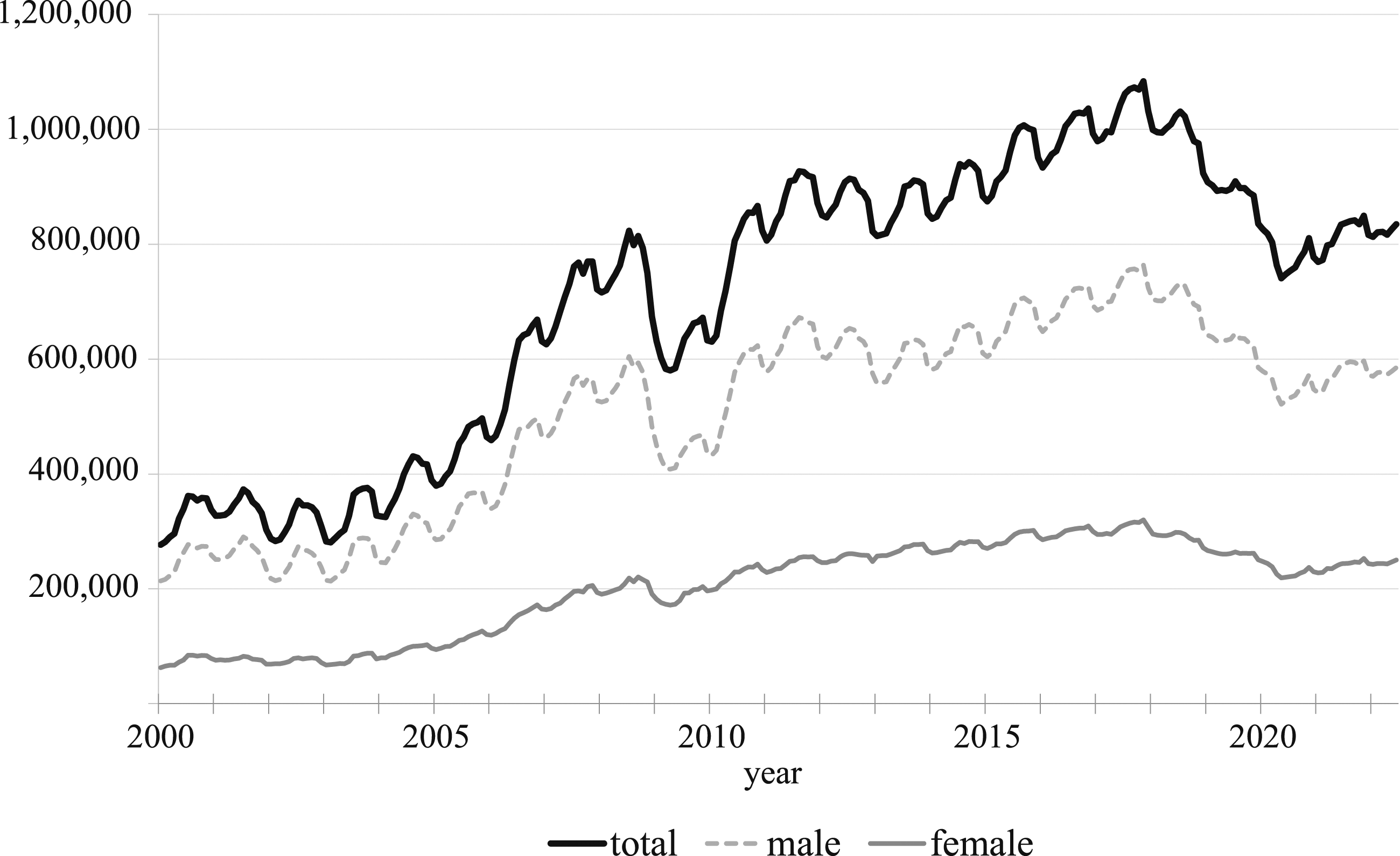
As Syrovatka (2021) points out, an increasing prominence of temporary and agency work would comply with contemporary European labour policy, which shifted towards promotion of deregulation during the Great Recession of 2008/2009. Subsequent to a sharp decline during the crisis, in Germany, the total number of temporary agency employees continued to increase, peaking at over 1 million in 2018 (Figure 1). During the Covid pandemic, agency employment had declined to around 750,000 by June 2020 but has been increasing again since then.
Whereas the overall TAE employment share is moderate, its dynamics is extraordinary and in the initial phase of economic recovery after the recession its contribution to job growth was crucial. In 2009 and 2010 altogether, 62% of all new jobs in Germany were taken up in the TAE sector (Haller and Jahn, 2014). The precise research questions guiding the following analysis are whether i. At the firm level, agency workers typically supplemented or replaced regular (non-agency) employees during and after the Great Recession. ii. The functioning of TAE varies according to the intensity and longevity of its utilization, by sectors and/or according to the regional context. iii. TAE utilization supported job growth in Germany specifically during the upswing subsequent to the recession, thereby improving its economic resilience.
While the first question outlines the basic concern, the second and third questions, which pursue effect heterogeneity and post-crisis outcomes, define the specific issues for the analysis.
Theoretical background and literature review
TAE is a specific form of temporary employment, which involves outsourcing of jobs to temp agencies. The division between permanent jobs on the one hand and temporary or outsourced jobs corresponds to the concept of dualism, according to which labour markets may be segmented into a primary sector with well-paid, secure jobs and a secondary sector comprising low-paid and insecure jobs (Doeringer and Piore, 1970). While early studies attributed labour market dualism mainly to a distinction between manufacturing and services, more recent concepts consider that both kinds of job can be offered in the same sector, firm, even for the same task. Establishment of a secondary sector with insecure jobs within the same firm may serve employers as a means to cut wages (Bachmann and Bredtmann, 2016; Lehner et al., 2022; Weisstanner, 2021), to prevent shirking (Bulow and Summers, 1986) or to make them more flexible in the face of cyclical fluctuation (Jahn and Bentzen, 2012; Spermann, 2011).
The theoretical background with respect to all research questions derives from this concept, as it explains the rationale for TAE from a user firm´s perspective. Dickens and Lang (1985) emphasize that an emergence of dual labour markets would oppose human capital theory, which assumes differences in skills as the main determinants of the distribution of income. In a dual labour market, however, there are little or no returns to education in the secondary sector and access to the primary sector is rationed.
Regarding TAE, impermeability to the primary sector indicates that dual labour market conditions apply, as it is unlikely to find a ‘stepping stone’ from temporary into regular jobs (Ahn, 2016; Autor and Houseman, 2010; wmp consult, 2013). Bratti et al. (2021) demonstrate that employment protection legislation may function as a rationing mechanism. When employment protection for regular jobs in Italy was lowered in 2012, more permanent jobs were offered by large firms.
Dualism exerts considerable consequences on workers failing to get access to regular jobs, as they appear to be likely to suffer from a long-term wage penalty when entering the labour market on a temporary contract (Pavlopoulos, 2009). Latner and Saks (2022) point out that more research is still needed to explore the mechanisms through which temporary employment affects the entire wage and employment careers of people. They conclude, however, that at the broadest level, most evidence would suggest a negative effect. For ‘insiders’ who are employed directly, an increasing share of less protected ‘outsiders’ may even improve the bargaining position on the job market (Ordine et al., 2017). As Weisstanner (2021) clarifies, however, only high-income earners can expect to benefit from such an advantage, whereas low-income and middle-income insiders experience declining wages.
With a view to cyclical fluctuation, Baumgarten and Kvasnicka (2017) find that between 2002 and 2010 regular jobs in Germany were more stable in firms, which also hired temporary agency workers. Further, client firms with a greater pre-crisis use of temporary agency work fared better with the decline in demand during 2008/2009 and made less frequent use of government-sponsored short-time work schemes.
With a view to the second research question it is important to note that with a GDP share of 26.6% (in 2021), Germany still relies more on manufacturing than, for example, France (16.8%), the United Kingdom (17.7%) or the United States (18.4% in 2020) (Federal Statistical Office, 2023b). Sectors such as automotives, electrical and mechanical engineering, the pharmaceutical and chemical industry represent the bulk of the German research and technological innovation capacity (Stifterverband, 2023). With respect to industrial relations, Germany is often regarded as the archetypical ‘coordinated market economy’, where firms engage in strategic interaction with trade unions, suppliers of finance and other actors (Hall and Soskice (eds.), 2001).
However, the German model of labour relations may erode as institutional arrangements from manufacturing fail to take hold in other sectors (Thelen, 2012). Considerable decentralization of labour relations has been on its way since the 1980s, for example, due to privatization of public utilities and outsourcing of various activities by large companies (Hassel, 1999). While agency work experienced a substantial spur by the German Hartz reforms, it is far from being completely deregulated. The vast majority of temp agencies recognize their own sector-specific wage agreement (BMAS (ed.), 2017). Furthermore, even though there is no specific focus on Germany in his study, Corraza (2020) points out that trade union density among nonstandard workers in Germany is high. Nevertheless, notwithstanding that EU legislation demands equal pay and equal treatment, in Germany agency workers may earn lower wages, if this is arranged for by an industry-specific agreement that compensates, for example, by lower working hours. Goldschmidt and Schmieder (2017) demonstrate that by outsourcing jobs German employers also save on firm-specific pensions, thereby reducing overall wages by approximately 10%–15%.
As regards the intensity of TAE utilization, between 1998 and 2006 in Germany, there was an increase in the number of ‘intensive user’ firms, among which agency workers account for over 20% of the total workforce (Bellmann and Kühl, 2008). Among these firms, flexible recruitment is particularly likely to coincide with the goal to cut wages. Since Kahn (2016) reveals that job content is higher in permanent jobs, in these firms, workers’ influence and task discretion can be expected to be particularly low. For ‘intensive users’, TAE has thus become a structural rather than a transitional element of their human resources management, even though individual assignments may be short (and fluctuation high). In this respect, using German establishment data, Hirsch and Mueller (2012) find a hump-shaped effect of the extent of TAE on the user firm´s productivity, reaching its maximum at a TAE share of around 12%. Beyond 22%, the productivity effect would drop below zero. A potential supplementary role of TAE would thus presumably apply to shares below 20%.
Herrero (2022) shows that between 1996 and 2014, agency employment increased particularly in manufacturing industries, where the share of agency workers had been highest (around 1.4%) already in 1996, yet it increased at a higher pace in East than in West Germany. It is important to note that firms externalize the costs of recruiting when utilizing TAE, as temp agencies engage in screening of suitable candidates. Many German temp agencies acquire comprehensive worker profiles. By specializing on selected sectors, regions and even firms, agencies thereby generate a flexible workforce likely to fit to firms’ requirements. Further, the respective labour demand is by no means restricted to low-qualified personnel. As part of industrial clusters, in which they cooperate with manufacturing plants, agencies may thus provide an alternative to short-term work schemes, in which participation in training courses is subsidized by the state. In a representative survey among German agency workers in 2013, only around 19% reported to have taken part in further training during the first half of the year. Yet, almost all (over 90%) of the costs of their training had been covered either by the temp agency or by a user firm (BMAS (ed.), 2017). The skills acquired are very likely to fit closely to the requirements of the industries involved, which may generate an advantage over workers taking part in state-subsidized training schemes. With respect to effect heterogeneity of TAE utilization, Meyer (2013) demonstrates that during the Great Recession in Germany TAE declined most rapidly in regions with a focus on export-oriented manufacturing industries, for example, the automobile industry.
Finally, with a view to the third question, Jahn and Rosholm (2018) emphasize that it may be more advisable for workers to hire with agencies during economic downturns, since in growth periods they may find other employment more easily. However, agency workers are more likely to supplement permanent workers if they are hired during an economic upswing, as it may be less costly for user firms to dismiss them in subsequent periods of decline.
Data and methods
Data sources
The analysis uses the German IAB Establishment Panel, an annual representative survey comprising around 15,500 firms (Ellguth et al., 2014). The panel consists of a stratified random sample of plants employing at least one worker liable to social security on 30 June of each year. It was initiated in 1993 for the purposes of the German Federal Employment Agency and thus comprises a detailed focus on employment-related topics (Hirsch and Mueller, 2012). It is beyond the scope of the annual study to examine the full universe of short-term temp spells in client firms. It is also impossible to find out in this data whether a specific permanent employee has been replaced by an agency worker performing the same tasks. Yet, it is possible to examine the relation between the amount of agency and non-agency jobs at the level of the individual firm.
The study uses data for the period 2006–2014, which makes it possible to study TAE utilization during and after the recession and thereby to exploit this exogenous impact on labour demand. The analysis will explore whether firm-level outcomes vary according to the overall intensity of TAE utilization and its evolution across years. In this context, it accounts for a broad division between transitional and structural TAE. Throughout the analysis, firms using at least one agency worker at the date of the survey in each year will be described as ‘client firms’.
Baumgarten and Kvasnicka (2017) find that the share of agency employees among establishments in the IAB Panel in 2007 or 2008 was not related to panel attrition and that the coefficient of interest (referring to the share of agency employees) in the analysis should therefore not be affected by sample selectivity.
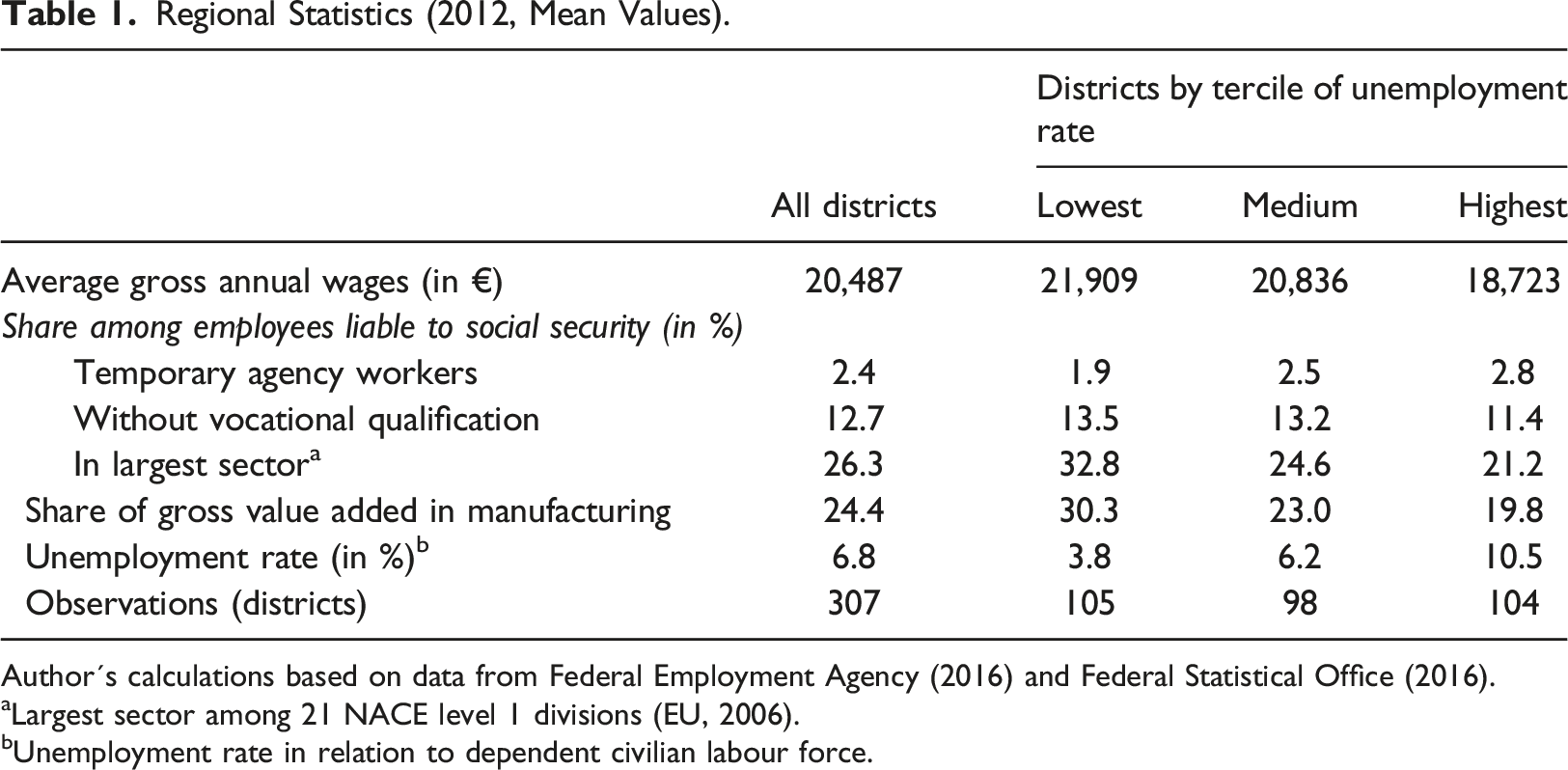
As the incentives for hiring from agencies may vary considerably according to the regional context, micro-level data from the panel will be complemented by regional data on unemployment rates. This regional-level information derives from German employment statistics, compiled at the level of municipal districts (Kreise and kreisfreie Städte, NUTS 3 regions). Among employees liable to social security in 2012, there was a regional share of temporary agency workers above the national average of 2.4% in many urban districts, in rural districts of East Germany, on the border between North Rhine-Westphalia and Lower Saxony, and in some more remote regions of Baden-Württemberg and Bavaria (Federal Employment Agency, 2016; Figure 2). As a whole, the share of agency employees is higher in regions with high than in regions with low unemployment rates (Table 1). Share of employees liable to social security in temporary employment agencies (2012, in %). Source: Own figure using data from Federal Employment Agency (2016). Regional Statistics (2012, Mean Values). Author´s calculations based on data from Federal Employment Agency (2016) and Federal Statistical Office (2016). aLargest sector among 21 NACE level 1 divisions (EU, 2006). bUnemployment rate in relation to dependent civilian labour force.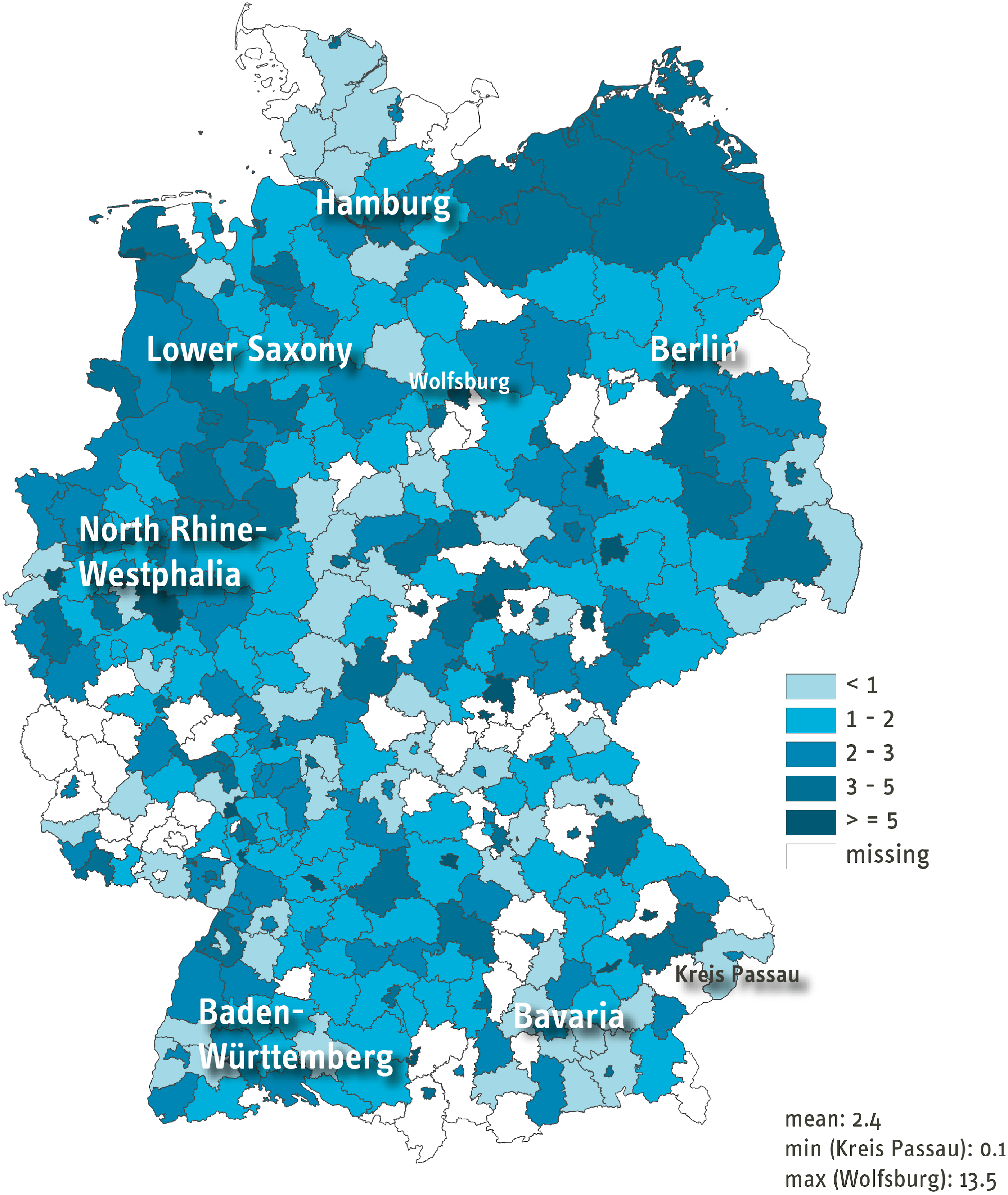
Descriptive statistics
Variable Definition and Descriptive Statistics.
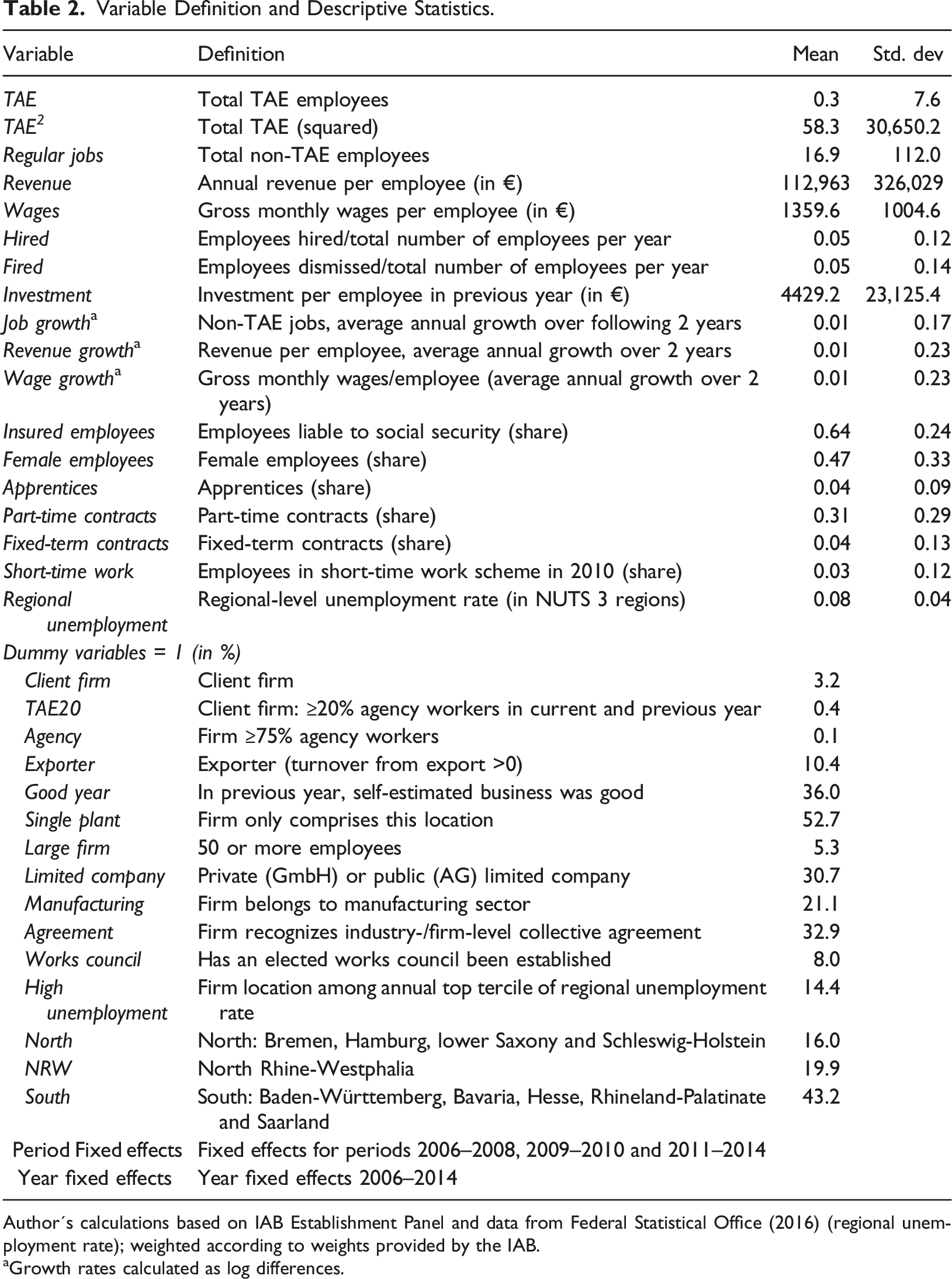
Author´s calculations based on IAB Establishment Panel and data from Federal Statistical Office (2016) (regional unemployment rate); weighted according to weights provided by the IAB.
aGrowth rates calculated as log differences.
Empirical strategy
Panel estimations
The analysis will pursue whether hiring agency workers in addition to regular workers had any effect on firm-level growth of regular jobs during cyclical fluctuation across the Great Recession. For this purpose, different quasi-experimental approaches will be applied. These are designed to construct a counterfactual situation, in which the performance of client firms is evaluated against a hypothetical alternative, in which they had employed a different number of agency workers or none at all.
The first and main step examines the effects of TAE utilization at the intensive margin, that is, it explores what happens if firms hire more agency workers. The second step explores the extensive margin, that is, it compares client firms to similar firms, which hire no agency workers. Various robustness checks will be applied to both steps.
In the first step, it is necessary (and possible) to rule out both unobserved heterogeneity between firms and unobserved changes taking place within firms. To address the respective identification problems, the analysis uses a linear dynamic panel-data model known as the Arellano–Bond estimator (Arellano and Bond, 1991). In the generalized methods of moments (GMM) estimation, unobserved heterogeneity between firms is eliminated by utilizing within-firm change over time and unobserved determinants affecting firm evolvement are accounted for by using lagged variables as instruments.
In equation (1),
System GMM Estimation: Regular Jobs in Client Firms (Log), All Covariates Endogenous (Except Year Fixed Effects), Two Periods.
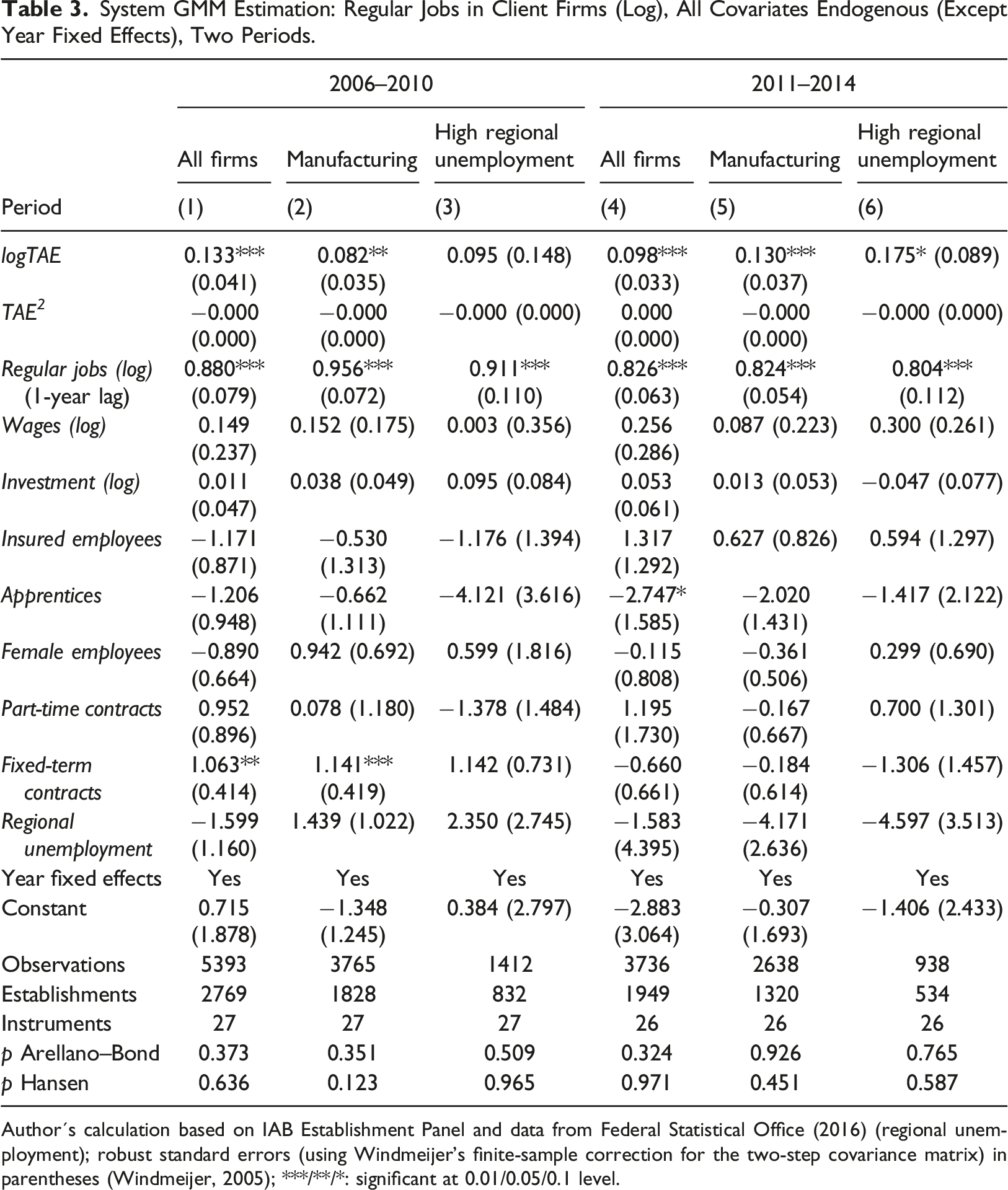
Author´s calculation based on IAB Establishment Panel and data from Federal Statistical Office (2016) (regional unemployment); robust standard errors (using Windmeijer’s finite-sample correction for the two-step covariance matrix) in parentheses (Windmeijer, 2005); ***/**/*: significant at 0.01/0.05/0.1 level.
The GMM estimation pursues a different IV approach, in which the shifts and levels of endogenous variables are instrumented by lags. In order to address unobserved heterogeneity affecting within-firm-evolvement, lags of endogenous covariates from
In order to account for cyclical differentials, estimations for the complete period will include period fixed effects for 2006–2008, 2009–2011 and 2012–2014, whereas separate estimations for sub-periods will include year fixed effects. A dummy variable (‘client firm’), which is 1 in case at least one agency worker is used by the establishment, replaces the variables
In order to limit the number of instruments and to be able to separate between two sub-periods (2006–2010 and 2011–2014), lags will be restricted to
Cross-sectional analysis
The most severe identification problems likely to result from unobserved heterogeneity will be eliminated by the GMM estimations. It is nevertheless of interest to additionally explore the outcomes of TAE utilization from a cross-sectional perspective in order to compare client firms and non-clients directly, even though any ‘treatment effects’ assigned to TAE utilization from this perspective cannot claim to derive from an estimation achieving strict exogeneity. The cross-sectional analysis focusses on research question ii., which is concerned with post-crisis outcomes.
The first cross-sectional approach draws on a propensity score matching algorithm (Rosenbaum and Rubin, 1983), in which the average treatment effect on the treated (ATT) with respect to annual growth over the forthcoming two years concerning outcome variable 
In estimation (2),
The ATT in terms of the outcome variable (average annual growth of regular jobs 2012–2014) will also be examined for client firms from - belongs to the manufacturing sector (the main group of clients), - generates at least part of its turnover abroad (as exporters were hit severely by the crisis), - only operates one plant, - accounts for 50 or more employees altogether, - operates as a private (GmbH) or public (AG) limited company (in order to consider characteristics of the capital stock), - may represent a temporary employment agency, as agency workers comprise 75% or more of its total workforce, - reports to have experienced good business in the previous year, - recognizes an industry or firm-specific collaborative agreement and - has established an elected works council.
Moreover, an interaction term accounts for whether a firm from manufacturing recognizes a collaborative agreement. Further dummy variables characterize the macro-region (Northern Germany, North Rhine-Westphalia or Southern Germany, East Germany including Berlin functioning as reference category). In order to consider the (as Baumgarten and Kvasnicka (2017) point out, negative) relation between usage of government-subsidized short-time work schemes and TAE, the share of employees participating in short-time work in 2010 is included as variable ‘short-time work’. 3 A complete list of variables used in the matching analysis and descriptive statistics on the matched samples is shown in Table A5 in the online appendix.
The propensity score, which is estimated from a binary choice model, condenses the information from the covariates into a single index function such that firms in the treatment and control group with the same distribution on the covariates would share the same score. It is assumed that conditional on the covariates the outcome in terms of job growth among client firms (
DiD estimations accounting for pre- and post-crisis fixed effects
The second part of the cross-sectional analysis comprises OLS estimations that draw on the concept of the difference indifferences (DiD) approach (Card and Krueger, 1994) in their identification strategy. These estimations explore cyclical variation across the Great Recession and incorporate all annual observations. The period 2006–2008 is defined as ‘pre-treatment’ and the period 2012–2013 as ‘post-treatment’. The ‘treatment effects’ (keeping in mind that a bias from unobserved heterogeneity between firms cannot be ruled out completely) in comparison to the recession period (2009–2011) with respect to the annual firm-level growth of regular jobs will be explored for different groups: - client firms versus non-clients, - client firms with a TAE share over 20% versus clients with a lower TAE share, - client firms located in regions with high unemployment versus client firms in other regions and - client firms, which are large manufacturing plants versus other client firms.

Equation (3) draws on all annual observations from years
This common trends assumption is also reverted to in a final robustness check using the two-stage difference-in-differences approach introduced by Butts and Gardner (2022). This two-way fixed effects estimator (TWFE) combines a fixed-effects panel model with the distinction between treated and non-treated units in order to eliminate unobserved heterogeneity between treated and control group. In contrast to the GMM model, which excludes firms that remain non-clients throughout the study period, this approach includes all observations. Untreated outcomes are identified from a first-stage regression using the sample of non-clients. The average effect of the treatment on the treated is then identified from a regression of outcomes on treatment status, after removing group and period effects. The ability of TWFE models to simultaneously adjust for within- and between-establishment effects critically relies upon the assumption of linear additive effects (Imai and Kim, 2021). As a certain extent of multicollinearity is likely, however, this approach will only be applied as an additional step in the verification of results. It will draw on the same set of covariates as the system GMM estimations.
Analysis
System GMM estimations: the intensive margin of hiring (more) agency workers
The Arellano–Bond and Hansen tests both deny the applicability of the system GMM estimation to an analysis incorporating all firms and controlling for dummy variable ‘client firm’ (estimation 1, Table A2 in the online appendix; regarding estimation 2, which omits the period fixed effects, only the Hansen test fails). Since the estimations for the complete sample and the complete period fail the statistical tests, the results for the complete period are only shown in the online appendix.
For separate periods 2006–2010 (which in fact accounts for the period 2008–2010 due to two-year lags required by equation (1)) and 2011–2014 (in fact 2013–2014), both Arellano–Bond and Hansen tests confirm the applicability of the system GMM model (Table 3). Due to insufficient numbers of observations, no estimations focussing on ‘intensive users’, however, can be applied to sub-periods. The estimations for all firms display positive coefficients for
With respect to regions with high unemployment rates, the estimations for sub-periods only confirm a significant effect regarding the post-crisis period (models 3 and 6 in Table 3). In the sample restricted to firms from the manufacturing sector, a significant coefficient for
Robustness checks using different dependent variables confirm a positive effect for an increase in the number of agency workers on firm-level efficiency in the total period and in both sub-periods. For the total period, a 1% increase in the number of agency workers is found to coincide with a 0.19% increase in revenue per employee (Table A3 in the online appendix). No effect is reported with respect to wages (Tables A3 and A4). It is important to note that part of the wage differentials between groups may be attributable to unobserved composition effects (Card and Krueger, 1994), which would cast some doubt on wage effects attributed to TAE utilization among the results of the empirical analysis, although as explained wage reductions still apply when considering that outsourcing reduces social security contributions.
Concerning firm-level labour volatility across the total period, the analysis finds a strong connection between an increase in the number of agency workers and total annual recruitment, a 1% increase in the number of agency workers being connected to a 0.4% increase of total recruitment (Table A3). On the other hand, a significant and negative coefficient (−0.211) is found for dismissals. While an increase in the number of agency workers in a specific year is thus likely to coincide with higher recruitment and lower dismissals, the connection is stronger regarding recruitment. The analysis would definitely not suggest that recruiting agency workers might have increased a firm’s likelihood to dismiss more regular workers during the course of a given year. This confirms the results from Hirsch (2016), who finds that job stability among non-temporary workers increases when firms hire agency workers. This stability stems predominantly from lower transitions into unemployment.
Client firms versus non-clients: the extensive margin of hiring agency workers
ATT (Outcome Annual Post-crisis Job Growth 2012–2014) for Client Firms (in 2012/2009), Logit Estimation, Epanechnikov Kernel Matching.
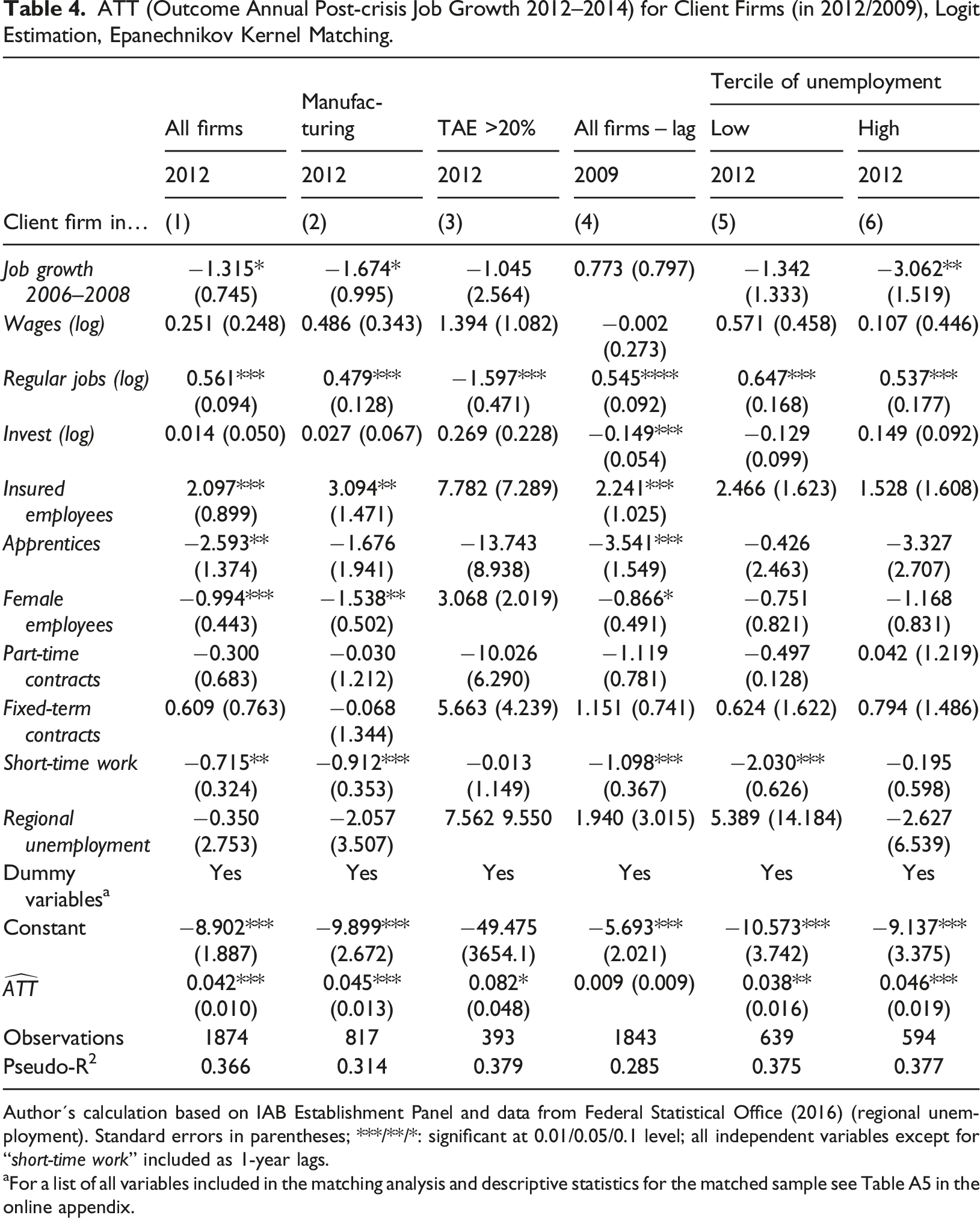
Author´s calculation based on IAB Establishment Panel and data from Federal Statistical Office (2016) (regional unemployment). Standard errors in parentheses; ***/**/*: significant at 0.01/0.05/0.1 level; all independent variables except for “short-time work” included as 1-year lags.
aFor a list of all variables included in the matching analysis and descriptive statistics for the matched sample see Table A5 in the online appendix.
The descriptive statistics for the complete sample reveal that close matches between clients and non-clients were achieved regarding all covariates (Table A5 in the online appendix). The ATT is significant and large in magnitude particularly for ‘intensive users’ in comparison with other client firms (estimation 3 in Table 4). Yet, since they only comprise a relatively small group, a bias from unobserved characteristics cannot be counted out. The variable ‘short-time work’ clearly confirms that it was less likely for client firms to revert to state-subsidized short-time work than for non-client firms with similar characteristics, as found by Baumgarten and Kvasnicka (2017). Among client firms in general, however, in 2010, a greater share (6%) also used short-time work than among all firms on average (3%).
Cross-sectional estimations of equation (3) account for a significant ‘treatment’ effect regarding client firms in comparison to non-clients with respect to annual job growth during the post-crisis period, amounting to a 6.6 percentage point growth difference (estimation 1 in Table A6 in the online appendix). Strong effects are also found again among ‘intensive users’ and a 1.8 point difference is found for firms located in regions with high unemployment rates (estimations 2 and 3). Yet, in these cases, the post-treatment effects are exceeded by even stronger differences in pre-trends.
Regarding large manufacturing plants, the analysis reports no significant difference in pre-trends between clients and non-clients, but a significant post-treatment effect amounting to a 1.7 point growth difference (estimation 4). In fact, for large manufacturing plants, the estimation of equation (3) confirms point estimates deriving from annual estimations (see Figure A1 in the online appendix), which suggest that the growth differences between clients and non-clients among this group were relatively small before the crisis (amounting to a 3 percentage point growth difference in 2006–2007), but rose to over 10 points in 2013–2014, following a period of volatility during the crisis.
While it is clearly beyond the scope of the cross-sectional analysis to identify a causal treatment effect of TAE utilization, both matching and DiD analysis suggest that a gap in job growth between client firms and non-clients among specific firms (large manufacturing plants) and regions (with relatively high unemployment rates) at least stabilized across the Great Recession. Finally, the two-way fixed effects (TWFE) estimation, which also controls for the pre-trend (2006–2008) when examining the ‘treatment effect’ experienced during 2009–2011 on post-crisis outcomes, finds a 0.6-percentage-point growth advantage among ‘treated’ clients firms over non-clients among large manufacturing plants.
Discussion and conclusions
The study provides new evidence on the functioning of temporary agency employment as an instrument of labour market deregulation. Drawing on agency workers serves as a means to cut wages, to prevent shirking and to make it easier to adapt to cyclical fluctuation. Substantial disadvantages are connected to agency work from the view of agency workers not being granted a stepping stone into regular employment. Undesirable effects, for example, on wages and job security, are likely at the macroeconomic level, if the agency sector acquires a large share of total employment. The empirical findings from this study suggest that agency work may have nevertheless helped Germany´s manufacturing industries to maintain permanent jobs secured by high standards of employment protection across the Great Recession of 2008/2009.
In order to address unobserved heterogeneity between (and within) firms, the first (and most important) part of the analysis uses a linear dynamic panel-data model (generalized method of moments (GMM)) that rules out both time-invariant and time-varying unobserved heterogeneity at the level of the firm. Since it is also of interest to study between-firm differentials in the consequences of utilizing agency employment, cross-sectional methods (matching and difference in differences (DiD)) are used, for which a bias from unobserved heterogeneity cannot be extinguished completely. Yet, the results from the different steps of the analysis are consistent.
Concerning basic research question i. The study finds that utilization of agency work coincided with larger numbers of regular jobs in German firms during and after the Great Recession. The basic question, whether TAE helps firms to adapt to cyclical volatility while maintaining a steady regular workforce is thus affirmed – under certain circumstances. As a whole, before and after the recession, more employees were hired directly by firms, which also utilized agency work and more regular employees were hired by firms, which hired more agency workers. The system GMM estimations for two separate periods establish that a 1% increase in the number of agency employees induced a 0.1% increase of non-agency workers in client firms during and after the crisis on average. A DiD estimation restricted to large manufacturing plants (for which a common trends assumption holds) reports an annual 1.7 percentage point advantage in the growth of regular jobs in client firms over non-clients during the post-crisis period (2012–2014). An additional two-way fixed effects (TWFE) estimation for large manufacturing plants confirms the DiD results, albeit suggesting that the impact was lower in magnitude. It finds an annual 0.6-percentage-point post-crisis growth advantage among clients.
While it remains difficult to determine the precise magnitude of the impact of TAE on the growth of regular jobs, the estimation approaches pursued by the analysis accordingly suggest a positive impact on manufacturing jobs. The different steps of the analysis confirm the finding of Baumgarten and Kvasnicka (2017) that regular jobs were more stable in client firms during the crisis and expands this observation to the post-crisis. Whereas hiring of agency workers paralleled with overall recruitment in the period of post-crisis economic growth, the analysis would not confirm that a reduction in the number of agency workers during the crisis coincided with a similar rate of dismissals of regular employees. Apparently, agency work provided firms with a ‘buffer’ that made it possible for them to stabilize regular jobs and to maintain them in periods of slump when dismissing agency workers.
As to research question ii. The panel (GMM) estimations confirm that the treatment effects concerning an intensification of TAE utilization were most prominent in manufacturing plants and in regions with high unemployment rates. The analysis thus adds to the finding of Meyer (2013), who demonstrates great regional variation in the impact of the crisis on agency work. As a whole, it can be argued that TAE supported adaptation of Germany´s highly regulated export-oriented manufacturing core to cyclical volatility. By providing sector-specific recruitment services and thereby supplementing regular jobs, TAE apparently improved the resilience of Germany´s ‘coordinated market economy’ (Hall and Soskice (eds.), 2001) in the course of ever-closer international interdependence accompanied by high volatility. In this respect, close integration of temp agencies among manufacturing clusters may provide an alternative to state-subsidized policy such as short-time work schemes. At least for a certain share (around 20%) of agency workers, further training is financed by either agencies or user firms. For these workers, agency employment may therefore provide advantages compared to short-time work schemes, which are reverted to less commonly among client firms.
As agency workers are usually assigned to client firms for short-term spells, the main functioning of TAE will correspond to short-term fluctuation in user firms’ labour demand over days, weeks or months rather than years. As this analysis demonstrates, it is plausible, however, that agency work can cushion large firms against fluctuation over longer periods.
With a view to question iii. It can be argued that in the specific German context agency employment supported adjustment of manufacturing industries to post-crisis recovery. After all, a gap in job growth between client firms, which hired more regular employees throughout the study period, remained stable in this period of upturn and firms hiring more agency workers also operated more efficiently in terms of revenue per employee.
Close integration of temp agencies among sectoral and regional manufacturing clusters suggests that TAE in Germany functions as an adjustment at the margins of its economic core. In this precise context restricted to large industrial plants, the undeniable disadvantages of agency work might be outweighed by the advantages. However, the apparent importance of TAE among manufacturing clusters would surely not provide arguments in favour of a more widespread application of temporary or agency work in general.
Supplemental Material
Supplemental Materials - Temporary agency employment: A supplement to regular jobs – under certain circumstances
Supplemental Materials for Temporary agency employment: A supplement to regular jobs – under certain circumstances by Uwe Neumann in Competition & Change
Footnotes
Acknowledgements
The article was motivated by preliminary work from a research project on behalf of the German Federal Ministry of Labour and Social Affairs (BMAS). I am grateful to Michael Kvasnicka for detailed comments, without which it might not have been possible to complete this work. I also thank Ronald Bachmann, Anna Maria Diaz, Lea Eilers, Rahel Felder, Martina Fuchs, the editors and two anonymous referees for helpful comments and Felix Lenz, Daniela Schwindt and Sarah Rühl for technical support. Last, but not least, I thank the ISG/RWI project team for raising my interest in the topic. This study uses the IAB Establishment Pan-el, Wave(s)  –2014. Data access was provided via remote data access by the Research Data Centre (FDZ) of the German Federal Employment Agency (BA) at the Institute for Employment Research (IAB) (project number 1134). Any remaining errors are my own.
Declaration of conflicting interests
The author(s) declared no potential conflicts of interest with respect to the research, authorship, and/or publication of this article.
Funding
The author(s) received no financial support for the research, authorship, and/or publication of this article.
Supplemental Material
Supplemental material for this article is available online.
Notes
References
Supplementary Material
Please find the following supplemental material available below.
For Open Access articles published under a Creative Commons License, all supplemental material carries the same license as the article it is associated with.
For non-Open Access articles published, all supplemental material carries a non-exclusive license, and permission requests for re-use of supplemental material or any part of supplemental material shall be sent directly to the copyright owner as specified in the copyright notice associated with the article.
