




Abstract
Digital and data-driven technologies are having substantial impacts on global production, with growing analysis within established frameworks such as Global Value Chains (GVC) and Global Production Networks (GPN). Given the claims, however, that digitalization is leading to transformations in the patterns of production and labor, further theoretical work is needed to consider how these frameworks fit with evolving dynamics. Beginning with critiques that mainstream GVC/GPN have poorly theorized the concept of value, the paper argues that a re-centering of value is crucial for improved understanding of digitalization. To do this, broader debates in the literature on the digital economy—on rent and surplus value—are reviewed. These debates provide an expanded perspective of value including a broader understanding of forms of techno-economic rent and the growing debates on heterogeneous forms of labor, shaping production. A stronger orientation towards value within mainstream GVC/GPN studies can absorb some of these ideas, but considering the evolving forms, conventional notions of governance and upgrading may be less viable.
Introduction
As digital technologies and connectivity have become widely adopted, the digital economy is becoming global. Beyond digitally-intensive firms in the so-called “new economy,” digitalization is pushing transformations across all sectors of the economy (Jordan, 2019). Acknowledging the important role that globally fragmented networks of firms play in the realm of production, this paper focuses on global production and digitalization (World Bank, 2019). There is a growing analysis that has sought to examine the implications of digitalization within globalized production, drawing on key frameworks such as Global Value Chains (GVC) and Global Production Networks (GPN) (e.g., Butollo, 2021; Foster et al., 2018; Howson et al., 2022; Kenney and Zysman, 2020; Li et al., 2018; Sturgeon, 2021). Such scholarship has been important in outlining some of the major patterns of change occurring in global production networks, identifying new global “digital leaders” and their role in governing and shaping production. Yet, as we will argue, such work has so far tended to neglect a deeper analysis of the core notion of “value.” Drawing mainly on mainstream GVC and “problem solving” approaches, development has been dealt with in relatively straightforward ways.
In line with the call that in the digital era “GVC/GPN research needs some ‘technological upgrading’ itself in order to come to terms with recent developments” (Butollo, 2021 p.2), this paper looks to map theoretical directions through an extended engagement with the concept of value. The motivation for the re-centering of value comes from the revival of analysis around the notion of value in the broader digital economy literature which forms the central discussion of this paper (e.g., Arvidsson and Colleoni, 2012; Christophers, 2020; Fuchs, 2010; Jordan, 2019; Srnicek et al., 2021). Here, theorizations have sought to move away from claims that technology leaders are “creating economic value” solely through their own innovation, towards an analysis of the digital economy and the altered relations of labor, control of knowledge production, risk, ownership of digital resources and financial imperatives amongst others. The intensity of discussion in this area arguably responds to limitations of knowledge—digital technologies and connectivity are playing an important role in altering production, work and labor, but grasping the nature of these changes requires further theorization. Returning to fundamental debates on value provides a foundation for these dynamics to be investigated through examining modes of capital accumulation, wealth creation and distribution in the economy.
This review paper therefore theoretically examines common frameworks of globalized production (GVC/GPN) from the perspective of value and brings these into a conversation with this literature on value in the digital economy, seeking to bring these two areas into stronger alignment. The paper does not advocate for a single underlying theory of value. Rather this re-examination of core assumptions of value reflects on a range of trajectories emerging in the literature. Discussion, however, is mainly grounded in economic conceptualizations of value and aligns with heterodox approaches that are critical of universal models of value solely grounded in price/market exchange. 1 The review particularly draws out discussion in two interrelated but distinct conceptual directions of value—those which have lineages linked to notions of rent, and those more closely aligned to surplus value. We use these two directions to discuss approaches to value within the GVC/GPN literature, how it is being conceptualized and extended within the digital economy literature, and ultimately reflect on their interrelation as a way of furthering the consideration of digitalization and production.
Such a theoretical analysis is important in pushing forward directions in using GVC and GPN studies related to digitalization. Patterns of value are often argued to be specific to their particular eras of capitalism and their historically-specific modes of accumulation (Harvey, 2018). Therefore, reflections on our assumptions about value are fundamental for building a clear picture of underlying processes of wealth creation and distribution in the global economy (Fuchs, 2010). The work can also further considerations of the digital economy. Where intangible and tangible processes of production are increasingly entwined, it is necessary to better incorporate an understanding of how prevailing industrial structure, institutions and forms of labor link into the changes occurring.
The argument in the paper proceeds as follows. The next section, ‘Global production analysis’ sets the scene. It reviews how the concept of value has previously been incorporated within frameworks of globalized production and highlights the growing critique of the conceptualization of value within so-called “problem-solving” approaches. This serves as the justification for further analysis. This section also introduces the emerging scholarship on digitalization in global production highlighting parallel limitations in terms of conceptualizations of value. In ‘Conceptualizing value in the digital economy’, the paper reviews the digital economy scholarship, emphasizing progressions linked to the two conceptualizations around rent and surplus value. In ‘Global production and the digital economy in dialogue’, the paper reflects on how digital economy debates can provide an expanded perspective of value including a broader understanding of forms of techno-economic rent, and heterogeneous forms of labor, shaping production. This is elaborated through a short illustration of online platforms and fashion production. Overall, we argue that a stronger orientation towards value within GVC/GPN can absorb some of these new ideas, but considering the evolving forms, conventional patterns of “governance” and “upgrading” may be less viable.
Global production analysis
Global production analysis and value
Globalized production is typically conceptualized within globally fragmented networks, chains or ecosystems of interconnecting actors. Global value chains (GVC) and Global production networks (GPN) are common frameworks that outline the forms of globally fragmented production, as lead firms focus on their core competencies and outsource activities seen to be non-core, or of lower value (Gereffi, 2001; Henderson et al., 2002). Spatially fragmented production emerges, taking advantage of conditions around labor costs and differentials in rules and regulations, amongst others (Coe and Yeung, 2015). These core frameworks have emerged from different disciplines and there have been intensive debates detailing their relative merits and lineage of these approaches (e.g., Bair, 2005). In this section, these frameworks are particularly reviewed in terms of their approach to value.
Some aspects of GVC and GPN have their lineage within Global Commodity Chain (GCC) research. Given its continued power in highlighting structural inequalities and its more sophisticated use of value concepts, an elaboration of GCC is prudent. Grounded in World Systems Theory, GCC elucidates the structural nature of a capitalist world economy, highlighting unequal modes of capital accumulation and links between surplus creation in periphery countries, captured elsewhere (Frank, 1986; Hopkins and Wallerstein, 1977). GCC frameworks approach this through an analysis of the global division of labor and the reproduction of these unequal relations—analyzing patterns of production and commodification across firms and territories (Bair, 2005). Global value chains (GVC) are more grounded in economic and business analysis. It responds to the observations that, at least in some regions such as East Asia, engagement with networks of production has supported the potential for firms to build capabilities. Through technological adoption and learning in production, they upgrade their positions. Therefore, through a closer analysis of sectoral dynamics, focusing on forms of governance, one can build an understanding of coordination, and consider strategies for upgrading within sectors (Gereffi et al., 2005). Global Production Networks (GPN) emerged from economic geography and make a closer analysis of the territorial implications of such globalized networks, with a focus on the interactive relationships between regional dynamics and power (Coe and Yeung, 2015). Thus, while the globalized inter-firm relations remain an important consideration for GPN research, attention is moved towards the ways productive activity is grounded within specific (and multiple) institutional contexts, labor relations and politics that will shape, and be shaped by their globalized nature (Henderson et al., 2002).
There remains continuing debate about the complementarity and divergences of these approaches (Bair, 2005; Selwyn, 2019). However, one commonality is that all these approaches ascribe a central position to value. Although they can embed diverse approaches, it is useful to define the major orientations as a starting point for a more in-depth analysis of value. Two major focuses are introduced below, one which associates value with forms of rent, and one that focuses on surplus value (Havice and Pickles, 2019; Selwyn, 2019).
Value and rent
A mainstream direction on value focus on how firms can create value within the contexts of chains of production (World Bank, 2019). Kaplinsky’s (1998) popular theorization positions this within Schumpeterian gains in the market. Firms capture value through short-term “quasi-rents,” created in a variety of different conditions including innovation, branding, marketing, and a favorable supply of inputs. Quasi-rents allow firms to gain temporary economic profit over competitors and/or exclude others from competing with them within the value chain (Kaplinsky, 1998). Subsequent investments, technology development and economies of scale can act as barriers to competition and thus short-term rents can become more prevailing (Gereffi, 2001). These quasi-rents might be seen as a source of upgrading allowing firms (subject to broader chain governance) to improve their position within production.
Such approaches to value creation resemble subjective traditions where value focuses on market exchange. It can also incorporate neo-Richardian perspectives through the notion of “composite quasi-rent.” Composite quasi-rent emerges because quasi-rents may require specific skills, creativity, and the ability to use technologies. Therefore, capital and labor may negotiate for their share of the “quasi-rents” produced with potential implications for firm competition and labor (Roy, 2012).
Such a focus on rent has been core to GVC, GPN-orientated studies have also looked to examine the spatial implications of quasi-rent, including how nation-states and regions may create the conditions for quasi-rent including taxes, infrastructure, and institutional support that support more systematic improvements within GPN (Coe and Yeung, 2015). Other more critical viewpoints on rent have been more sporadically incorporated into analysis, particularly in cases where inequality and development are discussed in relation to production. Therefore, rent might be more closely linked to market monopolies, land control and other types of monopolies. These views then more critically emphasize how value can be captured within production (Werner, 2018).
These represent the mainstream ways that rent has been incorporated into GVC analysis. However, other scholarship has emerged where discussions of rent are subsumed within broader competition amongst capitalists and differential rates of profit. Theoretically, Starosta’s (2010) critical elaboration of GCC provides an outline. He rejects the sectoral focus on strategic assets and barriers to entry erected by firms. Rather, he suggests, a closer emphasis on the wider capitalist conditions is important. Drawing on Marx’s theories of value and notions of general rates of profit, he contrasts relations between “enhanced capitals” (actors who earn an above-average profit) and “small capitals” (actors who earn a below-average profit). This then forms the basis for differential accumulation within broader conditions of capitalism. Complementary work does not so singularly draw on Marx’s theories as Starosta but follows similar directions through a broader economy-wide analysis of historically-specific patterns of accumulation (Baglioni et al., 2021; Werner, 2018). Such approaches acknowledge the ability of capitalists to gain above-average profit in certain activities, but they center this within economy-wide dynamics (Baglioni et al., 2021; Havice and Pickles, 2019). For example, economic patterns around standardizations and homogenization of labor, intangible assets and intellectual property have been studied as crucial in shaping the spatial division of labor and variable rates of profit (Baglioni et al. 2020, 2021; Durand and Milberg 2020). Within such competitive dynamics, one might also think about the broader circuits of value. Such analysis has particularly focused on financialization and its implications for production (Palpacuer 2008). For leading firms, profits can be associated with a range of financialized strategies, and imply more “vertical” chains of interrelations of capital that ultimately impact “horizontal” production relations (Palpacuer and Smith, 2021; Quentin and Campling, 2018).
Surplus value
The other major focus of value has come from work adopting a labor theory of value perspective with a focus on surplus value. With its closer lineage to World Systems Theory, GCC research has often centered this in terms of the global divisions of labor, with a focus on the global configuration of uneven capital-labor relationships manifested within specific sectors of global production (Werner, 2018). Some GVC studies also provide important perspectives on manifestations and forms of surplus value. While centering firm relationships, quasi-rent is underplayed in favor of value centered on the exploitation of workers within the global value chain (Barrientos et al., 2011; De Neve, 2014). Alongside analysis of labor exploitation, an understanding of patterns of surplus value will also link to forms of labor contestation and alliances within fragmented production (Carswell and De Neve, 2013; Smith et al., 2002; Taylor et al., 2013). GPN studies have also increasingly explored labor. They more strongly emphasize spatial variations in surplus value and workers’ rights, including examining the nature of labor agency, contestations and institutions as core factors (Coe and Hess, 2013; Rainnie et al., 2011).
Most analysis of surplus value focuses on details of labor within the direct capital-labor relationship within specific sectors. Nevertheless, some literature has looked to expand the scope of focus. Approaches grounded within feminist critiques of the labor theory of value argue that surplus value studies can underplay the role of reproductive labor as a socially important form of labor in the economy (Fortunati, 2007). This has led to an examination of those activities that suit outside direct forms of surplus value creation. It seeks to connect production patterns to an examination of institutions, non-capitalist production, and welfare regimes amongst others. (Naidu and Ossome, 2016, 2018). This approach decenters the surplus value relationship, to more closely consider its links to social reproduction and political economy. In this area, there remains debate about how one should approach such patterns of social reproduction within surplus value. Some suggest this represents a weakness of surplus value perspectives that needs a more substantial inclusion of a variety of forms of “labour,” “capitalism is not defined by the presence/absence of wage-labour. It is a mode of production based on the extraction of labour-surplus through a variety of ‘forms of exploitation’” (Mezzadri, 2021 p.1194). For example, one might make a more expansive analysis of the links between surplus value and social reproduction that directly impact surplus value in GCC (such as domestic labor as a subsidy for capital, and forms of household-based labor) (Bieler and Morton, 2021; Mezzadri, 2019). These discussions about wider patterns of surplus value have also emerged when examining the relationships between surplus value and other types of “non-chain” productive activity (McGrath, 2018). An analysis of how particular spaces reproduce inequality through globalized networks (notably for those in peripheral locations), better links value in global production to contexts and richer histories and struggles (Werner, 2018). This has particularly been taken up in studies of “disarticulations” that move to consider “…an alternative focus on the social and spatial processes that under-write these chains.” (Bair and Werner, 2011 p.1013).
Critiques of value approaches
Rent and surplus value as overarching concepts, and specific expression within the global production literature.
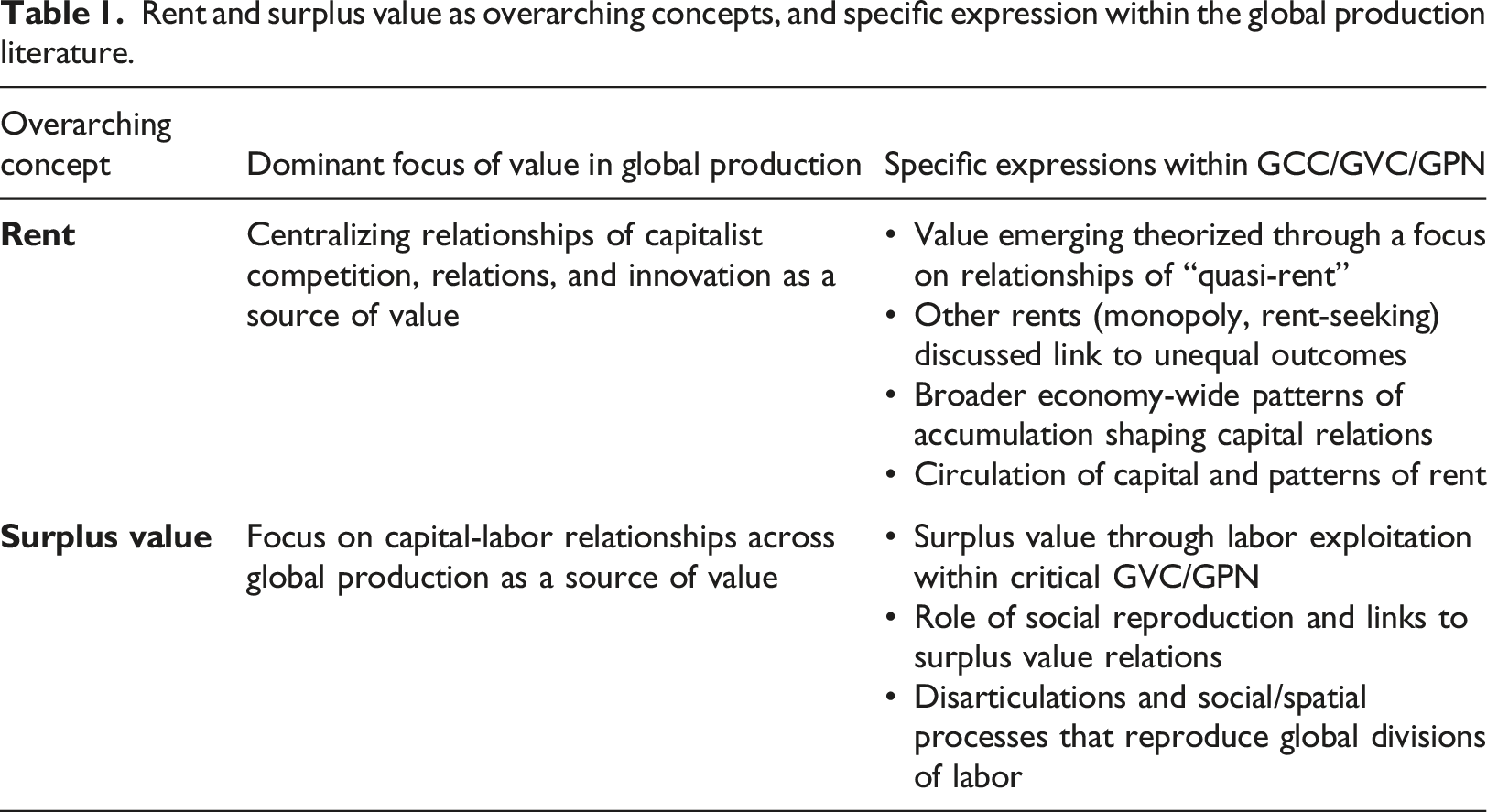
This wide use of value is not without challenges. A long-standing critique is a lack of clarity in the use of value and the way overlapping (and contradicting) value traditions are implicitly used and uncritically combined (McGrath, 2018; Quentin and Campling, 2018). Taylor (2013 p.2) goes as far as to suggest that typically “value has certainly taken on multiple meanings in GCC, GVC and GPN analysis, rendering it frequently meaningless.” A particular challenge is that the rich nature of value is underplayed compared to policy-orientated analysis (Selwyn, 2019). This is particularly the case in the mainstream applications of “problem-solving GVC,” which rarely take an overt value position. Here understandings of value can quickly move to a narrow orthodoxy of quasi-rent, or even folding towards economic-like calculations of value-added (Havice and Pickles, 2019). Even where surplus value and labor are incorporated into thinking, mainstream GVC and GPN studies may deemphasis patterns of value. It is relational analysis—whether that be network relations, governance, coordination, labor coercion, or power—that is more prominent in analysis with value taking a back seat. As we will argue in the next section, these limitations in value analysis are especially pertinent to our understanding of digitalization. A significant amount of the early literature in digitalization has focused on patterns of changing network, governance and control. There is potential to step back and reconsider aspects of rent and surplus value in this context.
Digitalization within studies of global production
The term digitalization has been used, to broadly describe how the integration of digital systems, the use of digital products and services and the emergence of digital data are facilitating change across a wide range of sectors (Brennen and Kreiss, 2016). It reflects the evolution of debate that has moved away from a narrow focus on the transformational impacts within the “internet economy” (somewhat separated from the broader economy) to focus on the integration of digital firms, resources and data across sectors, regions and all stages of production, distribution, and consumption (Brynjolfsson and Kahin, 2002).
Historically, the emergence of digital technologies has not been ignored within studies of global production. Major trends around fragmentation and outsourcing have been partially attributed to the ways that new communication infrastructures enable actors to communicate and coordinate activities across space (Baldwin, 2016; Henderson et al., 2002). Such views have evolved with the growing role of digital technologies. Recognizing the growing scaling of digital services, the flexibility and re-programmability of systems and the way that these resources begin to organize production and labor, it has become important to consider evolving digitalization (Foster and Graham, 2017).
Recent studies have sought to, therefore, more directly examine digitalization. Research has primarily drawn on frameworks of GVC, to describe how digitalization alters the governance and key actors in such chains. Brun et al. (2019) findings highlight key ideas. In some sectors, leading firms have led by integrating digital systems and services, cementing their sectoral governance. An alternative is an emergence of “digital multinationals” that become more disruptive lead firms and shape value chain governance. Given the heterogeneity of sectors, how these scenarios play out will relate to the nature of actors, products/service producers and transactions occurring (Foster et al., 2018; Sturgeon, 2021). Some studies also highlight cross-sectoral trends that occur beyond specific GVC (Butollo et al., 2022; Howson et al., 2022; Kenney and Zysman, 2020). Digitalization can define multifaceted (direct, standards, infrastructure) and multi-sectoral domains of coordination with implications for the concentrations of power and control.
Examination of digitalization and labor has also included some discussion of global production, albeit with less direct reference to specific frameworks such as GVC/GPN in many cases. As digital technologies are adopted by capital it may have uneven spatial impacts as jobs are automated, or else job roles evolve across specific segments of production, reducing the quality of work, their pay or their rights (Helmerich et al., 2021; Huang and Sharif, 2017). Work drawing on labor process theory has also outlined in more detail the changing patterns of work in sites of digitalized production. One important direction has been the ways that digitalization of the labor process feeds into performance measurement and control (Urbinati et al., 2018). This might happen at different scales. Within production facilities, “Digital Taylorism” implies performance becomes monitored and for laborers, potentially induces repetitive, stressful working conditions as well as alienation (Englert et al., 2020). Other types of labor such as online labor are mediated by systems that can shape activities through their design and algorithmic management (Rani and Furrer, 2021). In highly digitized workspaces, these patterns of monitoring and performance may become internalized within the work patterns and motivations of individual laborers (Moore and Robinson, 2016).
Digitalization is also particularly significant for value chains in the way it facilitates and integrates logistics and distribution, with implications for how production sites are interconnected (Butollo et al., 2018; Lüthje, 2019). At an inter-firm level, processes of “digital control” highlight the role of data in strengthening patterns of monitoring and standardization across different firms in value chains (Foster et al., 2018; Helmerich et al., 2021). These patterns have also enabled the incorporation of SMEs, individuals and “gig workers” more readily into global production (Foster and Bentley, 2022; Graham et al., 2017). For labor, such incorporation has often occurred under significantly adverse terms (e.g., low pay, unstable jobs, lack of employment rights and transferred risk) that lead to expanded profits to capital (Berg et al., 2018). Digitalization and associated changes also have implications for organized labor and resistance associated with digitalization. More fragmented and controlled laborers may be less able to organize against problematic issues (Helmerich et al., 2021; Woodcock, 2020). Yet, new forms of resistance may emerge to allow pushback again such challenges (Englert et al., 2020).
In sum, this work has revealed important new trajectories for global production studies. These directions bring in some ideas of rent and surplus value, but further work is needed in thinking about value. Discussion of digitalization that incorporates GVC tends to forefront changing sectoral governance and upgrading, in line with the “problem solving” GVC approaches critiqued previously, with little consideration about what value means. Rich discussions of digitalization and labor have tended to focus quite narrowly on productive spaces (factories, gig economy) with less discussion of more holistic patterns and networks of value (with exceptions, e.g., Helmerich et al., 2021; Howson et al., 2022). These limitations are more urgent to address if, as suggested by this literature, new types of processes and modes of accumulation are emerging in the digital economy. Re-centering value can support clearer worldviews and consideration of assumptions around wealth creation and distribution.
Conceptualizing value in the digital economy
Contrasting key trajectory of value in global production frameworks and the digital economy literature.
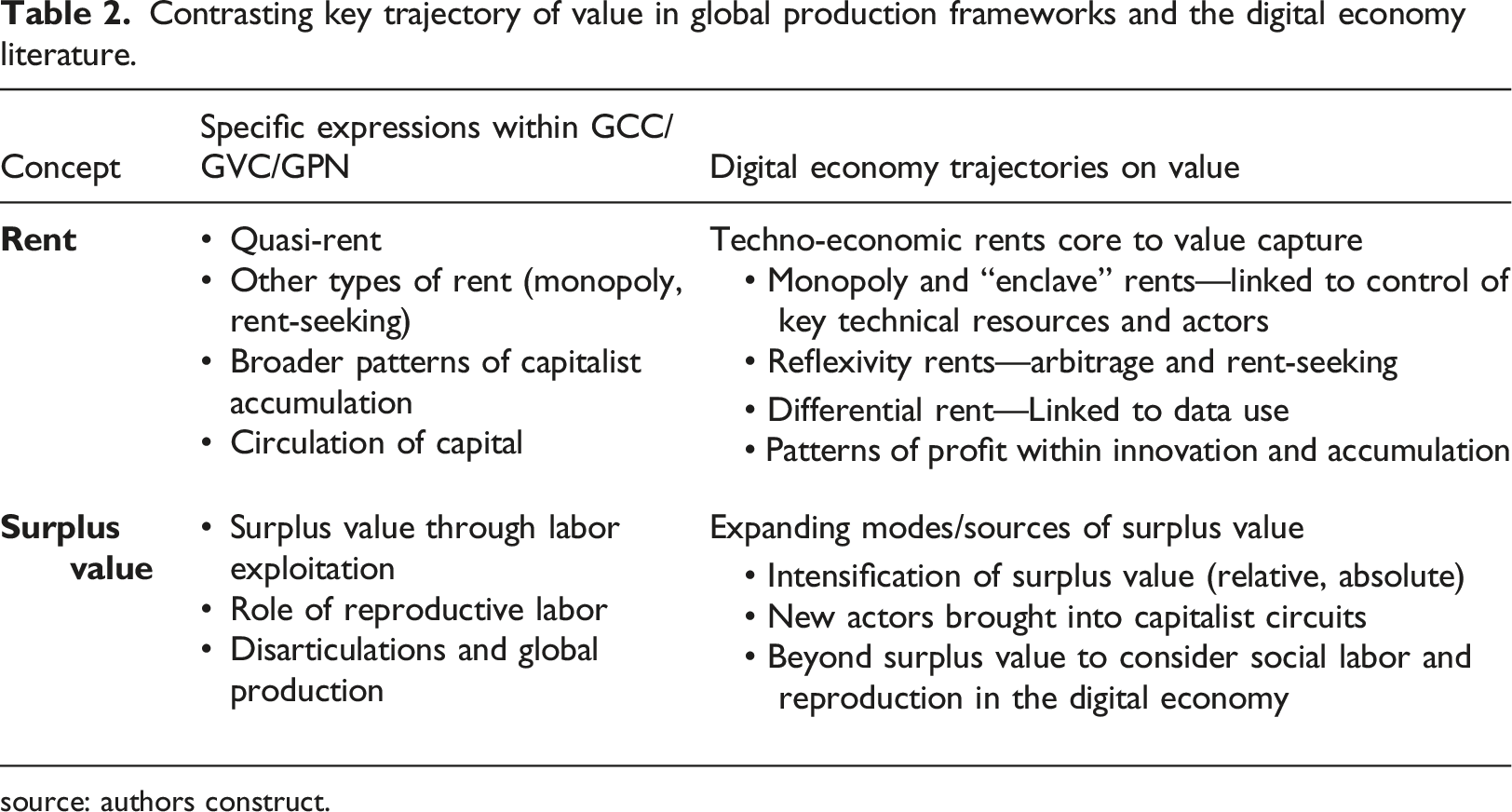
source: authors construct.
The notion of rent
The notion of rent is arguably the defining discussion in the digital economy literature, particularly as leading firms have been positioned as becoming key actors in late capitalism (Christophers, 2020; Mazzucato, 2018; Morozov, 2022). These discussions focus on the dominant role that digital firms are playing in the economy, extracting profits, rapidly expanding and controlling markets. In the context of the digital economy, the manifestations of economic rent might lead to an expanded set of conditions and processes by which actors position and create value. Therefore, rent is “as much a ‘technical-economic phenomenon’ as it is a ‘juridical relationship’ (e.g., property rights)” (Birch, 2020 p.8).
Rent principally emerges through the way that technical assets (e.g., digital platforms, systems, cloud services, infrastructure, and data/datasets amongst others) are monopolized (Christophers, 2020; Srnicek et al., 2021). The dynamics of such technical assets can expand the opportunities for rent, such as through economic “network effects” which support the rapid growth of leaders and act as a barrier to competition (Srnicek, 2016). Technical and intellectual assets are used to orientate activities and embed standards, rules and norms and leads to the control of systems by leading firms (Rigi, 2014). In these contexts, it is appropriate to think not only about monopolies of firms but how key technology control orientates the “enclaving” of complimentary actors and ecosystems (Birch and Cochrane, 2021; Rikap, 2020). It has been these forms of rent that form the basis for the increasing power and domination of digital technology firms in the economy.
As Christophers (2020 p.20) argues, “monopoly control of an asset is nothing economically if the owner lacks the power to monetize that asset in market exchange.” This statement has been pertinent in the digital economy because research suggests that direct profits from scarce assets have, in many cases, not been the major source of gains in the digital economy (Jordan, 2019). In some sectors, firms may capture profits directly from monopoly control of platforms, cloud systems, selling data etc, but it is often other patterns that can reap excess profits (Fuchs, 2010). Important manifestations of rent then link to “reflexivity rents,” which align somewhat with ideas of “rent seeking.” Rentiers use their monopoly control to seek points of arbitrage, market-shaping, spatial advantages, regulation, or other rule-bending to produce profit (Birch and Cochrane, 2021). In the digital economy, given opaque operations of digital systems and the ability for complex operation across borders, there are wider opportunities for reflexivity rents including, for example, complex platform cross-subsidization schemes, algorithmic pricing and manipulation of platform users may yield enhance profits (Fourcade and Healy, 2017). In contrast, “engagement rents” hark back to Ricardian ideas of differential rents. In the digital economy, these types of rent have been important given the growing importance of large-scale data (Zuboff, 2018). Excess gains come in how rentiers reap rewards for improved engagement, particularly through the use of data and associated data capital (Urbinati et al., 2018). For example, firms profit as they build resources which leads to significant improvements in profiling, matching, and targeting online based on monopoly control of data (e.g., more rapid transportation scheduling in apps) (Birch and Cochrane, 2021).
The revival in discussion on rent linked to the digital economy arguably reflects more novel dynamics (particularly elaborations of enclave, reflexivity, and engagement rent) and the potential for these to lead to firms capturing significant value. Discussion of these new patterns of rent within the digital economy have, however, led to significant critical pushback. A major critique is that such rentier firms are often characterized as simply value capturing, as represented by Mazucato’s (2018) “makers” and “takers” of value (harking back to older visions of rentiers often as landowners sitting back and reaping profits). This critique then reveals an additional complication of rent in the digital economy—even with excessive profits, digital leaders are investors and innovators. They are often playing an important role in building aspects of the productive economy (Comor, 2015; Morozov, 2022; Srnicek, 2016).
Given these critiques, the concept of rent needs to be carefully approached in the case of the digital economy. It may not be constructive to center rent, particularly as a source of power. Rather it can be seen as an outcome tied up within specific relations and processes of accumulation related to the digital economy (mirroring the non-mainstream discussion of excess profits discussed in the earlier section). Therefore, rent has more closely been connected to competitive dynamics. Economy-wide sources of rent and divisions of labor emerge through historically-specific processes of digital innovation, investment and/or control of intangibles (Rigi, 2014; Rikap, 2018). In the digital economy, for example, firm concentration or monopoly is often linked to the nature of financialization, characterized by unique investment patterns centered on constructing market value, where valuations may take precedence to exceed revenue streams or utility (Birch and Cochrane, 2021). Rents for firms that come from data and network effects are driven by financial actors who push firms toward scaling assets and acquisitions based on their perceived monopolies and future rent (Rahman and Thelen, 2019).
Theorizing surplus value
Surplus value in the digital economy has been examined in terms of both relative surplus value (an increase in the intensity of work) and absolute surplus value (extending working time). With relative surplus value, digitalization has been associated with improved efficiency that impacts surplus value. For example, digital disintermediation, communications, and coordination can reduce the labor time and costs involved in coordination leading to improved profits (Foster et al., 2019). More critical views would argue that major gains in relative surplus value are mainly through the more intense, dehumanized, and monitored work patterns associated with digitalization (Woodcock, 2020). Absolute surplus value is also important given that platforms or systems may facilitate forms of spatial mobility or fragmentation that allow capital to dissembled certain rules, institutions or organizational fixes leading to extended working time (Wood et al., 2019). In many areas, relative and absolute surplus value overlap. Where digital platforms incorporate new types of SME and individual actors into productive relationships, it can lead to competition amongst workers that leads to both longer working time, adverse terms (e.g., higher demand, monitoring, risks) and greater intensity leading to significant precarity (Graham et al., 2017).
Analysis of the digital economy and value has also opened up debates concerning the nature of laboring in production (Day, 2015). One direction comes from the porous division between consumers and producers. In his well-known discussion on the mechanics of social media and “free labour,” Fuchs (2010) outlines that consumers are the source of significant profit for firms through their online interactions. Seeing consumers as a new frontier of the commodification of value, their activities are argued to be productive and play a significant role in the creation of value (Fuchs, 2010). A parallel discussion on the nature of labor has emerged in the commodification of social reproduction where actors are being pulled into precarious relationships and intermediated by digital technologies, where productive and social reproduction increasingly overlap (Gandini, 2020). As outlined in earlier sections, because these observations on laboring stretch some readings of the labor theory of value, they have attracted significant debate on how they fit into notions of surplus value. For example, one can contend where such digital consumption activities are undertaken voluntarily, or when certain types of labor are unpaid, they do not fit into the idea of surplus value (at least not in a strict reading of Marx’s accounts) (Arvidsson and Colleoni, 2012; Comor, 2015).
The counter-argument to this is that as patterns of accumulation change, we need to consider broader dynamics of commodification and value that may be outside previous paradigms to understand labor exploitation by capital. These explore the “quite different regulatory and political worlds, with constitutive consequences for the actually-existing form of these digitized world-economies” (Peck and Phillips, 2020 p.87, Ström, 2022). Trajectories move toward the integration of post-Marxist perspectives in thinking about value (Hardt, 1999; Moulier Boutang, 2011). Day (2015), for example, points towards the key role that complex algorithmic resources such as Google PageRank and Facebook's network graph as a source of control and profit. Such constructions are representations of relations or interactions that provide the basis for core activities and divisions of labor. At the least, such discussions on value imply the need to better trace how labor and/or individuals’ activities become sources of profits in the digital economy, even if they blur the boundaries of surplus value.
In sum, digital economy literature provides useful consideration of value. In terms of rent, the dominant discussions connect to novel aspects of monopoly rent, and the different dimensions by which this occurs. In terms of surplus value, the literature on the digital economy often argues that digitalization extends core patterns of surplus value. However, in both dimensions, there are considerable debates about the key concepts themselves of “rent” and “labour” that lead to a deeper analysis of value. The two broad conceptual directions have also had relatively limited conversations with each other, suggesting further work can consider the inter-relationships (Morozov, 2022).
Global production and the digital economy in dialogue
Digitalization and production: Alibaba and fashion goods
We present an illustration related to Alibaba’s expansion and a discussion of fashion goods trading on Alibaba’s platforms. While an extended empirical analysis is beyond the scope of this theoretical paper, we use this case as a vignette to elaborate the theoretical discussions, drawing on secondary sources. 3 Manifestations of value discussed in the previous section are illustrated with a focus on Chinese platforms and the production of fashion goods sold online. This illustration provides some insights into rent and surplus value and serves as a starting point to consider their implications for global production.
Over the previous decade, Chinese platform firms have become highly concentrated. Alibaba initially focused on global business-to-business (B2B) sales. Through the benefits of network effects and with significant amounts of investment capital, it has rapidly expanded over time. Alongside platform expansion, Alibaba has become a leader through its “platform ecosystem,” most notably by controlling the leading digital payment providers. Not only does this provide significant revenue, but results in barriers for affiliated platform sellers to shift to platform competitors due to the tight integration of such ecosystems (Wang and Coe, 2021). The outcome of these dynamics is that Alibaba has significant control of e-commerce markets. For example, in the domestic B2C sector, Alibaba has a 47.1% share of sales in 2021 (Cramer-Flood, 2021).
Such indicators of monopoly can, however, conceals the exact ways a firm like Alibaba has been able to gain excess profits. The 2019 annual report highlights that direct revenue from platform commissions for Alibaba’s Chinese retail amounted to only 23% and is in decline (akin to direct monopoly profits). This compared to 57% came from “customer management.” This category mainly encompasses paid-for features where, for example, platform sellers bid for prominence in searches or pay for targeted advertising (Alibaba Group, 2019).
In the area of fashion goods, platform-driven business models have allowed for the possibilities of firms using platforms to innovate and upgrade. Firms, both domestic and international, have found that through branding and product innovation it is possible to use online platforms as part of rapid production upgrading (Li et al., 2018; Zhou et al., 2019). Nevertheless, the combination of these new models and (monopoly) platform mediation has led to significant challenges for many involved in production. We particularly highlight the critical documentation on “Taobao villages,” a subset of platform production in rural or semi-urban clusters of low-income producers of Alibaba in China. These types of platform producers dominate the “low-end” of domestic production (which is frequently in the apparel sector). 4 Alibaba guides such Taobao villages through the provision of service centers, local infrastructure, training, and as well as through its supply chain software (Wei et al., 2020). Given the significance of Alibaba’s platforms in China, fashion sellers often have little choice but to use such platforms if they wish to sell online.
The form of intermediation through platforms orientate networks of fashion production, “..existing fragmentation of small-batch production in traditional low-end manufacturing is reshaped and reinforced under platform-based sales and distribution systems with fine-grained internal division of labour” (Lüthje, 2019 p.13, Wang and Li, 2017). A significant trend in fashion has been the emergence of “test and repeat models,” that allows sellers to operate zero inventory businesses, test markets, and adapt fashion trends using data “through the consumer clicks, collections, shopping cart data on the Taobao platform” (Aliresearch, 2015).
Taobao villages have been celebrated as an economic success by institutions such as the World Bank given they have become important for rural job creation in China (Luo and Niu, 2019). However, detailed reports have outlined how these changing dynamics have led to significant labor issues. These conditions are particularly marked by the way that suppliers of specific goods in rural China are clustered, often marked by high levels of competition and imitation (Li, 2017; Zhang, 2020). For labor, “the workplace as well as living environment in many Taobao villages and urban villages producing for Taobao are poor. Informal employment gives rise to thorny labor issues, such as child labor and wage arrears” (Lulu, 2019 p.18).
While discussions of non-factory labor have been well documented including in China (De Neve, 2014; Mezzadri and Fan, 2018), studies of Taobao villages suggest platforms are a contributor to the expansion of micro-factories and courtyard labor. This is leading to growing concerns about how they incorporate family labor and migrant workers as flexible labor (Lüthje, 2019; Yu and Cui, 2019). Labor challenges not only concern the physical conditions but increasingly the link to technological systems “[store workers]…reported that they had to invest considerable mental and affective labor into customer service…because of the expectation created by the instantaneity of IM communication and the norms of the seller community on Taobao” (Zhang, 2020 p.123).
These descriptions provide some useful empirical context to consider the micro-level aspects of rent and/or surplus value creation. More broadly, one can also recognize the source of the power of such platforms and the way Alibaba controls ecosystems through its financialized and “conglomerate” structure. This enables them to marshal platform transactions, aggregate diverse data collected and supports improved quality of “data intelligence” at the aggregated scale (Jia and Kenney, 2022). From this viewpoint, the financialized forms of Alibaba and its building of capital and infrastructure drive diverse rentier positions and profits are mainly due to the gains at an aggregated scale (Wang and Coe, 2021; Zhang, 2020). Scale, cross-segment, and cross-sector expansion are important dynamics which complicate analysis in terms of considering sectoral value patterns and surplus beyond specific sectors such as online fashion.
In sum, this case highlights important aspects of production relationships and changes as digitalization expands. Importantly, it illustrates the increasing overlap between the tangible and intangible aspects of production across the chain. The nature of monopoly positions and labor exploitation are also interlinked through a more detailed analysis of their interrelation with the value chain.
Value trajectories
Using this case to reflect more theoretically, it might be viable to incorporate such findings within existing global production frameworks. One might see Alibaba as an emerging “lead firm” governing global/domestic value chains. Alternatively, a focus on the patterns of labor in GVC as mediated by platform intermediaries can be useful. Yet, the case alludes to important extensions that might be considered further.
Rent: Discussion of global production, particularly those from a GVC perspective have been centered on conceptualizations of rent, particularly quasi-rent. The debates from the digital economy would suggest the continued importance of rent but posit more diverse patterns of techno-economic rents. As shown in the illustration, these rents follow different patterns from those conceptualized in conventional models of global production.
Nevertheless, these expanding perspectives on rent might be readily incorporated into a more conventional analysis of global production to highlight sites of value capture, albeit with some care to examine the forms and ways that profits emerge include analyzing the nature of rent and the specific assets that are “monopolised,” and how assets and positions of rent are used to capture value from these positions of rent. This case also supports the idea that rentier positions are often maintained through more ephemeral aspects than previously—relating to the control of customers, key platforms, data, market dominance, producer lock-in, or a combination of these.
However, some modified emphasis will be needed on how to consider the central object of previous GVC/GPN studies—power, coordination, and governance. In line with the incorporation of digitalization into dominant GVC models. Emerging research of GVCs and digitalization has provided useful views to think about the way new digital leaders emerge, guide, and control production (e.g., platforms, lead firms, control of ecosystems). Given the variety of rents and their application as outlined in previous sections, such work needs to consider broader ways that power is embedded within value chains (and the way these are resisted). Dallas’ (2019) work moving beyond the direct and dyadic forms of power (i.e., governance) towards a consideration of more diffuse and collective forms of power is complementary to how firms with positions of rent, propagate norms, and rule-setting may be useful in linking to forms of guidance and power in digitalizing value chains (e.g., Foster et al., 2018; Sancak, 2021).
Surplus value: Digitalization can be seen as part of broader late capitalist processes of accelerating surplus value, whether that be how digital enables different modes of organizational fix, or in the ways that digital technologies are increasing relative surplus value through processes such as datafication and digital surveillance. These will come with evolving patterns of labor contestation and resistance.
Surplus value arguments in global production have centered classic capital-labor relations and divisions of labor as core to power. In a digitalized context, however, one needs to think carefully about what defines capital and labor. Capital, when it is increasingly incorporated intangible capital (e.g., data capital, social relations) suggests very different patterns of how capitalists build and protect these to control global production. In addition, the cleavages whereby labor can build counter-power in production are also likely to be somewhat different (e.g., selective rejection in platforms).
A challenge also comes in how to incorporate new modes of surplus value creation and capture, particularly as intangible aspects of production have become more entwined across all stages of production. Consideration of varying forms of surplus value across different sites is core to recognizing different types of labor changes that emerge. This includes consideration of the often less visible aspects of surplus value (e.g., time spend building reputations, online interacting with customers), the sources of labor exploited by capital outside conventions forms (invisible workers, prosumers) and the ways that types of laboring are integrated or separated from each other (Jordan, 2019; Qiu et al., 2014). Digitalization also suggests extended attention to work outside the workplace (e.g., overlap of work and non-work time, the role of so-called “free labour” in production).
Integrating directions: For some scholars, these trajectories around rents and surplus value represent a distinct set of propositions and theories: between subjective theories of value versus labor theories of value; between value creation and capture; between economic approaches and critical approaches to global production. However, for digitalization and global production, it can be prudent to see these approaches as overlapping and with competing concerns (as reflected in the illustration).
Firstly, and in line with non-mainstream and GCC analysis of rent, one might make a closer consideration of the broader processes of capital accumulation as information, knowledge, infrastructural and technological resources come to the fore. Approaches would start from an analysis of these resources and how they allow different groups to complete and capital value (Morozov, 2022; Srnicek et al., 2021). This suggests approaches more aligned with previous analyses on forms of capitalist accumulation where the resultant divisions of labor are an outcome of these patterns (Baglioni et al., 2020; Durand and Milberg, 2020).
Secondly, one might argue that digitalization is driving new patterns of accumulation that do not match previous paradigms. This includes thinking about how new forms of value are linked to cross-sectoral resources such as aggregated data, and broader intangible capital is increasingly central (Peck and Phillips, 2020). The nature of these patterns of accumulation has been described as a “thin layer, spread unevenly across the capitalist world-system, overlaying older patterns of social practice” (Ström, 2022 p.30 emphasis added), that are “neither acquired nor maintained through traditional forms of direct ownership….instead accrued through distinctive, digitally-enabled capacities to control and manipulate markets” (Peck and Phillips 2020 p.79).
This work then somewhat aligns with previous discussions of the integration of finance, global wealth networks and value form theories into global production literature. It moves outside tangible production relationships to concentrate on understanding new patterns of circulation and accumulation which then serve as the basis for studies of production. In cases where a closer analysis of accumulation patterns and digitalization is made, a more critical standpoint might be emphasized to power. Where consideration is on circulation of value and competition amongst capitalists, traditional chain-type power differentials as characterized by governance appear less powerful. Mapping these within the broader “layers” of control is crucial and power and governance may be seen more as an outcome of accumulation trajectories as necessarily as a cause.
Conclusion
The starting point of this paper was the argument that the literature on digitalization and global production requires further development in terms of the concept of value—to better conceptualize evolving production and labor. However, the “problem-solving” GVC/GPN frameworks that have been predominantly used have been limited in their application of this concept. Critiques around the failure to link with the evolving global patterns of value and the lack of clarity in underlying approaches are particularly challenging.
The paper has highlighted directions towards how we might recenter value to discuss processes of production that are increasingly being digitalized. Relevant discussion of value has particularly been associated with two areas identified from the digital economy literature: centered on debates on rent as core to processes of value and an expansion of thinking around labor that highlights the importance of tracking conventional patterns of surplus value, as well as critically exploring other types of commodification.
Reflecting on what this means for digitalization and global production. Conceptualizations of value in the digital economy suggest closer attention to the notion of rent. This includes studies of rent that move towards examining processes of rent and the unique rent-seeking patterns that digital rentiers take. As rent often comes in processes that exist outside the direct production relation, a more critical analysis of the relationship between rent-seeking and forms of control and power may diverge from prevalent ideas of value chain governance and coordination.
It has been well documented that digitalization has expanded surplus value through squeezing and optimizing labor, with implications for workers and their work. Beyond this, value creation comes more readily integrated with the ways that users’ activities are commodified by digital systems and other ways that intangible aspects of production are increasingly commodified. As the discussion of fashion production has illustrated, care is needed in thinking about the seams between more traditional forms of labor exploitation and these new modes, which might be argued to become increasingly central to large firm profitability as they digitalize.
With some modification, these approaches can be integrated within core frameworks of GVC/GPN literature, and indicate important trajectories of focus in considering forms such as understanding new forms of rent, and more careful orientation around labor and surplus value. However, tying these directions together may require more distinct approaches that begin to consider broader patterns of capitalist competition and distinct “layers” of digital accumulation. These approaches in turn would increasingly question core notions of governance and upgrading.
Footnotes
Declaration of conflicting interests
The author(s) declared no potential conflicts of interest with respect to the research, authorship, and/or publication of this article.
Funding
The author(s) received no financial support for the research, authorship, and/or publication of this article.
