Abstract
This paper examines the innovation strategy of Siemens, a key player in Europe’s digital economy, by performing network and lexical analyses using data derived from Siemens’s patents and scientific publications since 1998. We observe that the company’s innovation efforts evolved from a broader attempt to develop internal information and communication technology (ICT) capabilities – alongside its historical industrial priorities – to a strategy focused on developing artificial intelligence (AI) for sector-specific and niche applications (such as life and medical sciences). As a result, it became dependent on tech giants’ clouds for accessing more general AI services and digital infrastructure. We build on the intellectual monopoly literature focusing on the effects of tech giants on other leading corporations, to analyse Siemens’s experience. By abandoning the development of general ICT and given the emergence of tech giants as digital economy intellectual monopolies, we show that Siemens is risking its technological autonomy towards these big tech companies. Our results provide clues to understand the challenges faced by Europe and its firms in relation to US and Chinese tech giants.
Keywords
Introduction
There are many indicators, such as Artificial Intelligence (AI) patents, Internet of Things (IoT) connections and investment in intangible assets, that show that companies from the European Union (EU) are lagging in digital technologies (Castro & McLaughlin, 2021; China Institute for Science and Technology Policy at Tsinghua University, 2018; Stanford, 2021; UNCTAD, 2019). In this respect, an open and highly topical question is whether EU companies will catch up with those from the United States (US) and China (Castro and McLaughlin, 2021; Dernis et al., 2019; Joo et al., 2016; Stanford, 2021; UNCTAD, 2019).
US digital leadership is built on its global tech giants, in particular, Google, Amazon, Facebook (now Meta), Apple and Microsoft (often referred to as GAFAM) (Kenney and Zysman, 2020; European Commission, 2020a; UNCTAD, 2019; WIPO, 2019). These companies hold privileged positions in terms of exclusive access to constant and expanding flows of original data sources and the most powerful and accurate AI models to process these data (Rikap, 2020; Rikap and Lundvall, 2022; Srnicek, 2017; Srnicek and Gawer, 2021). This advantage has led Amazon, and afterwards Microsoft and Google, to offer computing infrastructure, platforms and software as a service in the cloud, which has become a driver of AI global adoption in several economic sectors.
Among cloud computing adopters or users, this article focuses on Siemens, a European leading company in terms of innovation (Allen, 2015). We analyse Siemens’s science and technology strategy in relation to its role as producer and user of AI focusing on the potential risks of depending on tech giants’ technologies. To that end, we conducted network and lexical analyses of Siemens’s granted patents and scientific publications since 1998 using the CorText platform.
According to a joint OECD-EU report, Siemens is the first European company – ranked 16th – among the world’s top 50 companies in terms of number of AI patents granted between 2014 and 2016 (Castro et al., 2019; Dernis et al., 2019; Joo et al., 2016; UNCTAD, 2019). The German company is the world leader for AI patents related to life and medical sciences (WIPO, 2019). It also employs the most international AI talent among European companies (Castro and McLaughlin, 2021; China Institute for Science and Technology Policy at Tsinghua University, 2018; Stanford, 2021; UNCTAD, 2019). Furthermore, Siemens expenditure on research and development (R&D) has increased by 6.7% annually – the largest increase among European companies in 2018 (European Commission, 2019). 1
From a political economy perspective, the global leading role of multinational corporations like Siemens strengthens their home regions’ hegemony (Schwartz, 2019; Starrs, 2013). Hence, in relation to digital technologies, Siemens could play a crucial role in the EU’s catching up, contributing to accomplishing the EU’s will to drive the second era of digitalization. As stated by Margrethe Vestager, the Executive Vice-president of the European Commission for ‘A Europe Fit for the Digital Age’, this second digitalization era is characterized by industrial digitalization. 2 However, if Siemens – as this paper concludes – is increasingly reliant on US (or eventually Chinese) tech giants’ (general purpose) digital technologies, this opportunity risks being jeopardized.
Indeed, and anticipating our findings, by the early 2000s, Siemens abandoned its broad attempt to develop internal information and communication technology (ICT) capabilities, which are the basis of analysing big data with AI as a general purpose technology. As this digital phase of the ICT revolution emerged, we show that Siemens’s science and technology strategy evolved to developing applied digital technologies for its ongoing businesses (medical imaging, energy and transportation). Therefore, it became partially dependent on tech giants’ digital technologies, which include the most advanced generic AI required to apply more specific AI solutions such as those of Siemens.
Our paper continues explaining that this dependence appears as a risk for Siemens – as well as for similar players in Europe – on two fronts. First, leveraging on the ubiquitous nature of digital technologies coupled with the technological advantages of their AI algorithms and data sources, tech giants have already entered Siemens’s businesses with the potential of becoming a serious rival. Second, the opportunity of catching up or leapfrogging shrinks in the field of AI and big data because data collection and algorithms present strong cumulative advantages. Unlike previous technologies, digital technologies are sold as black box services, thus limiting learning for those adopting them, further constraining catching-up possibilities. Value transfers in the form of rents between leading corporations, from Siemens to tech giants, are a corollary of this overall scenario.
The remainder of this paper is organized as follows. The next section reviews the literature and presents the theoretical framework of our analysis. The third section introduces the data and the methodology used. The fourth and the fifth sections present and discuss achieved results. The final section concludes.
Literature review
Cloud computing as the driver of AI adoption
The emergence of cloud computing – a term coined in 2007 and which refers to the outsourcing of computing services on the cloud – is a significant feature of the digital economy (Cusumano, 2010; Hayes, 2008; Synergy Research Group, 2021; Wang et al., 2010). It includes ‘Infrastructure as a Service’ (IaaS), which is a basic physical infrastructure, ‘Platform as a Service’ (PaaS), which manages the underlying infrastructure for companies (capacity planning, maintenance, patching, etc.), and ‘Software as a Service’ (SaaS). Together, these three services correspond to the entire digital value chain.
Amazon has a first-mover advantage. Together with Microsoft and, to a lesser extent, Google they concentrate more than half of the cloud market. In the last quarter of 2020, Amazon Web Services (AWS) accounted for between 32% and 34% of the market, followed by Microsoft with 20% and Google with 9%. 3 Also, cloud computing is representing a growing share of these companies’ revenue and profits: net sales of AWS increased from $7.9 billion (7.4% of Amazon’s overall net sales) in 2015 to $35 billion (12.5%) in 2019, representing 63.3% of Amazon’s operating income ($9.2 billion out of $14.5 billion) (US Congress, 2020). The value of Google Cloud Platform increased from $4 billion in 2017 (3.7% of Google’s revenue) to $8.9 billion in 2019 (5.5% of Google’s revenue) (Alphabet – Google, 2020).
Tech giants (and other minor cloud providers) sell computing services able to accommodate the information systems of companies in almost every productive sector. In relation to AI, they provide as a service every step of the AI technology system, from computing power and datasets 4 to AI models, visualization tools and platforms and protocols to build AI applications. In fact, Jacobides et al. (2021) recently found that AI provision is concentrated in the hands of those tech giants that also lead the cloud computing market.
The organizations that lack the internal capacity or prefer to outsource, for instance, algorithms’ training process can rent this service as well as pre-configured virtual machine templates as a cloud service. Cloud providers also offer data preparation tools required to process data with AI algorithms. These services are making the adoption of AI faster and easier and contribute to the development of AI field–specific or ready to use applications.
Cloud computing has become a central channel connecting the producers and users of digital technologies. Differentiating between cloud providers as the creators or developers of general or infrastructural digital technologies and their clients as adopters and adapters can be considered the contemporary form of the difference between technology producers and users (Lundvall, 1988).
By providing the necessary digital infrastructure and relying on the first wave of ICT technologies, Amazon, Microsoft and Google store and process increasing amounts of data that belong to cloud computing clients. AI processing takes place using deep neural network algorithms that learn as they process data, improving by themselves (Cockburn et al., 2018). Therefore, as these AI models process third-party data on the cloud, they become better predictors. Processing clients’ data improves tech giants’ AI services, thus reinforces their technological leadership. Unlike other technologies, the users of cloud computing not only contribute to improving the existing services with their feedbacks, as explained among others by Bhidé (2006), but directly enhance the technology itself as algorithms are constantly being updated as they are used. The value created by AI is, therefore, inseparable from data collection and centralization, which are indispensable for training AI algorithms and producing digital intelligence (Jia et al., 2018; Nuccio and Guerzoni, 2019; Rikap and Lundvall, 2020; UNCTAD, 2019).
By 2018, Amazon, Microsoft and Google concentrated in their clouds 13.5% of the data stored worldwide, a figure that was less than 5% in 2015 (Auvray et al., 2021). Moreover, these companies enjoy exclusive access to their platforms’ big data, such as Amazon’s marketplace, Microsoft’s LinkedIn data and Google’s search engine (Rikap, 2020; Srnicek, 2017; Srnicek and Gawer, 2021).
A unique characteristic of the cloud computing business is that technologies are offered as a black box. The cloud curtails technology users’ reverse engineering as an option to internally acquire the capabilities to eventually produce that technology. Potentially, the outcome of this process could be a situation where only a few firms exploit most of the profits of AI technologies offered as a service in the cloud, while most of the firms will have no better option but to accept paying to use – but without accessing – that technology at a price set by tech giants. In addition, clients’ lock-in is reinforced with high exit fees on long-term contracts (US Congress, 2020).
Overall, computing outsourcing seems to be engendering new forms of dependency between the organizations that lead AI development and its users. In this context, can Siemens maintain its technological autonomy from tech giants and keep a competitive edge even if these giants choose to compete with Siemens? Results show that, although Siemens is an active innovator in some specific AI application fields, it depends on tech giants’ cloud for technologies that it failed to develop in-house.
European companies in the digital economy
The potential dependence that springs from outsourcing computing services in the cloud is a threat for the EU because none of the top 10 cloud providers is a European company. Altogether, these top 10 companies account for over 80% of the market. The German company SAP occupies the 11th position with less than 2% of the market. 5 This is symptomatic of European companies’ overall lagging position in AI vis-à-vis US, Chinese and even Japanese firms (Castro and McLaughlin, 2021; Dernis et al., 2019; Joo et al., 2016; Stanford, 2021; UNCTAD, 2019). The US and China own 68% and 27%, respectively, of the world’s 70 largest digital platforms; the weight of Europe is only 3.6% (UNCTAD, 2019).
There are several reasons why EU companies are not major digital economy players. Among them, the region has had less access to venture capital funding for ICT (Veugelers, 2012) and a relatively lower level of overall R&D investment in the sector. This might explain its relatively weak investment in intangible assets, especially software and the Internet (Gruber, 2017).
In the specific case of the first wave of ICT, Antonelli (1993) shows that most European countries were late adopters of advanced telecommunications. By 1987, there were huge differences among their diffusion and distribution in Europe and the US. Adoption rates ranged from 76.2% in the US to less than 10% in several European countries including West Germany (1.5%). Moreover, while France was close to the US figures (69.7%), other countries, such as Denmark (10.8%), Italy (11.9%), Finland (20%) and Switzerland (31.3%) were lagging. When European companies finally reached the technological Frontier in the 1990s, they were unable to keep pace. While catching up in ICT technologies was initially based on a combination of imitation and supporting institutions (Daveri, 2002; Van Ark et al., 2008), digital services’ innovations – for the reasons we explained above – are more difficult to imitate.
It may also be argued that European companies did not move into the most dynamic sub-sectors of the ICT technological paradigm. In the first ICT wave, telecommunication companies (telecommunication operators and hardware) stood out with an outstanding role played by Nokia and Ericsson (Joo et al., 2016; Wallis-Brown and Von Hellens, 2000). However, these companies never acquired a competitive edge in third-generation mobile telecommunications (Gruber, 2017), whereas despite its late start, the Chinese national champion Huawei caught up with and surpassed Ericsson (Joo et al., 2016). In any case, European companies’ prioritized activities now appear much less dynamic than activities related to software, Internet and platform technologies (Veugelers, 2012). This has undoubtedly influenced European companies’ progress in the digital era.
Over time, competition in ICT (including digital) became fiercer and promising European ICT start-ups were acquired by US corporations, such as Skype acquired by Microsoft and Shazam acquired by Apple. It may be argued that these acquisitions contributed to further curtailing the emergence of European digital champions. As the European Commission (2020b) explains, US firms are the top acquirers of start-ups worldwide, with tech giants right at the top of the list. This report also shows that US companies acquired 27% of all the start-ups acquired in Europe (even by other European firms) in 2018. The report also refers to the recent growth of Chinese acquisitions in Europe, mostly of next-generation information technologies and energy-saving companies.
The European Commission has made its concern explicit in recent reports about its companies’ laggard position in the digital era, especially in relation to AI. Given the relation between AI development and data accumulation, the EU has focused on data extraction regulation, in particular through the General Data Protection Regulation (European Commission, 2020a, 2020c). In fact, according to Fefer (2021, p. 10), the EU policies aimed at regulating data and cloud services seek to ‘provide a trusted data sharing alternative to using “Big Tech” platforms’. More broadly, the European Commission concerns regarding big tech companies’ effects on competition and tax avoidance stand out (European Commission, 2016, 2017; Garcia Herrero, 2019; Kornelakis and Hublart, 2021).
Focusing on Germany, its National Industrial Strategy 2030 recognizes that the failure to establish a competitive computer or smartphone company is the main explanation for its minor role in the digital economy (Zettelmeyer, 2019). To prevent German companies from being left behind by the US and Chinese giants, 6 in 2005, Germany adopted ‘The Joint Initiative for Research and Innovation’. Among other things, this programme prioritized ICT and medical technology (Allen, 2015). Furthermore, in 2011, the German Ministry of Education and Research and the Ministry for Economic Affairs and Energy launched the ‘Industrie 4.0’ programme, which addresses digitalization of manufacturing; the core of Germany’s current (and historic) productive strengths (Klitou et al., 2017). 6
In this European and global context, could Siemens, the leading company in AI patenting in Europe, be conceptualized as a global digital leader? To answer this question, in the two following sub-sections we elaborate on the catching up framework and focus on specific features of the innovation process itself.
Technological catching up and the digital economy
The catching-up literature analyses the conditions and ways in which companies can overcome technological laggardness. In a nutshell, laggard companies catch up if they can follow the path of the leading companies up to the technological Frontier. The ability to skip certain stages and take new paths is described as leapfrogging (K. Lee and Lim, 2001: p. 460). According to Pérez and Soete (1988), major technological changes create windows of opportunity where leapfrogging is possible because the incumbents’ investments are locked into older technologies leaving the erstwhile laggards free to adopt the new technologies. However, in the case of supply chains organized as global value chains, the leaders can avoid the incumbent trap by transferring their innovation adoption costs to outsourced firms, which further strains their innovative resources (Rikap and Flacher, 2020).
Another important condition for catching up is related to the speed of innovation. In industries and technologies where innovation is rapid, the possibilities for catch up are particularly constraint (K. Lee and Lim, 2001; D. Li et al., 2019). This applies to the case of the digital economy (J. Lee and Lee, 2021). Also, extensive use of Intellectual Property Rights (IPRs) by the digital economy forerunners limits catching-up possibilities (Coe and Yeung, 2015; Foley, 2013; Rikap, 2019; Yeung and Coe, 2015).
Another limitation to catching up refers to the differences between those producing and those profiting from new technologies, as illustrated by the capacity of US and Chinese tech giants to exploit technology produced at the level of their global corporate innovation systems. While knowledge in the digital sector is developed internationally, it is mostly US and Chinese tech giants which exploit it for their own economic benefit (Lundvall and Rikap, 2022; Rikap and Lundvall, 2022). It is here where one of Bhidé's (2006) main conclusions – that ‘the development of scientific knowledge or cutting-edge technology is not a zero-sum competition’ – falls short for analysing digital capitalism. Once knowledge is turned into a secretly kept intangible asset, as it is generally the case of digital technologies, 7 its development results in a zero-sum competition because other organizations cannot access the developed technology. Even if they use it – for instance, when they hire cloud computing services – it remains a black box. Thus, it limits catching-up possibilities for technology users. In other words, they will remain as users instead of eventually becoming technology producers.
In addition, digital leaders use their massive funds to acquire start-ups and potential competitors, a strategy that has been shown to reduce the catching-up chances in this industry by disincentivizing venture capital investment in the markets of the acquired companies (Kamepalli et al., 2020). This discouragement is increased further by international IPRs agreements, such as the Trade Related Aspects of Intellectual Property Rights (TRIPS) agreement and the subsequent free-trade agreements, bilateral investment treaties and regional pacts. All these agreements reinforced entry barriers for potential innovators (Dreyfuss and Frankel, 2014). These aspects have transformed intellectual property into an investment asset and, overall, contributed to limiting learning and catching-up opportunities.
Policy discussions consider several conditions required for successful catching-up strategies. The role of the state is considered paramount for steering and promoting the private sector and driving innovation and entrepreneurship (Amsden, 1992; K. Lee and Lim, 2001; Mazzucato, 2015). Indeed, the role of the state has been crucial for explaining Chinese companies’ catching up and current leadership – albeit behind the US giants – in the digital economy, as highlighted by a growing academic literature (Godinho and Ferreira, 2012; Guo et al., 2019; Hawes and Chew, 2011; Humphrey et al., 2018; D. Li et al., 2019; R. Li and Cheong, 2017; Lundvall and Rikap, 2022; Wen, 2017; Wu and Gereffi, 2018).
In this respect, while the lack of EU champions in the digital economy is not in doubt, the catch-up possibilities of its leading companies, such as Siemens, remain an open question tightly associated with the EU policies in relation to this sector. Moreover, as we argue next, EU leading companies’ catching up also depends on innovation dynamics in digital technologies.
Innovation as a cumulative process
Although the academic literature has historically argued that companies innovate haphazardly, more often, innovation is based on the revenue generated by and the knowledge accumulated in past innovative activity. Innovation is a cumulative process with dynamic economies of scale (Antonelli, 1999; Dosi, 1988; Johnson and Lundvall, 1994). Given knowledge cumulativeness, the innovation literature emphasizes that in order to catch up, competitors need to achieve a certain knowledge threshold that protects the monopoly position of the innovator (Antonelli, 1999; Dosi, 1988).
Firms that innovate have a greater absorptive capacity to keep learning and innovating (Cohen and Levinthal, 1990) and the knowledge and technologies developed in previous stages are very often required for innovating anew. In a similar vein, Pagano (2014, p. 1423) points out that companies with ‘intellectual endowments will continue to do (possibly increasingly) better than those lacking this monopoly power’.
These characteristics of knowledge, combined with the availability of additional revenue from earlier innovation activity that can be invested to conduct further R&D, will provide innovative firms a greater chance to innovate anew before the rest of industry catches up. After several such cycles, only a few firms will self-reinforce innovative success while the others will limit their innovative activity mostly to adapt and adopt the former’s innovations (Levín, 1997; Rikap, 2020, 2021; Schwartz, 2020). Hence, the technological differentiation of firms is self-reinforcing and works to advance the technological leaders even further.
As knowledge is systematically turned into intangible assets, the technological forerunner will keep on garnering intellectual, technoscientific or knowledge rents (Birch, 2019; Durand and Milberg, 2020; Foley, 2013; Pagano, 2014; Rikap, 2018; Teixeira and Rotta, 2012). Assetization excludes others from accessing knowledge. This exclusion can be assured legally, using intellectual property rights, engendering a legal intellectual monopoly (Boldrin and Levine, 2008; Pagano, 2014; Schwartz, 2020). In this case, access requires a payment (a rent for the owner of that asset). Yet, access is also limited through secrecy, as in the case of tacit knowledge and industrial secrets, which as we mentioned is particularly relevant in explaining the exploitation of innovation in the digital sector.
Furthermore, the concentration of knowledge given its cumulativeness and absorptive capacity appears to be even stronger in sectors with network externalities. This is generally the case of digital industries, as far as potential competitors are facing a lock-in on the demand side. Therefore, following Rikap (2020) and Durand and Milberg (2020), we extend the definition of intellectual monopoly beyond legal ownership and consider tech giants as intellectual monopolies in core digital technologies. In the digital era, data are a source of knowledge, and exclusive access transforms processed data into intangible assets. Durand and Milberg (2020, p. 421), inspired by Foley’s (2013) concept of informational rents, defined data-driven innovation rents as rents derived from innovations based on processed data.
Intellectual monopolies are not only (nor necessarily) based on systematic in-house technological innovations. For instance, Global Value Chain (GVC) leaders command what Johnson and Lundvall (1994) conceptualized as know-how and know-who. GVC leaders organize and plan production, logistics and commercialization beyond their legal boundaries based on this exclusive knowledge. They harvest rents due to their exclusive knowledge of how to integrate the supply chain and who is most appropriate for each step (Durand and Milberg, 2020). Intellectual monopolies also harvest rents from turning into intangible assets knowledge produced at the level of corporate innovation systems integrated by other organizations (universities, firms, etc.), as it was shown for the case of Amazon, Microsoft and Google (Rikap, 2020; Rikap and Lundvall, 2020).
All in all, the emergence of intellectual monopolies is one side of the coin. The other is that several firms lose their autonomy to innovate, or their ability to obtain rents from their innovations they contributed to achieving (Levín, 1997; Pagano, 2014; Rikap, 2020, 2021; Schwartz, 2020). This latter side is especially relevant for the case of Siemens. Considering that knowledge (thus innovation) is a cumulative process, if Siemens is lagging in generic AI technologies and/or has limited access to big data (which is a raw source of knowledge), to what extent will it be able to maintain its technological autonomy? We address this question by analysing Siemens’s science and technology priorities focusing on its role as producer and user of AI. The next section describes the methodology used for this study.
Methodology
We developed a methodology for studying Siemens’s science and technology priorities focusing on its role as producer and user of AI based on analysing its patent portfolio and scientific publications over the last 20 years. We retrieved a corpus of Siemens’s granted patents (43,725) between 1998 and 2017 from Derwent Innovation. 8 A corpus with all the scientific publications authored by Siemens or any of its subsidiaries between 1998 and 2019 (24.615 scientific publications) was obtained from the Web of Science.
We used these corpora to conduct network and lexical analyses of Siemens’s science and technology strategy. Publications and patent data were processed using tools provided on the CorText platform. 9 We built co-occurrence maps using proximity algorithms. These maps associate entities (terms from the semantic analyses of patents’ and publications’ content) according to the frequency of their co-occurrence within a corpus of texts (Barbier et al., 2012). The procedure used to clean the data and construct the maps follows Tancoigne et al. (2014). The maps depict a series of interconnected clusters according to node co-occurrence frequency. Nodes correspond to entities and their sizes indicate the frequency of occurrence of the corresponding entity in the chosen corpus.
In the maps, nodes integrate clusters. Clustering is a technique used to build communities by grouping relatively closer entities within the networks (Fortunato and Hric, 2016). The Louvain community detection algorithm was applied as cluster detection method (Blondel et al., 2008).
To analyse the content of Siemens’s recent patent portfolio, we conducted a lexical analysis of the abstracts and titles of its granted patents. We extracted the 1000 most frequent phrases with up to six terms. CorText’s term extraction algorithm identifies similar terms (such as ‘automation device’ and ‘automation devices’) and associates them with the same multi-term. We excluded monograms to avoid words whose frequency responds to their grammatical function (‘and’, ‘or’, etc.). The list was also refined to avoid phrases unrelated to the field whose frequency is related to the level of grammaticalization within the field of innovation (e.g. ‘block diagram’, ‘flow chart of a method’, etc.). The refined list of patent terms contains 712 multi-terms.
Next, we constructed a series of network analyses by splitting the total patent corpus into four different periods. Each period has the same number of patents in order to have four comparable corpora regarding sizes, reflecting the evolution of Siemens’s patented technologies. It is important to note that the number of years differs from period to period since Siemens’s patenting activity boomed in the first decade of the 21st century. To evaluate the robustness of our analysis, we split the corpus into three subperiods and checked that the results held.
The resulting time periods for Siemens’s granted patents based on patent application year are 1979–1999, 2000–2004, 2005–2009 and 2010–2017. For each of these periods, we built network maps based on the 100 multi-terms with the highest co-occurrence frequency from our refined list of 712 multi-terms.
Since not every science-based innovation is patented, we performed the same lexical analysis and network mapping of the most frequently connected multi-terms for Siemens’s scientific publications. In this case, 1000 multi-terms were extracted from Siemens’s publication titles, keywords and abstracts. The refined list of terms contains 706 multi-terms. Siemens’s publications corpus was also split into four periods, each containing the same number of publications, resulting in four comparable corpora in terms of sizes: 1998–2005, 2006–2009, 2010–2014 and 2015–2019. All the resulting network maps (see Appendix 1) depict clusters of the most frequently connected multi-terms in each subperiod. Following Testoni et al.'s (2021) methodology, each cluster can be interpreted as referring to a specific technology or research priority (or to a set of closely interrelated technologies or research priorities).
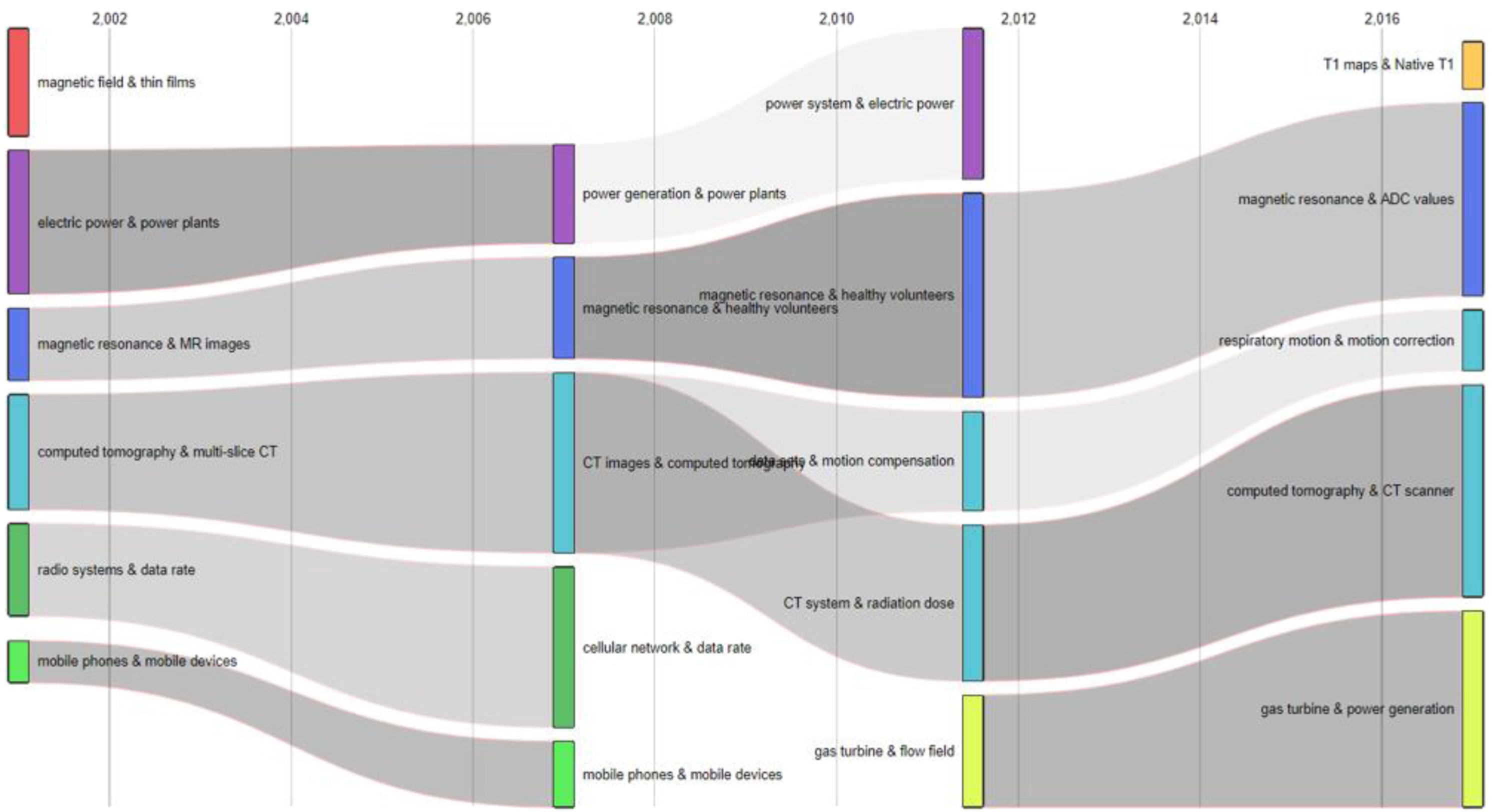
To determine the proximity of the nodes in the patent and scientific publication networks, we chose a distributional metric which allows the construction of network maps based on the similarity between two nodes compared with the entire co-occurrence profile of the identified entities. Hence, this metric measures the global distribution of the co-occurrence of each pair of nodes with all the other nodes. It is the preferred metric for textual network analysis (Barbier et al., 2012). To obtain a clearer sense of the evolution of topics in Siemens’s patents and publications portfolios, we used CorText to generate a ‘tubes layout’ for each dataset (Figures 1 and 2). The tubes layout provides a simplified depiction of how clusters evolved over time. Clusters are shown as coloured rectangles labelled with their two most frequent multi-terms and their width represents the number of records they contain. A cluster’s evolution over time is represented with grey tubes that connect clusters (rectangles) from different periods. The intensity of the grey reflects the similarity between clusters in terms of number of shared nodes.
10
Tubes layout. Patent Terms, Siemens 1998–2017. Source: Author’s analysis based on Derwent Innovation. Tubes layout. Scientific publication terms, Siemens 1998–2019. Source: Author’s analysis based on Web of Science.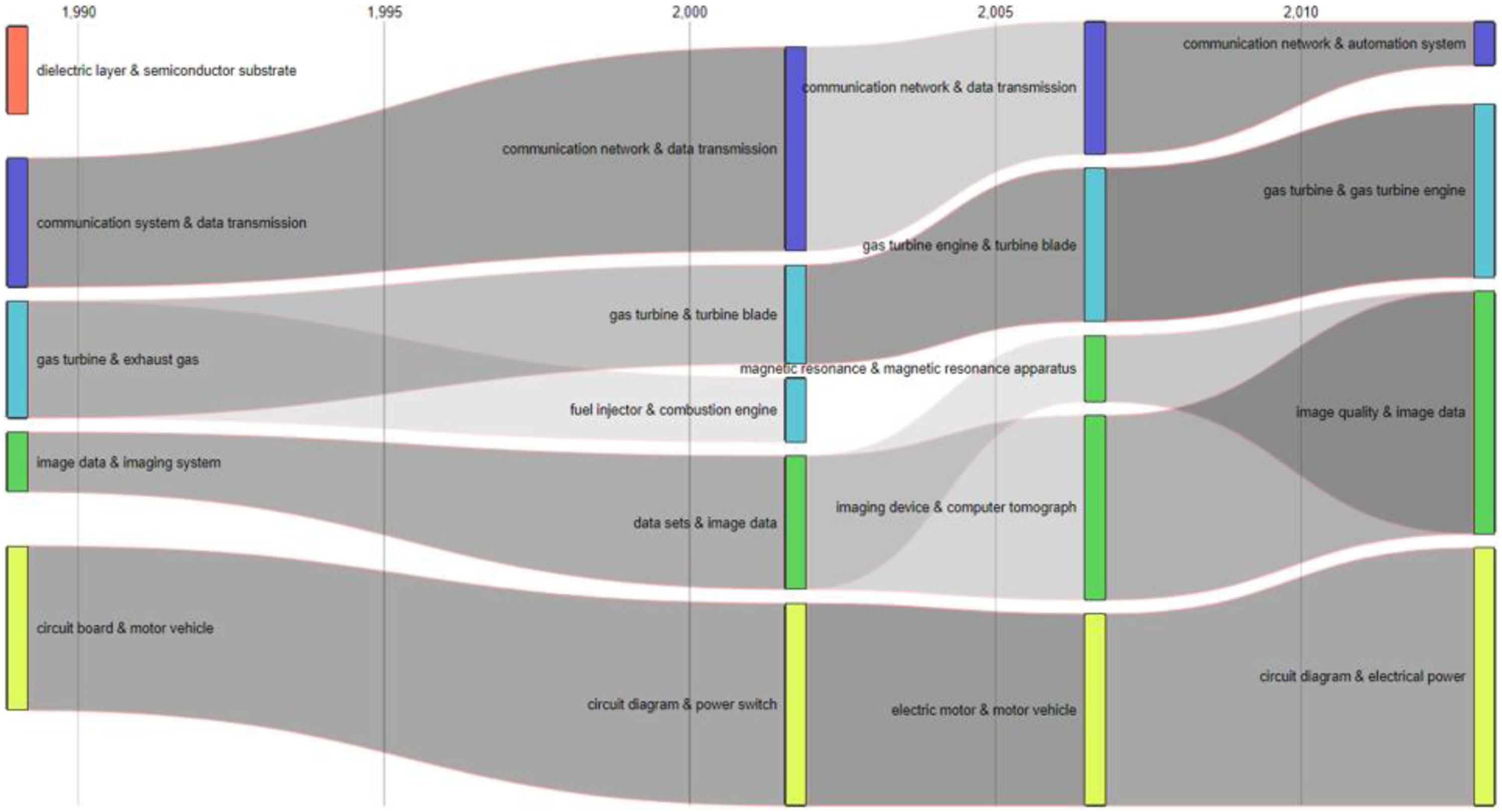
We validated our results with two in-depth interviews with Siemens’s top managers, both working at Siemens for more than two decades. Interviews were semi-structured and lasted for around 40 min. We also participated in an online seminar given by Frank Konopka, Senior Advisor for Digital Business and Digital Ecosystems at Siemens Healthineers where we asked about how Siemens was dealing with tech giants.
Results
Siemens is a leading company in terms of business expenditure on R&D (European Commission, 2019). Compustat data show that the German company has increased its R&D to net sales expenditure since 2007/2008, from 4.9% to 6.7% in 2018. However, this figure is below its value at the end of the 1990s and the start of the 21st century (above 7% on average). Siemens’s R&D investment over net sales decreased between 1998 and 2007, with a sharper and more sustained fall since 2005. This zigzagging evolution contrasts with the ever-growing R&D investments of the US and Chinese digital economy leaders (Dernis et al., 2019; European Commission, 2019). Yet, the evolution of its R&D investment is neither the only, nor the main difference between Siemens and tech giants, as we show next.
Siemens’s patent portfolio
In this section, we present the results of our semantic analysis of Siemens’s granted patents. The network maps corresponding to the four periods are presented in Appendix 1 (see Figures A1–A4). Altogether, the network maps and the tubes layout that summarizes our findings (Figure 1) show the technologies that Siemens privileged over time.
The last two periods (2005–2009 and 2010–2017), especially the last one, will inform on Siemens’s role as a digital technologies’ innovator. They coincide with the emergence of the digital economy since the early 2000s and the boom in AI patenting that started around 2012, when AI infrastructure transitioned from general purpose hardware to specialized hardware, unleashing deep learning potential (Ahmed and Wahed, 2020; World Intellectual Property Organization, 2019).
The first two periods are also relevant because, as we explained in section Innovation as a cumulative process, knowledge (and innovation) is a cumulative process. Moreover, given the strong link between patents on digital technologies with those of the first ICT wave (J. Lee and Lee, 2021), it may be the case that a laggard position in the development and absorption of the latter could have had a negative impact on Siemens’s chances to produce digital technologies.
In the first period (1979–1999), Figure 1 presents five clusters. Two of them are associated with technologies linked to more general ICT developments. They are integrated by multi-terms related to mobile technologies and communications (blue cluster) and hardware, such as memory devices and semiconductors (red cluster). 11 The importance of mobile technologies and communications is also visible in the second period although the semiconductors cluster disappears (2000–2004). We also observe increasing linkages with the medical imaging cluster in this second period (Appendix Figure A2).
In the third period (2005–2009), the telecommunications cluster starts to lose relevance, especially compared to medical imaging (see Appendix Figure A3). Given the density and number of the related terms, it seems that Siemens’s primary focus became innovation and patenting within the health sector. In the following section, based on various sources including our interviews, we elaborate on the reasons for this shift in focus.
The last period (2010–2017) reinforces the previously observed trends, showing a significantly diminished telecommunications cluster (see Figure A4). Other sectors also lost importance compared to the medical imaging cluster. Furthermore, the energy and transportation clusters became internally dense and more isolated.
Overall, the evolution of Siemens’s patented technologies reflects its changing business orientations. Since 1998, the company has increasingly patented in technologies related to its core business, such as energy, transportation and mostly digital imaging technologies linked to medical applications. 12 In the overall AI patenting ranking by WIPO (2019), Siemens ranks 11th. WIPO (2019) ranks Siemens first or second in granted patents related to AI applications for Energy, Life and Medical Sciences (which represent 32% of Siemens total patents) and Physical Sciences and Engineering. These figures are indications of the company’s innovation activity related to AI. Yet, both our analysis and WIPO’s (2019) general data show that Siemens’s innovation activity is focused on specific AI applications, which are not stand-alone technologies, given the dependencies of the AI technology innovation system (Jacobides et al., 2021). As we will show in section 5, this contributes to explaining Siemens’s outsourcing to – and dependence on – tech giants’ cloud.
Siemens’s publications
To complement patents’ lexical analysis and confirm the robustness of our findings, we also analysed Siemens’s scientific publications between 1998 and 2019 (see Figure 2 and Appendix Figure A5–A8).
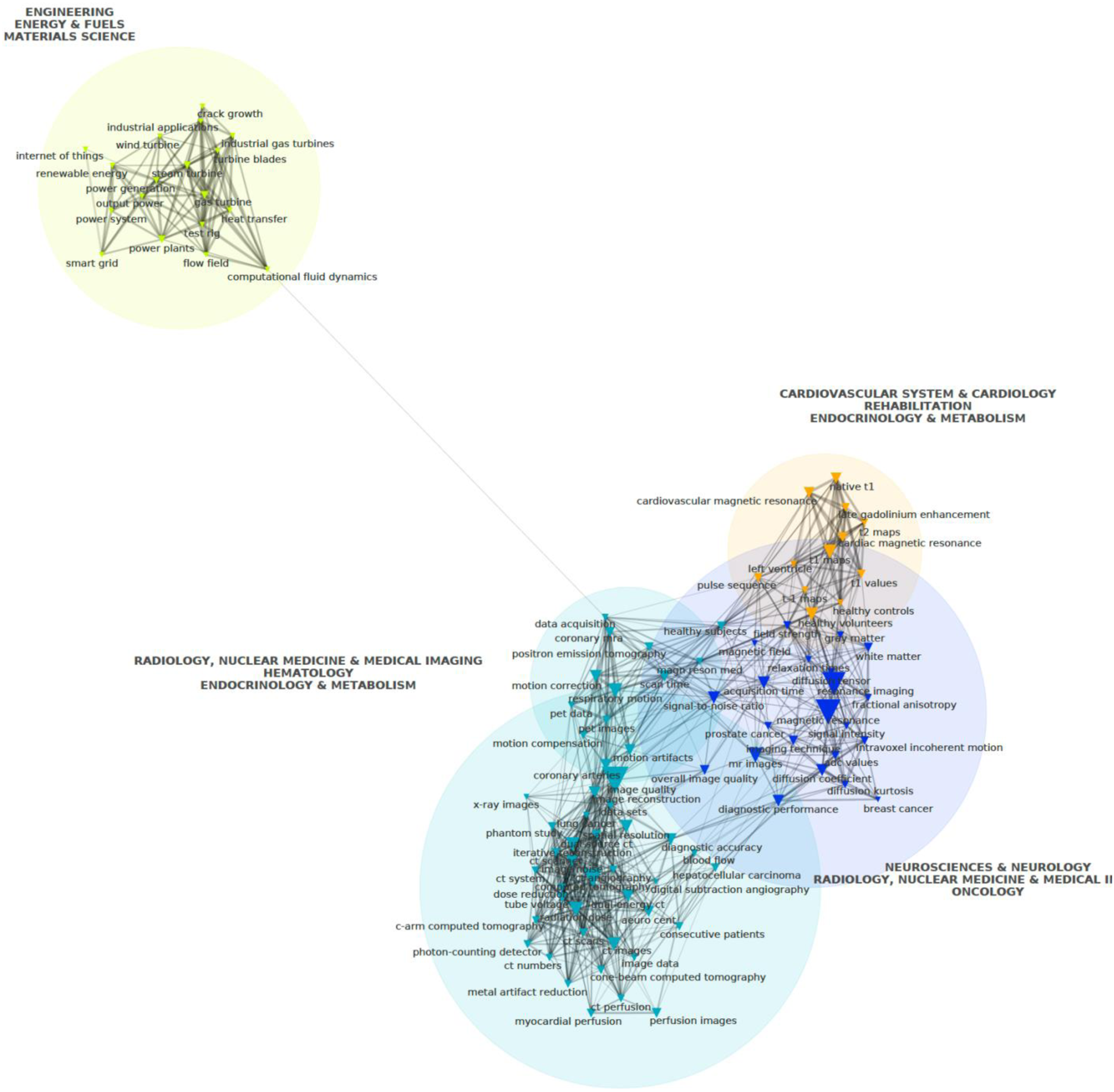
In the first period (1998–2005), alongside its focus on medical applications (blue and light blue clusters), Siemens was also working on energy and fuel (a violet cluster), industrial materials (red cluster) and ICT applications (dark green cluster). Besides these clusters, there is an additional one (in green) dedicated to AI research. This AI cluster includes the multi-terms ‘speech recognition’ and ‘video coding’. Although relatively small, this cluster is still a clear indication of Siemens’s early attempts to develop broader research capabilities in digital technologies. This cluster remains in the second period (2006–2009) reflecting growing importance of ICT related terms including the word ‘software’ (see Figures A5 and A6 in the Appendix). In this period, the green clusters, although still refer to ICT technologies, become more aligned with the industrial focus of Siemens´s business. At the same time, medical research – medical imaging in particular– becomes more relevant (in terms of the number of nodes and connections between them).
The specific clusters linked with computer science research disappear in the third period (2010–2014). Overall, terms related to medical diagnosis become more frequent than references to networks and mobile technologies, and ICT more broadly. Some multi-terms (‘mobile devices’, ‘mobile phones’) appear in the purple-coloured engineering cluster, which includes multi-terms related to telecommunications, but does not occupy a central position. ICT research seems to have taken a back seat; the light blue-coloured cluster, which includes computer science terms, becomes linked to imaging science and photographic technology, which reflects that Siemens was retargeting its ICT research to be focused on specialized medical topics. Overall, the content of Siemens’s publications in the third period suggests a growing emphasis on medical imaging.
In the last period (2015–2019), Siemens’s scientific publications are mainly related to medical diagnosis (4 clusters), with an additional cluster focused on energy infrastructure and industrial networks (in yellow). 13 The medical clusters – with stronger connections between them – are focused on radiology and medical imaging. They include terms like ‘image data’, ‘pet data’, ‘data acquisition’, ‘image quality’ and ‘resonance imaging’, which can be pointing to Siemens’s interest in digital technologies, yet always applied to medical solutions.
Our findings for this period show, also, that the company considers digitalization as a service relevant to the energy, transportation and industrial production sectors. For instance, in the case of energy research, this is reflected in the fact that the most connected and most frequent multi-terms of the yellow cluster, which correspond to energy technologies and include ‘steam turbine’, ‘gas turbine’ and ‘power plant’ are linked to terms associated with smart grids and the IoT. These results are in line with other research that shows that Siemens has indeed ‘invested heavily in IoT and CPS [cyber-physical system] related projects’ (Liao et al., 2017: p. 2).
In all four periods, a few multi-terms include the word data (e.g. ‘dataset’, ‘data rate’). Some of these terms are related to mobile and communication technologies. However, other of these multi-terms are linked to medical multi-terms, suggesting interest in the collection and analysis of healthcare big data and the use of the IoT in its medical devices. All in all, our analysis of Siemens’s scientific publications confirms our findings from the patent analysis.
Discussion: Siemens in the digital economy
Our results for Siemens’s patents and scientific publications reflect: (1) Siemens’s abandonment of general ICT R&D; (2) the increased relevance of the medical application sector and (3), in line with Lorenz et al. (2019), the persistence of Siemens’s traditional industrial business, especially energy, supported by new digital services areas.
Siemens’s abandonment of ICT general technologies
Our results highlight that, until 2010 approximately, Siemens was investing in R&D on general ICT technologies, a result that was validated by our interviewees. To that end, in the 1990s Siemens acquired Nixdorf Computer AG, a European computer technologies company. Moreover, in 1999, Siemens spun off Infineon, a semiconductor firm, and embarked on a computers joint venture named Fujitsu Siemens Desktop with Fujitsu. Siemens also tried to enter the telecommunications market through an endeavour with Nokia. They created a joint company called Nokia Siemens Networks, which was launched in 2007. Some of Siemens’s scientific publications between 2006 and 2009 are related to this partnership as we could check by looking at Siemens co-authors in the papers including the word ‘software’ that belonged to the computer science cluster.
According to Joo et al. (2016), this and other similar joint ventures involving big telecommunication industry players can be seen as a response to the slowdown in telecommunication industry sales following the dot.com bubble. However, Siemens progressively abandoned the development of general ICT, as we showed in the previous section. Indeed, in October 1999, it sold Siemens Nixdorf. In 2000, after spinning off Infineon, Siemens began disinvesting in this company and, by 2006, it had sold all its shares. Fujitsu Siemens Desktop was sold to Fujitsu in 2009 and Siemens left the joint venture with Nokia in 2013 (Börsch, 2004; Loch et al., 2008). This was also the year when Nokia abandons its operating smartphone system – Symbian OS – launched in 2001 (Feng and Yu, 2020).
Our interviews revealed that Siemens’s decision to abandon ICT core technology development was internally regarded as a ‘big mistake’. Interviewed managers explained that, by the mid-2000s, Siemens decided to focus on its core business neglecting dynamic ICT technologies. The announcement of a partnership with Japan’s NEC, an information and electronics company, could be read as an attempt to reconsider this decision. 14
Siemens dependence on tech giants’ digital technologies
While moving away from ICT’s (generic) innovation, our results show that the centrality of Siemens’s medical research grew and involved the development of related digital technologies. For instance, medical imaging (indicated by multi-terms such as ‘resonance imaging’, ‘image quality’ and ‘magnetic resonance’) looms large in the two most recent periods both for patents and publications network maps linked to terms that refer to data collection. As our interviews verified, Siemens became a frontrunner on AI applications for all its main businesses, especially in medical devices.
In 2016, Siemens launched MindSphere, an open cloud-based platform to host data retrieved from industrial equipment with IoT that can be analysed using digital apps developed, mostly, by third-parties. 15 According to Siemens, MindSphere receives data from ‘30 million automation systems, 70 million contracted smart meters, and 800 thousand connected products’ (Siemens PLM Software, 2017: p. 5). Its customers own their data and can decide whether Siemens can access them (Siemens PLM Software, 2017: p. 5).
To provide these digital services, since Siemens abandoned its more general ICT initiatives, its alternative became to rely on tech giants’ digital technology. Siemens purchases cloud services, including digital infrastructure, from diverse tech giants. As Siemens does not own hyper-scale data centres, data are stored in tech giants’ clouds and often processed with their AI services. As explained in the Literature Review, Amazon, Microsoft and Google are the main data and AI providers, acting as intellectual monopolies that rent these intangibles as services on their clouds.
Siemens Healthineers mostly operates with Microsoft Azure and, according to our interviewees, was also closing a deal with a Chinese cloud provider. Azure allows the company to manage all the data generated by its medical devices and provides powerful AI technologies as a service (for example, fast imaging analysis) 16 .
Meanwhile, Siemens’s Digital Industries Software, 17 formerly Siemens PLM Software, operates with AWS since 2012. In 2017, AWS took over responsibility for developing part of Siemens’s MindSphere. 18 Amazon Elastic Compute Cloud, Elastic Load Balancing and Amazon Relational Database Service are examples of the services rented for this purpose. Siemens’s ‘digital twin’ technique approach to manufacturing digitalization would not be possible without the infrastructure provided by Amazon. The former relies increasingly on the basic AI and data management services provided by AWS. AWS facilitates translation and automatic analysis – via machine learning techniques such as natural language processing – of Siemens’s employee data surveys 19 , contributes to its cyber-security 20 and provides a graph database and web-scale computing to enable online modelling. 21
Summing up, even if Siemens develops cutting-edge AI technologies in specific fields or niches, it remains a user of digital infrastructure, generic AI and data management services accessed as black boxes from tech giants’ cloud. As stated by Frank Konopka, which as we mentioned is Senior Advisor for Digital Business and Digital Ecosystems at Siemens Healthineers, ‘Google and the other big players have always developed tech that we need to base our technologies on top. Any platform layer cannot work without their underlying technologies’. This could potentially limit the company’s technological autonomy in the digital economy. Furthermore, as recognized in our interviews and as we anticipated in the second section, tech giants could be training their algorithms with at least some of the data collected from Siemens’s devices since the latter rely on deep neural network algorithms provided by tech giants’ clouds. This contributes to further developing tech giants’ technological advantage and, among others, may lead them to compete with some of Siemens’s businesses.
In fact, tech giants are expanding to several industries, including healthcare and energy (Couldry and Mejias, 2020; Sharon, 2016, 2020). They already compete with Siemens Healthineers, offering solutions directly to Siemens’s clients, as noted in our interviews and in Frank Konopka’s presentation. Furthermore, Frank Konopka’s presentation included an in-detail explanation of how the Chinese tech giant Tencent has already developed an all-embracing healthcare platform seeking to control individuals’ digital twins, accessing simultaneously to several data sources: from appointment booking and telehealth to personal health record management. This platform of platforms also includes a health insurance called Shuidi Huzhu and SoYoung, which is an aesthetic medicine marketplace. On this basis, Konopka warns of the dangers of US tech giants – which unlike Chinese ones have a global reach – developing such a comprehensive digital healthcare ecosystem.
In relation to direct competition, according to our interviews, Google is seen by Siemens as the biggest threat. Google’s healthcare ventures are channelled through Google Health, Verily Life Sciences, Calico – which focuses on ageing and age-related diseases – and DeepMind. In 2019, DeepMind claimed to have reached its biggest healthcare breakthrough: a deep learning model for continuously predicting the future likelihood of a patient developing acute kidney injury (AKI) (Tomašev et al., 2019). Besides these initiatives, Google, Microsoft and Amazon offer several cloud services for hospitals and healthcare providers directly on their clouds, which could eventually replace some of the services provided by Siemens.
Attempts to mitigate the tech giants’ dependence and associated risks
Siemens recognizes the above-mentioned risks in relation to tech giants and is attempting to mitigate them. First, by contracting different cloud providers. Second, by strictly enforcing European General Data Protection Regulation and encrypting data, with Auth0 as a strategic provider, to limit data usage by its cloud providers. Third, it limits the data that are stored in tech giants’ datacentres through edge computing with on-site data centres. Fourth, we learnt from our interviews that the company is considering a potential commercial agreement with Apple to analyse consumers’ data. Such a partnership can be interpreted as a way to establish a long-term agreement to develop greater data analytics capabilities with a big tech company that is not a cloud leader.
However, as far as Amazon, Microsoft and Google’s AI services are used for data processing, these tech giants’ algorithms will still be able to learn from the data collected by Siemens’s devices. Thus, Siemens’s strategy may not be enough to limit its dependence and potentially subordinate position vis-à-vis tech giants. The latter are leading the developments of federated learning (Benaich and Hogarth, 2020; Jacobides et al., 2021), which is a deep learning approach where the algorithms learn while processing data that do not need to be hosted altogether in a centralized location. 22 Hence, edge computing may not solve the risk of tech giants’ AI algorithms learning from Siemens clients' data.
Fifth, in terms of mitigating attempts, the case of healthcare is illustrative. To prevent the growth of a US tech company in digital healthcare, Siemens is promoting the creation of a collaborative ecosystem in which governments, instead of corporations, control access and store healthcare data, as presented by Frank Konopka. In this scheme, Siemens argues that individuals/patients should control their health data so that their consent is asked each time someone wants to use them. The proposal states that governments or state-created organizations without commercial interest should host a democratized data foundation where all the actors of the healthcare sector will contribute with their collected data. According to Siemens’s proposal, any company will afterwards be able to develop and operate digital services by accessing both the democratized data foundation and the individual data foundation.
The main limitation of this strategy, assuming that it works out and firms socialize healthcare data, is the definition of healthcare data itself. While electronic medical records are easy to be defined,23 this is not the case of other big data that can also inform healthcare-related businesses. So called Emergent Medical Data are collected from people’s everyday lives and include non-medical data used to infer health data such as transactions by and about individuals, including prescription orders and e-commerce (Marks, 2020). Creating a democratized data foundation for healthcare would thus require companies like Google or Amazon to disclose their search engines’ data since that data could be afterwards analysed with healthcare purposes, such as when Google analysed searches of Covid-19 symptoms to detect the spread of the virus. Although feasible in principle, this alternative does not seem to become real any time soon.
All in all, Siemens deprioritized ICT R&D and has focused on developing digital technologies for fields with specific or narrow applications (in particular medical imaging solutions) relying on tech giants’ general AI innovations. This seems to be a major reason explaining its current dependence on tech giants’ clouds. While risking Siemens’s technological autonomy, this favours tech giants not only by expanding their business but also by potentially accessing Siemens’s devices data to improve their AI algorithms.
Final remarks
Tech giants like Amazon, Microsoft and Google are leading the digital innovation race, which is driven by the collection and analysis of big data with AI. Meanwhile, European companies are lagging behind and the reasons underlying this outcome remain understudied. In this paper, we contributed to answering this open question by focusing on the science and technology strategy of Siemens, Europe’s main AI player.
We found that, while Siemens has clearly developed AI-skills and patented in AI, these developments were focused on sector-specific applications, like healthcare niches such as medical imaging. Our main contribution has been to explain why Siemens currently depends on the AI development environment and digital infrastructure – essential for its digital approach in health and manufacturing – provided by tech giants.
Our paper shows that, unlike the first ICT wave, where users adopting new products could learn by using and adapting technologies, cloud computing is a way of providing technology as a black box. As such, it limits users’ learning and generates long-term dependence even of leading corporations like Siemens. This dependence impacts on the distribution of value-added between leading corporations from different core regions – from Siemens to tech giants – and engenders a double threat for Siemens. First, as tech giants become direct market rivals, Siemens competes with those that provide indispensable technologies to operate its business. Second, it constrains its catching-up possibilities regarding general or ubiquitous digital technologies. Siemens cannot operate without tech giants’ cloud services, in particular without their AI algorithms sold as black boxes that curtail learning by using. Meanwhile, the more those algorithms are sold as a service, the more they learn and self-improve, thus favouring tech giants’ digital learning.
We also elaborated on possible explanations for this dependence. Through our text mining and network analyses of Siemens’ publications and patents over time, we found that the company deprioritized core ICT since the early 2000s and excessively focused on narrow R&D fields. These results were validated in interviews with Siemens’s managers.
Siemens became a user-adapter of the advanced digital technologies provided by foreign big tech companies. Given the nature of deep neural network algorithms and the fact that they are offered as a black box service, we argued that Siemens’s reliance on tech giants’ AI technologies is constraining its technological autonomy. In this respect, it is unlikely that Siemens could contribute to overcoming Germany – and the EU – laggard position in the digital economy. All in all, our results provide clues to understand the challenges faced by Europe and its firms in relation to US and Chinese tech giants, as the adoption of cloud computing becomes unavoidable and tech giants extend their sectoral scope. More research is needed on other European digital technologies forerunners to evaluate to what extent our findings are in line with those of other European companies.
Digital business leadership in Europe would involve competition with and eventually overtaking of existing tech giants business in the continent, thus the emergence of European tech giants. However, this would lead to greater concentration of capital, increases in rent-seeking, industry polarization and social inequalities, as it was the case both in the US and China. The emergence of Chinese tech giants, which was partly fostered by the Chinese state, was successful in terms of technological catching up but led to wealth concentration and clashes of political and corporate power (Lundvall and Rikap, 2022). All this suggests the urgent need for new political perspectives at the EU – and global – level, including common investment in a public-led digital transition that favours the many instead of the accumulation of a handful of corporations. Our future research will explore whether the creation of European high-tech public corporations, as was recently suggested by Archibugi and Mariella (2021), could be a feasible alternative considering our findings concerning the relationship of AI producers and users.
Footnotes
Declaration of conflicting interests
The author(s) declared no potential conflicts of interest with respect to the research, authorship, and/or publication of this article.
Funding
The author(s) disclosed receipt of the following financial support for the research, authorship, and/or publication of this article: This work was supported by Institut Francilien Recherche Innovation Société (IFRIS/LabEX SITES); Agencia Nacional de Promoción de la Investigación, el Desarrollo Tecnológico y la Innovación (PICT-2018-02562); and Universidad de Buenos Aires (UBACyT 20020190,200019BA).

Notes
Appendix
Network mapping of the most frequent multi-terms in Siemens patents (1979–1999). Source: Authors’ analysis based on Derwent Innovation.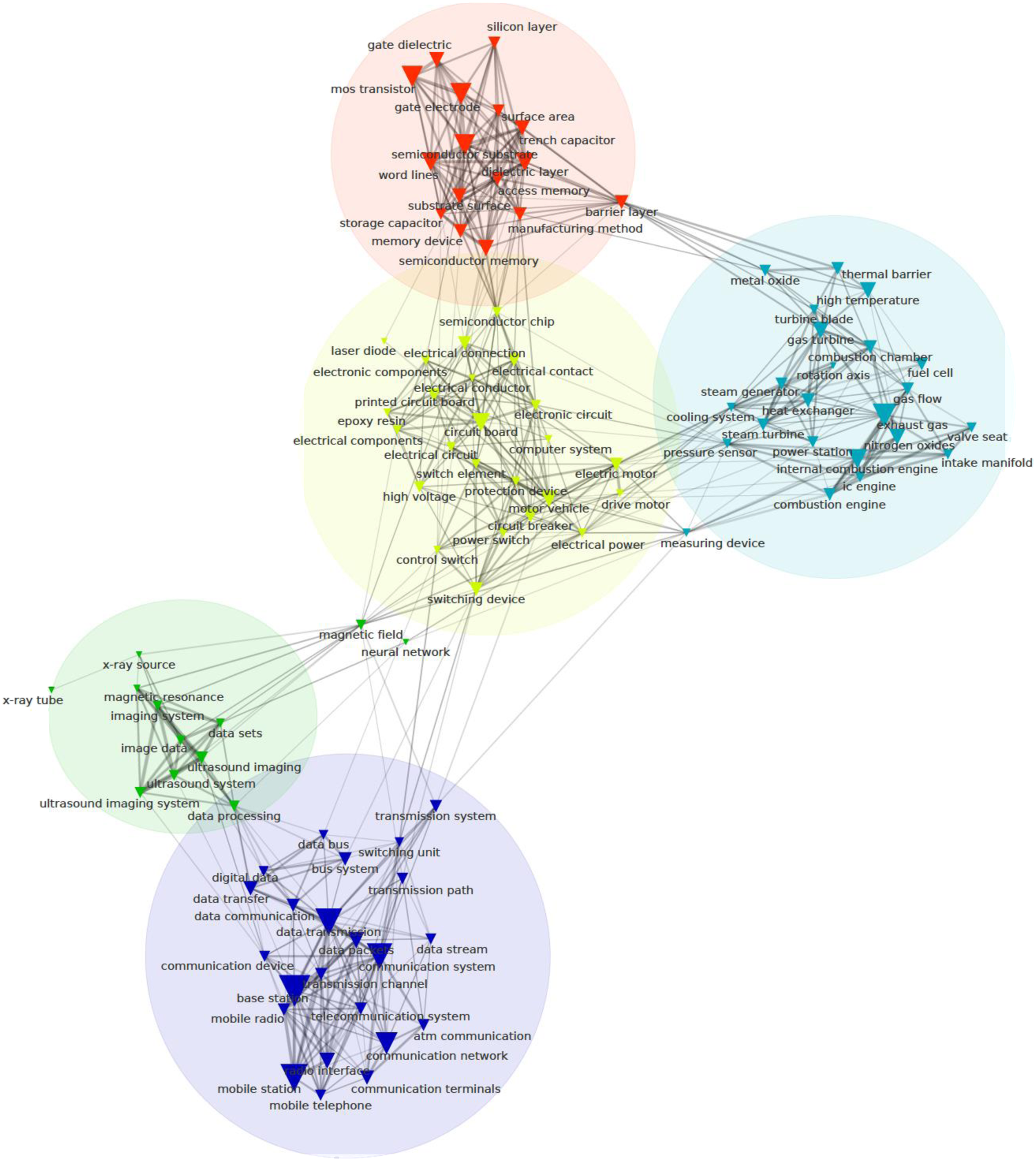
Network mapping of the most frequent multi-terms in Siemens patents (2000–2004). Source: Authors’ analysis based on Derwent Innovation.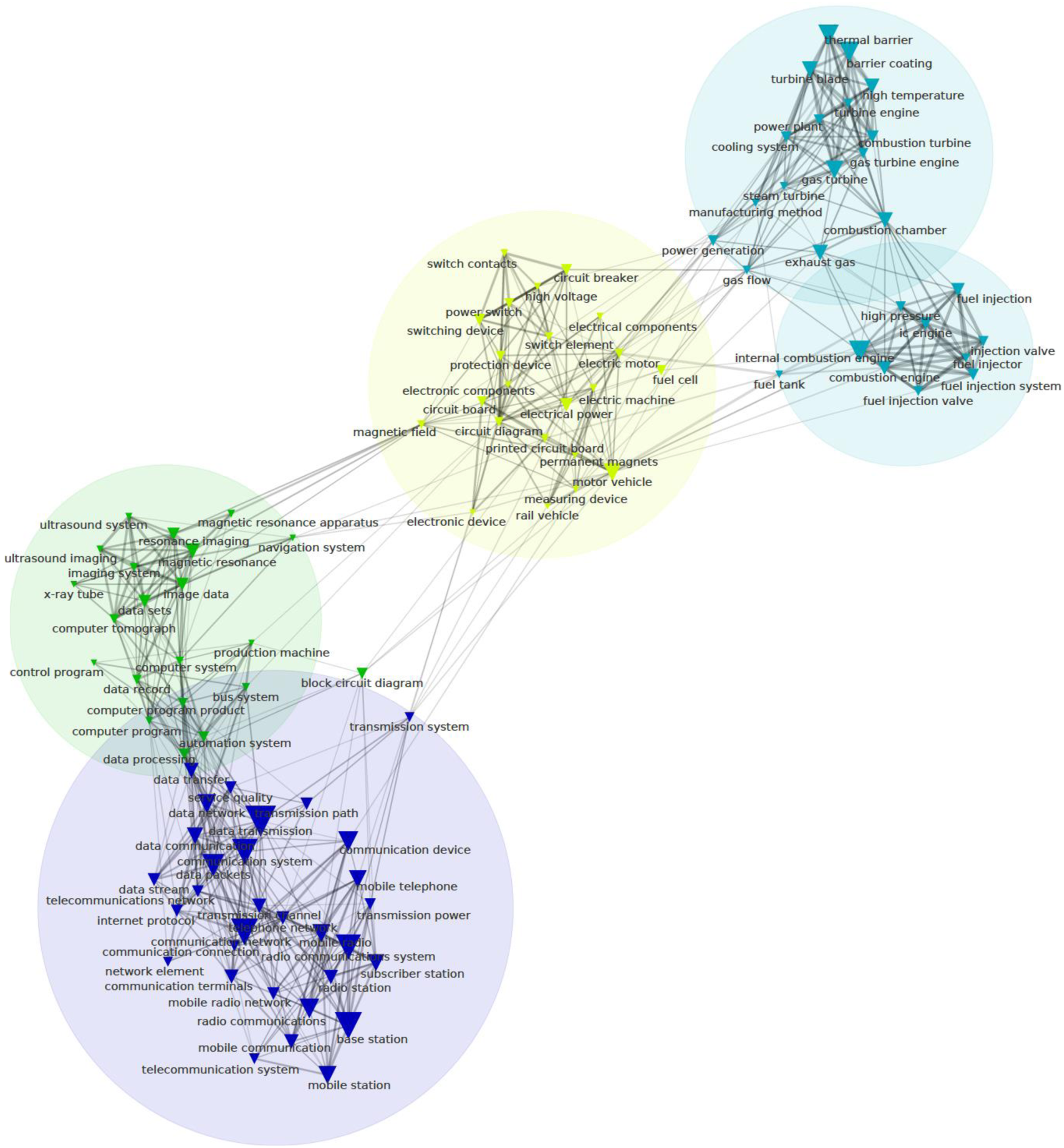
Network mapping of the most frequent multi-terms in Siemens patents (2005–2009). Source: Authors’ analysis based on Derwent Innovation.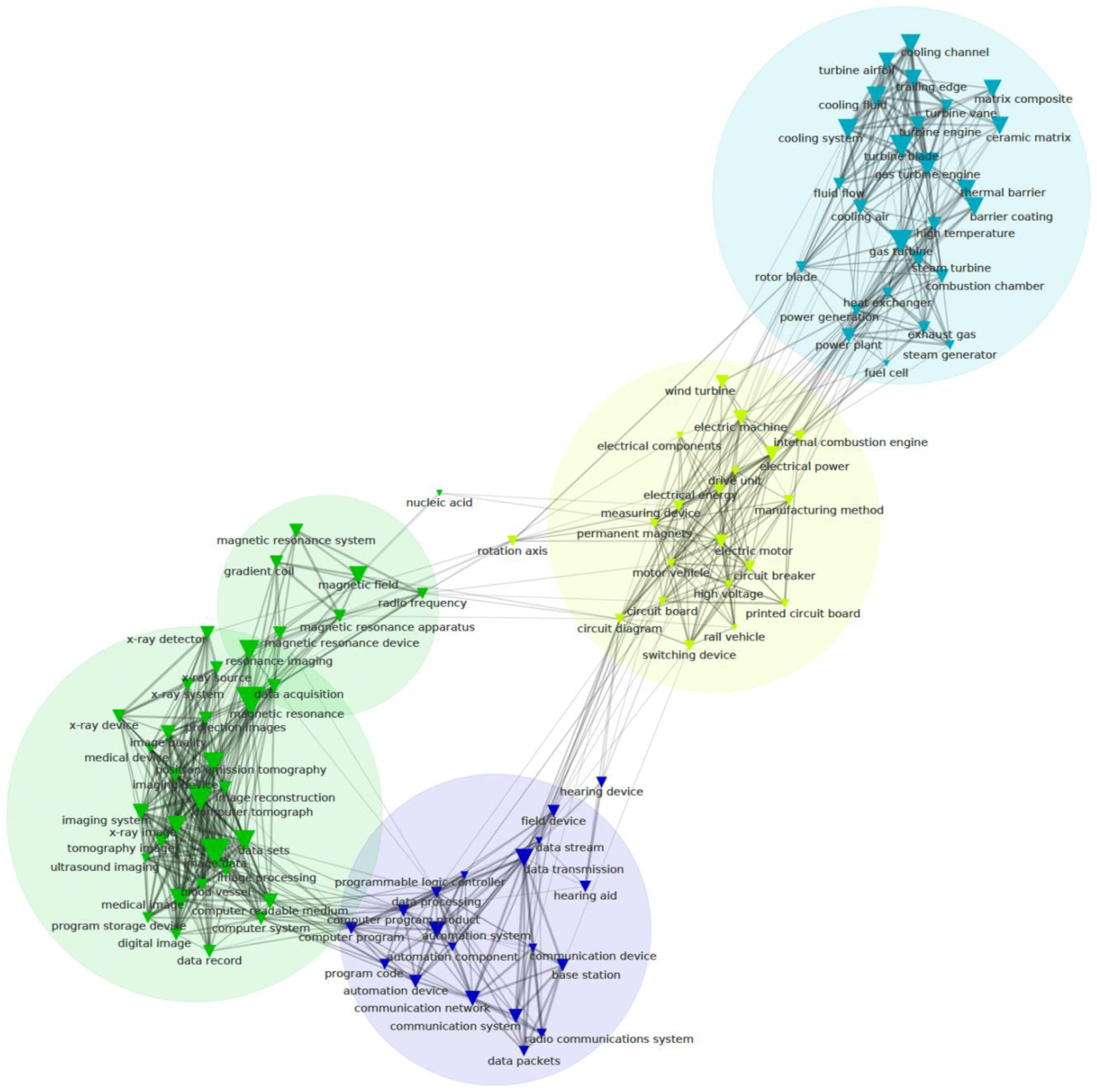
Network mapping of the most frequent multi-terms in Siemens patents (2010–2017). Source: Authors’ analysis based on Derwent Innovation.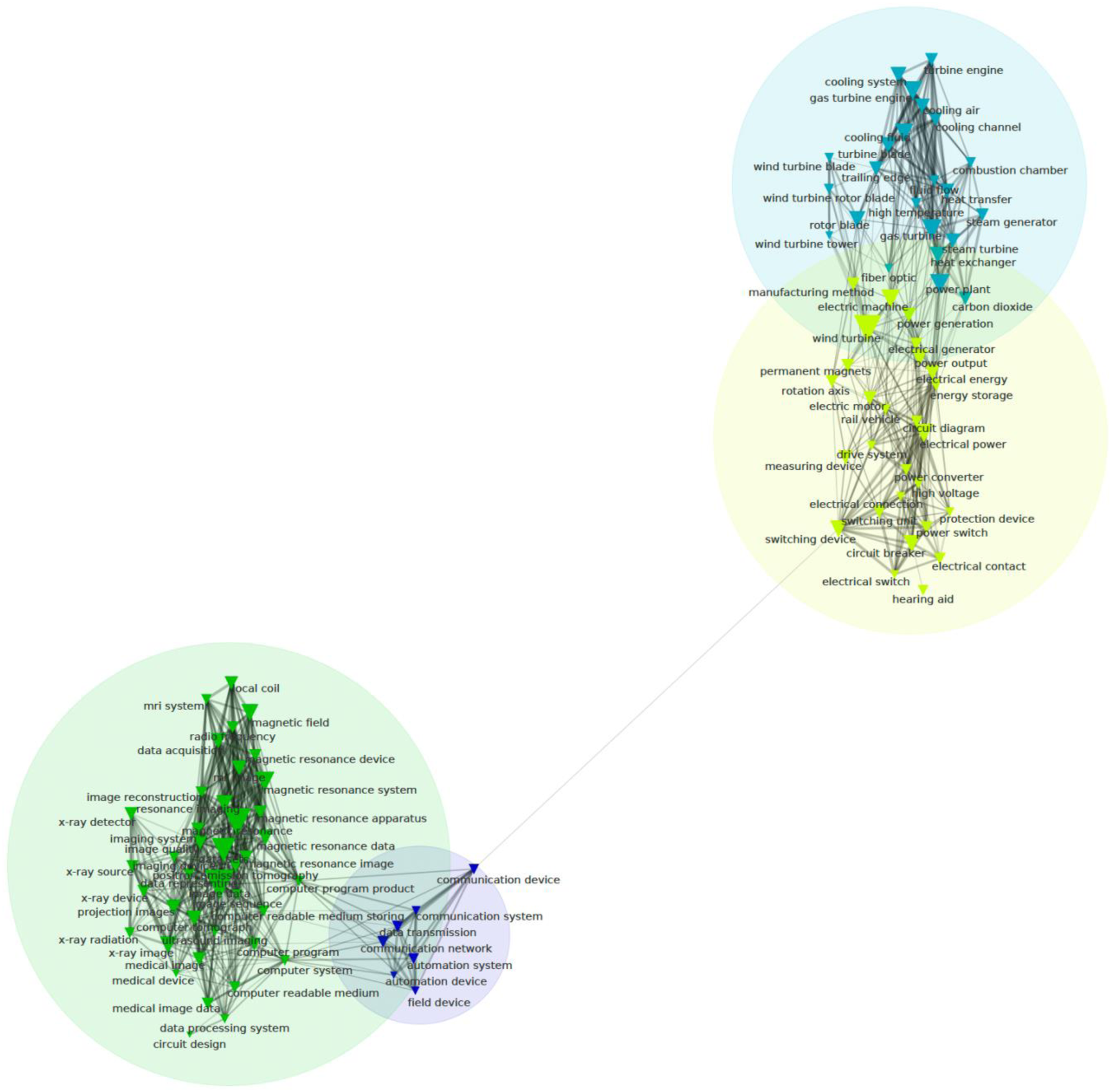
Network mapping of the most frequent multi-terms in Siemens scientific publications (1998–2005). Source: Authors’ analysis based on Web of Science.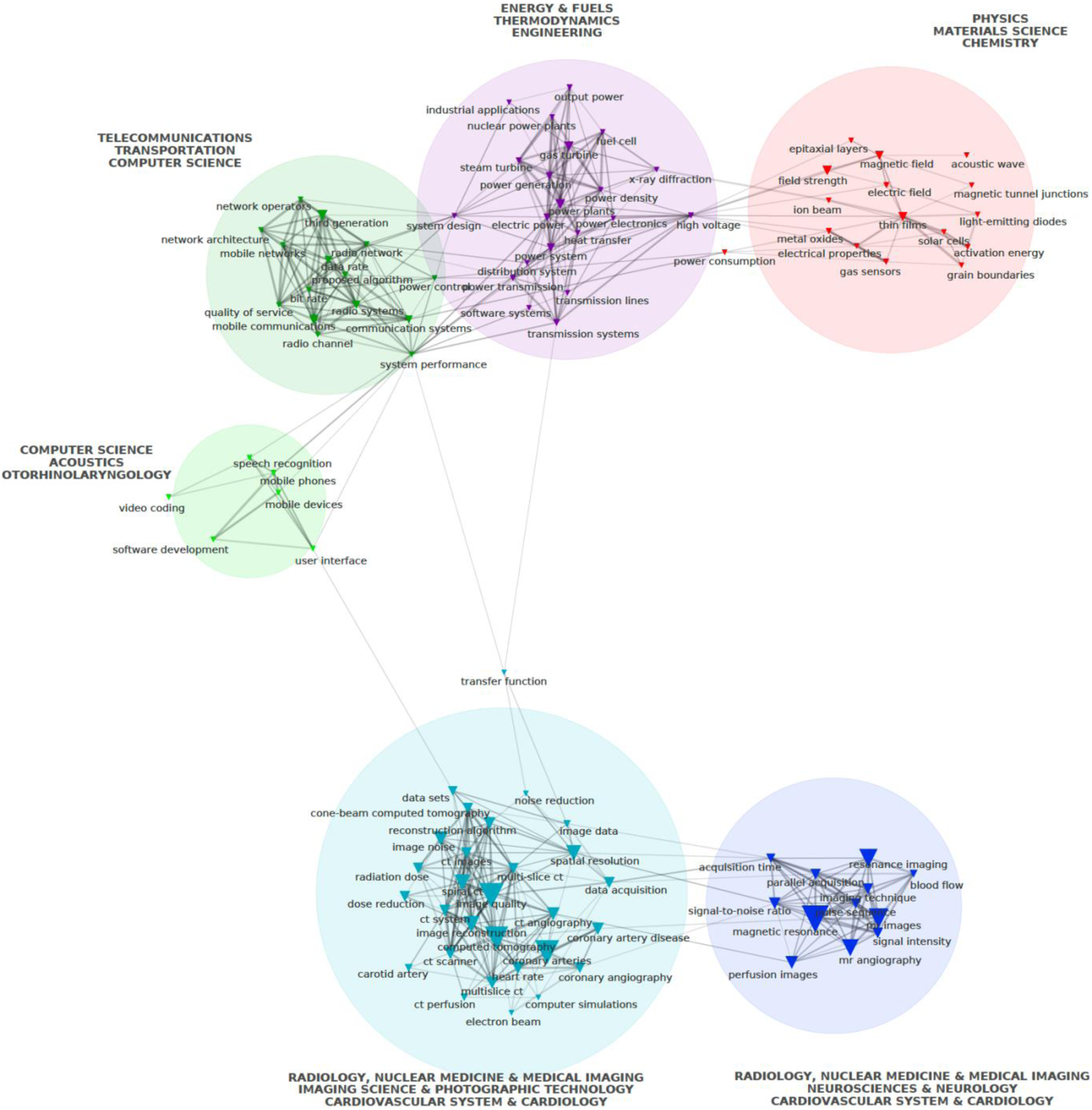
Network mapping of the most frequent multi-terms in Siemens scientific publications (2006–2009). Source: Authors’ analysis based on Web of Science.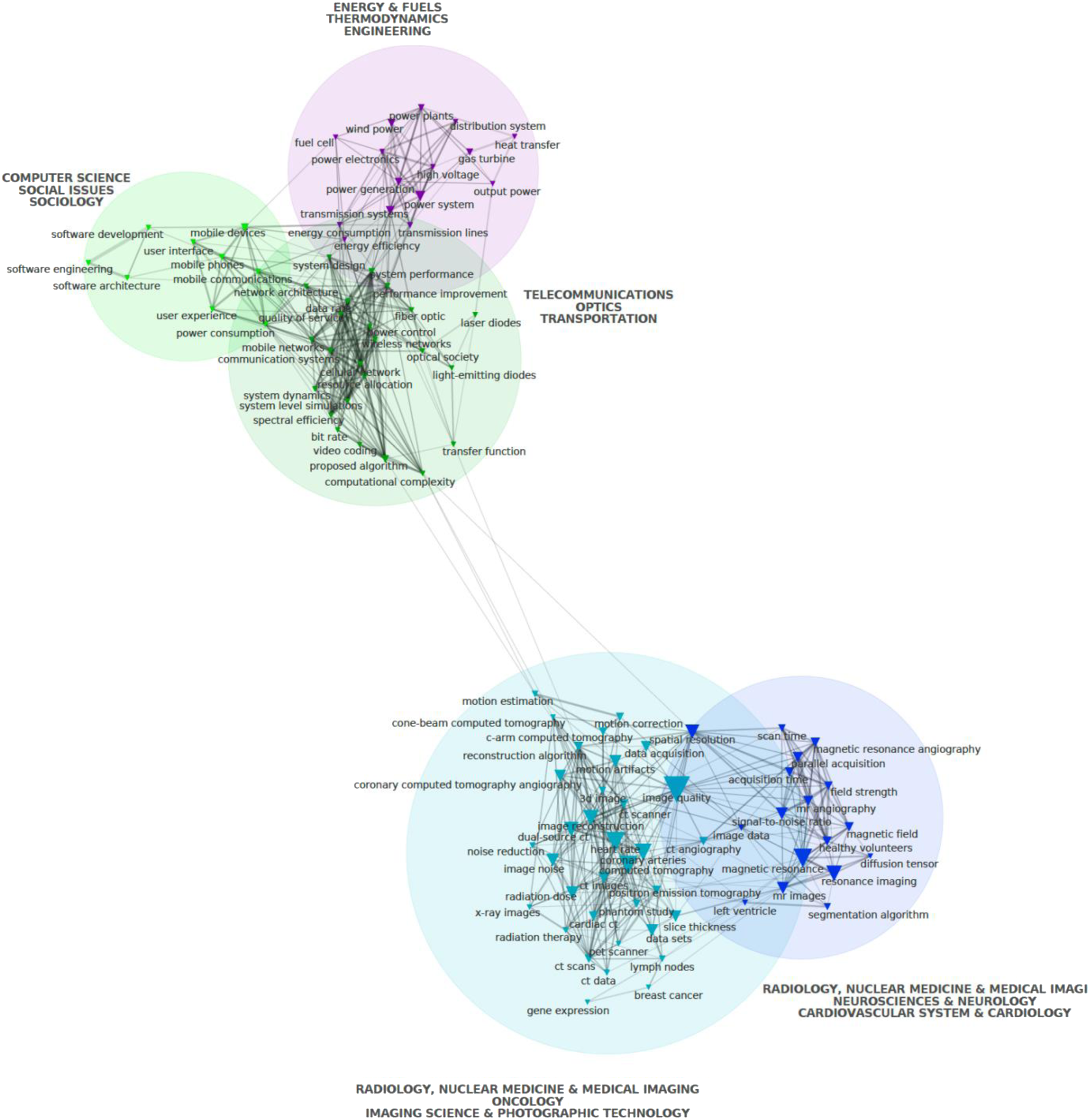
Network mapping of the most frequent multi-terms in Siemens scientific publications (2010–2014). Source: Authors’ analysis based on Web of Science.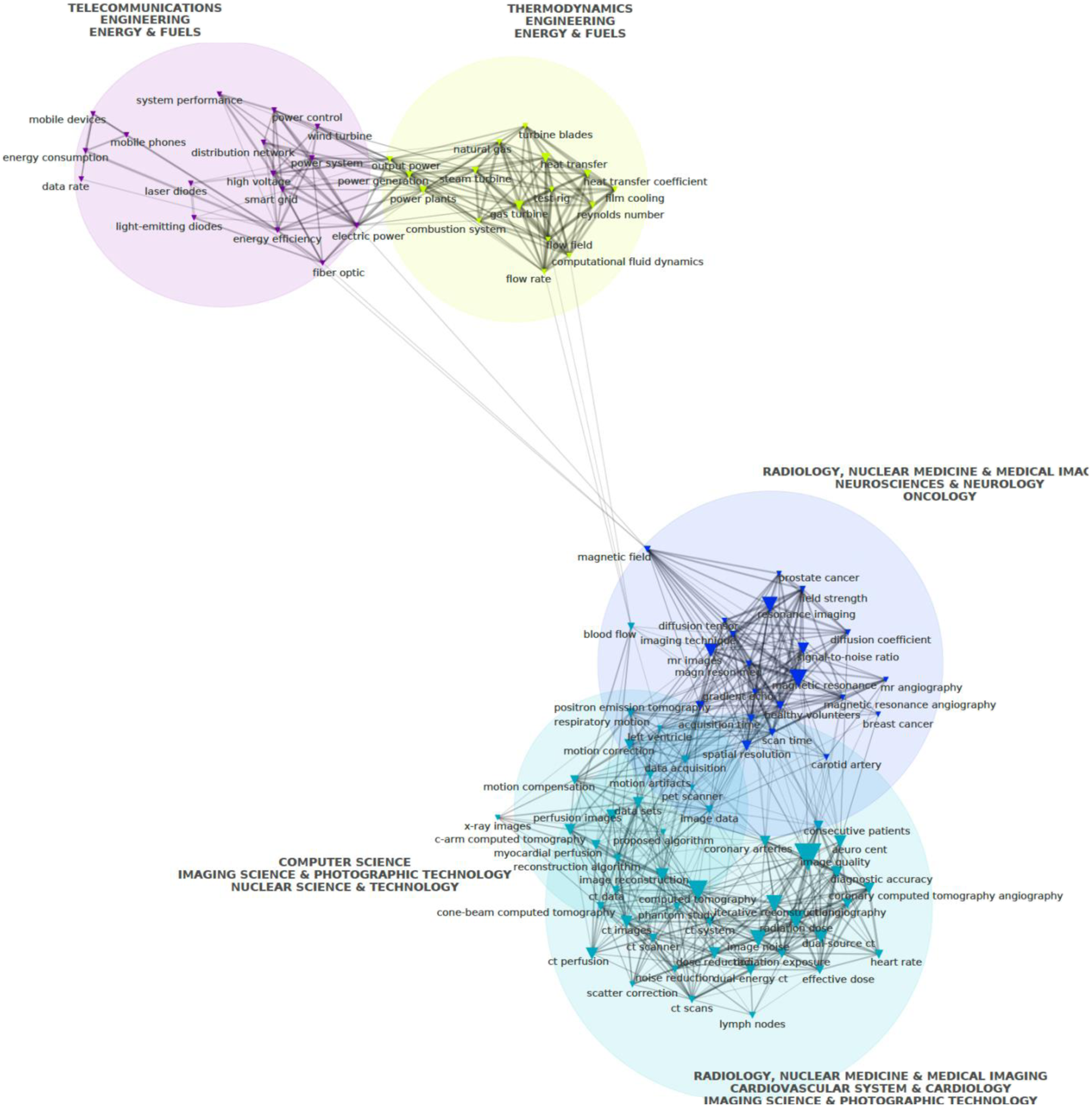
Network mapping of the most frequent multi-terms in Siemens scientific publications (2015–2020). Source: Authors’ analysis based on Web of Science.