




Abstract
We propose a simple theoretical model emphasizing the importance of a multi-sided platform (MSP) in fostering innovation. This model aims to assess the effects of structuring industries around an MSP on innovation dynamics and emphasizes the impact of cross-platform competition. It teaches us how to encourage cross-platform competition in terms of competition policy. The outcome is threefold. To begin, the presence of an MSP is critical for market innovation. Second, our findings indicate that skewed market power in favor of the MSP may stifle innovation in this industry, even if the negative impact on the industry’s rate of innovation is not immediately apparent. Finally, we demonstrate that industries with multiple MSPs have a higher rate of innovation. The model’s conclusions emphasize the critical importance of preserving the contestability of digital markets through competition rules enforcement. Even if the inherent technical characteristics of this industry result in a situation of dominance, competition rules should aim to preserve the possibility of market competition through, among other things, interoperability requirements, data portability requirements, and control of exclusivity clauses.
Keywords
Introduction
Concerns about the effect of multi-sided platforms (MSPs) on innovation are understandably coupled with concerns about competition. They resound particularly with some of the critical dimensions of proposals on both sides of the Atlantic regarding the need to bolster competition authorities’ regulatory arsenal. In the United States, the importance of giant platform companies and the risk that they will stifle competition are central to the five bills proposed by the House of Representatives in June 2021 and President Biden’s July 2021 proposals on competition strengthening. In the E.U., the concerns expressed above mirror those expressed in its Digital Markets Act proposal (hereafter DMA), prompting the Commission to propose complementary tools to the competition rules, in this case, Article 102 TFEU, which addresses abuse of dominance (E.U. Commission, 2020).
This article aims to assess the impact of MSP development on innovation. It addresses two issues raised in the European DMA proposal (Crawford et al., 2021): the extinction of market competition due to tipping and private regulation of competition. Conditions must be ensured that allow for undistorted competition, this is the DMA’s fairness argument. The second category comprises strategies that distort innovation in favour of ‘consolidating’ it through architectural strength. In the competition law domain, this raises the potential harm to innovation in terms of rate, size, and nature. An MSP that enters a market as a first mover may attract complementors thanks to the platform’s innovations, but it may also create a barrier to entry for other MSPs. This is a strong argument for more stringent competition laws enforcement.
We examine the competitive landscape created by platforms, and, more broadly, when the market is structured around a small number of competing platforms. Because of their disruptive actions, they may achieve monopoly status in some markets. This may not be a problem considering the radical innovations to these markets, but a necessary condition is that the market needs to remain contestable. In this regard, we are inspired by Beltagui et al. (2020) and the exaptation concept explaining that disruption requires a supportive ecosystem, but because ecosystems have a life of their own, cultivating a healthy ecosystem requires sowing seeds of disruption ‐ or contestability - within it. In our view, innovation can be an efficient proxy for the level of contestability. We are particularly interested in the potential correlation between the presence of an MSP and a long-term negative impact on innovation. Our reflections are motivated by the notion that businesses compete not only on price (Warin and Leiter, 2007; 2012; Warin and Troadec, 2016) but also on innovation (McIntyre et al., 2021). Previously, innovation and MSPs were studied, and it was proposed that “while (MSPs’) direct network effects constitute demand-side economies of scale, indirect network effects constitute demand-side economies of scope” (Gawer, 2014). This can lead to lock-in situations.
The definition of an MSP has evolved through time. A synthesis has been proposed in the Industrial Organization field (Weyl, 2010), based on the previous literature (Caillaud and Jullien, 2001; 2003; Rochet and Tirole, 2003; 2006; Armstrong, 2006). Three features are highlighted: (1) a multi-product firm providing different services to both sides of the market with potentially different prices, (2) cross-network effects and (3) bilateral market power. Following Parker and Van Alstyne (2018), we adopt the definition of platforms proposed by Boudreau (2010). He defines them as the components used in common across a product family. Platform functionality can be extended. The functionalities proposed by such platforms are extended by third parties (the complementors). Platforms and complementors structure ecosystems, which benefit from network effects (Eisenmann et al., 2011).
For our own definition, we propose to add a fourth dimension, which is network effects on each side of the platform. Indeed, the network effects are often assumed only on one side of the platform, and more particularly the users’ side. In what follows, we will also consider the existence of potential network effects on the complementors’ side, benefiting the platform. Moreover, a platform is a collection of assets organized in a typical structure that enables a business to efficiently develop and produce a stream of derivative products. Industry platforms are defined as products, services, or technologies that serve as a foundation for external innovators to develop complementary products, technologies, or services (Gawer and Cusumano, 2014). Our article is about the latter.
Our contribution is to put into perspective competition law debates related to potential harms to innovation resulting from MSPs’ market power and inform the conversation based on the results we obtain from our theoretical model. Our results are in line with the objectives defined in the DMA. They show, in the instance of preventing harm to innovation, the interest of preserving competition for the market (the rate of innovation is higher with two platforms than with one and decreases later). This result also points to the interest in implementing competition policies aimed at encouraging the entry or, to some extent, maintaining competing platforms on the market (and thus watching out for tipping phenomena). These purposes are apparent in dos and donts through the issues of data portability, interoperability, or the reduction of lock-in effects (e.g., switching costs). On the other hand, our model does not address the alteration of the composition of innovation (in favor of consolidating innovations, in other words, complementary innovations). It will be addressed in future work. In any case, it appears that the informational advantage makes it possible to control which innovations reach the market - and this is even more effective when the silos are closed and the other trading partners are ‘captive’.
Our article is structured around the following sections. Section 2 presents the literature review. Section 3 develops our theoretical framework, our model, and its results. Section 4 discusses the implications in terms of competition policy enforcement. Section 5 concludes.
Literature review
Multi-sided platforms-based markets
A market, especially when innovative, must be conceived as an intentional construction that fits into a teleological logic (Oh et al., 2016). The distinction should be made between non-digital and digital platform-based markets. A non-digital platform can consist of a modular organization of an industrial process that allows the development and production of a given product in a distributed manner. This structuring makes it possible to combine innovations developed by the various participants in this market (Henderson and Clark, 1990). Thus, the pivotal firm can pool and organize the innovation capacities of all the actors and combine them in the best possible way (Gawer, 2014). Therefore, this formalization is based on a sharing of roles characterized by a vertical relationship (Clark, 1985).
Conversely, digital platforms are distinguished by a set of characteristics (homogenization of data, auditability, programmability, self-referentiality, etc.) which should lead to greater horizontality (Yoo et al., 2010). The structuring of the platform no longer corresponds in this framework to a structure in which the architecture and functioning are defined by a single dominant actor (Henfridsson and al., 2014). This conception echoes a vision of the platform as a socio-technical assemblage in which the code is extensible. Each complementor can develop its applications, and the platform functions as many add-on software subsystems (Tiwana et al., 2010). This is only possible if all participants have access to boundary resources. However, both access to these resources and the interoperability rules are defined by the dominant platform. In what follows, we will use interchangeably the terminologies “digital platform” and “MSP.”
MSPs boost innovation in the industry by offering a general-purpose technology to its complementors. The decentralized architecture gives way to governance by the gatekeeper (Henfridsson and Bygstad, 2013). This ambiguity is at the heart of the tension between the innovation-enhancing effects of entering such a system and the risks of exhausting them due to the power position of the dominant actor. In short, MSP-based markets minimize transaction costs (Coase, 1937) and implement long-term contracts (Williamson, 1985) favoring long-term specific investments. It is also possible to highlight neo-Austrian logic with platforms that coordinate firms’ investments on a basis other than price signals by securing investments over sufficient time horizons (Gaffard and Quéré, 2007). Indeed, the concentration of economic power provides an MSP with a coordinating power vis-à-vis the other members.
1
The construction of such favorable externalities presupposes that the MSP makes a set of trade-offs favorable to the complementors. Williamson and De Meyer (2012) (p. 33) list some of these conditions: (1) attribute the added value to the complementor that generates it, (2) build and structure complementarities between members, (3) stimulate complementary investments, (4) reduce transaction costs, (5) promote flexibility and develop shared learning, and (6) design value capture tools for all. Parker and Van Alstyne (2018) explain the conditions at which an MSP may enhance innovation. The MSP enables its complementors, through its openness and the provision of complementary resources, to develop follow-on innovations The structuring platform can hinder innovation in several ways. First, by preventing third-party innovations from entering the market by “killing” them through anti-competitive maneuvers—making them technically incompatible or reducing their technical performance
2
—or buying them out.
3
Secondly, the structuring platform can hinder the development of third-party innovations requiring access to its members by controlling the nature of the innovations that enter the market through the control exercised over the strategy of the complementors that results from its pivotal position. The platform is both a gatekeeper and a regulator who can unilaterally decide on the technical conditions of access to the market. Another argument based on the coordination mechanism created by the platform for its members can be made. Indeed, decentralized decision-making fosters economies of scale and complementarity, resulting in increased strategic flexibility for the platform owner (Gawer and Henderson, 2007). However, from a competition law perspective, Paul (2020) states that economic power gives “rights of coordination” that would be sanctioned by competition rules in other market configurations. The result is a market model that is quite far removed from traditional Industrial Organization approaches: technologies do not pre-exist at the time of the investment decision, adjustments are anything but instantaneous, data are co-produced by stakeholders, profitability strategies are established over the very long term, etc.
Multi-sided platforms and kill zones
The concept of kill zones was developed in Kamepalli et al. (2020). Because of their financial and technical capacities, dominant firms can acquire innovative firms even if they are still potential competitors or develop technologies that may eventually prove to be complementary (not necessarily with a view to a killer acquisition. 4 However, also in the perspective of a consolidation in which the purpose of the acquisition is to reinforce the market dominance or extend this one to an adjacent market). They can also clone products (including improving them) and/or displace the complementor, respectively, because of their positions as gatekeepers and regulators. The House of Representatives report shows, through excerpts from hearings before the investigation commission, that many venture capitalists are increasingly reluctant to bet on companies that would be likely to enter such areas (Committee, 2020). The innovation strategies may be affected by the anticipation of such competitive risks. Parker and Van Alstyne (2018) build a model in which the MSP offers an implicit contract to the complementors offering a limited time protection for their innovation. At the end of the protected period, the MSP captures the innovations. If this second phase were not achievable, the platform would maximise innovation but would have no incentive to provide complementary assets to its partners
Indeed, as shown by Wen and Zhu (2019) and Zhu and Liu (2018), complementors may prefer to avoid investing in areas that would place them in competition with MSPs. Investments must be complementary to benefit from all the support that the latter can provide to their complementors (Marty and Pillot, 2021). For all that, it must not lead them to offer services that are or could be substitutable for those developed by each platform. As one of the people interviewed by the American Parliamentary Investigation Commission noted: “I think Amazon as the sun. It is useful but also dangerous. If you’re far enough away you can bask. If you’ll get too close you’ll get incinerated” (Committee 2020, 49). The additional problem noted in this hearing is that the distance will also depend on the MSP’s future strategy, which the complementor has no certainty.
The effect is significant in terms of incentives to innovate and the composition of the innovation. The issue is central, according to Ariel Ezrachi and Maurice Stucke. They point out that “under [an] evolutionary perspective, current impediments to innovation can affect not only future levels of innovation but also the types of innovation. Some types of innovation may be lost forever. As a result, today’s policy decisions affect not only future levels of investment but also the paths for innovation and the nature of innovation” (Ezrachi and Stucke, 2020).
Two hearings before the U.S. House investigation commission (as part of the “Innovation and Entrepreneurship” roundtable) may support this hypothesis. The first is that of Fiona Scott-Morton. For the latter, the weakening of competitive pressure from outside the platform allows the MSPs to develop a dynamic of innovation going in the direction that is most favorable to them “rather than being creatively spread across directions chosen by entrants” (Committee, 2020, 50). Jason Furman also underlines this control of innovation dynamics: “major platforms have distorted incentives to make more incremental improvements that can be incorporated into the dominant platforms rather than more paradigmatic changes that could challenge these platforms” (Committee, 2020, 50).
Multi-sided platforms and dependence
Complementors may fear a non-cooperative strategy from the MSP under certain conditions (Zhu and Liu, 2018). What are the MSP’s incentives to end cooperation? It is only in the interest of developing breakthrough innovations in competition with other platforms (Petit, 2020). Conversely, from an intra-platform perspective, strategic innovations consolidate their position vis-à-vis the various stakeholders (users, complementors, etc.). These innovations bring complementarities (access to other data sources) and incentives that reinforce lock-in effects: both concerning users and complementors. They are vulnerable as they evolve in a situation of economic and technological dependence (Bougette et al., 2019).
MSPs can control their members from a technological (by locking in the different stakeholders) and informational (by creating and exploiting an information advantage over them) perspective. They can use artificial intelligence, leveraging their data about the market, to identify weak signals quickly and efficiently about risks or opportunities. In addition, MSPs can (at a very early stage) neutralize competitive threats. A gradation can be observed between the European notion of harm to effective competition and more structuralist notions, which consider the harm to competition results from reducing the number of suppliers on the market.
Two other criteria have been put forward and deserve special attention, especially when combined. These are harmful to trading partners on the one hand and harmful to innovation on the other hand (Gawer, 2022). The first criterion may seem contradictory to the current principles of competition law. It would be possible to consider that it is only a vertical issue affecting the surplus sharing among firms. However, the consequences of such imbalances may be distributional. Imbalances in terms of rent sharing or access to data may reduce innovation and investment capacity, which is ultimately detrimental to the consumer and to the competitive process itself Bougette et al. (2019). The second criterion is harm to innovation. It has appeared, in European competition law decisional practice, with the Microsoft decision of March 2004 with the notion of harm to subsequent innovation. The control of critical technology for competitors or developers of complementary services or products may allow a dominant operator to hinder their access to the market.
Ezrachi and Stucke (2020) present some scenarios that could lead to a detrimental innovation strategy in competitive terms. The first scenario is innovation as a barrier to entry: the race to innovate may increase rivals’ costs, which will be all the less sustainable as the latter do not enjoy the same competitive position, if only in market share. A second scenario returns to the notion of predatory innovation (Schrepel, 2018). The third scenario is that of cannibalizing innovation. Its effect is to replicate an innovation developed by a third party. The consumer may gain through increased competition, but the strategy has the effect of curbing the growth potential of a company, which may at the same time be hindered in its access to the customer. The fourth type of innovation that can adversely affect consumer welfare is “exploitative” innovation. New products or services come on the market, but the additional utility for the consumer is paid for by an unjustified increase in data extraction or by manipulative practices or increased possibilities of price discrimination.
The strategic management literature has developed numerous works on this cooperation in digital platforms (Zhu and Liu, 2018; Lan et al., 2019). Indeed, questions are raised about the capacity and incentives of complementors to innovate. On the one hand, unbalanced contractual conditions may place them in a situation that makes it impossible to finance investments in innovation. On the other hand, there is also the question of incentives to invest when the prospect of a contractual hold-up could be envisaged. There is a question of participation constraints. Taking these risks into consideration can induce several types of harm to innovation. A first may be the harm in terms of composition. The complementor may direct investments towards incremental innovations instead of radical ones. One can also imagine that the damage is done through more insidious channels. Innovations developed by complementors could be “reserved” for a dominant platform to the detriment of others. The complementor would then give pledges of cooperation to prevent the risk of being crowded out or absorbed. The bias would then be the consequence of incentives produced by the MSP (possibly through contractual provisions) towards single homing.
It is also necessary to consider the situation of the MSP to consider the effects of this industrial structuring to appreciate its effects on the same incentives to innovate. Firstly, the literature in strategic management shows that the MSP can be encouraged to clone the innovations of its complements in very particular cases (notably in multi-homing cases or in cases of relative “underperformance”). Secondly, “killer” (or rather consolidating) acquisitions can lead to the disappearance of investments oriented towards innovation, not at the level of the prey (i.e., the complementor) but the level of the predator (the MSP in this case), that is, the reverse killer acquisition concept (Nadler and Cicilline, 2020).
Digital platforms may dominate their respective markets, but they compete in future markets. This is due mainly to convergence phenomena and competition vis-à-vis the platforms' stakeholders. The aim is to solidify its silo by encouraging various stakeholders to opt for single homing.
The optimal innovation is higher when an industry is composed of more than one MSP. However, suppose this molygopolistic configuration explains the current pace of innovation of the major operators (in pure and perfect competition, no capacity to innovate, and in monopoly, no incentive to do so) (Petit, 2020). In that case, questions may arise in the long term about the pace and composition of innovation. Indeed, once the silos have been consolidated, there is a risk that incentives will lead to a slower pace of innovation and a bias toward consolidating innovations. We propose to investigate this first effect in this paper. Compared to Parker and Van Alstyne, for instance, we consider the presence of two MSPs, which allows us to provide a general model. The effects on innovation of the effective rivalry between two platforms highlight the benefits of preventing the tipping of a digital market.
Theoretical framework
Hypotheses
As aforementioned in the literature review, we will build our formal model around our two main hypotheses:
MSPs boost innovation in the industry by offering a general-purpose technology to its complementors.
The optimal innovation is higher when an industry is composed of more than one MSP. The MSP’s incentives vis-à-vis the complementors are the same as for the users, to push them to single homing and make them captive. The longer the relationship, the more oligopolies the market faces between a few vertically integrated silos, the fewer the exit options. The complementor is gradually trapped in a platform because its exit option is increasingly expensive. Two dimensions must be considered successively: both players in an intra-platform cooperation logic (a and b) then the impact on the balance of inter-platform competition (c). Our theoretical framework is based on Aghion et al. (2005)’s work, also presented in Marty and Warin (2020) and Ezrachi and Stucke (2020). It is based on an innovation intensity in the form of an inverted U-shape curve. In pure and perfect competition, the incentives to innovate are strong, but the capacity to do so is weak. In a monopoly, the incentives are weak, even if the capacity to fund innovation is significant. There is, therefore, a maximum innovation intensity for an oligopolistic competition. As soon as the competition becomes too imperfect, the innovation intensity decreases. This scenario could prevail if the market is structured in silos and inter-platform competition becomes weaker. However, innovation can experience a plateau rather than a decline. Indeed, competition between platforms persists (Petit, 2020), and MSPs need to renew increasingly diversified data flows. If the MSP can facilitate innovations by leveraging scale effects and ensuring compatibility, it can filter the market innovations. The result is specific innovation dynamics that the formal model describes. The innovation rate gradually depletes with the duration of integration into the platform. For the complementor, this may be due to the following factors: (1) expropriation of the rent due to dependence and therefore less capacity to invest and (2) potential confinement to incremental innovations limiting the incentives to invest (lower potential gains than it can be expected for radical innovations). Similar reasoning can be made on the MSP side: there is no incentive to invest to “replace” oneself. However, the pace of innovation is not zero: maintaining an ecosystem of complementors, the necessary capture of user data, etc., and competition between platforms. So, there is a preservation of innovation, accompanied by a reduction in its pace and a possible alteration of its composition. Following Ezrachi and Stucke (2020, p. 52), it should also be noted that the persistence of the MSP’s incentives to innovate may be biased in favor of defensive innovations that may have ambiguous effects on consumer welfare and on the competition process itself. The presence of ongoing competition in the current, future, or potential markets of the MSP may have the effect of preserving incentives for innovation and thus maintain it at a higher level but should not alter our assumptions as to the shape of the innovation dynamics.
The model
Indeed, as aforementioned, we have two scenarios in the literature: one that demonstrates that MSPs are important innovation enhancers, and another that demonstrates with force evidence that MSPs can threaten innovation dynamics. Innovation dynamics on the market organized around an MSP are of the utmost importance. Conventional statistical evidence can tell two stories. This is where complexity thinking and Bayesian principles have to be considered. To this goal, we propose to build a theoretical framework around an innovation dynamics formal model.
In what follows, we model an industry constituted of an MSP and a complementor.
Our prior is the affiliation contract between the MSP and the complementor. We consider this prior, denoted, in two different ways: the duration of the affiliation contract and—related to it—the switching costs to another digital platform.
Innovation with only one platform
Like Parker and Van Alstyne, we are inspired by innovation models with a limited time protection for the intellectual property (Parker and Van Alstyne, 2018). Horowitz and Lai (1996) designed a very elegant model to represent the innovation dynamics in an industry with an innovator and an imitator. The goal of their model was to find the effect of patenting on innovation. Their model helped them define two interesting measures: the size and the frequency of innovation to characterize the innovation dynamics. In what follows, we share the same objective of measuring the impacts on innovation in a holistic manner. However, their model was designed to determine the optimal patent length to obtain the higher innovation rate. We differentiate ourselves from this original model since we want to model the potential lock-in effect between the MSP and its complementors and its impact on innovation.
Inspired by their discussion, we think we can make two adjustments to their original model: (1) we can apply it to a slightly different research question and (2) we can extend it to the question of MSPs.
We will apply the original model to compute the innovation rate in an industry with one MSP.
As aforementioned, hypothesis 1 states that MSPs boost innovation in the industry by offering a general-purpose technology to its complementors.
Let us build on this hypothesis and design some of the optimization constraints.
First, the MSP has all the power regarding the affiliation contract terms with its complementor. The platform accepts or rejects a complementor whenever it wants.
Second, the complementor will sign the terms, and during this period, it will use the platform’s technology. Therefore, it will not innovate itself and potentially develop a competitive service. This assumption is useful just to allow our results and the following discussion to remain focused on MSPs’ strategies.
Third, when a complementor leaves a platform, it can and must innovate to meet its market. The period of the affiliation contract corresponds to a period during which innovation relies on the platform.
If a platform is the only MSP in an industry, the innovation rate depends on it. If there is another MSP, competition rises, and innovation has to increase to attract complementors. This will affect the discount factor.
We will thus adapt the original model in our first step, and in a second step, we will extend the original model by adding a new condition that will affect the discount factor and make it more favorable when a firm has access to two platforms instead of only one.
In Horowitz and Lai (1996), the marginal cost of innovation is noted
Also, we include this model in the vertical differentiation framework.
MSP’s incentive to innovate
Under these conditions, the MSP at the

The lowest price at which the complementor will sell its product at the

The net revenue of the MSP at the

The description of the complementor’s innovation can be represented by the following equation

After the affiliation contract expires, the complementor’s position is the one the MSP occupied
The MSP will seek to maximize the present value of the net revenue stream represented by the previous equation

The first-order conditions with respect to

Solving the previous equation, we obtain the following result

In other words, the marginal revenue from innovation

We have determined the innovation incentive for the MSP created by the presence of complementors. It is interesting now to look at the innovation rate in the industry.
Total innovation in the industry
The MSP has an R&D program that introduces new products or services each time the previous affiliation contract expires. We will define the change in the product quality as the size of the innovation, which therefore can be measured by

Since
An important concept is the notion of innovation frequency. It can be defined as
We can now formally introduce the innovation rate concept. Denoted

By resolving the previous equations, we obtain the following result

The innovation rate can then be extracted as a function of costs, innovation frequency (1/

Thus, an increase in the duration of the affiliation contract
There is, however, a necessary condition for a positive innovation rate, which is represented by the following equation

It is possible to determine the maximum innovation rate based on the term of protection of the affiliation contract


See proof in the appendix for further details.

We can now determine the optimal rate of innovation with one MSP in an industry (see Figure 1). For graphical purposes (see Figure 1 and Figure 2), we will calibrate our parameters with the following values: Optimal innovation rate. Optimal rates of innovation.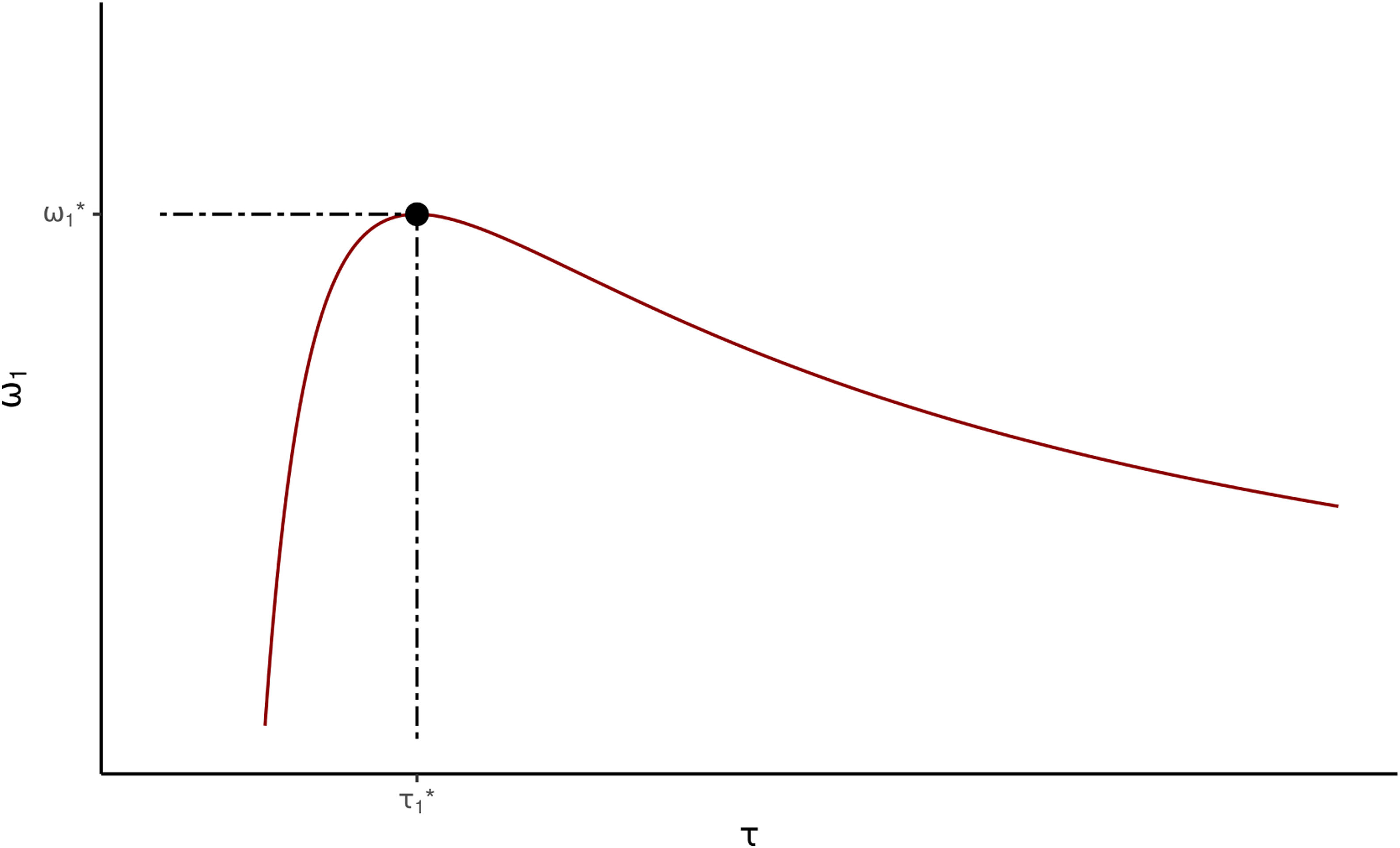
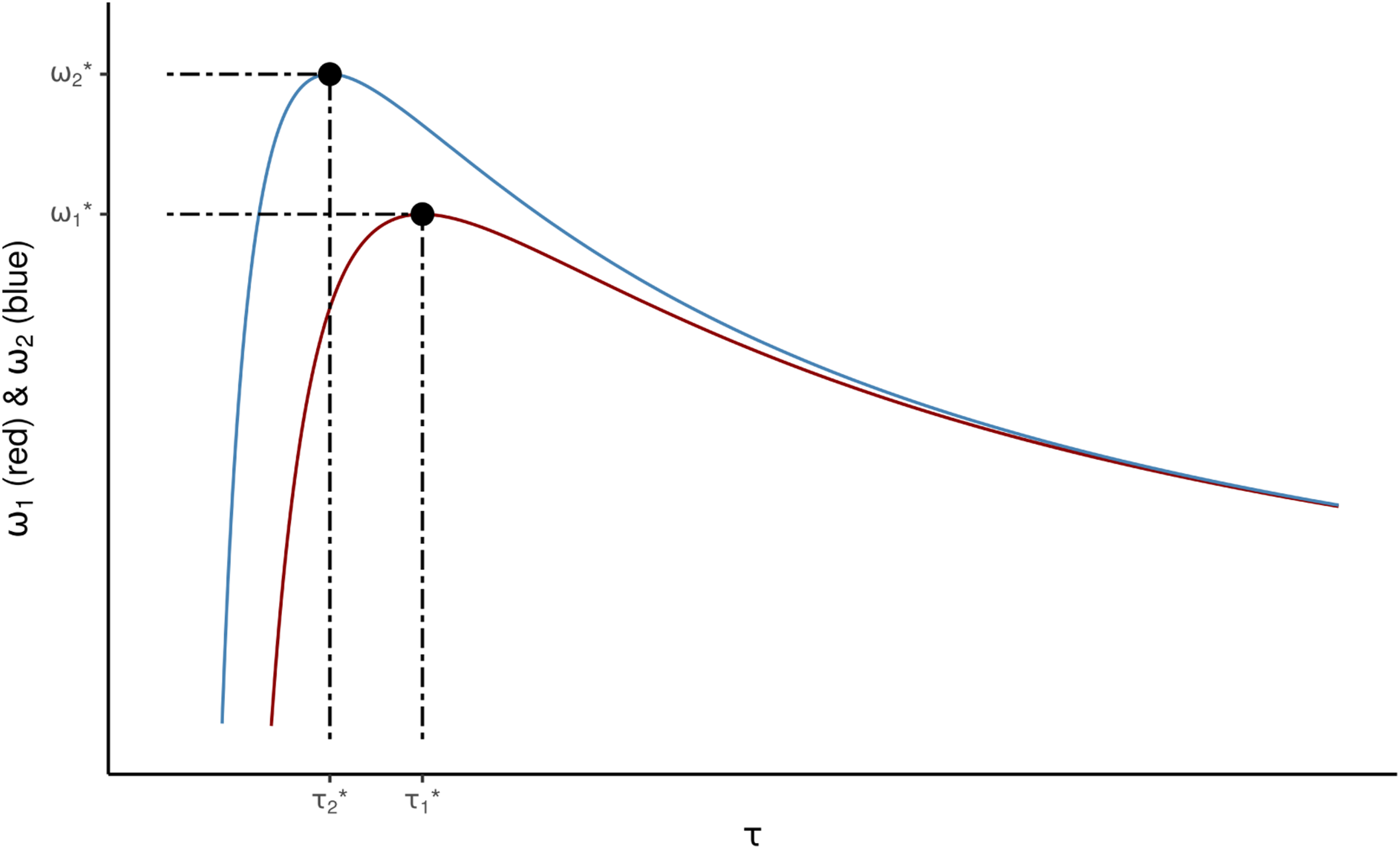
This provides us with a fascinating set of results and, in particular, the optimal point in terms of time and innovation rate. Indeed, it can be represented on the following graph with the optimal innovation level based on the affiliation contract’s length with the MSP
Let us now move to the Bayesian approach where we introduce a prior, denoted, and capturing the possibility of switching to a concurrent digital platform. Two related parameters are thus essential to consider: the duration of the affiliation contract and the switching costs.
Innovation when there is some competition with other platforms
Let us now augment the previous base model with our second hypothesis, in which two competing MSPs characterize the market. As aforementioned, hypothesis 2 states that when an industry is composed of more than one MSP, the optimal innovation is higher.
When we consider the possibility to access other platforms (or other digital platforms), the revenue is impacted by a factor, denoted
A further contribution could be to relax this condition to capture efficient platforms to less efficient ones. The following equation defines

It is again possible to determine the new maximum innovation rate based on the terms of the affiliation contract, as calculated in the following equation


Hence, as a result, we determine the new optimal rate of innovation when in the presence of a concurrent digital platform, as represented by the following equation

We have a new maximum
Figure 2 is computed with the following calibration for the parameters:
With these results, we think it is easier to grasp the subtleties of the—sometimes—contradictory conversations in the literature. Indeed, as aforementioned, we have two scenarios in the literature: one that demonstrates that MSPs are important innovation enhancers and another that demonstrates with force evidence that MSPs can threaten innovation dynamics.
When considering a conventional methodological paradigm, both scenarios can be valid in their context. This is why Bayesian empirical approaches have to be favored in this context. Researchers need to define a corresponding prior issue at stake. With the proposed theoretical framework, we demonstrate how introducing a prior can lead to more complex results in the methodological dimension.
In the competition law domain, we demonstrate that MSPs may positively and negatively impact innovation dynamics. The presence of an MSP is a terrific enhancer of innovation in an industry as long as the affiliation contract duration is below the optimal rate of innovation. In our case, the duration can be translated into a lock-in effect within a given platform. The duration is excessive as soon as the switching costs, which increased with the duration of the partnership, tend to be as high as they hinder any capacity to stop cooperating with the MSP. In other words, a too-long relationship may lead to an exclusive contract (single homing) or a situation of economic or technological dependence.
Beyond the optimal point, it has a negative impact. However, the first and second derivatives matter here. Before the optimal point, it is easy to find empirical evidence of the benefits in terms of innovation of the presence of MSPs. After the innovation point, the slope and its convexity demonstrate the more nuanced and subtle interpretations. Indeed, the innovation rate is still high and close to the optimal point. Researchers need a dynamic and a more long-term perspective to capture the negative first derivative. A static perspective may not lead to a negative interpretation.
Those lessons are essential for competition law enforcement. It is important to have a sound framework capturing the dynamics in the industry and having a more complex perspective than just a binary perspective. Of course, in this article, we deliberately chose to look at innovation. It is a philosophical bias towards a dynamic perspective of competition versus a more static analysis based on market structures.
Applications
We can discuss the conclusions derived from our model, by considering successively the impacts on innovation and the consequences in terms of competition policy.
As demonstrated in the formal model, MSPs are successful for they have built an adequate technological infrastructure. Complementors can indeed benefit from multiple dimensions: • First, the dimension related to the technological nature of the platform: economies of scale and network economies, access to resources potentially reducing barriers to entry, dedicated application programming interfaces (API), notably AI-based recommender systems, cloud-based services. • Second, the dimension related to the business nature of the platform: financial incentives (gains sharing related to the collection and processing of data by the MSP), potential protection against competition at least in the short term (from competing “complementors,” pooling of risks and investments, possible monitoring of the other members of the platform (nowcasting and possibility of “advanced” neutralization in case of development of “disruptive” technology for the platform). • Third, the dimension related to the incentives to single homing for complementors through mechanisms leading to exclusivity—also a logic of pre-emption to the detriment of competing platforms.
In short, platform integration has favorable effects—it increases the overall rate of innovation in that it lowers barriers to entry to innovation (reducing costs and risks), and it allows the coordination of investments between different platform members. As such, it resolves the radical uncertainty about the investment decisions of others. It may also provide some exclusivity. It may offer a form of interoperability and easy access to consumers (e.g., via the application store). Paradoxically, a platform escapes market forces and enters into a hybrid or integrated organizational form à la Coase (1937). There is less uncertainty and potentially no unnecessary duplication of investments in a sector where fixed costs are high and replication costs are very low.
Several issues could also be addressed. Some relate to the innovation dynamic in the digital world, and others to the consequences of competition policies.
Digital technology affects the various dimensions that affect collective innovation behavior compared to traditional activities. Digital platforms make it much more comfortable than traditional configurations to coordinate investments between independent players. These measures can create situations of dependence and vulnerability for complementors and allow the MSP to neutralize potential competitive threats (Marty and Pillot, 2021).
The innovation dynamics can also present another risk: complementors may only develop innovations at the module level and not at the architecture level (Yoo, 2016). Only the MSP can do this. However, its decisions—potentially unilateral—can significantly degrade ex-post the profitability of the complementors’ investments while at the same time proving to be favorable to the innovation dynamics as a whole or the consumer. The MSP’s ability to act unilaterally is problematic because it can play favorably or unfavorably concerning its complementors (De Meyer and Williamson, 2020).
Such a dynamic induces risks of competitive harm. The latter may be due to the development of anti-competitive exclusionary strategies (such as kill zones), the possible exercise of regulatory power within platforms, advantages linked to asymmetric access to data, and finally to possible abuses of economic or technological dependence.
MSPs can neutralize emerging threats (as nascent competitors, for instance, (Hemphill and Wu (2020)) through their data advantage (and their now casting capacities) and through their gatekeeper situation (in case of a kill zone scenario) or their financial ones (in the case of killer or consolidating acquisitions). Their capacity to neutralize competitive threats at their inception is based on their data advantage but also their algorithmic one. Their financial capacity to acquire promising companies is more helpful in this perspective. Such risks should be taken in account by competition law enforcers to assess the consequences on innovation dynamics of MSPs market practices and acquisition policies.
Conclusion
Regulatory tools or the implementation of competition rules could mitigate the competitive risks described above that could harm innovation. On the other hand, MSPs are at the heart of intra- and inter-platform competition. Regulation of these services along the lines of the network industries may be worth considering (Khan, 2019). Public policies should be designed to avert detrimental competition between platforms (examining the potential effects of exclusivity clauses and anti-fragmentation clauses)—switching providers incurs high financial costs and raises a slew of technical issues. Because maintaining market competition may be difficult when yields increase and there is a desire to avoid regulating contractual relationships within the platform, it is preferable to maintain market competition conditions. On a methodological level, additional research should examine whether the innovation dynamics associated with an MSP-based market structure are greater than those associated with a market structure close to a pure and perfect competitive market.
Footnotes
Declaration of conflicting interests
The author(s) declared no potential conflicts of interest with respect to the research, authorship, and/or publication of this article.
Funding
The author(s) received no financial support for the research, authorship, and/or publication of this article.

Notes
Proof
Let us present, here, the details of the optimization process (Horowitz and Lai, 1996)
Let us define
Now, let us take the first derivative
Let us look at the optimal innovation rate now
In order to determine
Let us define
Then
Hence, due to the convexity of
We then need to determine
From the previous equation