




Abstract
The World Development Report 2020 (WDR2020) asserts that global value chains raise productivity and incomes, create better jobs and reduce poverty, and proposes state policies to facilitate global value chain-based development. We deploy an immanent critique of WDR2020 to interrogate its claims regarding wages and working conditions. Using the Report’s own evidence, we identify contradictions in its claims, which stem from its use of comparative advantage trade theory to reconceptualize global value chain relations. This perspective predicts mutual gains between trading partners, but its core assumptions are incompatible with the realities of global value chains, in which (mostly Northern) oligopolistic lead firms capture value from (mostly Southern) suppliers and workers. We show how WDR2020 conceals these contradictions by misconstruing, inverting and ignoring evidence (particularly of labour’s agency), whilst failing to recommend redistributive measures for the unequal outcomes that it recognizes. By redeploying heterodox conceptions of monopoly capital and by using a class-relational approach, we scrutinize WDR2020's overly positive portrayal of lead firms. We provide alternative theoretical foundations to better explain the evidence within the Report, which shows that global value chains concentrate wealth, exacerbate inequalities and constrain social upgrading – with negative consequences for supplier firm workers in developing countries.
Introduction
Ever since their inception in 1978, World Development Reports (WDRs) have sought to promote their portrayal of inclusive global development. Framed in the mutual gains rhetoric of comparative advantage trade theory, they are pitched at the level of the general interest – as applicable to the entire international policy-making community. WDR2020 Trading for Development in the Age of Global Value Chains (‘the Report’) presents itself in the same light, confidently proclaiming that ‘GVCs boost incomes, create better jobs and reduce poverty’ (WDR2020: 3).
In a world of global value chains (GVCs), according to the Report, developing countries no longer need to establish entire industries. Rather, through linking up with lead firms (mostly transnational corporations (TNCs)), they can access best-practice techniques and latest technologies, and match them with their comparative advantage ‘factors of production’ of cheap labour and natural resources. 1 The Report emphasizes the benefits of ‘relational’ GVCs whereby ‘durable firm-to-firm relationships promote the diffusion of technology and access to capital and inputs along chains’ (WDR20202: 3, 14, 32, 67, 70).
According to WDR2020’s definition, GVCs are where production takes place in a series of stages, with ‘at least two stages conducted in different countries’ (WDR2020: 265). By 2008, 52% of world trade occurred under such arrangements (although the growth rate of GVC trade has stagnated since then, see Figure 1).
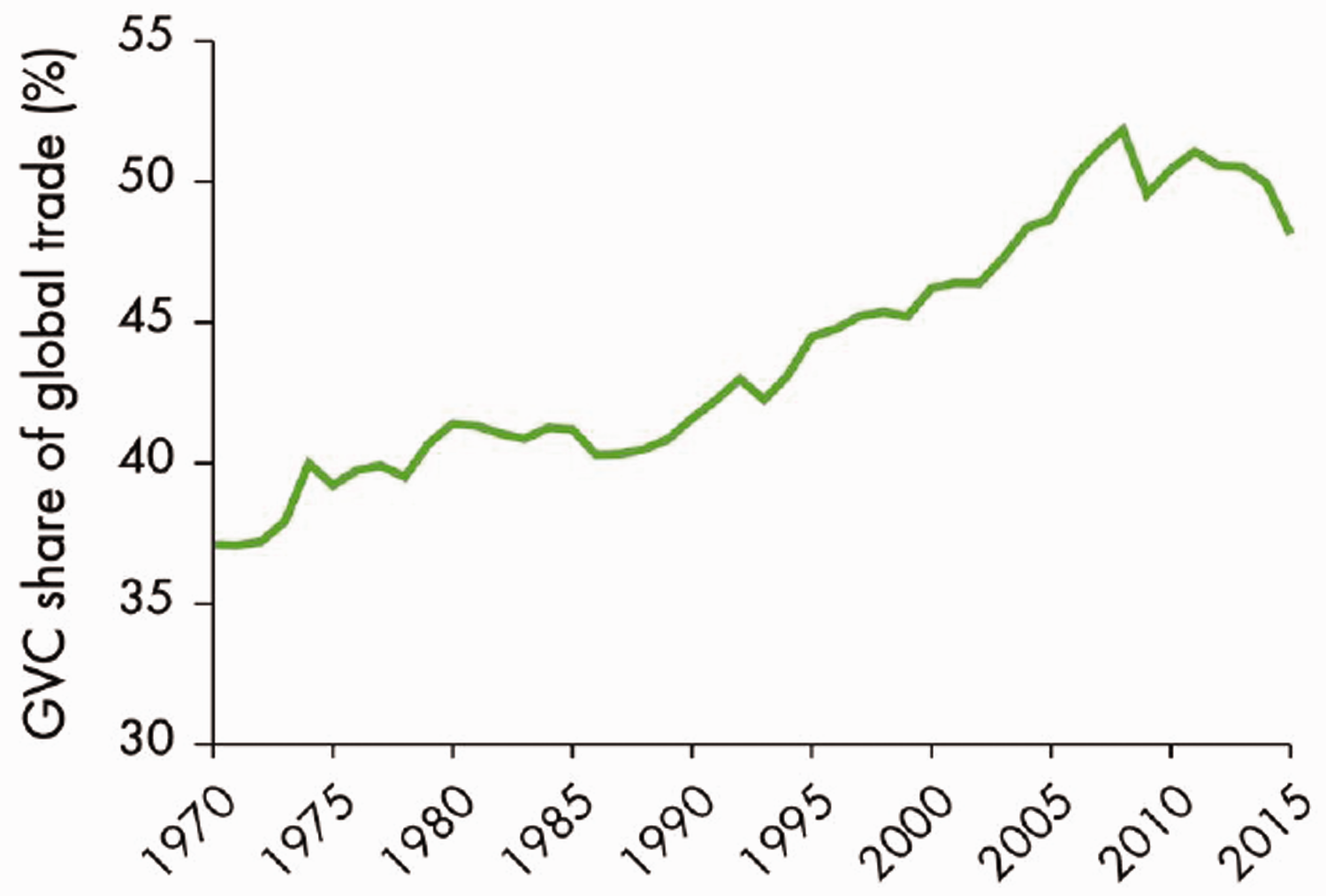
The growth of GVC trade.
Evoking Adam Smith (1776), the Report portrays ‘hyperspecialization’ (WDR2020: 14) as a process where supplier firms access advanced markets by focusing on the production of a limited range of (especially intermediate) components: [P]articipation in global value chains can deliver a double dividend. First, firms are more likely to specialize in the tasks in which they are most productive. Second, firms are able to gain from connections with foreign firms, which pass on the best managerial and technological practices. As a result, countries enjoy faster income growth and falling poverty. (WDR2020: xii)
However, according to WDR2020, between 1990 and 2015 only 34 countries (23%) upgraded out of its 146-country survey: 14 countries (including South Africa and Indonesia) upgraded from commodities into limited manufacturing GVCs, 11 countries (including China and India) upgraded from limited manufacturing into advanced manufacturing and services and 9 countries upgraded into innovative GVCs. Moreover, the growth rate of GVC trade has stagnated since 2008. So, despite its upbeat message, not that many countries have upgraded, and the opportunities for such upgrading appear to have lessened since the great financial crisis. But these are the least of the Report’s problems.
The report is as full of praise for the developmental potential offered by GVC inclusion as it is empty on the power relations inherent to the contemporary ‘GVC world’ (i.e. between different states, lead and supplier firms, and capital and labour) (Mayer and Phillips, 2017; Selwyn, 2019). However, this one-sidedness undermines, fundamentally, the Report’s core argument that ‘GVCs boost incomes, create better jobs, and reduce poverty’ (WDR2020: 3). In fact, the Report itself provides evidence to suggest that GVCs concentrate wealth, repress incomes, create many bad jobs (low-wage, low-skill, low-security and with poor working conditions), and reproduce new forms of in-work poverty.
Most GVC analysis – whether more mainstream or critical – recognizes the unequal power relations inherent to GVCs (Ponte, Gereffi and Raj-Reichert 2019). Not so the Report. Following from its mutual gains/comparative-advantage narrative, its conceptual foundations assume away power in the first place. The realities of GVCs, however, contradict the core assumptions and predictions of comparative advantage trade theory. The Report's own evidence shows that the contemporary world of GVC trade is one of heightened capital concentration and deepening labour exploitation.
Our article is original in three ways. We deploy an immanent critique methodology, which ‘takes the claims set by a theory seriously, reacts to the contradictions that arise in it and in its relation to the empirical world’ (Bernhold, 2019: 33) – to undercut the Report’s core claims. Second, we highlight the Report’s misuse of comparative advantage trade theory to explain GVC dynamics, and the effects this has on its analysis of empirical data. We argue, instead, that monopoly capital theory is more consistent with the evidence of unequal outcomes generated through GVCs that is presented within the Report.
Third, we show how WDR2020 obscures the anti-developmental outcomes for workers of GVC participation using various techniques of argument: It ignores evidence which opposes its good-news narrative (particularly regarding labour agency) and it misconstrues other studies to better support its claims. Where negative realities are undeniable, they are linguistically inverted as positives (i.e. what this article categorize as oligopolies, WDR2020 refers to as ‘superstar firms’), and it does not reflect its own evidence in its overall recommendations.
Like previous Reports, WDR2020 is quintessentially capital-centric (Selwyn, 2017). 2 It conceives of private capital-accumulation as the basis for the development of the poor, and identifies elite actors (lead and supplier firms) as drivers of capital-accumulation. Workers’ collective actions to ameliorate their conditions, and the developmental outcomes that these give rise to, are ignored. The term ‘social upgrading’ is not even mentioned in the report despite being central to three of the studies that are referenced within it, and despite its widespread use in the GVC literature. 3
Following this introduction, the upcoming section explains how the Report’s use of comparative advantage trade theory to explain GVC trade represents a category error: The existence of GVCs – where lead firms wield unprecedented economic power – undermines the key assumptions of comparative advantage trade theory. By contrast, the empirical reality of GVC trade, as reflected by data within the Report, confirms the theory of monopoly capital. The next section uses the Report’s own data to detail the extent of capital concentration and its effects on suppliers and workers in the contemporary GVC world. The subsequent section reveals how the Report attempts to overcome the logical contradictions within it by ignoring, misconstruing and inverting data on wages and working conditions, whilst failing to recommend redistributive measures for the unequal outcomes and deleterious impacts upon labour that it recognizes. The last section concludes.
Mainstreaming and the removal of power from GVC analysis
GVC mainstreaming
WDR2020’s key theoretical intervention is the removal of power relations from existing GVC frameworks through the use of comparative advantage trade theory. This represents the culmination of a decades-long process of mainstreaming a once-critical concept, in which the theorization of lead firm power over suppliers and workers in GVC research has been gradually minimized, before being removed entirely in WDR2020 (see Table 1).
GVC frameworks.a
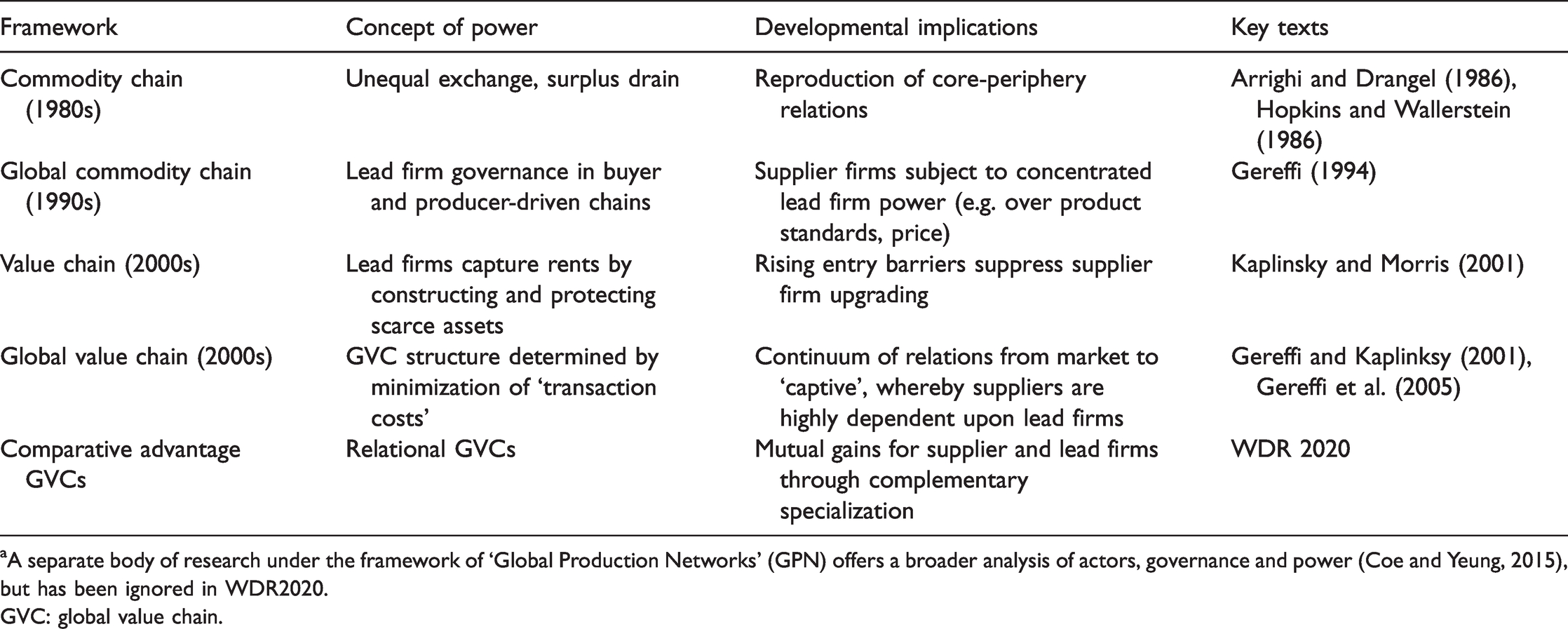
aA separate body of research under the framework of ‘Global Production Networks’ (GPN) offers a broader analysis of actors, governance and power (Coe and Yeung, 2015), but has been ignored in WDR2020.
GVC: global value chain.
Power and unequal exchange were very much at the centre of Hopkins and Wallerstein’s (1986) historical analysis, in which commodity-flows perpetuate a hierarchical global division of labour, and act to limit development. The focus shifted to inter-firm dynamics in Gereffi’s global commodity chain (GCC) approach (Gereffi, 1994). Although it allowed the potential for supplier upgrading, power relations remained central to explaining GVC outcomes – exercised by dominant ‘lead firms’ through ‘chain governance’. The later value chain (VC) approach theorized the power of giant lead firms in Schumpeterian terms, as rents derived from the control of key resources and vigorously protected in the form of ‘barriers to entry’ (Kaplinsky and Morris, 2001).
Notably, both GCC and VC approaches set themselves apart from comparative advantage trade theory. Gereffi (1994) and Kaplinsky (1998) drew heavily from Michael Porter’s The Competitive Advantage of Nations (1990), which argues that nations must compete in order to enable their industries to occupy higher-value tiers of international trade: National prosperity is created, not inherited. It does not grow out of a country’s natural endowments, its labor pool, its interest rates, or its currency’s value, as classical economics insists (Porter, 1990: 73).
Removing power: Comparative advantage trade theory
WDR2020 deviates from previous GVC frameworks in that it does not contain an explicit notion of power. Rather, it uses the language of comparative advantage trade theory to assert that GVC-led development generates mutual gains for both lead firms (concentrated in developed countries) and supplier firms (concentrated in developing countries), thus benefiting workers in both rich and poor countries alike: GVCs allow countries to benefit from the efficiency gained from a much finer international division of labor. GVCs exploit the fact that countries have different comparative advantages not only in different sectors, but also in different stages of production within sectors (WDR2020: 69, see also pages 36–39, 42, 48, 126, 137, 148, 160, 185, 195–197, 202, emphasis added). [B]ecause factor endowments matter, countries should exploit their comparative advantage by eliminating barriers to investment and ensuring that labor is competitively priced, by avoiding overvalued exchange rates and restrictive regulations. (WDR2020: 161).
The theory of comparative advantage dates back to David Ricardo’s classical argument that countries can benefit from trade even if they do not have an absolute advantage in producing any good, so long as they specialize in goods in which they have relatively higher productivity. If countries pursue this comparative advantage, then trade generates win-win outcomes whereby every country maximizes its income and enjoys cheaper goods (Mankiw and Taylor, 2008).
The dominant Heckscher–Ohlin (HO) version reformulates comparative advantage on the basis of ‘factor endowments’, i.e. whether a country is relatively ‘abundant’ in either capital or labour (both of which are assumed to be immobile). In this model, developed countries are capital-abundant and should thus focus on innovative high-tech production. Conversely, developing countries should exploit their advantage in cheap labour with labour-intensive production (Lin and Chang, 2009). As a result, poverty alleviation ensues through employment, and national income will be shared between capital and labour, with wages increasing in line with productivity. The factor-price equalization theorem predicts that the return to labour relative to capital should rise in developing countries (Samuelson, 1948).
The patchy empirical validity of the theory has long been a source of academic debate, but it has endured largely due to its parsimonious nature and popularity amongst economists (for an overview see Dunn, 2015).
Comparative advantage trade theory was briefly superseded in the late 1970s and 1980s by Paul Krugman’s (1979) New Trade Theory. This sought to explain the observation that similar (industrialized) countries traded similar (industrial) goods. In Krugman’s model, consumers enjoy varieties of products, and each country specializes in producing one variety (e.g. different cars produced by the United States or Japan). Economies of scale and monopolistic competition, rather than comparative advantage, determine specialization and trade patterns (Helpman and Krugman, 1985). Krugman’s model assumed that there are no barriers to entry and no fixed costs of exporting, therefore all firms are exporters and are highly similar.
In newer models pioneered by Marc Melitz (2003), it was identified that exporters make up only a small minority of firms within each industry, and they tend to be much larger and more productive than non-exporters (a situation referred to as ‘firm heterogeneity’). Melitz assumed that high productivity is necessary to surmount the fixed costs of exporting, enabling a few firms to expand and compete internationally. Similar approaches have been extended to importers who source from multiple countries, making them relevant to GVCs (Antràs et al., 2017). These models, which are also drawn upon in WDR2020, also lack a meaningful conceptualization of power-relations between firms.
While the heterogenous firm literature was emerging, however, the growth of trade between developed and developing countries tilted the debate back in favour of comparative advantage trade theory (as even argued by Krugman (2009)). In this new context, the Stolper–Samuelson model of comparative advantage trade theory (HO-SS), which allows for the international mobility of capital, was adopted by many economists. The HO-SS model redefined the two factors of production as low-skilled and high-skilled labour, rather than capital and labour (Dunn, 2015). Further iterations have been made relevant to GVCs by incorporating trade in intermediates (see Feenstra and Hanson, 1996; and Grossman and Rossi-Hansberg, 2008 – also referenced in WDR2020).
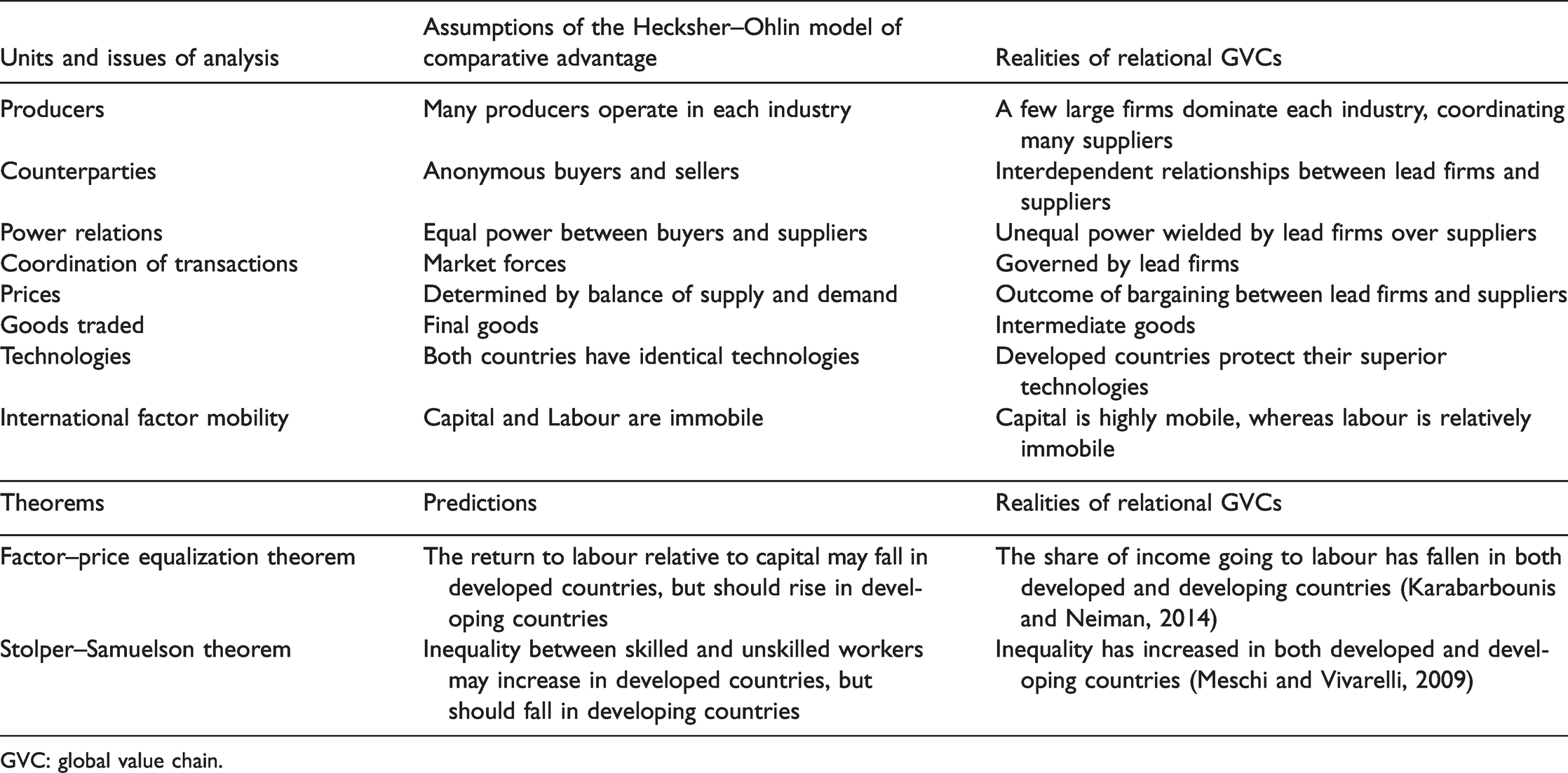
Such models continue to rely upon assumptions which are not compatible with the contemporary reality of GVCs; i.e. that trade takes place between anonymous parties with equal bargaining power (see Table 2). Conversely, the ‘relational’ GVCs described in WDR2020 are, by definition, based upon exchanges between connected firms of unequal power. As WDR2020 itself recognizes:
Comparative advantage trade theory versus GVC realities.
GVC: global value chain.
[T]hese features of GVCs lead to a novel, relational conceptualization of GVCs that shifts the focus away from the mere allocation of value added across countries through anonymous spot exchanges of goods and services. Instead, the identity of the agents participating in a GVC is crucial. (WDR2020: 32–34).
Despite this recognition, the Report proceeds to use the language of comparative advantage trade theory to explain the mutual benefits of GVC participation as trade-related specialization. Given this dissonance, however, it should be no surprise that the empirical evidence from GVC trade does not adhere to predictions derived from models of comparative advantage trade theory (see Table 2).
In Outsourcing Economics: Global Value Chains in Capitalist Development, Milberg and Winkler (2013) argue that the static efficiencies of comparative advantage trade theory are largely irrelevant in a world where development is pursued through dynamic upgrading, wherein powerful lead firms structure GVCs to serve their value-capture strategies: Firms within GVCs have determined the international division of labor … Suppliers have been forced to keep costs (especially labor costs) in check and to maintain markups over costs at a bare minimum. (Milberg and Winkler, 2013: 315)
Power in GVCs: A class-relational approach
Heterodox monopoly capital theorists place class relations close to the heart of their conception of capitalist expansion. In this way they differ quite profoundly from mainstream economists. As Robert Heilbroner (1975: 6) wrote: ‘The actual social process of production – the flesh and blood act of work, the relationships of sub-and super-ordination by which work is organised and controlled – are almost strangers to the conventional economist.’ A sentiment that applies equally to WDR2020.
Heterodox conceptions of monopoly capital – from neo-Keynesian to Marxist – theorize capitalism’s inner tendencies towards the growing size (concentration) and increasing dominance (centralization) of a few firms within each sector, and links this to adverse outcomes for suppliers and workers. John Bellamy Foster argues that ‘as the internationalisation of monopoly capital grows…the result is a worldwide heightening of the rate of exploitation (and of the degree of monopoly)’ (Foster et al., 2011: 12, see also Kalecki, 1990; Robinson, 1969; Selwyn, 2013; Veblen, 1904).
Dynamics of hyperspecialization and the slicing up of the value chain (Timmer et al., 2014) are made possible by the ever greater sub-divisions of the labour process. The control over, and management of, the labour process under monopoly capitalism is a function of the latter’s ‘incessant drive to enlarge and perfect machinery on the one hand, and to diminish the worker on the other’ (Braverman, 1998: 157). One consequence is a tendency towards labour force polarization between an ever-greater number of workers who occupy relatively unskilled positions and a minority who undertake relatively highly skilled work (Braverman, 1998).
Critical (dialectical) GVC literature illuminates these dynamics and trends. However, crucially, it also emphasizes the diverse forms such processes take, and the counter-dynamics that constitute the contemporary GVC world. On the one hand, as Nolan and Zhang (2010: 98, 99) note: the ‘commanding heights’ of the world economy are almost entirely occupied by firms from high-income countries … [c]ompanies from developing countries are trying to enter the ‘global level playing field’ at a time when the consolidation of business power has never been greater.
Selwyn’s (2019) global poverty chain concept illuminates and theorizes how such pressures reproduce impoverished labour forces in Cambodian garment and Chinese electronic chains. Whilst workers’ productivity is enhanced through hyperspecialization, their remuneration is determined by local labour regimes, where states and supplier firms, under pressure from/in coordination with lead firms, seek to maximize value extraction from labour (Ali, 2015; Kerswell, 2013; Smith et al., 2018). For example, Apple’s profit for the iPhone (in 2010) constituted over 58% of its final sale price, while Chinese workers’ share was 1.8% (Clelland, 2014; Kraemer et al., 2011). The latter, in turn, need to undertake extremely long hours (up to 90 a week), under strict managerial discipline and with deleterious health-impacts, to earn a subsistence wage (China Labour Watch, 2016).
Seabrooke and Wigan’s (2017) global wealth chain approach highlights how lead firms deploy mechanisms, such as off-shore banking, to minimize tax liabilities. Relatedly, Quentin and Campling’s (2018) notion of a global inequality chain illustrates how growing macro-scale wealth inequalities reinforce micro-level social (gender) inequalities. Such dynamics of systemic wealth concentration and labour subordination challenge Coe and Yeung’s (2015: 169) claim that structured hierarchies do not, anymore, characterize the world economy.
However, and on the other hand, while dynamics of concentration and centralization (of lead firm wealth and power) characterize the contemporary GVC world, this does not result in uniform developmental outcomes at the supplier base of the chain (Pickles and Smith, 2016). Rather, critical GVC analysis illuminates the relative diversity of forms, responses and outcomes to these mega pressures, some of which are generating notable counter-trends.
Workers’ self-organization is a crucial determinant of whether monopoly-capital pressures are transformed into immiserating growth outcomes. Critical GVC analysis illuminates how workers’ collective actions have generated significant gains in their terms and conditions in Brazilian grapes, Honduran garments, Indonesian sportswear, South African wine, and across the world of logistics respectively (Alimahomed-Wilson and Ness, 2018; Hastings, 2019; Las Heras, 2018; Selwyn, 2012; Siegmann et al., 2017).
One outcome of enhanced lead firm power is the raising of entry barriers to, and accelerated differentiation of, supplier firms. Whilst rising standards ‘offers substantial opportunity for producer upgrading into higher value activities…and in some cases social upgrading for workers …’ they also ‘limit participation to only those producers with the necessary investments needed for compliance’ (Goger et al., 2014: 11). While technology transfer has taken place within GVCs, its uptake is limited to firms that can jump the first barrier to chain participation. However, standardization in GVCs requires significant circulation and processing of information to communicate product specification, technical know-how and costs. As Durand and Milberg (2019) demonstrate, lead firms supported by core economy states, are at the forefront of monopolizing (through patents) such intellectual property (and see next section).
In her study of Argentinian grain and oilseed value chains, Christin Bernhold (2019) illustrates how upgrading occurs through class differentiation: smaller capitals/petty commodity producers have been displaced by large agro-industrial firms, which have, in turn, re-shaped capital-labour relations across the ‘Soy republic.’ One consequence of supplier firm differentiation is the emergence of a few giant oligopolistic supplier firms (such as China’s footwear producer Yue Yuen, and India’s denim producer Arvind) (Kumar, 2020).
The relative power of these suppliers vis-à-vis lead firms enables them to capture larger portions of value generated in their respective GVCs. This, in turn, generates new possibilities for organized labour to press for meaningful social upgrading (Kumar, 2020). Bair and Werner’s ‘disarticulations’ perspective places such class-dynamics in a long historical durée by explicating ‘the layered histories of dispossession, disinvestment and accumulation that shape a region’s position in global circuits of commodity production’ (Bair and Werner, 2011: 1001).
This dialectical understanding of capitalist development is absent in WDR2020. Its comparative advantage trade theory perspective precludes a meaningful theorization of power relations and, as we shall see, results in a series of contradictions between the claims of the Report and the evidence presented within it.
Lead firms: Squeezing suppliers
WDR2020 is keen to provide evidence of mutual gains under GVC trade, despite the fact that such trade is increasingly dominated by large corporations – these GVC firms (which WDR2020 defines as firms that both import and export) account for only about 15% of all trading firms in the world but capture about 80% of total trade (WDR2020: 30–31). Following Autor et al. (2017), WDR2020 calls the biggest lead firms ‘superstars.’ It argues that GVCs accelerate development because ‘relational’ GVC linkages transmit gains from lead firms to supplier firms in developing countries and on to their workers.
Irony rather than politically loaded admiration would have been more appropriate given that the lion’s share of gains from GVC trade flow in the opposite direction. As the Report itself documents, GVCs have inflated the profitability of lead firms at the expense of supplier firms in developing countries.
The rise of GVCs has ushered a profit bonanza for US lead firms, who have secured continually rising mark-ups over costs of production. WDR2020 notes that ‘GVCs have boosted superstar firms that earn superstar profits and may dominate the market’ (WDR2020: 84). The Report references De Loecker and Eeckhout’s (2018) analysis of the financial accounts of 70,000 firms across 134 countries, which found that profits have risen substantially since 1980, particularly in the United States and Europe, with average markups over costs of production rising from 1.1 to 1.6 by 2016.
Crucially, gains do not appear to be mutual, for either supplier firms in developing countries or for their workers (on the latter, see the upcoming section). De Loecker and Eeckhout find that firms from developing countries have seen markups stagnate or decline, particularly in South America and China (De Loecker and Eeckhout, 2018: 7). WDR2020 acknowledges that: Large corporations that outsource parts and tasks to developing countries have seen rising markups and profits, suggesting that a growing share of cost reductions from GVC participation are not being passed on to consumers. At the same time, markups for the producers in developing countries are declining. (WDR2020: 3) The implications of GVCs for the emergence of superstar firms huge in scale, high in market power, and large in profit rates are exacerbated by the disproportionate bargaining power that these large lead firms may have over their suppliers … Although buyer firms in developed countries are seeing higher profits, supplier firms in developing countries are getting squeezed. (WDR2020: 85)
The closest WDR2020 gets to theorizing power is cursory mentions of ‘market power,’ mainly to describe anti-competitive behaviour of digital platform firms (WDR2020: 145). The term is not defined in the Report, but it appears to adopt orthodox economics’ definition of firms’ ability to raise consumer prices. Remarkably, the 294-page WDR2020 avoids any mention of oligopoly. It only mentions monopoly in two restricted contexts: (i) to critique ‘inefficient public monopolies’ or (ii) to discuss how cartels raise prices for consumers (another ailment which is apparently best addressed by enhanced trade agreements) (WDR2020: 169, 249).
Unlike WDR2020, concentrated lead firm power has been empirically investigated and theorized rigorously by independently minded academics. As Strange and Newton (2006: 184) put it, a partial consequence of the centralization of TNCs’ economic power is that powerful buyers can ‘push down the prices of supplies to marginal cost and thus extract the full profits from the sales of the final goods …’ William Milberg (2008: 429) calls this the ‘mark-up effect … [through] which the lead firm in the global value chain is able to raise the mark-up over costs … through the control of input costs’. For example, significant import price declines (of over 40% between 1986 and 2006) have benefited US firms engaged in computers, electrical and telecommunications products, clothing, footwear, textiles, furniture, chemicals and miscellaneous manufacturers (including toys) (Milberg, 2008: 433).
One consequence of intensified lead firm concentration within GVCs is a rising share of national income going to capital rather than labour, which studies have attributed to the surge in TNC profitability. De Loecker and Eeckhout (2018: 10) find that the inflated mark-ups of large firms have resulted in an increasing share of income going to capital rather than workers: higher markups lead to higher profits, and … they are not driven by higher overhead costs. This further confirms the fact that the increase in markups brings about a distributional change with more of the surplus going to the owners of the firms and less to the workers. The skewed distribution of intangible assets limits value capture opportunities by tangible-intensive producers from the developing economies and thus limits their ability for ‘social upgrading,’ that is improvement in wages and labor standards. (Durand and Milberg, 2019: 19)
Unsurprisingly, this recognition has no impact on WDR2020’s perspective (comparative advantage trade theory), its developmental outlook (mutual gains derived from GVC participation), its policy proposals (designed to enhance lead firms’ power) or its conception of labour (as a factor of production).
Labour’s fate in WDR2020
WDR2020 sees the world from the perspective of capital. It heralds lead and supplier firms as representing dynamic and innovative actors while workers are portrayed as ‘comparative advantage factors of production’ to be deployed by developing countries to attract foreign direct investment by TNCs. The Report’s elite bias is showcased with characteristic vigour when addressing the labour question.
The Report relies upon four techniques of argument to conceal the anti-developmental outcomes, suffered by workers, from the exercise of lead firm power. These are: (i) ignoring evidence (particularly of labour agency), (ii) misconstruing studies, (iii) inverting negatives into positives, and finally, (iv) recognizing remaining problems (together with progressive proposals) but failing to make meaningful redistributive recommendations.
Ignoring evidence
WDR 2020 claims that GVC participation by supplier firms in developing countries can enhance workers’ incomes and livelihoods. The case study of Samsung’s new factories in Vietnam runs throughout the Report. Its opening lines wax lyrical about Vietnam’s successful integration into the electronics GVC, recounting how: Samsung makes its mobile phones with parts from 2,500 suppliers across the globe. One country—Vietnam—produces more than a third of those phones, and it has reaped the benefits. The provinces in which the phones are produced, Thai Nguyen and Bac Ninh, have become two of the richest in Vietnam, and poverty there has fallen dramatically as a result. (WDR2020: xi) Researchers reported testimonies of dizziness or fainting at work from all study participants and high noise levels that violated legal limits. Miscarriages were reported to be common and workers reported pain in their bones, joints, and legs which they attributed to standing at work for 70 to 80 hours a week. (UNHR: 2018)
Ignoring labour agency
The Report credits lead firms for implementing ‘voluntary codes of conduct’ that improve working conditions within their supply chains (WDR2020: 89). It also celebrates campaigns by benevolent western consumers and NGOs. But it veils worker’s own attempts to improve their pay and conditions. For example, it claims that: ‘In response to demands from international buyers, and learning from international best practices, Bangladeshi producers are increasingly recognizing that they must not only improve their practices, but also ensure that improvements can be independently verified by third parties’ (WDR2020: 67). Empirically however, militant strike action was instrumental in securing permanent pay rises in Bangladesh’s GVCs: Bangladesh’s official wage board has approved a 77% rise in pay for the region’s garment workers from December [2013] after the world's second largest clothing exporter was crippled by strikes and the Rana Plaza disaster … In September this year, thousands of garment factory workers in Bangladesh protested over low wage rates, resulting in the closure of many factories.
4
The Report’s conceptual denial of labour agency is also manifested in its non-consideration of the effects of labour’s collective actions upon capitalist decision-making (Silver, 2003). A significant impulse for North American and Western European firms to begin transnationalizing production from the late 1970s onwards was organized labour’s push for higher wages in the core of the world economy, represented by breakdowns in managerial workplace authority (Smith, 2016). The proliferation of GVCs across the East/South-East Asian region, is in part, a dialectical story of lead firms’ search for pools of cheap labour, rising class struggles for enhanced labour conditions, and new patterns of cheap-labour orientated spatial relocation (Cantin and Taylor, 2008; Gray and Jang, 2015; Zhu and Pickles, 2014).
Misconstruing evidence
The Report’s preferred benchmark is wages and employment, and it is keen to demonstrate that GVCs deliver both: ‘Not only do GVC firms employ more people, but they also pay better’ (WDR2020: 79). So keen in fact, that it presents a highly selective, or even misleading, interpretation of the evidence. The Report states that ‘across a sample of developing countries, firms that both export and import pay higher wages than import-only and export-only firms and nontraders’ (WDR2020: 80). It supports this statement, citing an article by Ben Shepherd and Susan Stone (2012), claiming that its findings are that ‘firms with the strongest international linkages – export, import, and foreign-owned – pay higher wages’ (WDR2020: 95).
However, the purpose of Shepherd and Stone’s study is to provide ‘evidence on the links between GVCs and labour markets, focusing on developing economies, particularly the OECD’s Key Partner countries (Brazil, India, Indonesia, China and South Africa) (Shepherd and Stone, 2012: 3). These countries account for the majority of workers employed in GVCs (Suwandi, 2019: 47). Shepherd and Stone do find a positive link with wages for a large sample of 108 countries. Crucially, however, when they focus on these five developing economies they find: ‘no discernible impact of international linkages on wage rates in these data for the key partner countries… the effects of GVCs may be primarily felt in emerging markets through increased employment rates rather than higher wages’ (Shepherd and Stone, 2012: 15). In summary, they discern no association between GVC employment and higher wages in these countries.
In a later section, WDR2020 reiterates that: ‘firms operating in GVCs tend to pay higher wages than firms operating in direct trade only’ (WDR2020: 198), referencing two further literature surveys. Again, this is a selective, or misleading, representation of the evidence. For example, the cited survey by Margaret McMillan and Ínigo Verduzco-Gallo (2011) does present a number of studies that have identified higher wages in foreign firms, but they continue: However, these wage gaps can be due to other factors. For example, if foreign firms attract more productive workers, then it would be reasonable to expect that these workers would demand higher wages to compensate for their higher productivity. In that case, the wage gap between wages in foreign and domestic firms would be explained by differences in the characteristics of the type of workers they hire. This seems to be the case; after controlling for firm and worker characteristics, the wage premium paid by foreign firms drops significantly. (McMillan and Verduzco-Gallo, 2011: 45)
To augment their literature review, the authors analyse a large international dataset to investigate the connection between trade liberalization and labour market outcomes, and conclude that: ‘at least in the aggregate, trade liberalization is not correlated with changes in real wages or employment’ (McMillan and Verduzco-Gallo, 2011: 55, emphasis added). None of this is reflected in WDR2020.
Inverting adversities
WDR2020 claims that GVCs are inclusive and provide ‘better jobs’ (WDR2020: 3, 80, 196). Unfortunately, the widely observed realities of job insecurity and inequality throughout GVCs are too ubiquitous to be ignored or misconstrued (Anner, 2012; Barrientos, 2008; Newsome et al., 2015). An important example is the higher prevalence of women amongst the lowest-paid and most precarious jobs within GVCs, with some of the worst conditions (Barrientos, 2008). Women, working under gendered power relations, are often perceived by employers as easier to discipline (Baglioni, 2018; Elson and Pearson, 1981). Aspects of gender-related wage inequality are recognized in the Report, but only after it celebrates how GVCs contribute to the ‘broader development benefits of higher female employment’, thus ‘improving their livelihoods and those of their families’ (WDR2020: 3, 68).
Widespread inequality within GVCs is also difficult to ignore (Goldberg and Pavcnik, 2007). The Report claims that ‘GVCs are, on the whole, inclusive’ (WDR2020: 196), and that there is a ‘lack of a systematic relationship between GVC participation and growth in income inequality for developing countries’ (WDR2020: 82). It does however recognize that GVCs have ‘increased wage inequality in low- and middle-income economies’ (WDR2020: 87). This contradiction is circumvented by arguing that GVCs disproportionately reward higher-educated and higher-skilled workers, a fact that is celebrated in the Report (WDR2020: 3, 68, 87). This is scant comfort, however, to the vast workforce of casualized, largely female, workers who are exploited throughout GVCs (Mezzadri, 2016).
The shift of income from labour to capital: Recognition but no reparation
Ever since Nicholas Kaldor’s ‘stylised facts’ (1961), Economists have assumed that the ‘share’ of national income going to labour versus capital remains constant over time (Eggertsson et al., 2018). Such faith is no longer tenable. Considerable evidence shows that the share of income in developed countries has shifted significantly from labour to capital since the early 1980s (Elsby et al., 2013). Studies have attributed the trend both to the rise of ‘superstar’ firms (Autor et al., 2017), rising TNC profits (Barkai, 2016; Kohler and Cripps, 2018) and GVC participation (Dao et al., 2017; Parteka and Wolszczak‐Derlacz, 2018). Contrary to the predictions of Heckscher–Ohlin model of comparative advantage trade theory (see Table 2) this has occurred in both developed and developing countries (Karabarbounis and Neiman, 2014). As UNCTAD’s (2018) report puts it: [T]he rise in the profits of top TNCs accounted for more than two thirds of the decline in the global labour income share between 1995 and 2015. Therefore, although the rising share of the profits of top TNCs has come at the expense of smaller enterprises, it has also been strongly correlated with the declining labour income share since the beginning of the new millennium (2018: 57). In 63 developed and developing economies, GVC integration as well as other domestic within-industry forces, such as technology or markups, contributed significantly to the reallocation of value added from labor to capital within countries between 1995 and 2011. (WDR2020: 86)
One potentially redistributive mechanism that is mentioned in the Report is the implementation of higher minimum wages. However, what it gives with one hand it takes with the other: It promotes minimum wages and even mentions living wages (WDR2020: 198) but then cautions immediately against meaningful wage increases: ‘In some countries, distortions in the domestic market may drive a significant wedge between a living wage for workers and the wage at which firms can remain competitive in international markets’ (WDR2020: 199). Where ‘competitive’ wages are below subsistence, WDR2020 shifts the responsibility onto the state to provide wage-subsidies (effectively, subsidies to firms) (WDR2020: 200, 202, 204).
On labour policy, some progressive suggestions are put forward in WDR2020. It references the ILO’s better work campaign and recommends adopting the ILO’s core conventions on labour standards (WDR2020: 195, 202). However, the overarching suite of policy recommendations aligns with the previous WDR on The Changing Nature of Work (WDR2019), which portrays capitalist globalization and technological change as certain, arguing that governments should not, therefore, burden employers with troublesome workers-rights and protections. Instead, WDR2020 argues that the state should promote a ‘flexible’ labour market (i.e. make it easy for firms to hire and fire): Because GVC employers need to compete in absolute terms in global markets, restrictive labor market policies can be a barrier to investment. To balance inclusion and competitiveness, countries may combine greater labor market flexibility (that is, limiting labor regulations that significantly restrict employers, while maintaining adequate protection of workers) with highly supportive social protection and complementary social insurance. (WDR2020: 202)
Conclusions
On the face of it, WDR2020 signifies the apogee of GVC analysis. Over two and a half decades, the approach has gone from academic sub-discipline to a primary concept in developmental intervention.
However, while WDR2020 represents the zenith of popularity of GVC analysis, it also embodies the intellectual low-point of the approach. WDR2020’s key messages and conclusions do not follow from its own evidence: Whilst the Report claims that ‘GVCs boost incomes, create better jobs, and reduce poverty’, its own evidence suggests that they concentrate wealth, repress incomes, create many bad jobs and reproduce new forms of in-work poverty. Our immanent critique of WDR2020 demonstrates how it selectively ignores evidence which opposes its good-news narrative, and it misconstrues other studies to better support its claims. Wherever the negative realities are undeniable, they are linguistically inverted as positives, and it does not reflect its own evidence in its overall recommendations.
The Report claims that GVCs generate mutual gains for lead and supplier firms, while its evidence suggests increasingly exclusive gains. It recognizes that buyer firms in developed countries reap higher profits while supplier firms in developing countries are squeezed as a consequence of GVC participation, but nevertheless promotes such GVC participation as a development strategy for the latter. It misconstrues evidence about higher wages in developing countries. While it claims that workers benefit from employment in supplier firms, it ignores well-documented evidence to the contrary. It erases any scent of workers’ agency when explaining improvements to their conditions.
The WDR’s long-standing commitment to the assumptions of mutual gains derived from comparative advantage theory-based trade generates a GVC framework devoid of power relations. Consequently, even when it recognizes problems of GVC participation caused by the exercise of lead firm power, these are externalized from its pre-determined deductive narrative.
In re-deploying a class-relational concept of monopoly capital we provide a framework that corresponds better to the empirical reality of intensifying lead firm power. Such power enables these firms to capture the lion’s share of value produced within GVCs, at the cost of falling markups to supplier firms and rising rates of labour exploitation. Whilst lead firms’ incorporation of myriad supplier firms into their networks requires a certain degree of economic upgrading, it also generates significant barriers to social upgrading.
WDR2020 represents a capital-centric research and policy agenda. It is a rationalization of oligopolistic globalization, widening inequality and intensified labour exploitation where, under the guise of development, lead firms purposefully structure market and extra-market relations to sustain their wealth capture strategies. A progressive research/policy agenda, by contrast, would include a meaningful conceptualization of power relations and labour agency as part of a dialectical understanding of development.
Footnotes
Declaration of Conflicting Interests
The author(s) declared no potential conflicts of interest with respect to the research, authorship, and/or publication of this article.
Funding
The author(s) received no financial support for the research, authorship, and/or publication of this article.
