



Abstract
A growing body of literature is devoted to understanding the drivers of companies’ corporate social responsibility strategies in developing countries. However, little is known about how institutions and stakeholders located at both international and local levels collectively shape the corporate social responsibility communication of MNC subsidiaries in their host countries. Drawing upon the framework proposed by Lee, this study addresses this gap in the context of Bangladesh. A series of semi-structured interviews as well as secondary data from annual reports and company websites are used to identify the roles that parent companies, international institutions and international stakeholders play in shaping local subsidiary corporate social responsibility communication. Contrary to the expectations derived from the literature, the findings show that despite the presence of institutional voids and limited pressure from local stakeholders, MNC subsidiaries engage in corporate social responsibility activities and employ corporate social responsibility communication, albeit instrumentally, in order to acquire business benefits.
Keywords
Introduction
Businesses are increasingly engaging in communicating their CSR programmes, products and impacts of the concerned stakeholders by utilizing different communication channels (Fifka et al., 2018; Morsing and Schultz, 2006). Globalization, emergence of new communication technologies and the transformation of the traditional political landscapes are instrumental in changing the face of company–stakeholder interactions (Crane and Glozer, 2016). Given this shift, the traditional stakeholder information strategy is increasingly being complemented by the stakeholder engagement strategy, which transforms the interaction between the company and its stakeholders (Capriotti, 2011). Which communication strategies are adopted by the company may depend on the expectations of stakeholders 1 and institutions. 2 It is contended that increasing pressures from stakeholders and institutions heighten the need to adopt a proactive strategy in which stakeholders are engaged (dialogue) in decision making processes (Lee, 2011), while the lack of such pressures may encourage companies to use the CSR communication platform for the sole purpose of disseminating information. The communication strategies adopted may also depend on whether the company sees its relations with stakeholders from a utilitarian or a normative point of view. For example, one might argue that companies with a narrow focus on business benefits tend to merely inform stakeholders, while companies engaging in a dialogue with stakeholders seek to generate benefits for different stakeholders (Kim and Lee, 2018; Morsing and Schultz, 2006). Of course, who benefits, and in what ways, will depend on the degree of pressure from stakeholders and institutions.
The degree of pressure from stakeholders and institutions not only dictates how companies communicate CSR but also determines the nature of benefits (either business benefits, stakeholder benefits or both) that companies tend to create from CSR communication. Current studies tend to examine CSR communication from the perspective of institutions (Lattemann et al., 2009; Matten and Moon, 2008) or stakeholders (Morsing and Schultz, 2006). Therefore, our understanding of how the interplay between institutions and stakeholders shapes CSR communication strategies and their motivation to communicate CSR still remains limited (see Islam and Deegan, 2008, 2010). Prior research examining the motivation behind CSR communication largely focused on developed countries (e.g., Birth et al., 2008; Blombäck and Scandelius, 2013), leaving a gap in knowledge in the extant literature as to why companies communicate their CSR activities in a developing country.
In view of the above state of affairs, the purpose of this research is twofold; first it aims to bridge the gap in the current literature by examining to what extent various institutions and stakeholders influence the CSR communication strategies of MNC subsidiaries in Bangladesh (RQ1). In this study, we view CSR communication as a symmetric communication model, encouraging the company as well as its stakeholders to persuade the other to change (Christensen and Cheney, 2011; Morsing and Schultz, 2006). Second, we set out to identify what motivates local subsidiaries to communicate their CSR initiatives and how these motivating factors are determined by the intricate relationship between stakeholders and institutions (RQ2). To address these two key questions, this study applies Lee’s (2011) framework, which demonstrates how the interactions between different institutions and stakeholders lead to several distinct CSR strategies (e.g., accommodative, obstructionist, defensive, and proactive). With the help of this framework, we will demonstrate how local subsidiaries’ CSR communication strategy is shaped by a range of local and international stakeholders and institutions. The study extends Lee’s (2011) work by arguing that subsidiaries are unlikely to adopt the obstructionist strategy (i.e. rejecting CSR activities) despite institutional voids and limited/no pressure from local stakeholders in developing countries. Stakeholder information strategy used by these local subsidiaries to create business benefits is largely a result of pressures exerted by international stakeholders and institutions. The findings can broaden and deepen our understanding of the dynamics and complexities associated with the interplay between institutions and stakeholders and their impact on local subsidiaries’ CSR communication strategies in developing countries.
This article is structured as follows. After providing a literature overview of CSR communication, this article makes a case for adopting the framework proposed by Lee (2011), explores how local subsidiaries communicate CSR, and sheds light on how CSR is communicated in Bangladesh. We adopt an interpretive qualitative research methodology, conducting 20 semi-structured interviews with managers and experts from Bangladesh. We then present the findings of our empirical study and discuss the findings in relation to how MNCs communicate CSR and what motivates them to communicate CSR. From there, we outline some implications, address some limitations and suggest avenues for further research in the relevant field.
Literature review
CSR communication
Morsing (2006) provides a simple definition of CSR communication, which ‘is designed and distributed by the company itself about its CSR efforts’ (p. 171). May (2011), though, argues that such a simple view fails to demonstrate the underpinning meaning of CSR communication, which is more than an instrument or tool or concept for management to disseminate CSR information. It also allows for developing new CSR perspectives by constructing and reconstructing the existing policies (May, 2011). Corresponding to this narrative, Christensen and Cheney (2011) assert that communication is not only a means to transmit companies’ intentions, objectives and CSR activities, but also is ‘a continuous process through which social actors explore, construct, negotiate, and modify what it means to be a socially responsible company’ (p. 491).
Morsing and Schultz (2006) propose three CSR communication strategies – i.e. the stakeholder information strategy; the stakeholder response strategy; and the stakeholder involvement strategy – within which both one-way and two-way communication channels are encompassed. Each promotes different communication means and objectives. For instance, the stakeholder information strategy uses one-way communication channels to create stakeholder awareness (Morsing and Schultz, 2006). The process model of CSR communication prescribed by Kim (2019) suggests that CSR awareness can improve stakeholder trust and encourages them to engage in CSR activities, which results in a positive effect on corporate reputation. Existing research has also identified other business benefits – e.g., managing legitimacy (Branco and Rodrigues, 2006) and influencing employee behaviour (Birth et al., 2008; Du et al., 2010) – that companies seek to gain from CSR communication. Desire to create business benefits through one-way CSR communication can limit the ability of a company to understand the expectations of stakeholders (El-Bassiouny et al., 2018; Morsing and Schultz, 2006). The shortcomings of one-way CSR communication demand more attention to two-way communication, which invites the company and its stakeholders to engage in concurrent negotiation over their concerns, thereby enabling the company to increase message credibility (Eberle et al., 2013) and build and manage relationships with stakeholders (Andriof and Waddock, 2002). The stakeholder response strategy is based on a ‘two-way asymmetric’ communication mechanism, the sole aim of which is changing public attitudes and behaviour (Morsing and Schultz, 2006). The stakeholder involvement strategy utilizes a two-way symmetric communication model (e.g., dialogue) in which the company and its stakeholders tend to persuade the other party to change. However, it is contended that two-way communication (e.g. dialogue) with all stakeholders is naive and unfeasible (Laskin, 2009), and it is a time consuming and expensive approach (Schultz and Wehmeier, 2010). Given the important roles played by both communication strategies, Elving et al. (2015) recommend that managers recognize the importance of both strategies and assess the effects of communication.
Theoretical background
Since CSR communication is shaped by both institutional and stakeholders’ expectations, it is critical to understand the collective role of institutions and stakeholders. Institutions such as government regulations and state constitutions set the rules of the game and exert strong influence in shaping companies’ behaviour (North, 1990). According to Lee (2011), institutions constitute distal mechanisms that shape companies’ strategies, pertaining to social and economic responsibilities. Institutions located at various levels such as industry, country and transnational have their own degrees of influence on firms’ business practices (Lattemann et al., 2009). In demonstrating how institutions shape companies’ behaviour and gain legitimacy, Scott (2014) identifies three institutional pillars: normative, regulative and cognitive. Here, legitimacy is produced by three key processes: normative pressure (i.e. normative pillar) – aligning with standards set by professional/educational authorities; coercive isomorphism (i.e. regulative pillar) – complying with codified rules, norms or laws; and mimetic processes (i.e. cognitive pillar) – adopting best practices (DiMaggio and Powell, 1983).
The theoretical link between institutional theory and stakeholder theory is drawn from the framework proposed by Lee (2011) who demonstrates how institutions and stakeholders collectively shape CSR strategy. Lee (2011) identifies four CSR strategies based on different configurations of institutions and stakeholders: (i) obstructionist strategy that rejects any form of social/ethical responsibility due to limited pressure from both stakeholders and institutions; (ii) defensive strategy that overlooks ethical responsibility due to limited stakeholder pressure; (iii) accomodative strategy that accepts some responsibility towards stakeholders due to limited institutional pressure; and (iv) proactive strategy that recognizes full social responsibility because of intense pressure from institutions and stakeholders (Table 1). CSR communication is also construed as the basis on how these institutions and stakeholders interact and form a particular configuration of influences (see Table 1 and Figure 1). For instance, companies choose an obstructionist strategy by distancing themselves from CSR activities and CSR communication when there is no institutional and stakeholder pressure to behave responsibly (Lattemann et al., 2009). Companies can easily ignore stakeholders and institutions if they do not reinforce each other.
Different configurations of institutional and stakeholder pressures and corresponding CSR strategies.
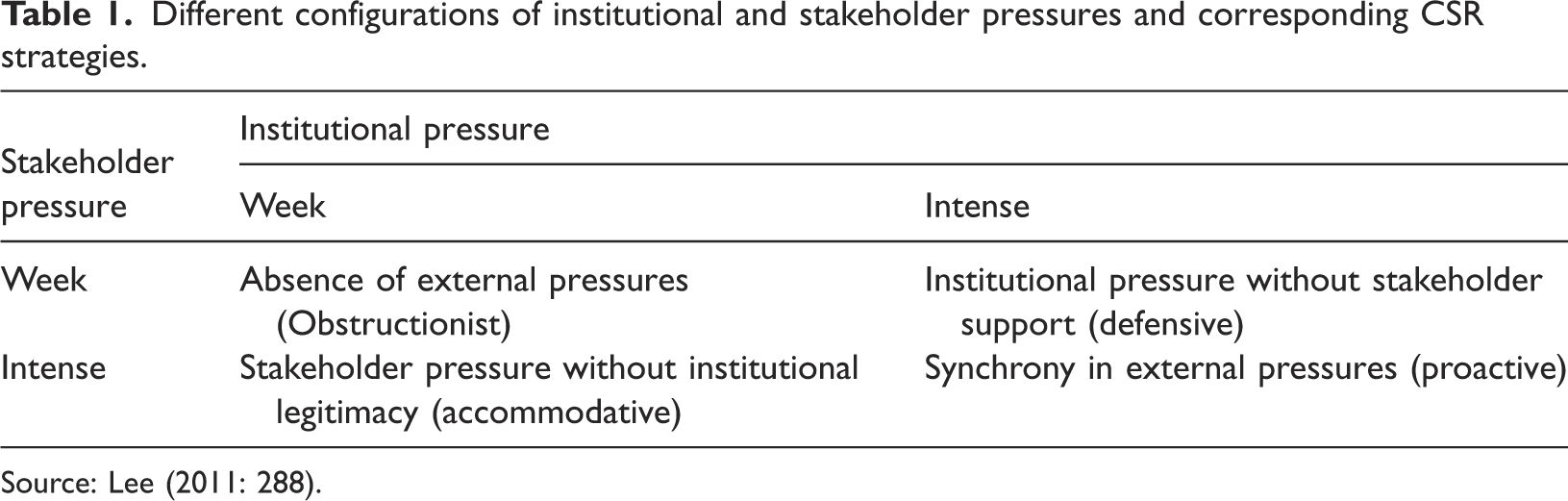
Source: Lee (2011: 288).
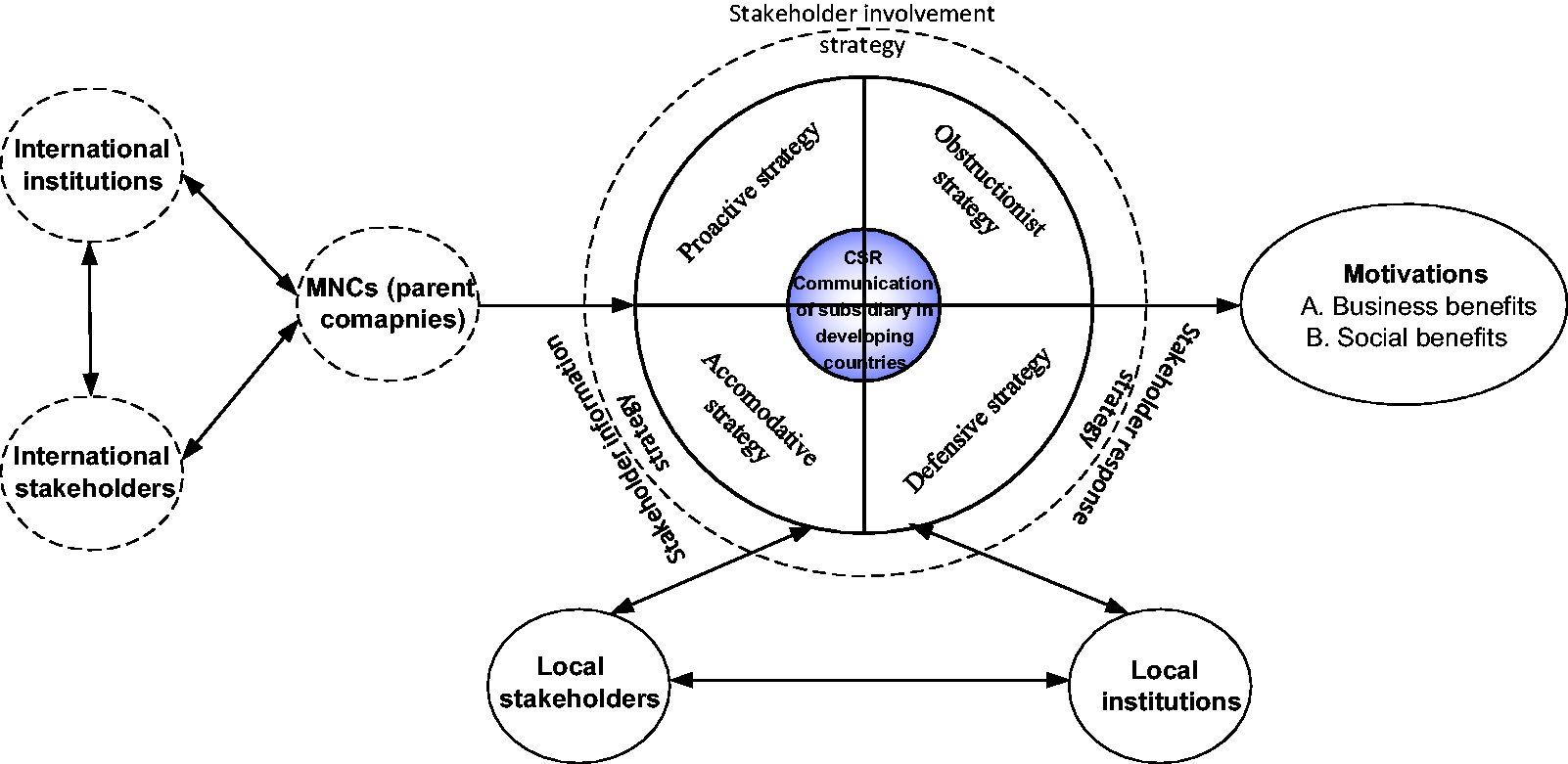
Relevant factors affecting the CSR communication strategies of MNCs and their motivation for communicating CSR in developing countries.
Through empowering stakeholders, institutions shape how companies communicate their activities with stakeholder groups. For example, environmental regulations in the United States (US) compel management to engage local actors such as the local community, firms and local governments in a dialogue before setting up operations (Campbell, 2006). Institutions further shape stakeholders’ expectations by dictating how companies should communicate their CSR initiatives with stakeholders (Morsing et al., 2008). On the other hand, institutional voids, which represent situations ‘where institutional arrangements that support markets are absent, weak, or fail to accomplish the role expected of them’ (Mair and Marti, 2009: 422), disempower stakeholders, and may encourage companies to hide CSR related information – i.e. an obstructionist strategy. For example, lack of adequate guidelines for CSR communication in developing countries impedes local stakeholders from accessing detailed information on companies’ CSR contributions (see Transparency International, 2012). Notably, stakeholders can empower institutions, undermine institutions, or create new institutions. In the absence of pressure from stakeholders, companies consider institutions simply as distal forces that can be ignored (Lee, 2011).
MNCs and CSR communication
MNCs are physically dispersed across environmental settings that represent very different institutional configurations, demanding internal linkage and coordination mechanisms that can respond to the requirements of diverse stakeholders and institutions (see Ghoshal and Bartlett, 1990). Whilst designing CSR strategies including CSR communication, MNC subsidiaries (as depicted in Figure 1) are required to incorporate the expectations of local stakeholders in host countries in order to acquire local legitimacy and fulfil the requirements of the parent company and international stakeholders to maintain their international license to operate (Kostova and Roth, 2002). When challenges are presented by multiple, fragmented or often conflicting institutional environment, local subsidiaries tend to ignore local institutions and stakeholders, and establish their own global management guidelines (Kostova et al., 2008). In this vein, literature argues that local subsidiaries can shape, ignore, reproduce and challenge existing institutions rather than being constrained by institutions (see Scott, 2014).
The growing homogenization of institutional pillars further allows local subsidiaries to adopt an isomorphic behaviour – i.e. standardizing their approach to CSR communication across the globe (Matten and Moon, 2008). ‘Institutional freedom’ enjoyed by MNC subsidiaries (Kostova et al., 2008: 999) allows them to formulate CSR communication strategies corresponding to their parent companies, international stakeholders and transnational institutions, and offers them the discretion to seek the benefits (either business, social or both) that they consider fit them best. Without having any pressure from local stakeholders and institutions in developing countries, pressures from international stakeholders such as Greenpeace and Friends of the Earth are considered as key drivers for local subsidiaries to adopt CSR (Azmat, 2008). Jamali (2010) reveals that local subsidiaries’ CSR strategies ignore the priorities of local stakeholders and follow the standardized CSR advocated by parent companies. The policies of parent companies informed by international stakeholders drive local subsidiaries to attach environmental and social information in their annual reports (Islam and Deegan, 2008; Momin and Parker, 2013). Depending on the size of operations in the host country, parent companies also allocate resources for local subsidiaries’ CSR activities including CSR communication (Lattemann et al., 2009). In other words, resources allocated for CSR may be concentrated in the parent company identified as ‘centralised hubs’ (Ghoshal and Bartlett, 1990: 611). By communicating CSR in line with the requirements of parent companies and international stakeholders, local subsidiaries are able to secure both internal and external legitimacy, respectively. This makes CSR communication very much a top-down approach dictated by the parent companies and international stakeholders. Lompo and Trani (2013) characterize this top-down approach as ‘non-participatory approaches’ where local stakeholders in a developing country were not involved in the design and implementation of CSR (p. 241).
Research context – Bangladesh
Bangladesh has witnessed continuous economic growth in recent times; however, its growth prospects have been severely affected by widespread corruption and lack of legal and regulatory systems and their implementation. Thus, institutional voids in Bangladesh have led to some mismanagement and anarchism in corporate practice which might have contributed to organizations’ inertia in practising CSR (Belal et al., 2015). Some researchers, however, noted that in spite of the above issues many companies have been involved in responsible entrepreneurship behaviour in Bangladesh (Azmat, 2008; Islam and Wise, 2012) to position themselves differently in the market vis-à-vis those that indulged in unethical practices. While researching CSR communication in Bangladesh, prior research identified various enablers and inhibiters such as corruption, state-business nexus, weak capital markets, lack of regulations, limited or no pressure from local stakeholders, pressure from international stakeholders, and political connections (Azmat, 2008; Muttakin et al., 2018; Siddiqui and Uddin, 2016). For instance, Islam and Wise (2012) reveal that stakeholders in Bangladesh neither comprehend nor are interested in CSR activities in which companies are involved. It can be posited that limited pressure from local stakeholders and institutional voids in Bangladesh are likely to encourage companies to adopt an obstructionist strategy. Contrary to the view of Islam and Wise (2012), Quazi (2002) shows how the growing consumer movement in Bangladesh is exerting pressure on businesses to integrate stakeholders’ needs into business planning and policies. In view of this discourse, it can be concluded that there is a need to explore how the diverse institutional factors and stakeholder groups in Bangladesh collectively form an institutional configuration that shapes CSR communication practices of companies operating in Bangladesh.
Research method
A qualitative research approach was adopted to explore the key issues around CSR communication, particularly the means and motives of CSR communication and the roles of institutions and stakeholders. Multiple case studies with semi-structured interviews were used to gather in-depth insights into CSR communication in Bangladesh and set the grounds for transferring our findings to other contextual settings (Lindgreen, 2017). It is important to note that the degree of transferability is a direct function between the two contexts and their associated fittingness (Lincoln and Guba, 1985). To improve transferability, a substantial amount of information about the research setting has been provided (see Slevin and Sines, 2000).
Case selection
Ten local subsidiaries in Bangladesh were selected for this study based on three criteria proposed by Hartman et al. (2007) and Jamali (2010; see Appendix 1). These criteria are (a) well-known, (b) local subsidiaries with some form of documented CSR involvement and (c) local subsidiaries with a distinctive background (e.g. industry, size). First, all the sample subsidiaries are internationally well recognized for their various CSR activities. For example, MNC_10 and MNC_02 have been ranked as the leader and the top five performers in the Dow Jones Sustainability Index respectively. These two subsidiaries were also award-winning subsidiaries in Bangladesh. The awards were accorded to them for their outstanding CSR initiatives such as offering education to underprivileged children and creating jobs (see The Daily Star, 2014). Interestingly, some of these sample subsidiaries faced serious public criticism as well as consumer boycott. For instance, Greenpeace International (an international NGO) condemned MNC_09 for irresponsible business practices including deforestation and encouraged consumers to boycott this multinational. Second, all these local subsidiaries communicated their CSR activities through either corporate websites, annual reports or both. Finally, sample subsidiaries mostly originated from Europe and North America, representing a number of industries ranging from products (e.g. tobacco and cement) to services (e.g. telecommunication and logistics) sectors. It is postulated that the type of industry affects how companies communicate CSR (see Lattemann et al., 2009). Size of the company would be also instrumental in terms of CSR communication intensity. It is posited that large companies are more exposed to stakeholder pressures and are thus more likely to communicate CSR with their stakeholders (see Lattemann et al., 2009). Size of the company was determined on the basis of revenue and number of employees as the case may be. A detailed list of sample subsidiaries along with other relevant information can be seen in Appendix 1. Company generated documents were also examined to assess their level of CSR engagement.
Data collection and analysis
Fifteen semi-structured interviews were conducted with local managers responsible for CSR strategies and each interview lasted between 35 and 45 minutes. Selecting this sample was not incidental as managers responsible for CSR activities have better understanding of CSR communication (see Appendix 1). To supplement these data, five additional interviews were conducted with representatives from key sectors (e.g., consultants, media personnel, government officials; see Appendix 1). These five additional interviews were deemed instrumental in providing deeper insights into CSR communication of local subsidiaries as the interviewees were involved with these companies in various capacities such as enforcing the industry standards or disseminating CSR information through media outlets. Interviews were recorded and field notes were taken to capture additional information and insights. All interviews were conducted in English. The semi-structured interview guide drawing on the main theoretical streams reviewed above can be found in Appendix 2. In accordance with the observation of Lee (2011), we asked all interviewees whether there were pressures from the surrounding environment, stemming from different stakeholders and institutions including rules/regulations and local traditions. Based on the work of Du et al. (2010) and Morsing and Schultz (2006), we also tried to gauge how MNC subsidiaries’ communicate CSR and their motivations for CSR communication in Bangladesh. In particular, we asked managers about the means used to communicate CSR, the rationale for selecting the particular means of communication, and the benefits the company tends to accrue from such communication.
After transcribing the interviews, data were imported to NVivo 10 and then analysed via thematic analysis. For thematic analysis, we followed the recommendations suggested by Corley and Gioia (2004). First, we identified initial concepts in the data and grouped them into categories. Then, we created higher order themes by employing axial coding wherein we searched for relationships between and among these categories. Finally, we gathered similar higher-order themes under several overarching themes (see Figure 2). A similar approach to data analysis is consistent with several prior studies on CSR (e.g., Maon et al., 2009; Yin and Jamali, 2016). Hence, the major findings that are presented in the next section support the theoretical underpinning explained in the foregoing theoretical section of this article.
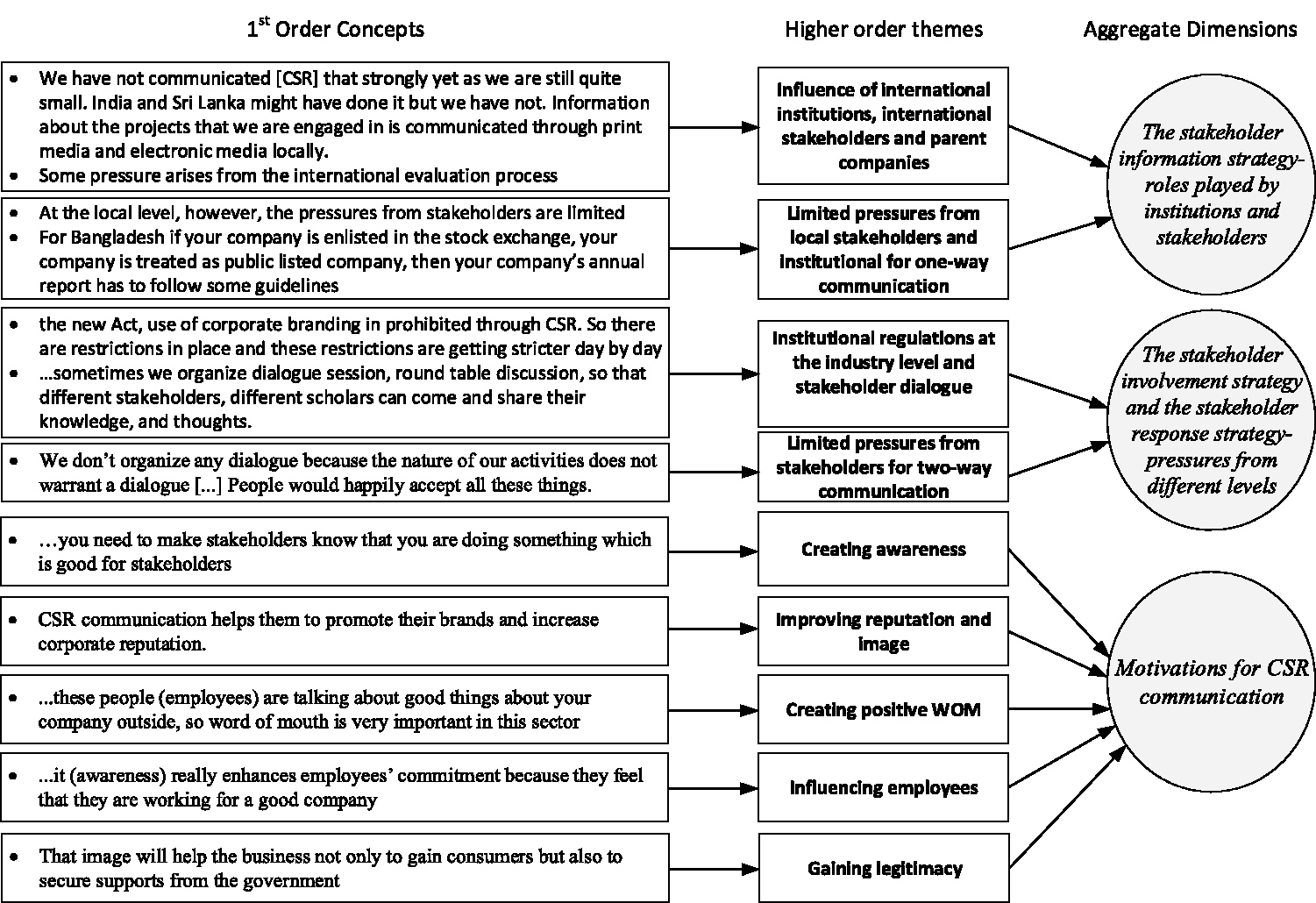
Data structure.
In order to improve the trustworthiness of our research, we have taken different precautions. First, all interviews were conducted by the same interviewer in order to minimize potential bias (Lincoln and Guba, 1985). Second, the researcher attentively listened to all audio-taped interviews at least twice and sent transcripts to the interviewees for comments, which improved the trustworthiness of the research, particularly in terms of credibility and dependability (Lincoln and Guba, 1985). Finally, each of the researchers involved in this study provided independent interpretations of the findings emerging from this research (Lindgreen et al., 2011).
Findings and discussions
This section analyses the data on the influence of institutions and stakeholders on the CSR communication of MNC operating in Bangladesh. Findings drawing from the data are summarized under three themes that address the following research questions: to what extent do various institutions and stakeholders influence the CSR communication strategies of MNC subsidiaries in Bangladesh (RQ1)?, What motivates local subsidiaries to communicate their CSR initiatives and how are these motivating factors determined by the intricate relationship between stakeholders and institutions (RQ2)? The analysis focuses first on the influences that different stakeholders and institutions have on the stakeholder information strategy, before examining the role of stakeholders and institutions in shaping local subsidiaries’ stakeholder involvement strategy. Finally, the analysis pays attention to different motivating factors that encourage local subsidiaries to communicate CSR.
The stakeholder information strategy – Roles played by institutions and stakeholders
The data suggest that one-way communication channels such as websites, annual reports, newspaper, industry-related magazines and internal portals are largely used by local subsidiaries to inform stakeholders about their CSR activities. Such CSR communication strategies are largely shaped by the demands of parent companies, international institutions and stakeholders (e.g., consumers, shareholders, media, NGOs and regulators). For instance, despite the limited number of internet users and the absence of pressure from local stakeholders such as consumers, media and NGOs in Bangladesh, local subsidiaries disclose CSR-related information via their websites. The use of such communication channels helps these local subsidiaries to gain support from these international stakeholders, as reflected in the following quotes: First, how many people in Bangladesh have access to the internet? It is around 4% of the population. Second, most people do not show any interest in CSR. You want to know about CSR because you are studying it. CSR is not yet that common as an informative tool here [Bangladesh]. (MNC_03: Manager of a Telecom company, Malaysia and Japan Domicile) ‘… Some pressure arises from the international evaluation process […]. At the local level, however, the pressures from stakeholders are quite limited.’ (BEX_03: local CSR consultant). We have not communicated [CSR] that strongly yet as we are still quite small. Subsidiaries in India and Sri Lanka might have done it but we have not. Information about the projects that we are engaged in is communicated through print media and electronic media locally. We have not ventured into international media yet. (MNC_06: Manager of a FMCG, Switzerland Domicile)
At the local level, most subsidiaries seem to have a clear view of who their key local stakeholders are (e.g., shareholders, customers, employees, regulators or business partners), which in turn defines who they communicate with and how CSR communication is channelled through internal and external communication media. The National Board of Revenue (NBR) in Bangladesh introduced a regulation providing for disclosure of information pertaining to CSR. For instance, all local subsidiaries involved with CSR are obliged to provide their CSR details to the NBR; on the other hand, any multinational listed on the stock exchange (either Dhaka or Chittagong) makes its CSR-related activities publicly available via annual reports, as reflected in the explanations provided by managers interviewed: ‘We have to report separately to NBR about what we are doing, why we are doing it, how much we are spending and how we are spending it. The Government is quite serious about our activities.’ (MNC_02: Manager of a Telecom company, Norway Domicile). For Bangladesh if your company is enlisted in the stock exchange, your company is treated as a public listed company, then your company’s annual report has to comply with some guidelines, and if the company has any investment on any CSR project then that has to be highlighted in the annual report […]. So the companies currently engaged in promoting CSR in their annual reports, they are basically doing it for the sake of guidelines, nothing else. (MNC_01: Manager of tobacco company: UK and USA Domicile)
At the industry level, there are only a few policies for guiding local subsidiaries to strategize CSR communication. The banking and telecom sectors are required to report their CSR activities to the Bangladesh Bank (BB; the Central Bank of Bangladesh) and to the Bangladesh Telecommunication Regulatory Commission (BTRC), respectively. Like the BB, the BTRC has also not provided any guidelines for regulating mobile based CSR activities, but companies from both industries are required to submit reports on CSR activities. As one manager mentioned: ‘Since our major stakeholder is BTRC, we have to provide them with a report on our CSR activities in every six months.’ (MNC_03: Manager of a Telecom company, Malaysia and Japan Domicile).
A local subsidiary operating in the energy and power sector communicated its CSR activities through ‘Energy and Power Magazine’– a medium targeting energy experts, regulators, or other international companies within the energy and power industry. Producing such reports is also seen as a means to target major stakeholder groups such as government regulators and investors. As articulated by a manager: … there is a magazine called Energy and Power magazine which is published twice a month. So we publish our articles covering what we are actually doing […] these are basically read by the International Oil Companies (IOCs) because it is only related to energy […] In fact, whoever is working in the energy sector and is directly or indirectly involved with the sector, reads this information about CSR activities (MNC_04, Manager of a gas company, Australia Domicile)
The stakeholder involvement strategy and the stakeholder response strategy – Pressures from different levels
Whilst the stakeholder information strategy was widely used, local subsidiaries from pharmaceutical and tobacco industries were found to adopt the stakeholder involvement strategy, engaging with key stakeholders such as media, NGOs and government. Institutional regulations prevent these subsidiaries from using traditional one-way communication channels such as newspaper and television to communicate their CSR initiatives. Here, the intent of incorporating dialogue in CSR practices is driven by institutional constraints. As noted by a manager from the tobacco industry: … the new Act, use of corporate branding is prohibited through CSR. So there are restrictions in place and these restrictions are getting stricter day by day […]. The people who are sitting at the centre, for example the Ministries of Agriculture, Environment and Forestry, they know what we are doing as we work closely with these people. (MNC_01: Manager of tobacco company: UK and USA domicile)
Engaging stakeholders such as government officials, NGOs, media and the International Development Organisation in a dialogue enables these local subsidiaries to gain legitimacy from key stakeholders and media exposure. Particularly, the involvement of top media personnel in a dialogue assists these subsidiaries in communicating CSR initiatives to a wider audience. This form of communication can be characterized as ‘concealed communication’ because it acts as a hidden persuader to communicate CSR and manage relationships with regulators and local communities (i.e. farmers). Due to lack of institutional requirements in other industries, stakeholder dialogue – i.e. two-way communication – tends to be ignored, seemingly because respondents believe that the subsidiary is only required to inform their stakeholders about their social involvement, thus suggesting some distance between the parties. The following quote is typical of many others: ‘We don’t organise any dialogue because the nature of our activities does not warrant a dialogue. More specifically, we try empowering people, so it doesn’t really require a dialogue. People would happily accept all these things.’ (MNC_03: Manager of a Telecom company, Malaysia and Japan Domicile).
However, there is some evidence to suggest that local subsidiaries seek the opinions and views of employees when developing CSR strategies through using multiple means (such as town-hall meeting and web portal): We have an online platform such as our notice board which is online. Everything is communicated through our online notice board for all the employees and they can comment and debate on the notice board. They have also access to daily news emphasising what the company is doing. (MNC_02: Manager of a Telecom company, Norway Domicile)
Motivation for CSR communication
The trajectory of CSR communication is steered by a subsidiary’s motives, attaining business benefits (e.g., creating awareness), or social benefits (e.g., understanding the expectations of society), or both. For instance, local subsidiaries undertake one-way communication as a means to enhance business benefits. This study identifies various business benefits of CSR communication such as managing legitimacy, creating awareness and reputation, covering externalities and influencing employees’ behaviour/attitudes. First, the majority of respondents identify stakeholder awareness as an important driver of CSR communication. One manager quoted Philip Tucker while explaining the motivation behind CSR communication. There is a quotation by Philip Tucker, ‘If you do something and don’t tell, that means you haven’t done anything’. So, I have to let everyone know that I am doing something […] we want other benefits as awareness alone cannot help. Awareness is the primary step followed by the next step which is about the tangible benefit … (MNC_03: Manager of a Telecom company, Malaysia and Japan Domicile)
Second, local subsidiaries employ CSR communication to reap other business benefits such as improving reputation or brand image as mentioned by an academic who is also acting as a consultant of a NGO: ‘They [MNCs] choose to promote it for their benefits. CSR communication helps them to promote their brands and increase corporate reputation.’ (BEX_05: Academic and consultant for a NGO).
Third, Word of Mouth (WOM) further emerges as a key driver for CSR communication for a multinational within the tobacco industry. Institutional restrictions on the tobacco industry may motivate this subsidiary to deploy such approaches in order to attain business benefits. A manager from the tobacco industry highlighted the importance of WOM for dispersing CSR-related information and enhancing corporate reputation. … these people (employees) are talking about good things about your company outside, so word of mouth is very important in this sector, like when these people will say good and positive things about your company to their peers, to their friends; these would ultimately help your company’s reputation to improve. (MNC_01: Manager of Tobacco Company: UK and USA domicile) Now our businessmen are thinking from another angle. If they contribute to the society, they are in fact building a positive reputation or image of the company among the people in the community. That image will help the business not only to gain consumers but also to secure supports from the government. (MNC_06: Manager of a FMCG, Switzerland Domicile)
It appears from the above discussion and evidence arising from the perspectives of respondents that local subsidiaries prioritize business benefits, which are also reflected in their existing communication approach (i.e. stakeholder information strategy). Targeting business benefits encourages these MNCs to use one-way communication channels for disseminating CSR-related information. Awareness created by one-way CSR communication acts as a prerequisite for companies to reap the business benefits of their CSR activities.
Discussion
The major findings of this research are presented and discussed, keeping in mind the research questions set in the introductory section of the study. In relation to research question RQ1, this study reveals that most local subsidiaries in Bangladesh largely adopt the stakeholder information strategy, aiming to influence both local and international stakeholders. This finding corroborates those of Amaladoss and Manohar (2013) and Liu (2006) who suggest that the stakeholder information strategy is preferred to the stakeholder involvement strategy in developing countries. Administering such communication in host countries is contingent upon the roles of different institutions and stakeholder, in particular increasing pressures from international stakeholders and institutions, parent companies and local industry level institutions. By incorporating institutions and stakeholders located at the local and international levels (see Figure 1), this finding contributes to the development of a better understanding of local subsidiaries’ CSR communication strategies in developing countries. Pressures from international stakeholders are salient, discouraging local subsidiaries from adopting an obstructionist strategy in which they tend to ignore CSR communication.
Legitimacy threats originating from powerful stakeholders such as international stakeholders outweigh the role of local stakeholders in shaping CSR communication strategies (see Muttakin et al., 2018). For instance, communication means such as websites are used to gain legitimacy from international stakeholders empowered by international institutions, also indicating the presence of mimetic isomorphism in CSR communication. The homogeneity in how local subsidiaries communicate CSR could be interpreted as a result of subscribing to highly standardized CSR training programmes for their public relations professional and managers in order to learn the best practices (see Matten and Moon, 2008; Tang et al., 2015). Flanagin (2000) argues that social pressures operating at the inter-organizational level also influence a company in adopting websites for communication. The mimetic process at the international level can drive the parent companies to adopt a particular communication strategy which is then institutionalized and standardized across all subsidiaries. To manage such pressures, parent companies tend to allocate more resources for CSR communication in countries where they have a large operation. This may be attributed to the fact that stakeholders pay more attention to subsidiaries with large operations (Lattemann et al., 2009).
With the exception of subsidiaries operating in the tobacco, oil and gas, banking, pharmaceutical and telecom sectors, there are limited pressures from the country-level institutions and local stakeholders on CSR communication in Bangladesh. Pressures from the industry level determine how local subsidiaries communicate their CSR and also who would be the targeted stakeholders. For example, a local subsidiary in the oil and gas sector uses magazines to communicate their CSR with energy experts, regulators or other international companies. This finding corroborates those of Lattemann et al. (2009) who suggest that the nature of industry affects how CSR is communicated. Limited regulations can prevent local stakeholders from compelling these MNC subsidiaries to disclose CSR information and get engaged in the CSR decision-making process (Lee, 2011); in other words, local stakeholders are not usually empowered by local institutions. Since there are no institutional requirements, local subsidiaries, which are not listed in the local stock market, avoid disclosing their annual reports publicly. Communicating CSR information via annual reports enables local subsidiaries to maintain internal legitimacy (Belal, 2001; Momin and Hossain, 2011) or diminish legitimacy threats stemming from local and international stakeholders (Belal and Owen, 2015; Moerman and Van Der Laan, 2005). It also appears that stakeholder response strategy instead of stakeholder involvement strategy is adopted to change the attitude and behaviour of employees who are not empowered by local institutions. Local subsidiaries will respond positively to the employees’ demands for the sake of business interests, but in actuality, their response will be passive and minimal, characterized as an accomodative strategy (Lee, 2011). Lack of local regulations allows these local subsidiaries to exercise their institutional freedom and select any communication approach depending on the needs of international stakeholders.
Interestingly, institutional barriers to CSR communication reinforced by stakeholders drive some subsidiaries to adopt the two-way communication approach. Particularly, subsidiaries operating in the tobacco and pharmaceutical industries host stakeholder dialogues. This is because the tobacco and pharmaceutical sectors are highly socially sensitive industries where stakeholders’ support is considered critical for these industries’ survival and growth, particularly in terms of avoiding imposition of further regulations thorough proactive CSR action and communication. The new Tobacco Control Law Amendment Bill’ 2013 restricts CSR activities as these activities have been employed as an indirect means of advertisement (Peiris, 2013). According to Section 5(3) of the Tobacco Control Law Amendment Bill-2013 any person engaged in social activities under Corporate Social Responsibility or in case of donation on such activities, shall not use any name, sign, trademark, or symbol of any tobacco manufacturing company or cause them to be used or shall not encourage other persons to use those (British American Tobacco Bangladesh [BATB], 2015).
While exploring the motivating factors for CSR communication in RQ2, this study identifies business benefits as the key drivers. These findings corroborate those of a great deal of the previous work in this field. Previous studies have identified similar key drivers such as creating stakeholders’ awareness (Birth et al., 2008; Du et al., 2010), improving corporate reputation (Morsing et al., 2008; Nielsen and Thomsen, 2009), managing legitimacy (Branco and Rodrigues, 2006), building effective relationships with stakeholders (Nielsen and Thomsen, 2009), and influencing employee behaviour (Birth et al., 2008; Du et al., 2010). Intent to create business benefits (such as gaining legitimacy, creating awareness or building reputation) rather than social benefits (e.g., empowering people, community development) drives these local subsidiaries to use one-way communication means for disseminating CSR-related information. In other words, one-way communication means are used to heighten both local and internal stakeholders’ awareness that in turn leads to business benefits (Kim and Lee, 2018). Such communications can improve stakeholder awareness provided they are transparent, consistent, personally relevant, and supported by factual information (Kim, 2019). This also implies that local subsidiaries operating in Bangladesh take advantage of the weak institutional framework and select communication strategies depending on their business interests. However, it is important to note that one-way communication – the result of the top-down approach – can limit subsidiaries how they understand the expectations of local stakeholders and create social benefits.
Conclusion
To sum up, this study has revealed that the roles of parent companies, international stakeholders and international institutions are very salient in shaping how local subsidiaries communicate their CSR activities to stakeholders. Despite institutional voids and limited pressure from local stakeholders in Bangladesh, MNC subidiaries are adopting the stakeholder information strategy for disseminating CSR information, further suggesting that they are not embracing the obstructionist strategy (i.e. rejecting CSR activities). Findings also suggest that MNCs tend to use CSR communication to accrue business benefits rather than as a platform for the understanding of social expectations. These findings have strategic implications for CSR communication of local subsidiaries in developing countries.
In terms of practical implications, our study suggests that managers should use both one-way and two-way communication channels in order to generate both social and business benefits (Elving et al., 2015). The one-way CSR communication channel enables subsidiaries to inform stakeholders, and the two-way communication channel helps them to understand stakeholder demands and to act accordingly. Increasing stakeholder CSR awareness is considered a prerequisite for securing business benefits resulting from an effective CSR communication strategy (Kim, 2019). However, CSR remains largely rhetoric and is unable to produce mutually beneficial outcomes if it fails to encompass stakeholder expectations and adopt measures to effectively address them (Morsing and Schultz, 2006). Towards developing a better understanding of the expectations or requirements of local stakeholders, MNC subsidiaries should voluntarily adopt the stakeholder involvement strategy (i.e. dialogue with stakeholders) in developing countries such as Bangladesh, where pressures from local stakeholders and institutions are currently limited.
Every research has defined boundaries and limitations, and ours is not an exception to this imperative. First, this study only included a selected number of well-known subsidiaries in the sample frame which may have the potential to limit the generalizability of the findings emerging from this study. Future research can broaden the sampling frame by including a large number of multinationals from other countries such as India, Japan, South Korea and China in order to further deepen our understanding of CSR communication issues across the borders of other emerging economies where CSR is increasingly attracting the attention of researchers, policy makers and practitioners (see Yin and Quazi, 2016). Second, the research is largely drawn upon the views of managers. To better understand the impact of CSR communication on stakeholders, future research can use mixed methods in which the views of other stakeholders such as consumers can be incorporated. Third, future studies can explore to what extent informal institutions such as culture located in the home country shape the nature/degree (explicit vs. implicit) of CSR communication. Finally, it was beyond the scope of this article to evaluate how CSR communication transformed over the period of time as a result of globalization, the emergence of communication technologies and the beginning of a new political landscape. Thus, a longitudinal study can also be undertaken to capture the extent to which CSR communication has evolved over time in developing countries. Furthermore, future research should explore the impact of pandemics such as COVID-19 on CSR communication strategies, particularly for multinational corporations operating in the developing countries where CSR programmes will warrant greater attention given that the significant impact of the pandemic on their stakeholders, particularly present and potential employees and consumers.
Footnotes
Declaration of Conflicting Interests
The author(s) declared no potential conflicts of interest with respect to the research, authorship, and/or publication of this article.
Funding
The author(s) received no financial support for the research, authorship, and/or publication of this article.
