




Abstract
The world of work is changing. Communications technologies and digital platforms have enabled some types of work to be delivered from anywhere in the world by anyone with a computer and an internet connection. This digitally-mediated work brings jobs to parts of the world traditionally characterized by low incomes and high unemployment rates. As such, it has been touted by governments, third-sector organizations, and the private sector as a novel strategy of economic development. Drawing on a four-year study with 65 workers in South Africa, Kenya, Nigeria, Ghana and Uganda, we examine the development implications of the gig economy on labour in Africa. We offer four analytical development dimensions through which platform-based remote work impacts the lives and livelihoods of African workers, i.e. freedom, flexibility, precarity and vulnerablity. We argue that these dimensions should be understood in a continuum to better explain the working conditions and lives of workers in the gig economy.
Introduction
Much of Africa has endured decades of economic stagnation and has been structurally dependent upon foreign aid and exploitation of natural resources, resulting in industrial decline, growth of unemployment and widening inequality (Bond, 2006; Carmody, 2011). The International Labour Organization (ILO) (2018a) reports that nearly 85.8% of the employment on the continent is in the informal economy. Another ILO (2015) report warned that youth unemployment on the continent is worsening, with long-term unemployment among young people as high as 60% for countries in northern Africa and 48% for countries elsewhere on the continent. Furthermore, on the UN’s Human Development Index, 17 of the 20 countries ranked at the bottom are on the African continent (United Nations Human Development Report (UNDP, 2019). In view of these figures, creative solutions for the provision of jobs for the continent’s quickly growing population has become a priority for national policy makers and international organizations. It is at this moment that many tend to look towards digital technologies and internet connectivity as a panacea for the region’s chronic unemployment.
Rapid diffusion of digital technologies has generated new kinds of economic activities (often referred to as the ‘gig economy,’ ‘digital work,’ ‘online work,’ ‘online outsourcing,’ ‘crowdwork’ and ‘virtual work’) across the continent (Anwar and Graham, 2020; Kuek et al., 2015). Insight2impact (2019) found that an estimated 4.8 million African workers reported having derived an income from gig work across seven of the eight countries for which survey data were available. The gig economy activities comprise a variety of tasks that are digitally-mediated or transacted through internet platforms and can be delivered either remotely or performed locally (Graham and Anwar, 2018a). Since we are concerned in this paper by work that can be performed remotely irrespective of the location of workers and clients through internet-based platforms or apps, we examine the development implications of remote gig work on African workers’ lives and livelihoods. The terms remote work and gig work are used interchangeably throughout the paper to refer to the same phenomenon, unless specified.
We explore the impact of gig work through the critical evaluation of the discourse found in the works of the World Bank (2016) and the Rockefeller Foundation (2013) and then contextualize it with the literature on the restructuring of capitalism and its implications on labour relations that are extensively covered in various social science disciplines, particularly sociology, development studies and labour geography. The central argument within the World Bank and Rockefeller Foundation’s reports is that gig work offers workers the ‘freedom’ and ‘flexibility’ to work whenever and wherever they want. In this paper, we challenge this assumption both theoretically and empirically.
To do this, we problematize the ‘freedom’ and ‘flexibility’ discourse through a conceptual exploration of the concept of ‘precarity’ and ‘vulnerability’ found in the extant quality of work literature (Green, 2006; Kalleberg, 2013; Standing, 2014). While gig work can be seen as an answer to unemployment in Africa by some, these jobs are also symbolic of deteriorating working conditions and labour standards among the workforce that is already structurally constrained in their local labour markets. A few studies have shown that the gig economy activities carry a number of risks and can lead to increasing casualization and commodification of jobs (De Stefano, 2016; Wood et al., 2019a). However, there has been limited focus so far on exploring gig work’s implications on labour from low- and middle-income countries (notable exceptions D’Cruz and Noronha, 2016; Wood et al., 2019b). Our article contributes to this debate by highlighting how gig work exemplifies new market-based employment relations where algorithmic controls of the labour process and an emphasis on individual freedom over freedom of association and collective bargaining shifts the risks from capital to labour. Practically, we examine how gig work brings freedom, flexibility, precarity and vulnerability into the lives of African gig workers. We argue that to understand job quality in the gig economy, it is important to consider these four dimensions together.
The paper is structured as follows. The second section puts the gig economy in perspective with regards to the dominant narrative around development and the gig economy in Africa. The notions of ‘freedom and flexibility’ are often invoked by many observers and commentators in relation to the gig economy. However, we argue that it is time to move beyond the anecdotal understanding of the impacts of the gig economy on African workers. In the third section, we bring discussions from the job quality research to problematize the contribution of the gig economy to the lives and livelihoods of African workers, particularly focussing on the concepts of precarity and vulnerability. Section four then provides methodological background before we move on to the empirical discussions (sections five and six) on the gig economy’s contribution to the freedom, flexibility, precarity and vulnerability of workers. We conclude by offering some suggestions to make the gig economy fairer for workers, particularly those in the low- and middle-income regions.
Contextualizing development discourse in the gig economy
It is well documented that since the 1970s, employment relations have increasingly become contingent, i.e. short-term, part-time and temporary employment, contractual and sub-contractual work agreements and home-based work (McDowell and Christopherson, 2009; Peck, 1996). In the context of low- and middle-income countries, where workers rarely had a chance of formal employment structures, some developments through state intervention to provide labour with rights and entitlements did emerge. But the imposition of the structural adjustment programmes in the 1980s reversed these changes to some extent (Webster et al., 2009). Africa is a prime example. In fact, we argue, that the gig economy is the latest embodiment of a new wave of international division of labour (Fuchs, 2016), largely made possible due to the rapid penetration of digital technologies in the production process.
Relatedly, the gig economy is perceived as an alternative to traditional forms of employment for low- and middle-income regions with progressive development potential (Kuek et al., 2015; UNDP, 2015). Because many workers joining gig work from these regions hardly had a chance to benefit from formalized employment relations, the gig economy in these locations is rarely seen with a critical lens. Therefore, there is a need to unpack how gig work is understood to contribute towards the lives and livelihoods of workers.
One of the oft-cited developmental impacts of gig work is touted as the provision of ‘freedom’ and ‘flexibility’ to workers. Gary Swart, former CEO of O-Desk (now Upwork), proclaimed that with the Internet increasingly enabling popular work approaches such as telecommuting, distributed teams, online work, and even entirely virtual companies, both businesses and workers are finding more freedom and flexibility to work whenever, however and with whomever they like (Swart, 2013).
1
Gig work in Africa has received a lot of media hype and corporate backing, driven largely by the supposed ICT revolution currently taking place in Africa. The Rockefeller Foundation (2014), for example, portrays gig work as a disruptive innovation for African youths which offers significant income earning potential for those who can successfully navigate the platforms. For employees, particularly young people, online work provides a low-barrier-to-entry opportunity to earn an income, while building their skills and digital work experience.
Primarily, the assumption that gig work brings freedom and flexibility to a worker is loaded with the language of neoliberalism (Holborow, 2015). First, this implicit notion that individual freedom to gig workers can be granted through the freedom of the market is a belief embedded in neoliberalism (Harvey, 2005). This individual freedom to workers in the gig economy is understood as freedom to choose employers, jobs, working hours and place of work. However, research is beginning to show that workers do enjoy considerable freedom but are constrained by algorithmic controls set up by digital work platforms (Rosenblat and Stark, 2016; Wood et al., 2019b). Our argument is, gig work exemplifies new market-based principles where contingent employment relations along with algorithmic controls of the labour process are used to great effect in shifting risks from capital to labour. More importantly, neoliberalism advocates a free market society where the individual freedom of workers is given more importance than the freedom of association and collective bargaining (Neff, 2012). As we shall see later, gig work favours individual freedom over collective freedom, which further puts pressure on workers’ ability to control their wages and working hours. As a result, the alleged freedom in gig work, which offers workers flexibility to schedule their working and personal lives becomes problematic.
What is regarded as flexible in the context of the gig economy can have different meanings for both firms and workers. Flexibility for a firm refers to labour market flexibility. Here the basic idea is that firms or organizations should have flexibility in the markets to exploit labour power to maximize their economic gains which has been a feature of neoliberal restructuring since the 1980s (see Peck, 1996). Key characteristics of flexible labour markets include flexible working hours, short-term contracts, shift-based work, hot desking and home-based work. Firms are increasingly looking towards flexible working for the sake of recruiting talent, skills and ideas, increasing productivity, enhancing competitiveness (Mulcahy, 2017) and reducing cost (Kelly Services, 2018). The online work platforms enable firms and organizations to now source workers globally and instantly to meet the demand for digital work at cheaper prices (Corporaal and Lehdonvirta, 2017). The prevalence of flexible working arrangements in the labour markets globally blurs the fact that a small pool of permanent employees exists with a large temporary workforce, which can be easily hired and fired. Thus, the burden of risk gets shifted from firms to workers, and the online labour markets are implicated in generating a disposable labour force.
Flexibility from workers’ perspectives means their ability to define and control their working hours, place of work, pace and scheduling of work – all important aspects of job quality (Green, 2006; Kalleberg, 2013). While workers enjoy some of the flexible working attributes, the emerging research on the gig economy has pointed that such flexibility remains a myth for most workers (Wood et al., 2019b). Further, Lehdonvirta’s (2018: 25) study on three different types of online work platforms found gig workers’ ability to control their time was often curtailed by structural (the availability of work and degree of worker dependence on the work) as well as cultural-cognitive constraints (e.g. procrastination). It is true that gig workers do enjoy considerable freedom in scheduling their work and value this to satisfy their individual needs. However, the interaction of technologies with existing socio-political institutions and management ideologies means that different types of people are affected differently by technology-driven flexibility (e.g. on gender see Silver and Goldschejder, 1994). Thus, flexibility for one can be uncertainty for someone else and different platforms may have different time management practices of their own, which can further influence workers’ flexibility. In this paper, we discuss Upwork and how its labour process management influences freedom and flexibility experienced by a variety of African gig workers.
The rise of the gig economy in low- and middle-income countries is seen as generating a new wave of employment opportunities for poverty reduction impacts (UNDP, 2019; World Bank, 2016). But very little is known about the quality of work in the gig economy for these regions (exception, Shevchuk et al., 2019; Wood et al., 2019b). Whereas Wood et al.’s (2019b) study focused on three African countries, this article’s focus on five African countries contributes to the expanding geographical scope of the job quality in the gig economy literature. Most importantly, we challenge the popular literature’s understanding of the development implications of the gig economy through our work to explore how gig work can bring precarity and vulnerability into the lives of African gig workers.
Job quality in the gig economy
The basic premise of the job quality literature has been that the quality of jobs rather than their quantity is a better indicator for development (ILO, 2014; Rubery and Grimshaw, 2001). Though there continues to be a debate on how to measure job quality and its applicability in low- and middle-income countries contexts, certain key aspects of job quality are considered transferable and are generally understood to differentiate between good and bad jobs (Burchell et al., 2014; Green, 2006). For example, some studies in recent years have examined how workers in low- and middle-income countries perceive job quality with several key characteristics such as income, health and autonomy to be key for job quality among workers in these regions (Monteith and Giesbert, 2017). In fact, one of the measures of the United Nations Human Development Index is income per capita, for it provides workers the freedom to achieve well-being and positive development outcomes that they value such as access to food, clothing and housing (Sen, 2001). Also important is worker power, particularly, associational power and structural power (Silver, 2003; Wright, 2000), which can be used individually and collectively by workers to influence their working conditions. Structural power is further divided into marketplace bargaining power (power derived by workers due to tight labour markets and shortage of skills) and workplace bargaining power (power derived through the position of workers in the production process) (Silver, 2003). Similarly, associational power is the ability of workers to organize themselves as a front for collective action (Silver, 2003), which can take place at the workplace level, sectoral level and national level (Wright, 2000), and in some cases globally (Schmalz et al., 2018). It can also be dependent on workers’ structural power (see Selwyn, 2012). A combination of these worker powers has proven critical to attain positive results (Webster et al., 2009). Both autonomy at work and bargaining power are recognized as two most critical elements of job quality (Green, 2006; Kalleberg, 2013).
Here, we are mindful that the understanding of what constitutes a good or a bad job can vary, depending on the types of work tasks, geographical and temporal contexts and personal positionalities. For example, in the video games industry, workers earn high incomes but have little separation between work and leisure (Bulut, 2015). Further, Monteith and Giesbert (2017) concluded that there is a need to investigate the quality of work by considering the social, economic and political contexts in which work takes place. Therefore, our argument here is that the [non]provisions of both the economic and non-economic rewards (Kalleberg, 2013), technological control of labour processes (Gandini, 2019), and various political-economic and socio-cultural contexts in which workers are embedded determine the job quality in the gig economy.
In the African continent, a majority of workers seek jobs in the informal economy, which are characterized by non-standard employment relations (Lindell, 2013). Research on non-standard employment relations suggest that these contribute to the increasing precarity and vulnerability among workers (Bulut, 2015; Kalleberg, 2009). Precarity and vulnerability have both been conceptualized and contextualized from a variety of perspectives (Lambert and Herod, 2016; Lewis et al., 2015; Waite et al., 2015).
One of the most recent and influential analyses on precarity came through the work of Guy Standing, who in his book ‘The Precariat’ argued that in the contemporary neoliberal era, we are witnessing the emergence of a new working class (the ‘precariat’), that lacks various forms of labour securities, insufficient social income, lack of community benefits and a lack of work-related identity (Standing, 2014). The ILO has adopted the term and broadly defines precarious work as non-standard employment that is poorly paid, insecure and unprotected, but cautions that non-standard employment and precariousness are not necessarily synonymous (see ILO, 2016). In other words, workers experiences of precarity can come from both standard and non-standard employment (ibid). Though very influential, Standing’s theorization has been critiqued powerfully by some.
Firstly, Scully (2016) cautioned against viewing precarity as a universal phenomenon as described by Standing. Scully’s argument is that while precarious work has been on the rise globally, Standing ignores the longer history of precarious work in the low- and middle-income regions such as Africa (also see Munck, 2013). The ILO notes, in Africa precarious work forms are the norm and that workers often employ mixed-livelihoods strategies that shape the way they experience wage work. But workers’ increasing reliance on wage work signals increasing commodification of labour in the contemporary neoliberal era. At the same time, state-led attempts to offer social protection programmes in some of the countries in the Global South represent a Polanyian double movement (Harris and Scully, 2015). Thus, for Munck (2013), a perspective from the Global South would understand precarity as part of the broader process of dispossession and the generation of new ‘surplus populations.’
Secondly, Alberti et al. (2018) voiced concern over the incorporation of a wide variety of working class by Standing, which leads to the conceptual overstretching of ‘precarity’ and diminishes its explanatory power. Alberti et al. (2018) suggest there can be ‘explicit’ and ‘implicit’ forms of precarization with management playing an active role. 2 These forms can be understood through an examination of drivers and patterns that can differ in a range of labour market contexts (ibid). In the online labour market contexts, the use of algorithms by platforms to control labour processes can influence workers’ experiences of implicit and explicit precariousness. As Wood et al.’s (2019b) study shows the algorithmic management of platforms’ labour process influences workers’ autonomy, flexibility and power, which will ultimately impact the experiences of precarious nature of the gig economy among gig workers. It is also important to remember that workers’ experience of work differ based on the socio-political landscape in which they are embedded, particularly those who have lived their lives in precarious situations.
In many parts of the African continent, standard employment relations have remained largely absent (Wood, 2008). Though, some forms of standard employment relations did develop but mainly in the formal sectors of the economy and at the expense of informal sectors which hosts the majority of the workforce (Webster et al., 2009). It is, therefore, not surprising that the emergence of the gig economy in rich countries is associated with the casualization and precarization of work (De Stefano, 2016). But the gig economy jobs are seen as workers’ entry into standardized forms of employment with great development potential in Africa (World Bank, 2016).
This is not startling considering that nearly eight out of ten employed persons in Africa are in doing informal jobs which can be considered as vulnerable forms of employment (ILO, 2018a). Under the ILO’s definition, vulnerable employment comprises own-account worker and family workers who lack the most basic of worker rights, social security and voice at work. But it does not capture the experiences other types of new non-standard employment such as gig work. A more practical definition of vulnerable employment is adopted by the Trade Union Congress Commission on Vulnerable Employment, which it defines as a form of employment in which workers despite accessing work remain at the risk of continuing poverty and injustice resulting from an imbalance of power in the employer–worker relationship (TUC Commission on Vulnerable Employment, 2008: 3). Thus, whereas precarity, as defined by Standing, is an experiential outcome of the working class’s embeddedness in the wider socio-economic and political landscapes, which affect their job quality outcomes, vulnerability, according to the UN protocol on trafficking, can be understood as ‘a situation in which the person involved has no real and acceptable alternative but to submit to the abuse involved’ (cf. O’Neill, 2011: 10). As we show in the subsequent parts of the paper, gig work is a form of vulnerable employment for the African workforce where the power imbalance between workers and employers results from the reputational scoring system and the organizational management strategies found on platforms. Therefore, it is not only critical to understand how gig work contributes towards both the explicit and implicit precariousness in the lives of African gig workers but also how their vulnerability is abused within this employment relationship and in many cases gets amplified as well, leading to adverse mental and physical impacts.
Methodology
Upwork as a platform is very typical for global remote work, containing a standardized website structure and simple user interface, information on workers and clients, work and payment histories and a reputation system. Workers bid for jobs posted by clients on Upwork. Upwork has a technological system of controlling the labour processes through a mix of algorithmic management and surveillance, which is also typical of other platforms such as Uber (Gandini, 2019, Rosenblat and Stark, 2016; Schörpf et al., 2017). It is also a go-to platform for African gig workers. A little over 123,000 workers from Africa are registered with searchable profiles on Upwork as on 21 July 2019. Despite workers able to register their profiles, less than 10% of workers globally and just around 6% of the registered African workers on Upwork ever get to earn at least a US$1 on the platform. Platforms, like Upwork, remove some of the traditional barriers to entry to work, such as the regulatory barriers and high transportation cost for work seekers (see Graham and Lannoy, 2016), making it easier for African workforce to theoretically enter online labour markets. Other barriers still remain such as technological (access to computer and the internet) and socio-economic (education, language and typographical skills), which influence the well-being in the gig economy.
We conducted in-depth interviews with 65 workers in South Africa (July–October 2016); Kenya (October–December 2016); Nigeria (February–April 2017); Ghana (April–June 2017) and Uganda (November 2017), on one of the world’s biggest gig work platforms, Upwork. We selected participants with the aim to include a diversity of experiences of work, including types of work performed, education, number of hours worked, income earned, hourly rates and gender (Table 1). 3
Characteristics of workers interviewed.
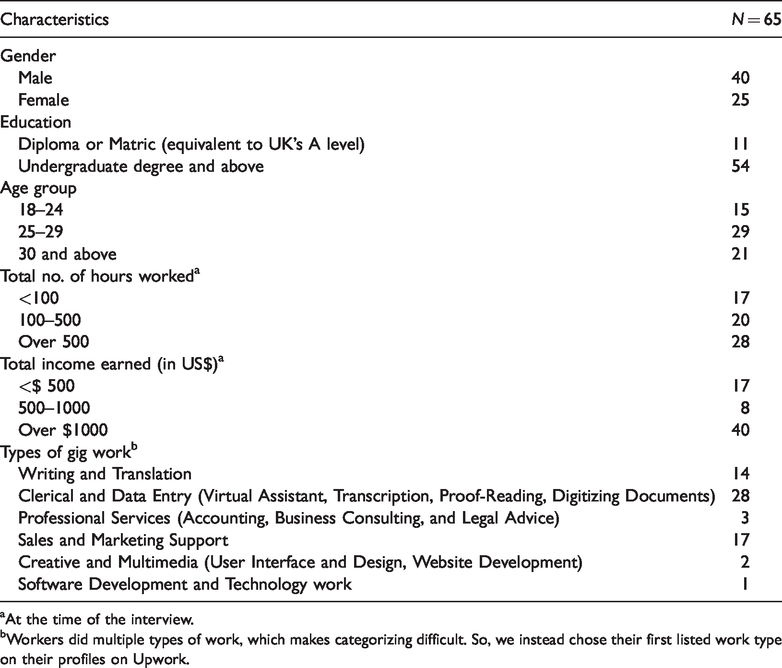
aAt the time of the interview.
bWorkers did multiple types of work, which makes categorizing difficult. So, we instead chose their first listed work type on their profiles on Upwork.
We first sent invitations to workers via the platform. Since some workers were reluctant to speak to us, we used a number of other techniques to recruit them. We contacted them through their social media profiles (such as Facebook) and professional networking sites, e.g. LinkedIn. Workers were more comfortable to speak when contacted through Facebook and LinkedIn. We also undertook snowball sampling. In order to avoid the sampling bias, we asked our initial respondents to encourage other workers in their networks to come forward and speak to us (see Heckathorn, 1997). This helped us examine the networks emerging in gig work, the levels of intermediation or re-outsourcing taking place, which are hard to discern when the workforce is dispersed and globally situated and how these networks might influence job quality outcomes of workers. Thus, our results are indicative and not representative of the gig work taking place on the African continent.
Our semi-structured interviews lasted between 31 and 116 min, gathering in-depth information about the nature and types of work done by these workers, career prospects and challenges of livelihoods, worker perceptions and motivations for undertaking gig work, its impact on their lives and livelihoods, the meanings and expectations they attach to the work, the challenges workers face, types of workers who find success in gig work, and the types who did not.
We also conducted two group discussions in Nigeria: one in Lagos and one in Abuja. 4 We recruited workers from these two cities to explore the meanings of some of the preliminary findings from our earlier fieldwork in South Africa and Kenya and generate a range of opinions and ideas around topics such as the perceived flexibility in gig work (on group discussion see Stewart and Shamdasani, 1990). Another important reason was to examine the locally-specific social challenges workers face to do gig work, case in point is the online scamming networks of Nigeria and their influence on worker ability to win contracts on platforms. The names of workers have been changed in this paper to protect their identities.
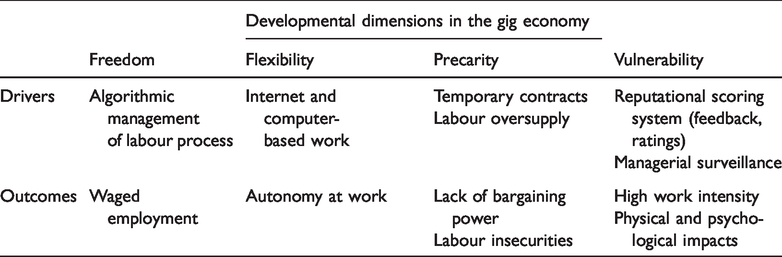
Interviews were transcribed and uploaded to NVivo for analysis. The data were initially sorted into broad categories based on both economic and non-economic rewards associated with job quality (see Kalleberg, 2013) and then systematically coded along those lines. We now move to give an empirical account of gig workers’ experiences of freedom, flexibility, precarity and vulnerability. Table 2 provides an illustrative summary of the developmental impacts of gig work on workers in Africa.
Understanding developmental impacts in the gig economy.
Freedom and flexibility dilemma
The African continent is characterized not only by rampant unemployment but also high rates of informal and vulnerable employment, which can be underpaid and unpaid (ILO, 2018b). Therefore, the affordances of digital technologies such as the Internet create a sense of connection to the wider world among workers and an escape from the current realities of dysfunctional local labour markets (Meagher, 2016). On the question of the importance of the internet on their work and lives, one Nigerian worker, Adaobi, replied, ‘it’s now a global village, global world.’ Such imageries are reinforced by organizations such as the World Bank, which classifies people working on online platforms as ‘entrepreneurs’ (Kuek et al., 2015). In comparison to local labour markets, platforms have lower entry-barriers for participation. Thus, workers frame various expectations around the gig economy and the potential income it can generate largely as a result of their dependence on this work. Particularly, for migrants who otherwise face relatively few options in the local job market, gig work is seen as an attractive alternative for livelihoods. Out of the eight international migrant workers we interviewed in South Africa, six said that platform-based work is their main source of household income. However, finding the first job on Upwork can be incredibly hard, as workers in our sample spent several weeks and in some cases months bidding for jobs.
It is known that gig work provides some workers in the lower income contexts with a higher level of income than they would get in their local labour markets (Wood et al., 2019b). Gig work offered better-paid job opportunity for a majority of the workers in our sample. Though the income generation is highly variable, workers with adequate skills and technological affordances are more likely to break the barriers to entry on Upwork and earn slightly higher income online than locally. Pat, in South Africa, told us that compared to the wages from local jobs, gig work pays better salaries and hence ‘it is very sufficient and very nice’ (Interview Johannesburg, August 2016). Likewise, Kufuo, a user-interface designer in Ghana, told us that he is earning twice in comparison to his previous job as an app developer for a local start-up (Interview Accra, May 2017). One respondent, Abaeze from Nigeria, who has a university degree in Geography, told us that over a period of five months preceding our interview, he was able to earn more than US$2500, or roughly US$500 a month (or Naira 180,000). We found this to be comparable or higher than entry-level graduate jobs in some of the private companies operating in Nigeria, including Proctor and Gamble (consumer goods), Zenith Bank (banking), Glo, MTN (telecom), Price Waterhouse Coopers (consultancy) and Shell (oil). 5
We also met with some contact centre agents (customer service jobs are considered to be entry-level among graduates) in Lagos and Abuja. 6 We spoke to agents at both in-house operations and third-party providers and found that contact centre agents for third-party providers were earning a quarter of Abaeze’s income from gig work. Agents working at in-house or captive centres were only marginally better off than those working for the third-party providers. 7 Further, Wood et al. (2019b) show in their study that African workers were earning slightly higher income than workers in South East Asia. There is some evidence that gig workers in India and Philippines are successfully supplementing their overall household income through gig work but that their absolute income levels are still lower than workers in rich countries (e.g. UK and US) (Beerepoot and Lambregts, 2015).
It is noteworthy here that economic compensation in the form of income may not necessarily transform into a person’s ability to achieve all the outcomes they value. Research has shown that people in some African countries might spend more money on phone credit than on family welfare and education (Carmody, 2012). Similarly, gig workers were spending more money on broadband internet than on food, hoping that with good internet connection they can work more and earn more. Kufuo survived on Coca-Cola and a loaf of bread on multiple occasions, with no food in the house. He said he would ‘rather pay for the internet and go hungry’ to impress the client/employer by delivering good quality work on time. The fact that gig work is dependent on the internet and other technologies (computer and electricity, for example), the added cost of these for workers to be able to perform this work can alter workers’ job experiences. Very rarely it is acknowledged that the high cost of mobile subscriptions in Africa (ITU, 2017), through which most Africans access the Internet, is a major hinderance to workers seeking jobs online. Workers often resorted to taking loans for buying computers or sharing them, and using public hotspots at cafes and libraries (Anwar and Graham, 2019a).
Nonetheless, while wage earning was the highly sought-after aspect that workers claimed as gig work’s main contribution to their lives, ‘social recognition’ (Honneth, 1996) was also highly critical among our respondents due to multiple constraints and social perception constructed around internet-based jobs. Nigerian workers, in particular, face stigma attached to freelancing, largely due to online scamming networks prevalent in the country (Reuters, 2018). One worker, Dayo, told us that freelancers are looked down upon with suspicion and people think they are a scammer (Interview Lagos, February 2017). In other places, internet-based jobs despite receiving negative connotations, help workers gain acceptance and prestige in the locality, primarily because they provide much needed income. This was indicated by Kenyangi in Uganda, who told us that a lot of people do not know or understand freelancing and therefore, it is hard for her to explain to other people what she does for living. She further said, ‘I am sure my parents still do not quite get it, but they are okay with it. They know I have a job that I earn money from’ (Interview Kampala, November 2017). Thus, freedom also has some non-monetary aspects such as confidence, self-image and self-esteem which help workers gain social recognition and identity, a key aspect to autonomy and agency (Rossiter, 2014).
The ability to gain autonomy in gig work, i.e. discretion to work at certain times and place is highly valued by our respondents. This idea of workers’ autonomy at work is illustrated by an online writer in Abuja, Kenny, said: I was attracted to the whole concept of working online firstly for freedom. I’m the kind of a person that loves freedom and having the opportunity to set your own schedule and do your own thing. I really need that freedom. Also, because personally I love being different in my dressing and my hair styles and stuff. (Group discussion, Abuja, March 2017)
Gig workers end up in really harsh working conditions under the garb of individual freedom and flexibility. Worker told us repeatedly of being defrauded by clients on Upwork, where workers did the job and the client never paid. Yet for some workers, like, Karl in Nigeria, platforms like Upwork are ‘marketplace of benefits’ (Group Discussion Abuja, March 2017). This can be also described as false consciousness (Augoustinos, 1999) developing among gig workers, which is a result of the dominant discourse built around digital technologies and development (see Thompson, 2004), now symbolized through gig work and its capitalist social relations favouring the individual over collective class identities. We now turn to explore some of the impacts of flexible working on platforms, which contribute towards precariousness and vulnerability into the lives of gig workers in Africa. Here our focus is on work-related stress, loneliness among workers, attack on autonomy at work and bargaining power.
Precarity and vulnerability
Work-related stress and loneliness
The flexible working conditions associated with gig work often obscures the insecurities and the associated physical and psychological impacts on workers. The UNDP (2015) raised concerns that for gig workers who are already living in poverty, the distinction between work and personal life will be challenging since it is never clear to them when the next work opportunity will come their way. Almost everyone we interviewed noted that flexibility comes with significant insecurities associated with working on Upwork, which affects them mentally and physically. As explained by Anu, an online writer in South Africa, ‘freedom comes with a lot of uncertainty and stress because you need to make sure that you always have a job.’ Variable working hours on platforms further exacerbate income insecurities. For Amahle, a data entry worker in South Africa, variable working hours mean that she could not earn regular wages, which, according to her, contributed towards depression and stress (Interview Johannesburg, October 2016).
We should highlight here that the majority of the respondents told us that the lack of a secure flow of work is a contributory factor towards their high stress levels. This is further amplified for certain types of workers. For example, a female transcriber may experience a greater degree of economic freedom from her husband or father, but it may also intensify her labour since she has to perform both productive and reproductive labour (McDowell, 2001). Timmy in South Africa described the challenges of working and raising kids. She told us that when kids wake up in the morning she would be exhausted from her late-night work. She has to deal with kids, prepare breakfast, take the kids to school and clean the house. By the time she is done with household chores, it will be around one 13h00 she would then login on her profile to start working from 14h00 until 22h00 at night (Interview Johannesburg, August 2016).
Another key implication of working from home was workers battling loneliness and social isolation since their interpersonal contacts and communications are reduced. Social interactions between fellow workers, family and friends have long been considered effective for psychological and physiological health of workers (Jahoda, 1982). Gig workers were often confined to their homes or cafes which were the main places of work. During a group meeting in Lagos, participants told us that they often felt the need to talk to people, given how lonely home working could get. To compensate this, gig workers usually turn to social media interactions and digital communications with friends and fellow workers, whose importance is also underscored in the survey of the US and Indian gig workers by Gray and Suri (2019). African workers’ digital communication networks through social media have proven to be critical towards their autonomy at work, well-being and off-setting some of the adverse implications of their work (Anwar and Graham, 2019a). Yet, African workers face highly competitive labour markets (both on online labour markets and local labour markets) which can adversely affect their autonomy at work and bargaining power on platforms.
Attack on autonomy and bargaining power
Much of the gig work is characterized by an oversupply of labour, particularly on Upwork (Graham and Anwar, 2019b). This has the potential to affect two key forms of bargaining power, i.e. associational and structural power (Silver, 2003; Wright, 2000). In the context of gig work, where workers bid for jobs, it is crucial to understand how their subjective perception of bargaining power affects their bidding, ability to demand higher wages, their understanding and awareness of online labour market competition, access to local alternatives, the potential cost of disrupting the production process and also their ability for collective action (Stillerman, 2017).
For African gig workers, both types of structural power (marketplace bargaining power and workplace bargaining power) are affected in multiple ways. Several workers told us that they struggle to find suitable jobs in their local labour markets despite having a university degree, a trend already noted by the ILO (2015). Workers reported regulatory bottlenecks, favouritism, patronage and discrimination to be some of the constraints of finding jobs locally. The handful of those who did find a regular job in the local labour markets, were poorly paid and often endured long commutes due to bad traffic, an everyday reality of almost all large cities in Africa. Therefore, gig work becomes an attractive option, where workers can enjoy home-based work and earn higher wages than local work. But workers also face intense competition on platforms. Almost every worker we met had the experience of being undercut by a lower bid, particularly from Indian, Bangladeshi and Filipino workers who have a reputation for bidding extremely low. In fact, workers told us that they could not compete with Filipinos or Indians. In the words of Chris, a Kenyan worker, ‘the Filipinos will accept anything’ (Interview Nairobi, October 2017), while a Nigerian respondent told us that Indians can be very intimidating because they can accept as low as US$1 for any job and work like ‘camels.’
Beyond marketplace bargaining power, workers also noted that their workplace bargaining power is constrained on the platform. The oversupply of workers and the lack of jobs locally also means that very few workers would threaten to withdraw from work if they find a job on platforms. Only experienced workers with good reviews and several hundred hours of work on platforms threatened their clients to cancel the contracts from their end if they do not meet their demands such as increment in wages. Where workers were aware of their workplace bargaining power and their ability to disrupt a client’s business, they were able to avoid the exploitation that comes with gig work. Ben, a worker in Kenya, told us that he worked for a Canadian client as a virtual assistant for a year. The client refused to increase his hourly wage, despite Ben’s requests. Ben cancelled the contract twice. Each time the client hired him back on higher wages. Though Ben’s hourly wage rate was only increased by half a dollar an hour. Thus, experienced workers like him are able to impose their structural power over clients to eke out minor concessions and short-term gains.
Further, since gig workers are often classified as self-employed and not employees, a lot of them endure various forms of labour insecurities (Standing, 2014). Firstly, a majority of the platform jobs are small, bite-sized ‘tasks’ or ‘gigs,’ defined by temporary contracts, carry with them no legal obligations on the part of clients, contributing towards job insecurity. Pat, in South Africa, told us that he was working on a long-term customer service contract for a French client and one day he had woken up to find that his contract had been cancelled overnight and that he could not log in. It has to be pointed out that there are medium to long-term jobs also available, where contracts can range from few months to a year. Also, Upwork provides some kinds of arbitration between the client and the worker to ensure contracts are respected. But these contracts can be ended at the client’s discretion. So, in relative terms African gig workers might experience less insecurity on platforms compared to local jobs, but in absolute terms gig work is also insecure and clients’ actions on platforms contribute towards precariousness among gig labour. In a different example, Shevchuk and Strebkov’s (2018) study on a sample of 5756 Russian gig workers on a Russian language platform found that nearly 73% of the workers face agreement violation by clients resulting in financial losses.
Additionally, a global competition for remote jobs means a race to the bottom rendering local minimum wages practically impossible in some circumstances (Graham et al., 2017), further increasing income insecurity. An online virtual assistant or a data entry clerk may experience greater autonomy in terms of working hours and place of work but they may have to accept extremely low wages in order to secure work, which may be lower than the local minimum wages. Some data entry workers we met were earning a mere US$1–2 per hour, but felt that if they asked for higher wages, the client might replace them with other workers. Noah, a data entry worker (location hidden due to privacy concerns), worked for Hummingbird Connect, a mobile-based app for internet search and questions. He would answer 50 questions posted by the mobile app users to earn one US dollar. It would take up to two hours for him to earn that dollar. To make matters worse none of our respondents had benefits like health care, pension funds or other forms of social welfare contributions paid for by their clients/employers. There were some forms of state welfare provisions such as health care in countries like Ghana, public pensions funds in Kenya and social grants covering pensions, disability payments and child support grants in South Africa. However, many countries in Africa are already financially constrained which makes the provisions of these welfare benefits through jobs of utmost importance for workers’ well-being.
More surprisingly, gig workers are often threatened ‘openly’ with the refusal of wages if their work is not satisfactory. Several platforms boast on their websites that clients will only have to pay if they are satisfied with the completed work (Figure 1), a clearest example of an attack on workers’ bargaining power. This is particularly pronounced for fixed-price jobs like transcribing, proof reading, and article writing, i.e. tasks that are paid on a piecemeal basis. Ozigbodi, an online editor and proof-reader in Ghana, told us that a client had asked her to edit a book and she clocked well over 40 h for which she was supposed to receive US$400. However, Upwork suspended the client’s account due to payment inaccuracies and cancelled her contract. Ozigbodi is still owed US$200 by the client at the time of writing. Similarly, Kenyangi, from Uganda, was writing movie subtitles for a US-based client. She completed around three-quarters of the job, or roughly 10 h of work, but was unable to finish it within the time allotted by the client. Thus, the task was categorized as unfinished (the client did receive the partially completed task from Kenyangi) and went unpaid. Under the ILO’s definition, withholding a worker’s pay or refusing to pay constitutes forced labour (ILO, 2005), an important factor of vulnerability among workers (Waite et al., 2015).
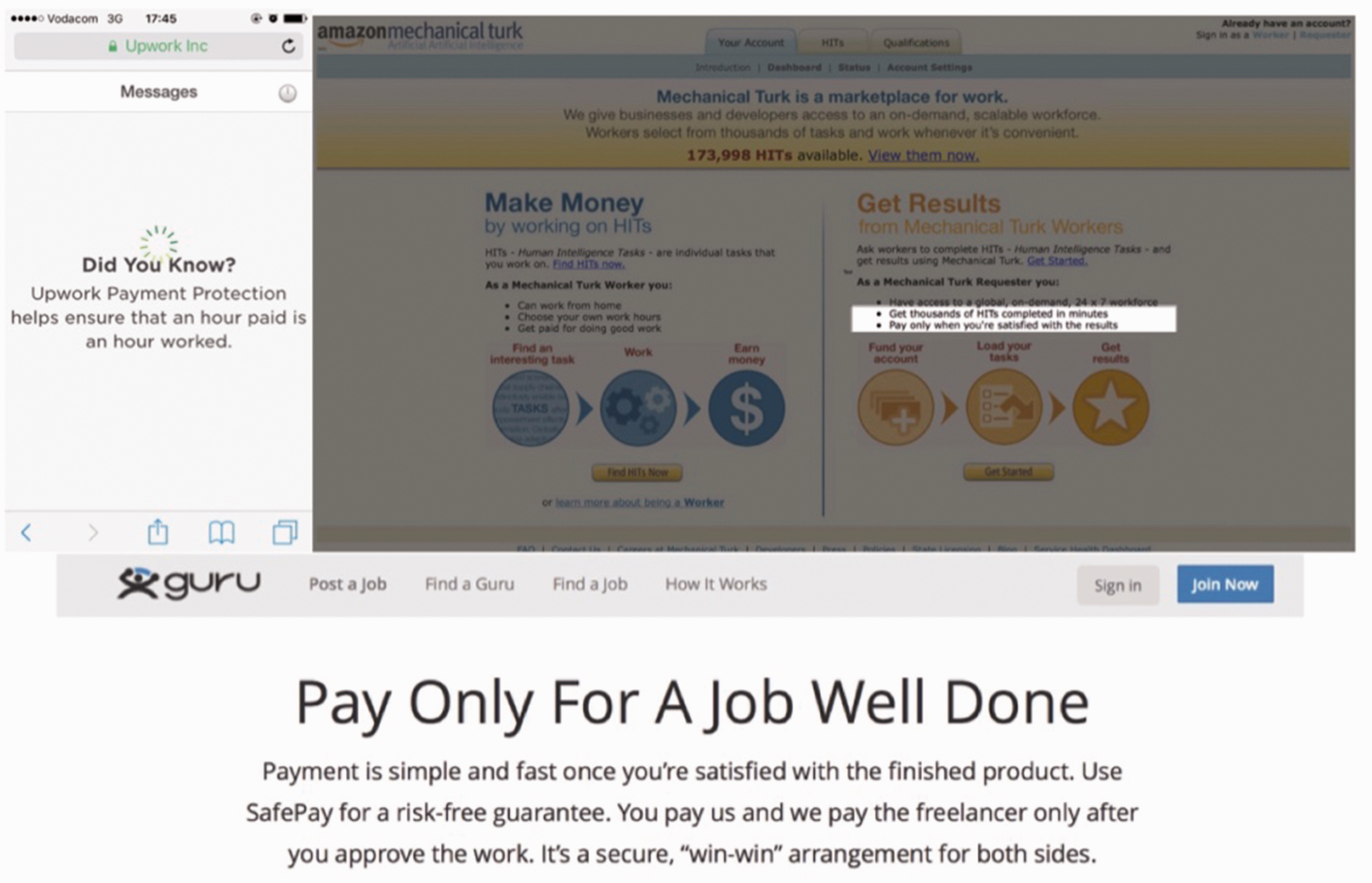
Various platforms advertising pay protection for clients.
Platforms’ use of algorithmic management, technological control of labour process and ratings system strongly impact workers autonomy in the form of high work intensity, unsocial working hours and constant monitoring of work (Schörpf et al., 2017;Wood et al., 2019b), which can vary based on types of contracts. Work intensity understood as pace of work and effort (Green, 2006); long and irregular working hours; emotional and time demands (Boxall and Macky, 2014) are key indicators of job quality. For African gig workers, increased work intensity and unsocial working hours add to their already existing vulnerable conditions by affecting their physiological and mental health. Plus, Upwork captures the screenshot of workers’ computer every 10 min to ensure they are working (Anwar and Graham, 2019a). This constant monitoring of work increases work intensity since workers are under constant pressure to sit in front of their screen for long hours, often late in the night resulting in high physical and mental stress, weakening of eyesight, constant back-pain and a lack of sleep. This is particularly true for hourly rate work like virtual assistants, web chat agents, customer service and sales. Even some of the most successful freelancers we met told us that they would be up way past midnight searching for jobs because this is when clients (mainly form the US and Canada) would normally post jobs. It was not uncommon for gig workers we met to work up to 60 h a week. Dayo told us that during his busiest times he could end up working around 80 h a week, and as a result he struggled to get enough sleep. A Kenyan worker, Daniel, a veterinary surgeon by training and an online video editor with a successful gig work history, told us that he had to sacrifice his sleep to get to where he is now. When he joined Upwork in 2012, he was going to sleep at around three or four o’clock in the morning, and developed migraines as a result (Interview Nairobi, December 2016). The flexible working schedule which is very common among gig workers and other types of freelancers obscures the late-night work put in by these workers, which undermines their autonomy. This autonomy paradox is also highlighted by Shevchuk et al. (2019) who found in their study of Russian gig workers that night work has adverse effects on workers’ subjective well-being as measured by satisfaction with work–life balance, life satisfaction and emotional exhaustion.
Despite a few narratives of workers being able to exert their individual structural power over clients, there is little evidence of associational power of workers on platforms. Trade unions have long played a key role in establishing institutional protections against unfair practices of employers (Frege and Kelly, 2004). None of the respondents we interviewed were members of any trade union, despite a particularly vibrant history of unions on the continent (Beckman et al., 2010). Trade unions for remote work rarely exist globally, though there have been efforts for unionization in place-based work (Minter, 2017). Therefore, a difficult question is how to convert workers’ structural power into the associational power in remote work (Selwyn, 2012). During our two group discussions with Nigerian workers, all the workers supported the idea of a labour union for freelancers in Africa but were less sure of how what would a labour union for remote work look like and if it would help them overcome adverse working conditions.
Conclusions
Gig work is framed by various international institutions and organizations, private firms, internet-based platforms and lately nation-states around the developmental notions of freedom and flexibility. This article has argued that we need to move beyond the language of freedom and flexibility that is deeply embedded into the developmental justifications of the newly emerging gig economy. Here, we have shown that the idea of freedom and flexibility in gig work is embedded in the neoliberal thinking, i.e. individual freedom is more important than collective and occupational freedom (defined as facilitation of personal development and satisfaction; Standing, 2014). Furthermore, these notions of freedom and flexibility do not necessarily translate into improved working conditions or livelihoods for many. While working from home is attractive, it masks the long, unsociable and irregular working hours quite common among gig workers. For Marx (1959), a shortening of the working day was the basic prerequisite for the freedom of labour. Most platform-based workers often do not necessarily have the ability to control their working hours, which results in various forms of health issues like lack of sleep, stress and tiredness. The fear of losing jobs, unexpected cancellation of contracts and withholding of wages were keeping workers trapped in continuous cycles of exploitation. This is particularly true for workers who are new to gig work; belong to disadvantaged socio-economic background; lack educational qualifications and do less-complex work activities such as transcription, data entry and search engine optimization. These workers often struggle to sustain themselves financially.
Therefore, examining job quality in gig work allows us to focus on a more rounded picture of the developmental impacts of gig work than offered in the popular and mainstream publications. Workers joining gig work from Africa are enticed by the top-down narratives and discourses of gig work. The policy rhetoric for development within the international organizations, such as the World Bank, is to promote self-employment and entrepreneurship among the unemployed, and gig work platforms are seen as one of the tools to foster entrepreneurship among workers (Kuek et al., 2015). However, some of these self-employed entrepreneurs might represent what Portes and Hoffman (2003: 55) call ‘forced entrepreneurialism’ because of the limited choices available in the local labour markets and the job losses in various sectors (Burchell and Coutts, 2019). We argued in this paper that gig work in its current capitalist manifestation can create and maintain conditions of precarity and vulnerability among gig workers in Africa. It is true that from many African workers’ perspective, gig work represents an idealized version of new formal sector jobs. But the structural and technological design of platforms contribute towards loneliness and social isolation, high work intensity, non-payment of wages and unfair dismissals, which adds to African workers’ precariousness and vulnerability. One of the challenges faced by remote gig workers is their lack of collective organization because they are spatially dispersed. Here, the networks of workers emerging on digital communication channels are key. Local trade unions could think of innovative ways to develop some sense of collective identity in the gig economy in Africa, such as leveraging social media networks of gig workers which are known to be critical for their labour agency and well-being (Anwar and Graham, 2019a).
Unemployment rates throughout Africa are at unsustainable levels, and policy makers often face insurmountable struggles to grow local economies in inclusive ways. As such, many in the development sector look to gig work as a route to solve unemployment and contribute towards economic development. The big challenge for the governments of most African countries is not just to generate jobs but good quality jobs. The emergence of the gig economy on the African continent has enabled many to join new labour markets but it also comes with plenty of risks. Platforms usually do not have workers best interests in mind and have generally skirted regulatory and juridical scrutiny both globally and regionally in Africa. Many governments appear to be less-inclined to put in place effective regulatory mechanisms for a fear of these jobs to go elsewhere. The need for adequate regulation of gig work platforms is immediate. This could mean developing and enforcing a set of local labour standards so that platforms comply with decent working conditions such as offering sociable working hours, protection against arbitrary firing of workers, non-payment of salaries, fair wages, etc. (Wood et al., 2019c). The setting up of Fairwork Foundation can ensure platforms certify themselves against certain standards, which can protect workers against precarious employment (Graham and Anwar, 2018b). The Fairwork Foundation’s work needs to be expanded to encourage international platforms (primarily in the US, Australia and the EU) for remote work to certify themselves against Fairwork standards. Ultimately, greater levels of multi-stakeholder collaboration (including state, labour unions, civil society and businesses) is needed to ensure workers’ rights and entitlements are not abused by the gig economy platforms and clients through bureaucratic loopholes and that they comply with legal work requirements and are answerable to a court of law.
Footnotes
Declaration of Conflicting Interests
The author(s) declared no potential conflicts of interest with respect to the research, authorship, and/or publication of this article.
Funding
The author(s) disclosed receipt of the following financial support for the research, authorship, and/or publication of this article: We are also grateful the European Research Council (Grant Agreement ERC-2013-StG335716-Geonet), The Alan Turing Institute (EPSRC Grant EP/N510129/1), and the ESRC (ES/S00081X/1) for funding our research.
