




Abstract
This article examines whether a shorter full-time standard working week can promote gender equality in the labour market by reshaping the distribution of paid and care work. Based on an overview of employment rates and working hours in the EU, it shows that, although there are major differences across the EU, women are often employed but disproportionately in part-time positions, resulting in lower earnings and pension entitlements. Using data from the European Working Conditions Survey, it highlights the unequal division of unpaid care and housework between women and men, rooted in persistent traditional gender roles. It also shows that these roles shape working time preferences. Against this background, the article then reviews empirical studies on the impact of shorter full-time standards on the gendered reallocation of care work and paid employment. The findings suggest that while reducing the full-time standard can foster gender equality, its effects depend strongly on institutional frameworks and persistent gender norms.
Introduction
It may appear to be a historical irony that the debate on working time reduction has been revived in recent years, precisely at a time when the long-anticipated shortage of skilled labour has become acute. While conservative politicians and employer representatives are calling, alternately, for an extension of weekly working hours, a raising of the statutory retirement age or (as was the case in Germany in January 2026) even the abolition of part-time work, at the same time, often in the guise of a four-day week, various initiatives and pilot projects have been launched, and highly publicised internationally, aimed at introducing a new, shorter full-time standard working week (hereafter: shorter full-time standard) (for example, Backmann et al., 2024; Gomes and Fontinha, 2023; Haraldsson and Kellam, 2021; Lewis et al., 2023; Schor, 2025).
Attempts to push working hours below today’s standard 40-hour week, however, date back far into the last century (and are not confined to Europe) (Hunnicutt, 1988; Promberger, 2021). More recently, in the EU, France introduced the 35-hour week with the Lois Aubry (1998 and 2000) (Lehndorff, 2014). On the other hand, an initiative by the Spanish government to reduce weekly working time (without a corresponding wage cut) from 40 hours to 37.5 hours (in two steps) initially failed in September 2025 as a result of a fragmented parliament. In many countries, collective agreements implementing various forms of working time reduction have been more successful. In Austria, the so-called ‘Freizeitoption’ (leisure option) was introduced as early as 2013 by collective agreement in the electrical and electronics industry, allowing employees to convert pay increases into time off (Gerold, 2017). In Germany in the mid-1990s industrial union IG Metall managed to push through the 35-hour week in western Germany, but failed to implement it comprehensively in the east of the country. Additionally, over the past 10 years, a number of collective agreements have been concluded that provide for working time reduction as an option, offering employees the possibility to choose between a pay increase or more free time (Schulten and WSI-Tarifarchiv, 2019). Collective agreements on a four-day week have also been concluded, which substantially reduced working hours without a corresponding reduction in pay (see, for example, ver.di, 2024).
Employees are very keen on shorter working hours. Surveys repeatedly show, across countries and consistently over time, a clear preference for reduced working hours, even with a corresponding reduction in income (Anxo et al., 2012; Bielenski et al., 2002; Eurofound, 2022).
As Böhle and Stöger (2022) demonstrate, however, motives with regard to working time reduction have changed over recent decades and are nowadays ‘fed less by labour market and health policy requirements, and more by changes in the relationship between gainful employment and life conduct in general’ (Böhle and Stöger, 2022: 17; author’s translation). In the context of the rising employment of women and mothers, the issue of reconciliation – more concretely, the question of who takes on unpaid care and housework – has become a key driving force. Caring for children and/or dependent relatives, as well as doing housework and self-care, requires an allocation of time not accounted for in the ‘adult worker model’ (Lewis, 2001), which assumes continuous full-time employment of all adults. In particular in societies in which paid and unpaid (care) work is distributed along gender lines, long working hours reflect a masculinised work culture and make it more difficult for women, particularly mothers, to participate equally in the labour market. In these circumstances, proponents of a shorter working time standard argue that shorter working hours for society as a whole might not only challenge existing gender roles, which assign men the role of provider and women the role of carer, but also help to transform them by promoting a more equal distribution of paid and unpaid (care) work. A shorter full-time standard would make it possible for men to devote more time to care and housework, which in turn would enable women to increase their engagement in paid work (Böhle and Stöger, 2022; Chung, 2022; de Spiegelaere and Piasna, 2017).
Although it is perfectly plausible that shorter working hours would enhance women’s labour market participation through a redistribution of care work, there is currently little research on whether this assumption is realistic within the framework of existing societal structures and gender roles. In this article I seek to help close this gap by systematically reviewing and synthesising the available research. To this end, the article starts with an overview of employment rates and working hours across the EU, adopting a comparative, gender- and country-specific perspective, with particular emphasis on part-time work, which women often choose to reconcile employment and family responsibilities. Section 3 examines a key driver of gender differences in labour market participation by analysing the time women and men devote to care and housework. Section 4 explores women’s and men’s working time preferences in the context of this unequal division of paid and unpaid labour, while Section 5 reviews empirical studies on the effects of shorter full-time standards on the gender-specific reallocation of care work and paid employment. The article concludes with a short summary and discussion of the key findings.
Employment and working hours in the EU from a gender perspective
To situate the debate on a shorter full-time standard in an empirical context, I examine the labour market participation of women and men in the EU and demonstrate that in many Member States employment patterns differ markedly between the sexes. This indicates that the question of how gender equality in the labour market can be achieved remains unanswered. To provide a more comprehensive picture, I do not restrict the analysis to employment rates as indicators of women’s and men’s labour market participation, but also consider average working hours. In countries with a traditional male-breadwinner model, such as Germany or Austria, high female employment rates are often achieved primarily through part-time work and correspondingly short weekly hours (Anxo et al., 2012). Focusing solely on employment rates would thus yield a distorted picture.
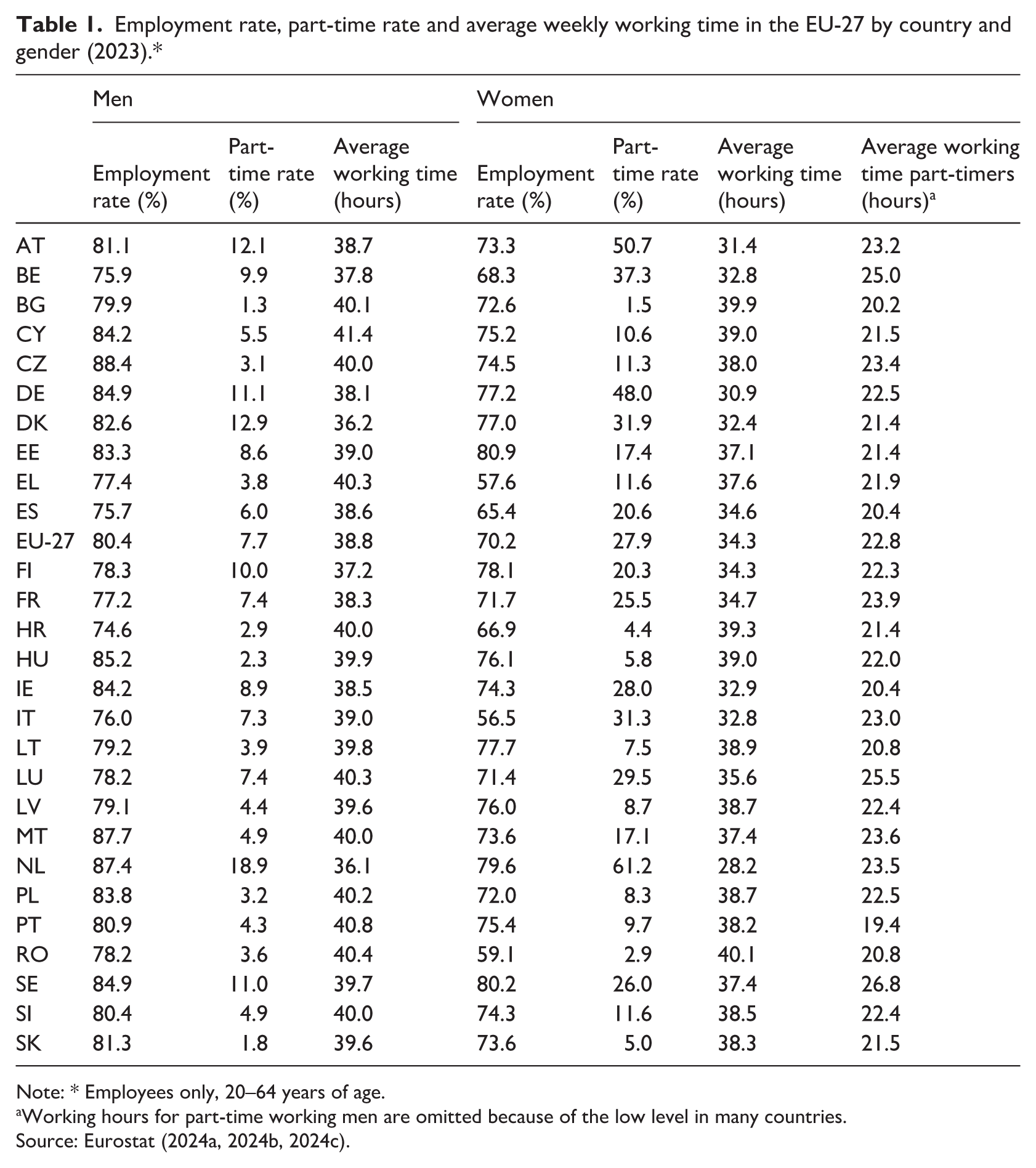
As shown in Table 1, there are significant differences between men and women with regard to labour market participation. Not only do men have higher employment rates, but they also work longer hours, in all EU countries. In 2023, the EU’s average employment rate of men was 80.4 per cent, compared with 70.2 per cent for women. Disparities in the employment rate exist for both women and men across individual EU countries, and the differences are more pronounced for women than for men. The employment rate for men varies from 88.4 per cent in the Czech Republic to 74.6 per cent in Croatia, and for women from 80.9 per cent in Estonia to 56.5 per cent in Italy. It is noteworthy that countries with high female employment rates are geographically widespread, but located predominantly in the Baltic (Estonia and Lithuania) and Nordic (Sweden, Finland, and Denmark) countries, as well as in western European countries such as Germany and the Netherlands. Conversely, southern and south-eastern European countries, such as Greece, Italy and Romania, have lower female employment rates, with figures below 60 per cent. There are also pronounced differences in the gender gap in employment rates: it is nearly 20 percentage points in Greece, Italy and Romania, while it is virtually non-existent in Finland and Latvia.
Employment rate, part-time rate and average weekly working time in the EU-27 by country and gender (2023).*
Note: * Employees only, 20–64 years of age.
Working hours for part-time working men are omitted because of the low level in many countries.
Source: Eurostat (2024a, 2024b, 2024c).
Furthermore, Table 1 demonstrates the heterogeneity of women’s working hours (and, to a lesser extent, those of men) across the EU. Men work an average of 38.8 hours per week in the EU, while women work an average of 4.5 hours less, at 34.3 hours. The working hours of women and men differ considerably between countries, and the differences are markedly larger for women than for men. In Cyprus and Poland, male employees typically work the longest hours, while the shortest hours are worked in the Netherlands and Denmark. For women, the longest working hours are observed in Romania and Bulgaria, while the shortest are found in the Netherlands and Germany. The disparity in average weekly working hours between women in the Netherlands and in Romania is 11.9 hours, equivalent to approximately 1.5 working days. The so-called gender time gap – that is, the difference between the average working hours of men and women – also differs significantly between countries. The gender time gap is widest in the Netherlands (7.9 hours), Austria (7.3 hours) and Germany (7.2 hours), and narrowest in Bulgaria (0.2 hours) and Romania (0.3 hours).
The reason for the significant difference between women’s weekly working hours and men’s average working hours is that in many countries a high proportion of women only work part-time (Table 1, column 6). In these countries, part-time work often functions as a means of reconciling care work and gainful employment and is predominantly taken up by women. This goes hand in hand with well-known risks and adverse effects on their career development, their incomes and their future pension entitlements (OECD, 2025).
On average, in the EU 27.9 per cent of women and 7.7 per cent of men work part-time. Once again, there are substantial cross-national differences. Part-time work is by far most prevalent among women in the Netherlands (61.2 per cent), Austria (50.7 per cent) and Germany (48 per cent), while by contrast it plays almost no role in Bulgaria (1.5 per cent), Romania (2.9 per cent) and Croatia (4.4 per cent). Among men, the share of part-timers ranges from 18.9 per cent in the Netherlands to 1.3 per cent in Bulgaria. The share of men in part-time employment is comparatively high in the Scandinavian countries Denmark and Sweden, as well as in Germany and Austria. Interestingly, all these countries also exhibit elevated rates of female part-time work.
On average, women employed part-time in the EU work 22.8 hours per week. There is, again, considerable cross-national variation in the extent of part-time work. For instance, women employed part-time in Sweden work on average 26.8 hours per week, whereas Portuguese female part-timers work on average fewer than 20 hours per week. In general, however, the working time of part-time employees is too short to constitute the main source of income or to generate a sufficiently high pension income – especially if such employment is pursued for a long period of time.
What conclusions can be drawn from all this for the research question pursued here? Analysis has shown that the employment and working time of men and women differ substantially across EU countries. While some countries succeed in integrating women in the labour market through both high employment rates and full-time (or near full-time) hours, in others employment is below average and full-time work appears to come at the expense of the employment rate; or high employment rates are achieved only at the cost of reduced working hours. Considering women’s employment rates and working hours jointly, it is evident that in at least 11 EU countries (Austria, Belgium, Croatia, Denmark, Germany, Greece, Italy, Ireland, the Netherlands, Romania and Spain) the labour market participation of a substantial share of women is markedly underdeveloped. In these cases, increasing employment rates and/or working hours should be the primary focus. For the time being, the debate on working time reduction appears to be irrelevant to these women’s lived realities.
Proponents of a reduced full-time standard would intervene at this point and argue that a lower full-time standard would contribute to a more equal distribution of working time and employment. The working time ‘lost’ by full-time employees could then be ‘absorbed’ by those currently working involuntary part-time. As full-time workers would gain more free time through a shorter full-time standard, they could devote more time to care and other unpaid work, which in turn would enable those who are currently not employed or only employed part-time due to care responsibilities to increase their working hours accordingly. 1
Unequal distribution of care work as a barrier to women’s labour market participation
As already noted, a key factor contributing to gender differences in labour market participation is the persistence of cultural norms that assign women primary responsibility for domestic work and child care, while men are expected to assume the role of (main) breadwinners. Thus, and in contrast to men, women’s employment prospects are significantly shaped by the availability of child-care facilities, educational institutions offering extended hours, services for the care of older people and flexible working arrangements (for example, Boeckmann et al., 2014; Bredtmann and Otten, 2025; Hipp and Leuze, 2014; Kümmerling and Postels, 2020). However, as other studies have shown, adequate provision of such infrastructure, such as child-care facilities, is a necessary but by no means sufficient condition for increasing female employment in the presence of entrenched gender norms. In this context, research has long focused on the impact of motherhood on women’s employment. A recent German study shows, however, that it is not so much motherhood that prevents women from taking up full-time employment as the amount of time they devote to housework and care-giving (which, of course, correlates with motherhood and prevailing gender norms) (Kümmerling et al., 2025a). In this regard, Müller and Samtleben (2022) find that housework constrains women’s labour force participation more strongly than care-giving tasks, and that an equal distribution of care work between partners has a positive effect on women’s labour force participation.
Table 2 shows the extent to which the time spent on unpaid work (defined by the uptake of care and housework) by men and women is distributed unevenly in all EU countries. In the EU, women spend on average 12.4 hours more per week on care and housework than men. Once again, both the overall amount of time devoted to unpaid work and the size of the gender gap vary considerably across countries. However, the relationship between the extent of gainful employment and the time spent on unpaid work is not always clear-cut or consistent. For instance, while the above-average time devoted by Italian women to household chores and care work might have been expected as they align with their high part-time rates and low average working hours, it is similarly elevated among Romanian and Croatian women, who log above-average hours in paid employment. It is therefore plausible to assume that country-specific norms also play an important role here.
Average weekly time spent on unpaid work by gender, by part-time and full-time employment and country, in hours (2021).

Source: Author’s analyses (EWCS 2021, see Eurofound, 2024).
It is often argued that a shorter workweek would enable men to devote more time to care and housework, as it would increase the amount of time available for these activities. This assumption is also based on the idea that a roughly equal distribution of paid work will lead to a roughly equal distribution of unpaid work. Table 2 presents the time spent on care and housework separately for part-time and full-time employees.
The analysis reveals two important findings. First, the fact that women devote more time to care work than men persists even among full-time employees. Full-time employed women spend on average 29 hours per week on care and household chores, exceeding the time spent by their full-time employed male counterparts by more than 10 hours per week. Second, the time spent on domestic and care work is significantly higher for part-time than for full-time female employees, whereas this is not the case for men. Male full-time employees spend on average more than two hours per week more on unpaid work than men working part-time.
This indicates that the decision to work part-time is shaped by different motives for men and for women. Eurostat analyses of the reasons for part-time employment show indeed that, compared with men, women much more frequently cite family and/or care responsibilities as their main reason for working part-time, whereas men are more likely than women to state that they work part-time because of education or training, or because they have not found a full-time position (Eurostat, 2024d). Further studies show that for men, monetary needs and employer requirements are more often the decisive factors in working time decisions, while for women it is more often the time requirements of private life, such as care and housework (among others, Anxo et al., 2012; Kümmerling et al., 2025a).
With regard to the research question addressed here, however, the data reveal another important aspect. If the available time frame were the only factor preventing men from taking on a greater share of care work, one would expect the average time that full-time employed men and women spend on care and housework to be more similar, as both groups have roughly the same amount of free time. In fact, full-time employed women in the EU spend significantly more time on care work, on average, than their male counterparts. There is ample evidence to suggest that gender-specific role patterns are at work, as a result of which women are continuing to shoulder the primary responsibility for household and care work. This prompts the question of why a shorter full-time standard should be expected to override these gender norms and result in a shift in men’s behaviour, leading to increased involvement in domestic tasks and child care.
In this context, working time preferences can be an important indicator of over- or underemployment. In Section 4 below I look at the working time preferences of men and women across the EU. This serves two purposes: first, to show the extent of over- and underemployment by country, and second, to examine whether men’s and women’s working time preferences align. In other words, are men’s preferences for shorter hours complemented by a preference among women for longer hours?
How much do women and men in the EU want to work?
Employees’ working time preferences reflect a trade-off between financial considerations, (physical and mental) workload and career aspirations, on the one hand, and private time obligations, on the other. The particular balance at a given point will depend on the employee’s life course stage. Measuring and interpreting working time preferences is challenging because of their dependence on both macro-structural conditions and individual characteristics. In this regard, an analysis of 21 countries revealed that employees in countries with low incomes and high unemployment expressed a preference for increased working hours, while those in high-income countries demonstrated a preference for shorter working hours (Otterbach, 2010). At the individual level, education, occupation and earnings, current working conditions and working hours, life course stage, and household financial situation also play an important role (Bielenski et al., 2002; Ehing, 2013). Antal et al. (2024), in their literature review on working hours and working time preferences, show that marriage and the presence of children do indeed have negative effects on women’s actual working hours, but also that the impact on their preferred working hours is less clear-cut. While mothers in most cases express a preference for reduced working hours, this is contingent on the husband’s financial situation and the availability of child care. Where affordable child-care services are available, women tend to prefer longer working hours, whereas the assumption of housework has a negative effect on their preferred working hours. The evidence for men is less unequivocal. Although marriage and having children are associated with longer working hours for men, the effect on their working time preferences appears, according to the review, to be ambiguous and context-dependent.
The following analyses are based on data from the European Working Conditions Survey (EWCS), collected in 2021.2,3 The EWCS is a large pan-European survey to assess and quantify the working conditions of employees and self-employed and one of the few datasets that collects information on working time preferences. The EWCS does not ask employees about their desired working hours in an ideal world, but instructs respondents to take into account when answering the question the fact that their salary would also change with the adjustment. The EWCS records both respondents’ actual working hours and their preferred hours. In order to capture preferences for an increase or reduction in working hours, the information on preferred working hours was related to the hours currently worked. Deviations of three or more hours upwards were defined as a preference for increased working hours, while deviations of three or more hours downwards were defined as a preference for reduced working hours. Deviations within the defined ±3 hours limits were interpreted as expressing satisfaction with current working hours. 4 To match the results of the Labour Force Survey displayed in Table 1, only employees aged 20–64 years were considered.
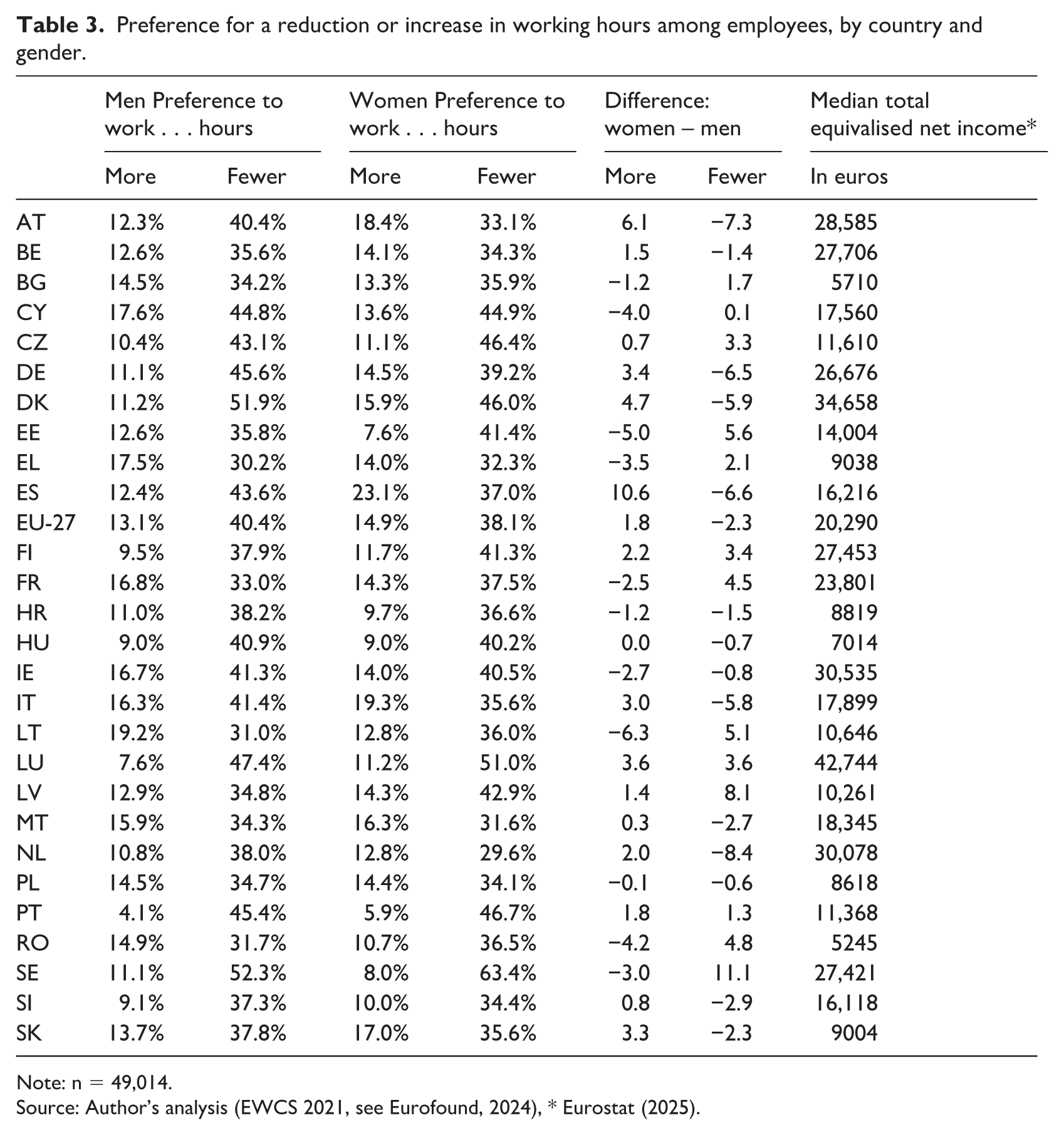
Table 3 shows that, in all EU countries, a preference for shorter working hours is more widespread than for an increase in working time. In 2021, around 39 per cent of employees in the EU wanted to reduce their working hours substantially, 14 per cent reported that they would prefer an increase, and almost 47 per cent indicated that they are more or less content with their current working time. Gender differences in working time preferences are not very pronounced at the EU level: compared with men, women are slightly more likely to report being underemployed and to prefer an increase in working hours and slightly less likely to wish to reduce their working hours. The majority of both women and men do not want to change their current working time.
Preference for a reduction or increase in working hours among employees, by country and gender.
Note: n = 49,014.
Source: Author’s analysis (EWCS 2021, see Eurofound, 2024), * Eurostat (2025).
Again, considerable cross-country differences can be observed. As Table 3 shows, among women, the desire to reduce working hours is strongest in Sweden and Luxembourg, followed by Portugal, the Czech Republic and Denmark. It is striking that the preference for shorter hours does not follow a clear country pattern: it is pronounced both in countries with high female employment and extensive opportunities for part-time work (such as Denmark, Luxembourg and Sweden) and in countries with a below-average incidence of part-time work (that is, the Czech Republic and Portugal). None of the countries in which a large share of employees wish to reduce their working time belongs to the group with above-average working hours in the EU. Interestingly, the country ranking for men is very similar to that for women with regard to the top five positions (Sweden, Denmark, Luxembourg, Germany and Portugal).
Table 3 also indicates that employees’ preferred working hours are associated with the country’s income level. For example, as also outlined by Otterbach (2010), male employees are particularly likely to express a desire to reduce their working hours in countries with high income levels (defined here, in the absence of more suitable data, as median equivalised net income). For women, a comparable correlation exists, but it is much less pronounced.
In Spain, Italy and Austria, countries with high shares of female part-time workers and comparatively low average weekly hours, as well as in Slovakia and Malta, where part-time work is uncommon and women tend to work longer hours, a notable proportion of women would like to increase their working hours substantially. The countries in which the highest proportion of men express a desire to substantially increase their working hours are Lithuania, Cyprus, Greece, France and Ireland. It is noteworthy that the first three belong to the group of countries with above-average EU working hours but below-average median equivalised net income. This may help to explain the preference for longer hours. However, neither of these factors accounts for the working time preferences in France and Ireland, which have below-average working hours but rank among the countries with high median equivalised net incomes. Overall, the descriptive analyses indicate that, although a relationship can be identified between country-specific median equivalised net income and the desire to increase working hours (for both men and women, but more strongly for men), the preference for longer working hours is a complex phenomenon that goes beyond what can be captured in bivariate analyses.
Given that women’s working hours are, on average, significantly lower than those of their male counterparts, and that working time is strongly associated with earnings, career prospects and pension income, one might expect women to express a preference for increasing their working time much more frequently than they actually do. When focusing only on those who would like to increase their working hours, it emerges that in many countries gender differences are not very pronounced and, in some cases, even point in the opposite direction (Spain being a notable exception). Moreover, even when distinguishing by part-time status (not shown in Table 3), the expected pattern does not emerge, at least not at the aggregate EU level: compared with part-time working men, part-time working women are much more likely to report that they do not wish to change their working hours (women: 51.6 per cent; men: 41.4 per cent), while part-time working men prefer an increase in working hours more often than their female counterparts (men: 41.8 per cent; women: 32.9 per cent).
It is also striking that men’s and women’s preferences do not align: in every country, the share of men who prefer shorter hours is considerably higher than the proportion of women who express a wish to increase their working time.
This raises the question of how these findings should be interpreted in light of the research question. Do they imply that women, by and large, are satisfied with their current working hours and also with the gendered division of labour, or are there other reasons for this pattern?
As already argued, care and household work are a key factor in the volume of paid work women perform, and financial considerations are of lesser importance for at least a certain share of women. If these assumptions hold, then the results may partly be methodological artefacts and are likely to underestimate the extent to which women are underemployed. Although the EWCS takes the monetary dimension of working time into account, it neglects the pull factor of unpaid work, a major driver of women’s working hours and preferences. Against this background, it is plausible to assume that women would respond differently if questions on working time preferences explicitly incorporated this factor. Further research on working time preferences should therefore explicitly take this aspect into account.
Can a shorter full-time standard contribute to the redistribution of paid and unpaid work? Evidence from the literature
The analyses presented so far have shown that, across all EU Member States, women are significantly less integrated into the labour market than men, in terms of both their employment rate and their volume of working hours. A central reason for this is that women devote substantially more time to care work than their male counterparts. This pattern persists regardless of the country examined and irrespective of whether women are employed part- or full-time. This, in turn, can be traced back to prevailing gender norms, which continue to assign women at least the greater share of responsibility for care work.
In this context advocates of a shorter full-time standard argue that moving away from the 40-hour workweek would enhance women’s labour market integration (among others, Böhle and Stöger, 2022; Chung, 2022). A shorter full-time standard would make it easier for women to reconcile care work and paid employment, thereby enabling them to take up full-time positions. Moreover, the time gained through working time reductions would enable men to invest more time in care and housework, which, in turn, would have a positive effect on women’s labour market participation. Men and women would thus, at least in principle, be able to allocate similar proportions of their time to paid work and care work. This ‘might put women on a more equal footing with men on the labour market’ (de Spiegelaere and Piasna, 2017: 27).
This argument makes the assumption that men would invest a substantial share of any time gained through reduced working hours in care and housework, thereby easing women’s time constraints and enabling them to increase their own working hours. Little empirical work has been carried out on the effects of a reduced full-time standard on employees (Boulin, 2024; Kümmerling et al., 2025b; Mullens et al., 2021), but there is even less evidence on how a shorter working time standard affects the intra-couple division of labour.
In a review of the existing literature on the effects of working time reductions (beyond part-time work), published between 2018 and 2024, Kümmerling (2025) identifies six studies that address, at least broadly, the consequences of a reduced full-time standard for the redistribution of paid work and care work. Four of these are company case studies, one of which was conducted in the context of four-day-week pilot projects (Gerold and Nocker, 2018; Haraldsson and Kellam, 2021; Lewis et al., 2023; Mullens et al., 2021). One study draws on quantitative employee surveys carried out in 33 workplaces in Sweden (Schiller et al., 2018), and another analyses representative survey data on the effects of the introduction of the 35-hour workweek in France (Pailhé et al., 2019). With regard to gender and gender differences, only the two quantitative studies treat gender as a fully fledged category of analysis; three additional studies at least refer to gender differences, for example in the qualitative sections of their reports, and in one Belgian company all but one employee were women (Mullens et al., 2021).
The analysis of the available literature shows little, if any, evidence that a shorter full-time standard leads to a redistribution of unpaid care work and paid employment between women and men.
Lewis et al. (2023), for example, report for the British four-day-week pilot that fathers stated they had increased the time spent on child care as a result of the reform, but no or only very small changes were observed with regard to other household tasks (Frey, 2023: 23). Haraldsson and Kellam (2021), in the Icelandic working time reduction experiment, find that men in heterosexual partnerships reported an increase in their contribution to housework following the reduction in working hours, although female respondents did not share this assessment. Schiller et al. (2018) likewise did not find gender-specific differences in time use after the introduction of reduced working hours. Moreover, Mullens et al. (2021) show, in a case study of a Belgian company with an almost entirely female workforce, that after the introduction of a 30-hour workweek, respondents’ time spent on household work increased significantly, contrary to their initial intentions for the use of the additional free time. Finally, Pailhé et al. (2019), analysing the impact of the 35-hour week in France on the division of household and care work, find no evidence that domestic tasks became more equally shared. On the contrary, the gender gap widened in terms of task specialisation: men devoted more time to what the authors term ‘flexible tasks’ (for example, repairs, gardening or shopping) on weekdays while they did less on weekends (especially shopping and cleaning), whereas women’s patterns remained largely unchanged, except that they spent more time with their children after the reform.
These findings are corroborated by further results. Schor (2025: 38), in her comprehensive evaluation of the four-day-week studies she led, concludes that only about 20 per cent of participating men increased their share of housework and child care, whereas – unlike in Mullens et al. (2021) – women’s unpaid care work did not rise. Against this backdrop, the findings of Gerold et al. (2017) are noteworthy: their analysis of the effects of Austria’s collectively bargained ‘leisure option’ shows that, although men used some of the gained leisure time to spend more time with their children, they did not use it to bring about more balance between work and care activities. This suggests that the gender-specific division of labour in the household remained largely unchanged by the working time reduction.
In summary, the – albeit admittedly sparse – literature provides scant scientific evidence that, under prevailing societal conditions and norms, a shorter full-time standard would lead to a more equal distribution of care work and paid employment, regardless of whether the working time reduction schemes were statutory, collectively bargained or company-driven.
However, three key limitations qualify this conclusion. First, the findings may, at least partly, be attributable to the specific form of working time reduction. Companies can implement reductions in various ways, such as through a shorter workweek (often with a fixed day off at the beginning or end of the week); shorter daily hours while maintaining a five-day week; or ‘“staggered”, “decentralised”, “annualised” and “conditional” structures”’ (Lewis et al., 2023: 5). In most of the cases examined, including Lewis et al. (2023) and Mullens et al. (2021), an additional day off was introduced without altering the distribution of working time on other days, which probably preserved the pre-existing division of labour on those days. This interpretation aligns with Fagnani and Letablier (2004), who, in their analysis of the French working time reform, concluded that shorter daily hours foster greater work-family compatibility than models featuring a shorter workweek.
Second, no long-term studies have examined the effects of working time reductions on the redistribution of care and paid work, nor are there recent studies analysing these effects at the household level. When one partner reduces their hours, without a corresponding pay cut, household income remains stable. Under conditions of unequal earnings, this preserves any existing power imbalances within the relationship and may remove any household-level incentive for the other partner to increase their working hours.
Third, research on shorter full-time standards has to date focused primarily on high-income countries, often in the western or Nordic regions. The extent to which these findings can be transferred to countries with lower income levels therefore remains questionable.
Summary and conclusion: it’s the care work, stupid!
The aim of this article was twofold. On the one hand, it sought to situate the current debate on working time reductions, often framed in terms of a shorter full-time standard, within the broader context of gender inequalities in the labour market and the unequal distribution of care work. On the other hand, it aimed to demonstrate that, under prevailing conditions and gender norms, the expectation that a shorter full-time standard would in itself lead to greater gender equality, as many of its proponents claim, is overly optimistic.
Analysis shows that in all countries women are less well integrated into the labour market than men and also have to take on a heavier burden of unpaid care and housework. On the other hand, men’s and women’s working-time preferences do not differ substantially, nor do they appear to be aligned. Although women are somewhat more likely than men to wish to increase their working hours, these differences remain comparatively modest. Moreover, the widespread desire among men to reduce their working time is not matched by an equally widespread wish among women to increase theirs.
This phenomenon can be attributed to prevailing gender norms that assign men the role of breadwinner and women that of primary caregiver. Moreover, it cannot be ruled out that responses on working time preferences are also affected by methodological artefacts, given that the questions on working time preferences used in the EWCS take income variations into account, but do not explicitly address the assumption of care responsibilities.
Against this background, the question arises of the extent to which a shorter full-time standard would prompt men to assume a greater share of housework and care work, thereby enabling women to participate more fully in paid employment. As shown in Section 5, the available studies suggest that such a redistribution is far from automatic and that prevailing gender norms at least complicate, if not completely stymie the reallocation of care and paid work. This seems to hold irrespective of whether the observed working time reduction was introduced by legislation, collective agreement or company-level initiative. Interestingly, the reverse effect appears more clear-cut: an equal distribution of care and domestic labour between partners increases women’s working hours, and to a greater extent than it reduces those of their male partners (Müller and Samtleben, 2022).
Against this backdrop, the success of a shorter full-time standard hinges on the following four factors. First, its adoption must be established as the prevailing norm across a country, rather than being left to employers’ discretion; instead, it should be anchored in legislation and collective agreements. Second, implementation should occur gradually over the long term, following a fixed timetable that allows firms – and societies – sufficient time to adapt. Third, while the choice between a shorter working week and shorter daily hours should rest with the social partners, a gender perspective, taking into account the redistribution of unpaid work, tends to favour shorter days (Fagnani and Letablier, 2004). However, the temporal demands of care and reproductive work vary across the life course, which casts doubt on the effectiveness of a ‘one-size-fits-all’ approach. Further research is needed to examine the long-term effects of different working time reduction models on gender equality, work-life balance, health and leisure behaviour, thereby informing more nuanced policy recommendations.
Finally, it is essential to recognise the value of care and reproductive work and to accord them appropriate societal standing. Dispelling the misconception that such work should be subordinate to paid employment is crucial, as it constitutes a prerequisite for gainful employment, particularly in ageing societies confronting demographic change. Policy-makers, in turn, must facilitate the redistribution of care work between partners. This requires, on one hand, expanding access to high-quality child care, all-day schools and elder-care facilities and, on the other hand, the political will to implement even potentially unpopular measures, such as abolishing joint taxation for couples in favour of individual taxation or mandating the equal sharing of state-subsidised parental leave between fathers and mothers. Achieving substantial shifts in the intra-family and gender-specific division of labour demands a new social paradigm that values care and reproductive work. A shorter full-time standard could mark a first step in this direction, but it is far from sufficient on its own. If successful, however, this endeavour could ultimately enhance overall societal gender equity and productivity in the long term.
Footnotes
Funding
The author received no financial support for the research, authorship, and/or publication of this article.
Declaration of conflicting interests
The author declared no potential conflicts of interest with respect to the research, authorship, and/or publication of this article.