




Abstract
The social partners often attain a more central role in decision-making during social or economic crises. This article examines whether this held true in Finland, Sweden and the Netherlands during the COVID-19 pandemic. These are countries with strong institutionalised power relations. It assesses whether the crisis affected institutional stability and social partner representation, referred to as crisis corporatism. Drawing on 30 interviews with representatives of social partner organisations and government agencies, as well as labour market experts, we demonstrate strong institutional stability and path dependence in industrial relations during the crisis. While Sweden’s institutionalised power relations remained stable, Finland and the Netherlands experienced temporary shifts, with governments bypassing the social partners on health-related issues. The health-care sector and precarious workers emerged as especially vulnerable.
Introduction
The COVID-19 pandemic hit Europe as both an economic and public health crisis, amplifying various existing vulnerabilities. Economic vulnerabilities arose from company closures, shifts in work and social patterns, and falling consumption. Simultaneously, public health-care systems were put under strain by rising infection and mortality rates, exposing systemic sectoral weaknesses, while lockdowns and social distancing worsened mental health, loneliness, family stress and domestic violence (Kuhlmann et al., 2021; OECD, 2021; for a review, see Brodeur et al., 2021). This twofold crisis likely impacted vulnerable labour market groups disproportionately, as critical vulnerabilities related to age, family, social and economic marginalisation, physical and psychological disabilities, and work environments were exacerbated. Such increases in vulnerability can potentially spark institutional change.
Despite differing strategies with regard to lockdowns and public restrictions, Finland, Sweden and the Netherlands implemented swift economic and social measures, leading to faster recoveries than the EU average (CBS, 2022; Irfan et al., 2022). Earlier research showed that social and economic crises prompt greater social partner involvement in decision-making (Ebbinghaus and Weishaupt, 2022), raising questions about their role in COVID-19 responses in protecting vulnerable groups and whether their measures reflected a continuation of past social dialogue or innovation. While crises often lead to crisis corporatism – temporary emergency coalitions between state, labour and capital (Meardi and Tassinari, 2022; Urban, 2012) – we argue that established institutional power relations (see Brady, 2022), longstanding frameworks involving the state, unions and employers’ organisations, remain critical in shaping crisis responses and policy-making for the vulnerable groups.
All three countries have comprehensive social protection schemes that cover a large segment of the population, both within and outside the labour market. The previous literature suggests substantial institutional continuity in the inclusiveness of the Nordic welfare states’ unemployment and labour market policy responses during COVID-19 (Béland et al., 2023), and in the post-pandemic responses to the unexpected inflation shock following the pandemic (Greve et al., 2023). Similarly, the Netherlands demonstrated continuity in social concertation during the 2008 recession (Van der Meer et al., 2021) and despite labour market flexibilisation it maintains generous social protection with wide coverage. Given this continuity, this article examines the potential rise of crisis corporatism during COVID-19 in these most likely cases of institutionalised power relations (Brady, 2022; Korpi, 1983). We seek to determine the extent to which there was stability or change in social partner representation in social dialogue; how they affected vulnerabilities in different sectors; and how their influence over decision-making changed during the COVID-19 pandemic in Finland, Sweden and the Netherlands.
This article’s contribution is twofold. First, it provides an empirical test of the two contrasting perspectives of crisis corporatism and institutionalised power relations. Second, it provides novel insights into social dialogue in times of crisis using interview data. The focus is limited to analysing changes in social partner representation in labour market policies, highlighting vulnerable groups. It therefore does not intend to cover the realm of health and economic measures implemented during COVID-19 nor to tackle collective bargaining and other corporatist practices. The next section delves into the theoretical opposition between the two perspectives. Thereafter, our analytical strategy is described. The fourth section provides the results from the country cases and compares them, before we conclude in the fifth and final section.
Theory and previous literature
Corporatism entails the involvement of organised civil society interests, namely labour unions and employers’ organisations, in state decision-making structures and policy implementation (Schmitter, 1974). Along similar lines, the power resource approach argues that social policies result from inert political struggles between capital and labour, where leftist interest groups – such as labour unions – use their collective power to advocate for social citizenship, enabling citizens to seek state support in times of socio-economic vulnerability (Korpi, 1983, 1989). Institutionalised power relations emphasise the institutional aspect of power resource investments, underlining the centrality of formal institutional power in social and redistributive policy-making (Brady, 2022; Korpi, 1989). From this viewpoint, the inequality-reducing measures and social policies implemented during the COVID-19 pandemic resulted from the pre-existing balance of political power, which also constitutes formal governing institutions. In the three countries discussed in this article, labour unions and employers’ organisations are longstanding formal internal parts of governance.
Crisis corporatism, in turn, combines the notion of corporatism with the suddenness and shock of crises. As such, it involves two central processes. First, crises are considered opportunities for new actors to be involved in decision-making or to actively mobilise and participate, as a defensive response to the challenges and uncertainty posed by the crisis. This is what Urban (2012: 230) refers to as an ‘alliance of the weak’. Secondly, the new emergency coalitions have an influence on policy-making, driving a shift in social policy paradigms (Ebbinghaus and Weishaupt, 2022). Crisis corporatism thus contrasts with institutionalised power relations on three key points. First, it emphasises short-term changes and innovations over sustained, long-term strategies (Crouch and Streeck, 1997; Jessop, 2002). Second, it downplays the importance of being embedded within formal institutional power relations, overlooking vulnerabilities related to representation (Crouch and Streeck, 1997; Jessop, 2002). Third, it disregards pre-existing power relations and established modes of collaboration, emphasising the impact of exogenous shocks to bring radical institutional change rather than endogenous developments that precede the crisis (Mahoney and Thelen, 2009).
Strong corporatism does not necessarily ensure equal representation across sectors, as power relations create ‘structures of bias’ (Korpi, 1989: 314). Union membership has been declining in all three countries considered here, and in Finland and Sweden, union density has shifted from blue-collar to white-collar dominance. While the manufacturing sector still leads tripartite negotiations in Finland, Swedish white-collar confederations have taken the lead in bipartite agreements (Bergholm and Sippola, 2022; Kjellberg, 2023a). Recent research has shown that this shift, along with employer demands for increased flexibility, exacerbated sectoral vulnerabilities during the COVID-19 crisis, especially in the health- and elder-care sectors (Kjellberg, 2021). In the Netherlands, social partner involvement in economic and labour market policy is deeply institutionalised through the Social and Economic Council (SER) and the Labour Foundation (STAR), which advise the government – even though union density is lower than in the Nordic countries. Because of these potential structures of bias, the analyses that follow will not only examine the overall involvement of social partners but will be sensitive to sectoral differences.
Analytical strategy
This article presents Finland, Sweden and the Netherlands as most-likely cases of institutionalised power relations. If new coalitions to protect vulnerable groups that influence policy-making have arisen (in other words, crisis corporatism) in these countries with historically strong social partners, it would provide evidence that the COVID-19 pandemic functioned as a path-breaker for institutionalised social dialogue structures.
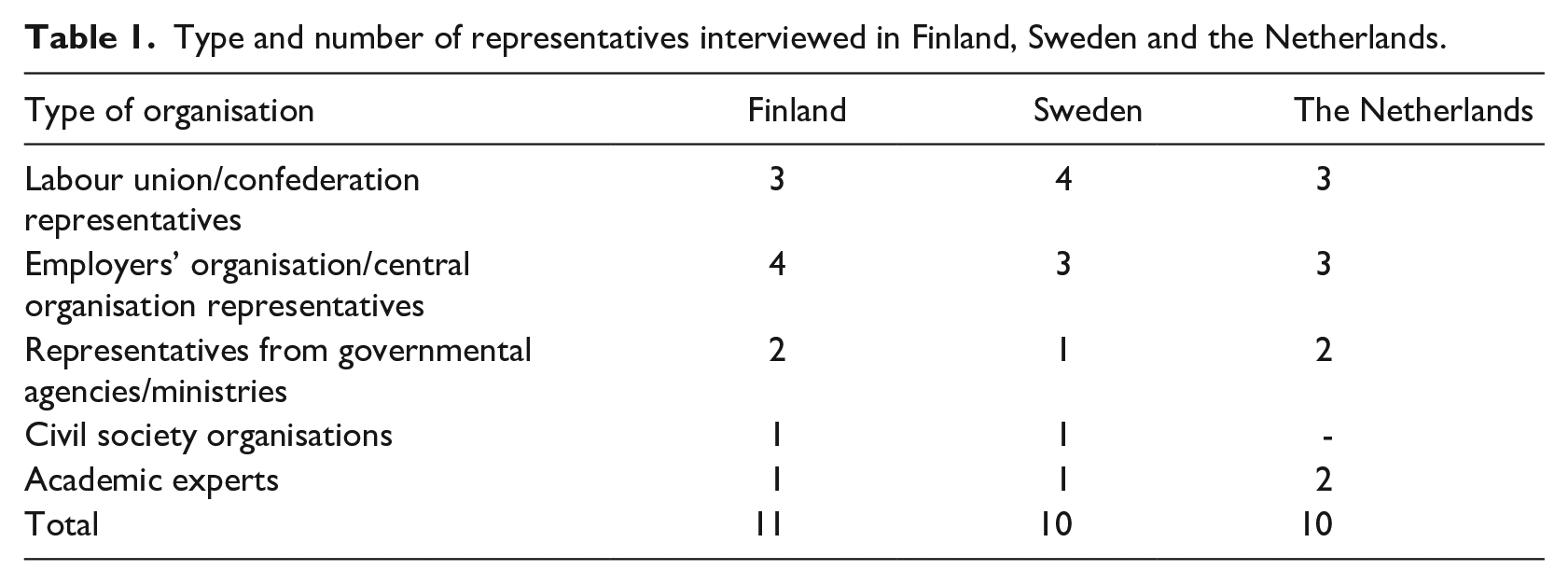
The article draws on retrospective qualitative interviews with national stakeholders from these three countries. It covers the period from the pandemic’s onset in Europe in 2020 throughout 2022. The interviews were conducted with representatives of trade unions (confederations), employers’ organisations (and their central organisations), government agencies, ministries, civil society organisations and academic experts in early 2023 (Table 1 details respondents). The core focus was the study of the social partners’ role in the policy-making and social dialogue behind those policy decisions. Qualitative content analysis was used (Elo and Kyngäs, 2008) with a coding scheme to assess collaboration, conflict and innovation in the social dialogue.
Type and number of representatives interviewed in Finland, Sweden and the Netherlands.
The interviews, analysed in a positivist sense, made it possible to interpret social dialogue and labour market relations using standardised questions. The emphasis was not put on the interviewees’ subjective understandings of the crisis. Instead, the answers were interpreted as realist descriptions of national social dialogue and institutionalised power relations to compare the answers across sectors and countries. As such, stability and change in terms of how the social partners worked, whom they collaborated with, what questions they advocated, which groups they saw as most vulnerable, and how they perceived their influence on formal decision-making structures were evaluated and compared across the three countries.
Conducting interviews shortly after the pandemic ended strengthens the reliability of the interviewees’ accounts as events remained fresh in their memory. That said, interviewees’ answers must be interpreted in a context of pre-existing social structures. There is not only one understanding of the crisis and it remains a task to examine empirically whether there was stability and collaboration, depending on the sector and respondent in question. This is why sectoral differences are highlighted in the analysis.
It should be pointed out that, as is often the case in interview-based research, our findings are based on a limited set of interviews. Our material does not cover all the sectors that were affected nor all the organisations involved in the societal mitigation of the pandemic’s impact. We did, however, incorporate actors from trade union confederations to obtain a broader view of the stakeholders.
Additionally, as this article focuses on crisis-specific social dialogue, large social partner organisations that are always involved and organisations that raised their voices specifically during the crisis are over-represented in relation to organisations outside institutionalised structures. In other words, there is a risk that the material is biased towards established social partners who were able to better articulate their agenda during the crisis. Therefore, the study also focused on trying to represent vulnerable groups, who are more at the margins of representation.
As part of the European project, the study has been reviewed by the University of Helsinki Ethical Review Board. 1 The Swedish research that contributed to this study was also approved by the Swedish Ethical Review Authority. 2 All quotes and references to information from the social interviewees in the article are anonymised.
Results: the cases of Finland, Sweden and the Netherlands
The following subsections provide an overview of the country’s industrial relations before COVID-19, the evolving role of the social partners and sectoral vulnerabilities during the crisis, and any lasting changes in industrial relations in Finland, Sweden and the Netherlands. The final subsection reflects on countries’ positioning within institutionalised power relations vis-à-vis crisis corporatism.
Finland
Finland’s industrial relations, rooted in the Nordic model, have traditionally featured high union density, extensive collective bargaining and strong tripartite cooperation (Kjellberg, 2023a). Unlike Sweden and the Netherlands, with their more decentralised systems, Finland historically has maintained a predominantly centralised collective bargaining structure (ILO, 2021: 6). However, the 2016 ‘Competitiveness Pact’ (Kilpailukykysopimus) marked a shift towards ‘centralised decentralisation’, with sectoral-level bargaining increasingly replacing national agreements (Jonker-Hoffrén, 2019). While union density remains relatively high in industry (63.4 per cent) and the public sector (76.7 per cent), it lags behind in private services (41.6 per cent), largely because of the sector’s particular characteristics, such as smaller, fragmented workplaces, high labour turnover and prevalence of fixed-term contracts. They make it more difficult for unions to organise workers effectively (Ahtiainen, 2023; Jonker-Hoffrén, 2019).
At the onset of the pandemic, Finland’s peak-level social partners – union confederations and employers’ organisations – collaborated effectively and swiftly reached consensus on proactive measures. Despite their differing priorities, respondents from both sides underlined that they shared a commitment to mitigate the crisis. The main outcome, the ‘COVID-19 Package’, helped companies to adapt to the changing economic landscape while providing support for workers at risk of lay-offs or unemployment (Eurofound, 2021: 5–6). It thus targeted vulnerability broadly across sectors. As several respondents explained, after just two days of negotiations in March 2020, the social partners proposed this package to the government. The government quickly adopted the proposals, leading to temporary legislative amendments that were integrated into collective agreements by unions and employers’ organisations. This swift and effective collaboration suggests a strong degree of continuity of social dialogue, with established partners using their traditional roles to respond to the crisis.
The COVID-19 Package addressed key labour and social insurance issues, with a strong emphasis on unemployment benefits. Employers’ organisations prioritised prevention of business bankruptcies and job protection, advocating changes in temporary lay-off rules. In contrast, unions emphasised expanding social protection, pushing to eliminate the five-day waiting period for unemployment benefits and suspend the maximum payment period. The package primarily benefited workers in standard employment relationships, while failing to address the needs of other (non-traditional) workers. As noted by the respondents, self-employed workers in cultural sectors, professional athletes, platform workers (such as food-delivery drivers) and freelancers remained largely unprotected because their social security status differed from that of salaried employees. Efforts to support these groups were limited: the process was slower and the outcomes were deemed ‘unsatisfactory’. The interviews revealed that this gap stemmed from challenges in finding appropriate legislative mechanisms for non-traditional workers, limited resources in ministries to develop new policies, and the prevailing assumption that the pandemic would be short-lived, prompting a focus on temporary adjustments to existing systems rather than the creation of new ones.
Initially, social partner–government communication was robust, with effective collaboration at sectoral and confederation levels. Trade unions and employer groups held direct discussions with the government and public officials to influence regulatory decisions and their implementation. Matters concerning occupational safety, health and social insurance were addressed through tripartite advisory boards, a practice that continued throughout the pandemic. As the crisis progressed, however, the government’s role in policy-making became increasingly dominant, shifting the dynamics of social dialogue. Social partners gradually began to feel that their influence over decision-making was diminishing as concerns about communication gaps with the government grew. The social partners noted that while formally their input was sought, they often felt it was overlooked. A respondent from a trade union confederation noted that ‘especially the Health and Social Ministry had a lot of power during the COVID crisis, so it was quite difficult to have discussions with [the government] [. . .] they didn’t listen, negotiate, or consult the trade unions much’. A respondent from an employers’ organisation similarly noted that ‘while unions were heard at every stage, their opinions did not always carry enough weight in decision-making’.
This shift towards a more top-down, command-and-control approach became particularly evident after the initial COVID-19 economic response package. The government increasingly relied on recommendations from the Finnish Institute for Health and Welfare (THL), bypassing thorough consultation procedures (Christensen et al., 2023). A Finnish Commerce Federation respondent described the challenges: ‘We’ve often been involved in the preparation process, but it’s been exceptionally difficult. Authorities, especially the Social and Health Ministries, have been very reluctant to listen [. . .] Legislation was pushed through at such a pace that proper consultation procedures were bypassed.’ Despite this, the social partners continued to support most enacted policies, acknowledging the urgency of the crisis. There were points of contention, however. Employers’ organisations opposed primary school closures because of concerns about educational inequality, and some aspects of health and safety measures faced criticism on the grounds of proportionality, for instance the lockdown of Uusimaa region. These disagreements were largely expressed in retrospect after vaccination rates had improved, however.
The COVID-19 pandemic tested Finland’s peak-level social dialogue, revealing both resilience and limitations. While the tripartite system effectively supported full-time salaried employees, the crisis exposed gaps in the representation of emerging vulnerable groups, particularly cultural workers (including musicians, theatre workers and other performing artists), professional athletes and self-employed entrepreneurs. Peak-level negotiations struggled to balance sector-specific concerns: sectors with established tripartite structures were able to influence decision-making through existing channels, while sectors lacking traditional labour market representation (such as cultural producers, event organisers and freelancers) were not. There was little evidence of broader involvement of civil society organisations. While structures effectively supported universal economic measures, such as the swift implementation of the COVID-19 Package, limitations surfaced around non-traditional workers. As one respondent noted, self-employed and freelancers remained ‘outside social security’, with access only to basic social assistance, which furthermore required the sale of any assets before qualifying. Attempts to create new support mechanisms were hampered by legislative complexity. For instance, the outdated Communicable Diseases Act did not distinguish between professional and amateur events, making it difficult to tailor restrictions appropriately. There were also resource constraints in ministries and an assumption that the pandemic would be temporary. While peak-level social partners maintained their formal consultation roles and successfully delivered some crucial agreements (such as the COVID-19 package that the government welcomed), their perceived influence generally diminished as the Ministry of Social Affairs and Health and THL took a leading role in decision-making, often providing limited time for consultation and sometimes announcing decisions without prior discussion.
In the aftermath of the COVID-19 crisis, Finland’s industrial relations system faced new turbulence. In autumn 2023, the new government introduced major labour market reforms to strengthen the export-driven labour market model (Eurofound, 2024a). These proposed changes to the Act on Mediation in Labour Disputes and other regulations have caused significant controversy, leading to extensive trade union actions, including one of the largest political strikes in Finnish history in February 2024. The government’s proposals included limiting wage settlements to the level set by export industries, increasing opportunities for company-level bargaining and restricting political strikes (Eurofound, 2024a). These changes were met with fierce opposition from the unions, who argued that they disproportionately targeted employees and the unemployed while strengthening employers’ positions. Despite labour union actions, on 8 May 2024, the parliament approved the laws restricting political strikes by 107 votes to 57, limiting political work stoppages to 24 hours and other political industrial actions to two weeks (Yle, 2024). The current right-wing government’s successful implementation of reforms despite union opposition represents a significant shift away from the consensus-seeking approach that characterised Finnish industrial relations, potentially marking a new era in Finnish industrial relations. Its consequences for social dialogue will materialise in the coming round of collective agreements, but also in the widening of the labour representation gap, particularly for the more vulnerable groups in the labour market.
Sweden
The Swedish industrial relations model is known for its stability and absence of conflict, in nearly all sectors. This was also the case during the COVID-19 pandemic. Despite a growing gap between union density and the density of employers’ organisations in favour of the latter, as well as a growing gap between blue- and white-collar unionisation, which could alter the respective power balances, self-regulation was able to produce a new basic agreement on employment protection, skill development and conversion amidst the COVID-19 pandemic without significant state involvement (Kjellberg, 2023b). At the same time, sectoral-level negotiations among the social partners, as well as peak-level consultations with the government, intensified to mitigate the negative impact of the crisis.
On 11 March 2020, one day before COVID-19 was confirmed to have spread to all Swedish regions, the Swedish Minister of Finance presented a revised state budget, including increased spending on staff for government agencies dealing with the virus, and financial support for individuals and companies (for a timeline of the Swedish response, see Olofsson and Vilhelmsson, 2022). From the start, social partners were involved in designing and implementing economic and labour market measures, such as short-time work schemes, temporary reinforcements of unemployment and sickness insurance, employer compensation for sick pay, and temporary reductions of employers’ social security contributions. Respondents representing most sectors in Sweden, health care being the notable exception, indicated that all policies they had called for were being implemented in one way or another. This demonstrates the strong shared values and reciprocity between unions, employers’ organisations and the state. Moreover, several of the temporary improvements in the unemployment and sickness insurance system were later made permanent, indicating that the pandemic accelerated policy change (Bengtsson et al., 2024).
The short-time working schemes, highlighted as critical by a majority of the Swedish respondents, are a striking example of how institutionalised power relations and established negotiation networks provide fertile ground for a rapid and collaborative labour market response to a crisis. A law on short-time working has existed since 2013, formalising the temporary schemes agreed on by the government and the social partners during the 2008 financial crisis. All employers, whether legal entities or natural persons, conducting business activities could apply if they had experienced a significant decline in their business operations because of the pandemic. While the self-employed were covered by the measure, workers on temporary contracts were not, thus making them increasingly vulnerable. Although it can be activated only by the government, implementation of the policy has often led to active social partner participation as its use is more flexible with short-time collective agreements at the sectoral level than without. A respondent from one of Sweden’s largest trade unions explained that they signed over 60 new agreements in just a few days when the schemes were re-implemented in the spring of 2020. When reflecting upon what they had achieved in such a short time, the respondent expressed a strong belief in the institutional stability of Swedish industrial relations, explaining that ‘[social dialogue] is not something that you can take out of the closet during a crisis – it has to be sort of alive and kicking all the time’.
In a similar vein, when asked how the COVID-19 crisis had affected social dialogue, another respondent explained that little had changed as ‘[the social partners] have established structures going back 100 years. Due to the existence of these, it’s easy for us to just continue.’ Albeit at a faster pace than before. In other words, the crisis intensified networks and relationships that were already in place. For instance, representatives of both the social partners and government agencies stated that the number of informal contacts and day-to-day interactions increased during the pandemic, and the COVID-19 crisis became a ‘trial’ of the durability of the Swedish model of industrial relations, as one of them put it. In line with this, a respondent from a government agency stated that they had never experienced such a tempo in tripartite relations during their 30 years at the agency, confirming the crisis’s role as a policy accelerator, as underlined by Bengtsson et al. (2024). However, this was not the experience across all sectors. Respondents from the health- and elder-care sectors told a different story, marked by conflict and increased vulnerability rather than value-sharing and collaboration.
The Swedish health- and elder-care sectors were vulnerable and had weak crisis preparedness in terms of resources, workload and personnel in the years before the pandemic (Stranz and Szebehely, 2018), as well as a high prevalence of precarious employment (Kjellberg, 2021). These shortcomings became clear during the spring of 2020, when Sweden had one of the fastest rising death tolls in Europe (Juul et al., 2022). A union representative drew a direct link between these developments and the crisis, implying that ‘the spread of the disease in care homes for the elderly and similar places became needlessly high because of these precarious employment relationships and extremely high staff turnover’. Similar reflections were made in the health-care sector, a union representative from which described how doctors, nurses and other medical personnel had to do overtime and double shifts, relocate to new wards or hospitals, cancel their annual summer leave, and even put together their own protective gear. Disagreements were apparent and the union had to ‘stand at the barricades with these issues’, as the respondent expressed it, demanding several interventions from the Swedish Work Environment Authority to improve conditions.
The conflict did not, however, represent a break with the Swedish model of industrial relations as the conflicts appeared within established structures, contributing to policy changes. If anything, the increase in the membership of the union organising health-care workers during the first year of the pandemic, government supported interventions, and people standing on the barricades are signs of institutionalised conflict procedures and a belief in the social partners as relevant and influential organisations. But the vulnerabilities of these sectors during the crisis are also path-dependent, based on the alarming conditions of the sectors before the pandemic.
The impact of the second and third waves of the crisis in 2021 and 2022 was less severe in Sweden. At the same time, the government implemented stricter health and safety measures related to public gatherings and social distancing (for example, public gatherings were limited to eight people, only seated guests were allowed at restaurants, the use of face masks was encouraged and unnecessary travel on public transport was discouraged). While some of the policy measures involving the social partners ended in the first quarter of 2022 (for example, employer compensation for sick pay and financial support for companies), many central measures, such as those strengthening unemployment and sickness insurance, remain in place still. As several respondents explained, although the intensity decreased, the social partners continued to provide accurate and accessible information on health risks, job security, social security entitlements and how to apply for them. Their efforts helped to facilitate economic stability for businesses and households and supported the rights of workers in close-contact occupations.
During the crisis, Sweden’s traditional social partners – labour unions and employers’ organisations – remained actively involved in collaborative negotiations with each other and the government. For other types of stakeholders, such as civil society organisations representing non-traditional workers, disabled groups and those suffering from chronic diseases, the crisis brought a sudden invitation to the decision-making table, reflecting signs of crisis corporatism. As one respondent noted, ‘there was a pressing need on the government’s side to establish contact with civil society organisations that represented many people’. Despite their involvement, however, the respondent felt that they were rather kept at arm’s length and received little recognition for their efforts, signalling how existing power relations determine what is recognised as credible influence.
Compared with the two other countries, Sweden’s COVID-19 crisis did not evolve into a new setting in 2021 and 2022, when the voice of the social partners was partly constrained. On the other hand, the crisis receded early in Sweden. This was partly because Swedish society was never really locked down, but also because of political exigencies. The elections in 2022 led to a change of government, and at the same time, the political agenda shifted towards Sweden’s NATO accession and the emerging cost-of-living crisis.
The Netherlands
The Dutch industrial relations model, known as the ‘Polder model’ (De Beer and Keune, 2018; Visser and Hemerijck, 1997), is characterised by strong and institutionalised social dialogue through peak-level consultations. Prior to the COVID-19 pandemic, social dialogue in the Netherlands was in reasonably good shape, especially compared with the more turbulent early 2010s. Despite this relative stability, however, concerns have been raised about the ‘erosion of the Polder model’ (De Beer and Keune, 2018), particularly with regard to the increasing challenges involved in reaching consensus on social agreements. Notably, the last major national labour market accord was reached in 2013 (see also De Beer and Keune, 2018), and no new comprehensive accord was reached during the pandemic.
In March 2020, however, the Netherlands pursued a textbook approach to tripartite collaboration in response to the economic impact of the COVID-19 pandemic. The government swiftly invited social partners to negotiate a series of financial packages, and within two or three weeks, they had agreed an unprecedented plan to support the self-employed, SMEs and large companies. Key measures, all negotiated with the social partners, included wage subsidies, temporary compensation for the self-employed and financial aid through tax relief and credit options. Generally, the strategy was to keep the major packages as broad as possible to cover all workers, regardless of sector-specific vulnerabilities. The main instrument was the Temporary Wage Costs Allowance Scheme (NOW), a wage subsidy administered by the Ministry of Social Affairs and Employment. Under NOW, all companies facing a significant loss in turnover could receive financial support to retain employees. Initially valid for three months, NOW was eventually extended until mid-June 2023. It replaced the previous short-time working schemes, ensuring the rescue of ‘Netherlands Ltd’ (‘BV Nederland’, as one respondent put it), and safeguarding job retention. NOW manifested strong values shared by all actors. It targeted all workers, with permanent, fixed-term and temporary contracts, and people outside the labour market were supposed to fall back on existing social protection. In addition, the social partners were united in extending social protection to the self-employed. The TOZO (Temporary bridging measure for self-employed professionals) provided them temporarily with social assistance to help them over the crisis.
Health and safety measures were managed without national mandates and social partner involvement was less close. The government implemented what it called an ‘intelligent lockdown’, emphasising individual responsibility, social distancing and working from home (which indeed became very widespread after the schools were closed). Sector-specific safety protocols, often developed in collaboration with the social partners, were put in place to ensure workplace safety during the pandemic (see also Bennaars, 2020). However, it was in this area that concerns about vulnerability were most prominent. Respondents told us that there was little steering from the peak level, and conflicts over workplace safety compliance and access to personal protective equipment arose especially in sectors representing frontline workers in health care, food services and other essential sectors. Unions, particularly in health and social care, voiced strong demands for PPE and safety protocols. Highlighting these growing divides, trade unions filed a lawsuit against the government for violating the constitutional rights of health-care workers and demanded compensation. These conflicts and the vulnerability of the sector can be set against the backdrop of a historic health-care sector strike in the year before the pandemic, and other industrial action in the care sector, in which workers had demanded wage increases and better working conditions in the years prior to the pandemic.
Unlike the Nordic countries, where many restrictions were lowered in the second year, year two of the pandemic (2021) in the Netherlands was marked by several complete lockdowns (with the exception of the summer months). Conflicts continued, now over testing procedures, the launch of vaccination programmes and highly unpopular curfews that severely restricted people’s mobility. While the economic support measures of 2020 were continued successfully, the rejuvenated social dialogue slowly came to be plagued by tensions and antagonisms as the crisis was prolonged and its consequences became clearer. While the pandemic became increasingly ‘medicalised’ (Van Amerongen et al., 2024), and the government’s crisis management shifted towards testing and vaccination, the Outbreak Management Team (OMT), consisting of biomedical scientists (epidemiology, virology, public health) and medical professionals, strengthened its role in advising the government on lockdowns, testing, vaccinations and public health measures. One respondent referred to this as ‘epidemiologists on the move’ during the second year of the pandemic. Similar to Finland, the social partners perceived the government as more insensitive to business community concerns: firms just wanted to reopen. The social partners’ position as ‘an equal discussion partner’ in economic packages had diminished, making it difficult for them now to ‘get a foot in the door’. Trade unions expressed frustration at being excluded not only from the design of COVID-19 policies, but also from their implementation, particularly in drafting protocols and exit plans. They had questioned the content of these protocols since the start of the pandemic and now criticised, for example, the National Institute for Public Health and the Environment’s (RIVM, an independent agency of the Ministry of Health, Welfare and Sport) guidelines on employee safety because they left too much discretion to employers.
State-level respondents, however, did not confirm this sidelining. Civil servants interviewed explained that as the government’s crisis management transitioned from an ‘initial’ economic and labour market crisis (although constituted by a public health crisis) to a prolonged and evolving health crisis, it reshaped the response, and the Ministry of Health took a more prominent role over time. Consequently, health-related agencies attained central importance, while labour market actors played a reduced role once the major economic concerns were addressed. By late 2021, the social partners were increasingly raising concerns about growing unilateralism in government decision-making. This was seen particularly in the area of control over lockdowns and vaccinations. Labour unions and employers’ organisations felt that some sectors, particularly the restaurant and retail sectors, were disproportionately affected by government decisions such as the pre-Christmas lockdown and evening curfew. Although the social partners sought greater involvement in drafting exit plans and preparing for future waves, their requests met only a limited response. As a result, in the final phase of the pandemic, in 2022, the government’s actions were seen as less transparent and coordinated than the initial response. The strong representation of labour interests had waned, sectoral power differences had become more visible, and the focus on vulnerability had largely shifted to a medical approach to the pandemic. Labour market insiders remained protected by NOW and the self-employed by TOZO, but others had to rely on the existing social security, and often with inadequate access to public services during lockdowns.
In 2022, new challenges arose, including labour shortages across various sectors, the Russian invasion of Ukraine and the related energy price crisis, as well as the Netherlands’ ‘home-grown’ carbon crisis as a result of the country’s high emissions related to the size of its economy. In the first months of 2022, most COVID-19 support measures were phased out and remaining restrictions were lifted. However, the focus on supporting the self-employed and promoting hybrid work through legislation (such as the ‘work where you want’ law) remained on the political agenda after the pandemic (although they had already been there prior to it). In the context of high inflation, high absenteeism rates and economic and political volatility, social dialogue in 2023 resulted in a historically high average wage increase of 7.1 per cent in agreements, even though once again the negotiations landscape was considered challenging (Eurofound, 2024b).
Institutionalised power relations or crisis corporatism?
Table 2 provides an overview of findings related to institutionalised power relations and crisis corporatism. Sectoral differences in industrial relations and sectoral-specific vulnerabilities in the respective countries are also highlighted. Additionally, long-term changes are compared, as this is a critical dimension that contrasts the two theoretical perspectives of this article.
The type and presence of crisis corporatism, institutionalised power relations, sectoral differences in industrial relations, and long-term effects in Finland, Sweden and the Netherlands.
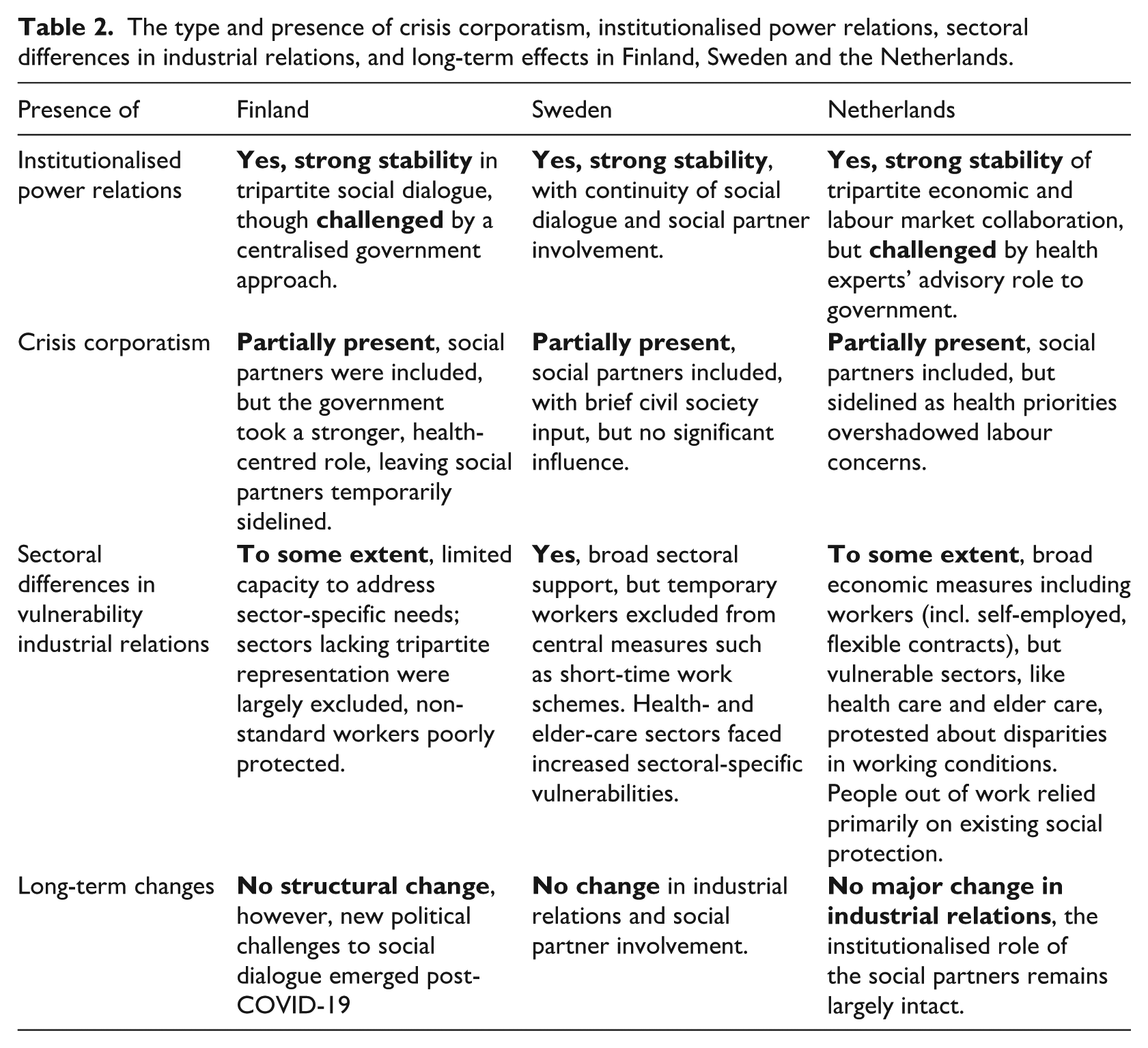
At the onset of the COVID-19 crisis, Finland, Sweden and the Netherlands maintained institutional stability in social dialogue, reflecting continuity in collaborative structures and shared values among most unions, employers’ organisations and the government. As the crisis evolved, however, this path-dependent stability was challenged in Finland and the Netherlands, but to a lesser extent in Sweden. In Finland, the government took a more centralised role, partially circumscribing the social partners’ influence, yet retaining mutual support for policies. In the Netherlands, the crisis shifted from an economic and labour market crisis (within the traditional realms of the social partners) to increasingly a health-care crisis, in which medical experts began to influence decision-making more than the social partners. Notably, the pandemic measures in the Netherlands (especially lockdowns) were more stringent and lasted much longer than in the Nordic countries, driving a different institutional focus of the social dialogue, as well as the actors involved, and eventually leading to more conflict in tripartite decision-making. Hence, looking at the crisis as a whole, Sweden demonstrated the greatest continuity in institutional power relations, followed by Finland and then the Netherlands.
Crisis corporatism arises when (new) actors gain influence in policy-making. In the Finnish case, although no new emergency coalitions were formed, the influence of tripartite governance was put to the test. Rather than signalling an ‘alliance of the weak’, the command-and-control approach applied by the government points in the opposite direction of alliance creation. In Sweden, civil society organisations took part in some social dialogue constellations, but remained uninfluential, thus partly fulfilling the first condition of crisis corporatism but not the second. The Netherlands also exhibits some aspects of crisis corporatism, as new actors took part in decision-making, and even to some extent replaced the actors traditionally involved. The Dutch social partners remained involved in economic and labour market issues, although the higher urgency of the pandemic restrictions in 2021 led the Dutch government to focus less on those issues in the later part of the crisis. The Finnish and Dutch governments became more unilateral and selectively sidelined the social partners with regard to health care, but not economic and labour market measures. This indicates that the social partners institutionalised power to different degrees in different domains (see also Hassel, 2014). The same aspect also hints at why these power struggles did not come up as an issue among the Swedish interviewees. When the pandemic hit, the experts of the Swedish Public Health Agency were immediately given a central role in health and protective decision-making (even to the extent that the commission evaluating the Swedish response criticised the government for ‘hiding’ behind the agency; see SOU, 2021: 89). This implies that the social partners had to share the consultative role from the start, thus limiting themselves to their traditional domains of labour market and social policy. However, more detailed knowledge of sector-specific motives is needed to explain why this did not cause more frustration among the Swedish social partners.
Sectoral differences in industrial relations and sector-specific vulnerabilities were visible in all countries. Non-traditional workers and workers on temporary contracts stood out as vulnerable in the Nordic countries. In the Netherlands, people on flexible contracts were also included, but people outside or at the margins of the labour market were not. Additionally, as expected during a pandemic, the health-care sector stood out as particularly vulnerable. One important issue is whether the conflicts in vulnerable sectors led to institutional change. In the Swedish case, Bengtsson et al. (2024) find that conflicts paved the way for social policy changes within the social insurance system. Our findings suggest that social dialogue remained largely intact. Comparing these findings, it is reasonable to believe that the stable institutionalised structures in Sweden provided opportunities for social policy change. The fact that many of the policy changes to the unemployment system that were later made permanent were implemented in the early phase of the pandemic, in which we saw most of the value-sharing in tripartite negotiations, strengthens this claim.
Thus, while the crisis increased the vulnerability of the health-care sector, which already existed before the pandemic, the conflicts that arose remained within the domain of traditional industrial relations. No powerful emergency coalitions formed outside existing industrial relations, although the government became more unilateral in Finland and the Netherlands.
In the two Nordic cases, the policies implemented as a consequence of social partner involvement were in line with the notion of universal targeting and what labour unions and employers’ organisations typically focus on. This partly explains why non-traditional workers and workers on temporary contracts were not targeted directly and no signs of long-term change in industrial relations were found. In the Netherlands, new health-care actors were influential in policy-making amidst the crisis. However, this did not result in lasting changes in policy paradigms or industrial relations. The 2023 industrial agreement suggests that the social partners remain relevant.
Conclusion
This article examines Finland, Sweden and the Netherlands within the framework of institutionalised power relations. It looks at the extent to which the COVID-19 crisis altered institutional stability and caused changes in social partner representation in social dialogue, as well as their influence on decision-making structures.
The evidence suggests that the three countries demonstrated strong institutional stability and path dependence in industrial relations in the face of the crisis. While institutionalised power relations in Sweden remained intact throughout the crisis, with few signs of crisis corporatism, in Finland and the Netherlands institutional stability came under greater challenge. In the Finnish case, the government strengthened its role in relation to the social partners. While this challenged power relations, it did not alter the traditional tripartite constellation at that time. In the Dutch case, health-care experts challenged the social partners’ position as government advisors. As this was temporary, however, and mainly in relation to public health policies during the pandemic, no long-term changes in industrial relations were apparent after the pandemic ended. In other words, the stability of social partner representation in social dialogue and their influence on decision-making helped them through the pandemic crisis. As confirmed by several respondents across all three countries, it was the strong social partnerships and collaborative structures of social dialogue that facilitated government social policy responses in the face of the COVID-19 crisis, in particular regarding economic and labour market measures. One policy implication for governments is thus the need to invest in and facilitate the role of unions and employers’ organisations in governance before the next crisis hits.
Footnotes
Funding
This research was financially supported by the European Commission [Grant No. VS/2021/0196].
1
Statement 2022/50.
2
Approval number 2022-07123-01.