




Abstract
This article examines limitations on the social rights of mobile EU workers in EU law through the national definitions of ‘worker’ and ‘socially insured’ person. It analyses EU laws and judgments of the CJEU and provides a comparative analysis of the core elements of the concept of ‘worker’ and ‘insured person’ in national laws and potential advantages for mobile EU workers of their broad interpretation. We argue that the present narrowly interpreted terms overwhelmingly put mobile EU workers at a disadvantage, which might lead to indirect discrimination and non-compliance with the principle of proportionality, which are prohibited in EU law with regard to free movement. Mobile EU workers are hindered in becoming ‘workers’ and ‘insured persons’, but targeted collection and processing of statistical data could help them to assert their rights and to enjoy social entitlements, and to avoid being pressurised to accept poor wages and working conditions.
Introduction
Mobile EU workers, a group that does not encompass third-country national workers, are more likely than non-mobile Member State nationals to be in non-standard employment (such as casual, on-call or bogus self-employment). Furthermore, they are likely not to qualify as ‘workers’ or ‘insured persons’ because of the restrictive definitions of these categories in some Member States. As a consequence, these mobile EU workers lack access to employment-based social security. The two definitions and the extent of social coverage are regulated and implemented in national laws. Resolving both the terminology gap and the access gap would fall within the discretion of Member States, but it is precisely the latters’ laws that make it attractive for employers to apply unfavourable conditions to mobile EU workers.
Our article examines how this terminology gap and access gap might be rectified via EU law. We propose for consideration two lines of argument: first, an expansive autonomous EU notion of worker and insured person that sets limits to national legislation based on the principle of effectiveness of EU law; and second, addressing as indirect discrimination the over-representation of mobile EU workers in non-standard employment in certain sectors and their consequent lack of categorisation as workers or insured persons and lack of access to social security.
We argue that an autonomous EU notion of worker and insured person, as well as the establishment of a notion of indirect discrimination would put the issue within the scope of EU law and would bring in not only the application of mandatory EU rules on equal treatment and proportionality, but the option for actio popularis litigation. A model path for asserting the social rights of mobile EU workers might increase worker bargaining power and enhance the job security and social advancement of mobile EU workers.
Section 2 sets out how mobile EU workers are more likely to be in non-standard employment and what factors prevent them from ultimately enjoying social entitlements. Section 3 provides an overview of the core elements of the concept of ‘worker’ and ‘insured person’ in EU law and the limits of this interpretation. Section 4 provides ideas on how the terminology gap and the access gap can be challenged at EU level, including the related legal terrain of actio popularis.
Non-standard employment and limited access to social rights
Structure of legal relationships with regard to work
Labour law has traditionally been based on a binary system, consisting of the two categories of a personally dependent employment relationship and independent self-employment. The standard employment relationship (SER) is the dominant concept of this system because it is not only the personal delimitation of all employment protection, but also delineates the personal scope of related protections, such as social rights (Adams and Deakin, 2014). The standard employment relationship is characterised by the full-time, open-ended, dependent employment of an employee with one employer. Because this is the model of employment regulation, any other legal forms of work, even if performed in an employment relationship, are usually considered to be non-standard. Recent decades have brought about a proliferation of atypical forms of employment, which varies on any of the terms of the standard employment relationship (for example, fixed-term, part-time). Therefore, atypical forms of employment are predominantly covered by the general provisions of labour law on the standard employment relationship, but with certain rules dedicated to each atypical form.
Self-employment is not a legally defined, uniform labour law category, but it is quite popular, representing 14 per cent of the EU workforce (European Commission, 2018a: 3). We identify three self-employed groups for the purposes of this research. At the two opposite ends, we may find the fully independent entrepreneurs (genuine self-employed) and the bogus self-employed, who seek to disguise their subordinate employment relationship. However, there is also a third category of economically dependent self-employed workers.
In between the categories of standard employment and self-employment, there is a growing mass of legal relations concerning work 1 that are usually labelled ‘non-standard work’, as they differ from the standard employment relationship as the frame of reference. However, non-standard work is a legally undefined umbrella notion, and thus its meaning varies in the literature (Chattopadhyay and George, 2016; Pfeffer and Baron, 1988). According to the widely accepted ILO definition, non-standard work includes four clusters: temporary employment (fixed-term, seasonal, casual work); part-time and on-call work (marginal part-time, zero-hours contracts); multi-party employment (temporary agency work, subcontracting); and self-employment (disguised employment, dependent self-employment) (ILO, 2016: xxi–xxii, 7–8). Some of these forms are atypical employment relationships, but a significant and growing number of them are performed in specific contractual arrangements outside of employment, and various forms of self-employment. Consequently, this is a very heterogeneous group of work statuses, with limited and manifold labour law protection.
In recent decades, various old forms (fixed-term, temporary, part-time) and also new forms (temporary agency work, job-sharing, employee-sharing) of employment relationships have been regulated in EU and/or national law. These atypical employees are fully covered by employment protection, although with specific provisions. Besides employment, a variety of new contractual forms have spread in Member States as transitions between and combinations of dependent employment and self-employment (European Commission, 2018a: 3). This colourful cluster of work relations includes: casual, intermittent and seasonal work; apprentices and trainees; voucher-based work; domestic work; or on-demand work, and all of their national variations. These non-standard workers are mostly not employees, but covered by specific, often limited employment protections. Therefore, their employment status varies.
Limited social rights of non-standard workers
The existence of significant social coverage gaps within the Member States is a well-established fact, irrespective of the presence of mobile EU workers. ‘Mobile EU worker’ in this article is interpreted broadly, not only as an ‘active EU citizen who resides in a Member State or EFTA country other than their country of citizenship’, but also as ‘cross-border workers who live in one EU or EFTA country and work in another’ (European Commission, 2023: 6, 8). Both Principle 12 of the European Pillar of Social Rights (EPSR) and the Council Recommendation on access to social protection for workers and the self-employed (2019 Recommendation 2 ) focus on broadening the available framework of social entitlements.
Surprisingly, the 2019 Recommendation itself starts from the premise that even certain categories of workers (such as marginal part-time workers, seasonal workers, on-demand workers, agency workers, and trainees) and also self-employed persons are excluded from social security schemes in some Member States and advocates for adequate social protection for all workers and self-employed persons. 3 Pursuant to the Recommendation, (i) applying the same rules to everyone would result in poorer outcomes for vulnerable groups, so equal treatment may not be sufficient; (ii) transitioning between different labour market statuses might diminish preservation and accumulation of social rights; and (iii) ancillary activities accompanied by a regular employment relationship should be treated separately. 4
Lack of social protection can result from both an inability to become insured at all, and also from the inability, though insurance, to meet the concrete requirements of eligibility (income and time thresholds, qualifying periods, waiting periods, minimum working periods, duration of benefits). Even eligibility is not a guarantee of fair benefits: there is a challenge here, as benefit levels include coverage gaps for many people. Additionally, to find solutions is important for Member States too because ‘many issues in the changing world of work are placing greater pressure on the financial sustainability of social protection systems’ (Hajdú, 2018: 192). The standard employment relationship will be considered as the basis of full social rights and of full protection against social exclusion. 5 Employees on temporary contracts are twice as likely to suffer from material and social deprivation as employees on a permanent contract, and three times as likely to be at risk of poverty. Part-time workers also have higher rates of social deprivation – the poverty rate is twice as high for them as for those working full-time (European Commission, 2020: 9).
Empirical studies on mobile EU workers
‘EU mobility is more segmented than originally envisioned by the creators of the EU internal market’, and the term ‘hierarchised mobility’ has been proposed by Arnholtz and Leschke to stress that mobility opportunities are unequally distributed across the EU and within Member States (Arnholtz and Leschke, 2023: 4076–4077). Access and coverage gaps are geographically widespread in the EU, as ‘they have been identified in fifteen Member States for unemployment benefits, twelve Member States for sickness benefits, twelve for maternity benefits, seven for accident at work and occupational injuries and thirteen Member States for old-age and survivors’ benefits’ in the case of non-standard workers (European Commission, 2018b: 9). Regarding unemployment benefits ‘in thirteen Member States, the self-employed have no formal access, in six of them they can join voluntarily and in only seven are they mandatorily included’ (Spasova et al., 2021: 8, 16). 6 In turn, ‘more than one third of the self-employed (37.5 per cent) are not eligible for sickness benefits, with considerable variation between countries’ (Spasova et al., 2021: 14). In the case of non-standard employees, responsibility for pensions, health care and associated risks are usually pushed back on them by law and by employers (Degryse, 2016: 34).
Mobile EU citizens are more likely than Member State nationals to be in non-standard employment, especially in low-skill, low-pay, routine, manual jobs (Felbo-Kolding et al., 2018). This is also supported by the data available on the manufacturing and construction sectors. Manufacturing is the largest sector of employment for EU movers (17 per cent). Other significant employment sectors are wholesale and retail trade (12 per cent) and construction (10 per cent) (European Commission, 2023: 82). Additionally, manufacturing and construction make up around 45 per cent of all cross-border workers (European Commission, 2023: 99). Altogether, proportions (percentage of all EU/EEA national cross-border workers) among these sectors look as follows (see Table 1).
Share of workers by economic sector in the EU and EFTA (%), 2021.
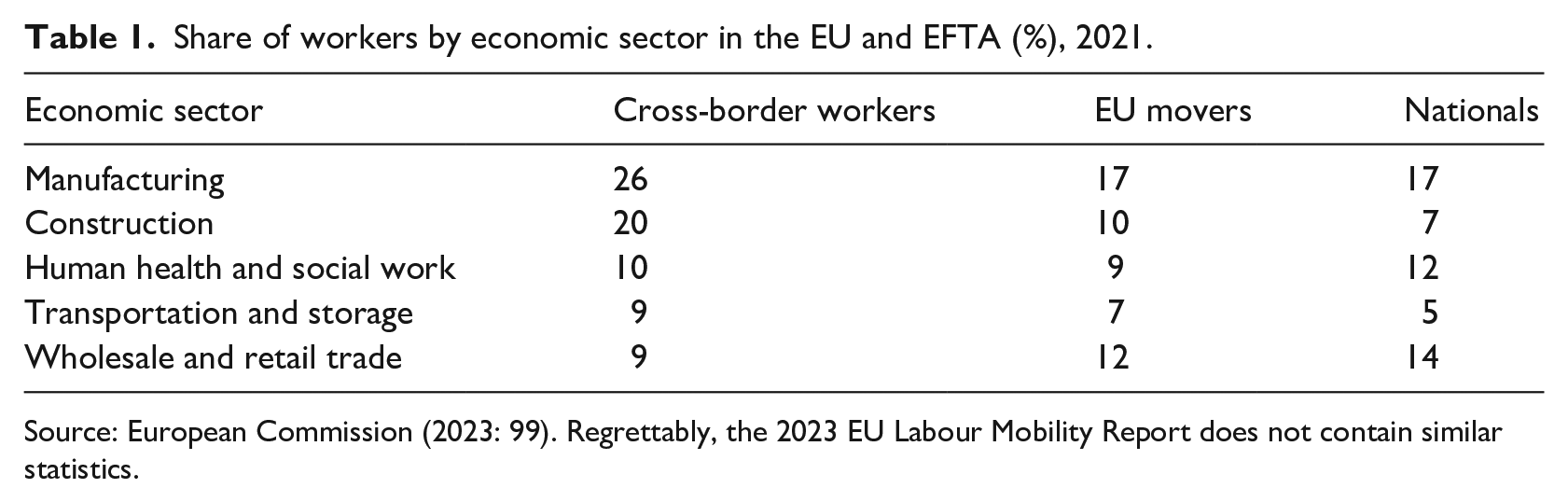
Source: European Commission (2023: 99). Regrettably, the 2023 EU Labour Mobility Report does not contain similar statistics.
The table shows that within the group of EU mobile workers (cross-border and EU movers taken together) the proportion of people working in manufacturing, construction, wholesale and retail is significantly higher than among nationals. A micro-data analysis examined workers in seasonal-sensitive sectors (specifically agriculture, construction, accommodation and food services) and came to the conclusion that ‘the latter sectors are susceptible to include a significant proportion of foreign-born workers’ (Zwysen and Akgüc, 2023: 11).
A recent study shows that the social protection of mobile construction workers is characterised by discontinuity in social contributions and negative interference in access to social benefits (Lillie et al., 2023: 3). 7 In simple terms, they are in an unstable and unfavourable situation in terms of social rights. Bogus self-employment is growing – according to a Finnish case, artificial ‘light entrepreneurship’ has become more common, which ‘seems not to be a legitimate practice, but rather a way to shift social security payments onto employees’ (Lillie et al., 2023: 6). De Wispelaere et al. give a succinct overview of the situation of posted workers in Belgium on the basis of data from 2021. Posted workers employed in the Belgian construction sector were mainly Dutch, Portuguese, Ukrainian, Polish and Romanian nationals, totalling 93,000 people, and almost three out of ten posted persons providing services in the construction sector have self-employed status (De Wispelaere et al., 2022: 31, 33–34).
The deterioration of health is a permanent threat for mobile EU workers. It is common that they want to maximise their income in the short term by agreeing to worse working and occupational health and safety conditions, and they tend to overlook minor injuries, such as back pain, headaches, dehydration, skinned fingers, scratches and rashes (Fiałkowska and Matuszczyk, 2021: 139). If more serious work accidents, such as falls, cuts and injuries from machinery go unreported in the host country, medical treatment and/or invalidity benefits fall back upon the country of origin or are completely lacking (Lillie et al., 2022: 3–4). Health-related vulnerabilities and exposure of temporary workers are especially high in agriculture and construction. They are labour-intensive and involve hard work with a higher rate of workplace accidents (Krilić and Jevšnik, 2023: 153). 8 Agriculture is also affected by outsourcing and long supply chains, because lower-level subcontractors are more likely to violate health and safety rules at the workplace (Shepherd et al., 2021: 142).
In addition, ‘reservation wages’ tend to be lower because mobile EU workers are more likely to be in non-standard employment and have limited access to social security. Non-standard workers, due to their high level of dependency on the employer, will be forced to accept poorer working conditions and lower wages. In general, this translates into downward pressure on wages in the Member State concerned. As other contributions in this special issue argue (Lillie et al., 2025, in this issue), this phenomenon can be also explained through the hierarchies of citizenship: mobile workers are in the most disadvantaged position in this regard.
Profit-driven employers engage in disruptive practices, but as Jorens states ‘It is [. . .] not so much the employer who tries to evade certain obligations by means of all kinds of constructions such as letterbox companies or bogus self-employed workers, but the legislator who makes it attractive for basically every employer established in a Member State to make use of posting provisions’ (Jorens, 2022: 383). The exploitation of legal loopholes is embedded in the dynamics of posting. Posted workers remain subject to the social security laws of the sending Member State, thus allowing both the employer and the receiving undertaking in the host country to derive financial advantages while the social protection of workers is often regarded as a secondary consideration or, in some cases, not considered at all. By analogy, for mobile EU workers, employers go as far as the law permits them in employing these workers under unfavourable conditions as regards social security. The next section examines how to make the unfavourable treatment of mobile EU workers less or not at all attractive for employers.
The notion of ‘worker’ and ‘insured person’ under EU law
The EU notion of worker in labour and social security law
The EU notion of worker: lessons from labour law
The EU’s notion of ‘worker’ was first elaborated by the Court of Justice of the European Union (CJEU) to guarantee the effective enforcement of free movement of workers. The notion is a useful judicial means in EU law of preventing national legislations from hampering the enforcement of EU laws through restrictions on personal scope. As it proved beneficial for free movement, it was later used again by the CJEU in the case of equality and labour law. On a case-by-case basis and over time, the CJEU extended the EU notion of worker to directives on equal treatment 9 and working conditions, and also widened the meaning of worker far beyond that of standard employees. 10
The various labour law directives contain different references to the role of national definitions. Some refer the definition of worker to national employment law, 11 but other directives do not refer to national law when defining the personal scope of EU law (Menegatti, 2020: 33). The notion of worker has not been declared generally applicable in labour law, but the CJEU has tended to unify this concept also in relation to directives that refer explicitly to national definitions (Risak and Dullinger, 2018: 41).
Importantly, the Court puts aside even direct reference to national definitions if they undermine ‘the effectiveness of that directive by inordinately and unjustifiably restricting the scope of that directive’. 12 When defining the concept of ‘worker’, the different aims of the various EU laws must be taken into account (Risak and Dullinger, 2018: 46). The reference made to the national concept of worker cannot ‘be interpreted as a waiver on the part of the EU legislature of its power itself to determine the scope of that concept’. 13 This contra legem interpretation gradually created a uniform concept of worker in EU employment law, which constitutes a complete turn away from the Danmols orthodoxy, 14 under which national definitions of worker prevailed because of the concept of partial harmonisation. The Court nowadays argues instead that it is for EU law to define personal scope based on the principle of effectiveness.
As for the content of the definition of worker, it is still based on the Lawrie-Blum formula: a worker is a person who, for a certain period of time, performs services for and under the direction of another person, in return for which he receives remuneration. 15 The economic nature of the activity and remuneration was important with regard to free movement in order to extend personal scope; however, the interpretation of ‘direction’ (subordination) became crucial in labour law in order to distinguish employees from the self-employed (Menegatti, 2020: 30). The CJEU has discussed economic aspects mainly in the context of personal subordination, but it has not used such economic factors to extend the scope of application to persons working on the basis of some form of economic dependency (Risak and Dullinger, 2018: 44). However, the CJEU has adopted a gradually widening, generous notion of subordination (Countouris, 2018: 8), stretching out as far as cooperation, 16 which helps to broaden the personal scope delineated by the concept of worker.
Consequently, the EU notion of worker is much broader than the national concept of employee, since the CJEU watered down the requirement of direction (see Danosa and Balkaya) and paid very little attention to the mutuality of obligation test. Thus, the EU notion includes all workers engaged in effective and genuine activities (as opposed to marginal and ancillary); who are economically, functionally and/or operationally dependent on a client; and receive some kind of remuneration in exchange for such activities (for example, casual, seasonal work, training). It certainly excludes genuinely self-employed workers (Menegatti, 2020: 38–39). At the same time, this case to case development of the concept comes with inherent uncertainties concerning the exact coverage of ‘worker’ arising at the boundary between subordination and independence (Countouris, 2018: 13). The CJEU recalled that there can be only two kinds of restriction: a person poses, by reason of his own personal conduct, a genuine and serious threat to public policy, public security or public health; or a person has left the territory of the respective state for a significant length of time without a legitimate reason. 17
Last but not least, reference should be made to the legal conclusion of the Payir decision. 18 In Payir the CJEU had to decide whether the fact that a Turkish national had been granted permission to enter the territory of a Member State as an au pair or as a student deprived that national of the status of ‘worker’. The CJEU took a broad approach and qualified au pairs and students as workers, on the basis of its general, EU-national related case-law: they ‘offered services which constitute genuine and effective economic activities, [. . .] they all worked under the direction of an employer and received remuneration in return for their services. [. . .] those activities display the characteristics necessary to enable, in principle, those who perform them to be regarded as “workers”.’ 19 The CJEU disregarded their national designation and classified them under the EU notion of worker. This shows that the CJEU can override national definitions based on EU legal principles.
The EU notion of ‘worker’ in social security coordination law
The EU regulation on social security coordination 20 uses the term ‘activity as an employed person’ (instead of worker), which ‘means any activity or equivalent situation treated as such for the purposes of the social security legislation of the Member State’. Additionally, legislation ‘means in respect of each Member State, laws, regulations and other statutory provisions and all other implementing measures relating to the social security branches covered by Article 3(1)’. 21 The two points, read together, imply that national social security laws can introduce their own definitions (listings) for persons pursuing ‘activity as an employed or self-employed’ person, for the sole purpose of determining which persons are entitled to what benefits under the different social security branches.
This conclusion has two consequences. First, definitions can be broader but also narrower than the national definition of ‘employee’, and might or might not embrace non-standard workers. Secondly, these definitions at present are not automatically interconnected with the EU notion of worker. The CJEU has dealt with this issue and declared that ‘there is no single definition of worker/employed or self‑employed person in Community law; it varies according to the area in which the definition is to be applied’. Moreover ‘thus the concept of worker used in the context of Article 39 EC and Regulation No 1612/68 does not necessarily coincide with the definition applied in relation to Article 42 EC and Regulation No 1408/71’. 22 The CJEU, on the other hand, does not exclude the applicability of the EU notion of worker in the field of social security either. 23
The concept of ‘insured person’ in EU social security coordination law
The concept of ‘insured person’ in EU law is best summarised by the CJEU and enhanced by Preamble 7 of Regulation 887/2004: ‘In the absence of Community harmonisation in this field, the conditions governing the right or obligation to become a member of a social security scheme are a matter to be determined by the legislation of each Member State [. . .], as are the conditions for entitlement to benefits.’ 24
However, Fuchs stated in the context of the joined cases Franzen and Others 25 that dealt with German ‘minor employment’ (status as a geringfügig Beschäftigte), which does not give rise to health and pension insurance coverage (other than for accidents), that: ‘If an employment relationship is without protection of these fundamental social security branches, the lex loci laboris principle lacks its raison d’être’ (Fuchs, 2016: 297). The lex loci laboris principle means that, as a rule, the national laws of the place of work are exclusively applicable to social security and the Member State is solely responsible for regulating social entitlements. We fully agree with Fuchs that if the competent Member State does not provide adequate coverage, the raison d’être of social security coordination fails. The option the CJEU is offering in the Bosmann and the Hudzinski/Wawrzyniak judgments regarding family benefits, 26 namely that the non-competent Member State might grant benefits based on its national laws, is only a voluntary possibility for Member States.
Solutions to tackle the terminology gap and the access gap via EU law
Various solutions have been proposed to ensure social security coverage and benefits for non-standard workers (Hajdú, 2018: 195–200). These concentrate on offering Member States voluntary choices, such as the one mentioned above regarding family benefits, but also including lowering thresholds on the minimum duration of employment and working hours, but also on the preservation, accumulation and/or transferability of entitlements between concurrent and consecutive jobs. 27 There are no mandatory mechanisms that protect mobile EU workers from unfavourable terminology and the related lack of social protection. We advocate for an expansive, autonomous (independent of national laws), uniform EU notion of worker and insured person that sets limits on national legislation, based on the principle of the effectiveness of EU law.
Autonomous EU notions of ‘worker’ and ‘insured person’?
Application of the EU notion of ‘worker’ in social security coordination
As presented above, the Court puts aside even direct reference to the national definition of employment relationship if it undermines the effectiveness of EU law by restricting the scope of the Directive. 28 The CJEU has stated that effectiveness is damaged by the lack of commonly used definitions in labour law, but we think that this may also happen with regard to EU social security coordination. In concreto, mobile EU workers in another Member State, despite pursuing a genuine and effective activity in accordance with CJEU case-law, might realise that under the social security law of that other Member State they are not pursuing an ‘activity as an employed person’, and that therefore national social security law does not cover them. In addition, this hiatus has a Union-wide element: they do not fall under the scope of Regulation 883/2004 on the coordination of social security systems either and cannot rely on the rules on aggregation and export when exercising their free movement rights.
This hiatus is usually explained by the limited EU competence in the area of social security, 29 and that labour law directives strive for harmonisation while social security coordination is restricted to coordination. Moreover, mobile workers might suffer disadvantages resulting from the differences between national social security systems. 30 It is settled case-law that social security coordination does not provide for harmonisation and that mobility may, depending on the case, be more or less advantageous or disadvantageous for the person concerned. 31
The legal basis of Regulation 883/2004 is part of the free movement regime, 32 however, as one of the four freedoms of the single market, and free movement also constitutes an EU citizenship right (Guild, 2004). 33 These concepts are the foundations of EU law and, referring also to the Tjebbes case, 34 induce the application of the general principles of EU law by the CJEU. 35 Also, the objective of the Regulation is straightforward: ‘The rules for coordination of national social security systems fall within the framework of free movement of persons and should contribute towards improving their standard of living and conditions of employment.’ 36
That is why, similarly to what was mentioned above in terms of labour law, the momentum might come when the effectiveness of implementing social security coordination may be at stake, whose effectiveness might be seriously jeopardised by restrictive national definitions of ‘worker’ that disproportionately disregard the objectives of free movement of workers. A similar approach was taken in the Payir case, where the CJEU overrode the national definition. Any possible disruptive effects of restrictive national definitions of ‘worker’ would be measured against the intended improvement of the employment and living conditions of mobile workers, irrespective of the coordinative nature of the Regulations.
Introducing an EU notion of ‘insured person’ for the purposes of social security coordination
It is common ground that Regulation 883/2004 designates the applicable national law, and that national law determines who is the beneficiary of the social security system (namely, who is an ‘insured person’). This means that the applicable national law and that alone determines benefits and beneficiaries. Originally no ‘Community (EU) meaning’ was meant to be attributed to benefits or beneficiaries (‘insured persons’).
It should be borne in mind that the CJEU has already added ‘Community (EU) meaning’ to certain benefit-related definitions in the Regulation. Despite the reference to national definitions, ‘cash benefits’ and ‘benefits in kind’ within the meaning of sickness benefits in Regulation 1408/71 ‘must also be given an autonomous interpretation in Community law’. 37 The CJEU made it clear, in connection with a German benefit, that ‘care insurance benefits consisting in the direct payment or reimbursement of the costs of a specialised home entailed by the insured person’s reliance on care fall within the definition of benefits in kind within the meaning of Title III of Regulation No 1408/71’. 38 The CJEU, by changing the classification of the benefit, made the German insurer pay for institutional care benefits obtained abroad.
The CJEU interpreted the terms ‘in kind’ and ‘cash’ sickness benefits also in the Vaassen and Göbbels case, 39 and stated that this interpretation was necessary because the Regulation does not define either term. Additionally, the status of special non-contributory benefits in accordance with Article 70 of the Regulation 883/2004 and its relationship with minimum subsistence (social assistance) benefits is still a disputed issue (Gijsbert, 2020: 1–10), requiring interpretation and qualification from the CJEU from time to time.
Consequently, national sovereignty to qualify benefits under EU law is not entirely intact. Also, challenges such as COVID-19 have already generated special legal solutions in the field of social security coordination (Verschueren, 2022: 79–94). Nowadays, labour markets are becoming increasingly globalised, and cross-border work and mobility between Member States is putting growing pressure on the functioning and flexibility of welfare systems, also regarding access to and portability of social benefits. Henceforth, the justification for giving the term ‘insured person’ Community (EU) meaning (or a set of minimum requirements) can be a way of leveraging the potential of social security coordination.
Indirect discrimination as a tool for challenging national practices
The core principle regarding the social rights of mobile workers is equal treatment (Gellérné Lukács, 2018). Equal treatment is enshrined in Articles 18, 45 and 48 of the TFEU, in Article 7(2) of Regulation 492/2011, 40 and in Articles 4 and 5 of Regulation 883/2004. 41 Pursuant to these rules discrimination against mobile workers is not permitted in the host Member State as regards the different branches of social security. However, equal treatment, when interpreted as ‘the same treatment as accorded to nationals’, does not in itself guarantee the protection of social rights. Rather, it acknowledges Member States’ freedom to differentiate between employment status and related benefits and apply them without finetuning them with regard to mobile EU workers.
The real issue is whether indirect discrimination can be established if a national of a Member State cannot become insured in another Member State, but this second host Member State’s own nationals are not insured in the same situation either. At first glance there is no discrimination. In the Tarola judgment, which concerned the awarding of unemployment benefits in case of short-time working, the CJEU endorsed this approach: ‘where national law excludes persons who have worked in an employed or self-employed capacity only for a short period of time from the entitlement to social benefits, that exclusion applies in the same way to workers from other Member States who have exercised their right of free movement.’ 42 The situation of a Romanian national Tarola was compared with the status of an Irish national who had also worked two weeks. The CJEU looked at the consequences of working for only two weeks, but did not take into account the wider context, namely why Tarola had to become a self-employed person and not a worker, how many mobile EU workers were employed and in what statuses in that economic sector.
We argue that indirect discrimination in itself cannot be ruled out if a demonstrably higher proportion of mobile EU workers are employed in a given economic sector without worker status and social benefits. However, it shall be proven that formal equal treatment affects mobile EU workers adversely because a larger proportion of mobile EU workers are affected. Only detailed and specified data could back up this line of argumentation, which can be transposed to the individual situation of a person in a concrete case.
The statistics available in the EU do not focus on this question. The Impact Assessment published by European Commission prior to the adoption of the 2019 Recommendation presents the increasing prevalence of non-traditional forms of work and related social security gaps. It also shows that the self-reported coverage rate differs significantly from what the statistics show. 43 Overall, monitoring is not simple because there are statistical gaps and shortcomings in existing databases (European Commission, 2018b: 71).
The 2022 annual Intra-EU labour mobility publication shows that non-standard work is more widespread among EU mobile workers: ‘EU movers have consistently higher employment on fixed-term (i.e., temporary) contracts than nationals: in 2021, this applied to 16% of movers and 12% of nationals. The magnitude of the difference has remained substantially the same in 2016–2021’ (European Commission, 2023: 14). In turn, ‘the pattern for part-time employees is similar to that of employees on temporary contracts: [. . .] the proportion is consistently higher for EU movers and third-country nationals, although the difference has decreased over time’ (European Commission, 2023: 72). However, these data do not contain the proportion of nationals and mobile EU workers in a given sector, how this proportion is related to the overall employment rate of nationals, and what the form of work is (full-time, part-time, temporary work or self-employment).
The EU LFS (Labour Force Survey) database is based on questions that focus on employment characteristics (duration, pay and so on). 44 However, on the one hand, the subjects of the data collected are people who have worked for at least 12 months, so that the representativeness of, for example, seasonal workers is negligible (European Commission, 2023: 94). This poses a serious challenge indeed because seasonal workers form a large part of movers and ‘initial results indicate that short-term mobile workers face high risks of working on temporary – and especially very short-term – contracts and in low-skill occupations’ (Zwysen and Akgüc, 2023). On the other hand, social security status is not collected, so there is no link between employment and social security coverage. Similarly, Eurostat’s European Statistics on Income and Living Conditions database lacks a link between nationality and employment status and social benefits. 45
Although the relevant data can be found in the various EU data collections, neither the currently available statistical publications nor the studies carried out in the various sub-areas of the topic provide a proper basis for asserting indirect discrimination. Because the sedentary bias of local and EU legislation is assumed in safeguarding social rights of the citizens or inhabitants of the Member States (see Mantu et al., 2025, in this issue) we advocate for a new approach in processing the available data resources aimed at making a link between employment and the social security status of mobile EU workers.
We argue that autonomous EU notions of ‘worker’ and ‘insured person’, as well as the recognition of indirect discrimination, would put the issue under the protection of EU free movement law. If these rights are breached, it would open up the possibility for legal claims and would also bring in an option for actio popularis litigation pursuant to Article 3(2) of Directive 2014/56/EU. 46 Associations, social partners (trade unions) or other legal entities that have a legitimate interest could engage, either on behalf of or in support of EU workers for the enforcement of their free movement rights.
Conclusions
The article maps the current landscape of law, practice and available data in the realm of the social security rights of mobile EU workers. National competence in defining the personal scope of social security coordination may lead to serious gaps in social security coverage when work is performed in a legal form other than the standard employment relationship. This may have negative consequences in particular for mobile workers who are concentrated in certain sectors (manufacturing, construction, hotels and catering), which are either seasonal or are characterised by the prevalence of non-standard forms of employment. Therefore, we argue that a merely formalistic application of the rules on an equal basis is not a suitable solution as things stand and that these questions require further research.
We identified alternative solutions to reduce existing coverage gaps regarding mobile workers. First, limited personal scope may be called into question by the elaboration of autonomous EU notions of ‘worker’ and ‘insured person’ in social security law, which would set limits on national legislation in order to guarantee the effectiveness of EU social security provisions. This development in EU law and case-law is urged by the proliferation of non-standard work and various forms of dependent self-employment with limited social security rights.
Second, the EU law concept of indirect discrimination may be invoked to restrict absolute national sovereignty. This should be supported by gathering detailed data (at present scarcely available) coupling labour law and the social security status of mobile workers. In particular, the EU LFS database should include social security coverage and entitlement to health and accident benefits. These developments could, taken together, bring the EU closer to the effective protection of mobile EU workers’ social rights through the existing legal framework of social security coordination. If mobile EU workers were to enjoy protection under the EU free movement regime, it would expand legal enforcement, as trade unions and associations would be able to use actio popularis to defend their rights.
Footnotes
Acknowledgements
The authors are grateful to Stefan Domonkos for his valuable comments. The usual disclaimer applies.
Funding
This research received no specific grant from any funding agency in the public, commercial, or not-for-profit sectors.
1
In 2016, 8 per cent of employed persons in the EU were full-time temporary employees, 4 per cent were part-time temporary employees, and 13 per cent were part-time permanent employees (European Commission, 2018a: 3).
2
OJ C 387, 15.11.2019, pp. 1–8 (2019/C 387/01). Available at: https://ec.europa.eu/social/main.jsp?catId=1312&langId=en
3
Preamble (18) and Objective and scope, point 1, subpoint 1.1.
4
Preamble (19)-(21).
5
SER is the most important pillar (60 per cent of the labour market), but only one of the constituents of the EU worker category (European Commission, 2018a: 3).
6
‘Formal access refers to whether a worker is formally included (mostly by law) in a social protection scheme. Effective access relates to whether a worker who has formal access can build up entitlements and meet the eligibility conditions to access the scheme’ (Spasova et al., 2021: 8).
7
A report on seasonal workers also confirmed that they are active mainly in agriculture, hotels and catering, and food services (Siöland et al., 2023: 19).
8
Vulnerability is understood ‘not as an individual characteristic of particular individuals but as a concept that can shed light on how specific policies and institutional processes generate and shape individual health experiences and larger patterns of disease’ (Krilić and Vah Jevšnik, 2023: 153).
9
Case C-256/01, Debra Allonby v Accrington & Rossendale College, ECLI:EU:C:2004:18, paragraph 66.
10
Case C-229/14, Ender Balkaya v Kiesel Abbruch- und RecyclingTechnik GmbH, ECLI:EU:C:2015:455.
11
For instance, Directive 2008/104 on temporary agency work, Article 3(1) (a).
12
Case C-216/15, Ruhrlandklinik, EU:C:2016:883, paragraph 36.
13
Ruhrlandklinik, paragraph 32.
14
Case C-105/84, Foreningen af Arbejdsledere i Danmark v A/S Danmols Inventar, ECLI:EU:C:1985:331, paragraphs 26 to 27.
15
Case C-66/85, Deborah Lawrie-Blum v Land Baden-Württemberg, ECLI:EU:C:1986:284, paragraph 17.
16
Case C-232/09, Dita Danosa v LKB Līzings SIA, ECLI:EU:C:2010:674, paragraph 49.
17
Case C‑14/09, Hava Genc v Land Berlin, ECLI:EU:C:2010:57, paragraphs 42 to 43.
18
Case C-294/06, Ezgi Payir, Burhan Akyuz, Birol Ozturk v Secretary of State for the Home Department, ECLI:EU:C:2008:36.
19
Case C-294/06, Ezgi Payir, Burhan Akyuz, Birol Ozturk v Secretary of State for the Home Department, paragraph 31. The CJEU examined the applicability of Association Decision 1/80 which implemented the Ankara Agreement and does not contain a reference to national law.
20
Regulation (EC) No. 883/2004 of the European Parliament and of the Council of 29 April 2004 on the coordination of social security systems, Article 1, points (a)-(b).
21
Regulation 883/2004, Article 1, point l.
22
Case C-208/07, Petra von Chamier‑Glisczinski v Deutsche Angestellten-Krankenkasse, ECLI:EU:C:2009:455, paragraph 68.
23
In the above Case C-208/07 the CJEU stated that a jobseeker was not to be regarded as a worker in the social security context, which is rather a special case.
24
Case C-262/97, Engelbrecht ECLI:EU:C:2000:492, paragraph 36.
25
Case C-382/13, Franzen and Others ECLI:EU:C:2015:261.
26
Case C-352/06, Bosmann, ECLI:EU:C:2008:290. and joined Cases C-611/10 and C-612/10 Hudzinski and Wawrzyniak, ECLI:EU:C:2012:339.
27
2019 Recommendation, part ‘Effective coverage’, point 10.
28
Case C-216/15, Ruhrlandklinik, EU:C:2016:883, paragraph 36.
29
Joined Cases C‑611/10 and C‑612/10, Hudzinski ECLI:EU:C:2012:339, paragraph 42: ‘each Member State retains the power to determine in its legislation, in compliance with EU law, the conditions pursuant to which benefits may be granted under a social security scheme’.
30
‘The Coordination Regulations cannot affect the disparities between the various social security systems’ (Cornelissen and De Wispelaere, 2023: 147).
31
Case C-208/07, Petra von Chamier‑Glisczinski v Deutsche Angestellten-Krankenkasse, ECLI:EU:C:2009:455, paragraphs 84 to 85.
32
Article 48 TFEU.
33
Article 20 TFEU.
34
Case C-221/17, M.G. Tjebbes, G. J. M. Koopman, E. Saleh Abady, L. Duboux and the Minister van Buitenlandse Zaken, ECLI:EU:C:2019:189. In terms of the Tjebbes case withdrawal of EU citizenship shall be in accordance with the principle of proportionality, even if no competence whatsoever has been transferred to the EU in this area, based on the legal nature of Union citizenship.
35
Case C‑127/11, Aldegonda van den Booren ECLI:EU:C:2013:140, paragraph 38: ‘the interpretation of Regulation No 1408/71 thus provided must be understood without prejudice to the solution which might flow from the potential applicability of provisions of primary law’.
36
Preamble (1) of Regulation 883/2004.
37
Case C‑466/04, Acereda Herrera, ECLI:EU:C:2006:405, paragraphs 29 to 30, and Case C-160/96, Molenaar, ECLI:EU:C:1998:84, paragraphs 32 to 36.
38
Case C-208/07, Petra von Chamier‑Glisczinski v Deutsche Angestellten-Krankenkasse, ECLI:EU:C:2009:455, paragraph 48. A set of judgments relates to special non-contributory benefits.
39
Case 61/65, G. Vaassen-Göbbels ECLI:EU:C:1966:39.
40
Article 7(2): ‘He shall enjoy the same social and tax advantages as national workers.’
41
Regulation (EC) No 883/2004 of the European Parliament and of the Council of 29 April 2004 on the coordination of social security systems.
42
See C-483/17, Tarola, ECLI:EU:C:2019:309, paragraphs 56 to 57.
43
Impact Assessment (European Commission, 2018b): ‘Considering the self-reported rates of coverage by key social security branches, large gaps emerge between standard employees on the one hand and the self-employed and non-standard workers on the other (see Figure A.28 in Annex 16)’, p. 6. Furthermore, ‘Non-standard workers are usually formally covered by social security in the same way as standard workers. However, in some Member States specific categories of non-standard employees are not formally covered for some or for all branches of social security. The main groups for whom this is the case in a significant number of countries are casual and seasonal workers, as well as trainees and apprentices’, p. 76.

45
Methodological Guidelines and Description of EU-SILC Target Variables (2022 version).
46
Directive 2014/54/EU of the European Parliament and of the Council of 16 April 2014 on measures facilitating the exercise of rights conferred on workers in the context of freedom of movement for workers (text with EEA relevance), OJ L 128, 30.4.2014, pp. 8–14.