




Abstract
Employee participation at company level is one of the core institutions of what can be called the ‘European social model’, based on national regulations and regulations at EU level, such as the directives on European Works Councils (EWCs) and the Societas Europaea (SE). This process of institutionalisation coincides with fundamental changes in the current era of globalisation and transformation, which increase the importance of the company level for employee participation. We argue that this development highlights the problem of articulation within the multi-level system of employee participation. By comparing institutions of participation at national – we include the cases of France, Germany, Spain and Sweden – and at EU level we analyse whether and how these institutions create opportunities to influence company decisions by giving voice to workers’ representatives. In doing so we identify good practices and, on that basis, develop policy recommendations to strengthen the articulation of employee representation at company level.
Introduction
Employee participation is one of the core institutions of what can be called the ‘European social model’. In most EU Member States, employee participation is regulated by law or through collective bargaining and guarantees rights of participation to employees and their representatives, be they trade unions or works councils, or both. At EU level, employee participation is institutionalised as a fundamental right in the European Pillar of Social Rights and, more specifically, in the EU Directive on European Works Councils (EWCs) or the Directive on employee involvement in the Societas Europaea (SE), which are intended to secure workers’ voice in transnational contexts.
This process of institutionalisation coincides with changes outside and within companies in the current era of globalisation and transformation – including the digital transformation, the green transition, value chain reorganisation as a result of the pandemic, new geopolitical developments or due diligence in supply chains – which put pressure on companies to develop sustainable and long-term market strategies. At the same time, there is a growing need to safeguard jobs, to develop employees’ skills and qualifications, and to modernise working conditions and work organisation. These challenges highlight the importance of the company level – and in this respect the level of the company headquarters – for employee participation. It is the company level at which managerial decisions on relocation, restructuring or transformation are taken, while at the workplace level there is little more to be done than to implement those decisions.
The landscape of employee participation in Europe is diverse with regard to the differences between participation at workplace and company level or the existence of board-level employee representation (BLER). Whereas in some European countries employee participation at company level is institutionalised, in others it is not. Besides the institutional preconditions, employee representation at company level requires arrangements based on communicative processes and thus relies on an ability to coordinate and integrate different interests, strategies and orientations across different levels. With a growing need for employee participation at company level these articulation processes also become more important (Haipeter et al., 2019). This is why we want to focus on the problem of articulation within the multi-level system of employee participation and address the question of which multi-level structures of employee representation enable and support employee participation at company level. By comparing different institutional patterns of participation, we will analyse whether and how these institutions create opportunities to influence company decisions by giving voice to workers’ representatives.
Our analysis is twofold. First, based on a comparative country analysis of four European countries – France, Germany, Spain and Sweden – we aim to shed light on how institutional features of different national systems of employee participation foster articulation processes by creating linkages between different levels and actors at the company level, and on how this influences the scope for exerting influence on management decisions at the company level. Second, we extend our analysis to the European level and ask how information and consultation procedures at that level are articulated with representation bodies and actors at national level. In the final section, we attempt to develop policy recommendations to strengthen the articulation of employee representation at company level. One of our main arguments is that articulation at the national level is an important precondition for effective articulation of employee participation at European and transnational level.
Articulation: conceptual considerations
The problems of coordination and integration in the area of employee representation at company level can be conceptualised in terms of articulation (see also Haipeter et al., 2019). Articulation depends on whether employee representatives from different contexts and with different identities can be integrated, through processes of communication, into common strategies based on shared interpretations and interests. In this respect, structures of employee representation at company level can be crucial for articulation as they provide a basis on which representatives from different workplaces can come together to develop shared strategies.
In this sense, the term ‘articulation’ is established as an analytical concept mainly in relation to two empirical phenomena. First, the analysis of board-level employee representation (BLER) and its relations to other institutions and actors, such as trade unions (Lafuente, 2019; Waddington and Conchon, 2016), and second, the analysis of articulation as a precondition for effective employee participation at the European level in European Works Councils (EWCs) or in the European Company (SE works councils: SEWCs) (Haipeter et al., 2019; Hoffmann, 2016). Little attention has been paid so far to the relevance of articulation patterns at the national company level, however.
There are two reasons why focusing on this aspect is important. On the one hand, it is at headquarters that strategic decisions are taken on relocations, restructuring or transformations in companies. Therefore, the presence of employee representatives at headquarters in their countries of origin is a crucial precondition for influencing such decisions. In this way, on the other hand, articulation at the national level also is a precondition for articulation at the European level. Employee representation on the national level enables trade unions or works councils to bundle interpretations and interests and to pass information from the European level down to the workplace level.
As already noted, the landscape of employee participation in Europe is diverse. Employee participation at company level can be based on complex combinations of institutions and actors, such as trade unions, works councils and board-level employee representatives. We take this as a starting point for analysing how institutional structures for employee representation at company level differ in terms of creating nodal points for articulation. In doing so, we aim to expand the dominant but valuable perspective of comparative descriptions of industrial relations systems in different countries (for example, Bamber et al., 2021; ETUI, 2024). Against this background, we will analyse how existing structures and practices of company-level employee representation contribute to the integration of often diverse interests (forms of integration) and support interaction between employee representatives at different levels (forms of coordination).
To reduce complexity, we focus on the following four countries: Germany, Sweden, France and Spain. The four countries show notable differences with regard to the degree of institutionalisation of employee participation at company level and the actors involved (see Table 1). Spain can be used as a reference example of how articulation works in the absence of legally framed structures of employee representation at the national company level. At the same time, the other three countries also show significant variations. All of them have some institutionalised form of board-level employee representation, but only France and Germany also have institutionalised bodies for employee participation at company level. Another difference between the countries is the structure and composition of the representative bodies, whether they be trade union bodies, as in Sweden; works councils that are formally independent of the trade unions, as in Germany; or dual structures of works councils and trade unions, as in Spain or France.
Employee participation at company level: main features.
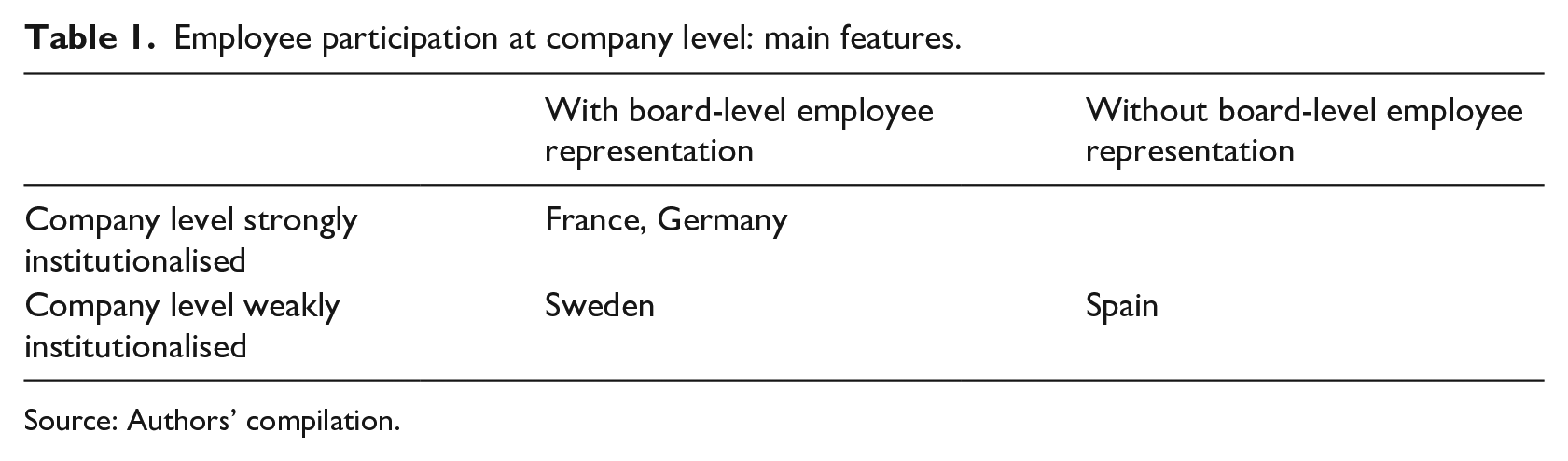
Source: Authors’ compilation.
The findings presented here are the outcome of different research activities carried out by the authors. First, we conducted 11 expert interviews with academics and trade unionists at both EU and national level from the four countries under scrutiny. In these interviews we discussed the respective institutional settings of employee representation, the role of different levels of employee representation, core issues dealt with in participation, and the developments and strategies of employee representatives. We use these interviews as background information and do not quote individual statements. Secondly, we rely on findings from recently completed research projects on European Works Councils (Haipeter et al., 2022) and on German co-determination and board-level employee representation (Haipeter, 2019; Telljohann, 2022). Thirdly, we add to this a literature review on the state of research on employee participation in the four countries under examination.
Participation and articulation at company level: four country cases
Germany
Institutional structures
Employee particitpation through works councils in Germany constitutes a multi-level system based on legal provisions for works councils and board-level employee representation. The Works Constitution Act sets out rules for co-determination at company and group level. If a company has several plants, each with its own works council, a central works council must be set up, bringing together representatives from the various works councils in the company. If a company has several subsidiaries in Germany, the central works councils of these companies can set up a group works council, provided there is a majority in favour. It is in these bodies that interests are aggregated and shaped and, later on, often negotiated with management. They also play an important role in pooling information and power resources. According to the WSI Works Council Survey 2016, around 44 per cent of the works councils surveyed had a central works council above them and in 28 per cent of the cases there was also a group works council (Behrens, 2019).
Co-determination through works councils is complemented by board-level employee representation, which in Germany is embedded in the dual system of corporate governance in which the management board is monitored and controlled by a separate body, the supervisory board. Board-level employee representation is based on three different items of legislation: the One-Third Participation Act, the Act on the Co-determination of Employees in the Supervisory and Management Boards of Companies in the Coal, Iron and Steel Industry, and the Co-determination Act of 1976. The latter – the most important – provides for equal representation of employee and shareholder representatives on the supervisory boards of companies with more than 2000 employees. Employee representatives include external trade union officials, who must be nominated by the trade unions represented in the company. However, the chair, who is always appointed by the shareholders, has a casting vote to ensure that the shareholders can outvote the employee representatives.
Participation and articulation at company level in practice
The growing importance of strategic issues and the growing pressure on works councils to safeguard jobs has increased the importance of central or group works councils, both as coordinators of arrangements to improve solidarity between works councils and as negotiators with management at central level, where strategic decisions are actually taken (Rosenbohm and Haipeter, 2019). This has led to a process of centralisation within Germany’s multi-level system of employee representation. Overall, this goes along with challenges such as how to organise solidarity between works councils, how to deal with employees’ participation in such centralised processes or how to shape the relationship between company and workplace agreements (Behrens and Kädtler, 2008). However, centralisation can be a driving force for the professionalisation of works councils and the development of strategic orientations to influence company strategies and the development of new resources for works councils (Haipeter, 2019).
The centralisation of decision-making in the works council system has brought this form of participation closer to board-level employee representation, which also takes place at company level. Research on German board-level employee representation has found a reorientation of supervisory board practice from a retrospective and monitoring stance to a more forward-looking and consultative one, accompanied by a growing influence of the supervisory board on strategic decisions (Jürgens et al., 2008). In addition, board-level employee representation can play a significant role during company restructuring by facilitating early access to information on important developments and offering scope to influence strategic decisions (Rosenbohm and Haipeter, 2019).
Overall, board-level employee representation and works council co-determination serve different, but complementary functions. While co-determination refers to the representation of interests and the regulation of working conditions in the workplace and in day-to-day operations, board-level employee representation provides access to privileged information about the economic and financial situation at company level, enables employee representatives to monitor the activities of management and provides opportunities to get involved in strategic decision-making.
The main challenge facing participation at company level in Germany is declining coverage. Between 2000 and 2021, the proportion of establishments with works councils fell from 12 to 8 per cent (Ellguth and Kohaut, 2022). The decline in the prevalence of works councils, however, was particularly pronounced in medium-sized establishments (see also Ellguth and Trinczek, 2016) and remained at a consistently high level of 86 per cent (of employees) in large establishments with more than 500 employees (Ellguth and Kohaut, 2022). Given that co-determination at company level exists mainly in larger companies, it can be assumed that the spread of co-determination at company level has remained fairly stable.
This is not the case for the spread of board-level employee representation, however. The number of companies with board-level employee representation under the 1976 Co-determination Act fell from 767 in 2002 to 635 in 2015 and 620 in 2020 (Sick, 2020). At the same time, only around 50 per cent of the limited liability companies (GmbHs) covered by the rules on board-level employee representation in the One-Third Participation Act of 2004 have actually implemented it (Bayer and Hoffmann, 2015). The main problem with board-level employee representation coverage is the existence of loopholes which companies can use to avoid or reduce its impact. These loopholes are both of German origin – such as insufficient monitoring and sanctions for limited liability companies subject to the One-Third Participation Act – and of European origin, such as the European Company (SE), the EU Directive on Cross-Border Mergers or the use of a foreign legal status not covered by the German laws on board-level employee representation (Sick, 2020; Telljohann, 2022).
Participation at company level: the case of Sweden
Institutional structures
In Sweden, trade unions have been the main actors in employee participation from the outset, as the Swedish system is characterised by the dominance of collective bargaining and a monistic system, with trade unions acting as interest representatives also in the workplace (Kjellberg, 1998). For a long time, employee participation in company decision-making did not play a role because management’s prerogative to decide on strategic issues was part of Sweden’s social partnership compromise. This changed in the 1970s, when the state laid the foundations for participation in the Swedish system. This system rests on two pillars: Employee representation at board level and co-determination at workplace and company level.
Board-level employee representation was introduced as the first pillar by legislation in 1973 (and later consolidated in 1987). According to the law, local branches of trade unions that have signed a collective agreement with the employer are entitled to appoint two members to the board, and three members if there are more than 1000 employees. The members should be employees of the companies concerned and their term of office is up to four years. They are prevented from participation in case of conflicts of interest (such as collective agreement issues or industrial action) (Votinius, 2011).
The Co-determination Act, the second pillar of participation in decision-making at company level, was introduced in 1976 and included information and negotiation rights for the so-called ‘established trade unions’, namely trade unions that have signed the collective agreements to which the employer is subject. The employer is obliged to negotiate with the unions on their initiative before making decisions on major changes to the business and, if requested, on decisions on working conditions
The starting point for negotiations is the workplace level; if no agreement is reached there between the employer and the trade union sections – called ‘clubs’ in Sweden – the employer has to negotiate with the central level of the trade union organisations, if requested. If no agreement is reached at this level, the employer can make a decision. The Co-determination Act thus confers a right to information and consultation for the trade unions (Rönmar, 2009). Unlike in the German case, no special body or committee has been implemented for negotiations at company level, as trade unions meet at this level only on an ad hoc basis to negotiate with company management.
Participation at company level in practice
In Sweden, board-level employee representation is minority representation. According to an annual survey of non-employee board members, the proportion of employee representatives was around a quarter to a third of board members in 2020 (ETUI, 2024). At the same time, board-level employee representation is available for companies with more than 25 employees (Conchon, 2011). Of the 15,500 limited companies in which employees had the right to appoint board-level representatives in 2018, only about 1800 had registered employee members with the Swedish Companies Registration Office (ETUI, 2024). This may indicate a lack of interest from the trade unions in using the opportunities offered by board-level employee representation and instead their focus on other forms of participation. High shares of SMEs might be another reason why the proportion of companies with board-level employee representation is well below the potential maximum.
The focus of board-level employee representation is mainly on the traditional union core areas of production and working environment. As Movitz and Levinson (2013) suppose, this is due to the limited opportunities and difficulties involved in influencing other topics. This suggests that employee representatives are able to exert influence on work-related issues, but lack the skills and resources to expand their activities (Wheeler, 2002).
This is explained partly by the fact that trade union clubs in Sweden are structured around workplaces rather than companies. Union groups at company level, which consist of members from the respective workplaces, tend to be formed on an ad hoc basis, without any institutionalised structure. This is exacerbated by the occupational structure of Swedish trade unions, which makes cooperation between them at workplace and company level an important precondition for developing effective forms of participation.
At least in some pioneering cases, however, Swedish trade unions have developed new forms of articulation between the different levels of participation. A model of good practice for trade union participation by promoting new technologies and securing jobs for green production is Volvo Cars (Kjellberg, 2021). The company announced in 2019 that electric engines would be produced abroad and that the engine plant in Skövde would have to be closed. In this situation, the trade unions worked closely together and raised the issue of jobs and the future of the engine plant in the company’s union group. Additionally, close articulation was developed between the union group and the union members on the company board, which benefited from the fact that the chair of the group was also the representative of his union on the board. On this basis the unions developed a strategic alternative. In the end, the trade unions were able to persuade the company to invest in the transformation of the plant. This example shows both a strategic shift of the trade unions towards proactive participation at company level and the importance of coordination between trade unions and of articulation between different levels of participation. It still seems to be an exceptional case, however.
Participation at company level: the case of France
Institutional structures of employee participation
In the French system of employee participation, the company level plays a much more important role than in Sweden. In general, employee representation in companies takes place through both trade unions and elected employee representatives (Fulton, 2021; Rehfeldt, 2019b). The latter focus on participation through information and consultation. Historically, there has been a wide variety of employee representation institutions at the workplace level, based on elections by the whole workforce. Following new legislation in 2017, which merged all elected bodies, the whole workforce is now represented by a single elected committee, namely the Social and Economic Committee (Comité Social et Économique – CSE).
If a company has at least 50 employees and more than one plant, there should be both a CSE at plant level and a central CSE at company level. Consultation on the company’s strategic direction and its economic and financial situation should take place at company level; consultation on social policy, working conditions and employment should take place both at company level and workplace level if these workplaces are likely to be affected. The CSE has also the right to call on experts, paid for either entirely or largely by the employer. The consultation process is usually very precise and formal, and management is obliged to listen and respond to the views of the employee representatives, but it can still pursue its own plans.
Although the CSE will be the employee representative body in most companies, changes under President Macron also provide for the possibility of setting up a company council (Conseil d’entreprise). Given the voluntary agreement of the trade unions, either through a company-level or an industry-level agreement, the normal functions of the CSE will be extended to include collective bargaining at company level, a task normally carried out by the union delegate. 1 In this case the company council gains new veto rights, which are also defined in the collective agreement and must include training. It is up to the agreement to determine what other issues, if any, should be subject to a similar veto, although the legislation suggests that gender equality could be one of them.
In the case of groups of companies, there is also the possibility of setting up group committees (comités de groupe). In some cases, the group committees have merged with the EWC by agreement as this has proven to enable a better articulation between national and transnational level.
Apart from the structures directly elected by the whole workforce, employee representation is also provided through trade unions. Trade unions have the right to establish trade union sections, which bring together their members at the workplace and have specific legal rights. In plants with more than 50 employees they can also appoint trade union delegates, provided they have sufficient support. Where trade unions are anchored in the company, trade union delegates play an important coordinating role (Fulton, 2021).
Board-level employee representation has long been limited to state-owned and privatised companies (Conchon, 2011). In 2013, it was extended to larger private companies with the obligation to have employee representatives on the board of directors or supervisory board of share-based companies (sociétés anonyme) with 5000 or more employees in France or 10,000 or more worldwide (France and other countries). Legislation on social dialogue and employment, enacted in August 2015, and the so-called ‘Pacte legislation’, adopted in 2019, have led to a further extension by including companies with 1000 or more employees in France or 5000 or more worldwide. Where there are up to eight board members, one has to be an employee representative; if there are more than eight, two employee representatives are mandatory (Fulton, 2021; Rehfeldt, 2019a). Interestingly, French law provides for the possibility of transnationalisation of board-level employee representation in companies with more than eight board members. In these cases, EWCs or SEWCs can be entrusted with the appointment of the second board-level employee representative, who can be a foreign member. In practice, this option has contributed to a Europeanisation of board-level employee representation and to the reinforcement of articulation between arenas of employee representation in transnational groups based in France (Lafuente, 2022, 2023).
Participation at company level in practice
Despite the elaborate multi-level system of participation in France, participation at company level seems ill-prepared to meet new challenges and demands, such as the digital and ecological transformations. Since 2021, the CSE has to be informed and consulted about the environmental consequences of the company’s activity. Employee representatives have been complaining about an overload of their representation and consultation burden, however, in particular since the 2021 reform, which has led to a drop in the number of representatives. Another problem concerns the lack of effective information and consultation and employers’ refusal to involve employee representatives in decision-making. Issues such as digitalisation and decarbonisation are either still absent from the social dialogue agenda in many companies, or, where they are present, they are often introduced unilaterally by management rather than being the subject of collective agreements and negotiations with trade unions. Trade unions are therefore calling for sufficient time and resources to carry out a thorough assessment of the information provided, with the support of economic/financial experts, in order to work out alternatives to measures that would have a negative impact on workers, including redundancies or plant closures.
With regard to consultation on company strategy, each company must set up a strategic economic and social (and since 2021 also environmental) database and make it available to the CSE and the union delegates. It remains to be seen whether employers will accept social dialogue in the area of strategic planning and economic decision-making at company level (Rehfeldt, 2019b). According to Rehfeldt (2019b), ‘the new rights for the works councils in this field combined with the extension of board-level participation might constitute some steps in this direction’.
With regard to board-level employee representation, the low number of employee representatives has proved insufficient to ensure adequate and high quality employee participation. The fact that French law requires newly appointed representatives to resign from any other representative mandates they may have elsewhere in the company once they join the board weakens the articulation between board-level employee representatives and the other bodies of employee representation.
Participation at company level: the case of Spain
Institutional structures of employee participation
Spain has the weakest institutionalisation of employee participation at company level among the countries under examination, although elected works councils are an important institution of workplace representation. Elections of employee delegates and works councils, known in Spain as ‘trade union elections’, determine not only the composition of those bodies (Köhler, 2021), but are also the criterion of representativeness for trade unions. Trade unions that win more than 10 per cent of delegates in national trade union elections (UGT and CCOO) or more than 15 per cent in an autonomous community have a general right to conclude collective agreements, a right of representation in public institutions and access to certain state subsidies. The importance of works council elections, combined with the relatively low union density in Spain, has led some authors to speak of a representative trade union model (voters’ trade unionism) as opposed to a membership organisational model (members’ trade unionism) (Martínez Lucio, 2001).
The rights of the works council include information and consultation on matters that may affect employees, on all company decisions that could lead to changes in work organisation and employment contracts or on possible counter-measures. For many works councils, however, their most important power is the right to negotiate binding collective agreements on pay and working conditions as trade unions, given that most works council members are unionised. In companies with more than 250 employees trade unions that have seats on the works council also have the right to elect a trade union delegate. Provided the trade union delegates have a majority on the works council, they also have the right to conduct collective bargaining (Fulton, 2021).
Representation at group level is possible in the form of a group works council (comité intercentros), which brings together several works councils from the same company, but only if provided for in a collective agreement. The distribution of its members among the unions must correspond to the results of elections in the works councils concerned, taken as a whole. In 2018, however, only 58 company agreements were signed that provided for a group works council (Fulton, 2021; Köhler, 2021). This means that representation is almost non-existent at company level and that in the vast majority of cases there is no articulation between company and plant level.
The weakness of participation at company level is exacerbated by the fact that there is no general right to board-level employee representation. Although the Spanish Constitution of 1978 (Article 129) states that ‘public authorities shall effectively promote the various forms of participation within companies and shall encourage cooperative societies through appropriate legislation’, there is no general statutory right for workers to be represented at board level. Public companies are an exception, but many of the public companies covered by board-level employee representation have ceased to exist.
Participation at company level in practice
With the change of government in 2018 new laws were passed that respond to the structural changes in the world of work caused by transformation processes. They guarantee employees adequate information rights, including a new obligation to inform employee representatives about the use of so-called ‘AI’ and algorithms (Alvarado Caycho, 2021). According to Köhler (2019), the participation of trade union delegates and works councils in medium-sized and large companies can be considered quite advanced. Group works councils are still rare, however, reflecting a weak articulation between different levels of employee representation. And because only a limited number of Spanish companies still have board-level employee representation, there is currently a vacuum with regard to the corresponding regulations.
In 2022, Labour Minister Yolanda Díaz announced her intention to negotiate a law on institutional participation with the social partners. However, the demand to be involved in strategic decision-making would require the existence of structures of interest representation at central level, in other words, group works councils. There is fierce resistance to the implementation of such a law among employers and managers, who are convinced that participation means a loss of decision-making power and control (García Elosua, 2018). As a result, the objectives linked to information and consultation rights, such as improving the management of restructuring and the preventive management of change or increasing workers’ adaptability and employability, have not been achieved (Ferrer Sais, 2022). This also means that this model does not seem to favour progress towards extending a culture of co-determination to aspects of company management at company level (Arrieta Heras, 2018).
Articulation with the EU level: European Works Councils and SE Works Councils
Although national institutions still form the backbone of employee participation at company level, there are two important institutions that have added a transnational European dimension: European Works Councils (EWC), on the one hand, and the European Company (SE) and its provisions on employee involvement (especially SE works councils, SEWC) on the other. In the following we will focus on these institutions and analyse their links with the national level of participation.
Since the EU adopted the first Directive on European Works Councils in 1994, proper participation on the part of EWCs has been lacking (Voss and Pulignano, 2020). In order to address these shortcomings, the EU adopted the Recast Directive in 2009 with the aim of increasing the number of EWCs, improving their functioning and ensuring legal certainty to the parties involved. Looking at the functioning of EWCs after the Recast Directive, there have been improvements, for example in the number of EWC meetings held per year.
EWC functioning is still afflicted with a variety of problems, however. The majority of EWCs receive either too little information or too late, or they are not properly consulted (De Spiegelaere et al., 2022). At the same time, there are serious deficiencies in enforcement. Sanctions, which according to the EWC Directive should be effective, dissuasive and proportionate, have proved insufficient in practice to ensure managerial compliance with EWC regulations (De Spiegelaere et al., 2022). As a result, it can be concluded that the Recast Directive fell short of guaranteeing adequate information and consultation processes on transnational issues.
Against the background of these shortcomings, the ETUC (2020a, 2020b) calls for more effective enforcement provisions as a prerequisite for effective employee participation. This demand is also supported by the European Parliament, which in January 2024 adopted a legislative-initiative resolution calling for a revision of the EWC Directive to tackle existing shortcomings. Following the two-stage consultation of the social partners, the Commission recently put forward a proposal for amending the EWC Directive, which is supposed to tackle existing shortcomings.
Apart from legal improvements to the EWC Directive, it seems that articulation with national systems of employee participation is a key prerequisite for efficient employee participation in EWCs, but also in SEWCs, which have similarities with EWCs (De Spiegelaere et al., 2022; Rosenbohm and Kuebart, 2022). Research findings show that high levels of articulation in terms of integration of interpretations and interests, as well as in terms of coordination of activities within the EWC, usually go hand in hand with coordination on the part of the European trade union federations and articulation efforts at the national level of the employee representatives who are members of the EWC (Haipeter et al., 2019).
Articulation at national level is thus an important precondition for effective information and consultation procedures at European level, for two reasons. First, the interpretations and interests of company subsidiaries in the respective countries can be integrated at national level before they are brought to the EWC or SEWC. This means that differences in interpretation or interests between sites within one country can be dealt with before they may arise in the EWC or SEWC. Articulation at national level requires some form of exchange and coordination, whether through a national representation body or through trade union coordination, or both. A national representative body can represent all sites, at least indirectly. The advantages of such indirect representation are twofold: on the one hand, the interest representatives of these establishments meet regularly and can formulate common positions and interests, which can then be brought into discussions in the EWC or SEWC. In the absence of such a body, integration would at least be made more difficult and would have to take place, in particular, through trade union intermediation. Such bodies could therefore complement trade union coordination. On the other hand, they will be informed by these representatives within the national employee participation bodies about what is going on within the EWC or SEWC and what are the most relevant information and issues being dealt with there. If such a level does not exist, only those sites that have representatives in the EWC or SEWC will be connected to the transnational level; the others will remain separate and excluded from this information channel unless there is national trade union coordination (Haipeter et al., 2019).
Employee participation at company level: a comparative perspective
The comparison of employee participation at company level in the four countries under examination, together with the findings on articulation with EWCs and SEs, shows the importance of a centralised and institutionalised level of employee participation within companies that complements management decision-making structures. As our analysis has shown, the national level of employee representation plays a crucial role in this respect, especially at the headquarters of companies, which have become more and more multinational. At this level, employee representatives build on the most established channels of negotiation with company management and have the capacities to develop strategic orientations in the first place. This can be shown by the example of Germany.
Here, the importance of the centralised level of company participation within the multi-level system of participation has increased as a result of globalisation, restructuring and companies’ digital or ecological transformation. Central and group works councils have become key players in integrating interests, creating common definitions of situations, and developing and negotiating strategic alternatives for company development based on the experience and skills of works councils and employees. Moreover, central and group works councils are essential in linking employee participation at national level with European information and consultation bodies. In addition, board-level employee representatives play an important role by providing additional information on financial developments and managerial strategies, by putting employee representatives in direct contact with board members and top management, by enabling informal agreements to be reached between the parties and by providing opportunities for escalating conflicts if the works councils fail to find a solution.
Like Germany, also in Sweden the importance of participation seems to increase in the course of restructuring and transformation. In this context, the articulation of different forms of participation at workplace and company level – including board-level employee representation – has been strengthened in some cases, such as Volvo. The need to cope with transformation, whether digital or ecological, could therefore increase the importance of participation as a means of influencing corporate decision-making, demanding long-term and socially sustainable strategies, and introducing strategic alternatives to management strategies.
These efforts are hampered, however, by the dominance of workplace structures on the trade union side and difficulties in establishing multi-level structures in line with company structures as legal forms for employee representative bodies at company level do not exist. In this situation, participation in company boards can be a source of information about company developments and forms an important basis for contacts with other board members. However, it is not necessarily well articulated with trade union clubs.
In France, the multi-level structure of employee participation includes institutionalised employee representation at company level. However, participation at company level has some weaknesses. In the case of board-level employee representation, the minority participation required by law can be seen as a source of information, but it does not provide a real opportunity to influence strategic company decisions. In addition, the fact that French law obliges the newly appointed board-level employee representatives to resign from other employee representative mandates weakens the articulation between board-level employee representatives and other bodies of employee representation. Moreover, the inter-union competition that exists in most workplaces can make articulation more difficult in terms of defining common positions and interests. On the other hand, the possibility of transnationalisation of board-level employee representation in companies with more than eight board members is innovative.
Finally, in Spain, the national level of employee participation scarcely exists. This seems to be a crucial shortcoming of the Spanish system of workplace representation because the right to be involved in strategic decision-making, especially in a period of profound transformation, would require the existence of interest representation structures at central level. With regard to information and consultation processes at European level, the absence of a central level of interest representation entails the risk that establishments not directly represented in the EWC will probably not be adequately informed about the results of EWC meetings unless there is national trade union coordination. To make matters worse, board-level employee representation does exist, but only for publicly owned companies, and it has virtually been abolished over the past two decades. However, a legal strengthening of employee participation at board level would give the employee side the opportunity to obtain timely access to information on strategic company decisions.
EWCs and SEWCs at European level are the main institutions of transnational employee representation in the EU. They are designed to complement employee representation at national level. These institutions add an extra layer, underlining the need for coordination between the national and European levels. In this regard, the national level of employee participation within companies remains an essential precondition for effective information and consultation at European level, for two reasons. On the one hand, it is at this level that the interpretations and interests of the respective subsidiaries can be integrated and then fed into the EWC or SEWC, and it is at the national level that information from the EWC can be shared and distributed to different company sites and subsidiaries.
On the other hand, because of the shortcomings of European-level employee participation, the national level of participation is still a central place of strategy building for employee representatives, especially at company headquarters. This applies under two conditions: that the employee representatives can build on formal institutions of employee representation at national level, and that they develop strategic capacities to cope with the ongoing transformations.
Conclusions
Six conclusions can be drawn from our analysis, which also contain policy recommendations to strengthen the articulation of employee representation at company level. First, the more pronounced the legal rights to information and consultation – or better still, co-determination – the more employee representatives can do at the headquarter level in order to influence company strategies and to improve corporate decision-making. This influence has proven to benefit long-term corporate strategies in terms of investments, employees’ qualifications or employment. In this sense, employee participation at company level is an important asset that enables companies to meet the current transformative challenges they face and to defend or improve their market position in global competition.
Second, an important precondition for successful employee participation in managerial decision-making is the existence of formal bodies of employee representation at company level. This can promote articulation by integrating different workplace interests, forming common understandings of situations and developing strategies to bring into negotiations with management. Without such an institution, workplace representatives would have to coordinate and build strategies on an ad hoc basis, which would be made more difficult by the competition between workplaces for investments or employment, the deeper the transformative changes are.
Third, board-level employee representation can be an important pillar of employee participation at company level, providing additional access to information and to networks and contacts with management. Moreover, board-level employee representation can also be an important tool for escalating conflicts and influencing corporate decision-making. However, these positive effects seem to be smaller, the lower the proportion of employee representatives at board level and the less board-level employee representation is articulated with the other elements of employee representation in the company.
Fourth, there are loopholes at both national and European level that companies can use to circumvent or disregard employee participation at board level. To address the lack of harmonised rules on employee representation in European companies and for companies making use of EU company law, the ETUC and the European Parliament have put forward proposals for a horizontal framework for information, consultation and board-level representation (ETUC, 2020b; European Parliament, 2021). Such a new framework would be an important step forward as it would clear away the existing patchwork of different standards and would lay the foundations for setting minimum standards.
Fifth, EWCs or SEWCs, which are the core bodies of transnational employee representation at company level, show some significant deficiencies in terms of their effectiveness and their ability to influence managerial decision-making. The overwhelming majority of EWCs or SEWCs do not function well in terms of the quality of information and consultation and have no or very limited influence on corporate decision-making. This is a problem, especially for employee representatives who do not have access to top management at the company headquarters, but who have to rely on information and consultation within the EWC. In light of these shortcomings, there is a need to make the rights of EWCs and SEWCs more effective, whether in terms of the quality and timeliness of information and consultation or deficiencies in enforcement.
Sixth and finally, articulation with employee participation – and at the national level – seems to be crucial for effective employee participation at company level: on the one hand as a precondition and support for the European level in terms of clustering and processing interests and information, on the other hand as a place of strategy building and negotiation with company headquarters. To date, this point has largely been neglected in relation to articulation, but it should be taken into account when discussing changes to the existing regulations.
Footnotes
Funding
This work was supported by the Spanish Ministry of Labour. We acknowledge support by the Open Access Publication Fund of the University of Duisburg-Essen.
1
Hitherto, no trade union has made use of this possibility, as this would mean abandoning the union monopoly of collective bargaining.