




Abstract
We develop a practice-based framework of inter-organisational human resource management that puts multi-employer work arrangements in inter-firm networks at its centre. By reinterpreting existing knowledge on multi-employer work arrangements and how they are managed, we delineate four processes in the assemblage of inter-organisational HR management. To illustrate the usefulness of our framework, we explore the question of whether and how an inter-organisational HR management develops in four exemplary cases of multi-employer work arrangements. These cases reveal that the quality and degree of inter-organisational HR management varies considerably, also depending on whether worker representatives show network awareness and orient their activities towards inter-organisational relations.
Introduction
The inter-organisational division of labour has changed workplaces considerably over the past two decades. Globally, inter-firm networks have become the dominant means of sourcing labour as supply chains and production networks have spread across national borders (Coe and Yeung, 2015; Gereffi et al., 2005; Helfen et al., 2018). Locally, network arrangements for sourcing labour can be identified in spatially close production sites in almost all industries, far beyond the archetypical multi-employer arrangements in construction or media projects. Examples include manufacturing, such as car or chemical production, as well as retail and other services, such as airports (Helfen et al., 2017; Hertwig et al., 2019). Consequently, the organisation of work has become ‘fragmented’ (Marchington et al., 2005a), and ‘fissured’ (Weil, 2014) and work is increasingly being performed in a ‘multi-employer environment’ (Rubery et al., 2003) in which workers are exposed to the contradictory requirements of more than one employing organisation; a situation somewhat similar to what has been hitherto predominantly ascribed to freelance work for different clients.
Despite this new reality of multi-employer work arrangements – frequently an outcome of outsourcing value creation and a preference for organising economic activities in inter-firm networks (Powell, 1990; Sydow et al., 2016) – the institutions and practices of labour-management relations are still tied, in most cases, to the traditional bilateral employment relationship within national boundaries (Anner et al., 2022). This lack of fit between a multi-organisational mode of employment and institutionalised practices of employment relations and workers’ voice has manifold repercussions.
The parties regulating the employment relationship – above all, management and trade unions – have for the most part failed to adapt to the new realities in networked workplaces. On the management side, human resource management (or HRM for short) has not matched the speed of developments and still lags behind in devising network-related practices capable of integrating, aligning, and creating consistency in HRM practices across firms and for (varying groups of) workers (see Marchington et al., 2011). This failure is likely to have tremendous consequences for the manageability of workforces across industries and regions, especially in situations of stress, crisis, and conflict (for example, labour shortages, supply chain disruptions, workers’ discontent). On the trade unions’ side, union organising and collective bargaining practices, as well as practices in support of workers’ voice and employee participation still lag behind in devising network-adequate answers leaving network-wide workers’ voice and representation still largely uncharted territory. Again, this may have considerable consequences for combating wage inequality and labour market exclusion, on the one hand, and enforcing previously achieved labour standards on the other.
For the most part, the parties in employment relationships are still oriented towards institutions built on the bilateral employment relationship as a reference point, such as labour law and collective agreements. For management this situation might be comfortable, at least under otherwise ‘regular’ conditions, because multi-employer work arrangements harbour the possibility of loosening the grip of labour regulation of all sorts and types. On the workers’ side the disadvantages seem to dominate, as precarious forms of employment rip up employment standards and worker protection. Nevertheless, unions and works councils can make a difference by adapting (after they become more familiar with the situation) these practices and develop what we will call a ‘network orientation’. Differing in degree, a network orientation includes devising legitimate representation practices in and towards networked firms as well as other organisations such as NGOs or state agencies. In short, worker representatives can make a difference where their activities and resources are also directed towards the regulation of working conditions in networked firms or organisations more generally. Network orientation can also be understood as a prerequisite for ‘network bargaining’ (Anner et al., 2022), in which unions aim for negotiating the working conditions along the inter-organisational relations of a central firm.
In what follows, we map the conceptual territory of multi-employer work arrangements and suggest a perspective on HRM and employment relations that may provide a better understanding of how a multi-organisational mode of employment functions in and through practice. We analyse how and by whom relevant practices of inter-organisational HRM are used, or not. To do so, we follow Marchington et al. (2011), who define multi-employer work arrangements as ‘a situation where the employment experiences of workers are shaped – to a greater or lesser extent – by more than one employer in contexts where organisations collaborate across boundaries to jointly produce goods or provide services’ (p. 314).
For us, inter-organisational HRM practices are thus to be conceived as (potential) practices that reach beyond a single employing organisation in an attempt to take account of the networked character of multi-employer work arrangements (Helfen, 2014). We scrutinise the introduction of these practices with an additional focus on workers’ voice in this process because value creation in inter-organisational relations can worsen working conditions and decrease the influence of worker representatives (for example, Doellgast and Greer, 2007). We also seek to explain why organisational actors often fail to devise adequate responses to the challenges of multi-employer work arrangements, but also sometimes succeed. Furthermore, we show what options are available for adapting employment relations to the new realities of the fragmented workplace, also for contributing to a more sustainable and resilient work organisation and multi-organisational responsibility.
We ground our theoretical development in illuminating exemplars, all drawn from our own research on German service operations: ground-handling work at airports, as well as on-site subcontracting in food industry logistics. Although these cases have their own limitations, they are particularly revealing for two reasons. First, we argue that our cases epitomise the practices of multi-employer work arrangements in their more mundane varieties and therefore help us to understand these practices better across the board. At the same time, we widen the view to encompass the labour-management relations in Germany’s large, but understudied service sector (for an example from manufacturing, Helfen et al., 2017). We abstain from engaging with platform work, despite some obvious connections (for example, Vallas and Schor, 2020), because of the complexities of (bogus) self-employment, freelancing, and technology that obscure and anonymise the social relations of work organisations in these cases.
Second, our examples are taken from an industrial relations setting in which there are comparatively strong labour laws and tripartite labour policy structures, as well as multi-firm collective agreements and employee workplace representation (for other country contexts, see Maran and Chieregato, 2022). This setting has been characterised as a dual system of interest representation with two pillars: (i) works councils – legally independent from unions – in the workplace, and (ii) (multi-)industry unions in collective bargaining, and tripartite bodies (Behrens, 2016). As a result, on the labour side, network orientations can – at least, potentially – develop within two distinct representational domains, namely, the firm-related arena around the works council and the arena of union politics around collective bargaining and labour regulation. We conclude by identifying potential avenues for further research and practical implications for management and worker representatives.
From bilateral employment relationships to multi-employer work arrangements
In standard textbooks, the conceptualisation of the employment relationship is still dominated by the idea of a (generalised) bilateral exchange based on an employment contract between one employer (usually an employing organisation) and an employee (an individual), specifying each party’s rights and obligations accordingly. This conception has far-reaching consequences for high- and low-road employment strategies (Kaufman, 2015; Kochan and Kimball, 2019; Osterman, 2018) in vertically integrated firms. As a result, practice recommendations and HR policy options focus on workers acting in a ‘standard employment relationship’ (Beer et al., 1985). This perspective – and this is important to us – remains relevant because employment is still to a considerable extent organised in and attached to organisational hierarchies.
Nevertheless, the emergence of multi-organisational employment relations – resulting from subcontracting and inter-firm networking – might be regarded as one of the most fundamental transitions in today’s world of work (for example, Cappelli and Keller, 2013; Grimshaw and Rubery, 2005; Rubery et al., 2003; Spreitzer et al., 2017). Fundamentally, the (re-)appearance of these work arrangements contradicts the internalisation of employment relationships within hierarchies for reasons of organisational rationality, domination, and profit (for example, Grimshaw and Rubery, 2005; Kieser, 1989). The phenomena observed in relation to this transition are anything but new, and many have been widely recognised and examined in studies of the rise of ‘non-standard employment’ (for example, Kalleberg, 2000) or the increasing prevalence of supply chain connections to other firms (for example, Scarbrough, 2000). A more recent stream in this literature has turned towards explaining the transition by emphasising the realities of working in and for organisations in inter-firm networks (Cappelli and Keller, 2013; Fisher et al., 2010; Grimshaw and Rubery, 2005; Lengnick-Hall et al., 2013; Marchington et al., 2005a; Spreitzer et al., 2017; Weil, 2014). Despite many important and fundamental insights, many questions remain unanswered. Among these, we concentrate on the issue of how it is possible under these circumstances for a practice of inter-organisational HRM to develop, and how unions can collectively represent workers’ interests in such settings.
The spread of multi-employer work arrangements
At first sight, there are no genuine work-related limits to organising work in and through multi-employer work arrangements with regard to industries, occupational labour market segments or professions. Such work arrangements can be found at the lower end of the pay scale (Weil, 2011, 2014), but also in high-paying elite jobs (Haunschild, 2003). They may include manual jobs in agriculture, as well as technologically mediated varieties of jobs, such as crowdwork in digitally networked organisations, also including (bogus or not) self-employed workers, as in the online auction platforms associated with ‘hyper-specialization’ (Malone et al., 2011; and with more differentiation, Bearson et al., 2020).
Also, there are different forms and degrees of multi-employer work arrangements giving rise to what has been called the ‘service triangle’ (Bélanger and Edwards, 2013). In many service encounters, the client, although not necessarily an employing organisation, is directly involved in work performance and appraisal – sometimes to the extent that entrepreneurial and managerial decision-making is de facto handed over to the client or other third parties. One of the purest archetypes is temporary agency work (Mitlacher, 2005). Another example is open book contracts in contract logistics which include performance evaluation and personnel cost transparency (Gutelius and Theodore, 2023). In other industries and segments, the client’s influence may be of less relevance. Multi-employer constellations are to be found in inter-organisational projects (Marchington et al., 2010; Sydow and Braun, 2018), and are to be encountered in multi-employer sites (from shopping malls to car manufacturing); in other words, where several independent employers operate at one spatially concentrated worksite. However, they are also spatially if not globally distributed along ‘multi-tier supply chain arrangements’ (Li and Choi, 2009; Mena et al., 2013).
In sum, multi-employer work arrangements have become common. However, the repercussions of these (inter-)organisational arrangements for HRM and workers are often left implicit (but see Scarbrough, 2000). Acknowledging multi-employer work arrangements entails the realisation that HRM practices are shaped in many cases by actors in and beyond the single employing organisation (Grimshaw et al., 2023; Marchington et al., 2005a). The same holds for workers’ experiences of their work situation, which is shaped increasingly by more than one employer (Bidwell and Fernandez-Mateo, 2008; Cappelli and Keller, 2013). For theory, this transition also affects the core unit of analysis in both HRM and employment relations, and hence shakes the theoretical underpinnings of HRM (Davidov, 2004; Grimshaw et al., 2023; Havard et al., 2009), as well as the instrumentality of almost any HRM practice, from recruitment and training to performance management, remuneration, and dismissal (Fisher et al., 2010; Kinnie et al., 2005; Marchington et al., 2011).
Management repercussions: towards inter-organisational HRM?
Of course, as multi-employer work arrangements are affecting more and more workplaces and production sites, they also have profound repercussions for HRM itself. The growth of the independent HR services industry, ranging from temp agencies to payroll services, as well as the emergence of HR service centres and ‘internal’ HR business partners consulting in large corporations suggest that HR managers already perceive their own roles differently, with repercussions for how HR management itself should be organised (Ackermann, 2011; Cappelli and Schwartz, 2024; Reichel and Mayrhofer, 2009).
For management, multi-employer work arrangements mean that the effectiveness of hierarchical fiat, which is assumed in managing workforces, is becoming increasingly limited. Organisations and actors ‘behind’ the organisation and beyond the collaborating organisations exert at least some degree of influence on HRM practices. In general, there has been a quantitative decrease in the number of workers formally and directly employed by an organisation (for example, Spreitzer et al., 2017; Weil, 2019). At the same time, qualitatively new challenges are arising because the strategic alignment of HRM, its integration, and consistency over time between individuals and groups – not only within but also across organisations – needs to be brought about with rather indirect HRM practices (for example, Gittell, 2000; Gittell et al., 2010).
In their seminal work on the consequences of multi-employer work arrangements, Marchington et al. (2011) see the need for a ‘fit’, in other words, an alignment between strategies and HRM practices, not only intra- but also inter-organisationally. This network dimension of HR strategising affects (potentially) all policy choices in HRM. For example, the selection of personnel, including the definition of hiring criteria, processes, and instruments, may often be (co-)defined by a third party. Hence, HRM practice needs to take into account different organisations’ standards because these affect the performance, productivity, and quality of work. Similarly, personnel development happens in and across organisations, or is provided by specialised service firms in the inter-organisational network (see Wirth, 2010). Seen from the perspective of a lead firm in such a network, the management tasks of selecting collaborating firms, allocating tasks, resources, and responsibilities, regulating the coordination of firms, as well as evaluating inter-organisational relations, sets of firms and their current relationships (Sydow et al., 2016) are important starting points for achieving the alignment, integration, and creation of consistency of HRM practices in inter-firm networks.
Consequences for workers and their voice
Beyond the management of work, multi-employer work arrangements pose challenges to almost all work-related institutions, such as social security systems, vocational training systems, and the exertion of industrial citizenship rights that provide the regulatory, normative, and cognitive underpinnings of work. From a worker’s viewpoint, the repercussions are tremendous, especially where the rules and regulations of work are centred on organisationally bound norms for reference. In Germany, for example, the standard employment relationship of regularly employed workers takes the firm-specific internal labour market as its reference point, regardless of the possible idiosyncrasies of different occupations, localities, or industries (Behrens, 2016). Hence, the workplace and the firm – in other words, the organisational situatedness of ‘regular’ work and employment – are still at the conceptual centre of labour regulations. ‘Regular’ employment of this sort provides for the coverage of employees and workers by the social security system, health and safety standards, but also by the rules governing industrial relations. ‘Regular’ employment also makes up the core of industrial relations coverage which has been identified as a zone of workplaces and firms in which workers are represented through works councils and enjoy an industry-wide collective agreement.
In contrast to the workplaces in the core zone of traditional industrial relations, inter-firm networks’ multi-employer work arrangements are at odds with this institutional framework. This is because the basic principle of German industrial relations ‘one workplace, one works council, one union, one collective agreement’ is considerably undermined in a variety of dimensions, resulting, to differing degrees, in diminishing opportunities for worker voice.
Deviations in employment and work arrangements from the organisationally bound reference points usually stifle opportunities for workers’ voice. As for co-determination, in inter-firm networks, for instance, several works councils would have to be established and coordinated (Sydow, 1992). As for collective bargaining, workers – depending on the actual inter-organisational division of labour – are employed de facto under the rules of different collective agreements; if at all, workers are members in different and sometimes competing unions.
Conceptually, the multiple, overlapping aspects of these phenomena have been sorted as ‘disenfranchised voice’, ‘fractured voice’, ‘fragmented voice’ and ‘disconnected voice’ (Marchington et al., 2005b: 244). Apart from a ‘shrinking core’ in which regular employees are still protected through a ‘standard employment relationship’, as described above, workers lack opportunities to get involved because management and worker representatives ignore them (to a large extent). This is exactly the case with disenfranchised voice, while fractured voice captures the phenomenon that unions are confronted by an internal segmentation of their membership, in which one or more member groups are excluded from traditional representation and voice because of their precarious attachment to the employing organisations. Fragmented voice indicates that voice opportunities – along with other employment and working conditions – differ between employing organisations, and the resulting differences do not trigger efforts for coordinated collective action or – even worse – make unions and works councils compete with each other. Finally, voice can also be disconnected because no constructive social relations and interactions between workers of the various firms in the network come into effect as a result of different working conditions, union traditions or different contracts.
Labour regulation and the state
While different countries have developed different, perhaps even increasingly divergent institutional systems (Bamber et al., 2021), hardly any country has responded sufficiently to the regulatory challenges posed by inter-firm networks and multi-employer work arrangements. However, there are several examples in which these challenges have been addressed. Supply chain laws deal indirectly with the effects of multi-employer work arrangements on basic human rights and international labour standards within the context of production and supply networks (Schüßler et al., 2023). Similarly, the emerging discussion on platform workers’ rights (Council of the EU, 2023; Risak, 2017) as well as the debate around regulating agency work (Helfen, 2015) are in part an indirect outgrowth of an acknowledgement of the increased importance of networked employment. Also, institutional frameworks may at least provide opportunities for gradual accommodation through practitioners in practice. In the case of German industrial relations, for example, the Works Constitution Act makes it possible to negotiate the establishment of a works council body in which workers from legally independent firms on a single worksite are represented. That option requires an explicit collective agreement with the employer, however; to date, such ‘network councils’ are rare in Germany.
Also, empirical studies on worker representation for externalised workers (for example, Benassi and Dorigatti, 2020; Doellgast and Greer, 2007; Helfen et al., 2020; Sydow, 1992) show that most worker representatives are still tied to the interests of their constituency in a single workplace and in a single firm. Therefore, unions and works councillors, like managers, are expected to display only a low level of network awareness and orientation. And the accommodation of extant institutions through practice is in a fairly experimental state. But in a very few cases, worker representatives have taken on the interests of (quasi-)externalised workers quite successfully and have acted beyond their legally defined constituencies in multi-employer work arrangements (Erol and Schulten, 2021; Hertwig et al., 2019; for an Italian case, Pulignano, 2005).
Multi-employer work arrangements: a practice-based perspective
Our conceptual framework is informed by practice theory (Feldman and Orlikowski, 2011; Nicolini, 2012) in general and by Giddens’ (1984) theory of structuration in particular, and we aim to capture the processes and practices of inter-organisational HRM and worker representation as they are situated in inter-organisational relations, as well as embedded in societal institutions of various types, such as regional, industry-wide, society-wide, as well as supranational institutions. We think structuration theory is adequate for theorising inter-organisational HRM, because it offers an agency-oriented, multi-level and multi-dimensional analysis of social life that does not overlook the role of structure and associated institutions (see also Barley and Tolbert, 1997; Sewell, 1992).
At the centre of the theory are social practices, which are recurring forms of action (re-)produced by agents in time and space. Social practices within and across these systems, according to the duality principle (Giddens, 1984; Sewell, 1992), are shaped (but not determined) by structures that enable and restrict agency at the same time. In their social practices actors refer to society-wide (for example, the labour law of the respective country) or even supranational institutions (for example, the EU regulation on the transfer of undertakings), but also to the structures of social systems, such as fields (industries, regions), inter-firm networks, and organisations (Ortmann et al., 2023). Social practices exhibit certain and only analytically separable cognitive (rules of signification), normative (rules of legitimisation) and power-related aspects (resources of domination). These are, according to the duality principle, reproduced or changed in interaction (communication, sanctioning and power usage). Hence (more or less) knowledgeable agents act against the background of unacknowledged conditions and produce sometimes unintended consequences that might feed back as unacknowledged conditions (stratification model of the agent). At the same time, agents can act otherwise, in the sense that they can deviate from prevailing social practices because power is distributed asymmetrically but never one-sidedly (dialectic of control). Actors reflexively monitor their own actions as well as those of others and observe the accompanying results in social contexts; they learn.
To explain the practices of inter-organisational HRM, such a perspective allows us to understand how policy choices are integrated across organisations (or not), and how a certain consistency of practices emerges as a consequence of actors’ network awareness and orientation in cognitive and normative terms. Of course, this includes all practitioners of inter-organisational HRM and employment relations: managers, workers, worker representatives or external stakeholders and regulators. All these actors can develop an awareness and respective network orientation in their practices and devote some of their attention and resources to networked organisations and working conditions in inter-firm networks.
Adopting a network-level view implies taking a meso-level perspective. Interactions and social relations in inter-firm networks shape and are shaped by micro- and macro-level phenomena; in other words, by the (inter-)actions of individuals and groups embedded in organisational fields and society at large. Developments at the micro and macro level are, therefore, potentially an independent source of variation. New practices on the micro as well as on the macro level are subject to influences from the network level. Focusing on the meso level via a practice-based perspective on managing HR in multi-employer work arrangements spotlights HRM practices that may have repercussions beyond a single organisation and across the inter-firm network. This includes policy choices and their recursive interplay (symbolised by the double-headed arrows in Figure 1) between inter-organisational networks, multi-employer work arrangements and HR outcomes. For example, from our practice-based perspective, ‘network bargaining’ (Anner et al., 2022) can be interpreted as a possible, but not a necessary, second-order learning outcome of a meso-level or (inter-)organisational reorientation of worker representatives’ and managers’ social practices.
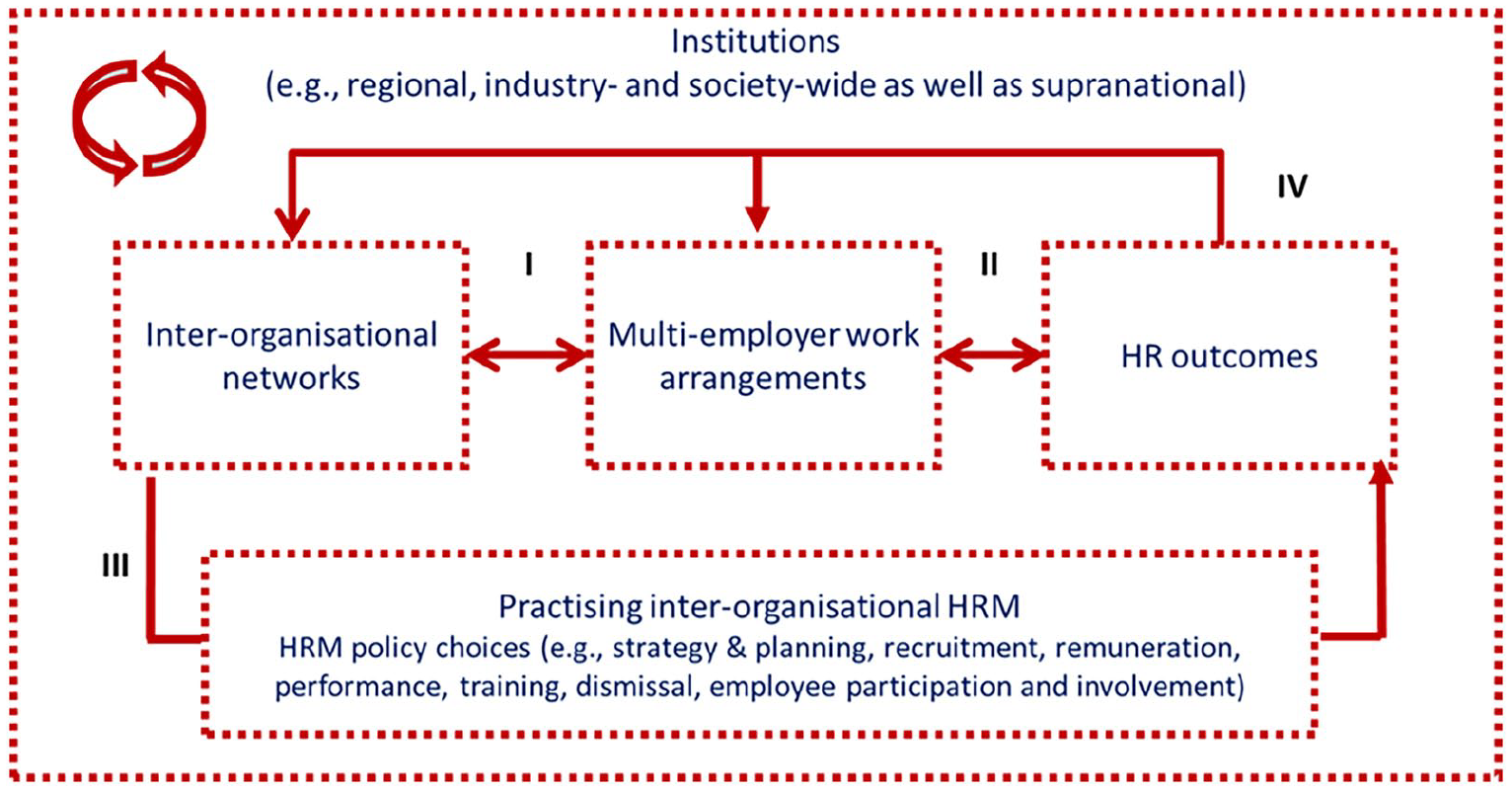
Managing human resources in multi-employer work arrangements.
Figure 1 summarises the core ideas of this practice-based theorisation of inter-organisational HRM.
In a nutshell, the practice of inter-organisational HRM – for example, in relation to issues of labour costs and performance, employee motivation and well-being, worker retention and so on – involves multi-employer work arrangements as constituted by inter-organisational networks (of firms). This practice is embedded in a set of diverse institutional contexts. Having said that, the practices and outcomes of inter-organisational HRM are not predetermined by inter-organisational network configurations or the types of multi-employer work arrangements chosen. Rather, outcomes depend also on how the practitioners of inter-organisational HRM – including worker representatives – handle the tensions of multi-employer work arrangements using various strategies and under a variety of conditions. Practices and outcomes may thus differ between single firms in the network and the network as a whole (or a part of the network); a wide array of practices is, in principle, possible (for an overview, see Fisher et al., 2010). In other words, an analysis of inter-organisational HRM from a practice-based perspective conceives practices as socially embedded and highly contingent. This is also because HR outcomes are likely to feed back on (and potentially, alter) the configuration and governance of inter-organisational networks, as well as the choices of multi-employer work arrangements.
In our view, managing human resources within multi-employer work arrangements is best conceived as being performed within a framework of four major processes:
(i) First and foremost, the (re-)appearance and extension of multi-employer work arrangements and inter-organisational networks as a widespread phenomenon are indicative of the increasingly contested nature of the hierarchically integrated organisation of value creation. Inter-organisational networks are seen not only as an up-to-date and legitimate response to current needs, but also as a medium and result of a ‘financialization’ (Thompson, 2013), in which labour’s share in the value created is reduced as part of the ‘extractive ambition’ of owners and managers. Seen this way, the (re-)appearance of multi-employer work arrangements can be explained by a business strategising – usually, chosen by a central organisation formally or de facto leading the network – to shift financial risk onto a network of business partners, including those units at the ‘periphery’ that (still) employ workers. Thereby, risk shifting aims to consolidate the value appropriation of the lead firm. Of course, the demand for pooling scarce resources among network participants also contributes to the spread of inter-firm networks (see Müller-Seitz, 2012). These inter-organisational change dynamics increase the possibility and necessity for inter-organisational HRM. At a strategic level, one can also look at the direct impact of HR outcomes and the choice of inter-organisational arrangements. For example, such arrangements are likely to be preferred if the efforts to increase shareholder value involve a strategic reduction in labour’s share of the value created through inter-organisational restructuring. It is here that labour-intensive work processes are often regrouped and externalised (outsourced) to independent organisational units. The option of multi-employer work arrangements also influences the structuring of networks, however, in that it allows for the selection of different forms of network governance (see Provan and Kenis, 2008) depending on, and under certain conditions even influencing, employment systems, corporate strategies and institutional opportunities.
(ii) Presupposing that multi-employer work arrangements have already been established in various forms, their contribution to multiple HR outcomes (such as personnel cost levels, performance, employee commitment and motivation) depends not only on the kind of relational structure observed, but also on how this structure is enacted in detail (Grimshaw et al., 2023; Marchington et al., 2011). Multi-employer work arrangements are associated with cost reductions in terms of reducing the wage bill and increasing the adaptability of wage costs over the business cycle (for example, Alewell and Hauff, 2011). These changes can be produced by a variety of forms of multi-employer work arrangements (such as agency work, on-site subcontracting, outsourcing along the value chain), as well as their combination. All of these come along with different effects on HR outcomes, depending on how they are practised. As we will see in the empirical section, on-site subcontracting can come along with high performance work systems (case FP 1) or with an inefficient despotic work regime (case FP 2). From a management perspective, however, the cost reductions are realised in tension with a host of critical HR outcomes, such as worker motivation, satisfaction, productivity, commitment, and retention. As multi-employer work arrangements increase the heterogeneity of workforces while reducing organisational integration, they also increase the conflict potential in employment relations. Such (presumably unintended) consequences and reverse outcome effects put inter-organisational HRM under (paradoxical) constraints that influence how specific work arrangements are chosen. The manner and degree of alignment, integration, and consistency in inter-organisational HRM can also trigger changes in the relevant practices and, ultimately, in the inter-organisational network itself. In the case of severe HR-related problems, inter-organisational relations can end, for example, and value creation activities be brought back ‘in-house’.
(iii) Seen from the standpoint of HR practitioners, inter-organisational arrangements have significant consequences for devising a genuine inter-organisational set of HR practices. As outlined above, the HR function itself may be subject to network formation by a firm bringing in HR service providers. Such a move is likely to change the professional role of practitioners concerned with managing workforces, because it comes along with a redistribution of responsibilities. For example, when HRM is subcontracted largely to external providers, and responsibility for managing employee performance is delegated to team leaders, the remaining HR managers may shift their attention towards coaching, counselling, and arranging development projects. In addition, the way in which actors carry out HRM policy choices might create tensions and contradictions, in particular by introducing new dividing lines and separations between different groups of workers. While practitioners such as lower and middle management in network organisations might prefer more training opportunities for workers to improve productivity, quality and retention, top management may champion cost considerations that contradict such an endeavour. One example of this is the practice of hiring and training employees versus engaging a temporary agency worker. The former usually extends the wage bill on a long-term basis, entailing a host of indirect payments. The latter is subsumed under material expenses (for goods and services) and can easily be extended or reduced. Of course, these preferences not only have consequences for the multi-employer work arrangement chosen, but also for the HR outcome attached to employment in contrast to being a temporary agency worker. Last, but not least, inter-organisational HRM practices can depend on individuals. For example, the appointment of a new manager can introduce new views and beliefs, as well as norms that shape practices.
(iv) The new ‘dividing lines’ resulting from widespread use of multi-employer work arrangements and the accompanying practice of inter-organisational HRM also influence regulation at an institutional macro level. This includes network- or industry-wide regulations (for example, collective bargaining arrangements), but also national and supranational labour law. One such example on the field level is the collective bargaining coverage in Germany (Helfen et al., 2016). Also triggered by the dissemination of inter-firm networks attempts at re-regulating labour standards took the road of introducing statutory minimum conditions instead of re-adjusting the traditional collective bargaining machinery. In Germany, the introduction of the minimum wage after decades of resistance might fall into this category. Other examples are the regulation of temporary work agencies, or the prohibition of subcontracting in the meat packing industry. At the supranational level, the new Minimum Wage Directive introduces a threshold for collective bargaining coverage, and there are also ambitions to regulate labour standards in global production and supply networks (supply chain law). Again, this might feed back to institutions governing social relations and interactions in inter-firm networks producing or reproducing rules and resources as the introduction of new labour law regulations at a macro level might provoke new responses from practitioners on the ground.
Inter-organisational HRM in practice
In what follows we take a closer look at examples we have studied in recent years in which inter-organisational HRM is practised (or not). These examples show that the nature of inter-organisational relations and the ways in which HRM is influenced by stakeholders operating in different contexts lead to varying degrees of inter-organisational HRM.
Two German airports
In their study of German airports, Sydow et al. (2020) explored whether airports practise any inter-organisational HRM and if they do, who introduced these practices and how they were implemented. They investigated two major German airports (both important ‘hubs’) that operate in a highly competitive environment. Deregulation (‘open skies’, EU ground-handling directives and labour market deregulation, in particular agency work), privatisation of formerly vertically integrated, publicly owned airports and new entrants into the market (such as low-cost airlines and peripheral airports for low-cost airlines) have led to rising competitive pressures. Organisations in this field reacted with new airport business models that have services around passengers at their core. Additionally, they restructured internally and externally. The latter restructuring led to ‘service delivery networks’ (Tax et al., 2013), which in effect produce a need for inter-organisational HRM.
Both airports studied operate in the same national but in surprisingly different regional institutional contexts. However, Airport 1 (AP 1) – similar to the British case investigated by Marchington et al. (2005a) – did not introduce inter-organisational HRM or even reduce formerly developed approaches in the period under scrutiny. Airport 2 (AP 2), by contrast, introduced more inter-organisational HRM in an emergent process over the same period, which was mainly instigated, interestingly, by initiatives from worker representatives.
At AP 1 the works council, the members of the supervisory board and the DGB unions set up a system of ‘co-determined inter-firm networking’ (Duschek and Wirth, 1999) in the 1990s. The rules stipulated the unhindered election of works councils within networked firms and the application of the relevant industry-wide collective agreement with the relevant member union of the German Trade Union Federation (DGB). This practice was introduced first during and by ‘political action’ when cleaning services were contracted out. As a result, pay was regulated at least in some way in the, at that time, ‘small’ inter-firm network, which decreased conflict in the network (firms) and introduced inter-organisational HRM with regard to working hours, training and, in particular, remuneration.
During restructuring, management acted more aggressively and co-opted a certain faction within the worker representation that was not interested in a network-wide representation of interests (Helfen et al., 2020). As a consequence, the pressures on top management for inter-organisational HRM diminished. This contrasts sharply with the necessity for performance-related practices in managing teams from different firms in the process of ground-handling work ‘on the front-line’ (as discussed in Ziehe and Helfen, 2021).
In the many HRM policies, only a low level of inter-organisational HRM could be found in later years. In recruiting and staffing, labour shortages turned recruiting into a more competitive endeavour for networked firms. Only job fairs and the use of ‘labour market intermediaries’ (Bonet et al., 2013) could be identified. The reorientation towards low-cost approaches in ground-handling service delivery contributed to a rise in the number of low-paid agency workers in and beyond the corporate group of AP 1. With regard to renumeration, managers ‘wished’ that firms in the network would pay higher wages on the basis of better collective agreements. But they did not cooperate to introduce common standards across firms at AP 1. Instead, they continued to practise firm-centred HRM for a shrinking and more narrowly defined part of the workforce, which they viewed as the ‘core’. With regard to training and development, AP 1 standardised, via a joint programme with the chamber of commerce, basic qualification programmes and introduced them in Federal Employment Agency-financed courses for the unemployed. Beyond these measures, the management of AP 1 ran a network-oriented campaign to improve service quality across network firms, cooperated in emergencies such as strikes, and formed joint ventures with customers in accordance with the regulations. Over time, network awareness and network orientation decreased.
At AP 2 we found a development that has some essential characteristics in common, but also diverges in important regards. Restructuring in the mid-1990s led to a deterioration in working conditions and divided the works council into two factions, in which the management-oriented faction dominated. This faction agreed to worsening working conditions within subsidiaries and the heavy use of agency work to protect the working conditions of white-collar workers and those ground-handling workers with seniority.
Associated with personnel turnover on the management side and a new majority in the works council, as well as an actively organising unit of the service union at AP 2, a stronger network orientation developed. This was the result of a reflection on past activities. The new management tried to keep operations within the range of the airport’s managing body and therefore preferred subsidiaries and the hierarchical fiat associated with them. Additionally, the union and works council exerted pressure for ‘decent work’ on the premises of AP 2, which was also seen by management as ‘one place of work’, with consequences for the way HRM policy choices were made within the inter-firm network.
As a result of political actions that delegitimised agency work in the 2010s, as well as the naming and shaming of AP 2 as a ‘slave driver’, accompanied by hundreds of lawsuits, agency work was limited to 5 per cent of the workforce in ground-handling. The activities of worker representatives turned agency work de facto into a recruitment tool as an outcome of the worker representatives’ higher network awareness and network orientation.
Another hint of network orientation is that remuneration is coordinated airport-wide because the firms of the AP 2 corporate group were bound by collective agreements. Contracted-out functions such as ground-handling had to be subject to collective agreements and works councils participated in the compulsory competitive tendering. Also, security services are provided by state agencies. This ensured remuneration in accordance with the public services collective agreement. The rules and regulations on compulsory competitive tendering included a requirement to meet certain minimum qualification standards for health and safety reasons. The relevant courses for workers of network firms were provided by AP 2 and financed by the employing firms. In this way the operational risks at AP 2 were reduced, revenues were generated for AP 2, and costs rose for network firms. A decrease in competitive pressures had been achieved for AP 2.
Sydow et al. (2020) explain the (non-)existence of inter-organisational HRM practices mainly in terms of differences in inter-organisational structure, differing degrees of network awareness and orientation, and the political activities of internal and external stakeholders. AP 1 decentralised operations in business units that were and still are fully responsible for their economic outcomes, creating internal (cost) pressures on middle management. In this situation, establishing a subsidiary for agency work seemed reasonable. Besides that, the business model changed from airport operations to a profitable concession and property management. AP 2 chose a different inter-organisational structure because it sourced agency workers in subsidiaries from independent suppliers and integrated its main customer into an operational joint venture. This created a common interest in sharing the benefits of rationalisation. Additionally, AP 2 set up subsidiaries in retailing and restaurants and thus internalised the profits generated in these services. Subsequently, the network awareness and, based upon this, the network-oriented practices in AP 1 and AP 2 differed – and still differ – because organisational structures shape the way actors view their worlds, and communicate and legitimise behaviours, in particular those of management. At AP 1 management continues to focus on the firm or the corporate group, but not at all on the inter-firm network. In stark contrast, actors at AP 2 see a ‘network social responsibility’ because stakeholders ‘assign the blame for whatever happens to the airport’ (AP 2 HR management). Therefore expertise in all operations and a common understanding as a unified place of work prevail. This also forms a basis for the internationalisation of business in cooperation with network firms.
These differences are augmented by different regional institutional contexts. At AP 1 the Ministry of Transport and Economic Affairs is responsible and favours economisation; at AP 2 the Ministry of the Interior is in charge, takes the lead because of the safety and security rules that apply at airports, and focuses on security of operations, even network-wide. Different joint ventures at AP 1 and AP 2 are an outcome of these jurisdictions, as are different regional union practices. At AP 1 worker representatives focused on white-collar employees and blue-collar workers with seniority. The same category of actors at AP 2 pursued an organising approach that pressures management in the focal firm and collaborating firms. They had learned from previous defeats, providing – in interplay with social partnership views on the owner’s side – a basis for strategising for inter-organisational HRM based on an emerging network awareness and orientation.
The case of the German food processing industry
The German food processing industry is also marked by considerable competition among firms. Four corporate retailing groups were responsible for 85 per cent of overall revenue from food at the time of the investigation (Duso and von Schlippenbach, 2014) and still are today. Besides that, it is well-known that German shoppers have a low willingness to pay for food, which leads to low margins for food retailers, pressuring suppliers in contract negotiations. As a result, firms in the food processing industry internally reorganised processes and structures, developed their own brands, restructured their supply chains and, above all, developed inter-organisational relations, for example, to on-site subcontractors because they paid lower wages. Our two cases in the food processing industry, FP 1 and FP 2, are from this milieu and focus on the logistic services involved.
FP 1 is an internationally operating dairy producer that sells a wide range of brands and claims that it practises corporate social responsibility. The firm also serves other firms as a logistics and storage provider. In the past decade, FP 1 has contracted out logistics, but also auxiliary activities, such as property services for its locations. In the latter case, the firm utilised a non-profit organisation (NPO) located nearby and a member of a regional labour market task force in a dual-sourcing strategy to cover peak loads in logistics and to recruit agency workers. A second logistics service provider employed mainly agency workers on a temporary residence permit. This extremely vulnerable group of employees – similar to employees in the German meat industry (Erol and Schulten, 2021) – experienced wage fraud and poor housing at high prices let by the main logistics service provider. Despite their vulnerability, the agency workers went on strike, which eventually also led to violence. After this conflict, finally, the logistics provider was formally declared insolvent. Under these circumstances and with the challenges involved in the production of perishable dairy products, the logistics provider, which formerly covered only peak loads, was selected as the new main provider and a third firm from Poland was later integrated into the network to cover peak loads. According to FP 1 management, this NPO was selected because it was known from previous business relationships and because of its membership of the regional labour market task force, which includes relationships with other (trustworthy) customers, but also the local branch of the Federal Employment Agency.
A new head of the logistics department brought in a new framing of inter-organisational collaboration. Reasonable prices had to be paid and the workloads of subcontracted workers needed to be bearable. Additionally, the integrity of the supplier became a relevant issue and part of a higher network awareness and orientation. This led to more reflexive network management practices with implications for HRM. For example, in the recruitment process management now communicated its expectations regarding workers’ qualifications, and coordinated firms’ daily business and strategic considerations. It systematically evaluated the processes and results of the on-site subcontractor. Furthermore, the tensions in the management of autonomy and dependency were addressed in a more nuanced dual-sourcing strategy. The relationships were now infused with some (!) competition between buyer and sellers, as well as additional selection criteria (such as integrity, labour supply, quality standards, productivity and decent working conditions, including adequate housing, which is monitored by network participants). Above all, an indirect inter-organisational HRM via network management contributed to high performance and low coordination costs.
The practices of indirect inter-organisational HRM controlled the selection of the on-site subcontractor’s workers by means of standards set down in the contract. They stipulated an adequate knowledge of German for workers and compliance with health and safety standards (along with the law and the buyer’s CSR statement). With regard to staffing, a mixture of formerly unemployed and employed persons were recruited. The latter were recruited via personal networks, which reduced (transaction) costs and provided better matching. Formerly unemployed were selected via the local branch of the Federal Employment Agency and were trained and acquired qualifications at a subsidiary of the on-site subcontractor in programmes financed by the local Employment Agency. In interaction with learning-on-the-job, this provided and still provides low-cost training opportunities. Staff deployment is coordinated by ‘anchor workers’ of the same ethnicity developed in the internal labour market. This signals productivity-enhancing career opportunities for workers, which is sometimes intensified by migrant workers’ short-term perspectives. Workers’ remuneration is now above the minimum wage and an agency work collective agreement serves as a basis for pay. The employer supplements it with elements of piece-work wages, which are re-financed by FP 1 and lead to efficiency bonuses, increasing productivity and quality. As a member of the regional labour market task force, compliance with actors and institutions such as unions and public authorities became crucial. Additional incentives now exist at the on-site subcontractor, because workers can move to other tasks (for example, forklift driver) or to other customers, which may offer higher salaries as a result of special industry agreements for agency workers. This has resulted in an adjustment in the buyer’s demands.
In this process of increased inter-organisational collaboration, worker representatives did not interfere in managing inter-organisational relations because their role was and remains regulated in the German institutional system. FP 1 produces several well-known brands, and the employment security of those regarded as core workers remains dependent on these brands’ success. That might be endangered by stakeholder naming and shaming. Consequently, worker representatives favour the maintenance of decent working conditions. Only when a journalist queried these practices did the head of the works council cooperate with management, presenting the good practices of FP 1 and of the new on-site subcontractor.
In conclusion, at FP 1 the elements of inter-organisational HRM bring about high-quality standards in operations, increased productivity and better (but demanding) working conditions for workers, as well as an end to previously scandalous housing conditions. The way HRM policy choices are now made has even given rise to a kind of ‘high-performance work system’ (Ramsay et al., 2000). But despite the success of these practices, the inter-organisational network remains fragile. The position of the NPO, for instance, has been undermined by the introduction of a new competitor, which takes over peak loads, and a newly acquired business. The relationships and HRM practices therefore display only relative stability.
Our second case from the food processing industry, FP 2, is a producer of fresh confectionary sold in their own outlets, as well as by franchisees. Because in both cases its products are sold in a highly competitive environment, characterised by consumers’ low willingness to pay much, cost pressures are manifold. Under these circumstances, the management encouraged the head of the logistics department to set up a firm that was contracted by FP 2 for order picking and distribution logistics. FP 2 workers were transferred according to the law governing the transfer of undertakings in the German legal framework (§ 613a BGB). It secured working conditions for at least one year in a newly founded firm without a collective agreement or company agreements negotiated by a works council (for details, see Hertwig et al., 2015: 87–111).
Because of the contract conditions, the on-site subcontractor was subject to heavy cost pressures. Its owner therefore imposed a harsh working regime in order to pressure workers and, if possible, even substituted new workers for workers with seniority. Later, it was discovered that the owner employed illegal workers and did not pay taxes and social security contributions. Besides that, managers from FP 2 interfered in the labour process and directed the on-site subcontractor’s use of labour because the latter’s HRM was leading to low productivity and quality problems. The form of inter-organisational HRM of FP 2 created an illegal form of bogus self-employment.
In this situation, workers of the on-site subcontractor and the works council of FP 2 started an organising campaign, in close cooperation with the food industry union, and tried to establish a works council. This can be seen as an expression not only of network awareness but of orientation. The management of the on-site contractor, however, pressured individual workers so hard that many left the firm and/or experienced mental health problems. As a result of these illegal activities, no works council was elected. In this situation, in which traditional practices of German worker representatives had not been successful, they strategised once more and acted as a whistleblower. They informed the customs authorities, which monitored the company’s books, as well as the forms and practices of employment. The authorities fined the on-site subcontractor, which subsequently went bankrupt. In this situation FP 2 was again responsible for order picking and distribution logistics, which were then performed mainly by new workers. The latter are now paid according to the industry-wide collective agreement relevant for FP 2. This has brought about better working conditions for most workers. In this situation, the management of FP 2 selected a new provider, which is similarly controlled by FP 2. The works council and the union reflexively monitor the activities of FP 2’s management and are preparing themselves for a new round of whistleblowing. The contestation of on-site subcontracting thus continues.
Hertwig et al. (2021) explain the (non-)existence of inter-organisational HRM practices in these two cases in terms of different management practices. FP 1 itself controlled the practices of inter-organisational HRM in the direction of alignment, integration and consistency after a learning process guided by their own CSR declaration and implemented by a new management. Additionally, the works council could consent to the working conditions of the new subcontractor because its practices enhanced the competitiveness of the firm and thus made workers’ jobs safer. In contrast, no inter-organisational HRM has been introduced at FP 2 because the management ‘translated’ cost pressures into inferior working conditions using sometimes illegal (HR) practices. In this case, worker representatives’ struggles for decent working conditions continue. This leads us to the conclusion that inter-organisational HRM becomes more probable if actors practise cooperative employment relations.
Case comparison and discussion
In the two industries under scrutiny in our case studies, with their focus on service delivery (airports and food distribution), firms operate in similar competitive contexts, but nevertheless developed different practices of inter-organisational HRM and employment relations. As a consequence, employment relations and inter-organisational HRM do not by any means seem to be determined by industry or regional contexts. Rather they are constituted in and between interacting organisations in which network awareness and network-oriented practices of managers and worker representatives, rules for legitimate action (like CSR along the value chain), and power relations (for example, when organising and/or naming and shaming take place) are crucial. This points to the leeway organisational actors seem to have in situations such as these.
Our empirical cases indicate that a more reflexive and case-specific inter-organisational HRM can contribute to the development of a ‘high road economy’ (Thelen and Turner, 1997) and go hand in hand with better economic performance. As a result, managers and also worker representatives should not fail to reflect on inter-organisational issues of HRM: ‘Don’t miss the boat’ (Fisher et al., 2010). But as shown above, inter-organisational HRM (and the employment relations associated with them) are likely to remain a challenge for management and worker representatives alike. In Table 1 we compare the results for our cases.
Multi-employer work arrangements, inter-organisational HRM and employment relations – empirical evidence from four cases.
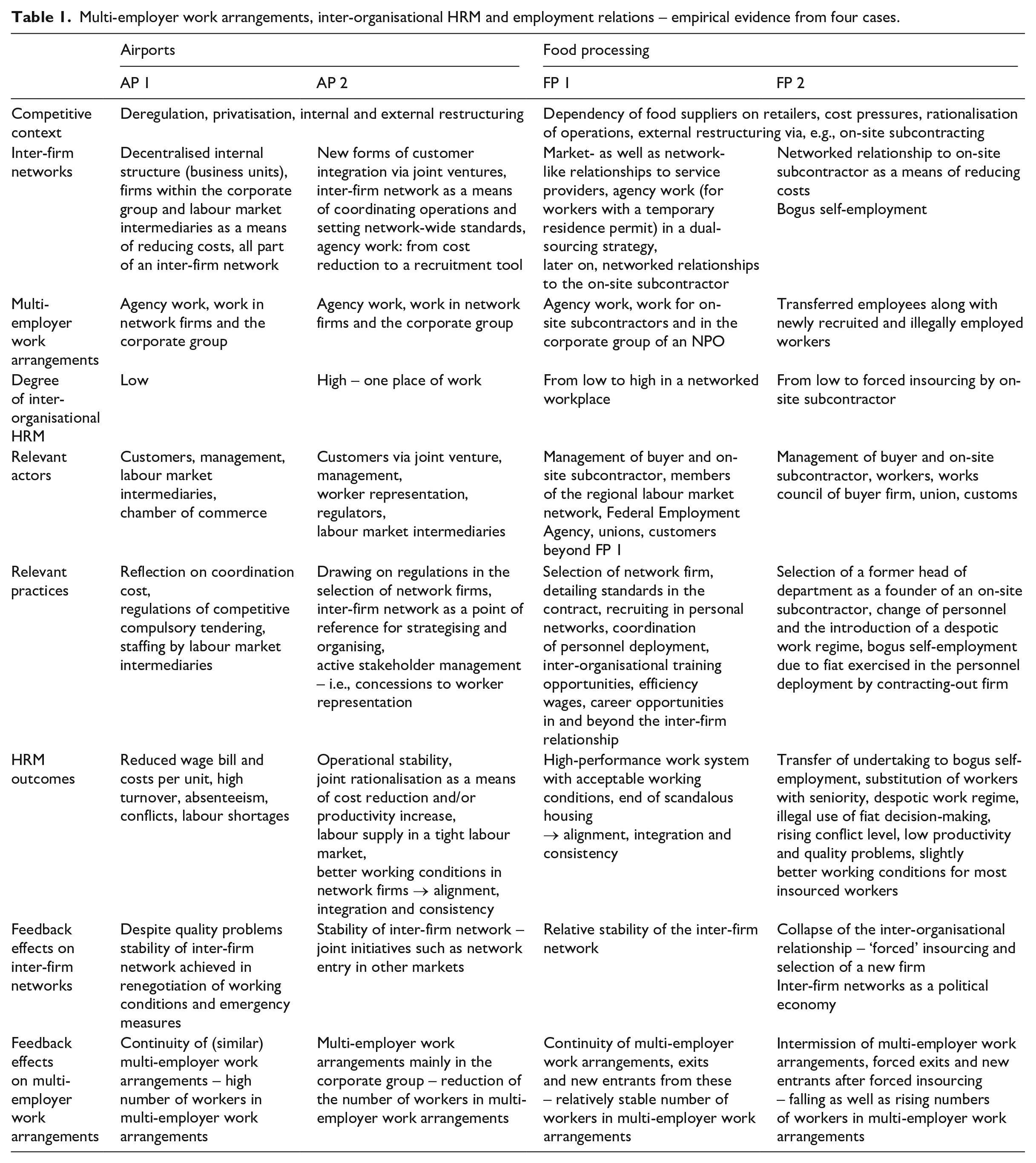
The practice of inter-organisational HRM is shaped by forms of inter-firm network governance and practice. Such decentralised organisational forms, combined with cost-centred strategies, are more likely to bring about a low level of inter-organisational HRM. Views, legitimisation needs and organisational interests are shaped to some extent by managers and reflected in organisational designs and incentives (AP 1, FP 2 and, at the beginning, FP 1). A higher degree of network awareness and network orientation (AP 2, and later FP 1), which also represent a higher degree of reflection on external stakeholders’ expectations or responsibility along the value chain, can contribute to a reflexive inter-organisational HRM. In this development, worker representatives can play a crucial role (for example, as at AP 2) or at least accommodate its development in the background (FP 1). Cooperative employment relations are more appropriate to promote inter-organisational HRM (formerly AP 1, AP 2, later FP 1).
Our cases reveal a variety of multi-employer work arrangements. They are the result of different combinations of third-party employment, only partly reflected in the still predominantly firm-centred conceptualisation of HRM (Lepak and Snell, 1999). These arrangements range from agency work via forms of work in subsidiaries and bogus self-employment to subcontracted work. Our cases thus represent a specific selection that could and should be complemented with cases analysing the role of supply chains for inter-organisational HRM and employment relations (for example, Gold et al., 2020; Helfen et al., 2018). But multi-employer work arrangements cannot be fully understood if their social embeddedness in networks of regional labour market actors and possibly in global structures of value creation is not taken into account, because these provide orientation for resource allocation practices and usage, for instance.
Inter-organisational HRM practices are the result of the recurrent activities of multiple stakeholders, enabled and constrained not only by the structures of the organisations involved but also by the inter-organisational network created and the existing institutional field. The focal organisational actors are, as expected, worker representatives (if any) and, in particular, the management of networked firms. But we also find external stakeholders such as state agencies or service providers involved in these practices. This explains, at least partially, the specific challenges of inter-organisational HRM, because these organisations must coordinate with one another, at least to some extent.
Inter-organisational HRM practices are shaped by organisational actors who draw on different kinds of structures, i.e., on resources and rules, in particular views and ways of legitimising action. Contracts, for example, as in the cases AP 2 and FP 1, provided a gateway for the introduction of HRM practices. The reflexive monitoring of relations and the opportunities and threats associated with them are also important. Such processes can result in a higher level of inter-organisational HRM. Self-binding rules such as CSR regulations can also contribute (FP 1) to this development. We also find forms of bogus self-employment that are part of an approach to inter-organisational HRM which turns out to be illegal. Whistleblowing has been used to combat this. Because such practices are hard to investigate because many organisational actors have an interest in hiding them from the public, it is difficult to measure the extent of their diffusion.
Our empirical evidence shows that worker representatives can play a crucial role in the introduction of inter-organisational HRM. Table 2 summarises their network awareness and orientation, the relevant actors and their practices.
Multi-employer work arrangements, inter-organisational HR management and employment relations – perspectives of worker representatives.
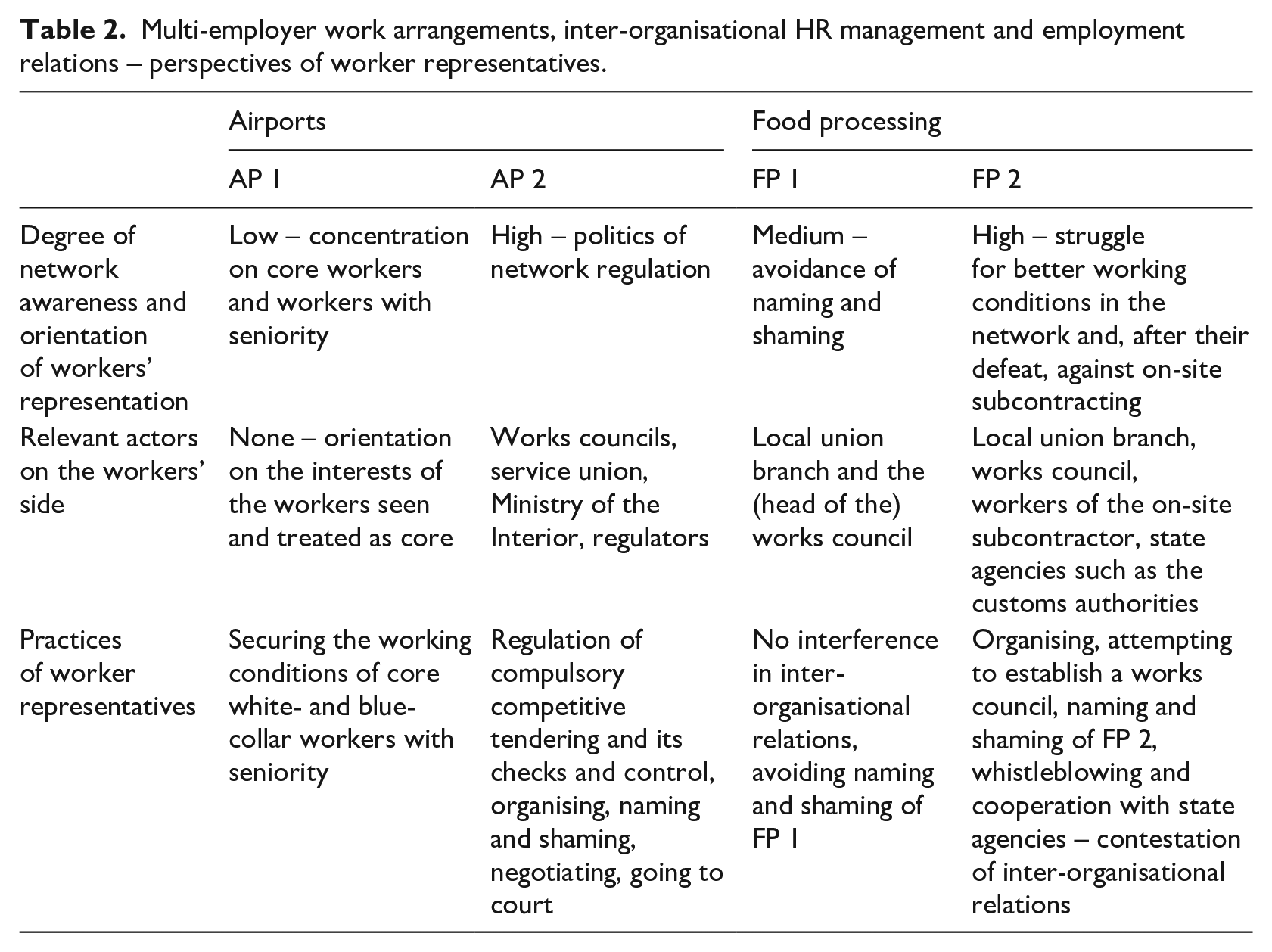
Worker representatives exhibit – and this accords with many other studies (for example, Anner et al., 2022; Benassi and Dorigatti, 2020; Berthod et al., 2021; Helfen et al., 2020; Hertwig et al., 2019) – differing degrees of network awareness and, based on this, network orientation in their practices. In our four cases the practices include the following: a profound ignorance of workers embedded in inter-organisational relations (AP 1); reflexive monitoring of the HRM practices in these relations (FP 1) and the integration of the workers in networked firms in worker representatives’ activities (AP 2); and an active struggle against working in inter-firm networks (FP 2). These practices are developed mainly by works councils and the respective industry-wide union. But organisational actors beyond the inner circle of employment relations – such as the customs authorities or the Federal Employment Agency – are involved and important as well. Core actors form temporary, project-based coalitions and networks with these actors – which are outside the inner circle – for this purpose.
We also see that worker representatives can represent the interests of workers in inter-firm networks and in doing so they can also shape practices of inter-organisational HRM. As such, worker representatives have started to develop network bargaining (Anner et al., 2022). They may even promote forms of inter-organisational HRM and thereby actively influence working conditions. But we have also shown that the potential here is far from being exhausted. Therefore, trade union training programmes and interactions within the union(s) can contribute to the development of a higher network awareness and orientation and of more reflexive interventions in inter-organisational HRM. In this way, worker representatives can shape the extended internal labour market, at least to some degree. This might prove to be crucial because workers’ status as ‘in’ or ‘out’ might change more quickly in the future.
Conclusions: implications and further research needs
In this article we have explored how, by whom and to what extent and degree practices of inter-organisational HRM have been introduced, shaping – and being shaped by – employment relations more generally. We also sought to explain why organisational actors have often failed to devise adequate responses to the challenges of multi-employer work arrangements. We have also shown how employment relations and HRM could be adapted to the new inter-organisational realities. This depends on the degree of network awareness and, based on this, the network orientation not only of managers but also of unions and works councils.
We grounded our theoretical development in two illuminating empirical examples: ground-handling work at airports and on-site subcontracting in logistics in the food industry. In both examples, our practice-based perspective helped us in carrying out both an analysis of the inter-organisational HRM and employment relations and an analysis of the interplay of both with the inter-firm networks under scrutiny. None of the firms we looked at performed its service activities within the boundaries of a single organisation alone. Despite this common characteristic of multi-employer work arrangements, we found different outcomes depending on the quality and degree of inter-organisational HRM and employment relations. Our framework assisted us in identifying and explaining this divergence in outcomes and helped us to illustrate how management and worker representatives do or do not adapt to networked service delivery.
In a nutshell, we observe how different practitioners promote divergent practices of inter-organisational HRM and employment relations to different degrees and are supported in this by different structures, i.e., rules and resources. These practitioners range from management and worker representatives directly involved in the respective service provision to interested state agencies and other parties external to the network in question. These external stakeholders differ in the pressure they exert on practice. Apart from a multitude of external stakeholders beyond management and worker representatives, we also reveal a wide array of practices on the management side as well as on the workers’ side. Crucial differences in the respective practices emanate from the degree of actors’ network awareness and orientation.
In our view, this result has practical implications for management and worker representatives alike. Apart from taking the network dimension of HRM more seriously, management could benefit from open social dialogue and collective bargaining with worker representatives about the opportunities and threats, as well as the strengths and weaknesses of their networks’ inter-organisational HRM practices. This might lead not only to higher network awareness and orientation in a single firm, but also to more reflective practices across the network.
Our cases also reveal how worker representatives can participate in introducing inter-organisational HRM and thereby ensure more decent working conditions benefiting the network. In this process, and depending on their network orientation, worker representatives face opportunities as well as limitations. Those worker representatives who engage with inter-firm networks can contribute to the spread of (more) decent working conditions. With practices like naming and shaming, unionising workers (also, in the network), whistleblowing on illegal practices, and seeking the support of state agencies they can build pressure on the networked firms to improve working conditions. Nevertheless, there will also be worker representatives who concentrate on the internal labour market, ignore externalised workers, and neglect the long-run repercussions for what they see as their ‘core’ constituency.
In conclusion, multi-employer work arrangements do not bring about a new ‘one best way’ of organising (work) and managing workforces. In some segments of the economy, we already observe trends towards reintegration of production (for German manufacturing see Jaworeck et al., 2024). It is too early to tell whether this reintegration indicates a departure from the ever expanding ‘networking’ of the last three decades. On the one hand, we observe an expansion of rather radical forms of multi-employer work arrangements such as the gig and platform work; on the other hand, the more recent supply chain disruptions, and labour shortages – sometimes associated with a looming ‘polycrisis’ – may strike a new balance between hierarchical integration and the contracting-out of work.
Against this background, our analysis also pinpoints the need for future research. In our article, we compared locally bound inter-firm networks at one (short) period in time in one country. Of course, more studies based on more cases are needed that widen the scale and scope by examining other institutional, organisational, and temporal settings. In addition, a closer look at inter-firm networks up- or downstream of the value chain is advisable, especially in cross-border and trans-sectoral settings. Similarly, fresh insights can be generated where the study of multi-employer work arrangements is extended to the individual level, for example by contrasting highly qualified workers’ views and conditions with those in essential, but nevertheless precarious jobs.
Given the spread of multi-employer work arrangements, all these extensions of research bear the potential to inform the debates around the appropriate shape of future labour regulation beyond ‘individualised’ labour ‘regulations’ based on the market power of both sides of the contract. Already, the network-adequate scope and network-related potential of collective action and collective bargaining is an under-researched topic. Similarly, how legislators and state(s) can effectively intervene and at what level by generalising and enforcing minimum standards of industrial citizenship in the ‘fissured workplace’ (Weil, 2014) is not well understood. Even more so, where there is also a risk involved that working conditions may become politicised to the extent that they depend on changing political majorities. Summing up, our plea for future research can be read as an affirmation of the recent calls for enriching the study of work and employment by asking questions about inter-organisational relations, and vice versa (Grimshaw et al., 2023).
Footnotes
Funding
The empirical data for our case studies were gathered in two distinct projects funded by the Hans-Böckler-Stiftung, Düsseldorf, Germany: The project ‚Dienstleistungsnetzwerke im Luftverkehr‘ (Freie Universität Berlin, Grant number: HBS 2014-741-2) and the project ‚Praktiken der Onsite-Werkvertragsvergabe in Deutschland‘ which was proposed by a group of researchers of the Institut für Arbeit und Qualifikation at the University Duisburg-Essen [Grant number: HBS 2014-808-18].