




Abstract
This article argues that key avenues to improve working conditions – value chain integration, on the one hand, and lead firms’ compliance processes, on the other – have not resulted in improvements in the European apparel industry. Evidence is drawn from economic and social up-/downgrading trajectories in major apparel producing countries as well as a case study on social audits and labour market enforcement in the United Kingdom. Both suggest that institutions to prevent labour exploitation in supply chains have largely been ineffective. Institutional experimentation, which has been hybrid in combining hard and soft law as well as public and private governance elements, underlined the role of lead firms but continued to exclude civil society actors. It is argued that human rights due diligence, at the heart of many institutional experiments, draws on a deficient private compliance model, rather than building in worker-driven elements that could lead towards a better alternative.
This article examines the search for institutions to improve work and employment conditions in the European apparel value chain and argues that key avenues of experimentation in global labour governance have not resulted in material progress in working conditions. The last decades have seen ambivalent trends in that fundamental norms have been backed at the United Nations (Human Rights Council, 2011), the International Labour Organisation (ILO, 2022b [1998]), or the Organisation for Economic Development and Cooperation (OECD, 2011 [1976]), norms that have been referenced by many multinational enterprises (MNEs) and multi-stakeholder initiatives. By contrast, from the perspective of supply chain operations, the enormous expansion of the private market-based compliance model, with social audits as their main instrument, is designed to address lead firm risks rather than build institutions that further human and labour rights (Kuruvilla, 2021; LeBaron et al., 2017). The economic interests of public and private actors in different tiers and locations of the value chain tend to override concerns of social compliance, often creating ‘empty spaces at the point of implementation’ within hybrid forms of governance (Bartley, 2018; Tartanoglu Bennett et al., 2021). Thus, the enforcement of human and labour rights along supply chains and access to remedy remain key concerns. In fact, the social compliance model seems to have given licence to business practices that accentuate exactly those conditions the former seeks to detect and remedy (Anner, 2019; Hammer, in press).
The article assesses three avenues to improve working conditions – upgrading through value chain integration, a hybrid context of private market-based compliance and public employment standards enforcement, and human rights due diligence (HRDD) – and makes three contributions. First, the potential civilising role of value chain integration and economic and social upgrading is considered. In this regard, one would expect established European producers to have offshored labour-intensive production and concentrate on higher value-added functions (Gereffi, 2018) while Central and Eastern European (CEE) producers might have benefited from joining the Single Market. The article shows, however, that apparel producers in the pan-European market have not been able to upgrade either in economic or social terms, even though their respective trajectories are very varied.
Second, the article analyses a hybrid combination of private market-based compliance, on the one hand, and public employment standards enforcement on the other. The former model is heavily underpinned by third-party verification of working conditions in the apparel supply chain and has widely been shown to have failed, fraught with conflicts of interest, unable to detect key risks and violations of human and labour rights, and failing to improve overall working conditions (Clean Clothes Campaign [CCC], 2019; Kuruvilla, 2021; Locke, 2013). Taking this research further, a case study from the UK demonstrates how ‘empty spaces at the point of implementation’ prevent workers from accessing their rights ‘even’ in institutionally developed economies of the North.
As a third avenue, the potential of the European Commission’s (2022) draft Directive on Corporate Sustainability Due Diligence (CSDD) is explored in the context of the labour governance challenges the European apparel value chain poses. While Human Rights Due Diligence (HRDD) frameworks’ legal requirements to monitor, report, prevent and mitigate potential and actual adverse impacts of businesses within their supply chains have been met with cautious expectations, this article analyses the implications of Corporate Sustainability Due Diligence (CSDD) from an employment relations perspective. Given the lack of social upgrading within the European Union’s apparel value chain, and the failure of social auditing and public labour standards enforcement, the CSDD draft Directive does not seem to include levers that could build capacity and democracy at the workplace. The limitations of the CSDD framework are clearly highlighted against key principles and examples of worker-driven labour governance.
The following sections analyse improvements in working conditions in the above three avenues in turn before arguing for the need to integrate worker-driven institutions in supply chain governance in the conclusion.
Value chain integration and downgrading
The European apparel industry has undergone considerable geographical restructuring at the same time as its economic and social trajectories mostly saw a further entrenchment of dependent production on its periphery. The last decades offer an interesting case of (European and) value chain integration as key CEE and Mediterranean countries emerged as important producers. An overview of these shifts as well as the economic and social trajectories of the industry suggests, however, that value chain integration in itself did not lead to social upgrading.
The rise of China and Bangladesh as key sourcing locations for European apparel, accounting for 45 per cent of EU-15 apparel imports 1 in 2020, has hidden a number of structural changes within the European market and its nearby producer markets. A first look at the evolution of trade patterns highlights the doubling of Asian producers’ share of EU-15 imports (see Table 1) as well as the step change in trajectories in the wake of the phasing-out of the Multi Fibre Arrangement (MFA) in 2005.
Total EU-15 apparel imports, regional shares.
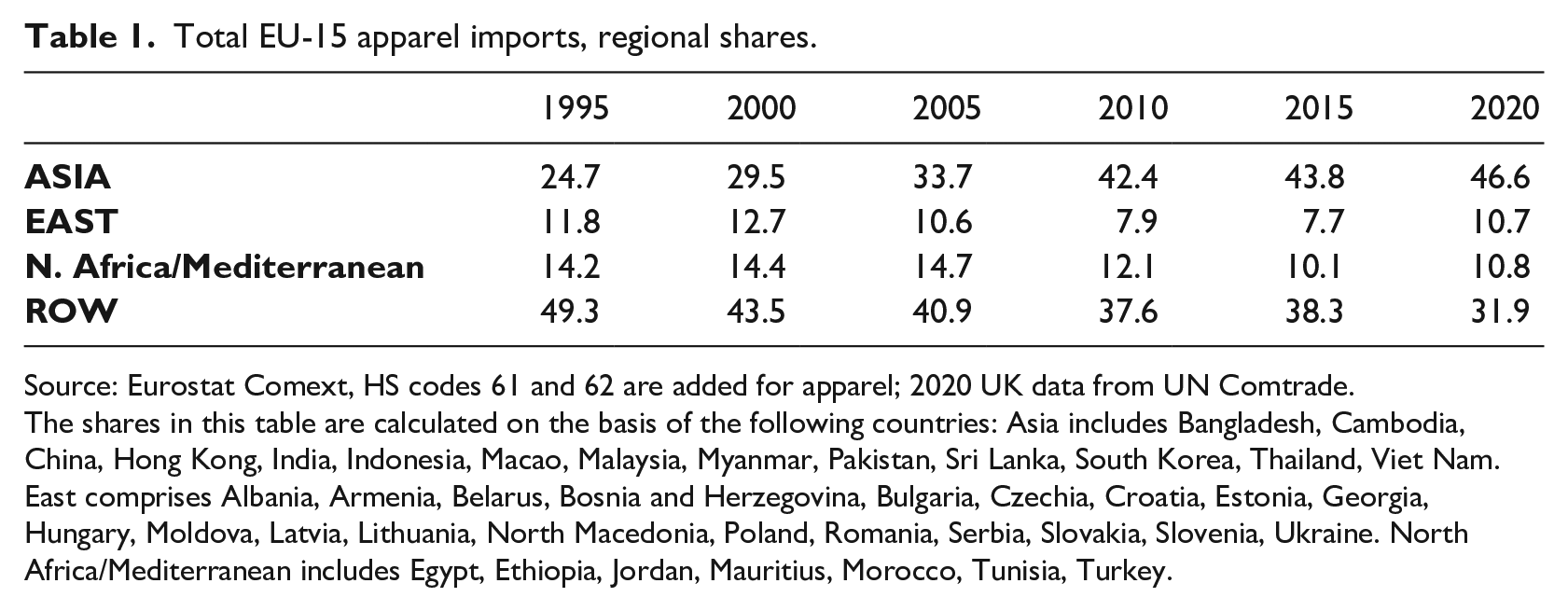
Source: Eurostat Comext, HS codes 61 and 62 are added for apparel; 2020 UK data from UN Comtrade.
The shares in this table are calculated on the basis of the following countries: Asia includes Bangladesh, Cambodia, China, Hong Kong, India, Indonesia, Macao, Malaysia, Myanmar, Pakistan, Sri Lanka, South Korea, Thailand, Viet Nam. East comprises Albania, Armenia, Belarus, Bosnia and Herzegovina, Bulgaria, Czechia, Croatia, Estonia, Georgia, Hungary, Moldova, Latvia, Lithuania, North Macedonia, Poland, Romania, Serbia, Slovakia, Slovenia, Ukraine. North Africa/Mediterranean includes Egypt, Ethiopia, Jordan, Mauritius, Morocco, Tunisia, Turkey.
A second look at the underlying data, however, also shows how traditional producers persist as key sourcing hubs. Earlier research on the delocalisation of production and the reconfiguration of trade patterns has highlighted parallel trends of divergence and persistence in the European clothing industry (Pickles and Smith, 2011), an assessment that still holds 10 years later. In fact, amongst the 20 countries under the ‘East’ label in Table 1, 11 have held or increased their EU-15 import share while nine saw their share decline. However, such broad trends obscure a range of different dynamics and underlying factors in the respective countries, discussed in more depth in recent research on established and emerging producers in Eastern Europe and North Africa (Pickles and Smith, 2011; Plank and Staritz, 2015; Rossi, 2013).
Aiming to gauge the quality of value chain restructuring, the debate on economic and social upgrading has tried to go beyond some of the ambivalence of trade patterns. A declining import share, for example, may point to a decline in competitiveness (for different reasons), a strategic choice to focus on low(er) value market segments (see e.g. Pickles et al., 2006), or a shift to different value chains (that allows higher added value capture; Gereffi, 2018). In this vein, the distinction between different forms of economic upgrading – shifts to higher value activities through process, product, functional or chain upgrading – is able to differentiate a range of dynamics at industry level as well as firm-level strategies. Attention to social upgrading, by contrast, aims to investigate labour as an actor (rather than a production input) that is socially embedded, as well as an actor that shapes industry trajectories at firm as well as industry level. The concept of social upgrading focuses on improvements in the ‘employment, standards and rights at work, social protection and social dialogue.’ (Barrientos et al., 2011: 324) There are a number of well understood points of caution within upgrading debates relating to conceptual issues such as the differentiation of different types of upgrading and the shift from firm- to regional- or industry-wide upgrading (Bernhardt and Pollak, 2016; Milberg and Winkler, 2011; Tokatli, 2013), as well as theoretical questions about the generalisability of upgrading and its value in analysing capitalist development (Selwyn, 2013). This article draws on upgrading trajectories in a descriptive sense, in the first instance, to underpin the analysis of institutions within the apparel value chain below. Furthermore, there are valid points regarding the quality and completeness of data concerning, for example, the way aggregating commodity classifications affects the calculation of unit values or how employment and wage data from the formal sector present a favourable picture of countries with high levels of informality.
This article develops a stylised picture of up- and downgrading trajectories within the orbit of European apparel markets. In this vein, it follows Bernhardt and Pollak’s (2016) parsimonious approach and investigates import and export data for selected apparel categories as such data tend to have very wide and detailed coverage. Central to measuring economic up- or downgrading is the relation between relative changes in unit values and market shares. A higher unit value compared to competitors can be the result of higher input costs and inefficiencies or of successful upgrading. The actual trajectory becomes more conclusive if read against the development of market shares. Similarly, improvements in work and employment conditions have many relevant dimensions and can certainly not be read off a single indicator. Limited comparative data availability restricts this analysis to one of real wage developments in the context of changes in employment.
Extending Bernhardt and Pollak’s (2016) analysis, this article investigates trajectories in five-year intervals (1995–2020) for six countries (three within the EU, three bordering the EU). This allows a deeper insight into the actual dynamic of up- and downgrading trajectories than a more linear shift that might be suggested by looking at the start and end points only. For the purposes of this analysis, economic upgrading occurs if a country increased its import unit values to the EU-15 relative to the industry average and increased its EU-15 import share. Social upgrading is defined as a country experiencing an increase in real wages as well as employment in its apparel industry. Downgrading, conversely, requires decreases in these indicators. Data for the period 1995–2020 are from Eurostat’s Comext database, the UN’s Comtrade database, as well as UNIDO’s Indstat database. The start of a trajectory is marked by a dot and the country abbreviation in Figures 1 and 2 whereas the end is indicated by an arrow. 2
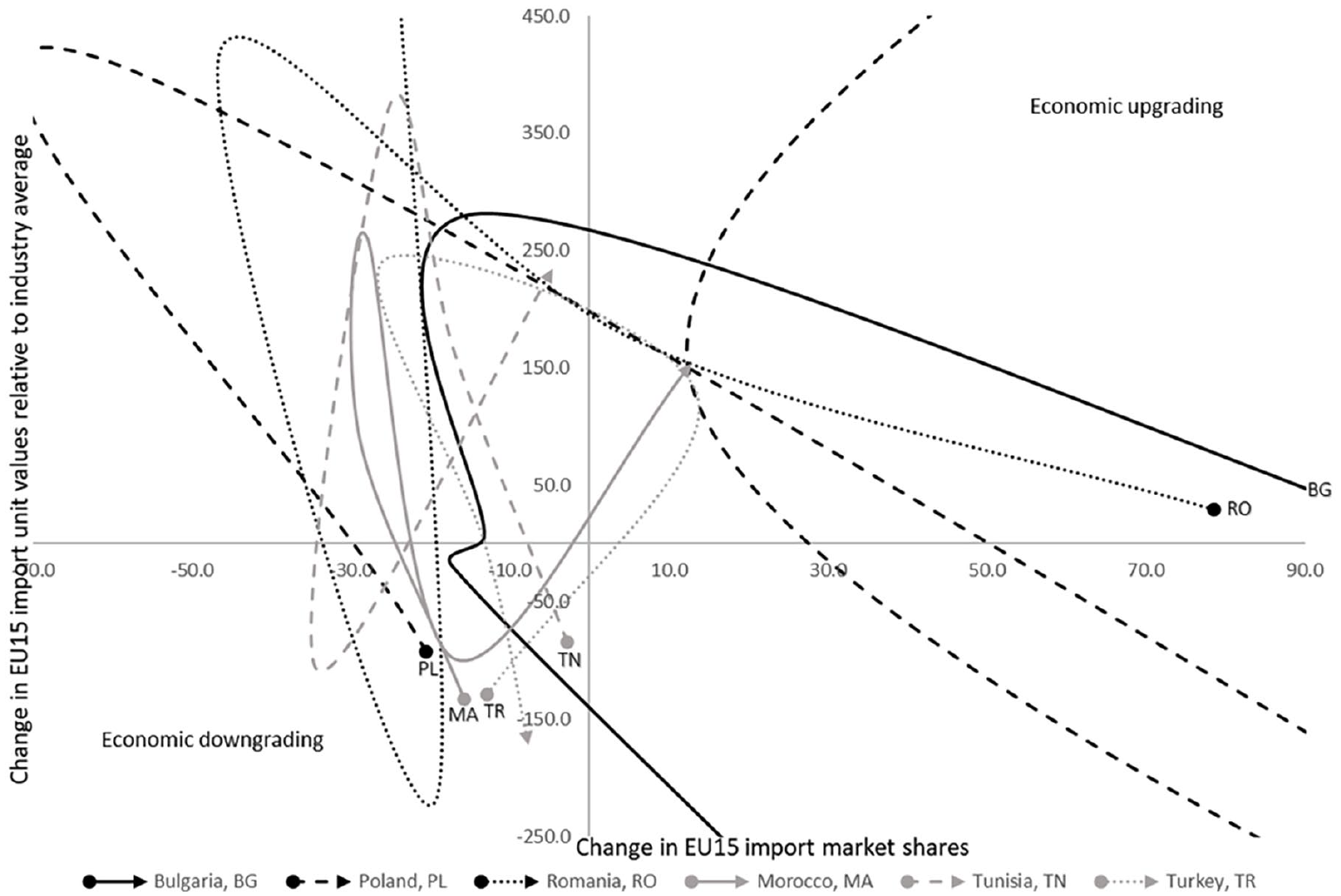
Economic up- and downgrading in the apparel GVC, 1995–2020.
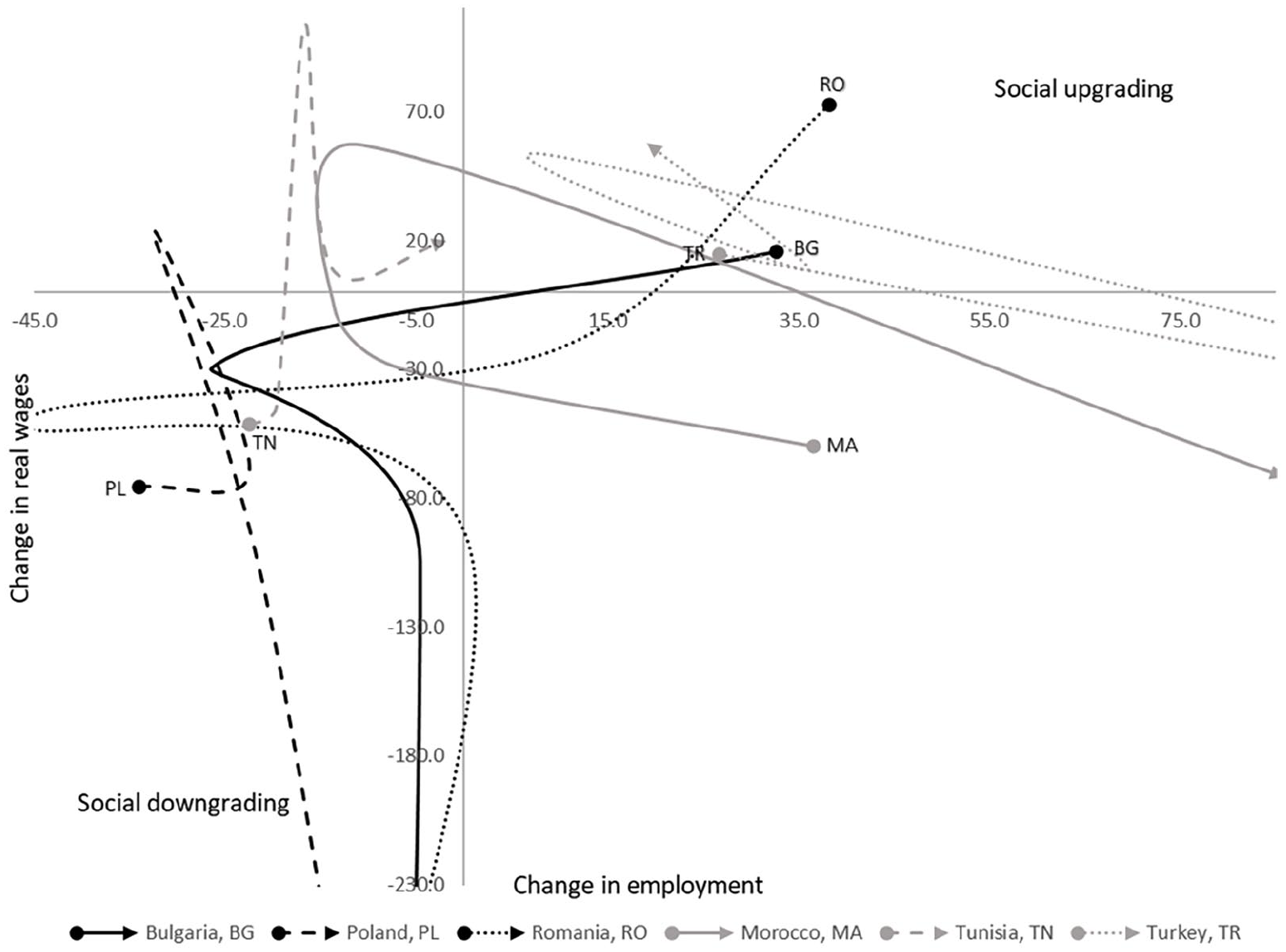
Social up- and downgrading in the apparel GVC, 1995–2020.
The figures on up- and downgrading clearly underline the complex and specific trajectories as regards economic and social parameters. The central message from Figure 1 is that no country was able to maintain continued success in the form of an upgrading trajectory. In fact, any move upwards seems inherently unstable. On the other hand, no country moved exclusively in the quadrant that denotes economic downgrading. The majority seem to struggle in this competitive market, in most cases only able to increase either unit values or the market share, and that only temporarily. Bulgaria, Romania and Poland all exhibit declining market shares early on before their trajectories diverge: while Bulgaria recovers some market share at the cost of lower unit values, Romania was able to increase unit values but was left with a lower market share. Poland saw its market share and unit values rise and fall across various periods, although rarely at the same time. What is striking for Turkey is that, while it broadly was able to increase its unit values, its trajectory shows a number of inflection points such that the 2020 end point is not far from where it started in 1995. It remains to be seen to what extent Tunisia and Morocco can build on progress in economic upgrading.
These economic trajectories come into a stronger contrast if analysed against the social trajectories. While Bulgaria and Romania started out in the social upgrading quadrant, with Poland in the social downgrading quadrant, all their apparel workers had to experience drastic declines in their real wages. All those countries’ end points as regards real wages are off scale, yet Bulgaria’s is particularly striking as its real wage decline is three times that of Romania and Poland. Any economic upgrading appears to come at the cost of social downgrading. While Poland moved into the economic upgrading quadrant, it seems to have achieved this on the basis of both falling real wages and falling employment. Bulgaria’s path is characterised by economic and social downgrading, whereas Romania maintains an EU-15 market share as a social downgrader. This confirms case-study research that pays close attention to uneven industrial and institutional developments: Plank and Staritz (2015) show how Romania’s apparel industry became set in a dependent model that resulted in functional downgrading. This development was, however, accompanied by process and product upgrading, before market diversification and back-shoring to poorer regions within Romania helped to grow its market share again over the last 10 years.
Real wage declines in Turkey, Tunisia, and Morocco, if at all, are much more modest. In fact, real wages slightly increased in Tunisia (in the context of rising unit values) which did, however, not increase employment. Morocco has moved towards the economic upgrading quadrant, showing large increases in employment but experienced real wage decline. The latter two countries’ overall trajectories might point to their emerging competitive position as near-sourcing locations for large European consumer markets. The largest exporter to the EU-15 from the Mediterranean area, Turkey, has moved through all quadrants as regards economic up- and downgrading, only to end up in the downgrading area which is where it was in 1995. However, Turkey has remained in the social upgrading quadrant over large parts of this period (at least as far as formal employment is concerned).
What the analysis of these pathways shows is first and foremost the complexity and unevenness of economic and social trajectories in the apparel global value chain (GVC). No country can be considered an unequivocal upgrader, that is, increasing both the economic and social indicators. Importantly, any notion that social upgrading is carried by value chain integration or economic upgrading is highly problematic.
It should be emphasised that some of the above trajectories would shift even more towards downgrading if the informal economy could be taken into account. Furthermore, the analysis above not only emphasised the non-linear nature of trajectories, it also revealed numerous U-turns in both the economic as well as social dynamics, suggesting major political and institutional factors. In order to assess drivers and causalities behind the configurations of economic and social dynamics – from dependent development (Pickles et al., 2016; Plank and Staritz, 2015) to inflected trajectories – a more embedded institutional and political economy perspective is indispensable. The analyses above can therefore only constitute a point of departure.
Creating governance gaps in hybrid institutions: social compliance in supply chains
Lead firms’ supply chains offered another avenue to improve working conditions in global sourcing networks, primarily through a compliance model that promised continued business relations in exchange for adherence to lead firms’ quality standards, be they technical, operational, or social (Kuruvilla, 2021). The ‘governance gaps’ that emerged as production networks spread into different localities were meant to be filled through a private market-based compliance regime that often anchored its fundamental aims in the ILO’s (2022b [1998]) core labour rights conventions but operationally remained entirely at the discretion of private actors (mostly individual lead firms as well as a small number of multi-stakeholder initiatives). The political and regulatory challenges emerging from such governance gaps are highlighted further when they are seen as a deliberate construction of ‘empty spaces at the point of implementation’ (Bartley, 2018; Tartanoglu Bennett et al., 2021) rather than a by-product of shifting economic structures of globalisation.
The tension between competition across space and necessarily place-based value creation is also based on differences in interest between capitals across value chain functions as well as across regulatory spaces. The state remains central in the creation of such differences which also have implications for the monitoring and enforcement of labour standards (Tartanoglu Bennett et al., 2021). The specific labour-rights exemptions for export processing zones come to mind here but, as will be shown below, the hollowing out of employment standards enforcement during austerity is as consequential in the creation of such ‘empty spaces at the point of implementation’. Thus, gaps in global labour governance have emerged as it has taken on a more variegated and multi-level character, and as underlying business models and their associated purchasing practices turned predatory and exerted downward pressures on work and employment conditions (Anner, 2019).
The social audit represents the key instrument of this private market-based compliance regime, having seen an explosive growth since the mid-1990s to reach a turnover of around US$80bn (Kuruvilla, 2021: 3). While there is broad evidence of the ineffectiveness of audit programmes to detect, report and resolve fundamental human and labour rights violations (CCC, 2019; Kuruvilla, 2021; LeBaron et al., 2017; Locke, 2013), this is not to suggest that the flaws are of a technical and design nature. Rather, the audit regime is problematic as it affords the private market-based compliance model legitimacy without much scrutiny. In particular, it allows lead firms to define human and labour rights as their responsibility, and to define their level of accountability and liability. The rise of the audit regime has occurred in parallel with the hollowing out of public labour market inspection systems, while at the same time it is rife with conflicts of interest. Lead firms have the power to set, implement, and enforce their own standards through their supply chain, thereby not only governing their suppliers’ but also their own social and economic terms of conducting business.
Social audits have also found their way into a range of institutional experiments in labour governance. In fact, governments have accorded legitimacy to social audits by endorsing them in legislation (LeBaron et al., 2017), such as the California Transparency in Supply Chains Act (of 2010), the UK’s Modern Slavery Act (of 2015), or as will be shown below, the European Commission’s (2022) Corporate Sustainability Due Diligence draft Directive. This integration into institutional experiments notwithstanding, the crux remains that third-party verification of hard and soft employment standards on behalf of clients bypasses workplace democracy as well as public authority. Auditors do not have sufficient powers to investigate and prosecute and are not able to enforce sanctions. At the same time, auditors as well as suppliers are ultimately accountable to their clients, the lead firms, only (LeBaron et al., 2017). The ineffectiveness of the social compliance model is further exacerbated by the hollowing out of public employment standards enforcement: the likelihood of inspection in UK manufacturing, for example, was once in every 500 years (DLME, 2018: 52) and there was a 1 per cent chance of being inspected in 1000 years in the US (LeBaron et al., 2017: 962).
Alongside the integration of CEE and Mediterranean producers, however, one can also observe a certain persistence of apparel production within the EU-15. The spatial reconfiguration of production networks, for example, weaved historically established local production clusters, local precarious workforces, and nearby consumer markets together to serve the demands of new business models based on the quick turnaround and online sales platforms of fast fashion. Hammer and Plugor (2019) have shown for Leicester (United Kingdom) that these reconfigured spaces of local growth are not founded on competitive business models or work arrangements but, on the contrary, super-exploitation which keeps workers’ wages below their reproductive needs. These trajectories of local production clusters have over decades been drawn into ‘empty spaces at the point of implementation’ (Bartley, 2018) through permissive regulatory, enforcement, and industrial relations frameworks that opened a space for a growing informal economy and practices of super-exploitation.
The boom phase (2010–2017) of Leicester’s small-scale production cluster was based on routine wage theft, a disregard for working conditions, as well as an organisation of the labour process along sweatshop lines. Grown out of hosiery manufacturing, the industry developed into a support for the fast fashion industry, drawing on a largely South Asian and emerging Eastern European workforce. Leicester’s production regime can be seen as a ‘neighbourhood regime’ in which workers’ families live locally, allowing the intensification of the labour process as well as some flexibility for the female workforce to juggle work shifts with care responsibilities. State benefits (for housing, income support) consequently became part of the wage package, turning elements of de-commodification to aid the further commodification of labour as it underwrote the continuation of informal employment relationships and super-exploitation (Hammer and Plugor, 2019). The state was, in fact, instrumental in developing Leicester’s particular informal economy, with economic development, immigration, social and industrial relations policies shaping the power asymmetry between capital and labour as well as producers and lead firms.
The UK apparel industry, with Leicester as its focal production hub, has proved as rich a terrain for institutional experiments in the wake of exposés of labour abuse as it missed opportunities to strengthen labour governance. While, in the first instance, an undercover investigation as well as research commissioned by a multi-stakeholder organisation (Fashion’s Dirty Secret, 2010; Hammer et al., 2015) created broad awareness and led to discussions at industry level, industry-wide activities were soon relegated in favour of individual brand-level action. With rapidly changing market structures, different business models and perceived exposure to ‘risk’ from labour abuse, it proved difficult to achieve a critical mass of fashion brands who could scale experiments from an organisational to institutional level (Murray et al., 2020). In the absence of a broader compromise, the key institutional outcome at this stage was a more robust social auditing methodology, a methodology whose uptake remained limited, however. This emphasis on social auditing was further reinforced when the introduction of the Modern Slavery Act (of 2015) focused attention away from reputation risks towards due diligence requirements within lead firms’ supply chains.
A second opportunity to strengthen labour governance institutions was missed when the UK government rejected the recommendations made by the House of Lords/House of Commons Joint Committee on Human Rights (Joint Committee on Human Rights, 2017) on ‘Promoting responsibility and ensuring accountability’. This inquiry focused on the implementation of the UN Guiding Principles on Business and Human Rights (henceforth UNGP; Human Rights Council, 2011) and drew, amongst others, on business practices in UK apparel. In its response, the government largely rejected calls for stronger regulation, for example as regards due diligence reporting and enforcement, the licensing of apparel manufacturers, or joint liability within supply chains (Joint Committee on Human Rights, 2018). While the remit of the (now) Gangmasters and Labour Abuse Authority (GLAA), which has police-style investigative powers, had previously been extended to the apparel industry, the government maintained its approach to support voluntary business initiatives, joint responsibility, multi-stakeholder ‘toolkits’ and ‘know-how guides’, and devolved enforcement responsibility to the fragmented institutional landscape of labour market agencies (DLME, 2018: 19).
A third, crucial, opportunity for institutional experimentation arose during the COVID-19 pandemic when online fast fashion retailers experienced a considerable rise in demand which they placed with local manufacturers who could, under observance of specific health and safety protocols, keep producing. The labour rights NGO, Labour Behind the Label (LBL, 2020), published an exposé of violations in Boohoo’s Leicester supply chain which ranged from violations regarding minimum wages, overtime and holiday pay, working time, health and safety, to furlough fraud, underpinned by systematic social auditing failures. This exposé prompted a series of initiatives, from tighter coordination of public labour market enforcement agencies, to systematic GLAA enforcement visits in the garment industry. While Boohoo subsequently tightened its corporate governance and supported various local initiatives through donations, it also evaded stricter audit scrutiny as it shifted most of its apparel sourcing to North Africa.
In contrast to the failure of the private market-based compliance model, industry stakeholders have, however, experimented in developing novel institutions. First, the GMB union has concluded a workplace access agreement with a handful of lead firms through which it can approach supplier workforces for training and capacity building. Second, trade unions and fashion brands helped in establishing the Fashion-workers Advice Bureau Leicester (FAB-L), an independent, low barrier, support centre for workers on a wide range of issues from work, to housing, benefits, immigration and training. FAB-L is located in the midst of diverse worker communities, its approach reflecting the multi-faceted dimensions of precarity workers face, and makes up for some of the cuts in public support services for vulnerable workers. Third, and most ambitiously, the LBL report resulted in intense multi-stakeholder deliberations within the Apparel and General Merchandise Public Private Protocol (AGM PPP). These debates were very far-reaching as they sketched commitments not only on core labour standards but also on lead firms’ purchasing practices, social audit protocols and, crucially, the binding nature of a Joint Responsibility Initiative. While such an agreement would be ground-breaking, progress has stalled as the umbrella of the AGM PPP was wound up in Spring 2023 in favour of a looser structure.
Overall, while industry stakeholders are aware of the shortcomings of the private market-based compliance model and engage in hybrid institutional experimentation, the lack of state involvement in supporting such experimentation and the continued under-resourcing of public labour market enforcement constitute a strategic bias in favour of private market-based compliance and the reproduction of governance gaps. As suggested through the above, limited, experimentations in the Leicester apparel industry, this dynamic also undermines efforts to establish (hybrid) collective institutions at workplace and industry level (Fine and Bartley, 2019; Murray et al., 2020). Ongoing deliberations around the Joint Responsibility Initiative show that any form of a private monitoring-public enforcement model (Fine and Bartley, 2019) remains a distant prospect. The next section discusses how private market-based compliance has received statutory backing, again sidelining the development of participative institutions.
Human rights due diligence: without worker participation?
The launch of the UN Guiding Principles on Business and Human Rights (Human Rights Council, 2011) underlies the linkage of hard and soft law as they established a duty for states to protect against human rights abuses by third parties, for business to respect human rights, and to establish greater judicial and non-judicial access to remedy for victims. The ILO’s (2022b [1998]) Declaration on Fundamental Principles and Rights at Work (1998), which sets out the fundamental labour rights, is one of the instruments referenced by the UNGP. The latter apply to all businesses and have subsequently established the background for a range of initiatives that provide a legal framework for mandatory human rights due diligence (mHRDD), albeit with reduced material scope and/or reach (Deva, 2023) to prevent, mitigate and provide remedy for adverse human rights impacts (see for example the UK Modern Slavery Act (of 2015), the French Corporate Duty of Vigilance law (of 2017), the Modern Slavery Act in Australia (of 2018), or the German Act on Corporate Due Diligence in Supply Chains (of 2021)).
While numerous MNEs and multi-stakeholder initiatives have already committed to such standards, the UNGP and derived frameworks are crucial as they establish HRDD as a central method to identify, prevent, account for, and mitigate businesses’ actual and potential adverse impacts (OECD, 2011 [1976], 2018a). The ILO (2022a [1977]) Tripartite Declaration of Principles concerning MNEs and Social Policy as well as the OECD (2011 [1976]) Guidelines for Multinational Enterprises have been revised to incorporate HRDD processes along the lines set out in the UNGP (Nolan, 2022: 5). As far as HRDD is concerned, a six-step process outlined in the OECD guidelines has become the standard for conducting due diligence: (i) Integrate due diligence into policies and management systems; (ii) identify; (iii) assess; (iv) prevent and mitigate actual and potential adverse human rights and environmental impacts; (v) publicly communicate such efforts; and (vi) provide for remediation, including appropriate procedures for complaints by affected persons, trade unions and civil society organisations (OECD, 2018a).
The European Union developed its own Directive on Corporate Sustainability and Due Diligence (CSDD) which saw substantive improvements between the proposal from the European Commission (European Commission, 2022; see also ETUC, 2022) and the version the European Parliament approved in June 2023. One of the Commission’s own starting points in developing an HRDD framework was the observation that
‘(v)oluntary action does not appear to have resulted in large scale improvements across sectors and, as a consequence, negative externalities from EU production and consumption are being observed both inside and outside the Union. [. . .] Adverse impacts include, in particular, human rights issues such as forced labour, child labour, inadequate workplace health and safety, exploitation of workers, and environmental impacts [. . .]’ (European Commission, 2022: 2).
The European Parliament’s (2023) CSDD Directive aims at establishing a minimum level playing field within the European Union in the face of numerous initiatives at national level, and to limit competition over due diligence requirements and civil liability. It focuses on the human and environmental aspects in referenced international conventions as well as the six steps of the OECD HRDD process. Its scope focuses on EU companies with more than 250 employees and €40m turnover as well as third-country companies generating at least €40m turnover within the EU, with different thresholds for parent companies. Enforcement of the due diligence duty was to be ensured through a combination of sanctions and civil liability. Substantially improving the Commission’s proposal, the text adopted by Parliament also refers to the right to a living wage/income, a much stronger reference to business models (that is, the role of companies’ pricing and purchasing practices), engagement with multi-stakeholder organisations, as well as a more comprehensive incorporation of stakeholder information and consultation across the due diligence process.
Substantial critiques of HRDD, however, have been developed along conceptual, operational and structural lines (Deva, 2023). Three critical points concerning exploitative work practices in global value chains – the process character of HRDD, engagement and consultation, and access to remedy – are briefly discussed in turn.
First, and most fundamentally, in dealing with processes rather than outcomes, HRDD frameworks recognise the vulnerabilities of specific groups of workers and communities as well as the asymmetries in power, information, resources and bargaining position while not addressing them (Deva, 2023: 17). HRDD frameworks specify a process rather than outcomes. Their effectiveness, therefore is not simply a matter of design (e.g. regarding scope, the inclusion of rightsholders, access to remedy) as existing vulnerabilities and asymmetries might, in fact, undermine participation in the process. Even where workers are able to frame their claims with the help of trade unions and civil society organisations (Tartanoglu Bennett et al., 2021), remedy is not guaranteed, neither through the courts at national level nor through HRDD, and is always existentially delayed in the face of the livelihood concerns of apparel workers. A key issue here is that many rightsholders (e.g. across different production relations such as the informal economy or home work) are not even aware of the HRDD process, its significance, opportunities as well as limitations (Deva, 2023; HWW, 2021). Much of the potential of HRDD relies on it being a comprehensive and robust process, that is to say a process that includes workers and rightsholders through all stages of HRDD. Reflecting some of Deva’s suggestions (2023: 7) to address power asymmetries, the Parliament’s text has given greater prominence to ‘meaningful engagement’ throughout the due diligence process, albeit limited to information and consultation:
‘Companies shall in particular inform and consult workers and workers representatives as well as other relevant affected stakeholders when developing a due diligence policy [. . .], when identifying adverse impacts [. . .], when developing action plans or terminating a business relationship [. . .], when prioritising their adverse impacts [. . .], when developing remedial measures [. . .], when establishing a notification or nonjudicial grievance mechanism [. . .] and when carrying out [monitoring and verification; NH] [. . .]’ (European Parliament, 2023, Article 8d(5)).
A second point relates to how specific vulnerabilities and structural asymmetries limit effective engagement and participation. It is concerning that social auditing receives considerable prominence, both in HRDD frameworks as well as in continued business practice. The CSDD, for example, gives third-party verification a central role in managing the risk of adverse human rights and environmental impacts and effectively promotes the social audit as long as it can reasonably be considered appropriate; in other words, as long as it can be considered robust from a technical point of view while leaving untouched the well documented structural problems with private market-based compliance. Further, it is understood that specific sectors come with higher risks of adverse human rights and environmental impacts (and exploitative work practices) and the OECD has therefore designated some of them, such as the apparel and footwear sector, as high-risk sectors (OECD, 2011 [1976], 2018b). While the Parliament’s text, too, now emphasises risk-based due diligence and commits the Commission to develop sector-specific guidelines for textiles and apparel, its scope still excludes SMEs. Against the background of the peculiarities of apparel value chains, it is difficult to see how this scope, together with the way social audits and stakeholder information and consultation are integrated, can generate sufficient transformative bite.
Third, the emphasis on access to remedy was a central innovation within the UNGP, and the text adopted by Parliament, apart from judicial and non-judicial routes, now requires independent notification and grievance mechanisms, and strengthened the role of labour and civil society actors in liability proceedings. States are to ensure that:
‘[. . .] mandated trade unions, civil society organisations, or other relevant actors acting in the public interest can bring actions before a court on behalf of a victim or a group of victims of adverse impacts, and that these entities have the rights and obligations of a claimant party in the proceedings [. . .]’ (European Parliament, 2023, Article 22, 2a(c)).
This formal role needs to be seen against the relatively limited remit of information and consultation of stakeholders in the supply chain where they managed to constitute themselves as relevant counterparts. Information and consultation as well as access to remedy are fraught with particular difficulties given the complex nature of the apparel value chain as well as the failures of public employment standards enforcement (e.g. Hammer and Plugor, 2019; Tartanoglu Bennett et al., 2021). In order to create effective access to remedy, Nolan (2022: 6) holds that institutions must be victim-centric, or in employment relations terms worker-driven (see Reinecke and Donaghey, 2021). According the market-based compliance model a central place within HRDD also carries the risk that abuses could be ‘priced in’ to business conduct, through a combination of symbolic consultation and compensation (e.g. Deva, 2023: 11).
The European Union’s CSDD Directive can be seen as relatively far-reaching as far as mHRDD goes. At the same time, it privileges the ‘market for virtue’ of private compliance and limits the role of labour and civil society to information and consultation. In this respect, it neither sees trade unions and workers as experts when it comes to their own working conditions, nor as integral parties of industrial democracy, but as data sources for third-party verification. A perspective that sees due diligence processes devoid of power asymmetries or conflicts of interest will likely have difficulties in recognising structural asymmetries in GVCs, in each case against considerable evidence (Anner, 2019; LeBaron et al., 2017). The consolidation of private market-based labour governance on top of lead firms’ market power, together with weak information and consultation provisions, is likely to increase rather than reduce gaps in labour governance.
Conclusion: towards worker-driven supply chain governance?
This article argued that institutional experimentation for better work in the European apparel value chain – through the private market-based compliance model, in hybrid combination with public enforcement, or through human rights due diligence – has not resulted in categorical improvements in work and employment conditions. In fact, those institutions are not designed to do so as they do not provide for trade union and worker participation throughout the design, implementation, monitoring and remediation processes that were being considered. Furthermore, even as mandatory HRDD frameworks have emerged, the state remains absent when it comes to backing the development of institutions that could re-balance some of the asymmetries between capital and labour within value chains.
Neither the economic, nor the managerial supply chain avenue have yielded a clear conceptual argument or sufficient empirical evidence of upgrading. On the one hand, there is no clear evidence of upgrading, even for industries that integrated into European apparel value chains while simultaneously integrating into the EU’s social and economic regulatory framework. The upgrading outcomes are not consistent, rather, industries move between positive and negative trajectories, more akin to uneven and combined development than any form of upgrading as a revised development paradigm (see also Bair et al., 2021). On the other hand, ‘institutional fixes’ to prevent, mitigate and remedy labour exploitation and abuse do not seem to have resulted in any categorical improvement either. Rather, novel mHRDD legislation must be considered weak insofar as it strengthens private market-based compliance, a model that is widely seen as deficient. HRDD might further entrench asymmetries between lead firm capital and supplier capital. Kumar (2020) and Anner (2019), for example, respectively highlight the monopsonistic and predatory aspects of apparel value chains. In this context it is even more significant that HRDD does not tackle the asymmetries between capital and labour.
Even though the apparel industry exhibits a low degree of autonomy and experimentation capacities amongst actors in the world of work at the same time as there are tight institutional constraints on organisational experimentation (Murray et al., 2020: 145), the industry has a rich history of institutional experimentation. This includes the examples of private market-based compliance and HRDD discussed above, which have found apparel supply chains as key targets. However, it also includes other examples that provide for distinct worker-driven characteristics such as an episode of triangular collective bargaining in post-war US (Anner et al., 2013), Global Framework Agreements (Miller, 2011), or the Bangladesh Accord on Fire and Building Safety (Bair et al., 2020). In fact, key elements of debates on hybrid governance as well as worker-driven supply chain governance overlap and have become an important reference point for trade unions and civil society organisations in negotiating agreements on supply chain responsibility, accountability, and liability.
Hybrid governance is often based on agreements between worker rights organisations and state agencies on linking private monitoring with effective public enforcement (Bair et al., 2020; Fine and Bartley, 2019). It includes labour as a key actor and driver in the design of the programme as well as the monitoring function and, crucially, is based on public enforcement being effective or standards being legally binding. Worker-driven governance applies to a range of different institutions (FLEX, 2020; Reinecke and Donaghey, 2021) and involves workers across the entire sequence from design to implementation and monitoring while also requiring a binding commitment from lead firms as well as sanctions for non-compliance (also Nolan, 2022).
The promise of such institutional experiments remains fragile, however, as they are threatened by the way the state has retreated and left the terrain to private market actors. This becomes particularly acute when it comes to the enforcement of labour rights: while workers often ‘have’ rights, they lack sufficient space to organise and to pursue routes to remedy (Tartanoglu Bennett et al., 2021). Nonetheless, institutional experiments can alter power resources and collective capabilities in production networks, particularly if leverage is ‘fitted’ well against market structures (Fine and Bartley, 2019) and effectively articulates local and global forms of leverage.
Footnotes
Acknowledgements
I would like to thank the reviewers and special issue editors for their helpful and robust feedback which has prompted considerable improvements.
Funding
This research received no specific grant from any funding agency in the public, commercial, or not-for-profit sectors.
1
For 2020, EU-15 includes data for the United Kingdom in order to aid historical comparison.
