




Abstract

The Directive on fair and adequate minimum wages represents a paradigm shift in EU economic governance. It marks a profound reorientation away from an economic growth strategy that prioritises liberalisation of labour markets and decentralisation of collective bargaining, which has dominated the policy orientation of most EU Member States and the European Commission for at least 20 years. The Directive reinforces the governance and the level of statutory minimum wages in EU Member States. In a second step, the Directive requests that Member States support collective bargaining and find concrete measures to increase bargaining coverage for those countries where coverage is less than 80 per cent. This second aspect is just as relevant to the Directive and even more ambitious than the first. While statutory minimum wages are in the control of governments, collective bargaining is based on voluntary negotiations between trade unions and employers’ associations. The role of governments and public policy towards collective bargaining is limited and only indirect. In this comment I will focus on the latter aspect of increasing collective bargaining coverage, but will argue first that the wider picture of a changing EU growth strategy is important to understand the significance of the shift. I will, secondly, discuss ways of strengthening collective bargaining, with a focus on the German case.
Growth regimes across time and the role of collective bargaining
Strong collective bargaining developed in the context of industrialisation and was fully operational during the era of Fordism and mass production. It peaked during the 1960s when unions forcefully pushed up living standards, while economies were growing strongly. The labour share of GDP was at a historic high and inequality low. The policy focus during that time was full employment and the role of central banks, capital markets and corporate profits rather limited (Blyth and Matthijs, 2017; Hassel and Palier, 2021).
The late 1960s and early 1970s were a watershed for trade union strength and collective bargaining. Tight labour markets, industrial unrest, and rising inflation shifted the macroeconomic paradigm of Western governments. Instead of approving strong unions and collective bargaining, governments started to either fight them (in the United Kingdom and United States) or neglect them (Germany). Collective bargaining and strong trade unions were seen by economists as obstructing economic restructuring, innovation, and flexible adjustment to a new economic regime (Aidt and Tzannatos, 2008).
In western Europe, the decline of unions and collective bargaining was gradual and also not universal, as some countries still successfully managed the transition to a service economy and have maintained high levels of bargaining coverage and strong trade unions. In the Nordic countries, Benelux and Austria, but also in southern Europe trade unions continued to have a strong influence over macroeconomic management. Germany was a special case as the new unified Germany presented a mixed case with the former socialist Länder in the East, and West Germany, where collective bargaining was entrenched.
The response to the eurozone sovereign debt crisis was again embedded in the macroeconomic regime of liberalisation and financialisation. The Troika focused on competitiveness through cost cutting and forced the southern European countries onto a path of export-led growth. Governments who were subjected to the bailout packages agreed to target social spending, minimum wages but also collective bargaining. Collective bargaining coverage in Greece went from 100 per cent in 2011 to 14.2 per cent in 2017 (OECD and AIAS, 2021). However, other southern European countries managed to protect their bargaining systems much better (see Figure 1).
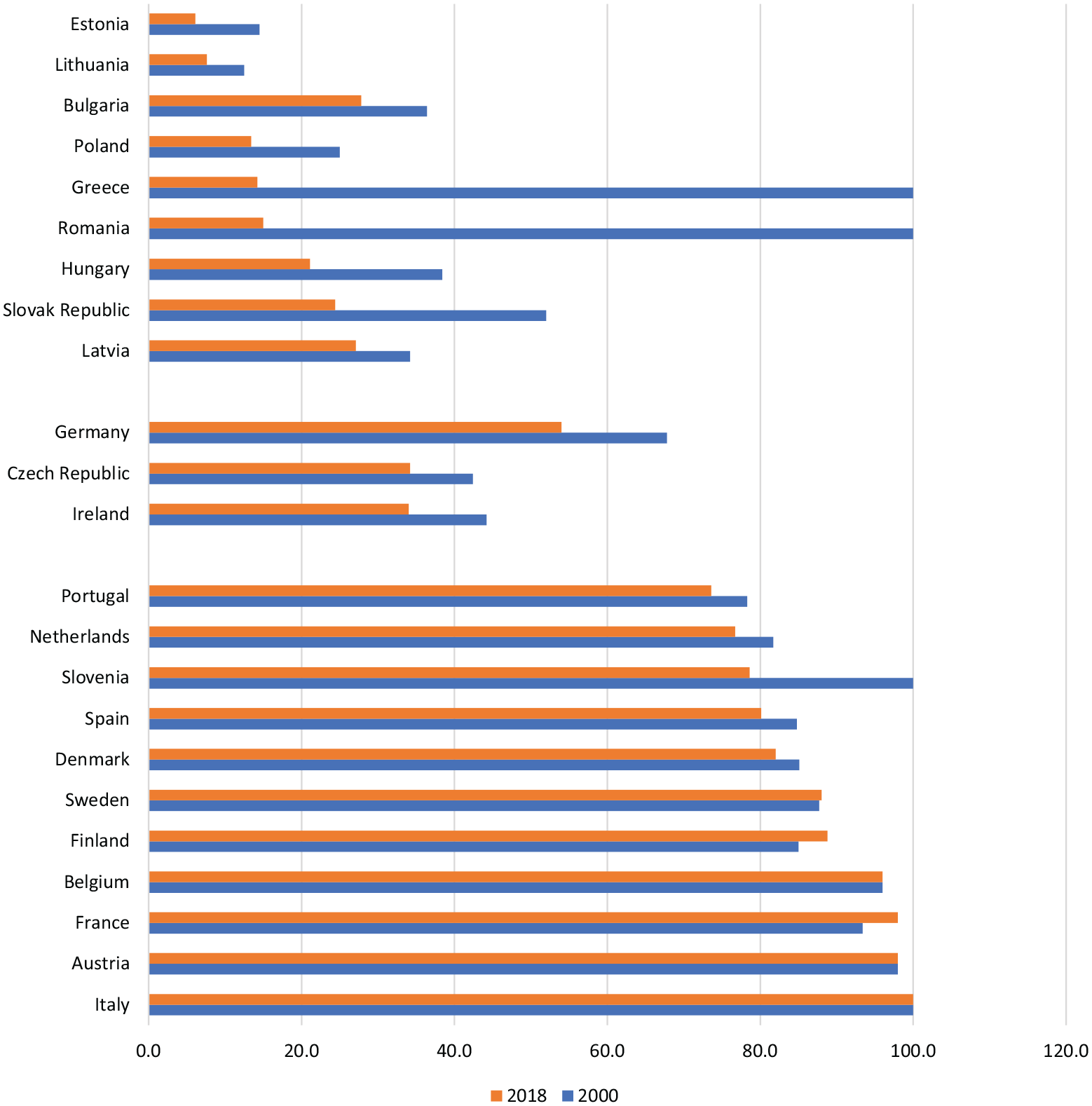
Collective bargaining coverage in EU Member States, 2000 and 2018.
While the shift in the European Commission’s position towards wage bargaining and the social partners is certainly a result of the political friction that emerged between southern and northern Europe during and after the eurozone crisis (exacerbated by the pandemic), it is most likely also part of the emergence of a new growth regime focused on the knowledge economy rather than on inflation control and competitiveness. The success of export-led growth based on cost competition also has its downsides, which have become visible over the past decade. The long low-inflation period, combined with the run-down of public infrastructure, led to high levels of underinvestment in both the public and private sectors. Many Member States started to lag behind in terms of digitalisation. The necessity to mobilise more investment for the green transition prompted a rethinking even among ordo-liberal economists.
Competitiveness based on low wages is not sufficient to restart growth in the EU. This is reflected in recent European Commission programmes, such as the Recovery Plan and Next Generation EU. A new EU growth strategy focuses on digitalisation and decarbonisation as two fundamental priorities. Wages and living standards are also part of the new growth strategy. Given tight labour markets, labour shortages and the need to upskill workers a sound wage structure that does not rely on an exploitative low-wage sector is complementary to an investment strategy in infrastructure, digitalisation and education.
Sound minimum wages and stronger collective bargaining have thereby become part of the EU’s growth strategy in its efforts to master the transition to a carbon-free knowledge economy. The focus on good jobs and higher living standards is not a social policy aim that has to be secured at the expense of other economic policy priorities, but should be seen as part of a new economic paradigm. Collective bargaining has been part of the European social model from its very beginning and has been proven to be the best predictor of lower levels of inequality and higher wages (Scheve and Stasavage, 2009). Supporting collective bargaining can therefore serve as a reference point for policy to make sure that within Member States good and well-paid jobs are part of a growth strategy towards the knowledge economy (Cazes et al., 2019). This does not, however, answer the question of how to increase coverage rates.
How to increase collective bargaining coverage
The Directive calls on Member States to submit National Action Plans to outline how to achieve a collective bargaining level of 80 per cent. This is a challenging task which affects the Member States very differently. We can divide these states into three groups: those with strong collective bargaining coverage, those with low coverage, and those in the middle. For the first group, there are 11 countries with high bargaining coverage above 70 per cent (Figure 1). Four have coverage of more than 90 per cent (Austria, Belgium, Italy and France). Sweden and Finland are above 85 per cent, Denmark and Spain above 80 per cent. Of those close to 80 per cent are Portugal, Slovenia and the Netherlands. Slovenia and the Netherlands have experienced a substantial decline but later recovered. Overall, these countries have stable collective bargaining systems with high coverage. They can look after themselves.
At the other end of the spectrum are the low coverage countries, which are primarily in Central and Eastern Europe (Slovenia and the Czech Republic are exceptions), together with Greece. Here bargaining coverage ranges from 8 to 30 per cent. All but Latvia are on a gradual downward trajectory, but start from different starting points. Hungary and the Slovak Republic started out at relatively high levels of 40 and 50 per cent in the early 2000s. The Baltic states, Romania and Bulgaria but also Poland are at very low levels of less than 20 per cent coverage.
Finally, there is a mid-level group encompassing only three countries: Germany, which is on a gradual downward trend but hovers around 55 per cent, and Ireland and the Czech Republic, which have coverage rates at around 35 per cent.
Collective bargaining coverage is a result of a number of factors, which derive from the wider industrial relations system. There is a wide variety of bargaining systems, ranging from decentralised firm-level systems to comprehensive ones in which bargaining takes place at the economy level. Trade unions and employers’ associations are also diverse. The high degree of diversity allows us a better understanding of the factors that drive collective bargaining coverage. The most important is the level of collective bargaining. Collective bargaining coverage rises with the centralisation of wage bargaining, which intuitively makes sense. If unions and employers negotiate at the firm level, coverage is only for the individual firm and it is harder to increase coverage by negotiating an individual agreement with each firm. If the social partners negotiate at the sectoral or national level it is much more likely that a broader group of firms, if not all, are covered by the agreement (Figure 2). Centralisation correlates with coverage by .88. 1
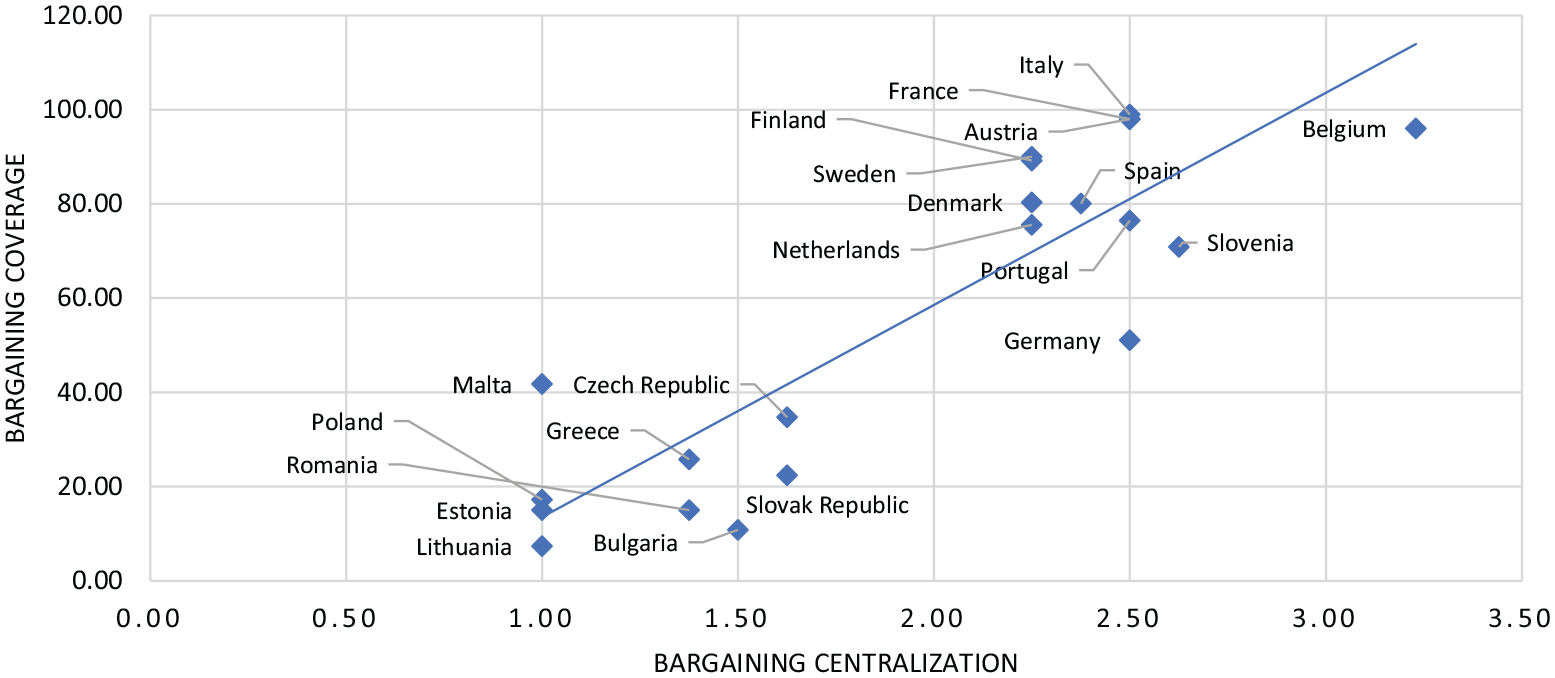
Collective bargaining coverage by bargaining centralisation.
Other influencing factors include the extension mechanisms of collective agreements (correlation coefficient .61), 2 trade union density (.55) but also degrees of coordination and government intervention. These strong levels of correlation indicate that collective bargaining coverage is the result of a system that relies on mechanisms and institutions but also strong actors.
If we treat collective bargaining coverage as an outcome of the wider industrial relations system, it becomes clear that the role of the government is limited. The government can indirectly support collective bargaining by tying public procurement to collective agreements in firms that apply for government contracts. 3 Other policy measures, such as extension mechanisms, can help to support coverage but even those require the acceptance of such measures by other actors and might encounter legal constraints.
Collective bargaining coverage in Germany
Germany is a special case on several accounts. First, Germany is at the geographical heart of eastern and western Europe, combining the legacy of former socialist East Germany with the institutions of corporatist West Germany. In the process of reunification, western institutions were transferred to the eastern Länder but lacked both the economic base (big firms in manufacturing) and the associational strength. Union membership in eastern Germany followed the trend of other eastern European countries and declined rapidly. Both phenomena – weak industrial base and low support for employers’ associations and trade unions – continue to play a role today. Trade unions have not been able to close the gaps with western Germany as regards wage levels and representation.
Second, even western Germany has always been a country of mid-level centralisation. Compared with the smaller Nordic and Benelux countries and Austria, but also the more centralised southern European countries, such as Italy, Spain and France, collective bargaining structures are more nuanced by sectors and regions, and collective bargaining has followed pattern bargaining rather than central decision-making. The DGB as national umbrella organisation does not have bargaining rights and cannot even coordinate between sectoral unions. National-level bargaining is exceedingly rare and confined to special industries, such as banking, the public sector, and railways. West German trade union strength could therefore not be transferred to the eastern Länder easily as regions bargained for themselves. Even the extension of trade union structures to the East in the 1990s did not suffice to build up robust industrial relations structures.
Thirdly, West German employers have actively dismantled collective bargaining coverage by introducing the option of membership of employers’ associations without participating in collective bargaining (OT membership – members without collective bargaining). OT membership was a response to increasing frictions within employers’ associations because suppliers and manufacturers were part of the same agreement, but also the same supply chains. Small suppliers experienced strong cost pressure from manufacturers, which they could not accommodate within existing pay agreements (Günther and Höpner, 2023).
Moreover, employers have started to resist the use of extension mechanisms. The peak employers’ association BDA has a veto right on extension decisions. This is in contrast to other EU countries where the final say lies with ministries of labour. Since 2000, German employers have used their veto actively. This is partly because of a principled stance by employers against increasing state intervention in wage bargaining (Paster et al., 2020). It is also a result of the pressures on German collective bargaining during the 1990s, when firms faced higher costs and fiercer competition in key export markets. The dualisation of the German economy between a competitive export sector and a low-cost service economy meant that employers’ associations made sure that wages in the service sector remained low (Hassel, 2014). As a result, the number of extensions of agreements declined from 146 in 1996 to 38 in 2016 (Günther and Höpner, 2023: 10). This also contributes to declining coverage rates (Figure 3).
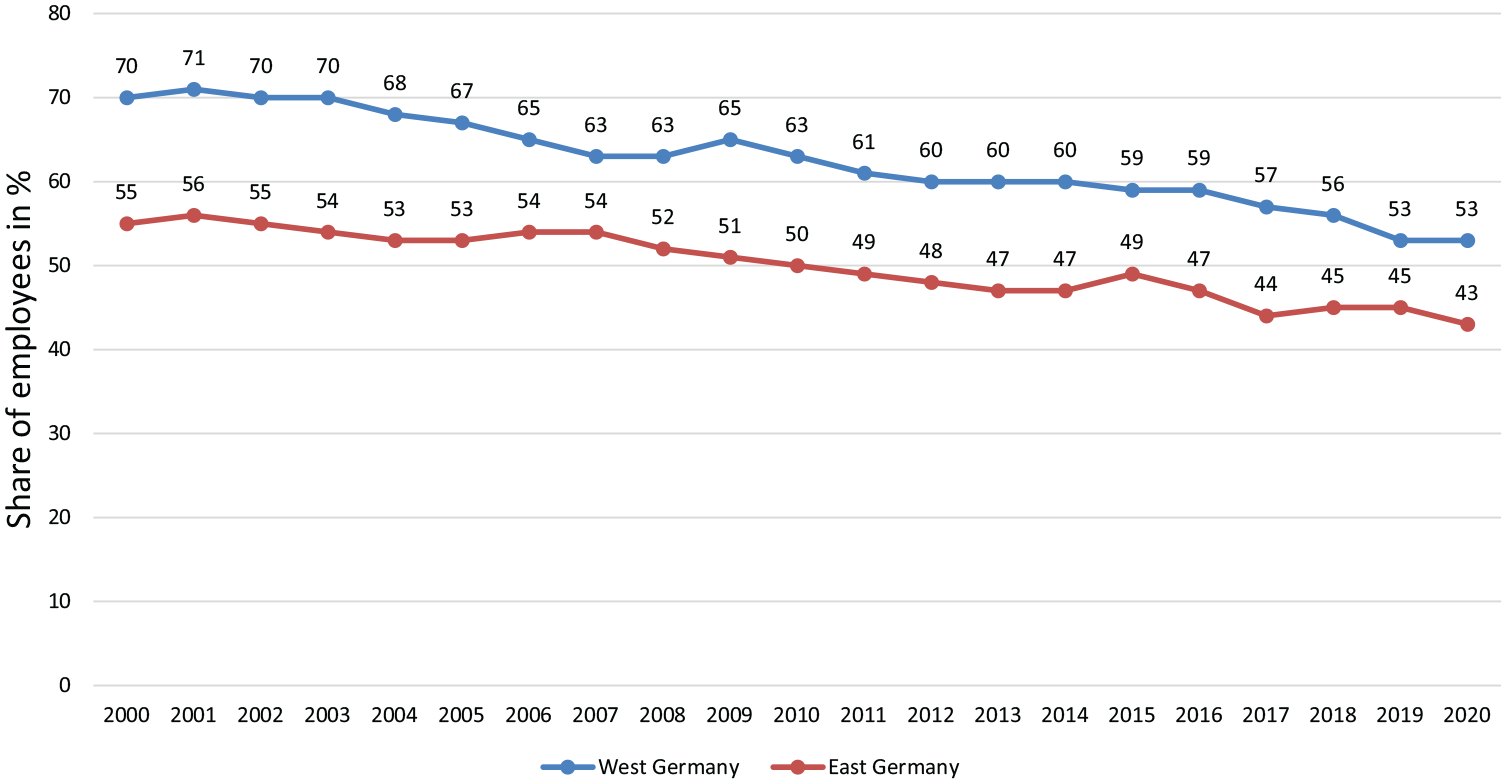
Collective bargaining coverage of employees in East and West Germany, 2000–2020.
In order to increase collective bargaining coverage rates, a national action plan would need to address a number of features, including extension mechanisms, public procurement and strengthening trade unions in general.
First, the veto right of the peak employers’ association in sectoral collective bargaining should be questioned and reformed. Sectoral collective agreements should meet a number of criteria in order to be extended to all firms in the sector. The decision should be made by the social partners in the sector concerned and not be dependent on the support of other sectors as it introduces sectoral and political conflicts into extension decisions. Employers should be encouraged to solve tensions within supply chains by working towards adjusting collective agreements to different levels of ability to pay.
Second, public procurement can and should be used more actively to stimulate collective bargaining. State-level legislation has introduced collective agreements as requirements in tenders for government contracts. About half of German states have now tied public procurement to collective agreements (Schulten, 2021).
Third, collective bargaining depends on trade union pressure on employers to engage in collective bargaining or join an employers’ association. German trade unions have lost members persistently over the past 30 years and only recently managed to stop the decline. At the same time, there has been more support for smaller unions and staff associations competing with the DGB. Legislative changes in 2016 strengthened the role of big unions vis-à-vis smaller ones.
Because trade unions have a weak membership base, an action plan should also encourage unions and employers to work on their membership bases. Employers should be encouraged to give up membership without collective bargaining participation (OT) and instead to facilitate collective agreements that suit all members. Regarding trade union membership, competition between DGB unions and small staff associations should be overcome by more cooperation between union organisations. The government should also engage with smaller trade unions as legitimate representatives of their members and facilitate joint initiatives. Recognising smaller trade unions as competent bargaining actors might mobilise the DGB trade unions to look after their members’ interests more effectively and develop cooperative working relations. The government should therefore support trade union bargaining alliances.
Conclusion
The Minimum Wage Directive is a significant shift in EU policy-making on industrial relations. After decades of liberalisation policies pertaining to labour markets, activation policies and market enhancement, the EU has for the first time moved towards a more proactive and potentially effective protection of the low paid. Moreover, it has also recognised the systemic importance of collective bargaining systems for fair pay and wage inequality.
Stronger wage growth in particular for the low paid is beneficial especially for Eastern Europe in order to prompt stronger convergence of incomes in Central and Eastern Europe and promote stronger catch up of living standards. To build up effective bargaining systems in Central and Eastern Europe, however, is a major undertaking as the social partners are still weak, bargaining structures are decentralised and government commitments to collective bargaining are likely to be hesitant.
Wage bargaining coverage is the result of industrial relations systems. We can identify supporting factors such as bargaining centralisation, the strength of trade unions and extension mechanisms. Further research should look into the role of public procurement for coverage, as well as financial and organisational support for social partners to set up more centralised bargaining structures.
In the case of Germany, the gradual long-term decline of coverage rates is the combined effect of weak sectoral and regional bargaining structures, the weakness of industrial relations in the eastern Länder, trade union decline, the internal conflicts of employers’ associations in manufacturing and employers’ proactive use of veto rights against bargaining extensions. While it will be difficult to remove the veto right, the conditions for its use could be redefined to allow for better practice.
Footnotes
1
Data from the OECD-AIAS database, most recent year available.
2
Extension mechanisms in the EU range from automatic extension (in seven EU Member States) to extensions only in exceptional cases (OECD-AIAS database). There are four categories: automatic, used frequently, used rarely, or no provision at all.
3
While the ECJ’s Rüffert judgment restricted the use of public procurement for wage norms, the ruling was changed after the Regio Post (C-115/14) ruling. The EU also introduced social criteria in its procurement guidelines in 2014, enabling national legislation to act on it.
Funding
This research received no specific grant from any funding agency in the public, commercial, or not-for-profit sectors.