




Abstract

With migrant workers now a structural workforce segment in a number of branches, this contribution summarises opinion research among such workers, in particular on their housing, working and living situations. The COVID-19 outbreak has highlighted the extent to which migrant workers carry out many essential functions in undertakings, albeit without the respect due to them. Many user firms leave the recruitment of migrant labour to their planning department, resulting in an instrumental approach. Trade unions hardly play a role as an agent. As a result, workers are often invisible and unrepresented, while employers glorify the ‘work ethic’ of migrant labour.
Over the past decade, a project team from the Tilburg Law School analysed the labour market effects of the cross-border recruitment of large numbers of migrant workers. Long-term cooperation with the Dutch Labour Inspectorate and trade unions facilitated the analysis of ‘employer behaviour’ in employing such workers. Based on desktop research and local employer surveys performed earlier, the team had already concluded that the anger caused by unequal treatment in the workplace undermined motivation and commitment, despite the fact that in many cases migrant labour was necessary to keep production going. It was found that migrant workers make trade-offs playing a crucial role in their decisions to stay or leave (Cremers and Houwerzijl, 2018).
As the majority of migrant workers are recruited as temporary agency workers, with HR departments generally not involved, they are not regarded as ‘own staff’. This status is at odds with the observation made during the pandemic that migrant workers perform vital functions in many firms. It also contradicts local research finding that user firms anticipate a need for migrant workers in the future.
Migrant labour as the flexible layer
Following the introduction of free movement in the EU, cross-border labour recruitment became an integral part of supply and demand in the Dutch labour market. Though we are faced with a dearth of macro-scale data, many industries seem to have become dependent on this form of employment, with migrant workers now constituting a structural workforce segment in large parts of the economy and an integral part of the ‘flexible layer’. Employers choose to deploy Central and Eastern European (CEE) workers because of the scarcity on the Dutch market of workers willing to perform unattractive, temporary and routine work under the working conditions offered. Recruitment regularly takes place using ‘business models’ that exploit legislative loopholes and are at odds with the principle of equal pay for equal work. Migrant workers are highly dependent on their employer and/or agency for their work, transport, housing and health insurance. The lack of alternative work and/or alternative housing, the absence of a social network, the language barrier and the patchy information in their own language, combined with a lack of knowledge of their rights, make it difficult for these workers to find their way in Dutch society.
Perceptions of the working lives of these migrant workers vary widely. On the one hand, temporary work agencies and user firms emphasise that migrants are hardworking, well-motivated and willing to do work shunned by Dutch employees and at the set (low) levels of pay and working conditions. Employers themselves admit that it is often dirty or monotonous work, with a bad image. The reasons why employers resort to migrant workers involve a combination of labour scarcity, cheapness, physically hard work shunned by other workers, the much-vaunted work morale and flexible employability – in short, an excellent ‘price/quality ratio’.
On the other hand, alarming reports regularly spotlight the dangerous and unhealthy work, underpayment, abominable living conditions and labour exploitation. Migrant workers are more likely to be employed in low-valued and low-paid 3-D occupations (an ILO term for unhealthy hard work – dirty, dangerous, demanding). Labour legislation often turns out to be a toothless tiger in combating abuse and undesirable living and working conditions. Other risks and problems beyond pay and primary working conditions are:
- Language barriers and a lack of instruction in their own language constituting a major barrier to access to justice and to gaining an understanding of regulations, occupational safety and health and other provisions;
- Their exposure to higher health and safety risks: working for a user company through intermediaries, temporary employment agencies or subcontractors engenders risks of less occupational health and safety, insufficient protective equipment and limited access to general health care;
- Their lower likelihood to take sick leave for several reasons, including insufficient insight into how the system works, unfamiliarity with local health-care facilities, and the fear of being fired or losing income;
- In many cases, irresponsible living/housing situations, inadequate sanitary facilities and poor hygiene.
The perception of migrant workers
The mission of the Dutch migrant labour observatory (Het Kenniscentrum Arbeidsmigranten) is to study the working, housing and living conditions of migrant labour. It carried out two online surveys in 2021 on a sample of migrant workers, the first in spring, with a report published in April 2021, the second in summer, with a report published in October 2021. Though both reports are only available in Dutch, the importance of their findings extends beyond national borders. This contribution summarises the findings and reflects on the overall outcome. 1
Housing, working and living
The first survey (1634 respondents) focused on housing arrangements, local integration and future prospects. Central questions were about satisfaction with their stay in the Netherlands, an assessment of working and living conditions, and their opinion on positive and negative aspects decisive for the future (Cremers and van den Tillaart, 2021).
One striking observation was the imbalance between the education received in the home country and the education and training requirements for the assigned work. This mismatch was particularly evident in the category of CEE workers working in low-skilled/-paid occupations. In this category, 54 per cent had secondary or higher education, yet only 19 per cent worked at this level. Around three-quarters of all respondents were satisfied with their stay in the Netherlands, though this satisfaction was substantially lower than among the Dutch population. Less than half (45 per cent) mentioned working conditions as a positive point, whilst 10 per cent viewed their working conditions negatively. Here again, the category of low-skilled/-paid CEE workers stood out, featuring just as many negative experiences as positive ones (21 per cent and 26 per cent respectively). Low-skilled/-paid migrant workers also cited less opportunities to express any dissatisfaction to their employer.
With the expected pay a key motivation for migration, the most frequently mentioned reasons for staying/leaving were wages and job opportunities. Living and working closer to family and friends was also an important reason for returning home (43 per cent of all respondents). Especially for CEE workers in low-skilled/-paid work, rising wages in their home countries were the most frequently cited argument for returning. Knowledge workers quite often indicated that they wanted to quit the Netherlands for another country. There appeared to be evidence that a large proportion of migrant workers, depending on the salary offered and good job opportunities, would readily swap the Netherlands for their home country or any other EU country.
Housing was by far the most negative aspect. Of the 1634 respondents, 40 per cent expressed a negative opinion about their housing and living situation, with just 25 per cent considering it positive. Almost half (46 per cent) would like to change their current living situation; this percentage was even higher among low-skilled/-paid migrants (56 per cent). A mere 14 per cent of low-skilled/-paid CEE workers viewed housing as a positive aspect of their stay in the Netherlands, while a large share of this category (40 per cent) explicitly considered it negative. The result was even worse for flex workers: only 13 per cent of migrants on temporary contracts cited housing as a positive aspect. This result shows that workers are not indifferent to their living and housing conditions.
Care and well-being, occupational safety and health
The second survey focused on the knowledge of and access to health care and occupational safety and health. While this survey had fewer respondents (just over 600), the proportion of low-skilled/-paid migrant workers was large enough to formulate indications (Cremers, 2021). The OSH results showed that workplace protection was in its infancy for the majority of migrant workers, with one-third of respondents (34 per cent) unaware of provisions regarding dangerous or unhealthy workplaces, and 23 per cent indicating that nobody was accountable. This finding is even more accentuated among temporary workers, with 41 per cent indicating that they had no knowledge of any of these provisions, and 34 per cent that nobody was accountable. Half of respondents (50 per cent) had never received any explanation of the function of the company doctor/occupational health service, 27 per cent had never received personal protective equipment, 23 per cent had received no safety instructions and 22 per cent had never received any details of what to do when sick. The results on, for example, the provision of safety instructions revealed a significant difference between respondents on permanent contracts (17 per cent never) and those on temporary contracts (30 per cent never). A majority of low-skilled migrant workers (more than 60 per cent) stated that the function of an occupational health service had never been explained to them. Workers were asked to indicate the necessity of OSH provisions, with 12 OSH aspects listed. The results revealed significant differences, with the worst scores recorded among low-skilled/-paid respondents.
On the basis of a bi-annual poll (TNO/CBS, 2021), these figures were compared with the overall Dutch workforce, revealing a huge gap in the application of OSH policy (Table 1). Whilst the overwhelming majority of the Dutch workforce (87 per cent) stated in 2020 that no additional OSH measures were needed in the field of physically hard work, a majority of the CEE workers in low-skilled jobs (58 per cent) indicated that more provisions were needed. Among the low-skilled/-paid the absence of a policy on work pressure and stress featured prominently, as was also the case with regard to noise and temperature (63 per cent said that measures were needed).
Comparison of the 5 most-mentioned OSH-areas.*
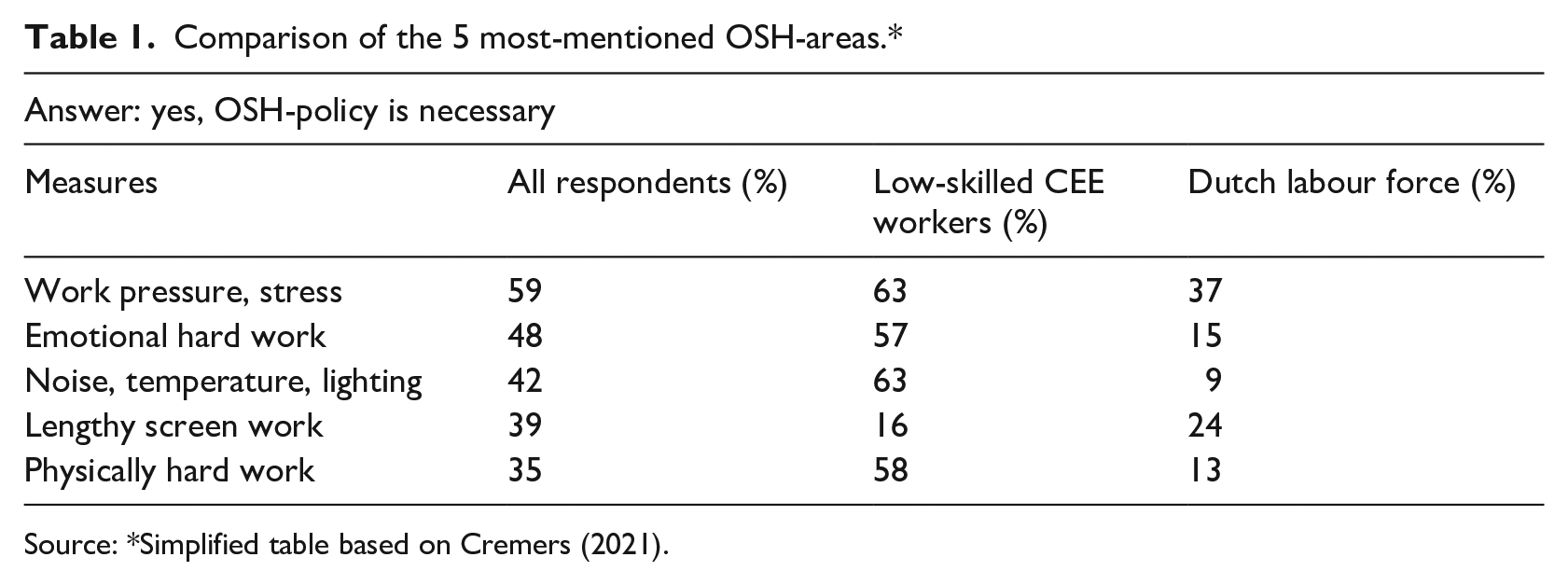
Source: *Simplified table based on Cremers (2021).
The myth of the ‘good worker’
In our local research, employers praised migrant workers because of their high work ethic, dedication and flexibility. Migrant workers were prepared to perform physically demanding work featuring irregular and long working hours. They could and wanted to work more because, being far away from home, they had fewer social contacts – one of the reasons why they had no 9-to-5 mentality. Wanting to work many hours, employers sometimes even had to ‘apply the brakes’. Several researchers spoke of a glorification of the ‘good worker’, possibly also an expression of an employer preference for workers over whom they could exercise maximum control (Anderson and Ruhs, 2010). Fieldwork revealed that the vaunted work ethic was not so much about hard work, but more about a willingness to work long and irregular hours, including weekends. As one employer put it: ‘no, I wouldn’t say they work hard, but they’re prepared to come in at seven in the morning and finish at ten at night if you ask them to’ (Thompson et al., 2013). A user firm can order the required number of workers at any time. Yet how they live does not really matter and housing is not important, as long as everyone stays quiet. The rest is left to the planning department.
The availability of a large potential migrant workforce has enabled such an approach. However, this does not mean that these workers accept the conditions. Several authors rightly point out that such an indifferent approach could quickly lead to a ‘good enough’ attitude among workers. For example, Jounin (2006) concluded that ‘The purely contractual dimension of wage earning always comes with the granting of a status, even an implicit one. That status determines the labour force supply, the quality of work as well as the loyalty of workers’. Observing that migrant workers in a vulnerable employment relationship regularly opt for an individual escape, he speaks of a spiral of disloyalties: shirking work, absenteeism, alcoholism, sabotage and ultimately departure (Jounin, 2006). Other fieldwork shows that, alongside such individual reactions and despite the power imbalance characterising their position, migrant workers develop further-reaching strategies to escape overly evident displays of power. For instance, Berntsen (2015) concluded that migrant workers applied a wide range of strategies to survive, frequently changing jobs. Ultimately, workers weigh up social and economic aspects and decide on that basis whether it is worth staying or not. Their precarious status facilitates this choice to a certain extent. Currently, this is expressed in them returning to their home country or opting for an EU country with more promising prospects. The consequences are a large turnover of personnel, the loss of know-how and of sustainable employment relations, and ultimately labour shortages.
Several decades ago, it was fashionable to discuss the ‘high road’ or ‘low road’ when looking at investments in human capital within organisations. The ‘high road’ was characterised by a ‘humane’ HR policy, while the ‘low road’ was instrumental. The rationale was that the first category would be better off because motivated personnel can be an important competitive advantage. Based on our results, it can be concluded that the second approach predominates for migrant workers. The complete absence of dignity and care is referred to in the literature as the ‘hard’ HR approach, a fate that migrant workers share with other marginalised groups on the labour market. In all such cases, minimising labour costs is paramount.
Footnotes
Funding
This research received no specific grant from any funding agency in the public, commercial, or not-for-profit sectors.
1
Though the sample is not representative for the Dutch migrant labour population, the results provide an indication of perceptions of labour migrant categories, including workers in high- and low-skilled/-paid jobs. The most relevant dichotomy is a clustering of characteristics such as low pay, low-skilled occupations and monotone, repetitive blue-collar work on the one hand, and median and high pay, skilled and qualified occupations and/or white-collar work on the other hand.  (accessed 4 January 2022).