




Abstract
The labour movement has long fought for the social protection of unemployed workers as a major social right in capitalist economies across Europe. Employers, on the other hand, have often been reluctant to accept such intervention in the labour market. Hence, scholars explaining differences in the evolution of unemployment benefit systems need to consider the power distribution of labour relations, the context of the welfare state and the variety of capitalism in which they are embedded. This article makes three contributions. First, it offers a heuristic that systematically identifies the analytical affinities between unemployment protection and its institutional context. Second, it offers a succinct overview with a focus on major crises and subsequent adaptations in labour market regimes, ranging from the oil shocks in the 1970s to the Great Recession and the current COVID-19 pandemic. And third, it discusses whether European economies have adjusted their unemployment protection to recent crises and assesses the effects on labour market regimes.
Introduction
Social protection against unemployment was a belated addition to social rights, often following only after the introduction of sickness, occupational injury and old-age pension benefits across Europe. Initially, policy-makers considered the budgetary risks to be more unpredictable and together with employers shunned such substantial interventions in the labour market (Alber, 1981). Trade unions, however, welcomed the expansion of social rights in this new domain as it offered relief in case of mass dismissals, but also set the reservation wage, defining the conditions under which the unemployed were able to refuse inadequate job offers and seek better ones. This strengthened union bargaining power vis-à-vis employers. The expansion of unemployment protection and regulation of labour markets by the state was crucial to rebalancing power between labour and capital.
Across Europe, welfare states became increasingly involved in mandating, subsidising and regulating unemployment insurance, but also in administering job placement at the turn of the last century. While unemployment schemes were quickly overwhelmed during mass unemployment in the 1930s, unemployment benefit systems and public employment services (PES) matured into a major element of the fast-growing post-war welfare state (Weishaupt, 2011). Responding to structurally induced transformations and economic crises in advanced industrialised nations since the 1960s, unemployment protection and public employment services have undergone several reform processes, most recently pursuing modernisation and austerity through benefit conditionality, enhancing activation measures and adopting reforms inspired by New Public Management (Weishaupt, 2010).
While trade unions in the past were often involved in mutual schemes to insure their members against the risk of joblessness, today they only administer so-called Ghent unemployment schemes in northern Europe (except Norway) and Belgium. In many more countries, however, trade unions and employers remain represented in tripartite public employment services. Such institutionalisations of social protection and social partners’ influence have become a hallmark of Europe’s Social Model (Alber, 2010). Despite this ‘neo-corporatist consensus’, the extent to which the social partners have retained their influence varies over time and across Europe. The political and economic power distribution, in turn, has affected unemployment protection, and this in turn has reshaped the power relations between capital and labour.
In our overview, we understand unemployment protection as part of welfare state responses to recurrent crises and conditioned by trade unions’ strength in defending these social rights. While we focus on unemployment benefits as a ‘social right’ (Marshall, 1950), we understand unemployment protection to go beyond that: it also includes furlough and short-time work schemes (STW), preventing or postponing unemployment; employment protection legislation (EPL), regulating the conditions under which employers can dismiss staff; early retirement options, shedding older workers into unemployment or pension schemes; and active labour market polices (ALMP), which affect jobseekers’ job mobility and employability.
Underwriting the theme of this special issue, we will first discuss how and why labour relations and unemployment protection are related. We will first demonstrate that they have coevolved together, although recent economic crises and reform efforts have also reshaped this relationship. In a brief historical overview, we then argue that unemployment protection systems have changed in several crisis-driven shifts in policy paradigms, from Keynesian demand-side full employment goals during the 1960/1970s to new forms of ‘passive’ labour market measures with the rise of mass unemployment in the 1980s, and increasing supply-side austerity policies since the late 1990s. Thereafter, we explore the role of social partners in managing the employment crises during the Great Recession (and Eurocrisis) since 2008, and the Great Pandemic of 2020/2021. We conclude by providing an outlook on potential labour relations scenarios and the development of unemployment protection for Europe’s post-pandemic future.
Institutional affinities
Unemployment protection in particular and labour market policy more generally need to be seen in the context of ‘elective affinities’ (Max Weber) between cross-national variations in welfare-state regimes, varieties of capitalism and labour relations (Ebbinghaus and Manow, 2001). We map the main institutional configurations for five regional variants across Europe: Anglophone liberalism, Nordic corporatism, Continental social partnership, Southern polarisation, and Eastern fragmentation (Table 1).
Typology of institutional variations in Europe.
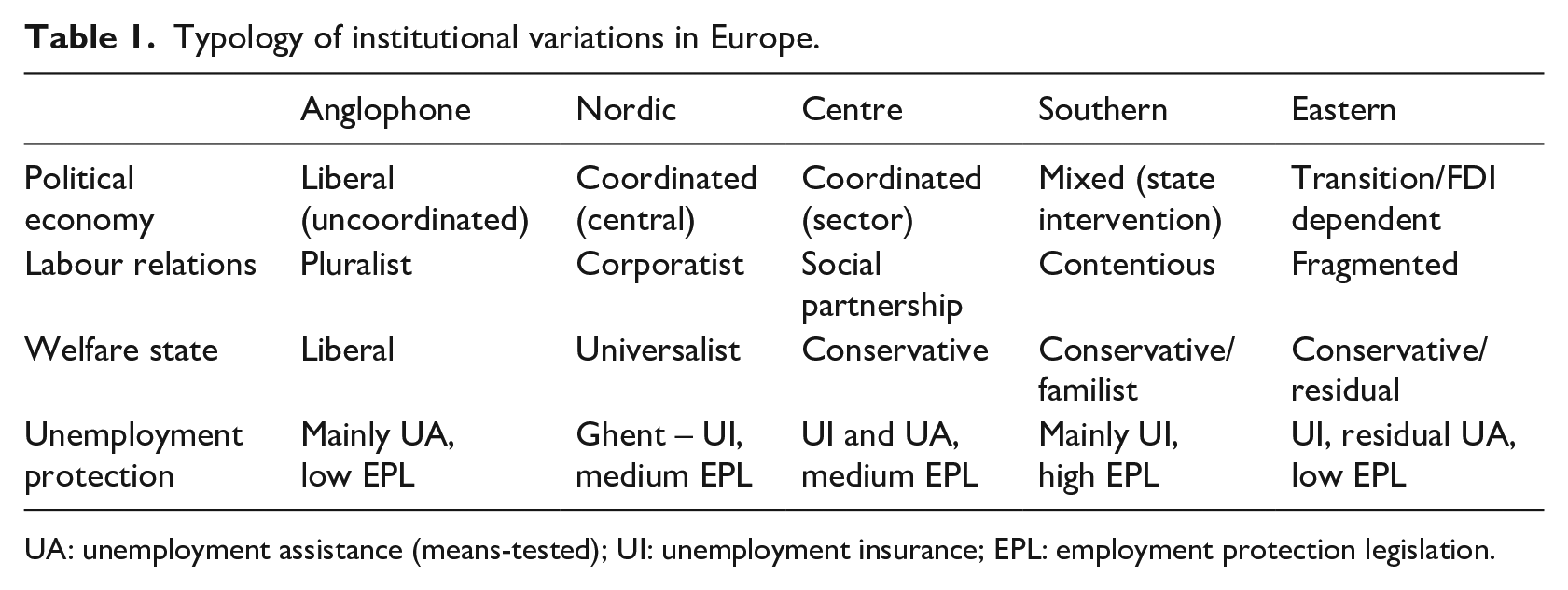
UA: unemployment assistance (means-tested); UI: unemployment insurance; EPL: employment protection legislation.
Most prominently, Esping-Andersen (1990) conceptualised three welfare state regimes based on three analytical dimensions. He first differentiates welfare states with regard to decommodification (Esping-Andersen, 1990) or the degree to which citizens can rely on social rights independent of their labour market participation. 1 His second dimension, the welfare state as a system of stratification, considers the effects of social protection on class structures. Welfare states may rely primarily on means-tested benefits that stigmatise recipients and thus intensify societal differences, while others may offer fairly generous, universal benefits, redistributing income from top to low incomes, thus reducing status differences (Korpi and Palme, 1998). Finally, a third type of welfare state may offer benefits according to individuals’ contributory history and reproduce social differences by preserving class positions and status. In a third and final dimension, Esping-Andersen (1990) stresses that welfare states also vary in terms of their reliance on the state, market and family/corporatist arrangements. In liberal welfare economies, the state is seen as a hindrance to the market, which in itself is considered the most effective means of achieving social mobility and gender equality. In progressive welfare states, the state plays a dominant role in taming markets and empowering families to engage in labour market participation. In a last group, neither state nor market are dominant, while the family plays a central role in social protection within the household and the social partners in regulating the labour market (Hemerijck, 2013).
When identifying the dominant political ideologies shaping welfare regimes, Esping-Andersen differentiates between Social Democratic northern Europe, in which the state traditionally assumes a central role, levels of decommodification are high, and the welfare state substantially redistributes. Furthermore, unemployment protection is characterised by extensive spending on ALMP, especially training and medium to high levels of employment protection. In the liberal, English-speaking welfare states, market forces play a dominant role, while the welfare state is characterised by more limited unemployment protection and residual minimum income provisions in order to incentivise people to seek work quickly. ‘Welfare’ (social assistance) is typically for the poor, while the middle and upper classes rely on private solutions, often supported through tax incentives. Finally, the Conservative welfare states found in continental and southern Europe often provide social insurance, thus benefits are linked to mandatory social contributions (depending on employment), reproducing social status due to contribution-benefit equivalence. ALMPs exist but passive measures are more dominant and employment protection is strict. These regime-specific variations still hold despite recent trends towards more liberalisation, activation and conditionality in labour market policies (Clasen and Clegg, 2011).
‘Varieties of capitalism’ (Hall and Soskice, 2001) represents a political economy approach, differentiating between liberal market economies and coordinated market economies. Varieties of capitalism scholars also embrace the differences in unemployment protection and de-/regulation of labour markets as key institutional features of broader variations in market economies (Hall, 2001). In contrast to welfare regime scholars, who focus primarily on social rights and stratification, varieties of capitalism scholars analytically prioritise skill formation and its effects on firms’ innovation capacity and national competitiveness. On the one hand, liberal market economies have highly flexible labour markets and residual unemployment protection – these institutional arrangements produce incentives to invest in general skills and on-the-job training, which are seen as crucial elements for radical innovation. On the other hand, there are varying combinations of unemployment protection and labour market regulation for coordinated market economies. While the Nordic countries with high union density are characterised by generous benefits, extended social investment and less tightly regulated labour markets, continental European labour markets are more tightly regulated, and welfare systems put more emphasis on ‘passive’ unemployment protection than on social investments (Estevez-Abe et al., 2001). In either case, unemployment protection and social investment provide incentives for workers and firms to invest in sector- and firm-level skill formation, which is needed for incremental innovation typically found in less cost-sensitive, high-quality manufacturing. According to varieties of capitalism scholars, corporate governance too is closely related to these labour market regimes: shareholder value in liberal market economies supports short-term profits and hiring-and-firing practices, whereas cooperative stakeholder orientation in coordinated market economies relies on more patient capital and long-term time horizons, building on tenured employment for a medium- to high-skilled workforce (Hall and Gingerich, 2009).
Finally, in relation to labour relations and the power of the union movement there are also elective affinities with unemployment protection in particular or labour market regimes more generally. The power resource approach (Korpi, 1983) identifies organised labour as an important force for welfare state intervention, particularly in promoting full employment during the post-war economy and in different responses to mass unemployment crises since the 1970s (Korpi, 1991). Typically, at least two dimensions of union power resources are distinguished. This includes organisational power, which considers the number of unionised workers relative to the workforce, as well as the coherence of the labour movement. Secondly, institutional power concerns the institutionalised ways unions (and employers) are able to influence policy-making processes (for example, in parliament or public employment services), as well as their role in implementing labour market policy.
When trade unions sought to translate their organisational power into institutional power, they introduced unemployment benefits for their members at the local level (Rothstein, 1992). In some European countries, municipalities then began to subsidise these voluntary local schemes, following the example set in the city of Ghent in 1901. Later on, numerous national governments transposed it to the national level, but only a few countries have retained this voluntary model of unemployment insurance (Denmark, Finland, Sweden), while the Belgian schemes are mandatory but union-administered (Rasmussen and Pontusson, 2018). Even though union membership has been declining in all European countries, this trend is less pronounced in countries with the Ghent system, which has helped to attract and retain members (Ebbinghaus et al., 2011).
In the remaining European countries, unemployment protection has been publicly mandated, though trade unions, and in most cases employers’ associations were involved in social insurance administration (Ebbinghaus, 2010) and represented on most public employment services governing boards (Soentken and Weishaupt, 2015; Weishaupt, 2011). Since the mid-1990s, however, many public employment services have undergone modernisation, which at times included reducing the role of the social partners to (still important) advisors but no longer co-decision makers (for example, Denmark and Sweden) or abandoning tripartism altogether (for example, Ireland). In other cases, such as Austria or Germany, the social partners retained their role and proved important partners in tackling unemployment during the Great Recession or the COVID-19 pandemic (Ebbinghaus and Weishaupt, 2021). More generally, in corporatist labour relations, political exchange on employment goals and wage formation has helped to mitigate international competition and moderate wage setting. Some researchers (Garrett, 1998; Katzenstein, 1985) have claimed that corporatist open economies used unemployment protection as a mitigation, if not a compensation mechanism against the adverse effects of globalisation.
These comparative analyses of welfare state regimes, varieties of capitalism and labour relations suggest particular elective affinities that provide the context for understanding the development of unemployment protection and employment policies across Europe. The particular strength of labour and universalist welfare states (plus Ghent-type unemployment schemes) have been the hallmark of the Nordic model, while the liberal market economy comes with more limited unemployment protection in Anglophone countries. There are many subtle variations on the Continent, ranging from less to highly regulated labour markets and residual to generous unemployment protection. While these stylised institutional variations describe the situation of the early 1990s, unemployment protection and the institutional landscape has been changing – albeit in a path-dependent way – in response to several employment crises.
Policy paradigms facing mass unemployment
Evolution of two-tier unemployment protection
With the rise of mass unemployment since the 1970s oil crises, the share of payroll tax contributions shrank because of lower employment rates, whereas more state financing was needed to support a growing non-working population. In particular, more jobseekers and long-term unemployed had to rely on lower-tier social assistance schemes for the jobless, who were not yet or no longer insured (Clasen and Clegg, 2011). While top-tier unemployment insurance helped those with long contribution records, higher pay, or at larger workplaces – that is, the ‘insiders’ – many with more precarious employment attachments, the low skilled, atypically employed, immigrants, young jobseekers and mothers returning from years devoted to child care had to rely on minimum income schemes – they are the ‘outsiders’. Additional low-tier schemes exist across Europe today, sometimes as special unemployment assistance or as general minimum income schemes, although schemes vary in conditionality, generosity and length (OECD, 2018). These low-tier assistance schemes are said, however, to reinforce the dualisation of labour markets (Emmenegger et al., 2012), particularly because conditionality and other activation measures are more pronounced in the non-contributory schemes for which means tests of household income are administered. But some of those receiving social assistance also have jobs, receiving in-work benefits to top up their low earnings, in addition to those unable to work because of care responsibilities.
The increased deregulation of labour markets and austerity measures of unemployment protection have been the most important developments over recent decades. Overall employment regulation is still relatively strong among the southern European countries, while many other continental European countries have a medium position. The United Kingdom, Ireland and Denmark, but also Belgium stand out with relative low regulation, though in the two latter countries the social partners play a protective role at workplace level. Changes towards deregulation were less pronounced than changes in unemployment benefit generosity. The Nordic countries, particularly Denmark and Sweden, have considerably reduced benefit generosity, followed by Germany, with reforms in the mid-2000s. However, some countries with relatively low generosity, such as Greece, Italy and Ireland, have increased their benefits over time (Weishaupt, 2013). Overall, we find a trend towards convergence in both unemployment protection and labour market regulation towards the middle ground, striking a balance between medium-level benefits and less rigid employment regulation. We will provide more historical and comparative context to understand these cross-national variations and changes over time.
Paradigm shifts in labour market policies
European labour market policies have followed major transitions since 1945; we review them to explain the changing context for the development of unemployment protection. The three post-war decades are known as the ‘golden age’ of Fordist mass production, consumption and prosperity. In an era of ‘embedded liberalism’ (Ruggie, 1982) governments in advanced industrial democracies followed more or less the state-interventionist Keynesian macroeconomic paradigm, while international trade was highly regulated and currencies pegged to the US dollar, backed by gold. Moreover, policy-makers not only relied on monetary and fiscal policy to reduce unemployment, but also expanded welfare state benefits, considering them ‘automatic stabilisers’ during recessions (Weishaupt, 2011).
With rapid economic and employment growth, union membership also expanded and industrial rights at sectoral or workplace level were introduced and/or extended. Most governments, regardless of ideological stance, saw in the social partners cooperative Keynesian allies, stabilising workers’ purchasing power during times of economic decline and ensuring moderate wage increases during a boom, thus keeping inflation in check. Hence, during this neo-corporatist era (Lehmbruch and Schmitter, 1982; Schmitter and Lehmbruch, 1981) trade unions typically abandoned their revolutionary goals and became ‘intermediating organisations’, stabilising economic growth and consolidating (embedded) capitalism (Müller-Jentsch, 2011).
This ‘historical compromise’ began gradually to falter with a turn toward ‘economic stagflation’, following the ending of the gold standard in 1971 and the oil shocks of the early and late 1970s (Streeck, 2014). While neo-corporatist crisis management still characterised the 1970s, policy-makers’ faith in Keynesianism was ultimately replaced by supply-side neoliberalism in the early 1980s (Hall, 1986). After the second oil shock in 1979, unemployment skyrocketed during the early 1980s, and so did inflation! The underlying premise of Keynesianism that unemployment can be reduced in exchange for higher levels of inflation was shattered. But not only did demand-side economic policy lose its legitimacy; social policy and labour relations, too, were increasingly seen as part of the problem. The Thatcher government and the Reagan administration became infamous for rolling back the (welfare) state and introducing anti-union legislation in an attempt to shift the balance of power in favour of employers and thus return to a path of economic growth (Pierson, 1994).
While the United Kingdom and the United States followed a distinctly neoliberal approach, unemployment remained stubbornly high, youth unemployment grew and long-term unemployment became a common feature in most southern and continental European economies during the 1980s. This diversity in employment performance convinced Western policy-makers that unemployment was predominantly a structural – in contrast to a cyclical – phenomenon. In response, the OECD launched a comprehensive ‘Jobs Study’, which was published in 1994 (Casey, 2004). The Jobs Study offered nine (later ten) general policy recommendations, including reducing/eliminating statutory minimum wages, easing employment protection legislation, lowering unemployment and other benefits, addressing the tax wedge, and decentralising wage setting (Watt, 2006: 2).
Many European policy-makers did not subscribe to all OECD prescriptions, remaining hesitant to transpose these highly conflict-prone structural reform ideas that trade unions forcefully rejected. European – mostly social democratic – leaders rather developed their own approach, institutionalised via the European Employment Strategy (EES), which aimed at recalibration rather than dismantling of welfare systems (Weishaupt and Lack, 2011). At the core was a new ‘activation paradigm’, in which, among other things, benefit rights were linked more closely to obligations, early retirement options gradually phased out, and higher levels of female labour market participation enabled through a state-led expansion of child- and elderly-care institutions (Ebbinghaus, 2006; Weishaupt, 2011). Partial deregulation of labour markets led to more atypical, low-paid and even precarious employment, reinforcing divisions between labour market ‘insiders’ and ‘outsiders’, not least due to dualisation (Emmenegger, 2014; Rueda, 2007). Policy-makers accepted, if not promoted, this growth of a low-wage sector as they believed that any job was better than no job and that atypical employment would serve as a ‘trampoline’ into regular employment (Cox, 1998).
Shifting power and labour relations
Also, labour relations continued to evolve after the 1980s, although proclaiming an ‘end of corporatism’ was premature (Lash and Urry, 1987). On the one hand, with the exception of the United Kingdom, Europe’s union movements remained strong, and even grew stronger in some countries, such as Belgium or Finland. Indeed, the 1990s became the decade of ‘social pacts’ during which many countries relied on tripartite deals to pursue structural reforms and pave the way to Economic and Monetary Union (EMU) membership (Avdagic et al., 2011). On the other hand, trade unions faced various challenges associated with technological and structural changes, de-industrialisation towards a knowledge society, increasing competition from emerging economies, and a shift in the power balance because of rising capital mobility. These trends increased tensions within the union movement as highly skilled and white-collar employees were no longer willing to accept ‘solidaristic’ collective bargaining (Streeck, 2014), while employers and policy-makers increasingly demanded to decentralise and flexibilise collective bargaining.
In the early 2000s, downward wage pressure intensified and higher levels of wage inequality developed when the Maastricht criteria institutionalised a monetarist paradigm across the EU. Furthermore, 10 new Member States – mainly from Central and Eastern Europe (CEE) – were admitted in 2004 (plus Bulgaria and Romania in 2007, Croatia in 2013), competing for foreign investments, which spurred a relocation of many industrial plants from ‘old’ to ‘new’ Members (Nölke and Vliegenthart, 2009). Except for Slovenia, the new Member States generally had rather weak labour movements, a fragmented left and ‘illusory’ corporatism at best. The expanded European Union thus became more diverse in terms of political, economic and social composition. Finding a common denominator on Social Europe has become more challenging, although the United Kingdom’s traditional ‘economic liberal’ voice vanished with the Conservative government’s decision to withdraw in 2021 in the wake of the Brexit referendum.
Labour relations still matter. Unions in northern Europe with Ghent schemes have been able to retain high, albeit declining, levels of union membership and bargaining coverage. At the opposite end of the spectrum we find most of the new Member States from Central and Eastern Europe, where union density and bargaining coverage are very low. Slovenia represents the ‘neo-corporatist outlier’, but it too has experienced drastic losses in membership of trade unions and employer associations (after mandatory membership was ended), and shrinking bargaining coverage. In Romania and Greece, the governments have abolished most ergo omnes rules, which has led to a substantial decline in bargaining coverage in both countries. Continental and especially southern European countries are characterised by low to medium levels of union membership, typically with some decline, while retaining relatively high coverage levels. Bargaining remains widespread in Belgium (with a quasi-Ghent scheme) and Austria (with compulsory membership of employer associations). Germany has the highest decline in bargaining coverage, particularly after unification, as a consequence of new firms shunning employer associations and a new associative status for firms unwilling to abide by collective agreements (Weishaupt et al., 2021).
Learning from recent crises
The Great Recession
The financial market crash of 2008 triggered the Great Recession, an economic crisis that spread across the globe from the United States to Europe. After governments opted to bail out the financial sector, they considered adopting measures to boost the economy and mitigate mass unemployment. Welfare states with their unemployment protection were designed to serve as automatic stabilisers for individuals and the economy, although the generosity of schemes varied across countries and rising income support for the unemployed increased public deficits (Ólafsson et al., 2019).
Several European governments consulted with the social partners on crisis management policies during the Great Recession (Ebbinghaus and Weishaupt, 2021), though these efforts at social concertation were weaker than the social pacts agreed in the run-up to euro introduction in the 1990s (Avdagic et al., 2011). Most European economies reacted to the global recession in 2008/2009 with stimulus packages following a brief ‘Keynesian’ reflex. These measures were typically designed in concertation with the social partners (or at least with their silent consent) as both capital and labour had a similar interest in boosting consumer demand.
Among the countries relying most on social concertation for crisis management has been the Netherlands, with a broad ‘social pact’, the Dutch Mondriaan Accord (2013), and several issue-specific agreements. During the Great Recession, however, only a third of national governments across Europe since 2008 used social concertation to cope with some aspects of the crisis. This was largely absent in countries most severely affected by the crisis, occurring instead in those with corporatist traditions, which recovered more quickly (Bender and Ebbinghaus, 2020, 2021). For instance, there were two tripartite crisis meetings in the German chancellor’s office in 2008–2009 to discuss stimulus programmes.
While some European countries – such as Germany, Denmark or Poland – were able to overcome the recession relatively quickly, many crisis-ridden countries suffered for several years as a result of a second blow.
As public deficits skyrocketed because of the bailouts and economic stimuli, the so-called ‘Eurocrisis’ emerged only two years after the financial market crash. This sovereign debt crisis hit southern European countries in particular, most notably Greece. In these crisis-ridden eurozone countries, even those previously known to engage in social pacts were unable or unwilling to engage in meaningful social concertation in the context of the Troika’s determined imposition of austerity there (Bender and Ebbinghaus, 2020, 2021). Portugal was the only crisis-ridden economy under Troika supervision with a strong tradition of social concertation. The capacity of families in southern and eastern Europe with a breadwinner ‘insider’ was too limited to absorb the non-employment shock within households (Biegert and Ebbinghaus, 2020) as not only youth unemployment but overall joblessness increased.
One mitigation strategy in response to the Great Recession was the use of short-time working in order to retain labour during the immediate plunge and to avoid mass dismissals (Boeri and Bruecker, 2011; Sacchi et al., 2011). Germany has long experience with short-time working (Kurzarbeit) during recessions. In 2009, more than one million German employees were on short-time work, at the peak making up about 4 per cent of the labour force, compared with an unemployment rate of around 11 per cent in 2009 (Weishaupt, 2021). Similarly, Belgium used short-time work more widely, increasing by 4.5 per cent at the peak of the crisis. Some other European countries also relied on their short-time work schemes during the crisis, in particular Italy (2 per cent), but also Austria, Czechia and Slovakia, Ireland and the Netherlands (1–2 per cent), followed by France, Hungary, Spain, Portugal, Denmark and Norway, where use was less widespread (below 1 per cent) (Hijzen and Venn, 2011). Thus, it was largely the Conservative welfare regimes with strong union representation at the workplace (German-speaking and Benelux), and to a lesser degree France and other southern European and Visegrád countries that implemented these job retention measures. In the face of unemployment, full or partial short-time work proved more effective and the relevant countries were able to overcome the crisis quickly. More protracted structural unemployment was experienced elsewhere. Moreover, the use of short-time work seems to have been particularly common in countries with ongoing social concertation, benefiting largely ‘insiders’.
In the crisis-ridden countries of southern and eastern Europe, however, the Troika advocated austerity measures to control public deficits and advocated supply side–oriented policies to deregulate the labour market in order to create economic growth. Governments were reluctant to enter into concertation with the social partners, adopting deregulation measures and retrenchment of social protection. In Spain, although the Socialist government consulted with the social partners there was much opposition to its measures from the left, and when the Conservatives returned to power they adopted Troika-backed austerity measures, refraining from concertation until 2014 (Luque Balbona and González Begega, 2015). Without facing the Troika, Italy embarked on the Fornero labour market reform (2012) under the Monti government and the subsequent Renzi cabinet’s Jobs Act (2014/2015) aimed at deregulating employment protection for permanent contracts, while improving unemployment insurance and short-time work schemes, particularly for long-term unemployed (Pinelli et al., 2017). Overall, the Great Recession had forced Italy to bring its passive and active labour market policies into line with other European competitors (Sacchi, 2018).
The Great Pandemic
The COVID-19 pandemic that started in spring 2020 has led to unprecedented containment measures, such as national ‘lockdowns’ in nearly all European countries. This caused a more sudden and severe employment shock than the Great Recession (Ebbinghaus and Weishaupt, 2021; Moreira and Hick, 2021). The ‘Great Pandemic’ has also given rise to a renaissance of short-time work measures in response to this sudden supply and demand shock. Belgium, Germany, and Italy were adopting containment measures at an early date, and also expanded their existing short-time work measures: nearly every second Italian, one in four Belgians and every fifth German in work was covered by job retention policies during the first wave of the pandemic in April 2020 (Müller and Schulten, 2020). Nearly half of all EU countries rolled out existing short-time work schemes, though some, such as the Netherlands and Ireland, changed the conditions and initiated also new COVID-related wage subsidies (OECD, 2020). About 10 further countries, including the United Kingdom, introduced new schemes to support employees and the self-employed with state-paid furloughs or wage subsidies to firms. In particular, the UK scheme was a break with flat-rate unemployment protection and provided rather generous conditions (Hick and Murphy, 2021). Nordic welfare states and some eastern European countries had fairly low take-up rates because of the less severe containment measures and less favourable access conditions.
During the Great Recession, short-time working was largely limited to industrial jobs, whereas the COVID-19 job retention schemes had a much broader scope, particularly covering non-essential personal services, such as restaurants and retail, as well as occupations that could not be done from home (OECD, 2020). Overall, job retention policies had been used widely across Europe, and in contrast to North America, unemployment rates did not increase as dramatically but remained more under control during 2020 and again in 2021 (Ebbinghaus and Lehner, 2022). The southern European countries experienced the largest decline in total working hours across Europe, followed by the United Kingdom and continental European countries, while eastern European countries were less affected through 2020, and Nordic countries and the Netherlands were able to shift to working from home. While these job retention policies helped to mitigate mass dismissals and functioned as income support, the long-term impact of several pandemic waves and the repeated use of short-time working to mitigate them remains to be seen. An increase in youth unemployment, particularly in southern and eastern Europe but also in the Nordic countries, indicates that job retention policies work best for labour market insiders, while new entrants and other precarious groups face non-employment similar to the Great Recession.
Looking ahead
Since the global financial crisis, Europe has been in a state of perpetual crisis, including the so-called Eurocrisis, the refugee wave, the climate predicament, Brexit problems, and most recently the COVID-19 pandemic, to name only the most important. With economic crisis becoming the ‘new normal’, unemployment risks and social inequality are on the rise. The welfare state as automatic stabiliser is needed to protect citizens from an ever more unpredictable and risk-laden global capitalist order. Trade unions have a historical role as defenders of welfare state achievements, important partners in social administration and PES eco-systems, and proliferators of progressive ideas in times of transformation. Examples can be found in social pacts in the run-up to the euro in the 1990s, crisis management during the Great Recession from 2008 onwards, and most recently during the Great Pandemic (2020/2021). Union membership has been on the decline for decades, however, and bargaining coverage is becoming more fragmented, weakening labour’s power resources. De-industrialisation, the growth of atypical employment and a less solidaristic society are among the most common explanations of this development, while the shift toward supply-side economic policy and austerity policies are certainly equally important factors since the 1980s.
Adapting to a changing world of work, trade unions need not only to reverse membership decline and extend their bargaining clout, but also to represent more than just labour market ‘insiders’. It will be important to prove that they are effective organisations in enabling more sustainable employment and economic growth, while helping the jobless and reducing social exclusion. The role of social partners in crisis management may have been more limited in both the Great Recession and the Great Pandemic, but unions and workplace representatives have been involved in securing employment, negotiating social dismissals where necessary and returning to work after lockdowns. The COVID-19 pandemic has shown that Europe has been more successful than the United States in mitigating unemployment risks via short-time work schemes, while unemployment protection and collective bargaining have stabilised the incomes of millions of European workers and their dependents. However, ‘labour retention’ policies can help only temporarily and largely benefit insiders on average to high wages, while, worryingly, in-work poverty, as well as youth and long-term unemployment increase. As a result of the pandemic it is to be hoped that societal understanding has evolved in relation to core or essential jobs, such as health care and food provision, as well as the benefits and disadvantages of working from home, child-care needs, the role of schools for families and the welfare state. The social partners need to reconsider employment conditions and unemployment protection for the future. A broad debate on a new social contract is necessary in light of the importance of modernising unemployment protection and adapting labour market regulation to the new knowledge society.
Footnotes
Funding
The authors received funding from the German Research Foundation (DFG) project No. 289769799 (Crisis Corporatism or Corporatism in Crisis? Social Concertation and Social Pacts in Europe).
1
Scholars operationalising decommodification often rely on indicators such as replacement rates, qualifying periods and duration of unemployment, as well as sickness benefits and pensions (Ferragina et al., 2013; Jahn, 2018; Scruggs and Allan, 2006).