




Abstract
Europe has been faced with multiple challenges during the COVID-19 pandemic, including the problem of how to secure jobs and earnings. In our comparative analysis, we explore to what degree European welfare states were capable of responding to this crisis by stabilising employment and workers’ incomes. While short-time work was a policy tool already partly used in the 2008/2009 Great Recession, job retention policies were further expanded or newly introduced across Europe in 2020 in the wake of the pandemic. However, cross-national variations persist in the way in which these schemes were designed and implemented across European welfare states, aiming more or less to hoard labour and thereby avoid mass dismissals throughout the employment crisis. We distinguish between business support and labour support logics in explaining the variation in job retention policies across Europe. Our finding is that Continental, Mediterranean and liberal welfare states did more to foster labour hoarding using short-time work than Nordic or Central and Eastern European countries.
Introduction
European welfare states have been faced with multiple challenges during the COVID-19 pandemic, including the problem of securing jobs and earnings affected by containment measures, particularly during national lockdowns. Given that national states imposed unprecedented restrictions on businesses and employees in pursuing their day-to-day economic activities, governments needed to compensate them for financial losses, using a mix of social, employment and fiscal policies. During the first lockdown, starting in March 2020 across most of Europe, not only were business receipts threatened but also the earnings of employees and the self-employed. During this first and subsequent waves of the coronavirus pandemic, European welfare states used both existing social protection schemes and new measures to respond to the public health and economic crisis. Our analysis focuses on job retention policies as a specific economic and social policy response to the crisis-induced employment shock.
Focusing on the ‘Great Lockdown’ of 2020, we seek to demonstrate that European governments opted for labour hoarding 1 during this sudden crisis in order to prevent mass dismissals, having learned crucial lessons from the Great Recession. In contrast to the US, Europe experienced no rapid increase in unemployment during the first wave due to the widespread use of short-time work, as we will show in our analysis. Across Europe, job retention policies, a previously tested instrument, were scaled up and extended or newly introduced, with potential long-term implications for labour market policies. We contrast two different motives for using job retention policies, looking at them from both an employer and employee perspective. We contend that employers opt for short-time work (hereafter STW) arrangements instead of dismissals due to a business support logic if their labour costs are relatively low, while employees are motivated by a labour support logic when STW schemes are more generous than unemployment benefits. We assume that these design features of job retention policies affect the take-up rate, thus providing a more or less effective crisis response. We aim to test this proposition by focusing on the design, take-up and unemployment mitigation effect of job retention policies across Europe during the first wave of the pandemic.
In our contribution, we discuss the importance of job retention policies during the COVID-19-related employment crisis, looking at whether welfare states extended pre-existing schemes or introduced new innovatory ones and whether these became widespread tools to prevent greater unemployment. In our analytical section, we discuss the political economy approach for our comparative analysis, arguing that varieties of economies and welfare state regimes play a role in accounting for cross-national variations in the design and effectiveness of job retention schemes (Natali, 2022). Although some of the schemes are being phased out, some policy innovations have the potential to remain in the tool-box for future economic crises, given their success during the pandemic. Analytically, we explain the observed variations in job retention policies by using business support and labour support logics, informed by political economy and welfare state literature. The subsequent section presents our empirical analysis of the COVID-19-related employment shock, the diffusion of job retention policies and innovation in their design, and the economic and social outcomes of these STW schemes. The conclusion reassesses our argument and sketches an outlook for the recovery and future crises.
Welfare states facing an employment crisis
Path dependency versus policy innovation
The COVID-19 pandemic is an exogenous, simultaneous and similar shock to labour markets across Europe exceeding the immediate employment crisis of the Great Recession that started in 2008. It serves as a quasi-experiment for our comparative analysis of welfare state crisis responses. A crisis is a moment for governments to respond either with their usual instruments (possibly adapted) or with innovatory measures thus far not used (Hall, 1993), i.e., either a path-dependent ‘reloading’ and adaptation of policy responses or a first step towards path departure through policy innovation (Ebbinghaus, 2005). The initial pandemic wave was a major challenge for governments, requiring them to respond to a potential employment shock and forcing them to decide whether to rely on tested welfare programmes, such as unemployment benefits, or to introduce special measures such as STW schemes.
Pierson (2004) acknowledges the different time horizons of cause and outcome: for instance, a short-term event can have a short impact (like a tornado) or more profound long-term consequences (like a meteorite impact). Applied to social policy, Chung and Thewissen (2011) argue that short-term crisis responses tend to follow path dependence rather than inducing major systemic changes. While some policy analysts claim that policy-makers tend to rely on muddling through instead of systemic policy change, others see a crisis as a ‘window of opportunity’ (Kingdon, 2014) to innovate at a ‘critical juncture’, with lasting impact for the future (Capoccia and Kelemen, 2007). The job retention policy response to the COVID-19 pandemic could either reinforce path dependence when established policies successfully absorb the main employment shock or begin path departure through adopting new policy measures with potentially lasting consequences.
From a comparative perspective, we study the cross-national variations within Europe (Arts and Gelissen, 2010). We extend the three ideal-type welfare regimes of Esping-Andersen (1990) – liberal, conservative (Continental) and social democratic (Nordic) regimes – by further distinguishing Mediterranean and Central and Eastern European (CEE) welfare states (Adascalitei, 2012; Ferrera, 1996). Contrary to the previous period of welfare state retrenchment, in particular the period of austerity following the bailouts during the financial market crisis (Ólafsson et al., 2019), the COVID-19 pandemic has been characterised by a remarkable return to social policy expansion (Moreira and Hick, 2021). Béland et al. (2021a) view the policy responses in a first assessment as following policy legacies, whereas we also acknowledge some instances of path departure.
The purpose of job retention policies
In addition to relying on unemployment benefit schemes, European welfare states reloaded their STW schemes or introduced new job retention policies. These measures sought to mitigate the employment crisis resulting from their containment policies, in particular the national lockdown during the first wave of the COVID-19 pandemic. Job retention policies have the function of maintaining employee incomes and sustaining firms throughout a recession. During a crisis, these labour-hoarding measures help preserve employment relationships and sustain consumer demand, facilitating ‘bouncing back’ during a subsequent recovery. From a macroeconomic perspective, STW schemes function as an important ‘automatic stabiliser’ (as part of the tax and benefit systems) through smoothing labour income over the business cycle similar to unemployment benefits (Gehrke and Hochmuth, 2021). At a microeconomic level STW prevents skill depreciation while preserving the employment relationship. Functioning like an insurance policy against unemployment during a demand crisis, it is also commonly used to cope with seasonal work fluctuations, as often experienced in the construction sector.
Comparing previous crisis-related social policy responses to those adopted during the COVID-19 pandemic, recent analyses have stressed that STW schemes have been ‘novel in scope and scale’ (Moreira and Hick, 2021: 1). Eichhorst et al. (2020b); Müller and Schulten (2020); European Commission (2020); Eurofound (2021a) and OECD (2020a, 2020b, 2021a) provide overviews of cross-national variations in STW designs and effects. An analysis of preliminary data has pointed to the inverse relationship between the expansion of STW take-up and changes in unemployment rates (Eichhorst et al., 2020a).
Business support and labour policy logics
We use a simple analytical framework to explain the cross-national variations in STW take-up during the first pandemic wave. Using an institutionalist actor-oriented model (Scharpf, 1997), we juxtapose the respective interests of employers and employees in deciding in favour of job retention (instead of unemployment benefits) in the face of the pandemic containment measures. At its onset, policy-makers expected the pandemic to only last for a short spell. They thus looked for short-term measures, while the public expected to be compensated for any losses incurred as a result of the imposed restrictions. In this rapidly growing and unprecedented crisis with its high level of uncertainty, policy-makers seized the window of opportunity for an unparalleled fast expansion of business and labour support to mitigate the impact of the containment policies. This was all the more surprising given that European welfare states had gone through severe bouts of austerity following the Great Recession (Ólafsson et al., 2019), with many economies only slowly recovering from mass unemployment and still facing mountains of accumulated public debt.
We argue that the design of job retention policies adopted across Europe follows two distinct rationales, mirroring the interests of employers and employees respectively. Identifying those logics helps us understand some of the unexpected developments in STW take-up and its potential efficacy in mitigating the employment crisis.
(i) Following the business support logic, governments have an interest in limiting firm bankruptcies by subsidising underused labour costs and maintaining employment relationships (labour hoarding) in the hope of a quick economic rebound once containment measures are eased. In this case, governments shoulder the labour costs to a significant extent, thereby subsidising firms during the crisis.
(ii) Following the labour support logic, governments have an interest in limiting unemployment due to its long-term scarring effects and compensating workers for income losses during the crisis to sustain popular support for their containment measures. In this case, governments increase the generosity of STW benefits relative to unemployment benefits.
Analytically we expect and empirically find different configurations (see Figure 1) along the two dimensions of business and labour support. Both objectives can go hand in hand when labour hoarding is beneficial to employees and profitable for employers (Labour hoarding model: Quadrant B). However, there are also welfare states that fail to achieve either goal, relying merely on existing unemployment protection and flexible labour market adaptation (Flexibility model: Quadrant D). Analysing cross-national variations in policy design through the lens of the two logics helps us understand the varying effects of job retention. In some countries, though labour support is relatively generous, it might still depend on whether employers are willing to use it due to high labour costs (Flexicurity model: Quadrant A). The flexicurity model provides relatively generous social support to the unemployed but relies to a greater extent on fluid labour markets than on labour hoarding via job retention, thus resulting in higher unemployment rates during crises. In the case of pro-business support (Business supporting model: Quadrant C), labour hoarding is less costly and preferable for firms due to potential re-hiring problems, even if furloughed workers face considerable cuts in their income.
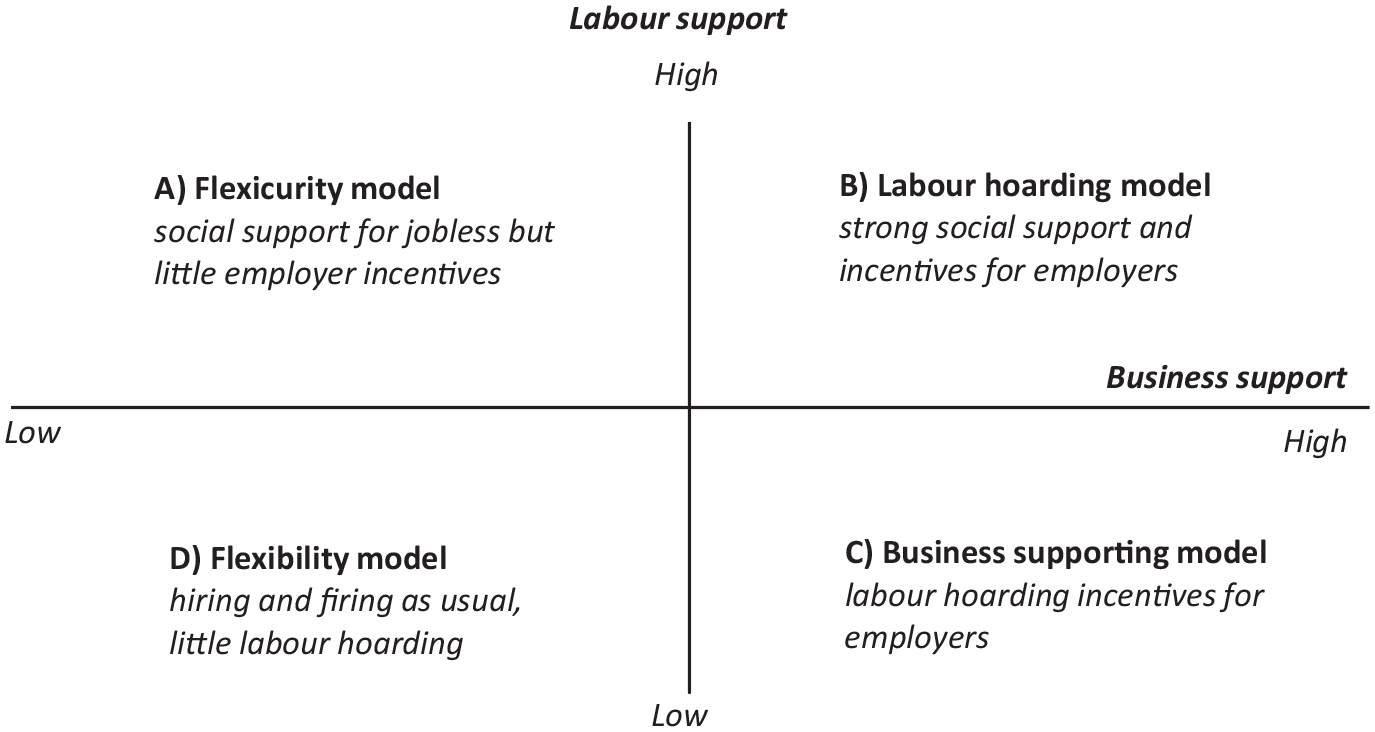
Business support and labour support logics.
Job retention policies during the 2020 pandemic
In our empirical analysis, we explore to what degree welfare states were capable of responding to the pandemic through stabilising workers’ employment and incomes in Europe during the first COVID-19 wave. While several economic measures and labour market policies were used, we limit our focus to the key (and in several countries novel) response to the employment shock: job retention policies (both short-time work and wage subsidy schemes). We discuss briefly their emergence, provide an overview of their design, and explore the variations in take-up and unemployment performance across Europe. We rely on the datasets of international organisations and national agencies after screening so-called ‘policy trackers’ (https://supertracker.spi.ox.ac.uk/), time-variant databases of policy measures drawn up by international organisations and by academics in the wake of the pandemic (Daly et al., 2020).
The pandemic employment shocks
The Great Lockdown in March/April 2020 limited most non-essential business, required working-from-home and restricted leisure activities outside the home, leading to an unprecedented demand and supply shock. While the first pandemic wave led to temporary mass unemployment in the United States, skyrocketing from 5 per cent to around 14 per cent in April 2020 (Béland et al., 2021b), the EU unemployment rate did not exceed 8 per cent during 2020, though there was nearly a doubling of the inactive working population (17 per cent), indicating widespread withdrawal from the labour market (Eurofound, 2021a: 1). In April 2020, following the sweeping reduction of economic activities due to strict containment measures, 42 million people in the European Union (EU) were subject to STW arrangements, equivalent to one in five employees (European Commission, 2020; Müller and Schulten, 2020). By contrast, during the Great Recession of 2008/2009 a then ‘record-breaking’ 1.5 million employees were on short-time work across the European Union, a fraction of the 2020 peak.
Despite the overall trend across Europe, there were notable cross-national variations in unemployment rates during the pandemic (Figure 2). Although most European countries experienced a gradual increase during the first wave beginning in March 2020, the cross-national variations largely mirrored prior welfare state regime patterns. The increase was pronounced in the Baltic economies with their relatively flexible labour markets and residual welfare states, followed by the Nordic welfare states with their lower reliance on job retention schemes due to their relative generous unemployment benefits. Still suffering from the mass unemployment incurred during the last crisis, the Mediterranean countries experienced modest increases, though younger jobseekers were at higher risk. Unemployment increases were also largely mitigated in the core Continental welfare states. Liberal or residual welfare states such as the UK and CEE countries experienced relatively small unemployment increases from comparatively low levels.
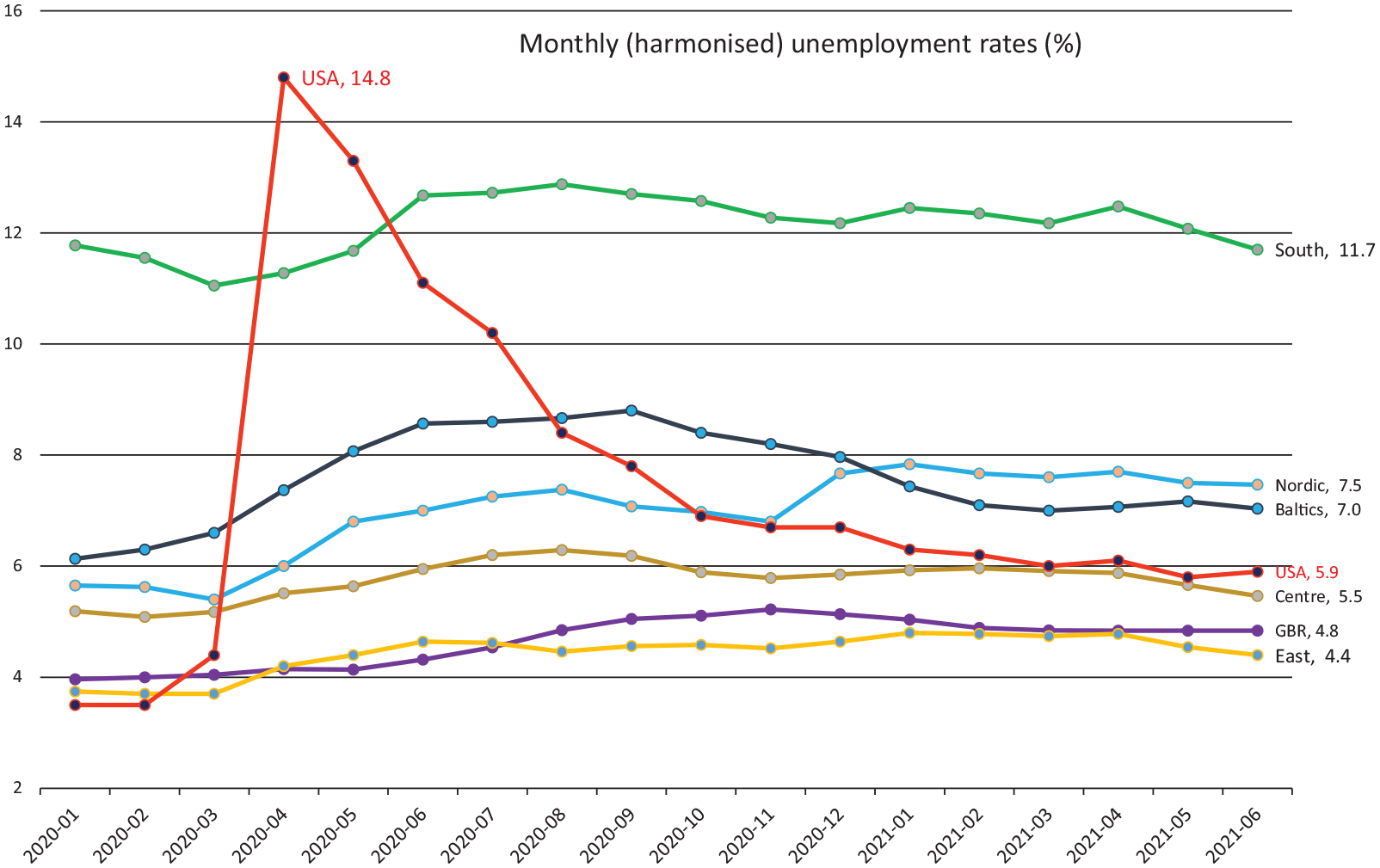
Unemployment rate in Europe and USA (OECD) 2020.
Adopting job retention policies during the first COVID-19 wave
The first local coronavirus containment measures in Europe were enacted in Italy in February 2020, weeks before the World Health Organization (WHO) finally declared COVID-19 a ‘pandemic’ on 11 March 2020.
Within the next few days, many governments followed suit, with hastily decided national lockdowns across Europe aiming to ‘flatten the curve’, prevent an exponential spread of the virus and reduce pressure on overstretched health-care systems. Initially, policy-makers and experts saw the pandemic as a short-lived economic stoppage and hoped for a quick V-shaped rebound. To boost compliance with containment restrictions, governments were under pressure to help businesses survive and to protect the workforce from income loss. The use of the ‘emergency Keynesianism’ of the Great Recession (Bremer and McDaniel, 2020) topped the political agenda during the Great Lockdown (Béland et al., 2021a), overcoming years of austerity.
During the Great Recession, about a dozen European welfare states (see Table 1) had already resorted to short-time work schemes to combat mass unemployment – with significant impacts (Hijzen and Martin, 2013), in particular Belgium (additional 4 per cent of workers during the peak), Germany (4 per cent) and Italy (2 per cent), followed by other continental countries but also Ireland, Denmark and Norway (ranging between 0.5 and 2 per cent). For the most popular schemes, partial working time reductions were possible, eligibility was high, conditionality not very severe, and the costs for employers low, while benefits were relatively high (Hijzen and Martin, 2013). Some European countries thus had positive experiences of STW schemes and were able to scale them up at short notice, while other countries introduced them from scratch.
Characteristics of job retention schemes.
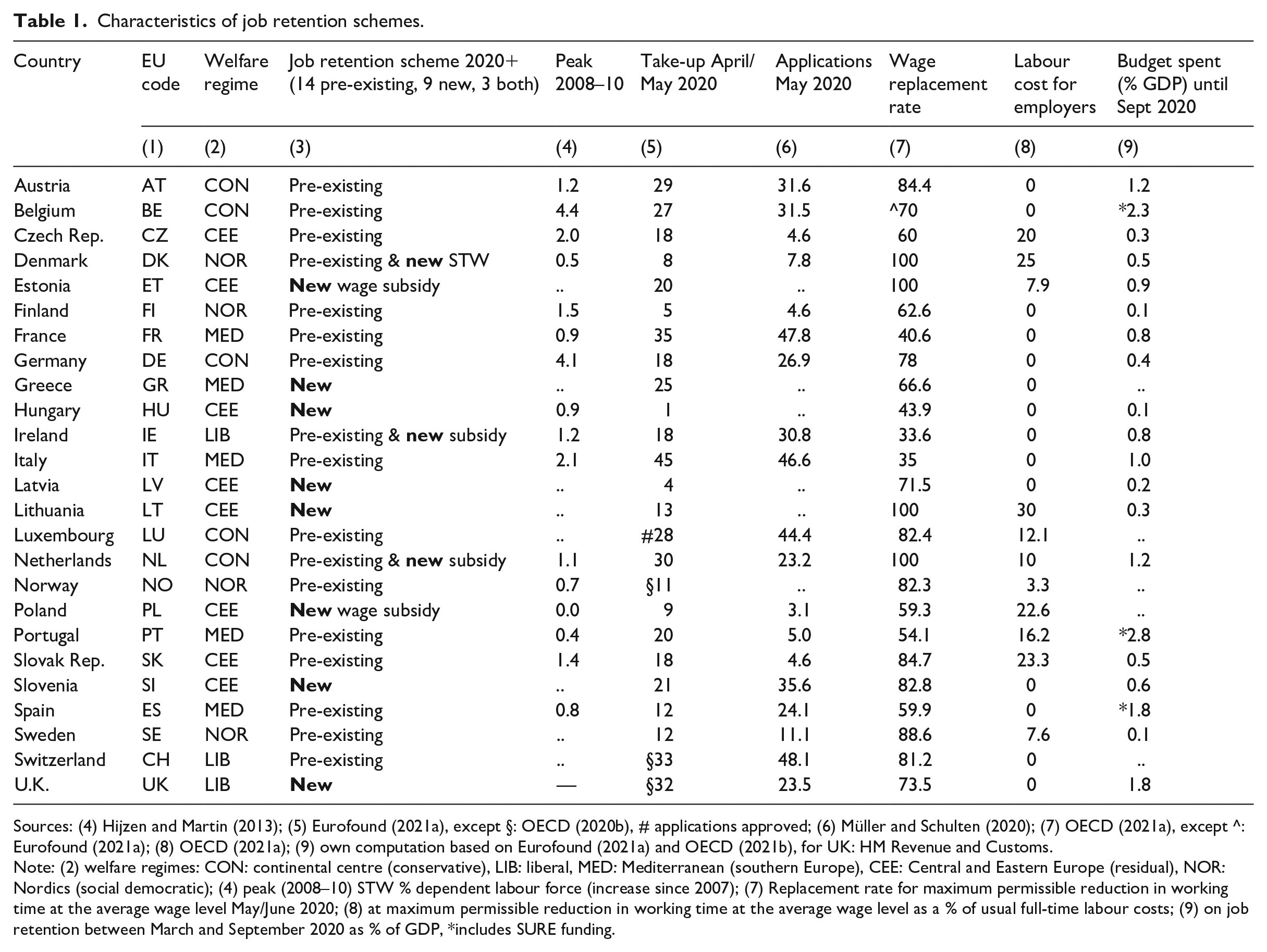
Sources: (4) Hijzen and Martin (2013); (5) Eurofound (2021a), except §: OECD (2020b), # applications approved; (6) Müller and Schulten (2020); (7) OECD (2021a), except ^: Eurofound (2021a); (8) OECD (2021a); (9) own computation based on Eurofound (2021a) and OECD (2021b), for UK: HM Revenue and Customs.
Note: (2) welfare regimes: CON: continental centre (conservative), LIB: liberal, MED: Mediterranean (southern Europe), CEE: Central and Eastern Europe (residual), NOR: Nordics (social democratic); (4) peak (2008–10) STW % dependent labour force (increase since 2007); (7) Replacement rate for maximum permissible reduction in working time at the average wage level May/June 2020; (8) at maximum permissible reduction in working time at the average wage level as a % of usual full-time labour costs; (9) on job retention between March and September 2020 as % of GDP, *includes SURE funding.
Moreover, the European Commission (2020) promoted STW as an effective tool for firms to reduce labour costs, increase flexibility without firing costs, and preserve human capital during a crisis. In March 2020, acting on a proposal tabled by the European Commission, the European Council negotiated emergency funding to be disbursed from unused EU Cohesion Funds, soon to be followed by the ground-breaking agreement on SURE (de la Porte and Jensen, 2021; Pochet, 2022) and signalling ‘this time is different’. The EU support helped Mediterranean and CEE governments to ramp up borrowing in order to spend more on employment protection during the crisis (European Commission, 2021a), finally followed by the Next Generation EU recovery plan at the end of 2020.
European governments acted swiftly enacting job retention policies at the very beginning of the pandemic (Eurofound, 2020). As early as February 2020, Italy set up an exceptional wage guarantee fund to compensate for the first local lockdown, soon to be followed by national measures. Also hit relatively early, Belgium applied a time-credit scheme for employees, followed by a partial unemployment scheme. In the first week of March, Germany extended access to its pre-existing STW scheme, though only improved its generosity later on (Herzog-Stein et al., 2021). All three countries introduced their STW schemes quickly, repeating the lead role taken in the Great Recession. By contrast, the British government was criticised for belatedly implementing a national lockdown, yet this was backed by a new Coronavirus Job Retention Scheme (JRS) more generous than the existing flat-rate unemployment support, breaking with its liberal credo to provide earnings-related benefits (Hick and Murphy, 2021).
In addition to these legislative or executive measures, social partners and governments signed tripartite agreements, most prominently Denmark which introduced a new scheme alongside an existing one (Eurofound, 2021b). Nearly half of the 25 European countries investigated (see Table 1) introduced new schemes (nine without any prior scheme, while three added a new scheme to their pre-existing one), while the larger group (14 countries) relied on existing schemes, though often improving their conditions.
Continental, Mediterranean and Nordic welfare states often relied on existing instruments that were adjusted, while most liberal market economies and CEE countries had to set up new job retention schemes, often introducing ad-hoc wage subsidies (OECD, 2020b: 7). Adaptation of existing schemes took place in the form of reducing costs for employers and increasing generosity for workers. Moreover, several countries broadened coverage to all (or at least further specific) sectors, non-standard workers and the self-employed. Governments also simplified administrative procedures to speed up enrolment and extended maximum durations. Job retention measures were typically introduced on a temporary basis, though many were extended as the pandemic continued.
Many policy-makers relied on crisis corporatism to design and implement their labour market response measures (Meardi and Tassinari, 2022). Involving social partners to build consensus and to rely on expertise has been common during previous crises in countries such as Germany, with short-time work at the heart of measures, which found support of both social partners (Ebbinghaus and Weishaupt, 2021). While design choices have been discussed with social partners in several countries (Eurofound, 2021b), not all governments involved them in their policy-making. Among CEE countries, governments in Hungary, Slovakia and Slovenia barely consulted trade unions on their crisis responses (Podvršič et al., 2020). However, the social partners often did play a role during the step-by-step reopening of economies after the first lockdown, when return-to-work conditions needed to be implemented with the consent of employers, unions and workplace representatives (Ebbinghaus and Weishaupt, 2021).
Design and functioning of job retention policies
While job retention policies were adopted in the first few weeks of the first lockdown, policy choices differed not only between extending existing and setting up new schemes. Two policy design dimensions need to be highlighted: the generosity of STW schemes vis-à-vis unemployment benefits for employees, and whether job retention schemes cover the labour costs of employers. These two dimensions mirror our analytical framework of a labour support vs. a business support logic.
Around a quarter of about 30 European countries linked STW eligibility to a drop in company revenues of more than 25 per cent or at least 30 per cent reduction in working time (Eurofound, 2021a: 2). Wage replacement rates ranged from 30 per cent to 100 per cent for the hours not worked, although benefit ceilings were often capped, thus limiting maximum payments. By contrast, France and Germany also provided support for higher income groups in line with their contributory earnings-related unemployment insurance. STW benefits varied widely in maximum duration, ranging between two and 21 months across Europe (Eurofound, 2021a: 2), though only a dozen or a third of about 30 countries provided for six or more months. Average public spending to preserve employment amounted to around 1.7 per cent of GDP across the OECD compared to around 0.2 per cent pre-COVID-19 (IMF, 2021: 73), though with considerable cross-national variations in reliance on job retention and its generosity (see Table 1). The European Commission (2021b) approved a total of €94.3bn in financial support for SURE.
Nordic welfare states focused on their automatic stabilisers, relative generous unemployment benefits and an emphasis on employability in line with their flexicurity model. For instance, Finland lowered employment protection to increase employers’ flexibility for lay-offs, while at the same time boosting unemployment benefits and extending social protection to vulnerable groups (Greve et al., 2021: 7). While STW was part of the crisis response in Norway and Sweden, as were wage subsidies in Denmark, job retention generally played a less prominent role. Although wage replacement rates for workers were high, relatively low labour cost subsidies to employers made job retention less attractive (OECD, 2020b). For instance, wage replacement rates in Denmark’s and Sweden’s STW scheme were the highest in Europe, while subsidies for firms’ labour costs were less generous than elsewhere, leading to a take-up rate of around 10 per cent in the first wave (Greve et al., 2021: 11). STW was less frequent in Nordic welfare states than for Continental conservative regimes, regardless of whether measured by applications approved or actual STW take-up (Table 1). Though Norway placed greater emphasis on STW, even there less than 10 per cent of the workforce were furloughed at its peak, a figure that had dropped to just 2 per cent by September 2020. Nevertheless, the generous unemployment benefits of the Nordic flexicurity model were successful in mitigating the pandemic’s social impact.
Continental (conservative) welfare states in the centre of Europe focused predominantly on maintaining employment relationships via a model aimed at supporting businesses rather than replacing the incomes of the unemployed. Germany covered the full labour costs of furloughed workers and had a wave-like pattern in STW take-up but at lower levels than in other countries due to Germany’s less severe first pandemic wave (see Figure 3). Compared to the Nordic countries, less generous wage replacement rates were offered under Germany’s ‘Kurzarbeitergeld’, though sectoral collective agreements provided supplementary benefits for around half of all employees (Pusch and Seifert, 2021: 101–102). By contrast, Austria’s and Belgium’s STW schemes were more generous for both employees and employers (Cantillon et al., 2021; Schnetzer et al., 2020; Tamesberger and Theurl, 2021), although Belgium applied a relatively low cap to workers’ salaries. Taking a different direction, the Netherlands introduced a series of new wage subsidies with liberal features (Cantillon et al., 2021: 333; OECD, 2020b). Overall, STW take-up in these Continental welfare states was high, not least thanks to the ability of allocating substantial public funds (Table 1).
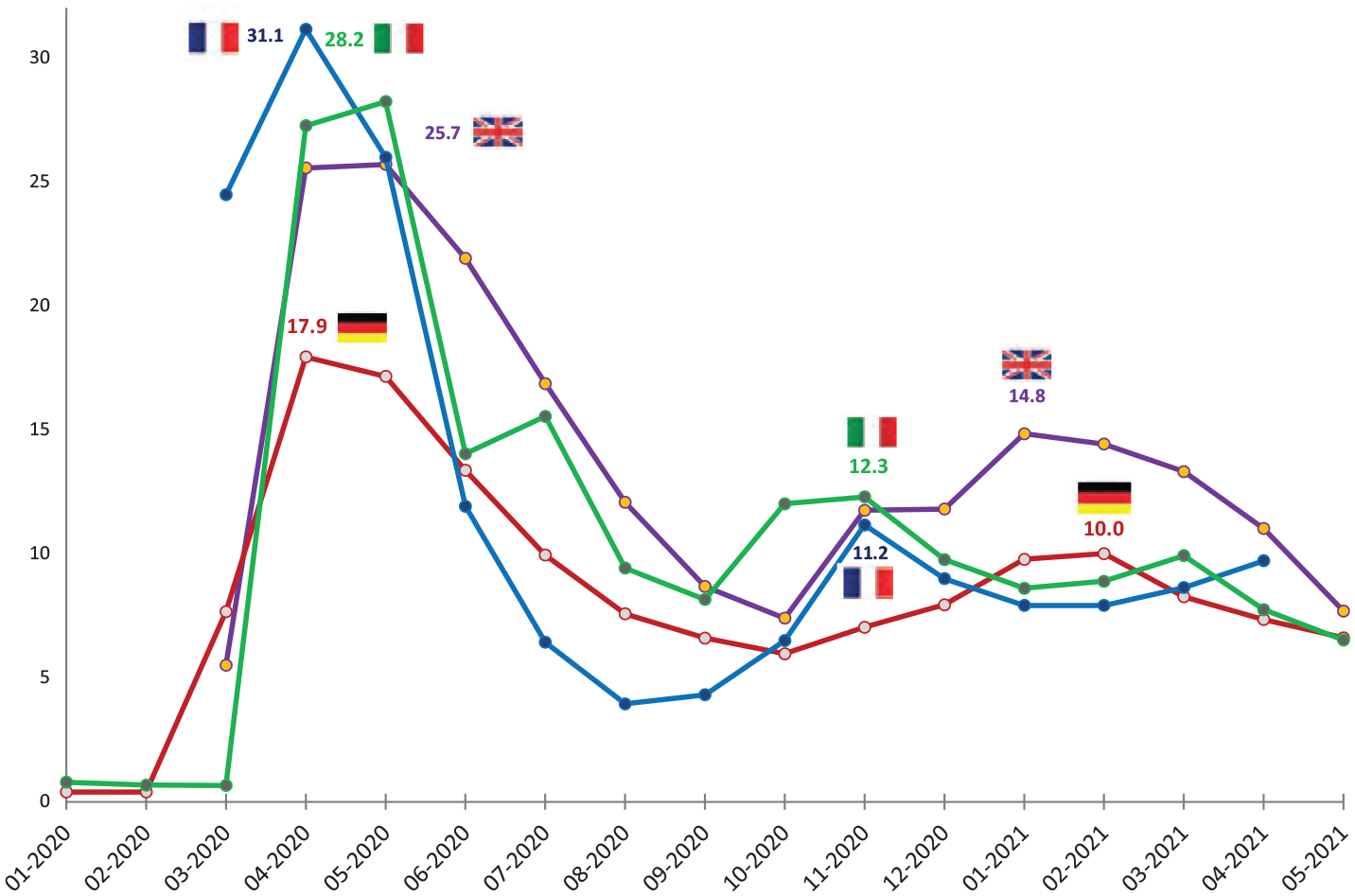
Job retention rates (% dependent labour force) in Germany, France, Italy and United Kingdom, 2020–2021.
Mediterranean welfare states doubled down on job retention through a business-supporting model. With EU SURE support, Italy, France and Portugal were able to deploy substantial funding to maintain their pre-crisis employment levels. In Italy, thanks to previous labour market reforms, unemployment benefits had already been extended before the pandemic. In addition to the established STW scheme (Cassa Integrazione Guadagni, CIG) for industrial workers, a shorter COVID-related CIG was introduced for all employees. Given the strict lockdown during the first wave, Italy’s and France’s STW take-up was considerable (see Figure 3). Less STW was used in Portugal, while Spain’s job retention scheme (ERTE) was not very successful in preventing unemployment (Moreira et al., 2021: 9). Greece initially introduced a flat-rate lockdown benefit for private-sector workers and the self-employed lasting several weeks. However, its full job retention scheme (SYN-ERGASIA) failed to attract many employees due to its late introduction (June 2020), unattractive design and employers’ reluctance to abstain from dismissal (Moreira et al., 2021: 8–9). Employment protection was further strengthened through restricting dismissals or increasing associated costs, with Italy and Spain for example imposing a universal ban on dismissals for the crisis period. The combination of low costs for businesses to retain workers under STW schemes and high dismissal costs made it attractive for businesses to furlough workers instead of laying them off.
Surprisingly, liberal welfare states, particularly the UK, pursued policies of generous support for businesses and workers, thereby promoting labour hoarding. Subsidies for employers were the highest in Europe, making the UK’s Coronavirus Job Retention Scheme one of the costliest (Table 1). The high furlough take-up rate of around 20 per cent during the first wave (see Figure 3) was due to employers not having to contribute to the costs in the initial 6 months and only minimally thereafter (Hick and Murphy, 2021: 8–9). Compared to the UK’s low flat-rate unemployment benefits, employees received relatively generous proportionate wage replacement payments. By contrast, Ireland as a liberal-conservative hybrid adopted a less generous wage subsidy scheme with very low but universal benefits. Switzerland pursued a universal approach by widely extending eligibility to vulnerable groups, including workers on fixed-term contracts, apprentices, temporary workers, on-call workers and even family members helping in small firms (Eichhorst et al., 2020a: 6), resulting in a high STW take-up.
Turning to Central and Eastern European (CEE) countries, the rapid introduction of job retention schemes led to an expansion of their welfare states, albeit comparatively less generous for employees and employers (Table 1). Despite receiving substantial EU SURE funding, less was spent on job retention by these relatively modest welfare states. Subsequently, STW take-up was lower in 2020 than in most other countries, though the more conservative Visegrád countries differed from the more liberal Baltics (Nölke and Vliegenthart, 2009) and some of the peripheral new EU Member States. Poland provided the lowest level of wage compensation to companies under its ‘Anti-Crisis Shield’ (40 per cent of the minimum wage), leading to a low STW take-up rate (Aidukaite et al., 2021: 12). Hungary, a comparatively high spender, undertook very little in the field of social protection (Aidukaite et al., 2021: 13). While the Baltics tended to be less generous, the pandemic coincided with an election and a pro-welfare president in Lithuania, leading to the government adopting universal policies complemented by generous targeted social protection. While the pandemic brought about some expansion of residual welfare states, labour market flexibility remained in place during the crisis.
Our comparison of job retention schemes highlights their importance across Europe during the pandemic, while also revealing important cross-national variations in their design. Nordic welfare states continued their tradition of strong social protection for workers but refrained from generous firm subsidies. Combined with already fluid labour markets, employers had relatively little incentive to furlough workers. CEE countries with few exceptions improved their otherwise residual support through STW but had lower take-up rates than elsewhere. Higher firm subsidies combined with more stringent employment protection in Continental and Mediterranean welfare states led to higher STW take-up, expanding their already successful strategy of the past. Liberal welfare states, especially the UK and Switzerland, embarked on a new path in their employment policy response. After introducing a widely used model of labour hoarding, the UK government found itself unable to wind down these expensive job retention schemes for more than a year. As a consequence of these measures, Continental, Mediterranean and liberal welfare states spent on average four times more on job retention than Nordic and CEE countries (Table 1).
The trade-off between unemployment and job retention
Across Europe, we find that welfare states with higher STW take-up rates experienced lower increases in unemployment during the initial crisis (Figure 4). 2 This inverse relationship is robust regardless of the STW measure: applications approved or STW take-up both point to an inverse relationship with changes in the unemployment rate, supporting the thesis that job retention policies help avoid mass dismissals. While the use of job retention schemes also correlates with variations in government restrictions and economic activity, initial estimates indicate that job losses would have been 50 per cent to 100 per cent higher without job retention measures (OECD, 2021a: 114–116). This figure is supported by the European Commission’s Employment and Social Report (European Commission, 2020: 122) which finds that in selected countries (Austria, Belgium and Germany) the largest part of negative employment shocks was absorbed by short-time work, at least until May 2020.
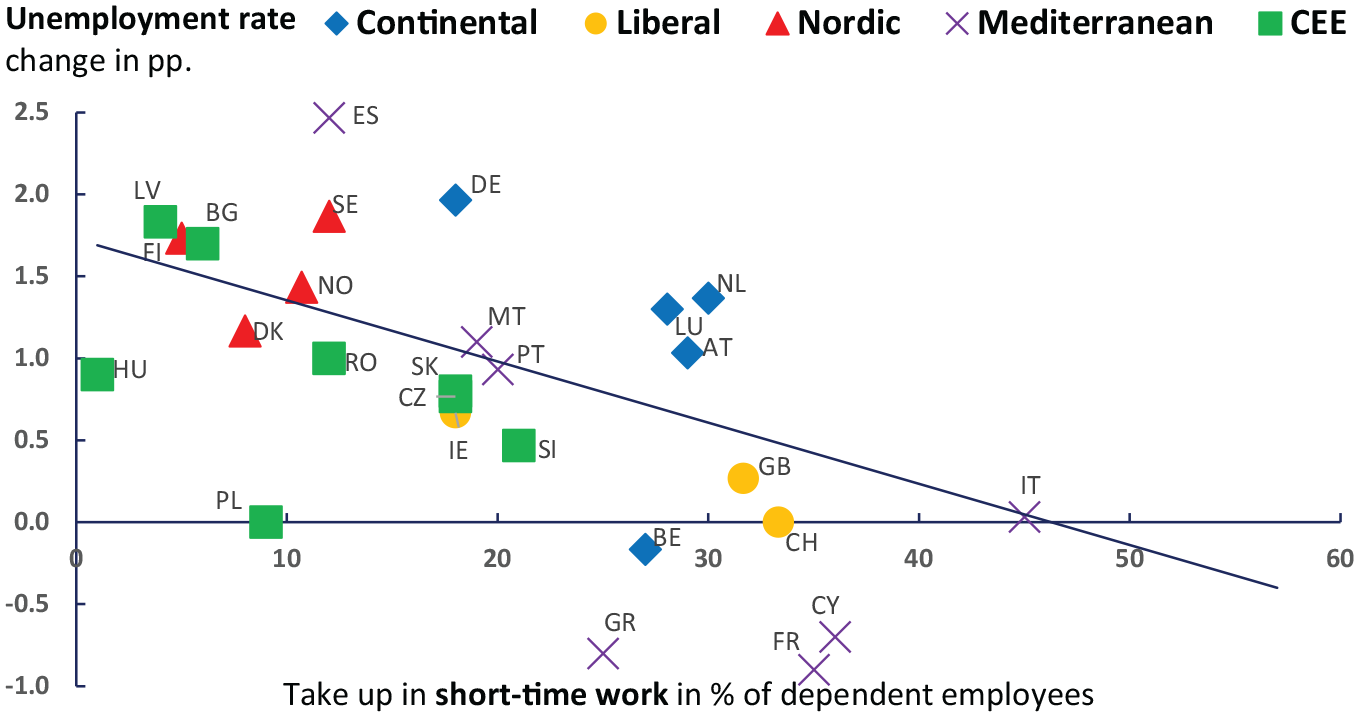
Effectiveness of short-time work schemes varies between welfare states.Source: Own compilation based on Eurofound (2021a), OECD (2021a), OECD (2020b), Eurostat (2021) and OECD Employment Database (OECD, 2021b).
Cross-national variations among welfare state regimes continued (Figure 4): Continental, Mediterranean, and liberal welfare states relied more on job retention, while experiencing lower unemployment increases. Several Mediterranean welfare states even reported declining unemployment rates at the beginning of the pandemic, in parallel with high STW take-up rates. For instance, 3.3 million French workers were on short-time work in April 2020, while the number of registered unemployed declined (European Commission, 2020: 112). By contrast, Nordic and Baltic countries experienced higher increases in unemployment as STW take-up was much lower. These cross-national differences suggest that a scheme’s design affects its effectiveness in protecting workers against dismissal.
Given their welfare state regime, there are striking outliers, particularly the expansive STW responses in the United Kingdom and Switzerland, two liberal welfare states with flexible labour markets. The strong response by Mediterranean welfare states also differs from the previous crisis when they were severely restricted by current account deficits and budgetary pressure (Bieling, 2012). Some CEE countries used the crisis to expand their residual welfare states, particularly Slovenia and Lithuania and to a lesser extent Czechia, Slovakia and Romania. It is too soon to predict whether such path departures will have a lasting impact on their welfare state models beyond the crisis.
Mapping business and labour support logics
Design choices matter for the effectiveness of job retention policies: Countries offering limited labour cost subsidies to businesses (lower than 100 per cent) on average experienced fewer STW applications and subsequently lower take-up. There was no difference in applications approved or STW take-up between pre-existing and new schemes, underscoring the differences between the business support and the labour support logics. Governments following the business support logic aim to lower the labour costs of firms, allowing them to hoard labour and thus further strengthening the power of business. This proved effective, as the decision whether to put staff on short-time work or to terminate their employment contracts lies predominantly with employers (Adams-Prassl et al., 2020: 605–607; Möhring et al., 2021: 7).
By contrast, governments following the labour support logic aim to cover employees’ income losses to sustain popular support. However, we find no link between STW take-up and income replacement for workers, again pointing to a skewed power balance in employment relationships: employers, not their employees, decide whether to put staff on short-time work or to terminate their employment contracts. The two logics, support for business and for labour, help explain some of the theoretically counterintuitive developments, given the path dependence expectations based on the respective welfare state regime.
Based on our comparative analysis, we propose the following mapping of the five welfare regime clusters in a stylised two-dimensional model showing reliance on labour hoarding on the horizontal axis and the generosity of STW benefits on the vertical axis (Figure 5). Although the figure includes benefit generosity (wage replacement rates for workers), it does not include labour costs to employers, as these were essentially reduced to zero in most liberal, Continental and Mediterranean welfare states (see Table 1, countries on the righthand side of Figure 5).
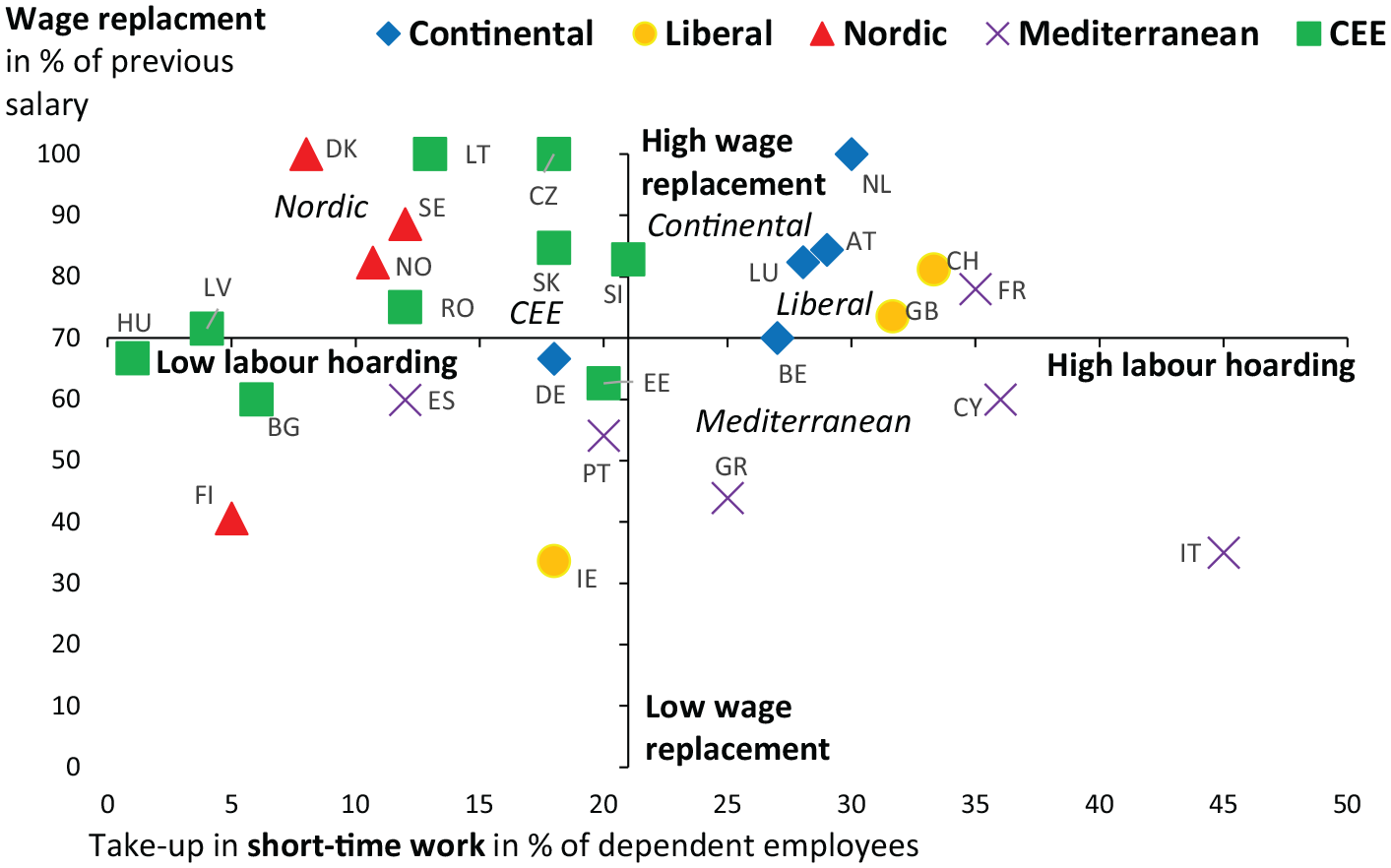
Mapping business support and labour support logics to welfare state regimes.
The Continental welfare states, in particular Germany, are a model of labour hoarding in crises, whether the Great Recession or the pandemic. Nevertheless, in the first wave of the pandemic, liberal welfare states, such as the UK and Switzerland, recorded even higher numbers of furloughed workers. Liberal, Continental and Mediterranean welfare states relying on the business support logic provided attractive conditions for businesses, with the reimbursement of their labour costs (Table 1) leading to a high take-up (horizontal axis in Figure 5). By contrast, Nordic welfare states relying on the labour support logic and thus providing generous STW schemes in line with unemployment benefits proved ineffective in preventing unemployment, as STW take-up was rather limited, with employers tending to resort to dismissals instead. Most CEE countries used STW relatively sparingly (with the Baltics suffering more from increases in unemployment). The lack of either policy design logic explains the low take-up.
Conclusion
In response to the COVID-19 pandemic and the ensuing employment shock, Europe responded by introducing or expanding job retention policies on a large scale. Almost all European countries managed to successfully implement such policies during the first wave of the COVID-19 pandemic in 2020. STW take-up during the Great Lockdown by far exceeded that of the Great Recession. The widespread diffusion of job retention policies across European countries – irrespective of their welfare state regime – indicates an important policy innovation triggered by the specific nature of this crisis. Contrary to the United States, Europe was able to avoid a massive increase in unemployment due to a rapid roll-out of STW schemes. Europe’s social model was sustained and – thus far – has substantially mitigated the negative social effects of the employment crisis. The abrupt and unprecedented crisis led to unilateral government decisions within a short timeframe and governed by uncertainty. Even under such conditions, social partners were crucial in providing expertise, facilitating workplace implementation and raising popular support, as happened with job retention and return-to-work processes. Conversely, social partners were able to leverage the crisis to regain relevance and negotiate additional benefits for their constituents.
Cross-national variations, nevertheless, continued to persist in the way in which these schemes were implemented and adapted. Countries relied differently on job retention policies and were successful in hoarding labour through the crisis, indicating the predominant path dependency of welfare states. Nevertheless, the crisis also brought policy responses diverging from previous trajectories. Continental welfare states – the archetypal labour-hoarding states – were this time joined by liberal welfare states with flexible labour markets, with the latter providing generous support for labour and businesses and relying massively on costly furlough schemes, especially in the United Kingdom and Switzerland. The EU played an important role in facilitating policy innovation via SURE funding, allowing Mediterranean and several CEE welfare states to massively scale up their STW schemes, though the latter were more reluctant to do so (partly as they were less affected by the virus during the first wave).
During the pandemic, Continental and Mediterranean welfare states relied on the business support logic, Nordic welfare states mainly on the labour support logic, while liberal welfare states followed both logics. However, most CEE countries failed to benefit from either logic, as seen by the lower take-up during the first wave. Overall, the job retention policy responses to the pandemic showed path-dependent patterns, though there were instances of path departure. It remains to be seen whether any innovation from institutionalised patterns, in particular the UK’s break with austerity, will last beyond this unprecedented crisis.
Our comparative analysis leads to questions needing to be the subject of future analyses. First, why did countries choose distinct policy responses? Our finding of different policy legacies is a starting point for such an investigation but would require further analysis to understand the specific political decisions taken. Second, we are as yet unable to explore the long-term impact of the policy responses and to apply the two logics to the subsequent use of job retention schemes during later pandemic waves or even future crises. Moreover, subsequent research could investigate whether the differences in higher income replacement rates for short-time work compared to unemployment benefits have led to the emergence of new inequalities associated with labour market dualisation and segmentation (Möhring et al., 2021; Naumann et al., 2020). Some job retention policies were designed to be more inclusive than others which excluded atypical employment, such as the marginally employed, dependent self-employed or freelancers. Are job retention policies inherently insider-oriented, hardly helping more vulnerable groups? Which social risk groups are not benefiting from short-time work, for instance, precarious migrants (Ban et al., 2022) and undeclared workers (Williams and Oz-Yalaman, 2021)?
As Europe emerges from the immediate health crisis, severe economic and social consequences are set to last much longer. The EU has gained importance as a facilitator of policy innovation. The Next Generation EU recovery plan will support the economic rebound through the first joint EU debt financing tool. To prepare for future crises, STW schemes could be further developed into a permanent tool available to prevent unnecessary mass dismissals and provide automatic stabilisation as an emergency Keynesian response during any recession (Corti and Alcidi, 2021). The tool should address the concerns of social inequality, adapt to new social risks and support life-course-related needs. Working time accounts could be used to rebalance the changing needs of employees over their working lives (Boulin and Cette, 2013). Other proposals call for a wider-ranging work-life insurance system (Schmid, 2020). Government subsidies to largely compensate for working time reductions became a widespread and respected tool during the pandemic, also thanks to EU SURE funding. Establishing permanent STW schemes could be part of a broader reform triggered by the ‘COVID moment’ (Crouch, 2022) possibly leading to a ‘pandemic paradigm shift’ (Rubinić, 2020) increasing welfare state resilience and thereby strengthening Europe’s social model.
Footnotes
Note on supplementary material
Replication data for this article is stored at the Harvard Dataverse (https://doi.org/10.7910/DVN/9D9F5M) and can be accessed online:  .
.
Funding
Our research has received financial support from the Economic and Social Research Council [grant number ES/P000649/1]; the Scatcherd European fund; and the Saven European fund (Lukas Lehner, PhD scholarship) and for research assistance from the University of Oxford’s Higher Studies Trust Fund (PI: Bernhard Ebbinghaus).
1
By labour hoarding we refer to the preservation of the employment relationship instead of dismissal despite a substantial or full reduction of working time with the provision that the employee will increase working hours when needed without any re-hiring by the employer.
2
Other measures may also take hold, such as temporary dismissal bans or extensions of parental and sick leave.