




Abstract
Working in two or more jobs at the same time creates special needs in terms of social security that differ from those of standard dependent employees or the self-employed. To investigate how well social security systems adapt to multiple jobholders we examine three case studies of countries with different levels and trends in multiple jobholding: Denmark, the United Kingdom and Germany. We review recent trends and policies to address social protection gaps for multiple jobholders in these countries prior to and during the COVID-19 pandemic, and the extent to which the emergence of the ‘platform economy’ can exacerbate multiple jobholding. We conclude that attempts to resolve the gaps in social security protection reflect distinctive characteristics of each employment system.
Introduction
Interest in multiple jobholding is linked to trends of increased fragmentation and individualisation of working arrangements. These in turn have given rise to a number of challenges to the levels of and entitlement to social protection. Some of these have long-term antecedents (Kalleberg, 2009) and are linked to the fissuring and fragmentation of work and organisations that supply products and services to larger companies (Weil, 2014). The growth of platform employment is often seen as exacerbating these tendencies as it encourages firms to diversify the types of jobs they offer. They can encourage multiple jobholding through self-employment as ‘independent contractors’ or a combination of part-time and temporary contracts as dependent or independent workers/contractors. They can also be linked to incentives and penalties created by national social protection systems that affect multiple jobholders. To explore how social security provisions have adapted to these developments we set out to examine trends in multiple jobholding in three countries where it is declining (Denmark), is stable (the United Kingdom) or is increasing (Germany). Based on this analysis we show how particular path-dependent policies have been adopted in each country to address these gaps in social protection for multiple jobholders.
Literature review
Multiple jobholding, including new forms of self-employment, in its latest incarnations is quite different from traditional independent self-employment. In the immediate post-war period the treatment of the self-employed, in terms of taxes and social protection, diverged from the benefits available to dependent employees. Lower levels of social contributions were used to compensate the individualised risks taken by these independent self-employed entrepreneurs (Schulze Buschoff, 2007). The renaissance of self-employment observed across Europe in the 1970s and 1980s was quite different, for example, with the emergence of ‘bogus self-employment’. Here the traditional independence of these self-employed workers was increasingly curtailed and they were more dependent on the companies they provided services for.
One of the key problems emerging from these forms of multiple jobholding concerns the employment status and social protection of workers engaged in more than one job, either as dependent employees, self-employed workers or both (Prassl, 2015, 2018). Attempts to regulate this employment, both within national jurisdictions and at the EU level, are problematic at a number of levels. One problem is in establishing clear demarcations as regards differential status and treatment, for example between the self-employed as independent contractors and those who are dependent employees. A related problem arises with regard to restrictions under EU competition law: price-fixing agreements between self-employed workers are regarded as cartels and are not permitted unless such self-employment is found to be ‘false self-employment’. 1 Today new forms of self-employment have also been linked to patterns of multiple jobholding that can include those working in several dependent employment jobs at the same time, or combining these with self-employment in either the traditional or the platform economy (Bührmann et al., 2018; Campion et al., 2020; Conen, 2020; Eurofound, 2020a; Schulze Buschoff, 2007).
Once classification as an employee, self-employed or a third category has been determined, the question arises as to their entitlement to social protection under existing social security law. Platform work is usually treated as self-employment in most countries. The social security available to the self-employed varies considerably between countries, however. While in most European countries the self-employed are compulsorily insured under the state pension scheme, in Germany this applies only to certain groups of self-employed (Schulze Buschoff, 2018a). In countries such as Denmark, with comprehensive social protection, there are also significant gaps in coverage and entitlement. This has been due to numerous exceptions especially for the self-employed working limited hours, as is often the case when it is their secondary form of employment (Schulz-Weidner and Wölfle, 2019: 399). In countries such as the United Kingdom, where social protection is means-tested, there can be disincentives to continue in supplementary secondary forms of employment if a worker loses their primary job. In addition, in-work benefits tend to encourage the take up of marginal employment, which does not necessarily encourage multiple jobholding but reinforces patterns of working poverty and gaps in entitlement to benefits and pensions.
The development of platform work and the more recent consequences of the COVID-19 pandemic have made a number of these gaps in social protection more visible for particular groups of vulnerable workers, which may include some types of multiple jobholding. While some authors are enthusiastic about the emergence of the platform economy, others suggest that this has further aggravated the dualisation of labour markets and increased the number of and disadvantages associated with atypical jobs (Emmenegger et al., 2012; Neufeind et al., 2018; Palier, 2018). With these new opportunities, and the relatively low entry barriers, we might expect the digitalisation of employment to lead to an increase in new forms of self-employment and multiple jobholding (Kenney et al., 2019). According to a survey by Huws et al. (2018), crowdwork is carried out mainly as a secondary job to top up income from full-time or part-time employment; it is rarely the only or main source of income in advanced economies (Schor, 2017). The question is, to what extent is multiple jobholding the result of choice or a necessity (Campion et al., 2020; Eurofound, 2020b)? If it is the outcome of necessity, what consequences does it have for multiple jobholders in relation to social protection?
Recent research on the characteristics of multiple jobholding in Europe has shed some light on the problematic nature of this form of employment, taking a closer look at the factors that push people into multiple jobholding. Conen (2020: 20) shows that multiple jobholders have lower earnings in their first job than employees with one job in full and permanent employment, and that they work more hours (Conen, 2020: 14). This provides evidence of the push factor of financial need to take up a second job, rather than a lifestyle choice. Multiple jobholders have significantly lower net monthly earnings, higher job insecurity and poorer career prospects (Piasna et al., 2021). As a result, multiple jobholders are associated with higher labour market risks and lower levels of entitlement to social protection.
This problem is particularly acute in countries that have seen an increase in multiple jobholding, such as Germany (Fachinger, 2014; Folta et al., 2010; Kay and Suprinovič, 2019; Suprinovič et al., 2016: 19), while this trend is falling in Denmark and has remained relatively stable, at a low rate, in the United Kingdom. Using a most different case comparison of the evolution of multiple jobholding in these countries we aim to explain how social policy provisions have been adapted and have reinforced these trends.
Methods
This analysis draws on an extensive body of comparative data and comparable reports from country experts involved in the WSI-funded project ‘Hybrid Work in Europe’. 2 Country experts worked collaboratively on an agreed structured questionnaire on the legal and social security situation of multiple jobholders. Focusing on three countries as a ‘most different case’ comparative research design we examine the extent to which multiple employment is integrated into the social protection system in each country in comparison with standard employees. We then review the recent set of policies to address social protection gaps in these countries introduced during the COVID-19 pandemic. In conclusion, we draw out the implications of national policies and their implications for the EU in terms of how gaps in social protection for multiple jobholders are being reformed in each of these countries.
European trends in multiple jobholding
Three distinctive trends in European countries can be identified from Eurostat data between 2010 and 2019. First, there are a group of countries in which the number of multiple jobholders has increased. These include most Scandinavian countries, the Netherlands, Estonia, Germany, Belgium, France, Ireland and the Czech Republic. The proportion of multiple jobholders has fallen as an overall percentage of the employed in Denmark (albeit from a relatively high level), Poland and Central and Eastern Europe. In contrast there has been little change in the United Kingdom, Italy or Slovakia. Contrary to our expectations, vulnerable labour markets such as those in Central and Eastern Europe or those hit hard by the fiscal crisis, such as southern European countries, display very low shares of multiple jobholders in official statistics (Eurostat, 2020).
According to the EU Labour Force Survey, across all Member States, the overwhelming majority of multiple jobholders (up to 90 per cent) have their first job in dependent employment (Eurostat, 2020). For approximately a third of them their second job is in solo self-employment; self-employment with employees accounts for approximately 3 per cent of all those with second jobs. The share of multiple jobholders who combine their primary job with working in solo self-employment in their second job is almost three (United Kingdom) and six (Germany) times higher than the share in the working population as solo self-employed (Eurostat, 2020). The quality of employment in these jobs tends to be very low in terms of high physical risk, high working hours and demands on availability, compromising their ability to manage a work–life balance, in particular those multiple jobholders who do this to make ends meet (Eurofound, 2020a).
The share of women in multiple jobholding has increased substantially since 2000: in 2019 women multiple jobholders outnumbered men, whereas 20 years previously men had accounted for over 60 per cent of all multiple jobholders in Europe (Conen, 2020). Women are more likely to work fewer hours than men in their primary job and use multiple jobholding as a way to increase income-earning hours (Preston and Wright, 2020). Women’s motivation to work in multiple jobs to obtain additional income is often driven by a higher sense of insecurity in their primary employment compared with equivalent men (Doucette and Bradford, 2019). Nevertheless, there are country differences: gender differences are more pronounced in the United Kingdom (4.7 per cent of women compared with 2.8 per cent of men) and in Germany, where 6 per cent of women have two jobs compared with 4.9 per cent of men; in Denmark the gender difference is negligible (7.4 per cent of women compared with 7.2 per cent of men).
In sum, existing data indicate (i) distinctive trends in the extent of multiple jobholding between countries, (ii) the poor quality of second jobs that are taken up out of necessity, and (iii) identifiable gender differences. We now turn to identifying the gaps in social protection for multiple jobholders and how social security provisions for multiple jobholders in each country are evolving.
Adapting social protection to the needs of multiple jobholders
Denmark
Denmark has one of the highest levels of multiple jobholding in Europe, although it has also seen one of the steepest falls in recent years. Approximately 10 per cent of all employees were multiple jobholders a decade ago; this has since fallen to slightly above 7 per cent, which is still comparatively high within the EU, where the average is around 4 per cent (Eurostat, 2020). A high proportion of multiple jobholders in Denmark tend to be either quite young or older; and while gender differences are small, women are slightly more likely to be multiple jobholders.
Multiple jobholders in Denmark have to rely on basic protection and social assistance more often than core industry workers, who have access to more generous negotiated unemployment insurance in sectors with stronger traditions of collective bargaining. Industries in which the share of non-standard employment is highest have the lowest levels of collective bargaining (Mailand and Larsen, 2018); solo self-employed and marginal employees are amongst the hardest to organise (Ilsøe, 2018).
The Danish case exemplifies a universal welfare state focusing on preventing poverty and securing a basic level of protection. This is largely achieved by a basic pension scheme and generous social assistance not bound to the principle of equivalence in terms of contributions (Mailand and Larsen, 2018). Welfare entitlement is based on citizenship/residence. Means-testing and employment-related benefits play a limited role. Most social protection schemes entail a generous public minimum and a more generous occupational scheme bound to industry collective agreements. In the pension system there is a publicly financed first pillar of statutory entitlement and a more generous second pillar, based on occupational sector pensions linked to collective agreements.
The tax-financed national pension system has been supplemented since 1964 by an income-related and contribution-financed supplementary ‘lifelong pension’, which is only relatively weakly based on the equivalence principle. Under the ‘lifelong pension’, all employees, regardless of their employment status (with the exception of public employees) between the ages of 16 and 65, are compulsorily insured. The system excludes marginally employed persons with a working time of fewer than nine hours, as well as solo self-employed persons without a history of previous employment. To receive the full entitlement to the public pension it is necessary to have had residency in Denmark for 40 years and to have reached the age of 65.
Occupational pensions are covered by sector-specific collective agreements. These are financed by contributions from employers (paying two-thirds) and employees (contributing one-third). Over 90 per cent of all employees in Denmark are entitled to an occupational pension. The importance of occupational pensions for employees with high and regular incomes ensures they are significantly better off in old age than employees with low and inconsistent incomes.
Earlier reforms have resulted in a tightening of access to social protection. For example, unemployment benefit entitlement was halved from four to two years; for workers between the age of 25 and 29, social assistance was cut to the level of student assistance. Recent reforms have aimed to overcome the disadvantages atypical workers face in a system focused on collective bargaining, however, and further reforms have been especially tailored to push individuals back into employment (Mailand and Larsen, 2018).
A significant protection gap for multiple jobholders is evident in unemployment insurance, which is administered by the unions. Membership of unemployment insurance is voluntary. Wage replacement rates for the unemployed in Denmark are determined by collective agreements, with replacement rates of up to 90 per cent of previous income for the two years prior to unemployment. Fixed rates of social assistance provide a lower rate of benefits for those not entitled to unemployment insurance to prevent poverty attributable to job loss. For multiple jobholders unemployment benefits have been calculated solely on the basis of their primary employment; income from previous second jobs was not included in these calculations, thereby diminishing their overall benefit entitlements (Mailand and Larsen, 2018).
Reforms introduced in 2017 and implemented in July 2018 created a new basis for the replacement rate, taking into account the entire earnings of individuals with several jobs (Kvist, 2017). This constituted a major departure from the previous system, in which benefit entitlement did not take account of the income earned by multiple jobholders from their second job. These reforms, alongside the voluntarist collective bargaining characteristics of the Danish system, enabled further adaptions to social protection affecting multiple jobholders. In particular they sought to adapt to the rapid and incremental changes arising from the digital transformation of work and the emergence of platform employment (Ilsøe, 2018: 278; Söderqvist, 2017).
One notable recent example of the flexibility of adaptation in the Danish system was evidenced by the unilateral initiatives to adapt the pension system taken by the largest Danish pension company. They now offer a programme that provides pensions to 15 different unions, representing employees not covered by collective agreements in both the public and private sectors. By taking unilateral action they have circumvented the problem of platform firms, which are less likely to join collective agreements. Ilsøe (2018: 281) argues that ‘the pension scheme is very attractive for groups such as the solo self-employed as it includes many of the same elements and benefits (for example, insurance and low administrative costs) as the labour market pension schemes that form part of most collective agreements in Denmark’.
The Danish case exemplifies how reforms to the inferior status of multiple jobholders’ entitlement to social protection have led to greater integration in recent public policy reforms to unemployment and private pension initiatives. Nevertheless, while there has been considerable flexibility in adapting to challenges created by employment in the digital economy, the trend has been for this pattern of multiple jobholding to fall over the past decade, albeit from relatively high levels, which could merit further investigation.
United Kingdom
The share of multiple jobholders in the United Kingdom has remained surprisingly stable over the past decade, at around 4 per cent of all employees. Women in the United Kingdom are more than twice as likely as men to have multiple jobs. Although 80 per cent of multiple jobholders have their first job in dependent employment, this is lower than in EU countries; consequently, almost 20 per cent of multiple jobholders’ first jobs in the United Kingdom are in solo self-employment. For multiple jobholders in the United Kingdom their second job is also more likely to be in solo self-employment, accounting for 38 per cent of all second jobs and the highest value of the three countries in this study (Eurostat, 2020).
The most common forms of multiple jobholding are ‘cash-in-hand’ work in trades, small business, house maintenance and child care (ONS, 2018). There is some evidence of growth in the number of platform firms operating in the United Kingdom across a range of services that encourage multiple jobholding (Huws et al., 2018). Limitations in the reach of the UK Labour Force Survey makes data collection on this type of working difficult, but it has been estimated that the gig economy represents about 4 per cent of the labour market (RSA, 2017: 25). The government is currently examining how working time regulations could be applied to those in the gig economy (Department for Business, Energy and Industrial Strategy, 2018: 68).
Levels of social protection are heavily determined by employment status and contributions to National Insurance, working time thresholds and income levels (O’Reilly and Lewis, 2018). In the United Kingdom employment status differentiates between workers, employees, the self-employed and contractors; directors; and office-holders. Each term of employment status stipulates statutory rights and responsibilities in employment relationships. It is the employer’s duty to establish the employment status of those who work for or with them. There are significant differences between those who are in permanent employment and enjoy occupation-based protection and those who are unemployed, underemployed or in precarious work.
Some distinctive characteristics of the UK social protection system include: low contributions and means-tested benefits; in-work benefits; employer-provided benefits; and universal health care. Social protection policies in the United Kingdom are aimed at ‘reducing poverty and wealth gaps through the national minimum wage, means-tested benefits, payments such as working tax credits to low earners and assistance with child care, pensions, payments in kind such as free prescriptions, and the provision of services such as local authority home-care help’ (Macrory, 2010: 1). They have developed as a mixture of out-of-work and increasingly in-work regulations and benefits. There is a longstanding relationship in the United Kingdom between benefits and low pay. The main recipients of these benefits are often in marginal and atypical employment. In-work benefits effectively act as an incentive to accept low-paid work, with benefits providing a top-up income.
The introduction of Universal Credit is the biggest reform of the benefit system since 1945 (Hood and Norris Keiller, 2016: 82). The introduction of Universal Credit replaced Job Seekers Allowance (JSA), along with five other benefits: Child Tax Credit, Housing Benefit, Income Support (the safety net benefit), income-related Employment and Support Allowance, and Working Tax Credits. Universal Credit was introduced in 2013 and is being rolled out in stages across the country, although it has encountered a number of technological obstacles in the implementation phase. There have been repeated demands to make further significant changes to Universal Credit and increase benefit rates, in particular since the rise in unemployment related to the COVID-19 pandemic (Guardian, 2020). The main aim of Universal Credit is to remove the hours threshold for in-work credits and to integrate in-work and out-of-work benefits.
Benefit levels vary by age category and whether claimants live as a couple. Grimshaw et al. (2016) argue that ‘In the original design the incentives to work were high for main breadwinners but low for second income earners; the announced rise in the national minimum wage from April 2016 marginally increases incentives for second income earners but they still lose 65% of every pound earned until Universal Credit is reduced to zero’. The impact of Universal Credit on atypical employment will be to remove the hours thresholds so that there are more opportunities to work short hours and to top up income with benefits. This could be seen as encouraging the use of zero-hours contracts, which do not require the employer to guarantee any hours of work and therefore no guaranteed income. These contracts have increased significantly: in 2000 zero-hours contracts accounted for less than a quarter of a million workers, by 2019 this had increased to almost 900,000, accounting for 2.8 per cent of overall employment in the United Kingdom (ONS, 2020). Sectoral variation in the use of these contracts indicates that they are more prevalent in the accommodation and food sector, accounting for 23 per cent of employment, and 20 per cent in health care and social work in 2019 (ONS, 2020); these are the very sectors that have been hit hardest by the COVID-19 pandemic.
In terms of pensions there has been long-term decline in the number of people enrolled in pensions in the United Kingdom, particularly in the private sector. The introduction of mandatory automatic enrolment in the National Employment Savings Trust (NEST) by the Pensions Act 2008 was intended to address this by increasing enrolment from 55 per cent in 2012 to 70 per cent of all eligible employees by 2019. This is aimed particularly at jobholders on moderate to low incomes, who do not have access to a good-quality workplace pension (Forth and Stokes, 2014). The minimum contributions to the savings fund as of April 2019 were 5 per cent of workers’ earnings paid by the employee and 3 per cent paid by the employer.
Harris and Large (2016) point out that at the time of the Survey in 2015 only a minority of employers (25 per cent) offered a workplace pension provision, although this had increased by six percentage points since 2013. This gives an example of the extent of poor pension coverage beyond that offered by the basic state pension in the United Kingdom. Grimshaw et al. (2016) argue that although there is evidence of a gradual increase in coverage as a result of recent automatic enrolment legislation introduced in the Pensions Act 2008, major gaps in provision remain, especially among those in small firms and multiple jobholders. The most recent data from the Pensions Policy Institute in November 2020 indicated that many multiple jobholders are excluded from automatic enrolment, which is triggered only once a worker earns over £6240 a year in a single job. Even for those who earn slightly more, the lower earnings limit means that they miss out on contributions from each of their different jobs. 3
In sum, multiple jobholding in these circumstances does not address the problem of in-work poverty, which is more likely to be associated with part-time work and self-employment. The UK Office for National Statistics (2015) estimates that 46 per cent of people living in poverty in 2012–2013 were in working families; by 2018 this was estimated to have increased to 56 per cent (ONS, 2020). Unsurprisingly, transition out of poverty was found to rely on an increase in working hours and even more so on higher hourly earnings. The Taylor Review and the government’s response and commitments are recognition of how the changing contours of the UK labour market are vulnerable to legal loopholes in enforcing employment legislation and social protection. How future reforms will be implemented and with what effect remains to be seen in the context of ‘Brexit’ and a number of unprecedented social policies introduced during the COVID-19 pandemic.
Germany
The growth of multiple jobholding in Germany over the past decade has risen from 3.7 per cent in 2010 to 5.5 per cent in 2019, and women are increasingly more likely to be multiple jobholders (6 per cent) than men (5 per cent). This has raised concerns about the adequacy of the social protection system to integrate these emerging forms of employment in both the conventional and the digital economy (Rahner and Schönstein, 2018).
The German social protection system rests upon statutory social insurance. In contrast to other European countries the basis for social protection follows the actuarial logic of contributions and entitlements rather than universalistic public insurance, as in Denmark. This focuses on dependent employees (wage labour) as the starting point of social security. Additional social security provision for their dependents includes their marital status in the social insurance system. Spouses who do not work, or are only marginally employed, derive their social insurance protection from their working spouse, including free entitlement to health insurance for themselves and their dependents.
Public health insurance is based on the principle of solidarity. Where risk occurs, the costs are covered by the community of the insured, regardless of the previous contributions of the individual. Public health insurance contributions are paid as a percentage of the main earner’s income, which is usually the male earner in the household. High-income earners have the option to sidestep the solidarity principle by opting for private insurance instead. Since a reform of 2009 health insurance is now mandatory for all inhabitants (Schulze Buschoff, 2018b). This now includes the self-employed alongside the marginally employed.
Unemployment insurance is mandatory only for dependent employees above a certain income threshold. Those of the self-employed who were previously dependent employees are allowed to retain their entitlement to unemployment insurance on a voluntary basis. For the marginally employed there is no option to be insured against unemployment.
The German statutory old-age pension scheme is strongly based on income and on the principle of equivalence of entitlement related to contributions. It clearly adheres to the principle that the pension mirrors the individual’s work history. Pension benefits are determined primarily by contributions paid on earned waged income over the working life, which is split equally between employers and employees.
With regard to the social security of self-employed workers, Germany is unique among European countries (Schulze Buschoff, 2018b). While in the majority of European countries self-employed workers are systematically included in the compulsory statutory insurance system, access in Germany is limited to a few special groups of self-employed workers. Special compulsory systems therefore exist today for around one-quarter of the self-employed (for example, midwives, coastal fishermen, crafts/trades people, lawyers, artists and authors), although the conditions vary greatly depending on the professional group.
Therefore the present old-age security regulations for self-employed workers are particular and selective. Different forms of work and professions are protected in very different ways under German social law: as a result, status changes and changes of professions can be seriously detrimental to these people. The absence of a form of minimum social security creates a risk of old-age poverty. This risk is particularly high for the self-employed who are not compulsorily insured, for those who are compulsorily insured self-employed but with low incomes, and for individuals with flexible work histories. Flexible workers whose career history contains periods of non-compulsory insured self-employment or periods of limited-income employment (so-called ‘Mini-Jobs’) are at particular risk.
The German mini-job is a specific kind of marginal employment in which the employee earns no more than €450 per month. Since 2003 employees working a mini-job as a second job do not have to contribute to the otherwise statutory social insurance. This regulation is unique in international comparison. It was developed to allow companies to hire staff without incurring high insurance obligations, with the intention of making it easier for part-time workers to take on an additional second job. The number and proportion of employees holding multiple jobs has almost tripled, up from one million in 2003 (Graf et al., 2019; Walwei, 2018). The €450 threshold acts as a strong disincentive to earn more or work longer, because full taxation and a gradual integration into social insurance begins as soon as earnings exceed €450 per month. This arrangement, however, is quite attractive and popular with secondary earners, such as married women, people with a fully socially protected first job, students and pensioners. Since a reform in 2015, the marginally employed have also been subject to pension insurance. Against the background of low contributions, however, benefits are too low to protect against poverty in old age. Most employees make use of opting out of pension insurance contributions, as contributions are disproportionally high in relation to their very low wages and they derive their entitlement by their dependent status (Eichhorst and Tobsch, 2014: 25; Hohendanner and Stegmaier, 2012).
While reduced social insurance and tax regulations make mini-jobs attractive to some employees and particular types of employers, especially in the service sector and retail, there are a number of disadvantages. The gaps in social protection, lower pension entitlements, fewer opportunities for further education, limited opportunities for advancement, and considerable deficits in the enforcement of employment regulations are some of the drawbacks. For employers there are also disadvantages, as the preferential treatment in exemption from tax and social insurance contributions effectively works against employees increasing their hours worked.
Against the background of the criticism of labour market and socio-political effects and disincentives, various proposals have been made for the reform of mini-jobs. Walwei (2018) has suggested that there needs to be a slow reduction of the incentives to take jobs that do not require tax contributions. This could lead to an increase in ‘midi’ jobs enabled by more extensive care provisions to facilitate workers’ choices. Integrating mini-jobbers into insurable employment could secure skilled workers for employers and living wages for employees.
Overall, the gaps in social security for multiple employees are comparatively large in Germany compared with employees with one job in full and permanent employment. This is particularly true for mini-jobbers and multiple jobholders who are self-employed in at least one job. In addition, such workers are more likely to be single adult women with children and, according to Conen (2020), they are more likely to be in low-quality jobs compared with men with multiple jobs. An important feature of the German labour market in recent years has been the promotion of mini-jobs exempt from social security contributions and taxes, which inevitably leads to high growth of such jobs. Little reform effort is visible in the encouragement of these atypical employment forms. Therefore, while there are incentives in social policy provisions to take these up it comes as no surprise that the number of multiple jobholders has grown in the past decade.
Comparing responses to COVID-19 and the consequences for multiple jobholders
The COVID-19 crisis has shown how the lack of rights for non-standard workers and, in particular, multiple jobholders puts them at risk in the labour market (Eurofound, 2020a: 8). Multiple jobholding might also expand, however, as a survival strategy for individuals in the labour market who are able to secure partial forms of employment (Piasna et al., 2021). Based on Eurofound data, Table 1 shows measures that may mitigate the consequences of the crisis in Denmark, the United Kingdom and Germany for the target groups ‘employees in non-standard employment’ and ‘solo self-employed’, categories that frequently overlap with forms of multiple jobholding.
Policy measures in the context of the COVID-19 pandemic in Denmark, the United Kingdom and Germany (data collection started in March 2020, last update considered here 20 May 2020). Target groups: Workers in non-standard forms of employment and solo self-employed
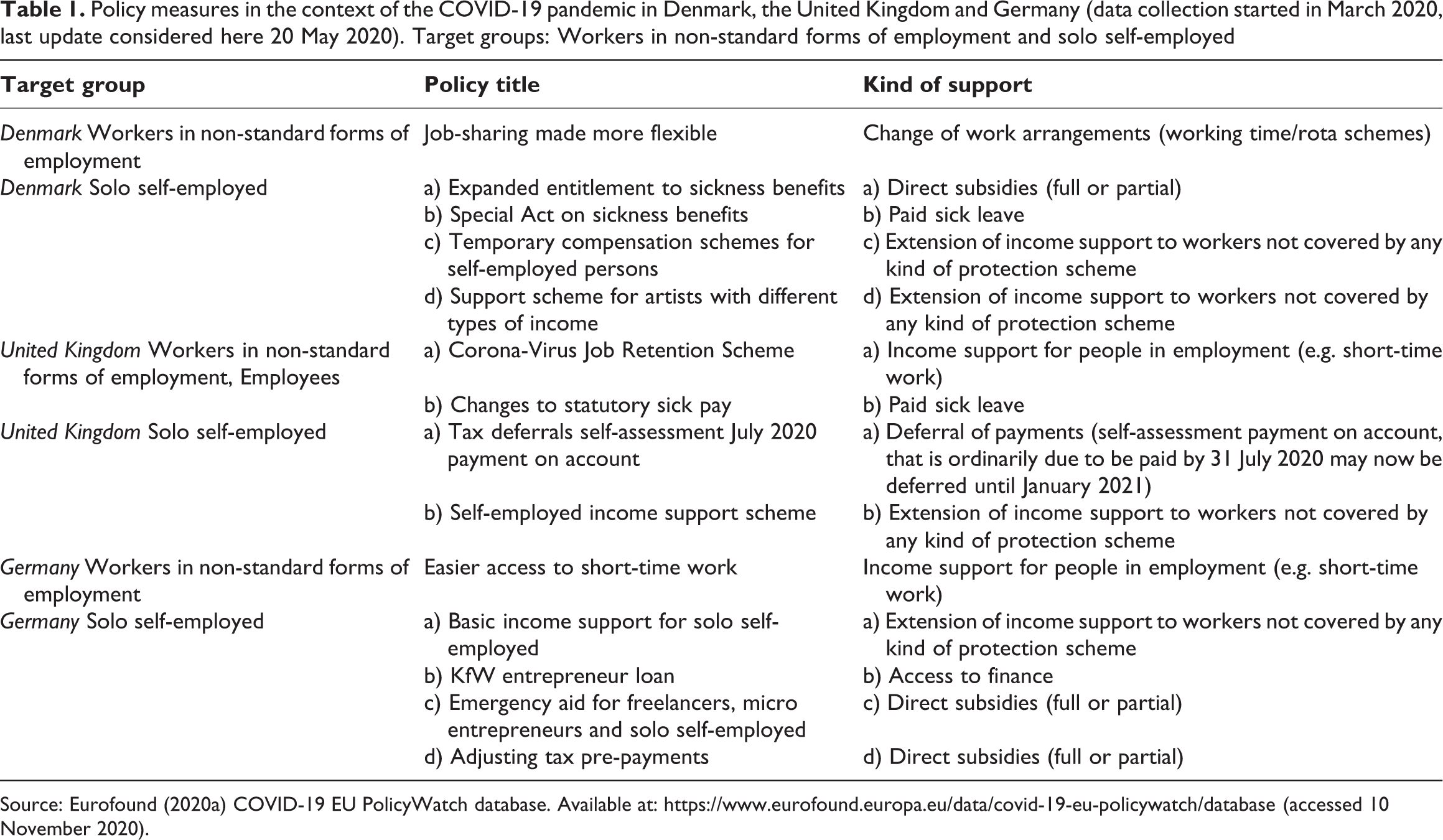
Source: Eurofound (2020a) COVID-19 EU PolicyWatch database. Available at: https://www.eurofound.europa.eu/data/covid-19-eu-policywatch/database (accessed 10 November 2020).
In sum, the Danish government has implemented changes that increase flexibility in the existing rules on reduced working hours. In order to avoid direct dismissals, it is possible, under the new rules, for companies to make use of the existing job-sharing scheme in a more flexible way.
In the United Kingdom the Job Retention Scheme provides unprecedented income support for people who had been furloughed, in other words, where they were no longer able to work: employers could apply for 80 per cent of their salary up to a £2000 monthly limit. This is broadly comparable to, but not as generous as, the German short-time working scheme. One major criticism is that the solo self-employed in the UK have to date not been able to access these benefits and they have had to rely either on loans or recourse to social assistance provided by Universal Credit.
In Germany, short-time work benefits are an important measure to alleviate the consequences of the COVID-19 crisis for employees. Short-time work benefit is an unemployment insurance benefit. The aim is to preserve jobs and, at the same time, at least partially replace the employee’s loss of income caused by a reduction in working hours. With the far-reaching financial effects of the Corona crisis on companies, this wage replacement benefit plays a crucial role. More people than ever are currently on short-time work; by the end of April 2020 there were already over 10 million (Bundesagentur für Arbeit, 2020).
Special measures were introduced to help the solo self-employed affected by the Corona crisis lockdowns. Unlike dependent employees, who benefited from various versions of short-time work programmes, such insurance benefits do not exist for the self-employed, who have largely been left to request business loans or move onto social assistance (Eurofound, 2020a). The crisis clearly shows the gaps in safeguarding the self-employed.
In all countries, the aim should be to include the self-employed in insurance systems that compensate for a temporary loss of income as a result of unemployment. Insurance benefits for which the self-employed have paid contributions are more reliable and safer than one-off state payments or business loans.
Conclusions
Although the countries studied here differ in their respective social protection schemes they produce markedly different outcomes in dealing with some of the challenges arising from the fragmentation of work and emerging forms of precariousness associated with the digital economy. There are distinctive ways of dealing with the social protection gaps for multiple jobholders in each country. While Denmark has integrated multiple jobholders’ income streams in their benefit entitlement calculations, there has been a consistent reduction in the number of multiple jobholders over time. The voluntarist model has proven to be flexible in adapting to new challenges arising from the digital economy, corresponding to its status as a digital front-runner in Europe (DESI, 2020). In the United Kingdom, Universal Credit was intended to simplify the claimant system but benefit levels remain very low. Multiple jobholding is not necessarily a solution to reduce poverty in the face of means-tested social protection and low-wage employment; this might to some extent explain why levels of multiple jobholding remain relatively low and stable. In contrast, the German model remains dualist, protecting core workers and incentivising the take-up of atypical employment, such as mini-jobs. Further social protection for solo self-employed in the actuarial system continues. This has contributed to the rise in multiple jobholding in recent years. Proposals to escape this trend have suggested the integration of mini-jobs into the system of taxation and social protection, drawing attention to the gender take-up of these jobs and a gradual reduction of incentives to offer jobs that evade social contributions (Walwei, 2018).
This country comparison of social security for multiple jobholders differentiates between three different risk patterns in the pre-pandemic period. These patterns refer to the entitlement or gaps in social protection for multiple jobholders:
−
−
−
The COVID-19 crisis has revealed the vulnerability of particular groups of workers, such as those with one or several jobs in self-employment as they have been more likely to signal financial hardship. For example, two-thirds of the self-employed surveyed in April 2020 believed that their financial situation had deteriorated since the onset of the pandemic; and over half of the self-employed believed that their financial situation would deteriorate further over the summer of 2020 (Eurofound, 2020a: 8). Because of the insufficient social protection for these workers a number of time-limited measures have been introduced during the pandemic. 4
In the face of these immediate shocks, and the longer-term structural changes implied by the digitalisation of employment, the need to reform existing social protection systems has come into stark focus. These issues were already on the political agenda before the pandemic. In March 2018, the European Commission published a proposal for a Council recommendation on access for workers and the self-employed to social protection. The recommendation aims to support all those who, due to their status or the length of their employment, were not sufficiently covered by social security systems. This recommendation is to be welcomed, but it is less ambitious than expected in terms of the principles of upward convergence set out in the European Pillar of Social Rights. This may change as a consequence of the pandemic, but the degree to which there will be a European solution is questionable.
We have seen with regard to overcoming the risks caused by increasingly flexible labour markets and multiple job histories, that inclusive systems (such as Denmark) are more suited than systems that are clearly oriented towards previous work performance. Basic protection, which represents citizen or resident entitlements, performs well in protecting individuals against poverty because neither employment nor (changing) activity status are decisive factors in determining eligibility. In Denmark all residents, regardless of employment and activity status, are insured by the state basic social security system and the benefits are sufficient to prevent poverty. Pension gaps in terms of maintaining one’s living standards during retirement, however, do exist in Denmark. Access to both the second pillar of occupational pensions and the more generous unemployment insurance depend on collective agreements, which often do not apply to the sectors in which multiple jobholders are more likely to work.
Differences between welfare systems concerning the inclusion of multiple jobholders in the social security systems are especially visible when looking at old-age pension systems. While in public health insurance all insured workers are generally entitled to the same benefits in kind, even in continental-Bismarckian systems, entitlements to old-age benefits vary widely for different types of employment between countries with universal benefits, such as Denmark, and those with insurance and equivalence-based systems, typified by Germany.
In all countries, multiple jobholding has been accompanied by the emergence of the platform economy. Employment in the platform economy presents a special challenge with regard to regulating employment and social security. Particularly in need of regulation is the outsourcing of services or the offshoring of functions/processes to the detriment of local labour markets, including beyond national borders. For these forms of employment in particular a transnational, possibly EU-wide framework for regulation is necessary.
Social protection systems in Europe face challenges in providing effective coverage for workers in all forms of employment, namely workers on various types of contracts in paid employment, self-employment or holding multiple jobs. It is evidently necessary to strengthen and adapt social protection systems to enable them to fulfil their key role in preventing and reducing poverty, enhancing income security and limiting inequality, as so poignantly revealed by the COVID pandemic. Ensuring universal social protection requires closing coverage gaps and adapting to new contexts related to digitalisation and the emergence of new forms of employment, so as to realise the human right to social security for all (Behrendt and Anh Nguyen, 2018: 30). All types of employment should be protected, not only in the case of unemployment and old age, but also during critical transitions throughout the life course, such as the transition from dependent employment to self-employment (Schmid, 2011). Building comprehensive social protection systems with strong, nationally appropriate social protection floors is fundamental to promoting sustainable and solid social security (Behrendt and Anh Nguyen, 2018: 31), and the ability to introduce at short notice new unprecedented and extensive policies during the pandemic period indicates that creative and decisive policies are possible.
Footnotes
Acknowledgements
The article builds on expert knowledge gathered through the research network ‘Hybrid Work in Europe’ funded by the WSI (Institute of Economic and Social Sciences) at the Hans Böckler Foundation. We thank the participants in the panel on Digitalizing and Fragmenting Labor at SASE 2019, Anke Hassel, Felix Sieker and Joshua Cova, as well as Rosa Daiger von Gleichen for valuable comments at several of the many draft stages of the article.
Funding
This contribution is part of the research network Hybrid Work in Europe funded by the Hans Böckler Foundation with additional funding from the ESRC Digital Futures at Work Research Centre [grant number ES/S012532/1].