




Abstract
In the context of rising inequality between capital and labour and among wage-earners in Europe, this state-of-the-art article reviews the literature concerning the relationship between collective bargaining and inequality. It focuses on two main questions: (i) what is the relationship between collective bargaining, union bargaining power and inequality between capital and labour? and (ii) what is the relationship between collective bargaining, union bargaining power and wage inequality among wage-earners? Both questions are discussed in general terms and for single- and multi-employer bargaining systems. It is argued that collective bargaining coverage and union density are negatively related to both types of inequality. These relationships are however qualified by four additional factors: who unions represent, the weight of union objectives other than wages, the statutory minimum wage, and extensions of collective agreements by governments.
Introduction: the surging interest in inequality
Since the mid-2000s there has been increasing interest, in Europe and in the rest of the world, in the role of inequality in our societies and economies. Income inequality has been on the rise for decades now in the majority of European and other rich countries (as well as in most developing countries) (Berg, 2015; OECD, 2011, 2018; UNDP, 2013, 2019). Also, inequality has turned out to be substantially higher than often assumed when taking wealth into account in addition to income (Piketty, 2014). As part of these tendencies, recent decades have seen an increase in low-wage work and precarious work in the EU (Doellgast et al., 2018; Gautié and Schmitt, 2010; Kalleberg, 2009), creating additional dimensions of inequality.
Inequality has moved to the centre of political and academic debate first of all because it contradicts perceptions of social justice, in terms of both increasing poverty at the bottom of the distribution and the continuously expanding proportion of wealth and income appropriated by the richest strata (ILO, 2016).
Secondly, in recent years numerous studies have underlined the negative social consequences of inequality (for example, Atkinson, 2015; Piketty, 2014; Wilkinson and Pickett, 2009). As these authors argue, countries in which inequality is higher also perform worse in terms of health, poverty levels, social mobility and other social indicators.
Thirdly, there is increasing interest in the relationship between economic growth and inequality. On the one hand, it has become broadly accepted that inequality has negative effects on economic growth (Akyüz, 2018; European Commission, 2018; IMF, 2015; Moore et al., 2019; OECD, 2015) and innovation (Dosi et al., 2018). On the other hand, evidence abounds that economic growth does not necessarily reduce inequality, as growth often benefits in particular the richest strata of society. Moreover, the low growth rates of recent decades have intensified distributional conflicts, resulting, apart from growing inequality, also in declining trust in politics, polarisation and declining social cohesion (Streeck, 2017). This has spurred a debate about the concept of ‘inclusive growth’, that is, ‘economic growth that creates opportunity for all segments of the population and distributes the dividends of increased prosperity, both in monetary and non-monetary terms, fairly across society’ (OECD, 2015: 80). The European Commission has underlined the importance of inclusive growth for addressing some of the structural weaknesses of the European economy (European Commission, 2018).
As a result of all these developments, combating inequality has become more prominent in the policy debate and after decades dominated by a discourse that paints inequality as an unavoidable, sometimes even positive aspect of capitalism, today the conviction is growing that inequality is not a ‘natural’ phenomenon, but the outcome of unequal power relations, political choices and ideologies that justify inequality (Piketty, 2020; also Atkinson, 2015; Stiglitz, 2012).
One of the major spheres in which inequality is fostered in Europe is the labour market: ‘It is there that value is created and divided between the various gradations of wage-earners. It is there that the inequities which necessitate redistribution are set up’ (Wilkinson and Pickett, 2009: 249–250). Within the labour market, the level and distribution of wages are key in determining both wealth and income inequality, through two types of wage inequality: inequality between capital and labour (the functional income distribution), and inequality in the distribution of wages across wage-earners.
An aspect of the labour market often neglected in the inequality debate is collective bargaining. However, collective bargaining plays a pivotal role in wage setting in many European countries and can therefore be expected to be a key determinant of the two types of wage inequality. To fill this gap, the question this article addresses is, what can be learned from the literature concerning the relationships between collective bargaining, the bargaining power of labour and the two types of wage inequality?
The article focuses on the European Union. It reviews literature that discusses the EU as a whole and compares (clusters of) EU countries. It also presents country examples to illustrate the points made. The review addresses two main issues: the relationship between collective bargaining, union density and functional income distribution (Section 2); and the relationship between collective bargaining, union density and wage inequality among wage-earners (Section 3). It then discusses four factors that qualify the relationships between collective bargaining density and inequality (Section 4). Section 5 concludes.
A fair share for wages? Collective bargaining and functional income distribution
One of the main questions related to collective bargaining and inequality concerns the functional income distribution (the distribution of total income between capital and labour), reflected in the wage share. In other words the share of value added produced in the economy that goes to labour and not to capital. The size of the wage share influences levels of inequality between employers, investors and shareholders, on the one hand, and wage-earners, on the other. In post-war Europe wage share-based inequality initially declined following from the rapid growth of real wages. This growth was fostered by growing trade union strength, union success in defending workers’ interests through collective bargaining and other mechanisms, as well as the introduction of minimum wages and other state policies promoting fair wages and constraining the power of economic elites (Atkinson, 2015; Crouch, 1993). Since the mid-1970s, however, real wage growth has not kept pace with productivity growth, and the wage share in the EU has been falling, rapidly in the first few decades and more slowly in recent years. Lately, mainly the southern European countries and Ireland have seen their wage shares decline sharply (Akyüz, 2018; European Commission, 2019; ILO, 2016; OECD, 2018). Inequality between capital and labour has increased as a result, concentrating income at the top of the income distribution. Moreover, the wage share has not developed equally for all wage groups; it has in fact increased significantly when considering solely the top incomes, while it has declined more than the average for the rest of wage-earners (OECD, 2011; Piketty, 2014).
The decline in the wage share has been taking place in a political and economic context that has tended to strengthen the power of capital over that of labour through processes of globalisation and the expansion of the EU Single Market, which have increased options for capital mobility and concerns about (wage) competitiveness. Also, financialisation has augmented the pressure on companies for higher and short-term rates of return. Moreover, until the corona crisis, there was a long-term austerity drive concerning public budgets in national and EU policies and legislation. These developments have created a general pressure for wage moderation, as well as a propensity on the part of workers to accept (wage) concessions in order to safeguard jobs (Glassner et al., 2011; Marginson, 2014; Pochet et al., 2010; Schulten, 2002; Stockhammer, 2017).
Simultaneously, a common trend involving the gradual liberalisation of labour market and industrial relations institutions has taken place in Europe, even though there have been substantial differences between countries in the shape and speed of liberalisation (Baccaro and Howell, 2017; Streeck, 1998; Thelen, 2014). Here the concern is mainly with those institutions that matter for wage bargaining, in particular the coverage of collective bargaining and trade union density, but also the level at which bargaining takes place and the extent to which it is coordinated. On all these dimensions an erosion of mean values can be observed for the EU: a decline in collective bargaining coverage, lower union density, decentralisation of collective bargaining and reduced bargaining coordination (OECD, 2019a; Visser, 2016). The extent to which these developments have taken place again differs strongly by country (OECD, 2019a; Visser, 2016; see also below).
In general terms, the erosion of these institutions has resulted in a weakening of workers’ and trade union bargaining power in contrast to employers (Akyüz, 2018; Erne, 2008; ILO, 2016; Kohler et al., 2019). This has had negative effects on the wage share. In both advanced and emerging economies the major explanatory factor for wage share decline are changes in the coverage of collective agreements and union density (Moore et al., 2019: 284–285; see also Dosi et al., 2018; Fichtenbaum, 2009; Kristal, 2010). Higher union density gives unions more bargaining power towards employers, increasing the likelihood of higher wages for the workers covered by union bargaining and hence a higher wage share. Wider bargaining coverage expands the group of workers that share in the benefits of bargaining. This is supported by the positive association between the wage share and bargaining coverage (Figure 1) and the weak but still positive association between the wage share and union density (Figure 2). Bargaining coverage seems to be the more decisive factor here. Indeed, apart from countries in which both indicators are high (in particular, Belgium and Denmark), several countries with high coverage but low or medium union density also have a relatively high wage share (in particular Slovenia, the Netherlands and France).
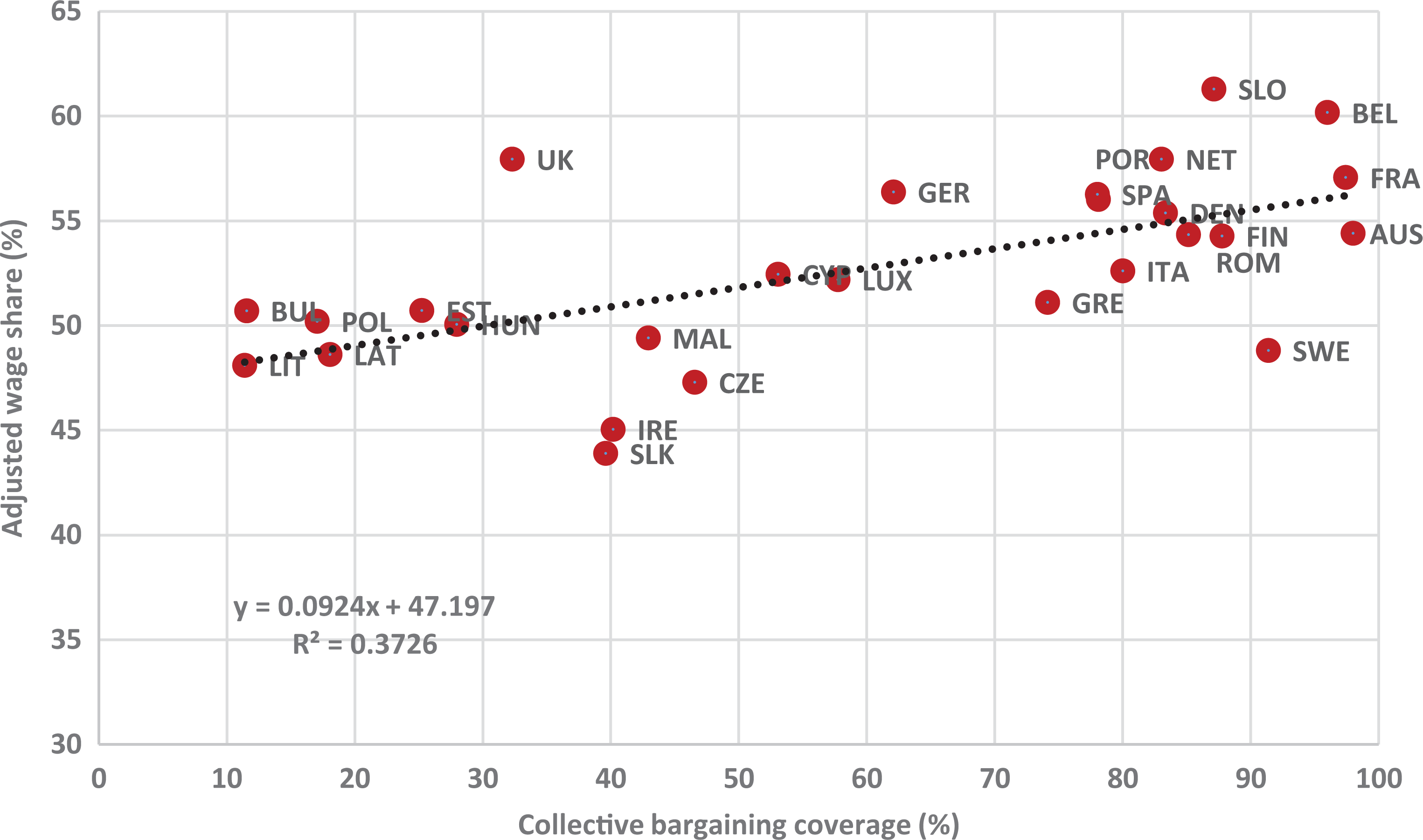
Collective bargaining coverage and adjusted wage share, EU-27, average values for the period 2000–2016.
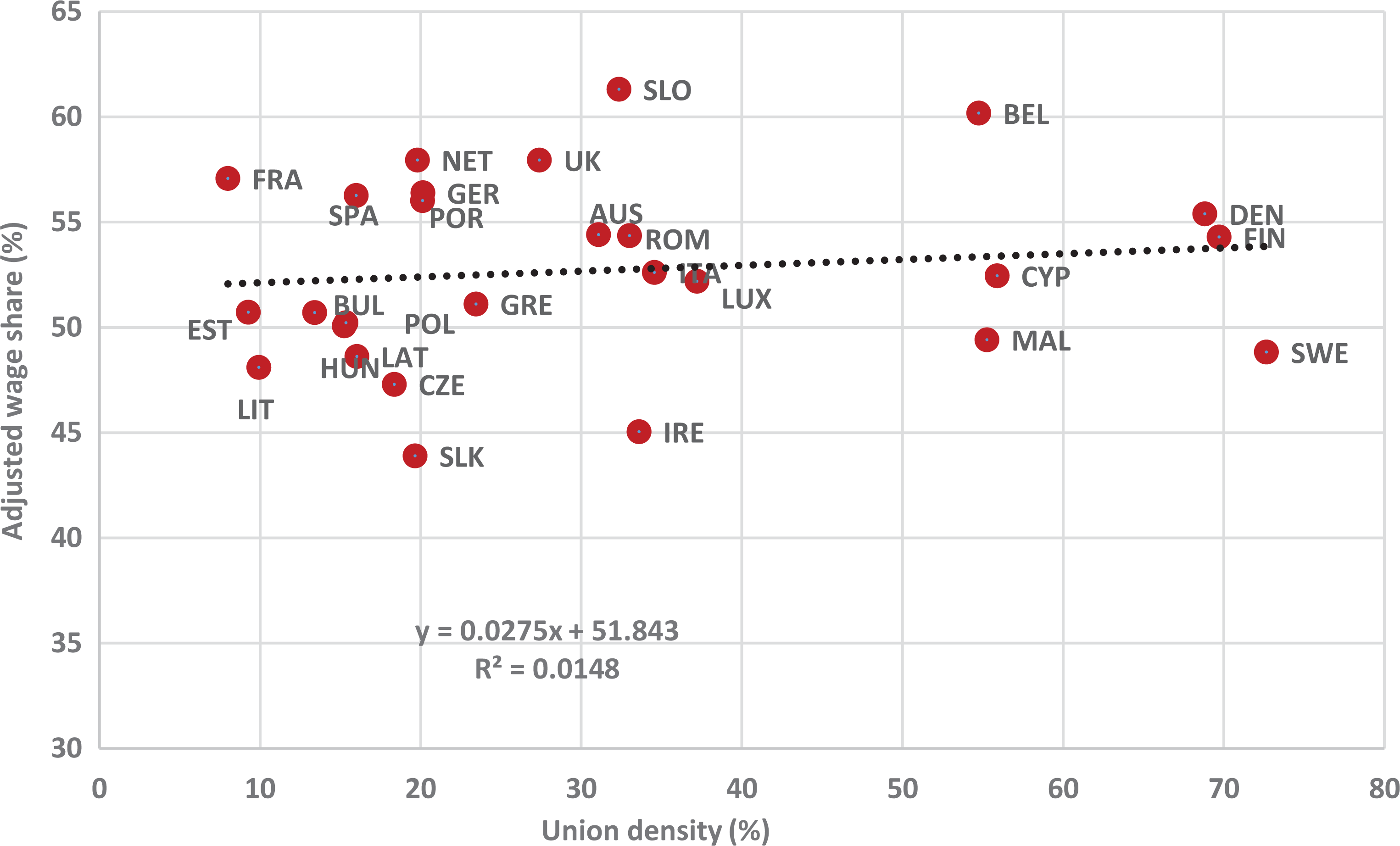
Trade union density and adjusted wage share, EU-27, average values for the period 2000–2016.
The above discussion helps us to understand the general relationships between labour market institutions and the wage share. Further deepening this understanding, however, requires that we examine these relationships in different types of bargaining systems. Three such systems can usefully be distinguished (Visser and Checchi, 2011): (i) single-employer systems with low coverage and low union density; (ii) multi-employer systems with high coverage and low union density; and (iii) multi-employer systems with high coverage and high union density. In single-employer systems, wages are generally bargained individually and often imposed unilaterally. Collective bargaining mainly takes place in the restricted group of organisations in which union membership is substantial. In these organisations, unions can employ collective bargaining to obtain better wages (the union premium) than individual bargaining would obtain. In multi-employer bargaining systems bargaining mainly takes place at sectoral (and sometimes regional or national) level and bargaining coverage is extensive. In multi-employer systems with high union density, unions have a greater capacity to bargain for better wages and a higher wage share than when density is low.
As will be discussed below, however, in both single- and multi-employer systems unions do not per se translate their bargaining capacity into higher wages, because they also have other objectives they want to achieve. Also, bargaining systems are not static in the present era of liberalisation and erosion of labour market and industrial relations institutions. National systems may thus undergo within- or between-type changes over time, with possible fluctuations in their respective inequality outcomes as well. To illustrate this we will briefly review three exemplary country cases to see how the wage share, bargaining coverage and union density relate to each other and have developed over time.
Single-employer bargaining
A key example of single-employer bargaining is Poland, where between 1992 and 2018, trade union density fell from around 50 per cent to around 12 per cent, and collective bargaining coverage declined to around 18 per cent (OECD, 2019a). This was accompanied by a strongly declining wage share, from 62.8 per cent in 1992 to 56.8 per cent in 2000, and 49.2 per cent in 2018 (data from AMECO 1 ). During this period, bargaining has become restricted largely to the company level and today sectoral agreements are rare as employers strive to avoid them (Bernaciak, 2018; Magda et al., 2012). Managerial unilateralism has thus come to dominate in wage setting, resulting in sluggish wage growth, largely disconnected from productivity growth (Bernaciak, 2018; Magda et al., 2012; Stockhammer and Onaran, 2009). Comparing full-time workers’ wages in private sector manufacturing companies covered and not covered by collective agreements, Magda et al. (2012, 2016) find that company agreements come with a substantial union premium of around 8 per cent, in particular in relatively new companies established in the late 1990s (often multinationals), underlining the argument that bargaining can be decisive in obtaining a higher wage share. There is some evidence, however, that during the economic and financial crisis, when unemployment was high and export sectors were badly affected, unions rather engaged in concession bargaining, exchanging wage moderation for maintaining employment for their members, who were indeed less likely to lose their jobs than non-members (Glassner, 2013; Ivlevs and Veliziotis, 2017; Meardi and Trappmann, 2013). Bargaining coverage and the wage share are thus closely linked, but maximum wage growth is not always the unions’ only objective.
Multi-employer bargaining with high coverage and low union density
These observations also emerge, in a slightly different form, in the Netherlands, a key example of multi-employer bargaining with high coverage but low union density. Collective bargaining coverage in the Netherlands has been fairly constant since the 1970s, at around 80 per cent of workers, largely through (extended) sectoral agreements. At the same time, union density declined substantially, from 35 per cent in 1980 to 16 per cent in 2018, which has undermined bargaining power even though bargaining coverage remains high (De Beer and Keune, 2018). The same period saw a decline in the wage share, from 68.7 per cent in 1980 to 63.6 per cent in 1992, 59.3 per cent in 2000 and 57.1 per cent in 2018 (AMECO). Indeed, whereas real collectively agreed wages and productivity increased at the same pace in the period 1950–1980, since then the connection between the two has been lost and wages have structurally been lagging behind productivity (De Beer and Keune, 2018; Keune, 2016). In the period 1982–2016 productivity increased by some 65 per cent, while real collectively agreed wages have compensated for inflation, but have not captured any of the productivity increases. 2
This disconnection between productivity and real wages can be understood as the result of a number of interrelated factors that have gradually undermined trade union bargaining power. One is the decline in trade union membership, already mentioned. Second, the share of workers on flexible contracts, who have lower bargaining power than those on permanent contracts, has been rising rapidly in the Netherlands since the 1990s. This affects overall union bargaining power, in particular in the more flexibilised sectors, such as retail or hotels and restaurants (DNB, 2018). According to the Dutch National Bank, more than half of the falling wage share can be attributed to the expansion of the flexible workforce in recent decades (DNB, 2018). Third, for many years, the ‘wage moderation in favour of competitiveness and employment’ discourse was pervasive in the Netherlands, hardly questioned and often made explicit in social pacts (Keune, 2016). Exemplary for this is that until 2013 the main trade union confederation (FNV), which coordinates its wage demands across the economy, used the ‘maximum wage demand’ (roughly, productivity plus producer price inflation) as its main coordinating instrument, with a view to supporting employment and excluding any ambition to increase or even maintain the level of the wage share (Verhoeff, 2016). Only in 2013 did it start to use fairness as the basis for its demands, aiming to recuperate some of the wage share lost in previous decades.
Multi-employer bargaining with high coverage and high union density
Denmark is one of the main examples of multi-employer bargaining with high bargaining coverage and high union density in the EU. Bargaining coverage has been quite stable in Denmark for many decades, hovering at around 80 per cent. Union density has declined over time, from 74.6 per cent in 1990 to 66.5 per cent in 2018, but it remains very high by European standards. The combination of high union density and high coverage has resulted in a quite stable wage share (OECD, 2018; Onaran and Obst, 2016). According to AMECO data, the wage share amounted to 57.9 per cent in 1990 and by 2018 had fallen only slightly, to 54.7 per cent. On average, wage developments are largely in line with underlying productivity developments (for example, OECD, 2008), and workers and their unions can exert sufficient power to achieve a balanced division of income between capital and labour.
Summarising, the wage share is positively related to bargaining coverage and union density and is therefore higher in multi-employer bargaining systems than in single-employer bargaining systems. Between the two types of multi-employer bargaining systems, the ones with a higher union density have a stronger capacity to bargain for a higher wage share. Declining coverage or density may lead to a lower wage share.
Wage inequality among wage-earners
The second main question is how collective bargaining influences the level of wage inequality among wage-earners. Wage inequality among wage-earners can be considered on many dimensions, including gender, skill levels, migratory background or age. Because of space limitations, here we will limit ourselves to overall wage inequality. Such wage inequality is the result of both within- and between-enterprise wage inequality. According to the ILO (2016), in 2010, wage inequality within enterprises accounted for almost half of total wage inequality in Europe and about 80 per cent of workers were paid less than the average wage of the enterprise in which they work. Collective agreements can foster within-firm wage equality in two main ways: (i) in terms of equal pay for equal work by making wages dependent on procedures, job descriptions and/or seniority rather than on managerial arbitrariness; and (ii) by compressing the wage structure by raising the lower wage rates and/or lowering top wages. Multi-employer agreements can also limit wage inequality between firms by setting the same procedures and wage rates across a group of firms (for example, a sector). Finally, centralised coordination of wage bargaining may reduce differences in wage growth between sectors by promoting common wage growth rates, although this rather cements than reduces inequalities between sectors.
The extent to which collective bargaining does indeed reduce wage inequality depends on a series of factors related to the three bargaining systems discussed in the previous section. First of all, enterprises covered by collective agreements tend to have a more compressed wage distribution than enterprises not covered, reducing within-firm inequality (Kohn and Lembcke, 2007; Moore et al., 2019; Vaughan-Whitehead and Vazquez-Alvarez, 2018). Also, bargaining coverage is negatively correlated with wage inequality within a national labour market; the extent of this, however, also depends on trade union bargaining power and the type of bargaining system (with less clear evidence on the issue of centralisation) (Bosch, 2015; Bryson, 2014; Hayter, 2015; Visser and Checchi, 2011; Wallerstein, 1990, 1999). As Visser and Checchi (2011: 249) argue:
These results suggest that unions contribute to wage compression by restricting wage decline among low-wage earners and restraining wage hikes among high-wage workers. However, the channels through which this happens vary with the bargaining framework. When coverage is low, local presence or power of unions matters. In contrast, when coverage is high, union membership becomes less relevant, but inequality reduction is obtained on a larger scale. For obvious reasons, the combination of high coverage and high density, observed in Northern Europe, is associated with the lowest level of earnings dispersion.
These relationships also emerge from data on wage inequality, bargaining coverage and union density. There is a strong negative association between collective bargaining coverage and wage inequality, here expressed as the percentage of workers earning wages below two-thirds of the mean wage (Figure 3). In countries with single-employer bargaining and corresponding low bargaining coverage this percentage is between 20 and 30 per cent, while in countries with multi-employer bargaining and corresponding high bargaining coverage it is between 2 and 20 per cent (with Romania as an outlier). There is a similar, although somewhat weaker association between union density and wage inequality (Figure 4). Wage inequality is then lowest in the countries with high coverage and high union density – Sweden, Denmark, Finland and Belgium – as well as in the exceptional case of France, where coverage is high but density low. It is highest in the countries with low coverage and low density – Latvia, Estonia, Poland Lithuania and the United Kingdom – as well as in the exceptional case of Romania, in which coverage is high and density at a medium level.
To illustrate these relationships, we will briefly review three exemplary country cases to see how the wage inequality among wage-earners, bargaining coverage and union density relate to each other and have developed over time.
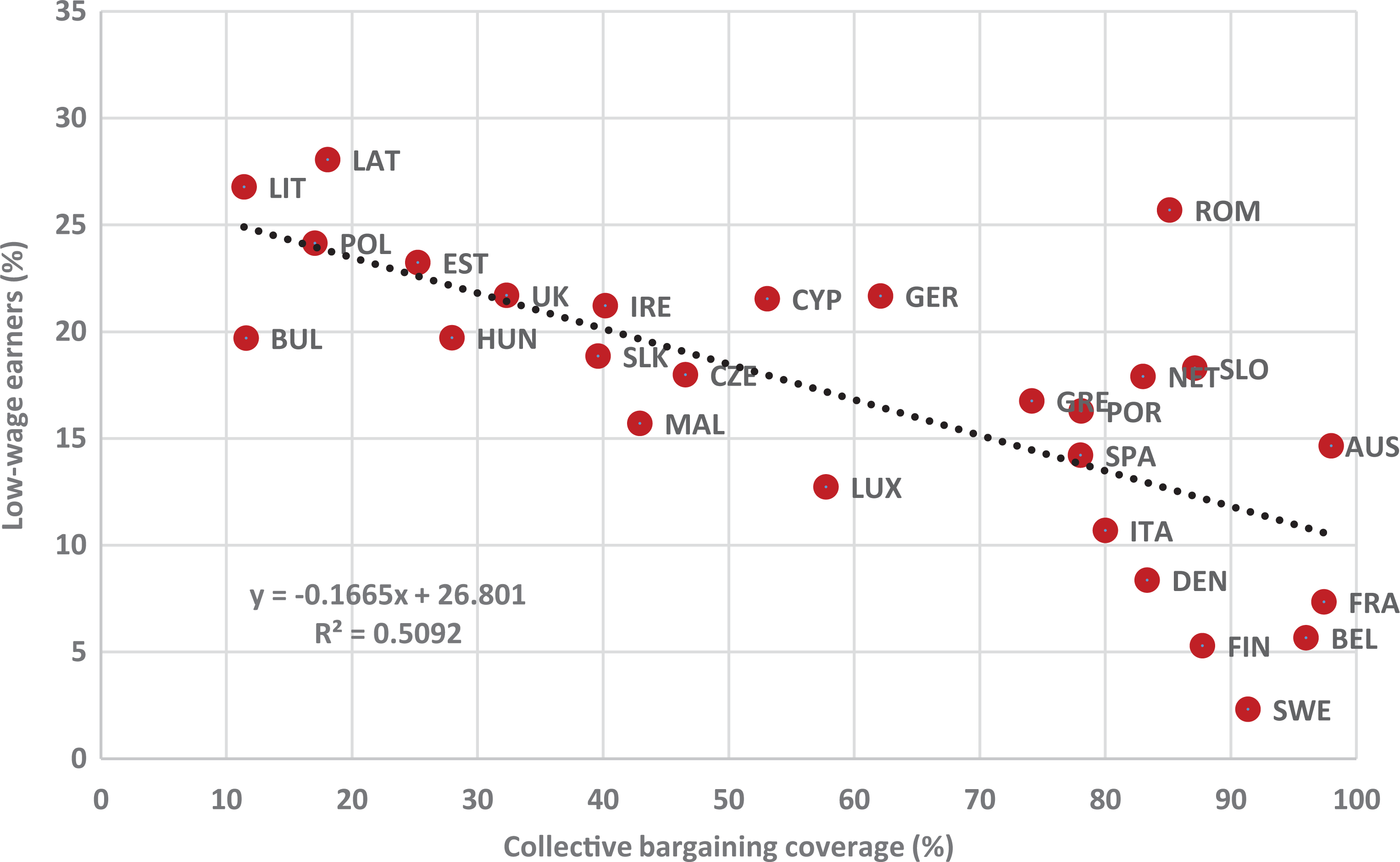
Collective bargaining coverage (% employees) and percentage of workers with low wage, EU-27, average values for the period 2000–2016.
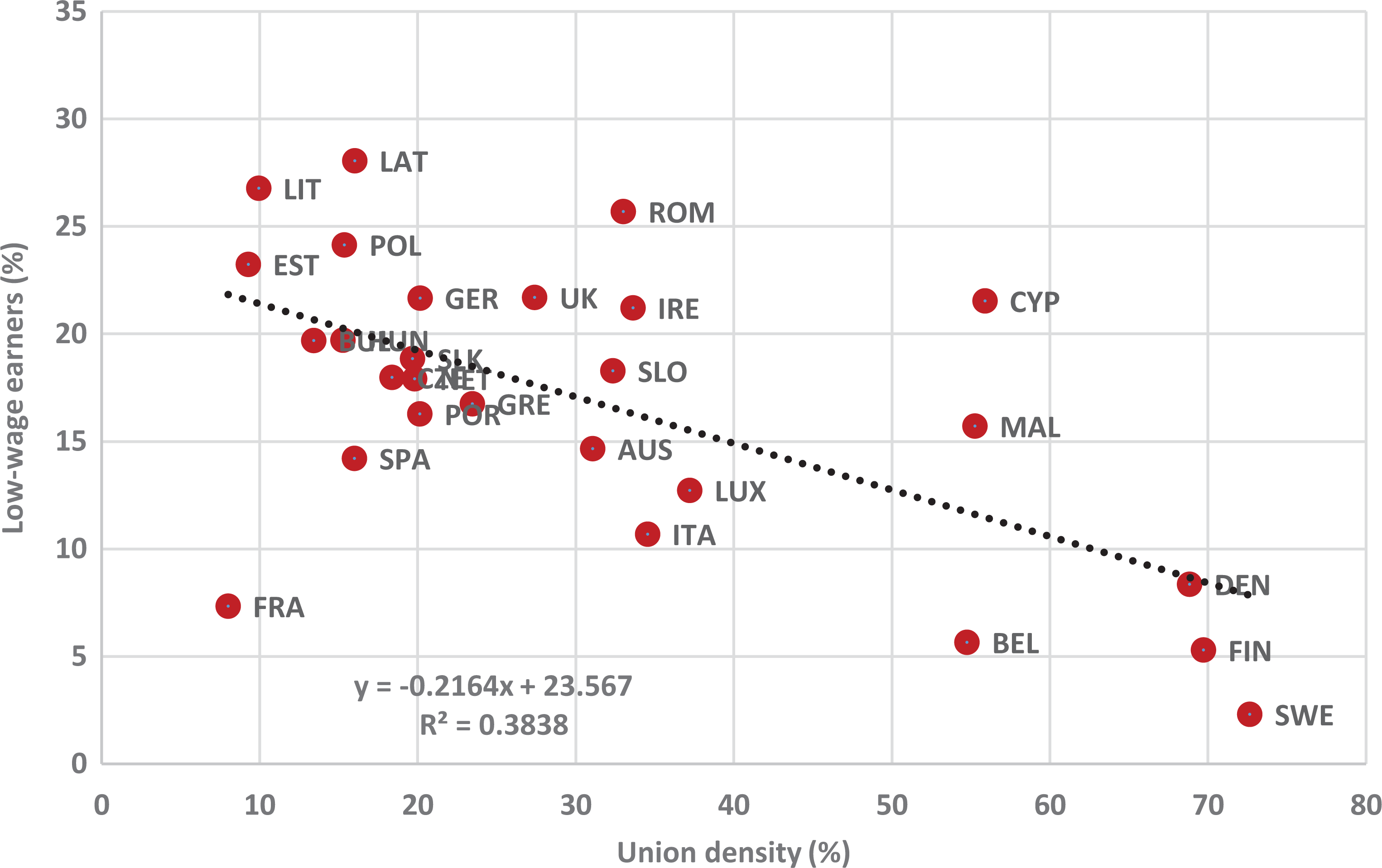
Union density and percentage of workers with low wages, EU-27, average values for the period 2000–2016.
Single-employer bargaining
Following the weakening of unions and collective bargaining from the 1980s onwards, wage inequality in the United Kingdom increased, first rapidly and then more slowly, to more or less stabilise at a high level in the 2000s (Machin, 1997; Vacas-Soriano et al., 2020, Figure 3). Initially, it was caused by a widening of wage dispersion both at the bottom and the top of the wage distribution, although more recently mainly top incomes have been feeding wage inequality (Bell and Van Reenen, 2013). In comparative perspective, with its single-employer bargaining system and limited bargaining coverage, in the United Kingdom wage inequality between both individuals and between enterprises is high (ILO, 2016), and within-firm inequality is lower in firms covered by collective bargaining than in firms not covered (Moore et al., 2019; Visser and Checchi, 2011).
Multi-employer bargaining with high coverage and low union density
In the Netherlands, too, wage inequality has been increasing in the past few decades. Collective bargaining coverage has been stable, but union density has been cut by a half. Since the early 1990s, increasing wage inequality has resulted from the growing distance between the top wages and the minimum wage (De Beer, 2014). But the more general dispersion of wages, which had its lowest point in 1984, has also increased, with some interruptions: the Gini coefficient for full-time workers is today more than one-third higher than at its lowest point and, if we include the hourly wages of part-time workers, inequality is even higher and increasing more rapidly (De Beer, 2014). To some extent this development can be explained by the relative decline of the value of the minimum wage, which lowers the bottom of the wage distribution. It is also related, however, to the reduced bargaining power of trade unions – making it more difficult to achieve solidarity objectives – as well as to trade union sensitivity to competitiveness arguments and changes in the nature of collective agreements. Such agreements are increasingly of a minimum standards nature and have little grip on the higher wage categories (De Beer, 2014; Ibsen and Keune, 2018).
Multi-employer bargaining with high coverage and high union density
Sweden has had very high bargaining coverage – around 90 per cent – for many decades. Union density has been falling since the 1990s, from more than 90 per cent to 65.6 per cent in 2017, but is still high in comparative perspective. Following from this high coverage and despite the declining union density (or, more positively, because of the still comparatively high union density), Sweden is one of the countries with the lowest wage inequality and inequality has been decreasing somewhat in recent years (ILO, 2016). Collective bargaining plays a key role in maintaining this low inequality (OECD, 2019a). Swedish unions aim to foster equality through collective bargaining. They are mainly class-based and bargain at sectoral level. They favour traditional wage solidarity, equality of outcomes and reduced differences between low- and high-skilled workers, which they pursue mainly by improving the wages of the lower skilled (Ibsen and Thelen, 2017). One important function of collective agreements in Sweden is that they set minimum wages (there is no statutory minimum wage), which are high in comparison with minimum wages in the rest of Europe (Andersen et al., 2015; Eldring and Alsos, 2012). In this way, they compress the wage structure from below.
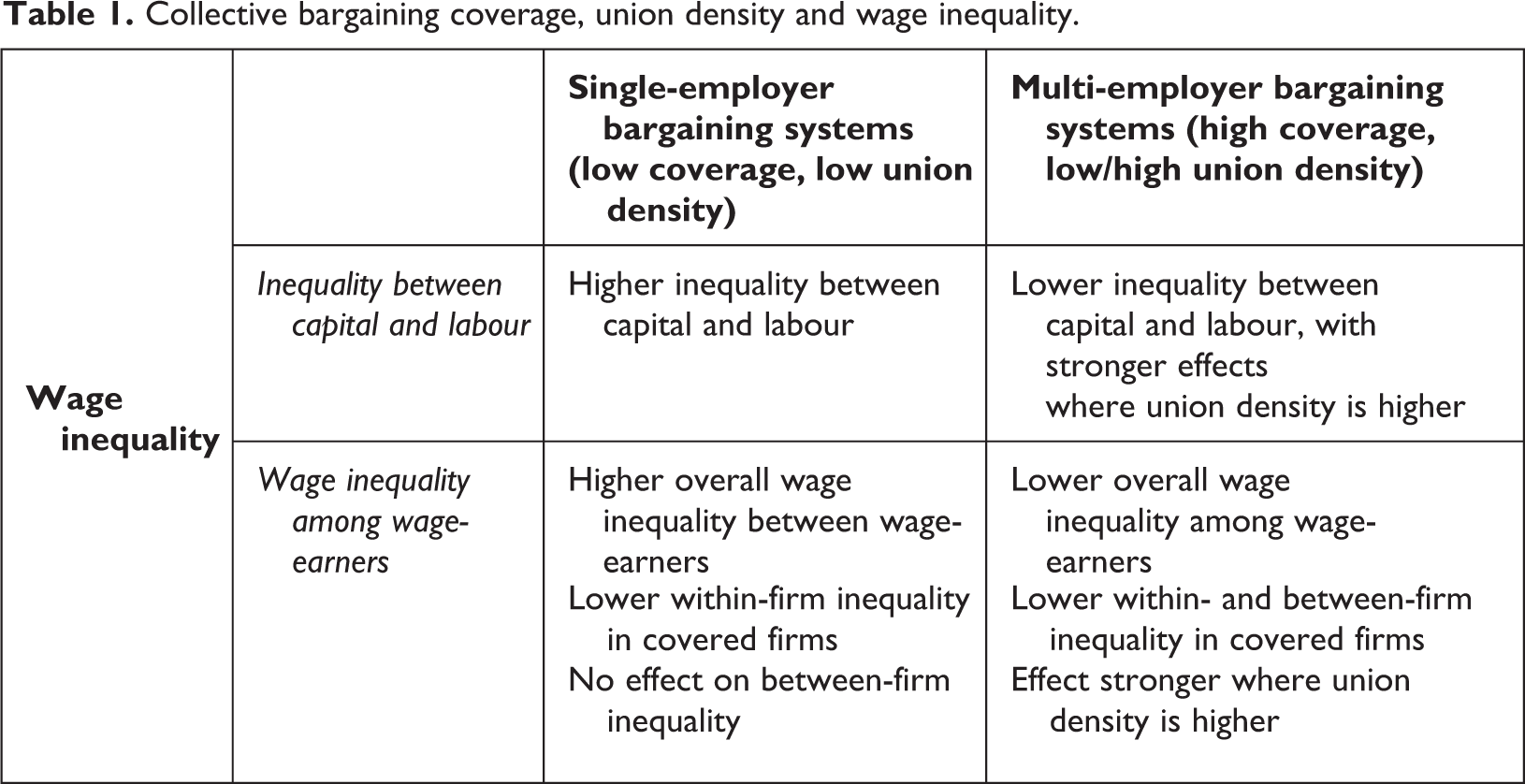
Summarising, wage inequality among wage-earners is lower in multi-employer bargaining systems than in single-employer bargaining systems. Within single-employer systems wage inequality is lower in firms in which collective bargaining takes place. In multi-employer systems both within- and between-firm inequality is lower in covered firms, the effect being stronger where union density is higher. Change in coverage and density is likely to lead to changes in wage inequality as well. Table 1 summarises these relationships and those discussed in the previous section related to inequality between capital and labour.
Collective bargaining coverage, union density and wage inequality.
Beyond the coverage–density framework
Collective bargaining coverage and union density, as discussed in previous sections, are important explanatory factors for the two types of wage inequality. There are however a number of other collective bargaining–related factors that qualify the relationships between coverage, density and wage inequality. Here four key factors will be highlighted.
The first concerns the question of who unions represent in wage bargaining. Is it only their members, who are often not the workers on the lowest wages, and are sometimes referred to as insiders, or is it also the so-called ‘outsiders’, namely, the more vulnerable low-wage workers (Hyman, 2001; Visser and Checchi, 2011)? Insider–outsider proponents argue that trade unions mainly further the interests of the insiders, while ignoring or opposing the interests of outsiders (Lindbeck and Snower, 1986; Rueda, 2005, 2007). They claim that unions therefore have little interest in addressing low-wage problems and in raising the wage floors in collective agreements. While this may be true in some cases, in particular where occupational unions are concerned, in recent decades many unions in Europe have attempted to represent the interests of precarious workers, including the problem of low wages, through collective bargaining and other strategies (Doellgast et al., 2018; Hyman and Gumbrell-McCormick, 2017; Keune, 2013; Martínez Lucio et al., 2017). They do so in recognition of the fact that the well-being of insiders and of outsiders are interrelated and that employers use precarious workers to put pressure on insiders’ wages and conditions, as well as based on normative ideas about social solidarity and social justice (Keune, 2013; Keune and Pedaci, 2020). Indeed, workers join unions for instrumental reasons, but also because of normative concerns related to inequality and union members favour social solidarity and equality more than non-members (Checchi et al., 2010; Rosetti, 2019). These attitudes differ across groups of countries, with equality orientations being strongest in the Nordic and southern European countries, and weakest in the Anglophone countries (Rosetti, 2019). Hence, not only the capacity to bargain for higher and more equal wages, discussed in previous sections, matters but also the inclination to do so effectively. Coverage and bargaining power being equal, there is likely to be less inequality where unions favour more equal wage distribution between capital and labour and/or among wage-earners. This counts for employers as well: one of the arguments employers traditionally put forward in favour of multi-employer agreements is that they help to avoid poaching by taking wages out of competition through the lower between-firm wage inequality they produce (Bulfone and Afonso, 2020; Streeck, 1989).
The second factor concerns unions’ other non-wage objectives and priorities. Often, competitiveness and employment objectives are more important to trade unions than achieving the maximum possible wage increases. At the macro level, in particular in multi-employer bargaining systems, this can be expressed in coordinated wage moderation aimed at lowering labour costs, higher competitiveness and employment growth, often in the context of severe economic challenges and possibly formalised in social pacts (Avdagic et al., 2011; Fajertag and Pochet, 1997; Pochet et al., 2010). Macro-level wage moderation has also been negotiated by unions in exchange for increased public investment in social and labour market policies (Hassel and Ebbinghaus, 2000). Similar exchanges of wage restraint for other objectives can be observed at the firm level, sometimes taking the shape of concession bargaining, in which wage moderation is agreed upon under the employer’s threat to outsource, relocate or terminate jobs (Benassi, 2015; Glassner and Keune, 2012; Hancké, 2000; Roche et al., 2015). Hence, although unions may have the capacity to bargain for higher wages or lower wage inequality, they may choose – or feel forced – not to do so in favour of other objectives.
A third factor is the statutory minimum wage. A statutory minimum wage can set a wage floor that is likely to have a positive effect on the wage share and reduce wage inequality (Freeman, 1996; Garnero et al., 2015; ILO, 2016; Moore et al., 2019). This will especially be the case in single-employer bargaining systems, but also in multi-employer bargaining systems with low union density, where trade unions have less bargaining power and thus encounter more difficulties establishing effective sectoral minimum wages in collective agreements. In countries such as Denmark and Sweden, with high coverage and strong unions, a statutory minimum wage is often considered to be of less value in this respect because the lowest wage levels tend to be high compared with most other European countries (Andersen et al., 2015). Also, depending on the extent to which wage scales in collective agreements are linked to the minimum wage, changes in the latter may cause ripple effects in the entire bargained wage structure, leading to a higher wage share and/or less wage inequality (Grimshaw et al., 2014). All depends, however, on the level of the minimum wage: higher minimum wages will have stronger effects on the wage share and wage inequality than lower minimum wages.
Finally, extensions of collective agreements play an important role in determining bargaining coverage. Governments in many countries can, under certain conditions, extend collective agreements made between certain employers’ organisations and trade unions to firms and workers that are not part of the agreement (see Hayter and Visser, 2018a for an in-depth study). This promotes multi-employer bargaining, and increases and stabilises the coverage of agreements beyond the membership of unions and/or employers’ organisations. For example, in the Netherlands union density is around 17 per cent, employer density around 60 per cent but, because of extensions, bargaining coverage is around 80 per cent. Extensions foster the application of the bargaining results of strong groups of workers, as well as respect for minimum standards, to weaker outsiders (Hayter and Visser, 2018b). They also take wages out of competition to an important extent. All these effects of extensions are likely to reduce both types of wage inequality, as well as raise the wages of outsiders and homogenise wage levels across sectors.
Conclusions
Inequality of income and wealth has figured prominently in the EU’s policy debate in recent years. The labour market plays an important part in creating inequality. We have observed a long-term increase in inequality in the division of income between capital and labour, reflected in declining wage shares, and in wage inequality among wage-earners. At the same time, there are substantial differences between EU countries. In this article we have argued, based on the literature, that these differences are closely related to developments in collective bargaining coverage and workers’ bargaining power, expressed in terms of union density. On average, coverage and density are positively related to the wage share and negatively to wage inequality among wage-earners, and when coverage and/or density change, wage inequality can be expected to change accordingly.
We also introduced four factors that qualify these relationships: who unions represent; the weight of their objectives other than wages; the statutory minimum wage; and extensions of collective agreements by governments. The first two factors influence the extent to which unions translate their capacity to reduce the two types of inequality into an actual decline in inequality. The last two are key public policies that affect the incidence of low wages and collective bargaining coverage. They illustrate the fact that the state often plays an important part in determining wage inequality outcomes beyond those that unions (and employers) can achieve by themselves. Indeed, state support is often indispensable for trade unions to achieve their goals (Bosch, 2015; Crouch, 1993, 2017). In recent decades, however, states have often undermined rather than fostered bargaining coverage and union density (Van Gyes and Schulten, 2015).
If reducing inequality is indeed a policy priority in the EU, so should be the coverage of collective bargaining and union density. Workers need strong collective mechanisms and bargaining power to countervail the bargaining power of employers, obtain a fair wage share and limit wage inequality. For the moment, however, these factors are hardly taken into account in the inequality debate. And if union density continues to decline in the great majority of EU countries and/or bargaining coverage continues to fall in an important number of them, inequality is bound to continue to increase.
It is in the first instance up to workers and their unions to (re-)build this countervailing power. In many countries, however, they have not been able to do so in the past couple of decades, despite many attempts at union renewal (Gumbrell-McCormick and Hyman, 2013; Lehndorff et al., 2018; Müller et al., 2019). They therefore also need other actors, such as the state, the EU, social movements and employers to step in to jointly pursue stronger bargaining power for workers and higher collective agreement coverage. Apart from assisting workers in obtaining a fairer wage, such support is also justified by the important negative societal and economic consequences of inequality.
Footnotes
Acknowledgements
I am thankful to Nacho Álvarez for Figures 1
– . I received very useful comments on an earlier version of this article from Julieta Haidar and two anonymous reviewers.
Funding
Some of the work for this article was supported by the ILO.