




Abstract
This article contributes to research on the embeddedness of multiple work arrangements in the employment biography. We investigate transition and duration effects of multiple jobholding on financial and non-financial job outcomes, and the role of flexible work arrangements and household contexts. To that end, we examine panel data from Germany, the United Kingdom and the Netherlands for the period between 2002 and 2017. The findings underscore the importance of economic factors in the decision to work multiple jobs and reveal that labour market contexts play a significant role in outcomes. Findings furthermore indicate negative well-being effects for those who have both multiple jobs and children. For a substantial share of workers, holding multiple jobs occurs in relatively short-term episodes, posing the question of whether episodes of multiple jobholding necessarily come with either clear enrichment or depletion effects, or are merely a phase in the overall employment biography.
Introduction
Over recent decades, the nature and organisation of work have been transformed as a result of – among other things – technological developments and globalisation. This has led to more flexible and fragmented labour markets in many advanced economies. Although scholars, employers and employees share the notion that the organisation of work has changed radically, we have yet to arrive at a coherent picture of the implications of these developments (Kalleberg, 2011; Osterman, 2013). Multiple jobholding 1 is a significant and growing characteristic of labour markets in various advanced economies (Conen, 2020). Our understanding of multiple jobholding and its implications for individual workers in terms of enrichment or depletion remains rather limited, however (Campion et al., 2020; Sliter and Boyd, 2014).
Until the beginning of the 20th century, multiple jobholding was fairly common, particularly in rural areas, where for instance small landowners often needed to engage in additional work to survive (Rouault, 2002). Throughout the 20th century, full-time regular dependent work increased significantly and went hand in hand with technical change favouring capital-intensive, large-scale production, the rise of the ‘Fordist model’ and a change in industrial organisation in most countries (Supiot, 2001). The recent upsurge of alternative arrangements – that is, work under arrangements that differ from full-time regular employment, the ‘renaissance of self-employment’, the emergence of click-working in the gig economy and the blurring of the boundaries between dependent and independent employment (for example, Cappelli and Keller, 2013; Conen and Schippers, 2019; Eurofound, 2017; Vosko, 2006) – is likely to boost various multiple work arrangements and put multiple jobholding in a new context and analytical position. Multiple jobholding is increasingly referenced within the literature on labour market flexibilisation and new forms of (atypical) employment, although research on the subject is particularly silent as regards the role of alternative work arrangements in characterising multiple jobholders and the outcomes of their pluriactivity.
It is common in the international literature to note the diversity in motives and profiles in relation to multiple jobholding (for example, Averett, 2001; Amuédo-Dorantes and Kimmel, 2009; Dickey et al., 2011; Hipple, 2010; Hirsch et al., 2016; Sussman, 1998; Wu et al., 2009; for an overview see also Campion et al., 2020). Broadly speaking, two main categories have been distinguished: (i) disadvantaged workers adding an extra job as a means of tackling financial constraints (induced, or ‘pushed’, by, for instance, low-wage full-time work or involuntary part-time work) and (ii) workers who take up a second job from heterogeneous motives (‘pulled’), such as psychological fulfilment or career development (Dickey et al., 2011; Panos et al., 2014; Wu et al., 2009). On the one hand, recent labour market developments are considered to provide opportunities for ‘post-modern’ employment forms to flourish. ‘Free workers’ are increasingly able to choose their position in the labour market, and determine where, for whom and under what employment conditions they are active (Guest et al., 2006). This positive outlook is also related to the literature concerned with the boundaryless career and career self-management (King, 2004; Sullivan, 1999). In contrast, recent labour market developments may also provide more of a threat that ‘pre-modern’ employment forms are returning, namely necessity-driven pluriactivity, originating from push motives, which are often a survival strategy for low-income households.
Starting from this fundamental notion that multiple jobholding is heterogeneous in terms of motivations and profiles, this study aims to provide more insight into the consequences of multiple jobholding in terms of subsequent job outcomes. Do enrichment and depletion effects differ between instances of multiple jobholding and can we shed more light on potential determinants? Earlier studies investigating consequences find a higher risk for multiple jobholding of earning lower wages compared with single jobholders, while on average a majority of people engaged in multiple jobholding seem to find themselves in a relatively self-sufficient (household) situation (Bamberry and Campbell, 2012; Campion et al., 2020; Conen, 2020; Kimmel and Smith Conway, 2001). Studies also find that multiple jobholding offers variety, improved work satisfaction and a conduit for further career progression and employability for some groups (Bamberry and Campbell, 2012; Conen, 2020; Panos et al., 2014). Finally, there is evidence that managing multiple work roles depletes an individual’s psychological and physical health (Campion et al., 2020; Sliter and Boyd, 2014). The consequences of multiple jobholding have been under-researched in the field of multiple jobholding studies and the results have been mixed hitherto (‘there are also enrichment effects in domains where scholars usually find depletion (for example, personal outcomes) and depletion effects where scholars usually find enrichment (for example, career-related outcomes)’ (Campion et al., 2019: 13).
We draw on this strand of literature and investigate the financial and non-financial consequences of multiple jobholding transitions and episodes within the employment biography. We thus contribute to the field of dynamic analyses of multiple jobholding, which may reveal more about various mechanisms and determinants behind diversity of outcomes, as well as on the transitory or sustainable nature of multiple jobholding. Is the transition to multiple jobholding related to upward or downward wage mobility? How does the transition affect job satisfaction and well-being? For how long do individuals work in multiple jobs? And what are the consequences of longer multiple jobholding episodes? Furthermore, we aim to improve research in this area by examining within-group diversity in more depth, and explicitly include the impact of flexible work arrangements and household composition on job outcomes.
To that end, we analyse panel data for the period between 2002 and 2017 in three European countries. In the analyses we follow the definition of multiple jobholding proposed by Campion et al. (2020): ‘[multiple jobholding is] the act of working more than one job simultaneously, including working for employers and self-employment, wherein all tasks, or sets of tasks, are performed in exchange for, or expectation of, compensation’. This definition includes a diversity of multiple work arrangements and allows us to classify work by various economic work arrangements, including self-employment.
The three countries included in the study are Germany, the Netherlands and the United Kingdom. Multiple jobholding is a significant characteristic of the labour market in all three countries, with an average of 5 per cent, 8 per cent and 3 per cent respectively of the workforce working multiple jobs in 2018 (Eurostat, 2020). Multiple jobholding is a growing phenomenon in Germany and the Netherlands (Conen, 2020). All countries witnessed changing employment patterns and a numerical flexibilisation of their labour markets in the period between 2002 and 2017, although to different degrees and in different forms. The Netherlands in particular has been transformed into one of the most flexible labour markets in Europe, with relatively high levels of part-time employment and a strong increase in solo self-employment and temporary/fixed-term employment. The United Kingdom has witnessed a clear increase in solo self-employment (for the second time, to relatively high levels) (see, for example, Meager, 2019). The relatively low levels of employment protection in UK labour legislation mean that employers have little need to resort to fixed-term contracts; in fact temporary work has always remained at a relatively low level in the United Kingdom compared with other countries. Germany seems to have experienced a relatively moderate change compared with the other two countries. We use rich and internationally comparable panel data from these three countries, which will provide novel insights on the role of alternative work arrangements and the robustness of outcomes in different labour market contexts. Analyses are executed separately for each of the countries.
The article is structured as follows. The next section briefly reviews the relevant literature on enrichment and depletion as potential consequences of multiple jobholding. The following section describes the data and variables used in this article. After that we present the results. The final section presents the main conclusions and discusses the outcomes.
Enrichment and depletion effects
Multiple jobholding in general
People engaged in multiple jobholding tend to work substantially fewer hours and earn lower incomes in their main job (see also Piasna et al., 2021). Overall, however, they more than make up for the shortfall by taking on additional jobs (according to LFS, Labour Force Survey data from 2017, multiple jobholders in Europe worked an average of 41 hours, compared with 37 hours among single jobholders). Whether the transition to multiple jobs and working more hours also translates into higher (total) earnings, depends on the hourly earnings of the various jobs. Possible enrichment from multiple jobholding may take the form of financial improvement, skill and task enrichment, career development and creation of meaning (for example, Arora, 2013; Fenwick, 2006; Fraser and Gold, 2001; Panos et al., 2014). Possible depletion from multiple jobholding may originate particularly from strain, taking into account that multiple jobholders often work more hours than single jobholders, and relatively often at ‘inconvenient’ or ‘unsocial’ hours. This may entail, for instance, sleeping fewer hours per night than single jobholders, higher risk of physical injury at work, work–family conflict and burnout (for example, Conen, 2020; Marucci-Wellman et al., 2014, 2016; Sliter and Boyd, 2014; Webster et al., 2019). Moreover, role conflict may play a role in multiple jobholding depletion, as multiple jobholders face extra demands in managing to juggle their work roles, are more apt to find difficulties integrating with co-workers in the various roles (due to less time spent or less involvement in the different jobs) and may have reduced job commitment (for example, Bamberry and Campbell, 2012; Guest et al., 2006).
Both financial and non-financial job outcomes will thus be affected. In this article these are operationalised as (financial) income effects, and (non-financial) satisfaction with work and subjective well-being effects. Whereas effects may differ between various groups of workers (see also ‘explaining job outcomes’ below), we hypothesise that in general:
Explaining job outcomes
To explain enrichment or depletion effects from holding multiple jobs, we first consider the effect of the type of employment contract in the main job. Other research (for example, Broughton et al., 2016; Conen, 2020; Piasna et al., 2021) shows that workers, including multiple jobholders, with non-standard work arrangements in their main jobs more often face lower job quality levels in terms of basic or extrinsic functions, such as income and (in)security of work. This notion may add to the probability that individuals in non-standard work arrangements will have stronger incentives to engage in multiple jobholding, and wage mobility effects may be relatively high for multiple jobholders with non-standard work arrangements in the main job. Besides economic factors, the transition to multiple jobholding may be accompanied by a change in satisfaction and well-being. Starting from motivation theories (Maslow, 1954) we hypothesise that workers with permanent contracts experience relatively stable basic functions from work (income, security) and therefore feel more freedom to aspire to ‘higher values’ from work, such as seeking opportunities through new experiences or greater challenges (heterogeneity motives). In other words, multiple jobholders with a permanent contract in their main job are particularly likely to report positive satisfaction effects. Finally, workers with a permanent contract in the main job may have a relatively stable situation to start from, and additional work may as a consequence be less detrimental in terms of additional load. We hypothesise that:
Secondly, household composition is likely to affect enrichment or depletion effects from multiple jobholding. Particularly for single parents, adding an extra job may meet an extra income need. Strain and work-role conflict may be particularly strong for those who combine multiple jobs and have children, potentially (negatively) affecting both satisfaction from work and well-being. Conversely, having a partner may in turn ‘relieve’ some of the experienced strain and work-role conflict.
Finally, the three country-comparison between Germany, the Netherlands and the United Kingdom provides more insight into whether outcomes and determinants are robust within different labour market contexts. A priori we do not have expectations with regard to deviating outcomes or mechanisms. Therefore, we formulate the final hypotheses as:
In the analysis we control for a number of characteristics, including working hours in the main job, gender, a quadratic specification for the worker’s age, educational attainment level, occupational level, region and year.
Data and sample
This study used 16 waves of panel data from the German Socio-Economic Panel (SOEP, 2019), the British Household Panel Survey (BHPS)/Understanding Society (University of Essex, 2019) and the Dutch National Bank Household Survey (DHS) (2002 to 2017). The three surveys contain information at the individual level and provide detailed information on work-related aspects, income and socio-demographic variables in Germany, the Netherlands and the United Kingdom. Variables on income, satisfaction and background variables are similar in the three surveys, making it possible to make meaningful comparisons.
Earnings in this study are deflated to 2002 values (euros/pounds). Work satisfaction is based on a single survey question, using a summary measure containing information about how workers evaluate their work in general. (DE: ‘How satisfied are you today with the following areas of your life? – Your job’; NL: ‘How satisfied are you all in all with your current work?’; UK: ‘All things considered, how satisfied or dissatisfied are you with your present job?’). These constructs have a cognitive dimension and hold an evaluative judgement about (several aspects of) a job. For well-being single survey questions were also used (DE: ‘Finally, we would like to ask you about your satisfaction with your life in general. How satisfied are you with your life, all things considered?’; NL: ‘All in all, to what extent do you consider yourself satisfied with life?’; UK: ‘Using the same scale: how dissatisfied or satisfied are you with your life overall?’). Although single survey questions lack information on how individuals score differently on different aspects of work satisfaction or well-being, this (simplified) approach has merit in its comparability between surveys.
All surveys identify individuals who hold more than one job by asking whether workers currently have an additional job (second paid job) or earn any money from a second job/odd jobs. As has been noted (Campion et al., 2020; Conen, 2020), such measurements are often used in survey research, but they are likely to underestimate the scope of multiple jobholding. Among other things, the questions have a formal dimension that may lead to underreporting from people active in more informal employment activities, but there may also be an issue with the time aspect (when do you consider yourself currently to have a second job, particularly when additional work is on an irregular basis?).
In our empirical analyses we employ a sample of individuals in paid employment, 18 years of age or older at the time of the interview. The total sample of workers in Germany is N=166,580, in the Netherlands N=18,064 and in the United Kingdom N=214,228. The total sample of multiple jobholding workers in Germany is N=12,077, in the Netherlands N=1519 and in the United Kingdom N=16,329.
Results
Profiling multiple jobholders
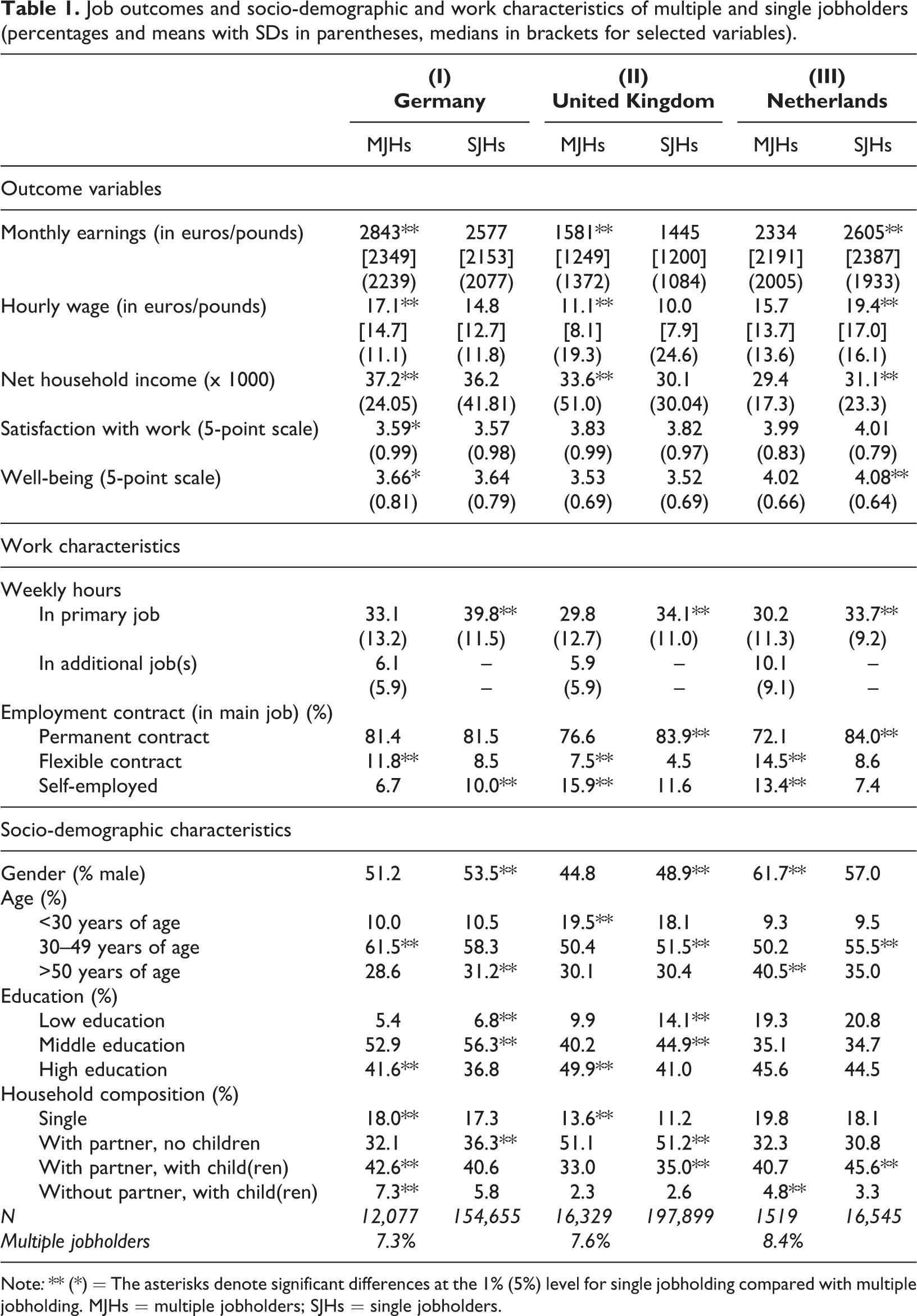
In the first step of the analysis we investigate differences in job outcomes and socio-demographic and work characteristics between multiple and single jobholders. Table 1 presents summary statistics and mean differences for multiple and single jobholders in the three samples, providing descriptive information on the characteristics of multiple jobholding in the three countries.
Job outcomes and socio-demographic and work characteristics of multiple and single jobholders (percentages and means with SDs in parentheses, medians in brackets for selected variables).
Note: ** (*) = The asterisks denote significant differences at the 1% (5%) level for single jobholding compared with multiple jobholding. MJHs = multiple jobholders; SJHs = single jobholders.
On average, 7 to 8 per cent of the employed samples is occupied in more than one job. In Germany and the United Kingdom, multiple jobholders have higher monthly earnings, higher hourly wages and, on average, higher net household incomes than single jobholders. In Germany, multiple jobholders also have higher levels of satisfaction with work and well-being. These findings are largely in line with hypothesis 1a, stating that multiple jobholders in general report higher levels of (total) income from work, higher levels of satisfaction with work and lower levels of well-being than single jobholders. The last part of the hypothesis does not seem to hold, indicating that multiple jobholding as such is not detrimental to individuals’ level of well-being. The story seems very different for the Netherlands, however, with relatively low earnings, low net household incomes and low levels of well-being among multiple jobholders compared with single jobholders. This reversed pattern is largely at odds with hypothesis 1a and suggests a more vulnerable position for multiple jobholders in this country, perhaps indicating different motivations and background characteristics.
In all countries, multiple jobholders work fewer hours, on average, in their primary job. In total, however, adding up the average hours worked in the additional job(s), multiple jobholders work more hours per week, particularly in the Netherlands. Multiple jobholding is more prevalent among workers holding a flexible employment contract, and in the Netherlands and the United Kingdom the self-employed also are more likely to hold multiple jobs. In Germany and the United Kingdom, multiple jobholders are relatively highly educated, younger and more often female than in the Netherlands. In all countries, multiple jobholders are relatively often single.
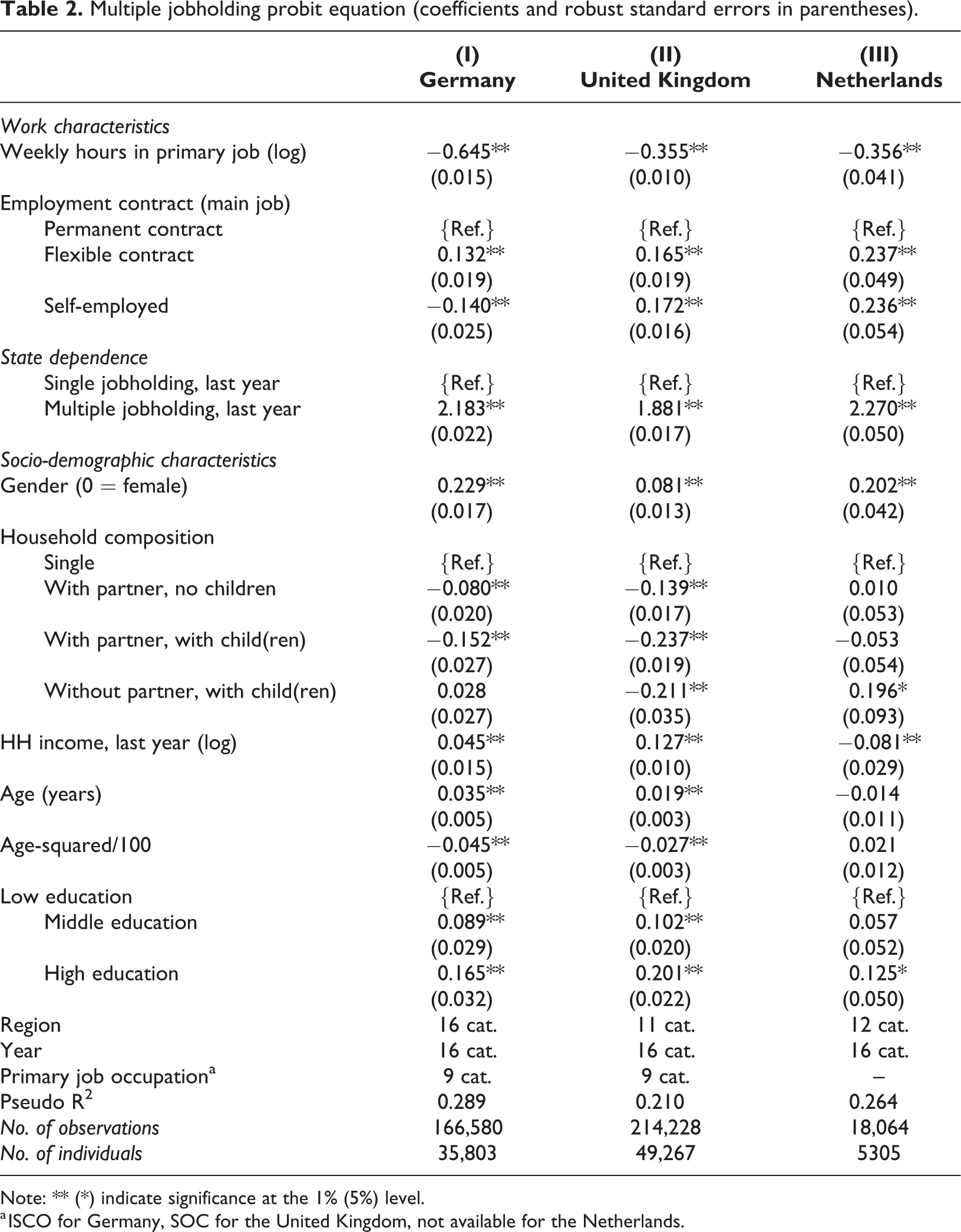
In a subsequent step, we estimate the likelihood of individuals to engage in multiple jobholding. This is done by applying multilevel random effects probit models with multiple jobholding in year t as the dependent variable. Individuals i denote the higher level, and observations from individuals at year t the lower level. Analyses report robust standard errors by clustering at the household level, which accounts for the fact that observations for individuals in the same household cannot be treated as independent.
Results from these analyses are presented in Table 2. Apart from a term accounting for state dependence (MJH(t-1)), the specification controls for socio-demographic and work characteristics. We omit characteristics of the second or other jobs because they are not observed for single jobholders. The table reports the estimated probit coefficients, followed by their t statistic in parentheses.
Multiple jobholding probit equation (coefficients and robust standard errors in parentheses).
Note: ** (*) indicate significance at the 1% (5%) level.
a ISCO for Germany, SOC for the United Kingdom, not available for the Netherlands.
The results confirm the importance of hours constraints and financial motives in the decision to work in multiple jobs. First, the number of hours in the primary job has a negative and significant effect on the decision to hold multiple jobs. In other words, individuals who work fewer hours in their primary job are more likely to engage in multiple jobholding. Employees with flexible contracts (Germany, Netherlands and United Kingdom) and self-employed workers (Netherlands and United Kingdom) have a higher probability of holding multiple jobs than workers with a permanent contract in the main job (confirming hypothesis 2a). The importance of financial motives seems particularly prevalent in the Netherlands; there is a negative relation between an individual’s household income in the last year and the probability of holding multiple jobs in year t-. In explanation, Dutch individuals living in a household with a lower net household income had a higher probability of being multiple jobholders one year later.
The estimated model includes a control variable for the multiple jobholding status of individuals in the previous year, which has a positive and statistically significant effect on holding multiple jobs in the current period. This finding suggests that the incidence of multiple jobholding contains a more durable labour market element and is more than a short-term individual response to, for instance, a financial shock or ad hoc opportunity. In the next section we will explore the transitory nature of multiple jobholding in more depth.
Changing tracks: transitions and job outcomes
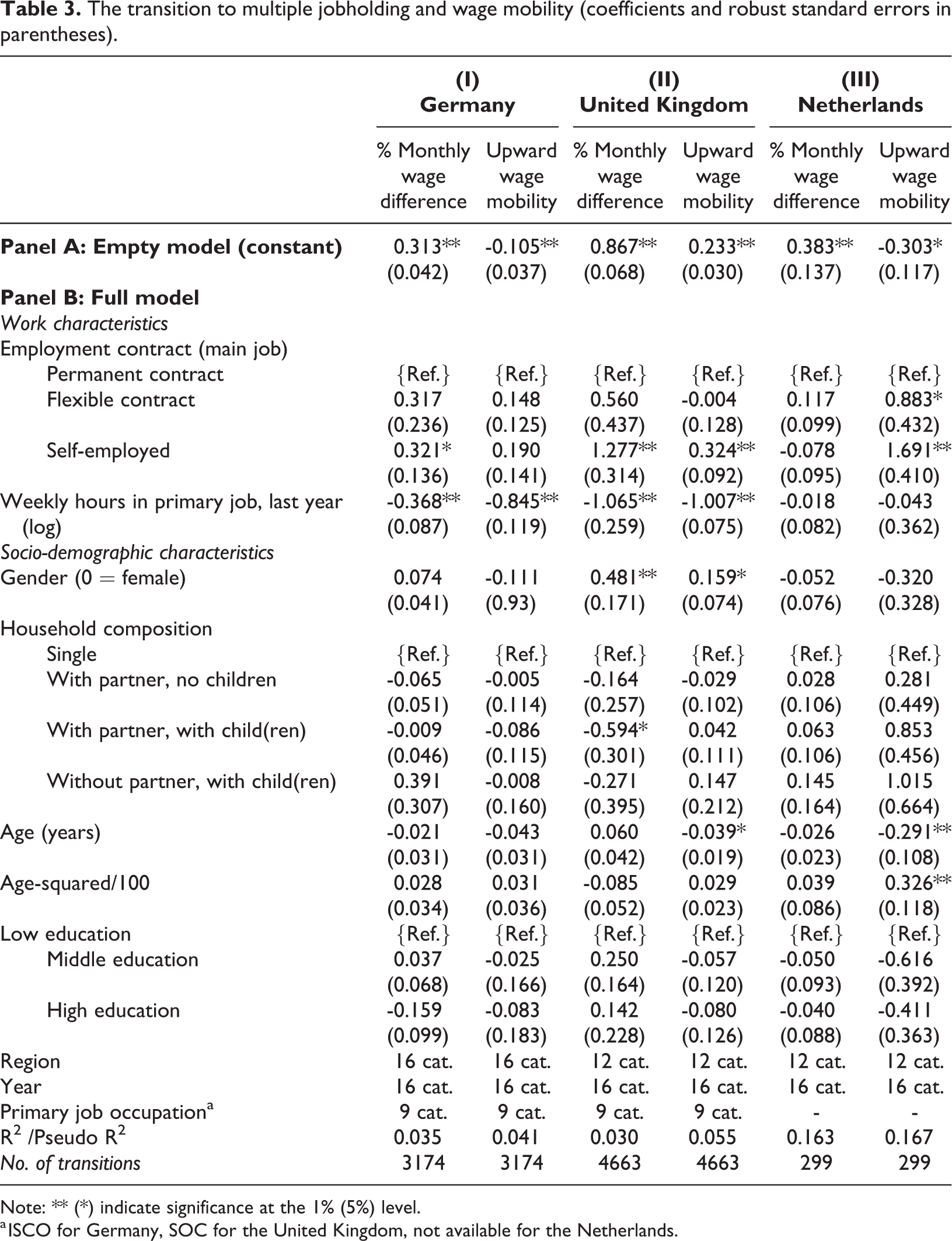
Is the transition to multiple jobholding related to upward or downward wage mobility? In Table 3 we present estimates of financial job outcomes in the year following the transition to multiple jobholding. Two job outcomes are examined (see also Panos et al., 2014), namely (a) the change in monthly wage from year t -1 to year t, expressed as a ratio r = waget / waget-1 and (b) upward wage mobility, defined as a binary variable taking the value 1, if the monthly wage increased by more than 15 per cent as compared with the previous year. Models examining changes in monthly income use linear random-effects regressions, and models addressing upward wage mobility use random-effects probit estimation.
The transition to multiple jobholding and wage mobility (coefficients and robust standard errors in parentheses).
Note: ** (*) indicate significance at the 1% (5%) level.
a ISCO for Germany, SOC for the United Kingdom, not available for the Netherlands.
In Panel A of Table 3, the findings show that individuals generally report positive wage mobility effects in the transition from a single job to multiple jobholding. This confirms hypothesis 1b on wage mobility effects. The binary variable on upward wage mobility is negative in Germany and the Netherlands, indicating that upward wage mobility tends to be lower than 15 per cent for most workers, while in the United Kingdom this is positively related.
The results presented in Panel B of Table 3 show that in Germany and the United Kingdom self-employed workers in particular report an increase in monthly wages following the transition from a single job to multiple jobholding, compared with the reference category (employees with a permanent contract in the main job). In the Netherlands, the binary variable on upward wage mobility is also significant for self-employed workers, indicating that there is a tendency for self-employed workers, compared with employees with a permanent contract, to report a wage increase greater than 15 per cent. This tendency is also visible for Dutch workers with flexible contracts, as indicated by a significant positive effect of flexible work arrangements on upward wage mobility. The findings only partially support hypothesis 2b; multiple jobholders with a permanent contract in the main job do not convincingly report less positive wage mobility effects, although in the Netherlands (substantial) upward wage mobility seems more prevalent among employees with flexible contracts and self-employed workers. The findings also do not support hypothesis 3c, stating that, compared with single multiple jobholders, single multiple jobholders with children will report more positive wage mobility effects; wage effects seem to be – more or less – similar among different household compositions.
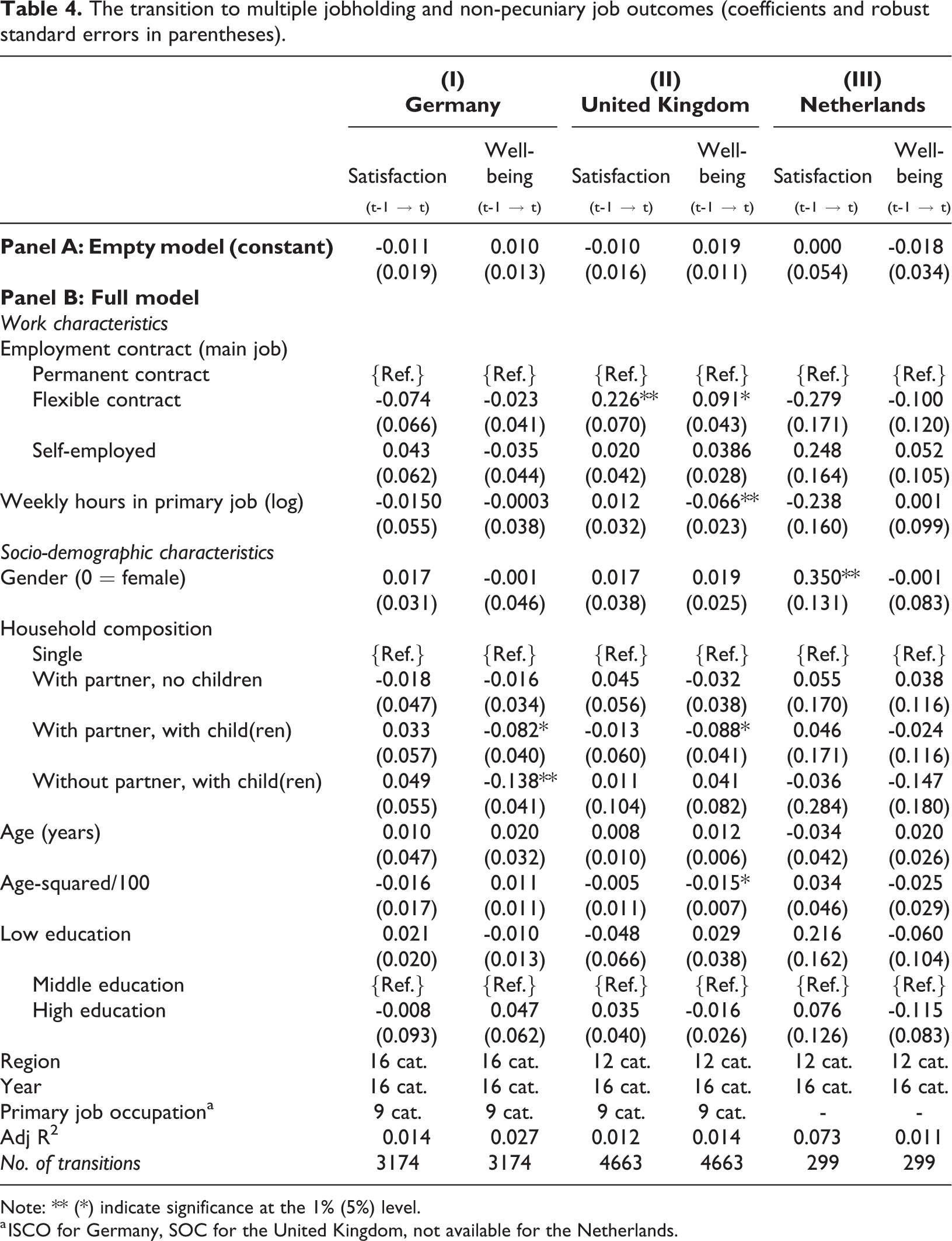
Table 4 addresses the question of whether and, if so, how the transition affects satisfaction and well-being, presenting estimates of non-financial job outcomes in the year following the transition to multiple jobholding. Two job outcomes are examined: the absolute change in satisfaction and in well-being between year t -1 and year t. In Panel A of Table 4, the findings show that individuals generally do not report significant satisfaction or well-being effects in the transition from a single job to multiple jobholding (rejecting hypothesis 1b on satisfaction effects). In addition, the results presented in Panel B of Table 4 show similar satisfaction and well-being effects in the transition from a single job for multiple jobholders on various types of employment contracts. In the United Kingdom, however, employees with flexible contracts, compared with employees with a permanent contract, report more positive satisfaction and well-being effects in the transition from a single job. Finally, in line with hypotheses 3a–c, the findings on household composition provide support for the idea that multiple jobholders with a partner and with children, and single multiple jobholders with children report more negative well-being effects upon transition.
The transition to multiple jobholding and non-pecuniary job outcomes (coefficients and robust standard errors in parentheses).
Note: ** (*) indicate significance at the 1% (5%) level.
a ISCO for Germany, SOC for the United Kingdom, not available for the Netherlands.
In the longer term?
Is multiple jobholding a stable form of employment, or does it merely constitute relatively short spells in workers’ employment biographies? And what are the consequences when multiple jobholding episodes are longer in duration?
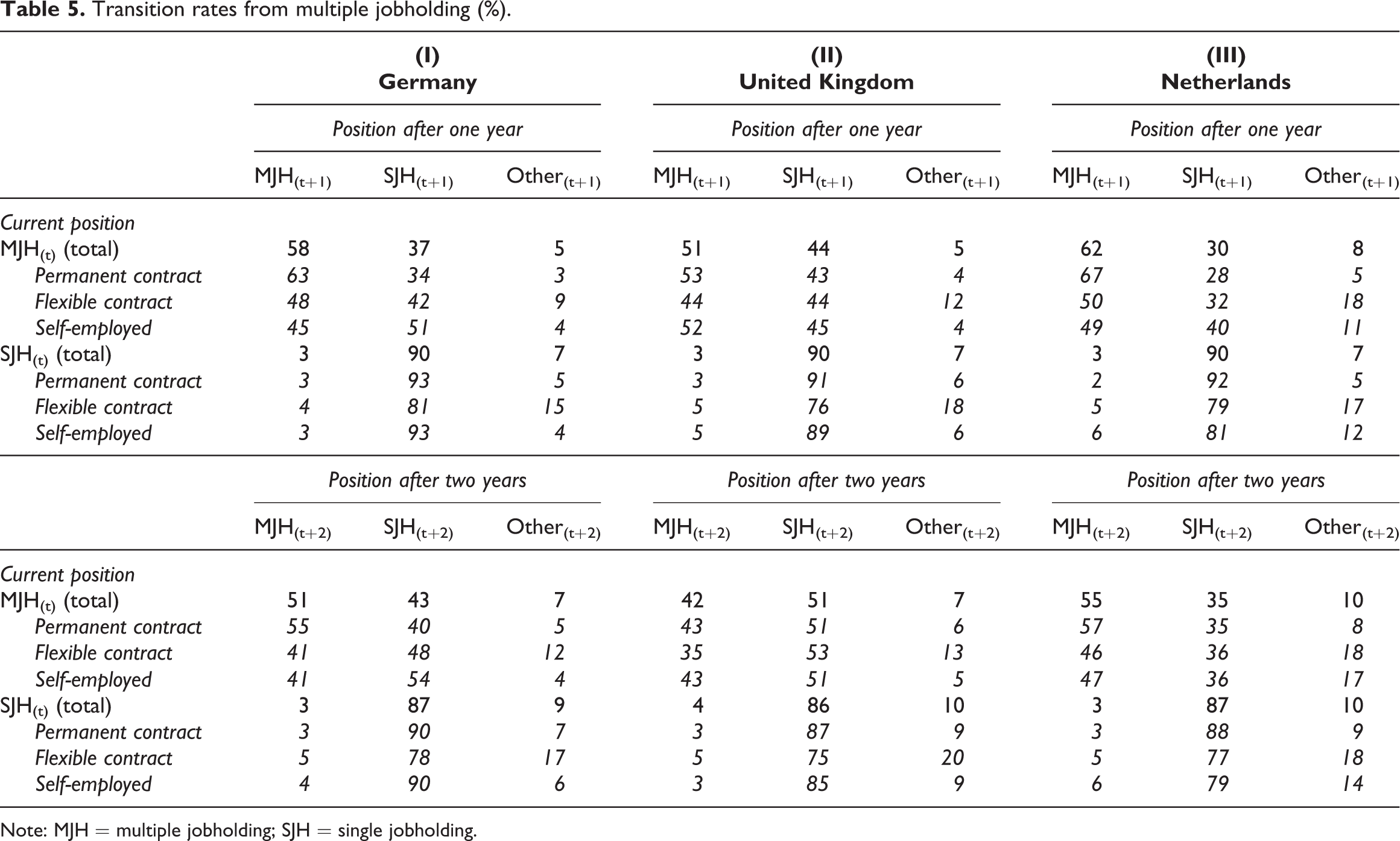
Table 5 shows yearly transition rates from multiple jobholding into other labour market states, overall and by employment contract in the main job. The table thus shows the employment states of multiple jobholders after one year (upper panel) and after two years (lower panel), representing stability and possible exit from multiple jobholding. The findings show that in Germany, 58 per cent of those who were multiple jobholders remained so after one year. Some 37 per cent of all multiple jobholders held a single job one year later, and 5 per cent became unemployed or inactive. In the Netherlands, a relatively high percentage of multiple jobholders are still holding multiple jobs one year later (62 per cent, that is, relatively high stability). In the United Kingdom, the results show a relatively high transition rate from multiple to single jobholding (44 per cent). There is also a relatively high outflow into unemployment or inactivity among Dutch multiple jobholders, however (8 per cent). In all three countries, multiple jobholders with a permanent contract in the main job have the highest probability of still being in multiple jobholding one year later (63, 53 and 67 per cent, respectively). Furthermore, 90 per cent of single jobholders remain so one year later, 3 per cent made the transition to multiple jobholding and 7 per cent to unemployment or inactivity. Comparing the lower panel to the upper panel, the findings show that the transition rates between multiple and single jobholding increase further between t+1 and t+2, but at a decreasing rate; that is, relatively many transitions out of multiple jobholding take place during the first year.
Transition rates from multiple jobholding (%).
Note: MJH = multiple jobholding; SJH = single jobholding.
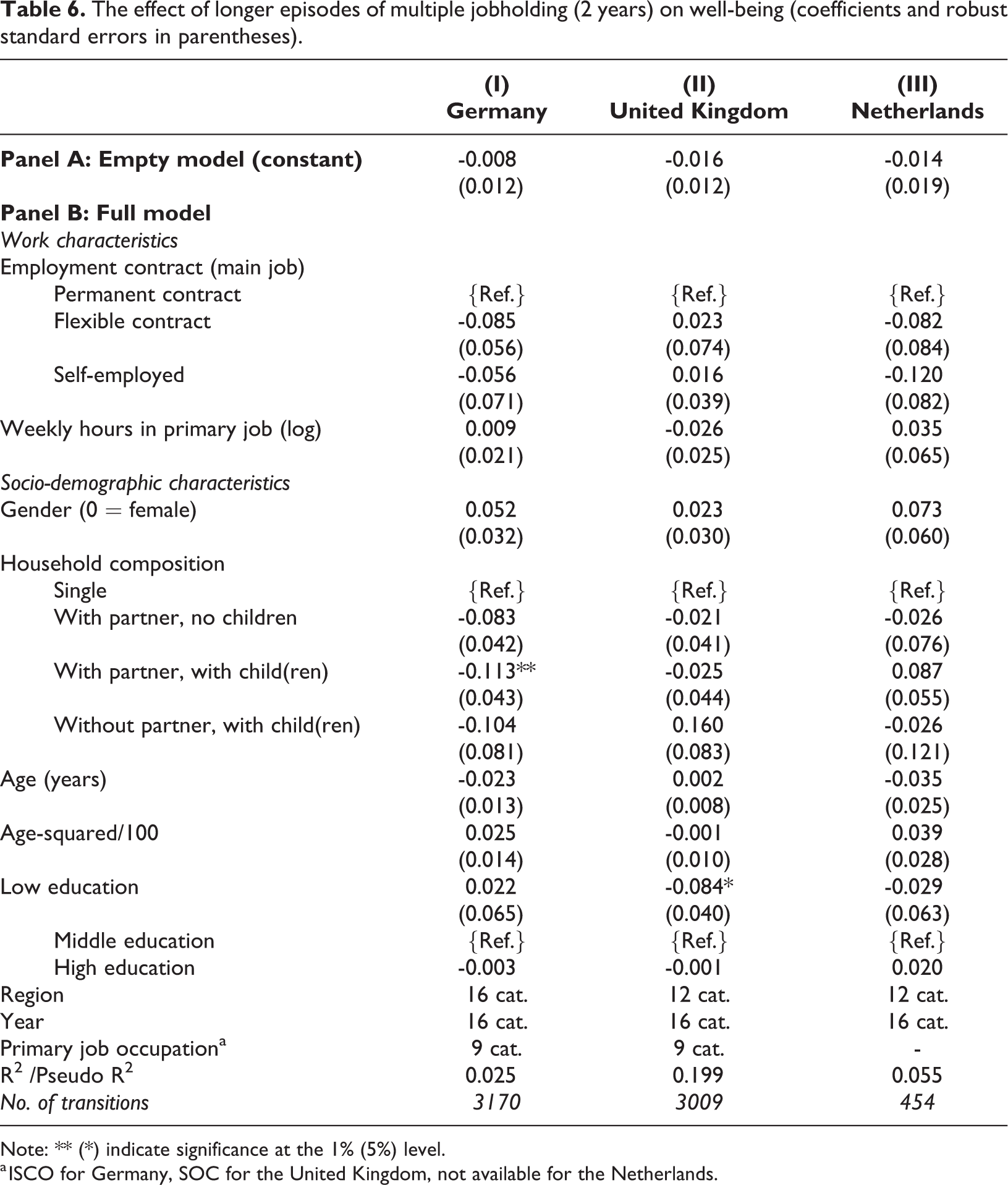
For those multiple jobholders who keep multiple jobs for longer episodes (at least two years), Table 6 presents the impact on well-being, examining the change in well-being between year t and year t+2. In Panel A of Table 6, the findings show that individuals generally do not report significant well-being effects for longer episodes of multiple jobholding, rejecting hypothesis 1c. The results presented in Panel B of Table 6 do not provide much support for any of the other hypotheses on long-term effects either: multiple jobholders with a permanent contract in the main job do not seem to report different well-being effects for longer episodes (rejection of hypothesis 2c), and household composition does not seem to affect well-being – once in the situation of holding multiple jobs – either. Only in Germany do the results show an effect of multiple jobholders with a partner and with children reporting more negative well-being effects.
The effect of longer episodes of multiple jobholding (2 years) on well-being (coefficients and robust standard errors in parentheses).
Note: ** (*) indicate significance at the 1% (5%) level.
a ISCO for Germany, SOC for the United Kingdom, not available for the Netherlands.
Conclusions and discussion
In this study we investigated the transition and duration effects of multiple jobholding on financial and non-financial job outcomes, and the role of flexible work arrangements and household contexts therein. To that end, we examined panel data from Germany, the Netherlands and the United Kingdom for the period between 2002 and 2017.
The findings confirm the importance of economic factors on the decision to work in multiple jobs. In general, workers report positive wage mobility effects of the transition from a single job to multiple jobholding. This wage mobility effect seems particularly marked among the self-employed. In addition, the findings reveal that labour market contexts play a significant role in outcomes. Especially in the Netherlands, the financial dimension seems to deviate from Germany and the United Kingdom, suggesting that the nature of Dutch multiple jobholding is relatively vulnerable. One possible explanation might be that the Dutch labour market is characterised, in international terms, by a very high percentage of part-time workers. Although Dutch part-time workers generally have decent working conditions (including good average pay), there is a possibility that people prefer to work more hours but are not able to find jobs offering such conditions. In other words, perhaps involuntary part-time employment is an important reason for choosing multiple jobholding in the Netherlands – to supplement low household incomes and to achieve preferred total working time. Whether and how the relatively strong flexibilisation of the Dutch labour market has incentivised working in multiple jobs, and whether there is a direct effect on wage levels could be an interesting avenue for further research.
Individuals generally do not report significant satisfaction or well-being effects in the transition from a single job to multiple jobs, but the findings do support the idea that strain and work-role conflict may play a role in particular for those who combine multiple jobs while having children, because multiple jobholders with a partner and children, and single multiple jobholders with children report more negative well-being effects.
For a substantial share of workers, holding multiple jobs seems to be temporary in nature; across the countries under comparison, after two years about half of the initial multiple jobholders made the transition to single jobholder, unemployment or inactivity. This transitory nature of multiple jobholding may partly explain why this study finds only limited transition and duration effects of multiple jobholding episodes. Perhaps, for many workers, multiple jobholding does not necessarily come with either clear enrichment or depletion effects but is rather ‘just’ a phase in their overall employment biography.
The study has several strengths and also limitations. We examined transitions and transition sequences for multiple jobholders in their employment biographies. Although the panel data are rich and internationally comparable, they are not suitable for following individual multiple jobholders over long periods of time. This is because of the relatively low numbers of multiple jobholders in the population, as well as sample and panel attrition. Future studies may want to make use of registers or administrative data and employ sequence analyses for employment pathway analyses to achieve a deeper understanding of what drives and shapes multiple jobholding and its consequences for employment biographies. This study used a sample of both male and female multiple jobholders. Although labour market behaviour may have converged over recent decades, it is still likely that men and women differ in their behaviour; future studies may want to pay closer attention to this gender dimension.
Footnotes
Acknowledgements
This article is based on data from the German Socio-Economic Panel Study (SOEP) by the German Institute for Economic Research (DIW), Berlin; the British Household Panel Survey and Understanding Society, made available through the ESRC Data Archive; and Dutch National Bank Household Surveys. Neither the original collectors of the data nor the archives bear any responsibility for the analyses or interpretations presented here. The authors would like to thank the editor and two anonymous referees for their helpful comments and suggestions.
Funding
This research was financially supported by the Hans-Böckler-Stiftung through the grant ‘Hybridisation of Work: Structure and Dynamics’.