




Abstract
This article examines the role of extension provisions for collective agreements in France, Portugal and Spain, three countries that have faced pressure to introduce more flexibility in their employment regimes during recent economic crises. The article establishes the continuing importance of extension provisions for maintaining high bargaining coverage in all three countries and traces the origin of national differences in their evolution to the strategies of the various actors, governments, employers and trade unions, and the context in which they are operating. It also looks at the characteristics of the extension regulations themselves.
Cet article examine le rôle des mécanismes d’extension des accords collectifs en France, au Portugal et en Espagne, trois pays qui ont été contraints d’introduire plus de flexibilité dans leurs régimes d’emploi durant les récentes crises économiques. L’article établit l’importance constante des dispositifs d’extension pour maintenir une couverture de négociation élevée dans ces trois pays et retrace l’origine des différences nationales dans leur évolution par rapport aux stratégies des différents acteurs, gouvernements, employeurs et syndicats, et au contexte dans lequel ils fonctionnent. Il examine également les caractéristiques des règles d’extension proprement dites.
Der vorliegende Artikel untersucht die Regelungen für die Ausweitung von Tarifverträgen in Frankreich, Portugal und Spanien. In diesen drei Ländern gibt es Forderungen nach mehr Flexibilität in der Gestaltung von Arbeitsverträgen vor dem Hintergrund der Wirtschaftskrisen der letzten Jahre. Der Artikel beschreibt die unverminderte Bedeutung dieser Ausweitungsregelungen für den Erhalt eines hohen Deckungsgrades von Tarifverträgen in allen drei Ländern und geht den Ursachen für unterschiedliche nationale Entwicklungen entsprechend den Strategien der einzelnen Akteure, Regierungen, Arbeitgeber und Gewerkschaften in ihrem jeweiligen Handlungskontext nach. Der Artikel befasst sich ebenfalls mit den Merkmalen der verschiedenen Ausweitungsregelungen.
Introduction
This article focuses on the extension of multi-employer collective agreements in Europe. Extensions enable the application of agreements to workers and companies that are not affiliated to the social partners responsible for their negotiation, whether trade unions or employer organisations. They provide important support for collective bargaining in the European Union.
Different forms of extension have been developed within the EU. This article examines extensions in three southern European countries: France, Portugal and Spain. These are all state-influenced market economies associated with a highly regulated model of capitalism (Schmidt, 2012). In recent decades pressures have developed to introduce more flexibility into the three countries’ industrial relations systems. During the recent economic crisis, Portugal and Spain faced such pressures from the so-called ‘Troika’ (the European Central Bank, the European Commission and the International Monetary Fund) in return for aid. In the case of France, by contrast, pressures were generated rather internally by political and business actors. This article examines extension provisions in the face of such pressures
The focus will be on the effectiveness of extensions in continuing to discharge two functions identified by Visser (2016): (i) enabling the coverage of collective agreements to extend beyond the parties directly involved in the negotiation and signing of agreements and (ii) promoting collective bargaining. We examine this effectiveness within the framework of a number of key variables: the role of the actors associated with the provisions, the nature of the provisions, and their institutional, economic and historical context. The state is a central actor in the establishment of extension provisions, given its regulatory capacity to construct, formalise, and restructure institutions (Howell, 2016). It is not a monolith, however. At different times, different political configurations exercise power to different ends in the name of the state. The stability of governments and their ideological emphasis will vary, influencing their interest in and capacity to initiate change in institutions. As well as the state’s political actors there are also public agencies that can influence the institutional practices of the social actors, such as the judiciary.
An emphasis on the role of the state means that attention tends to be concentrated on the role of the regulatory framework to explain the development of industrial relations institutions. But the maintenance of effective institutions also depends on a supportive culture among the industrial relations actors (Streeck and Thelen, 2005). We therefore need to look at union and employer orientations towards extension provisions. Their attitudes may in turn be influenced by actor characteristics (for example, degree of unity, organisation and representation), as well as the power relationships between them.
The detailed characteristics and origin of the regulatory framework may also influence the operation of extensions. Provisions may differ along a number of dimensions, including the degree to which they are embedded in a country’s constitution, the requirements for them to be activated and the provisions for exemption from extension.
Finally, the institutional, historical and economic context within which extension provisions are located may influence their evolution. Extension provisions co-exist with other institutions that do not necessarily share their aims and can come to challenge them (Streeck and Thelen, 2005). One competing institution might be company-level bargaining and the space it occupies in relation to multi-employer bargaining. The historical context of extension provision might relate to the circumstances of their establishment and their degree of embeddedness in the industrial relations system. Furthermore, globalisation and the crises of the past decade have provided a challenging economic context for extension provisions, which warrants examination.
Extension of collective agreements
Countries in which multi-employer bargaining predominates generally have broader bargaining coverage (Visser, 2013a). The strength of multi-employer bargaining in turn is related to the existence of strong and representative bargaining partners and supportive state policies, the most important of which may be the extension of collective agreements (Schulten et al., 2015).
The extension of collective agreements has a long history in the EU. But although extension provisions are widespread their characteristics differ. Schulten et al. (2015) identified two different approaches. First, there is the extension of collective agreements to non-organised workers in companies affiliated to the employer bodies negotiating an agreement, preventing companies from discriminating between unionised and non-unionised workers. There is a legal erga omnes provision in most European countries that supports this type of extension. The second approach is the extension of an agreement to workers in non-affiliated companies. This typically would be carried out by administrative extension through a declaration of general applicability by the relevant ministry. There are, however, variations to this second approach. In some countries there are functional equivalents to extension, which have the impact of declarations of general applicability. Thus in Italy, collectively agreed minimum wages are taken by courts as a point of reference when assessing whether wages conform to the constitutional requirement of fair pay. Another variation is to establish a legal erga omnes provision that applies to all employers and therefore all workers in a sector, organised or not (as in Spain). Although extension provisions exist in most European countries the frequency of use varies. In nine EU countries the use of extension provisions is very common, common or general, whereas in other countries their use is rare or limited, or they are not used at all (Hayter and Visser, 2018).
Hayter and Visser (2018) identified three different extension regimes: the semi-automatic, the supportive and the restrictive. In semi-automatic regimes there is no need for a public authority to make a decision to extend an agreement. As long as the collective agreement is valid and negotiated by duly constituted and representative parties, it has general applicability to all workers and employers in its sector, often without a need for the parties to request extension. Hayter and Visser identified seven countries – including France and Spain – in this category (although, as we shall see, recent reforms raise a question mark about France’s inclusion). The Portuguese regime could be characterised as semi-automatic until 2011 (Schulten, 2016).
Supportive regimes are more complicated. Extension is typically applied by decision of the appropriate Ministry and normally the negotiating bodies must have requested extension. In reaching its decision the Ministry may have to take into account whether an agreement fulfils certain criteria, often in relation to its representativeness or public interest. 1 This category includes Belgium, Croatia, Germany, Italy, Netherlands, Portugal, Slovenia, South Africa and Switzerland.
Finally, ‘restrictive regimes’ have more demanding criteria that must be met before extensions can be instituted, such as a proportion of workers in a sector who must be employed in affiliated companies. Hayter and Visser (2018) identified 12 countries in this category: Albania, Bulgaria, Czech Republic, Estonia, Hungary, India, Ireland, Israel, Latvia, Norway, Romania and Slovakia.
The significance of extension provisions for collective bargaining coverage has been regularly emphasised. Traxler et al. (2001) argue that in many European countries state support is the most important variable explaining high bargaining coverage, with administrative extension of collective agreements being the most important instrument. The effect of extension regimes on bargaining coverage is not easy to establish, however (Hayter and Visser, 2018). In most countries where extensions are employed, bargaining coverage is much higher than union membership density, because erga omnes provisions extend agreements to all workers in firms covered by agreements, regardless of union membership. Hayter and Visser (2018) calculate the gap between the proportion of employees working in organised firms and the bargaining coverage when seeking to identify the effect of different extension regimes. They found the largest effect in the semi-automatic regimes, ranging from 30 percentage points in France to 16 points in the case of Finland.
Such analyses rely on the availability of dependable data on employer organisation. As Visser (2013a, 2016) comments, however, such data are sparse. It was not until 2013, on the occasion of the fourth edition of the ICTWSS 2 (Visser, 2013b) that an attempt was made to present data on employer organisation. It is difficult to obtain reliable data because of employers’ tendency to affiliate to more than one association (which results in double counting) and the dependence on estimates from employer organisations themselves (which are prone to exaggerate their membership) (Cazes et al., 2019).
The value of extension provisions has been debated. It has been argued that, by setting common working conditions within the same industry, wage inequality is limited and collective bargaining’s protective and distributive functions are strengthened (Carcillo et al., 2020; Martins, 2020; Villanueva, 2015). Concern has been expressed about whether extensions are in the public interest if they come at the expense of reduced employment and company well-being, however (Martins, 2020; OECD, 2017; Villanueva, 2015). Scholars have also criticised the anti-competitive effect of binding agreements, suggesting that established companies in employers’ associations have an interest in extending collective agreements so that wages are increased to raise rivals’ costs and make new entries to a sector less viable (Haucap et al., 2001).
There is also a debate among the social partners on the merits of extensions. Employers express concern about their lack of flexibility. Thus we have seen the introduction of exemption provisions from extended agreements in some countries, whereby companies claim that they are unable to meet the terms of agreements. Many small firms value agreement extensions, however, because they establish a level playing field for all companies in a sector and minimise uncertainty (Rocha, 2018). Trade unions worry about the effect of extensions on union membership because workers benefit from the agreements regardless of such membership. Most unions value extensions, however, because they enable their negotiating power to reach workers in many companies in which union presence is limited.
Extension provisions in three southern European countries
France
The origin of extension provisions in France lies in the 1936 Statute, introduced when the Popular Front government sought to strengthen collective bargaining and trade unions had low membership, and were unstable and divided (Sturmthal, 1951). The law provided that the government could extend agreements reached by the ‘most representative organisations’ when requested by one of the bargaining parties. The term ‘most representative’ could include more than one organisation (preventing the CGT from obtaining a monopolistic position) and was not dependent on membership alone, taking into account a union’s age, role in past negotiations, financial stability and conditions of membership. The trade union movement viewed the new legislation positively (Sturmthal, 1951) and the employers were comfortable with a system that established a level playing field for their sector at minimum conditions, while giving them scope at company level to organise work as they saw appropriate (Goetschy, 2002).
The Ministry of Labour has retained the right to decide on extension provisions. Only valid agreements can be extended. Since 2008, to be valid an agreement must be signed by one or several unions that obtained 30 per cent of the votes cast in the first round of workplace elections (this validity criterion applies to agreements at workplace, sectoral and interprofessional levels). Likewise, it must be signed, where appropriate, by at least one representative employers’ federation. An agreement ceases to be valid if contested by one or more unions that obtained a majority of votes in workplace elections.
From 2017 the Ministry of Labour was required to pay more attention to the public interest. Reforms provided for the Ministry to be advised by an independent group of experts on the economic and social effects of extensions. Furthermore, extensions could be rejected if they did not include special provisions for small firms, were considered harmful to vulnerable groups of firms and workers or risked undermining competition. These changes took place in the context of the discussion of the advantages and disadvantages of extension provisions and the relatively rare use of an existing provision on taking into account the public interest in extension decisions (OECD, 2017).
The use of extensions in France is not therefore an automatic process and approval by the Ministry of Labour is required. This approval has normally been forthcoming, however, contributing to a high coverage rate (94 per cent; Visser, 2019).
In 1947 membership levels were introduced as a criterion for considering trade unions to be ‘representative’, but additional criteria such as political independence and having a patriotic stance in the war encouraged the role of smaller unions (Parsons, 2013). Since 2012–2013 representative status has been based on union performance in workplace elections. At workplace level unions must obtain 10 per cent of the votes cast in the first round of elections. At sectoral level a union has to obtain 8 per cent of the aggregate vote (votes cast in the first round of elections for works council representatives, for single staff delegates and in ballots in companies with fewer than 11 employees). In 2014 and 2016, legislation for the first time introduced criteria for ‘representative’ employer organisations, which have to prove they represent 8 per cent of the sector’s companies or 8 per cent of its employees (Rehfeldt and Vincent, 2018).
Initially, following the 1936 Statute, representative status was held by two unions: the CGT (Confédération Générale du Travail), linked to the French Communist Party, and the catholic and confessional CFTC (Confédération Française des Travailleurs Chrétiens). Currently three additional unions enjoy representative status: CFDT (la Confédération Francaise Démocratique du Travail), a secular independent breakaway from the CFTC; FO (Force Ouvrière), a breakaway of activists worried by the CGT’s lack of independence from the Communist Party; and CGC (Confédération Générale des Cadres), representing professional/managerial staff. The CGT represents the more militant wing, being less willing to negotiate flexibility at enterprise level or support government-promoted liberal reforms. From 2017, the CFDT enjoyed the most support in representativeness elections. It tends to be more willing to sign agreements and negotiate and seek to influence government-proposed reforms. Three employer organisations also meet the representative criterion: MEDEF (Mouvement des entreprises de France), the largest, representing 750,000 firms; CPME (Confédération des petites et moyennes entreprises) predominantly representing SMEs; and UPA (Union Professionelle Artisanale) representing craft-based firms. They tend to show more unity than the unions.
Parallel to extension provisions the state has promoted decentralised bargaining, beginning with the Auroux laws of 1982, and continuing with legislation in 1996, 1998, 2000 and 2004. The El Khomri Law of 2016, under the Hollande government, and the Macron government’s Ordinances of 2017 maintained this process by facilitating agreements at company level in the absence of a union and diluting the favourability principle, whereby sectoral agreements had priority over company negotiations (Rehfeldt and Vincent, 2018).
These legislative changes have resulted in the growth of a company-based bargaining system, supported by employer organisations. This has not affected the coverage of extensions, but has reduced their importance. More issues are now negotiated at company level. The number of company-based agreements increased from 8500 in 1995 to 39,000 in 2013. In 2014–2016, 65 per cent of employees in companies with more than 10 employees were covered by company agreements (Dares, 2019). Although a minority of companies directly engage in bargaining (38 per cent between 2014 and 2016), as Figure 1 indicates, they include most large firms and a not insignificant proportion of small firms.
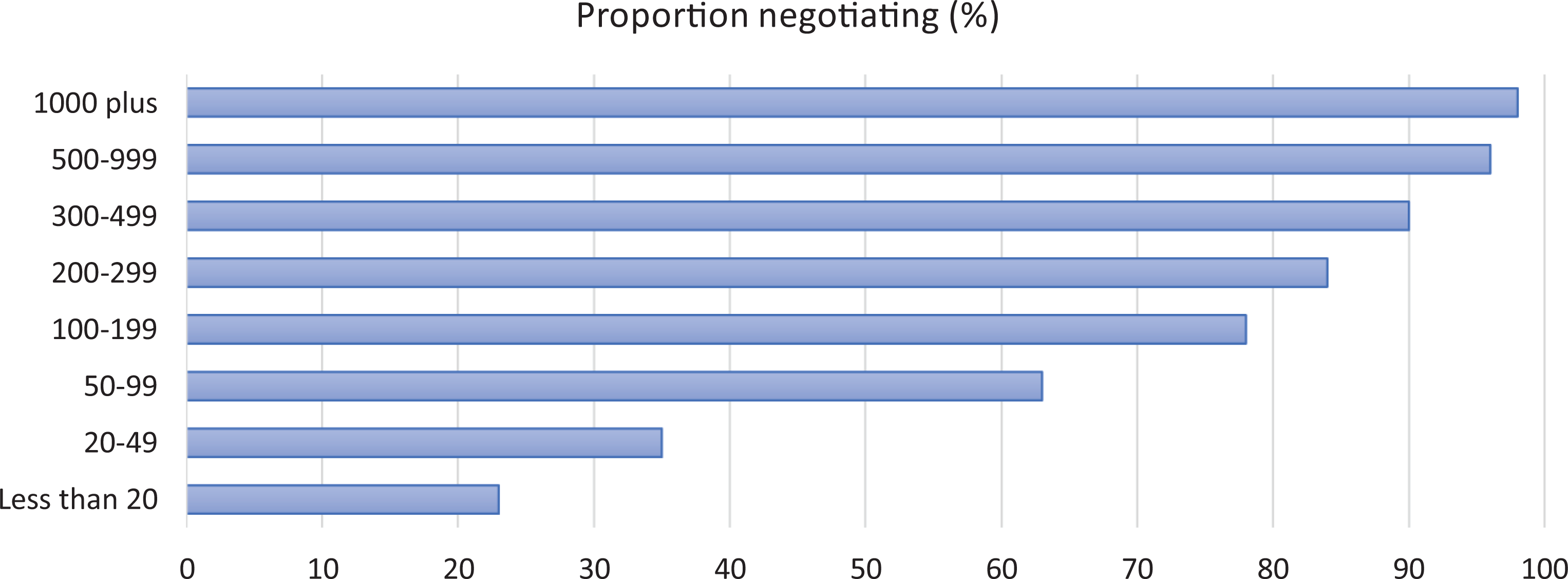
Companies directly negotiating collective agreements by number of employees, 2014–2016. Source: Dares (2018).
Portugal
The system of industrial relations that emerged in Portugal following the dictatorship in 1974 developed in a post-revolutionary climate favourable for trade union rights. The principal trade unions – the communist-linked General Confederation of Portuguese Workers (CGTP) and the socialist-inclined General Union of Workers (UGT) – faced with the employers’ reluctance to negotiate, sought government intervention. In this context extension provisions were introduced.
If the negotiating parties requested it, the Ministry of Labour extended an agreement to all workers in a given sector and it remained in force until replaced by a new agreement, which could not be less favourable for workers than the previous one (Barreto and Naumann, 2002). No legal criteria existed concerning what constituted a representative trade union for bargaining purposes. The extension provision contributed to a typical bargaining coverage rate of around 60 per cent, counting only new agreements and new extensions of existing agreements, or over 90 per cent if pre-existing, still valid agreements were counted (Schulten et al., 2015).
In the 1980s and 1990s, employers and their organisations (including the Confederation of Portuguese Industry [CIP] and the Confederation of Portuguese Commerce [CCP]), faced with increasing globalisation and competition, began to campaign for more flexibility. In response, in 2003–2004, a new Labour Code was adopted by the centre-right government. The favourability principle (whereby collective agreements could only set more favourable conditions than legislative standards) was eliminated and agreements not renegotiated for a number of years could expire. The government also temporarily stopped extending collective agreements (a step reversed by the Socialist government elected in 2005). Revision of the Labour Code in 2009 further limited the renewal of agreements. The unions’ ability to oppose these changes was limited by their disunity (Távora, 2019). The CGTP put the emphasis upon worker mobilisation. The UGT, more willing to negotiate, sought to use its influence with the government to defend workers’ rights.
During the economic crisis of 2010–2014, Portugal accepted a debt bailout from the ‘Troika’ and in 2011 signed a memorandum of understanding specifying reforms to be implemented, including a review of extension provisions. Extensions were almost completely suspended by the incoming centre-right government, and, a year later, in October 2012, restrictive criteria for extension were introduced. This was opposed by the social partners. Agreements could be extended only if the signatory employer bodies represented companies employing at least half the workers in the sector, making extensions unlikely (Schulten et al., 2015).
Figure 2 indicates the pattern of extension provision and collective agreements negotiated from 2000 to 2018. From 2012 to 2014, immediately following the 2012 restrictions, the number of annual extension decrees varied between nine and 17 compared with over 100 in the previous years. In addition, the number of new multi-employer agreements and new extensions of existing agreements (published agreements) declined from an annual average of 272 between 2000 and 2011 to 37 between 2012 and 2014. Employers became less interested in negotiating multi-employer agreements as competition could not be avoided if all companies could not be bound by an agreement (Schulten et al., 2015).
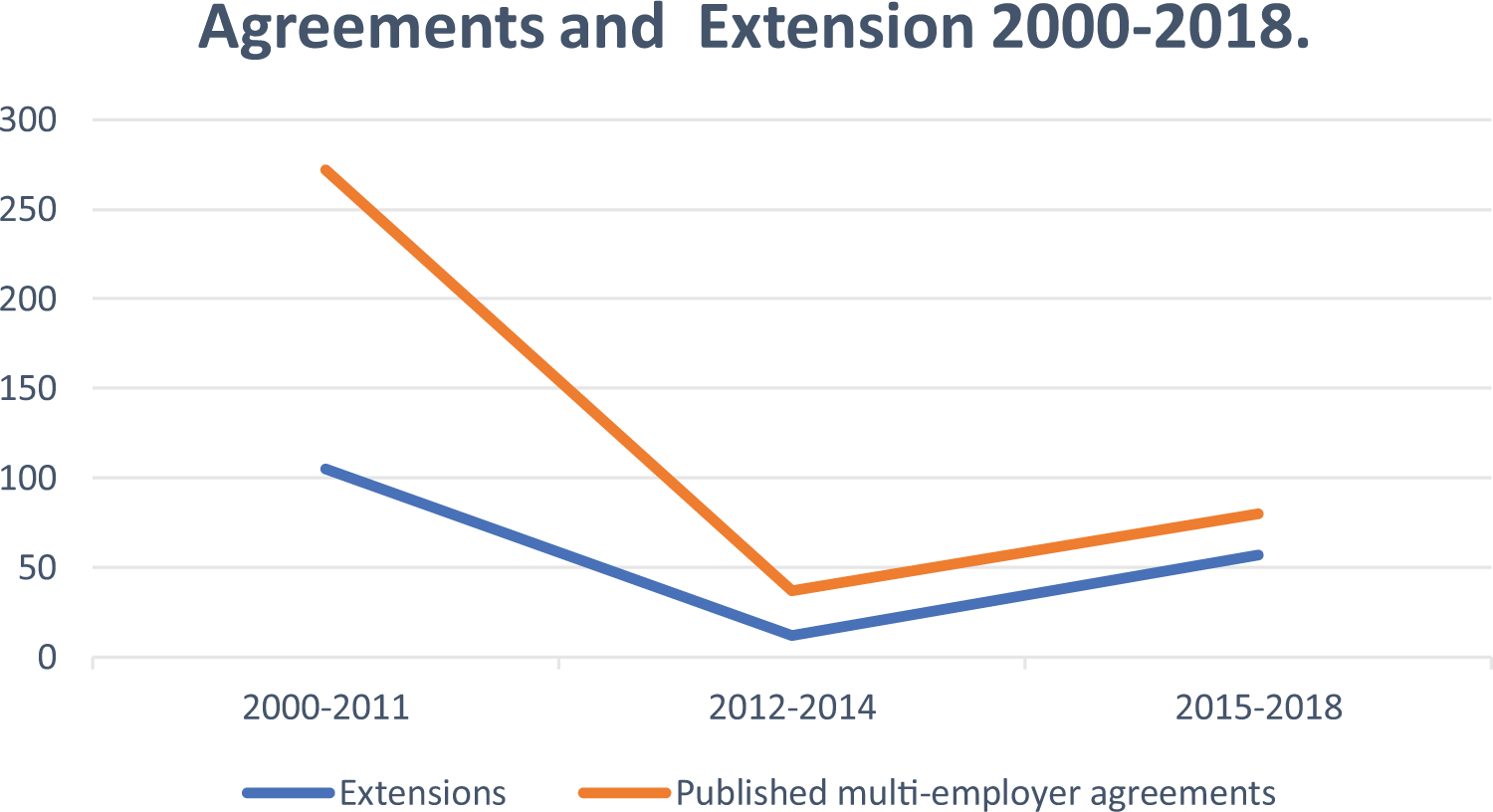
Multi-employer agreements and extensions (2000–2018).
The impact of the change in extension provision on bargaining coverage has been debated (Addison et al., 2015). The proportion of workers covered by new agreements or the renegotiation of existing agreements declined significantly from an average 84 per cent in the five years before the financial and economic crisis. Including workers covered by valid pre-existing agreements, however, coverage remained high, at 74 per cent (Visser, 2019).
Under pressure from unions and employer bodies (the latter being concerned about unfair competition in the absence of extensions (Eurofound, 2013)), in 2014 the Portuguese government began to relax the extension criteria and extension became possible if at least 30 per cent of the contracting employer association members were SMEs. Given the structure of the Portuguese economy, with 97 per cent of firms SMEs, employing 83.5 per cent of employees (Eurostat, 2018), most agreements met the new criteria. In 2017 the government went further, abandoning representativeness criteria for extensions and focusing on public interest criteria related to the wage and economic impact of agreements, including their effects on inequality and the position of women.
The relaxation of criteria has contributed to an increase in the number of extensions (Figure 2), although they have not regained pre-crisis levels. The number of published agreements remains lower than before the crisis, suggesting a continuing reliance on a stock of agreements that have not been renewed recently and have lost their regulatory capacity and relevance (Müller et al., 2019). Távora (2019) has related this partly to changes in the 2012 Labour Code introduced by the Social Democrat government, which provide for reductions in overtime pay and make it easier for employers to introduce working time accounts at company level. These company-level options, together with limits on the renewal of agreements, have changed the balance of power, reducing employers’ incentive to maintain sectoral bargaining and making the unions, particularly the CGTP, reluctant to sign agreements that concede employer demands for flexibility. In addition, it is proving to be a complicated and contentious process to revise those longstanding agreements which were not reviewed during the crisis when bargaining activity was at a low level.
Spain
The establishment of the Spanish system of industrial relations under democracy in the second half of the 1970s took place in a favourable environment for the unions, who were important protagonists in shaping the new democracy. CC.OO (Workers Commissions) had been associated with the opposition to the dictatorship. The UGT (the General Workers Union), an important union in pre-civil war Spain, became active during the democratic transition. The unions were in a strong position to help shape a favourable legal framework.
The Workers’ Statute of 1980 3 provided for the establishment of works councils in companies and introduced the automatic extension of collective agreements to all companies and workers in a sector, without the need for requests from the negotiating actors and without administrative intervention. Agreements continued to apply unless superseded by a new agreement (the ‘ultra-activity’ principle). Until the financial crisis the only significant modification was in 1994, when agreements were obliged to include provisions that enable employers to avoid wage agreements on the grounds of financial difficulties. The Trade Union Freedom Act of 1985 4 introduced the status of ‘representative union’: this applies to unions that obtain 10 per cent of works council members or delegates elected in a sector that therefore have the right to negotiate sectoral agreements.
This legal framework contributed to high bargaining coverage, averaging over 70 per cent in the four years (2006–2009) before the financial and economic crisis hit (CCNCC, 2020). The most important bargaining level was the sectoral. In 2008, of the workers covered by bargaining, 90 per cent were covered by multi-employer agreements and only 10 per cent by company agreements (CCNCC, 2020).
In the 1980s there were divisions between trade unions, based on ideological and strategic differences (the CC.OO was close to the Communist Party and the UGT to the Socialist Party). In the 1990s, however, a high degree of unity developed. As regards the employers, one main organisation, the Confederación Española de Organizaciones Empresariales (CEOE), has represented their interests at national level since the democratic transition. The CEOE has pursued a strategy of negotiation and social dialogue. Both union and employer representatives have viewed positively the extension provisions.
Spain’s recent economic crisis began in 2008. A reform package was introduced by the right-wing government in 2012 to meet the ‘Troika’s’ demands, in return for a bank bailout (Rocha, 2018). The reforms made it easier for companies to avoid implementing sectoral agreements, prioritised company over sectoral agreements and limited ultra-activity to 14–18 months.
Despite the opportunities the reforms offered to employers, there have been minimal changes to the structure of bargaining. Coverage has remained high at 78 per cent, with only 8 per cent of workers covered by company agreements (CCNCC, 2020). Few employers have sought to avoid sectoral agreements both because they appreciate the advantages of multi-employer agreements and because they are uncertain about the legality of the reform measures (both factors are discussed in more detail in the next section). In 2016, only 0.3 per cent of workers were subject to the non-application of sectoral agreements. The limitation on ultra-activity had little impact. Employer organisations agreed with unions to extend the terms of existing agreements (doubts about the change’s legal status were confirmed by a Supreme Court judgment in 2015). Automatic extension has therefore operated consistently in post-Franco industrial relations.
Explaining the evolution of extension provisions in France, Portugal and Spain
This article has acknowledged the recent development of extension provisions in France, Portugal and Spain. We initially posed the question of whether these provisions made it possible to extend the coverage of collective bargaining beyond the parties directly involved in the negotiation of agreements and promoted collective bargaining.
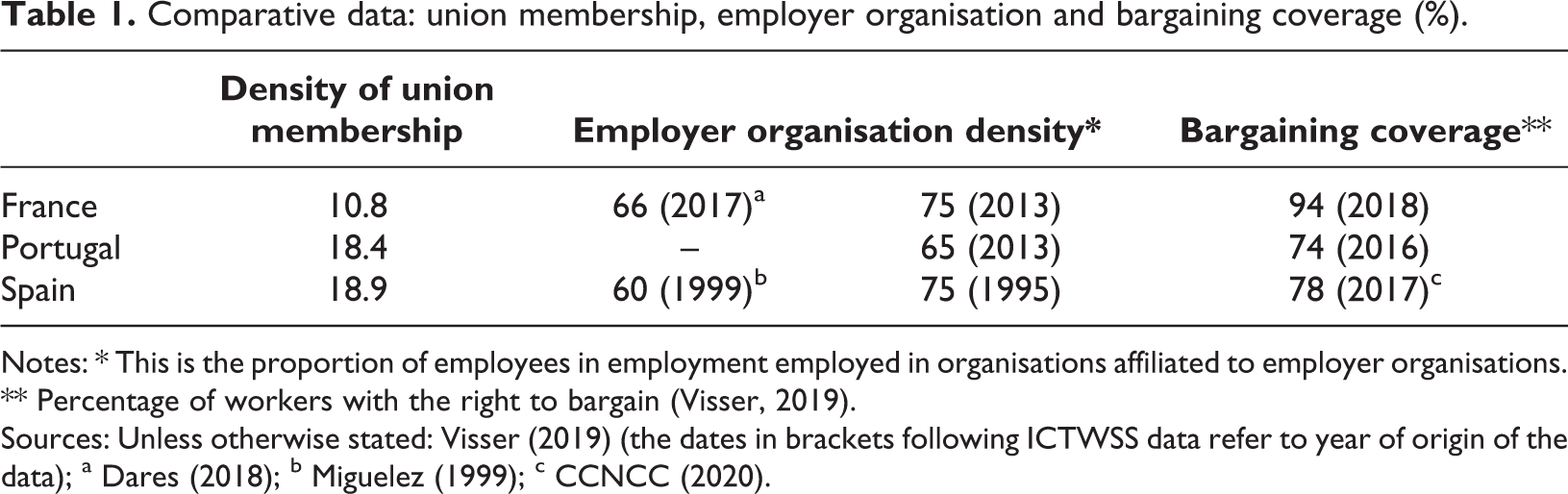
Table 1 presents data on trade union membership density, employer organisation and bargaining coverage for the countries under consideration. It suggests that the level of employer organisation is more important than union density in influencing bargaining coverage. In all countries, coverage far exceeds union density.
Comparative data: union membership, employer organisation and bargaining coverage (%).
Notes: * This is the proportion of employees in employment employed in organisations affiliated to employer organisations.
** Percentage of workers with the right to bargain (Visser, 2019).
Sources: Unless otherwise stated: Visser (2019) (the dates in brackets following ICTWSS data refer to year of origin of the data); a Dares (2018); b Miguelez (1999); c CCNCC (2020).
Table 1 largely employs ICTWSS data (Visser, 2019), with three exceptions: employers’ organisations in France and Spain and bargaining coverage in Spain. We have already raised concerns about data on employers’ organisations. We employed additional sources to reduce these problems. For France we used a national census carried out in 2017 (Dares, 2018) and for Spain expert opinion reported in 1999 (Miguelez, 1999). No source other than ICTWSS was identified for Portugal. Nonetheless the levels reported in Table 1 are likely to overstate the level of employer organisation (as the DARES report points out in the case of France). Bargaining coverage in Spain is subject to varying estimates, including 85 per cent (ETUI, 2016) and 68 per cent in 2017 (Visser, 2019). Our estimate is based on the definitive data for workers covered in 2017 (CCNCC, 2020).
The evidence of Table 1, together with the proviso on the inflation of employer coverage data, suggest that extension provisions in all three countries extend the coverage of collective bargaining significantly beyond the workers employed by affiliated employers and boost its impact. The effect appears to be greatest in France, but it is still significant in Portugal and Spain. We now consider differences in the evolution of extension provisions with reference to the variable framework introduced earlier.
Collective bargaining in all three countries exists in an economic context of globalisation and crisis, with increasing pressures to extend flexibility. National responses have varied, however. In France and Portugal the criteria for granting extensions have come under scrutiny: in France there has been a shift from focusing on the representative status of the negotiating parties to giving importance to the wider public interest and the social and economic effects of extensions; in Portugal, initially extension was made more difficult but recent changes, again incorporating public interest criteria, have encouraged an increase in the number of extensions, but not yet to pre-crisis levels. It is too early to evaluate the impact of these changes. In Spain there has been no review of the relevant criteria and no significant modification of the extension mechanism itself.
In Portugal and, especially, France, there has also been a challenge to the significance of extension provisions and multi-employer bargaining. In Portugal the regulatory regime has strengthened employers’ ability to implement changes in working time at company level and made it easier for agreements to expire. This has shifted the balance of power in bargaining and made it more difficult to reach multi-employer agreements. In France, the growth of company bargaining means that many issues determining employment conditions are resolved at company level (Dufresne and Maggi-Germain, 2012). Extension provisions continue to be important in establishing coverage but the importance of that coverage has been reduced as regards content. These changes in the institutional context of extensions in the two countries point to the type of gradual transformative change identified by Streeck and Thelen (2005), whereby ‘traditional arrangements are discredited or pushed to the side in favour of new institutions and associated behavioural logics’.
In Spain, changes to the institutional context of multi-employer bargaining have not presented the same challenges. Giving primacy to company-level bargaining has had little impact on the dominance of extended multi-employer agreements. The response to pressures for increased flexibility has taken a different form. Multi-employer agreements themselves have become a vehicle for wage reductions. In addition, the prominent role of temporary contracts in the Spanish labour market and reinforced powers to unilaterally modify working conditions have provided employers with important ‘safety valves’ (Rocha, 2018).
The different normative regimes for extension have played a part in explaining the differences we have noted between the three countries. In Spain the extension process is automatic and founded on basic legislation introduced during the transition to democracy. This also linked bargaining rights to the system of worker representation and established a philosophy of inclusiveness as far as collective bargaining is concerned. This provided for a degree of ‘stickiness’ in extension provisions: modification would have required a fundamental and controversial change in the principles of Spanish industrial relations. In both France and Portugal, on the other hand, the application of extension clauses is more exposed to government influence. It is more discretionary, depending ultimately on an administrative decision of the Ministry of Labour and changing provisions is not as big a legislative task – it involves modifying a clause in a specific article in the law rather than rewriting a whole law. This greater ‘stickiness’ of the normative regime therefore provides part of the explanation for the absence of changes in Spain’s extension criteria.
Governments and the political parties forming them have been major actors shaping the different normative regimes of extension. The Portuguese government’s decision to accede to ‘Troika’ pressure to modify extension provisions was the main factor contributing to the decline of collective agreements from 2011 onwards. On the other hand, the government’s relaxation of the strict criteria for extension has helped with the recent partial recovery of collective bargaining and bargaining coverage. Similarly in France successive governments have promoted the decentralisation of bargaining and introduced wider public interest considerations into extension decisions.
In Portugal the approach to extensions has reflected the political complexion of the relevant government. Measures to reduce the role of extensions, starting even before the financial and economic crisis, have coincided with centre-right governments led by the Social Democrats (PSD), which in their winning campaign in the 2011 election announced their intention to go further than the ‘Troika’s’ Memorandum and then unilaterally suspended extensions (Campos Lima, 2019). Socialist-led governments, on the other hand, have been more associated with efforts to establish concertation with the social partners. The Left Coalition, in power since 2015, was responsible for the most recent relaxation of extension criteria (Naumann, 2018).
The decentralisation of collective bargaining in France has been reinforced during the past two decades by governments of all political complexions. Centre-right governments have been influenced by employer pressure for greater flexibility. Left-of-centre governments have traditionally favoured decentralisation as a means of increasing local democracy and mutually beneficial agreements (Amable, 2016).
The Spanish centre-right government in power from 2011 to 2018, during most of the financial and economic crisis, reacted to ‘Troika’ demands by introducing mechanisms to introduce more flexibility into the bargaining process, but it resisted pressure to modify extension provisions, reflecting the historical and normative weight of the post-Franco settlement, as well as the concerns of other actors.
The impact of normative changes in collective bargaining institutions has also been mediated by judicial actors, particularly in Portugal and Spain. In Portugal the Constitutional Court has ruled several times against government labour market reforms going beyond ‘Troika’ demands, such as legislative changes curtailing collective bargaining (Távora, 2019). The Spanish courts, traditionally tending to favour worker interests, reduced the impact of crisis-led reforms. Using obligations embodied in the Constitution, such as negotiating in good faith, they created legal uncertainty about provisions permitting derogation from sectoral agreements. A more determined government could have made greater efforts to redraft the legislation more tightly but this would have been complex (Gómez, 2015).
The employer organisation level has already been discussed as a key variable influencing the impact of extension provisions, but employer strategies have also had a part in shaping the role of extensions in the three countries. They have avoided prioritising the limitation of extension provisions, seeking to increase flexibility by other means. In the case of France, where the percentage impact of extensions appears to be greatest, the peak employer body (now MEDEF) changed its position on its preferred bargaining level several times after the Second World War, but by the end of the 20th century emphasised the advantages of firm-level bargaining: increasing flexibility, distancing the government from bargaining and increasing opportunities to evade higher level norms.
Portuguese employers have been consistently in favour of extended sectoral agreements, worried that without them organised employers would be exposed to competition from non-affiliated firms. Accordingly, they were opposed to the curtailment of extensions during the financial and economic crisis. They appear, however, to be taking advantage of the flexibility provided by regulations enabling them to trigger the expiry of agreements and to introduce changes in working conditions at company level (Távora, 2019). As already indicated, this modification of power relations has contributed to a situation in which collective bargaining and extension provisions have not fully recovered from the decline experienced during the financial and economic crisis.
Spanish employers have shown most reticence in relation to decentralised bargaining. Few have taken advantage of derogation opportunities provided by labour market reform. We have pointed out they had other options for achieving flexibility and appreciated the advantages of multi-employer agreements, which establish a level playing field for all employers, and obviate transaction costs of negotiating terms and conditions in each company. A lack of knowledge concerning the negotiation of agreements, the absence of worker representatives in small firms and a desire not to ‘import’ labour conflict into the firm were additional reasons for them to continue to support multi-employer bargaining (Malo, 2015; MESS, 2014; Rocha, 2018).
The impact of trade union actors on the evolution of extension provisions has been less evident than in the case of other actors. But although all of the unions concerned appreciate the value of extensions in extending the coverage of agreements, differences in approach have been evident. French unions have displayed a variety of postures in relation to bargaining reform. The CFDT, from the 1980s onwards, became increasingly supportive of micro-level reform (Amable, 2016) and has regarded decentralised bargaining as inevitable, reflecting changes in employment. It has sought to take advantage of decentralisation to shape local agreements (Milner and Mathers, 2013). By contrast, the CGT and the smaller FO have unsuccessfully resisted efforts to weaken the role of multi-employer bargaining, while increasingly taking part in firm-level negotiations to maintain a presence in bargaining (Milner and Mathers, 2013). This division has weakened the unions’ capacity to influence institutional change in France.
Disunity has also weakened union influence in Portugal. The CGTP’s and the UGT’s political identities may have been diluted but they have regularly adopted different positions in relation to collective bargaining and social dialogue, with the UGT more willing to negotiate change. This disunity has made it difficult for the Portuguese unions to apply concerted pressure and has encouraged an interventionist state, reducing the credibility of tripartite agreements when there was no guarantee their results could be implemented (Royo, 2002).
By contrast, in Spain unity has grown between the two main unions since the 1990s because of the decreasing communist influence over CC.OO and the increasing militancy of the UGT, together with its distancing from the Socialist Party (Stoleroff, 2013). This unity has consolidated the unions’ status as the voice of the workers and has enabled them to maintain pressure on the state and employer bodies to ameliorate the impact of changes in collective bargaining. Successful union-promoted legal actions have formed part of their approach. For the unions, maintaining the integrity of sectoral agreements (and therefore extension mechanisms) has been a priority, given the predominance of SMEs in the economy. As a consequence, however, they have been willing to accept poorer agreements and wage devaluation to ‘keep the employers on board’ (Cruces Aguilera et al., 2016).
Conclusions
Our examination of extension provisions in three southern European countries has found that they continue to be effective in extending the coverage of collective agreements beyond the companies directly associated with their negotiation. Our comparison shows the importance of the nature of the regulatory framework in the functioning of extension provisions. Thus when the representativeness of a multi-employer agreement is a key criterion for its extension (as in Portugal in 2012–2014) the application of extension provisions is more complicated. That is also the case when government agency plays a key role in approving extensions, as in France and Portugal. It is too early to evaluate the impact of the recent emphasis on public interest criteria in France and Portugal.
In the introduction we emphasised the impact of actor strategies on institutions. The support of the principal actors has been key to the continuity of extensions: governments, employers and unions (with the exception of Portuguese governments at particular points in time). Given the challenging economic circumstances faced by all three countries, however, it is not surprising that extensions have come under scrutiny from international agencies and governments seeking to encourage more flexible employment regimes, while employers, if not questioning extensions in themselves, have been attracted by the prospect of greater flexibility at enterprise level. Institutional reforms in France and Portugal have reduced the significance of extension provisions. In France, in particular, the promotion of company-level bargaining has challenged the role of multi-employer bargaining and of the content of extension provisions in protecting employees. The Spanish case is rather different. Government and employer actors have no less interest in flexibility, but the latter have been able to access it without major changes to industrial relations institutions. The reluctance of Spanish governments to modify extension provisions can be explained by their embeddedness in one of the founding laws of the democracy, which emphasises the importance of the origin of the regulation of institutions when explaining their evolution and effectiveness.
Trade unions, though aware of the advantages to be derived from extension, do not appear to have been the major protagonists in their evolution. Our analysis has shown, however, that the unity of the Spanish unions and their maintenance of constructive relations with employer organisations have been important factors encouraging the stability of multi-employer agreements and extensions. In the other two countries the lack of union unity has given more freedom to other actors to initiate change and greater flexibility.
We have sought to show, in conclusion, that while extension provisions continue to extend the coverage of collective agreements, particular changes in their institutional context (such as movements towards bargaining decentralisation) can reduce their importance. Thus the continuance of institutions should not conceal important changes in the way employment conditions are determined (Streeck and Thelen, 2005). Nevertheless, the active engagement of the social partners in maintaining existing industrial relations institutions, as in Spain, can play a major role in limiting change and maintaining their significance.
Footnotes
Funding
This research received no specific grant from any funding agency in the public, commercial, or not-for-profit sectors.