




Abstract
Drawing on a case study on the civil airline industry in Portugal, this article addresses the impact of precarious employment on trade union action and examines the conditions under which trade unions defend precarious workers’ interests. Using a power-resource theoretical framework, findings in this article highlight that cost-cutting employment practices are used strategically by employers to curb collectivisation and trade unionism. In addition, this article shows that when trade unions engage in an inclusive strategy to defend precarious workers’ interests, the compounded and inter-linked effect of trade union power resources, network embeddedness and international solidarity may be key to achieving success.
S’appuyant sur une étude de cas portant sur l’industrie du transport aérien civil au Portugal, cet article traite de l’impact de l’emploi précaire sur l’action syndicale et examine les conditions dans lesquelles les syndicats défendent les intérêts des travailleurs précaires. À partir d’un cadre théorique fondé sur les ressources du pouvoir, les conclusions de cet article soulignent que les pratiques de réduction des coûts de l’emploi sont utilisées de manière stratégique par les employeurs pour freiner la collectivisation et le syndicalisme. En outre, cet article montre que lorsque les syndicats s’engagent dans une stratégie inclusive pour défendre les intérêts des travailleurs précaires, les effets combinés et interdépendants des ressources de pouvoir des syndicats, de leur ancrage dans les réseaux et de la solidarité internationale peuvent être la clé du succès.
Der vorliegende Artikel beruht auf einer Fallstudie über die zivile Luftfahrt in Portugal und befasst sich mit den Auswirkungen prekärer Beschäftigung auf gewerkschaftliches Handeln sowie mit den Bedingungen, unter denen die Gewerkschaften die Interessen prekär beschäftigter Arbeitnehmer wahrnehmen. Die Autoren nutzen den Rahmen der Machtressourcentheorie für ihre Untersuchung und kommen zu dem Schluss, dass kostensenkende Beschäftigungspraktiken von Arbeitgebern strategisch genutzt werden, um gegen kollektives Handeln und Gewerkschaftsbewegung zu agieren. Darüber hinaus zeigt der Artikel, dass es für die Gewerkschaften ein Schlüssel zum Erfolg sein kann, wenn sie zur Wahrnehmung der Interessen prekär beschäftigter Arbeitnehmer eine inklusive Strategie nutzen, die auf sich gegenseitig verstärkende und ergänzende gewerkschaftliche Machtressourcen, Einbettung in Netzwerke und internationale Solidarität setzt.
Introduction
This article examines the impact of precarious employment on trade union action and the conditions under which trade unions strategically engage with precarious workers to defend their interests. Researchers have highlighted that work and labour relations are increasingly being marked and shaped by precarious and insecure employment (Buschoff, 2015; Standing, 2011). Precarious work is usually associated with a combination of features, such as non-standard employment contracts, pay insecurity and weak employment and social rights. Atypical contracts and contractual insecurity, however, do not necessarily entail precariousness and not all standard jobs entail security or absence of precariousness. For instance, highly skilled or unionised workers may enjoy security while working under non-standard contracts or through agencies. Equally, workers employed through standard contracts may experience insecurity depending on national or industry-specific employment regulations and social security (Vosko et al., 2009). Therefore, precarious work involves a number of characteristics with varying levels of objective insecurity (legal status at local and national level) and subjective insecurity (individual experience) (ILO, 2012: 27). In this way, precariousness is related not only to objective employment structures, but also to individual experiences, encompassing fear of imminent job loss, poor prospects for future employability and low levels of control over how and when work is performed and remunerated (Heyes et al., 2018).
One key issue in the industrial relations literature is to understand how precarious work promoted by employers impacts on trade union strategic responses (Gumbrell-McCormick, 2011; Heery, 2009; Pulignano et al., 2016). Within these debates some authors have suggested that trade unions have been key in strengthening the segmentation of workforces by focusing on protecting the interests of their membership, which usually consist of a core secure workforce, and disregarding the interests of precarious and insecure workers (Hassel, 2014; Palier and Thelen, 2010). Other scholars have challenged this assumption and highlighted that trade unions also engage with precarious workers with the intention of improving their contractual status and/or working conditions (Doellgast et al., 2018).
This article contributes to this debate by examining the conditions under which trade unions respond strategically to precarious employment in the airline industry in Portugal. By using a power-resource theoretical framework (Gumbrell-McCormick and Hyman, 2013; Wright, 2000), this article analyses the key factors that enable trade unions to promote solidarity, organise action and, ultimately, defend the interests of flight attendants working for Ryanair in Portugal. In doing so, this article has two main concerns. First, to examine how low labour cost practices and precarious employment pursued by the employer impact on trade unionism and power resources. Secondly, to analyse the conditions under which trade unions strategically respond to precarious work by using the power resources available to them. This article contributes to knowledge in two ways: on the one hand, the evidence demonstrates that cost-cutting employment practices are used strategically by the employer to curb employees’ collectivisation and trade union action. Secondly, this article shows that an international alliance combined with the compounding and inter-linked effects of different trade union power resources are key determinants in minimising the challenges that precarious employment creates for trade union action.
Trade union responses to precarious employment and their power resources
Researchers have highlighted the challenges that unions face with segmented labour markets and organisational practices that foster precarious work (Hassel, 2014). The effects of labour market segmentation on precarious work may be moderated by country-specific regulatory frameworks and welfare regimes, as well as by employment dynamics at firm or workplace level (Doellgast et al., 2018). These, in turn, shape trade unions’ strategic responses to precarious work through the use of their power resources, whether institutional, structural or associational (Gumbrell-McCormick and Hyman, 2013; Wright, 2000).
At national level, research has highlighted the role of inclusive and comprehensive institutions in extending regulatory protections from stronger to weaker groups of workers (Doellgast et al., 2018). These may involve inclusive collective agreements, universal welfare state protections and uniform minimum wages that encourage coordinated bargaining and constrain employers’ capacity to expand precarious employment (Hermann and Flecker, 2013). Empirical findings suggest that more inclusive institutions reinforce trade unions’ institutional power and their capacity to regulate employment conditions through collective bargaining and political and regulatory leverage. In this context, unions have more institutional power to constrain employers’ ability to adopt organisational practices that promote precarious work (Mrozowicki et al., 2018).
The use of outsourced labour to control labour costs, however, may also enable employers to circumvent country-specific collective bargaining frameworks. For instance, Doellgast et al. (2009) document that by hiring workers from agencies, firms operating in different countries can engage in ‘institutional avoidance’ with the aim of exploiting country-specific legal and regulatory loopholes. This is particularly acute in the context of the European Union (EU), where an unclear delineation of the respective competences of the EU and of its Member States makes institutional avoidance more sophisticated because there is no clear framework with regard to which national legal system is to be applied (Wagner and Hassel, 2016). In a cross-sectoral study focusing on private companies in the construction, shipbuilding and meat industries, Lillie and Wagner (2015) demonstrate that subcontracting precarious workers through transnational service providers was used by employers with the primary intention of lowering labour costs. This was achieved through precarious employment, avoiding national employment regulation and accessing a less unionised and militant workforce. Workers subcontracted through recruitment agencies from a country different from the one where the work is carried out are treated under the legal and regulatory standards of the country they are sent from, rather than those of the country of arrival. As a result, such workers were, to a large extent, excluded from collective bargaining architectures that regulated their precarious and insecure employment status more comprehensively (Lillie and Wagner, 2015).
Research also highlights that power resources related to inclusive institutions may not suffice for an effective union response to precarious work. Wright (2000) suggests that trade unions’ outcomes may, in turn, depend on structural and associational powers. Within their structural power resources, workers’ bargaining leverage results from their location in the economic system. These resources can be differentiated into marketplace bargaining power and workplace bargaining power. Marketplace power is enhanced when the ‘reserve army of labour’ is small and firms cannot easily cover their labour needs through external recruitment because the job requires specific skills that are difficult to find (Flecker et al., 2013). The second, workplace bargaining power, derives from the position workers occupy within the production process and is key to whether unions can activate other forms of power (Wright, 2000). Workers that occupy a crucial position within the production system will have more bargaining power because disruptions such as strikes will deeply affect the economy and company productivity (Wright, 2000). Workers’ bargaining power will, however, vary according to how easy it is to replace precarious workers through external recruitment opportunities. Therefore, in sectors or industries in which precarious employment is common, structural power may be diminished and trade unions have to rely on their capacity to build various forms of associational power (Silver, 2003).
In addition, Doellgast et al. (2018) argue that associational power may be a key determinant of unions’ ability to curb precarious employment effectively. Wright (2000: 962) defines associational power as unions’ capacity to recruit and represent workers. Doellgast et al. (2018: 19) argue that associational power is related to the range of resources that unions can develop and deploy in order to enhance worker solidarity (Doellgast et al., 2018: 19). Associational power is therefore related not only to union density, but also to a union’s capacity to build links amongst different groups of workers that may or may not belong to the same workplace. In this sense, the presence of a group of precarious workers within a workplace may challenge inclusive forms of worker solidarity. The insecurity stemming from precarious work has been argued to reduce workers’ willingness to bargain for better working conditions and join trade unions (Drahokoupil and Myant, 2015). In addition, fragmented workforces, composed of core permanent workers and peripheral precarious workers, can be used by employers as an effective divide-and-rule strategy that weakens labour solidarity (Hammer and Riisgaard, 2015). As Hyman (1997: 521) argues, the differentiation between groups of workers ends up eroding ‘egalitarian commitments’ as it promotes the dispersion of workers’ interests. As a result, a group of workers may choose not to join the union because they may perceive it as favouring other groups’ interests more than theirs. Inclusive union strategies are constructed around the capacity to build broad collectivist forms of identification that overcome divisions within split workforces and new solidaristic identities that go beyond workplaces (Mrozowicki et al., 2018).
Trade union success is therefore ultimately determined by their strategic capacity to deploy and utilise power resources in a particular bargaining context (Lévesque and Murray, 2010). Above all, unions require the capacity to articulate and frame workers’ interests within wider networks of solidarity. According to Lévesque and Murray (2010: 339), unions need new kinds of network embeddedness or external solidarity, which refers to the degree to which unions have horizontal and vertical links with other unions and with civil society. For instance, De Spiegelaere (2020) suggests that an alliance of European unions through transnational industrial action can be key for successful bargaining for better working conditions with a multinational company.
The various power resources need to be considered and contextualised to identify and analyse the ways in which trade union action can be successful or not (Gumbrell-McCormick and Hyman, 2013: 193). The following sections examine the conditions in which trade unions are able to respond to companies’ management strategies that further precarious employment and limit collective action.
The airline industry, methods and research design and analysis
The civil aviation industry in the EU was liberalised in 1993, leading to the development of the low-cost carrier business model in which a ‘no-frills’ strategy is paramount. The success of the low-cost business model has resulted in enormous pressure being exerted to reduce costs across the industry (Bamber et al., 2009: 167). Labour plays a key role as it is the only cost that is potentially malleable, unlike fuel and maintenance costs (Turnbull et al., 2004). The impact of such a business model on working conditions across the industry has been widely reported (Gleave, 2015; Jorens et al., 2015; Moen, 2017). In a recent report on the working conditions of pilots and flight attendants, Gleave (2015) identified a range of precarious forms of employment utilised in the industry. There is an overwhelming consensus that temporary agency work, part-time employment and fixed-term contracts increased between 2005 and 2014. With regard to employment relations, the picture is mixed. The attitudes to unions of companies operating in the industry vary from cooperative to hostile. Trade union density in civil aviation is relatively high as a whole, with rates over 90 per cent being reported in the case of flight attendants (Broughton, 2005). In Portugal, it has been reported that the national union of civil aviation cabin crew staff (Sindicato Nacional do Pessoal de Voo da Aviação Civil [SNPVAC from now on]) represents 81.2 per cent of total flight attendants (Naumann and Rego, 2010). 1 The situation is likely to be very different in low-cost companies, however. According to Moen (2017) with regard to the Norwegian Air Shuttle, the employment practices typically applied by low-cost companies to control labour costs may result in a number of challenges for trade unions.
This article focuses on Ryanair as a case study. Ryanair was established in 1984 to compete with British Airways and Aer Lingus on routes connecting Ireland and the United Kingdom. After a stumbling start, the company relaunched itself under a new business model rooted in providing customers with the lowest possible fares on the market. In Europe, Ryanair employs 10,357 pilots and flight attendants (Ryanair, 2017); 300 flight attendants are based in Portugal.
Qualitative research was conducted between November 2017 and January 2019. The bulk of the data come from nine semi-structured interviews with eight informants. In the first stage, one semi-structured interview was conducted with one trade unionist, in which themes such as the labour process and trade unionism were explored. The trade unionist acted as gatekeeper and provided access to other informants participating in this study. In the second stage, an additional eight semi-structured interviews were conducted with three trade unionists (including a second interview with the gatekeeper) and five flight attendants. The flight attendants are all employed by Ryanair through agencies and are based in Portugal. Due to increasing tensions between management and employees, the informants’ identity was anonymised. Interviews were structured around themes such as the company’s business model, the labour process, employment conditions, contractual terms and trade union action. To overcome the limited number of interviews and due to the lack of management response to requests to participate in the study, data were also collected from a variety of other sources: the company’s annual reports and official documents and media items, with public statements from key stakeholders such as policy-makers and company representatives.
Data were thematically analysed in Nvivo using parental nodes and child nodes, which were linked to particular topics of interest, such as the company’s low-cost business model, precarious work and trade union activity (Richards, 1999). Data triangulation procedures were followed (Creswell and Miller, 2000) using three data sources: (i) the company’s official documents; (ii) public statement from policy-makers and company representatives; and (iii) semi-structured interviews with trade unionists and flight attendants (Table 1 presents details of these sources and how they were used analytically).
Data sources and use.
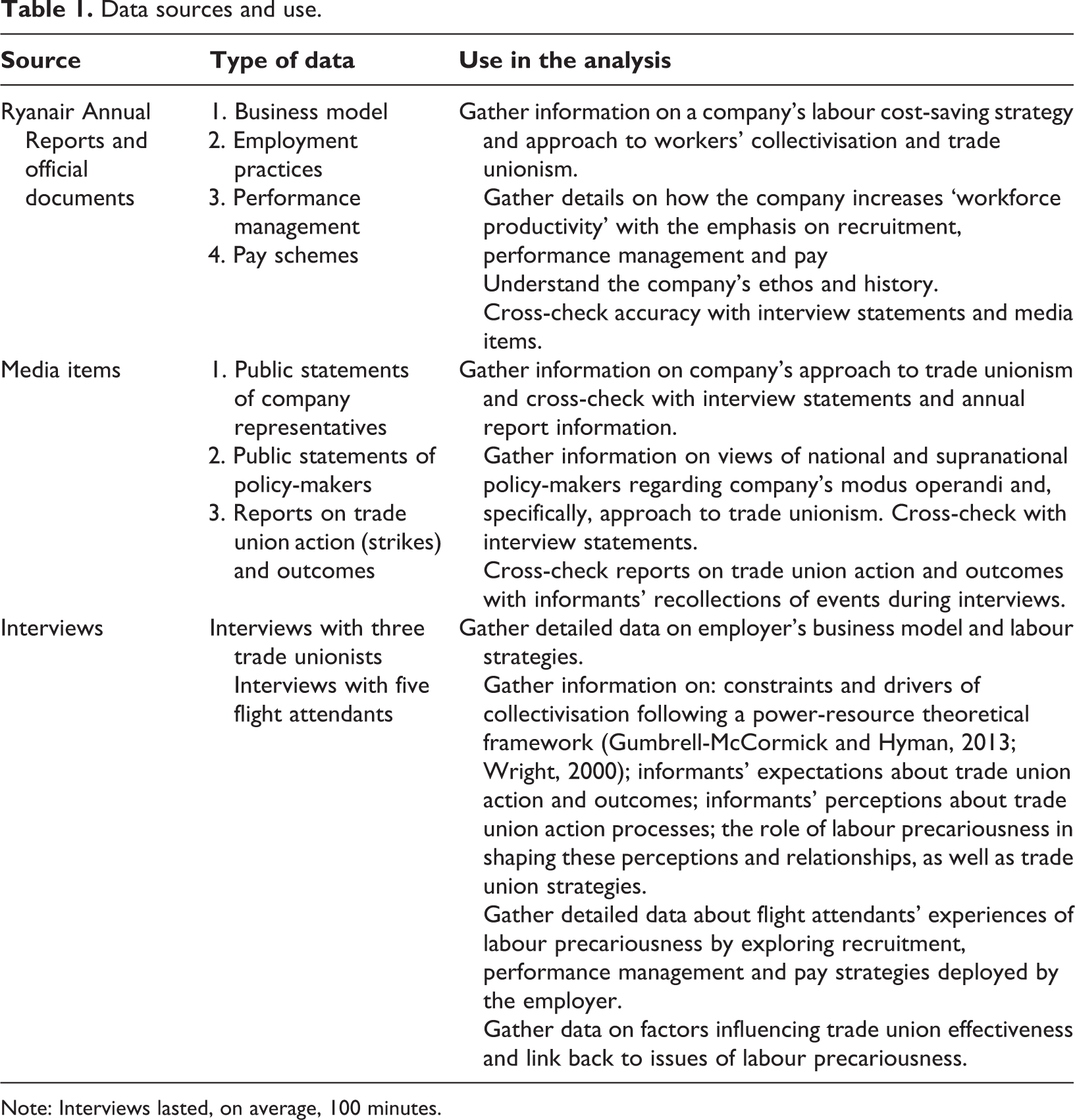
Note: Interviews lasted, on average, 100 minutes.
Findings
The analysis presented in this section is organised in two sub-sections. The first covers the ways in which the employer circumvented less favourable institutional frameworks, such as country-specific labour regulations and collective bargaining, as a strategy to curb labour costs and labour solidarity. The second covers the ways in which the trade union relied on the articulation of its power resources successfully to defend precarious workers’ interests despite relatively weak institutional support and aggressive corporate strategies.
Ryanair: low-cost labour practices and precarious work
European competition and the proliferation of new low-cost airline companies in the region have changed the industry’s landscape. As a result, established players are under strong pressure to remain competitive by offering consumers ever-lower prices. For Ryanair, labour is a key determinant in remaining competitive. One interviewed trade unionist observed that ‘Ryanair is forced by the market to maintain focus on cutting labour costs – they aspire to always be the number one and the way they organise labour has been a determinant factor’ (Trade Unionist 1). Data from Ryanair’s annual report support the interviewee’s assertion: ‘Ryanair strives to reduce or control four of the primary expenses involved in running a major scheduled airline: (i) aircraft equipment costs; (ii) personnel costs; (iii) customer service costs; (iv) airport access and handling costs’ (Ryanair, 2017: 68). The document further highlights the necessity to control labour costs in order to continually increase productivity: ‘Ryanair endeavours to control its labour costs by seeking to continually improve the productivity of its already highly productive work force’ (Ryanair, 2017: 69).
Outsourcing labour was consistently referred to by interviewees as a key strategy used by the company. Data from interviews and document analysis showed that Ryanair employs flight attendants by resorting to different contractual arrangements: some are employed directly on a permanent basis with Ryanair and others are employed through fixed-term outsourcing. In Portugal, all 300 of Ryanair’s flight attendants were hired on precarious conditions through agencies on zero-hours contracts. According to interviewees, the outsourcing of labour in Portugal enabled Ryanair to register employment contracts in Ireland under its employment law rather than in Portugal. The company legitimised this action by stating that the flag of the aircraft in which employees carry out their work determines the employment law that the company has to comply with.
This article builds on Doellgast et al.’s (2009) concept of ‘institutional avoidance’, to argue that flight attendants in Ryanair are purposively institutionally displaced. In the case of Ryanair, the institutional displacement of flight attendants to the Irish regulatory setting allowed the company not only to control labour costs better, but also to circumvent less favourable national regulations. On the one hand, the company was able to benefit from the Irish tax system in which employers have to contribute less to social security than most other European countries 2 (OECD, 2019a). On the other hand, Ryanair would have access to Irish employment regulations, which are less comprehensive and more flexible compared with those of other European countries. This is particularly acute in relation to employment protection legislation. By centralising the contracts in Ireland, Ryanair was able to circumvent the stricter and more inclusive employment protection legislation in Portugal, where zero-hours contracts are not considered legitimate, and also to apply the looser and more favourable Irish regulatory framework to their Portuguese employees (Figure 1).
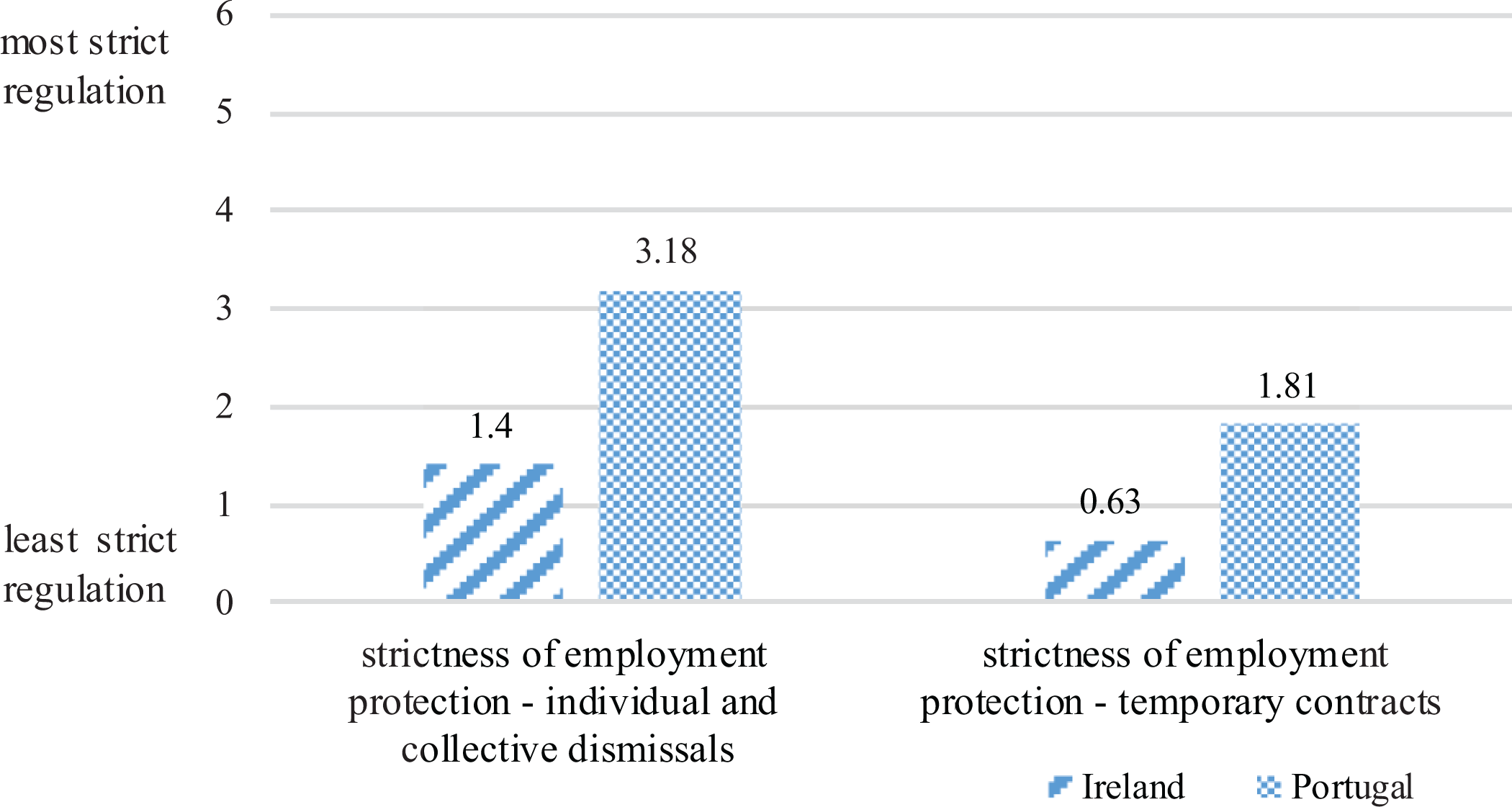
Employment protection legislation in Ireland and Portugal, 2013.
Trade unionists consistently stressed that the company’s ability to access more deregulated labour markets gave it more flexibility at company level and made employment conditions more employer-dominated. One trade unionist explains: [Irish] labour regulations are strikingly more favourable when compared to the Portuguese [and] they give Ryanair a lot of scope to negotiate and implement all [kinds of] flexible practices […]. For the company, operating under Irish labour law means less comprehensive sick and parental leave for flight attendants, less secure employment with more flexible hours and more variable and performance-related pay. In essence, it’s cheaper labour. For the worker it means more precariousness because they can easily be replaced and they have to accept non-standard hours and changes in rostering. They sometimes have to work twelve-hour shifts but only get paid for eight because their pay only starts when flights take off. Pay is also becoming increasingly flexible and linked to their individual performance selling on-board products. (Trade Unionist 1)
Applying voluntarist collective bargaining architectures in which the state tends not to intervene is in line with the company’s anti-union approach, as repeatedly stated by senior management in public statements (
CNBC, 2018). This evidence is further supported by Ryanair’s annual report, which recognises that the low-cost business model may be threatened if individuals and trade unions keep pursuing ‘unrealistic demands and expectations that do not align with the Company’s high productivity business model’ (Ryanair, 2018: 65). Interviewees also referred to the company’s strategic decision to circumvent country-specific industrial relations institutions. One trade unionist argued: When Ryanair decided to centralise all contracts in Ireland it was already with the intention of denying, or at least delaying for as long as possible, any interaction with trade unions in other European countries. They (Ryanair) used to say that they only had to deal with Irish trade unions because all their employees were registered there [Ireland] and not in Portugal or Spain or Italy – so they didn’t have to talk to us. (Trade Unionist 1) Like it’s not enough having these contracts with temporary work agencies, our contract is based in Ireland […] [this] is the same as depriving us of any sense of security – what do I know about Irish labour law? What type of support do I have there? Basically, the company is stripping us of any type of security […] it’s not only contractual, but much more […] these practices also limit our rights to organise and unionise. (Flight Attendant 5)
These strategies pursued by Ryanair indicate a clear aim of avoiding less favourable (to them) institutional frameworks by engaging in employment practices that displace workers to institutional regulatory frameworks conducive to the company’s business model. In turn, such practices end up heightening employment precariousness and affecting workers’ overall position.
Trade union responses to precarious employment at Ryanair
We now turn to trade unions’ strategic capacity to represent and defend precarious flight attendants in Portugal, hired by Ryanair. The precariousness of employment at Ryanair was an early concern for SNPVAC. In spite of Ryanair’s attempts not to recognise trade unions across European countries (De Spiegelaere, 2020; O’Sullivan and Gunnigle, 2009), the situation started to change significantly in 2017/2018 when the Court of Justice of the European Union ruled that Belgian judges were competent when they decided that Belgian-based flight attendants’ contracts should be under Belgian regulatory jurisdiction (De Spiegelaere, 2020). This was a key moment in the SNPVAC strategy towards precarious workers in Portugal. In 2017/2018, the campaign promoted by SNPVAC specifically aimed at organising Ryanair flight attendants based in Portugal and pressuring the company to recognise workers’ rights according to Portuguese labour law. A successful campaign would have diminished precariousness by eradicating zero-hours contracts, securing broad employment rights, such as parental leave and sick leave, and providing the possibility of being represented by an independent trade union that represents other flight attendants working in the industry in Portugal. However, the institutional displacement, intense precariousness and low-cost practices pursued by the company were seen by interviewees as making things very difficult for the union.
The efforts to oppose the institutional displacement of Portuguese flight attendants encountered a number of hurdles. For instance, although Portugal has a national institutional framework for tripartite negotiations, observers have argued that unions often lack state support, resulting in an empty institutional shell (Távora and González, 2016: 263). Lacking institutional support, unions do not have the power to enforce demands in sectoral or company-level negotiations. In order to overcome this weakness, SNPVAC have focused on increasing their power resources through national and supranational social and political campaigns aimed at building institutional support and solidarity among different groups of workers.
Through a mass media campaign SNPVAC managed, at first, to frame the issue of precariousness at Ryanair as a social problem that affected the majority of sectors and industries in Portugal. On the one hand, the union was able to involve non-union actors, such as political parties and social movements, against precariousness. As a result, public opinion was highly mobilised and Portuguese society as a whole understood, and supported, the strikes and workers’ grievances. On the other hand, SNPVAC lobbied for legislative clarity at supranational level. For instance, trade union officials asked the European Commission to compel Ryanair to comply with the European employment and labour legislative framework (Regulation (EC) No 593/2008). 3 Tangible results were achieved when the European Commission pressured Ryanair to comply with European labour laws. Official statements highlighted that the applicable employment regulation for flight attendants is not stipulated on the basis of the flag of the aircraft but rather the place from which the workers leave for work and return (European Commission, 2018). This gave SNPVAC a mandate to negotiate Ryanair flight attendants’ working conditions and to curb precarious work in the Portuguese civil aviation industry.
As already mentioned, trade union density is high (82.1 per cent) among flight attendants in the Portuguese civil airline industry. Increasing precariousness and segmentation in the industry was regarded by interviewees as a challenge to the union’s associational power. Trade unionists mentioned SNPVAC’s efforts to organise Ryanair flight attendants and to get them to participate in union meetings. SNPVAC’s engagement was seen by interviewees as crucial to intervening in the precariousness of the local labour market as well as strengthening the union’s associational power. However, the unfavourable local labour market, with relatively high unemployment and low-paid jobs, coupled with a high level of precariousness, initially constrained flight attendants’ engagement with the union for fear of dismissal or being disciplined by the company. In this context, considerable resources were required to unionise the segment of precarious flight attendants. One trade unionist explained: Only if we show we are in this together can we make a difference. What we did was to talk to the most active group [of Ryanair flight attendants]. We wanted to sensitise people to the importance of joining SNPVAC – that we are a formal union and that we lawfully represent the rest of flight attendants working in the industry [in Portugal]. This was done using private social media groups, flyers and face-to-face meetings and the result is that, currently, we represent more than 90 per cent of the whole Portuguese [Ryanair] cabin crew workforce. (Trade unionist 2)
Trade union action, promoted by SNPVAC and their power resources, was also challenged by the precarious conditions under which flight attendants were employed. A series of industrial actions were organised in order to bring more attention to flight attendants’ interests and demands. The first action, described in the previous section, occurred in April 2018 and successfully mobilised precarious flight attendants, but was unsuccessful in terms of its disruptive impact. The union called for a three-day non-consecutive strike, which was joined by 90 per cent of the precarious flight attendants based in Portugal. However, Ryanair successfully minimised disruptions by breaking the strike with other precarious agency workers based in different European countries. This resort to external recruitment also enabled the company to diminish workers’ structural power.
The highly centralised management, coupled with a highly international and flexible workforce, resulted in Ryanair being able to curtail any attempts at local trade union action. This important structural problem was overcome by international solidarity. Building on the 2018 European Transport Federation (ETF) report stating that ‘crew across the network facing similar issues can only resolve them on a transnational basis’ (ITF ETF, 2018), SNPVAC strategically established contacts with other European trade unions after the first strike in an effort to coordinate industrial action. As a sign of international solidarity and cooperation, SNPVAC, Spain’s SITCPLA and USO, Italy’s Ultrasporti and Belgium’s CNE/LBC released a joint statement calling for a strike in July 2018 if their demands were not met by June 2018. One trade unionist argued that the joint effort and cooperation amplified the potential for disruption and SNPVAC’s structural power: With the support of other trade unions there is not a chance for Ryanair to replace striking workers because they cannot get staff from anywhere else. (Trade unionist 2)
This international solidarity contributed to two important effects. First, trade union action resulted in high levels of disruption across Europe ( Independent, 2018). Although Ryanair asked other workers to break the strike, they refused to do so in solidarity with their co-workers. In this way, SNPVAC was able to mitigate a crucial downside of precarious employment: being easily replaceable by other workers when engaged in industrial action. Secondly, SNPVAC was able to frame the interests of precarious flight attendants as common to other groups of workers and beyond their immediate national and workplace boundaries. This coordinated strike resulted in stronger transnational solidarity, not only between unions across Europe, but also between different groups of workers (such as pilots).
Negotiations between SNPVAC and Ryanair continued throughout the year and in November 2018 an agreement was signed in which the company recognised SNPVAC as the legitimate representative of Ryanair flight attendants based in Portugal. This agreement ‘establishes that Portuguese labour law will be applied to Ryanair workers based in Portugal […] and negotiations about working conditions and employment contracts will start from 1 February 2019’ (Trade unionist 1). The success of this campaign was therefore key to pushing Ryanair to recognise the union and Portuguese labour law as the legitimate regulatory framework, and to start negotiating the flight attendants’ employment status and working conditions.
Discussion and conclusion
This article has examined how cost-saving labour practices and precarious employment pursued by the employer impacts on trade unionism and power resources and has analysed the conditions under which trade unions respond strategically to precarious work by using the power resources available to them.
In relation to the first research question, the case study analysis has demonstrated that precarious employment is used by the employer not only as a cost-saving strategy, but also as a way of weakening collectivism and trade unionism (Drahokoupil and Myant, 2015). The data show that the employer has attempted this at institutional and company level. With regard to the institutional level, this article contributes to the literature by arguing that the current EU regulatory framework is prone to ‘institutional avoidance’ (Doellgast et al., 2009; Lillie and Wagner, 2015; Wagner and Hassel, 2016). However, this article builds on previous research to demonstrate that the outsourcing of agency work can also provide the opportunity for companies to institutionally displace workers from less to more favourable institutional regulatory settings. Specifically, the findings of this study show that multinational companies may attempt contractually to bind the worker to a country other than the one of which he or she is a citizen/resident, with the aim of exploiting specific legal and regulatory loopholes. The worker is therefore institutionally displaced from the regulatory framework of his or her country of residence that potentially would have more encompassing labour regulations. In turn, the findings show that this strategy heightens precariousness among the workforce as feelings of insecurity rise due to the lack of awareness of legislation ruling their employment. Moreover, this strategy restricts trade union representation by obstructing workers’ access to representative bodies in the country in which they are based.
At company level, this article shows that the employer uses outsourced labour as a means to diminish workers’ structural power. Outsourcing undermines the position of workers within the economic system and, as a result, constrains their actions and bargaining power (Wright, 2000). This is significant as these employment strategies end up tilting the balance of power in the employment relationship in favour of the employer and their capacity to suppress workers’ power resources.
In relation to the second research question, despite tough corporate strategies aimed at precarious flight attendants, the case study presented in this article illustrates the trade union capacity to organise successful collective responses (Doellgast et al., 2018). Trade union action has been particularly effective in opposing the employer’s strategy of institutionally displacing their Portuguese flight attendants. This is particularly evident in SNPVAC’s capacity to use their network embeddedness to highlight the issues of precarious labour within the wider Portuguese society and across European countries (Lévesque and Murray, 2010). In doing so, SNPVAC was able successfully to pressure supranational institutional structures to enforce European employment legislation (Regulation (EC) No 593/2008) and, in this way, extend trade union representation to precarious flight attendants employed by Ryanair in Portugal. The evidence of the initially weak enforcement of formal institutional regulations provides further corroboration that unions’ resources are effective only when properly deployed and compounded (Doellgast et al., 2018; Lévesque and Murray, 2010). This is a key finding in a context of precarious work. The precarious employment and segmentation observed by Ryanair collides directly with the precondition of egalitarian commitments that Hyman (1997) identifies as a crucial factor in labour solidarity. It was, however, the union’s ability to frame precarious work as a sectoral and societal issue that enabled it to build ties of solidarity with external actors, create an inclusive agenda (Doellgast et al., 2018) and extend institutional regulations that protect precarious workers.
Moreover, although a loose local labour market permitted the company to use effectively a divide-and-rule strategy to break up strikes (Hammer and Riisgaard, 2015), the union was successful in organising collective protests. The initially weak structural power, the result of divisions within workforces and high levels of precariousness fostered by the employer, was overcome not only by building solidaristic identities that went beyond the immediate workplace (Mrozowicki et al., 2018), but also by transcending occupational and national boundaries. It was the capacity to promote transnational alliances of solidarity, combined with their capacity to build a collective identification (including with different groups of workers, such as pilots), that enabled SNPVAC to control the ‘reserve army of labour’ and strengthen their structural power (Flecker et al., 2013). This finding supports De Spiegelaere’s (2020) arguments that going beyond workplace boundaries and engaging in transnational industrial action is crucial in a context such as the one found in Ryanair. In so doing, the union was able to start negotiating the extension of existing collective agreements in the Portuguese civil aviation industry to Ryanair flight attendants. This included wages, sick leave, parental leave and working hours. In sum, institutional frameworks can be used effectively by unions when it comes to constructing inclusive union strategies. However, these may be useful only through an organised labour struggle and, if they are to be maintained, they may need constant backing from trade union power resources at a transnational level.
Despite the study’s limitations, this article achieves two aims. First, it shows that politico-economic conditions do shape workplace arrangements and that these are important in explaining the levels and degrees through which trade unions are successful (or not) in regulating precarious work. Secondly, it demonstrates that local unions can play a key role in fighting precarious employment by building comprehensive strategies that may reduce the effects of precarious work on individuals, societies and unions. In addition, this article shows that trade unions enhance their power resources when developing an inclusive agenda that transcends occupational and organisational boundaries to promote transnational alliances with wider society and other European unions across the sector.
Footnotes
Funding
This research received no specific grant from any funding agency in the public, commercial, or not-for-profit sectors.