




Abstract
In Germany, the dual system of apprenticeship training has traditionally been very strong. The dominant position of the dual system, however, is being challenged by other training routes gaining significance, particularly tertiary education. This article investigates the extent to which this is leading to a restructuring of the dual system. Developments in school-based vocational programmes, trends of academisation and challenges deriving from qualifying low achievers are discussed. The growing significance of school-based programmes is linked to the gender impact of the vocational education and training (VET) system and the gender segmentation of the German labour market, while academisation reflects labour market demands for high skills. With dual study programmes and three and a half-year dual training, the dual system seeks to provide attractive training options for highly skilled young people. This, however, has made access to fully-qualifying vocational programmes very difficult for low-achieving young people, including migrants and refugees, thereby challenging the integration function of the German VET system.
Introduction
In Germany, the vocational track has traditionally been very strong and skilled labour continues to play a key role for economic prosperity, even under globalisation and changing labour markets. During the most recent economic crisis, the German vocational education and training system (VET) received much international attention as youth unemployment rates in Germany remained remarkably low as compared to most other European countries. This was attributed to the German dual apprenticeship training, which can be linked to facilitating a smooth school-to-work transition and low rates of youth unemployment (Forster et al., 2016; Müller and Shavit, 1998; OECD, 2018). One reason is the occupational specificity of training, which increases initial productivity and reduces the immediate need for on-the-job training for firms (Forster and Bol, 2018).
Skill formation in Germany is typically associated with the dual system of apprenticeship training. The dual system is much discussed and researched and upheld as a model for countries around the world (Bohlinger and Wolf, 2016; Gessler et al., 2019). The German vocational training system, however, comprises more training routes, each of which corresponds to a specific labour market demand, training concept and logic of social inclusion. Apart from the dual system, school-based vocational training programmes constitute the second fully-qualifying training sector in Germany. Like dual training, school-based programmes have a well-established tradition and have been gaining significance with the ongoing expansion of the service sector, as they mainly qualify people for jobs in personal social services (Haasler and Gottschall, 2015; Hall, 2012). In addition, a considerable number of pre-vocational programmes are targeted to prepare young people either to enter a fully-qualifying vocational programme or to complete a regular school qualification (Protsch and Solga, 2016). In 2017, one-third of the roughly one million young people in Germany opting for the vocational track enrolled in pre-vocational programmes and 21.5 per cent in school-based programmes, leaving about 45 per cent for the dual system (Autorengruppe Bildungsberichterstattung, 2018). Finally, tertiary education has also gained significance in the past decade. In 2013, for the first time in German history, the absolute number of first-year higher education students was higher than the number of young people starting a dual apprenticeship programme (Federal Ministry of Education and Research [BMBF], 2017). These developments reflect changing labour market and skilling trends and challenge the role, structure and historically dominant position of the dual system in various ways. Whether and to what extent the growing significance of other training segments can be linked to the restructuring of the dual system, or whether specific adjustments can be anticipated for the future, is the focus of the present article.
This perspective addresses the flexibility and adaptability of dual apprenticeship training and whether it will be able to maintain its dominant position within the German skill formation system. While flexibility concerns the responsiveness of the dual system to changing skilling and labour market demands by adjusting occupational profiles, it also addresses the flexibility of training arrangements by, for example, taking up modularisation approaches (Rauner, 2007) or part-time options and adjusting the duration of training programmes. Since the enactment of the Vocational Training Act (BBiG) in 1969, which defines and regulates dual apprenticeship programmes (see the section School-based vocational programmes and the challenge of gender), many adjustments have been made, in particular in terms of introducing new occupational specialisations and updating existing training ordinances (Federal Institute for Vocational Education and Training [BIBB], 2019). Furthermore, broader occupational profiles have been defined to integrate and consolidate formerly distinctive training programmes, particularly in the areas of metal and engineering (Thelen, 2014). Any revision or new enactment, however, tends to take several years because of the consensus-based corporatist system, which requires the agreement of the social partners (employers’ associations and unions) and the state (see the section The institutional context of vocational education and training). In the context of the rapidly changing demands of the knowledge economy and the digitalisation of work, the slow adaptation capacities of the dual system are thus of growing concern.
In this article, aspects of the flexibility and adaptability of the dual system are discussed along the lines of three major challenges that derive from developments in other training and qualification sectors. After introducing the institutional background of the German VET system, the focus shifts to school-based vocational programmes. Most studies on skill formation in Germany concentrate on training in core industries, such as manufacturing and commercial services. This has led to a specific understanding of vocationalism tied to the socialisation function of apprenticeship training (Deissinger and Hellwig, 2005) and has rendered school-based vocational training programmes a blind spot (Greinert, 2007). These programmes are less standardised than dual apprenticeship programmes and are associated with labour market disadvantages such as limited career development opportunities in the related occupational areas. In terms of gender distribution, school-based training programmes are female dominated and the gender impact of the overall VET system interconnects with the persistent gender segmentation of the German labour market (Haasler and Gottschall, 2015).
The section Academisation and the challenge of high skill demands looks at the restructuring effects of academisation, namely the significant rise of participation rates in tertiary education, in combination with the growing number of young people with a university entrance qualification who opt for the vocational track. These developments challenge the dual system in two ways. First, as an increasing number of young people enter tertiary education, the dual system is losing its dominant role in the German skill formation system; and second, the trend of academisation reflects growing labour market demand for high skills – not least driven by digitalisation – to which the dual system, too, is expected to respond. As a consequence, dual apprenticeship training programmes increasingly provide training routes that are attractive for highly qualified young people. Today, almost 30 per cent of young people entering the fully-qualifying VET programmes hold a university entrance qualification and belong to the highly skilled segment (BMBF, 2017).
The rising number of highly qualified young people following the vocational track has implications for the integration of low achievers into VET. This is addressed in the section The challenge of qualifying low achievers. For low-qualified young people, access to vocational training places is becoming ever more competitive and difficult. As a consequence, low achievers spend considerable time in pre-vocational programmes and are pushed into vocational areas and jobs with less prestige, lower wages and limited career development opportunities. While providing adequate qualification routes for low-achieving young people to support their labour market participation has been a recurrent theme since the 1990s, in recent years, high numbers of migrant workers and refugees have added a new perspective to this challenge. Facilitating the social integration and labour market participation of low achievers and, concurrently, responding to demands for high skills – that is, adequately serving the two groups at the boundaries of the VET system – poses probably the greatest challenge to the flexibility and sustainability of the German VET system.
The institutional context of vocational education and training
The foundation of the German VET system is a ‘dual’ training approach based on the apprenticeship model, which combines (theoretical) knowledge acquired in vocational schools and (practical) workplace training in the company (see the section School-based vocational programmes and the challenge of gender for details). From this principle derives the specific governance structure by which the federal states take responsibility for the school-based component and companies organise and provide the company-based training. This partnership reflects a corresponding cost-sharing model, one crucial stabilising factor in the system: costs are shared between the state and the private sector, but also between small and large firms, as well as employers and apprentices, who receive an allowance under a training contract that increases with each year of training.
To provide training, companies need to comply with nationally defined standards in terms of formal requirements (such as employing a certified trainer), quality and content. The chambers of industry and commerce monitor companies’ training standards and conduct apprentice examinations. 1 While a little more than half of all companies in Germany are authorised to provide firm-based vocational training (54 per cent in 2017), only about 20 per cent of German firms employed at least one apprentice in 2015 (BMBF, 2019). Capacities and commitment to offer apprenticeship places thereby vary by firm size: 80 per cent of large and 65 per cent of medium-sized companies offer training, but small and very small companies often encounter difficulties to meet the requirements or do not have the resources to provide training. For firms, an important incentive to offer training places is the recruitment function of the dual system, whereas for young people it provides a key entry route into the labour market. In 2016, 68 per cent of apprenticeship graduates remained employed by the firm in which they had trained (Autorengruppe Bildungsberichterstattung, 2018). 2 Whereas large firms benefit from screening young job entrants for recruitment for their own labour supply, small and medium-sized firms derive advantages from using apprentices to save labour costs through apprentices’ rapid integration into production and service provision processes. In the third training year, apprentices are almost fully qualified, but are paid apprentice wages, which are lower than wages for skilled workers (Thelen, 2014).
In Germany, the VET system interconnects institutionally with the school system, on the one hand, and with the labour market and the social welfare system, on the other. The three-pillar school system prepares pupils from as early as 10 years of age (12 in some federal states) to pursue either a vocational track (with graduation after grade 9 or 10) or an academic track to obtain a university entrance qualification (Abitur) after grade 12 or 13. As changing between different school types is difficult, particularly when moving into higher school tracks (Blossfeld, 2018), the early allocation of pupils to the different tracks significantly determines subsequent educational and career choices. In addition, as a result of the high level of standardisation of VET in connection with the German labour market organised along occupational lines (Rubery and Grimshaw, 2003), access to jobs is highly structured by occupational certificates, which also limits mobility between occupations (Haasler, 2014). The vertical and horizontal stratification of the VET system (Protsch and Solga, 2016) that restricts job flexibility among the workforce, as well as social mobility (Schindler and Reimer, 2010; Solga, 2008), has been widely criticised. For example, it reproduces social inequality across generations by channelling working-class children into apprenticeships rather than supporting their higher education, even if they hold a university entrance diploma (Müller and Shavit, 1998; Powell and Solga, 2011). Finally, the high level of standardisation of VET and tight coupling with the labour market also interconnect with the German social welfare system as full-time, continuous and protected employment in industry has been the backbone of the social welfare system since the 1960s (Baethge and Baethge-Kinsky, 1998; Haasler and Gottschall, 2015).
The nexus between VET, the labour market and the social welfare system has created a regulatory framework that has made the German VET system extraordinarily stable over time (Baethge, 2008; Thelen, 2004). It has survived various modes of production, economic crises and changing political environments, going as far back as the German Empire. The corporatist structure has been a key stabilising factor because employers’ associations and trade unions generally agreed on the main organisational principles of the dual model (Thelen, 2004). The social partners are involved at all levels of decision-making (national, regional, sectoral and firm) and social dialogue and co-determination shape the implementation of VET reforms.
Despite its stability, the German training system has also had its ups and downs. While the dual system was an important carrier of economic growth in the 1970s and 1980s, the stabilising factors mentioned above became fragile in the two decades that followed. During the 1990s, government interventions, support programmes and financial subsidies were necessary to maintain the dual system and counteract the decreasing numbers of apprenticeship places in relation to high numbers of school leavers (Baethge, 2008; BMBF, 2005). In this period, the profitability of providing apprenticeship training and investing in skills became questionable for firms exposed to the competitive pressures of the global economy. Accelerated technological change and digitalisation required rapid skills adaptation, which was not easy for the German VET system to accommodate because of its complex governance structure and co-determination. This led firms to make increasing use of university graduates, who seemed better equipped to adapt to labour market flexibility and fast-changing technology and who were, under conditions of economic constraints and high unemployment rates, relatively cheap to employ.
Due to demographic shifts and the expansion of tertiary education (see the section Academisation and the challenge of high skill demands), the situation of apprenticeship places has stabilised and, since 2008, supply has outstripped demand; in 2018, about 57,000 apprenticeship places could not be filled. Despite financial constraints following the economic recession of 2008, firms upheld their commitment to providing vocational training, not least because the number of school leavers started to decrease and shortages of skilled labour began to affect some segments of the economy, in particular in the logistics sector, some technical domains and personal social services (Maier et al., 2012). Despite skill shortages, on the demand side about 24,000 young people trying to enter the vocational track were left without training placements in 2018 (BMBF, 2018). This gap points to a certain mismatch between skill supply and demand, but also to the challenge of getting into training and employment a considerable number of young people who do not have the necessary skills and qualifications to access a vocational programme (see the section The challenge of qualifying low achievers).
School-based vocational programmes and the challenge of gender
Apprenticeship training in crafts and trade dates back to the Middle Ages (Deissinger, 1994). In Germany, the crafts-based apprenticeship model was applied for skill formation required for industry and complemented by vocational schools between 1890 and 1920 (Hanf, 2007). The aim was to supply the newly emerging and fast growing factories with standardised skills, but also to pacify the increasing numbers of proletarian youth by enrolling them in formalised, predominantly in-company training (Greinert, 2007). The dual system was derived from this, characterised by a combination of subject-oriented and general education in vocational schools and work-based training in the company. Varying by vocational specialisation, apprentices spend about 15 to 25 per cent of their usually three-year training in vocational schools and the remaining time in the company. 3 At vocational school, apprentices attend upper secondary general education in core subjects (such as mathematics and the German language) and theoretical knowledge related to their vocational specialisation. In the second half of the 20th century, service sector occupations were included in the dual system. With the general expansion of the service sector, the proportion of these occupations in the dual system has risen to about 60 per cent (BIBB, 2019).
At the time when apprenticeships were introduced in industry, full-time vocational schools were established for vocational domains that did not form part of the crafts or industrial training system, such as education, social work and health care. Targeted at young girls to provide them with a decent vocational education and prepare them for their roles as housewives, governesses or for duties in personal services (Friese, 2013; Kleinau and Mayer, 1996), these schools developed into a school-based vocational training segment covering skills formation for areas such as child care, nursing, elder care, speech therapy, physiotherapy and other professions, predominantly personal services (Hall, 2012). Today, the school-based route covers over 100 vocational training programmes that remain female-dominated and make up almost one-quarter of the German VET system in terms of the number of young people involved. Most of these programmes require relatively high entry qualifications: over 80 per cent of all new enrolments have an intermediate or upper secondary school-leaving certificate compared with only around 70 per cent in the dual system (Autorengruppe Bildungsberichterstattung, 2018: 131; see Figure 1).
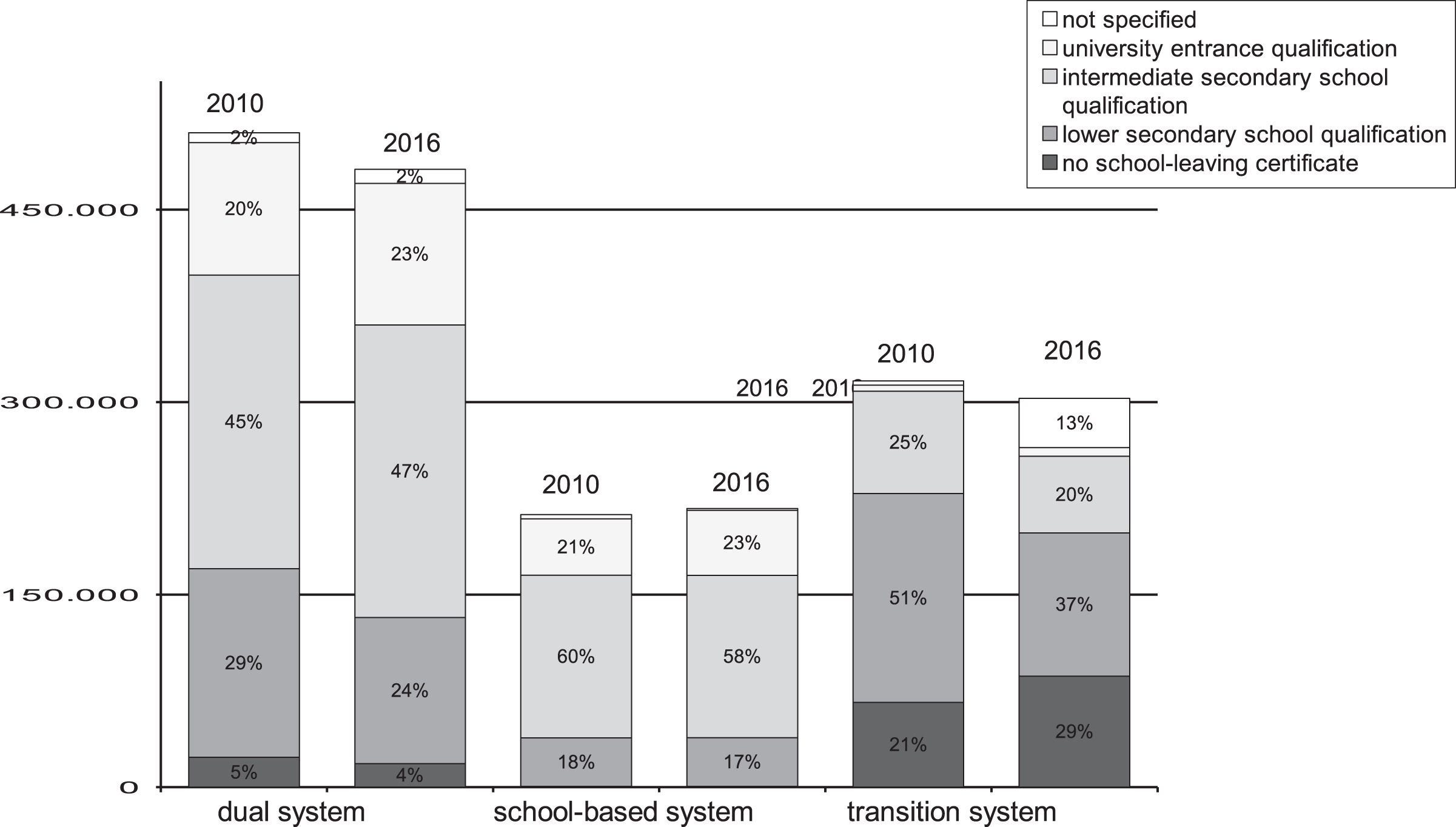
Distribution of new enrolments in the three VET sectors according to school qualifications (2010 and 2016).
The school-based vocational programmes are also dual track in the sense that the training covers theoretical knowledge and work-based learning to support the development of general, as well as practical skills (Leschinsky and Cortina, 2008). They also take three years and lead, after successful completion, to a fully-qualifying VET certificate. The two programmes are organised under different regulatory frameworks, however. The different governance structures confer different statuses, resulting in a number of disadvantages for graduates from school-based programmes. The currently 325 dual apprenticeship schemes are governed by the Vocational Training Act (Berufsbildungsgesetz), which guarantees the involvement of the social partners and the implementation of nationally standardised and closely monitored framework curricula for the workplace (Füssel and Leschinsky, 2008; Hanf, 2011). The school-based training sector, by contrast, is organised by the 16 German federal states, whereby vocational schools are responsible for quality of training. As only about half of the school-based programmes are based on nationwide federal regulations, curricula are heterogeneous, less standardised and difficult to assess in terms of the quantity and quality of the programme providers and courses offered (Hall and Krekel, 2014). In addition to the relatively high entry qualification requirements, the young people who enrol have the status of students, who pay fees in contrast to employees in the dual system, who receive apprenticeship wages. For many areas, students need to be 18 years old to start training, while dual training can be started as early as 15 years of age.
In terms of the school-to-work-transition, graduates of school-based programmes are much less likely to find stable employment, at least in the short term: only 15 per cent of all graduates had a permanent contract within three months of completing their training compared with 47 per cent of those in the dual system; one year after programme completion, about one-third found themselves on another training course (Zöller and Kroll, 2013). Concerning future employment, the related professional domains are characterised by restricted career development pathways, whereas the dual system has an established system of progressive careers and protected employment, secured by the involvement of the social partners. Here, the Meister and Techniker advanced vocational qualifications have been recognised, since 2014, as equivalent to a bachelor’s degree in the German and European Qualifications Framework. Apart from facilitating entry into higher education, this further qualification is a central instrument for career progression in manufacturing and industry (Haasler, 2014). Research has also shown that the Meister qualification is linked to higher levels of job quality, including income (Wicht et al., 2019). With regard to the school-based routes, a matching, standardised advanced qualification exists only in certain domains, such as nursing. 4 As a consequence, prospective earnings in the personal service domains, beyond the first years after job entry, are lower than in many professional domains for which the dual system trains (Hall, 2012).
The gendered nature of the German VET system is reflected in the unequal gender distribution between the dual and the school-based sector: the latter has over 70 per cent female representation compared with 41 per cent in the dual system (Hall, 2012). Furthermore, the related professional domains are denoted ‘semi-professional’, which has resulted in a specific female-stereotyped understanding of vocationalism. While the expansion of the welfare state and the public sector between the 1960s and 1990s strongly promoted women’s integration into the labour market, it also contributed to the feminisation of the sector (Esping-Andersen et al., 2002). Female labour force participation in Germany has been rising significantly, from 57 per cent in 1991 to 72 per cent in 2018 (Statistisches Bundesamt, 2019). Labour market segmentation by gender in Germany, as in other Western countries, has become more pronounced, however. This concerns not only sectoral segmentation, but also working time, pay structures and representation in job hierarchies (Schäfer et al., 2012). In Germany, the social welfare system also comes into play as full-time, continuous and protected employment are strongly linked to a (male) skilled worker’s career in industry (Baethge and Baethge-Kinsky, 1998). The rise in female labour force participation since the 1990s, by contrast, has been mainly in the segment of non-standard and marginal employment (Bundesagentur für Arbeit, 2012). 5 The service sector is furthermore characterised by low average wages, irrespective of its growing importance. Over the past two decades, wage structures in this sector have shown considerably less increase in pay than jobs of the same qualification level in core industries (Bispinck, 2013). One reason is the lack of strong interest representation.
To enhance training standards, professionalism and recognition of the professional areas that school-based vocational programmes train for, some qualification programmes are moving into higher education, including nursery school teaching, nursing, midwifery and other health care-related professions. Another approach under discussion is to integrate school-based vocational programmes into the dual system and organise them under the same regulatory framework. This is a fairly recent discussion that would entail restructuring for the VET system overall, by broadening and redefining professional profiles, training arrangements and certification schemes. For example, discussions are taking place as to how the dual system can be made more appealing to young females in order to improve the gender balance between the two systems. Concrete implementation measures, however, are yet to be determined (Zöller and Kroll, 2013).
Academisation and the challenge of high skill demands
In Germany, vocational skills still ensure labour market inclusion and good prospects of stable employment. Despite the overall decreasing numbers of apprentices and fluctuations of companies offering apprenticeship training (Greinert and Braun, 2015), little more than one million young people opted for the vocational track in 2017 (Autorengruppe Bildungsberichterstattung, 2018; see Figure 1). On the other hand, the number of young people completing a university entrance qualification that provides for broader career development opportunities has risen. Their proportion has been rising steadily since the 1970s and, since 2013, the absolute number of first-year higher education students has been higher 6 than that of young people starting an apprenticeship (Autorengruppe Bildungsberichterstattung, 2018). This reflects the expansion of tertiary education and the general trend to academisation across all OECD countries: the share of young adults with higher education (that is, tertiary education at universities, polytechnics and universities of applied sciences, as well as in specific vocational tracks) has increased by more than 19 percentage points between 2000 and 2017, having reached an OECD average of 44 per cent of the 24–35 years age group (OECD, 2018). At 31 per cent and an increase of less than 14 percentage points over the same period, Germany remains at the lower end.
The rising numbers of students completing a university entrance qualification nevertheless represents a challenge to the VET system in two ways. First, the expansion of tertiary education challenges the leading position of the dual system within the German skill formation system. Second, the VET system is also expected to serve the highly skilled. A key education policy objective is that VET should remain attractive to school leavers and provide training that is also appealing to the well qualified. In the two fully-qualifying VET sectors, the proportion of students with an university entrance qualification has been rising constantly, now reaching almost 30 per cent. 7 These school leavers mainly occupy the upper middle and highest segments of the dual system that are typically linked to well-paid jobs and high status occupations in industry and commerce (such as technicians, industrial mechanics, bank clerks or IT technicians) (Autorengruppe Bildungsberichterstattung, 2012). The related jobs, characterised by good career prospects, job stability and relatively high wages, are almost inaccessible to low achievers. The growing proportion of highly qualified school leavers has made the stratification of the dual system in terms of access to different occupations on the basis of school attainment even more marked (Protsch and Solga, 2016).
On the other hand, the VET system is expected to ensure that youth acquire high skill levels in response to labour market demands in the context of digitalisation, fast-changing technologies and a knowledge-intensive society. One approach to meet this challenge has been the strengthening of dual study programmes, which combine apprenticeship training with a bachelor’s degree in an integrated programme (Thelen, 2014). This model is also supposed to promote closer links and permeability between vocational and academic programmes. The model originated in the 1970s in the federal state of Baden-Wurttemberg and was strengthened with the introduction of ‘Dual Bachelor’ programmes in 2012 (Graf, 2013). These programmes combine work-based learning with course programmes in a condensed way, and are offered mainly by universities of applied sciences and large firms for various technical areas and industrial economics, but also, increasingly, for service domains (Krone and Mill, 2014). Upon successful completion, students receive a double certificate, a fully recognised vocational certificate and a bachelor’s degree.
Fostering dual study programmes has engendered concerns that they may gradually become a substitute for vocational programmes, because offering an additional academic qualification may make them more attractive. Studies indicate that this might indeed be the case for some sectors or professional domains, particularly those that require advanced and complex technical and problem-solving skills, such as the IT sector. For most occupational domains, however, including commercial segments, the classical apprenticeship model is projected to persist (Elsholz et al., 2018). Thus far, dual study programmes have played a very minor role in the overall system, accounting for less than 5 per cent of all enrolments in the education system.
Another approach to meet the demand for high skills is the introduction of extended vocational programmes of three and a half years. These have resulted from the merging of different occupational specialisations into new vocational profiles. One example is the vocational profile of ‘mechatronics’, which combines mechanical and electronic skills and competences. In the case of traditional vocational profiles, extended training programmes serve the need to acquire very complex skills in specific areas, such as electronics and metal engineering, but also for training as a piano builder or goldsmith. The three and a half-year dual training programmes attract in particular school leavers who are eligible to enrol in tertiary education.
The challenge of qualifying low achievers
Because VET has become an attractive option for young people holding a university entrance qualification, access to training places is now highly competitive for low-achieving young people. These include school drop-outs without any school-leaving certificate and those holding the lowest secondary school qualification (Hauptschulabschluss). Since the 1990s, both groups have increasingly faced difficulties in enrolling in fully-qualifying VET programmes. Between 2010 and 2016, the proportion of school leavers with the lowest certificate entering the dual system decreased from 28.8 to 23.6 per cent and of those with no certificate from 4.6 to 3.8 per cent. Regarding access to the school-based system that has higher entrance requirements, the proportion of the first group is about 17 per cent, while school drop-outs are almost not represented (Autorengruppe Bildungsberichterstattung, 2018: 131).
Low-qualified young people, who successfully make their way into fully-qualifying VET programmes, typically train in lower-skilled agriculture, crafts or service occupations, such as hairdressing, shop assistance or construction (Autorengruppe Bildungsberichterstattung, 2012). Jobs in these areas are characterised by low job quality, low wages, poor working conditions and higher unemployment risks. Only about 20 per cent of school drop-outs and 45 per cent of school leavers with the lowest qualification, however, successfully enrol in any dual or school-based programme. The majority enter pre-vocational programmes, which constitute the third sector of the German VET system (see Figure 1). Although the dual system, according to the Vocational Training Act, does not have any specific entry requirements in terms of secondary schooling, in practice most employers (accounting for about two-thirds of all dual training placements) require an intermediate school-leaving certificate as the minimum requirement (BMBF, 2017). Apart from preferring higher skill levels, employers want to ensure that their trainees are capable of successfully completing the training programme (Solga et al., 2014).
Pre-vocational programmes, which constitute the so-called ‘transition system’, are targeted to qualify young people who do not have the skills, qualifications or ‘readiness’ for VET to enter a vocational programme or complete a regular school-leaving certificate. These preparatory programmes cover a broad range of different training measures, usually lasting a year, although longer or shorter options also exist. Notwithstanding the fact that a considerable number of apprenticeship places remain vacant every year, about one-third of young people entering the vocational track enrol in pre-vocational programmes. Almost 30 per cent of them are school drop-outs and around 40 per cent hold the lowest school qualification (BMBF, 2017). Furthermore, the transition system absorbs a considerable number of young people with a migrant or refugee background, that is, about one-third of all young people entering the transition system (BMBF, 2017). Their proportion has been growing significantly in recent years, which has also increased the proportion of young people without any school-leaving certificate.
While ideally the transition system should qualify participants to enter dual or school-based vocational training, in recent years only around 70 per cent were able to accomplish this within three years after completing a pre-vocational programme (BMBF, 2017). The rest continue to move between different pre-vocational measures, unskilled jobs and unemployment. As routes to skilled labour without holding a vocational qualification have become almost impossible in Germany, a considerable number of young people are left with limited opportunities to find employment in the primary labour market and hence face a high risk of long-term labour market exclusion. Furthermore, continuing failure to enter any qualifying VET programme increases the risk of stigmatisation because a vocational qualification is established as the norm for school-to-work transition in Germany. Not being able to comply with this norm is thus seen as a personal failure. When it comes to realising their vocational aspirations, low-achieving young people are particularly disadvantaged (Protsch and Solga, 2016; Solga, 2004).
The challenge of integrating low-qualified individuals in training programmes and the job market is yet to be successfully addressed. Although since the end of the 1990s the overall number of people in the transition system has been decreasing (BMBF, 2012), it has been rising again since 2015 because of the high rate of refugees entering the system. Overall, training opportunities for low achievers have been improving slightly as birth cohorts decrease and trainee shortages continue. In addition, two-year training programmes were restructured between 2003 and 2010 to enhance training opportunities and access for low achievers, taking into account that the third training year tends to be the most complex and theoretically most demanding. The current 27 two-year training courses basically cover the first two years of dual training and offer a first level certificate after the second year. Upon successful completion, it is possible to continue for another year to fully qualify in a corresponding regular dual training programme. Examples of two-year training courses are bicycle assembly, clothing alterations, sales or catering. While controversial and not fully supported by the social partners, about 7 per cent of all training contracts followed this model in 2015. Whether it supports the successful integration of low achievers is, however, under critical debate. While the model enhances integration opportunities, it does not address the challenge of having tailor-made programmes for young people with learning difficulties that can offer more flexible approaches and that respond to individual learning needs.
Conclusions
The German VET system is based on highly standardised and stratified educational and occupational routes and formal qualifications ensure a tight coupling between skill formation and occupational labour markets. The well-known dual system of apprenticeship training plays a central role in the allocation process, historically maintaining a dominant position in the German skill formation system. With changing skilling and labour market demands, as well as demographic shifts, the skill formation landscape in Germany is undergoing adjustments, challenging the dominant role of the dual system in various ways and engendering several restructuring processes.
With the overall expansion of the service sector and skill shortages in personal social service occupations, school-based vocational programmes have been gaining significance over the past two decades. Fully-qualifying school-based programmes are also dual track, but are organised under a different regulatory framework. This gives rise to a number of disadvantages in terms of training quality, school-to-work-transition at labour market entry, employment conditions, mid- and long-term labour market outcomes and career development possibilities. Given the unequal gender distribution, these disadvantages and higher labour market risks mainly affect women, who are allocated to tracks that represent disadvantageous training paths. While some school-based training routes are being restructured into academic routes – not least to enhance recognition and professionalism – regulating school-based VET in the same way as the dual system is increasingly being discussed. Concurrently, dual training programmes are being promoted to become more attractive for young females to counteract gender disparities and the overall gender impact of the German VET system.
In particular because a growing number of young people are moving into higher education, the dual system is being challenged to defend its dominant position for skill formation. One approach is to ensure that VET is also attractive to high achievers by offering complex training for a highly skilled workforce. Dual study programmes and three and a half-year dual training schemes offer advanced and prestigious training in which mainly school leavers with a university entrance qualification enrol. These training courses lead to well-paid jobs with stable employment and good career prospects. The expansion of high-skills training, however, is increasingly excluding low achievers and school drop-outs, for whom entering a fully-qualifying VET programme has become highly competitive. This group is increasingly being pushed to train in lower-skilled (and low-paying and insecure) agriculture, crafts or service occupations with restricted labour market possibilities, or is absorbed by the so-called transition system composed of preparatory programmes. This has made the segmentation and stratification of the VET system even more marked. In recent years, the situation of low-achieving youth, including young migrants and refugees, has become very difficult and a considerable number of them are at high risk of long-term labour market exclusion. While the situation of low achievers might improve due to decreasing birth cohorts and projected labour shortages, the restructuring of two-year dual training programmes has thus far had little impact. Neither pre-vocational nor two-year training programmes provide a training approach tailored to the learning needs of poorly qualified young people. As full vocational qualifications remain the norm for school-to-work-transition in Germany, it has been argued that less valuable qualifications might reinforce the stigmatisation of low achievers.
Qualifying under dual apprenticeship training in the core industrial sectors has until now conferred the greatest benefits on young people in terms of labour market outcomes. However, developments in other training segments suggest that this may change, particularly with the increase of tertiary education. Whereas the centrality of the corporatist structure and involvement of the trade unions in all institutional layers contributes significantly to the stability and strength of the dual system, its weaknesses and problems may potentially be avoided in those national contexts in which school systems and training routes are less segmented and stratified.
Footnotes
Funding
This research received no specific grant from any funding agency in the public, commercial, or not-for-profit sectors.