




Abstract
This article focuses on the under-researched temporary agency employment in Greece. It shows that the development of the temporary employment agency sector has gone hand in hand with the flow of undocumented and exploitable migrant labour in Greece over the past 25 years, reflecting the segmentation of the Greek labour market along ethnic lines. Using empirical research evidence on the operation of temporary employment agencies in the Greek hospitality and health care sectors, the article highlights the precarious or even illicit nature of agency employment in a context in which labour outsourcing and flexible employment are promoted by policy-makers. Last but not least, it suggests that the segmented landscape of the Greek labour market has become more complex during the economic crisis, with more and more Greeks drawn to agency-mediated precarious employment.
Introduction
Informal economic activity in Greece has consistently been estimated at more than a quarter of its GDP in the period between 1997 and 2013 (Schneider and Williams, 2013). The high incidence of informal and undeclared employment in this context has been a common discussion theme among all studies with a focus on migration in Greece, both before and since the crisis. Many of these studies point to the precarious work and life trajectories of these migrants as they take their first steps in the host country (see, for example, Psimmenos, 1995). At the same time, these studies highlight examples of agency in the lives of migrants, who are closely constrained by repressive migration policies and work arrangements. Studies with more of an interest in the long-term trajectories of different migrant groups portray a more positive situation in which migrants manage to construct forms of security within their informal work and social settings (see, for example, Lyberaki and Maroukis, 2005; Psimmenos and Skamnakis, 2008; Maroukis et al., 2011), which are at times intersected by ethnic community-based forms of collective organization (Fouskas, 2012). A discussion of precariousness, if any, gives way to narratives of upward socio-economic mobility as these migrants move from one economic sector to another, become self-employed subcontractors, expand their (in)formal portfolios of clients and legalize their residence status. However, in focusing on the agency, mobility and heterogeneity that migrants do display, these studies risk shifting the emphasis from the work inequalities that characterize the political economy in which the migrants live and work. The analysis essentially moves away from debates on the shortened and insecure work frames of flexible organization of production, which increasingly are depriving people of a life narrative at work (Sennett, 2006; Duell, 2004). Such debates need to be raised when the organization of capitalist production systems and labour markets is in crisis.
The prime focus of the research discussed in this article is not the migrant worker but the particular type of employment – temporary agency employment – which is, on the one hand, celebrated as a key example of flexible working and, on the other, criticized for placing the power of labour negotiation in the hands of the brokering agency/agent rather than the worker. The analysis inevitably focuses on the migrant worker because migrants have been the main labour pool of agencies (see below).
This article’s focus on the under-researched temporary agency employment in Greece has two advantages. First, it reflects the segmentation of the Greek labour market, with migrant workers being disproportionately concentrated in jobs characterized by informal, temporary and insecure work arrangements (Mingione, 1996; Karamessini, 1997). In doing so, the article highlights the precarious or even illicit nature of agency employment in a context in which labour outsourcing and flexible employment are promoted by policy-makers. Secondly, the focus on agency employment opens a discussion on the multiple segmentation of the Greek labour market. This segmentation is no longer primarily on ethnic lines but increasingly now takes in other social categories, such as age and gender at a time when the Greek youth unemployment rate stands at 52.4 per cent in 2015 and male unemployment rates were 6.5 percentage points higher than the corresponding rates for women during 2014. 1
In the first part of the article, I demonstrate that the temporary staffing industry has traditionally had limited reach among unemployed Greeks. In particular, only a segment of this industry has been linked to the Greek unemployed since the new millennium and especially during the economic crisis when the pursuit of EU funds by the Greek state in the name of an active labour market policy agenda became more desperate. In the second part, I display the instrumental role that post-1990s migration to Greece has played in sustaining the temporary agency work industry since then. To this end I use empirical research evidence on the operation of temporary employment agencies in the Greek hospitality and health care sectors. I indicate that the exploitation and even trafficking of migrant labour has been the main labour market strategy of temporary employment agencies.
The research in the hospitality and health care sectors draws on in-depth qualitative interviews with 19 agency and bank nurses (‘exclusive’ nurses; see below) in seven hospitals, nine agency hospitality workers (maids, kitchen porters, chefs) and three whistle-blowing agency recruiters. I used informal personal and immigrant community contacts to recruit interviewees. Fieldwork was carried out between May 2013 and September 2014 and was based on controlled snowball sampling. I also interviewed three employment agency managers, the Association of Private Employment Agencies in Greece (PASIGEE) and 23 labour end-users (hospital directors, hotel HR managers and hotelier associations).
The extent of the temporary employment agency sector in Greece
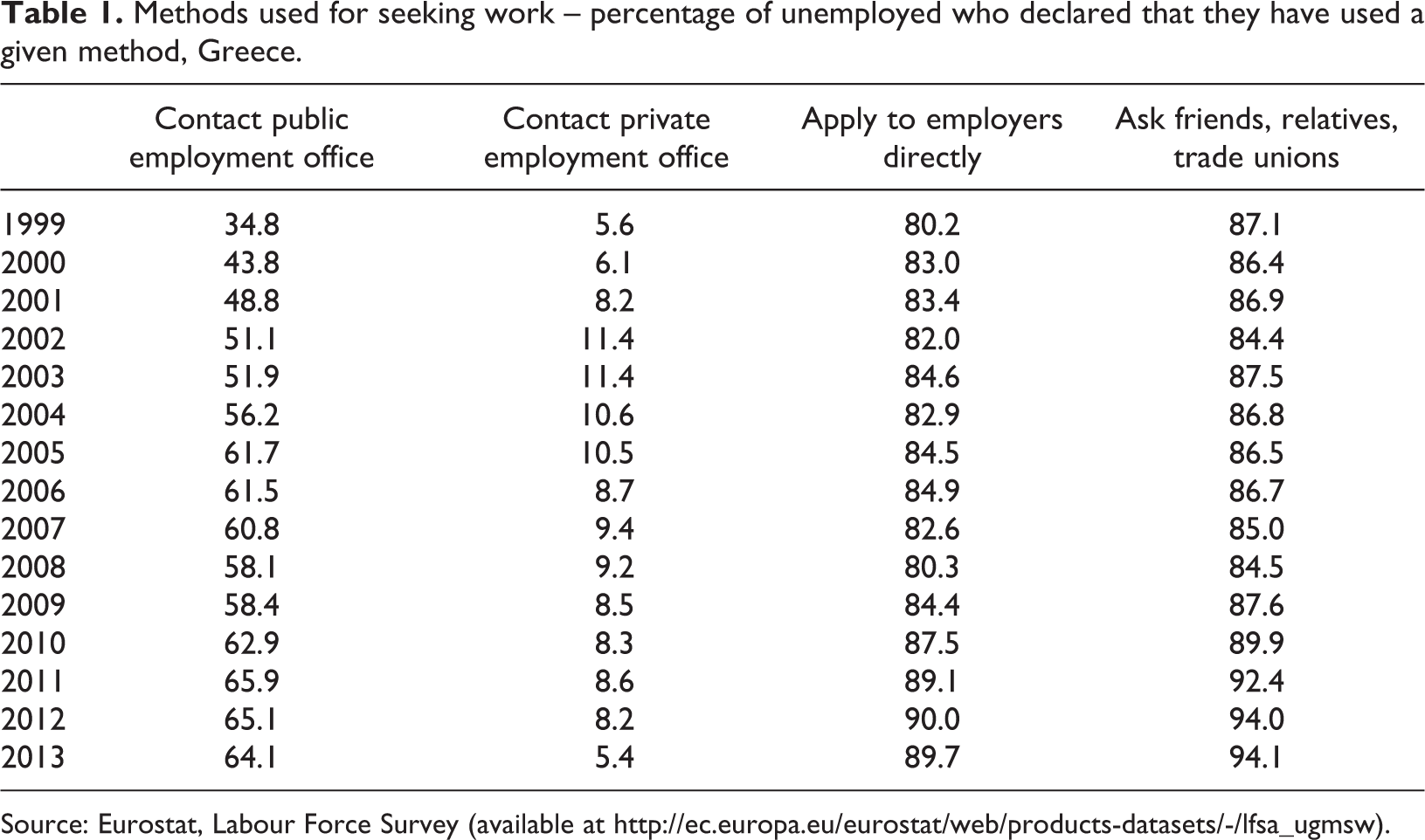
In contrast to most western and northern European welfare states, the growth of the Greek temporary worker staffing industry over the past 25 years has hardly drawn on the population of its unemployed citizens. According to Labour Force Survey data (Table 1) only 5.4 per cent of the unemployed used private employment offices as a method of seeking work in 2013, which is well below the EU average of around 25 per cent.
Methods used for seeking work – percentage of unemployed who declared that they have used a given method, Greece.
Source: Eurostat, Labour Force Survey (available at http://ec.europa.eu/eurostat/web/products-datasets/-/lfsa_ugmsw).
The way in which the unemployed have looked for work in Greece until recently seems to leave little room for private employment agencies. Familistic networks maintained their dominant role in job-seeking methods among the Greek 2 unemployed during the 1990s (Ferrera, 1996; Papadopoulos, 2006), through the 2000s and well into the crisis (see Table 1). The fact that Greek businesses look for workers mainly through informal networks corroborates this picture (Voudouris, 2004; Anagnostopoulos and Siebert, 2012). Interestingly, the relevance of the public employment office (OAED) in job-seeking grew considerably in the period between 1999 and 2013. This is explained partly by the creation of a network of Employment Promotion Centres in the early 2000s, which flagged the labour market activation agenda of Greek governments in the background of the Lisbon strategy; and partly by the increasing availability of EU funds in support of the unemployed during this period (Papadopoulos, 2006: 226; and legislative developments below).
Attesting to the problematic alignment of Greek labour markets with the production-outsourcing trends in the domestic and European economy are the low levels of temporary and part-time employment. The latter stood at 8.2 per cent in 2013 (rising from 3.9 in 2003), compared with the EU average at 20.7 per cent. 3 Temporary agency workers comprised 0.1 per cent of the country’s workforce in 2009 and 2010 (Voss et al., 2013: 23).
Interestingly, despite the low numbers of temporary workers there has been legislative activity seeking to regulate and promote temporary agency work and the extent of the temporary staffing industry.
Greek legislation distinguishes between Temporary Employment Firms (EPA) and Temporary Employment Agencies (TEA). According to Law 2956 of 2001, Law 3846 of 2010, Law 4052 of 2012 and Law 4093 of 2012, EPA are obliged to be in a contractual relationship with the worker and to ‘lease’ the worker to an end-user employer for a certain period of time. Their activity is in this sense similar to that of the employment agencies in most continental European countries. In addition, EPA need capital in order to be licensed; they need to submit two guarantee bonds of €60,000 each to the Ministry of Employment. The TEA (Temporary Employment Agencies) have no such starting-capital requirements and in this sense reflect the profile of a small or medium-sized business. Their operation is similar to British temporary employment agencies, which do not have to issue contracts with the workers they send to end-user employers.
Only tentative observations can be drawn concerning the activity of EPA from social media articles, legal documents and the very limited academic research available. It seems that their workforce of temporary workers are not only migrants but also Greeks and that precariousness cuts across low- and medium-skill work placements.
Kouzis et al. (2009) have pointed to the key role of the post-1990s migration to Greece in the activities of EPA in commercial cleaning and, in particular, in public transport. The banking sector has stood out as a user of EPA workers during the past decade (Voss et al., 2013: 56). Qualitative field interviews with eight Greek EPA workers working in the loan and debt-collection departments of the two biggest Greek banks indicate that the majority of their fellow EPA workers have been Greek. The demand for fluent Greek speakers in this sector and the fact that working in a bank is associated with skilled labour has created conditions whereby Greeks are more likely to be attracted and attractive to these agencies. That said, the working conditions and promotion prospects of these banking sector temps are precarious. As one of them notes ‘One day we are in, next day we are out with nothing, no compensation, as if you were never there; it makes no difference whether you have been there for years’. The regulations stipulating that agency workers should become employees of the end-user firm after 36 months of continuous employment do not seem to be implemented. Another EPA worker leased to banks over the past eight years explains that he was dismissed as soon as he enquired about his right to become an employee of the bank where he had been working continuously for 3.5 years. They kicked me out of [name of bank]. It was really bad. In the end I was very lucky that the agency [EPA] sent me to another bank [name of the bank] to do the same thing. Five years later I’m in the same insecurity and do not dare to ask anything…There are thousands of unemployed knocking on our door…and now they don’t even need to remind us of this.
The Temporary Employment Agencies (TEA), on the other hand, have been banned by Greek law from collaborations with the public sector, and their clientele, as my research case studies show in more detail, comprises families, small and medium-sized Greek hospitality businesses and businesses in the entertainment and sex industries and criminal networks. The TEA, similar to the EPA segment that specializes in low-skill labour, draw mainly on migrant workers. The President of PASIGEE (the National Association of TEAs) himself admitted that the labour markets in which the agency sector is active are not compatible with the skills (and aspirations) of most Greeks. I had young Greeks with university degrees coming here [during the crisis] and begging for some work and I couldn’t help them. I can’t send them to our jobs. I am very upset about this. Our young suffer.
Temporary agency work, migration, trafficking and the crisis
The temporary employment agency industry has been present in the Greek economy since the early 1990s despite its delayed and fragmented development as a port of call for the Greek unemployed. Focusing specifically on temporary employment agencies (TEA), this section explains how the low-skill temporary employment sector has grown against the odds, reflecting the segmentation of the Greek labour market.
The temporary employment agencies were particularly active in service sectors that relied heavily on cheap, undeclared migrant labour. These were mainly hospitality and the care sector; in particular, the domestic labour industry and the niche of ‘exclusive’ nurses (see below) in Greek hospitals (interviews with President of PASIGEE, agency managers and recruiters). The size and turnover of the temporary employment agency sector in Greece grew thanks to the advent of unprecedentedly large and illegal immigration flows in the early 1990s. Migration has been a key external supply condition which, for nearly two decades, sheltered the welfare of Greek families and small and medium-sized businesses from their structural problems. An ageing population, the delayed entry of the young into and the early departure of the middle-aged from the labour market, the limited public spending on health and social care, low competitiveness and falling productivity have all been problems to which migration has offered short-term solutions (Maroukis, 2013; Kasimis and Papadopoulos, 2013; Lazaridis, 2007). Not only small and medium-sized businesses but also temporary employment agencies have capitalized on the supply of informal migrant labour.
The labour pool of agencies has traditionally consisted of newcomer migrants who have limited social capital in Greece or are undocumented. The forms of control the employment agencies exercised over agency workers relied to a significant extent on the restrictive and malfunctioning migration policy regime that for more than two decades offered migrants more pathways out of legality than into it (Maroukis et al., 2011). For most of the 1990s Greece’s immigrant population was kept in illegality. Then through a series of amnesties from 1998 to the last one in 2005 many migrants legalized their residence status. However, as several studies have demonstrated, it was difficult to provide evidence of formal work (mainly work contracts and social security contributions) and maintain a legal residence status when most job offers towards migrants involved undeclared work. All in all, the restricted legal entry avenues and the insecurity of the legal residence status obtained have had a ‘disciplining’ effect on agency workers as they did with directly employed migrant workers. In the words of one agency recruiter, ‘agencies used this legal system and they made fortunes’ (Ukrainian agency recruiter, 50 years of age).
Above, I indicated that EPA exert control over their Greek workers by relying on their fear of unemployment. The type of agencies discussed here (TEA) exert control over their migrant workers by capitalizing on their fear of denunciation and deportation. One of the agency nurse interviewees was sexually assaulted and beaten by the agency manager when she did not bring enough money to the agency from her work. However, she could not go to the police to report this incident because she was afraid that she would be deported (Ukrainian agency nurse, 48 years of age).
A typical practice of employment agencies throughout the 1990s and up to mid-2000s was to withhold the workers’ passports (agency recruiters’ interviews). In the words of one of the whistle-blower labour recruiters who did this job from 2000 until 2011: All the offices [employment agencies] in Greece ask for money from the girls. When I came in this business, they used to keep the passport if the girl had no money to pay upfront. As a guarantee. Every single office did that. The fee used to be 40,000 drachmas…We stopped it when the police raided an office that had the girls locked in one of its rooms. (Romanian agency recruiter) My boss paid me €10 for every girl that I brought from abroad. I wrote down which girl was mine. There were other people bringing girls to the office, too. But I was good. The initial deal was that he would also give some shifts but then I brought so many that I was too valuable to him and he gave me a salary. He didn’t want me to waste time working here and there. (Ukrainian agency recruiter, 50 years of age)
Employment agencies, either on their own initiative or in collusion with traffickers, bribed officials in embassies, who issued temporary tourist visas for these workers. Success depended on the access which the agency recruiters’ informal networks provide to the formal state infrastructures regulating migration (eastern European embassies and consulates in Greece). One of the interviewed migrant whistle-blower agency recruiters describes the way she ‘gets migrants in the country’ for the agency: The person on visas at the embassy is the son of S. [female immigrant]. He arranges the [tourist] visas for our office [agency]. S. and I share a long story. We became friends when we first came here [in Greece] as migrants. That’s how things go…Of course she has a cut from all this. So she is not just doing it out of the goodness of her heart. (Ukrainian agency recruiter) Our coaches would come full with girls. For example 40 persons. The office knew how many were coming. And for whom: restaurant, hotel, private home, hospital or something dodgy…you know…bars, brothels. We [recruiters] didn’t know that. And the employers would come to a room where the girls were locked up and pick them. I translated. That’s how we closed 40 jobs per day. The following day, another bus, 40 more jobs to be arranged. (Ukrainian agency recruiter)
The main method by which agencies make a profit in the health care and hospitality industries is by cutting deep into their workers’ wages. My research indicates that the majority of temporary employment agencies charge workers with illegal brokerage fees prior to work placements. The whistle-blower agency recruiters interviewed noted that their managers regularly ask them to send workers to their competitors to check what fees they charge. My boss was very stingy. He wanted to make sure that he is charging no less than the other agencies. He didn’t want to be the fool in the market. (Bulgarian agency recruiter)
Corroborating the international literature, temporary agency work in Greece grows and contracts in tandem with the economy (Ward, 2003; Forde, 2001). Agencies are the first to be hit in a recession because businesses first start cutting their external costs and then may move part or the whole of their economic activity underground or close down. Both agency and employer associations in my case study noted that the current recession drove the majority of employment agencies out of the market. According to the president of the hoteliers association of Halkidiki, the main tourist region in northern Greece, only two or three out of 30 agencies were left in the market supplying Halkidiki hotels with labour in 2014. The increase of informal direct employment and the closure of businesses during the economic recession has eliminated a substantial number of agencies throughout Greece, according to the president of PASIGEE. He noted that in 2013 there were around 98 legal TEA in Greece. Available data from the Ministry of Employment on the total number of TEA operating from 2001 until 2014 bring this number down to 89.
However, measuring the impact of the recession on agency activity requires more robust data on the business demand for agency labour. Such data are currently unavailable in Greece. Interestingly, changes in the labour supply seem to have had an equally significant impact on the Greek agency industry. This is because the TEA profits are primarily obtained from exploitation of labour. The above-reported dramatic fall in the turnover of agencies during the crisis coincided with the shake-up of Greece’s settled immigrant population and the decrease of migrant flows from eastern European countries (Maroukis, 2013). All the interviewed hotelier associations and hotel managers in tourist destinations noted that they found a long lost labour pool among the local Greek population during the crisis. Members of Greek households in rural and tourist local economies are going back to jobs predominantly done by migrants over the past 25 years (see Kasimis and Papadopoulos, 2013, for the modest return of urban dwellers to the rural economy).
All in all, the shrinking of the pool of exploitable migrant labour and its substitution by less exploitable local labour is the decisive parameter which drove many TEA agencies out of the market. Their main survival strategy under these circumstances was to dig deeper into the agency workers’ earnings. The illegal fee that the worker pays to the agency had been €250–€300 in 2013–2014 for a guarantee of one to three months’ work, whereas this deposit lasted for six months before the crisis.
Below I analyse in more detail agency practices and workers’ experiences of temporary agency employment in the Greek hospitality and health care sectors.
Temporary agency work in the Greek hospitality sector
One of the most important market niches of the agency sector is the seasonal labour demand that is hard to cover from local labour pools. Small and medium-sized family-owned hotel and catering enterprises form the biggest segment of the Greek tourist industry (Andriotis, 2002; Mourdoukoutas, 1988). The bulk of agencies’ hospitality sector clients are these small and medium-sized family-owned hotels and catering businesses in tourist destinations. Hotels in Athens don’t take workers from us. They find labour through other methods. We always collaborated with hotels outside the big cities, in the islands usually. (PASIGEE interview)
Large luxury hotels linked to international hotel chains tend not to use agency workers from TEA. Quick access to pools of labour is equally essential for them. But they generally avoid the unskilled labour that the Greek temporary employment agencies usually offer. These hotels usually need to strike the right balance between access strategies to labour and internal business service standards. The waiting/waitressing and housekeeping staff (hotel maids) need to follow certain procedures that are centrally set across the hotel chain or franchise.
All of the interviewed large luxury hotel HR managers in Greece reported that one of the reasons why they do not resort to agencies for their labour needs is the greater need for investment in induction and training for agency labour, which is characterized by high turnover.
They employ instead their own banks of ad hoc labour in order to strike a balance between the fluctuating market demand and the cost of permanent, full-time labour. A precondition for such arrangements is to have labour regulations that permit flexible fixed-term contract arrangements. Several of the hotel managers interviewed today employ their own banks of ad hoc labour under ‘framework contracts’, according to which workers are on call and can do from zero to four days’ work per week. This ‘framework contract’ in the hospitality sector is the Greek labour regulation equivalent of the UK variable (or zero) hour contracts.
Flexible forms of contracted labour need to be accompanied by regulation and registration systems that can be processed just-in-time without a heavy administrative cost for the business. Interestingly, prior to the introduction of electronic social insurance contribution submissions to IKA in 2013, HR managers faced difficulties managing their own banks of ad hoc staff: For every day’s work that these people were doing, we had to issue an individual contract, declare them at IKA (the main social insurance fund for paid workers in Greece)…and since we were particularly fussy with the law because we are at the airport, this was a huge volume of work, involving thousands and thousands of registrations for this ad hoc labour. (Hotel HR manager, Athens airport) Students are cheaper in the collective agreements. And you avoid paying several extras to the state. Interns get paid €300–400. (Hotel HR manager, Athens centre)
Unlike directly employed workers, the interviewed hotel maids, kitchen porters and waiting staff that worked through agencies in Greek island resorts reported that they were not paid what was initially agreed. The interviews with the agency recruiters corroborated this.
Wages are not paid monthly or weekly and if they are paid at all it is at the end of the season. The subsistence costs for the agency worker are covered in the meantime by the employers. Agency workers are usually given food in the restaurants and hotels where they work. There have been several cases where kitchen porters and hotel maids were given left-overs from clients. In cases where hotel cleaners were given hardly anything to eat all day, they would eat the breakfast left-overs from clients in their rooms.
One Polish agency worker managed to claim the wage for the actual days she worked only when she threatened that she would report both the hotel and the agency to the police. Unlike other agency workers she did not hesitate to denounce the employer and the agency. This is partly explained by the fact that she was an EU national with full rights to residence and employment in Greece and faced no risk of deportation. However, she got her pay and left only when the agency sent a substitute to the hotel. I said to the agency that if they don’t bring me back to Athens, I’ll go to the police in Patmos and I’ll say what happens. When I said that to the agency, the agency spoke with the owner and they did not want to let me go because there was no replacement, and after I told the agency that thing about the police they sent a replacement the next day and the owner paid me the money…I later found out that they were double charging. I would pay €200 and the boss hiring me would also have to pay money and I think it was 350. (Polish agency hotel maid and kitchen porter, age 49) I could not go to the police. You know when I came to Greece it was not legal. (Ukrainian agency hotel maid and kitchen porter, age 25)
As already mentioned, the illegal brokerage fee that the worker pays to the agency is meant to be a guarantee for one to three months’ work. In the cases in which migrants left their jobs in Greek islands without getting paid before the end of the guarantee period, agencies may change this informal agreement. There are agencies which do not send the agency workers to another placement unless the latter pay another deposit. If these workers have no more money to give to the agency and no informal support networks in Greece, their options are to leave the country or be indebted to the agency for more work coming their way.
Indicative of the multiple segmentation of the tourist labour market is that migrants already living in Greece generally avoid the agencies. As the interviewed Bulgarian agency recruiter explained: I used to get €5 for every girl I found from within Greece. The girls that were already living in Greece did not want to go to the islands. They knew what was awaiting them there. That’s why it was cheaper. We also charged them less; the guarantee was smaller.
Temporary agency work in Greek health care
Due to the chronic insufficient supply of permanent, full-time contracted health care staff (Lazaridis, 2007; Notara et al., 2010), self-employed health care workers are allowed to provide care to individual patients within the premises of Greek public hospitals to meet staffing needs. These are private quasi-nurses or ‘exclusive’ nurses (apokleistikes nosokomes). 5 The nursing directorate of every hospital until recently had its own list of these self-employed nurses and managed the relevant rota. According to interviews with hospital directors and bank nurses, registration on the hospital list required the submission of a nursing university degree, a professional licence issued by IKA and a certificate proving payment of annual social insurance contributions. Lazaridis’s study (2007) notes that the entry criteria in the hospital’s list were blurred in practice. Every year IKA renews the ‘exclusive’ nurses’ licences provided that they pass health exams, obtain a health certificate and have their contributions paid. This reserve health care staff is paid by the client, who is reimbursed 36.6 per cent of what they paid for a night shift by submitting the transaction invoice to their Social Insurance Fund. 6 At the same time, hospital administrations resorted to external private employment agencies (TEA) to supply such ‘exclusive’ nurses when all bank nurse resources were exhausted. This was despite a circular issued in 2004 by the Greek Ministry of Employment prohibiting the supply of hospitals with ‘exclusive’ nurses by TEA.
With the advent of the crisis and the sharp fall in the agencies’ turnover in tourism and the domestic work industry, agencies became more proactive in their labour supply approach to hospitals. They devised several strategies to take over the hospitals’ bank nursing lists. Bribing hospital employees and administrations, using the corrupted state system of ‘exclusive’ nurse licensing operated by IKA based on counterfeit nursing degrees, and ‘flooding’ hospitals with workers in search of clients/patients have been the main practices by which agencies crowd out the hospitals’ in-house bank supply of ‘exclusive’ nurses with their own agency nurses. Several of the interviewed agency recruiters, agency and bank workers also mentioned cases where permanently contracted hospital nurses were operating their own agencies, channelling agency ‘nurses’ into their hospitals (see Maroukis, 2015).
The control that the agencies exercise over their nurses can amount to labour trafficking. Because the agency nurses are paid by the patients, the agencies take part of the workers’ pay after the assignment. At present, the illegal rate that the patient pays is €50 for a 12-hour day shift or an eight-hour night shift, €20 to €30 of which are taken by the agency (three agency recruiters, one Albanian bank nurse, one Russian and two Georgian agency nurses). Agency ‘exclusive’ nurses effectively work 12- or eight-hour shifts for €10–€20 or for nothing if they want to renew their professional licence. Agency workers are generally interested in renewing their (original or bogus) professional licence as this provides them with cover in case of an inspection in the hospital wards. However, they cannot afford social insurance payments for their licence on these wages. Most become indebted to the agency for continuing to work and live under these conditions.
Whether the agency nurses buy a professional licence or not, the illegal fees that the agencies charge go up. Agencies practically turn agency workers against each other by asking them to pay more money to maintain the number of shifts they are allocated. The current rate is around €300 for 10 shifts per month. This is way below the 20 shifts on average that apokleistikes had prior to the crisis, according to the study by Lazaridis (2007).
Being pushed to work consecutive 12-hour shifts, having to give away much more than half of their (meagre) earnings in order to be given shifts, illegally hired agency nurses can hardly survive on their wages and cannot even afford to rent accommodation and feed themselves. Two of the interviewed agency nurses shared a 35 square metre basement flat with five of their co-national ‘colleagues’. The ones that do not have the opportunity of crowded accommodation even sleep in the wards and use the patients’ bathrooms to wash themselves (interviews with Albanian and eastern European bank and agency nurses).
Agencies keep a close eye over their nurses. They often pay a cut (around €10) to permanent hospital staff to keep an eye on agency nurses in hospital wards. Their main duty is to notify the agency if the agency worker secretly strikes deals with other patients in the hospital so that the agency is able to demand extra fees from any ‘unauthorized’ assignments. These hospital employees also notify the agency when the worker leaves the hospital. Agency employees, managers or recruiters who wait outside the hospitals at the end of the shifts to collect money from the agency nurses is a common practice. In other cases, agencies do not have to have such a tight grip on their nurses. They know where the nurses live and in some cases they arrange their accommodation. Threatening to stop giving them shifts and even exercising physical violence unless the nurses pay is routine.
The formal hospital bank nurses, on the other hand, lose their jobs to the illegally hired agency nurses. With the rotas taken over by the agencies, professional bank nurses cannot afford to pay their annual social insurance contributions to IKA and are effectively driven out of the hospitals or into the agencies’ hands (all interviews with bank nurses). The hospital bank nurses who are effectively outsourced to the agency end up being exploited by and indebted to the agency.
This crowding out of the hospital formal bank nurses with trafficked agency ‘exclusive’ nurses has been obscured by the recent replacement by the Ministry of Health of hospital bank nurse lists with a national list of ‘exclusive’ nurses and its loosening of the criteria for registration on these lists. According to Ministerial Decision 1944/B/8-8-2013, which was drawn up in the context of the ‘liberalization’ of ‘closed professions’ in Greece, nurses may register on the national list without the need to provide evidence of a nursing degree. As a result, hospital administrations no longer have any control over their supply of ad hoc nurses.
Conclusion
This article has shown that the development of the temporary employment agency sector has gone hand in hand with the flow of undocumented and exploitable migrant labour in Greece over the past 25 years, reflecting the segmentation of the Greek labour market along ethnic lines. On the basis of the evidence gathered in the preparation of this article, the total control that TEA agencies exercise on their workers in many cases can be considered to border on the criminal activity of human trafficking. In light of this finding, the aim of increasing the ad hoc temporary workforce in specific Greek labour markets, which is being promoted under the labour market ‘reforms’ package of the Greek bailout agreements, should be treated with extreme caution as it runs the risk of normalizing the trafficking of people for the purposes of labour exploitation.
The article further suggests that the segmented landscape of the Greek labour market has become more complex during the economic crisis, with more and more Greeks drawn to agency-mediated precarious employment (via the EPA segment of the agency sector) as part of the ‘activation’ drive in Greek labour market policies and the restructuring of the banking sector. However, there is a need for more research on EPA agencies and their workers in order to explore these changes.
Footnotes
Funding
This work was supported by the European Commission, Seventh Framework Programme, People, Marie Curie Actions (FP7-PEOPLE-2011-IEF).