




Abstract
This study presents the main features of patent law in the European Union, the United States and China, with a special focus on patentability. Each patent regime is reviewed in its historical context, exploring the stages leading to the given jurisdiction's contemporary patent law. After mapping the differences and similarities of patent law in the EU, the US and China, possible reasons for the detected divergence and convergence will be explored. This study reveals that the differences in codified patent law between the EU, the US, and China are for the most part a matter of nuance and much of the convergence stems from international harmonization efforts and common historical roots as well as external pressure to convergence in patent law for mainly economic reasons. Whereas patent laws in the EU and US are more established, China's patent law has been moulded into its contemporary form only recently. Differences across the chosen jurisdictions are explained not only by cultural factors but also by underlying theoretical differences in patent doctrine and differing aims of patent protection, as well as the divide concerning the role of statutory law and case law between the common law and Romano-Germanic law.
Introduction
Patents are, alongside trade secret protection, the primary method of protecting and rewarding inventors. 1 A patent can be defined as an incorporeal statutory negative and prohibitory right to exclude others, for a limited period, from manufacturing, using or selling a patented product or patented method or process. 2 Although patents in essence may create a monopoly, the existence of patent protection provides an incentive for inventors to create useful information and disclose it since inventors can recover the costs of innovation by having the resulting information being protected. 3 By solving this aforementioned primary problem, patents promote innovation and provide benefits to both patentees and society as a whole. 4 It follows that regardless of jurisdiction, patent laws generally attempt to cater to two competing goals: the private rights of inventors in the form of claims for recognition and economic advantages, as well as the public's interest in promoting economic development and encouraging invention while allowing consumers to enjoy goods. 5
The purpose of this study is to explore patent law in a comparative context. More specifically, I will juxtapose the legislative framework of patent law in the European Union (EU), the United States (US) and the People's Republic of China (China). The guiding research question of this study is then: ‘To what extent do patent law in the European Union, the United States and China resemble each other and to what extent do they differ?’ In addition to detecting differences and similarities concerning patent law between these jurisdictions, I aim to address the following research question: ‘What possible factors explain similarities and differences in patent law in the European Union, the United States and China?’ Whereas the first research question mainly focuses on what the differences and similarities are, the second research question is about why, specifically, which reasons might explain the findings of the first research question. With such a formulation of the research questions, the questions act in a symbiotic relationship, complementing one another like pieces of a puzzle.
Previous studies scrutinizing patent law in a comparative context have remained scarce, especially studies comparing patent law as a field of law across multiple jurisdictions. Wong and Mahalatchimy compared stem cell patents in Europe, United States, China and Japan. 6 Although their comparative study offers insight into the patentable subject matter of human stem cell-based inventions across these four patent areas, Wong and Mahalatchimy's descriptive study lacks a deeper explanatory analysis of the reasons underlying the detected differences and similarities. Gulati and Gulati juxtaposed requirements for patentability in European, US and Indian patent law. 7 Although Gulati and Gulati's study offers insight into the differences and similarities of the required skill level of a person skilled in art in the context of patentability, akin to Wong and Mahalatchimy's study, the analysis of the reasons underlying the differences and similarities is for the most part non-existent or cursory. Other notable contributions within comparative IP law studies include Kotabe's comparative study of US and Japanese patent systems, Sorell's study of selected aspects of patent law in China and the United States, as well as Cotter's analysis of patent remedies in multiple patent areas. 8 Despite their contributions to comparative IP law studies, and more specifically, comparative patent law, these studies are more steered towards the description of differences and similarities as opposed to explicating the differences and similarities. In contrast to these earlier studies, this study sheds light on previously unanswered questions by drawing conclusions about similarities and differences between patent law in the EU, the US and China. The main academic contributions of this study include not only systematizing the commonalities and differences of patent law in the EU, the US and China but also a compilation of a pool of possible explanatory factors at play. In so doing, this study addresses recent calls within comparative law to conduct more interdisciplinary comparative law, drawing on non-legal fields of knowledge. 9
This study reveals that the differences in codified patent law, ‘law in books’, between the EU, the US and China are for the most part a matter of nuance and that similarities in the structure and wording of patent laws are more prevalent. 10 Whereas European and US patent laws are more established, China's patent law has been moulded into its contemporary form only recently. I find that much of this convergence in patent law is attributable to international harmonization efforts and common historical roots, while differences are explained, among others, by underlying theoretical differences in patent doctrine and differing aims of patent protection, as well as the divide concerning the role of statutory law and case law between the common law and Romano-Germanic law.
Methodological and theoretical freedom inherent in comparative law enable seeking answers to the research questions of this study with a customized approach while adhering to the basic approach of comparative legal method as described by the pioneering comparatist Schlesinger, that is, identifying similarities and differences and attempting to explain reasons for the found differences and similarities. 11 It follows that in carrying out the comparison, I will to a great extent follow Siems’ four-phase model of steps for conducting a comparative study. 12 Having first decided on the research questions and the legal systems to be compared, I will summarize some major characteristics of patent law in the EU, the US and China. I will concentrate on authoritative written texts from the EU, the US and China. In addition to covering legislated patent law, I review court cases to unravel how judicial opinions from these different jurisdictions reflect the nuances of how patent laws vary. To complement understanding of patent law across the chosen jurisdictions and to avoid the pitfall of reducing the analysis to mere case law journalism, I will also review legal research covering doctrine on EU, US and Chinese law when necessary. 13 The description of the laws will be followed by a comparison of the laws in all the jurisdictions.
Although the methodological approach employed in this study treats describing and comparing as separate phases, even the description of patent law in the three jurisdictions integrates some comparative elements. This means that none of the patent laws are treated in a complete vacuum, even when presented first separately from the other jurisdictions. Instead, some reference is made to other patent areas, although briefly. This ensures, among other things, that this study treats comparison holistically and shuns merely copy-pasting descriptions of patent laws. That said, this study presumes a certain level of knowledge about EU, US and Chinese law, history and politics. This background knowledge can be gained by familiarizing oneself with more general presentation of these jurisdictions. 14
After describing patent law in the EU, the US and China, I will explore possible reasons for the detected similarities and differences. Even though the research design of this study does not directly emulate any particular study in the spirit of methodological freedom of modern comparative law but follows Siems’ model as presented above, in formulating the study I have been inspired by Tolonen's legal comparative study juxtaposing legislation on limited companies in England, France and Germany as well as Valcke's comparison of the English, French and German concepts of a contract. 15 Similarities between this and the above-mentioned studies are to be found particularly in the descriptive part of the studies and in the way the law is analyzed and systematized consecutively in three different jurisdictions. 16
For the purposes of this study, ‘law’ in reference to patent law is to be understood as the body of legal rules that fall under that specific field of law in the given jurisdiction. 17 In defining ‘legal rule’, in turn, I draw upon Sacco's conceptualization of legal rules as rules of constitution, legislatures, courts and legal doctrine formulated by scholars. 18 Then, for instance, in this study, ‘US patent law’ encompasses relevant passages of the US Constitution, the common law, statutes, US legal doctrine on patents and other relevant legal norms that are categorized under patent law in the US, with the caveat that only some of the main features of the particular field of law in the chosen jurisdictions will be compared to maintain the focus of this study on synthesis rather than on an all-encompassing description of laws. Specifically, I will focus on the historical development of each patent regime, patentable subject matter and requirements for patentability in the EU, the US and China.
The territorial scope of this study encompasses three prominent players of substantial size and importance on a global scale: the European Union, the United States and the People's Republic of China, the ‘three giants’. 19 Today's standards of comparative law allow fruitful comparisons even between legal systems whose developmental stages differ. 20 On the other hand, the US belongs to the common law system, whereas individual EU Member States belong for the most part to the Romano-Germanic law or ‘civil law’ tradition. 21 To complicate matters, features of both common law and civil law are merged in EU law. 22 Belonging to different legal families has important ramifications for the legal-cultural features of these systems, as in common law the legal system is based on precedents that are binding in future decisions, whereas in Romano-Germanic law the content of the legal system stems from the norms of statutory, positive law. 23 This fundamental difference between the common law and the Romano-Germanic law will play an important role in this study, both when describing the legal framework of the EU and the US as well as in attempts to explicate the found differences and similarities.
Including China as the third area for comparison poses both obvious and more subtle challenges. Although Chinese law has been assigned numerous labels; including civil law, socialist law and Confucian and East Asian law, these categorizations tell little about China's complex and multifaceted reality of laws. 24 De Cruz has warned against judging Chinese legal system from an Anglo-European standpoint since applying blindly Western standards to the analysis of the Chinese legal system has led in the past to the misguided conclusion that China lacks a legal system. 25 In a similar vein, Ruskola has suggested that interpretation of Chinese law through Western eyes often leads to neglecting the vast discrepancy between law in action and law in books. 26 In describing how the Euro-American West has associated itself with law and, conversely, China with an absence of law, Ruskola has coined the notion of Legal Orientalism. 27 More specifically, Legal Orientalism refers to intertwined narratives about what is and is not law and who are or are not its proper subjects. 28 Legal Orientalism, or rather avoiding it, has also implications for the subject matter of this study, as falling prey to Legal Orientalism, idealizing American law and despising Chinese lawlessness, would at worst lead to biased comparison.
With such risks of misinterpretation involved, why then compare Chinese patent law to that of the EU and the US in the first place? As one caught between Scylla and Charybdis in choosing whether to conduct comparative research doomed to be plagued with some degree of flawed representation of Chinese law or to abandon at the onset any attempt to compare China's law to EU and US law (which in and of itself leads to ignorance of Chinese law rather than to increased Western understanding of Chinese law), I have opted for the latter alternative. 29 Despite the potential hazards mentioned here, China's ‘otherness’ offers potential for a more nuanced comparison. This in turn gives impetus to China's inclusion in this comparative legal study, metaphorically choosing Scylla over Charybdis. For instance, including China in the regions to be compared offers a more heterogeneous comparison as China has gained a notorious reputation for having adopted a diverging outlook on the protection of IPR rights compared to most industrialized countries. 30 Sacco has emphasized that a comparison of legal systems with different economic bases is possible even if the systems appear dissimilar because comparison measures differences, whether minor or major. 31 Lastly, because China has adopted many legal concepts, terminology, institutions and processes of Anglo-European origin, how these legal transplants – or, in Teubnerian terms, legal irritants – have interacted with Chinese culture and tradition provides fertile ground for comparison. 32
Next, I turn to describing patent law in the European Union, in the United States and in China. The description of laws is the second phase of the comparative method since we have already covered the first step by choosing the regions to compare and establishing research questions. This second phase enables the study to fulfill its main purposes, namely to compare patent law in the EU, the US and China (the third phase of the comparative method employed in this study) and, even more importantly, to attempt to explicate the differences and similarities found (the last phase of the method).
Patent law
Intellectual property rights (IPRs) have traditionally been conferred under the national laws of individual states, with legal effects restricted to the territory of the conferring state and enforced by the courts of the conferring state applying domestic law, a concept referred to as IP territoriality. 33 IP territoriality is a two-edged sword: while it preserves the freedom for a sovereign state to define its own IP laws and policies to reflect local values and interests, IP owners might find it burdensome to have their IP rights recognized and protected once the IP subject crosses the territorial boundaries of the IP rights-granting state. 34 To ease the acquisition and enforcement of IPRs outside the conferring states, states have been willing to surrender some degree of their sovereign power through international IP systems, starting with bilateral agreements in the 1800s and moving to IP conventions in the 1800s and 1900s. 35
IP territoriality was codified in the Paris Convention, the first international agreement to address concerns relating to industrial property, including patents. 36 The Convention, adopted in 1883, was initially signed by only a handful of signatories but has since experienced a significant increase in its contracting parties as well as gone through several amendments. 37 Patent protection under the Paris Convention remains limited, with only a few provisions devoted to patents. 38
The Patent Cooperation Treaty (PCT), concluded in 1970, marked a further step into steeper international harmonization. 39 The PCT offers the possibility of obtaining multinational patent protection for an invention in each of the contracting states by filing a single international (also called PCT) application. 40 Originally, the US championed the creation of a worldwide patent treaty to simplify the patent granting procedure. 41 While this goal did not materialize, the PCT managed to streamline the filing process; in addition to unified filing, the PCT provides for a unified search procedure, centralized publication and preliminary examination, followed by a national phase that entails the final examination of the PCT application and grant protection, carried out in accordance with the national laws of the PCT contracting states. 42
All the countries in the European Union as well as the United States and China are members of the World Trade Organization (WTO), thus adhering to the Agreement on Trade-Related Aspects of Intellectual Property Rights (TRIPS Agreement) that established a minimum level of protection for intellectual property rights. 43 Given that the minimum level of protection required by TRIPS Agreement is low and enforcement is left to TRIPS’ nations own discretion, the TRIPS Agreement enables variety in TRIPS nations’ substantive patent law and judicial decisions. 44
Patent law in the EU
Patents count perhaps as the least harmonized area of intellectual property laws in the EU if measured in terms of EU directives and regulations. 45 Until 2023, no unitary patent system governing EU Member States existed, nor was there a unified patent court in the EU. 46 The lack of one patent system in the EU entailed that every EU Member State had its own patent regime: purely national patents coexisted alongside nationally validated EP patents, resulting in multiple layers of patent law in EU Member States: international law, EU law, national law, with national courts being the final arbiters of patent disputes and the CJEU acting in a very minor role. 47 The introduction of the EU unitary patent system and the Unified Patent Court (UPC) mark a historical effort into the unification of patent protection and enforcement at the EU level while not piecing together the mosaic nature of the patent landscape in the EU. 48 What is currently understood as patent law in EU Member States includes a complex and fragmented legal system of national patent laws, conventions signed by EU Member States, as well as EU legislation and ECJ case law. 49
Historical context of patent protection in the EU
The continental European rationale for granting patent rights is traditionally conceived as being largely based on natural rights theory. 50 According to this theory, inventions and creations are the products of people's intellectual work that should be protected by property rights. 51 The patent law is stipulated to protect this inherent, natural right and thus, by administrating patent rights, the state merely confirms the rights of the owner as opposed to creating new rights. 52 Whereas natural rights justification with respect to authors’ rights in the copyright regimes of EU Member States continues to play a role, the extent to which this natural rights justification for the patent system in the EU still holds validity has been questioned. 53 Instead, the EU has shown interest in IP rights as legal tools to further its ultimate goal, the functioning of the internal market. 54 The EU has resorted to the existence/exercise doctrine, albeit merely a legal fiction, to allow the union to override national IP legislation to fulfill its trade and regulatory policies. 55
The earliest European initiatives to unify the protection of industrial property, including patents, date back to the end of the Second World War. 56 Among other unifying achievements, this harmonization work led to the establishment of the European Patent Convention (EPC) in 1973, a supranational agreement that established a system of law for the grants of patents for inventions. 57 Despite the mosaic nature of patent law in the EU, the patent systems of the EU Member States are currently fairly similar, not due to EU harmonization, but rather as a consequence of adopting key provisions of the EPC. 58
For a long time, obtaining a patent in an EU Member State meant either seeking the patent grant from a national patent office through the centralized system of the European Patent Office (EPO), regulated by the EPC, or through the international route to WIPO, regulated by the PCT. 59 Membership in the EPO is not limited to EU membership, although most of Europe and all of the EU Member States are also EPO Member States. 60 It used to be the case that a patent applicant seeking patent protection in one or two European countries chose the national route, whereas three or more European states gave rise to direct filing of the European patent application with the EPO or alternatively, first filing for an international application and later entering the European phase, the so-called ‘Euro-PCT’. 61 Regardless of the path chosen for filing a patent in the EU, whether through national, European or international procedures, the end result was one or more national patents with effects only within the territory of the granting state(s) and regulated by national law. 62 Commentators have lamented that the objective of establishing an integrated market in the EU has been severely hindered by the lack of a common patent for the territory of the EU and that failure to create a unitary patent system will leave the EU at a disadvantage compared to the rival patent systems of Japan and the US. 63 Efforts to create an EU unitary patent system have been made as the EU Member States signed the agreement to the Unitary Patent and Unified Patent Court system in 2012/2013, the so-called ‘EU patent package’. 64 Reviewing in depth the reasons for the delay in executing the EU patent package is beyond the scope of this study, but suffice to say that Member States’ conflicting views on translation and judicial issues posed obstacles to achieving unitary patent protection. 65 This again reflects the extraordinary legal order of the EU, with traces of federation and the challenges associated with creating a unified union comprising various EU Member States with their own political, economic and national interests. 66
After years of delays and rounds of negotiations, the new EU unitary patent system, entering into force on 1 June 2023, makes it possible to obtain a single patent conferring equal and uniform protection throughout the territories of several, but not all, EU Member States alongside a central specialized court, the UPC, to provide cross-border judgments on matters of enforcement and infringement. 67 The reform means redefining IP territoriality, a quintessential hallmark of IP law discussed at the onset of this chapter, by creating patent rights that take effect through the territory of the UPC-contracting EU Member States instead of a single country such as Germany or Italy. 68 The promising potential of the new system is shadowed by a number of uncertainties. 69 Despite the promise of unification embedded in the system's name, the unitary patent system only applies to some EU Member States, thus excluding European countries within the European patent system outside of the EU, most notably the UK. 70 Moreover, some of the participating EU Member States have yet to ratify the Agreement on a Unified Patent Court (UPCA) and some have not even signed it, creating uncertainty regarding the exact territorial coverage of unitary patents filed at different times. 71 All in all, at this point, amidst the uncertainty of future developments, it is safe to say that the EU unitary patent system alongside the UPC will further enrich as well as complicate patenting in the EU.
Patentability
European patents are granted by Article 52(1) of the EPC for any invention that is novel, inventive and susceptible of industrial application. Disclosure of an invention in a manner sufficiently clear and complete to be carried out by a person skilled in the art is also a fundamental requirement for the grant of a patent. 72 The fifth criterion for patentability entails that the invention is not excluded by Article 53 of the EPC. An invention is considered new under Article 54 of the EPC if it does not belong to ‘the state of the art’, comprising everything made available to the public. This implies that Europe applies the absolute novelty standard; novelty is destroyed if the technology has been used or known or if it has been published in written or oral form anywhere in the world before the filing date of the patent application. 73
In addition to the criterion of novelty, under Article 56 of the EPC, the invention needs to involve an ‘inventive step’, meaning that the invention is non-obvious to a fictional, legal construct labelled as a person skilled in the art (the ‘skilled person’). Examining the inventive step is carried out in three main stages (the so-called ‘problem/solution approach’), which involve first identifying the ‘closest prior art’. 74 Second, the objective technical problem to be solved is established and finally, an assessment is carried out to determine whether the skilled person would have arrived at the solution claimed and achieved the same effects as those ascribed to the invention. 75
As the problem-solution approach adopted by the EPO indicates, the role and identity of the skilled person are central to determining the inventive step. The skilled person, not a real but a fictional character akin to a reasonable and ordinary man or many similar legal constructs, is assumed to have an average level of ability and common general knowledge in the given technical field to which the subject matter of the relevant patent or application is connected and, if needed, to know where to seek relevant information. 76 The technical field should be specified in the patent application. 77 The skilled person, despite literally referring to a single individual, can even point to a group in industries in which teams of experts are common. 78 The skilled person is also central to assessing the fourth patentability criterion, namely the disclosure of the invention. The description must disclose any essential feature for carrying out the invention in a sufficiently detailed manner so that a skilled person knows how to put the invention into practice. 79 The purpose of the disclosure requirement is at least two-fold: first, to ensure that the invention can indeed be carried out by a skilled person and second, to justify the grant of an exclusive patent right through the display of the contribution of the invention to the state of the art. 80
Although the Boards of Appeal, the first and final judicial instance in the procedures before the EPO, have ruled that the ‘problem and solution approach’ is merely one possible route for the assessment of inventiveness under Article 56 of the EPC, the Boards of Appeal have systematically relied on the problem and solution approach in assessing inventive step. 81 Moreover, national courts in EU Member States tend to employ the problem-solution approach in assessing inventiveness, although some country-to-country variation exists. 82 Against this background, the problem-solution approach adopted in Europe has been praised for its high degree of objectivity, predictability and legal certainty for the users of the system as well as for the general public. 83
In addition to novelty and inventive step, the invention needs to be susceptible of industrial application under Article 57 of the EPC and to have technical character within the meaning of Article 52(1). In EPO's jurisprudence, an invention satisfies the requirement of ‘technical’, if it is an objectively determinable and causally determined result of human intervention in the physical world that can be repeated. 84 It is sufficient that the invention has the potential for industrial application, although speculation about potential uses does not fulfill the criterion of industrial application. 85 The EPO's notion of inventions as technical subject matter reflects the purpose of the patent system: to support technological innovation. 86
Article 52(2) of the EPC excludes discoveries, scientific theories, mathematical methods, aesthetic creations, the presentation of information and computer programs. Thus, the term ‘invention’ from Article 52(1) is defined as a negation of these aforementioned categories. 87 Under EPO case law, exclusion on computer programs applies to the computer program listings, which should instead be protected by copyright. 88 It follows that a computer-implemented invention can be granted a patent only if it solves a technical problem in a novel and non-obvious manner. 89
The Biotech Directive has been the EU's main legal response to the growing number of patent applications within the burgeoning field of biotechnology, a field growing in importance for a broad range of industries and involved in the controversies surrounding ‘patenting life’. 90 The Directive follows along the lines of patentability requirements found in the EPC and EPC Implementing Regulation but clarifies the meaning and application of ‘biotechnological inventions’ to refer to product inventions consisting of or containing biological material and process inventions by means of which biological material is produced, processed or used. 91
Since the harmonization of EU patent law has been nearly non-existent, relevant cases have also remained scarce. All of the following cases relate to the Biotech Directive, the meaning of the ordre public exclusions and whether inventions involving human biological material fall out of the scope of patentability. 92 In Brüstle, the ECJ held that human embryos used for technological or commercial purposes are not deemed patentable on morality grounds, interpreting widely the concept of ‘human embryo’. 93 In a later judgment in International Stem Cell Corporation (ISCC), the ECJ ruled that a stimulated ovum without the ‘inherent capacity to develop into a human being’ is not considered a human embryo under the Biotech Directive. 94 Minssen and Nordberg have argued that in ISCC, the ECJ limited the broad definition of human embryo established in Brüstle, where the Court held that unfertilized human eggs whose division and further development have been stimulated by parthenogenesis are patentable in the EU. 95 Some commentators have predicted that the stringent legal position adopted in Brüstle, the unpatentability of human stem cells, will most likely not lead to a global standard but will instead drive related industries away from Europe, marking an exception to the main rule of the EU's strong and growing ability to promulgate regulations that become entrenched in the legal frameworks of developed and developing markets. 96
To sum up, patent protection in the EU is not available for inventions involving human biological material whose commercialization may offend the dignity and integrity of the person or pose ethical or other risks to society. 97 Not only has the Biotech Directive extended the ECJ's jurisdiction to cover substantive patentability requirements, but it has also brought about potential conflicts between the EPC and EU law. 98 Needless to say, the mosaic patent system in EU Member States with overlapping jurisdiction, a multilayered hierarchy of norms and the implementation of the new EU unitary patent system and the UPC is not being pieced together, at least not in the near future.
B. Patent law in the US
Since the US follows a common law system, to fully grasp US patent law, both case law and patent statutes will be considered. After a brief peek into the history of IPR protection to contextualize modern-day US patent law including a discussion on the theoretical basis of US patent system, current US patent statutes as well as judicial opinions from US courts will be reviewed with a focus on patentability requirements.
Historical context of patent protection in the US
The US Constitution authorizes a patent system ‘[t]o promote the Progress of Science and useful Arts, by securing for limited Times to Authors and Inventors the exclusive Right to their respective Writings and Discoveries’. 99 Whereas the term ‘Science’ lays the foundation for copyright protection in the US, ‘useful Arts’ provides the basis for the US patent system. 100 Although the meaning of the word ‘progress’ has been subjected to several interpretations, the objective of the US patent system has been dominantly linked to creating incentives to innovate to promote society-wide technological progress. 101 It follows that the underlying theory of the US patent system is utilitarian-economic efficiency justification. 102 Alongside utilitarian-economic efficiency justification, market-based neutrality is another foundational value in the US patent system. 103 Market-based neutrality entails that the usefulness of the invention should be determined by the market in such a way that, regardless of technology, ‘by custom, all patents are created equal’. 104 Numerous scholars have questioned the dominance of utilitarian-economic-efficiency justification for patents and called for a greater role for distributive justice with an emphasis on access and equality in patent law and policy to decrease the disproportionately unequal distribution of wealth. 105
Legal protection of patents was adopted in the US as early as 1787 at the Constitutional Convention, where Congress was granted the authority to legislate patents under the so-called ‘Patent Clause’. 106 The federal patent system was created a few years later, in 1790, with the passing of the first US patent statute. 107 The Patent Act has since then, understandably, undergone several revisions and amendments, although the current patent statute is surprisingly similar to its early versions. 108
The United States is known for serving as a central market for patents as well as an advocate of strong IPR protection. 109 Despite acting as a vocal advocate of patent and IPR protection, the US has not always been a leading IPR advocate. 110 Paradoxically, the US is considered to have been the leading IPR violator during the 1800s by many historians studying this era. 111 For instance, Americans copied secret British designs for looms and mills. 112 Such violations of British IPR rights were backed by the US government. 113 Why were such grave violations of foreign IPR, at least by today's US standards, not merely allowed but even endorsed by US institutions? Some commentators have argued that the US refusal to protect foreign IPR before 1891 can be explained by low levels of literary and economic development in the US, which meant that protecting foreign IPR would have meant protection for foreign inventors, authors and firms at a higher cost of goods for domestic consumers. 114 This brief excursion into the history of IPR exemplifies that understanding law in its historical context is vital if we are to comprehend IPR law more holistically and, for the purposes of this study, to compare legal systems.
With the passing of the America Invents Act (AIA) in 2013, the US joined the rest of the international community by becoming a first-inventor-to-file-country. 115 Prior to this, the patent priority was determined based on first to invent, not first to file, the patent application, which set the US apart from nearly all other countries. 116 According to Armitage, the AIA transformed the US patent system ‘from one of non-transparency, subjectivity, unpredictability and excessive complexity, to one that will operate with near-complete transparency, objectiveness, predictability and simplicity in the principles that govern patentability and patent validity’. 117
Patentability
With the passing of the Patent Act of 1952, US patent law was simplified and the statutory requirements concerning patentability, most notably the requirement of non-obviousness, were codified. 118 Currently, this act is found in Title 35 of the United States Code (U.S.C.), a multivolume consolidation and codification of published federal statutory law. 119 Title 35 of the U.S.C. consists of 37 chapters and 376 sections and it governs all aspects of US patent law. The US Patent Act provides that patents have the attributes of personal property, which include the right to exclude others from making, using, offering for sale or selling the invention throughout the US, in essence creating a state-granted negative monopoly. 120 For an invention to be granted a patent in the United States, it must satisfy the five statutory requirements of Title 35 of the U.S.C. These criteria include falling within the categories of patentable subject matter (section 101), utility (section 101), novelty (section 102) and non-obviousness (section 103). Additionally, enablement, that is, disclosure of the invention in such a manner that a person skilled in the art could make and use the invention, is a basic criterion for patenting. 121
The US Patent Act recognizes three types of patents: utility, design and plant patents, of which the utility patent is the most common form of patent. 122 Under 35 U.S.C. § 101, the subject matter of a utility patent covers processes, machines, manufactures or a composition of matter. The scope of these four statutory categories has been defined in common law. 123 Design patents may be granted to anyone who invents a new, original and ornamental design for an article of manufacture. 124 A design patent covers an object's non-functional visual and tactile characteristics and the design must be purely aesthetic with no functional benefit. 125 Plant patents may be granted to anyone who invents or discovers and asexually produces distinct and new varieties of plants. 126 Utility patents will be the focus of the following overview of patentability requirements under US patent law.
US courts have been challenged with determining whether a new invention qualifies as patentable subject matter or falls outside patent protection due to being only an abstract idea, a natural phenomenon or a law of nature. 127 These exceptions have been seen to represent the basic tools of scientific and technological work. 128 In the emblematic case of Diamond v. Chakrabarty, the US Supreme Court found that the live, man-made microorganism useful in breaking up crude oil is patentable subject matter. 129 The court famously confirmed that the subject matter of patents under 35 U.S.C. § 101 includes ‘anything under the sun that is made by man’, sparking the exponential growth of biotechnology-related inventions. 130 More recent US Supreme Court cases have dealt with patentable subject matter. In Association for Molecular Pathology v. Myriad Genetics, Inc., the US Supreme Court examined whether DNA and complementary DNA (cDNA) sequences are patentable subject matter. 131 The Court stated that since naturally occurring DNA segments are products of nature, they are not eligible for a patent just because they have been isolated from the surrounding genetic material. 132 On the other hand, in the same decision, the Court ruled in favour of cDNA's patent eligibility because it does not occur in nature. 133 Until the 1980s, software was deemed unpatentable subject matter because it incorporated algorithms, but in Diamond v. Diehr, the US Supreme Court recognized historically that a process controlled by computer software can be patentable, reasoning that the invention was not merely a mathematical algorithm but a useful and non-obvious process for moulding rubber. 134 In another landmark case involving software, Alice Corp. v. CLS Bank International, the Supreme Court examined the patentable subject matter requirement for a computer-implemented business method patent. 135 Although the Court confirmed that an invention is not ineligible for patent only because it involves an abstract concept, it also referred to a longstanding rule that an idea in and of itself is not patentable. 136 Since the Court held that the petitioner's claim at issue was directed to an abstract idea and thus did not add any substance to the underlying abstract idea, the Court held that the computer-implemented scheme was not eligible for a patent. 137 Apart from falling into the subject matter of patents, the invention has to meet the utility requirement. 138 The utility requirement serves to ensure that only ‘useful’ inventions are granted patents. 139 A claimed invention must be useful or have utility that is specific, substantial and credible. 140 The US Supreme Court has held that the new product or process needs to be shown to be ‘operable’, that is, it must be able to be used in a manner to accomplish the objective it was set out to accomplish to meet the utility requirement. 141 In In re Fisher, the court held that an invention must be useful to the public as disclosed in its current form instead of potentially useful at some future date after further research. 142 Fisher thus reflects the US approach to utility: the requirement is met as long as the specified utility is reasonable and not merely an attempt to create non-existent utility. 143 Under US patent law, a person is entitled to a patent unless the claimed invention was patented, described in a printed publication, in public use, on sale or otherwise available to the public before the effective filing date of the claimed invention. 144 Additionally, under 25 U.S.C. § 102(b), the inventor can be prevented from obtaining a patent on an invention if the inventor has disclosed the claimed invention for more than one year before the filing date of the patent application. A patent case relating to novelty includes Group One, Ltd. v. Hallmark Cards, Inc., where the Federal Circuit examined whether the communications between the patentee and a third party regarding the patented machine constitute an offer for sale. 145 Such communication would remove the novelty of the patented inventions and thus make the patent invalid under the law. 146 The court held the patent to be invalid under 35 U.S.C. § 102 (b) on the grounds that the invention had been on sale for more than one year before the filing date of the patent application. In arriving at a similar conclusion in a more recent case, the US Supreme Court held that because the inventor had sold the invention to a third party with an obligation to keep the invention confidential, the invention had become prior art and thus lost its novelty. 147
Apart from falling into the subject matter of patentability and satisfying the utility and novelty requirements, the claimed invention must be non-obvious to a person with ordinary skill in the art, a fictitious person, under 35 U.S.C. § 103. The steps involved in assessing non-obviousness, Graham factors, were confirmed in the KSR International Inc. v. Teleflex Inc. case: determining the scope and content of the closest prior art, ascertaining the differences between the claimed invention and the prior art and resolving the level of ordinary skill in the pertinent art. 148 Additionally, secondary considerations, such as commercial success, are analyzed if there is doubt as to whether the invention fulfills the requirements of non-obviousness. 149 After the Graham factors have been assessed, a patent examiner needs to determine whether the claimed invention as a whole would have been obvious to a person skilled in the art. 150 The required skill standard for the legal construct has shifted from an ordinary mechanic to an ordinary designer and finally to an ordinary researcher, thereby significantly raising the standard for patentability. 151 This gradual shift has been attributed, to have been enabled, among others, to the lack of expressed intent of the US Congress as well as deliberate policy crafting by the judiciary. 152 In terms of level of knowledge, the hypothetical person is presumed to have read, understood and remembered every existing reference to the prior art. 153 US patent law contains no concept of team in reference to a person with ordinary skill in the art, unlike under the EPC, where the hypothetical entity can, under some circumstances, be conceptualized as a team of experts. 154
The concept of ‘common sense’ established has been central in evaluating obviousness. 155 In Perfect Web Technologies, Inc. v. InfoUSA, Inc., the Federal Circuit addressed the question of whether the invention related to methods of managing bulk email distribution to groups of selected consumers could be considered non-obvious, and consequently ineligible for patent protection under 35 U.S.C. § 103. 156 The Court found the patent to be obvious since someone of ordinary skill could have arrived at the email distribution method in question. 157 The Court thus employed the common sense criterion as well as the legal fiction of an ordinary person with skill in the art to evaluate obviousness as a criterion for patentability.
Non-obviousness counts as the most central standard in determining whether an invention qualifies for a patent under US law. 158 It then comes as no surprise that non-obviousness has been found to be the most common reason for invalidating patents in the US at both the trial and appellate level. 159 Especially after KSR, the bar for non-obviousness for products combining elements of existing inventions was raised and the quantity of lawsuits challenging existing patents for lacking non-obviousness slightly increased, revitalizing but by no means restoring the non-obviousness requirement. 160 In KSR, the US Supreme Court held that an invention is obvious and falls out of patent protection if it merely combines results from ‘ordinary innovation’ and results in no less than ‘predictable results’, judged from the standpoint of a person of ordinary skill. 161 Prior to KSR, determining non-obviousness relied on outdated tests, according to the Supreme Court, so in its ruling, the Court wanted to make the standard of non-obviousness more flexible to better cater for the demands of evolving technology while increasing predictability. 162 Thus, this landmark decision tightened the patentability standard by raising the standard for non-obviousness while reflecting the dynamic nature of the US patent system, which relies on precedent in the interpretation of patent law and, more specifically, the non-obviousness requirement for patentability.
C. Patent law in China
Having covered EU and US patent law, next I turn to China's patent law. After a brief peek into the history of the evolution of China's IP regime in general and patent law in particular, the patentability requirement and exceptions to patentability under China's current patent law will be introduced.
Historical context of patent protection in China
The core idea of IPRs resting on exclusion, individuality and innovation stands in stark contrast to traditional Chinese Confucian values emphasizing sharing, not individual ownership, community, not the individual, and tradition and rituals over creativity and innovation. 163 The work of Harvard legal scholar William Alford on the historical development of China's history of intellectual property has been foundational to the (misleading, according to his critics) notion among Western scholars that IP protection is incompatible with Chinese Confucian cultural values. 164 Similarly, Beaumont has warned that Chinese traditions hinder the promotion of innovation for historical reasons: innovation was viewed with mistrust due to previous colonization of China by the West and aligning the concept of innovation with Marxist doctrine posed a challenge. 165 Perhaps even more importantly, the concept of rights of the individual did not exist in traditional Chinese law because the interests of the group were given priority, namely, an individual was not viewed independently but first and foremost as a member of a group. 166 Moreover, traditional Confucian culture emphasized voluntary compliance with moral obligations and ethical behaviour and saw strict rules administered by the state and the rights of an individual as a threat to social harmony, one of the main moral ideals of the Confucian vision. 167
Although Confucian theory did not recognize individual property, in the light of recent scholarship, individual property was able to coexist with jointly owned household property. 168 Moreover, Confucianism is surprisingly closely aligned with what is generally regarded as the public domain in the West. 169 When it comes to identifying Confucianism as the culprit for China's widespread piracy and counterfeiting problem, traditional Chinese culture did not always call for verbatim copying but rather the transformative use of preexisting works tailored to the user's context was preferred. 170 All these factors entail, once again, that we have to be careful not to draw misguided conclusions based on stereotypical notions as to how Chinese societal context positions itself in relation to a Western-style concept of property, more specifically intellectual property and, for the purposes of this specific study, patents. Indeed, to grasp the most accurate and holistic picture of the development and status quo of the IP system, the views of both ‘sides’ need to be considered. Even after that, determining the exact degree of influence of Confucianism, be it negative or positive, on the reception and adoption of a Western-style IP system in China will surely be beyond my and any Westerner's reach. 171
Socialism, alongside Confucianism, is another ideology with strong roots in China and a contributor to the hostile perception of intellectual property rights due to the fact that Marxist doctrine viewed granting property rights to individuals as upholding bourgeois class society. 172 Any scientific or technological achievements were considered to be public goods for the free use of the public, free of charge. 173 However, Yu has suggested that indeed socialism, rather than Confucianism has caused the hostile reception of IPRs in China. 174 Also here, some caution is in order. Assigning these cultural thoughts as the only culprits for the weaknesses in the contemporary IP regime in China might overlook other, perhaps more significant, factors at play. Namely, some recent scholarship challenges the notion that Confucianism and socialism continue to exert a weakening effect on China's IP system nowadays. On the contrary, Thomas found in her recent study that legal professionals involved in IP matters in China view that neither Confucianism nor socialism play as significant a role in influencing China's current IP system as lack of awareness of IP rights, local protectionism and lack of consistency in enforcement. 175 Unlike Thomas, Zhang views Confucianism as continuing to play an important role in shaping China's patent law system but views this influence for the most part as positive. 176
Although China has a long and impressive track record of pursuing innovation and technological advancement, the patent system in China has only fairly recently been enacted as a consequence of the liberalization of the domestic market in the late 1980s. 177 The development of Chinese patent legislation can then be described as a process of catching up with developed nations. 178 Not surprisingly, the patent laws and practices of various developed nations were studied by Chinese experts in law, science and politics who were sent abroad to gather comparative material for the preparation of the PRC's first patent law. 179 As a result, the PRC's first patent law, passed in 1984, shared many commonalities with the patent regimes of the United States and several EU Member States. 180
China's Patent Law has since its inception undergone major changes through four amendments: first in 1992, then in 2000 and 2008 and most recently 2020. 181 In the stream of legal literature examining China's patent regime, China's current patent law is usually presented in its historical context by summarizing the amendments in chronological order. 182 A common underlying assumption seems to be that each revision has raised China's Patent Law to a higher evolutionary stage. 183 A similar tactic of reviewing the amendments to China's patent legislation in succession will be employed here, as in this manner, an insight into the evolution of China's patent regime can be gained in an informative yet summarized form. 184
The first amendment to the Chinese Patent Law took place in 1992 and the reforms resulted from pressure exerted by China's trading partners, particularly the US. 185 The aim of the first amendment was to make the Chinese Patent Law compliant with the requirements of the TRIPS Agreement to pave the way for China's accession to the WTO some 10 years later. 186 Additionally, the 1992 amendment placed more emphasis on the role of IP legislation in promoting innovation; one of the purposes stipulated in Article 1 of the Chinese Patent Law was revised from the earlier ‘to promote the development of science and technology’ into ‘to promote the development and innovation of science and technology’ [emphasis added]. 187 Similar to the 1992 amendment, the purpose of the second amendment to China's patent law in 2000 was to ensure gaining admission to the WTO, which required China's formal IP legislation to comply with the minimum requirements of the TRIPS Agreement. 188
In alignment with the objective of turning China into an innovation powerhouse, enhancing innovation capabilities was set for the first time as one of the legislative aims of the amended Chinese Patent Law in 2008. 189 Zhao even claims that a real patent system integrating China's international IP obligations was not in place in China until after the 2008 amendment. 190 Unlike its predecessors, which were for the most part driven by external pressure, the 2008 amendment addressed China's own internal development needs to promote domestic innovation and protect IP in alignment with international IP law. 191 Similarly, Bruun and Zhang argue that China's role from ‘norm taker’ has been increasingly shifting to ‘norm maker’, which entails that China's current IP regime combines transplanted and locally created norms driven by local needs. 192 In a similar vein, Yu notes that although China will continue to benchmark other legal systems in amending its patent law, China's patent system has matured to the point where it can and should focus on local needs, interests, conditions and priorities. 193 The most recent revision to China's Patent Law took place in 2020. 194 The latest amendment materializes the continuing spirit of enhancing patent protection in China. 195
Patentability
The concept of patent in Chinese (专利权, zhuan li quan) roughly translates as ‘monopoly, or exclusive controlling advantage’. 196 China's patent law permits the granting of three types of patents to ‘invention-creations’. 197 These include ‘inventions’, ‘utility models’ and ‘designs’. 198 The content of the object of protection of these three types of patents is closely aligned with the Paris Convention. 199 Originally, under China's 1984 Patent Law, pharmaceutical products were not listed in the scope of patent protection. 200 The legislator motivated this choice for two main reasons: first, pharmaceutics closely affect people's health and lives, and second, most of the pharmaceutical products at the time were developed and owned by companies in developed nations. 201 This exception did not become a permanent part of China's IP regime due to trade pressure from the US and requirements from the TRIPS Agreement. 202 Already during the first amendment of the Patent Law of 1992, pharmaceutical products and substances obtained by means of a chemical process could be granted patent rights as patentable subject matter, given that they satisfied all the other requirements of patentability: novelty, inventiveness and practical use. 203 Clear disclosure of the technical solution provided by the invention to enable one skilled in the art to work with the invention is also a criterion for patentability. 204 By novelty, it is to be understood that prior to the filing date, an invention or utility model in question is not an existing technology, is not described in a patent application or is not recorded in a patent documentation. 205 Novelty refers to newness in form and in function or performance. 206 The 2008 amendment to the Patent Law changed the standard of novelty because, prior to the revision, mere use or knowledge of an invention or a utility model outside China did not eliminate novelty, enabling patent hijacking and ‘junk patents’. 207 Instead of the previously described relative novelty standard, China has now adopted a more common ‘absolute novelty standard’ so that ‘prior art’ covers any technology known to the public in China or abroad before the filing date. 208 Zhang argues that this amendment introducing absolute novelty reflects ‘Ren’, a central idea of core humanity in Confucianism. 209 Although the revision may be in alignment with ‘Ren’, numerous countries with no connection to Confucianism have also adopted the absolute novelty principle, and as such, adhering to Confucian values alone does not explain the motivation for adopting this revision.
Under China's Patent Law, inventiveness entails that, as compared with the technology existing before the date of filing, the invention has prominent substantive features and represents obvious progress. 210 The key statutory terms here – substantive features and obvious progress – are by themselves too elusive to be assessed in isolation. 211 To mitigate the inherent abstract nature of these key terms, Chinese patent examiners and courts often rely on the Official Guidelines for Patent Examination that detail the necessary elements of substantive features and obviousness. 212 Although the statutory language of the inventiveness requirement has remained to a large extent unaltered since the Patent Law of 1984, guidelines and regulations governing the concrete implementation of China's Patent Law and, consequently, the jurisprudence interpreting inventiveness have undergone major shifts influenced by inventiveness doctrine in the US and EU Member States. 213
To trace these shifts in the Chinese inventiveness standard and, more specifically, in the first founding components of inventiveness, substantive features, Wang analyzed the change in the wording of the very same legal source that examiners and courts have relied on, namely China's Official Guidelines for Patent Examination. 214 Regarding the interpretation of the term ‘substantive features’, in the earliest version of the guidelines, the standard for the concept of person of ordinary skill in the art was set as someone omniscient about all prior arts in relevant fields. 215 The bar for inventiveness was set unrealistically high in order to prevent overpaying for foreign patents and to avoid trivial foreign patent claims for less revolutionary technologies. 216 The high standard resembled the ‘ingenuity’ standard of US Supreme Court rulings in the middle of the 1900s. 217
In the next version of the guidelines, inventiveness was equated with the US non-obviousness standard, influenced by the Sino-US MoU on IPRs in 1992 that drove the first revision to China's Patent Law. 218 Since measuring non-obviousness was not clearly defined, in the third version of the guidelines, a three-step test was introduced to evaluate non-obviousness. 219 The steps are as follows: first, identifying the closest prior art; second, identifying the technical features that are different between the closest prior art and the invention; and finally, evaluating what technical problem is being solved by those different technical features. 220 The origins of the three-step test in the EPO's standards are reflected in the fact that Chinese textbooks tend to explain the three-step test in light of the EPO's inventive step requirement. 221 In a further version of the guidelines, the non-obviousness standard was somewhat relaxed, shifting the emphasis from the capability of the person skilled in the art to the technical problems presented by the prior art. 222 Still, the standard for a person skilled in the art remains a person with ordinary skill but with presumed awareness of all the common technical knowledge, having access to all the technologies that existed before the filing date or the priority date in the technical field to which the invention pertains, as well as having the capacity to apply all the routine experimental means before that date. 223 However, the hypothetical person is deemed to lack creativity and imagination. 224
In addition to the prominent substantive features, a patent claim under Chinese Patent Law demands ‘obvious progress’. 225 Obvious progress should be evaluated objectively based on technical effects. 226 This entails that either the invention has made a significant achievement compared to the most related prior art by overcoming defects in the existing technology, represents a certain new trend of technical development or produces an excellent or unexpected effect. 227 Regarding the evolution of ‘obvious progress’, Wang found that the earliest version of the guidelines provided little assistance in unravelling the meaning of obvious progress whereas later versions gave concrete examples to be considered in assessing the fulfillment of the obvious progress criterion. 228 For instance, when compared with the closest prior art, if the invention produces a better technical effect, such as quality improvement, increase in output, energy savings or environmental pollution prevention or control, it can be assessed as making obvious progress. 229
Practical use is the third essential requirement for patentability under China's Patent Law. 230 Practical use is described in the Guidelines as meaning that an invention or utility model can solve a technical problem and that it can be put into practice. 231 In other words, a patent right for an invention or utility model requires that the invention or utility model be able to be made or used in an industry and that it can produce a positive effect. 232 The concept of industry is to be understood in the broadest way possible. 233 Akin to most, if not all, other patent regimes in the world, China's Patent Law does not require the invention or utility model to have been put to use before filing the patent application, as long as the patentable object can be used industrially. 234 The positive effect refers to three separate aspects: the social effect, the technical effect and the economic effect. 235 The social effect entails that the implementation of the invention or utility model does not cause societal harm; the technical effect refers to the furthering of technical development by the application; and finally, the economic effect means that the invention or utility model is economically profitable for its inventor, patentee or country after implementation. 236
China's Patent Law contains exclusions to patentability both on moral and subject matter grounds. 237 The moral exception under Article 5(1) of China's Patent Law forbids granting patents to such inventions that violate the laws or social morality or are detrimental to the public interest. To dissect Article 5(1) into three parts, the key statutory terms identified here are the concepts of ‘law’, ‘social morality’ and ‘public interest’. The exact scope of moral exclusion remains elusive since these key terms are not defined in the law itself. Once again, China's patent guidelines provide concreteness in listing examples of violations of the law, social morality and public interests and thus, ineligibility for patent protection. 238
First, ‘law’ encompasses here laws or regulations enacted and promulgated by the National People's Congress (NPC) or Standing Committee of the NPS following the legislative process. 239 Second, social morality refers to ethical values and codes of conduct that are considered reasonable and acceptable by the public in China. 240 Social morality is contextualized by time and region. 241 Third, public interest means that implementation of the invention would cause harm to the public or society or affect the normal order of society and the country. 242 Thus, ordre public or morality exceptions are adopted in China's Patent Law. 243
Article 25 of China's Patent Law contains six subject matter exclusions from patentability. These exceptions are as follows: (1) scientific discoveries; (2) rules and methods for intellectual activities; (3) methods for the diagnosis or treatment of diseases; (4) animal or plant varieties; (5) methods of nuclear transformation and substances obtained by means of nuclear transformation; and (6) designs that are mainly used for making the pattern and colour of the combination of the two prints. Akin to most patent areas in the world, China's Patent Law thus stipulates five requirements for granting patent rights. 244
Explaining differences and similarities
Determining the focus of comparative law has divided comparatists: many have viewed similarities in legal cultures as the point of departure, whereas others have presumed differences. 245 These polarized stances have been interpreted to reflect a deeper paradigmatic dichotomy of nature versus cultural divide. 246 Although both paradigms have their merits, in this study I have not strictly adhered to either of these approaches. I have instead striven to give equal attention to both differences and similarities in patent law in all three geographical areas to join the growing number of comparatists striving for the middle ground approach. 247
When comparing patent law in the EU, the US and China, some fundamental differences need to be addressed at the onset. To begin with, the patent system in EU Member States is not based on merely EU legislation; the European Patent Office is not an EU institution, which entails that legally it is not bound by the Biotech Directive or the ECJ case law. 248 The existence of the EPO as an institution outside of the EU's institutional and legislative structure dates back to the inception of the EU and since then there has been controversy surrounding whether the powers of the EU extend to legislating internal IP matters and especially patents. 249 However, starting in the 1990s, the CJEU has considered purely external trade aspects of IPRs to fall within the exclusive jurisdiction of the EU, and currently, the EU has the competence to harmonize even internal IP legislation. 250 The special nature of the EU's legal order integrating international and EU law is not simplified by the recent introduction of EU unitary patents. First, unitary patents are granted by the EPO, which is not an EU party and second, the judicial authority to adjudicate over the unitary patent system is not the ECJ but the UPC, not an ordinary EU court. 251
Adding to the legal pluralism in the EU is the current state of affairs: both the EU unitary patent system and the Unified Patent Court have finally been launched. Rather than solving the problems the new system was set out to solve, the reform contains several deficiencies, such as failing to unify patent law and patent jurisprudence, incompatibility with EU law and uncertainties in territorial coverage, that could further complicate the already fragmented patent landscape in the EU. 252 Recognizing the underlying values, purpose and context of specific legal rules is essential in analyzing the European legal order, where different language versions are legitimate side by side and legal rules are drafted by committees consisting of multiple nationalities that give different semantic meaning to the same legal terms. 253 The historical purpose of the patent system in the EU differs from that of the US patent system. Traditionally, natural rights justification for intellectual property rights has been dominant in EU Member States, although this theory seems to have lost some traction in granting patents. 254 US courts have already long ago rejected the natural rights justification for granting patents and instead embrace principles of utility, efficiency, market-based neutrality and value neutrality. 255 Market-based neutrality entails that the US patent system is hesitant to pass ex ante value judgments on the degree of technological advancement of a particular invention, and instead, the markets should be left to determine this. 256 The patent system in EU Member States is driven by support for technological innovations since the EPO conceives inventions as patentable for their technical aspects. 257 Increasingly, economic justification and the maintenance of the internal market have become major concerns for the EU regarding IP rights, including patent rights. 258 How decisive the differences in the historical underlying theoretical justifications are in practical and modern terms can be questioned since, after all, both systems are mainly concerned with encouraging the creation and dissemination of new inventions. 259
The purpose of China's patent system combines elements of both utilitarian as well as distributive justice arguments, as the PRC's patent law is to ‘promote the advancement of science and technology’ as well as to ‘promote the economic and social development’. 260 A detail of the legislative history of China's patent law illustrates the balancing act of these two differing aims; originally, under China's 1984 Patent Law, pharmaceutical products were not listed in the scope of patent protection. 261 This was motivated partly on social grounds, contributing to the greater good of the nation, as pharmaceutics play a key role in individuals’ health. 262 Yet this exception in China's IP regime was short-lived, and it was soon moulded, as were so many other aspects of IP law in China, to meet the expectations of the US and requirements arising from the TRIPS Agreement. 263 As of 1992, pharmaceuticals have also been patentable under China's patent law.
A. Differences in patentable subject matter and in patentability
Exclusions from patentable subject matter differ between the US, the EU and China. Whereas in the US the three judicial exclusions – abstract ideas, natural phenomena and laws of nature – have been developed in common law, exceptions to patentable subject matter in EU countries and in China are statutorily defined, a direct reflection of the civil law versus common law difference. 264 Whereas both the EPC as well as the Biotech Directive and China's Patent Law contain provisions that exclude certain subject matter from patentability based on ‘public morality’, there are no moral limits on patent subject matter in the US patent system, making the US an outlier. 265 One could then argue that what gets excluded from patentable subject matter in the US is more subject to legal uncertainty compared to EU countries and China since the US Supreme Court can, as it has done so in the past, with a single ruling change how patentable subject matter is to be interpreted under the US patent law. Some of the landmark cases discussed earlier in this study exemplify this: in Diamond v. Chakrabarty, the US Supreme Court held that patentable subject matter can be any type of living or nonliving matter, as long as it is human-made, sparking a whole industry of biotechnology-related inventions in the US and in Diamond v. Diehr, the US Supreme Court opened the door for patent-eligibility of software-related inventions. 266 However, the differences are not exactly this straightforward since the EPO's case law has interpreted the exclusions under the EPC rather deliberately, as has the ECJ regarding patentable subject matter under the Biotech Directive. 267 The patentable subject matter in China and in EU Member States is still narrower, mostly due to the stricter exclusions to patentable subject matter compared to the US, but similar to each other, bearing in mind that the exceptions set out in China's Patent Law Article 25 bear resemblance to Article 53 of the EPC and the exceptions found in the Biotech Directive. 268
Although all three patent areas employ the fictional construct of a person skilled in the art (in the US, the term is ‘person with ordinary skill in the art’, also known as a skilled addressee or simply a skilled person) as a heuristic tool, each jurisdiction has its own standard for this hypothetical legal construct. This variation is largely enabled by Article 29.1 of the TRIPS Agreement, which requires the patentee to sufficiently disclose the invention in their patent application so as to allow a person skilled in the art to easily carry out the invention. Since a person skilled in the art is only dictated in the TRIPS Agreement in conjunction with the disclosure requirement, Member States have degrees of freedom in continuing to interpret and decide the level of expertise of the person skilled in the art. 269 Curiously enough, the very mechanisms that have contributed to the convergence of patent law in the EU, the US and China, namely international IP agreements, also explain some of the variation, in this case differences concerning the skill standard of a hypothetical person.
Whereas the skillset and knowhow of a person skilled in the art (or, to be more precise, a person having ordinary skill in the art 270 ) are used to evaluate non-obviousness in US patent law, in the EU this legal construct is employed to consider inventive step and in China inventiveness (see Table 1). In the US, the skill standard for the legal construct has gradually been raised through judicial and scholarly understanding from an ordinary mechanic to an ordinary designer and finally to a professional researcher. 271 This current US standard is somewhat higher than in EU Member States, where the fictitious person is deemed to have an average level of skill, whereby the hypothetical person is presumed to be merely a boring technician with good command of the basics, lacking any inventiveness of their own. 272 However, the presumed knowledge level across all three patent areas is more similar: in EU Member States, the knowledge level is described as common general knowledge with access to everything in the state of the art and in China, the person skilled in the art is presumed to have omniscient knowledge about the given technical field. 273 Finally, a similar standard for the knowledge level of a person with ordinary skill in the art is also the applicable rule in the US. 274
Comparison of ‘person skilled in the art’.
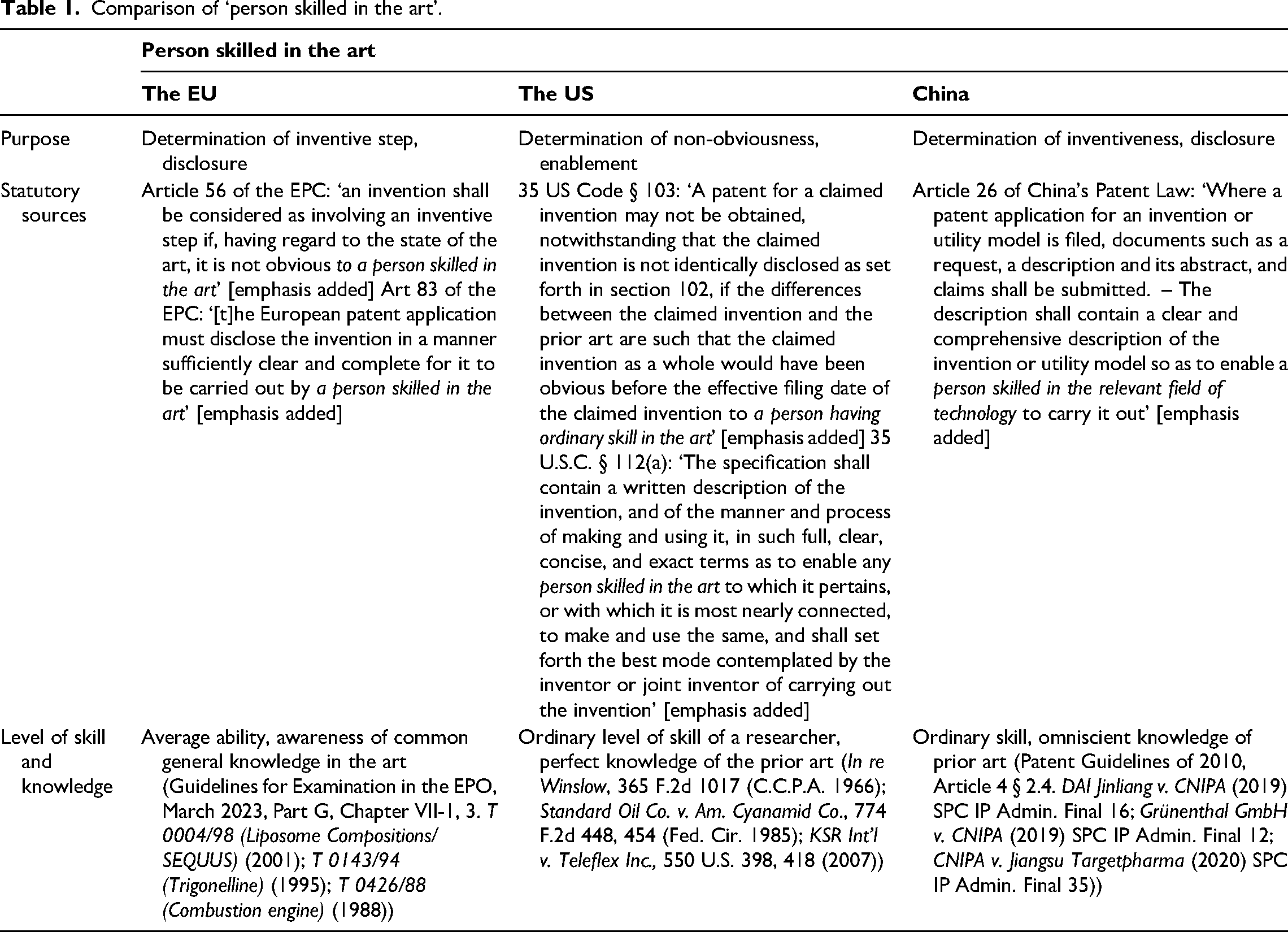
Comparison of ‘person skilled in the art’.
Although some variation exists with regard to the presumed skill level of the hypothetical construct, in the light of the analysis conducted in this study, assessing inventiveness as an essential part of patentability is fairly similar in the EU, the US and China. 275 Moreover, across the compared jurisdictions, the hypothetical legal construct is also essential in determining disclosure, stemming from the requirements of the TRIPS Agreement. 276 This leads us to a deeper discussion on the similarities between patent law and patentability requirements in the compared jurisdictions, the topic of the next section.
B. Similarities in patent law
From differences, I will now turn to identifying commonalities between and among the patent laws of the EU, the US and China to give meaning to comparative convergence. This endeavour is inspired by Lundmark's exhortation, ‘It is hoped that future scholars will take a more nuanced view of […] the supposed divide between the common law and civil law worlds without forgetting that all legal systems in both of these traditions have far more in common with each other than not’. 277 Not all but a majority of the EU Member States belong to the Romano-Germanic or civil law legal tradition, whereas the US is, with some notable exceptions (such as the state of Louisiana with a mixed legal system), a common law country. On the dichotomic civil law/common law continuum, China falls into the civil law tradition. However, as noted at the onset of this study, this characterization oversees many of the main features of the Chinese legal system, with traces of socialist law and Confucian and East Asian law.
Congruence has often been assigned as an explanatory factor for the variation between jurisdictions in comparative literature. 278 Furthermore, harmonization and convergence have been treated separately, with harmonization viewed as a deliberate process and convergence as evolving without planning. 279 Siems has further distinguished convergence through congruence and congruence through pressure. 280 Convergence through congruence has taken place due to similar social, political and economic circumstances on an international level and is manifested by growing interdependencies of societies, cultures and economies. 281 One can credibly postulate that the US and the EU, as representatives of Western capitalist and democratic thought with highly interdependent economies, have been faced with similar challenges socially, politically and economically, thus explaining some of the similarities found in their respective patent regimes. Consequently, despite historical differences in the rationale for granting patent rights between the approach in EU Member States based primarily on natural rights and the Anglo-American approach based on market utilitarianism, both the US and EU countries have engaged themselves in international efforts aiming at achieving a high level of patent protection. 282 Additionally, the EU views IPs as a legal tool to enhance the functioning of the internal market. 283
Convergence through pressure, on the other hand, refers to the influence of international and regional organizations and lobbying efforts. 284 Similarities between patent laws in the EU, the US and China can be at least partly explained by international harmonization of IP law through the formation of various organizations and agreements governing intellectual property commodities. Consequently, convergence of patent laws is not only an expectation but an outright obligation since the EU, the US and China are all members of the WTO and WIPO and parties to a host of international IP agreements such as the Berne Convention and the TRIPS Agreement. Especially in the case of China, convergence through pressure from its trading partners, most notably the US, has played a major role in why China's patent regime has, in a relatively short period of time, been transformed to resemble the patent regimes of the US and EU Member States. 285
Although the details of patent law are a matter for national legislatures, some fundamental features of protection for patents are, to a great extent, shared by all the EU Member States, the US and even the rest of the world, including China. 286 For patents, this universality entails that to be patentable, an invention needs to be novel, inventive and industrially applicable. 287 In the US, the invention needs to fall within the scope of patentable subject matter, be useful, novel, non-obvious and disclosed in an acceptable manner. 288 The EPC's five criteria for patentability include novelty, involving an inventive step, being capable of industrial application, disclosure of invention and being not excluded by Articles 52(2) and 3 of the EPC. 289 China's Patent Law requires novelty, inventiveness and practical use as well as appropriate disclosure and not being excluded from patentable subject matter. 290 The European criteria of ‘inventive step’ resemble their US counterparts ‘non-obvious’ and ‘capable of industrial application’, which are equivalent to ‘useful’, respectively. 291 Similarly, ‘novelty’, ‘inventiveness’ and ‘practical applicability’ required in China's Patent Law are equivalent to the concepts of ‘novelty’, ‘non-obviousness’ and ‘utility’ under US law for a valid patent. 292 To move beyond the statutory language of patent legislation, Chinese patent jurisprudence has since 2000 been moving closer to the European problem-solution approach due to Chinese patent offices’ and courts’ aspirations to achieve greater uniformity and objectivity. 293 To sum up, all three systems have fairly similar five basic requirements for patentability.
Once again, analyzing historical evolution concerning patent law offers insight into understanding similarities between each patent regime. The Venetian Republic is thought to have enacted the first true patent statute in 1474, although this legislation codified even earlier practice. 294 It included surprisingly similar elements compared to the current patentability requirements in EU Member States and the US: the invention needed to be new, useful and reduced to practice and registration was required. 295 From Renaissance Italy, systematic state protection for intellectual property spread first to Continental Europe and later to England and by the 1600 s, various European states had enacted similar patent legislation. 296 Thus, through this common origin, the patent laws in modern-day EU Member States and the US are branches of a single system of jurisprudence, which makes the similarity in patentability criteria more understandable. 297 By applying path dependence theory to patent law, we see that the shaping of patent law has been influenced by evolutionary change in the past, akin to evolution in nature. 298 A similar yet distinct theoretical approach drawing originally also from biology, namely the concept of imprinting, suggests that early features persist beyond subsequent environmental changes, which would lead to similar results explaining why patent law in the EU and the US has remained surprisingly unaltered from its origins and consequently similar to each other. 299 Although path dependency has been used in earlier legal studies, to my knowledge, this study is one of the first within comparative patent studies to suggest that employing the theoretical concept of imprinting could also offer explanatory power in comparative legal studies.
To explain the similarity between the patent laws of China compared to those of the US and the EU, we again find history to be the most convenient place to embark on our investigation. Because Chinese envoys were sent abroad to study foreign patent laws, the first modern Chinese patent law enacted in 1984 shared many similar features with the patent laws of the US and various EU countries. 300 Sobel deems the similarities remarkable despite the significant differences that exist between the languages, cultures, histories and political and economic systems of China and the US. 301 Legal borrowing also explains the striking similarity of patent laws in China and EU Member States. As became evident in reviewing the historical development of each patent area, the US has pressured China to tighten its patent laws, although the US's own track record suggests that the country only started advocating stronger patent protection, including foreign inventions, when it suited its own interests, which could even warrant the use of ‘patent bully’ 302 in describing the double standard of the US regarding patent protection.
Having established legal borrowing as one explanatory factor for the similarity of patent law of China, the US and the EU, the next step is to ask what motivated the Chinese to emulate their patent law according to such developed nations as the US and several EU Member States. Some have suggested that the Chinese valued experience, and since they lacked sufficient resources for IP law in their own tradition, it was convenient to turn to nations with more established IP regimes for emulation. 303 Additionally, economic considerations have been attributed to having been significant: the Chinese recognized that providing adequate protection for intellectual property owners was a prerequisite to accelerating China's economic development by attracting foreign direct investment, particularly from the United States. 304 Another useful theoretical lens to explain the convergence of China's patent law compared to patent law in the EU and the US is neoinstitutionalism. 305 Originating in sociology, neoinstitutionalism is based on the premise that to gain and maintain legitimacy, institutions come to resemble the accepted norm over time. 306 Applied in the context of this study, neoinstitutionalism would suggest that Chinese patent law has been moulded to confirm Western-style patent law and be viewed as legitimate. Commonalities should not, however, be accepted at face value, as underneath apparent convergence, differences may still loom. Underneath the apparent convergence between East Asian and Western legal systems, major differences still persist after almost 40 years of legal change and legal transplants. 307 Critics of neoinstitutionalism have pointed out that although institutions may seem similar on the surface, the meanings of institutions reconstructed by local actors may still reflect local needs and demands. 308 So, too, there is evidence that increasingly indigenous social and political demands in China are growing in importance; thus, apart from external forces, internal demand for rewarding inventive and creative activities has also played a role in introducing Western-style IP legislation in China. 309
Conclusions
In this study, I have analyzed patent law in the EU, the US and China. I have sought to address two interrelated questions, namely, first, ‘To what extent do patent law in the European Union, the United States and China resemble each other and to what extent do they differ?’ and second, ‘What possible factors explain similarities and differences in patent law in the European Union, the United States and China?’ This study reveals that the differences in patent law as embodied in statutes and judicial decisions between the EU, the US and China are mostly a matter of nuance. I find that, to a great extent, similarities in patent law stem from international efforts to harmonize patent protection as well as from common historical roots, resulting, among others, in fairly similar patentability requirements in all three patent systems. Economic and trade concerns are a major driving force for all three patent systems that are concerned with providing incentives to create and disseminate inventions. Similarities between Chinese and Western patent regimes can be explained with the help of congruence through convergence and pressure, legal borrowing and neoinstitutionalism. Differences are explained, among others, by underlying theoretical differences in patent doctrine. Differences in the objective of patent protection as well as the divide concerning the role of statutory law and case law between the common law and Romano-Germanic law also explain some of the found differences. For instance, the patentability requirements in the US have been shaped by common law, whereas in the EU and China, patentability requirements are expressed mostly in positive law and less subject to shift changes by judicial opinions giving new interpretations of legal norms governing patents. The reasons underlying the differences and similarities discussed in this study are by no means exhaustive, leaving plenty of room for future studies to explore related questions. This study has especially laid the foundation for future studies comparing judicial practice concerning patents in the EU, the US and China.
In addition to contributing to veins of literature comparing patent law, this study situates itself in comparative law. Calls to reconsider assumptions and lines of reasoning in comparative law have been made. 310 Similarly, I propose that comparative law should avoid presenting itself as ‘everything to everybody’. Additionally, comparative law as a field has an abundance of theorizing about comparative law and legal families and traditions but less guidance on how to compare specific areas of law. 311 Surely, developing the theory of comparative law is and should be a key priority of the field that essentially lacks its own substantive law, but if the majority of comparatists are armchair theorizing about comparative law and not concerned with matters concerning actually conducting comparative analyses, this imbalance can manifest itself in a lack of high-level studies carrying out actual comparison. 312 Comparative law as a research field has always striven to fulfill the double mandate of practical relevance and academic sophistication. 313 This study, too, has aimed at achieving both of these objectives, a balancing act not easily performed. 314 But as in many scholarly endeavours, nothing ventured, nothing gained.
Footnotes
Acknowledgements
The author is grateful to Professor Jaakko Husa (University of Helsinki), Professor Juha Raitio (University of Helsinki), Associate Professor Samuli Seppänen (Chinese University of Hong Kong), Professor Marcus Norrgård (University of Helsinki) and Professor Taina Pihlajarinne (University of Helsinki) for their helpful comments on earlier drafts of this article. The author would also like to thank this Journal's anonymous reviewers for their valuable comments.
Declaration of conflicting interests
The author declared no potential conflicts of interest with respect to the research, authorship, and/or publication of this article.
Funding
The author received no financial support for the research, authorship, and/or publication of this article.
