




Abstract
There is currently no empirical evidence on whether or not the use of childlike sex dolls would prevent or encourage sexual abuse of children. Yet, more and more countries prohibit or contemplate prohibiting these objects, and the EU Commission also announced it would consider this issue in the context of the fight against child sexual abuse. This article describes and compares the laws and policies of five countries in which childlike sex dolls are currently banned: Australia, Germany, Denmark, Norway and the UK. These countries have adopted different approaches to dealing with the newly emerging phenomenon of childlike sex dolls: While in Australia, Germany and Denmark dedicated laws prohibiting these dolls are introduced, in Norway and the UK existing laws are applied to these objects. By juxtaposing and critically assessing the different approaches to prohibiting childlike sex dolls, the article aims to inspire and guide other countries that also contemplate legislative action in this context.
Keywords
Introduction
While adult sex dolls have been around for a while, childlike sex dolls – that is, dolls with a childlike appearance that are used to generate or enhance sexual arousal and pleasure – are a relatively recent phenomenon. 1 The international legal framework on child pornography (the 2000 Optional Protocol to the UNCRC on the Sale of Children, Child Prostitution and Child Pornography, the 2001 Budapest Convention, the 2007 Lanzarote Convention and Directive 2011/93/EU) currently does not provide a basis for banning these objects. This is because childlike sex dolls per se cannot easily be considered as child pornography according to any of these legal instruments. State Parties are thus not obliged by international or EU law to prohibit these objects. 2 Nonetheless, more and more countries have prohibited or are considering prohibiting childlike sex dolls. In a similar vein, the EU Commission announced it would consider the issue of the sale of childlike sex dolls in the context of the EU strategy for a more effective fight against child sexual abuse adopted for the period 2020–2025. 3 But what should a ban on childlike sex dolls look like? Should it only cover the production and distribution of these objects or also their possession, even though one could argue that the latter activity is a strictly private affair? Furthermore, how should a childlike sex doll be defined? Should a ban only cover realistic dolls or also childlike dolls with unrealistic or adult features?
Various academic articles discuss the need and possible justification for a ban on childlike sex dolls. 4 Proponents of a ban claim that even though child sex dolls do not cause direct harm to children, they pose a danger to children as they may create indirect harm by increasing the risks of child victimization associated with escalation. Drawing from research suggesting an escalation in relation to child exploitation material, experts argue that it is possible that the use of childlike sex dolls may encourage problematic behaviour, resulting in hands-on sexual abuse of children. 5 Using a childlike doll could positively reinforce sexual activity with children and lower the barrier to committing contact sexual abuse, by conditioning the user and increasing the attractiveness of such conduct. 6 Some ethicists and clinicians, on the other hand, argue that the use of childlike sex dolls could have a cathartic benefit as they would allow users to direct their desires away from real children and to relieve their socially and morally unacceptable urges on an object. 7 Currently there is no empirical support for either of the two positions, which is why some commentators strongly criticize introducing a legal ban on childlike sex dolls, arguing that it would violate the harm principle. 8 Others, however, claim that even in the absence of clear empirical evidence, legal moralism permits a prohibition of childlike sex dolls based on moral grounds. 9
Whereas there is quite some academic literature dealing with the question of whether or not childlike sex dolls should be banned, no study has been conducted so far that maps and critically examines the laws and policies of countries that have already prohibited these objects. This article seeks to address this lacuna. It describes, analyses and compares the laws and policies of five countries which are at the forefront of legal developments in this field as they have already prohibited childlike sex dolls in one way or another: Australia, Germany, Denmark, Norway and the UK. These countries have adopted different approaches to dealing with this new phenomenon and, therefore, make for interesting case studies. Australia was the first country to explicitly ban these dolls in 2019. Germany and Denmark followed suit by prohibiting them in 2021 and 2022, respectively. In Norway and the UK, however, previously pre-existing laws were deemed applicable to these objects. In Norway, childlike sex dolls are classified as child pornographic material, and in the UK, law enforcement agencies rely on customs and obscenity laws to prosecute individuals for importing and distributing childlike sex dolls. By juxtaposing and critically assessing the different approaches to prohibiting child sex dolls, the article aims to inspire and guide other countries that also contemplate legislative action in this context.
This article is based on the results of a study on childlike sex dolls that the authors conducted in 2022. 10 In order to provide an accurate picture of the different legal approaches in the chosen countries, relevant national laws and policies as well as publicly available case law and press releases on childlike sex dolls were gathered and analysed. 11 In addition, semi-structured interviews were carried out with a total of nine national experts in the field of childlike sex dolls, including experts from custom services, the police, the Public Prosecution Service, academics and persons working in psychological and forensic care. 12 The aim of the interviews was to reflect on the national bans on childlike sex dolls and to obtain information regarding their practical enforcement.
This article provides a thematic overview and a critical discussion of the varying aspects of the national provisions banning childlike sex dolls. It touches upon issues such as the nature and scope of the criminal offences; the legal interest(s) that the applicable laws seek to protect (for example, children's freedom from sexual abuse or sexualization, morals); and the question as to how childlike sex dolls are currently defined and identified in the examined jurisdictions. This latter issue particularly addresses the question as to when a doll is considered childlike and when a childlike doll is considered a sex doll. Other themes involve the statutory sanctions for the different offences involving these objects, the required form of criminal intention (mens rea) and the legal exemptions that are applicable. We critically reflect on the abovementioned themes by discussing the pros and cons related to some of the choices that the national legislators, courts and other relevant practitioners have made. An overview of the relevant parts of the examined national legal provisions can be found in Appendix 1.
Applying existing provisions versus adopting an explicit ban
When the national offences applicable to childlike sex dolls in the five countries are compared, interesting differences regarding their nature come to light. The UK and Norway apply more generic laws that were already in existence. In the UK, the surge in the number of seized childlike sex dolls in 2016 led children's organizations and the National Crime Agency to call for tough criminal enforcement against individuals involved in dealing with these objects. In the absence of legislation explicitly banning the purchase and sale of child sex dolls, the authorities relied on old customs laws – the Customs Consolidation Act 1876 (hereinafter CCA) and the Customs and Excise Management Act 1979 (hereinafter CEMA) – to prosecute the importation of these dolls. 13 In a landmark ruling from 2017, a judge at Canterbury Crown Court decided that childlike sex dolls were to be classified as ‘indecent or obscene articles’, whose importation into the UK is illegal. 14 A series of cases followed, in which individuals were prosecuted and convicted for trying to import a childlike sex doll. 15 In 2019, the Crown Prosecution Service (hereinafter CPS) released a legal guidance outlining the statutory framework of offences which prosecutors could rely on to bring charges against importers and sellers of childlike sex dolls. 16 As a result of the use of previously existing customs and obscenity laws, individuals that import childlike sex dolls (s. 42 CCA, s. 170(1)(a) CEMA) 17 , distribute or sell them (or having them with intent to do so) (s. 2(1) Obscene Publications Act 1959 – hereinafter OPA) 18 or send them by post (s. 85(3)(b) Postal Services Act 2000) 19 can be held liable for criminal prosecution. Yet, the simple possession of a child sex doll remains legal. 20
In Norway, law enforcement also use existing laws to counter the phenomenon of childlike sex dolls. According to case law, childlike sex dolls can be classified as child pornographic material and are, thus, covered by § 311(1) of the Norwegian Criminal Code (hereinafter NCC), which criminalizes not only ‘depictions of sexual abuse of children’ but also ‘depictions that sexualise children’. 21 In a landmark case of 2019, the Norwegian Supreme Court upheld a decision in which a child sex doll was interpreted as belonging to the latter category. 22
Australia, Germany and Denmark, however, decided to adopt new laws explicitly prohibiting childlike sex dolls. In Australia, the application of previously existing laws was eventually supplemented with dedicated criminal provisions. Originally, the Australian judiciary considered the legal definition of child pornographic material broad enough to cover these objects. In 2016, the New South Wales District Court had found that a childlike sex doll could fall within the definition of child abuse material 23 and convicted an individual for having acquired and possessed such an object. 24 However, the Australian legislator felt the need to clarify existing Commonwealth laws on child abuse material. Hence, in 2019 it inserted s. 273A into the Australian Criminal Code Act (hereinafter ACCA), 25 which expressly prohibits the possession of childlike sex dolls. 26 Furthermore, it extended the definition of ‘child abuse material’ in s. 473.1 ACCA to clearly capture childlike sex dolls, meaning that existing offences relating to all dealings with child abuse material (Subdivision B of Division 471 and Subdivision D of Division 474) also extend to these objects. 27 Finally, the legislator made the intentional import and export of child sex dolls an explicit criminal offence, pursuant to subs. 233BAB(5) and 233BAB(6) Customs Act 1901.
Also in Germany and Denmark, childlike sex dolls are explicitly prohibited. In 2021, the German legislator adopted a ban by inserting § 184l into the German Criminal Code (hereinafter GCC). 28 A year later, in 2022, §235a of the Danish Criminal Code (hereinafter DCC) went into force, prohibiting these dolls in Denmark. 29
One of the advantages of adopting a dedicated provision prohibiting childlike sex dolls rather than applying previously existing laws relating to child abuse material or obscenity laws is that it provides the legislator the opportunity to establish tailor-made sanctions. In a dedicated provision, the legislator can, for instance, determine that the maximum penalty for violating the ban against childlike sex dolls is lower than the penalty for offences relating to actual child abuse material. Establishing the (direct) harm caused by these latter offences is much easier than it is for offences involving childlike sex dolls, where harm to others is yet to be researched and can only be indirect at best (see section 4). It also allows for differentiation in law regarding the various behaviours related to childlike sex dolls. If child sex dolls are assumed indirectly harmful to children or public morals, the mere private possession of such dolls might be considered less harmful – and as a consequence less blameworthy – than other doll-related activities of a more public, commercial or promotional nature. 30 In the case of private possession, apart from the user, no one else, and in particular no children, will be confronted with the doll. Whether this argument carries any weight will also depend on national differences regarding the respect for individual (sexual) freedom and the idea that criminalization should only serve as a measure of last resort (ultima ratio principle). Of course, these nuances in sentencing can also be accomplished in court, with judges imposing lower penalties for offences involving (the possession of) childlike sex dolls in comparison to actual child abuse materials, but the idea of trias politica is typically best served if the legislator takes the lead in expressing the seriousness of offences, not the judiciary.
Another advantage of dedicated laws is that this is more in line with the lex certa component of the principle of legality. For the Australian legislator it was precisely this principle that led to the adoption of §273A ACCA despite childlike sex dolls already being considered child abuse material under more generic criminal provisions. This new provision has made it crystal clear that childlike sex dolls are in fact considered child abuse material, thereby enhancing the clarity and foreseeability of Australian criminal law. Typically new laws are also extensively discussed in parliament previous to their adoption, leading to insightful parliamentary documentation which could be helpful in determining the scope and proper interpretation of the new provision, for instance, when it comes to assessing when a doll can be considered childlike or having a sexual purpose. All in all, this leads to the conclusion that dedicated provisions could be considered ‘best practice’. If countries are, however, adamant in tackling the phenomenon by using existing laws, the UK example of providing further direction with the help of the CPS’s legal guidance document deserves following. At least UK citizens can acquaint themselves with the manner in which the prosecution service interprets the law, whereas Norwegian subjects will patiently have to await further developments and clarifications in case law.
Definition of a childlike sex doll
Adult-like sex dolls are not illegal and neither are ‘regular’ toys that children play with. Thus, when demarcating an illegal childlike sex doll from its legal adult counterpart or a regular child doll, two questions have to be addressed: (1) Can the doll be considered childlike? and (2) Can the doll be considered a sex doll? Critics of a ban on childlike sex dolls argue that it is difficult to clearly define such childlike sex dolls in a way that is in line with the legality principle or legal certainty (lex certa). Furthermore, they anticipate problems with regard to establishing the age and sexual nature of dolls in practice. After all, it could be difficult to distinguish between a child and an adult sex doll, in particular in relation to the higher age categories (15+ years). Equally problematic could be the determination of the sexual nature of a doll, provided that there are numerous innocuous dolls available that also have body openings or representations of reproductive organs. However, in order to encompass the wide variety of childlike sex dolls, the criminal provision prohibiting these dolls cannot be defined too precisely either, for example regarding the exact appearance and measurements of the dolls, for this would allow individuals to easily circumvent the prohibition. A certain ‘vagueness’ or use of open terms is therefore required, as is a tailor-made assessment of the specific features of the doll in the individual case.
The five countries have worked around this conundrum by requiring that both the question of whether the doll represents a child and the question of whether it can be considered a sex doll have to be assessed objectively, based on the doll's overall appearance, using a reasonable person standard. The motive of the person who acquires the object is irrelevant and not to be taken into account. For example, in Australia, the Explanatory Memorandum clarifies: 98. (…) Consideration should be given to the characteristics of the doll in its entirety, including its functionality, proportionality, physical features and anything else that provides context to the purpose and age resemblance of the doll.
99. Paragraph 273.A.1(c) requires that a reasonable person would consider it likely that the doll or other object is intended to be used by a person to simulate sexual intercourse. This is an objective test focused on the function or capability of the doll or other object. The subjective intention or motive of the person that possesses the doll is not a relevant consideration in proving this limb of the offence. (…) 31
In Denmark, the explanatory remarks on the ban in § 235a DCC provide a rather detailed guidance on what features are to be taken into account when assessing a doll's overall appearance. With regard to the question as to whether the doll represents a child, the remarks state the following: Regard shall be had to whether the doll has the anatomy and proportions of a child, including whether the doll appears to be a person who has not undergone puberty and whether it has a face with obvious childlike features. Neither the height nor the flat chest is in itself decisive in the assessment, but could contribute to the overall impression that the doll must be regarded as a child. Regard may also be had to whether the doll is in kids’ clothes or with kids’ props, such as toys intended for children. Regard may also be had to whether the doll is equipped with a sound effect which, in expression or words, signals that the doll is construed to imitate a child. In this context, the marketing of the doll could be taken into account, even if this is not in itself sufficient to prove the appearance of a child, just as it is not in itself sufficient to conclude the contrary: that the doll does not appear as a child. The final assessment of whether the doll falls within the definition will depend on the circumstances of the case. (…)
32
In order to assess whether the childlike doll can be considered a sex doll, the explanatory remarks on § 235a DCC clarify that regard can be had, inter alia, to whether the doll is equipped with functions for sexual use (for example, body openings and/or human bodily temperatures) as well as to its marketing.
33
These features also need to be considered, according the UK CPS’s legal guidance: When assessing whether or not the doll has been created for sexual use, consideration should be given to any evidence concerning the purpose for which it is marketed; any features which are consistent with use for sexual gratification; any accompanying paraphernalia indicating that sexual activity is to take place.
34
In Germany, on the contrary, relatively limited guidance is provided regarding the question as to when an object can be considered a childlike sex doll. The travaux préparatoires only state that ‘the replica must, by its nature, meaning objectively, be intended for the performance of sexual acts. This is to be derived in particular from the specific depiction of the sexual organs and the presence of orifices.’ 35 The legislator did not clarify which other features are to be taken into account in order to assess the sexual nature of the doll or how to establish whether a doll indeed can be considered childlike. This is why critics argue that the ban on childlike sex dolls in § 184l GCC would violate the principle of legality. 36
None of the studied jurisdictions requires the doll to be anatomically correct or realistic in order to fall within the definition of a childlike sex doll. What counts is the overall appearance of the doll. For example, in Denmark, the explanatory remarks on § 235a DCC clarify that: ‘In assessing whether a doll falls within the proposed provision, it is not in itself decisive whether the doll bears full resemblance to or approximates a real person.’ 37 Hence, a short doll that has large breasts might still be considered childlike if it has a face with childlike features and/or is equipped with kids’ toys or clothes. Also, a fantasy or anime sex doll which is designed based on a cartoon or manga character and which does not fully resemble or approximate a real person may fall within the definition of a childlike sex doll if it has features of a child. In a similar vein, the CPS’ legal guidance in the UK clarifies that ‘prosecutors should consider whether the nature and quality of the childlike features mean – whatever other characteristics are also present – the doll unquestionably embodies childlike features.’ 38
On the one hand, this inclusive interpretation of childlike sex dolls prevents creative offenders from finding ways to easily evade criminal prosecution by simply adding unrealistic components to their dolls. One could furthermore argue – although this is again highly speculative – that unrealistic dolls might also lower the threshold for engaging in child sexual abuse; that they might also contribute to the sexualization of children; or that unrealistic dolls also harm public standards of propriety and morals. On the other hand, a too-inclusive criminal provision runs the risk of becoming overly broad, with also highly unrealistic dolls and innocuous cuddly toys becoming suspect. Investigating and prosecuting behaviours involving these latter dolls might become too taxing, draining the criminal justice system of already scarce resources for tackling more important crimes, such as actual child sexual abuse. Also, with an eye on lex certa, the legislator will have to clearly define and delineate what constitutes a childlike sex dolls. This could be even more complex in the case of (quasi) unrealistic dolls or parts of a doll.
Protected legal interest(s)
The ratio legis of the laws that are applicable to childlike sex dolls differ in the examined legal systems. Generally speaking, three main interests could be discerned: (1) the protection of children from sexual abuse; (2) the prevention of the sexualization of children or the normalization of child sexual abuse; and (3) the protection of public morals.
Countries that primarily justify their prohibitions of childlike sex dolls by reference to the dangers that these objects may pose to real children often find themselves in a difficult position, for the fact that the production, importation, possession and so on of these dolls typically does not cause direct harm to clearly identifiable individual victims.
39
They are so-called victimless crimes.
40
As a result, the criminalization is typically based on the supposed or assumed risk of indirect harm, namely the encouraging effect that these objects may have on users to eventually engage in criminal sexual behaviours involving real children. In Germany, for example, the ban on childlike sex dolls is based on the assumption that these objects will increase the danger of indirectly promoting sexual abuse of real children. The German legislator made this clear by stating: There is a danger that sex dolls with a childlike appearance lower the inhibition threshold for sexual violence against children and thus indirectly contribute to sexual violence against children. The use of such objects can awaken or strengthen the desire to perform the sexual acts practised on the object on a child in reality. This increases the risk for children to become victims of sexual violence, which is unacceptable.
41
Also the Australian legislator was convinced that the use of childlike sex dolls would increase the risk of sexual abuse of children. The Explanatory Memorandum on the Amendment Act motivated the explicit ban on childlike sex dolls by claiming that: (…) the purported sexual abuse of children through the use of childlike sex dolls must be criminalized to reduce the risks that these behaviours may escalate the risk posed to real children. Contemporary research is more frequently referring this risk.
42
However, this risk has not been conclusively established and some experts even attribute a protective or cathartic effect to these objects in the sense that certain users would no longer long for intercourse with real children, because they can live out their paedo-sexual fantasies on the dolls. If this is true, the prohibition of childlike sex dolls with an eye on protecting children would even be counterproductive.
In this respect, however, it is noteworthy that in almost all the cases that we reviewed, the defendants were found guilty not only of acquiring or possessing a childlike sex doll but also of possessing actual child abuse material. 43 Only in one reviewed English case was an individual convicted solely for trying to import a childlike sex doll. 44 This might be suggestive of a possible link between the acquisition or possession of childlike sex dolls and (other) child pornography related crimes. Further evidence of this possible link can be gathered from estimates by the UK's National Crime Agency. According to the NCA, in 75% of cases where the discovery of a child sex doll lead to a search, digital child pornography was also found in the suspect's home. 45 However, final conclusions on the existence of a link between childlike sex dolls and other crimes cannot be based on these findings. The data could be distorted due to prosecutorial and investigative decisions that could not be controlled for. It is, for instance, possible that – based on the principle of expediency – prosecutors mainly target individuals who are also suspected of other, more serious crimes. Convincing (empirical) evidence of a causal link – that engagement with childlike sex dolls could somehow increase the risk of persons getting involved in child pornography or child sexual abuse – is still lacking altogether. And as long as there is no conclusive answer to the question of whether the use of childlike sex dolls actually lowers inhibitions to engage in child sexual abuse, the assumptions that lie at the heart of these justifications for criminalization remain just that: assumptions.
It is for this reason that countries whose national laws mainly strive to protect children were often met with fierce criticism, even up to the point where critics argued that the new offence was mainly aimed at criminalizing immoral and repulsive behaviour – namely the acting out of auto-erotic paedophilic fantasies – although it does not harm anybody. 46 The critics conclude that the introduction of the ban on childlike sex dolls was not actually about the protection of children and their interests, but about morals. 47
It is perhaps due to the controversy surrounding the harm principle that some countries felt the need to choose an alternative motive to base their laws on, namely the prevention of sexualization of children or normalization of child sexual abuse. In Denmark, for instance, the legislator did not specifically mention the protection of children from sexual abuse as the ratio legis of the ban on childlike sex dolls that was introduced in 2022. In fact, a previous parliamentary motion proposing to adopt a criminal ban on child sex dolls
48
was rejected in 2017 with a particular reference to the lack of empirical evidence on whether the use of childlike sex dolls would prevent or encourage sexual abuse of children.
49
When the Minister of Justice eventually proposed a new prohibition on childlike sex dolls in 2021, he did not explicitly mention the protection of children from sexual abuse. Rather, the main justification he offered for the ban relied on the need to prevent the normalization of sexual abuse of children and the sexualization of children: (…) there is a need to send a clear message that sexual abuse of children is in no way acceptable. Similarly, children should not be sexualised to such an extent that they become the subject of realistic dolls, created for a sexual purpose.
50
However, this rationale is not without problems either, for it is unclear why children should not be sexualized, especially if the sexualization only involves inanimate objects. In and of itself, this rationale therefore seems inadequate. But it could serve as a stepping stone towards another, underlying or ultimate rationale. We would argue that there are two legal interests that could serve as the answer to the question as to why children should not be sexualized, and that, as a result, could qualify as ultimate rationale: the protection of morals or the protection of children against sexual abuse. So either countries condemn the sexualization of children because they feel this goes against public standards of propriety, or because it could indirectly incite users to act out paedophile fantasies in practice.
This (causal) link between the protected interest of sexualization of children and child sexual abuse is explicitly endorsed in Norway. The ban on child pornographic material in § 311 NCC had initially been limited to materials depicting sexual abuse of children but was broadened in 2005 to include material that depict children as sexual objects with the aim to ‘contribute to protecting children against sexual assaults’. 51 If we compare that to the Danish ratio legis, where the legislator did not specify such a causal connection we can conclude that the underlying rationale of the Danish ban is unclear: Is the Danish prohibition more about morals or about child protection? Carving out the precise underlying rationale of this law could be worthwhile for it determines whether persons convicted of violating the law are seen as individuals who merely acted against public morality or as potential child abusers.
A country that clearly opted for a moralistic reproach of childlike sex dolls is the UK. In the UK, childlike sex dolls are currently classified as ‘obscene or indecent articles’, according to offences in customs and obscenity legislation. English courts have interpreted the terms ‘indecent or obscene’ in offences contrary to the CCA and the Postal Services Act 2000 to refer to articles that are ‘repulsive, filthy, loathsome, or lewd’. 52 The OPA defines an article as ‘obscene’ if its effects ‘tend to deprave and corrupt persons who are likely, having regard to all relevant circumstances, to read, see or hear the matter contained or embodied in it’ (s. 1(1)). 53 It is clear that these offences have a moral basis. Obscenity laws prohibit certain dealings with obscene and indecent material because it offends ‘against recognised standards of propriety’. 54 They aim to protect public morals by suppressing obscene or indecent material rather than to prevent inciting crime. 55 The CPS’s legal guidance does therefore not refer to the need to prevent children from sexual abuse. In fact, it explicitly points to the lack of conclusive evidence on the question as to whether childlike sex dolls in fact encourage or discourage actual abuse of against children and stresses that prosecutors cannot therefore rely on an assumption related to the possible effect of childlike sex dolls on child sexual abuse when assessing obscenity. 56
Perhaps the choice for applying pre-existing customs and obscenity laws on the importation and so on of childlike sex dolls was more inspired by pragmatism – these laws were already in place – rather than an in-depth examination of the optimal manner in which to legislate against these behaviours, but at the moment the UK laws have an unambiguous moral basis. Of course a problem with criminalizing behaviour that is ‘only’ immoral rather than directly harmful to others is that this is highly controversial as well. Based on the postulate by John Stuart Mill ‘that the only purpose for which power can be rightfully exercised over any member of a civilized community, against his will, is to prevent harm to others’, many ‘classical’ liberal criminal law theorists still hold that the mere protection of morals forms an insufficient justification to base criminal law on.
Nowadays, however, the dominance of the classical or strict interpretation of the harm principle seems to have lost territory to more relaxed interpretations of harm in which uncertainty surrounding the actual chance of certain harm materializing as a result of certain behaviour can be negated by the seriousness of the harm if it indeed materializes. 57 In the case of childlike sex dolls this means, for instance, that the important legal interest of protecting children from sexual abuse could ‘compensate’ the equally great uncertainty regarding the potentially negative effect of the dolls on child sexual abuse. Also, modern-day legislators seem to have fewer reservations against criminalization based on legal moralism.
Scope of the national provisions on childlike sex dolls
In Australia, Germany, Norway and Denmark, the prohibitions cover a wide range of behaviours, including producing, advertising, distributing, selling or in any other way transferring childlike sex dolls as well as acquiring and possessing these objects. 58 In the UK, however, only importing, distributing and selling a childlike sex doll, whereas the simple possession of such an object is not (see section 2). Although the criminalization of childlike sex dolls is highly controversial in and of itself (see section 4), it is precisely the private possession of these dolls where the discussions surrounding their criminalization seem most poignant. 59 This has several reasons.
First, while the import, export, trade, production and so on of childlike sex dolls might be construed as paedophile propaganda, this is not true for the private possession of such objects. 60 So while the other behaviours could be considered (extra) blameworthy due to the possible element of promoting or inciting child sexual abuse, the mere possession of such dolls – being a strictly private affair – does not have this inciting potential. This makes the identification of a legal interest that can justify the prohibition of the possession of childlike sex dolls harder than in the case of the other behaviours associated with childlike sex dolls. Second, it is in the context of private possession where the impact of a prohibition on individual freedoms is most detrimental, since it takes away an individual's freedom of sexual development and self-expression. So while the producers, importers, traders and so on only risk losing a business opportunity and a venue to make money, for individual users or buyers there is much more at stake. In a similar vein, a criminal record for dealing in childlike sex dolls might not carry the same social stigma as a conviction for their possession and use. It is probably for these reasons that in some legal systems, the statutory penalty for acquiring and possessing childlike sex dolls is lower than for producing, advertising, selling and so on these objects (see section 7). In Australia the lack of distinction in terms of statutory penalties between the production and distribution of childlike sex dolls and the simple possession for personal use was strongly criticized. 61
A careful consideration of a potential differentiation between possession and other behaviours is all the more important, since it is primarily the private end users who are currently being prosecuted in this context. In the UK, Australia and Norway, a number of individuals have already been prosecuted for offences involving a childlike sex doll, 62 but the accessible case law in the three mentioned countries almost exclusively involves individuals being prosecuted for importing, acquiring and/or possessing these objects. 63 The manufacturers and distributors are located in other jurisdictions (mostly China and Japan), 64 where childlike sex dolls are typically not prohibited, which is why law enforcement authorities in the receiving countries usually target the end users of childlike sex dolls. 65 This means that the prohibition on producing and exporting these dolls from their countries of origin is currently mostly symbolic.
Criminal intention (mens rea)
The national offences applicable to childlike sex dolls also differ with regard to the fault element. In the UK, for the offence in s. 170(1)(a) CEMA to be committed, there must be a ‘knowing acquisition’ of a childlike sex doll. According to the CPS’s legal guidance, this means that the prosecution must prove that the defendant, who acquired a childlike sex doll, knew that the importation and exportation of such an object into the UK is currently prohibited.
66
The guidance clarifies that since the simple possession of a childlike sex doll is not unlawful, this element of the offence has to be carefully considered and ‘prosecutors should start with the position that, without more, a suspect may not know its importation is unlawful’.
67
In order to assess whether the defendant knowingly acquired an article whose importation to the UK is prohibited, the prosecutors may in particular focus on the circumstances of the purchase as well as on the appearance of the doll:
What the evidence concerning the purchase is: were there warnings about potential prohibitions on importation on the website? Were there other indications about its illicit nature? Or did the offer for sale allow a person to conclude that the doll could lawfully be imported? What information is available as to the type of website from which the goods were purchased? What other types of goods were being offered for sale on the website? Was the website available on an openly accessible part of the internet? Was information provided as to any particular measures that would be used to package and send the item? Has any information about the purchaser's communications with the seller been obtained? By what means was the doll imported? How plainly obscene is the article? The more obviously a child doll, particularly a clearly young or very young doll, and one to be used for sexual purposes, the greater the inference that the suspect did in fact know it was subject to a prohibition. That is particularly the case when inspected upon receipt: the doll having been imported, is the inference plain that the person upon acquiring it must have known that it was a prohibited or restricted article?
68
Also, an individual distributing or selling a childlike sex doll is only liable for the offence in s. 2(1) OPA if he knew that his action would make him liable according to the OPA. Hence, the defendant cannot be convicted if he can prove that that he had not examined the article in respect of which he is charged and had no reasonable cause to suspect that it was such that distributing or selling it would make him liable for the offence (s. 2(5) OPA).
69
In Germany and Denmark, intention is required for the offence in § 184l GCC and § 235a DCC, respectively, to be committed, negligence is not sufficient. 70 Thus, the prosecutor must prove that the offender knew that he acquired, possessed, sold and so on a doll with childlike features and a sexual purpose or that he was at least aware of and accepted the risk that the doll might be a childlike sex doll (dolus eventualis). In practice, the fault element is inferred from objective facts and circumstances. Hence, like in the UK, the prosecutor will have to focus on the circumstances of the purchase (for example, marketing of the doll on the website) as well as the appearance of the doll in order to assess whether the offender acted with intention. For example, the fact that the doll was advertised as ‘100% like a young girl's body’ and/or was equipped with kids’ clothes and toys indicates the offender's knowledge or awareness of the doll's nature. His defence that he was not aware that he bought or possessed a childlike sex doll (mistake of facts) will not be successful. 71 Also, an offender's claim that he did not know that his behaviour constitutes a criminal offence (mistake in law) will not excuse him. 72
In Norway, negligence is sufficient for the offence in § 311 NCC to be committed. Negligent behaviour is punishable by a lower sentence (monetary fine or imprisonment of a maximum of six months) 73 than its intentional counterpart (monetary fine or imprisonment of a maximum of three years). 74 This distinction between a crime with an intentional and a negligent alternative can be explained by the fact that all child abuse material is classified as such. Provided that also other (unrealistic) child abuse materials that do not feature actual children falls within those two categories, it is only logical and in line with the internal consistency of the Norwegian criminal law system as a whole that this would also apply to childlike sex dolls. At the same time it widens the scope of the criminal law provision, making more behaviours involving childlike sex dolls prone to criminal liability. This could be seen as an advantage if the goal of the national legislator is to ban childlike sex dolls from society to the largest extent possible: defences involving lack of intent or knowledge are futile if at least a certain level of neglect on the part of the defendant can be established. However, given the stigma that is typically associated with a conviction for child sexual crimes – including potential difficulties with obtaining a ‘Certificate of Good Conduct’ – one could also argue that qualifying crimes involving childlike sex dolls as (also) crimes of negligence is too strict an approach, in particular in the light of the difficulties with determining the actual harm that is caused by these crimes.
In Australia, s. 273A.1(c) ACCA provides for an objective test requiring that ‘a reasonable person would consider it likely that the doll or other object is intended to be used by a person to simulate sexual intercourse’, taking into account objective circumstances (for example, functionality, proportionality and physical features of the doll) (see section 3). Yet, the individual acquiring and possessing a childlike sex doll is not required to know that the doll is to be used for sexual purposes. The choice to not require proof of actual (subjective) knowledge by the offender of the sexual nature of the childlike doll or other object was strongly criticized by the Law Council of Australia. After all, the Council argued, other sexual offences also depend on that sort of proof. 75 However, the bill was not changed in that respect, because law enforcement agencies and the Director of Public Prosecutions maintained that such a cognitive requirement would create difficulties in proving the offence. They argued that it would make it harder to successfully prosecute these cases if the prosecutor had to demonstrate that the defendant knew what the childlike sex doll was being used for. 76 So in contrast to Norway, the Australian legislator accepted that the provision relating to childlike sex dolls was internally inconsistent with other sexual crimes.
Prescribed penalties
Comparing the prescribed sanctions in different jurisdictions as such is pointless, as they depend on the national legal system and culture. Having said that, it is interesting to assess whether the laws of the examined countries make a distinction in terms of prescribed sanctions between different behaviours involving childlike sex dolls, and whether or not these sanctions reflect the sanctions prescribed for offences involving actual child abuse material.
In Germany, the sanctions for producing, advertising, selling or in any other way transferring childlike sex dolls is higher than for acquiring and possessing these objects. Whereas the former is punishable by a fine or imprisonment of up to five years, 77 the latter is punishable by a fine or a maximum sentence of three years. 78 Also in Denmark, the sanction for producing and selling childlike sex dolls is higher (fine or imprisonment of up to two years) 79 than for the possession offence (fine or imprisonment of up to one year). 80 In Norway and Australia, however, no distinction is made in terms of penalties prescribed for acquiring and possessing child abuse material, on the one hand, and producing, publishing, selling and so on such material, on the other hand. In Norway, all offences relating to child abuse material are punishable with a monetary fine or criminal imprisonment of a maximum of three years, 81 whereas in Australia, a statutory sentence of a maximum of 15 years applies. 82
As explained above, a case may be made for lower sentences in the case of mere private possession (see section 4). If the ratio legis revolves around the prevention of the sexualization of children or the protection of public morals the national legislator might want to take the fact that the defiant behaviour involves a strictly private affair into account as a factor that mitigates the statutory sentence. However, if countries base the rationale of their national laws on the protection of children against sexual abuse, one could also argue that no distinction in statutory sentences ought to be made. In that case, legislators are perhaps advised to seek maximum deterrent effect by also threatening the end users with high penalties. After all, it is precisely on the part of the end users that an escalation to actual child sexual abuse is dreaded.
The countries can furthermore be distinguished in those that opted for statutory sanctions reflecting those for offences involving actual child abuse material, on the one hand, and countries where the prescribed penalties for offences relating to childlike sex dolls are lower than those for offences involving actual child abuse material, one the other hand. 83 In Norway and Australia, childlike sex dolls are classified as child abuse material, so the prescribed penalty for offences involving childlike sex dolls is equivalent to the penalty prescribed for offences involving material depicting actual abuse of children, namely three years and 15 years, respectively. Also in Denmark, the maximum penalty for possessing a childlike sex doll is equal to the penalty prescribed for possessing and distributing actual child abuse material. 84 In Germany, however, the sanctions prescribed for offences involving childlike sex dolls are significantly lower than those for offences relating to child pornographic material involving real children. According to § 184b GCC, producing, selling, disseminating and so on child pornographic material is punishable by a custodial sentence of one to ten years, whereas someone who possesses such material incurs a penalty of one to five years. Yet, if the pornographic material involves a childlike sex doll (for example, an image depicting sexual acts with such a doll), it is considered as fictitious pornographic material which is punishable by a lower sentence of three months to five years. 85 Also in the UK, the sanctions prescribed for offences involving childlike sex dolls are significantly lower than the penalty prescribed for distributing child abuse material (maximum of 10 years’ imprisonment). 86
Again the deterrent ambitions of national legislators might justify the threat of serious sanctions. However, with an eye to the harm principle, crimes involving real children are undeniably more serious and more worthy of severe punishment than crimes where no direct harm to another person can be discerned. It stands to reason that this difference will typically be expressed in the penalties imposed by the courts, including in those countries where the national legislator made no such distinction. However, as stated before, the idea of trias politicas is better served in systems where the onus of expressing the relative seriousness of crimes is placed upon the legislator and not the judiciary (see section 2).
Exemptions to criminal liability
The studied jurisdictions are similar in the sense that almost all provide for legal exemptions that, if present, take away criminal liability. These exemptions are typically considered behaviours that are considered as of ‘public benefit’. However, the studied countries differ in the variety and extent of the exemptions allowed. A rather broad range of legal exemptions can be found in the Norway and the UK. Norwegian law provides that the offence criminalizing ‘depictions of sexual assault against children and depictions that sexualize children’ does not apply to ‘depictions that are considered justifiable from artistic, scientific, informative, or similar purposes’. 87 In the UK, an individual will not be liable for selling or distributing a childlike sex doll within the UK if he did so for an artistic, educational or scientific purpose. 88 Yet, such a defence does not apply to the importation of childlike sex dolls into the UK. 89 Australia is stricter in the sense that childlike sex dolls may, too, be used in the context of scientific, medical and educational research, but this is contingent on prior written approval by the Australian Federal Police Minister. 90 In Germany, criminal liability is only excluded for transferring or possessing a childlike sex doll if this ‘exclusively serves the lawful fulfilment of state duties or official or professional obligations’. 91 The travaux préparatoires do not clarify whether a childlike sex doll can also be possessed for scientific, medical or educational purposes. In Denmark, however, there are no exemptions applicable in cases involving childlike sex dolls. The Ministry of Justice rejected a proposal to the effect of introducing a legal exemption for the sake of therapy, arguing that the dolls are currently not used in controlled therapeutic processes and that it would be ‘difficult to ensure an efficient enforcement of the ban, if it did not apply without exceptions’. 92
Legal exemptions introduce exceptions to a general prohibition, thereby complicating the effective enforcement of a ban of childlike sex dolls. 93 A uniform prohibition is much simpler in that regard. Childlike sex dolls are currently not (structurally) used in a therapeutic context and perhaps the use of alternative therapeutic strategies is to be preferred. In addition, there might be a risk of end users abusing the therapeutic exception and reporting themselves to therapists in order to gain easy access to childlike sex dolls. 94 Exemptions may, nonetheless, prove helpful, for instance if future research demonstrates that childlike sex dolls can indeed be used in a therapeutic setting in order to prevent child sexual abuse. Until that is the case, and provided that national laws allow for it, national legislators might also consider leaving these situations up to practice for the time being rather than introducing legal exemptions, for example by relying on the expediency powers of the public prosecutor or relying on courts to acquit defendants, because there was a justification for their actions.
Conclusion
We currently do not know whether or not the use of childlike sex dolls prevents or encourages sexual abuse of children. We might never know, as empirical research determining such a causal link would be very difficult to design and could raise ethical concerns. Nonetheless, more and more countries do not want to take the risk and prohibit or consider prohibiting childlike sex dolls.
In terms of choosing the protected legal interests to justify a ban, national legislators find themselves in a conundrum: on the one hand, the countries that base their laws on the protection of children have little empirical evidence to rely on. Due to a lack of conclusive research on the potential encouraging or protecting effect of these objects on child sexual abuse, they take a leap of faith that might even prove counterproductive if future research were to demonstrate that these dolls have a protective effect on (some) users. On the other hand, criminalization based on the protection of public morals is not without controversy either. Whatever choice national legislators make in terms of ratio legis, they are advised to at least be upfront and clear about the questions and controversies that still surround this topic. In that sense the choice for preventing the sexualization of children as main underlying rationale for a ban on childlike sex dolls seems unsatisfactory as it obscures what goal the legislator ultimately pursues with the ban: to protect children, public morals or both?
With an eye on legal certainty (lex certa) national legislators are furthermore advised to provide their constituency with as much guidance as possible on how to identify an illegal childlike sex doll, without making the definition too narrow. It seems that the use of open terms is inevitable in order to avoid suspects circumventing the prohibition, but a detailed – yet non-exhaustive – account of how the notions ‘sex’ and ‘child’ could be interpreted is very helpful in furthering the legal certainty aspect of national laws. The same applies to questions of whether phantasy dolls or also parts of dolls would fit the legal description of a childlike sex doll in case of doubt. Furthermore, the choice for an objective assessment (using a reasonable person standard) of the overall appearance of the doll seems a sensible approach to adopt.
Regarding the choice of whether the prohibition excludes the possession of childlike sex dolls or whether the possession of childlike sex dolls ought to carry a lower statutory maximum sentence than other behaviours involving these dolls, arguments pro and against were discussed. A careful balancing of interests – also taking into account the negative effects on the individual freedom of (sexual) self-expression and the ratio legis of the national prohibition – will help determine whether such a distinction between possession and other behaviours involving childlike sex dolls ought to be made. It would, however, stand to reason to at least distinguish a higher maximum penalty for child abuse material that involves real children.
A similar weighing of interests is required in deciding whether or not to adopt legal exemptions to the ban. Introducing exemptions may complicate effective enforcement, it may raise questions of legal certainty again, and it might open the door to abuse from defendants who use the exemptions as an excuse to have or gain access to childlike sex dolls. However, one could conceive circumstances where negating criminal liability could be just. But rather than introducing legal exemptions, national legislators might also contemplate leaving these situations for practice to deal with, at least for the time being.
Footnotes
Funding
The author(s) disclosed receipt of the following financial support for the research, authorship, and/or publication of this article: The article is based on a research project funded by the WODC.

Author Biography
Notes
Appendix 1
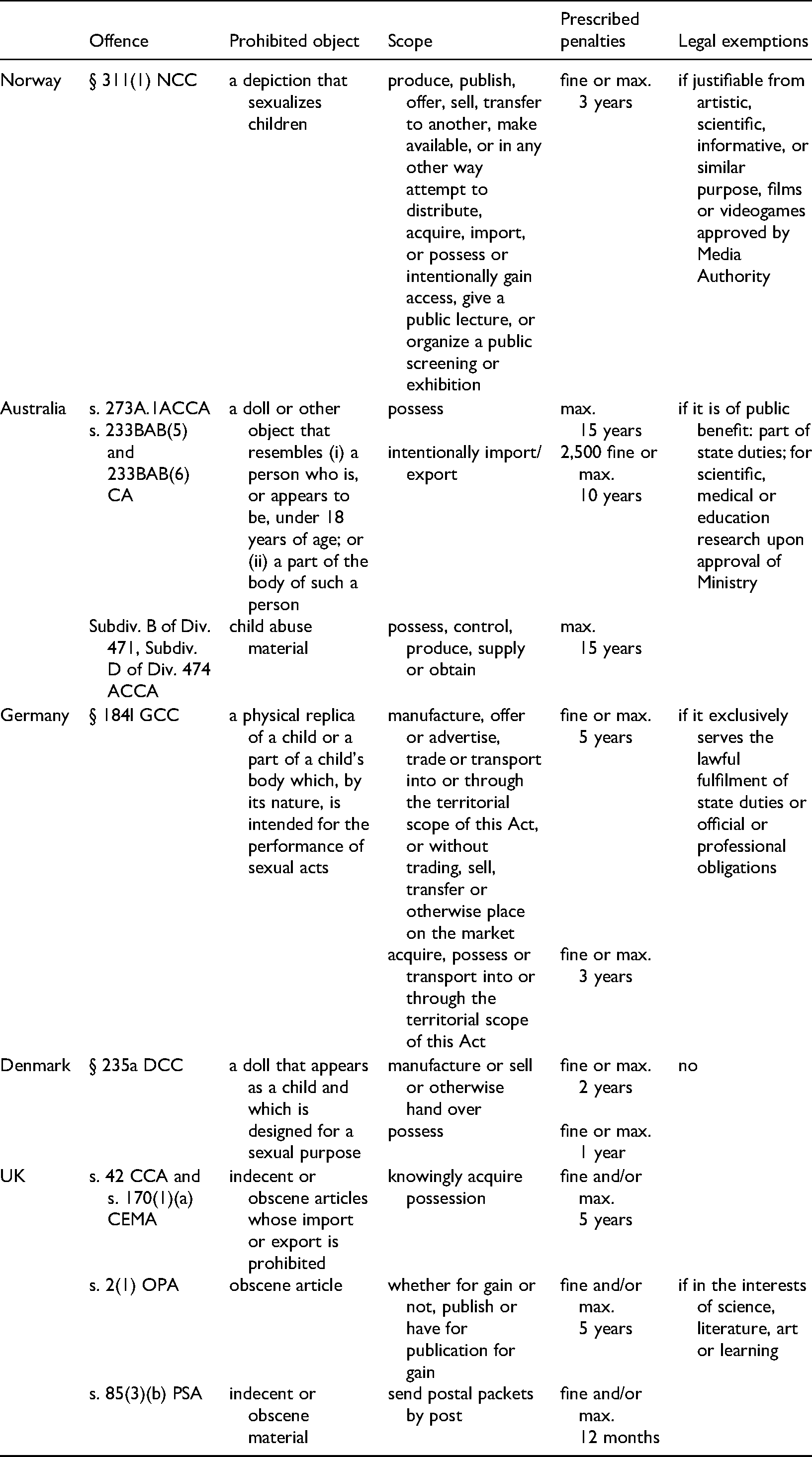
| Offence | Prohibited object | Scope | Prescribed penalties | Legal exemptions | |
|---|---|---|---|---|---|
| Norway | § 311(1) NCC | a depiction that sexualizes children | produce, publish, offer, sell, transfer to another, make available, or in any other way attempt to distribute, acquire, import, or possess or intentionally gain access, give a public lecture, or organize a public screening or exhibition | fine or max. 3 years | if justifiable from artistic, scientific, informative, or similar purpose, films or videogames approved by Media Authority |
| Australia | s. 273A.1ACCA s. 233BAB(5) and 233BAB(6) CA |
a doll or other object that resembles (i) a person who is, or appears to be, under 18 years of age; or (ii) a part of the body of such a person | possess | max. 15 years | if it is of public benefit: part of state duties; for scientific, medical or education research upon approval of Ministry |
| intentionally import/export | 2,500 fine or max. 10 years | ||||
| Subdiv. B of Div. 471, Subdiv. D of Div. 474 ACCA | child abuse material | possess, control, produce, supply or obtain | max. 15 years | ||
| Germany | § 184l GCC | a physical replica of a child or a part of a child's body which, by its nature, is intended for the performance of sexual acts | manufacture, offer or advertise, trade or transport into or through the territorial scope of this Act, or without trading, sell, transfer or otherwise place on the market | fine or max. 5 years | if it exclusively serves the lawful fulfilment of state duties or official or professional obligations |
| acquire, possess or transport into or through the territorial scope of this Act | fine or max. 3 years | ||||
| Denmark | § 235a DCC | a doll that appears as a child and which is designed for a sexual purpose | manufacture or sell or otherwise hand over | fine or max. 2 years | no |
| possess | fine or max. 1 year | ||||
| UK | s. 42 CCA and s. 170(1)(a) CEMA | indecent or obscene articles whose import or export is prohibited | knowingly acquire possession | fine and/or max. 5 years | |
| s. 2(1) OPA | obscene article | whether for gain or not, publish or have for publication for gain | fine and/or max. 5 years | if in the interests of science, literature, art or learning | |
| s. 85(3)(b) PSA | indecent or obscene material | send postal packets by post | fine and/or max. 12 months |