




Abstract
The EU general principle of effective judicial protection is the epitome of the EU liberal-constitutionalism. The creative force of this principle has emerged, among others, in connection with the protection of the rule of law and the introduction of procedural guarantees both at the national and EU level. It is well established that effective judicial protection stems from the ECHR and the constitutional traditions common to the Member States. While existing scholarship has explored the influence of the ECHR over the development of this principle, less attention was paid to the impact of constitutional traditions from the Member States. Yet, exploring the role of constitutional traditions in shaping effective judicial protection, the primus inter pares among the general principles of EU law, goes at the heart of the conundrum of the EU: the latter is an autonomous legal system, which is inevitably shaped by the legal concepts and traditions existing in the Member States. This exploration is particularly timely. Some Member States affected by the rule-of-law backsliding have recently invoked constitutional traditions on judicial protection to delimit the application of EU standards of effective judicial protection, thus questioning the relationship between the EU principle and national conceptions of judicial protection.
Keywords
Introduction
The EU general principle of effective judicial protection (or ‘effective judicial protection’) is one of the pillars of the EU legal order and the epitome of the EU liberal-constitutionalism. The creative force of this principle has emerged in connection with, among other things, the protection of the rule of law and the introduction of procedural guarantees both at the national and EU level. 1 Effective judicial protection appears to be the factotum of the EU legal order. Since the Johnston case, 2 it is well established that effective judicial protection stems from the European Convention of Human Rights (ECHR) and the constitutional traditions common to the Member States. While existing scholarship has explored the influence of the ECHR over the development of this principle, 3 less attention was paid to the impact of constitutional traditions from the Member States.
Yet exploring the role of common constitutional traditions in shaping effective judicial protection – the primus inter pares among the general principles of EU law – brings focus to the heart of the conundrum of the EU: although it is an autonomous legal system, it is inevitably shaped by the legal concepts and traditions existing in its Member States. What is more, while it has been established that common constitutional traditions remain an evolutionary force for EU law, 4 in so far as they shape EU general principles, recent developments highlight two tensions between national constitutional traditions and EU standards of effective judicial protection enshrined in the homonymous principle.
The first tension concerns the complex interactions between national constitutional identities, constitutional traditions and the general principle of effective judicial protection. Article 6 TEU acknowledges the role of common constitutional traditions as a source of general principles of EU law. In selected circumstances national constitutional traditions have also received protection at EU level. 5 Additionally, Article 4(2) TEU requires the EU to protect the national identity of the Member States. Hence, the EU constitutional architecture acknowledges the role of national constitutional traditions and identity in shaping the EU. However, in recent litigation, some Member States have invoked national constitutional traditions to delimit the application of EU standards of effective judicial protection. 6 Such reliance on constitutional traditions signals the Member States’ objective of opposing specific, national views on justice administration and judicial protection against the relevant EU standards. This development inserts itself in the recent trend among national authorities to request protection of national constitutional identities under EU law. 7 Yet, the recent reliance on constitutional traditions on effective judicial protection in litigation before EU courts should be singled out, as it took place in conjunction with the rule of law backsliding in the same Member States. The rule of law saga therefore shed new light on the difficult co-existence between national constitutional identities and traditions with the emerging EU constitutional identity – a dynamic which requires renewed academic investigation.
The second tension regards centralisation and pluralism trends in the standards of judicial protection in the EU legal landscape. Under the combined reading of Articles 6 TEU, and 52 and 53 of the EU Charter, the EU system of fundamental rights protection is both pluralistic and centralised. It relies first on general principles of EU law stemming from the ECHR and common constitutional traditions and second on the EU Charter of Fundamental Rights. In particular, the ECHR has a significant role in shaping the interpretation of corresponding EU Charter rights, although the EU judicature may go beyond the ECHR standards. 8 Article 47 of the EU Charter, which codifies the principle of effective judicial protection, has a leading role in the EU legal landscape 9 and thus enhances the centralisation of standards of effective judicial protection. What is more, under Article 52 of the EU Charter, Article 47 itself should be interpreted in the light of constitutional traditions common to the Member States on effective judicial protection and the relevant case law of the Strasbourg Court. Does the centralising power of the Charter and Article 47 thereof risk annihilating pluralism in legal traditions on judicial protection? Is pluralism in the EU justice system desirable, after all, and if so, to what extent?
This paper has a threefold objective. First, it analyses the influence of constitutional traditions on the principle of effective judicial protection. Second, it reflects on the recourse to constitutional traditions – as a plea raised by national authorities – to delimit the application of the EU standards of judicial protection. While the analysis focuses on recent cases from the rule of law saga where the principle of effective judicial protection was challenged under national constitutional traditions, the paper also offers general remarks on how to avoid abuses of EU law under the aegis of national constitutional traditions and identities. Third, taking stock of the dominance of Article 47 of the EU Charter in the EU case law, the paper critically assesses the tension between pluralism and fertilisation in the standards of judicial protection in the EU legal landscape.
The paper is structured as follows. First, it investigates the concept of ‘common constitutional tradition’ and discusses the available methodologies to identify one. Second, it offers a classification of constitutional traditions on effective judicial protection in the Member States and reveals the influence of such traditions on the creation of effective judicial protection. Third, the paper identifies three typologies of uses of the constitutional traditions on judicial protection in the reasoning of Advocates General (AGs). Fourth, the paper critically analyses the recourse to constitutional traditions as a plea raised by national authorities to delimit the application of the EU standards of judicial protection. Finally, the paper concludes with some reflections on pluralism and centralisation of effective judicial protection standards within the EU legal order.
Common constitutional traditions in the EU legal landscape
The Court of Justice of the EU (CJEU) has long established its practice to engage with comparative law. 10 Lenaerts and Gutman 11 observe that comparative analysis has various functions, such as filling the gaps of the EU legal order or facilitating the interpretation of concepts of EU law. The concept of common constitutional traditions is a by-product of the comparative methodology of the CJEU. This umbrella term was first used in the Internationale Handelsgesellschaft judgment, 12 in which the Court explained that ‘The protection of such rights, whilst inspired by the constitutional traditions common to the Member States, must be ensured within the framework of the structure and objectives of the Community.’ 13
With this dictum, the Court masterfully appeased national constitutional courts’ critiques 14 by underlying the existence of a shared ‘tradition’ concerning the protection of fundamental rights in the Member States, to be taken into consideration also at the Community level. At the same time, Internationale Handelsgesellschaft indicated that the CJEU was seeking to construct the Community's autonomy in the fundamental rights field, as the application of fundamental rights had to be ensured ‘within the framework of the structure and objectives of the Community.’ 15 Indeed, full compliance with national conceptions of fundamental rights at Community level would have hindered the self-determination of the Community; it would also have entailed a fragmentation of the Community order, making it the prey of national constitutional specificities. Instead, identifying a supra-national dimension to the protection of fundamental rights – in the form of general principles – ensured the effective equality of the Member States before the Treaties, the CJEU being the ultimate arbiter of the compliance with such rules.
The ERT judgment 16 later specified that ‘fundamental rights form an integral part of the general principles of Community law the observance of which [the CJEU] ensures. For that purpose, the Court draws inspiration from the constitutional traditions common to the Member States and from the guidelines supplied by international treaties for the protection of human rights on which the Member States have collaborated or of which they are signatories […].’
The ERT judgment has several implications. First, the CJEU does not interpret individual national constitutional traditions. The competence to identify and delineate the content of the Member States’ constitutional ethos is left to the national courts. The CJEU may instead draw inspiration from the constitutional traditions of the Member States that are deemed to express elements of the EU constitutional identity to establish a general principle of EU law. In this sense, the category of common constitutional traditions is a hybrid of national and EU law: the traditions have a national origin but are subsequently communalised at EU level via the interpretative action of the CJEU. Put differently, the concept of a ‘common constitutional tradition’ acquires a European dimension via the identification of general principles of EU law in case law of the Court of Justice. 17 Second, and consequently, general principles inspired by common constitutional traditions are subject to the exclusive interpretation of the CJEU. National courts cannot interpret but only apply EU general principles. While it is not unthinkable that national courts may identify common constitutional traditions in the context of a comparative exercise, the identification of those traditions cannot bear any legal consequence on the EU legal order, and would not lead to the establishment of general principles having a transnational binding nature. Third, from a constitutional standpoint, common constitutional traditions and their translation into general principles strengthen the constitutional identity of the EU. The EU ethos builds on the legal heritages of the Member States. Overall, the recourse to the category of constitutional traditions allows a horizontal and vertical dialectic between the national and the EU legal orders. As argued by Pollicino and Fichera, common constitutional traditions are ‘an expression of the conciliatory side of security’ narratives in the EU. 18
The influence of common constitutional traditions in the field of the protection of fundamental rights was constitutionalised under Article F(2) of the Maastricht Treaty. However, national legal traditions were a source of inspiration beyond the protection of fundamental rights, examples being the doctrines on the extra-contractual liability 19 or the concept of right 20 developed in the Member States and borrowed by the CJEU. Currently, Article 6(3) TEU states: ‘Fundamental rights, as guaranteed by the European Convention for the Protection of Human Rights and Fundamental Freedoms and as they result from the constitutional traditions common to the Member States, shall constitute general principles of the Union's law.’ Therefore, the common constitutional traditions are a manifestation of the pluralistic pedigree of the EU fundamental right protection system.
Before assessing how the CJEU has utilised constitutional traditions to shape the principle of effective judicial protection, it is necessary to consider what is a common constitutional tradition in the EU. While the concepts of ‘tradition’ (a consolidated interpretation 21 of the law) and ‘constitutional’ (related to the national ‘constitution’ and supreme norms broadly understood) 22 are rather intuitive, what remains unsettled is the notion of ‘common’. 23 Does this adjective refer to legal heritages that exist in all Member States? Or does it concern the existence of major trends in constitutional traditions of the Member States? The answer to these questions is ‘Neither and both’, as will be discussed in the following section.
How to identify common constitutional traditions in the EU?
When the CJEU establishes a general principle of EU law it reveals the transformative power of constitutional law and legal traditions: like an alchemist, the CJEU transmutes common constitutional traditions into a source of EU law, namely, into general principles of EU law. While alchemists follow alchemical processes to change metals into gold, one may wonder what methodology is used by the CJEU to identify common constitutional traditions and eventually forge general principles of EU law. 24
In principle, at least four methods may be distinguished. To begin with, the CJEU may draw on constitutional traditions common to all or some Member States. While the first option is self-explanatory, under the second alternative a majoritarian approach would be followed (i.e., only traditions shared by a majority of the Member States may be considered common). The majoritarian methodology nevertheless leaves open the question: would an absolute or a relative majority be required? 25 As a third option, the CJEU may look for trends in the traditions of the Member States without relying on a precise majoritarian rule. While the second option (i.e., a majoritarian approach) ensures that constitutional traditions are effectively embedded in most Member States, the ‘trend methodology’ gives more leeway to the CJEU. That means that also a tradition shared by a minority of Member States could be considered as common so long as it reflects a ‘constitutional trend’ in more than one Member State. 26 However, the issue remains as to how many traditions would be ‘sufficient’ to give rise to a common legal heritage at the EU level. A fourth and final option is that a tradition enshrined in a single Member State may be protected under EU law and ultimately operate as the source of inspiration of an EU general principle. In this way, a single constitutional tradition would be ‘communalised’ among the Member States via the channel of general principles of EU law.
In practice, the EU case law has touched upon matters of methodology only superficially and has provided contradicting guidance. The Johnston 27 and Mangold 28 cases are of interest in this context. As mentioned, in Johnston, the CJEU established the principle of effective judicial protection. As will be discussed later, although the Court did not explicitly carry out a comparative analysis in the judgment, the fact remains that all Member States at the time of the Johnston decision had developed constitutional traditions on judicial protection and access to courts. However, in Mangold, 29 the CJEU has hailed non-discrimination on the ground of age as a general principle of EU law stemming from the constitutional traditions of the Member States, although only a minority of EU States de facto provided that protection. 30
In light of the above, it is submitted that the potential consolidation of a specific methodology to discover common constitutional traditions may lead to excessive formalism. The CJEU should freely use any legal heritages from the Member States to institutionalise and enrich the ethos of the EU. By contrast, the potential crystallisation of a specific methodology could limit the CJEU ability to tap into the reservoir of legal traditions and redefine the EU constitutional landscape. What is more, the use of a selected method might run counter two additional considerations: the need to respect pluralism of national constitutional traditions – when compatible with the EU core values; and the power of the CJEU to freely shape a level of protection of fundamental rights that is autonomous from the national ones. Balancing pluralism and supranationalism of values is ultimately one of the most challenging activities for the CJEU – something at which this Court has offered an exemplary model.
As a matter of interpretation of EU law, the EU judicature would be fully entitled to autonomously interpret the content of EU general principles by reference to common constitutional traditions. One may nevertheless consider that identifying common constitutional traditions, when grounded in a majority of Member States’ legal orders, could disregard ‘minoritarian’ constitutional heritages. Truth be told, the traditions themselves would not be binding but could potentially constitute a source of inspiration for the emergence of new EU general principles: all Member States become equally subject to the same general principles. By using the umbrella of common constitutional traditions, the CJEU simply highlights a status quo linked to the commonalities between national legal orders and the parallel development of the EU constitutional identity. In so doing, the CJEU embeds moral considerations in the EU constitutional architecture. Moreover, the identification of general principles at EU level as stemming from constitutional traditions may lead to cross-fertilisation among legal systems, judges and legal practitioners being able to learn from the EU legal order, and, indirectly, other Member States. 31 In this sense, common constitutional traditions enhance tolerance among the Member States while transforming the EU legal order into a more complete constitutional system.
Currently, Article 2 TEU, which lists the EU founding values, acts as an additional proof of the existence of common legal heritages in the EU. 32 This is because EU fundamental values de facto stem from the constitutions and traditions of the Member States. 33 The EU case law confirms this finding. In the opinion in the A.K. case, 34 AG Tanchev has connected the common constitutional traditions on effective judicial protection with the protection of the rule of law, one of the EU founding values. 35 Therefore, common constitutional traditions and EU founding values mutually reinforce each other and could be jointly relied upon to protect the EU's constitutional identity.
Having set the scene, sections 4 and 5 will turn to the discussion of the diachronic influence of national constitutional traditions in creating and developing the contours of the EU principle of effective judicial protection.
The original influence: Constitutional families on judicial protection and the birth of effective judicial protection in community law
The principle of effective judicial protection entered the EU constitutional landscape with the Johnston case. In that judgment, the CJEU established that Article 6 of the Directive 76/207/EEC included a right to judicial control that: ‘[…] reflects a general principle of law which underlies the constitutional traditions common to the Member States.’ Notably, Article 6 of the Directive stipulated that: ‘Member States shall introduce into their national legal systems such measures as are necessary to enable all persons who consider themselves wronged by failure to apply to them the principle of equal treatment […] to pursue their claims by judicial process […].’ 36 This provision thus enabled individuals wronged in their right to equal treatment to initiate judicial proceedings to protect their interests. But what were the constitutional traditions from which the CJEU drew inspiration to create the principle of effective judicial protection?
An examination of the constitutional texts and doctrines of the Member States is necessary to address this question. Although this line of analysis does not capture the complexities of national legal heritages, it gathers findings on the constitutional guarantees existing in the Member States regarding judicial protection. As a matter of fact, constitutional norms are an expression and a source of the constitutional traditions of the Member States.
It should be preliminarily observed that the constitutions and doctrines of all Member States guarantee, although to varying extents, the right of access to courts. The presence of such constitutional protection should be contextualised in light of the trend that emerged in the aftermath of the Second World War to uphold the ‘right to a natural judge’. This right has been framed in different fashions in constitutional texts across Europe and is linked to the idea of independent and impartial courts established by law. Access to justice is a pivotal aspect of the rule of law ideals emerging in the same period. 37
In particular, based on an analysis of the constitutional provisions of the Member States, it is possible to identify two main conceptualisations of judicial protection in the EU Member States: (a) those that provide a constitutional right for individuals to obtain judicial protection of rights, seldom in addition to guarantees of a fair trial; and (b) those that only regulate the right to a fair trial. The first category of provisions is manifestly individual-focused: these norms include a right for individuals to obtain judicial protection of their legal entitlements, corresponding to a duty of courts to effectively protect rights. The focus is on the rights and claims advanced by the parties before courts. In this sense, judges become the arbiter of the breadth of legal protection that individuals enjoy in a given society. In the context of the provisions falling into (b), the guarantees offered concentrate less on the effective protection of individual rights, but rather on the fairness of judicial proceedings. This type of norm enshrines a crucial aspect to ensure justice: procedural fairness. Without the guarantee that claims brought before courts be subject to a fair proceeding, justice cannot be seen to be made. In the light of these different rationales, it may be suggested that provisions belonging to (a) overall respond to a distributive justice perspective, 38 while the norms falling into (b) serve a procedural justice 39 purpose.
There are two caveats to this original categorisation. First, as mentioned, some of the constitutions of the States belonging to the first category also lay down provisions on the right to a fair trial and a natural judge. 40 The states falling into (b), instead, do not have constitutional norms explicitly ensuring an effective protection of rights. This finding does not suggest that constitutions of the Member States providing only for fair trial guarantees offer a lower level of judicial protection; rather, they merely reflect a legal tradition revolving around procedural fairness. Second, these two categories of norms share a common core, being the guarantee of impartiality and independence of courts. Indeed, all 41 Member States’ constitutions and judicial doctrines refer to the principles of impartiality and independence of courts. Judicial independence is the core of traditions on judicial protection in the Member States.
Moving back to our main enquiry, at the time of the Johnston judgment, 42 the European Communities comprised 12 Members: Germany, France, Italy, the Netherlands, Belgium, Luxembourg, Denmark, Ireland, the United Kingdom, 43 Greece, Spain and Portugal. As reported in Table 1, out of twelve legal orders, eight did refer to the effective protection of rights by courts, while four constitutions predominantly concentrated on the fairness of proceedings. We can thus affirm that the CJEU took special inspiration from the constitutional tradition (a), which focuses on the effective protection of individual rights.
Constitutional traditions on judicial protection in the EU.
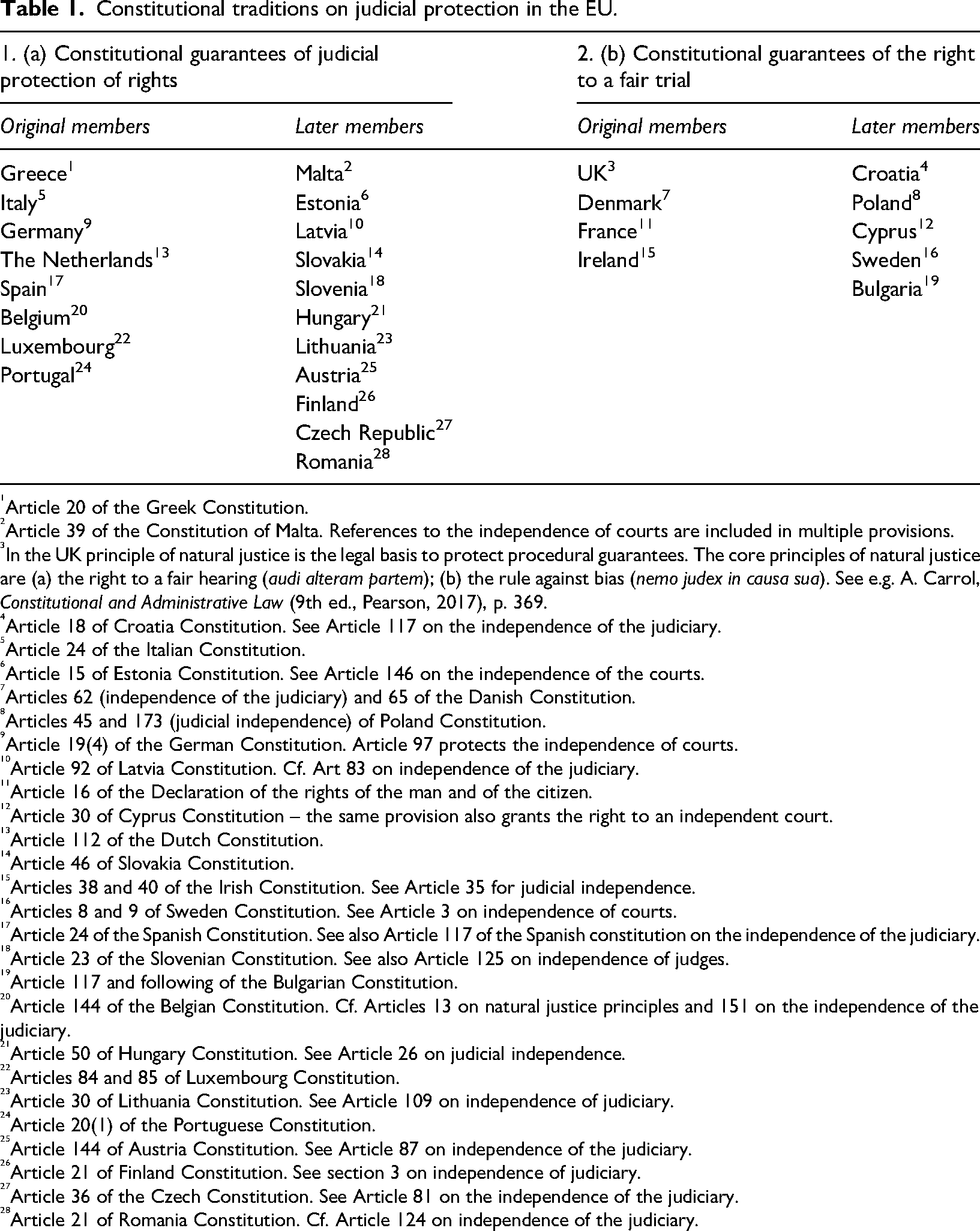
Constitutional traditions on judicial protection in the EU.
Article 20 of the Greek Constitution.
Article 39 of the Constitution of Malta. References to the independence of courts are included in multiple provisions.
In the UK principle of natural justice is the legal basis to protect procedural guarantees. The core principles of natural justice are (a) the right to a fair hearing (audi alteram partem); (b) the rule against bias (nemo judex in causa sua). See e.g. A. Carrol, Constitutional and Administrative Law (9th ed., Pearson, 2017), p. 369.
Article 18 of Croatia Constitution. See Article 117 on the independence of the judiciary.
Article 24 of the Italian Constitution.
Article 15 of Estonia Constitution. See Article 146 on the independence of the courts.
Articles 62 (independence of the judiciary) and 65 of the Danish Constitution.
Articles 45 and 173 (judicial independence) of Poland Constitution.
Article 19(4) of the German Constitution. Article 97 protects the independence of courts.
Article 92 of Latvia Constitution. Cf. Art 83 on independence of the judiciary.
Article 16 of the Declaration of the rights of the man and of the citizen.
Article 30 of Cyprus Constitution – the same provision also grants the right to an independent court.
Article 112 of the Dutch Constitution.
Article 46 of Slovakia Constitution.
Articles 38 and 40 of the Irish Constitution. See Article 35 for judicial independence.
Articles 8 and 9 of Sweden Constitution. See Article 3 on independence of courts.
Article 24 of the Spanish Constitution. See also Article 117 of the Spanish constitution on the independence of the judiciary.
Article 23 of the Slovenian Constitution. See also Article 125 on independence of judges.
Article 117 and following of the Bulgarian Constitution.
Article 144 of the Belgian Constitution. Cf. Articles 13 on natural justice principles and 151 on the independence of the judiciary.
Article 50 of Hungary Constitution. See Article 26 on judicial independence.
Articles 84 and 85 of Luxembourg Constitution.
Article 30 of Lithuania Constitution. See Article 109 on independence of judiciary.
Article 20(1) of the Portuguese Constitution.
Article 144 of Austria Constitution. See Article 87 on independence of the judiciary.
Article 21 of Finland Constitution. See section 3 on independence of judiciary.
Article 36 of the Czech Constitution. See Article 81 on the independence of the judiciary.
Article 21 of Romania Constitution. Cf. Article 124 on independence of the judiciary.
This finding confirms that common constitutional traditions used by the CJEU do not necessarily have to stem from all the Member States. A shared constitutional heritage reflecting the EU constitutional identity may be identified even when a constitutional tradition exists in a majority of Member States. Yet, as explained above, the majoritarian approach should be seen as one of the options for identifying a common tradition, not the only viable method. Currently, 19 Member States’ constitutions include provisions laying down the individual right to receive effective protection of rights before a judge.
Two final observations are in order. First, although the principle of effective judicial protection was born out of the constitutional tradition on effective protection of rights, the subsequent case law has also incorporated the second family above identified, that regarding fair trial guarantees. 44 Second, Article 47 of the EU Charter of Fundamental Rights, which reincarnates the principle of effective judicial protection, embodies both constitutional traditions above identified: the first sentence of this provision protects the right to an effective remedy while the latter two lay down fair trial requirements.
The paper has so far explored the original influence of common constitutional traditions in establishing the EU principle of effective judicial protection. We will now trace the diachronic impact of common constitutional traditions in shaping the EU standards of effective judicial protection via the opinions of AGs.
This section focuses on the use of constitutional traditions in the opinions of AGs on the principle of effective judicial protection. 45 In other words, this part of the paper enquires on the diachronic influence of common constitutional traditions in moulding the principle of effective judicial protection as we know it. Some remarks on methodology are necessary. The judgments of the ECJ tend to be prescriptive rather than descriptive. As a result, they do not always develop a comparative analysis or provide a detailed discussion on the influence exercised by national legal orders in shaping EU law. 46 By contrast, AGs’ opinions are like a smithy for the EU judicature to forge concepts and principles of EU law. Lenaerts and Gutman have rightly pointed out that AGs have a prominent role in carrying comparative analysis at the Luxembourg Court. 47 Firstly, they identify legal trends in the national systems as well as commonalities among the traditions of the Member States. 48 Secondly, they may adopt in their opinions an approach to legal matters shaped by their own judicial traditions. It follows that AGs’ opinions are the best sample to trace the influence of constitutional traditions in the evolution of the principle of effective judicial protection.
Methodologically, opinions were not chosen under a systematic approach. Instead, two elements have guided the selection: first, the seminal nature of the case in establishing the content of effective judicial protection; second, the presence of references to the concept of constitutional traditions common to the Member States. As will be demonstrated, constitutional traditions have been used in three ways: as a constitutional-building rhetoric; as a majoritarian phenomenon to limit the expansion of effective judicial protection; as dialogic tools for developing EU standards of effective judicial protection.
Common constitutional traditions as European constitution-building rhetoric
In the first category of opinions, references to common constitutional traditions were not elaborated on in the reasoning of AGs’ opinions but mentioned in passim, without substantive discussion. Reliance on this concept is not the symptom of an in-depth comparative analysis. Rather, it signals the intention to create the EU's constitutional identity, which builds upon the EU principle of effective judicial protection. Through this principle, the EU judicature was able to establish a narrative of compliance and enforcement of EU law embraced by national courts. Most of the opinions on effective judicial protection belong to this category. Examples of this use of common constitutional traditions are the opinions in Commission v. Austria, 49 UPA, 50 Unibet, 51 Kadi I 52 and Texdata, 53 all opinions delivered by AGs trained in different legal systems and of different professional backgrounds. These opinions will be discussed in turn.
After the Johnston case, a first opinion in which we can trace a discussion on the role of the common constitutional tradition on effective judicial protection is that of AG Tizzano in Commission v. Austria. 54 The case stemmed from infringement proceedings against Austria, which was alleged to have breached Directive 89/105/EEC by not introducing judicial procedures for challenging decisions on the prices of medicinal products. It is interesting to note that the opinion of AG Tizzano 55 in the case concentrated on the presence of judicial control over national measures affecting rights stemming from that Directive. According to AG Tizzano, the requirement of judicial control originated from the constitutional traditions common to the Member States. He found that in case the only available remedy was an appeal procedure to bodies that ‘are not judicial in nature but also lack decision-making power […]’, 56 then Article 6 of the Directive would be breached. The reference to common constitutional traditions was not developed but was employed to enhance a shared fundamental right rhetoric. 57
Another seminal case on effective judicial protection is UPA, 58 concerning the criteria of direct and individual concern under Article 230 EC. In his renowned opinion, 59 AG Jacobs recalled the settled case law according to which the principle of effective judicial protection stems from constitutional traditions common to the Member States and Articles 6 and 13 ECHR. He then explained that proceedings at the national level might not comply with the principle of effective judicial protection. Therefore, according to AG Jacobs, the principle should have been interpreted as requiring access to the Community's courts to challenge Community acts that do not require implementing measures. In UPA, like in Commission v. Austria, the reference to constitutional traditions works as a formal reminder of a shared constitutional heritage among the Member States. The scope of effective judicial protection proposed by AG Jacobs, a British scholar and legal practitioner, is more encompassing than would be suggested by the UK constitutional tradition about judicial protection, which (as indicated above) focuses rather on the right to be heard and the principle of adversarial justice. 60 Yet, AG Jacobs’ understanding of effective judicial protection does have ties with the liberal standing requirements used in UK administrative law. 61
A third case to consider is Unibet and the relevant opinion delivered by AG Sharpston. In her opinion, AG Sharpston recalled the Safalero 62 case. In Safalero, national procedural rules did not permit court proceedings to challenge a measure adopted by the public authorities concerning EU rights. The Court held that those rules were compatible with EU law so long as a remedy to protect Community rights was provided under national law. 63 According to AG Sharpston, such an interpretation of effective judicial protection ‘reflect[s] the fact that the principle of effective legal protection itself reflects a general principle of law which underlies the constitutional traditions common to the Member States.’ 64 But this case is also an example of constitutional traditions being used as a constitutional rhetorical device, with a marginal role in AG Sharpston's reasoning.
Finally, the same usage of common constitutional traditions may be traced in the opinions on the Kadi I appeal and Texdata cases. These decisions are of interest because they clarified crucial aspects of effective judicial protection in two different areas. The Kadi I appeal established that the addressees of sanctions are entitled to obtain effective judicial protection of the rights they derive from Community law, while Texdata delineated the procedural rights of companies which did not submit their accounting documents on time in violation of EU law. Both the opinions of AG Poiares Maduro on the Kadi I appeal 65 and of AG Mengozzi in Texdata 66 refer to constitutional traditions but do so without any development; references to common constitutional traditions are rhetorical and almost mechanical.
The considered opinions reveal a limited role of constitutional traditions in giving form to effective judicial protection. A more thorough engagement with the concept is absent, the use of constitutional traditions appearing as a stylistic addition seeking to give life to the EU constitutional identity. However, another category of opinions suggests that constitutional traditions may also be used as a ‘brake’ for the expansion of effective judicial protection.
Common constitutional traditions as a limit to the expansion of effective judicial protection
In a series of AGs’ opinions on effective judicial protection, the concept of a ‘constitutional tradition common to the Member States’ has been used to limit the expansion of that principle. Specifically, in cases where a shared constitutional tradition on judicial protection could not be identified, AGs have concluded that the EU principle should not be expanded to incorporate a broader set of rights. In those cases, the approach adopted by AGs indicates that the constitutional traditions of Member States can only reshape effective judicial protection when present in (at least) a majority of national systems.
The opinion of AG Mengozzi in DEB 67 is illustrative of this second category of opinions. The case concerned whether legal entities could be granted legal aid to pursue claims based on EU law. AG Mengozzi explained that ‘it is impossible to infer from the respective practices of the Member States any constitutional tradition whatsoever common to the Member States. As regards international practice, the outcome of the analysis seems to suggest that there is no international obligation incumbent on the State to grant legal aid to legal persons’. 68 AG Mengozzi concluded that ‘there is no general principle requiring Member States to grant legal aid to legal persons on the same conditions as those applying to natural persons’. 69 Therefore, the absence of a common approach in the Member States could not lead to the expansion of effective judicial protection. 70
The opinion of AG Bot in Melloni 71 is an additional example of the role of common constitutional traditions under a majoritarian methodology. As is well known, Melloni concerned the scope of the right to an appeal in the context of the execution of a European Arrest Warrant. Notably, the Tribunal Constitucional asked the CJEU whether it should enforce the Spanish level of protection of that right, which would have granted a right to appeal to Mr Melloni and halted the execution of the arrest warrant. In the opinion of AG Bot on the case, he wrote that: ‘[…] the Court of Justice cannot rely on the constitutional traditions common to the Member States in order to apply a higher level of protection. Indeed, the fact that Framework Decision 2009/299 is the result of an initiative by seven Member States and that it has been adopted by all the Member States allows us to presume, with sufficient certainty, that a large majority of the Member States do not share the view taken by the Tribunal Constitucional in its case-law.’ 72
With this convoluted statement, AG Bot concluded that ‘a large majority of the Member States’ was assumed not to protect a constitutional tradition on judicial protection similar to that present in Spain. The reason for this assumption was that the level of protection of the right to appeal included in the European Arrest Warrant Framework, which reflected the consensus of the Member States, was different from (i.e., lower than) that afforded by Spanish legal tradition. AG Bot thus seems to make two points: first, constitutional traditions – even when common to some Member States – may not be used to expand the scope of fundamental rights in EU law; second, in any event, constitutional traditions common to the Member States are only relevant in the EU legal order when enshrined in most Member States. In AG Bot's opinion, there is no indication that the majority of constitutional traditions should be absolute or relative. 73
In conclusion, the opinions in DEB and Melloni indicate that, unless a majority of the Member States shares an interpretation of judicial protection, the influence of national traditions cannot go as far as to reshape the principle of effective judicial protection. A consequence of this approach is that constitutional traditions may be used as a brake for the expansion of that principle.
Interestingly, recent opinions indicate that a more profound engagement with the various constitutional traditions in Member States can open novel avenues of dialogue between legal orders.
Common constitutional traditions as a dialogic tool for the development of EU standards of effective judicial protection
National constitutional traditions in the field of effective judicial protection have been at the centre of a series of recent opinions. AGs have actively engaged in comparative analysis and have openly reflected on the possibility of incorporating elements of judicial protection stemming from Member States’ legal orders. AGs have further considered whether constitutional traditions could be enforced even when conflicting with EU law. While the outcomes reached in these cases are diverse, what unites the opinions is an open stance towards national constitutional traditions and a more in-depth engagement with their role at EU level. It is submitted that the use of common constitutional traditions as a dialogic tool is to be preferred; it allows for cross-fertilisation between the EU and the national legal orders, thus furthering the dictum in Internationale Handelsgesellschaft. 74 These points will be discussed in the following paragraphs.
In the recent case Repubblika v. Il-Prim Ministru, 75 the matter was whether the principle of effective judicial protection imposed any constraints on appointments of judges made by the Maltese executive. In his opinion, AG Hogan explicitly engaged with comparative analysis and considered various traditions in the Member States and beyond. He stated: ‘[…] it would be pointless to deny that politics has played a role – sometimes even a decisive one – in the appointment of judges in many legal systems, including those in many Member States. It is sufficient here to refer to the experience of two of the world's most prominent and influential courts – namely, the US Supreme Court and the German Constitutional Court – nearly all of whose members were associated with particular political parties and political traditions.’ 76 He then observed that in some Member States, such as France, Belgium and Germany and to a certain extent in Italy, judges of the Constitutional Courts may be even former politicians. He remarked that these figures ‘are often simply traditionally appointed as judges of those courts’. 77 He concluded, however, that ‘[…] there is no doubt that all of these courts have proved to be resolutely independent vis-à-vis the other branches of government.’ 78 AG Hogan ultimately submitted that the rules existing in Malta were compatible with the principle of effective judicial protection. The analysis conducted in this opinion is illuminating and honest: it does not deny the differences among constitutional traditions. At the same time, it carves out the limits within which the Maltese heritage on judicial appointments may be compatible with EU effective judicial protection – respect for judicial independence being of the essence.
AG Hogan also evaluated Member States’ constitutional traditions regarding the principle of effective judicial review in Republic of Venezuela v. Council of the EU. 79 The question concerned the standing of third countries in annulment actions before the EU courts. AG Hogan submitted the argument that ‘at least in certain Member States, third countries can bring actions before national courts, which can in turn submit, in that context, requests for preliminary ruling to the Court of Justice, including regarding the validity of Union acts.’ 80 His view was that ‘The constitutional traditions of the Member States also do not appear to stand in the way of such an open interpretation.’ 81 Differently from the opinions in Melloni and DEB, AG Hogan's opinion in Republic of Venezuela did not rely on a majoritarian approach with the view to limit the development of effective judicial protection. Instead, it shows the dialogic use of common constitutional traditions: the latter may indicate the path for future developments at EU level.
A final opinion to discuss is that of AG Pikamäe in VK v. An Bord Pleanála.
82
This opinion offered an extensive discussion of constitutional traditions in the field of effective judicial protection, especially concerning the right to be defended by an established foreign lawyer. It was argued that the regime of Directive 77/249, concerning the freedom of establishment of lawyers, did not sufficiently take into account the legal traditions of the Irish system. After recalling that Europe is home to many traditions, AG Pikamäe observed ‘the legal and judicial systems of the Member States remain anchored in the tradition of each State, which is reflected not only in their institutions but also in their law and rules of ethics.’
83
The opinion then addressed whether the presence of a common law heritage in Ireland could justify derogations from the Directive system. AG Pikamäe observed that: In view of the obligation on the European Union to respect its rich cultural diversity, enshrined in the fourth subparagraph of Article 3(3) TEU, I believe it would be inappropriate to seek to give one national judicial system ‘privileged’ status compared with the others. To do so would clearly conflict with the principle of the equality of Member States before the Treaties which the European Union is required to uphold, in accordance with Article 4(2) TEU.
The opinion subsequently scrutinised the compatibility of the Irish legislation with the Directive 77/249 through the lenses of proportionality. AG Pikamäe's opinion is an extraordinary example of balancing between the achievement of EU objectives and Irish legal heritage.
So far, we have considered the use of the concept of ‘constitutional traditions’ in the reasoning of AGs’ opinions regarding effective judicial protection. Nevertheless, Member States have also invoked constitutional traditions to disapply EU law, including the standards of effective judicial protection. In these cases, the issue arises as to how to protect constitutional traditions while avoiding abuses under EU law.
Constitutional traditions invoked by Member States: How to avoid abuses?
Member States have, at times, invoked national constitutional traditions as a limit to the application of EU law. 84 This recently occurred in the rule of law saga, where constitutional tradition was used by Polish authorities as a purported shield from the application of EU law standards of effective judicial protection. Primary examples are the A.B. 85 and Commission v. Poland 86 cases (the ‘Polish Cases’) concerning the judicial reforms introduced in Poland since 2015. In A.B., the Luxembourg Court found several violations of EU law, including of the principle of effective judicial protection, while in Commission v. Poland the CJEU ordered the suspension of several aspects of the judicial reforms introduced in Poland. In both cases, the Polish Government submitted that ‘the EU law provisions raised in the questions referred 87 do not constitute a yardstick of the control of national provisions concerning procedures for the appointment of judges’, 88 lest they violate the principle of the respect of Member States’ constitutional traditions. Hence, the Polish Government alleged a contrast between the EU general principle of effective judicial protection and the constitutional traditions on judicial independence existing in Poland. Such invocation of national constitutional traditions deserves special attention as it questions the relationship between these very traditions and EU law. Three interconnected matters warrant examination in this respect: first, the boundaries of the CJEU's jurisdiction when assessing the compatibility of national constitutional traditions with EU law; 89 second, the interplay between constitutional traditions and national identities, the latter being protected under EU Treaties; 90 and third, the intensity of the scrutiny carried out by the CJEU in affairs involving constitutional traditions or national identities.
Let us begin from the first issue, i.e., the limits of the CJEU's jurisdiction when evaluating the compatibility of national constitutional tradition with EU law. While constitutional traditions common to the Member States are mentioned in Article 6 TEU, individual constitutional traditions are not ‘directly’ protected under the Treaties. Being part of national law, they are subject to the interpretative monopoly of national courts. Constitutional traditions may nevertheless be protected under EU law if common, that is if they reflect a shared view by the EU legal order on a specific legal concept, and thus form the basis for general principles of EU law. As mentioned above, 91 while the CJEU cannot interpret individual constitutional traditions, that Court may assess the compatibility of a constitutional tradition invoked by a Member State with EU law. This has occurred, emblematically, in the Omega case. 92 In so doing, the CJEU would not interpret the constitutional tradition per se. Rather, based on the information provided by the referring Court or the parties of the case, 93 the CJEU may consider a specific application of national constitutional tradition to be precluded in light of EU law. Considering the cases on rule of law backsliding in Poland above referred, the CJEU was competent to scrutinise the application – that is the implications – of the tradition invoked by the Polish Government from the angle of EU law, although the Luxembourg Court did not strictly speaking do so. In that context, there was no risk of usurpation of jurisdiction by the CJEU to the national courts’ detriment.
The second matter to examine is the interplay between constitutional traditions and national identities. Due to the origins of constitutional traditions in the legal landscape of Member States, the question arises whether national constitutional traditions (as opposed to common constitutional traditions) may be considered part of the EU concept of national identity, 94 which finds protection under EU law via Article 4(2) TEU. 95 Put another way, the question is whether constitutional traditions invoked by Member States may be shielded via the prism of national constitutional identities. It is submitted that constitutional traditions are not necessarily part of the national constitutional identity of a Member State. National constitutional identity is a narrower concept. This is because, for the idea of national identity to be meaningful, two elements appear of the essence: the constitutional feature invoked by the national authorities should be of the highest ranking in the scale of values of that legal order; second, that constitutional feature should also be considered crucial for the preservation of the national order. 96 Peculiar conceptions of fundamental rights or institutional rules essential for the functioning of the Member State are potential examples of constitutional features of highest ranking and crucial nature in a constitutional order. 97 Yet not all constitutional traditions developed in a legal order will possess these characteristics. It is worth mentioning that the importance of constitutional features in a legal community boils down to a context-dependent assessment. Various factors may be of relevance in this evaluation, including the history or the constitutional structure of the selected state. In any event, it would be for the national authorities to clearly articulate how a national constitutional tradition forms part of the national identity under Article 4(2) TEU. 98 National courts and authorities would ultimately have the last word in identifying the ‘content’ of national identities and of constitutional traditions. The CJEU has consistently applied such a deferential approach to its case law. 99
Taking, for instance, the Polish Cases discussed above, one may wonder whether the constitutional tradition on judicial protection invoked by the Polish Government should have been protected as an expression of the Polish national constitutional identity. As mentioned, the answer appears positive: constitutional traditions and national identities may be connected, in principle. Constitutional traditions which are of the highest ranking in the scale of values of that legal order and are considered as crucial for the preservation of the national order may be covered under the concept of national identity. However, two observations are in order. First, the Polish authorities have not clearly explained either the content of the invoked constitutional tradition or how it could be protected via the gateway of national identity. Second, the history and the institutional settings of the Polish legal order do not reveal that the tradition proposed in that case was part of the Polish constitutional identity. Rather, the political and institutional context pointed to an instrumentalisation of the concept of constitutional tradition on judicial protection, with the view to provoke a constitutional conflict before the EU judicature.
Yet it is not unlikely that, as in the Polish Cases, national authorities may hide themselves behind the protection of national identities or constitutional traditions to circumvent EU obligations, especially in countries affected by rule of law crises. In other words, recourse to constitutional traditions or the concept of national identity may disclose an abusive behaviour under EU law: constitutional traditions and identities may be façades to hide political agendas of Member States willing to escape the reach of EU law obligations.
This observation brings us to the third point to explore, being the intensity of scrutiny applied by the CJEU when parties invoke constitutional traditions or national identities as legal grounds. Member States may not invoke national identities or constitutional traditions in all instances to commit abuses under EU law. But in some cases reliance on these aspects of national legal heritage may go to the heart of protecting a Member State's legal order or constitutional system. The question is how to ensure that review by the CJEU strikes a fair balance between national and EU constitutional interests? Identifying the appropriate level or intensity of scrutiny to be applied in these cases (to assess the compatibility of national identities and traditions) is crucial to effectively regulate emergent constitutional conflicts within the EU.
The recent opinion of AG Kokott in V.М.А. v. Stolichna obshtina, 100 although not concerning the principle of effective judicial protection, offers insights in this respect. The case concerned, among other issues, the protection of Bulgarian national identity by reference to the concept of ‘traditional family’. The issue arose from a request for a birth certificate for a child born in an EU Member State including two mothers as parents. Considering that the concept of ‘traditional family’ is part of the Bulgarian national identity, AG Kokott held that ‘[…] where the fundamental expression of national identity in accordance with Article 4(2) TEU is at issue, the Court must confine itself to a review of the limits of the reliance on that principle, in particular respect for the values enshrined in Article 2 TEU.’ 101 Therefore, according to AG Kokott, the level of scrutiny to be carried by the CJEU in cases involving national identities should be restrained to identifying flagrant violations of EU law, and especially of the values listed under Article 2 TEU: put differently, the EU judicature may only verify that the EU founding values protected under Article 2 TEU are complied with in relation to the invocation of constitutional identity by the Member State. The alternative, scrutinising constitutional identities under the EU Charter of Fundamental Rights, would be too intrusive.
The opinion of AG Kokott further suggests that Article 2 TEU is the appropriate parameter to reveal abuses of the EU constitutional system by Member States. Violations of Article 2 TEU are instances in which the attack to the EU legal order is so manifest that the tenure of constitutional identities or traditions cannot hold. By contrast, she appears to propose that balancing national identities with EU secondary law may be inappropriate because of the importance of constitutional traditions in the hierarchy of norms in Member States. The methodology proposed by AG Kokott has also another interesting implication, that of putting EU and national supreme values on equal footing: EU and national founding values should receive equal protection and should thus be balanced as a rule. It follows that EU and national values are in principle reconcilable. Article 2 TEU may be used as a parameter to unmask the lack of good faith by national authorities when they seek to flagrantly circumvent EU law. In this context, the CJEU should assess whether the protection of the constitutional identity invoked by the Member State ultimately threatens the founding values of the EU. As argued in section 2, those values reflect the constitutional traditions common to the Member States of highest ranking in the EU. Therefore, when Member States invoke elements of their own national constitutional identity which hinder the realisation of EU essential values protected under Article 2 TEU, they risk abusing the rules of the European constitutional landscape and undermine the legal heritage on which the EU is construed. The approach advanced by AG Kokott speaks common sense and is workable in light of the EU constitutional structure, composed of EU and national legal orders. It is a methodology imbued with pluralism and crossed dialogue between legal systems.
The level scrutiny suggested by AG Kokott in V.М.А. could be applied, mutatis mutandis, to pleas based on constitutional traditions which could be reviewed from the angle of respect for Article 2 TEU to identify flagrant violations of the founding values of the EU. It is here added that, to avoid violations of the jurisdiction of national courts, the CJEU could specifically focus on the application (in the sense of practical effects) of the constitutional traditions or national identities invoked by national authorities, leaving the interpretation of those concepts to national courts. 102 In instances such as the Polish Cases, constitutional traditions on judicial protection were invoked to justify reforms whose effect was to undermine judicial independence, one of the pillars of the EU rule of law. In so doing, national authorities have not only attempted to commit flagrant violations of Article 2 TEU, but have also sought to abuse the EU legal order and its founding values. Although in A.B. the CJEU found that the judicial reforms introduced by the Polish Government violated EU law, it reached this outcome via Article 19 TEU rather than Article 2 TEU. The result of the case is in essence the same as if the CJEU had followed the approach suggested by AG Kokott in V.М.А. Yet the level of scrutiny suggested by AG Kokott appears more restrained and offers the constitutional signposting of the equal value of EU and national supreme values, which should be balanced unless the risk of abuses emerges. 103
We have thus far teased out the interaction between national traditions and identities with EU values. What remains unsettled is the relationship between centralisation and pluralism in the standards of judicial protection in the EU legal landscape.
Constitutional traditions on judicial protection and Article 47 of the EU Charter: corrosive pluralism or oppressive centralisation?
The above analysis has provided a main finding: constitutional traditions are still alive and kicking in the EU case law on effective judicial protection. They have been employed by the CJEU, in particular by AGs, in shaping the content of effective judicial protection. Member States have also invoked them as a plea to disapply EU law. What has not been considered so far is the how to reconcile pluralism and centralisation in the field of judicial protection in the EU. With the acquisition of a leading role of Article 47 of the EU Charter, reaffirming the principle of effective judicial protection, constitutional traditions linked to judicial protection may suffocate and be flattened under the aegis of the application of EU law and the principle of effective judicial protection.
Three comments can be made. First, what is essential in these settings is respect for the limits of the scope of application of EU law. 104 In other words, the reach of the EU standards of effective judicial protection should be such as not to impact areas not covered by EU law. The EU requirements of judicial protection stemming from the homonymous general principle of EU law may be higher or lower compared to national requirements. Therefore, applying the EU principle of effective judicial protection exclusively within the remit of EU law not only has the benefit of showing deference to national authorities whenever EU law is inapplicable, but may also create internal regulatory and enforcement competition between claims based on EU and national law. For instance, where claims based on EU law receive higher guarantees of protection through the prism of the principle of effective judicial protection, courts and individuals may be incentivised to reframe national actions under the lens of EU law, with the view to obtain the more extensive protections and entitlements. As a result, pluralism may be preserved while cross-fertilisation would be facilitated.
Second, when considering the tension between pluralism and centralisation with reference to judicial protection in the EU, we should bear in mind that a crucial aspect in the EU's functioning is the uniform application of EU law. 105 For the EU to achieve its goals and maintain its legitimacy, the enforcement of EU law should occur in the same terms in all Member States. Hence, pluralistic approaches to judicial protection in Member States may be conducive of an uneven application of EU law. Principles such as effectiveness and equivalence 106 intrinsically allowed pluralism although they also favoured the enhancement of centralised views on judicial protection when procedural rules hindered the effective enforcement of EU law. Nevertheless, it is undeniable that procedures shape substantive legal entitlements and thus the scope of rights, including those stemming from the EU. With the advancement of the EU legal order, currently protecting an array of rights – including fundamental ones – the need to ensure the uniform enforcement of those legal entitlements becomes a pivotal aspect in the EU evolution: as protector of the rule of law, the EU and national institutions should also ensure equality before the law, a quintessential aspect of the rule of law. Accordingly, a new framework on pluralism and centralisation of standards of judicial protection in the EU is required.
Third, when it comes to defining the EU standards of judicial protection, constitutional traditions from the Member States should keep their crucial role in furthering or reshaping general principles of EU law. 107 Constitutional traditions could further enrich EU Charter rights via the channel of the general principles. In practical terms, this means that traditions that are surfacing in the Member States could be used to redefine Charter rights. Constitutional traditions are not a ceiling: they permit the dialectical enshrining of fairness and values in the evolving EU legal order. Focusing on the EU principle of effective judicial protection, constitutional traditions may act as a catalyst for reforming and improving the level of judicial protection in Member States as well as at the EU level. A recent example of the expansive power of common constitutional traditions is the Republic of Venezuela v. Council of the EU case, in which the CJEU broadened the standing of third countries in actions for annulment, also in light of the legal traditions of Member States. 108 A desirable use of constitutional traditions would be, for instance, to provide more liberal interpretations of the standing rules concerning non-privileged applicants before EU courts. 109 By embedding constitutional traditions in the interpretation of EU requirements of effective judicial protection, the CJEU would expand the scope of the entitlements deriving from that general principle and strengthen fairness aspirations within the EU under a liberal constitutional approach. 110
Conclusion
This paper has dealt with an age-old issue, that of the influence of and interplay between constitutional traditions and the EU principle of effective judicial protection. In so doing, it has sought to fill a long-standing gap of the literature exploring the impact of the ECHR on EU standards of effective judicial protection, which has thus far disregarded the role of constitutional traditions. The main findings of the paper can be summarised as follows.
First, there should be no consolidation of a specific approach to identify common constitutional traditions. The crystallisation of a selected approach could entail excessive formalism and unreasonable constraints on the CJEU to shape the EU constitutional ethos. Thus, it is suggested that any future developments of the EU general principle of effective judicial protection should not be determined under a specific methodology in the EU jurisprudence.
Second, the Johnston judgment, in which the principle of effective judicial protection was forged, seems to have drawn from one of the two major constitutional traditions on judicial protection available in the Member States, being that focusing on the judicial protection of individual rights. This distinct constitutional tradition, opposed to one concentrating on the fairness of proceedings and procedural guarantees, could be traced in the majority, but not all, of the Member States’ constitutional orders at the time of the Johnston judgment. Those traditions are still living through the prism of Article 47 of the EU Charter, which protects both the right to effective remedies and that to a fair trial.
Third, an analysis of the opinions of AGs concerning the principle of effective judicial protection demonstrates that there are three ways in which constitutional traditions have been used to define the content of the principle of effective judicial protection: (a) as instruments of European constitution-building rhetoric (e.g., UPA); (b) to limit to the expansion of effective judicial protection (e.g., Melloni); (c) as dialogic tool for the development of EU standards of effective judicial protection (e.g., Repubblika v. Il-Prim Ministru). Among the three categories, the third is preferable: such use of constitutional traditions highlights the dialectical relationship between the EU and the Member States’ constitutional orders, where the former can be enriched by the latter.
Fourth, constitutional traditions and national identities may be strictly interconnected. Yet, either category could be invoked by national authorities to defend abuses under EU law. As suggested by AG Kokott in V.М.А., the protection of either of these categories should occur in compliance with Article 2 TEU. The scrutiny of the CJEU through this provision aims to unveil flagrant violations of the EU founding values and is less intense than that carried under the Charter. Accordingly, pleas invoking national traditions on judicial protection raised by Member States to limit the application of EU standards of effective judicial protection could be scrutinised from the angle of Article 2 TEU, with the view to uncover any blatant attempts to commit abuses under EU law.
Finally, the paper has reflected on the tension between centralisation and pluralism in the standards of effective judicial protection in the EU legal landscape. Three comments were raised. First, the application of judicial protection standards predicated under the homonymous principle of EU law should be limited to the scope of application of EU law. Such an approach would ensure deference to national authorities when EU law is not applicable and may even stimulate enforcement competition between EU and national claims. Second, the advancement of the EU legal order requires a rethinking between pluralism and centralisation of judicial protection standards. With the expansion of EU law entitlements, currently including fundamental rights and values, the uniform application of EU law should rest on the principle of equality before the law, or else risk violating the founding value of the EU rule of law. Third, constitutional traditions common to the Member States may still play a significant role in shaping effective judicial protection. EU Charter rights, including Article 47 thereof which reaffirms the principle of effective judicial protection, may be interpreted and redefined in the light of new constitutional traditions developed in the Member States. Although the EU has its own system of remedies, Member States can offer further inspiration for the development of the EU standards of effective judicial protection. As mentioned by US Supreme Court Justice Breyer: ‘If here I have a human being called a judge in a different country dealing with a similar problem, why don’t I read what he says if it's similar enough? Maybe I’ll learn something…’ 111 The common constitutional traditions are a Pandora’s Box that awaits to be fully opened. It is true that, once opened, the Box brought to the world all kinds of evil. However, it also brought hope.
Footnotes
Acknowledgements
A previous version of this paper was presented at the 2021 Young FIDE seminar. I am thankful to the organizers and the panellists of that seminar, and to Merijn Chamon, Mariolina Eliantonio and the anonymous reviewers for helpful comments. A reduced version of the paper is published in EU Law Live Weekend Edition: Gentile, G. (2021). ‘“Faraway, so close!” The principle of effective judicial protection and the constitutional traditions common to the Member States’, EU Law Live, Weekend Edition n. 64, p. 7–11, available at  .
.
Declaration of conflicting interests
The author(s) declared no potential conflicts of interest with respect to the research, authorship, and/or publication of this article.
Funding
The author(s) received no financial support for the research, authorship, and/or publication of this article.