




Abstract
This article explores why national judges remain passive on EU legal integration by examining judges’ reasons for not requesting preliminary rulings from the European Court of Justice (ECJ). The article combines insights from social psychology and literature on the role of national courts in European integration to formulate expectations regarding what type of motives guide national judges’ behaviours. Drawing on interviews held with Croatian, Slovenian and Swedish judges, our results reveal three shared reasons judges remain passive: referrals are not required by the formal rules (procedural normative motivation), referrals are not made to protect the parties to the case (substantive normative motivation) and referrals are not made to protect judges’ reputations (instrumental motivation). In addition, we unveil motives that are shared by only judges from one or two Member States, such as not referring cases to uphold the capacity of the preliminary ruling procedure (Swedish judges) and not referring cases due to a fear of sanctions and a lack of knowledge and resources (Croatian and Slovenian judges). We discuss these similarities and divergences in light of the theoretical discussion on the role of courts as active or passive actors in EU legal integration.
Keywords
Introduction
National courts are considered the main interlocutors of the European Court of Justice (‘ECJ’ or ‘the Court’). 1 The conventional view holds that national courts and judges have helped the ECJ push the integration process further than Member State governments would have been willing to do on their own. 2 The national judges have done so by supplying the Court with cases under Article 267 of the Treaty on the Functioning of the European Union (‘TFEU’). However, while many national courts refer cases to the ECJ and thereby become co-producers of EU legal norms, 3 others remain passive bystanders of the EU integration process. 4 This phenomenon whereby some national courts and judges refrain from engaging in the preliminary ruling procedure has important implications for the future direction of EU legal integration. If national judges fail to introduce their Member States legal traditions before the Court, they leave it for the ECJ to apply EU law as it sees fit. 5 By extension, pluralistic European constitutional dialogue is likely to be weakened. 6
While there is a growing body of literature on the behaviour of individual national judges, for instance with regard to their knowledge of and attitudes towards EU law, 7 only a handful of studies have provided in-depth insights into how judges experience the preliminary ruling procedure and what drives their decision to remain passive. 8 This article contributes to the literature on the role of national judges in the EU legal system and on the debate on passive national judges in two ways. First, it makes an empirical contribution by investigating how Croatian, Slovenian and Swedish judges decide not to request preliminary rulings from the ECJ. Apart from a few notable studies on Danish courts, 9 knowledge regarding the passive behaviour of judges in Nordic Member States such as Sweden is largely lacking. 10 Moreover, although important contributions have been made to the literature on the actions of courts in post-communist Member States such as Poland, 11 Croatia and Slovenia, 12 the judges in these younger Member States have still received relatively little attention. 13 Second, the article sheds new light on the discussion regarding the behaviour of passive national courts in the EU legal system. Exploring why judges in Member States with relatively few referrals proportional to their population sizes, such as Croatia, Slovenian and Sweden, 14 are discouraged from requesting preliminary rulings may help in identifying effective remedies to reduce their passiveness.
To analyse the passiveness of national judges in the preliminary ruling procedure, this article combines insights from the social psychology literature on the driving forces of human action and the previous research on the role of national courts in European integration to develop expectations about how individual national judges motivate their decision not to refer cases to the ECJ. The social psychology perspective allows us to differentiate between procedural normative motivations (the formal EU rules) and substantive normative motivations (other professional norms shaping judges actions). This distinction, in turn, provides a more nuanced account of national judicial behaviour in the preliminary ruling procedure. Drawing on qualitative interviews held with 55 judges from Croatia, Slovenia and Sweden, the findings show that judges share three main reasons for not referring cases: referral is not required by the formal rules (procedural normative motivation), concerns about the consequences of referral for the parties (substantive normative motivation) and concerns about reputational loss (instrumental motivation). Furthermore, the analysis reveals noticeable differences between judges in the different Member States. While Swedish judges refrain from making a referral out of a concern for the ECJ’s limited capacity to deliver rulings (substantive normative motivation), Croatian and Slovenian lower court judges avoid the procedure due to their lack of resources and knowledge and the risk of being punished by their employers for not meeting production targets (instrumental motivation). These findings have important implications for our understanding of whether the passiveness of some national judges threatens the functioning of the EU legal system.
This article proceeds as follows. Section 2 presents previous research regarding the behaviour of national judges in the preliminary ruling procedure. In section 3, we develop our theoretical framework. Section 4 describes the materials and methods used. Section 5 presents our empirical findings. We conclude by discussing the implications of our findings with respect to the debate on the role of courts as active or passive actors in EU legal integration in section 6.
Passive national courts in the EU legal system
In light of the uneven acceptance of ECJ doctrines and the variation in referral rates across and within Member States, 15 attempts have been made to theorize why national judges are reluctant to engage in the preliminary ruling procedure. We identify the following three main theoretical explanations applied in this debate: the compliance pull explanation, the inter-court competition thesis and the sustained resistance explanation.
The compliance pull explanation (legal formalism) builds on the assumption that national judges will make referrals to the ECJ because they have a responsibility to follow the letter of the law (namely, Article 267 TFEU). 16 Claes argues that national judges initially accepted EU law because they were convinced by the Court’s legal arguments on the validity and supremacy of EU law over national law. 17 Expanding on the compliance pull explanation, Hübner proposes that resorting to the preliminary ruling procedure in a specific case will depend on whether judges need help with issues surrounding the validity and/or interpretation of EU legal acts. 18 If judges feel that such help from the ECJ is not needed, for example because they find the interpretation of EU law to be ‘obvious’, 19 they will not make a referral.
The second theoretical explanation builds on the logic of Alter’s inter-court competition thesis, which proposes that judges working in lower instances can become empowered by participating in the preliminary ruling procedure by, for instance, being granted the right to exercise judicial review. In contrast, high court judges are generally expected to be less willing to request preliminary rulings. By withholding references from the ECJ and resolving disputes themselves, national high court judges do not have to share their decision-making power with the ECJ. 20 According to this logic, national high court judges’ motive for not referring cases is to maintain their power.
Finally, the sustained resistance explanation suggests that national judges refrain from requesting preliminary rulings out of a desire to defend national policies and slow the pace of EU legal integration. 21 Similarly, Volcansek, 22 Carrubba and Murrah 23 and Dyevre and Lampach 24 argue that the refusal of national judges to refer cases to the ECJ can be understood in terms of their negative sentiment towards European integration and their preferences for national law.
While all of these three explanations have merit, they have also been criticized on empirical and theoretical grounds. For instance, critique of the compliance pull explanation has highlighted that this explanation cannot explain variations in referral rates or acceptance of ECJ doctrines across courts from different Member States. 25 Similarly, the inter-court competition thesis has been criticized for not being able to account for the steady but uneven rise in referrals from the highest national courts. 26 While some studies have found support for the proposition that judges who are sceptical of EU law and who do not see themselves as EU law judges are less likely to make a referral to the ECJ, even in cases when they are obliged to do so, 27 the works of Krommendijk, 28 Pavone 29 and de Werd 30 suggest that reasons relating to personal preferences and empowerment proposed by the sustained resistance explanation and the inter-court competition thesis are more of an exception rather than a rule. In addition, Leijon 31 theorizes that national judges’ referral behaviours may instead be the result of an attempt to strike a balance between EU law and Member State autonomy.
To shed new light on the question of what drives the behaviour of national judges, the next section combines the literature on EU legal integration with insights from social psychology scholarship to develop our expectations for what motivates judges not to refer cases to the ECJ.
Theorizing motivations for national judges’ passiveness in the preliminary ruling procedure
To explore what motivates national judges to be passive in the preliminary ruling procedure, a useful starting point is the social psychology literature and the distinction between instrumental motivations, procedural normative motivations and substantive normative motivations. 32 These three different categories enable us to theoretically identify judges’ motives for action that are neither strictly based on formal EU rules (compliance pull arguments) nor based on self-interested considerations. In addition, this literature helps identify the instrumental reasons that are unrelated to the politico-strategic dimension of European integration.
We first turn to instrumental motivations for human actions. Building on the rational and consequential logic, 33 it is assumed that actors guided by instrumental motivations generally strive to avoid punishment and to evade risks. These punishments and risks may include sanctions from political principals or personal consequences such as reputation loss and additional workload. 34 Apart from suggestions that judges avoid referring cases because they want to protect national law from EU law intrusions (sustained resistance explanation) or maintain their authority (inter-court competition thesis), literature on the referral behaviour of national judges proposes several concrete instrumental motivations. For example, with regard to reputational considerations, it has been argued that when the ECJ rejects national judges’ request for a preliminary ruling and instead issues a reasoned order, 35 this decision may have a ‘chilling effect’ on judges’ future referral propensity. 36 This claim is supported by a study of the Dutch judiciary, which finds that judges sometimes avoid referring cases out of a fear that the ECJ would dismiss their questions as irrelevant. 37 For sanctions from a political principal, scholars such as Pavone 38 and Wind 39 find evidence that the aversion of Italian and Danish judges to the preliminary ruling procedure is related to the direct ‘threat’ of disciplinary sanctions from legislative or state legal services.
Given this fairly broad range of potential instrumental motives, it is not possible to formulate specific expectations regarding all risks judges may want to avoid. Instead, we adopt an open-ended approach: if judges decide not to refer cases to the ECJ on instrumental grounds, we expect them to justify their decision based on their fear of suffering negative consequences 40 (such as the risk of reputational loss, deteriorating work conditions or a loss of influence). For example, judges may decide against a referral because they do not know how to formulate it and because they consider that requesting a reference would increase their workload and thereby negatively affect their work-life balance. Moreover, considering the generally unequal division of workload versus resources across tiers of the judicial hierarchy, 41 we expect such motives related to the likely increase in workload resulting from requesting a preliminary ruling to be more common among lower court judges than among judges working on final instance courts.
Human action guided by procedural normative motivations denotes that individuals loyally follow legal sources that they consider legitimate. 42 Loyalty to the law is considered a ‘professional imperative’. 43 According to the literature on European integration and the compliance pull explanation, this legitimate legal source is EU law. Hübner, for example, stresses that national judges ‘generally follow the letter of the Treaty when they are deciding which rules they are asking the ECJ to interpret’. 44 Hence, national judges can be expected to decide not to refer cases to the ECJ with reference to the formal EU rules regulating the preliminary ruling procedure. This proposition requires a closer look at the Treaty Article that regulates the procedure. According to Article 267(3) TFEU, lower national courts may, and courts of final instance shall, refer questions regarding the interpretation of EU law to the ECJ. However, following the ECJ’s case law, there are two exceptions to these rules. First, courts of the final instance are not required to refer a case if the interpretation of EU law is ‘obvious’ (the CILFIT criteria). 45 Second, lower national courts are obliged to refer cases for which the validity of EU law is at stake. 46
Given these assumptions, what are our expectations? If national judges base their decisions on procedural normative motivations, we expect lower court judges to justify their decision not to request a preliminary ruling from the ECJ based on the fact that a referral is not required (that is, that they have no obligation to refer) unless the validity of EU law is at stake. For final instance judges, we expect them to decide not make a referral because they find the application and interpretation of EU law to be sufficiently clear and unambiguous.
Finally, substantive normative motivations for human actions include motives that build on actors’ own conception of justice. These motives are shaped not only by formal rules but also by empathy and justice. 47 In the case of judges, their conceptions of justice are likely to be based on shared beliefs about judicial obligations, 48 traditions of professional judicial conduct, and abstract legal principles such as the principle that judges are supposed to act in a way that is appropriate concerning the integrity and independence of the judiciary. 49 The role of substantive normative motivations has been less explored with respect to judicial behaviour in the preliminary ruling procedure. However, some empirical studies have stressed that national judges sometimes deviate from formal EU rules because they believe that following these rules would be unreasonable, for example, when making a referral would lead to high economic costs for the parties to the case. 50
Due to the lack of previous research on substantive normative motivations in the literature on the preliminary ruling procedure, we formulate our expectations regarding the judges’ conceptions of justice in a more encompassing manner. If national judges base their decision not to refer cases to the ECJ on substantive normative motivations, we expect them to justify their decisions with reference to what they consider just and appropriate in a given situation, regardless of what action the formal EU rules prescribe.
Table 1 summarizes our theoretical expectations and the relationship between the literature on EU legal integration and social psychology.
Theoretical expectations.
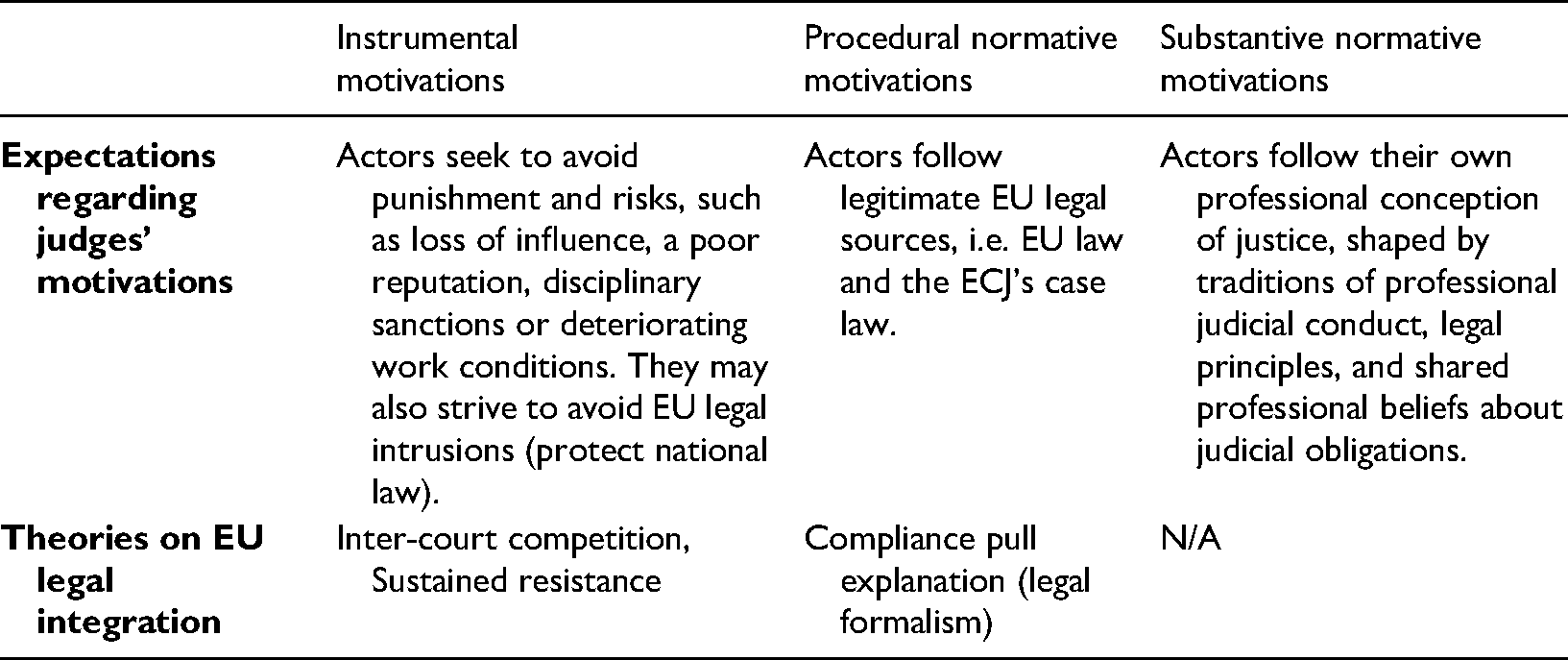
Theoretical expectations.
To contribute to the scholarly discussion regarding what discourages national judges from referring cases to the ECJ, this study builds on semi-structured interviews with a total of 55 judges from Croatia, Slovenia and Sweden carried out in 2017 and 2018. 51 In Sweden, a random selection of 10 judges from the final instances and 10 judges from the lower instances were interviewed. Of the total number of judges contacted (n = 22), two declined to participate due to personal reasons. In Croatia and Slovenia, the respondents were approached as part of a survey on the application of EU law among lower court judges. After indicating their willingness to participate in a follow-up interview (n = 74), 18 judges from Croatia and 13 judges from Slovenia were ultimately interviewed. 52 To allow for comparisons across court levels, a random selection of final instance judges (n = 10) was later approached, and three Croatian judges and one Slovenian judge agreed to be interviewed. 53 During the interviews, judges were asked to describe their experiences with EU law, with a particular focus on occasions where they considered whether to refer a case to the ECJ and why they decided against this. To analyse the interview transcripts, thematic content analysis was used. 54
Apart from making an empirical contribution, exploring what motivates judges in Croatia, Slovenia and Sweden to not refer cases to the ECJ sheds light on the views of European judiciaries that can be described as passive consumers in relation to the EU legal system. Here, ‘passive consumers’ refers to national judiciaries that request relatively few preliminary rulings, a behaviour that implies that they risk being side-lined when the ECJ and courts in other Member States develop EU law. 55 The courts in these three Member States fit the description of being fairly passive since they have referred fewer cases to the ECJ than the EU average. 56 From 2016 to 2020, Swedish courts referred on average 3.7 cases per million inhabitants to the ECJ. This figure is substantially lower than those of referrals made from the courts in the other Nordic Member States, namely, Denmark (5.7) and Finland (5.5), but also lower than the EU average (8.5). Croatian courts have referred on average 5.5 cases per million inhabitants to the ECJ, while the corresponding figure for Slovenia is 7.5. These figures are below the number of referrals made by courts from other Central and Eastern European (‘CEE’) Member States, such as Bulgaria (15) and Hungary (10.7).
Another advantage of this case selection approach is that the three Member States differ with regard to their accession dates: Sweden joined the EU in 1995, while Croatia and Slovenia are younger Member States joining the EU in 2013 and 2004, respectively. Interviewing judges from these Member States enables us to investigate the proposition made in the literature that judges in younger Member States refrain from referring cases to the ECJ because they lack knowledge of EU law and have not yet had time to become acquainted with EU legal procedures. 57 We thus expect judges in Slovenia and, in particular, in Croatia to be more likely to refer to their insufficient knowledge 58 of the procedure as a reason for not sending legal questions to the ECJ than their Swedish counterparts.
There are certain limitations to the design of this study. First, while interviews are considered an appropriate method to gain an understanding of how actors perceive their world and make decisions, 59 we cannot know whether the respondents reveal their true motivations for action. Due to social desirability bias, respondents may be prone to portray themselves in a more favourable light by, for example, overemphasizing their experience with EU law. Second, the selection of respondents relies partly on self-selection, which might lead to a bias where judges with certain characteristics, such as substantial knowledge of EU law or positive sentiment towards the EU, are more likely to participate in an interview. 60 While it is not possible to fully resolve these issues, it is important to keep them in mind when interpreting the results.
Results
This result section consists of two parts. The first part presents the results on reasons for not referring cases to the ECJ shared among Croatian, Slovenian and Swedish judges. In the second part, we turn to the motives that are common to respondents from only one or two of the studied countries, and we propose potential explanations for such divergence. When relying on direct quotes, each respondent is assigned a country abbreviation (e.g. CRO for Croatia, SI for Slovenia and SE for Sweden), a number, and the level of the court the judge sits on (first, second or third instance).
Passive for the same reasons
Croatian, Slovenian and Swedish judges share three main reasons for being passive in the preliminary ruling procedure: a referral is not required by the formal rules, a wish to protect the parties to the case, and a wish to protect one’s reputation. In addition, a few respondents from each Member State also articulate that their unwillingness to refer stems from their own negative views of EU law and the ECJ.
Referral not required by the formal rules: A procedural normative motivation
Almost all respondents mention the formal rules prescribed by Article 267(3) TFEU or the CILFIT criteria when describing their decision not to refer EU law cases to the ECJ. For instance, lower court judges argue that ‘the first instance does not have to [make a referral]’ (CRO 4, first instance), as they are ‘not obliged’ to request preliminary rulings (SI 2, first instance) and ‘can interpret [EU law] by themselves’ (SI 9, second instance).
The respondents from high courts also frequently evoke the CILFIT criteria as a reason for not turning to the ECJ with a preliminary question. As a Swedish high court judge states, ‘It is always a question of assessing whether there is a need to get an answer from the ECJ; one can often on very good grounds claim that “this question is not unclear; we do not need to ask”’ (SE 14, third instance). Although the CILFIT criteria formally apply only with respect to the highest national courts, our results show that lower court judges, contrary to our expectations, also make use of the acte claire doctrine. 61 A Slovenian judge states that ‘if the interpretation is clear enough I interpret the matter in light of EU law’ (SI 12, second instance). Furthermore, the fairly small number of preliminary questions submitted by the lower courts in Slovenia can, according to one judge, be justified by the fact that if ‘the court is confronted with some sort of divergence [between Slovenian and EU law], the court interprets it in a way that is consistent with EU law’ (SI 9, second instance). Similar to Dutch and Irish lower court judges, these judges are also ‘well aware of their discretion to refer’. 62
These quotes serve as clear examples of procedural normative motivations corresponding to the expectations of the compliance pull explanation, which assumes that judges are professionally bound to follow legal rules. In the EU legal system, national judges may refrain from sending questions regarding the interpretation of EU law to the ECJ under certain conditions. It is, therefore, not surprising to find that respondents justify their decision not to request preliminary rulings with reference to these conditions in Article 267(3) TFEU or the CILFIT criteria. However, as we show in the next sections, legal rules are not the only factor preventing judges from making referrals and, for many judges, they may not even constitute the main factor at play.
Protect the parties from negative consequences: A substantive normative motivation
Several respondents from all three Member States (13 from Croatia, 5 from Slovenia and 5 from Sweden) from both lower and higher courts emphasized the well-being of the parties to the case as a reason for not requesting preliminary rulings. In particular, and in contrast to previous research, 63 it is the delay of the legal process that judges find to be the main problem facing the parties and the reason why cases are not referred to the Luxembourg Court. Sending a preliminary question ‘means a delay in the procedure, and no one would want that. It would not be well accepted. This is probably why posing a preliminary question is not attractive’ (SI 10, second instance) and ‘you have to think about the costs and what it would mean for the parties if we would put the case on hold for two to three years’ (SE 5, second instance). Notably, these respondents all refer to situations in which the parties to the case had not raised the need to request a preliminary ruling. 64 Formally, national courts do not have to consider the wishes of the parties when making this decision. 65 However, a Croatian judge went as far as to say that if the parties do not want a preliminary ruling, then the court will not consider requesting one. S/he argues that the referring case ‘should be on the party’s initiative… We cannot do anything without the positions of the parties’ (CRO 8, first instance).
The respondents’ concern for the parties’ situation is considered a substantive normative motivation, which relates to the principle that ‘justice delayed is justice denied’. The time it takes to resolve a legal dispute is crucial for whether citizens consider the justice system to be fair. 66 Waiting almost two years for an issue to be resolved by the ECJ is likely to contribute to a person’s dissatisfaction with the effectiveness of the legal system. However, for some respondents, it is also connected to instrumental motivations and a wish to avoid criticism. A Supreme Court judge in Croatia, for example, mentions the unpleasant public criticism s/he faced when the court decided to make a referral: ‘There were some public attacks on the Supreme Court because now we again prolonged the proceedings by asking the preliminary question’ (CRO 19, third instance).
These findings, although in contrast to results reported by Krommendijk, are in line with the propositions put forth by de Werd, who argues that ‘[c]onsidering the average time of 16 months taken by the Court to answer a reference, this is a missed opportunity in terms of the efficiency and effectiveness of both the procedures at the Court and at home’. 67 In a similar vein, Tridimas found that because British judges attribute particular importance to judicial efficiency, their referral behaviour is driven by an ‘if in doubt, decide yourself’ presumption. 68
Protect one’s reputation: An instrumental motivation
Respondents from each of the three Member States commonly mention that fear of damaging their reputation had made them less inclined to refer cases to the ECJ (eight from Croatia, six from Slovenia, and four from Sweden). These judges, working both at lower and higher courts, elaborate on the risks associated with referring the ‘wrong’ cases to the ECJ. As one Slovenian judge noted, ‘nobody wants to make a fool out of himself with a wrong or simply poorly posed preliminary question’ (SI 10, second instance).
The interviewees are also concerned about receiving a reasoned order, instead of a preliminary ruling, from the Court. An order suggests that the referral could have been avoided if the national judge had spent more time drafting the question or had checked the ECJ’s case law. A Swedish judge notes that it is ‘a great horror…if the answer you receive is a reasoned order because it means that “you could have read about it in this and this judgment”’ (SE 9, second instance). A Slovenian judge similarly states the following: This is one of the fears. If I asked the preliminary question and the Court says, ‘C’mon, you don’t have a clue’, I would feel embarrassed. Or, maybe this question has already been asked, and I did not know that… It is a serious embarrassment if you ask a preliminary question to which the answer has already been given (SI 12, second instance).
When a question is addressed by a reasoned order, this is likely to be known to fellow judges, since this information is included in the final ruling and available on the ECJ’s database for everyone to read. A Croatian judge responsible for organizing workshops on EU law says ‘Our first preliminary questions were [immature as] “kittens”. We even gave them negative examples at the workshops’ (CRO 10, second instance). This desire to protect one’s reputation has been found at both lower instances and at the highest courts. For example, a Supreme Court judge from Croatia says ‘It is not pleasant if the EU court tells you: “Oh, c’mon, we have already answered this 10 times. What do you want now?” This might indicate that you have not studied the Court’s practice well enough’ (CRO 19, third instance).
Criticism from high courts may undermine the status of judges, hurt their reputation in the legal community and jeopardize their future careers. 69 Our findings show that judges from Croatia, Slovenia and Sweden think about how referring the ‘wrong’ type of case might reflect badly on them. Judges, therefore, appear to have a reputation-driven incentive to avoid receiving a negative response from the ECJ, serving as a clear example of instrumental motivation.
Negative sentiment towards European integration, EU law or the ECJ: An instrumental motivation
A less common motive for not referring cases to the ECJ, which only a few respondents express (four from Croatia, three from Slovenia and one from Sweden), concerns negative sentiment towards the process of EU legal integration or the ECJ. According to a Swedish high court judge, requesting a preliminary ruling from the ECJ may threaten the constitutional division of power between the Member State and the EU (SE 16, third instance). The Croatian and Slovenian judges go further by arguing that EU law ‘is like a foreign body. [Judges] do not want to turn [to the ECJ]’ (CRO 6, first instance) and that there is ‘a nationalistic response to all of these quasi-European tendencies in our country’ (CRO 16, first instance). When asked about their role as EU law judges, a Slovenian judge elaborates: I do not know whether all of us are EU law judges or whether this is much accepted from the inside. I think that most judges, if you ask them ‘Who are you?’, they will say…‘a Slovenian judge’. This law…applies in Slovenia and everything, but it is not internally ours yet (SI 1, first instance).
Furthermore, in explaining the low number of preliminary questions from Slovenia, this judge compares Slovenian judges’ attitudes to those of British judges. S/he says, ‘As English judges said, “[EU law] is of no interest for us. We do not do EU law”’ (SI 1, first instance).
These types of motives are instrumental in nature and correspond to the expectations of the sustained resistance explanation, namely, that national judges are reluctant to refer cases to the ECJ because they want to defend national sovereignty against creeping integration. 70
Passive for different reasons
Although the respondents express quite similar views on the preliminary ruling procedure, a few important differences remain between, on the one hand, judges from Sweden and judges from Croatia and Slovenia on the other.
Swedish judges and upholding the capacity of the preliminary ruling procedure: A substantive normative motivation
The interviews with Swedish judges reveal a motive that has thus far not received attention in the literature, namely, that judges avoid requesting preliminary rulings because they believe that this approach might overwhelm the capacity of the preliminary ruling procedure. Five of the Swedish respondents from both lower and higher courts state that they do not refer cases out of concern for the ECJ’s limited capacity to deliver rulings. Their reasoning is illustrated by the following quote: It has often happened that we have interpreted EU law in different ways, and obviously, on many of those occasions, we did not think that [EU law] was all that clear. However, if we had sent all those cases to the ECJ, [the Court] would have been overwhelmed by requests for preliminary rulings (SE 6, second instance).
Notably, some of the respondents who share this view are high court judges who reveal that they do not always request rulings, even when the interpretation of EU law is unclear: ‘Indeed, the resources of the ECJ are very limited and I think one should think twice before using this opportunity to ask questions’ (SE 19, third instance). This problem of overwhelming the Court with preliminary questions has been addressed in the literature. Dyevre et al., for example, found that the Court’s increasing practice of using reasoned orders is a strategic way of controlling its docket. 71 Similar views have been expressed by Advocate General Bobek, who questioned the need of having all preliminary questions referred to the ECJ over worries how the Court’s workload may affect the quality and efficiency of justice. 72
These interviewees are well aware of the formal rules whereby courts of final instance are obliged to refer questions regarding the interpretation of EU law while lower courts may do so if they want to. However, they believe that if they strictly adhered to the wording of Article 267 and the CILFIT criteria, the ECJ would be overburdened with insignificant cases. Instead, the respondents argue that national judges should think carefully about which types of cases to refer to avoid hampering the ECJ’s capacity to answer the most relevant EU law questions. This line of reasoning corresponds to reasoning based on substantive normative considerations, since the judges reflect on what the appropriate action is regardless of the formal rules.
Croatian and Slovenian judges’ fear of sanctions and lack of knowledge and resources: instrumental motivations
Interviewees from predominantly lower courts in Croatia and Slovenia articulate three common motives for not referring cases to the ECJ: a fear of sanctions from their employers and a lack of knowledge and resources.
Fear of sanctions
Several lower court Croatian (n = 7) and Slovenian (n = 9) judges point out that domestic case targets make them less likely to refer cases to the ECJ. Although this motive has not been commonly invoked in previous research, Pavone notes an incentive to manage one’s workload as one of three main reasons that inhibit Italian lower courts’ collaboration with the ECJ.
73
Numerical production targets are in force in Croatia and differ according to the type and level of the court. These targets prescribe the number of cases that each judge should solve in a calendar year.
74
Failing to fulfil the numerical target can result in a lower grade and lead to sanctions such as salary reductions and even dismissal.
75
Such a disincentive to refer is absent at the highest courts as the production targets do not apply at the level of supreme or constitutional courts. Making a referral to the ECJ is, according to the interviewed lower court judges, not attractive, because: It does not even count [in your production targets]. And, it may happen to you that, after you ask the question and the Court makes a ruling on the preliminary question, your party withdraws the lawsuit. And, then,…it looks as if you almost did not work on that case at all (CRO 5, second instance).
In Slovenia, the numerical production target has been replaced with time targets, which prescribe the time period in which a judgment should be delivered.
76
The existence of such time targets constrains judicial participation in the preliminary ruling procedure since the procedure before the ECJ can take more than one year. A Slovenian judge explains as follows: Time targets determine…how much time you have to write your decision. Otherwise, the case is marked as a judicial backlog. Therefore, time targets have a major impact on [the submission of a preliminary question] because you are under pressure to work faster. Even faster (SI 7, first instance).
These quotes from the Croatian and Slovenian judges illustrate typical instrumental motivations. The judges find that referring cases to the ECJ results in resolving fewer cases per year, which is likely to have negative consequences for them. To avoid facing sanctions such as wage cuts, judges handle EU law cases without a reference. These sanctions are different from those found by Wind, 77 Wind et al. 78 and Pavone, 79 where pressures or threats of disciplinary sanctions had come from the government as a direct response to making a referral. In Croatia and Slovenia, by contrast, sanctions are a consequence of unfulfilled production targets. Pressures on judges to meet production norms have also been identified in the Netherlands, 80 albeit not in relation to referrals to the ECJ.
Swedish judges do not refer to production targets as reasons not to request preliminary rulings. There are two possible explanations for this finding. First, the number of incoming court cases in Croatia and Slovenia, particularly at lower instances, is much higher than in Sweden (see Figure 1). Second, although productivity targets exist in the Swedish court system, such targets are evaluated at the level of the court rather than at the level of an individual judge. 81 Thus, and in contrast to Croatian and Slovenian judges, Swedish judges have fewer cases to deal with, and if they refer cases to the ECJ, they do not run the risk of facing sanctions.
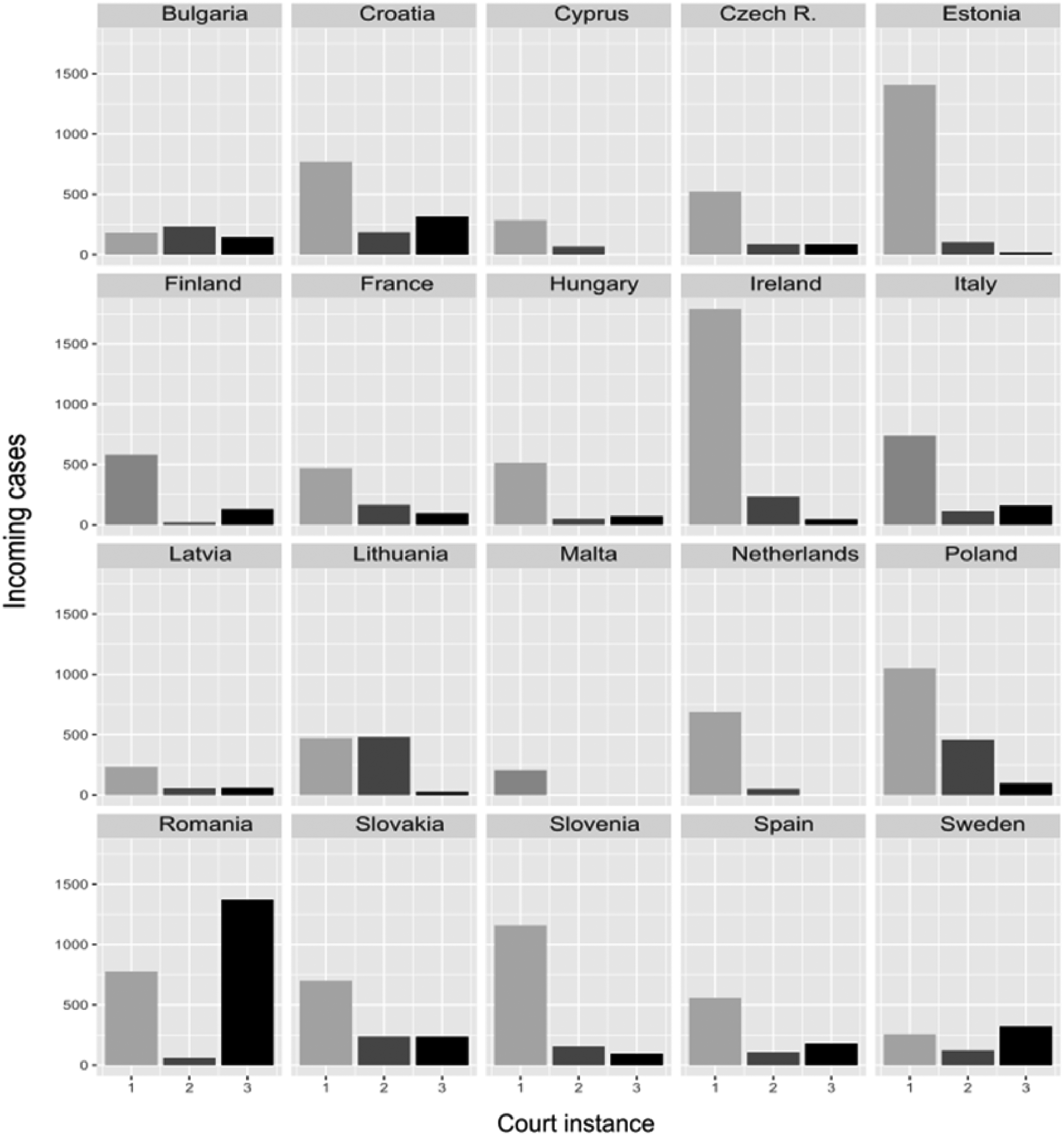
Judicial workload in EU member states. Note: Figure 1 illustrates judicial workload across (1) first instance courts, (2) second instance courts and (3) supreme courts. The workload was calculated as a fraction between the total number of incoming cases and the number of judges for the period between 2010 and 2014. Data were missing for some member states. The data come from European Commission of Efficiency of Justice (CEPEJ), ‘Dynamic database of European judicial systems - Efficiency and Quality of Justice’, https://www.coe.int/en/web/cepej/cepej-stat.
Based on previous research, judges in younger Member States, such as Croatia and Slovenia, are expected to be more likely than their counterparts in older Member States, such as Sweden, to refer to their less extensive experience and knowledge of EU law when justifying their decision not to request preliminary rulings. The results from the interviews are in line with this expectation since only respondents from Croatia (10) and Slovenia (4) attribute their decision not to request preliminary rulings to a lack of experience and knowledge of EU law. These lower court judges mention that their knowledge of EU law is simply too inadequate for them to engage with such a complex task as formulating a request for a preliminary ruling. The judges admit that ‘one big obstacle [to the functioning of the preliminary ruling procedure] is limited knowledge of EU law’ (SI 12, second instance) and that only ‘10% of judges in the entire system know…how this procedure works’ (CRO 17, first instance).
However, contrary to the assumption that judges in younger Member States learn over time,
82
the findings suggest that it is less likely that experience and knowledge will increase over the years since the respondents claim to have very limited access to education on EU law and Article 267 TFEU. A judge describes this trend as ‘the problem of ignorance and of how to formulate the preliminary question in the first place. This is something for which we should undergo specific training’ (CRO 3, first instance). However, another judge notes that ‘to this day, I do not recall receiving education on how to ask a preliminary question before the European Court’ (SI 5, second instance). Even when education on the preliminary ruling procedure is offered, opportunities for training are usually limited. A president of a court in Croatia recalls that: They gave an introduction to the law of the European Union and for [our region], they organise one workshop per year. Our court at that time…had 11 judges, and we have a right to send one participant. It will take 10 years for all of us to have a turn to participate in the seminar on the introduction to the law of the European Union or on the preliminary question. Well, that just does not make sense (CRO 11, second instance).
Moreover, non-engagement in the preliminary ruling procedure is also connected to a lack of resources, especially among lower court judges. Eleven respondents from Croatia and nine from Slovenia state that they have very limited resources to devote to each case and limited access to the literature and databases on EU law: ‘For a complex area of law like European law, you need literature. The problem is that there is often not enough literature. Or [the literature] is written in languages that most [people] at the court do not understand’ (SI 10, second instance) and ‘publications for certain areas of law with clear instructions…are still missing’ (CRO 5, second instance). Other resources that are lacking include help from other court personnel: ‘If you have a law clerk who could prepare things for you, this would be crucial’ (SI 3). However, a judge notes that ‘judges in Croatia are left on their own. You do not even know who to contact if a problem emerges’ (CRO 2), which stands in contrast to the higher court judges, who receive help from law clerks and specialized EU law departments 83 and can often rely on their connections at one of the law faculties. 84
To be sure, the above reasons for not referring cases to the ECJ articulated by the Croatian and Slovenia respondents may be described as personal factors. 85 However, we argue that in this context, a lack of knowledge and resources may also be considered to be connected to instrumental motives. The reason for this is that in this situation a lack of knowledge and resources is intimately associated with being unable to perform a part of one’s job. The interviewed judges describe how they refrain from requesting preliminary rulings due to doubts of being able to perform this work task. In other words, these judges think that they will fail if they try to refer a case to the ECJ because they lack EU law training and material resources. To avoid failing, a negative outcome in itself, 86 these judges chose not to refer cases to the ECJ. Furthermore, these findings illustrate that workloads and resources are usually unevenly divided across the judicial hierarchy. As a result, lower courts face more workload pressure and have fewer resources than higher courts, leaving low court judges less equipped to refer legal questions to the ECJ. The finding that scarce resources constrain judges is in line with the team model of adjudication and the work of Romeu, 87 who argued that if judges at the first instance encounter an EU law issue during their fact-finding task, they normally resort to the use of the EU law precedent on the issue instead of making a referral to the ECJ.
Concluding discussion
This article has provided an in-depth analysis of why judges from Croatia, Slovenia and Sweden decide not to refer cases to the ECJ and how their reasons for not engaging in the preliminary ruling procedure are to be theoretically understood. The empirical analysis shows that the respondents share three specific motives for being passive in the preliminary ruling procedure: referrals are not required by the formal rules (procedural normative motivation), referrals are not made to protect the parties to the case (substantive normative motivation), and referrals are not made to protect judges’ reputation (instrumental motivation). In addition, a few respondents from each Member State expressed that their negative views on EU legal integration had made them reluctant to refer cases (instrumental motivation). Apart from finding that the risks of negative reputational repercussions are a salient motive, these results mostly correspond to expectations described in the literature. 88 With regard to the literature on the role of national courts and judges in EU legal integration, this study finds partial support for expectations of the compliance pull explanation and the sustained resistance view.
This article also reveals cross-national differences in motives between respondents from Croatia and Slovenia on the one hand and respondents from Sweden on the other. Starting with Sweden, we find a previously untheorized motive whereby several judges (including final instance judges) avoid making referrals to protect the functioning of the EU legal system. We argue that the behaviour of these Swedish respondents is an attempt to abide by one of the most important professional responsibilities of a judge to safeguard the proper functioning of the legal system. This motive should be understood as a substantive normative motivation, since the judges justify their decision not to refer with reference to what they consider appropriate for the entire legal system, regardless of what action the formal EU rules on the preliminary ruling procedure prescribe. However, when relying on interview data, one should keep in mind that respondents’ statements may be pretexts rather than their true motives for not referring a case. While this possibility may be the case here, there is provisional support for the interpretation that the judges’ statements reflect their actual motives for action, namely, that the judges actually name many different reasons for their passiveness that are not supported by the formal EU rules. In other words, respondents who prefer not to disclose their real motivations for avoiding the preliminary ruling procedure can simply refer to Article 267 TFEU or to the CILFIT criteria, rather than, as the findings of this study show, referring to several other types of instrumental and normative considerations. Future studies should investigate the views of other stakeholders in the preliminary ruling procedure, such as lawyers and parties to the cases. By triangulating different actors’ views of the procedure, we can gain a better understanding of judges’ reasons for remaining passive in the preliminary ruling procedure.
Next, our results show that a lack of knowledge of EU law as a disincentive to make referrals to the ECJ appears only for respondents from Croatia and Slovenia. These judges attribute their insufficient knowledge to limited access to training in EU law and limited material resources. This finding supports the proposition of previous research that judges in younger Member States are more likely than judges in older Member States to experience difficulties with the application of EU law because they have not yet had time to become fully acquainted with the Union’s acquis. However, while knowledge of EU law may increase over time, as suggested in the literature, 89 a lack of resources and EU law training may impede the processes of learning and Croatian and Slovenian judges’ socialization into the EU legal system.
Finally, what emerges as the most important difference between the studied countries lies in the Croatian and Slovenian respondents’ fear of sanctions from their employers for failing to fulfil domestic production targets. Our results identify this fear as one of the most common motives for not referring preliminary questions to the ECJ among lower court respondents from Croatia and Slovenia. These sanctions are not part of legislative pressures to dissuade judges from using the preliminary ruling procedure as reported by previous research 90 but are rather connected to the efficiency of the judicial system.
Although the design of the present study does not allow for generalizations of the results to all judges in Croatia, Slovenia and Sweden, it is important to consider the implications of the identified motives. Rytter and Wind warned that when national judges choose not to take part in the preliminary ruling procedure, they deny themselves the chance to influence EU legal development. 91 By not referring cases, these judges leave it for the ECJ to shape EU law and for other Member States’ courts to impose their legal traditions before the Luxembourg Court. The question concerns under what circumstances the passiveness of national judges can be considered a problem.
In light of the intentions behind the preliminary ruling procedure, it would be unproblematic if judges decided not to refer a case to the ECJ because they considered the interpretation of EU law to be clear (CILFIT criteria). What is, however, problematic for the functioning of the preliminary ruling procedure is when judges decide against requesting a preliminary ruling or do not even consider the possibility because they lack the necessary knowledge and resources or are likely to face sanctions as an indirect result of referring a case to the ECJ. These motives are particularly concerning if they are more likely to be an issue for judges in younger EU Member States, who had less time to ‘absorb’ the entire acquis communitaire, as well as judges working on lower instances, as they are the ones most often facing a disadvantageous workload versus resources ratio and production targets. Requesting preliminary rulings is a means for national judges to inform the ECJ of the characteristics of the national legal system and of the consequences EU rules might have for the national legal order. Ideally, dialogue between the ECJ and national courts in the preliminary ruling procedure ensures a balance between national legal traditions and EU law. 92 If no dialogue exists between (some) national courts and the ECJ, the integration process may run into conflicts and misunderstandings. 93 To be sure, our data show that it is mainly lower court judges that decide against a referral with reference to a lack of resources or a fear of sanctions. However, while it is true that these cases may be subject to an appeal and eventually referred to the ECJ by a higher court, lower courts’ references are not in themselves irrelevant. As Pavone and Kelemen argue, ‘lower court references continue to be an essential conduit between local actors in civil society and the European Court, and the implicit threat that they may rebel against the decisions of their superiors is an essential driver of domestic compliance with EU law’. 94 Hence, instrumental motives such as a fear of sanctions or a lack of resources can be considered problematic for both higher and lower court judges. 95
How, then, can national judges evolve from passive bystanders to active co-producers of EU law? While it may be difficult to encourage judges to worry less about making mistakes, changes to the existing institutional structure, such as the removal of strict production targets for EU law cases or providing more resources to courts that process EU law cases, may increase judges’ willingness and abilities to participate in the preliminary ruling procedure. However, such reforms require not only economic resources but also political action that may be difficult to achieve.
While this article has shed light on the views of Croatian, Slovenian and Swedish judges, it also raises new questions regarding the passiveness of national judges in the preliminary ruling procedure. For instance, this study shows that the variations in motives expressed between court levels are fairly limited. However, due to the relatively small number of respondents from each court level, this finding should not be interpreted as a strong support for the claim that important differences between court levels do not exist. Future research should aim to explore whether there are systematic differences between the motives of lower court judges and higher court judges and how these motives shape the judges’ referral behaviours.
Footnotes
Acknowledgements
The authors are grateful to Andreas Hofmann and the participants at the Law and Court section, ECPR General Conference Virtual Event 2020, for their constructive feedback on earlier drafts of this article. The authors would also like to thank the two anonymous reviewers for their helpful comments and suggestions.
Declaration of Conflicting Interests
The author(s) declared no potential conflicts of interest with respect to the research, authorship, and/or publication of this article.
Funding
The author disclosed receipt of the following financial support for the research, authorship, and/or publication of this article: The author Monika Glavina acknowledges financial support from ERC Starting Grant 638154 (EUTHORITY).
