




Abstract
Green public procurement is assumed to have a strong steering effect. The recent EU Green Deal contains proposals to amend green public procurement rules from voluntary to mandatory regulation, which has been endorsed by several legal scholars. At the same time, the effectiveness of green public procurement as an environmental policy tool has been studied in economics, where research results present a reserved approach towards green public procurement’s effectiveness. This article examines green public procurement applying a law and economics methodology, with the goal of combining the approaches from different disciplines and finding ways in which environmental objectives can be effectively addressed through procurement regulation. The main conclusions are that the steering effect, costs and potential environmental impact of green public procurement vary in different industries and therefore a sector-specific approach should be adopted in the development of green public procurement regulation. In order to encourage companies to invest and develop their operations in a greener direction, it is important that a large number of contracting authorities use harmonized green public procurement criteria. Further, the effects of green public procurement regulation on competition and emissions from the private consumer market should be monitored and the potential of public procurement to achieve environmental objectives should be explored and compared with other policy options.
1. Introduction
In its Europe 2020 strategy, the European Commission identified and recognized public procurement’s significance in the promotion of sustainability across the EU. 1 The current Procurement Directive 2014/24/EU underlines such emphasis by stating that ‘this Directive clarifies how the contracting authorities can contribute to the protection of the environment and the promotion of sustainable development while ensuring that they can obtain the best value for money for their contracts’, 2 and the current public procurement strategy highly prioritizes a more intense use of strategic procurement to achieve sustainability goals. 3 According to the Commission, sustainable public procurement is ‘(…) whereby contracting authorities take account of all three pillars of sustainable development (economic, social and environmental), when procuring goods, services or works’. 4 Green public procurement (later referred as ‘GPP’) is one these three strands of sustainability and has its emphasis on minimizing the harmful environmental impact of public purchases. Here GPP stands for all kind of environmental criteria including technical specifications, selection criteria, exclusion grounds, contract award criteria and contract provisions. This paper is focused on GPP, which has lately developed, as Trybus puts it, into a separate category of sustainability in public procurement 5 and thus social public procurement, which in turn aims in creating employment opportunities, promoting better employment conditions and standards, ethical trade and design for all, is not discussed.
The requirement to promote sustainability and environmental protection particularly is engraved in the EU Treaties. 6 As Sjåfell and Wiesbrock point out, balancing economic efficiency with environmental or social goals should not be about choosing one over another, but rather about designing measures through which these different objectives can co-exist. 7 However, it is not always easy to find a balance between these – at times – conflicting goals. On the other hand, Kingston argues that there are signs of economic aspects ruling over environmental objectives in EU’s current policies. 8 This seems to be even more apparent in times of crisis: it is often the crucial short-term economic and employment related challenges that overrule other objectives. 9
2020 was an exceptional year, not only due to COVID-19, but also from the perspective of GPP-relevant research and policies. During the past year, the door for new GPP rules was opened by the EU Green Deal stating that public authorities, including EU institutions, should lead by example and ensure that their procurement is green. To ensure such development, the Commission will propose further legislation and guidance on green public purchasing. 10 Subsequently, several European legal scholars also suggested amendments to GPP rules including the enforcement of mandatory green criteria. 11 Moreover, the Swedish Konjukturinstitutet published a critical report on GPP’s cost-effectiveness, which seemed not to satisfy all stakeholders. 12
This article is motivated by the recent developments in the field of GPP and the confrontation between environmental and economic objectives. Legal rules play an important role in this context. Hence, this contribution aims to analyse the interplay and difficult balance of these overlapping objectives in public procurement from a law and economics perspective, where the hypothesis is that all contracting authorities should advance sustainability objectives in their public contract awards provided that such efforts are cost-effective, that is, if the long-term benefits to society and the environment are greater than the costs related to GPP. In this paper, GPP is studied from a legal and welfare economics perspective by using the wealth maximization principle, the Kaldor–Hicks efficiency standard. Kaldor–Hicks’ standard is one of the most common standards applied in law and economics analysis. 13 It is based on an idea that there are both winners and losers in relation to legal rules or practices. Nonetheless, according to the standard, a regulation can be considered cost-effective if its positive effects overweigh and would suffice to ‘compensate’ the negative effects – even if that compensation does not materialize.
The law and economics approach has its limits. It can be criticized for its emphasis on costs. Thus, moral, legal or societal obligations to protect our planet are not the main focus. Nonetheless, assessing the cost-effectiveness of GPP has the potential to reveal ineffective practices and gaps of knowledge, thus opening up new research avenues and settings aimed at finding the most effective policy and regulatory measures for environmental protection.
GPP has interested researchers across disciplines. For the purposes of this article, especially research outputs concerning law, economics as well as social sciences are looked into. In relation to GPP, the theories of circular economy and life-cycle costing play an important role in the development of GPP rules and policies. 14 Regardless of the growing amount of research literature around the topic, there has been a limited attempt to combine the approaches from different disciplines. 15 This paper aims or, more modestly put, starts the discussion that addresses this gap between different disciplines and suggests solutions to improve GPP’s cost-effectiveness. 16
The first part of this article looks into law and economics methodology and its potential to study public procurement law and GPP in particular. The next section provides a quick overview of the legal context of GPP and the recent de lege ferenda proposals, then the economics of GPP is discussed in more detail from the perspective of costs generated by GPP and its effectiveness to result in positive environmental impact. Finally, this article discusses and concludes with a few suggestions on how both the environmental, legal and economic interests relating to GPP could be aligned in public procurement regime and where further research is needed.
2. Law and economics in public procurement
A. Law and economics
Already in 1897, Holmes argued that the man of the future is the man of statistics and the master of economics. 17 It would be naive to assume that we can gain something without losing something else. Rules are always trade-offs between different objectives and impact analysis is currently a part of every legislative exercise. However, the discussion on the economic impact of individual rules and their efficiency in achieving targeted goals is still often limited to provisions that generate immediate economical effect such as taxation, state aid etc. The value of public procurement massive and amounts to 11–20% of GDP in each EU and EEA Member State, with a total value of €2 trillion, 18 but legislative proposals seldomly address the statistics or research on potential economic impact of different rules even though the knowledge and research around these topics are constantly growing.
As Holmes suggested more than 100 years ago, we need to be aware of the impact of the measures in order to know what we choose, when we elect between different alternatives. 19 Posner argued that there is no reason why law should not be suitable for a scientific study based on the coherent theories of economics. 20 In the realist tradition, which spurred on the law and economics methodology, law is viewed as a tool and thus an understanding of its relationship and effect to society is necessary. 21
Law and economics is a study of the economics of law and it is based on the hypothesis that legislation and legal practices have an impact on economic activities and society. Legal rules guide the behaviour and choices of companies and consumers. 22 Law and economics suit well when it comes to analysing public procurement rules. According to the 2014/24/EU Procurement Directive, public procurement rules’ objectives are twofold: they are viewed as a significant mechanism to foster market-based smart and sustainable growth, while ensuring the best value for money. The latter could also be described as an aim to use public funds efficiently. These objectives do not necessarily align. In fact, they can even be in conflict at times. One could ask whether the sustainability objectives should in fact be a starting point for all public contract awards, or whether they should be applied only when considered effective from the perspective of effective competition and use of public funds. In research, the law and economics approach has been considered as a functional method to analyse public procurement rules and practices. For example, law and economics have previously been applied, when studying compliance with public procurement rules, 23 their potential distortions of dynamic competition in the relevant markets, 24 the fight against corruption 25 or the effectiveness of the legal framework as a whole. 26
B. Law and economics of green public procurement
Economic analysis of law is interested in allocative efficiency of different measures at two levels: (1) satisfying the economic desires of individuals and (2) generating the highest possible level of social well-being. 27 As Coase suggested already in the 1960s, viewing law from an economics perspective is crucial, especially when the regulated regime is market-based and thus subject to the economic incentives of market operators. 28 From this perspective, law and economics is well suited for analysis of public procurement rules and particularly for reviewing horizontal objectives such as environmental protection. The public procurement regime is market-based and in fact the promotion of any public procurement objective is fully dependent on the system’s capability to attract competition for contract awards. 29 If there is no competition and companies are not incentivized to bid for the award of the contract, no green goals can be achieved. Nonetheless, it seems that there is a common hypothesis across disciplines that GPP is an efficient way to reduce emissions and encourage the green transformation of markets. Further, it is assumed that the green goals can be reached if the use of GPP is increased. 30 Only few research outputs have been critical towards increasing the use of GPP criteria. 31
In 2014 Emelie Eriksson published, thus far, the sole study on green public procurement in the EU from the perspective of law and economics. One of the main conclusions that Eriksson presents is that: [e]conomic analysis of public procurement regulation should be the starting point of any policy suggesting the use of GPP to rectify or mend environmental problems and economic inefficiencies, as such an analysis can present economic weaknesses in political reasoning and legislation.
32
Eriksson’s conclusion is well aligned with ideas of environmental economics, where impact analysis and cost-effectiveness are central standards against which different measures and regulations are assessed. 33 Further, she points out that so far the discussion and analysis of GPP has been one-sided and inadequate: the EU policies and strategies only look at the demand side and assume that the suppliers will follow. 34 Since Eriksson’s research, new studies relating to GPP in the field of law as well as empirical and theoretical economics on cost-effectiveness of GPP have been published. Moreover, new empirical research on the reasons for low competition in public procurement is available.
3. The variables in the law and economics approach to green public procurement
A. Starting point
There are several separate or overlapping measures through which the EU and its Member States can fight climate change and pursue global carbon neutrality targets. Due to its size (€2 trillion), the public procurement market is seen as one of the key areas for reaching sustainability goals. Usually discussion on the importance of green public procurement is not highlighted through its environmental effects, but rather with the argument that the public sector needs to lead by example, be the driver for green transformation and demonstrate through its own purchasing strategies that public spending will be directed more and more towards green alternatives. 35 Moreover, public procurement is viewed as an important tool to support and test green niche innovations and consequently paving the way for innovative products and services into the markets. 36 These arguments and legal rules encouraging or obliging to GPP are rarely analysed from a cost perspective and their suitability to reach the desired outcome.
The public procurement rules, and in this event the rules on GPP in particular, do not operate in a vacuum. GPP rules are instruments, policy tools that aim for environmental impact. GPP rules are not independent: environmental impact and costs resulting from the adoption and application of such rules both at the level of the contract award in question as well as at the specific product or service market more generally, are subject to the formulation of the legal provisions. For the purposes of this article, the following division of different aspects affecting GPP’s effectiveness from law and economics perspective is used. This chapter aims to look each of the following variables more closely: (1) law; (2) direct costs (transaction costs and contract price); (3) indirect costs (effects to competition and consumer markets) and (4) environmental impact and to elaborate on their difficult balance (Figure 1).
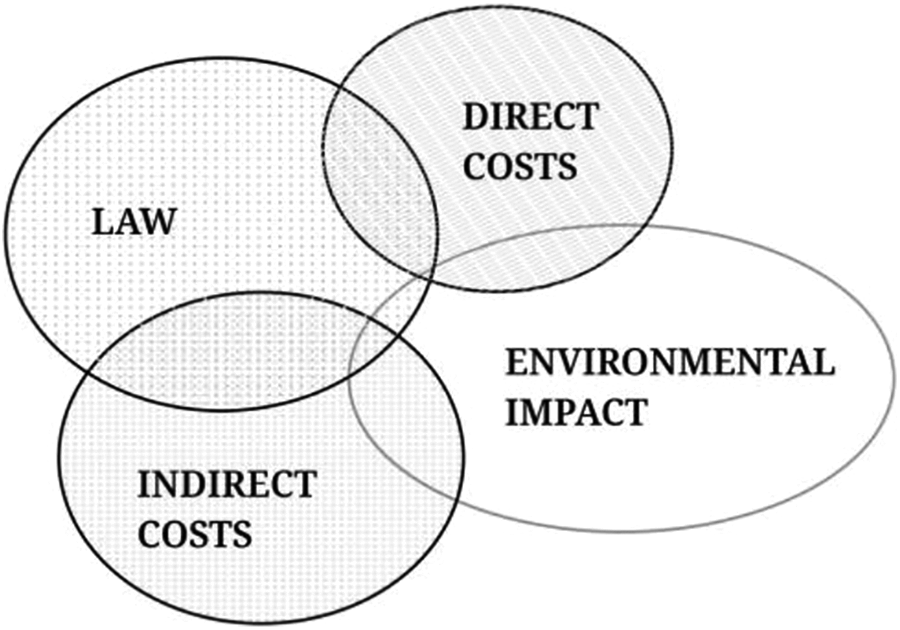
The variables of law and economics of green public procurement.
In GPP-related research literature the costs, market consequences and environmental impact potential of the measures or new rules are rarely discussed. And if such discussion takes place it usually addresses only GPP’s complexity (transaction costs) and potential price premiums for green products at the level of a single procurement. 37 Such approach suggests that cost-effectiveness of GPP rules can be measured by looking at the direct costs it generates to a single contracting authority in an individual contract. However, this perspective leaves societal effects unknown. In the law and economics analysis of GPP the potential indirect effects and costs of any regulation also need to be identified and acknowledged. Thus, breaking the matter into categories of direct costs, indirect costs and environmental impact, allows one to examine GPP’s effects in more detail and at the level of the society at large.
B. Law and green public procurement
Three decades ago there was uncertainty on whether non-economic criteria, such as ecological aspects, could be taken into account in public procurement. In 2002 the Court of Justice gave one of its landmark rulings. Case C-513/99 Concordia Bus started a new era for GPP and paved the way for other horizontal policies in public procurement by opening a possibility to recognize other than financial and conventional qualitative elements in tender evaluation provided that certain conditions of transparency and equal treatment are met when awarding a contract. 38 Before the Court decided on the Concordia Bus case, in 2001 the European Commission published guidelines for different possibilities to consider GPP criteria across public procurement procedures. This was needed, as the public procurement rules at that time did not explicitly provide for such possibility. 39 In 2003, the case EVN and Wienstrom further specified the conditions for using GPP criteria by prohibiting the use of award criteria that could not be verified or that recognized the ‘greenness’ of products or supplies beyond the subject matter of the contract. 40 In 2004, GPP entered into the procurement directives and consequently into national legislations of the EU Member States. Directive 2004/18/EC included several articles with a reference to environmental aspects, among others standards (Article 50), technical specifications and eco-labels (Article 23), award criteria (Article 53) and contract clauses (Article 26). 41 Following the codification of GPP rules, legal research focused on discussing different possibilities and legal limitations of GPP criteria within procurement procedures. 42 GPP rules were further strengthened and clarified in the 2014/24/EU Procurement Directive, which among others introduced life-cycle costing (Article 68), 43 brought some flexibility to the use and reference to eco-labels (Article 43), an obligation to respect environmental laws (Article 18(2)) and the possibility of excluding a tenderer on infringement thereto (Article 57), and set out a verification requirement for contracting authorities regarding their contract award criteria (Article 67(4)).
The pressure to enhance climate actions has also intensified in the public procurement context. The already existing rules that encourage rather than oblige contracting authorities to use GPP criteria are seen to hinder progress. The most recent development in the sustainability and particularly in GPP research discussions are the arguments presented in favour of mandatory GPP rules. Several legal scholars have lately called for more stringent approach and amendments to public procurement rules in order to oblige all contracting authorities to consider GPP in their purchasing activities.
44
It is likely that these wishes will be granted to some extent in upcoming years as the recent EU Green Deal states that: [t]he Commission will propose minimum mandatory green criteria or targets for public procurements in sectorial initiatives, EU funding or product-specific legislation. Such minimum criteria will ‘de facto’ set a common definition of what a ‘green purchase’ is, allowing collection of comparable data from public buyers, and setting the basis for assessing the impact of green public procurements. Public authorities across Europe will be encouraged to integrate green criteria and use labels in their procurements.
45
In more concrete terms it has been suggested, for example, that EU GPP criteria for product and services categories would be made mandatory, the link to the subject matter of the contract would be removed and replaced with a the reference to life-cycle, 46 a general obligation to buy green or a mandatory percentage for GPP should be regulated and that a shift towards life-cycle thinking is needed. 47
Transitioning from voluntary regulation towards mandatory rules is supported by empirical economics and it may well be the only option to push green purchases as increasing knowledge on green purchasing possibilities has not led to significant levels of GPP-based purchases. 48 Research conducted with Chinese procurement data concluded that increasing knowledge of GPP does not necessarily promote green practices. On the contrary, increased knowledge of GPP seemed to make procurement officials more reluctant to implement green purchasing practices. 49 There can be many reasons for such reluctance, but it is likely that the costs generated by GPP and the uncertainty regarding the environmental impact of individual GPP practices play a part.
So far in legal research the focus has not been on discussing the effectiveness of GPP or comparison of effects associated with different methods such as sectorial legislation v. general public procurement rules. The focus and the trend of the current legal GPP research seems to be to search for avenues to change the purchasing culture and legal framework towards stricter and mandatory use of GPP across all procurements. In such an approach, concerns relating to cost-effectiveness or the actual environmental impact potential of a particular service or product category, certain requirements, award criteria or contract clauses seem not to be that relevant. However, it is surprising that all of the contributions advocating for mandatory use of GPP criteria lack any significant analysis on the costs or the market consequences these proposals entail. Further, there has been little attempt to compare public procurement rules and incentives to other available instruments such as emission taxation, tradable permits or sectoral legislation, even though such suggestions have been made over time in policy papers and by economics researchers. 50
C. Direct costs
1. Transaction costs
It is clear that pursuing environmental impact through public procurement has a cost effect. For the purposes of this paper, these costs are divided into direct costs and indirect costs. The former consist of impacts on contract prices and transaction costs for both the contracting authority and the bidders participating in the contract award. Indirect costs such as the cost of reduced competition and effects on private consumer market behaviour are discussed later.
Using green requirements, award criteria, life-cycle costing and performance clauses renders procurement documents and procedures more complex and increases the need for external advisors both at the drafting stage and at the bid evaluation and verification stage. 51 Costs and efforts are considerable in the case of life-cycle assessments if developed for the purposes of a single contract. 52 GPP is often associated with increased complexity in contract award, due to the higher technical and documentation requirements. 53 Further, and on a more general level, adding complexity to award procedures can have a negative effect on competition and sometimes encourage procurement litigation 54 and have a positive correlation with delays and higher costs. 55
A survey from 2006 conducted among purchasers demonstrated that procurement experts are poorly equipped to enforce sustainability. 56 The increased expertise requirements for applying green criteria in public procurement has been one of the drivers of recently introduced EU Commission’s public buyer professionalization recommendation 57 and competency framework ProcurCompEU. ProcurCompEU identifies 30 key competences of public procurement professionals and aims to support public procurement as a strategic function that channels public funds for sustainable growth. 58 Other EU initiatives can also be viewed as an attempt to reduce transactions costs and to boost the legal certainty of GPP. These include among others the common EU GPP criteria for certain product and services categories that the EU Commission has developed since 2008. 59 Further, the attempts to create a general life-cycle costing methodology and model are aimed at reducing the administrative burden and costs for all parties and increasing legal certainty of the complex model, although so far the progress is seen as being too slow. 60
2. Contract price
Using GPP criteria may increase contract prices. It is clear that environmental protection does not come without a cost. Thus, it is a general assumption among contracting authorities that green products and services cost more than conventional alternatives. 61 GPP is not necessarily more expensive by default, if considering the whole lifecycle of the product or service, but the price variation as well as the frequency of using GPP depends on the product and service category. 62 However, to the author’s knowledge, there is no extensive empirical research on the GPP’s price impact across different product and service categories, although recent research indicates that public authorities indeed pay a price premium for GPP. 63
Sustainability efforts are not free of charge. On the other hand, in the case of public procurement, price cannot be irrelevant either. Public procurements are financed by taxpayers’ money for the common good and these funds should be used in a responsible and effective way. Therefore it can be argued that the requirement on public sector accountability sets some limits on the costs of GPP. In research literature it is often submitted that, by combining environmental aspects, price and quality, the best value for taxpayers’ money can be gained. 64 So far there has not been discussion on what can be perceived as an acceptable price premium from the perspective of accountable use of public funds.
Moreover, in order to reach the ideal best value for money by using GPP, there should be some certainty as to the investment’s positive impact on the environment. Unfortunately the evaluation of GPP’s environmental effects is difficult due to the lack of public statistics, lack of controlled experimentations of purchases on alternative criteria and uncertainties of different calculation models. 65 Examples from Sweden suggest that GPP can be considerably more expensive than the conventional alternative. Empirical research on Swedish data revealed that an organic food basket was 65.6% more expensive. 66 The price premium can in some cases be much more than that. Another example from Sweden revealed that a carbon neutral pre-school building cost 5–7 times more than a conventional one. 67
Nonetheless, it is important to point out that there are also a lot of GPP criteria that do not necessarily increase contract pricing, such as measures for the circular economy that do not add requirements as such, but rather aim to extend the lifespan of a product (availability of spare parts, maintenance and education on proper use as well as recycling) or increased use of leasing and hiring of products. 68
Alhola et al. submit that using ambitious GPP criteria gives suppliers a signal that can be translated into innovations, but this requires understanding of the current status and potential of the market and its technological development. 69 This approach is adopted also within the Finnish National Procurement Strategy, which sets an objective that 10% of all procurements were to be innovative. 70 Markets tend to respond if there are business opportunities, but there is a risk that the cost of such product or service can skyrocket when economic operators transfer the expenses of the innovation development to public buyers. 71 Thus, procuring green niche innovations also requires an understanding of the expenses of innovation development as well as of its impact potential. Moreover, if the main purpose is to support investments or R&D for novel green technologies, direct funding possibilities through an innovation fund or different state aid instruments could be considered as an alternative. 72
Another concern relating to the costs of GPP is the lack of transparency and data on the environmental price premiums. Contracting authorities are often unaware of the actual price tag of the GPP criteria they have applied. This is mainly due to two reasons. First, in the event, where GPP criteria are used as mandatory requirements, only companies fulfilling such requirements can submit a bid. Thus, the market price of a conventional alternative remains unknown as well the potential savings that could have been realized through enhanced competition. 73 Second, if GPP criteria are used as contract award criteria, the transparency of its effects on contract prices is subject to the contracting authority’s expertise and the scoring model used. Bid evaluation models that are based on points and relative comparison to scores of other submitted bids, rather than choosing a winner on the basis absolute monetary values, are seen to compromise GPP’s cost transparency and to result in unequal and false outcomes from the perspective of choosing the ‘most economically advantageous tender’. 74
3. Indirect costs: competition and consumer markets
Sometimes, as discussed above, even the direct costs of GPP can be hard to detect. However, the impact of GPP on transaction costs and contract price is easier to measure than the potential cost effects that they may generate on the markets. One of the European Commission’s major concerns in public procurement relates to the functioning of the markets and the level of competition. 75 GPP likely has an effect on competition. 76 Mandatory requirements such as eco-labels or certain production standards limit the pool of potential tenderers. On the other hand, even the use of non-mandatory GPP criteria can disincentivize conventional economic operators from participating due to the lower likelihood of winning the contract. Sanchez-Graells is one of the few legal scholars that currently call for further promotion of the principle of competition, even in the sustainability context of public procurement. He stresses that public procurement’s role in supporting economic development, including socially responsible and sustainable growth, is conditional on its ability to promote the maximum degree of competition and being open to market-led innovation. 77 His views align well with the law and economics tradition discussed earlier: in market-based regimes, regulation’s effectiveness is conditional upon the economic incentives of market operators. Similar concerns relating to competition have been presented in the context of social public procurement by Trybus, who submits that ‘social objectives are nevertheless important considerations which governments and legislators must not neglect. However, there are many alternative and better suited instruments to promote social considerations – inter alia criminal law, labour law, tax law, or State aids (subsidies)…’. 78
Assessing markets’ reactions to GPP criteria is difficult. The rationale behind GPP assumes that markets will respond to the use of GPP and sustainable development follows. 79 As participation in public contract awards is voluntary for economic operators, it is likely that the use of GPP will reduce competition as conventional product suppliers refrain from bidding. 80 Further, if applications of GPP criteria are random and approaches adopted by different contracting authorities vary, the incentive factor often associated with GPP can be diminished. Thus, standardized, unified approaches such as general EU GPP criteria and sectoral legislation could be viewed as more direct and appealing ways to pursue sustainability goals. 81
The potential negative effects of GPP on competition are particularly problematic in the light of current concerns relating to already existing low level of competition in public procurement. According to the Commission, the competitive process on which public procurement relies to achieve best value for money is either not present or it is losing intensity. Between 2006 and 2016, the number of contract awards with only one bid has grown from 17% to 30%. The average number of offers per tender fell from five to three in the same period. 82 The trend is similar across Nordic countries: the level of competition in Finland is overall very low, with the median number of bidders being only two, 83 and similar results have been reported for Sweden. 84 In a recent research report on competition in Swedish public procurement, Halonen and Tukiainen submit that the complexity of procurements and bidding costs (combined with the uncertainty of winning) are among the top reasons for not bidding in public contract awards. 85 Our finding are important, as competition is crucial for the functioning of the whole public procurement regime and its ability to produce value for money. 86 Increased competition generates also savings: increasing competition by one bidder is associated with a 5–10% decrease in procurement costs. 87
Public authorities are on the one hand encouraged to promote ambitious green innovations through public procurement, but also on the other hand to concentrate their purchases on green alternatives, when such products or services are available. In the latter case, the focus is not so much on expediting green transformation as on leading by example and reducing the emissions of a single contracting authority. It has also been suggested that concentrating public purchases on green products will lower the price of sustainable alternatives and improve their availability for others, 88 and encourage others to be more concerned about the environment. 89 However, economic substitution policy sheds doubt on such conclusions. It proposes that amendments in public sector purchasing policies may also lead to changes in private consumer consumption. If the public sector is concentrating its purchases on green products, the producers of conventional products need to attract customers elsewhere, if they wish to stay in the business without green investments. 90 Private consumption is not led by purchasing strategies and it is susceptible to changes in the event of price reductions. In other words, if the price gap between green and conventional products increases, private consumers that previously bought green products may adapt and start consuming conventional options. 91 Thus, GPP can lead to significant price reductions of conventional products and subsequently result in increased demand from private consumers. Substitution policy is supported in different economic studies demonstrating that increased consumption of green products risks inflicting a counterproductive effect among private consumers and compromising the positive environmental effects of GPP. 92 Therefore, it is submitted that potential substitution behaviour of private consumers should be closely monitored in the future and in particular if current proposals on the imposition of green purchase obligations on contracting authorities and making the current EU GPP criteria mandatory become a reality.
4. Environmental impact
The size of the public procurement market and consequently the purchasing power of the public sector has been viewed to support GPP’s role as an effective policy instrument. 93 There is a worldwide trend to use public procurement as a tool for environmental policy. 94
Regardless of the size of the market, there are challenges in achieving sustainable goals through public procurement, which have been demonstrated in economics research both at the level of theory and empirical findings. Public procurement rules and practice have developed over the past decades to a regime of multiple objectives. The purpose is no longer only to ensure transparency and the effective use of public funds or receiving value for money for contracting authorities and users of public services. Instead, public procurement has transformed into an instrument for promoting societal change.
Recently, legal scholars have called for mandatory GPP elements to be included to public procurement rules. 95 Such approach can be justified through the interpretation of EU law and policies, but multiobjective public procurement appears problematic from the perspective of the economic ‘Tinberger rule’. The Tinberger rule, developed in 1952, also known as the rule of thumb, is a mathematic rule according to which each policy objective should be targeted with a specific instrument. 96 In case multiple objectives are subject to the same instrument, their efficiency is compromised. Recently, the Tinberger rule has been applied in economic research on GPP and as a result GPP was not considered as an effective environmental policy instrument. 97
GPP’s effectiveness is subject to its ability to lead polluting firms to invest in less polluting technologies or products. In order to achieve environmental impact, it is necessary, according to Lundberg and Marklund, that the requirements go beyond the market’s current environmental standard. 98 So far GPP’s ability to drive such green transformation has been considered limited, but instead it has focused on buying already green products. Also there seems to be ambiguity regarding which environmental targets the use of certain GPP criteria aims for. 99
The growing importance of GPP has also increased research literature on topics related thereto, but most of these have concentrated on the policy and regulation or practices and uptake views. Research literature that draws an optimistic and positive views on the environmental impact of GPP are usually based on case studies, literature reviews or some qualitative interviews, 100 whereas economic theories and quantitative empirical research have provided a more reserved view. Research on GPP’s effectiveness is nonetheless still very limited and especially more empirical research is needed. 101 The limited amount of empirical research can be in part due to the lack of common eProcurement systems, lack of detailed bid level data or due to the limited access to such data, but situation is improving through better access and AI. 102 Lundberg et al. studied the effectiveness of GPP criteria in cleaning service contracts. The research was based on a vast Swedish bid level dataset. The research concluded that GPP criteria are often non-binding and do not create incentives for bidders to drive a green transformation. Green criteria also had a weak effect on supplier’s environmental performance. 103 In California, results from the construction sector suggest that a large-enough buyer can drive some change to speed up green building standards in the private sector. 104 Similar, more encouraging results were found by Lindström et al. regarding GPP’s ability to drive conversion of farmland into organic production. In the latter, the positive correlation between purchasing strategies and conversion of farmland was mostly due to the unified approach adopted by all Swedish municipalities. 105 Based on these two, more promising examples of GPP’s ability drive green transformation in the markets, it can be argued that if GPP is to be used as a policy tool, public buyers’ purchasing power should be harnessed towards a common EU or national set of GPP criteria applied by all contracting authorities and designed for the specific industry in order to send a clear signal to market operators instead of random, heterogenous and at times conflicting ad hoc criteria applied by different contracting authorities. This would be beneficial also from the perspective of minimizing transactions costs for both parties. Nonetheless, such systematic approach also has its disadvantages and risks relating to the substitution of private consumption as discussed above. Sectoral legislation that would set a higher, industry-wide environmental standard for all suppliers, and not only those supplying the public sector, would be the most effective way forward because it would not leave room for demand substitution. On the other hand, substitution risks depend on the private consumption share of the relevant market. In limited private consumption markets, for instance within healthcare in countries with state-funded provision, substitution risks would be significantly lower than for cleaning products for instance.
4. Discussion
Over the last two decades, pursuing environmental impact through public procurement has moved from allowing the use of green criteria to recommending their use. Lately a shift towards a more stringent approach has started. The new EU Green deal and outputs from various legal scholars call for amendments to the public procurements rules and the enforcement of mandatory GPP. Simultaneously, the EU public procurement regime is losing the ability to generate competition for public contracts. In a system where competition is a prerequisite for functioning of markets, it is critical that regulation encourages bidding in tenders for public contract. Moreover, competition has a huge savings potential: each additional bidder could even result in up to 5–10% savings. 106
GPP, like any objective of public procurement, is subject to the market’s reactions and the actual level of competition. If there is no competition, also the environmental impact potential of public procurement is lost. A common hypothesis in public procurement related policies and legal research seems to be that if only rules would allow or dictate the use of green criteria, the private sector will adjust and invest in greener technologies. 107 So far the empirical evidence does not fully support this and there is a risk that the use of GPP has a counterproductive effect on private consumer markets, if suppliers of conventional products are able to attract private customers through price reductions.
In the impact analysis of potential new GPP rules, whether dictating green purchases or allowing the use of green criteria more flexibly, their ability to create or maintain competition should be reflected as additional requirements and the complexity of bidding are some of the most common reasons for not bidding in public contract awards. Further, the effects on private consumer markets should be carefully analysed and monitored ex ante and ex post in order to ensure that the GPP’s environmental impact potential is not compromised via private consumer markets. An impact assessment reflecting both direct and indirect costs as well as future rules’ environmental impact potential would also be beneficial prior of any amendments to existing rules in order to support the effective functioning of internal market.
There is a growing need for new, and especially multidisciplinary, research and good practices in the field of GPP. There are still gaps of knowledge on the impact potential of GPP on environment, contract pricing and its ability to drive a green transformation. Research on these topics is now probably more important than ever as, due to the COVID-19 pandemic, many EU Member States are facing pressure for budget cuts – as well as increased pressures to redirect procurement priorities towards economic, industrial and employment-related goals. Cost and impact analysis as well as GPP’s cost transparency will likely get easier in the near future as well due to constantly growing procurement data, the use of life-cycle costing models, tender evaluation models based on monetary values and further professionalization of public buyers – as well as the potential deployment of artificial intelligence. 108
From a law and economics perspective, GPP does not appear to be the most cost-effective legislative tool to promote environmental policies due to the multiple, overlapping and interrelated objectives of public procurement. But taking into account the obligation set out at the level of the EU Treaty to integrate environmental protection on all sectors, there is a need for further research on how to use public procurement rules in order to create the largest environmental impact, while maintaining or even increasing competition for public contracts.
In order to drive a green transformation in the respective product or service category markets, it is submitted that a common approach at the EU or at least national levels would be beneficial. The empirical evidence from certain industries suggest that if public sector aims to make changes in specific markets, that is, going beyond the current standards, the target needs to be clear enough and the purchase power big enough. The development of contracting authority specific criteria should be avoided. If public sector as a whole sends a clear signal, for example through adoption of sectorial legislation or common GPP criteria, they can initiate transformation. 109 But even in such approach there is a risk of demand substitution for conventional products in private consumer markets. Thus, if green requirements apply solely to public procurement, their potential effects on private consumption should carefully be monitored and, if an increase in the consumption of conventional products is detected, the green requirements should be extended to the industry as a whole (taking a supply-side approach, rather than a demand-side approach to the imposition of the requirement).
It is also worth considering whether GPP criteria should be applied across all sectors or whether the legal rules should be targeted to the industries that hold the largest potential for environmental impact. From the perspective of law and economics and Kaldor–Hicks standard, the latter option would be preferable. It has been submitted above that the use of GPP generates costs. It can increase both transaction costs and contract prices through higher production costs as well as due to potential reduction of competition. Hence, it is argued that the best alternative would be to extend higher environmental standards to industries through sectoral regulation. If such an approach is deemed inadmissible for some reason and consequently green requirements were limited only to public sector purchases, regardless of the risk of demand substitution compromising the overall environmental impact (subject to public-private consumption shares of the overall market, as discussed above), then the future development of GPP rules and requirements should be sector-specific and mandatory green purchases required in those product and service categories where the environmental impact potential is clearest.
More research on alternative and more direct measures to achieve environmental impact is needed. 110 So far there have not been research attempts to compare from a cost-effectiveness perspective the potentials of different policy measures such as taxation, permits or sectoral legislation against public procurement policies or regulation. It appears that costs, outcomes and the effectiveness of GPP vary between industries and certain product and service categories. 111 Therefore a more refined and sector specific approach is needed to improve the cost-effectiveness of GPP. If GPP would be equally applied in all sectors regardless of their potential impact on the environment or share of global emissions, the overall effectiveness of GPP instruments would be compromised. Due to GPP’s tendency to generate both direct and indirect costs, green purchases should primarily target sectors that hold the greatest environmental impact potential.
5. Conclusions
There are a lot of expectations for public procurement’s societal impact. Due to the massive value of the expenditure in public procurement, it is generally considered that it is capable of accelerating a green transformation in the markets.
Most of the research on GPP is related to its status in public policies and treaties, its societal importance, possibilities to incorporate green criteria into procurement processes or public contracts and some focus on giving guidelines and sharing of good practices. In recent years, the discussions around public procurement has increasingly focused on impact potential. However, in order to have an impact, one must be able to measure the effects. Research on measuring the impact of GPP has also begun, although it is still relatively limited.
In the field of law, the research on GPP rules has lately focused on how to increase the use of GPP and, as an answer, a new regime enforced with mandatory GPP rules has been proposed. This ‘the more, the better approach’ 112 has its risks. To meet the environmental protection targets set for public procurement, it is essential to be able to monitor the impact of the measures on both the environment and society at large in the future. This review needs to pay attention to the impact of regulation on procurement costs, competition and changes in private consumer market behaviour. In the preparation of new EU rules and policies, the impact analysis on the GPP’s effectiveness should not be done at the level of individual contracts as case studies since potential negative effects on competition and consumer markets at large remain then invisible.
It is likely that other legal instruments could lead to green transformation in a more direct and effective way than public procurement. Thus, it would be important to move from the embedded policy specific analysis to a holistic approach, comparing different policy options and their effectiveness. This would also require open out-of-the-box thinking. If answers are sought exclusively within a particular policy tool, it will inevitably impose restrictions on the public sector’s ability to promote environmental objectives. Currently, for example, the cost and environmental impact of GPP is difficult and sometimes even impossible to measure, although the development of cost and impact measuring models will certainly be rapid in the coming years. If we could find a way to channel, for example, the money saved through efficient public procurement that increases competition in public contract awards just by one bidder per award (resulting in 5–10% cost savings), even in part, to work on climate change, the environmental impact could be significant.
Recent impact studies have shown that public procurement may be able to promote some change in the market. However, this requires a systematic and consistent targeting of a large number of contracting authorities in order for economic operators to see a sufficient incentive to develop new solutions. The environmental impact potential and, on the other hand, GPP’s steering effect, also differ across industries. Therefore, in developing GPP regulation in public procurement, special attention should be paid to sectoral thinking, impact potential and harmonized requirements.
Footnotes
Acknowledgements

Funding
This article is a result of research projects LEXSECURE Law for Secure Supply: Internalizing the Crisis Exceptions funded by the Academy of Finland (2020–2023) and HILMARI Carbon sinks and climate benefits with controlled risks: Policy measures for forests and wood products funded by the Ministry of Agriculture and Forestry in Finland (2021–2023). I want to thank both of the funding institutions for their financial support for this research.