




Abstract
The German and the Dutch criminal justice systems not only share a common legal history but also follow the inquisitorial tradition with the prosecution playing a strong role. Despite these commonalities, there are a number of remarkable differences between the two jurisdictions, particularly with a view to procedural law and legal practices. While the German criminal law is known for being formal and rather doctrinal, the Dutch system is strongly driven by pragmatism and efficiency. This efficiency has become an important factor for the progressing Europeanization of criminal law and increasingly influences German criminal procedural law.
This article compares selected aspects of the Dutch and German criminal justice systems. While previous legal comparative studies of the two neighbouring countries have focused on substantive criminal law, this paper will mainly deal with procedural criminal law and prosecutorial practices. The emphasis will be on criminal justice effectiveness and efficiency. Some of the questions addressed are: what constitutes an efficient criminal justice system? How is efficiency defined and implemented in legal practice? A variety of indicators for criminal justice efficiency are proposed and applied to criminal proceedings, prosecutorial practices and the sentencing systems in both countries.
1. Introduction
Over 20 years ago, the German sociologist Erhard Blankenburg published the comparative legal study ‘Patterns of Legal Culture: The Netherlands Compared to Neighboring Germany’ in the American Journal of Comparative Law. Blankenburg was a professor of legal sociology at the University of Amsterdam, and a distinguished expert on the Dutch and German legal systems. 1 In his study, Blankenburg stressed the fact that Dutch and German legal cultures are comparable, as well as their political and legal histories. 2 But despite these commonalities, he was also puzzled by the ‘extremely different patterns’ that both legal cultures display in some regards. To identify these patterns, he was convinced that a legal comparative analysis should not only take into account the law, but also nuances in legal writing style, the defining power of journals, faculties and supreme court jurisdiction, conditions for admission to the bar and the career patterns of judges – all of these being institutional features that are not only determined by law, but rather by organizations and traditions. 3
In addition to these nuances, the most significant difference between the Dutch and German legal systems today is without much doubt the dichotomy between a formalistic and a pragmatic approach to the application of the law. Already in 1985, Blankenburg and Bruinsma stipulated in their book on Dutch legal culture: ‘The Dutch tend to be pragmatic. They use law to solve problems not to create additional ones. If applying the rules would lead to serious disadvantages, the Dutch try to find ways around them. Rules too strict to be applied are ignored and if that meets with resistance, they change them.’ 4 Indeed, numerous examples exist within the Dutch legal system – and particularly within its approach to criminal justice – where this pragmatism can be identified.
In Germany, however, the approach is different. In fact, the mere thought of finding ways around laws, leaving them unapplied or changing them out of convenience, may sound outrageous to German legal scholars. From their point of view, the Dutch pragmatic approach not only breaches basic constitutional principles, but also opposes the idea of the Rechtsstaat in general, which is strongly protected by the German Constitutional Court that looks back on a long history of restraining and limiting executive power. In Germany, it is sometimes realized with surprise that in the Netherlands, a constitutional court does not exist to this day. 5 This example demonstrates that while the Dutch legal system is often governed by efficiency and pragmatism, the German counterpart tends to be formalistic with a clear tendency to favour systematic and strict doctrinal solutions. 6
While Blankenburg and Bruinsma’s assessment has not lost much of its validity after more than two decades, the political and societal circumstances in which the Dutch and German legal systems are embedded have changed dramatically since. The ‘Europeanization’ of law, a legal political agenda pushed by the European Union and its institutions, as well as the European Court of Human Rights, have harmonized and streamlined national legal systems in many ways. In recent years, this has increasingly included the field of criminal law and the transformation of criminal justice systems of the EU Member States. 7 These developments were initiated and promoted following the abolition of borders with the Schengen agreement in 1996, which has not only facilitated trade and the freedom of movement within the EU, but also increased opportunities for transnational organized criminals. This, in turn, created a demand for far-reaching cooperation in the field of criminal law between Member States. Such cooperation requires a growing number of harmonized laws to ensure efficient law enforcement, and to reduce legal and executional tension that may eventually lead to impunity. 8
Hence, one of the guiding principles behind the harmonization of criminal justice systems was, from the start, to increase effectiveness and efficiency. 9 Today, it seems that these have become the gold standard; not only for European criminal law, but also for European integration as a whole. 10
This article uses Blankenburg’s legal comparative study from 1998 as a conceptual basis to analyse selected aspects of the Dutch and German criminal justice systems with regard to efficiency, effectiveness and pragmatism. The analytical focus will be on legal cultural aspects of law enforcement (particularly organizational aspects of the police and prosecution services), criminal procedure and the penal system in both states. A broad scope like this covering a variety of aspects within two legal systems and cultures must remain incomplete and runs the risk of being arbitrary or of mere anecdotal value. The identification of ‘patterns of legal culture’, as Blankenburg suggested over three decades ago, enables to bridge the gap between the ‘law-in-the-books’ and the ‘living-law’ as similarities of formal legal systems are bad predictors of how legal cultures actually work. 11 In this sense, his conclusion that Dutch law is considerably more pragmatism-driven or, more generally, driven by economic factors, making it more efficient than the German justice system, serves as a starting point for the following analysis. The questions which the present paper tries to answer is whether this assumption holds true, where this pragmatism (or formalism as its antagonist) can be identified within the legal system and how it influences the law in practice. The validity of Blankenburg’s assumption will be tested by examining publicly available empirical data on criminal justice systems, indicators and patterns of legal culture, as well as on the written law and the law in action. This article will look, firstly, at the empirical aspects of both systems, which will be compared by focusing on relevant data with regard to police and prosecution in the Netherlands and Germany, specifically of the western German state of North-Rhine Westphalia (NRW). The scope of analysis is limited to a single German state for methodological reasons, in particular to ensure comparability – as will be explained in the next section. Both states share a common border, a common legal history and are similar in their population size, demographics and socio-economic composition, and are, therefore, ideal objects of comparison, especially when it comes to empirical patterns of legal cultures. Secondly, this study will examine and compare selected aspects of criminal procedural law where efficiency plays a crucial role. And thirdly, different facets of the penal systems, especially those related to sentencing in both countries are analysed.
A. The concepts of efficiency and effectiveness
The topic of efficiency – or more specifically, performance – within the criminal justice system and the relation to public trust, has been discussed extensively. 12 After all, an inefficient criminal justice system may damage trust in – and credibility of – the rule of law as a whole. 13 For example, current reforms of German criminal procedural law, which are based on the simplification and expedition of judicial procedures, have triggered harsh criticism from legal scholars. 14 Allegations of a ‘rush disease’ that has taken over criminal proceedings are voiced, and the erosion of defence rights are considered collateral damage of this continuous pursuit of efficiency. 15 For a similar debate about managerialism and efficiency in the United States, Robert Bohm coined the term ‘McDonaldization’ of criminal justice. 16 The debate is further complicated by the lack of a precise definition of what efficiency, effectivity and even pragmatism mean in the context of criminal (procedural) law. While in democracies it generally does not seem uncommon for the public administration and the judiciary to be measured by criteria of effectiveness, on closer inspection it proves difficult to define what constitutes the efficient enforcement of criminal law. This can be explained by the fact that it is situated in a complex system of checks and balances, ranging from constitutional guarantees, defence rights and fiscal restrictions, to the provision of security and crime prevention. Moreover, criteria of effectiveness and efficiency are often based on judicial and criminal policy guidelines, which, in turn, are influenced by dynamic political debates, crime trends and risk analysis. This leads to the question of whether efficiency within the criminal law system can even be measured.
The American Heritage Dictionary of the English language defines effectiveness simply as ‘Having an intended or expected effect’. The concept in itself is rather neutral, as shown in the following example: cutting down a tree with a nail file may be effective, but it is most certainly not efficient nor pragmatic. The latter is defined as ‘(…) a practical, matter-of-fact way of approaching or assessing situations or of solving problems’, 17 while efficiency is ‘acting or producing effectively with a minimum of (…) expense, or unnecessary effort.’ 18 Despite these semantic differences, these concepts are deeply embedded in neoclassical economic theory. 19
The economic analysis of criminal law and crime, and public management practices within the judiciary, have a long scientific tradition in Anglo-Saxon countries, and, to a lesser degree, in the Netherlands. 20 Packer already in 1964 stated with regard to the criminal process: ‘By “efficiency” we mean the system’s capacity to apprehend, try, convict, and dispose of a high proportion of criminal offenders whose offenses become known.’ 21 In Germany, however, this field has only started gaining more attention from legal scholars over the past decade. 22 In recent years, a growing number of scientific studies in Germany and the Netherlands consider effectiveness as an indicator for the functioning and the level of trust of citizens in the police, prosecution and the judiciary. 23 For example, the German victimization survey conducted in 2017 by the German Federal Criminal Police Office established a direct link between the perceived effectiveness of law enforcement agencies (including the judiciary) by citizens and the trust in these institutions. 24 At the same time, the rise of right-wing populism in Germany and throughout Europe can be attributed, among other factors, to the growing popularity of ‘tough on crime’ approaches that are often equated with criminal justice efficiency. 25
2. Comparing the Dutch and the German legal systems
Comparative legal studies run a variety of risks, including risks associated with ethnocentrism, relativism 26 and misunderstandings. 27 This can potentially confuse the law in the books and the law in practice, 28 but also the way in which we address the problem of finding a common language for the description of phenomena. 29 This endeavour becomes more complicated if the slippery abstraction of legal culture is included in the analysis. 30 Besides these general challenges, comparative legal studies must specify which legal units are being compared (for example, legal systems in general, specific areas of law, particular concepts of rules, approaches, institutions and legal cultures), and how the comparability of collected data, legal processes and procedures will be ensured. 31
Although a number of comparative studies dealing with criminal justice more generally – or on an EU level – have been conducted over the past years, the number of comparative studies that specifically analyse German and Dutch substantive criminal, procedural or penal law are less common. 32 This is somewhat surprising, given that the Dutch and German legal systems are just as intertwined as the turbulent history of both countries. While private law in both countries was strongly influenced by Roman law, both criminal law systems share a common legal body dating back to the Constitutio Criminalis Carolina from 1532. The French revolution, and the occupation of the Netherlands and parts of Germany by Napoleon, led to a remarkable influence of the Code Napoleon on substantive laws and on the court systems, and superseded the rather decentralized legal cultures. 33 The Dutch criminal law was strongly influenced by the French ‘Code pénal’, leading to the final establishment of the Dutch criminal code in 1886, the basis for today’s criminal code (Wetboek van Strafrecht). 34 The Penal Code of the German Empire (Strafgesetzbuch für das Deutsche Reich) was passed in 1871, and is considered to be the foundation for today’s German criminal code (Strafgesetzbuch).
The fact that the Dutch and the German criminal justice systems are based on the same ‘legal family’ 35 is reflected in many aspects, such as the three-tier court structure, the stages of appeal in criminal cases, the prosecution monopoly of the public prosecutor’s office and the inquisitorial criminal justice system. The Dutch system is, in many respects, closer to the common law systems of the UK and the USA, as its guiding principles are often pragmatism and practicality. Hence, Roef and Keiler stipulate that these systems pay less attention to the degree of complexity and sophistication of doctrinal solutions when compared to German criminal law. 36 Dutch criminal law is less dogmatically driven and less formalistic than its German counterpart, a fact also reflected in Dutch jurisprudence, where a just and – most importantly – workable solution to the problem at hand is often considered more important than systematic coherence. The opposite is true in Germany, where jurisprudence is guided by systemic thinking, internal consistency and comprehensiveness of the law, resulting in a tendency towards a certain degree of formalism. While case law – especially when handed down by the German supreme court (Bundesgerichtshof) – plays a part in shaping the application of criminal law in lower courts, it generally plays a much smaller role than case law in the Dutch legal system, and is far from having the fundamental role it has in common law systems. 37
The formalistic German approach is deeply imprinted into legal terminology. For example, the term criminal legal doctrine in German language translates into Strafrechtsdogmatik, comprising the word ‘dogma’, usually describing an official system of principles or doctrines of a religion. And indeed, at first sight the German science of criminal law (Strafrechtswissenschaft) and theology share some commonalities. The German criminal code is at the centre and the main source for this legal science, and almost every year more than a dozen commentaries are published by distinguished scholars, sometimes in the second or even third generation. Most of these commentaries are printed on thin scritta paper and can easily reach up to 3000 pages, with each written paragraph equipped with a margin number. In those commentaries each of the 358 articles of the criminal code are commented on in depth, analysing the historical and doctrinal development, citing relevant case law, dissertations and academic papers and providing an interpretation or opinion on the underlying ratio of the legislator. If this interpretation is dissenting from jurisprudence but shared by the majority of other legal scholars, it is awarded the label ‘herrschende Meinung’ (abbreviated h.m.), which can be translated as ‘dominant or ruling opinion’. In consequence, for many criminal legal problems there exist numerous solutions and sometimes legal reasoning within the case law changes on basis of these scholarly works.
This strong doctrinal focus of German jurisprudence is reinforced by the sheer size and complexity of the judicial system itself. The German supreme court alone counts approximately 130 judges, divided among 13 senates specializing in different areas of civil law; six senates for penal law and eight more senates for special topics such as antitrust law. In addition, there is a federal Labour Court, a Fiscal High Court, a Federal Constitutional Court with six chambers, and another 16 constitutional courts for each of the German states. The senates of each high court, each with their own audience, publish over 200 German-language law journals for specialized practitioners and law professors at the country’s 45 law faculties, all of which contributes to a highly complex legal doctrine. 38
In comparison, the Dutch legal elite is what Blankenburg calls a ‘cozy club’; the supreme court (Hoge Raad der Nederlanden) consists of three chambers with currently 36 judges who decide on leading cases in the fields of civil and labour law, on penal law and fiscal law issues. Administrative courts were not established until 1974, and in the absence of a constitutional court, judges could only refer to European courts if they wished to review the constitutionality of national legislation. 39 In combination with the influential role of case law, determining the valid law and how it is applied, this allows the Dutch to run their legal system efficiently and in a pragmatic manner, with considerably less specialized law than their German neighbours. 40 In summary, both legal systems have influenced each other considerably in the past. 41 However, in recent years, while Dutch legal doctrine remained open to influences from German legal doctrine, this has been more of a one-way-street. German doctrinal thinking, due to its complexity and often over-complication, isolated itself largely from external influences. This self-isolation by choice has been fiercely debated for years among German legal scholars. 42 On the one side, there are those who openly proclaim the superiority of German doctrinal thinking in criminal law. 43 In this view, other criminal legal systems as well as the EUs harmonization efforts are no more than ships lacking a functioning compass and instead navigated by political aims. 44 Against this stands the popular view which accepts and even welcomes the internationalization of German criminal law and doctrinal thinking, while criticizing the ‘provincial confidence’ celebrated by many German scholars and (high court) judges. 45
3. The Netherlands, North-Rhine Westphalia (NRW) and the European Union
Since this comparative study is not limited to a legal comparison, but also draws extensively from empirical data from both legal systems, it is necessary to narrow the focus to exactly what needs to be compared. The many commonalities of the Netherlands and Germany are not limited to their legal systems, but extend to economic and social terms, especially when using data from the neighbouring German state of North-Rhine Westphalia (NRW). 46
The Netherlands and NRW form one of the most densely populated regions in Europe, with around 17 million and 18 million inhabitants respectively, many of whom live in the highly decentralized metropolitan regions. In the Netherlands, the so-called Randstad consists of large cities such as Amsterdam, Rotterdam, The Hague and Utrecht (approximately 8.2 million inhabitants combined). Only two hundred kilometres to the east, the Rhine-Ruhr metropolitan region consists of major cities like Cologne, Düsseldorf and a conglomerate of cities named the Ruhr-area, with a total of almost 10 million inhabitants. The border between the Netherlands and NRW stretches over nearly 400 kilometres, but with the EU Schengen agreement that abolished customs and border controls, the border became more of a virtual line than a state border in the traditional sense.
Historically and culturally, the Netherlands and NRW are closely intertwined, as evidenced by a number of so-called ‘Euregios’, cross-border and regional administrative partnerships between German, Dutch and also Belgian municipalities. An example is the Meuse-Rhine Euregio with almost 4 million inhabitants, consisting of the regions around the city of Aachen and partly Cologne in Germany, the southern part of the Dutch province of Limburg with, for example, the city of Maastricht and the Belgian provinces of Liège and Limburg. Within the European context, these border regions are often referred to as ‘laboratories of European integration’ and are thriving hubs for economic cooperation and tourism. 47 However, with the absence of borders and border controls, these Euregios have also become focal points of cross-border crime, particularly drug-related organized crime. As a result, a great deal of criminological research has been carried out in the Dutch-German border region over the past decade. 48 Transnational organized crime structures in both countries take advantage not only of absent borders, but also of the remaining frontiers, namely those between the legal systems, state institutions, law enforcement agencies, local governments and administrations, and the one between languages, with the aim of avoiding prosecution. 49
The European Union has responded to the growing exploitation of the borderless Schengen area by making considerable efforts to harmonize the criminal law systems of the Member States, with the aim of closing the impunity gaps resulting from their incompatibility. 50 Important milestones in that regard were, for example, the European Arrest Warrant or the European Investigation Order, both created with the aim of simplifying complex and lengthy legal aid procedures. 51 Based on the guiding principles of mutual trust, all these harmonization efforts are guided by the idea of making cross-border cooperation in criminal matters more efficient. 52
It should be noted that NRW is not a sovereign state under international law, but rather one of the 16 states (Länder) of the German Federation (Bund) and therefore has sovereign rights and responsibilities. As provided by Article 30 of the German Basic Law (Grundgesetz), the exercise of state powers and the exercise of administrative functions lies with the states. In practice, however, the federation has regulated virtually all matters of legal and political significance, which means that the German states have legislative powers mainly in the fields of cultural and municipal affairs and public order. 53 To this day, German federalism is controversially discussed, with some viewing it as an effective tool for ensuring checks and balances, while others point to its paralysing effects, especially for law enforcement or more general legal cooperation between the states. 54
For this study, the federal structure of Germany is only relevant in the instances where it influences NRW’s criminal justice system. For example, while criminal law and criminal procedural law fall under federal legislative power and are therefore the same for all 16 states, the police, public order and the judiciary are mainly under the supervision of the states. This includes the judicial infrastructure such as criminal courts, prison oversight and law enforcement agencies – such as prosecution services and the state police. Thus, although the criminal justice systems in Germany are very similar, they may differ in some respects. For example, in comparison with other EU Member States, Germany is generally considered to be rather lenient when it comes to sentencing. 55 Within Germany, however, there is strong evidence of a so-called north-south division, with – in 25% of all cases – tougher sentences for equal crimes in the German south than in the northern states. 56 Although such deviations are rare, it is worthwhile to exercise caution when making generalizations for Germany as a whole based solely on the state of NRW.
4. Empirical data on crime rates and law enforcement performance in NRW and the Netherlands
For a better understanding of some of the main similarities and differences between the criminal justice systems of both states, it is useful to look at crime and clearance data. Although the data is rather crude, there are indicators that provide some insight into performance and effectiveness.
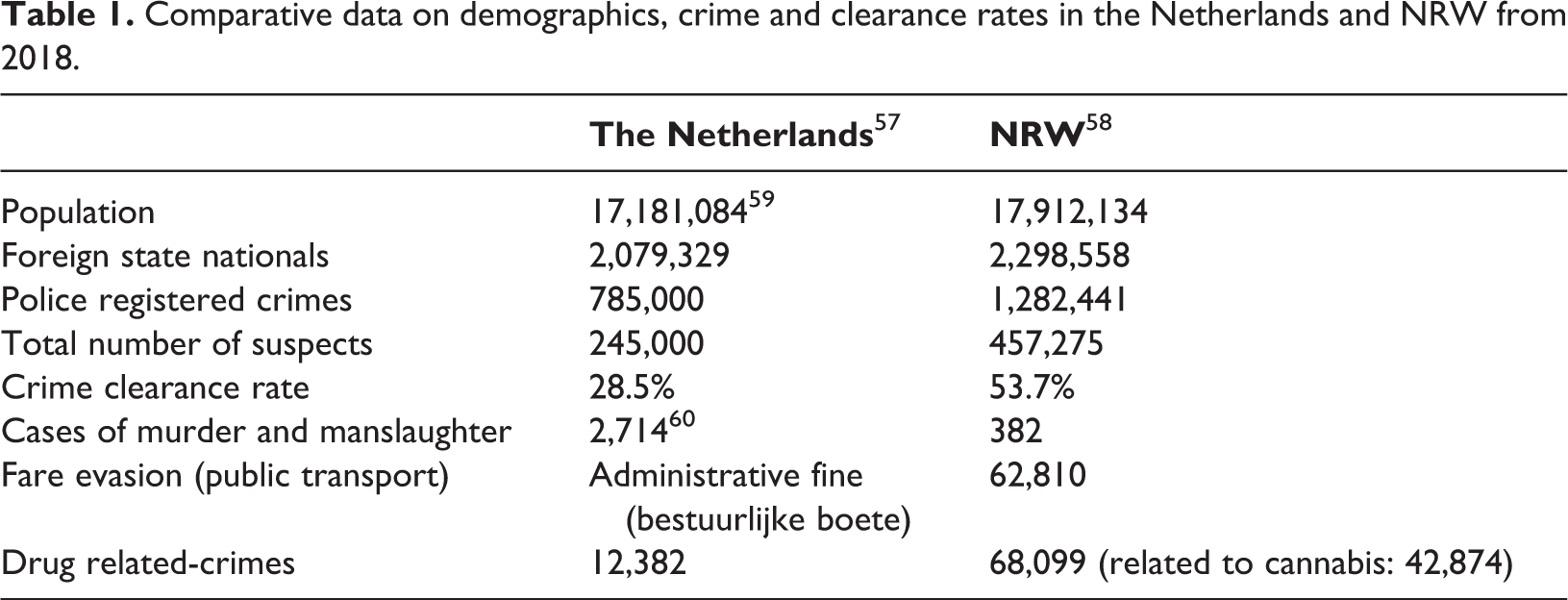
Table 1 shows that the main difference between the two states is the number of registered crimes, despite the fact that both have very similar demographics. While the police of NRW registered approximately 1.3 million crimes in 2018, Dutch authorities recorded nearly 40% fewer crimes. This difference is even more obvious when looking at the total number of suspects: NRW registered almost twice as many persons (457,275) as the Dutch law enforcement authorities (245,000). These datasets alone, and the remarkable differences they show, raise the question of how they can be interpreted. Can one simply conclude that people living in NRW are more criminal than Dutch citizens? Or is the explanation to be found within the criminal justice system itself: is deterrence within the German criminal justice system less effective than in the Netherlands? Or is the opposite the case: are German law enforcement agencies more effective than their Dutch counterparts when it comes to detecting crimes and suspects? Or are the reasons for these significant differences to be found somewhere else entirely, such as a different crime registration method?
The importance of the latter can be demonstrated by the clearance rates, that is, the rate of crimes solved by the police. The clearance rate in the Netherlands, at 28.5% of all detected crimes, is only half as high as in NRW (53.7%). But this difference is based not so much on the ineffectiveness of the Dutch police, but rather on a different registration practice: the German police consider a case cleared as soon as suspect is identified, and the investigation file forwarded to the public prosecution service. The Dutch police are more cautious in this respect; cases where the suspect is identified, but where evidence is insufficient, are less often passed on to prosecutors. Therefore, these cases will not appear in the clearance statistics. 61
This limited explanatory value of comparing crime statistics can be demonstrated even more clearly when looking at the example of registered cases of murder and manslaughter. While NRW recorded 382 murder and manslaughter cases in 2018, the number was more than seven times higher in the Netherlands with 2714 cases. A surprising result, all the more so since the Netherlands recorded a substantial drop in homicide and manslaughter offences (by more than one third) since 2012. On closer inspection, the reasons for this discrepancy can be found in the different categorization of the offences. Although murder and manslaughter are constructed in a similar way in the German criminal code (§ 211 and § 212) and the Dutch criminal code (Article 287 and Article 289), Dutch crime statistics utilize a much broader definition and also record euthanasia, illegal abortions and assisted suicide. NRW crime statistics do not include these categories in the definition of murder and manslaughter (with the exception of assisted suicide). Therefore, a direct and objective comparison of murder and manslaughter cases between the two states is difficult.
In addition to differences in recording practices, differences between the criminal justice systems should also be taken into account when comparing crime data. Table 1 shows that nearly 5% of registered crimes in NRW are a result of the criminalization of fare evasion in public transport (so-called Beförderungsmittelerschleichung pursuant to § 256a StGB), making it one of the most common offences. In the Netherlands, there is only an administrative fine for the same offence, and it is therefore not registered in crime statistics. Very similar is the case of drug-related crimes. Due to the infamously liberal drug policies in the Netherlands, which de facto result in the decriminalization of soft drugs such as cannabis, German laws are stricter in criminalizing the possession of soft drugs (with the exception of insignificant amounts). 62 Especially in the border region of NRW, where drug tourism is a widespread phenomenon, law enforcement handles thousands of minor cases of soft drug possession every year, resulting in a significant peak in registered crimes.
Comparative data on demographics, crime and clearance rates in the Netherlands and NRW from 2018.
It is recommended to bear in mind these differences in the recording practice and between the criminal justice systems when comparing crime and clearance statistics. However, these differences can only partly explain the significant differences in registered crimes and suspects between NRW and the Netherlands. And there are indeed other factors that better explain the differences, and which are deeply embedded within the legal culture of the two countries. One of these factors is the opportunity principle, which is implemented very differently, and which strongly influences the work of Dutch and German law enforcement agencies.
A. Policy aspects of Dutch and German law enforcement: Opportunity vs. legality principle
The opportunity principle gives the Dutch criminal procedure at the investigative stage an optional character by giving the prosecution considerable discretionary powers. According to this principle, a crime will only be prosecuted if it is considered opportune. The Dutch prosecution service is therefore referred to as the ‘spider in the web of the criminal justice system’. 63 In practice, the principle is implemented through a case management system, in which assessment teams are formed (so-called ‘weegploegen’), consisting of the local police chief, a senior prosecutor and the mayor of the municipality. In these teams, investigative priorities are set annually on the basis of criminal policy considerations, clearance prospects or the seriousness of the offences. Police and prosecution investigations focus on pre-defined areas of crime, while offences that fall outside this scope are neither investigated nor prosecuted. 64
Closely related to the opportunity principle is the so-called ‘beleid’ or ‘gedoogbeleid’. This concept, best translated as ‘tolerance policy’, forms an integral part of Dutch legal culture and society. 65 It is embedded in a complex system of criminal policy guidelines, partly determined by the public prosecution authorities themselves, which determine the cases in which illegal practices could be allowed and in which cases prosecution must take place. 66 A well-known example of this is the Dutch narcotics law (opiumwet) and the policy with regard to soft drugs. Contrary to popular belief, the possession of soft drugs such as cannabis and its derivatives is not legal in the Netherlands, but explicitly prohibited by law (Article 2 and 3 opiumwet). In this context, ‘beleid’ means that law enforcement is selective, and that the sale and use of cannabis in limited quantities is tolerated. The rationale of this criminal policy is to give priority to the prosecution of other offences considered more dangerous as well as to offences creating nuisance for society (‘overlast’).
This policy of tolerance, which has its origins in the progressive culture of the 1970s and which has since made the country world famous for its thriving coffee shop culture, has also been criticized. Bruinsma, for example, speaks of a discretionary no-man’s-land and points out that ‘beleid’ is often not more than an euphemism for administrative phlegm and indifference. 67 The fireworks disaster of Enschede, a city of 150,000 inhabitants, which took place in the year 2000, serves as an example for the potential disastrous effects of ‘gedoogdbeleid’: a fireworks company in the centre of the city had disregarded safety regulations, while the authorities had deliberately tolerated this infraction, resulting in an explosion with 22 casualties, nearly 1000 people injured, and over 4000 people losing their homes. 68
In contrast to the Netherlands, the German criminal justice system is strongly guided by the legality principle. This principle, which dates back to the classical legal scholar Feuerbach and his work on criminal law from 1801, is to this day remarkably influential in the German criminal (procedural) law and is regarded as no less than one of the cornerstones of the rule of law. 69 Contrary to the opportunity principle, the legality principle laid down in numerous legal provisions (such as § 152 II and §§160, 163 German Procedural Code (StPO)) reduces the power of law enforcement agencies to investigate a crime to zero. In theory, this means that any crime reported or brought to the attention of the German police or prosecutors, triggers a formal investigation. The principle is legally enforced by the possibility to hold public officials criminally liable when they refuse to investigate (see § 258a German Criminal Code (StGB)), inter alia by procedural means to compel prosecution services to publicly prosecute a crime (so-called Klageerzwingungsverfahren pursuant to § 172 StPO).
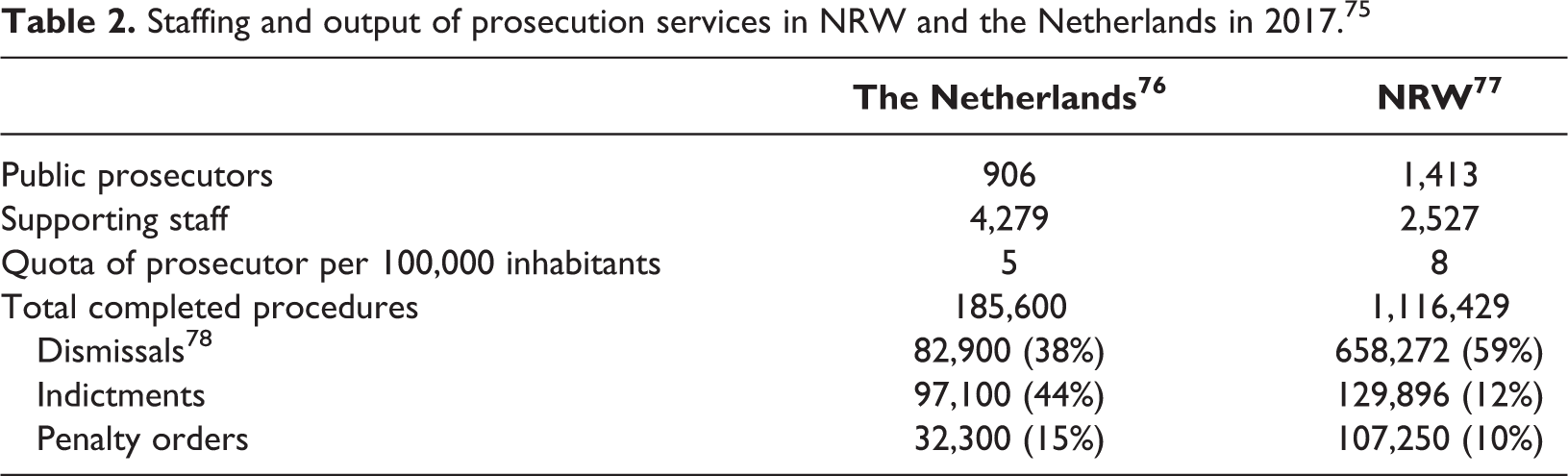
In legal practice, however, law enforcement authorities implement this legality principle less strictly due a lack of capacity. In fact, there are many cases in which the opportunity principle has indeed been codified under German procedural law (for example, see §§ 153 et seq. StPO), allowing prosecution services to refrain from prosecution, for example in cases of minor offences. However, the opportunity principle does not apply to the police, who are obliged to formally register and investigate all crimes, even when there is not much doubt that the prosecution will most likely cancel the investigation. This results in a considerable amount of red tape: while the police are obliged to register and report all reported crimes to the prosecution, the prosecution is obliged to inform the accused and victim or the claimant in a reasoned writing about their decision to cancel the prosecution (pursuant to §§ 170, 171 StPO). That this is very often the case is demonstrated in Table 2, which shows that nearly 60% of all initiated investigation are dismissed on grounds of opportunity.
Staffing and output of prosecution services in NRW and the Netherlands in 2017.75
Nevertheless, the comparatively strict implementation of the legality principle in Germany not only explains the relatively large number of registered suspects by the police but is also a good illustration of how law enforcement authorities tend towards a certain formality, without considering a more pragmatic way of handling cases. On the face of it, this may be interpreted as inefficiency, but in a more nuanced interpretation it could be argued differently: from the point of view of a crime victim filing a police report, the fact that even a minor crime launches an official investigation may have a positive effect on the trust in the law enforcement authorities. On the other hand, from a more doctrinal point of view, the Dutch approach of leaving law enforcement to the prosecution discretion can be considered baffling. It accepts the executive power to ultra vires ignore certain laws created by the elected parliament. Moreover, this practice runs the risk of extending the discretionary power, which is mostly applied to high-volume crimes, to other, more serious crimes when the prosecution services deem it appropriate.
B. Organizational aspects of the Dutch and German prosecution services
Organizational aspects of the prosecution service influence the efficiency of law enforcement. The Dutch Public Prosecution Service (Openbaar Ministerie) is organized on three levels: 10 public prosecutors’ offices are assigned to the 11 courts of first instance (rechtbanken) at district level (arrondisementen). In addition, there are public prosecutors’ offices at the middle level (ressorts) of the four courts of appeal and at the highest national level. In contrast to Germany, the Netherlands has opted for a rather flat hierarchy, as can be seen, for example, in the horizontal and central management of the public prosecutors’ offices by the ‘college van procureurs-generaal’, an administrative board for the public prosecution services. The national public prosecutors’ offices are not superordinate to the regional offices, but are on the same level. 70
In Germany, the prosecution service is organized hierarchically. In NRW, the 19 public prosecutors’ offices are each assigned to one of the district courts (Landgericht) with three attorney generals (in Cologne, Düsseldorf and Hamm) for supervision. This hierarchical structure can also be found within the prosecution service with strict qualification requirements and career paths. Compared to the Dutch judiciary, the German legal professions are not only hierarchically structured, but also remarkably exclusive, with virtually no possibilities for external professionals to enter, and very limited possibilities to change careers within the profession. 71 The Dutch legal system, on the other hand, promotes mobility and diversity of career paths, for example by encouraging applicants to gain work experience in other legal professions before entering the public service or the judiciary. 72 It worth mentioning that in both countries, the prosecution services and courts are been under constant pressure to recruit a sufficient number of qualified employers. 73
In terms of staffing, Table 2 provides a number of comparative insights into prosecution services in both states. It is noteworthy that Dutch prosecution services employ more than a third fewer public prosecutors than the prosecution services in NRW, but nearly twice as many supporting staff. In this regard, it is also interesting to compare the prosecution rates per 100,000 inhabitants. In the Netherlands there are five public prosecutors per 100,000 inhabitants, whereas in NRW the ratio is eight. It is worth mentioning that this ratio of public prosecutors in the Netherlands has more than doubled since 1992 (when the ratio was 2), while the number of prosecutorial procedures has since decreased by approximately 21% (from 276,000 to 218,000 today). 74 In NRW, however, the ratio of prosecutors per capita has remained relatively stable since 1992.
In terms of prosecutorial performance, the data about staffing becomes more meaningful when viewed in relation to what can be referred to as prosecutorial output, particularly the completed caseload and the outcome. Data shows that the caseload handled by German prosecutors is more than six times higher than in the Netherlands. Taking into account the total number of registered crimes (see Table1), the fact that more than 90% of all registered crimes reach the prosecution service confirms the already mentioned police practice of forwarding all opened investigations to the responsible prosecutor. What is remarkable in this respect is the fact that less than a third of the crimes registered by the police in the Netherlands ever reach the prosecution service. One can only speculate as to why this is the case, but the reason may be found in the opportunity principle. Reported and registered crimes often remain formally under investigation but are simply stored with the police when there is insufficient evidence for an indictment. 79 This assumption is supported by the fact that of all the cases that actually are forwarded by the Dutch police, the prosecution services (so-called ‘instroom misdrijfzaken’) have a completion rate of 100%.
A source of public debate in both states is the number of cases that are dismissed by the prosecution services. In the Netherlands, this discussion was recently given a new impetus when a government report in 2018 revealed that the number of dismissals had tripled since 2007. 80 The reason for this sharp increase was attributed to the abolition of the so-called ‘politiesepot’, a case dismissal ordered by the police in anticipation of a likely dismissal by the public prosecutor. This practice, which has no legal basis but is based solely on police practice, was abolished in 2013, which led to a sharp increase of dismissals by the prosecution services.
In 2017, 38% of all cases in the Netherlands were dismissed by Dutch prosecutors, compared to almost 60% dismissals ordered by prosecutors in NRW. Besides the legality principle, the prosecution services are equipped with numerous possibilities to dismiss a case. Only 12% of the cases handled by the prosecutors in NRW actually lead to an indictment, an astonishingly low number compared to the 44% of indictments issued by Dutch prosecutors. Both prosecution services also make extensive use of penalty orders. Effectiveness and efficiency play an important role in this respect, since this form of criminal fine does not require a public hearing of the defendant. This will be further discussed in the next section.
C. Length of procedures
In addition to caseloads and completion rates, an important indicator of prosecutorial efficiency is the length of procedures. Due to differences in data collection methods between the Netherlands and Germany, a detailed comparison remains difficult. Nevertheless, some general interpretations can be made on the basis of the available data.
In NRW, more than three quarters of the proceedings were completed in 2017 within the first two months following the transfer of a case to the prosecutor’s office. The average time taken to handle a case to completion was 1.6 months. 81 Dutch judicial statistics distinguish between types of proceedings and use 90 days as the reference value. For example, of the so-called simple proceedings with a monetary fine or minor sentencing (eenvoudige zaken), the vast majority (82%) were completed within 90 days. More than three quarters (77%) of the so-called ‘interventiezaken’, which are proceedings relating to everyday crimes in which the public prosecutor’s office is authorized to impose a sanction itself (for example by means of a penalty order), were completed within 90 days. The handling of ‘onderzoekszaken’, which are serious crimes involving substantial investigations, took an average of 219 days. 82
With respect to the prosecutorial expediency, the Dutch so-called ZSM procedure is worth mentioning. This is an accelerated criminal procedure that was introduced in 2011 by the public prosecutor’s office and the police to deal with everyday crimes more effectively. It is based on the idea of involving all relevant stakeholders (such as the probation service, the victim support service or the youth welfare service) at an early stage of the procedure and bringing them together in so-called coordination centres. The stated aim is to complete most proceedings within six to nine hours after the arrest of the suspect. 83 At most, the proceedings should not take more than three days to complete with a suspension, a penalty order or a referral to a hearing by judge. According to judicial statistics, in 2014 the ZSM proceedings resulted in approximately 43% of cases being completed within one day and 87% within one month. Critics voiced their concern that the speed of these proceedings make a proper defence nearly impossible, thus curtailing the defence rights of the accused. 84
The same criticism was voiced with regard to the Dutch practice of issuing a penalty order. While in Germany the penalty order pursuant to § 407 StPO only relates to offences pursuant to § 12 II StGB, i.e. those that are punishable by a term of imprisonment of less than one year or by a fine, the Dutch penalty order (pursuant to Art. 257a of the Dutch Code of Criminal Procedure Sv) has a broader scope. The penalty can be ordered for offences punishable by up to six years’ imprisonment. While no custodial sentence can be imposed under the Dutch order, this is possible in Germany under certain circumstances. In the Netherlands, as in Germany, the time limit for an appeal is two weeks (see § 410 I StPO respectively art 257e Sv). However, there is a very significant procedural difference: while in Germany the prosecutor files the penalty order with a judge who has the final decision, this is not the case in the Netherlands. The exclusion of judicial review makes the Dutch penal order a quick and efficient instrument for the public prosecutor’s office. It therefore comes as no surprise that Dutch prosecutors have made extensive use of the order in the past. In particularly, the so-called ‘wash streets’ established by the Dutch prosecution services at music festivals have received a lot of attention. These were shipping containers or tents set up like conveyor belts to arrest visitors on suspicion of illegal possession of (hard) drugs. In addition to a forensic laboratory for drug testing, there were interrogation containers, a resolution container where a corresponding penalty order was issued by the public prosecutor’s office and a container with an ATM where the imposed fine could be paid immediately. The only thing missing was a tent for the defence counsels, as critics remarked. 85 Following harsh criticism, this practice was discontinued.
D. Criminal procedural efficiency and expediency
In addition to empirical indicators, there are numerous procedural aspects related to Dutch and Germany criminal (procedure) that play a role in relation to judicial and prosecutorial efficiency. Indeed, many rather minor differences exist between German and Dutch court proceedings, and most are most likely related to varying legal cultures. For example, while jury trials do not exist in both systems, the German system ensures public representation in some criminal trials by employing lay judges (so-called ‘Schöffen’), persons with no formal legal education who preside together with professional judges. In the Netherlands, on the other hand, layman participation in trials does not exist. All judges are legal professionals, even where so-called ‘plaatsvervangende rechter’ are involved, who often are law professors or lawyers serving as trial judges. While broadcasting during trials is strictly prohibited in Germany due to privacy and data protection issues, the Dutch are much more lenient in this regard. This list of nuanced differences based on legal culture could go on, but the application of the principle of immediacy has a more significant impact. The principle itself can be considered as one of the cornerstones of criminal trials in both countries, and its implementation in legal practice reflects the contrasting approaches of pragmatism and formalism.
In German procedural law, the rather strict approach to the immediacy principle differentiates between formal and material immediacy. Formal immediacy refers to the procedural requirement that judges may base their judgement only on perceptions made during the trial, and more specifically during the court sessions. Material immediacy, on the other hand, requires judges to base their reasoning on the most immediate evidence available. One of the consequences, for example, is the exclusion of hearsay evidence from trial if more direct evidence is available. 86
Formal and material immediacy are strictly applied in German procedural law with § 250 StPO codifying the principle of personal interrogation. This means that wherever evidence is based on the perception of a person, this person shall be heard directly during trial, and this hearing shall not be replaced by reading out a previously made statement. There are some limited exceptions to this principle (for example, § 251 et seq. StPO), but it is generally strictly applied. Consequently, trials slow down significantly by summoning each witness (including expert witnesses) and hearing them in person during court sessions. In addition, it leads to enormous difficulties in proceedings where the indictment mainly relies on witness statements for of other evidence. This is particularly the case in trials against organized criminals where witnesses are at risk of being threatened or being paid off, and where there is a high risk that previous statements are withdrawn or changed during trial. Due to the strict application of the immediacy principle in these instances, the court cannot rely its reasoning on the previously recorded or transcribed statements of the same witnesses. If a statement is not made in person and at the hearing, the court must disregard previously made statements (except in exceptional cases). It is not surprising that in a recent survey among German judges and prosecutors, more than three-quarters called for a reform of the procedural application of the immediacy principle in some form. 87
In the Netherlands, the immediacy principle is applied very differently in criminal proceedings. In the Dutch Code of Criminal Procedure, the principle is codified in a number of provisions. In judicial practice, however, it is handled with much more leniency. Since the so-called ‘de auditu’ decision of the Dutch Supreme Court in 1926, which allowed witnesses of hearsay during trials, the role of direct witness statements has diminished considerably. 88 Today, the summoning and the hearing of witnesses by the court at the hearing has become the exception in Dutch criminal proceedings. 89 Generally, transcripts of previous interrogations conducted by the police, the prosecution or investigative judges are read out during trials. The same applies to expert opinions and statements made by the accused. 90 As a result, trials are handled with astonishing expediency as no witnesses are summoned and even extensive murder trials are sometimes concluded within one trial day.
This practice, although undoubtedly efficient, is not without critique among Dutch legal practitioners and scholars. 91 In particular, the question of whether this constitutes a violation of the fair trial principle derived from Article 6 III d ECHR and of the right of the accused to question witnesses is controversially discussed. 92 Moreover, it may be argued one of the core prerogatives and tasks of trial judges to assess the credibility – and form an opinion – of a witness, which can only be achieved in person, and with the possibility to ask further clarification or to contest contradictory statements immediately. 93
Arguments against this view are based on findings from legal psychology. 94 It is doubtful whether reliable criteria exist to distinguish a lie from the truth, regardless of whether a witness is assessed by the presiding judge directly and in person, or whether a written statement is read out. In fact, the possibilities of deceiving or manipulating judges may be greater if a witness gives direct testimony. However, even if no intentional deceit is at play, the negative effects of long periods of time on memory between the occurrence of a crime and a testimony in court have been proven. More practically, it may be argued that the consistency of witness statements can be better checked by trial judges by referring to a written statement that allows for re-readings and double checks, whereas this is not as easy during a trial hearing. It should be noted that it is not common practice in either Dutch or German trials to transcribe the entire court session. From a trial efficiency perspective, the Dutch reading practice solves the problem of intimidated or corrupted witnesses, as subsequent elisions or adjustments remain irrelevant to the court’s truth-finding and reasoning.
That all these arguments had close to no impact on German legal practices may have a number of reasons. Legal debates are strongly focused on more doctrinal reasoning and tend to be rather isolated from empirical findings. Another reason may be found in the more hierarchical thinking and professional self-conceptions of German judges, who tend to be sceptical about the quality of police interrogations. This is also reflected in German procedural law, which exceptionally allows the transcript of a witness statement to be read out at the trial if the interrogation was conducted by a judge during the investigation phase (see § 251 II StPO).
In contrast, in the Dutch debate, scholars call for judges to make more generous use of their right to summon witnesses (Article 263 lid 4 Sv), especially if this is requested by the defence. 95 While the legal provisions regarding the application to collect evidence are fairly similar in Dutch and German criminal procedural law, the legal practice is different in many respects. 96 While in the Netherlands the defendant’s request defendant to gather additional evidence during trial is the exception, the opposite is true in Germany. Here, requesting the gathering of additional evidence is often part of an aggressive defence strategy with the aim of systematically delaying proceedings. 97 Since judges are obliged to provide a justification for the dismissal of a filed motion, in order to prevent a potential overturn of the judgement by the appellate court, German judges have for years called for legal reform to make proceedings more expedient and efficient. 98
5. Comparative aspects of sentencing and imprisonment in NRW and the Netherlands
There are not many areas where different legal and cultural traditions are reflected to the same extent as in punishment and sentencing. Asp stipulates that ‘sentencing reflects values held by the community very directly and it does not only – as the criminal law system in general – reflect the division between what is acceptable and what is not, but also the way different values relate to each other and how one reaches a compromise between different interests.’ 99 Comparing penal systems therefore has a long tradition in comparative legal research. 100
Nevertheless, comparing sentencing is not serving an end in itself. The central question with regard to this paper is whether harsh penalties, or punitiveness in general, can be considered as indicating efficiency within a criminal justice system. While from a scientific point of view the answer may be clearly negative, the answer becomes more blurred when public perception of the criminal justice system is taken into account. According to Blankenburg, culturally significant differences in punitiveness are clearly determined by professional mentalities rather than by those of the general population who tend to react more punitively than professionals do. 101
With regard to sentencing, the Netherlands and Germany have both been described as liberal states, with a mild punitive justice system characterized as ‘exceptionalists’, a title hitherto given to Scandinavian countries. Penal policies are strongly focused on crime prevention programs and the reintegration of offenders into society. 102 With the rise of populist parties in many European countries, including Germany and the Netherlands, an increase in penal populism can be observed. 103 The increasing demand for higher and harsher sentencing has therefore become an influential part of debates on crime policy, asking to what extent strict sentences are a hallmark of an efficient justice system. 104 A recent study on public perceptions of sentencing decisions in Germany concluded that sentencing decisions that are too lenient may contribute to mistrust both in the functioning of the judiciary and in the willingness of the state to effectively protect its citizens from crime. It is not only the harshness of sentencing decisions that influences this level of trust; the perceived homogeneity of sentencing is also an important factor. 105
These public discussions, often triggered by a single heinous crime case, are not new in Germany and the Netherlands. In the 1980s and up to the 1990s, both countries and the rest of Europe were affected by the so-called ‘punitive turn’. For example, in the Netherlands, under the motto ‘no nonsense’ and ‘the end of tolerance’, the traditionally low prison population numbers quadrupled until 2006. 106 However, the trend was short-lived and prison population numbers steadily decreased again, so much so that some scholars spoke of a ‘reversed punitive turn’, leading to historically low imprisonment rate of 54.4 in 2018, one of the lowest in Europe. 107 Similar to the Netherlands, Germany’s detention rates have remained relatively low, with 77.5 prisoners per 100,000 inhabitants for some time compared to other European countries. In North Rhine-Westphalia, where almost a quarter of all German prisoners are held in one of the 37 prisons, the number was nevertheless higher at 87.4. 108
However, comparisons of prison population numbers are only of limited value in measuring the punitiveness of a criminal justice system. 109 The duration of prison sentences are also an important indicator. Dünkel gives the example that low imprisonment rates in Scandinavian countries such as Sweden (53 prisoners per 100,000 inhabitants) are the result of the widespread use of short sentences. In fact, nearly four times more people enter Swedish prisons than in Germany, many of them for minor offences, resulting in average stay of 1.8 months (compared to 8.4 months in Germany). 110 This raises the question of which penal system is more punitive: the one that sentences more people to short prison sentences for lesser crimes or the system that sentence fewer people to longer prison sentences? Moreover: how do alternative sanctions such as community service, which is widely used in the Netherlands, play a role in that comparison? Assessing the efficiency of a penal system is even more complex than assessing the punitiveness of a criminal justice system, as the example of the Netherlands shows. The remarkably low imprisonment rates can be an indicator of successful crime prevention and low recidivism rates. But they can also be an indicator for an overly lenient penal policy, or even of low clearing rates by the police. This may therefore have a negative impact on the perceived effectiveness of the penal system and public trust in the justice system. While from a public spending perspective low imprisonment rates may seem advantageous at first sight, from an economic point of view one could question the efficiency of a penitentiary system that was using only about 86% of its prison capacity in 2018. 111 As a result, the Netherlands has started renting out prison space to other countries. In the city of Tilburg, a few hundred inmates convicted in neighbouring Belgium were received, while in the north of the Netherlands a prison was populated with inmates from Norway. Both ‘prison agreements’ were terminated in 2017. 112
E. Empirical data on sentencing and imprisonment
Despite the many commonalities between the Dutch and German penal systems, there are a number of differences that are relevant to the scope of this study, as the following example illustrates: a recent survey among judges and prosecutors conducted by the European Monitoring Centre for Drugs and Drug Addiction (EMCDDA) on the sentencing of drug offence in EU countries showed that the sale/importation of one kilogram of heroin, although punishable under Dutch law with up to eight years’ imprisonment, in practice leads to only about eight months’ imprisonment. 113 The same offence in Germany (punishable under criminal law by up to 15 years imprisonment) leads to a median sentence of four years and three months. 114 The Netherlands thus scored as one of the lowest of the 26 EU Member States in terms of imposing and implementing penalties for the supply of drugs. 115
Another example is the practice of imposing life imprisonment in both countries. While, pursuant to § 57 a StGB a life sentence in Germany usually means 15 years’ imprisonment (with a few rare exceptions), this is not the case in the Netherlands. For example, murder is punishable by 30 years’ imprisonment in the Netherlands, twice the maximum sentence in Germany. Together with the United Kingdom, the Netherlands remains the only EU country (soon to be the only one) where life imprisonment can actually mean a life until death in prison. According to data provided by the Dutch Ministry of Justice, since 2006 eight persons have been convicted by Dutch courts to life in prison without the possibility of parole. 116
Taken into account the aforementioned limitations in the assessment of punitiveness, there remain strong indications that the Netherlands, compared to NRW, is far less punitive. Table 3 shows that the Dutch prison population is substantially smaller than in NRW, and has less than half the number of prisoners with a custodial sentence. Based on the admission rate and the imprisonment rate for sentences under six months, one can also conclude that the Dutch tend to imprison more people for a shorter period of time. Dutch courts justify avoiding long prison sentences because of their alleged dissocializing effect, and rely on short prison terms for a larger number of offenders. 117
Comparative data about imprisonment and sentencing in the Netherlands and NRW in 2018.
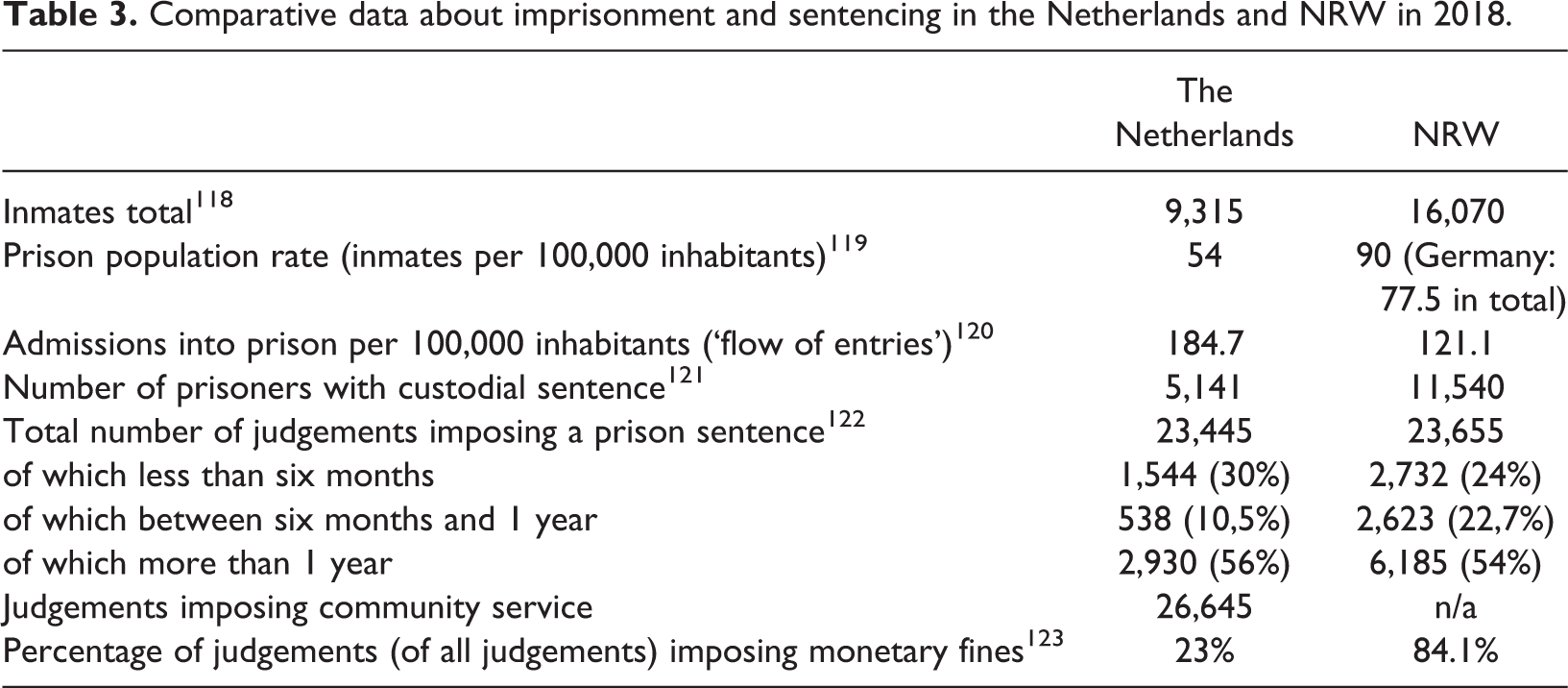
In Germany, short prison sentences (that is, of less than six months’ imprisonment) pursuant to § 47 StGB are considered to be the exception. Interestingly, the reasoning is similar to that in the Netherlands, but the conclusions are opposite: short prison sentences are considered ineffective because the deterrent effect is limited and the negative consequences (loss of job, weakening of family ties, criminal contagion, the costs of reintegration into society and the risk of prison overcrowding) are considered to outweigh the benefits. 124 However, judicial data from Germany shows the obvious gap between law in the book and the law in practice. In penal practice, the number of short prison sentences amounts to nearly a quarter of all prison sentences (24%) and is only marginally lower than in the Netherlands (30%). Moreover, Table 3 shows that even though the prison population in NRW is more than twice as large as in the Netherlands, the distribution of the length of prison sentences is remarkably similar. The same is true for the number of judgements imposing a custodial sentence, but not for monetary fines; the latter being by far the most frequently imposed penalty in Germany with more than 84% of all sentences.
Another crucial difference between the Dutch and the German penal systems is the role of community service as a sentence. In the Netherlands, community service (taakstraf) is a main sentence, with a maximum duration of 240 hours (Art. 22c (2) Wetboek van Strafrecht). According to the Dutch Probationary Services, the average duration of a work sentence in practice amounts to approximately 60 hours. 125 It can be suspended or combined with a fine or, in exceptional cases, a prison sentence. The courts are free to determine what type of work the convicted person has to perform, and in cases of non-compliance the sentence can be converted to imprisonment.
Table 3 shows that community service is a popular sentence in the Netherlands and was even imposed more often than a custodial sentence. But this popularity of community service as an alternative to imprisonment is not undisputed. In terms of legal policy, this practice came under considerable pressure in the early 1990s, when it became public that community service had allegedly been imposed for serious offences such as manslaughter or even murder. 126 Although these allegations were not confirmed in a subsequent investigation, the acceptance of the ‘work penalty’ by the population suffered as a result. Despite strong criticism, the legislator responded with considerable restrictions on judicial discretion and legally excluded work sentences for a number of serious offences (Article 22b Sv).
Under German criminal law, community service is rarely imposed. The reasons for this are again based on doctrinal rather than pragmatic or empirical considerations. Pursuant to § 38 StGB, community service is not a main sentence (with the exception of juvenile criminal law), but can only be imposed as a condition within a probationary sentence (the so-called ‘Bewährungsauflage’ pursuant to §56b II S.1 No. 3 StGB). Empirical data on the number of cases in which a work condition is imposed on a probationary sentence are not available, but there are indications that this remains the exception. However, it is worth mentioning that the suspension of prison sentences (whether conditional or not) is a fairly popular instrument among judges in NRW. Of the nearly 24,000 custodial sentences imposed by judges in NRW in 2018, nearly 70% were suspended. 127
These differences between the two legal systems are not only seen in the sentencing phase of the criminal trial. Also, with regard to the question whether a trial takes place and judgements are rendered at all, legal practices deviate. For example, in Germany in absentia trials and convictions are formally possible but almost not existing, while these trials play an important role in Dutch legal practice. 128 The annual percentage of judgments issued in the absence of the accused (the so-called ‘verstekvonnis’) is approximately 35% of all judgments. 129 Under Dutch law, the accused is free to be present at their own trial. The only conditions for a conviction in absentia is that the accused has been summoned and that the court is convinced that the summon has been duly served. 130 The accused may be represented by his defence counsel, and the hearing shall continue in absentia (Article 279 lid. 2 Wetboek van Strafvordering). 131 In principle, a judgement in absentia is also possible without legal representation. The reasoning behind this practice is, in addition to ensuring an effective prosecution, to avoid making criminal trials available to the accused. 132
In Germany, in absentia trials are handled very differently. Due to the fair trial principle and the right of the accused to defend themselves, judgements in absentia are only possible under very limited circumstances. In legal practice, there are almost no decisions rendered in absentia. In most cases where the accused is absent during the first trial, the courts will issue an arrest warrant (pursuant to § 230 StPO) or simply dismiss the case. In 2018, the number of dismissals issued by judges in NRW due to the absence of the accused represented 16% of the total number of dismissals (53,434 cases in total). 133 In addition, one has to account for the dismissals issued earlier in the investigation phase by the prosecution services due to the absence of the accused (amounting to 41,547 cases). 134 While this is a considerably high number of dismissed cases, one should be cautious to consider this as an indication of ineffectiveness. It is even doubtful whether judgements in absentia are of great value when it comes to judicial effectiveness, even if public trust is taken into account. Although prevents a deterioration of evidence, it restricts the defence rights of the accused. In fact, in absentia trials may take up a considerable amount judicial capacity, with little added value, if the convicted person is never captured. In many cases, the person convicted in absentia is a foreign national, and extradition is often difficult even between neighbouring states such as Germany and the Netherlands. This is illustrated by the case of the German terrorist Knut Folkerts. He was convicted of murder in the Netherlands in 1977, and has been in prison in Germany ever since, and although his whereabouts are known, Germany refuses to extradite him despite numerous requests by Dutch authorities. A more recent example is the criminal trial against four Russian and Ukrainian suspects for shooting down flight MH17 from Amsterdam to Malaysia on 17 July 2014, killing 298 people, many of them Dutch nationals. It seems unlikely that Russia will ever extradite the suspects to the Netherlands, but the message to the public that impunity will not be accepted by the Dutch criminal justice system is seen as more important.
All these examples paint a rather vague picture when analysed under the initial premise of efficiency and pragmatism of the penal systems. One might view the Dutch approach of a remarkably lenient sentencing policy for drug-related crimes, or the widespread application of alternative means of punishments – such as community service – as rather pragmatic. The fact that imprisonment rates are low and prisons relatively empty may serve as evidence of the strategy’s success. In comparison, the German penal system, with high imprisonment rates and a strong tendency to relieve capacity by widely suspending custodial sentences and refusing in absentia judgements, may seem more formalistic and driven by doctrinal considerations.
6. Concluding remarks
Measuring the performance of public institutions by assessing their effectiveness and efficiency has a long tradition. This is also true for stakeholders within the criminal justice systems, for criminal courts, law enforcement and penal agencies. However, on closer empirical inspection, this comparative legal study has shown that the question of what constitutes an efficient criminal justice system is complex and goes far beyond a mere economic analysis. Criteria for effectiveness and efficiency within the criminal justice system vary and are often based on judicial and criminal policies, which in turn depends on dynamic crime trends, risk analyses and contemporary political currents.
Generalized assumptions such a categorizing the German criminal justice system as retributionist, and the Dutch system as utilitarian, contribute to a clearer picture and a better understanding of national differences and commonalities. 135 Legal cultural differences, such as pragmatism versus more formalistic or doctrinal approaches, may be useful to explain some of the observed empirical differences. But when we take empirical evidence into account and focus on the details, ironically, the picture does not become clearer, but rather more blurred. The image of the Dutch law enforcement as being more pragmatic and efficient may be accurate when it comes to prosecutorial clearing rates. But when taking into account crime rates and the fact that only about a quarter of all registered crimes ever reach the prosecution services for indictment, and the fact that about 40% of those cases are terminated, this picture becomes more relative. The Dutch criminal justice system, which is based on a high degree of prosecutorial opportunity and pragmatism, is highly selective, while police clearing rates remain remarkably low compared to those in NRW.
Similar legal cultural patterns can be observed with regard to criminal procedural practice. Efficiency and pragmatism govern Dutch criminal trials, which are characterized by expediency and a rather flexible interpretation of the immediacy principle. But it comes at a cost: basic suspect rights, such as confronting hostile witnesses or gathering exculpating evidence, may exist in theory but are considerably limited in legal practice. The opposite is the case in German trials, in which doctrinal consistency and a strict application of immediacy are guiding principles. Here, however, there is a risk of impunity and of rewarding those defendants who choose to delay defence strategies.
From a comparative perspective and when considering the different aspects of the criminal justice systems examined in this study, strong evidence for the efficiency of the Dutch approach can particularly be found with regards the penal system. Low incarceration rates and high prison capacities, in addition to a flexible sentencing system with a variety of alternative sanctions, indicate that the system is operating successfully. It appears the Dutch system strikes a balance between leniency towards volume crime, particularly drug-related crimes, and harsher sentencing with regard to serious crimes. In comparison, the German penal system seems to be more retributive. NRW in particular is characterized by high incarceration rates compared to the Netherlands and the rest of Germany. Controlling incarceration is mainly achieved by issuing financial penalties and by suspending a considerable number of sentences. Although alternative sanctions exist and in absentia convictions are theoretically possible, in practice they play a minor role. In comparison, sentencing in Germany seems somewhat anachronistic and formalistic, while the Dutch once again live up to their image of a lenient and progressive system with good results that speak for themselves.
But in recent years, concern has been voiced that Dutch leniency comes at an increasingly high cost: over the past decades, organized crime groups have found good conditions to further their illegal drug business and money laundering activities, which has a spillover effect upon other European states. 136 The phenomenon of ‘ondermijning’, that is the infiltration into legal markets and other parts of society, including the public administration by organized criminals, has become a popular and controversial topic among politicians and criminologists. This debate is further fuelled by the alarmingly high number of liquidations on Dutch streets as a result of an ongoing underworld drug conflict. 137 Recently, one of the largest national newspapers voicing its concerns about the worrying developments and referring to the Netherlands as a ‘Narcostate’, became the target of a large-scale arsonist attack by organized criminals, which resulted in the prime minister witnessing democracy being under attack. 138 A sad peak of the conflict was reached in September 2019, when the defence lawyer of a key witness was murdered during a trial against a criminal drug gang in front of his home in Amsterdam, triggering comparisons to the mafia wars in Italy during the 1990s.
While there is not much doubt about the fact that the Netherlands has a problem with organized crime, there is disagreement about the extent of this problem and whether – and if so, to what extent – the lenient penal system has contributed to this. It should be remembered that problems with organized crime groups are not unique to the Netherlands, but also exist in NRW and Germany, although most likely on a somewhat smaller scale. Although this societal context is important to understand how and why criminal justice systems are shaped the way they are, it would go beyond the scope of this study to assess their specific impact.
Finally, the question remains as to what conclusions can be drawn from this study with regard to the aforementioned Europeanization and harmonization of criminal legal systems pursued by the EU and its affiliate institutions. Efficiency and effectiveness prima facie are generally shared principles within criminal justice systems. But the example of the Netherlands and Germany, two neighbouring countries with closely related legal traditions, show that the devil is all too often in the detail. Criminal justice systems are built on a complex and intricate balance between executional powers, judiciary control mechanisms, security interests and human rights considerations. Future reform efforts, whether initiated by the EU or its Member States, are well advised to take this into account.
