




Abstract
This research paper aims to highlight hurdles that EU citizens may encounter when exercising their social security rights while working across borders. With the focus on the worker who is highly mobile in the sense of performing various work activities in two or more Member States, the paper analyses how the current system of coordination copes with the increasing mobility in the European labour market. On the basis of an illustrative case, it demonstrates where and explains why high mobility leads to legal and practical ambiguities due to the different interpretations of the rules determining the applicable law, particularly Article 13 of Regulation 883/2004.
1. Introduction
A. Setting the scene: A changing European labour market
Today, it is no longer unthinkable that a resident of Amsterdam works part-time for a French employer that holds office in Brussels while working two days from home per week next to having an own company. 1 Nor are eyebrows raised when a professor holds a position at the Humboldt Universität in Berlin and at the same time teaches at European University Institute in Florence while doing empirical fieldwork in the south of Spain. These are not hypothetical or far-fetched examples, but actual reality.
Technological advances have expanded the possibilities for mobility tremendously: not only can one move faster and cheaper from location A to location B, technology has also changed our working practices. It is no longer necessary to move physically as the internet connects people to an incredible number of other people or networks who would otherwise be far out of their sight. Working can easily be supra-regional. The increased possibilities and velocity of physical and virtual mobility affect people’s work patterns and working lives.
In parallel, the trend of favouring flexibility over stability on the European labour market has led to a growing variety of work forms and job mobility. 2 Instead of being attached to one employer in a ‘lifelong’ relationship, more and more people are moving from job to job, in and out of different kind of working relationships, in and out of the labour market or combining several working relationships at the same time. 3 Short-term mobility in the EU labour market does indeed form an important part and is likely to increase in the future. 4 Furthermore, one can observe different approaches to the organization of resources. The so-called ‘sharing economy’ provides a platform for temporary access of physical assets between consumers, possibly for money; the rise of gig economy meets the growing demand for accomplishing short-term and on-demand tasks. 5 These various trends are expected to cause a greater dualization of the labour market, where those with a standard employment engagement 6 (insiders) have a different position in comparison to those in more irregular or precarious work situations (outsiders). 7
Mobility is also seen as one of the cornerstones of the European integration project. Mobility of workers, the possibility of providing services across borders and the freedom of establishment of enterprises are seen as a tool to reduce regional imbalances on the European labour market. 8 However, from a law perspective, mobility can complicate situations, especially when a person pursues various economic activities and employs increased mobility opportunities while crossing national borders. In such cases, different areas of law apply and give rise to legal complexity and uncertainty. Due to its heterogenous forms, it is difficult to grasp the issue at its core.
B. Approach
This paper seeks to identify the impact of the trends of increased mobility and flexibility on the European labour market on social protection as provided for by EU law. 9 It explores conceivable stumbling blocks relating to the access to social security insurance benefits for the cross-border worker from a macro perspective, namely the law in books. Also, potential practical issues of the law in action are scrutinized through an illustrative fictitious case situated in the Maas-Rhine Euregio between Belgium, Germany and the Netherlands. Although this paper will address some possible routes to prevent or repair conceivable stumbling blocks, specific recommendations need further exploration and will, therefore, not be addressed. The focus is on the conflict rules provided for by the EU social security law 10 framework and laid down in basic Regulation 883/2004 and implementing Regulation 987/2009, and in particular on Article 13 applicable to mobile EU citizens pursuing activities in two or more Member States. 11 Indeed, there has been a remarkable increase in citizens pursuing activities under Article 13 in recent years. 12
This paper seeks to answer the central research question: How does the current system of coordination determining the applicable social security law for persons working in two or Member States cope with changing work patterns and mobility in the European labour market? In order to answer this question, the following sub-questions serve as assessment framework: Where would persons engaged in various work activities in the several Member States be insured under the current system of conflict rules? What legal and practical challenges may a worker encounter in terms of application of the conflict rules laid down in Article 13 of Regulation 883/2004?
Before investigating these questions, a few preliminary remarks should be made regarding mobility. Firstly, mobility is understood as the ability to move freely and easily between the Member States of the European Union. 13 Secondly, the analysis assumes that mobility is sparked by a need to pursue work activities while having a stable place of residence; digital nomads are therefore not envisioned. Lastly, the paper utilizes the term ‘highly mobile workers’ (hereinafter HMW) 14 to indicate two aspects of mobility: performing the work activity across borders (geographic mobility) and mobility in form and pattern of work engagement (job mobility). 15 Specific forms of work that can be observed on the labour market are not taken explicitly into consideration for two reasons. Firstly, the Regulation itself does not differentiate between forms of work. Instead, it refers to any activity or equivalent situation treated as such for the social security legislation of the Member State where the work activity takes place. 16 Furthermore, elaborating on various forms of work would be counterproductive, given the aim of evaluating the mechanism of this EU law instrument including the changing nature and vagaries of the European labour market.
C. Outline
This study is conducted as follows: Section 2 provides a concise introduction of EU social security law. This is followed by an in-depth analysis of the assessment criteria of Article 13 of Regulation 883/2004 in Section 3. The analysis follows the line of reasoning commonly applied by the Court of Justice of the European Union (hereinafter CJEU), namely a doctrinal legal analysis approach by means of scrutinizing the wording of the text (grammatic and textual interpretation) as well as the spirit and purpose of the legal instrument (systematic and teleological interpretation). 17 The applied sources are Regulations 883/2004 and 987/2009, related judicial statements of the CJEU and practical guidelines. 18 Section 4 is an endeavour to link the legal analysis to the social reality by employing a fictitious case illustrating the complexity and contradictions which a highly mobile person may be confronted with while applying deductive reasoning. After outlining the different legal and practical challenges of HMWs in the conclusion, this paper ends with some suggestions for mitigating legal and practical issues for HMWs.
2. EU social security law
EU social security law coordinates national social security insurance schemes in order to guarantee that the right to free movement of persons can be exercised effectively and contribute towards improving the standard of living and conditions of employment within the European Union. 19 The coordination instrument may, in principle, not interfere with the Member States’ own social security legislation. 20 Accordingly, working across borders is not neutral per se in its effect as the enjoyment of social rights for the individual person can differ – both positively and negatively – due to the substantive and procedural differences between the Member States. 21 Notwithstanding, the Regulation aims to prevent persons who made use of the right to free movement from being left without social security cover (negative conflict of law) and to avoid social benefits overlapping (positive conflict of law). 22 Furthermore, the Regulation embraces the principle of non-discrimination, allows for the aggregation of periods of insurance, and prescribes the portability of benefits in cases where a person works or resides in another Member State. 23
Title II of the Regulation provides for a set of rules determining the competent Member State whose social scheme applies to a person working across borders. 24 These so-called ‘conflict rules’ consist of a uniform and complete system, 25 with the objective of providing legal certainty by its exclusive, binding and mandatory effect. 26
As a main rule, the legislation of the Member State where a person works should be applied (the lex loci laboris principle). 27 Hence, the Member State receiving social contributions also grants the insured social benefits. 28 Accordingly, the applicable social security law shifts, in principle, from the first day of working onwards for the person concerned, regardless of the duration of the period actually worked. As this is not desirable in specific work situations – in the case of short-term work or multiple places of work, the lex loci laboris principle would complicate the exercise of freedom of movement to work or provide services 29 – other connection criteria have been introduced, namely the attachment to the place of residence (the lex domicilii principle) or the place of the establishment of the employer. The deviation of lex loci laboris principle is permitted when a person only works for a limited period of time in another Member State for the same employer (posting), 30 when activities are pursued in two or more Member States 31 or when a person is engaged as contract staff of the European Communities. 32 Since this paper focuses on high mobility, the following section verifies both explicit and implicit criteria prescribed by Article 13 of Regulation 883/2004 addressing HMWs pursuing activities in two or more Member States while pointing out issues of debate. 33
3. Article 13: Working in various Member States
In the situation of performance of work in multiple places across borders, a person may receive several wages or salaries from different employers. Therefore, Article 13 may appoint the Member State of residence as the competent Member State. It consists of one central provision applicable to all persons pursuing activities in two or more Member States covering persons working as an employee, as a self-employed person or as a civil servant. Article 13 consists of five sections envisioning four possible work scenarios: (i) persons working for one or more employers, elaborated with a detailed explanation for those persons who do not pursue a substantial part of activities in the Member State of residence;
34
(ii) self-employed persons active across borders;
35
(iii) persons with mixed work activities combining employed and self-employed activities;
36
(iv) civil servants who pursue in addition activities as an employee and/or a self-employed person.
37
The last and fifth paragraph clarifies that once the applicable law has been established, the competent institution must consider the person concerned as though they pursued all their activities and received all their income in the Member State concerned.
38
The following subsections investigate when and how Article 13 is to be applied.
A. When is a person pursuing activities in two or more Member States?
The first issue to be tackled is determining whether a person is working in two or more Member States. Therefore, one has to observe the activities pursued and where they are performed.
1. Observing all activities
In principle, the activities pursued by a person must be considered as a whole and comprise the activities as defined in the contractual documents and the actual work performed. 39 Nevertheless, certain work activities are left aside.
First, only ‘work’ activities that provide access to social security benefits are included. 40 Certain employment engagements do not lead to a benefit affiliation and must disregarded for the application of Regulation 883/2004. 41 Notwithstanding, certain work activities are considered as ‘work’ under the Regulation, however, only lead to partial enjoyment of benefits, such as the mini-job in Germany. 42 Also, activities can be considered as relevant at a later stage of the assessment period, namely when the scope of activity surpasses a certain exemption threshold. It is the national legislator who defines what is considered as work, which work activities provide access to social security benefits and to which extent. Therefore, differences can be observed in interactions and policy measures concerning new forms of (virtual) work between the Member States.
Secondly, marginal activities are to be disregarded when applying Article 13 of Regulation 883/2004. 43 The Regulation itself, however, does not give a definition or indicator or guidance on how to assess marginal activities. This is remarkable, and particularly relevant for those involved in an irregular and changeable work context, such as HMWs. It is, therefore, worth investigating further.
What are marginal activities?
The concept of marginal activities has been introduced by the European legislator in 2012 with a two-fold objective in sight. 44 Firstly, it aims to enhance legal certainty for those who pursue an effective and genuine activity in one Member State in parallel to a marginal activity in another Member State. Secondly, it intends to avoid possible misuse of the conflict rules by virtue of circumventing certain legislation becoming applicable in favour of the person’s benefit 45 – for example working a certain number of hours from home (also referred to as teleworking or working remotely) or taking up a small activity at the side and in this way manipulating the conflict rules while getting affiliated to a particular (more advantageous) social security scheme.
The word ‘marginal’ suggests that the activity is not essential within the overall picture of work activities. 46 In actual fact, it is unclear how the term ‘marginal’ is to be interpreted. The complete absence of any indicator of the meaning of the word ‘marginal’ has also been recognized by the European legislator. In order to deal with the complexity as well as certain lacunae regarding the interpretation and application of the conflict rules, a Practical Guide (hereinafter PG) has been issued by the Administrative Commission for the Coordination of Social Security Systems. 47 Formally, the informative text is of a non-binding nature; 48 however, the PG is carefully observed by the implementing authorities as well as the members of the CJEU. 49 Therefore, and due to the lack of any other legally binding source, this paper assumes that the definition provided by the PG is the one intended by the European legislator.
The PG describes marginal activities as activities that ‘are permanent in nature but insignificant in terms of time and remuneration’. 50 Hence, marginal activities encompass merely occasional activities and activities that occur on a regular basis. Several aspects may indicate marginal activities: (1) activities that account for less than 5% of the worker’s regular working time and/or (2) activities that account for less than 5% of his/her overall remuneration. In addition, (3) the nature of the activities must be observed, such as whether activities are of a supporting nature, are lacking independence, are performed from home or are in the service of the main activity. Furthermore, activities are to be assessed per Member State separately and cannot be cumulated. 51 In other words, the same or similar activity performed in small bits and pieces on the territory of several Member States are to be considered as multiple marginal activities and, therefore, are to be disregarded for the purpose of the conflict rules. Hence, working time can refer to the proportion of working hours as well as to the duration in length of time. 52 The first assessment step can be visualized as shown in Figure 1.
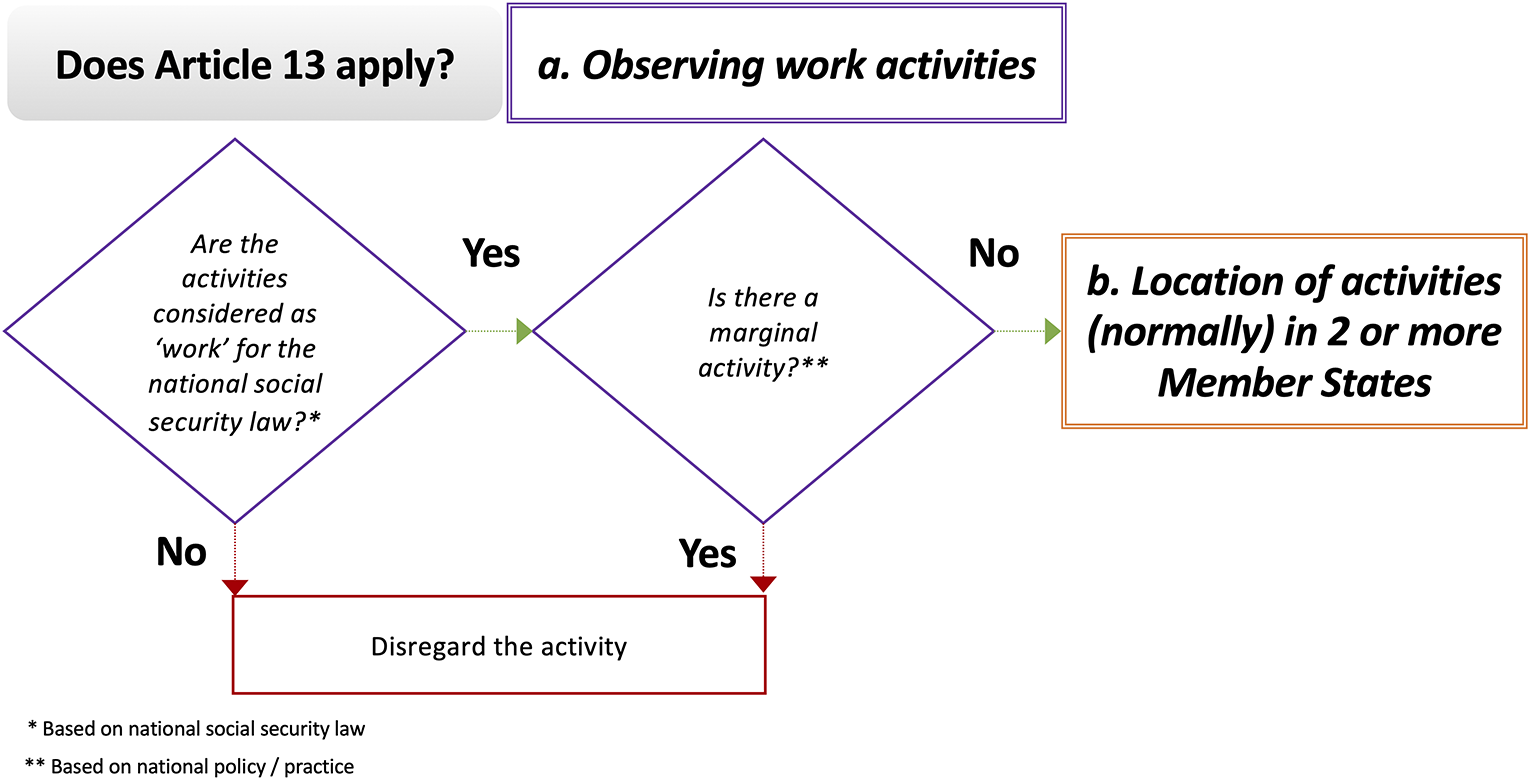
Scope of application of Article 13 Regulation 883/2004: First assessment step.
Figure 1 shows that the delineation of marginal activity is a decisive component in the assessment process. Despite the provided definition, confusion about how to assess marginal activities remain. The PG does not specify whether or not all three indicators must be considered as a whole, and if so, in which proportions. The use of ‘and/or’ appears to suggest that the indicators can be used both alternatively and cumulatively. 53 Moreover, the choice for the term indicators advocates that they are intended as suggestions for the national implementing authorities. Consequently, the national implementing bodies enjoy a large discretion of interpretation and may develop their own framework of criteria. After all, when is work considered supportive?
Whether this genuinely fosters the original purpose of enhancing legal certainty is debatable. Inbuilt flexibility can have both a positive or negative effect. It might indeed encourage implementing authorities to assess in such a manner as to prevent administrative complications while facilitating the free movement for workers. On the other hand, the inbuilt flexibility can create a grey area that makes the application of Article 13 less transparent and more divergent in practice. It may even create legal uncertainty for those persons confronted with a diversified and irregular work pattern across borders. After all, the situation can occur that an activity becomes ‘marginal’ in a given point of time due to a shift in the number of activities pursued as the whole, or vice versa.
Moreover, the definition of ‘marginal activity’ presumes a comparative benchmark, i.e. another (main) activity and or revenue. What if there is de jure no ‘permanent’ main activity existing, but there is a patchwork of many ‘marginal ‘activities? Would the application of Article 13 in such situations disregard all ‘marginal activities’, and thus eliminate a major part of the work pattern? Or should all these activities be seen as a mere set and thus be added up? Both approaches are plausible, yet neither the Regulation nor the PG clarifies how to proceed in such situations.
2. Location of activities in two or more Member States
A second condition to fall within the scope of Article 13 is that the work performed must be situated on the territory of at least two Member States. The decision of the law applicable concerns, in principle, the following 12 months. It must, therefore, be possible to ascertain in advance – by virtue of foreseeability or predictability – not only when and for how long a work activity takes place, but also where. 54 The concept of location is a matter of EU law and refers to the place where the work is conducted on the ground. 55 Hence, the place of performance is also relevant for persons engaged in virtual working, for example, as teleworker or platform worker. 56 From the legal text itself, it remains, however, unclear how this is to be proved and verified.
Besides, employed and self-employed persons must ‘normally’ pursue activities on the territory of two or more Member States to fall under Article 13. 57 Observing the legislator’s text, the implementing Regulation describes that normally pursuing ‘an activity as an employed person in two or more Member States’ must be understood as a person who (1) simultaneously, or in alternation, exercises (2) one or more separate activities in (3) two or more Member States. 58 The same applies to self-employed persons, although the Regulation adds the nuance that the nature of the activities pursued should not be of relevance. 59
This explanation clarifies the requirements of the pursued activity regarding the work pattern ((1) and (2)) and location (3) – i.e. doing one or more (self-)employed activities across national borders at the same time or in interchange. Yet it does not define what should be understood by ‘normally’. Some indications can be found in the PG, expressing that the intention of Article 13 is to cover ‘all possible cases of multiple activities with a cross-border element and to distinguish activities which, as a rule, habitually extend over the territory of several Member States from those that are exercised exceptionally or temporarily’. 60 This touches upon the difficult task to draw a line between habitual and temporary, which can be a challenge for HMWs since they are confronted with a certain degree of constant irregularity. The meaning of ‘normally’ is, therefore, worth further exploration.
‘Normally’ working in two Member States
The verbatim text of the word ‘normal’ itself refers to ‘usual’ or ‘as a rule’. It suggests a certain regularity implicitly and opposes to the unusual, ad-hoc or temporary activity. 61 This explanation aligns with the further usage of ‘normally’ appearing in the Regulation: in the event of posting a person to another Member State, activities normally carried out by an employed person are considered ‘ordinarily’ performing substantial activities. 62 Normally pursued activities for self-employed persons are described as ‘habitually’ carried out substantial activities. 63 Both terms – ordinarily and habitually – are no clearer in actual fact than ‘normally’; however, they underline the idea of regularity in the activities pursued. The question of where to draw a line between habitual and temporary remains.
Logically, the difference between ‘temporary’ and ‘normally’ working is the occurrence of more than a one-time activity in the work pattern. When observing the plain text and examples of the PG, it becomes clear that, at the moment of inquiry by the competent institution, a person must pursue periods of work in the several Member States that ‘follow each other with a certain regularity in the course of the following 12 calendar months’. 64 Therefore, the work activities and the nature of work as described in the employment contract(s) must be consistent with the activities likely to be undertaken. Where there is a difference between the factual situation and the contract description, the actual situation prevails. 65 Hence, ‘normally working’ refers to (1) a certain regularity in (2) activities actually pursued (3) during 12 months. 66
Notwithstanding, the requirement of ‘certain regularity’ in the work pattern remains vague. Interestingly, Article 13 distinguishes two kind of work patterns: activities that are performed simultaneously under the same or different employment contracts and activities that are performed in alternation and consisting of successive work assignments. 67 Simultaneous work activities are characterized by (1) coinciding activities and (2) may not display a gap between the activities.
On the other hand, gaps between work activities are allowed in case of alternating activities and as long as there is a certain regularity of activities. This is the case if the activities are foreseeable or predictable and the prospective factual working situation demonstrates a stable or repetitive work pattern in two or more Member States. 68 The number of alternations is not of relevance. The estimation of the work pattern can be based on the description of the work engagement. However, in case of seasonable work, or when it is not possible to base a decision on planned work patterns, the prediction can be established on the nature of the work as described in the contract or on the observation of the work pattern during the past 12 months. 69
It is remarkable that both work patterns – i.e. simultaneous or alternative work activities – require a continuum of activity as the work pattern must be foreseeable or predictable in the projected 12 months. 70 Furthermore, the word choice of ‘or’ suggests that the work patterns are mutually exclusive and cannot be combined. 71 A doubtful assumption since the combination of a regular work engagement (for example, a part-time employment) with project-based work assignments is very well possible. 72
What does this line of reasoning mean for HMWs who are confronted with constant irregularity? In other words, when an irregularity is a ‘normal’ characteristic of the work pattern. Could the constant irregularity itself be considered as ‘normally’ under Article 13? In case of notable geographic and job mobility that is foreseeable or predictable during a projective 12-month period, probably yes. The snag here is, however, to prove the foreseeability or predictability of the work pattern in advance in social reality, especially for those persons working in a labour field particularly sensitive to dynamics in the economic cycle.
Moreover, it is highly likely that gaps occur between different work engagements. Could a work situation display intermittent periods of non-activity fall within the scope of Article 13? Observing the examples and descriptions of the PG, it becomes clear that ‘normally’ requires, in principle, a continuum of activities pursued without interruption. 73 Nonetheless, intermittent periods can be accepted in two particular situations: in case of seasonal work and when irregular work patterns are intrinsic to the occupation. The interval between periods of work should not be, however, ‘of such a length or nature to modify the work pattern in a way that a person would no longer be “normally” working in two or more Member States.’ 74
According to the PG example concerning a circus artist, this period of non-activity can be fairly extensive and even up to more than half of a year. The person concerned performs in the various Member States. Nonetheless, it is unknown in advance where and when this will be exactly. 75 The PG example indicates that an interruption period of seven months can be accepted. It is noteworthy that the circus artist is employed with a full-time employment contract of an undefined period of time. The work pattern is, therefore, likely to repeat every year and prove to be a foreseeable repetitive (‘normal’) work pattern in two or more Member States. The presence of a standard employment contract seems to be a key factor here as it contrasts to the example concerning a construction worker. 76 The latter example concerns a person engaged under a framework contract having an intermittent period of two months. 77 According to the PG, a framework contract cannot be accepted as a sufficiently precise and concrete confirmation of a certain regularity in cross-border work activities. Hence, the actual length of interruption is not decisive, but the type of contractual document proving foreseeability or predictability of repetitiveness in the work pattern. 78
In short, there are quite a few elements to be verified for the second assessment criterium in order for a situation to fall within the scope of Article 13. Figure 2 provides an overview of the decisive elements.
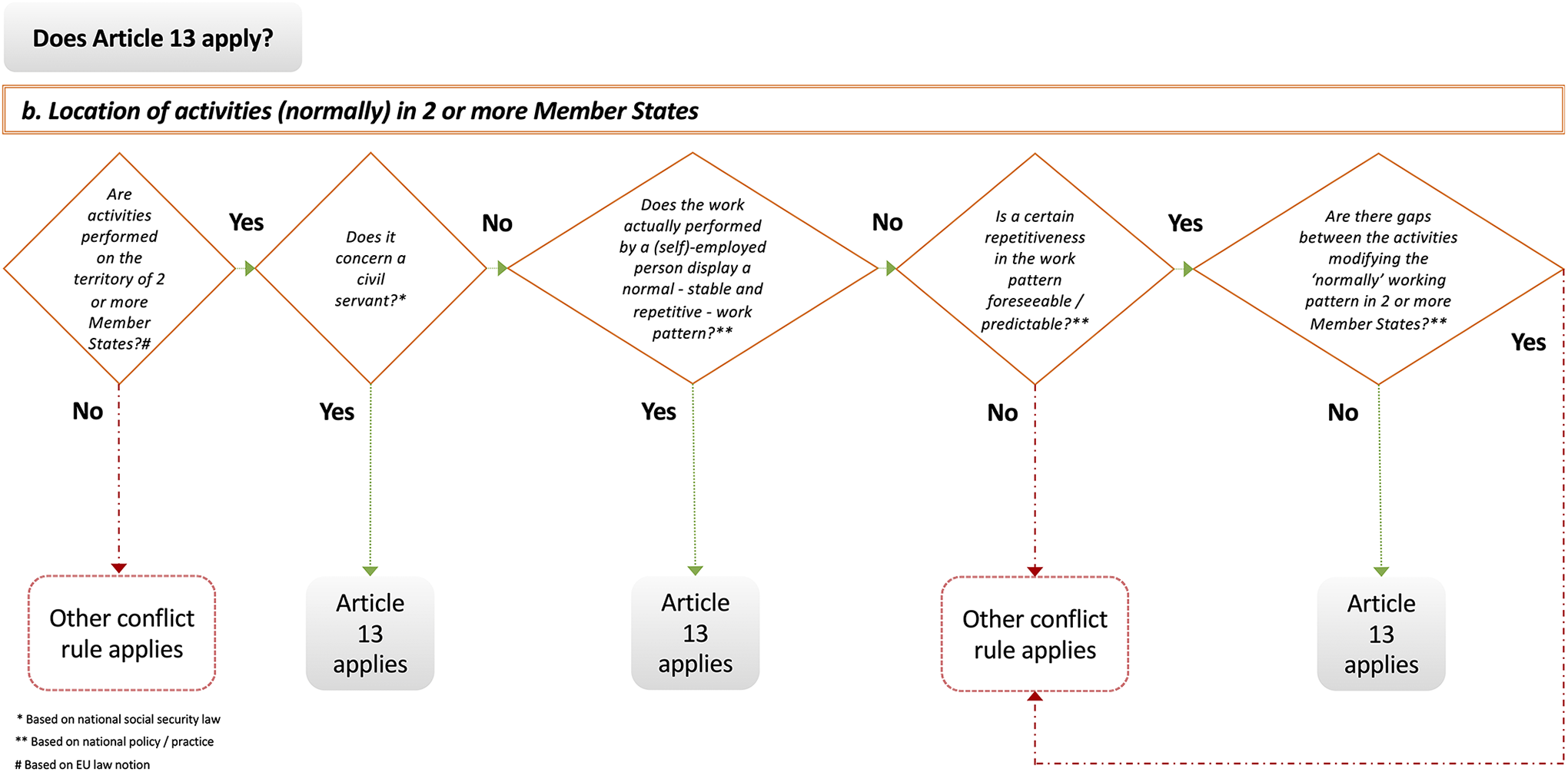
Scope of application of Article 13 Regulation 883/2004: Second assessment step.
Once a situation falls under Article 13, the decision on the applicable legislation remains, in principle, stable for the following 12 months. This prevents the occurrence of a ‘yo-yo’ effect by changing legislation frequently and ensures legal stability. 79 Note that the legislator merely envisions changes in geographic mobility, as the competent institution is required to reassess the decision on the applicable legislation in case of a change in employment or resident status.
B. How must Article 13 be applied?
There are several substantive elements decisive to appoint the applicable legislation. The relevant one are the classification of the work activities pursued; the territory on which the substantial part of activities take place in case of plural work engagements similarly classified; and the connection factor that is most suitable to establish a link to the applicable social security scheme.
1. The classification of work
The legislator differentiates between three classifications of work, namely employee, self-employed person and civil servant. Therefore, the classification of the employment situation based on national social security law is essential for appointing the legislation applicable according to Regulation 883/2004. 80
The hierarchy between work
Article 13 applies a clear hierarchy between the different work classifications as employee status prevails over self-employed status, and civil servant status prevails over employee status (Figure 3). 81 A situation can occur where the same or a similar activity is classified as being performed by an employed civil servant by the legislation of one Member State while at the same time it is labelled as an employee activity in another Member State. This also implies that the Member State where activities which are undertaken in the capacity of civil servant are pursued is mandatorily appointed. It is worth noting that the legislator has overlooked the possibility of two work engagements as a civil servant in different Member States – a situation that is perfectly feasible for those working for public institutions, for example researchers in academia or higher positions in public health institutions. 82 A literal interpretation of Article 13(4) would declare two legislations applicable in such cases, which is against the principle of the one-single-state rule. 83 It remains unclear which legislation prevails in such situations in practice. 84
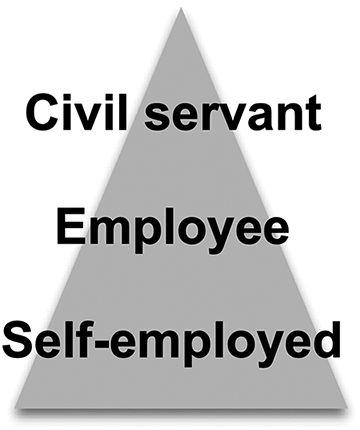
The hierarchy between the classification of work inherent to Article 13 Regulation 883/2004.
The priority given to certain employment situations above others testifies to the assumption that there are differences between the levels of social protection related to the different classifications of work. Indeed, differences can be observed on a national level, especially between the level of protection of an employed and self-employed person. This is an adequate approach when persons are involved in a continuous full-time work engagement with only one kind of activity, as access de jure also provides access de facto to a social security scheme. This assumption becomes invalid, however, as soon as persons are involved in more than one work engagement or confronted with changes in work classification due to job mobility.
Moreover, changes in the work classification can also occur on the Member State level. New kind of jobs challenge the traditional concept of work with the employee-employer relationship at its heart. In addition, certain Member States take the battle against bogus self-employment rather seriously by introducing control mechanisms that can be an incentive to apply or omit certain work forms or practices, thus controlling the classification of work. Furthermore, national governments proactively implement policy decisions that change the classification of work for the purpose of the Regulation. 85 Whether a change of work classification is caused by a person pursuing activities displaying both geographic and job mobility or by adaptations on the national policy level, it can generate another mandatory decision on the applicable legislation. Consequently, this may lead to a different level of social protection by virtue of the different protection level provided by the social scheme.
2. The substantial part of activities for (self-)employed persons
In principle, the hierarchy between activities applies in case of different work classifications. However, what if a person works within the same work classification of activities (i.e. employee or self-employed) in two or more Member States? In those cases, the closest link to a Member State is to be established by weighting the ‘substantial part of activities’. 86 Hence, the question of where the substantive part of activities is carried out needs to be answered. The concept of substantial part of activities has been introduced for (self-)employed persons to prevent manipulation of the conflict rules, e.g. by taking up a minor – but more than marginal – activity in the Member State of residence and thereby making its legislation applicable ‘through the backdoor’. 87
A ‘substantial part’ of activities appears when at least 25% of all the (self-)employed activities is pursued in the Member State of residence without this necessarily being the major part of those activities. Factors to be considered are the working time and/or remuneration of an employee, or the whole of the turnover, working time, number of services rendered and/or income in case of self-employed persons. 88 For example, in the situation where a person works for 20 hours in Member State A and for 10 hours in Member State B, the legislation of Member State A becomes applicable when the person resides there. If the person would reside in Member State B, the latter legislation becomes applicable, even though it is not an absolute majority but only a substantial part (33%) of work activities that took place there. However, it is unclear how the indicative factors are balanced against each other and whether or not certain factors, such as working time or remuneration, have a greater impact. It is known that Member States apply the substantive activity criterion sometimes as a hard indicator and sometimes as a softer indicator during the assessment. 89 When there are different implementation methods, there are presumably also different outcomes across the Member States. 90
3. The connecting factor
The last yardstick when applying Article 13 relates to the connection criteria of the (legal) persons pursuing activities with a Member State. It is the only conflict rule provision where the place of residence is a possible connecting factor for cross-border workers. 91 The place of residence refers here to the EU notion that is defined as the place where a person habitually resides and is to be distinguished from a temporary residence. 92 Only one place can qualify as place of residence. 93
Article 13 prescribes that the legislation of Member State of the place of residence applies when a substantial part of the activities is situated there. 94 If not, other connection criteria are established: for employees the legislation of the place of employment, 95 the place of the registered office or the place of business of the undertaking or employer; 96 for self-employed persons the place of the centre of interest of his/her activities; 97 or, in case of civil servants, the legislation of the Member State to which the administration employing him/her is subject. 98 The affiliation to a particular connection criterion is, therefore, partly determined and intertwined with the establishment of where the substantive part of activities takes place, which is evaluated by the competent institution of the Member State. Figure 4 provides an overview of the various assessment steps and relations related to the application of Article 13 of Regulation 883/2004:
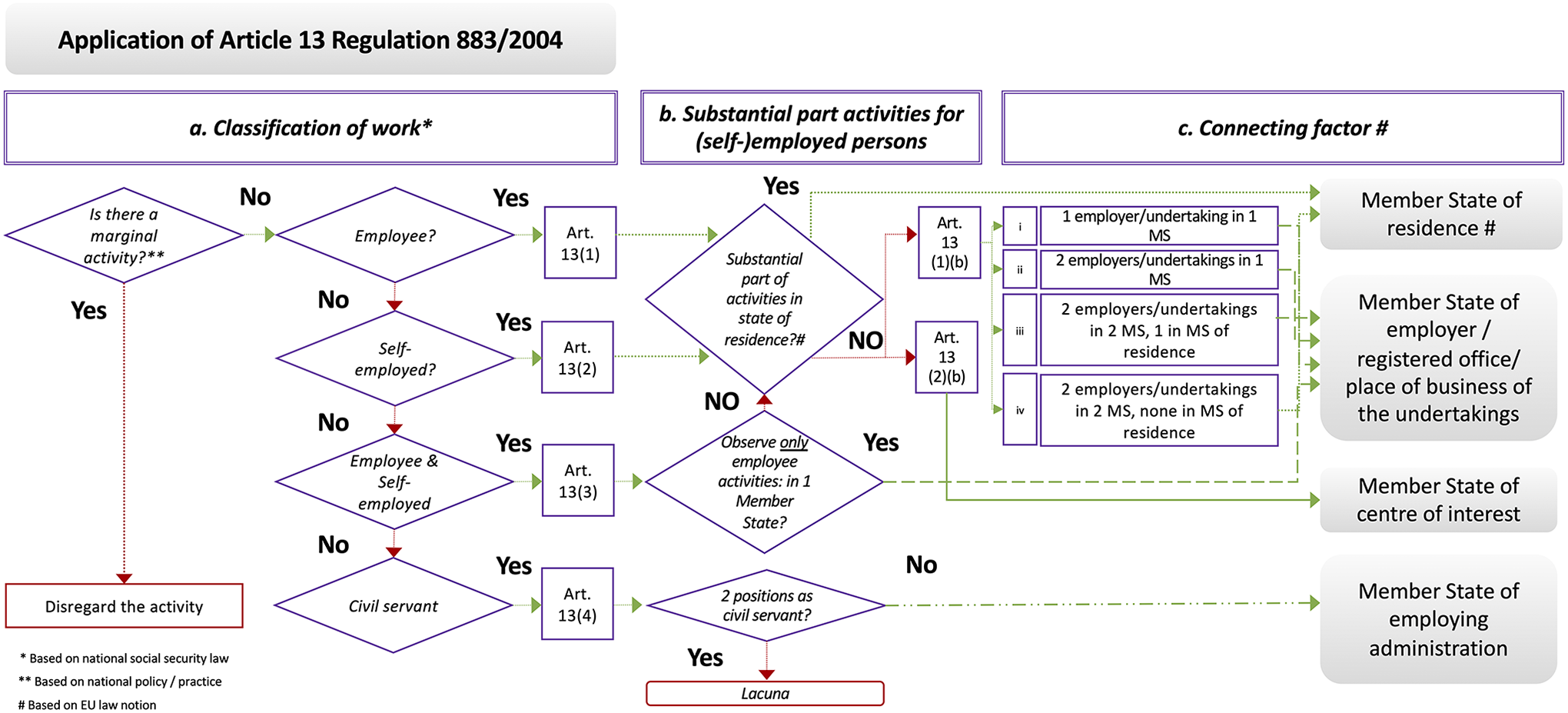
Flowchart of the assessment steps when applying Article 13 Regulation 883/2004.
The diagram shows clearly that the competent institution must strike a balance between, on the one hand, the work classification of the pursued activities as defined by national law and, on the other hand, the prescribed connection according to the Regulation. The various assessment factors involved here comprise a mix of EU and national law notions, which can lead to confusion, unclarity or even errors in interpretation or inconsistency in application. 99 For example, a person can in the first instance be confronted with the national law notion of residency when the desk officer involved is applying the national residence criteria unintentionally. This could arise for the simple reason that (s)he has overseen the cross-border element as these situations are less common.
Moreover, the moment and timing of review could emphasize one notion or another: initially, the competent institution involved may, out of negligence or carelessness, apply the national criteria for the place of residence. However, in case of disagreement or a lodged objection, a judge reviews the very same situation on the basis of the EU notion of place of residence as prescribed by the implementing Regulation. 100 Consequently, when applying Article 13 different elements and assessment methods may be emphasized due to the national definition of place of residence. Moreover, the rather complex decision process of Article 13 is unambiguous when the work classification is evident, and the place of residence is also evident and stable for the law. However, new forms of work and more mobile working lives or lifestyles do challenge these two anchor points.
4. Practical challenges for HMWs
The previous section identified various legal ambiguities stemming from ‘the law in the books’. This section seeks to illustrate and unravel the impact that the current system may have on HMWs in social practice. Let us take a professional musician living and pursuing various work activities in the Euregio, that is, Belgium, Germany and the Netherlands.
101
Where should this HMW be insured according to the conflict rules? Moreover, what are the possible challenges that an HMW may face? Step by step, this section provides possible answers while highlighting practical issues that are potential causes for legal uncertainties that HMWs, their employer(s) and desk officers may be confronted with. A young professional violinist with German nationality wins the competition for a part-time job of 50% with the Johann Strauss Orchestra of André Rieu. The orchestra is based in Maastricht, Netherlands and operates on a project basis while touring regularly abroad. The craftmanship and condition is maintained through individual and regular practice hours. (S)he also takes part in ad-hoc musical projects that are self-organized or at the request of others. Due to the new job, the violinist is able to exchange the student accommodation in Maastricht for a small apartment in Aachen, a German city 30 km away.
The violinist in casu is an EU citizen living in Germany and pursuing activities across borders. 102 As regards the work pattern, full-time project weeks are alternating with weeks of less or no activity. The violinist makes use of the right to free movement of workers and is, therefore, subject to the conflict rules. 103 The rehearsals and performances take place in the Netherlands and other countries, varying according to the season and programming. One would, therefore, assume that Article 13 of Regulation 883/2004 is applicable here. Is this the case?
Whether or not the situation falls within the scope of Article 13, the total of activities must be observed next to the place of performance. The violinist has two employment engagements, namely freelance activities and part-time employment with the Strauss Orchestra in the several Member States. Furthermore, it must be assessed whether certain activities are to be set aside since they qualify as being marginal.
The freelance activities are irregular, which makes it difficult to predict the amount of all the performance activities in advance. Certain freelance activities may indeed qualify as marginal. This depends on the proportionality of the activity with the total amount of activities and on the location of performance, reviewed over a period of 12 months. For example, when during a concert season the violinist has only one freelance engagement of one week on Belgian territory, this would most probably qualify as marginal and thus be left aside for the conflict rules. Ergo, the violinist is seen as only employed in the Netherlands, and thus falling outside the scope of Article 13. However, in case of a longer or several performances on Belgian territory – hence, more than a marginal performance in Belgium – Article 13 would apply.
The renowned Strauss Orchestra differs from most symphony orchestras because it regularly performs concerts all over Europe. Therefore, the violinist pursues activities in more than one Member State in any event with this particular employer, independent of the freelance activities. Seen in this light, the situation in casu falls within the scope of Article 13.
When applying Article 13, as a second step, the work classification determines the applicable paragraph of Article 13. Since the status of employee prevails over the self-employed activities as freelancer, Article 13(1) applies. Furthermore, the substantial part of activities and place of residence must be observed in order to ascertain the connecting factor. Given the various locations of performances in the several Member States, both as employee and as self-employed person, the applicable legislation is presumably that of the registered offices of the employer, here the Netherlands. 104 Although German legislation may become applicable when the violinist performs 25% or more of their working hours on German territory, as it is the country of residence. 105 A situation that is not unlikely to occur since the Strauss Orchestra is popular in Germany.
In addition, it is quite probable that a large part of the freelance activities take place in Germany, due to the ties of residence in Aachen. Moreover, the major part of the individual’s practice hours take place at home. Nonetheless, it is unclear whether these ‘working’ hours are also to be considered for the purpose of the Regulation. 106 Irrespective of the latter, the work pattern displays significant changes in amount and place of performance throughout a season. Therefore, it is difficult – if not impossible –for the violinist to predict the actual work pattern for 12 months, the reference period on which the decision of applicable legislation is based. Moreover, not all employers are able or willing to distribute the proof of prospective work engagement. From the Regulation and the PG it remains unclear how this can be proven and verified. Yet, it is certain that it is verified.
From the above illustration, it can be concluded that for the practical application of Article 13, HMWs are confronted with difficulty in fulfilling the conditions to: (i) know and prove in advance the place of performance of the activity; (ii) know and prove in advance the significance of the activity in the sense of work hours and/or income.
After the initial step, the second career step follows: The violinist starts simultaneously with teaching activities at the local music school in Aachen for eight hours a week.
Following the change in the employment situation, the violinist is now working across borders while being employed by the Strauss Orchestra in the Netherlands and being engaged as teacher alongside freelance activities as a self-employed person under German law. At first glance, one would say that the violinist does freelance activities at the same time as working for two employers, of which one is situated in the Netherlands and one in Germany. According to Article 13, the Dutch social security scheme applies when less than 25% of the activities take place on German territory. 107 On the other hand, when a substantial part of the activities take place in the state of residence, the German legislation must be employed. The latter situation occurs when the violinist’s work activities consist of teaching in Germany and performing with the Strauss Orchestra. 108 The freelance activities could put a spanner in the works by virtue of the place of the activities and number of freelance performances. For example, if the various freelance engagements taking place outside Germany were increase by such an amount that it altered the substantial part of activities to below the indicator of 25%, the applicable social security legislation would shift mandatorily from Dutch to German law.
There is a snag here, however, as teaching at music schools in Germany is frequently on the basis of an Honorrarvertrag. This is a form of work engagement considered as a contract for services and thus self-employed activities for social security purposes under German law.
109
Although the different classification does not change the applicable law in casu, it does indicate the importance of being correctly informed of the work classification.
110
Assessment errors lurk here when the person signing a contract thinks (s)he is an employee, or when the desk officer is not sufficiently familiar with the legislation of a (neighbouring) country. Hence, another practical challenge regarding the application of Article 13 for HMW situations emerges: (iii) both the cross-border worker and desk officer must be familiar with the work classification of the employment situation for the purpose of the Regulation 883/2004.
A (fake) cherry on the cake? Recently, the violist has been proposed to become the chamber music teacher for the string department at the Royal Conservatoire of the city of Liège, Belgium. The work engagement consists of a one-year contract for four hours a week carried out in blocks of eight hours on a biweekly basis.
If the violinist accepts the job offer, another layer of activities will be added. Moreover, another work classification comes into play: teaching at a public institution in Belgium is qualified as a civil servant for the purpose of social security legislation. Ergo, the hierarchy inherent in the paragraphs of Article 13 applies and the civil servant status prevails. Hence, the Belgian law would be appointed even though the substantial part of activities may still take place in Germany or the Netherlands. 111
There is one fly in the ointment. The teaching job concerns a relatively small appointment and could, therefore, qualify as marginal activity. 112 If so, the weighting of substantial part of activities comes into play and stipulates the Dutch or German legislation. 113 Also, the unpredictability and possible fluctuation of the freelance activities lead to uncertainty here. When the violinist has nearly no freelance activities during a season, the amount of working time as civil servant approaches 5%. 114 Should these activities therefore be disregarded for the entire assessment of Article 13?
The textual analysis of the assessment criteria for marginal activities shows that they can be interpreted in various ways. Should the competent institution emphasize the quantitative assessment criterion of the number of working hours and/or remuneration, it is quite conceivable that the activity in Belgium would qualify as marginal and hence should be disregarded for the application of Article 13, which makes the Dutch or German law applicable. 115 However, the outcome will be different if the qualitative element were be accentuated by taking into account the nature of the activities; the teaching job is a distinct engagement, which is also manifested in a separate contract. In this situation, the teaching activities would be considered when applying Article 13. Hence, the Belgian law will become applicable.
Either way, one of the employers involved will be confronted with the application of another social security scheme than usually applied. This requires an investment on the part of the employer in terms of administrative time and possibly higher social contribution fees. In practice, this can pose a burden on small and medium-sized employers in particular, who are usually not familiar with cross-border Regulations and do not have an in-house legal expert who can translate foreign law provisions. Also, for the HMW, there can be a far-reaching effect as regards economic competitiveness. When the work engagement is based on a fixed-term contract, there is a risk that this will not be renewed due to higher costs in comparison to a non-migrant worker.
That is not all: if the applicable legislation shifts, it is possible that de jure will no longer equal de facto access to national statutory social benefits. To genuinely enjoy social benefits, the national eligibility requirements prescribing thresholds regarding, for example, the number of working hours, the duration of employment or level of contribution must be met. For a person who is temporarily employed in another Member State, in our example of the violinist, the Regulation makes mandatory the legislation of the Member State employing the part-time engagement as civil servant without taking account of the substantive implications this could have. In the short and medium term, the effect could be perceptible regarding sickness benefits, while in the long term there are the issues concerning old-age pensions. 116 Thus, although a person may have access to social security benefits according to the Regulation, the very same person may be at the same time confronted with limited access in terms of duration and/or amount of benefit or may even not be able to effectively enjoy access to social benefits at all. 117
This illustration shows that the application of Article 13 in HMW situations leads to difficult challenges concerning: (iv) both the cross-border worker and the engaging employer(s) needing to know the applicable law and tangible effects relating to administrative and financial consequences; (v) a cross-border worker needing to know the short-, medium- and long-term effects of being affiliated to different social security schemes.
In sum, a mixed bag of work engagement in terms of classification, working time and workplace are leading to legal uncertainty for the HMW in practice. In particular, the irregularity in pursued activities in more than two Member States may lead to a mandatory change of applicable legislation more than once. Hence, marginal activities in absolute terms can become unexpectedly big in relative terms.
5. Closing remarks: Article 13, a marriage between strict requirements and legal ambiguities?
A. Conclusion
Analysing Article 13 of Regulation 883/2004 from the viewpoint of high mobility has shown that several assessment criteria give rise to lack of clarity, leading potentially to legal uncertainty and practical obstacles. Not only the cross-border worker may be confronted with these flaws, but also their employers or purchasers and the desk officers applying the law. The national implementing authorities themselves decide on whether or not, and if so, how irregular or new forms of work are integrated. The segmentation of the European labour market may, therefore, cause stumbling blocks and cracks in the uniform system of determining the applicable law. Various issues can occur when applying Article 13, which may erode the actual objective of providing legal certainty by its exclusive, binding and mandatory effect. Moreover, Article 13 can unintentionally lead to a frequent switch of the legislation applicable, the so-called ‘yo-yo’ effect. The in-depth analysis has led to various observations regarding the scope, the application and practical implementation related to legal uncertainty.
For a situation to fall within the scope of Article 13, lack of precision in the legal texts can cause lack of clarity regarding: (i) whether or not a certain work activity is considered as relevant ‘activity’ for the national social security legislation, especially in the case of ‘new’ forms of work; (ii) whether or not a certain work activity is considered to have an ‘inherent’ irregular work pattern, so that intermittent periods of working between activities may be accepted; (iii) in case of acceptance of intermittent periods between the activities, how long this period should be and whether or not there is a maximum length of the gap between the pursued activities; in other words, when the pattern of ‘normally working in two Member States’ for (self)-employed persons is considered to be disrupted in case of irregularity in the work pattern; (iv) which evidence is expected and accepted as proof of foreseeability and/or predictability of the workplace and pattern in two or more Member States; (v) whether or not a certain ‘small’ work engagement is considered as a ‘marginal activity’ and thus must be disregarded for the scope of Article 13. It remains unclear how and which of the proposed assessment requirements are applied in practice (i.e. the amount of working time, remuneration, or nature of activity) and what should be the comparative benchmark.
Also, difficulties can arise when applying the legal provisions of Article 13 to a situation concerning the classification of the work, establishing the substantial part of activities and whether or not the place of residence is an adequate connecting factor, causing the following problems: (vi) the classification of the employment for the Regulation 883/2004 is based on national social security law, however, this is not always transparent as: ▪ similar work activities can be classified differently per Member State depending on the national law; ▪ the status of work can be unclear due to blurring of line between the concepts of employee and employer, especially in case of new forms of work (such as platform work); ▪ the status of work can be subject to national policy changes; (vii) in the case of similar classification of employment, the Regulation does not cover the situation where a person is engaged as a civil servant for the purpose of social security in two Member States (lacuna legis), and national implementing authorities apply their own solution; (viii) whether or not a specific ‘small’ work engagement is considered as ‘marginal activity’ and thus must be disregarded for the assessment of the ‘substantial activities’ of (self-)employed persons (see also point (v)); (ix) unclarity concerning the identification of the ‘substantial part of’ activities within a given situation by the national implementing authorities as the assessment process is ambiguous related to which aspects are taken into account and the balancing thereof; (x) confusion or carelessness regarding the criteria establishing the ‘place of residence’ may differ during the application procedure being based on national or EU law criteria.
Furthermore, certain ambiguities in the legal text can be amplified by the fact that the Regulation itself is only a coordination instrument, and thus allows differences in interpretation and assessment procedures by national implementing authorities. Having said this, however, the HMW, their employers, as well as the desk officers implementing the law, are confronted with legal ambiguity and extra (administrative) workload in practice by virtue of informing and providing information to allow the correct application of the conflict rules. Besides, there can be financial consequences in the event of changing in the decision of applicable law for both the working person as their employer or purchaser. Additional practical obstacles for the HMW cum suis can concern: (x) knowing and proving in advance what the significance of the activity is so as to make an informed choice as to whether or not to talk up an activity; (xi) knowing and proving the foreseeability or predictability of the place of performance of the activity in the 12 months to come; (xii) being familiar with the classification of the employment situation for the purpose of Regulation 883/2004 and the eventual consequences of a change of the applicable social security legislation; (xiii) knowing the applicable law and tangible effects as regards administrative and financial burden when undertaking an activity across a border; (xiv) knowing the effects in social reality concerning the social security insurance position on the short, medium and long term when being affiliated to another or several social security systems during working life.
Looking at the points outlined above, one could state that Article 13 of Regulation 883/2004 – in conjunction with the current trend of high mobility – may cause various difficulties. Lack of clarity and unanswered questions regarding the assessment and decision of the applicable law – and the impact thereof – can occur at different stages, leading to legal uncertainty to which a clear-cut answer is not available. The answer to the question whether EU social security law is able to adapt to today’s trends of mobility is unsatisfactory.
Moreover, the current sphere of influence of the HMW is limited to being informed about the operation of the conflict rules and adjusting their own form or pattern of work. In addition, the employer or purchaser involved on the other side must also be willing to invest in extra effort to provide information and apply rules of another social security scheme when another Member State becomes competent. If time is money, the HMW must, therefore, bring some desirable skills for it to be worth for employers and purchasers to ‘go the extra mile’.
B. Reflections
One could wonder whether it is not too far-reaching to expect an ordinary worker, employer or purchaser to be familiar with the complexity of the EU coordination instrument to such extent. Even if the parties concerned are well-informed, it is a Sisyphean task to know in advance how the implementing authorities will assess certain employment situations. It is virtually impossible for the highly mobile EU citizen – and for the employer engaging a worker from another Member State – to make an informed choice whether or not to undertake certain work activities across borders while knowing the potential implications regarding social security benefits and work opportunities. It is problematic in the sense that it can deter the exercise of the right to free movement of workers and the functioning of the internal market as a whole, and it is exactly contrary to the aim with which the conflict rules were created in the first place.
Hence, an ‘upgrade’ of the conflict rules integrating high mobility is desirable. Unfortunately, this is not yet captured by the current process of amendment. 118 Undoubtedly, the ‘how’ will be a painfully complex task as there is no one unified answer available to the various legal uncertainty issues. In addition, there is the requirement to act unanimously by the European legislator in the field of social security, which complicates the already present political challenge. 119 Yet that should not be a reason to resign nor cease efforts to find ways to integrate highly mobile workers who are engaged in atypical forms of work and work patterns in the EU social security law framework. On the contrary, it is questionable whether the assumption of ‘standard’ employment – and accordingly, the organizational system of the conflict rules – is still defendable for a coordination instrument in the 21st century. 120 The great importance of the contractual employment relationship seems to impair those workers who consider the EU to be their work territory, transcending the Member States’ borders. Clearly, Article 13 of Regulation 883/2004 is at odds with the rapid changes of the concept of work belonging to the 21st century. Moreover, work-life patterns can change much sooner and faster than expected, currently demonstrated en masse by the Covid-19 pandemic leading to a world-wide lockdown and people working virtually from home while being confined. This has been a clear wake-up call and appeal for another approach than the current, rather old-fashioned and rigid top-down one.
One could imagine introducing a new conflict rule for highly mobile workers to mitigate legal uncertainty and adverse effects on their social security rights and obligations. This would require, however, careful consideration and a great deal of political commitment, which seems currently to be lacking. Alternatively, a soft-law way forward could be more effective. This could consist of more proactive guidance by the European Commission via the Administrative Commission for the Coordination of Social Security Systems. For example, one could imagine increasing the transparency of the assessment criteria through an upgrade of the Practical Guide concerning the interpretation of the terms ‘normally’, ‘marginal activity’ or ‘substantive part of activities’. Also, national implementing authorities could be more supportive by informing cross-border workers and their employers proactively, preferably ex ante. If the situation would result in substantial disadvantages for the worker pursuing activities across borders (and involved employer(s)), national implementing authorities should encourage the arrangement of special individually concluded agreements under Article 16 of the Regulation. 121
Nonetheless, one thing is for certain: as long as there is an inherent legal uncertainty present within EU social security law, this inevitably trickles down to the national authorities implementing the law, and, accordingly, all those involved in various cross-border economic activities in two or more Member States. When the European legislator fails to cope with high mobility in a more legal foreseeable way, there is the grave risk of legal fragmentation and losing a group of highly mobile workers by creating a dual reality for those mobile workers ‘fitting in’ and those who are not.
