




Abstract
The UK decision to leave the European Union could directly impact on the application of the EU private international law (‘PIL’) instruments in the UK. Any fresh legal uncertainty driven by such a change in the legal landscape in relation to PIL could have significant impact on private parties’ access to remedies. This article proposes a socio-legal model for measuring the Brexit impact on litigants’ access to legal remedies. In order to systematically identify the important issues (which need to be considered by policy-makers as priority in this context), the proposed theoretical model is developed around the litigants’ strategies. The advanced model has two major features. First, it is set to analyse the triangular relationship between: 1) jurisdiction (procedural rules); 2) choice of law (applicable substantive laws); 3) outcome of a cross-border case. Secondly, the relevant claimants’ and defendants’ strategies in cross-border cases are thoroughly considered by taking a game theoretic perspective.
Keywords
1. Introduction
The disputes arising out of different cross-border activities seem to be increasingly complicated. The high level of complexity echoes the transnational character of the various commercial transactions as well as the corporate structure of the business undertakings 1 which are reflecting the global nature of trade and services. In order to provide private parties with access to legal remedies in cross-border disputes arising out of their transnational economic activities, a level of judicial cooperation between the national courts is much needed. 2 To this end, the various national, regional and international policy-makers strive to set a global arena for judicial co-operation in cross-border disputes. 3 This paper aims to demonstrate that there is a strong case that the UK decision to leave the EU calls for a new theoretical paradigm which is necessary to inform policy choices in respect to judicial co-operation in the post-Brexit era.
It is well established that the EU has incentivised a high level of economic integration, with different national economies developing a level of specialisation in certain sectors (for example, manufacturing; pharmaceutical industry; financial and/or legal services). As acknowledged by the New EU/UK Political Declaration of October 2019 (para. 16), long supply chains have been formed across the EU. The EU Civil Justice framework is set to facilitate private parties’ access to appropriate legal remedies in cross-border cases arising out of the various pan-European supply chains. The problem is that the effective resolution of such cross-border disputes is not an easy task.
It is not only that the existing EU chains of distribution would include multi-national companies, large national companies, SMEs and consumers from the EU and UK, but also the cross-border disputes arising out of such chains (fostered by the EU regulative framework for cross-border trade and services) may raise a mixture of issues. Various disputes with an international element may pose complex questions raising contractual, tortious, IP, competition and other regulatory aspects which all may be subject to heated discussions before national courts.
The PIL issues are important because - if some of the currently applicable EU Regulations were to no longer apply in the UK post-Brexit - the UK policy-makers might need to re-design the framework for judicial co-operation. This may be a major task, not least because the English and Welsh courts and law firms have traditionally been attracting claims involving parties from across the globe. 4 This enabled English and Welsh judges to specialise in dispensing justice in complex cross-border family, civil and commercial cases. 5 Thus, the UK decision to leave the EU may have significant implications for the private parties’ access to legal remedies. A central question is: how would a change in the legal landscape in relation to PIL post-Brexit impact on the parties’ strategies and their access to appropriate legal remedies in cross-border cases?
The response to this question is complex because it seems that the UK and EU might need to re-design the post-Brexit legal landscape for cross-border trade (as well as for judicial co-operation), whilst taking account of less predictable than desirable domestic politics. The ‘political systems across the West [and the UK in particular are] far more volatile, fragmented and unpredictable than at any point in the history of mass democracy.’
6
This means that the UK/EU policy-makers are operating on a somewhat unstable political scene which increasingly reflects the revolt against ‘[t]he [p]ower of International ‘Governance’ Elites.’
7
The political scientists appear to identify an issue with the way the multi-level governance
8
was functioning within the EU as follows: One problem was that as decisions over key issues moved up to the European level, longer and less transparent chains of delegation reduced the accountability of those who were making the decisions. This also made it difficult, if not impossible, for elected politicians at national level to be accountable to their national citizens, while also having to deal with the growing number of treaties, demands, players and processes that now surround them.
9
The difficulties - which policy-makers face in the course of Brexit negotiations - are demonstrated by the consistent failure of the former UK Prime Minister to secure the UK Parliament’s approval for the agreed Withdrawal Agreement. The inability of the former UK Prime Minister to find support for the Brexit deal in the UK parliament along with the UK General Election 2019 results could be perceived as a strong indication that the legal landscape for doing cross-border trade post-Brexit may significantly change. 10 Such a change might impact on the regime for judicial co-operation between the UK courts and the EU Member States’ courts. There are policy choices to be made post-Brexit in this respect. The issues need a renewed attention because, despite the fact that the PIL rules are harmonised within the EU, the PIL rules normally are national and vary across the globe.
Measuring the Brexit impact on private parties’ access to legal remedies in cross-border disputes is important for the UK policy-makers to decide on the various policy choices. As part of this process, the following questions need to be addressed: Will a post-Brexit change in the legal landscape in relation to PIL affect (negatively or positively) the attractiveness/appropriateness of the English courts? If the regulatory landscape in relation to cross-border trade and services were to change, what is the optimal level of judicial co-operation between the UK courts and the EU Member States’ courts as well as between the UK courts and non-EU courts? The methodological hurdles with regard to the assessment of the Brexit impact on trade have been recently noted by an expert witness who submitted evidence in front of the House of Commons’ Exiting the European Union Committee. In particular, George Peretz QC made the following observation: ‘[w]hen one looks at large parts of the EEA agreement and one asks a fundamental question of, “What would happen if…?” the answer is that we do not really know because it has never happened.’ 11
The issues are even more complex when considering the relevant counterfactual with a view to evaluating the Brexit impact on the private parties’ access to legal remedies in cross-border cases. The higher level of complexity is due to the fact that the rules concerning cross-border judicial cooperation will only have a secondary role to facilitate private parties’ access to legal remedies within the primary re-designed framework for the future ‘ambitious, broad, deep and flexible partnership across trade and economic cooperation with a comprehensive and balanced Free Trade Agreement at its core’ 12 (which - unfortunately - is yet to be agreed). An appropriate and dynamic model for empirical data analysis is much needed to measure the Brexit impact on different types of private parties’ access to legal remedies in cross-border disputes. 13
The article advances a socio-legal model for measuring the Brexit impact on litigants’ access to legal remedies in different types of disputes with an international element. In order to systematically identify the important issues (which need to be considered by policy-makers as priority post-Brexit), the proposed theoretical model is developed around the litigants’ strategies. More specifically, the advanced socio-legal model is devised to methodically analyse the correlation between the PIL landscape (including any potential change to the legal landscape) and private parties’ access to remedies in different cross-border disputes (family; contractual; tortious; company; regulatory; competition law; banking/finance).
It is important that an appropriate perspective is taken to consider the interests of the opposing sides (claimants and defendants) in disputes with an international element before the English and Welsh courts. There is a strong case that an appropriate socio-legal model - taking a game theoretic perspective 14 - should enable the researchers to thoroughly factor in the opposing interests of claimants and defendants which may be impacted differently (positively or negatively) by a potential change in the legal landscape in relation to PIL.
Since the cross-border litigation is an actively evolving process which goes through certain phases/junctures at which the parties interact, it was felt that a dynamic theoretical model should be adopted with a view to measuring the Brexit impact. 15 The article offers, on the basis of recent data which was gathered as part of a pilot study on Brexit and PIL, a socio-legal model 16 for analysis of the litigants’ strategies. Such a model is necessary to analyse the existing data and collect further new data with a view to ultimately feeding into a long-term evidence-based policymaking process for a future PIL framework (going beyond a short-term Brexit strategy). The author will demonstrate how the proposed theoretical model using a game theoretic approach could be used to analyse litigants’ strategies with a view to systematically ascertaining priorities in redesigning rules for cross-border litigation.
2. Gap in the PIL literature and research methodology
In this section, the gap in the existing PIL literature will be, first, outlined with a view to demonstrating the contribution of this paper. Then, the research methodology for a pilot study - which was conducted from May 2018 to September 2018 - will be introduced. Before doing this, however, the author will briefly outline why PIL has an important role to play in providing private parties with access to legal remedies in cross-border cases.
Traditionally, private law deals with rights and remedies for parties in civil and commercial law disputes. 17 According to Professor Jaffey, 18 the private law theory distinguishes between the so called primary private relationship (setting out the rights and obligations of the parties) and the ‘remedy [which] serves to protect or fulfil the primary relation.’ 19 It is well established that the outcome 20 in a domestic dispute would depend on the facts and law (merits of the case). There would be, however, an entirely different set of considerations in cross-border cases. The procedural rules (including evidential rules) in cross-border cases would be pre-determined by the jurisdictional rules. PIL must be used to determine which national court is competent (to hear and determine the dispute by applying its own procedural rules). The competent court should ascertain the rights and obligations of the parties by applying the applicable set of substantive law/s (which may be local and/or foreign). Since, by their very nature, cross-border disputes are connected with more than one legal system, PIL should specify which national law (or transnational law) applies to the merits of such a dispute. Furthermore, PIL rules would indicate whether a judgment by a court – which is competent under the applicable PIL regime – would be recognised and enforced abroad, if such enforcement would be required in an individual case.
The problem is that the relevant landscape in relation to PIL in England and Wales has been, to a large extent, devised at EU level (for example, the Brussels Ia, Rome I and Rome II Regulations). The Queen’s Speech in December 2019 reiterated the importance of private international law with a view to ‘maintain[ing] and strengthen[ing] the UK’s role as a world leader in delivering justice across borders on civil and family justice issues’. 21 Whilst the issues concerning the applicable laws in civil and commercial matters appear to be somewhat settled (with the UK adopting a statutory instrument 22 ensuring that ‘Rome I and Rome II (…) will continue to apply, as domestic law, post exit’ 23 ), the relevant PIL aspects of jurisdiction and judgments require reciprocal arrangements. To address the latter concern and facilitate private parties’ access to legal remedies in cross-border cases in the post-Brexit era, the UK has now ratified the Convention of 30 June 2005 on Choice of Court Agreements 24 and Convention of 23 November 2007 on the International Recovery of Child Support and Other Forms of Family Maintenance. 25
A major difficulty, however, is that many of the currently applicable legal instruments which presuppose a level of reciprocity and ‘[m]utual trust in the administration of justice in the Union’ 26 might not apply in the UK, post-Brexit. For example, Regulation No 1215/2012 on jurisdiction and the recognition and enforcement of judgments in civil and commercial matters (‘Brussels Ia’), Council Regulation (EC) No 2201/2003 of 27 November 2003 concerning jurisdiction and the recognition and enforcement of judgments in matrimonial matters and the matters of parental responsibility (‘Brussels IIa’) and Regulation (EC) No 1393/2007 on the service in the Member States of judicial and extrajudicial documents in civil or commercial matters (service of documents) may no longer apply post-Brexit.
More importantly, it is highly likely for the regulatory regime for cross-border trade and services between the UK and EU to be modified. This could potentially impact on the substantive rights and obligations of parties in some cross-border cases, where certain regulatory aspects need to be considered, before the English and Welsh courts. The problems are exacerbated by the fact that the EU negotiating directives (Annexed to the Council of the European Union’s Decision of 25 February 2020, authorising the opening of Brexit negotiations) do not appear to explicitly include a mandate for the European Commission to negotiate on various policy options in relation to judicial co-operation in civil and commercial matters (as opposed to judicial co-operation in criminal matters as well as in family law matters). 27 This is a major omission which poses the question: How would the UK/EU negotiators facilitate the resolution of civil and commercial disputes (for example, tortious and regulatory disputes) arising out of the existing supply chains which (according to the EU/UK Political Declaration of October 2019) they intend to maintain post-Brexit? There is a strong case that the response to this question must be preceded by a systematic evaluation of the Brexit impact on private parties’ access to effective legal remedies in cross-border cases.
A. Brief literature review: Identifying the gap in the PIL literature
The Report 28 compiled by the Justice Sub-Committee forming part of the UK Parliament’s Select Committee on the European Union unequivocally concludes that a number of ‘academic and legal witnesses differed on the post-Brexit enforceability of UK judgments’. 29 The difference in the submitted expert evidence/opinions 30 appears to strongly indicate that there is a case for addressing some major flaws in the PIL literature. The different opinions might suggest that the expert witnesses are highly likely to be reliant on different information/data which is being analysed by employing different theoretical models (if any).
In other words, different data/information – which is inconsistently organised and analysed - would lead to dissimilar assessments about the potential impact of Brexit which might explain why the relevant experts share incompatible views. To address this issue and capture the Brexit impact, new data needs to be systematically collected. This means that an appropriate research methodology needs to be devised with a view to selecting appropriate expert interviewees as respondents. More importantly, if there is no appropriate PIL model for empirical data analysis, there is a risk that no relevant data would be collected as well as that any collected data may be misinterpreted. This strongly suggests that the collection of new data must be preceded by the advancement of an appropriate theoretical model which is necessary to identify what data is needed to measure the Brexit impact.
The deduction that there is a case for an appropriate socio-legal model for data analysis in PIL could be sustained further by making a reference to the expert witness statement submitted by Professor Fentiman who states: It is often held up as a potential disadvantage, if we were to leave [the Brussels] regime, that English judgments would no longer be passported, so to speak, automatically into the rest of Europe. This is often held up as a significant disadvantage of Brexit which we have to do everything to cure by trying to retain, in so far as we can, a mechanism for the automatic enforcement of judgments across borders. Our feeling is that that is not the risk that it is perceived to be, and there are a number of reasons for that. First, a study a couple of years ago by the British Institute of International Comparative Law into the reasons why people litigate in England made no reference at any point to the fact that people wish to litigate in England because they wanted the passporting of their judgments into the rest of Europe. This does not appear to be a significant factor. Secondly, certainly in the realm of commercial law (…), these disputes never go to judgment. In fact, it is very unlikely that they will go to a trial on the merits at all. In other words, you simply will not reach the point at which you have a judgment which needs to be enforced. (…) The kind of disputes that we are talking about a[re] very complex, high-grade, high-value disputes. Very large sums of money are involved. The parties view litigation essentially as an extension of their commercial practice, so to speak, they will always arrive at a commercial result in the event that there is a dispute. The best commercial result is invariably to have a negotiated settlement, so that is what happens.
31
Professor Fentiman’s witness statement clearly shows that he is aware of the litigants’ strategies which impact on the settlement dynamics. However, it is necessary for researchers to go a step further and systematically analyse the aspects of the PIL framework (including issues concerning the recognition and enforcement) which could impact (positively and/or negatively) on the settlement dynamics. Given the complexity of some cross-border disputes, it is a relatively safe assumption that the relevant settlement discount - which is central to achieving a negotiated settlement - would factor in the effectiveness/ineffectiveness of the relevant PIL framework (including such PIL aspects as – jurisdiction; parallel proceedings; applicable law; recognition and enforcement of rendered judgments). 32
The case for a new theoretical model for empirical data analysis could be strengthened further by noting that any existing studies of litigation strategies appear to start (and often seem to finish) with the question: why is there a desire to litigate in England and Wales? The BIICL report (on which Professor Fentiman relied above) indicates that ‘London is a centre for high value commercial litigation and that foreign parties are frequent litigants.’ 33 It went on to conclude that the experience of the English and Welsh judges is one of the most important factors which influences a party’s decision to issue proceedings in London. One could hardly be surprised by the BIICL finding that the experience of any adjudicator would be a significant factor in deciding on the dispute resolution mechanism (be it litigation or be it arbitration or be it expert determination).
That said, the BIICL report overlooked some important questions which are left wide open: Why so many cases do ultimately settle before trial, if judges are so important? Is a choice-of-court agreement a separate factor? If the parties trust the English judges, then should this not be the main explanation why a choice-of-court agreement is included? Is the choice-of-court agreement rather a contractual expression (of the level of trust in the English judges) which is meant to ensure that the parties’ dispute is ultimately litigated in England and Wales? Could the existence of an English choice-of-law clause be justified by the fact that, after all, the English and Welsh judges would be most capable to apply English law? Or could there be other factors which make English law more appealing to the outcome of the disputes for one of the parties (that is normally the party having a bargaining power)?
The need for a more in-depth study could be further justified by the fact that – as identified by the BIICL report - there were some other important factors, which were considered indicatives as to why the parties might desire to have their dispute litigated in England. These were: ‘efficient remedies; (…) procedural effectiveness; (…) neutrality of the forum; (…) market practice; (…) English language; (…) effective UK-based counsel; (…) speed; and (…) enforceability of judgments in foreign jurisdictions.’ 34
The lack of a theoretical model to organise and analyse the gathered data meant that many questions - concerning the interrelationship between the identified factors and their balancing in an individual case - were left unanswered. For example, how much of the trust in the English and Welsh judges is due to the robust procedural rules in place? How much of the trust in the effective resolution of the dispute is due to the experience of the legal practitioners (barristers, solicitors) who present the parties’ cases? How much of a factor is the ability to litigate in English? Even if one assumes that English has been the language used by the parties in their relations, is England and Wales the only jurisdiction where they could litigate in English? Why do they not litigate in Scotland where some substantive law provisions (concerning contract law, tort/delict, company law) will not be very different from those in England and Wales? If London is so attractive to litigate (and there is certainty 35 under the current PIL framework at present), why do some parties not desire to litigate in England, for example, by challenging the jurisdiction of the English and Welsh courts? There would probably be multiple related factors which would depend on the relevant aspects of the PIL framework as well as on the broader attributes of claims. All these specifics would be considered by different types of parties (individuals, SMEs, multinational companies) in individual cases.
Moreover, the BIICL 36 report was set to address the question why the parties desire/prefer to litigate in England and Wales in the pre-Brexit era. Relying on this report in a post-Brexit context would inherently entail real risks. As already noted, 37 the BIICL study was aiming to identify the factors which impacted on the forum-selection process at the time when the relevant data was collected (February – June 2014), with all the respondents naturally making the assumption that the legal landscape will not significantly change (for example, the Brussels I regime was going to continue to apply within the UK). If the recognition and enforcement was not a massive factor in 2014, a change in the legal landscape in relation to PIL could alter this in some disputes, to say the least, in the post-Brexit era.
The case for an advanced socio-legal model (which captures the aspects of PIL framework in place and attributes of the relevant claims) may also be sustained by a review of the PIL literature which considers the Brexit implications for the judicial cooperation within the EU. A major problem is that the pre-Brexit PIL scholarship has been pre-occupied with analysis of the vague concept of legal certainty 38 (which has multiple dimensions 39 ) as a central objective for PIL, without sufficiently considering how it relates to parties’ access to appropriate legal remedies in disputes with an international element. A more methodologically consistent approach is for the phenomenon of legal certainty to be regarded as a means (rather than an absolute objective) which is set to facilitate private parties’ access to effective legal remedies in cross-border cases. 40 If someone uses the concept of legal certainty (without even making an attempt to define it) as a sole and primary objective when evaluating the relevant policy options post-Brexit, then this would almost invariably mean that no changes should be made or any changes should be aimed to preserve (or be close to preserving) the status quo. This might not work in a post-Brexit context which appears to suggest that – in the light of the UK General Election 2019 results - some changes to the existing regulatory framework for trade would probably be inevitable.
Any changes in the regulatory regime for cross-border business activities may reasonably be reflected in the advanced regime for judicial cooperation in the post-Brexit era. The broader context, within which the regime for judicial co-operation is set to operate, must be considered. The important aspects - which are to be considered in this respect - can be nicely illustrated by referring to Dr Fitchen’s article which concludes that: the issue could not be simpler: will the UK and EU each allow Brexit to so affect the cross-border operation of their private international laws as to routinely deny or multiply legal rights that they would formerly have routinely recognised and enforced, or, will each undogmatically strive to find means to avoid such undesirable eventualities?
41
The response to the posed (supposedly) rhetorical question is not as simple as Dr Fitchen appears to imply. The terms of the Brexit withdrawal agreement and the future relationships between the UK and EU may positively and/or negatively impact on the cross-border business activities. The issues are complex because wider economic interests in fostering international trade (affecting the civil and commercial law disputes) and far-reaching policy reasons concerning migration (impacting on the family law disputes) may mean that policy-makers might advance a different approach with regard to the future UK/EU relationship. The former Chief Executive of the UK Financial Conduct Authority, Mr Andrew Bailey (who is to be the new Governor of the Bank of England), has forewarned that: ‘An agreement on a customs union would tie down the goods model, but it wouldn’t tie down the services model. (…) We’ve got to settle these issues well before negotiation [with the EU on the future relationship] (…) we have to have these issues on the table and in people’s minds.’ 42 All these issues would, in turn, impact on the optimal regime for judicial co-operation in the post-Brexit era.
Moreover, the national populism 43 movement – as demonstrated by the results of the EU Parliament Elections in the UK, with the Brexit Party winning most of the votes 44 - is another significant factor which may impact on the regulatory framework (and the relevant pattern of) cross-border trade, post-Brexit. The fact that the Brexit withdrawal agreement was so difficult for the UK to approve indicates that some broader economic interests and wide-ranging policy issues would need to be considered, in the first place, by UK and EU policy-makers. If the pattern of cross-border economic activities (including the migration of workers) changes with the UK exiting the EU Customs Union and the EU Internal Market, then the principles of mutual recognition and mutual trust 45 might no longer be relied upon to promote an enhanced level of juridical co-operation in civil and commercial matters. A new model for judicial cooperation might be needed in this respect. This should reflect the agreed framework for the post-Brexit trade relationships between the UK and EU which appear to be the primary concern for the EU/UK policy-makers to agree upon in the months to come. 46 A suitable socio-legal model for PIL research is needed to decide on the appropriate policy options in this context.
The need for a new socio-legal model for PIL research can be substantiated further by the relevant PIL literature which considers the alternative policy choices to be made in the post-Brexit era. Professor Dickinson was quick to advocate accession to the Lugano Convention and/or even contemplate a return to an old version of the Brussels Convention. 47 Dr Merrett was of the opinion that ‘there is a short-term solution in the common-law rules that would work well if we did nothing. The longer-term optimal solution may well be to try to negotiate a reciprocal regime.’ 48 Professor Rühl argues that ‘the best short-term option for both the UK and the EU would be either to agree on the continued application of the existing EU instruments or to strive for the conclusion of a new agreement that closely replicates these instruments.’ 49 Similarly, Professor Tang argues that, ‘[f]rom pragmatic perspective, the UK model, which supports the conclusion of a new EU–UK convention on judicial co-operation, would be the best choice.’ 50 She goes further to conclude that ‘the optimal model is the UK model’ 51 which seemingly ‘incorporates the current EU private international law rules.’ 52 (One might theorise whether this is to be classified as a UK model or rather as a variation of the EU model for judicial cooperation which is to continue to apply in some form in the UK, post-Brexit.)
This article is set to demonstrate that a new empirical approach for doing research in PIL is necessary, in order for appropriately advanced research findings to inform policy choices. Indeed, a real issue – which is identified by reviewing the existing PIL literature (considering the policy choices in the post-Brexit era) - is that the various proposed solutions are labelled by the relevant authors as optimal or best or pragmatic, without setting out the criteria which are considered as appropriate to substantiate that the advanced policy options are optimal/best (bearing in mind the Brexit context). More importantly, applying any such criteria and analysing the long-term policy options presupposes for the UK policy-makers to know what the model is for the post-Brexit trade relationships between the UK and EU. 53
In order to conduct empirical research which is set to inform policy choices post-Brexit, an appropriate model for data analysis is much needed. Central to this is the analysis of the relationship between PIL rules, litigants’ strategies and outcome. 54 At present, Professor Hartley 55 takes the view that: ‘the outcome of a case depends much more on jurisdiction than choice of law’. 56 However, he stops short of considering whether and/or how - in individual cases - choice-of-law rules could happen to be equally important (or even more important than the jurisdictional rules). There might be individual cases where – given the particular attributes of the claim – substantive law may be very important to the outcome of the dispute. In such cross-border cases, parties might be having prolonged and intensive arguments about the applicable law. 57
B. Pilot study: Socio-legal model and research methodology
Adopting a theoretical model - which allows researchers to analyse how the litigants’ strategic decisions would change (if at all) post-Brexit - is of primary importance for measuring the Brexit impact on private parties’ access to legal remedies in cross-border cases. The relevant analysis should capture the impact of any actual and/or potential changes to the PIL framework on the litigants’ strategies in disputes with an international element. The proposed socio-legal model is central to mapping research findings and informing policy choices necessary to facilitate private parties’ access to appropriate legal remedies in cross-border cases (maintaining and/or even improving the position of the English courts as a venue of choice for high value disputes).
A systematic analysis of the Brexit impact on access to legal remedies in cross-border cases pre-supposes a socio-legal model 58 which reflects the important role that PIL plays for the effective resolution of disputes with an international element. The proposed socio-legal model is developed around the litigants’ strategies. It should be noted that ‘[a] strategy in politics or business or war or chess can be defined generally as a general plan of action containing an instruction as to what to do in every contingency.’ 59 There is a view that ‘a central thrust of legal strategy is to control legal outcomes’. 60 By analogy, a litigant’s strategy could reasonably be expected to direct the litigation (settlement) result that is desired by the party devising it. A party’s strategy will be devised with a view to attaining an appropriate legal remedy. 61 In cross-border cases, parties’ access to such legal remedies would be dependent on the effectiveness of the relevant PIL regime (and the relevant institutional framework implementing the multilateral/bilateral/national regime) in place. 62
In order to test the advanced model (which is to be used to assess the Brexit impact and set the scene for creation of an appropriate post-Brexit dataset), a pilot study was conducted from May to September 2018 in England and Wales. The purpose of the pilot study was to measure the expected initial impact of Brexit on parties’ strategies which will in turn have a bearing on the litigants’ access to legal remedies (as well as on settlement dynamics) in cross-border disputes. The relevant socio-legal model was designed to identify the aspects of the PIL framework which – if changed post-Brexit – could have an impact on parties’ access to legal remedies. The model was set to capture the triangular relationship 63 between: 1) jurisdictional rules (which predetermine the applicable procedures, including evidential rules); 2) applicable laws (ascertaining the parties’ entitlement to legal remedies); 3) private parties’ access to appropriate legal remedies (final judgments/settlements, materialising the outcome). The advanced paradigm reflects the fact that the outcome 64 of the cross-border dispute would depend on the procedure (for example, provisions allocating jurisdiction- indicating inter alia whether the rendered judgments will be recognised and enforced abroad) and substantive laws (and the relevant choice-of-law rules,) which will be shaping litigants strategies. 65
Moreover, the advanced socio-legal model is set to reflect the fact that claimants and defendants would often be sharing different views as to their rights and obligations (which might depend on the applicable substantive laws and the relevant evidential rules). Since the opposing parties will seek to attain dissimilar legal remedies (whilst holding clashing views as to what their entitlement/liability is), it is highly likely for them to adopt different strategies to direct the litigation outcomes they seek to achieve. 66 For example, if a claimant’s goal is to swiftly obtain a declaratory and/or compensatory and/or injunctive relief in a cross-border case by issuing proceedings in England and Wales, then a defendant (with access to finance – deep pockets) may challenge the jurisdiction (and/or issue proceedings elsewhere), inflating the litigation costs and making it difficult for his opponent to achieve the desired legal remedies. 67
Another important challenge which the advanced socio-legal model is set to address concerns the fact that the relevant policy and practical considerations to litigants’ strategies in various types of cross-border (family, civil and commercial) disputes are different. There is a strong case that the specific aspects of the legal landscape in relation to PIL and the broader attributes of a particular claim will both have an impact on the litigants’ strategies and, in turn, on the their access to remedies in cross-border cases. Two clarifications should be made in this context. First, the related aspects of the PIL regimes in place (for example, multilateral, bilateral frameworks for judicial cooperation; common law) would include the relevant body of case law dealing with the contentious PIL issues. Second, the broader attributes of the claim should enable the researchers to consider, for example: types of parties (individuals, SMEs, multinational companies, issuing cross-border claims); desired remedy (including its monetary value, if any) which the parties seek to achieve; facts of the cases (which need to be established by relying on the relevant procedural rules); relevant substantive laws (which would be ascertain by using the relevant PIL rules); costs (including cost-shifting rule and defendant’s access to finance) which might be linked to procedure 68 ; legal landscape (or any change of the legal landscape) for cross-border economic activities (broadly defined to cover the migration of workers).
Assessing the Brexit impact on the private parties’ access to legal remedies in cross-border cases would be central to devising an effectively functioning PIL framework post-Brexit. In theory, any change in the legal landscape in relation to private international law – in so far as it shapes the litigants’ strategies in cross-border cases - may have significant implications for the parties’ access to legal remedies. A reasonable working hypothesis is that any fresh legal uncertainty/ambiguity attributed to Brexit would be exploited by strategic parties (in order to adversely affect their opponents’ expectations about the outcome of litigation). The nil hypothesis is that there will be no change in the litigation strategies (and private parties’ access to legal remedies).
To test this hypothesis as well as to test the advanced socio-legal model, empirical data was gathered through: 1) self-completion survey questionnaires (which were sent to the Heads of litigation departments and family law units within sampled law firms; 2) semi-structured interviews (which were conducted with legal practitioners in England and Wales). The primary quantitative data (from the self-completion survey) provides information about the statics of the cross-border litigation pattern (for example, volume; type of cases). The quantitative data was needed to quantify the Brexit impact if any on the volume of work for various respondents as well as to ascertain the proportion of cross-border cases in the various segments (for example, commercial, family, etc.) which settle.
The quantitative data was gathered from the litigation departments or the family law units within the sampled law firms. The list of the relevant law firms for the quantitative survey was drawn, in April 2018, from the Legal 500 and Chambers & Partners. In family law, the list included eighty two (82) family law firms. They were all approached. Fourteen (14) responses were received back, with the response rate being approximately 17%. In commercial law, a list of one hundred forty four (144) was drawn. Twenty eight (28) responses were received which amounted to a response rate of 19.44%. It should be noted that the quantitative data was very difficult to obtain because many law firms do not record the information which was needed. The response rate was disappointing. But – since nearly all respondents appear to indicate that the litigation pattern is broadly similar to the one before the Brexit vote – the collected data should suggest that, statistically, there is hardly much of a change at this stage. The difficulties in quantifying the Brexit impact was noted by one interview respondent who submitted: I should have thought that if you looked at the numbers - across the board within the country - of couples who (for example) are thinking about getting married and having a prenuptial agreement here, you might find there is a reduction. But, I am speculating - I do not have any evidence to that effect. I think that is probably all I can say (which is not particularly helpful). There just are not the numbers. If you think about it, there is only (what?) 100,000ish divorces a year in the country - by the time you strip out: all of those people who sought it out themselves; and those who do not have any money; and those who do not have any international connection – it is not a huge number. Then, you divide that out amongst all of the law firms who are taking a bit of it, we are not going to have any statistically significant information.
69
Methodologically, this is a strong indication that the qualitative data may be more revealing about any initial Brexit implications in the first instance. Indeed, any Brexit impact would not necessarily be statistically verifiable for a few years after Brexit has actually materialised. The qualitative element of the pilot study was particularly important because, given the high number of settlements 70 (inter alia suggesting that there is a high level of privatisation 71 of justice) in cross-border cases, any theoretical model which does not factor in the relationship between PIL and ADR/settlement negotiations 72 in England and Wales is bound to be incomplete. The primary qualitative data (from the semi-structured interviews) provided information about the parties’ strategies (that is, the dynamics of the cross-border litigation pattern). The views of the legal practitioners were much needed. The sampling framework, which was drawn for the EUPILLAR project, 73 was adjusted. Given the pilot nature of the study and the fact that the legislative framework has not changed yet - the judges were excluded from the sampling framework.
It should be noted that, for the EUPILLAR purposes, the names of the actively practising barristers was drawn from the judgments rendered in the EU PIL cases, as identified for the EUPILLAR databases. 74 The list with names of solicitors was drawn to include the names of the leading individuals listed on the Legal 500 and Chambers and Partners. The solicitors’ lists intended to represent both London lawyers and those working elsewhere in England and Wales by adding names of solicitors from regional law firms and branches of large law firms. After any duplicates were eliminated and the lists were updated to reflect any changes in the status of legal practitioners, the sampling framework included: 393 barristers (civil and commercial law); 217 barristers (family law); 457 solicitors (specialising in commercial law) and 396 solicitors (specialising in family law). The potential interview respondents were randomly selected from each category, and invited to take part in the pilot study.
There were 15 interview respondents – 7 family law practitioners (4 barristers from London, including 1 QC; and 3 solicitors - 1 from London and 2 from regional law firms); 8 civil and commercial law practitioners (3 barristers from London, including 1 QC; 5 solicitors – 3 from London, 2 from regional law firms). The collected data was organised to capture the correlation PIL rules (and potential changes in this respect) – litigants’ strategies – access to remedies, trying to identify the potential impact of Brexit (considering the level of speculation/uncertainty).
3. Devising a theoretical model necessary to measure the Brexit impact
The thinking behind the civil justice model in England and Wales is that the ‘disputes should, wherever possible, be resolved without litigation. Where litigation is unavoidable, it should be conducted with a view to encouraging settlement at the earliest appropriate stage.’ 75 The success of Lord Woolf’s reform 76 is clearly reflected in the Jackson ADR Handbook which appears to suggest that ‘negotiation remains the most common form of dispute resolution’. 77 These developments indicate that, when it comes to dispute resolution, litigation might often be seen as parties’ ‘BATNA – Best Alternative To a Negotiated Agreement’. 78 Issuing court proceedings might as well be used to induce an opponent to engage in settlement negotiations. 79 This would, of course, depend on the availability (or lack) of resources for the defendant to defend a relatively strong claim brought against him. A game theoretic perspective may be used to analyse litigants’ strategies, reflecting the opposing interests which claimants and defendants would naturally share in cross-border disputes. 80 It should be noted that commentators have been applying game theory models to ‘antitrust litigation’ 81 as well as to ‘potential litigation costs strategies, settlement offers and negotiations’. 82
The parties may be even more strategic in cross-border disputes where the parties might believe that there would be perceived advantages/disadvantages to be derived from issuing a cross-border claim in one jurisdiction rather than another. A game theoretic perspective may be taken to analyse how the PIL framework is functioning because there is an ever bigger room for tactical manoeuvring in cross-border cases. Given the nature of these disputes, such cases will naturally be connected with more than one legal system. The interplay between the parties’ desired remedies (including but not limited to their monetary value) and the level of ambiguity concerning the interpretation of the relevant PIL rules as well as any weaknesses in the relevant institutional framework would be shaping the litigants’ strategies. The devised parties’ strategies, in turn, would impact on their opponents’ access to appropriate legal remedies in cross-border cases.
There are two related features which, in the light of the available information concerning the strengths/weaknesses of the advanced claims/defences, will impact on the parties’ strategies. First, the aspects of the relevant PIL framework (for example, common law regime, Brussels I, Rome I, Rome II, Hague Convention on Choice of Court Agreements) are considered because, in cross-border cases, they will impact on parties’ estimation about their entitlement to desirable legal remedies and their value. 83 Secondly, the broader attributes of the case (for example, types of parties, facts, evidence) will need to be considered when analysing how the legal landscape in relation to PIL shapes the litigants’ strategies in different cross-border disputes (contractual; tortious; regulatory). In theory, it has been submitted that ‘different decision alternatives can be represented by aspects on different attributes. Given the decision maker’s past experiences, his or her goals, values, and affects in the situation, a degree of positive or negative attractiveness becomes associated to the aspect.’ 84 In other words, the applicable aspects of the PIL framework along with the relevant attributes of the claim in question will shape litigant strategies in cross-border cases.
The pilot study clearly shows that the parties’ strategies, which are devised under the relevant set of applicable PIL rules, do have a major impact on the triangular relationship, jurisdiction (procedure, evidence) – choice of law (entitlement to remedies) – access to legal remedies (final judgment, settlement). 85 In particular, the PIL aspects (for example, jurisdictional rules; choice of law) and various attributes of the claim (for example, value of the claim; cost exposure; access to finance) shape the claimants strategies which are set to facilitate the ‘attainability’ 86 of a desired and effective legal remedy. For example, the place of litigation – which will be dependent on the relevant jurisdictional rules – will be indicative about the evidential rules as well as about any procedural rules in place. The point was reiterated by one interview respondent who fist noted that ‘in fraud cases, for example (…) getting disclosure from the defendant is absolutely fundamental; or equally, when you are a defendant, getting disclosure from the claimant is also quite important.’ 87 And, subsequently the same respondent went on to outline the importance of the ‘conflict of laws rules in the state where the court is located, because they will apply their laws to work out what is the actual proper law.’ 88 In other words, the applicable laws would have an impact on some parties’ entitlement to effective legal remedies so it might be an additional factor.
Hence, the relevant PIL rules would have an important role to play in shaping the claimants/defendants’ legal strategies, exploiting the strengths/weaknesses of the PIL regime and any Brexit driven changes. The claimants’ decision to issue proceedings in England and Wales would in turn impact on the opposing party’s strategies. Defendants (who face the claims in question) would consider the attributes of the claim (for example, relative strength, value, exposure to cost and damage, access to finance) and the PIL aspects (for example, court-first-seised rule, forum non conveniens, anti-suit injunctions, recognition and enforcement of rendered judgment), in order to devise their strategies.
A game theoretic approach should consider how the legal landscape in relation to PIL (and any post-Brexit change in the UK legal landscape in relation to PIL) and the relevant attributes (for example, any Brexit driven changes of the regulatory landscape, types of parties, value) of the claim shape claimants’ and defendants’ strategies. In addition, the correlation between the adopted litigants’ strategies and the outcome (for example, final judgment; settlement) of the cross-border case would need to be considered. The adopted game theoretic model is devised to: guard against looking at interactions between players in isolation. A problem that may look like prisoner’s dilemma or some other simple two-by-two game may be part of much larger game. One cannot assume that, once embedded in a larger game, the play of the smaller game will be the same. Moreover, many interactions between individuals are inherently dynamic. People deal with each other over time and make decisions in response to what the other does. Two-by-two games that model simultaneous decisionmaking are not useful vehicles for analysing such problems.
89
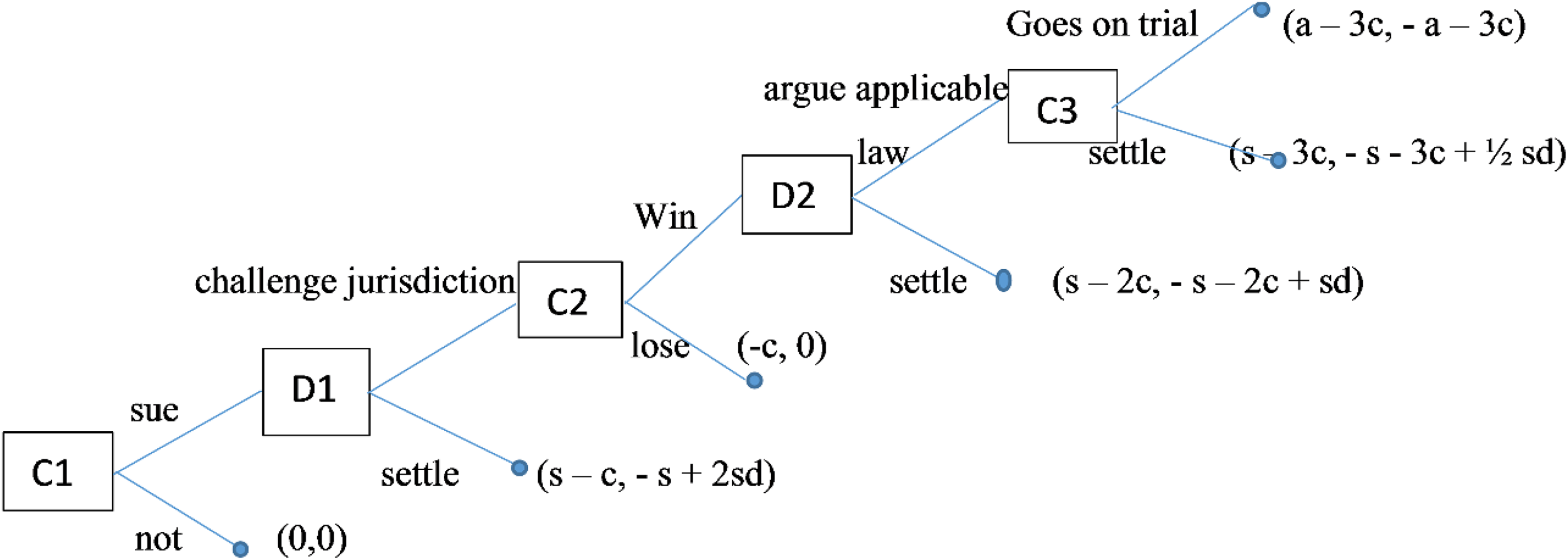
Cross-Border Cases: Litigants’ Strategies and Legal Remedies. 94
The level of complexity is multiplied by the fact that the legal landscape for pan-EU economic activities (broadly defined to cover the migration of workers) turns out to be a very important attribute which needs to be considered in some cross-border disputes. For example, if the pattern of trade changes (with some major companies leaving the UK or setting up their subsidiaries in the EU Member States), then England and Wales might become a less attractive place for litigation. 91 Similarly, if the UK migration rules change, this might have an impact on cross-border family law disputes involving couples and children. The collected data strongly indicates that the broader public-policy choices (concerning cross-border trade, services and migration) made by the UK government must be factored in as a separate attribute related to the claim which would impact on the litigants’ strategies. Hence, devising a theoretical model is a complex task in so far as different attributes may impact on the correlation between PIL rules and parties’ strategies which is central to ascertaining the aspects of the PIL framework that may facilitate/impede the parties’ access to appropriate legal remedies in cross-border cases.
Given the fact that the settlements play an important role for the resolution of disputes in England and Wales, 92 the advanced socio-legal model goes further to take account of the settlement dynamics. More specifically, the connection between any uncertainty generated by the relevant PIL rules (inflating the litigation costs) and the parties’ expectations about the outcome of their dispute (which would impact on the settlement dynamics), factoring the Brexit implications in. Moreover, the proposed model for data analysis reflects the fact that litigants’ information about the strengths/weaknesses of their opponents’ case would be constantly expanding. The relevant information - which is revealed as part of this process of parties’ continuous interaction (through disputes on preliminary issues and/or ‘without prejudice’ negotiations) - impacts on the parties’ decisions to continue with litigation and on any settlement dynamics. It should be noted, however, that some types of disputes are less likely to settle than others. The pilot study, for example, shows that the binary nature of the disputes concerning relocation of children in family law disputes means that such disputes are less likely than not to settle. 93
The first decision (See Figure 1) which a claimant (C1) must take is where/whether to sue or not, considering the litigation costs (c) and the value of the desired remedy (a). A ‘not suing’ decision would bring no change to the position of the parties. The pilot study suggests that the strategy adopted may vary depending on the value and strength of the claimant’s claim as well as on other attributes of the claim such as – for example - the nature of the dispute, the party who is bring the claim and the party who is defending it. The location of the assets may be another important factor in matrimonial disputes as well as in some commercial disputes. Similarly, the location of the child would be a significant factor in disputes involving children. In cross-border contractual relationships – by way of another example - the Brexit risks could be managed by the inclusion of an arbitration clause in parties’ contracts. Such a solution would not be readily available in all tort disputes, of course. Therefore, an analysis must assess the Brexit impact on access to remedies in different types of disputes (for example, disputes concerning contracts; torts; family). To this end, the strategic decisions of both parties – claimant (C) and defendant (D) should be factored in.
Once a cross-border dispute has arisen between the parties, then the defendants’ strategies will need to be factored in the socio-legal model for data analysis. The pilot study strongly indicates that the strength of the defence (broadly defined to include any procedural hurdles which a claimant might face) would be an important consideration which would be central to the defendant’s strategies. A defendant in a cross-border claim would have some strategic choices to make not least because (a) service of the claim form might be an issue, (b) several courts may find themselves competent, (c) jurisdiction may be challenged, (d) the recognition and enforcement of the rendered judgment abroad may be necessary. Nevertheless, the qualitative interview data appears to suggest that many of the contractual disputes, involving sophisticated parties, would be likely to settle, with the parties aiming to minimise their exposure to cost and/or any reputational damages. 95 On the contrary, as already noted above, the relocation disputes involving children would be most binary and least likely to settle. 96
More importantly, the various cross-border tort disputes and/or other complex disputes involving tortious and regulatory issues (for example, competition law claims) would be largely fact specific, with different attributes (concerning post-Brexit regulatory landscape) impacting on the correlation between PIL aspects and the outcome of the cross-border cases. 97 Indeed, there is a strong case that the impact of Brexit on the existing regulatory framework for in the various sectors (for example, banking; insurance; car manufacturing) and - in turn - on the different types of disputes (family; contractual; tortious; company; regulatory; competition law; financial matters) would vary. In order to appropriately assess the Brexit impact in this context, it is necessary to devise an appropriate socio-legal model for analysing the collected data, measuring the relevant impact.
According to the devised theoretical model, a defendant (D1) facing a relatively strong cross-border claim in England and Wales may have two broad options to consider: 1) offer a certain settlement (s) amount; 2) challenge the jurisdiction or raise another preliminary issue. It should be noted that a defendant facing a weak claim is unlikely to delay (by raising preliminary issues) and/or propose a settlement. 98 Similarly, a settlement may be unlikely, if there is a high level of legal uncertainty about the claimant’s entitlement to any remedy. 99 Since the various attributes of the claim would be diverse, the impact on different parties (individuals, SMEs and multinational companies) would vary. This means that the advanced model needs to be subsequently fragmented to capture the impact for the specific types of disputes and various parties.
The issues are important because, if a defendant decides to make a settlement offer (without raising any preliminary issue which might be an option if the legal landscape changes), it is likely for any settlement offer to comprise a settlement discount (sd) that could be significant (which is signified by ‘2sd’ denoting a higher settlement discount). Any settlement offer might inflate the claimants’ expectations about the outcome (which may be high at the outset), so a settlement might not be probable at this stage. A preliminary skirmish involving a jurisdictional battle (or on another preliminary issue concerning service, if the parties have no appropriately drafted jurisdictional clause in place) would be likely to ensue between the parties. The pilot study appears to indicate that jurisdictional challenge (and parallel proceedings) in both family and commercial might become an increasing common feature, if forum non-conveniens was to be revived post-Brexit 100 which might inflate litigation costs undermining some parties’ access to legal remedies. Service might be another issue which might need to be carefully considered post-Brexit. 101 This could be potentially be an issue even in some contractual disputes where parties have included jurisdictional clauses.
The stakes in any jurisdictional battle would be high because a party – who loses a jurisdictional battle - might incur significant costs. If the defendant were to successfully challenge the jurisdiction (and, respectively, the claimant (C2) were to lose the jurisdictional dispute), then no legal remedy would be available to such a claimant in England and Wales in so far as the English and Welsh courts will have no jurisdiction. A defendant who successfully challenge jurisdiction might still make a settlement offer containing a significant settlement discount (in order to avoid fighting this claim again before courts in another country). The loss of such a jurisdictional battle might mean that a claimant could well accept a settlement offer which otherwise he would not. If the claimant were to win and the English courts were to assume jurisdiction, then a defendant faced with increasing costs might increase his settlement offer (reducing the settlement discount to ‘sd’ rather than ‘2sd’ – see Figure 1). The point came through in the course of the qualitative interviews, with one interview respondent noting that: these sorts of [jurisdiction] challenges are often brought when the facts are weak for the party bringing the challenge. So, if you get over the hurdle of the jurisdictional challenge, you are down into the facts and at that point the[re are] incentives to settle.
102
Hence, if the claimant is winning at different junctures where the parties interact, the settlement discount would be smaller, but the costs will be higher. That said, delaying tactics by a defendant (with deep pockets) could impact on the claimant’s (for example, an SME; individual) willingness to continue with litigation. 103 The pilot study appears to suggest that different types of litigants (SMEs, multinational companies) could adopt different strategies. The main attributes - which would impact on the correlation between PIL aspects and defendants’ strategies – appear to ‘include matters such as: the defendant’s resources; the defendant’s aversion to risk; and the defendant’s perception of the merits of the case.’ 104 Analysing the relevant correlations in the light of appropriately identified attributes for the various cases is central to devising a well-functioning PIL framework post-Brexit.
A party’s decision to engage in cross-border litigation presupposes a commitment of financial resources to be spent on a particular cause of legal action with a view to accessing a legal remedy. The desired remedy would normally have a monetary value (or any other value for the claimant) that should justify the resources. The ‘expectancy-value models’
105
are normally used with a view to determining why the individuals would ‘commi[t] to a course of action that is intended to produce a satisfying state of affairs’.
106
In order to ascertain the aspects of the legal landscape in relation to PIL which shape the litigants’ strategies, it is also necessary to consider the broader attributes (for example, costs, including access to finance; strength of the claim; procedure; speed) which might impact on parties’ access to appropriate legal remedies in individual cases. The difficulties in analysing the interplay between costs and litigants’ strategies, in contentious non-contractual disputes, was nicely captured by one interview respondent: I think I have probably said two things, which on the face of it are inconsistent. Firstly, I said to you that claimants sometimes think it is helpful to them to bring proceedings in this jurisdiction because the relatively high costs and the cost-shifting rules, they think, will push defendants to settle. On the other hand, you often have defendants who think claimants are not going to want to stump up lots of costs up front. And so, they pick lots of preliminary issue fights to run up costs. So, I think it is not the most rational (or perhaps proportionate) way of dealing with these cases, where all parties have a somewhat skewed view of running up costs. But yes, it affects them in those ways. Then, obviously, when you actually get to do the deal, you very often have cases where the costs start to get close to (or actually in some cases exceed) the value of the claim. That can be a big problem in reaching a settlement.
107
Such aspects as parties’ perception, emotions and communication 108 will all have a bearing on the parties’ decision to settle or continue with litigation. Hence, the role of the legal practitioners would be very important. For example, the role of emotions in some family law disputes may be significant and an analysis – assuming that the parties are rational – may not work well in such disputes.
More importantly, in some cases, a defendant – who has unsuccessfully challenged the jurisdiction might wish to raise another preliminary issue (for example, applicable law 109 which might have an impact on parties’ entitlement and liability). Once this issue has been dealt with by the court, then a defendant – who has perhaps lost another dispute on a preliminary issue – might make an improved settlement offer (with lower settlement discount – sd). In such a scenario, the claimant (C3), respectively, would have another important decision to make – a) accept such an improved settlement; or b) continue with the trial. At this juncture, a settlement is likely because the parties would have better information of the relative strength of their cases. That said, a claimant with a very strong claim may be unwilling to accept a settlement discount (sd) and may potentially go to trial to maximise the award (a), assuming that the rendered English and Welsh judgment would be recognised and enforced abroad.
Therefore, on the basis of the pilot study, a socio-legal model for doing research in PIL is advanced. In order to measure the Brexit impact on private parties’ access to legal remedies in the light of the pursued broader public interests concerning trade and migration post-Brexit, the advanced model has two major features. First, it is set to analyse the triangular relationship between: 1) jurisdiction (procedural rules); 2) choice of law (applicable substantive laws); 3) outcome of a cross-border case. The litigants’ strategies are central to the relevant analysis of the triangular relationship, which might modify if the legal landscape in relation to PIL changes. Secondly, since the advanced theoretical model is developed around the litigants’ tactics, the relevant claimants’ and defendants’ strategic decisions in cross-border cases are thoroughly considered. The suggested game theoretic perspective is set to factor in the opposing interests of the parties as well as the correlation between the Brexit driven changes in the legal landscape in relation to PIL (as well as in relation to the regulatory landscape for trade and services) and litigants’ strategies which will in turn impact differently on access to legal remedies in cross-border disputes (re contracts; tort; matrimonial matter; children).
4. Litigants’ strategies: Analyses at different stages of litigation process
The advanced socio-legal model reflects the fact that the litigants’ strategies are a dynamic variable which would be influenced by a change in the legal landscape as well as by some important attributes which characterise the claims and/or the parties issuing the relevant claims. Since the parties devising their litigants’ strategies would factor in any change in the legal landscape in relation to PIL, it is important to robustly analyse the relevant correlations (PIL aspects and relevant attributes – litigants’ strategies; parties’ strategies – access to legal remedies) at each and every stage of the litigation process.
There are three major stages (pre-action; post-issuing proceedings; after a judgment is rendered by a domestic court – Figure 2) in the dispute resolution process which must be considered with a view to ascertaining how the relevant aspect/attributes shape the litigants’ strategies in the different types of disputes (for example, contractual, tort, matrimonial, children). Although the stages are distinct, they are inherently inter-related in shaping the parties’ strategies. For example, sophisticated claimants would factor in the aspects of the relevant body of case law dealing with PIL aspects which might be exploited by the defendant after the proceedings have been issued (that is, the second stage) as well as after a judgment has been rendered (that is, the third stage) of the dispute resolution process.
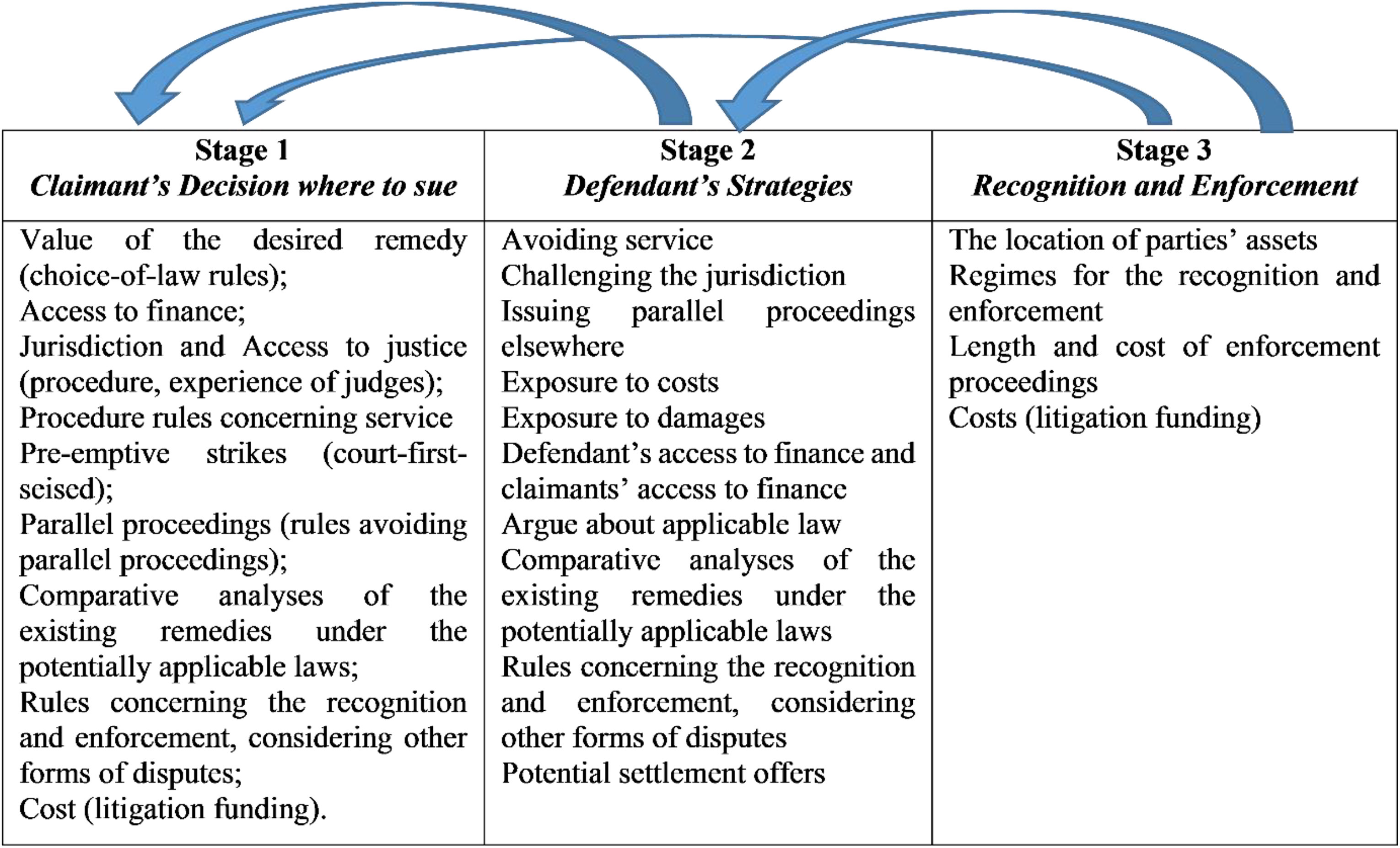
PIL Regime in Place - Attributes of the Claim - Possible Litigants’ Strategies.
The first stage concerns the ‘pre-action conduct’. 110 (See Figure 2) In the course of the pilot study, qualitative data was gathered to consider the correlation between the PIL aspects and litigants’ strategies in the light of the various attributes of the claims. As part of this process, a potential claimant (and his lawyers) would have to consider the relative strength of his claim, considering the relevant PIL framework and the various attributes of the claim with a view to ascertaining how probable is for him to achieve a desired and appropriate remedy/result in a cross-border case. Hence, the pursuit of an appropriate legal remedy - which is ‘perceived as attainable’ 111 - is central to the strategy-devising process. The qualitative data from the pilot study strongly indicates that, in cross-border cases, the parties will take account of: a) the relevant jurisdictional rules specifying the competent court/s (which indicate the procedural rules – broadly defined to cover service of the claim form as well as the subsequent recognition and enforcement of the rendered judgment); b) the choice of law rules ascertaining the applicable substantive laws (determining the merits of the cases and parties’ entitlement to any remedies).
A closer look at the relevant data allows to make an interesting preliminary observation. In particular, the qualitative data from the pilot study strongly indicates that the UK reputation
112
may be another major factor which might be adversely affected by Brexit as well as by competitors’ campaign against London. Parties to civil and commercial contracts are increasingly including arbitration clauses into their contracts with a view to minimising any legal uncertainty in the Brexit era.
113
These preliminary research findings clearly show that the Justice Sub-Committee’s submissions made by Mr Oliver Jones
114
and Mr Hugh Mercer QC,
115
noting a potentially growing role of arbitration in some disputes were spot on. The qualitative data goes on to demonstrate that the standard terms of contracts operated by some major institutions might be another major factor (remotely relating to the London’s reputation as a business/financial centre post-Brexit) which might have an impact on the pattern of litigation in the post-Brexit era. The point was put forward by one interview respondent, submitting: I am aware that the European Development Bank has already changed its contracts. It is now using Luxembourg law. It has effectively completely abandoned English law and English jurisdiction. They are now using Luxembourg law and Luxembourg jurisdiction. But, that has not yet affected any actual litigation. But, it undoubtedly will do, will have a future impact.
116
A commercial (or any rationale) party would only devote financial resources and finance a cause of action which is likely to be time-consuming, if the value of the desired legal remedy outweigh the costs of litigation. 117 Since Brexit and the way the Brexit negotiations have been handled may bring fresh uncertainty, then strategic defendants with deep pockets could exploit the relevant uncertainties, in order to increase the litigation costs for claimants with less access to finance. This means that, if these issues are not addressed, the access to effective legal remedies for SMEs could become a real issue, post-Brexit. 118
An entirely different set of factors would be relevant for defendants with access to finance which allows them to be more strategic. The preliminary findings appear to suggest that the access to legal remedies for sophisticated multinational companies would be less of an issue not least because they would have alternative options to exploit (for example, including an arbitration clause into their contracts or litigating elsewhere). The pilot study shows that any post-Brexit changes to the UK PIL landscape could differently affect the relevant factors which would impact (one way or another) on various types of private parties’ (for example, multinational companies’; SMEs’; individuals’) access to appropriate legal remedies. 119 That said, this is an important correlation which could affect the attractiveness of English and Welsh courts, so that the relevant aspects would need to be properly ascertained and thoroughly analysed.
The second stage in the dispute resolution process, which should expose the correlation between the specific aspects of the legal landscape in relation to PIL and private parties’ strategies, concerns the strategies of the parties after the claim has been issued. Whilst the focus in the first stage is to an appreciable extent on the behaviour of the potential claimants, the defendants’ strategies would need to be considered as part of this second stage. Defendants’ strategies might be designed to exploit the weaknesses of the current framework. The advanced socio-legal model should help researchers in determining how a change in the legal landscape in relation to PIL would impact on the defendants’ strategies in cross-border cases before the English courts. More importantly, it would be necessary to consider how the defendants’ strategies would impact on the claimant’s expectations about the outcome of the case. It is particularly important to consider ‘the relationship of [the parties’] actions to expectations [about the outcome of litigation], where these expectations encompass beliefs about the implications of behaviour, and where an important set of these implications consists of consequences that have positive or negative perceived value.’ 120
Once again, the defendants’ strategies could vary depending on their access to finance, strength of the relevant claim, value of the remedy as well as on the effectiveness of the UK PIL 121 framework which is to be applied in a post-Brexit context. Sophisticated defendants (facing strong or relatively strong high value claims) are less likely to economise on costs because (no matter how high the costs are), such costs would be a small proportion from the whole claim. Such a defendant may delay by avoiding service; challenging the jurisdiction; issuing parallel proceedings elsewhere; arguing about applicable law. A claimant facing a strategic defendant would have to re-consider its litigations strategies (for example, its decision to continue with the litigation; make/accept a settlement offer) considering inter alia the effectiveness of the relevant PIL rules and their ambiguity. 122
In order to fully consider the correlation between litigants’ strategies and private parties’ access to legal remedies, the litigation costs should be considered as an important attribute which could affect the settlement dynamics. The point that different parties may be affected differently by their cost exposure came through in the course of interviews, with one interview respondent clearly noting that costs in cross-border cases affect the settlement dynamics: (…) my clients are the SMEs and costs have an impact on them. Putting the other hat on - if you are acting for the other side - do costs affect the settlement dynamics? If you are dealing with a big global company that has got pots of cash, I am not sure to what extent costs affect them. They use costs to put pressure on the smaller entity (…). Even if they think they are not going to win, they will spend money because they know they can outspend their opponent.
123
In other words, an SME (facing a claim from a strategic claimant with appropriate budget resource) might swiftly make (or accept) a settlement offer to minimise its exposure to litigation costs. Similarly, as already noted above, it seems that a higher level of post-Brexit uncertainty might adversely affect SMEs’ strategic decisions to issue cross-border proceedings against multinational companies with access to finance because such parties may strategically delay and inflate their litigation costs. 124 There would potentially be real issues for such parties’ access to legal remedies in cross-border cases, post-Brexit.
The third stage concerns the recognition and enforcement (see Figure 3) of an English judgment in the EU Member States and beyond. Once an English court had determined the rights and obligations of the cross-border litigants by applying the relevant set/s of substantive law rules, the parties’ effective access to remedies would depend on the enforceability of an English judgment abroad. In the pre-Brexit era, the EU PIL Regulations were set to guarantee that the UK judgments are swiftly enforced across the EU.
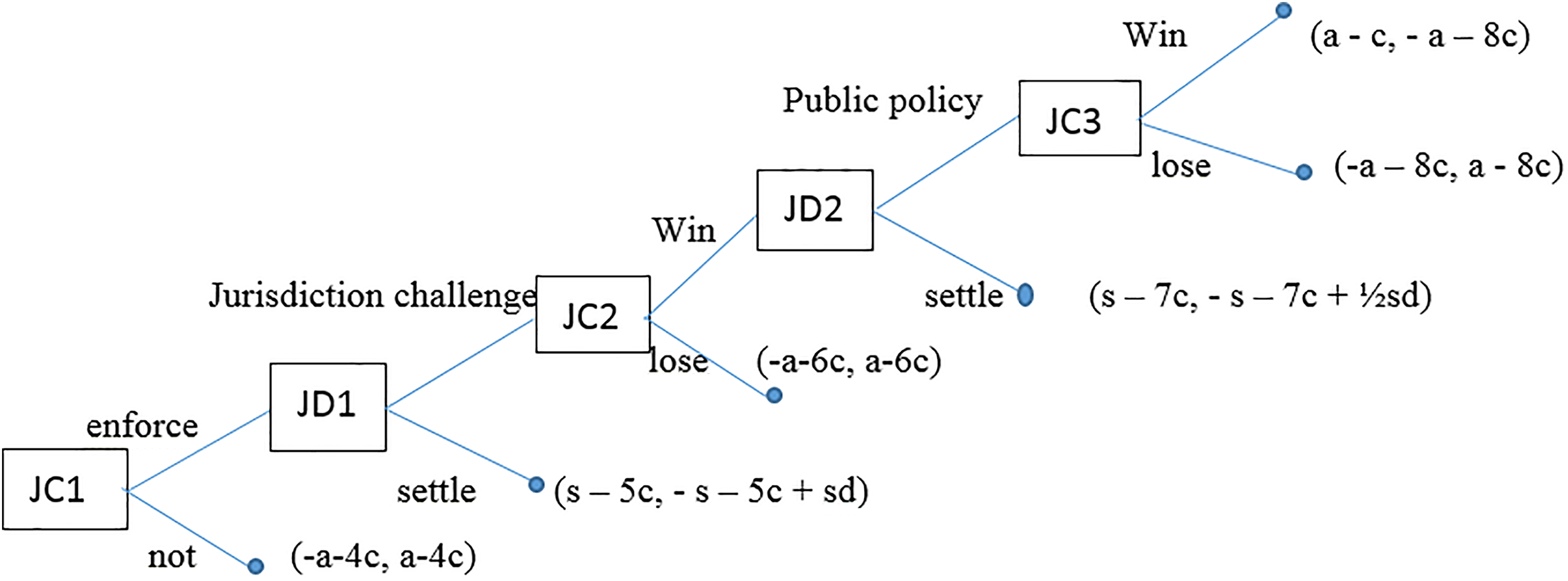
Recognition and Enforcement: Game Theoretic Perspective. 127
Since this is an area where the EU PIL Regulations have worked reasonably well,
125
the non-application of these EU PIL instrument in respect to judgments rendered by the UK courts could depreciate their value in so far as any legal uncertainty could potentially be exploited by strategic/sophisticated litigants. The issues are important because some defendants may be strategic, as one interview respondent put it: if the merits are poor that you would be spending an enormous amount of money fighting the case - and it may well be better to do nothing; and if it is against a corporate entity, to try and then say, ‘We will defend it on enforcement,’ for example.
126
This poses the question whether any uncertainty about the recognition and enforcement of English and Welsh judgments abroad would impact to some of the parties’ decisions to bring their claims before the English courts.
Figure 3 is set to reflect the fact that the process of recognition and enforcement of the foreign judgment could result in another set of jurisdiction proceedings, which would impact on litigation costs (c) and settlements (s) as well as on any settlement discounts (sd). If the judgment debtor (JD) was not willing to voluntarily pay the award (a), then the judgment creditor (JC) will have a decision to make - seeking enforcement abroad or not. There would inevitably further expenses. That said, the potential financial rewards at this stage will be significant for JC who had won the desired award, incurring significant costs in the proceedings before the court of origin (-4c) which he would to fully or partly recover. If the recognition and enforcement was not possible, the lost for the JC would be significant because the award would not be recovered (-a) and neither would be the costs (-4c). Any jurisdictional challenges of the court with original jurisdiction would increase the litigation costs further, but the financial exposure for JD – at this stage – would be high, so it is likely for such a challenge to be raised (where possible), with the potentially public policy defence being subsequently invoked on procedural and/or substantive law ground as the case may be.
One might argue that it should be obvious that - if it becomes less easy to enforce English and Welsh judgments in the EU - parties may be less likely to choose to issue proceedings in London. The pilot study, however, indicates that a more sophisticated analysis is needed to inform policy choices in the post-Brexit era. On the one hand, it is clear that a well-functioning recognition and enforcement regime would certainly feedback into the claimant’s decision whether/where to issue court proceedings in a cross-border dispute (See Figures 1 and 2). This was clearly noted in the course of the research interviews: At the present time - relying on the relevant EU regulations - English judgments are automatically recognised in the EU. It is unclear as to what is going to happen post-Brexit. Therefore, for current purposes, our advice to clients - due to that degree of uncertainty – is, if they have a concern about it, to actually change their dispute resolution provision from a court provision to an arbitration provision because you can enforce under the New York Convention.
128
Indeed, both qualitative and quantitative data appear to indicate that the recognition and enforcement would be an issue. On the other hand, a closer look at the data strongly suggests that the enforcement is only one factor which is to be considered along with others. The recognition and enforcement might be less of an issue when the parties are multinational groups of companies with sufficient assets in different jurisdictions as well as in England and Wales.
129
There are other broader attributes relating to the recognition and enforcement which might impact on the forum-selection process. Some factors are captured in the following example: one of the things where England becomes quite a good venue, is: where you have an offshore businessman who has a second home here or something; or maybe is living here, but he is able to scoot off to Middle East countries. Depending who you are acting for - if you are acting for the wife (…) she says, ‘Well, I could file here. I could file in France because we have got a home in the South of France, or we could file in a Middle Eastern country.’ The Middle Eastern country is completely out because she is going to get nothing. France is an okay option - it is not a bad option; it is a European country. But, he does not have to go to France. But, he does really have to come back to London - from time to time - for his business. So you look at all of that - and I have had to give this advice to men - unless you are prepared never to return, you are going to ignore all the orders and you are not going to pay her a penny. But, you know you cannot come back to this country - you will be arrested if you do. We are lucky because London is a business centre, so that might be a factor.
130
Therefore, different attributes of a particular claim would need to be considered along with the relevant PIL aspects when assessing the Brexit impact at different stages of the litigation process. A strong feature of the devised socio-legal model is that it is sufficiently unified and necessarily dynamic to capture various aspects of the relevant PIL landscape along with the broader attributes of a particular claim. Using such a model to ascertain the specific Brexit impact (if any) for different classes of parties’ access to legal remedies would be central to devising a well-functioning framework for cross-border judicial cooperation which facilitate private parties’ access to legal remedies in the post-Brexit era. This may – in turn - impact on the parties’ willingness to enter into settlement negotiations and the outcome of such negotiations.
5. Conclusion – measuring the Brexit impact: Addressing the theoretical challenges
The UK decision to leave the European Union, exiting the internal market on 31 January 2020 (or after any extension under Article 50 TFEU has elapsed), means that the UK legal landscape in relation to PIL could significantly change then or after the end of any transitional deal 131 which is to be approved by the UK Parliament. This could directly impact on the application of the EU instruments - which apply on the principle of reciprocity - in the UK (and/or in respect of British courts’ judgments which need to be recognised and enforced within the EU). Any fresh uncertainty driven by such a change could have significant impact on private parties’ access to remedies (and on the relevant settlement dynamics) which may in turn affect the attractiveness/appropriateness of London as a venue of choice. This poses the question what governance model concerning judicial cooperation is to be adopted in the post-Brexit era. 132 The response to this question pre-supposes an evaluation of the Brexit impact on private parties’ access to appropriate legal remedies in cross-border cases before the English and Welsh courts.
In order to systematically consider how the adopted litigants’ strategies would correlate with parties’ access to remedies in cross-border disputes, a careful analysis of the dynamics of the triangular relationship (jurisdiction – choice of law – outcome) is necessary. To this end, two major correlations were identified as pivotal to the advanced socio-legal model for qualitative data analysis. First, it is necessary to consider how the relevant PIL framework shapes the litigants’ strategies (factoring in various broader attributes – for example, types of parties (individuals, SMEs, multinational companies), desired remedy, including the value of the claim; facts of the cases; relevant substantive laws; costs, including access to finance and exposure to costs). Second, it is equally important to consider whether the (so devised) parties’ strategies are facilitating or impeding their opponents’ access to legal remedies. An analysis of these correlations should enable the researchers to evaluate the Brexit impact on private parties’ access to legal remedies in cross-border cases. On this basis, it would be possible to systematically classify the aspects which have a bearing on the attractiveness of the English courts for parties (that are in position to be selective).
The pilot study clearly shows that, in a Brexit context, a novel paradigm could be used to capture whether (and how) a post-Brexit changes in the legal landscape in relation to PIL (ie bringing uncertainties and/or speculations) would impact on the litigants’ strategies and, in turn, on private parties’ access to justice in disputes with an international element. The adopted game theoretic perspective draws a distinction between the claimants’ strategies and defendants’ strategic decisions in cross-border cases at three different (but closely related) stages: 1) pre-action; 2) after proceedings have been issued; 3) after a judgment has been rendered. An analysis of gathered data should enable researchers to identify the weaknesses of the PIL regime, which may be exploited by strategic litigants to impede their opponents’ access to legal remedies in cross-border cases.
A newly generated data was used to consider the correlation between a possible change in the legal landscape and the parties’ alternative strategies as well as to analyse the relationship between the litigants’ tactics and private parties’ access to justice in cross-border cases before the English and Welsh courts. The pilot study has produced a bank of data on litigation strategies in a Brexit context, and that in planning for any future reforms it would be good to collect further data showing the strengths and weaknesses of the cross-border litigation regime post-Brexit. This socio-legal model could clearly be used to make any comparison between existing and new data which should feed into the long-term policy making, (bearing in mind that any agreed framework for long-term judicial cooperation has only a secondary role to play with a view to facilitating trade and free movement of workers within the EU).
The proposed theoretical model is set to capture any post-Brexit driven deviations in the litigants’ strategies, measuring the impact of Brexit on private parties’ access to legal remedies in different types of disputes (family; contractual; tortious; company; regulatory; competition law; financial matters). On the basis of this socio-legal model for data analysis, it will be possible to identify any new (positive and/or negative) factors, which - due to any actual or expected/potential change in the UK legal landscape in relation to PIL – would facilitate/impede parties’ access to effective legal remedies in disputes with an international element. Therefore, a systematic analysis of the litigants’ strategies by adopting a game theoretic perspective in cross-border cases will enable researchers to identify the major aspects of the PIL framework which shape parties’ strategies that are devised to direct the litigation outcome.
A comparison between the data gathered within the pilot study with an appropriately gathered data that captures the post-Brexit impact in this respect should helpfully indicate how the UK PIL landscape should be adjusted with a view to facilitating private parties’ access to remedies in cross-border cases post-Brexit. In planning for any future post-Brexit reforms, the data from the pilot study could be compared with newly collected data. Relevant comparisons should enable the policy-makers not only to ascertain the issues which might adversely affect private parties’ access to remedies in cross-border cases, but also to identify the issues which are to be addressed as priority post-Brexit.
An analysis of the post-Brexit litigants’ strategies in the light of newly gathered data will helpfully indicate the aspects of the PIL which need to be changed with a view to facilitating private parties’ access to legal remedies. 133 This should inform the UK policy-makers in re-designing the UK legal landscape in relation to PIL with a view to facilitating private parties’ access to justice in cross-border cases. This is important because the pilot study appears to suggest that, if the legal landscape in relation to PIL were to change, any fresh legal uncertainty/ambiguity attributed to Brexit could be exploited by strategic parties with access to finance (in order to adversely affect their opponents’ expectations about the outcome of litigation). This would impact on potential claimants’ willingness to issue proceedings in England and Wales which would impact on access to legal remedies for SMEs and individuals as well as on attractiveness of English and Welsh courts for big multinational companies in the post-Brexit era.
Footnotes
Funding
The author disclosed receipt of the following financial support for the research, authorship, and/or publication of this article: The pilot study was funded by the University of Exeter Center for Commercial and Corporate Law. This paper is written within the framework of an AHRC funded Research Network ‘Where do we go from here? The development of private international law in the UK and the post Brexit environment.’ The author is very thankful to the interview participants as well as to the law firms that took part in the survey. The relevant data is deposited with the UK Data Archive - M. Danov, ‘Data Collection - Cross-border litigation in England and Wales: Initial Brexit implications 2016-2018’ Colchester, Essex: UK Data Service <  >. The author is also thankful to Professor Beaumont and Dr Jonathan Kamkhaji (University of Exeter) as well as to the anonymous reviewers for their helpful remarks on earlier versions of this article. The gratitude is extended to Jon Lawrence (Brick Court Chambers), Tim Cowen (Preiskel & Co), Stephen Dnes (NCH) and all the other participants in a workshop on Cross-Border Litigation in England and Wales: Initial Brexit Implications which was held in the University of Exeter on Friday 1 June 2018. The errors that remain are mine and mine alone.