




Abstract
Faced with numerous repetitive applications, the European Court of Human Rights (ECtHR) has welcomed the unilateral declaration mechanism as a way to handle these efficiently. In a unilateral declaration, the state admits a human rights violation and promises to provide redress to the applicant. On that basis, the Court strikes out an application and does not deal with its merits. Some authors and non-governmental organizations warn against losing sight of the applicants’ interests whilst relying on unilateral declarations. Against this background, this article aims to establish whether unilateral declarations are indeed (mostly) used to dispose of repetitive applications and how this procedure works in practice. The second aim is to determine whether the interests of the applicants are sufficiently protected when the Court rules on unilateral declarations. The analysis is based on all 1285 unilateral declarations, which the states parties to the ECHR have proposed in the five years following 2 April 2012.
Keywords
1. Introduction
One of the major current challenges for the European Court of Human Rights (ECtHR) is the large number of repetitive applications: more than four out of ten applications are repetitive. 1 Moreover, the total number of repetitive applications increased from 30,500 in 2015 to 35,000 in 2016. 2 Such applications result from systemic domestic problems, which remain unresolved even though the ECtHR has already addressed them in a previous judgment. 3 These problems are, for example, the length of civil proceedings in Italy, the non-enforcement or delayed enforcement of domestic decisions in Ukraine and detention conditions in Russia. 4 When deciding these applications, the Court merely repeats its well-established case law. The ECtHR and the states parties therefore agree that repetitive applications should be disposed of efficiently and that their root cause – the failure to execute judgments properly – should be addressed. 5 An innovation they have welcomed in order to achieve the former aim is the Unilateral Declaration (UD). 6 It is, therefore, unsurprising that UDs have become a ‘routine procedure’ ever since Turkey proposed the first UD in 2001. 7
In a UD, the respondent state admits a violation of the European Convention on Human Rights (ECHR) and promises to provide redress to the applicant. Instead of having to resolve the merits of a complaint in a judgment, the ECtHR decides (more efficiently) if the UD constitutes a basis for striking the application out of its list of cases. 8
Considering the background against which UDs have been introduced, two questions arise. The first question is whether UDs are indeed (mostly) used to dispose of repetitive applications and how this works in practice. The first aim of the article is to answer this question. For this aim, the types of cases in which UDs are approved will be studied and the way in which the Court deals with UDs in its rulings will be analysed. This analysis will confirm that the ECtHR mostly uses UDs for the said purpose. The second question is whether the Court’s efficiency drive, which is at least part of its motivation for accepting UDs, leads it to neglect, in practice, the interests of the applicants whose applications it strikes out based on a UD. A critical non-governmental organisation has remarked, for example, that some UDs do not fully cover the damages suffered by the applicant. 9 The second aim of this article is, therefore, to establish whether the ECtHR protects the interests of the applicants adequately when UDs are at play. 10 It can be assumed that their interests are protected adequately on paper at least by the rules on UDs in the Court, the Rules of Court of the ECtHR (Rules of the Court) and the Strasbourg case law. This can be assumed because the Court has developed safeguards in the Rules of the Court and in its case law ever since it accepted the first UDs. Furthermore, these safeguards have remedied 11 the criticism levelled against the ECtHR’s early practice of accepting UDs. 12 Additionally, most critical remarks were made before the Court formulated specific rules for accepting UDs. 13 Besides, the non-governmental organization is not so much critical of the rules, as it is of the Court’s observance of the rules in practice. 14 For the second aim, the content of the UDs and the ECtHR’s scrutiny thereof will be analysed so as to establish whether these rules are complied with. Since the applicants’ interests naturally extend beyond the UD to its implementation and effect on their domestic cases, the article also looks into these matters. The answer to the second research question will clarify that that the applicants’ interests are guarded well generally, but that improvements are possible as well.
The analysis is based on the 1285 UDs that the states parties have proposed in the five-year period following 2 April 2012. On that date, Rule 62A of the Rules of the Court on UDs entered into force. Since the article relies inter alia on this rule for its analysis, the date of entry-into-force of the Rule is an appropriate starting point. The length of the period should provide a solid basis for the analysis, and the period is more recent than the one the other studies covered. 15
Before moving on to the analyses, the article includes a short note on the methodology (section 2) and outlines the relevant rules (section 3) and some figures (section 4). These, inter alia, help gain insight into the type of cases in which the UDs are submitted. This is done in section 5. Section 6 analyses UDs in light of the relevant rules. Section 7 analyses what happens after an application is struck out based on a UD. The conclusion (section 8) analyses the findings in light of the two aims as outlined above and makes recommendations.
2. Methodology
The relevant rulings were found by entering these keywords into the ECtHR’s case-law database Human Rights Documentation (HUDOC): ‘unilateral declaration’ and ‘déclaration unilatérale’. It is unclear if all the relevant rulings of the Committees were found through this method. This would not have been the case if the Committees of three judges had struck out the applications based on UDs in letters and not in decisions, as the Court does not publish letters on HUDOC. Committees may use letters when no ‘further examination’ of a case is needed, 16 something that is presumably needed if a UD is filed, which makes it unlikely that they approve UDs in letters.
Both the number of cases in which a UD was proposed and the number of affected applicants are noted, considering that multiple applications can be joined in one case and that as many as 66 17 applicants can file one application. 18 To compare, the Court’s figures are in terms of applications, 19 which does not reveal the number of applicants affected by the UDs. Since this article is concerned with the interests of the applicant, it is logical to use the numbers of applicants. The number of applicants who rejected a UD and who did not comment is not specified because the ECtHR does not always specify this. 20
The content of the UDs is known, because the Court either reproduces the UD or summarizes its content in its decisions and judgments. The ECtHR also includes the applicants’ observations on the UD and paraphrases their motivation for accepting or rejecting the UD, if they give a motivation at all. 21 Furthermore, the ECtHR virtually always states if it rejects or approves a UD.
3. Relevant rules
The relevant rules are discussed chronologically and derived from the ECHR, the ECtHR’s case-law, and the Rules of the Court.
A. Article 39 of the ECHR
The original text of the ECHR already provided for the possibility that the ECtHR would not rule on the merits of a complaint, but strike out a case when the parties agreed to a friendly settlement. 22 Those settlements are currently regulated in Article 39 ECHR. This provision is relevant to UDs, because the ECtHR regards the UD as a friendly settlement and applies Article 39 ECHR when the applicant accepts a UD. Friendly settlement negotiations are confidential and both parties must agree to the settlement. 23 The decision in which the ECtHR strikes out an application briefly summarizes the terms of the settlement. This decision is transmitted to the Committee of Ministers (Committee) so that it can supervise the execution of the settlement. 24
B. Article 37 of the ECHR
In 1990, the states extended the possibilities for striking out applications, in addition to the possibility in Article 39 ECHR, by adding the predecessor of the current Article 37 ECHR to the ECHR. 25 This provision permits the ECtHR to strike out an application on the ground that the applicant does not intend to pursue the application; the matter has been resolved; or it is no longer justified to continue examining an application for any other reason.
The ECtHR usually uses the last ground to strike out cases in which the respondent state proposed a UD. The Court cannot strike out a case on these grounds if respect for the ECHR rights necessitates examining a complaint, a requirement that will be referred to as the ‘human rights requirement’. The second paragraph of Article 37 ECHR specifies that the Court may restore an application to its list if the circumstances so justify.
C. The Tahsin Acar factors
It took until 2001 for Turkey to adopt the first ever UD and to suggest that the ECtHR strikes out the application under Article 37(1)(c) ECHR. The Court followed the suggestion.
26
Subsequently, in the Tahsin Acar v. Turkey judgment of 2003, the Court gave a non-exhaustive list of relevant factors to assess whether it can strike out a case in conformity with the human rights requirement.
27
These factors are:
28
the nature of the complaint; whether the issues raised are comparable to those already determined by it; the nature and scope of any measures taken by the state in the context of the execution of its judgments and the impact of these measures on the case at issue; and whether the parties are in dispute regarding the facts.
D. Rule 62A of the Rules of the Court
Rule 62A incorporates two Tahsin Acar factors, turning them into essential requirements for approving a UD, as these ‘shall’ be included. These requirements are that the state must ‘clearly’ acknowledge a violation of the ECHR in the applicant’s case and undertake to ‘provide adequate redress and, as appropriate, to take necessary remedial measures’. 29 Apart from these rules regarding the content, Rule 62A also contains a requirement regarding the timing: the state should file a UD after an attempt to reach a friendly settlement, save ‘where exceptional circumstances so justify’. 30 UDs must furthermore be filed ‘in public and adversarial proceedings conducted separately from and with due respect for the confidentiality of any friendly-settlement proceedings’. 31 Unlike in the case of a friendly settlement, the applicant does not need to approve the UD, 32 though (s)he has the opportunity to submit observations, 33 and the Committee does not supervise the execution of UDs normally as it will be explained in section 7. As was noted when discussing Article 37 ECHR, the ECtHR cannot strike out a case if the human rights requirement is not fulfilled. As UDs are struck out based on Article 37 ECHR, this requirement also applies to UDs in addition to the requirements in Rule 62A.
4. Figures
As Table 1 shows, 34 the ECtHR accepted the UD for 90.51% of the applicants and rejected it for 3.14% of them. As for the remaining applicants (6.35%), the ECtHR accepted the UD as a friendly settlement because the applicant had accepted the document. Therefore, when a state submits a UD, the ECtHR is likely to strike out the case. It is even more likely that the ECtHR will strike out a case based on a friendly settlement than reject a UD.
Applicants are less inclined to accept UDs; only 10.51% of them did. The other applicants either did not respond or rejected it. These figures are not so surprising, because the state files a UD after friendly-settlement negotiations fail, which already indicates that the applicant wants the ECtHR to examine the complaint.
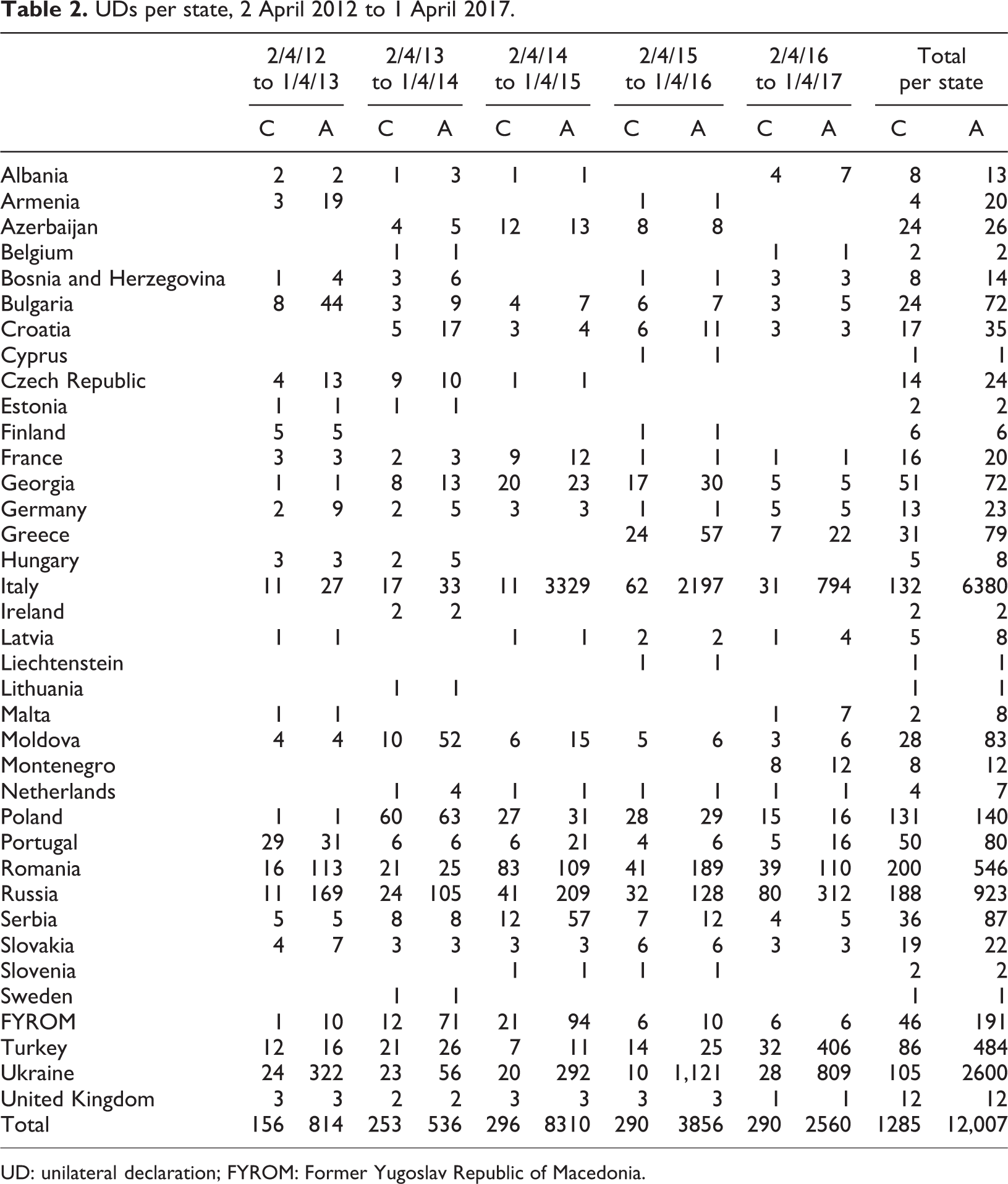
Table 2 gives an insight into the number of UDs filed in all, and per state. In the five-year period of interest, 12,007 applicants (in 1285 cases) were confronted with a UD. The number of UDs per state differs widely: 10 states have never submitted a UD, 24 have submitted it for 1–50 applicants, and six states for 51–100 applicants. The remaining seven states are Poland (140 applicants); the Former Yugoslav Republic of Macedonia (FYROM; 191 applicants); Turkey (484 applicants); Romania (546 applicants); Russia (932 applicants); Ukraine (2600 applicants), and Italy (6380 applicants, of which 3055 are in one case 35 ).
5. Types of cases
The ECtHR approves UDs in cases with very different complaints. Nevertheless, UDs most frequently feature in cases concerning structural problems that cause repetitive applications. 36 This is apparent from the fact that six/five of the seven states that issued UDs in respect of most applicants overlapped with the states appearing in the Court’s top 10 of states with the most pending cases in 2017. 37 UDs are therefore mostly used in cases in which the ECtHR and states parties consider them to be of special benefit.
6. Analysis of UDs in the light of relevant rules
This section analyses the UDs and the ECtHR’s rulings in light of the relevant rules, but first makes some general observations.
Most UDs are short: the state acknowledges a violation and promises to pay a sum of money to the applicant. It, thus, abides by the two requirements in Rule 62A (the state must clearly acknowledge a violation and must undertake to provide adequate redress). If the UD is more elaborate, the state, for example, briefly explains the facts, the domestic law 38 or the circumstances in which it accepts the violation. 39 The state expresses regret only exceptionally. 40 In repetitive cases and especially if multiple applications are joined, the ECtHR usually gives a general description of the facts without reference to the individual cases; the applicants’ details are listed in the Appendix. 41 The ECtHR’s review of a UD is usually limited to verifying if the two requirements in Rule 62A are included, normally without actually invoking Rule 62A, 42 and if it already has established clear and extensive case-law concerning the topic of the complaint. If the ECtHR rejects a UD, it usually states its reason for doing so, but the exact reason for rejection is not always clear, as it sometimes just notes that it has rejected the respondent state’s request. 43
A. Article 39 of the ECHR
As noted, if the applicant expressly agrees to a UD, the ECtHR interprets the document as a friendly settlement and strikes out the case under Article 39 ECHR. 44 The ECtHR’s practice in this respect was not fully consistent. In comparable circumstances, it struck cases out under Article 37(1)(b) ECHR, 45 without referring to a specific legal basis in the dictum 46 or as a UD under Article 37(1)(c) ECHR. 47 The latter is ‘by definition impossible’ since the applicant has accepted the terms. 48 In the last year studied, the ECtHR’s practice had become consistent, because it dealt with all accepted UDs as a friendly settlement. Table 1 confirms this: the number of applicants who accepted a UD – 398 – equalled the number of applicants in whose case a friendly settlement was concluded.
B. Article 37 of the ECHR
In a few cases in which the state had proposed a UD, the ECtHR noted that it had invited the applicant to comment on it, whilst drawing attention to Article 37(1)(a) ECHR (‘the applicant does not intend to pursue his application’). Since the applicant had not replied, the ECtHR struck out the application based on that provision. 49 This practice is remarkable because the ECtHR has very often noted that the applicants have not commented, without concluding that they no longer intend to pursue their application. Moreover, since the declaration is unilateral, it is not logical to make striking out a case on that basis dependent upon the applicants’ observations.
C. The Tahsin Acar factors
1. Nature of the complaint
According to an information document, the ECtHR examines UDs ‘submitted in sensitive or complex cases, and those concerning the most serious human rights abuses (…) with particular care and attention’. 50 Nevertheless, and as it has been explained in section 5, the ECtHR approves UDs in many different types of cases, including Article 2 (right to life) and 3 ECHR (prohibition of torture) cases, and does so seemingly irrespective of the nature of the complaint. Moreover, in one case, even when the ECtHR alluded to the ‘serious nature of the allegations made’, and then rejected the UD, this was not the sole reason for rejection. The ECtHR also relied on the fact that the state did not agree to take general measures, 51 which can be a reason for refusal on its own. 52 The first Tahsin Acar factor (the nature of the complaint), therefore, does not seem to play a role of major importance, though the ECtHR can refer to it. 53
2. Not a new issue
In virtually all rulings, the ECtHR verifies whether it has established clear and extensive case-law concerning the topic of the complaint. 54 It, thus, ascertains whether the issue raised is comparable to those it has determined already. 55 The absence of such case-law can be a reason to reject a UD. The Court continued to examine an Azerbaijani case, for example, because it had not yet examined the merits of any complaint in respect of the violations that were specific to the 2010 elections. 56 In other rulings, however, it was sufficient that the relevant case-law existed in the form of judgments issued against states other than the respondent state. 57
3. Previous execution measures
As will be explained in section 6.C.1, the failure to take general measures in response to previous judgments may be a reason for the ECtHR to continue examining an application. The opposite also holds: the ECtHR may not be convinced of ‘the usefulness of another judgment on the merits’ when the state has already taken relevant execution measures. 58 Nevertheless, the ECtHR usually does not verify whether such measures have been taken whilst approving a UD relating to a structural problem. 59
4. No disputed facts
The last relevant factor is whether there is a dispute regarding the facts presented by the parties. This factor was a bar to the approval of the UD in the Tahsin Acar case, 60 but did not play a role of any importance in the scrutinized rulings. 61 When the applicants submitted that there was a disagreement regarding the facts in another case, the ECtHR rejected the UD, but not for this reason. 62 In another case, it did not address the existing dispute about the facts. 63
D. Rule 62A of the Rules of the Court
1. Filed after a friendly settlement
According to an information document of the ECtHR, exceptional circumstances that justify the passing over of friendly-settlement negotiations exist when a case is repetitive. 64 It is odd to qualify repetitive cases as an exceptional circumstance, because repetitive cases are very common. 65 The ECtHR, therefore, permits passing over these negotiations not just in exceptional circumstances. It cannot be known how often negotiations are omitted, as the ECtHR does not always mention that the UD was filed after negotiations and because it is not clear if the negotiations took place or not when the ECtHR does not mention them. 66 The absence of such negotiations is not a reason for the ECtHR to reject a UD. On the contrary, in a couple of Georgian cases, the ECtHR recalled that it might exceptionally accept a UD in the absence of negotiations. At least one of these cases was clearly not repetitive as Georgia admitted a violation of Article 11 ECHR (freedom of assembly and association), 67 a violation that the ECtHR had not yet found in respect of that state. 68 Some of the other cases were hardly repetitive either, in view of the (combination of) violations admitted. 69 The ECtHR did not explain why an exception was warranted in these cases.
2. Acknowledgement of a violation
This section analyses the scope and the precision of the acknowledgments. Additionally, it discusses ex gratia payments, a practice that is incompatible with the requirement of an acknowledgment.
Applicants rejected various UDs, because their scope was said to be too limited, as the UDs were only concerned with one of the complaints. 70 The limited scope of a UD does not, however, prevent its approval because the ECtHR can strike out part of the application based on the UD and deal with the remainder of the complaint by declaring it inadmissible or by deciding it on its merits. 71 Also, the ECtHR once invited the state to amend the terms of the UD to reflect the full complaint. 72 In other cases, the limited scope meant that the ECtHR rejected the UD, for example, because the acknowledgment only covered part of the applicant’s detention. 73
The states sometimes limit the scope of their acknowledgment by adding that the violation took place ‘in the special circumstances’ of the applicant’s case. 74 Thus, they probably want to stress that not a structural problem, but a hiccup in their system of human rights protection (which works well in principle), caused the violation. Yet, one can wonder whether this image always reflects the reality. To illustrate, the FYROM added such a clause in 38 cases of the 169 applicants who complained about a violation of their right to a hearing within a reasonable time 75 and Georgia added it in 10 cases of 11 applicants complaining about deficiencies in the course of medical treatment in prison. 76 Considering these numbers, the circumstances were hardly ‘special’.
Two states were imprecise in two cases, because they did not acknowledge a violation at all. The ECtHR rejected both UDs for that reason. 77 Acknowledging a violation is, therefore, indeed an essential requirement. It is more common for the state to be imprecise because it just notes that ‘the interference in this case does not conform with the requirements of the Convention’, 78 without referring to a specific provision. This was not a reason for rejection, although it is doubtful whether such an admission abides by the requirement in Rule 62A that the state ‘clearly’ acknowledges a violation.
Even when the UD refers to a specific provision, the acknowledgments are ‘usually (…) vague’. 79 The applicants may reject a UD for this reason and more specifically, for example, because it was unclear precisely which acts in the course of an investigation were in breach of Article 3 ECHR 80 or because a breach of that Article was admitted, but not that torture took place. 81 The ECtHR did not respond to these reasons for the rejection of the applicants in the cases cited. Nor did it reject other UDs for being imprecise. In conclusion, rather general admissions of a violation suffice.
The states offered to pay ex gratia a sum of money in a number of cases, meaning that they pay without recognising liability. 82 Although this contradicts the requirement of an acknowledgment, 83 it was not a reason for rejection for the ECtHR. 84 It did not even comment on the ex gratia nature of the payment in most cases. 85 When it did, it noted that the state did acknowledge a violation and offered redress and then approved the UD. 86
3. Redress
This section first discusses the individual measures of redress that a state can undertake. Such measures can be of a monetary or a non-monetary nature. After that, the section examines undertakings of a general nature.
The ECtHR rejected most UDs because the sum of money was inadequate. 87 The applicants most often rejected UDs for the same reason. This leads to the following question: when does a sum qualify as ‘adequate redress’ in line with Rule 62A?
In the information document on UDs, the ECtHR clarifies that redress should be provided in line with its case-law on just satisfaction. 88 Nevertheless, the ECtHR does not fully apply this case-law in its UD rulings for two reasons. First, whilst the finding of a violation by the ECtHR may constitute sufficient just satisfaction in itself, 89 the acknowledgment of a violation in a UD does not absolve the state from the duty of providing for other redress. 90 Second, whilst requesting just satisfaction, the applicant must ‘submit itemised particulars of all claims’ 91 under three headings (pecuniary damage, non-pecuniary damage, and costs and expenses). 92 Likewise, the ECtHR makes its awards under these three headings. 93 In their UDs, the states usually provide for a lump sum without itemising sums per heading. 94 At most, they deal with costs and expenses separately. 95
The ECtHR establishes whether the proposed amount ‘is approximately equivalent to’, 96 ‘corresponds to’, 97 or ‘is comparable with’ 98 its awards in similar cases. These qualifications point out what the ECtHR explains: that the sum should be ‘reasonable’ in comparison with, but does not need to ‘correspond exactly to’, previous awards. 99 This is also apparent from when the ECtHR rules that a sum is too low, because it then notes that the sum ‘does not bear a reasonable relationship of proportionality to’ 100 or ‘is substantially lower than’ 101 previous awards. The ECtHR’s leniency may be explained by the fact that it permits the states to reduce the sum awarded previously by 10 per cent in the case of an ‘unjustified refusal by the applicant of a friendly settlement’. 102 Another reason for its leniency may be that it is nigh impossible for the states to calculate precisely the required amount, because the ECtHR relies on some general principles for calculating just satisfaction and because its just-satisfaction case-law ‘is characterized by the lack of a consistently applied law of damages at the level of detail which one would find in national systems’. 103
Adequate redress, in short, is redress that corresponds to, and is not therefore substantially lower than, the awards that the ECtHR made previously.
Exceptionally, the states promise to take non-monetary individuals measures, such as, the enforcement of a domestic judgment that has remained unenforced. 104 The ECtHR ‘welcomes in principle’ redress in kind, provided the state describes it sufficiently clearly and certainly. 105 For example, when proposing to provide a flat to the applicant, the state should provide ‘sufficient details of the flat in question’. 106 Not including such measures can be a basis for rejection, for example, when it means that the applicant continues to be in pre-trial detention in violation of Article 5 ECHR (right to liberty and security). 107 This is a grounds for refusal, because the following principle, which applies to judgments in which the ECtHR finds a violation, applies to UDs as well: that the state has a legal obligation to not only make reparation for the consequences of the violation, but also to put an end to the violation. 108 The remainder of this section zooms in on two measures that feature in different UDs: conducting an investigation and reopening domestic proceedings.
The states promise to investigate, for example, the death of the applicant’s relative 109 or the excessive use of force by the police. 110 The inclusion of this undertaking in some UDs goes to show that it is lacking in others, even when the state has admitted a substantive and procedural violation of Article 3 ECHR 111 or Article 2 ECHR. 112 The ECtHR approves such UDs though Article 2 ECHR requires ‘that there should be some form of effective official investigation when individuals have been killed’. 113 Moreover, ‘the obligation to carry out an effective investigation into allegations of treatment infringing Article 3 ECHR suffered at the hands of State agents is well established in the ECtHR’s case-law’ and ‘[i]n case of will-full ill-treatment the breach of Article 3 cannot be remedied only by an award of compensation to the victim’. 114 Therefore, even when an investigation is required, the ECtHR does not always require an undertaking to this effect to be included in the UD, which makes it questionable whether the redress is indeed ‘adequate’ as required by Rule 62A.
The state sometimes points out that the applicant is entitled to request the domestic courts to reopen relevant domestic proceedings and the ECtHR may then take note of this possibility whilst accepting the UD. 115 In other cases, the applicants oppose a UD because they only have the right to apply for reopening their domestic cases if the ECtHR finds a violation in a judgment. 116 The ECtHR may agree with them and reject a UD for that reason, because the reopening of proceedings is sometimes the ‘most efficient, if not the only, means of achieving restitutio in integrum’. 117
The states can also commit to taking general measures not specifically relating to the applicant, although this cannot substitute for individual redress. They promise to take such measures to avoid similar violations in the future, 118 but do so rarely. Albania promised, for example, to prevent, promptly investigate, and adequately punish acts of violence against detainees. 119 More commonly, the states point out that they have already taken general measures, usually in the form of new legislation. 120 Pointing this out can be of relevance, because the ECtHR can find a reason to reject a UD in the case of a failure to propose general measures that would address a structural problem causing repetitive applications. 121
7. After the strike-out decision
This section looks beyond the strike-out decision. It examines the role of the Committee and the ECtHR in supervising the implementation of UDs and the effect of a UD on the applicant’s case at the domestic level.
A. The Committee of Ministers
The Committee only supervises the execution of judgments, not decisions, 122 and the ECtHR strikes out a UD in a decision, unless it has declared the application inadmissible. 123 Therefore, the Committee does not normally supervise the execution of UDs. 124 Practice confirms this, as the ECtHR rarely strikes out a UD in a judgment. This happens only when a UD is concerned with the reserved Article 41 ECHR procedure during which the ECtHR determines whether to award just satisfaction to the applicant or only part of a complaint, which means the ECtHR rules on the merits of the other parts in a judgment. There are two exceptions to the rule that the Committee does not supervise decisions: first, when the ECtHR awards costs in a decision, 125 which it hardly ever does, and, second, when the ECtHR strikes-out a case based on a friendly settlement. 126 The Committee’s supervision of the implementation of a UD, therefore, depends on factors that one would not expect to determine this: the applicant’s agreement, the UD’s scope, and the stage of proceedings in which the UD is filed.
Since the Committee does not systemically supervise the implementation of UDs, we do not know if the states implement them (unless the applicant requests the ECtHR to restore an application, which happens seldom). Nor do we know whether they pay redress on time, 127 which is something the Committee does register for judgments and friendly settlements. 128
B. The ECtHR
In its strike-out decisions, the ECtHR regularly recalls that it may restore an application that it struck out of its list if exceptional circumstances so justify. 129 It may therefore scrutinize the UD twice: before striking a case out and after that. 130 In the latter scenario, it may interpret the terms of the UD and its strike-out decision. 131 The ECtHR’s competence to verify the state’s compliance with its undertakings is odd because it does not have the jurisdiction to verify whether a state has complied with the obligations imposed on it by a judgment 132 or a friendly settlement. 133
Does the ECtHR also regularly restore an application that it struck out based on a UD? The Grand Chamber noted in Jeronovičs v. Latvia of 5 July 2016 that it had restored only one Russian case of 29 applicants. 134 This appears to be incorrect, because the ECtHR had noted in previous rulings that it had restored: two Armenian cases (of five applicants), 135 two Ukrainian cases (of two applicants) 136 and 11 Russian cases (of 11 applicants). 137 In the period after Jeronovičs, the ECtHR restored another three cases (of four applicants). 138 The ECtHR therefore restored nine cases (of 51 applicants) in the five-year period.
The reasons for restoration of the cases mentioned in the previous paragraph were as follows: in one case, the state’s representative and the applicants requested restoration because the state had provided the ECtHR with erroneous information whilst submitting the UD. 139 Two other cases were restored because the state did not pay the sum of money 140 and another case was restored because the state had failed to enforce domestic judgments. 141 The Russian cases of eleven applicants were restored, because the UDs dealt only with the conditions of the detention issue, whilst the complaints of two applicants were also related to the excessive length of pre-trial detention. 142 The ECtHR immediately struck these cases out based on a new UD after it had restored them, because Russia also took into consideration the other complaints in the new UD. 143 The ECtHR, therefore, gave Russia a second chance that the state hardly deserved, considering that it had submitted an incomplete UD (which the ECtHR should probably not have approved). The ECtHR did not explain why it restored the two Armenian cases of five applicants, but this was, taking into account the terms of the UD, probably because Armenia had not given the applicants a flat.
Keller, Forowicz and Engi expected in 2010 that more applications would be restored ‘once the ECtHR starts using friendly settlements and UDs more frequently in cases concerning countries with systemic problems’. 144 Back then, only one restoration decision had been taken in respect of a UD. This expectation has become true, because the ECtHR has indeed restored more applications. Compared to the number of UDs approved, however, the number of restoration decisions is still low and these decisions are not yet regular phenomenon. It is unknown if this is so because the states meticulously execute the UDs or because the applicants do not have the energy, time and/or resources to go to Strasbourg again, particularly because the ECtHR takes the restoration decision separately from the new ruling on the merits. Consequently, an application may only result in a judgment more than nine years after it was lodged (and struck out and restored in the meantime). 145 Another explanation may be that we simply do not yet know that more applications have been restored. Some restoration decisions could not be found on HUDOC. These decisions, therefore, probably taken by a Committee of three judges in a letter or by a single judge, are not published. 146 Even so, we know of their existence, because the ECtHR referred to them in its subsequent judgment on the merits. 147
Even when the ECtHR does not restore a case to its list, it may become involved again after it has approved a UD. This happened in Jeronovičs, when the state admitted inter alia that the applicant’s ill-treatment by police officers and the effectiveness of the investigation into his complaints did not meet the Article 3 ECHR standards. 148 Jeronovičs filed a new application after that, alleging that the domestic authorities’ refusal to reopen domestic proceedings concerning his ill-treatment as acknowledged in the UD violated Article 3 ECHR. 149 The ECtHR agreed and found a violation of Article 3 ECHR. 150
C. Effect of the strike-out decision on the case at the domestic level
The states sometimes include the following clause in their UDs: ‘the payment will constitute the final resolution of the case’. 151 Contrarily, the states may confirm that the UD does not exempt them from, for example, their obligation to enforce a domestic judgment delivered in the applicant’s favour. 152 The question is, therefore, what the effect of a strike-out decision is on the applicant’s case. A comparable and more specific question arises against the background of section 6.D.3, in which it was established that UDs do not always contain the undertaking to investigate a violation of Article 2 or 3 ECHR even when the ECHR standards require it. The question is, therefore, also if the applicants may still request an investigation at the domestic level after the ECtHR struck a case out and when the UD did not contain an undertaking to that effect.
It can already be derived from the strike-out rulings that a UD does not need to be the final resolution of a case because the ECtHR sometimes emphasizes that its decision constitutes a final resolution of the application only as far as the Strasbourg proceedings are concerned. Its decision is, therefore, ‘without prejudice to the use by the applicant of any other remedies that may be available (…) at the domestic level’ 153 and to the state’s continuing obligation to conduct an investigation, 154 as the ECtHR sometimes emphasizes in its decision. 155
8. Conclusion and recommendations
In this section, the article returns to its aims as formulated in the introduction and it makes some recommendations based on the conclusion.
A. Conclusion
The first aim of the article was to establish whether UDs are indeed (mostly) used to dispose of repetitive applications, and how this works in practice. UDs are indeed mostly used for this purpose, but not exclusively: the ECtHR also strikes out non-repetitive applications, even when relevant case-law only exists in the form of judgments against states other than the respondent state, as was described in section 6.C.2. As it has been explained in the introduction, the ECtHR and the states parties have welcomed UDs, because they can help dispose of repetitive applications in an efficient way. UDs indeed function in that way in practice for the states, because the approval rate is high and because UDs are usually short. Moreover, the ECtHR permits the states to pass over friendly-settlement negotiations if an application is repetitive. The ECtHR has enhanced the UD’s efficiency by usually issuing rather short rulings (limited to verifying compliance with three conditions and without summarising the facts of each case) and by joining different applications in one ruling. As the introduction noted, the ECtHR and the states parties agree not only that repetitive applications should be disposed of efficiently, but also that their root cause should be addressed. The states pay attention to this other aspect when they point out which general remedial measure they have already taken, but overlook it when they include the clause ‘in the special circumstances’ of the applicant’s case when the circumstances are not so ‘special’. The ECtHR does not comment on the inclusion of this clause. Nor does it normally verify whether the state has taken such measures whilst approving a UD in a repetitive application. At the same time, the ECtHR does sometimes remind the state of the importance of general measures by not accepting a UD for the failure to undertake general measures. It is, therefore, likely that the ECtHR finds it unnecessary to emphasize this aspect when it knows that the state is taking such measures.
The second aim of this article is to establish whether the interests of the applicants are sufficiently protected when the ECtHR rules on UDs, by verifying whether the ECtHR and the states abide by the relevant rules and by looking into the matter of supervising the implementation of UDs and of the effect of UDs on the domestic case.
The analysis based on Articles 37 and 39 ECHR has shown that the ECtHR does not always apply the relevant rules consistently: it did not always strike out an application under Article 39 ECHR in the case of an accepted UD and it exceptionally struck out cases under Article 37(1)(a) ECHR when the applicants did not comment on the UD. Further, the ECtHR applies only one Tahsin Acar factor in virtually all rulings (the ‘not a new issue’ factor); the other factors hardly play a role of any significance. Although Rule 62A requires that a UD is preceded by friendly-settlement negotiations, the ECtHR also approves UDs that that were not preceded by such negotiations. The ECtHR accepts that the states do not fulfil this requirement in repetitive and some non-repetitive cases. It, however, refuses to accept UDs that do not contain the two essential requirements, which happens exceptionally. The standard for complying with these requirements is not very demanding though: the ECtHR approves UDs that do not refer to a specific ECHR provision and those containing a rather general acknowledgment. Moreover, it accepts UDs containing an ex gratia payment, UDs that do not contain an undertaking to investigate, 156 and UDs that stress that the payment constitutes ‘the final resolution of the case’. 157 In conclusion, the interests of the applicants seem to be guarded well generally from the perspective of the applicable rules, because the ECtHR enforces at least the two essential requirements. Nevertheless, improvements are possible and where this is the case, recommendations follow below.
The Strasbourg institutions hardly ever supervise the implementation of a UD. The ECtHR only does so after a request for restoral. Requesting this is burdensome for the applicants, because they must bring a second complaint of their own motion, which is only likely to be successful if the state has not taken action for quite some time. Moreover, the ECtHR takes a restoration decision and examines the merits of a new complaint in two separate rulings. The Committee’s rare involvement depends on factors that one would not expect to determine this. One of these factors may even be an incentive for applicants to accept a UD, because the Committee supervises the implementation of friendly settlements. This incentive goes against the ECtHR’s warning that UDs are ‘not intended (…) to circumvent the applicant’s opposition to a friendly settlement’. 158 From the implementation perspective therefore, the applicants’ interests are not guarded well on the level of the Council of Europe. This holds especially when it is recalled that the Committee supervises the implementation of friendly settlements and that there is no cogent reason for making a difference between friendly settlements and UDs in this regard. As for the other aspect, the effect of a UD on the applicant’s domestic case, it is notable that some UDs suggest that they form the final resolution of a case, although this is not necessarily true. It is also notable that obligations on domestic actors, which continue to exist after the approval of a UD, are not always included in the document. From this perspective therefore, there is room for improvement to better protect the applicant.
B. Recommendations
The conclusion is not only that UDs are employed to deal with repetitive applications in an efficient manner, but also that there is room for improvement, and therefore for recommendations, when it comes to protecting the applicants’ interests. The recommendations balance between better protection of the applicants’ interests and not imposing overly strict standards, because such standards would lead to a lower acceptance rate of UDs by the ECtHR. This effect would make the recommendations unappealing for the ECtHR and the states, because they regard UDs as an efficient tool for dealing with repetitive cases. Additionally, some recommendations help ensure that the ECtHR and the states do not lose sight of the importance of remedying the structural problem at the root of repetitive applications.
It is recommended that the Committee becomes responsible for supervising the implementation of all UDs. 159 The Council of Europe’s Steering Committee for Human Rights did not consider this desirable, because the possibility of restoration by the ECtHR ‘provides sufficient safeguards to the applicant’. 160 However, supervision by the ECtHR is very burdensome for the applicant. Furthermore, when the ECtHR strikes out many repetitive cases based on a UD, the structural problem causing the complaints or the scale of that problem may escape its and the Committee’s attention, especially because it usually does not verify whether the state has taken general measures in response to previous rulings. Systematic supervision by the Committee addresses this matter too. 161 This recommendation can be implemented in two ways: the ECtHR could approve UDs in judgments 162 or Article 39 ECHR could be amended to give the Committee jurisdiction over UDs. 163
Furthermore, the ECtHR is recommended to always strike out a case under Article 39 ECHR if an applicant agrees to the UD, so that applicants in similar circumstances are treated similarly. For the same reason and since the document is unilateral, the ECtHR is recommended to continue ruling based on a UD, regardless of whether the applicant sent observations. This is also in the interest of the applicant, because, if the ECtHR invokes Article 37(1)(a) ECHR instead, it does not strike out a case based on the UD and the state does not have to implement the UD’s terms. To clarify the effect of a UD on the domestic case, the ECtHR could require the states always to promise to take those measures (for example conducting an investigation) that the ECHR standards require. 164
The last recommendation requires the ECtHR to become stricter. Since the recommendations aim to achieve a balance between strictness and efficiency, the ECtHR is not recommended to become stricter on the remaining points for improvement. Instead, the ECtHR is recommended to clarify further the standards that a UD should fulfil. More clarity helps the states to draft clearer, more complete, and more human-rights-friendly UDs, improvements that would be in the interest of both the applicant and the ECtHR. Additionally, more clarity may stimulate the states to adopt more UDs. 165 The ECtHR can enhance clarity by adopting a practice direction on UDs. The ECtHR’s president may adopt such a document ‘notably in relation to such matters as (…) the filing of pleadings and other documents’. 166 Appendix 2 outlines the points that the ECtHR could address in a practice direction on UDs. In this way, the ECtHR can continue to use UDs as an efficient means of dealing with repetitive applications, without losing sight of the interests of the applicants.
Footnotes
Acknowledgements
The author would like to thank professor J.H. Gerards for her valuable comments on an earlier draft of this article.
Appendix 1
Applicant’s response to and ECtHR’s decision on UDs, 2 April 2012 to 1 April 2017. C: Cases; A: Applicants; R/NC: Rejected or no comment; UD: Accepted as unilateral declaration; FR: Accepted as friendly settlement; R: Rejected. UDs per state, 2 April 2012 to 1 April 2017. UD: unilateral declaration; FYROM: Former Yugoslav Republic of Macedonia.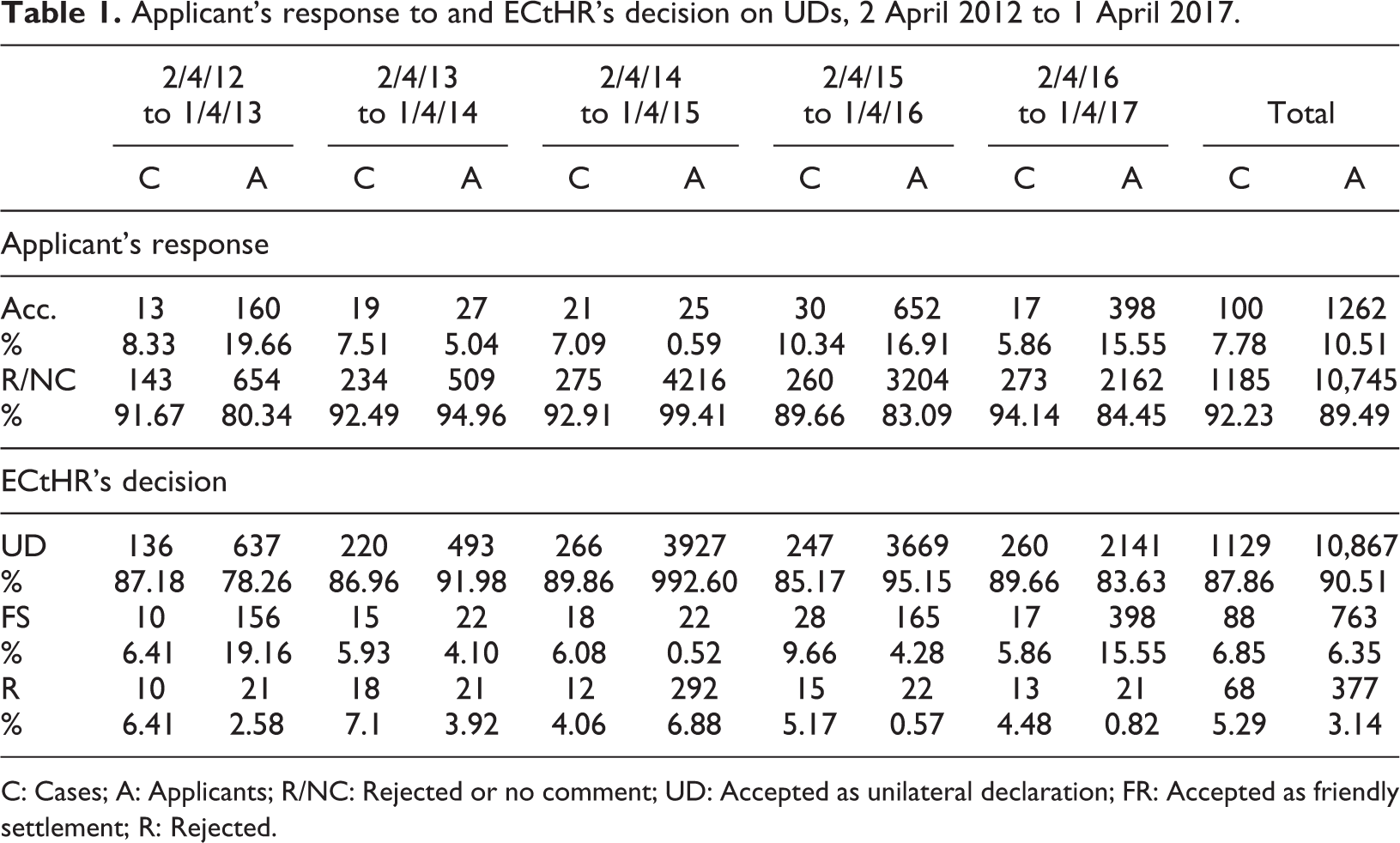
2/4/12 to 1/4/13
2/4/13 to 1/4/14
2/4/14 to 1/4/15
2/4/15 to 1/4/16
2/4/16 to 1/4/17
Total
C
A
C
A
C
A
C
A
C
A
C
A
Applicant’s response
Acc.
13
160
19
27
21
25
30
652
17
398
100
1262
%
8.33
19.66
7.51
5.04
7.09
0.59
10.34
16.91
5.86
15.55
7.78
10.51
R/NC
143
654
234
509
275
4216
260
3204
273
2162
1185
10,745
%
91.67
80.34
92.49
94.96
92.91
99.41
89.66
83.09
94.14
84.45
92.23
89.49
ECtHR’s decision
UD
136
637
220
493
266
3927
247
3669
260
2141
1129
10,867
%
87.18
78.26
86.96
91.98
89.86
992.60
85.17
95.15
89.66
83.63
87.86
90.51
FS
10
156
15
22
18
22
28
165
17
398
88
763
%
6.41
19.16
5.93
4.10
6.08
0.52
9.66
4.28
5.86
15.55
6.85
6.35
R
10
21
18
21
12
292
15
22
13
21
68
377
%
6.41
2.58
7.1
3.92
4.06
6.88
5.17
0.57
4.48
0.82
5.29
3.14
2/4/12 to 1/4/13
2/4/13 to 1/4/14
2/4/14 to 1/4/15
2/4/15 to 1/4/16
2/4/16 to 1/4/17
Total per state
C
A
C
A
C
A
C
A
C
A
C
A
Albania
2
2
1
3
1
1
4
7
8
13
Armenia
3
19
1
1
4
20
Azerbaijan
4
5
12
13
8
8
24
26
Belgium
1
1
1
1
2
2
Bosnia and Herzegovina
1
4
3
6
1
1
3
3
8
14
Bulgaria
8
44
3
9
4
7
6
7
3
5
24
72
Croatia
5
17
3
4
6
11
3
3
17
35
Cyprus
1
1
1
1
Czech Republic
4
13
9
10
1
1
14
24
Estonia
1
1
1
1
2
2
Finland
5
5
1
1
6
6
France
3
3
2
3
9
12
1
1
1
1
16
20
Georgia
1
1
8
13
20
23
17
30
5
5
51
72
Germany
2
9
2
5
3
3
1
1
5
5
13
23
Greece
24
57
7
22
31
79
Hungary
3
3
2
5
5
8
Italy
11
27
17
33
11
3329
62
2197
31
794
132
6380
Ireland
2
2
2
2
Latvia
1
1
1
1
2
2
1
4
5
8
Liechtenstein
1
1
1
1
Lithuania
1
1
1
1
Malta
1
1
1
7
2
8
Moldova
4
4
10
52
6
15
5
6
3
6
28
83
Montenegro
8
12
8
12
Netherlands
1
4
1
1
1
1
1
1
4
7
Poland
1
1
60
63
27
31
28
29
15
16
131
140
Portugal
29
31
6
6
6
21
4
6
5
16
50
80
Romania
16
113
21
25
83
109
41
189
39
110
200
546
Russia
11
169
24
105
41
209
32
128
80
312
188
923
Serbia
5
5
8
8
12
57
7
12
4
5
36
87
Slovakia
4
7
3
3
3
3
6
6
3
3
19
22
Slovenia
1
1
1
1
2
2
Sweden
1
1
1
1
FYROM
1
10
12
71
21
94
6
10
6
6
46
191
Turkey
12
16
21
26
7
11
14
25
32
406
86
484
Ukraine
24
322
23
56
20
292
10
1,121
28
809
105
2600
United Kingdom
3
3
2
2
3
3
3
3
1
1
12
12
Total
156
814
253
536
296
8310
290
3856
290
2560
1285
12,007
Appendix 2
Based on the conclusion, the ECtHR could address the following points in the practice direction on UDs, such as: whether there are other ‘exceptional circumstances’ than the repetitive nature of a complaint that justify passing over the friendly-settlement negotiations; the ECtHR invites applicants to submit comments about a UD:
and if they do not reply, the ECtHR assumes that they disagree with the terms of the UD and assesses whether the UD provides a basis for striking the application out under Article 37(1)(c) ECHR; and if they accept the UD, the ECtHR treats the UD as a friendly settlement and strikes out the application under Article 39 ECHR. respect for the ECHR rights (see Article 37(1) ECHR) implies that:
the states should not adopt a UD if the facts are in dispute between the parties; the states should explain in the UD which general measures they have taken to solve the root cause of repetitive applications, especially when this has not yet been clarified in a previous ruling of the ECtHR; and the ECtHR must have established clear and extensive case-law concerning the topic of the complaint in respect of the respondent state before it can approve a UD. The UD is not necessarily the final resolution of a case on the domestic level, because the respondent state may still need to take individual and/or general measures (even when it does not undertake to implement these measures in the UD, although these measures are preferably included in the UD). An acknowledgment of a violation must:
cover the entire complaint (for example the entire duration of the applicant’s detention); relate to a specific right; be as specific as possible (for example clarify which acts/omissions have caused the violation); and not be followed by the clause ‘in the special circumstances’ of the applicant’s case if the case does not concern an isolated problem. Adequate redress generally:
imposes on the respondent state a legal obligation to put an end to the violation and make reparation for its consequences in such a way as to restore as far as possible the situation; is more than the acknowledgement of a violation because it also requires individual and possibly general measures; and should be described sufficiently clearly and certainly. Adequate monetary redress:
must be reasonable in comparison to the amounts that the ECtHR has awarded in similar cases and therefore cannot be substantially lower than that; is as far as possible itemized under three headings (pecuniary damage, non-pecuniary damage, and costs and expenses); and cannot be ex gratia. Adequate non-monetary redress:
is welcomed in principle and may be indispensable depending on the nature of the violation (for example, releasing the applicant from detention contrary to Article 5 ECHR); may require an investigation in case of an acknowledgment of an Article 2 or 3 ECHR violation; and may require that the applicant can request the reopening of relevant domestic proceedings based on the acknowledgment in the UD.