




Abstract
Background
Artificial intelligence (AI) has experienced rapid advancements leading to numerous applications in foot and ankle surgery. This study aimed to assess the current status, research trends, and future directions of AI in foot and ankle surgery and to identify emerging hotspots in this field.
Methods
Relevant publications on AI in foot and ankle surgery were retrieved from the Web of Science Core Collection database up to December 31, 2024. A bibliometric analysis was conducted, and data visualization was performed using VOSviewer and CiteSpace.
Results
A total of 2047 publications from 1999 to 2024 were included. The number of AI-related studies in foot and ankle surgery has shown a steady annual increase. China (581 publications, H-index = 47) and the United States (489 publications, H-index = 53) are the leading contributors in terms of publication volume and research impact. Keyword co-occurrence analysis indicates that AI research in this field has progressed from foundational algorithms to the study of lower limb kinematics and clinical disease applications. Keyword burst analysis highlights diabetic foot ulcers and computer-aided diagnosis as key research focuses and emerging hotspots for future investigation.
Conclusion
AI research in foot and ankle surgery has expanded rapidly, with China and the United States at the forefront. The field has evolved from algorithm development to applications in lower limb kinematics and clinical disease management, with diabetic foot ulcers and computer-aided diagnosis identified as major areas of future research.
Introduction
In recent years, the field of artificial intelligence (AI) has experienced rapid advancements, leading to numerous applications in medicine. Within foot and ankle surgery, the integration of AI has been transformative. By leveraging advanced technologies such as machine learning and deep learning, AI significantly enhances various aspects of this specialty, from diagnosis and treatment planning to post-operative care. In medical imaging, AI enables the rapid analysis of images, facilitating the accurate identification of anomalies, which expedites diagnosis, improves precision, and allows for the development of tailored treatment plans.1–3 In surgical planning, AI utilizes patient data to simulate potential outcomes, providing surgeons with valuable insights to guide decision making.4,5 This personalized approach reduces risks and enhances overall success rates. Additionally, AI contributes to post-operative care by monitoring biomarkers and patient movement, allowing for real-time adjustments to rehabilitation protocols and promoting safer, more efficient recovery.6,7 In summary, AI is revolutionizing foot and ankle surgery by expediting diagnostics, personalizing treatment plans, and optimizing recovery processes. With continued advancements in computational power and algorithmic refinement, AI is expected to become increasingly integral to this field. However, despite the expanding research interest, a comprehensive analysis of global trends in AI-related research within foot and ankle surgery remains lacking.
Publications are fundamental to scientific research, serving as a primary indicator of research progress. Bibliometrics, a quantitative method for analyzing publications, enables comprehensive assessments of past, present, and future developments within a specific research domain, and facilitates comparisons of contributions from scholars, journals, institutions, and countries. 8 Additionally, bibliometrics is widely used to map and evaluate research performance in specific fields and to predict future trends. 9
This study aimed to conduct a bibliometric analysis, supplemented by visualizations, to evaluate the current state of research on AI in foot and ankle surgery. By analyzing published literature, we sought to explore temporal trends, identify emerging topics, and predict future developments in this field.
Materials and methods
Data source
Publication data was sourced from the Web of Science (WoS) Core Collection database which included over 12,000 prestigious international scientific journals recognized for their high impact and quality. This selection ensured a comprehensive dataset of relevant publications.
Search strategy
Referring to relevant literatures,10–12 the search strategy was as follows: (TS = artificial intelligence or TS = Intelligent Systems or TS = Machine Learning or TS = Deep Learning) AND (TS = foot or TS = ankle or TS = forefoot or TS = rearfoot or TS = midfoot or TS = achilles or TS = plantar fascia or TS = Lisfranc or TS = metatarsal or TS = talus or TS = cuboid or TS = malleolus or TS = hallux valgus or TS = hallux rigidus or TS = tibial tendon insufficiency or TS = navicular or TS = flatfoot or TS = cavus or TS = equinus or TS = pilon or TS = tarsal or TS = osteochondral lesion).
The search results were further refined to include only articles and reviews published in English, with the time frame extending from the inception of the database to December 31, 2024.
Data collection
All publications meeting the specified search criteria were obtained in TXT format from WoS, containing essential information such as article titles, publication years, author names, author nationalities, author affiliations, journal titles, keywords, abstracts, and references. Data collection and extraction for this study were carried out independently by two authors, with any discrepancies resolved through discussion to reach a consensus. Subsequently, the two authors manually prepared the data for analysis.
Bibliometric analysis
Basic bibliometric characteristics, including publication numbers and citation counts, were analyzed using the built-in functions of WoS. Data for individual author, institution, journal, and country was refined by indexing them accordingly in WoS. The H-index for countries or regions was calculated as the number of publications (H) that have each been cited at least H times, providing an indicator of research impact.13,14
Visualized analysis
Visual analysis of the included publications was conducted using VOSviewer (version 1.6.20, Leiden University, Leiden, The Netherlands) and CiteSpace (version 6.2.R4).15,16 VOSviewer was used to construct co-authorship maps for countries, regions, institutions, and authors, illustrating collaborative relationships. CiteSpace was employed to analyze and visualize keyword co-occurrence clusters, timeline views of clusters, and citation bursts, providing quantitative insights into research developments and trends.
Results
A total of 2047 articles from 1999 to 2024 were included in this study. Over this time period, the number of publications has increased rapidly year by year, from 3 (1999) to 468 (2024). (Figure 1) Annual number of publications on AI in foot and ankle surgery from 1999 to 2024.
Analysis of countries or regions
This study covered publications from 105 countries or regions, with China leading with 581 publications, followed by the United States (US) (n = 489) and the United Kingdom (UK) (n = 191). (Figure 2(a)) The US publications had the highest average citations (29.43), followed by UK (25.55) and Australia (23.07). In terms of H-index, the US had the highest score (H-index of 53), followed by China (H-index of 47) and UK (H-index of 34), reflecting their research productivity and impact. (Figure 2(b)) Publications by country and international collaborations in AI-related research on foot and ankle surgery. (a) Top 10 countries by number of publications. (b) Average citations and H-index of the top 10 countries by number of publications. (c) Co-authorship map among countries according to various continents. The size of the points indicates the number of publications, and the weight of the lines indicates the degree of closeness of cooperation.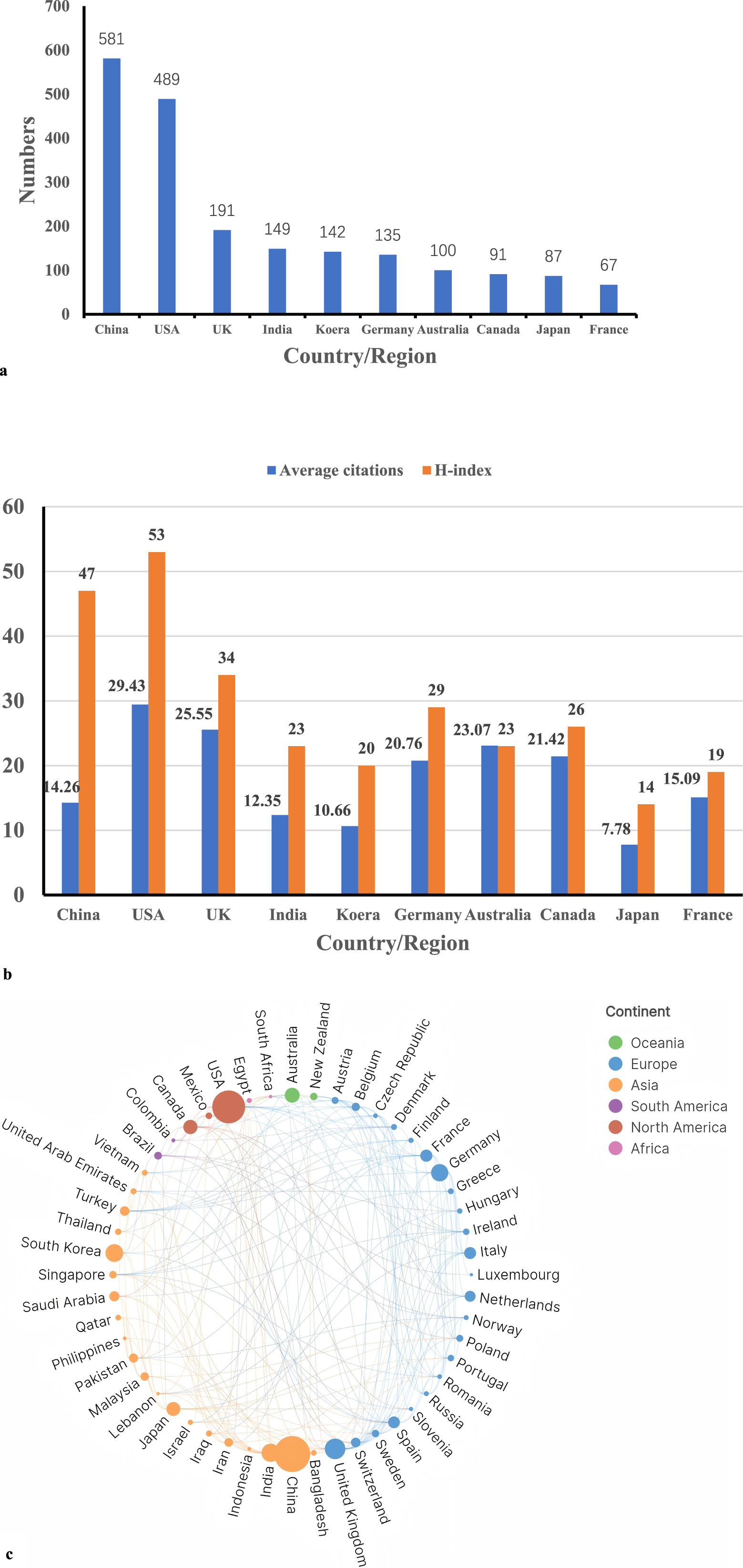
Figure 2(c) showed the cooperation network among different countries or regions. The US communicated most with countries in Europe. The five countries with the strongest links were the US (412), UK (308), China (288), Germany (181), and Australia (129).
Analysis of institutions
The top 10 institutions contributing to publications in AI-related foot and ankle surgery.

Figure 3 presents the co-authorship network among institutions, illustrating limited collaboration between relevant research institutions, with cooperation primarily remaining at the regional level. The five institutions with the strongest links were Harvard Medical School (154), the Chinese Academy of Sciences (102), Ludwig-Maximilians-Universität München (87), Boston University (80), and the University of Manchester (77). The time trend co-authorship map among institutions. Point size denotes the number of publications, while line thickness reflects the strength of cooperative ties. The color gradient, ranging from white to blue, indicates the publication timeline from 1999 to 2024, with lighter shades representing earlier occurrences and darker shades indicating more recent collaborations. Clusters signify groups of institutions with frequent and strong collaborations, often sharing common research themes.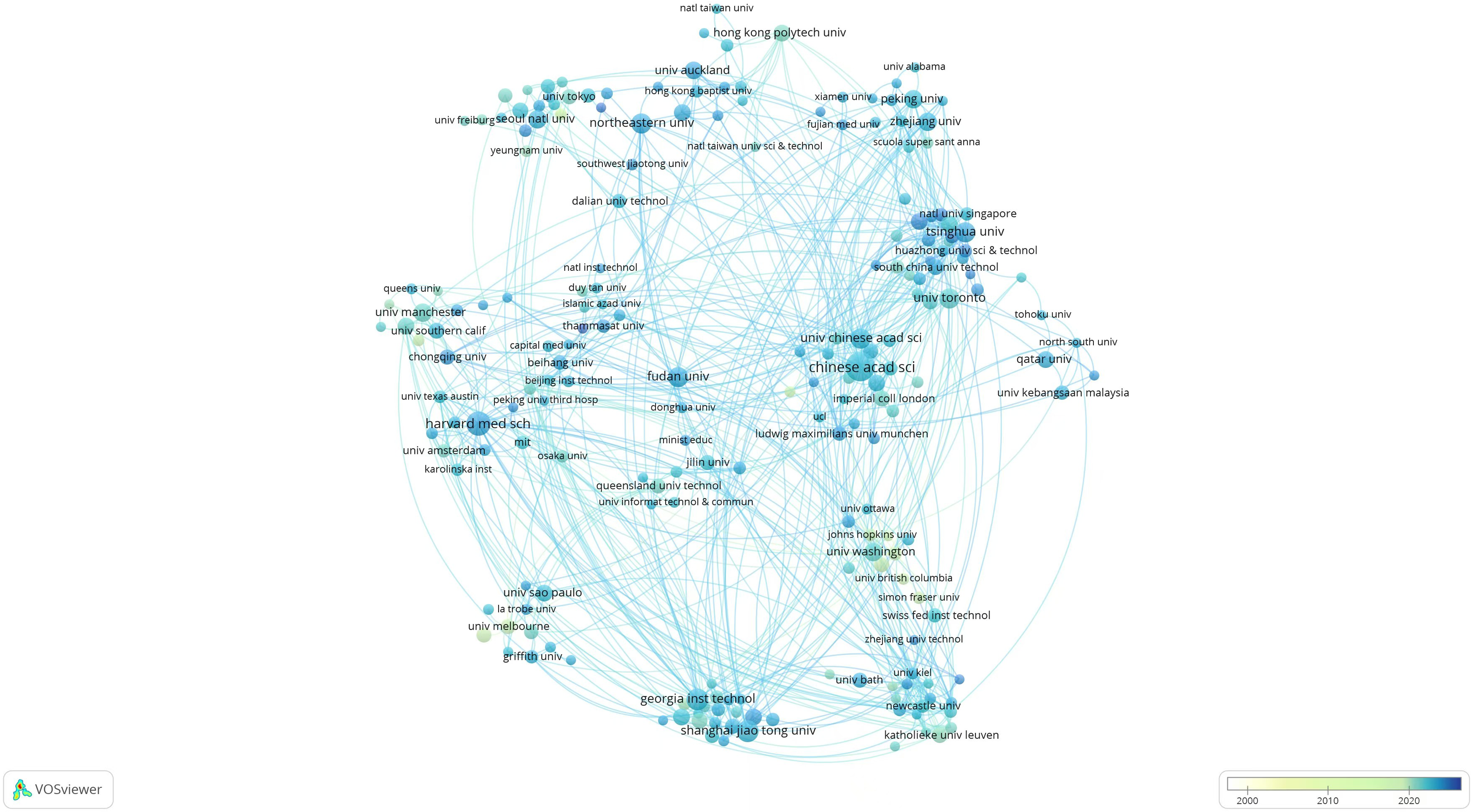
Analysis of authors and journals
The top 10 authors in this field collectively contributed 115 publications, accounting for 5.62% of all publications, which underscores the emerging nature of this field without clear leadership. Chowdhury MEH stand out as the most prolific author with 13 articles, followed closely by Gu YD, Kim J, Kim S, and Lee J with 12 articles. (Figure 4(a)) (a) Top 10 anthors by number of publications. (b) Top 10 journals by number of publications. (c) The time trend co-authorship map among authors. Point size denotes the number of publications, while line thickness reflects the strength of cooperative ties. The color gradient, ranging from white to blue, indicates the publication timeline from 1999 to 2024, with lighter shades representing earlier occurrences and darker shades indicating more recent collaborations. Clusters signify groups of institutions with frequent and strong collaborations, often sharing common research themes.
Research focusing on the application of artificial intelligence in foot and ankle surgery primarily finds its place in engineering journals. The journal with the highest publication count is SENSORS (159 publications), followed by IEEE ACCESS (68 publications) and IEEE SENSORS JOURNAL (61 publications). (Figure 4(b))
Figure 4(c) showed the co-authorship map of authors. The predominance of blue points and the dispersed distribution of clusters suggest that this field remains in its early research stage, with limited collaboration among authors.
Keywords co-occurrence analysis and burst terms
Keywords co-occurrence analysis is conducted by assessing the frequency of term co-occurrence within publications in a specific field, which serves as a valuable tool for identifying research directions and emerging topic areas within the field.
17
In this study, the keywords (the minimum number of occurrences of a keyword was over five) were analyzed by CiteSpace. A total of 5749 identified keywords were analyzed, and there were 20 clusters including deep learning, machine learning, gait analysis, artificial intelligence, support vector machine, reinforcement learning, neural networks, diabetic foot, legged locomotion, single-trial analysis, humanoid robot, hidden Markov models, biotic engineering, gait event detection, multiple sclerosis, deep convolutional neural network, fall detection, deep belief networks, dialogue generation (Figure 5(a)). Keywords co-occurrence map in AI related foot and ankle surgery. (a) Cluster diagram of keywords from 1999 to 2024. (b) Cluster diagram of keywords from 1999 to 2019. (c) Cluster diagram of keywords from 2020 to 2024. Each numbered cluster represents a distinct research focus within the field of AI related foot and ankle surgery. Larger cluster numbers represent smaller or more niche topics. Each point within a cluster corresponds to a specific publication contributing to that topic. The density and size of points indicate the volume and interconnectivity of research within the cluster. Lines connecting points represent co-citation relationships, with denser connections indicating stronger thematic coherence within a cluster. The color scale (red to blue) indicates the temporal distribution of publications within each cluster.
Furthermore, we conducted a comparative analysis of research themes in the field of artificial intelligence in foot and ankle surgery over two time periods—5 years ago and the past 5 years. Across both periods, machine learning has remained the primary research focus. From 1999 to 2019, research encompassed various domains, including wearable sensor (#1), gait analysis (#2), gait event detection (#3), fractal analysis (#4), pattern recognition (#5), and artificial intelligence (#7). In contrast, from 2020 to 2024, new research directions have emerged, including deep learning (#1), reinforcement learning (#4), convolutional neural network (#5), diabetic foot ulcer (#6), feature extraction (#7), image analysis (#8), long short-term memory (#11), virtual reality (#12) (Figure 5(b) and (c))
In order to discern prevailing research trends, we conducted a burst term analysis. The burst term analysis showed that, prior to 2011, artificial intelligence in the field of foot and ankle surgery was primarily in the foundational research phase, with a focus on exploring basic technologies such as fuzzy logic and hidden markov models. Between 2011 and 2018, the research focus gradually expanded to include the recognition of basic movement states, covering areas such as fall detection, activity recognition, pattern recognition, and mobile gait analysis. From 2018 to 2022, with the rapid development of neural network models and wearable devices, the research on movement states became more refined, incorporating aspects like ground reaction force and plantar pressure, and was applied to studies on Parkinson’s disease and freezing of gait. Since 2022, the primary research focus has shifted toward diabetic foot ulcer and computer-aided diagnosis. (Figure 6) Top 25 key words with the strongest citation bursts. Citation bursts for keywords appeared as early as 1999. The bursts strength of these 25 keywords ranged from 1.68 to 4.05, and endurance strength was from 1 to 16 years.
Discussion
To the best of our knowledge, this is the first study using bibliometrics to summarize and describe the current knowledge landscape and predict future development trends of AI related foot and ankle surgery. The study highlights the rapid growth of AI in this field, with the China and United States leading the research efforts. Over time, artificial intelligence research in foot and ankle surgery has advanced from foundational algorithms to the analysis of lower limb kinematics and clinical disease applications. Currently, diabetic foot ulcers and computer-aided diagnosis represent key research trends and emerging hotspots for future investigation.
Global trends in the field
Researches on AI in foot and ankle surgery commenced in 1999, but significant growth only occurred in the past 5 years. This surge can be attributed to advancements in computing power and model development. With the breakthroughs in computer science, we anticipate that this field will continue to gain momentum and evolve rapidly. Leading the way in this field are China and US, both in terms of publication quantity and quality.
Authors, institutions, and journals
The top 10 authors by publications in this field only accounted for 5.62% of all publications, signifying its recent growth. The co-authorship map of authors showed limited collaboration among authors, which also suggested that this field remained in its early research stage.
Among the top 10 institutions with the highest publication numbers, six were from the US, two from India, one from China and the rest from Swiss. Notably, the Chinese Academy of Science had the highest publication count, while the University of California System secured the top position in average citation numbers. The research conducted by these institutions warrants further attention in the future.
The journal with the highest number of published articles was “SENSORS” (159 publications), significantly exceeding other journals in terms of volume. The literature related to AI in foot and ankle surgery primarily finds its place in journals within the fields of engineering and computer science. This suggests that the application of AI in foot and ankle surgery is still in its early developmental stages. The top 10 journals by publications and journals containing highly cited articles deserve attention in the future.
Hotspot and research trends
Co-occurrence analysis was performed based on the frequency of keywords appearing together in publications, with the goal of evaluating relationships among the identified items, showing the closeness and prevalence of research topics in scientific areas. 18 In this study, we constructed a co-occurrence network map by analyzing the keywords present in all the included studies.
The visualization network of keywords from 1999 to 2024 showed that this field primarily employed deep learning, machine learning methods (support vector machine, reinforcement learning, hidden Markov models, neural networks, deep convolutional neural network, deep belief networks, dialogue generation), applied in basic medical research for the analysis of lower limb movement states (gait analysis, legged locomotion, gait event detection), and has been widely used in the diagnosis and treatment of conditions such as fall detection, diabetic foot, and multiple sclerosis. In summary, research in this field is centered around AI algorithms, focusing on precision medicine and rehabilitation in foot and ankle surgery, while also exploring the integration of robotic technology.
Furthermore, we conducted a comparative analysis over two time periods—five years ago and the past 5 years The cluster word comparison chart indicated that in recent years, research on artificial intelligence in foot and ankle surgery shifted from traditional machine learning to deep learning, gradually expanding into clinical applications such as the diagnosis and treatment of diabetic foot ulcers. This suggests that artificial intelligence technology is evolving from fundamental hardware and software research to clinical treatment. With the continuous advancement of algorithms and computational power, artificial intelligence is expected to have broader applications in the areas of refined patient diagnosis, personalized care, and rehabilitation in the future. Additionally, emerging technologies such as feature extraction, image analysis, long short-term memory networks, and virtual reality are expected to create new research hotspots and application directions.
Burst detection analysis serves as a vital tool for exploring the evolution of research hotspots. The top 25 with the strongest citation bursts showed that the application of artificial intelligence in foot and ankle surgery underwent several stages. Initially, the focus was on foundational technologies such as fuzzy algorithms and Markov chains. This was followed by an expansion into the recognition of movement states, including fall detection and gait analysis. With the development of neural networks and wearable devices, research became more refined, encompassing lower limb movement and plantar pressure, and was applied to studies on Parkinson’s disease and freezing gait. Currently, the research focus has shifted toward diabetic foot and machine-assisted diagnosis.
Although machine learning models have been applied to clinical modeling for some time, their performance in clinical prediction models has been suboptimal. 11 There is an urgent need for further research to improve the accuracy and effectiveness of these models. Currently available machine learning models demonstrate better fitting capabilities and predictive performance in identifying minimal clinically important difference. For instance, using machine learning, Nour successfully pinpointed several predictive factors linked to the occurrence or absence of venous thromboembolism in patients who experienced an ankle fracture. 19 However, evidence on the ability of machine learning to predict the achievement of substantial clinical benefit is scarce, and no evidence currently exists for its role in predicting the patient-acceptable symptomatic state. Additionally, studies in this field are limited by inconsistent reporting of performance metrics, varying methods for quantifying clinically significant outcomes, lack of adherence to predictive modeling guidelines, and limited external validation. 20 Deep learning models present several advantages, including automatic feature extraction, the ability to manage complex data patterns, and the potential to achieve state-of-the-art performance. Their primary application has been in image recognition, such as detecting foot and ankle fractures. 21 However, deep learning models require substantial labeled data, lack interpretability, and may overfit when dealing with small datasets. Ethical considerations, computational demands, and regulatory challenges also warrant careful attention when applying these models in healthcare settings.
Diabetic foot is a critical area of research within foot and ankle surgery. With the increasing global aging population, the prevalence of diabetes has steadily risen, leading to a corresponding increase in the number of patients with diabetic foot. Poorly managed diabetes can result in severe complications, including diabetic foot ulcers (DFUs) and areas prone to infection, which may progress to severe infections and life-threatening conditions. However, due to sensory loss caused by neuropathy, DFUs often go unnoticed in their early stages and are difficult to monitor as they develop. Artificial intelligence has become indispensable in the monitoring and prevention of diabetic foot complications. Machine learning models, including both shallow and deep learning approaches, have been used to identify risk factors and predict prognosis of DFU. 22 Non-invasive sensor technologies, such as visible spectroscopy, near-infrared spectroscopy, infrared spectroscopy, and hyperspectral imaging, can accurately measure wound size and depth, diagnose infections, and identify potential infection risks. 23 Some researchers have also combined sensors with mobile applications to better manage diabetic foot. 24 Mobile camera-based digital technologies are also being developed to enhance remote diagnosis, monitoring, and follow-up care of DFUs. Prediction models for wound healing are currently being developed, linking the characteristics of DFU images with clinical and laboratory parameters of diabetic patients. 25 Another critical area addressed by AI is the development of appropriate footwear for diabetic patients. 26 Despite the high efficacy of AI-based systems in diagnosing and detecting diabetic wounds, most research is constrained by limited datasets and heavy reliance on clinical experience, and still far from clinical application. Acquiring clean and reliable data is challenging due to legal and privacy issues. Therefore, close collaboration between computer scientists and medical experts is crucial for the successful implementation of these systems.
Gait analysis is a fundamental area of research in this field; however, early studies were constrained by the limitations of monitoring tools and computational methods. With advancements in sensor technology and motion capture systems, large volumes of high-dimensional, temporal, and complex data have been generated, necessitating the use of more sophisticated analytical techniques. AI algorithms, with their powerful computational and analytical capabilities, have brought about a paradigm shift in this domain. AI has facilitated the integration of advanced gait analysis features, including gait posture, 27 plantar pressure, 28 and ground reaction force, 29 and has been applied to fall detection 30 and freezing of gait. 31 In the coming years, continuous monitoring, routine diagnostics, and real-time feedback for gait control techniques are expected to become more prevalent. This progress will enhance rehabilitation by providing valuable information to both medical professionals and patients. However, before AI-driven gait analysis using inertial sensors can be established as a standard clinical diagnostic tool, further rigorous research is required. Standardization of these methods necessitates extensive testing in patient populations to ensure reliability and clinical applicability. Consequently, future intelligent gait analysis systems will integrate sensor technology with automated monitoring and biofeedback mechanisms for walking detection in both indoor and outdoor environments. Such advancements will ultimately contribute to improving overall health and quality of life.
Strength and limitations
To the best of our knowledge, this study represents the inaugural bibliometric analysis of AI related foot and ankle surgery research. We offered a comprehensive overview of the current state of research in the field of foot and ankle surgery, employing bibliometric techniques to pinpoint potential research focal points.
However, it is essential to acknowledge several limitations inherent in this study. Firstly, while the included publications sufficiently capture the present landscape, our data retrieval exclusively relied on the WoS database, potentially leading to the omission of relevant publications due to database bias. Secondly, it is noteworthy that the overwhelming majority of the identified publications are in English, possibly resulting in the exclusion of pertinent articles due to language bias. Thirdly, inherent disparities exist between the outcomes of bibliometric analysis and real-world research. The bibliographic coupling and co-citation analyses performed in this study may naturally favor earlier publications that have had the opportunity to accumulate a substantial number of citations. Consequently, this approach might underestimate the influence of more recent articles, as well as the associated authors, journals, institutions, and countries. These recent contributions, despite their publication in high-quality journals, may not have had ample time to amass a significant citation count. It is essential to consider these factors when interpreting the findings presented in our study.
Conclusion
This study found that AI research in foot and ankle surgery has expanded rapidly, with China and the United States at the forefront. The field has evolved from algorithm development to applications in lower limb kinematics and clinical disease management, with diabetic foot ulcers and computer-aided diagnosis identified as major areas of future research.
Footnotes
Author contributions
All authors listed meet the authorship criteria according to the latest guidelines of the International Committee of Medical Journal Editors. All authors are in agreement with the manuscript.
Declaration of conflicting interests
The author(s) declared no potential conflicts of interest with respect to the research, authorship, and/or publication of this article.
Funding
This study was supported by the Youth Foundation of Jishuitan Hospital (QN-202510). The author(s) received no other financial support for the research, authorship, and/or publication of this article.

Data Availability Statement
Data will be available upon request by the first author LZ.