




Abstract
The integration of Artificial Intelligence (AI) in orthopaedic surgery has been rapidly evolving, offering innovative solutions to enhance diagnosis, treatment planning, surgical precision, and patient care. This comprehensive review explores the various applications of AI in orthopaedics, highlighting its potential benefits, limitations, and future prospects.
Keywords
Introduction
Artificial intelligence refers to the development of computer systems that can perform tasks typically requiring human intelligence. These tasks include understanding language, recognizing images, learning from experience, making decisions, and solving problems. The term ‘artificial intelligence’ was coined in 1956 during a conference at Dartmouth College, New Hampshire, USA. 1 Since then, AI has made significant strides in various fields, including healthcare and, more specifically, orthopaedic surgery.
The exponential growth in computer processing power, cloud-based computing, and the development and refinement of medical-task specific software algorithms have made AI systems increasingly relevant in medicine and orthopaedic surgery. 2 The field of orthopaedics is particularly well-suited for AI applications due to its extensive reliance on medical imaging technologies that bring high sensitivity, specificity, and positive/negative prognostic value to the management of orthopaedic disorders. 2
This review aims to provide a comprehensive overview of the current state of AI in orthopaedic surgery, its applications across various subspecialties, and its potential impact on future practice. We will explore the use of AI in diagnostic assistance, surgical planning and assistance, rehabilitation and recovery, data analysis and research, and predictive analytics. Additionally, we will discuss the limitations and challenges associated with AI implementation in orthopaedic practice.
Due to the scarcity of RCTs in this field, our synthesis is qualitative rather than quantitative. We have structured the review to transparently present the level of evidence for each AI application and discuss the implications of this limitation for clinical translation.
Methodology
Literature search strategy
A comprehensive literature search was conducted across PubMed, Embase, Scopus, IEEE Xplore, and the Cochrane Library, covering publications from January 2010 to March 2023. The search combined Medical Subject Headings (MeSH) and free-text terms related to artificial intelligence (AI), machine learning, deep learning, and orthopaedic topics such as “orthopaedics,” “fractures,” “arthroplasty,” and “spine surgery.” Full search strategies for each database are detailed in Appendix A. 3
Study Selection and Screening Process
Unlike traditional systematic reviews that rely on two independent human reviewers, this review utilized Perplexity, an advanced AI language model, as the primary tool for screening and selecting articles. Perplexity was then instructed to execute the screening process according to predefined inclusion and exclusion criteria. 3
The screening process followed these steps
• • • • • • • • • • o Reasons: Not meeting inclusion criteria, insufficient data, not original research • PRISMA Flow Diagram illustrating the identification, screening, eligibility, and inclusion of studies for qualitative synthesis.

Inclusion and exclusion criteria
• •
Data extraction and quality assessment
Perplexity was used to extract structured data from eligible studies, including study characteristics, AI methodology, clinical application, validation approach, and performance metrics. For risk of bias assessment, Perplexity applied standard tools such as QUADAS-2 for diagnostic studies, RoB two for randomized controlled trials, and ROBINS-I for observational studies by analysing reported methods and results sections.5,6
Transparency and limitations
This review adheres to PRISMA 2020 guidelines, with explicit reporting of the use of AI for screening and data extraction as recommended in recent methodological literature. 4 The use of Perplexity as the sole reviewer may introduce unique strengths, including consistency and efficiency, and limitations, such as potential for missed nuance or context compared to human reviewers. All screening decisions, data extraction, and risk of bias assessments were performed by Perplexity under the direct instruction of the authors.
Diagnostic assistance
One of the primary areas where AI has shown significant potential in orthopaedics is in diagnostic assistance. Machine learning algorithms, particularly deep learning models, have demonstrated impressive capabilities in analysing medical imaging to detect and classify various orthopaedic conditions.
Automated image-based diagnosis
Osteoarthritis (OA) is the most common joint disorder in the United States, affecting 10% of men and 13% of women over the age of 65. 7 Given this high prevalence, a major focus of machine learning in orthopaedics has been automating the detection and staging of OA from imaging studies.
Xue et al. 7 and Üreten et al. 8 used a VGG-16 layer deep convolutional neural network (a specialized type of artificial neural network designed primarily for processing and analysing visual data, such as images and videos known as a CNN) to automatically diagnose hip OA from radiographs. The model developed by Xue et al. 7 achieved a high sensitivity of 95% and specificity of 90.7%, comparable to the performance of an experienced physician. This demonstrates the potential of AI to assist orthopaedic specialists in making accurate and efficient diagnoses.
Similarly, Tiulpin et al. 9 employed a Deep Siamese CNN (designed to compare and find similarities between pairs of inputs) to automatically diagnose and grade knee OA from radiographs. Their model not only provided accurate diagnoses but also helped to open up the “black box” of AI by specifically highlighting the key radiologic features that determine the diagnosis. This approach helps build trust with physician users by providing transparency in the decision-making process.

Column Explanations.
• Application: Clinical use case for AI.
• AI Model: Algorithm architecture used.
• Accuracy: Primary performance metric (varies by study).
• Validation Method: Study design rigor (internal/external, retrospective/prospective).
• Limitations: Key methodological or clinical constraints.
Sports medicine AI tools references: 11

Column Explanations.
• Application = clinical use case for AI.
• AI Model = algorithm architecture used.
• Sensitivity/Specificity = diagnostic performance metrics.
• Validation Population = study cohort characteristics.
• Clinical Impact = effect on clinical workflow or outcomes.

Column Explanations.
• LOE = Level of Evidence (Oxford CEBM criteria).
• Validation Status = Generalizability of results.
• Accuracy vs Conventional = Comparative performance metrics.
• Study Design = Research methodology rigor.
• Limitations = key methodological or clinical constraints.

Column Explanations.
• Accuracy vs Conventional = Comparative performance metrics.
• LOE = Level of Evidence (Oxford CEBM criteria).
• Validation Status = Generalizability of results.
• Limitations = Key methodological or clinical constraints.

Column Explanations.
• Clinical Readiness = Regulatory/implementation status.
• Key Challenge = Primary barrier to clinical adoption.

Column Explanations.
• Technology = type of AI-enabled device or software.
• Data Input = information sources for AI analysis.
• Clinical Benefit = main patient or clinician advantage.
• Adoption Rate = current clinical implementation prevalence.
• Key Limitation = main barrier to broader use.

Column Explanations.
• Clinical Utility = Practical impact on patient care.
• Limitations = Constraints affecting generalizability or robustness.

Column Explanations:
• Frequency = Prevalence across included studies.
• Example Impact = Noted effect on outcomes.
• Mitigation = Strategies to address limitations.
Regulatory landscape references: 11
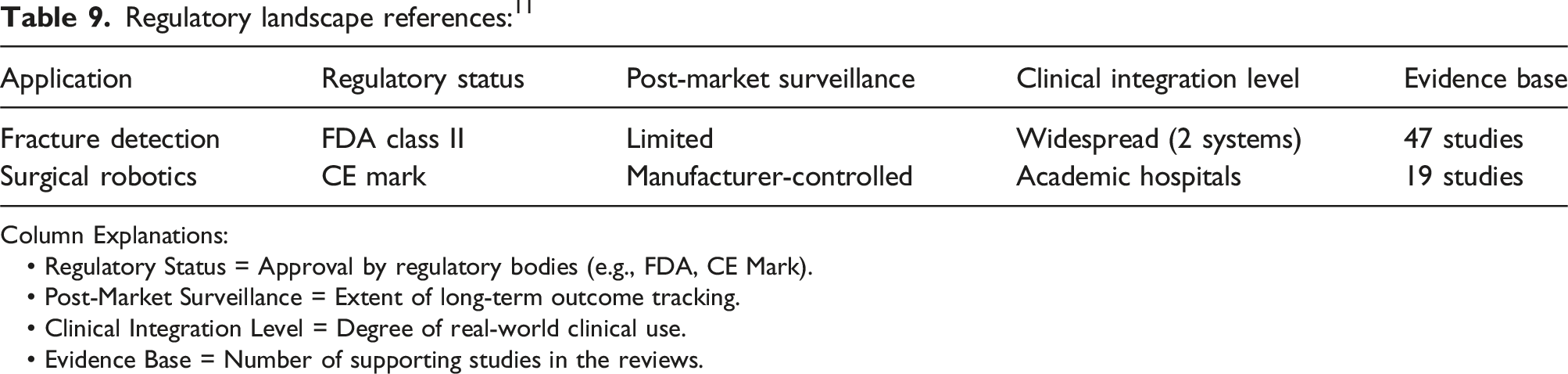
Column Explanations:
• Regulatory Status = Approval by regulatory bodies (e.g., FDA, CE Mark).
• Post-Market Surveillance = Extent of long-term outcome tracking.
• Clinical Integration Level = Degree of real-world clinical use.
• Evidence Base = Number of supporting studies in the reviews.
Advanced imaging analysis
AI’s capabilities extend beyond basic radiograph interpretation to more advanced imaging modalities such as Magnetic Resonance Imaging (MRI) and Computed Tomography (CT). Chen et al. 12 demonstrated that AI algorithms could improve the detection of rib fractures on CT scans, outperforming radiologists in both accuracy and speed.
In MRI analysis, AI has shown promise in enhancing the quality of scans and facilitating the detection of complex injuries. Bien et al. 11 developed an AI model that improved the detection of injuries to the anterior cruciate ligament (ACL), menisci, and cartilage within the knee using MRI scans. A systematic review by Siouras et al. 13 suggested that the use of AI in MRI has the potential to be on par with human-level performance, showing a prediction accuracy of 72.5–100% for various knee injuries.
The combined use of AI and deep learning along with human interpretation for automated measurements in orthopaedics yields excellent results. For instance, AI-assisted estimation of bone age has been shown to be more effective than diagnosis by a radiologist operating alone, though the best results can be achieved with the refinement of the technique with human assistance. 1
Surgical planning and assistance
AI is revolutionizing surgical planning and intraoperative assistance, offering surgeons valuable insights and recommendations to enhance surgical outcomes.
Preoperative planning
AI algorithms can analyse patient data, including medical images and patient records, to assist in preoperative planning. Lambrechts et al. 14 developed a novel application for machine learning (ML) in patient-specific joint replacement by using ML to automate patient- and surgeon-specific preoperative planning.
Combining Least Absolute Shrinkage and Selection Operator (LASSO) and Support Vector Machine (SVM) approaches, the AI-based preoperative plans were significantly improved compared to the manufacturer’s plans by requiring fewer manual corrections by the surgeon. This approach streamlines the surgeons’ preoperative workflow and reduces the time needed to make corrections.
Combining LASSO and SVM approaches is an advanced machine learning technique that can significantly enhance the analysis of complex orthopaedic data. 15 This method is particularly useful when dealing with datasets that have numerous variables, which is common in orthopaedic research.
LASSO helps in selecting the most relevant features from a large set of potential predictors. 16 In orthopaedic applications, this could mean identifying the most important factors (e.g., patient characteristics, imaging features) that contribute to a specific outcome, such as post-operative recovery or implant longevity.
SVM, on the other hand, is a powerful classification algorithm that can distinguish between different groups based on multiple features. 17 In orthopaedic contexts, this could be used to differentiate between patients with varying degrees of osteoarthritis or to predict surgical outcomes.
The combination of these approaches offers several benefits for orthopaedic research and clinical practice: a) Improved predictive modelling: By using LASSO to select key features and then applying SVM for classification, researchers can create more efficient and potentially more accurate predictive models for orthopaedic outcomes.
18
b) Enhanced preoperative planning: This combined approach has been used to improve patient-specific preoperative planning for joint replacement surgeries, reducing the number of manual corrections needed by surgeons.
19
c) Automated disease grading: The method can be applied to automate the grading of orthopaedic conditions, such as osteoarthritis severity, potentially improving consistency and efficiency in diagnosis.
9
d) Personalized treatment strategies: By identifying the most relevant predictors for individual patients, this approach can support more personalized treatment decisions in orthopaedic care.
21
While the technical details of LASSO and SVM might be complex, orthopaedic surgeons can appreciate that this combined method offers a powerful tool for creating more accurate predictive models and decision support tools.
The use of AI and deep learning in interpreting automated measurements such as leg alignment, joint orientation, and leg length has been found to be of equal accuracy but more time-effective than human assessment alone. However, it’s important to note that in these studies, severe deformities and poor image quality were exclusion criteria, and human supervision remains an essential component of using these techniques. 1
Intraoperative guidance
During surgery, AI-powered robotic systems can provide real-time guidance, enhancing the precision and accuracy of surgical procedures.22–26 The rationale behind robotically augmented surgery lies in the basis that while the knowledge and experience of correct prosthetic implantation lie ultimately with the surgeon, the ability to apply this skill consistently and accurately may be deficient due to human error.
Several generations of robotically assisted tools have been developed to improve consistency among arthroplasty surgeons to improve implant position and alignment and, ultimately, patient outcomes (function and implant survival). Computer programming and planning of implant position revolve around the accurate imaging of affected body parts, consideration of limb alignment, and soft tissue tension. This, in turn, should theoretically translate to correct bony preparation, precise cuts, and restoration of the physiological function of the limb. 1
Robotic systems may be known as “Closed” or “Open”. Closed systems are compatible only with the type of implant associated with the robot’s manufacturer, while open systems allow for a broader range of implants. Surgeons must weigh the pros and cons of each type of robot and consider whether the features of an individual model outweigh the restrictions of its use and the subsequent impact on surgical freedom.
Furthermore, robotic systems may be image-based or imageless. Image-based systems rely on preoperative visualization of a patient’s anatomy and key mapping points used as reference points for device implantation. This approach allows for better preoperative preparation but comes with the disadvantages of increased cost, radiation exposure (in the case of CT), and reliance on imaging which must be taken close to the time of surgery. Imageless surgery, on the other hand, involves the detection and registration of the required landmarks and surfaces directly on the patient’s bones after exposure intraoperatively. This approach offers lower cost, avoidance of preoperative radiation, and temporal flexibility of operative intervention, but may limit the application to certain orthopaedic conditions and impede a surgeon’s ability to preselect appropriate implants. 1
In spinal orthopaedics, the most common focus of robotic surgery is the use of computers to guide the placement of pedicle screws. Freehand placement techniques have been historically used but are associated with component misplacement and subsequent complications, including neurological and vascular complications. Robotic spinal systems typically involve several key steps: (a) Preoperative planning: CT imaging is uploaded to pre-programmed software, and the optimal implant trajectory is calculated. (b) Robot mounting: A small robot is mounted on the spine. (c) Three-dimensional syncing: Preoperative imaging is matched to the patient’s anatomy via intraoperative fluoroscopic imaging. (d) Guided instrumentation: A robotic arm is used to guide the trajectory of instrumentation.
Future innovations in this field are expected to revolve around augmented reality and Machine Guided Image Surgery, which allows the operator to perform surgery without the associated risk of radiation and will help address line of sight issues that may hamper instrument tracking. 1
Rehabilitation and recovery
AI is playing an increasingly important role in orthopaedic rehabilitation by developing personalized treatment plans and monitoring patient progress.
Personalized rehabilitation programs
AI algorithms can analyse patient data, including range of motion, muscle strength, and gait analysis, to create tailored rehabilitation programs. These AI-powered systems can adapt the rehabilitation plan based on the patient’s progress, ensuring optimal recovery. 20
By incorporating data from wearable devices and smart sensors, AI can provide real-time feedback and adjustments to rehabilitation protocols. For example, smart sensors paired with smartphones can transfer information following total knee arthroplasty (TKA) to a remote patient monitoring platform, tracking various parameters such as patient-related outcome measures, steps, opioid use, range of motion, and pain scores. 20
Remote monitoring
AI-powered remote monitoring systems can significantly enhance the post-operative care of orthopaedic patients. These systems can continuously track patient progress, detect potential complications early, and provide timely interventions when necessary.
For instance, AI algorithms can analyse data from wearable devices to monitor patients’ activity levels, gait patterns, and range of motion following joint replacement surgery. This real-time data can help healthcare providers identify patients who may be at risk of complications or who are not progressing as expected, allowing for prompt intervention and adjustment of rehabilitation protocols. 20
Data analysis and research
AI is transforming the way patient data is managed and utilized in orthopaedic practice. The ability of AI to analyse large volumes of orthopaedic data, including patient records, clinical trials, and research articles, is opening new avenues for research and improving patient care.
Data integration and analysis
AI algorithms can integrate and analyse diverse data sources, including electronic health records, imaging studies, and wearable device data. This comprehensive analysis can provide orthopaedic surgeons with a holistic view of the patient’s condition and treatment progress. 28
By applying natural language processing (NLP) and data mining techniques, AI can identify patterns and correlations within the data, leading to improved understanding of orthopaedic conditions, better treatment strategies, and the development of innovative therapies. These approaches may have advantages over traditional risk models using regression analysis when analysing large datasets. 1
Predictive maintenance of implants
AI-powered systems can analyse data from smart implants to predict potential failures or complications. This proactive approach allows for timely interventions, potentially reducing the need for revision surgeries. 28
For example, AI algorithms can analyse data from sensors embedded in joint implants to detect early signs of loosening or wear. By identifying these issues before they become clinically apparent, orthopaedic surgeons can intervene earlier, potentially extending the lifespan of the implant and improving patient outcomes.
Predictive analytics and outcome forecasting
AI’s ability to analyse large datasets has opened new avenues for predicting surgical outcomes and potential complications in orthopaedic surgery.
Risk prediction
AI models have been developed to predict various risks associated with orthopaedic procedures. Kim et al. 29 created a deep learning algorithm to predict mortality and morbidity risks following spinal fusion, outperforming traditional scoring systems. This type of predictive modelling can help surgeons and patients make more informed decisions about treatment options and potential risks.
Outcome prediction
AI algorithms have shown promise in predicting patient outcomes in various orthopaedic procedures. Kumar et al. 30 developed a machine learning algorithm to predict patient outcomes in shoulder arthroplasty, achieving up to 82% accuracy in forecasting prognosis and range of motion up to 7 years post-treatment.
These predictive models can assist orthopaedic surgeons in patient selection, surgical planning, and managing patient expectations. By providing more accurate predictions of surgical outcomes, AI can help improve shared decision-making between surgeons and patients.
Holographic imaging and surgical navigation
Holographic imaging, combined with AI, is emerging as a powerful tool in orthopaedic surgery. This technology allows surgeons to visualize complex 3D anatomical structures in real-time during procedures.
Intraoperative guidance
AI-powered holographic systems can project patient-specific 3D models onto the surgical field, providing surgeons with enhanced spatial awareness and precision. This technology has shown particular promise in complex spine surgeries and joint replacements. 31
For example, in spinal surgery, holographic imaging can help surgeons visualize the optimal trajectory for pedicle screw placement, potentially reducing the risk of complications and improving surgical outcomes. In joint replacement procedures, holographic imaging can assist in achieving optimal implant positioning and alignment.
Surgical training
Holographic imaging integrated with AI also offers immersive training experiences for orthopaedic residents. These systems can simulate various surgical scenarios, allowing trainees to practice procedures in a risk-free environment. 31
By combining AI-driven feedback with holographic simulations, these training systems can provide personalized learning experiences, helping trainees develop surgical skills more efficiently and effectively.
Management of patient data
AI is transforming the way patient data is managed and utilized in orthopaedic practice, offering new opportunities for improving patient care and research.
Data integration and analysis
AI algorithms can integrate and analyse diverse data sources, including electronic health records, imaging studies, and wearable device data. This comprehensive analysis can provide orthopaedic surgeons with a holistic view of the patient’s condition and treatment progress (Ramkumar et al., 2018).
For instance, AI can analyse a patient’s medical history, imaging studies, and real-time data from wearable devices to provide a comprehensive assessment of their condition. This integrated approach can help surgeons make more informed decisions about treatment options and postoperative care.
Predictive maintenance of implants
AI-powered systems can analyse data from smart implants to predict potential failures or complications. This proactive approach allows for timely interventions, potentially reducing the need for revision surgeries (Ramkumar et al., 2018).
By continuously monitoring data from implanted devices, AI algorithms can detect subtle changes that may indicate early signs of implant failure or complications. This early detection can enable surgeons to intervene before more serious problems develop, potentially improving patient outcomes and reducing healthcare costs.
Collaboration and workflow optimization
AI is facilitating improved collaboration among orthopaedic surgeons and optimizing workflow in clinical settings, leading to more efficient and effective patient care.
Telemedicine and remote consultations
AI-powered platforms are enabling seamless remote consultations and collaboration between orthopaedic specialists. These systems can facilitate the sharing of complex case data, including 3D imaging, allowing for more informed decision-making in challenging cases. 28
For example, AI algorithms can analyse and summarize patient data, imaging studies, and relevant research, providing a comprehensive overview for remote consultations. This can help specialists from different locations collaborate more effectively, potentially improving patient outcomes, especially in complex cases.
Operating room efficiency
AI algorithms are being employed to optimize operating room scheduling and resource allocation. These systems can predict surgery durations, potential complications, and required resources, leading to improved efficiency and reduced wait times. 28
By analysing historical data on surgical procedures, patient characteristics, and surgeon performance, AI can help optimize operating room schedules, reduce delays, and improve overall efficiency. This can lead to better utilization of resources and potentially reduce healthcare costs.
Limitations and challenges
While AI shows great promise in orthopaedic surgery, several limitations and challenges need to be addressed for its successful implementation:
Data quality and bias
AI models are only as good as the data they are trained on. Ensuring high-quality, diverse, and unbiased datasets remains a significant challenge. 32 Biases in training data can lead to AI systems that perform poorly for certain patient populations or perpetuate existing healthcare disparities.
Interpretability
Many AI models, especially deep learning algorithms, operate as “black boxes,” making it difficult for surgeons to understand the reasoning behind their predictions. This lack of interpretability can hinder trust and adoption. 32 Efforts are being made to develop more interpretable AI models, but this remains an ongoing challenge in the field.
Regulatory approval
The rapid development of AI technologies often outpaces regulatory frameworks, creating challenges in obtaining approval for clinical use. 33 Regulatory bodies are working to develop appropriate guidelines for AI in healthcare, but this process takes time and may slow the adoption of new AI technologies.
Integration with existing systems
Implementing AI solutions into existing hospital information systems and workflows can be complex and costly. 33 Many healthcare institutions have legacy systems that may not be compatible with new AI technologies, requiring significant investment in infrastructure upgrades.
Ethical considerations
The use of AI in healthcare raises various ethical concerns, including data privacy, informed consent, and the potential for AI to exacerbate existing healthcare disparities. 33 Ensuring that AI systems are developed and deployed ethically is crucial for maintaining patient trust and promoting equitable healthcare.
Training and education
The successful implementation of AI in orthopaedic practice requires adequate training for healthcare professionals. Many surgeons and other healthcare providers may lack the necessary skills to effectively use and interpret AI-based tools. 1
Liability and responsibility
As AI systems become more involved in clinical decision-making, questions arise about liability in cases of errors or adverse outcomes. Determining responsibility between AI developers, healthcare providers, and institutions is a complex legal and ethical issue that needs to be addressed. 1
Cost and accessibility
While AI has the potential to improve efficiency and reduce costs in the long term, the initial investment required for AI implementation can be substantial. This could lead to disparities in access to AI-enhanced care between well-funded and under-resourced healthcare settings. 28
Validation and generalizability
AI models developed and validated in one clinical setting or patient population may not perform as well in different contexts. Ensuring that AI systems are robust and generalizable across diverse patient populations and healthcare settings is a significant challenge. 2
Data security and privacy
The use of AI in healthcare involves the processing of large amounts of sensitive patient data. Ensuring the security and privacy of this data is crucial, particularly in light of increasing cybersecurity threats. 33
Future directions
Despite these challenges, the future of AI in orthopaedic surgery looks promising. Several areas are likely to see significant developments in the coming years:
Personalised medicine
AI has the potential to revolutionise personalized medicine in orthopaedics. By analysing vast amounts of patient data, including genetic information, lifestyle factors, and treatment outcomes, AI could help predict which treatments are most likely to be effective for individual patients. 20
For example, AI could help determine the optimal type of implant or surgical technique for a specific patient based on their unique characteristics, potentially improving outcomes and patient satisfaction.
Advanced robotics and haptic feedback
The integration of AI with advanced robotics and haptic feedback systems could further enhance surgical precision. Future robotic systems may be able to adapt in real-time to changes in the surgical field, providing surgeons with enhanced control and sensory feedback. 1
These advancements could lead to minimally invasive procedures becoming even less invasive, potentially reducing recovery times and improving patient outcomes.
Augmented reality and mixed reality
The combination of AI with augmented reality (AR) and mixed reality (MR) technologies is likely to transform surgical planning and execution. These technologies could provide surgeons with real-time, three-dimensional visualizations of patient anatomy overlaid on the surgical field. 31
For instance, AI-powered AR systems could highlight critical structures, optimal implant positions, or potential risks during surgery, enhancing surgical precision and safety.
Predictive maintenance and smart implants
The development of AI-enabled smart implants could revolutionize post-operative care and long-term patient monitoring. These implants could continuously collect data on factors such as wear, load distribution, and surrounding tissue health, allowing for early detection of potential issues. 28
AI algorithms could analyse this data to predict potential complications or implant failures before they become clinically apparent, enabling proactive interventions and potentially reducing the need for revision surgeries.
Natural language processing in clinical documentation
Advancements in natural language processing (NLP) could significantly improve clinical documentation in orthopaedics. AI-powered systems could automatically generate detailed and accurate clinical notes from surgeon dictations or even conversations during patient consultations. 1
This could reduce the administrative burden on surgeons, improve the quality and consistency of clinical documentation, and facilitate more efficient data analysis for research and quality improvement initiatives.
AI-driven clinical decision support systems
The development of more sophisticated AI-driven clinical decision support systems could provide orthopaedic surgeons with real-time, evidence-based recommendations for diagnosis and treatment. These systems could integrate the latest research findings, clinical guidelines, and patient-specific data to assist in complex decision-making processes. 2
Such systems could help standardize care, reduce variability in clinical practice, and ensure that patients receive the most appropriate treatments based on the latest evidence.
AI in orthopaedic research
AI is likely to play an increasingly important role in orthopaedic research. Machine learning algorithms could analyse vast amounts of research data, identifying patterns and generating hypotheses that might not be apparent to human researchers. 28
This could accelerate the pace of discovery in areas such as implant design, biomaterials, and tissue engineering, potentially leading to breakthrough innovations in orthopaedic care.
Conclusion
Artificial Intelligence is poised to revolutionize orthopaedic surgery, offering unprecedented opportunities to enhance diagnosis, treatment planning, surgical precision, and patient care. From automated image analysis to personalized rehabilitation programs and holographic surgical navigation, AI is transforming every aspect of orthopaedic practice.
The integration of AI in orthopaedics has the potential to improve diagnostic accuracy, enhance surgical precision, optimize treatment plans, and provide more personalized patient care. AI-powered tools can assist surgeons in making more informed decisions, potentially leading to better patient outcomes and more efficient use of healthcare resources.
However, the successful integration of AI in orthopaedics will require addressing significant challenges, including data quality, interpretability, regulatory approval, and ethical considerations. Ensuring the privacy and security of patient data, addressing potential biases in AI algorithms, and maintaining the human touch in patient care are crucial considerations as we move forward.
As these hurdles are overcome, the collaboration between human expertise and artificial intelligence promises to usher in a new era of precision and personalization in orthopaedic care. The future of orthopaedics is likely to see an increasing symbiosis between human surgeons and AI systems, with each complementing the strengths of the other.
In conclusion, while challenges remain, the potential benefits of AI in orthopaedic surgery are immense.
Footnotes
Declaration of conflicting interests
The author(s) declared no potential conflicts of interest with respect to the research, authorship, and/or publication of this article.
Funding
The author(s) received no financial support for the research, authorship, and/or publication of this article.
