




Abstract
Purpose
To investigate the diagnostic value of anti-Mullerian hormone (AMH) and Inhibin B (InhB) in menopausal women with osteoporosis from the Chinese Daur ethnic group.
Methods
A total of 175 menopausal women were selected and divided into the osteoporosis group (N = 90) and the control group (N = 85). BMD was measured by dual-energy X-ray absorptiometry, and laboratory indicators of osteoporosis, for example, serum osteocalcin (OC), β-collagen special sequence (β-CTX), and procollagen type I amino-terminal propeptide (PINP), bone alkaline phosphatase (BALP), AMH, and InhB were measured by commercial kits. The relationship between osteoporosis and AMH or InhB was analyzed. The predictive values of AMH and InhB were reflected by the ROC curve and logistic regression.
Results
The level of BMD was decreased and the levels of OC, β-CTX, PINP, and BALP of the menopausal osteoporosis group were increased. The concentration of AMH and InhB in the menopausal osteoporosis group was decreased and they had connections with each other. AMH and InhB could be used as independent indicators for the occurrence of osteoporosis in menopausal women and their combination had a higher diagnostic value.
Conclusion
AMH and InhB measurements in menopausal women had a certain clinical significance in the detection of osteoporosis. The occurrence of osteoporosis was related to BMD, OC, β-CTX, BALP, AMH, and InhB.
Introduction
Menopause indicates the failure of ovarian function, accompanied by a decrease in hormone levels, which increases the risk of metabolic diseases in women. 1 Menopause is often accompanied by fatigue, sleep disorder, depression and anxiety, bone and joint pain, hot flashes, and sweating. 2 Long-term hormone deficiency may increase the risk of osteoporosis and cardiovascular and cerebrovascular diseases. 3 Monitoring menopausal hormone levels is helpful to prevent chronic diseases in elderly women and improve their health and quality of life. 4 Osteoporosis is a systemic metabolic bone disease characterized by microstructural changes of bone tissue, decreased bone strength, and increased risk of fracture. 5 It is a common disease that gradually occurs with menopause and aging. 6 There are no obvious symptoms in the occurrence and development of early osteoporosis, and patients are usually found after physical examination or fracture. The diagnosis of postmenopausal osteoporosis is mainly based on bone mineral density detection, but the sensitivity of early diagnosis is not high, and there is potential radiation risk. 7 Therefore, it is necessary to develop a highly sensitive and specific method for the diagnosis of postmenopausal osteoporosis.
A variety of hormones play an important role in regulating bone metabolism. With the increase in female age and the decline of ovarian reserve function, the depletion of oocytes accelerates, the change process of estrogen levels in the body fluctuates and decreases, and osteoporosis is more likely to occur.8,9 Anti-Mullerian hormone (AMH) is a hormone secreted by the granulosa cells of the antral and small antral follicles of the ovary, which is one of the indicators of ovarian function that changes with age. 10 The concentration of AMH is decreased with age in the menopause transition of women and it has a possibility in predicting bone loss, 11 indicating that AMH is a confounder of osteoporosis. Inhibin B (InhB) is secreted by reproductive system cells, which is of great significance for maintaining female reproductive health. The levels of InhB are one of the predictors in reflecting ovarian reserve function. 12 In a study of postmenopausal women, the InhB levels are decreased in menopausal patients with osteoporosis, indicating that InhB is involved in the occurrence of osteoporosis during menopause. 13 However, there is no evidence about AMH and InhB in diagnosing osteoporosis in menopausal women.
Chinese Daur ethnic group is one of the 56 ethnic groups in China, mainly distributed in the Daur Autonomous Banner of Molindava in the Inner Mongolia Autonomous Region and Qiqihar City in Heilongjiang Province. 14 The Daur ethnic group is sparsely populated, with a total population of about 132,000 based on the sixth national census of China. In recent years, there have been more and more researches on osteoporosis of minority nationalities, but there is no research on osteoporosis of Daur nationality. Therefore, the research on this subject is very necessary and meaningful. In recent years, the number of osteoporosis patients in our hospital has reached a certain proportion. Given the current lack of research on this population, we launched research on Daur nationality in order to find the relationship between osteoporosis and InhB and AMH, to achieve the biological indexes of screening Daur osteoporosis. The AMH and InhB levels were detected and analyzed to document their correlations with osteoporosis. Their predictive significance was revealed in indicating osteoporosis of menopausal women from the Chinese Daur ethnic group.
Materials and methods
Study objects and ethics statement
Menopausal women who underwent physical examination at XXX hospital from September 2019 to October 2022 were enrolled in this study. The menopausal women from the Chinese Daur ethnic group were included and these persons were cataloged into the control group (N = 85) and osteoporosis group (N = 90) according to the diagnostic result of osteoporosis. In addition, 58 individuals were excluded from the study because they failed to meet the requirements. These 90 patients with menopausal osteoporosis were diagnosed according to the WHO criteria, that is, osteoporosis is defined as a T score ≤ −2.5. 15 The inclusion criteria included: (1) meeting the diagnostic criteria for osteoporosis; (2) postmenopausal women; and (3) having no infection history, surgery history, hormone use history, and anti-osteoporosis treatment in the past 6 months. Exclusion criteria were as follows: (1) patients with endocrine system diseases; (2) patients with autoimmune diseases; and (3) tumor patients. Another 85 individuals without osteoporosis were also included in this observation. All participants in this study declared that they were from the Chinese Daur ethnic group. The levels of fasting plasma glucose (FPG), diastolic blood pressure (DBP), systolic blood pressure (SBP), and calcium were examined and collected from the control group and osteoporosis group.
This study was approved by the institutional ethics review committee, and the study subjects voluntarily provided written informed consent before enrollment.
Enzyme-linked immunosorbent assay (ELISA)
All enrolled patients fasted for at least 8 h and 5 mL peripheral venous blood was extracted from each individual in the morning. After natural coagulation for 60 min, the serum was centrifuged for 10 min at 3000 r/min. After the serum was fully separated, it was stored in the refrigerator at −20°C. The levels of serum AMH and InhB were determined by the ELISA method on RT-2100c enzyme-labeled instrument (Raytolife, Hamburg, FRG). The reagent was provided by Kanlang Biotech (Shanghai, PRC).
Certification of bone mineral density (BMD) and other indicators of bone metabolism
The BMD level was measured at the spine (L1 - L4), femoral neck, and total hip by a dual-energy X-ray absorptiometry (GE Lunar, Madison, USA). The built-in software was used to calculate the bone T value.
After thawing, the levels of serum osteocalcin (OC), β-collagen special sequence (β-CTX), and procollagen type I amino-terminal propeptide (PINP) of patients in the group were determined using a chemical immunoassay analyzer (Roche Diagnostics, Mannheim, FRG). The bone alkaline phosphatase (BALP) was detected using a chemiluminescence enzyme immunoassay (Beckman Coulter, Miami, USA). 16
Statistical analysis
Statistical software SPSS 20.0 was used to process the data obtained in this study. Measurement data were presented in the form of (x ± s), and a t test was used for comparison between groups. Spearman correlation analysis was used to analyze the correlation between osteoporosis and AMH or InhB. The receive operating characteristic (ROC) was plotted for the diagnostic value of AMH or InhB or their joint. Binary logistic regression was used to analyze the risk confounders of postmenopausal osteoporosis. p < .05 was considered statistically significant.
Results
Comparability of the control group and osteoporosis group
Difference of clinical information between controls and patients with osteoporosis.
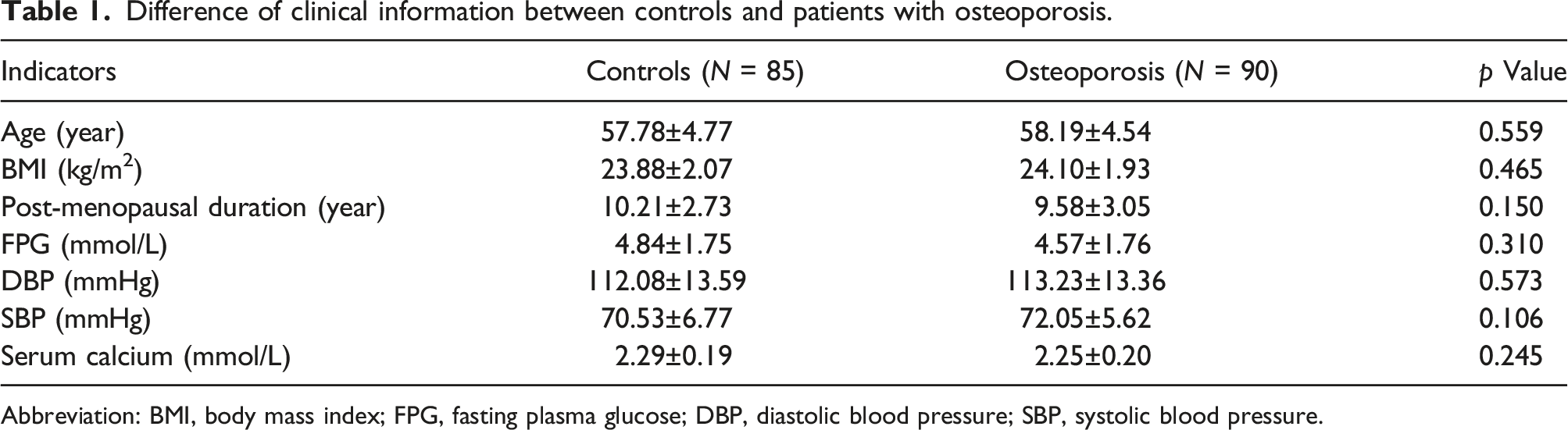
Abbreviation: BMI, body mass index; FPG, fasting plasma glucose; DBP, diastolic blood pressure; SBP, systolic blood pressure.
Comparison of osteoporosis-related indicators
Information related to osteoporosis.

Abbreviation: BMD, bone mineral density; OC, osteocalcin; β-CTX, β-collagen special sequence; PINP, procollagen type I amino-terminal propeptide; BALP, bone alkaline phosphatase.
In addition, the biochemical bone metabolism indices, such as OC, β-CTX, PINP, and BALP were assessed. The concentration of OC, β-CTX, PINP, and BALP were elevated in the osteoporosis group relative to the control group, indicating high turnover in bone metabolism (p < .001, Table 2). The findings of these parameters further verified the results of the BMD comparison.
Levels of AMH and InhB in menopausal women with osteoporosis
Compared to the controls, the AMH levels in the patients with osteoporosis were decreased, indicating that AMH might involve in osteoporosis (p < .001, Figure 1(a)). The concentration of InhB declined in the patients with osteoporosis, pinpointing that InhB levels changed with the happen of osteoporosis (p < .001, Figure 1(b)). Furthermore, the correlation between InhB and AMH was reckoned with Spearman correlation analysis. The finding was depicted in Figure 1(c), which showcased that AMH had positive interconnection with InhB levels in menopausal women with osteoporosis (r = 0.875, p < .001). Expression and relationship of AMH and InhB. (a) The content of AMH in osteoporosis was decreased. (b) Declined concentration of InhB in osteoporosis. (c) A closed correlation between AMH and InhB in the osteoporosis group. ***p < .001.
Correlation of osteoporosis with AMH and InhB levels
Taking the abnormally expressed AMH and InhB into consideration, the relationship of osteoporosis with AMH and InhB was interpreted by analyzing whether these two indicators were associated with the osteoporosis-related items.
Correlations of osteoporosis with AMH and InhB.

Abbreviation: AMH, anti-Mullerian hormone; InhB, Inhibin B; BMD, bone mineral density; OC, osteocalcin; β-CTX, β-collagen special sequence; PINP, procollagen type I amino-terminal propeptide; BALP, bone alkaline phosphatase.
The high InhB content was proportional to the elevated levels of spine (L1 - L4) BMD (r = 0.597, p < .001, Table 3), femoral neck BMD (r = 0.677, p < .001, Table 3), and total hip BMD (r = 0.638, p < .001, Table 3). InhB levels had inverse correlations with AMH and OC (r = −0.657, p < .001), β-CTX (r = −0.596, p < .001), PINP (r = −0.620, p < .001), and BALP (r = −0.567, p < .001) in all patients with osteoporosis (Table 3).
Predictive significance of AMH and InhB
The diagnostic value of InhB and AMH was forecasted by the ROC curve. The area under the ROC curve (AUC) of AMH was 0.836 (95% CI = 0.773 – 0.899), the specificity was 0.671, and the sensitivity was 0.922 (Figure 2), clarifying that the change of AMH content had a certain value in differentiating osteoporosis of menopausal women. It had high sensitivity and a relative low specificity. As for InhB, the AUC was 0.829 (95% CI = 0.770 - 0.888), indicating that InhB could sever as a biomarker (Figure 2). The specificity was 0.765 and the sensitivity was 0.756 of InhB in indicating osteoporosis of menopausal women (Figure 2). In addition, the predictive significance of joint AMH and InhB was unveiled. The AUC of joint AMH and InhB was 0.853 (95% CI = 0.797 - 0.908) with a sensitivity of 0.856 and a specificity of 0.775 (Figure 2). The diagnostic significance of AMH, InhB, and their combination.
Logistic regression analysis of risks for menopause osteoporosis.

Abbreviation: BMI, body mass index; FPG, fasting plasma glucose; DBP, diastolic blood pressure; SBP, systolic blood pressure; BMD, bone mineral density; OC, osteocalcin; β-CTX, β-collagen special sequence; PINP, procollagen type I amino-terminal propeptide; BALP, bone alkaline phosphatase; AMH, anti-Mullerian hormone; InhB, Inhibin B.

Forest plot of a multivariable logistic regression model.
Discussion
With the continuous improvement of medical and health level and the continuous extension of human life span, the number of menopausal women has increased year by year. The decline of ovarian function and sex hormone level in menopausal women lead to a series of symptoms in menopausal women. 4 Osteoporosis is a common metabolic disease in menopausal women. 17 The prevalence of postmenopausal osteoporosis in China shows an increasing trend year by year, which seriously affects women’s physical and mental health and quality of life. 18 Osteoporosis is an important risk factor for fractures and has become one leading cause of death in the elderly. 19 Therefore, it is essential to study the potential risks of postmenopausal osteoporosis.
In the present study, we collected individuals from the Chinese Daur ethnic group, a traditional group living in the Heilongjiang River. The clinical characteristics were analyzed and the results indicated that age, BMI, post-menopausal duration, blood glucose, hypertension, and serum calcium were not influenced by the occurrence of osteoporosis. In a paper on women in Yazd of Iran, the increased weight and calcium were predictors of osteoporosis, which was different from our findings. This might be because the racial differences or a small sample size. 20 Overall, our data documented that the data of the two groups were comparable. Bone mineral density (BMD) refers to the content of mineral substance and is a main indicator of bone strength, reflecting osteoporosis or osteopenia. 21 Osteoporosis patients have decreased bone strength and BMD, which increases the risk of fracture under low-energy trauma. 22 In the current research, the spine (L1 - L4) BMD, femoral neck BMD, and total hip BMD were assessed in all participants. These BMD levels were all decreased in patients with osteoporosis relative to controls, suggesting the poor bone mass of osteoporosis group. OC is a regulator of bone calcium metabolism and bone metabolism. 23 The content of β-CTX reflects the degree of bone resorption and bone loss, and the content of PINP and BALP in serum is a basic laboratory index to monitor osteoblast viability and bone formation.24,25 The content of OC, β-CTX, PINP, and BALP were increased in the osteoporosis group, indicating a high turnover in bone metabolism.
In the current research, the concentration of AMH was inhibited in the osteoporosis group compared to the controls, suggesting that AMH levels were involved in osteoporosis. The decreased content of InhB was observed in the osteoporosis group, reflecting that osteoporosis might contribute to the InhB levels. The increased AMH levels were proportionate to the elevated content of InhB. The alternation of AMH and InhB in bone formation and loss is the focus of researchers. In a paper on ovarian dysfunction in premenopausal women, AMH decreases with age, and it is positively correlated with serum BMD, indicating that osteoporosis may inhibit the expression of AMH. 26 AMH correlates with the extent of ongoing bone loss, which can help early intervention in women on the edge of significant bone loss. 11 Karim et al. report that the level of InhB has a positive correlation with BMD level, indicating that InhB may link to the presence of osteoporosis. 27 In this study, we certified that AMH and InhB were positively associated with BMD, and negatively correlated with OC, β-CTX, PINP, and BALP, suggesting AMH was related to osteoporosis.
In a paper published in 2022, the detection of AMH may be an avenue reflecting bone strength in perimenopausal women, documenting the value of AMH in osteoporosis. 28 Anastasilakis et al. document that InhB is an independent risk element of postmenopausal osteoporosis, lending a piece of evidence that this factor may become a diagnostic biomarker. 13 Thus, this paper estimated the diagnostic values of AMH and InhB in diagnosing individuals with postmenopausal osteoporosis. In the present observation, the detection of AMH could serve as a diagnostic indicator with high sensitivity, however, its specificity was relatively low. The changes in serum InhB might distinguish patients with menopausal osteoporosis from normal menopausal persons, showing its predictive possibility. The ROC results of joint AMH and InhB showed high AUC, sensitivity, and specificity, indicating that the combination of AMH and InhB showed a promising diagnostic value with relatively high performance. Furthermore, the multivariable logistic regression method was applied to verify the risk indicators of menopausal osteoporosis. Our findings reported that InhB and AMH were independent biomarkers of menopausal osteoporosis and low levels of InhB and AMH represented a high risk of suffering osteoporosis. Dual-energy X-ray absorptiometry (DEXA) is a widely used method for checking bone mineral density, but it has contraindications and radiation risk. 29 The examination of AMH and InhB is a way to use biomarkers for detection, which is now in the stage of theoretical verification, and its feasibility in the clinic needs to be further explored. With the theoretical perfection and technical development of AMH and InhB examination, the clinical feasibility of this technology will be greatly increased. In terms of price, for a single inspection, the cost of a joint inspection of AMH and InhB may be higher than that of a DEXA scan. However, with the development of technology, for large sample sizes or multiple inspections, AMH and InhB joint inspection may have more price advantage. However, the sample size selected in this study was small, and all factors affecting osteoporosis were not included in this study. Therefore, it is necessary to further expand the sample size and comprehensively consider a variety of factors to explore the factors affecting osteoporosis, to provide more effective reference for improving the accuracy of clinical diagnosis. Additionally, the lack of research on other ovarian hormone levels is also a limitation of this paper.
Conclusion
In total, the content of AMH and InhB declined in patients with menopausal osteoporosis and correlated with the presence of osteoporosis. The detection of AMH and InhB in menopausal women from the Daur ethnic group could screen osteoporosis, and the occurrence of osteoporosis was related to spine (L1-L4) BMD, femoral neck BMD, total hip BMD, OC, β-CTX, BALP, AMH, and InhB. Our study may provide a new viewpoint for the diagnosis of osteoporosis in Daur nationality, which will be beneficial to the follow-up clinical screening of osteoporosis.
Footnotes
Declaration of conflicting interests
The author(s) declared no potential conflicts of interest with respect to the research, authorship, and/or publication of this article.
Funding
The author(s) disclosed receipt of the following financial support for the research, authorship, and/or publication of this article: This study was funded by Qiqihar Academy of Medical Sciences Clinical Research Fund Project (QMSI2022L-01).
