



Abstract
Social sciences mostly characterise the relationship between football fans by hostility and rivalry. In recent years, an increasing number of cases of so-called antagonistic cooperation among football fans emerged, where fans unite to achieve a common goal. This study compares the emerge of organisational patterns during cooperation on an international scale, based on a quantitative survey including responses of 73 experts from 50 countries around the world. The study explores general characteristics of the fans, reasons for cooperation, belonging, groups size, tactics and degree of organisation during the cooperation. The results indicate that cooperation like rivalry is an expression of traditional fandom. They emphasise the relationship between belonging and group size, similar as those of tactics and organisational structure.
Here are football teams who compete every Sunday, but now they are all here together. (Martínez in Milfred, 2025)
Introduction
The relationship between fans of different football teams is usually described as a ‘story of rivalry and opposition’ (Armstrong and Giulianotti, 2001: 1). In Europe, social scientists started doing research on football and its fans due to violent clashes between supporters and the need to understand and stop deviant behaviour (Benkwitz and Molnar, 2012). Research on football fans has recently explored other topics, but deviance and rivalry are still important (Hollanda and Busset, 2023; Kossakowski, 2017, 2021; Rodríguez Aguilar, 2023; Seijbel et al., 2022).
The quote from the Argentinian football fan Martinez indicates that rivalry represents only one aspect of supporters’ culture. Football fans cooperate in specific situations, even when they are usually rivals. Case studies have reported on cooperation during political protests, including those observed in Egypt in 2011 (El-Zatmah, 2012), the Gezi Park protests (Turan and Özçetin, 2019) and the Maidan protests in Ukraine (Krugliak and Krugliak, 2017; Ruzhelnyk, 2018). Furthermore, fans also cooperate to defend their common interests. Examples include the 2013 demonstration organised by supporters of various English football clubs in opposition to commercialisation (Hill et al., 2018); or the protest by Italian fans against the introduction of a fan ID card (Doidge, 2017; Guschwan, 2013).
One of the most recent examples are fans from Argentina, like Martínez, protesting against the austerity agenda of President Milei and in support of pensioners, including those of rival teams such as Boca Juniors and River Plate (Milfred, 2025). Fan cooperation has also led to the establishment of fan organisations such as ANATORG, a Brazilian organisation representing 1.5 million supporters, which is engaged in lobbying related to security measures, and reducing violence between different Torcidas (Lopes and Teixeira, 2023), similar to FSE and Supporters Direct Europe in Europe (Cleland et al., 2018; Numerato, 2018). The examples provided from various continents and societies underscore the significance of examining the cooperation of supporters and its dynamics on a broader scale, thereby facilitating a more profound comprehension of football fans’ mentalities and practices.
The formation of coalitions of opponents uniting to achieve a common goal while their antagonism becomes (temporally) less relevant was called antagonistic cooperation (Sumner, 1940). This concept has been applied to military conflicts (Schwab, 2023), political parties (Invernizzi, 2023) and football fans. However, existing literature mainly focuses on single case studies or compares a few cases (Brandt et al., 2017; Brandt et al., 2024; Kossakowski, 2021). While these studies contribute to a better understanding of these cases, their general contribution is limited. One reason for the lack of international approaches may be the difficulty of comparative studies, given that national contexts and particularities influence supporters’ behaviour (Zheng and García, 2017). In contrast, a comparison allows to elaborate on the relation of local and global dynamics of football fandom. This study aims to move beyond single or a few cases, offering a distinct approach to understanding supporters’ cooperation on a global scale. Therefore, the present study explores patterns that influence the probability of cooperation among football fans and explores the patterns that emerge during antagonistic cooperation.
The following section, therefore discusses theoretical explanations based on general existing literature on antagonistic cooperation and those on football fans. Afterwards, the methods section provides a more detailed description of the process of gathering and analysing the data conducted for this article. The results are presented in three stages: first, descriptive statistics of the sample are provided; second, results on conditions of emerging cooperation are presented; and finally, patterns of cooperation are described. The results are then discussed in the context of existing literature.
Theory
The early sociologist Georg Simmel (1908) discussed how conflicts contribute to Vergesellschaftung (sociation). Among other aspects, he describes how external pressure during a conflict fosters a sense of community within groups, reducing antagonistic elements between its members. Additionally, Sumner (1940) describes general antagonism in nature, as well as among members of society. However, they cooperate for the common good, ‘while minor antagonisms of interest which exist between them are suppressed’ (Sumner, 1940: 18). He called this antagonistic cooperation. Antagonistic cooperation includes long-term arrangements to guarantee fundamental needs, as well as short-term arrangements in times of crisis. One example of long-term arrangements involves political parties working together to ensure the smooth running of the parliamentary system (Best, 2009). An example of short-term, crisis-driven cooperation occurred during the Covid-19 pandemic, when antagonistic parties in many countries cooperated to manage the crisis (Weinberg, 2020). The shared goal is often a common enemy that threatens all groups involved in the cooperation (Coser, 1956; Schwab, 2023). Based on this cooperation, a long-term relationship could emerge between the groups, and even unification could be possible. But the cooperation tends to disappear once the common goal has been achieved or disappears. The chance of long-term cooperation increases when the groups show similarities in cultural and structural terms (Coser, 1956) and when individuals or (sub-)groups form emotional and normative ties (Best, 2009).
Antagonistic cooperation has been analysed from different theoretical perspectives. One approach to investigating the formation of cooperation refers to rational choice and game theory. This approach analyses the rationales behind cooperation in relation to the number of individuals or groups in alliances during conflicts. According to this approach, it is appropriate for groups to seek allies if they cannot reach a certain goal alone. In this regard, the new ally needs to increase the resources and power of the coalition. Therefore, group size is a relevant parameter for analysing antagonistic cooperation. While larger allies usually mean a stronger increase in power, the loot also needs to be distributed among more individuals, minimising the rationality of too large groups (Schlee, 2004, 2008). However, these approaches have been criticised for their simplification, as the forces of allies and opponents are often difficult to measure (Holsti et al. 1973). When searching for cooperation partners, certain similarities between the cooperating groups should exist in order to create a sense of homogeneity within the new in-group. If different opportunities exist, the one where a construction of similarities is easier is chosen (Schlee, 2004, 2008).
Additionally, non-rational factors may influence cooperation. Theories on emotional resonance are particularly relevant in this context. Resonance is defined as ‘an experience emerging when affective and cognitive work provides actors with novel ways to puzzle out, or “solve”, practical situations’ (McDonnell et al., 2017: 3). This means that people develop new interpretations of situations triggered by specific incidents. The concept has also been used in relation to social movements to describe their spontaneous formation. Resonance can be caused by messages, discourses or cultural objects, but their effect depends heavily on people's (as interpreters) knowledge, experience and the situation. Emotional resonance describes situations in which different interpreters feel similar emotions based on similar experiences. This shared feeling creates a sense of belonging that can lead to cooperation that goes beyond rational approaches (Beauregard, 2022). Belonging is defined as the feeling of being ‘at home’ in a social group (Yuval-Davis, 2011). According to Pfaff-Czarnecka (2020), belonging is constructed by the following three elements: communality, attachments and mutuality. Communality means the perceptions of a shared something which creates bonds. This could include perceived worldviews, beliefs, experiences and many others. Attachments are emotionally charged objects or places related to belonging. Mutuality means that belonging is related to a specific reciprocity, commitment and loyalty in the group someone belongs to, including rules and duties to the group. These dimensions became relevant in constructing in- and out-groups during cooperations, similar to Schlee (2004, 2008). Meanwhile, belonging includes benefits, duties (Anthias, 2008) and can be used as a resource to mobilise for political or social issues, by those belonging to something mobilised to engage in the defence of it or to increase the benefits of a social group (Pfaff-Czarnecka, 2020), which has also been used to describe cooperation among football fans.
Fans and cooperation
Fans are defined by a long-term emotional investment in an object to which they have no personal connection, with their fandom becoming a significant part of their identity (Porat, 2010). This basic definition enables us to consider local differences between fans, although fans and partial scientists discuss additional characteristics of ‘true’ fans. Various typologies of football fans exist (Weber et al., 2021), the most prominent of which is that of Giulianotti (2002). This consists of an axis of investment in the club (traditional/consumer) and loyalty (hot/cold). Supporters, who are characterised by a traditional emotional relationship and hot loyalty, are the most relevant group for this article.
Football fans have been associated with protests, which are discussed in the social sciences as social movements, collective action or activism. The three terms demonstrate a degree of similarity and are frequently employed as synonyms (for further discussion, Perasović et al., 2025). Activism is defined as a range of civic engagement activities, including those that are directed towards economic, political, social or football-related transformations. In contrast to other forms of social activism, fan activism is characterised by the prior existing football communities functioning as a significant emotional touchstone during activism (Fitzpatrick and Hoey, 2022). The term activism in football is used to denote activism directly related to the nature of football fandom. Contrary to, activism through football, which defines activism that addresses broader social issues, which, however, are not directly related to the realm of football fandom (Numerato, 2018). Football fan activism represents a paradigmatic exemplification of contemporary activism that is not affiliated with political parties, trade unions or other representatives. This form of activism is characterised by its focus on a specific issue and the engagement in leisure activities (Giulianotti, 2007; Perasović et al., 2025). Numerato (2018) identified eight reasons for football fan activism. The following categories are to be considered: political issues (e.g., national politics, ideologies), social issues (e.g., illness, disaster, community), governance (e.g., ownership, corruption), experience (e.g., tickets, kick-off times), performance (e.g., players, referees), security measurements and politics (e.g., fan ID cards, criminalisation), sociocultural and symbolic aspects (e.g., location, colours, identity) and atmosphere (e.g., pyrotechnics, tifo). In the context of activism, fans employ a range of tactics to articulate their protest, encompassing demonstrations and marches, symbols, direct actions, petitions, public statements and flyers. These tactics could be employed by supporters of a single club or by supporters of multiple clubs in order to achieve a common goal (Cleland et al., 2018). Additionally, collecting donations is a common tactic of fans. This can be associated with the political actions of fans, for instance, when collecting blood donations for soldiers in Ukraine (Brandt et al., 2024) or donations for refugees (Cleland et al., 2018). But collecting donations is also associated with broader social issues and less political. For instance, fans have been known to gather donations for food banks (Fitzpatrick and Hoey, 2022) or gather donations for unwell members of the community (Brandt et al., 2024). It has been observed that several fan groups have established long-term cooperative relationships with civil organisations through gathering donations. While these activities may be less visible, they are nevertheless an integral component of the social activism exhibited by fans.
Antagonistic cooperation is also a component of the fan tactic repertoire. The cooperation of fans has been analysed by two taxonomies. Brandt and Hertel (2017), examined the reasons for cooperation among fans and the sense of belonging that was created during this process. The initial point of the cooperation of football supporters could be differentiated into three different types: outside the living world of supporters, supporters in the scope of society or in the enclosed world of supporters. The studies conducted by El-Zatmah (2012) in Cairo, Turan and Özçetin (2019) in Istanbul and Krugliak and Krugliak (2017) in Ukraine are clear examples of outside the living world of supporters. These supporters are participating in protests against the national regime. In terms of their sense of belonging, they engage in cooperative behaviour as citizens, defending their rights in alliance with other civil actors. This suggests a sense of belonging as supporters as part of society (Brandt and Hertel, 2017).
The introduction mentioned examples of fans cooperating in response to perceived repression, like ID cards or commercialisation. Here, the initial impetus for cooperation is the perceived pressure on fans and their way of life. This is described as supporters in the scope of society. Supporters defend their living world together, emphasising the sub-cultural elements that create a sense of belonging as fans. This sense of belonging is formed through shared values, practices (such as the use of pyrotechnics and banners) and experiences, such as those during conflicts with security authorities.
The third type identified the initial point as being in the enclosed world of supporter. In this case, the rationale behind the cooperation is associated with internal logics that are inherent to the supporters’ habits. Examples of this phenomenon include the unification of fans in support of the national team (Chiweshe, 2017), and the addressing of practical issues, such as the enhancement of safety during travel (Moreira et al., 2017). The concept of belonging in this context is confined to fans of specific groups, such as supporters of two teams cooperating against those of a third team.
Kossakowski's (2021) work proposed a second taxonomy, with a focus on the factors underpinning cooperation and the organisational aspects. The following three categories are distinguished: Deals, alliance and suspended animosity. With regard to Polish fans, the author describes a deal as ‘looser form of association, which mostly involves cooperation between hooligans or coordination of support at the matches of the national team’ (p.43). Such deals are instrumental arrangements between two or more groups. Conversely, alliances are defined as long-term collaborations between two or more fan groups with a shared history. It has been observed that such organisations typically offer reciprocal assistance during away matches. Brandt and Hertel (2017) describe these two reasons as in the enclosed world of supporters. Kossakowski (2021) added the long-term aspect to that.
The concept of suspended animosity defines situations where fans temporarily set aside their rivalry to achieve a higher goal or fight a shared enemy (Kossakowski 2021). This type of cooperation is frequently characterised as fragile (Cleland et al., 2018). One potential explanation for this phenomenon is that some supporters may perceive the cooperation as a betrayal of their identity (Hollanda Da Teixeira, 2017; Kossakowski, 2021). Suspended animosity describes cooperation Brandt and Hertel (2017) characterise as an initial point outside the world of supporters and fans in the scope of society. In certain cases, activism can result in the establishment of more formal and long-term networks like FSA (Cleland et al., 2018) or ANTAORG (Lopes and Teixeira, 2023). The distinction between short-term and low-structural or its long-term and institutionalised characteristics of cooperations is therefore a relevant factor in the investigation of cooperation among fans on a global scale. The current article seeks to explore the global patterns of cooperation and non-cooperation among football fans.
Methods
Therefore, a research approach is required that facilitates the comparison of results across a larger sample size while simultaneously enabling the acquisition of more profound insights into the topic. After an evaluation of the available methodologies, a quantitative survey grounded in the insights of domain experts was chosen. Such an approach is common in benchmarking studies (Pankowska et al., 2024), or as an aspect of Delphi studies, which aim to predict future developments (van Gelderen et al., 2021). Quantitative surveys based on experts (including academics) have also been used to compare developments in different countries in administrative (Christiaens et al., 2010) or political sciences (Knutsen et al., 2019; Knutsen et al., 2025).
The survey was conducted on local experts in order to assess the fans in a specific region. As experts in the field, we selected scientists from various disciplines who have published at least one article on football fans in their respective regions. A list was created containing 198 experts who were deemed to be promising. The authors got this list from their own contacts and by searching scientific articles on fans of particular countries. This investigation uses English keywords, which might affect the samples. Between the end of July and mid-August 2024, we got in touch with these experts by e-mail and, in a few cases, via ResearchGate. The e-mail introduced the idea of the research approach, included a link to the survey and an invitation to forward it to other experts. One expert, originally not considered by us, contacted us because the survey had been forwarded to him.
In September 2024, we contacted selected experts a second and third time. This only happens if the country they represent has not yet been covered by a completed survey. In the end, we received 73 full responses from 50 countries, which means a response rate of 37%. Only these full responses are used for further analysis. The sample includes nine responses on fans in African countries, nine from Asia (including Australia), 14 from the Americas and 41 from Europe. Surprisingly, Sweden has the most replies (N = 5). To verify the data, we checked the consistency of the qualitative responses with the single-choice questions and examined the non-response rates. We consider all responses as reliable because both checks showed that no response needs to be excluded.
The survey consists of 51 questions in English, based on existing literature. Other languages were not considered, to grantee homogenise meaning of questions. However, this might exclude non-anglophone scientists from the survey. It includes questions to identify the country, general characterisations on fans based on Giulianotti, (2002) (5-point Likert scale), their activism based on Numerato (2018) (5-point Likert scale), group size (ordinal), and weather a cooperation exist (binary). For cooperating cases, additional questions ask on reasons for cooperation (open field), names and sizes of involved groups (open field), practises of the cooperation (binary) based on Cleland et al. (2018) and belonging based on Brandt and Hertel (2017), and the way of organisation (5-point Likert scale). The online survey utilised the Unipark/Tivian tool of the University of Bayreuth. Prior to its dissemination, the survey was pre-tested by three academic experts on fans (one from America and two from Europe), who provided feedback that was incorporated into the survey. The open question concerning the reasons for cooperation was subjected to inductive coding in order to make them statistically accessible (Loehnert, 2010). The results were statistical analysed using PSPP version 2.0.1, a software analogous to SPSS. Due to the presence of multiple bivariate and ordinal-scaled parameters within the dataset, the statistical analysis was restricted. We will describe the statistical approaches used when we present the results. To assess the quality of the data, we calculated interrater reliability (IRR) for the general characteristics of the cases (15 variables) that had more than one response. Following the recommendation of de Raadt et al. (2021) for studies where the severity of disagreement matters, we used Pearson correlation as an indicator. The case of India was excluded because the respondents were unable to answer all questions. While some countries showed high correlations, such as Germany (r =0.96) and Greece (r = 0.90), others yielded less satisfactory results, for example Italy (r = 0.15). Overall, the IRR was r = 0.65, which is acceptable but could be stronger.
Results
This section will describe and discuss some of the main results from the survey. It starts with fans’ general characteristics. Afterwards, sections present the results on reasons for cooperation and describe existing patterns during the cooperation, including belonging, group sizes and way of organisation.
General characteristics
The primary set of questions is designed to capture supporters’ general characteristics. In the majority of cases, fans are described as showing hot or rather hot forms of loyalty in the sense of Giulianotti's (2002) famous taxonomy (74%). The second axis of the typology is linked to characteristics of emotional investment. The results indicate that most experts (63%) suggest that football fans’ investment is a traditional or rather traditional. In contrast, 12% of experts consider fans as consumer-oriented.
In relation to other characteristics, fans are classified as moderate political, with responses divided into 38% highly or rather political, and 30% as modestly political. 31% respond that supporters are hardly or simply non-political. In 76% of cases, supporters are described as highly and rather critical, compared to 20% who consider themselves to be indifferent, and just 4% who express that fans agree on developments in football. The latter group consists of cases from South Korea (rather agreeing), Russia and China (agreeing). Furthermore, 55% of respondents described fans as having rather weak or weak influence at club level, and 69% described fans as having rather weak or weak influence on general football governance.
Additionally, we evaluate seven dimensions of reasons for fan activism, based on the taxonomy of Numerato (2018). Figure 1 shows that activism is mostly linked to the atmosphere inside the stadium as well as sociocultural and symbolic aspects. Both aspects are related to fans’ daily experiences. Society-related issues are at the opposite end of the scale.
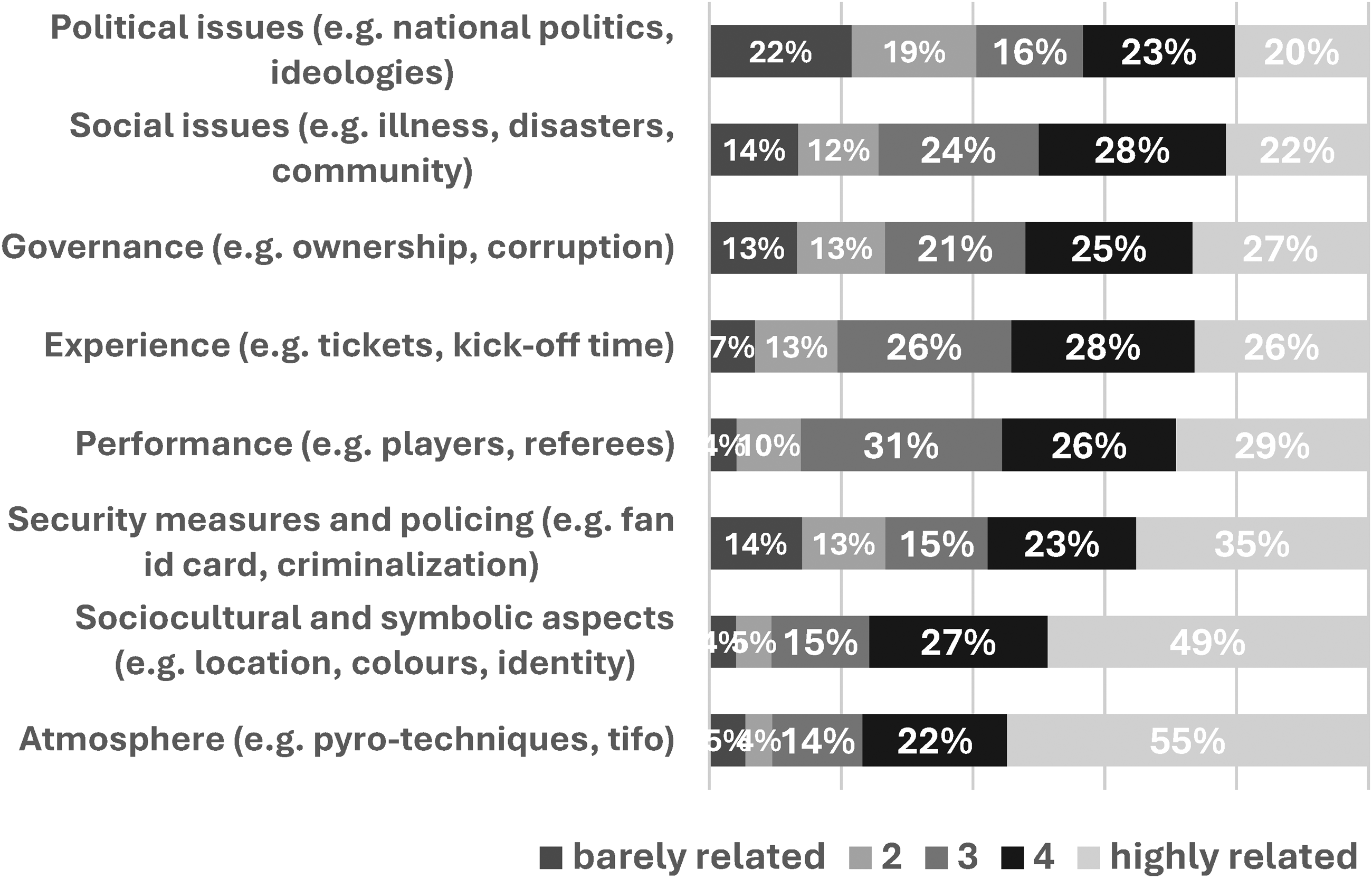
In the country of your expertise, how much is football fan activism related to the following issues?
The final characteristic examined is the intensity of rivalry (Figure 2). Our results indicate a negative correlation between the intensity of rivalries and the investment in the club (r = −0.346**, p = 0.000*) and a positive correlation with the loyalty dimension (r = 0.446**, p = 0.000*). In both cases, the correlation is weak, since the coefficient oscillates between only 0.3 and 0.5. This finding suggests that when experts perceive fans to have intense rivalries, they also perceive them to have hotter forms of loyalty to their clubs and a more traditional orientation. Conversely, as the experts judge that fans have low-intensity or almost no rivalries, they indicate them as having consumer-oriented investment in the club and cold forms of loyalty. This result emphasises that rivalry is an inherent aspect of traditional fandom. The following section will shift the focus to the contrasting aspect of fandom: cooperation.
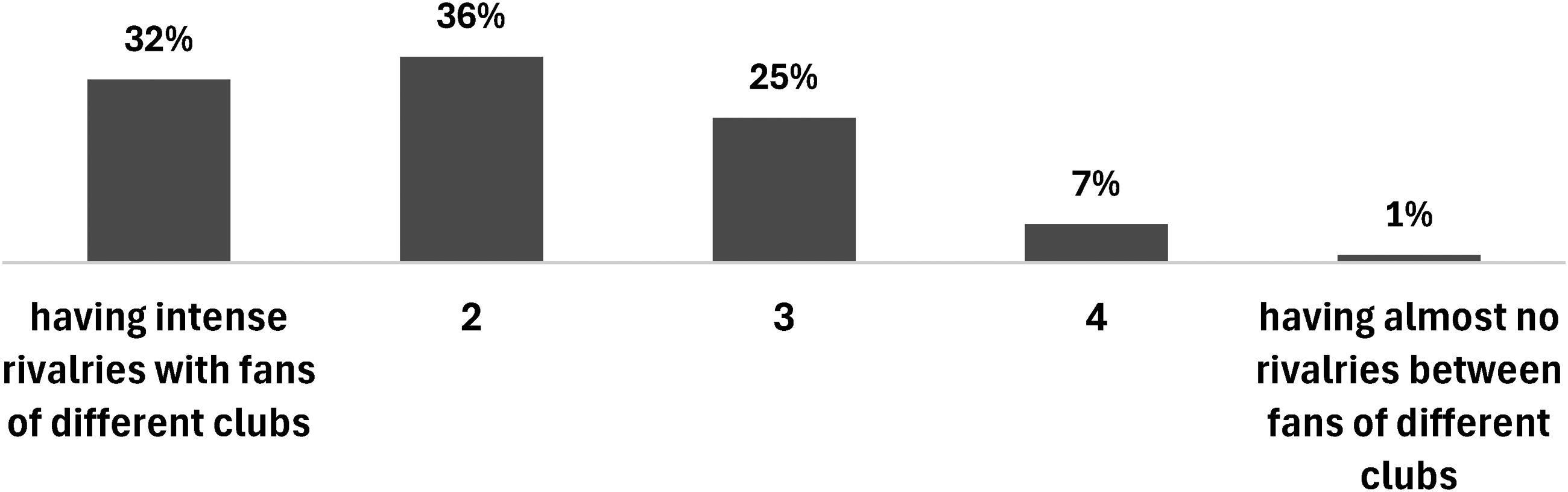
Rivalries (%).
Figure 2 demonstrates that 68% of respondents characterise fans as having intense rivalries with supporters of different clubs.
Cooperation
The initial observation is that 75%, have confirmed the existence of cooperation among rival groups. In 55% of cases, multiple cooperations were reported, thereby emphasising the relevance of cooperation among fans. The decomposition of the frame below (Figure 3), considering the different continents, provides a more nuanced understanding of the reality of each region. The findings of this study suggest that traditional leagues, such as those in Latin America and Europe, demonstrate a higher probability of fan cooperation than newer or emerging leagues, such as those in Asia, Australia, North America and Africa. 25% of the experts do not recognise antagonistic cooperation in their related country, which is a significant proportion. We could not identify clear characteristics of these countries. The group comprises a number of relatively small football nations like Canada, as well as countries with a distinguished fan tradition, such as Spain. Nonetheless, it is plausible that the expert overlooked an existing collaboration when responding to the questionnaire.
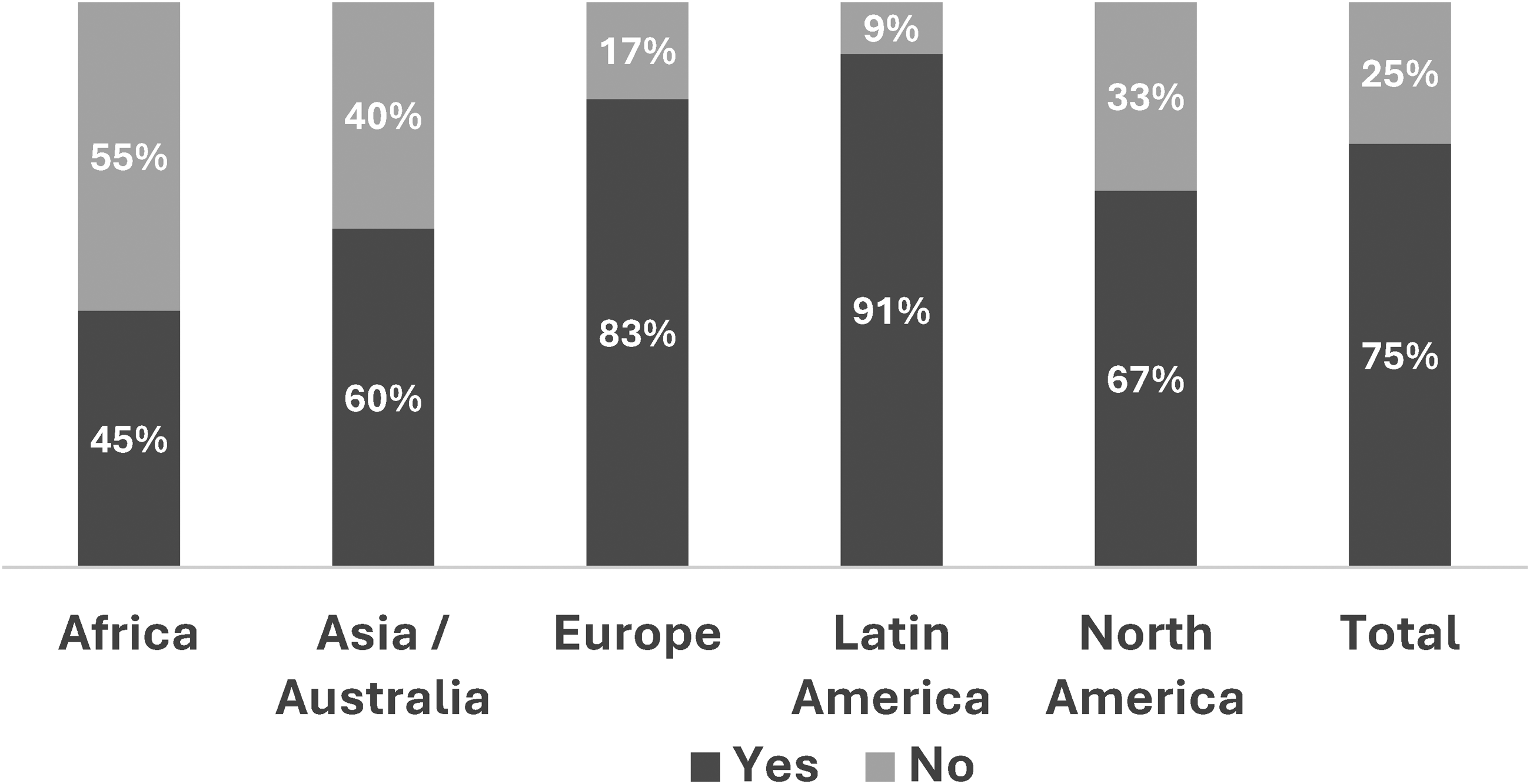
Case of fan cooperation by region (%).
In order to further analyse the differences between cases of cooperation and non-cooperation, a logistic regression model was constructed from the data. This type of multivariate statistical analysis allows the understanding of the probability of cooperation based on the given variables (Field, 2009). In practical terms, a modelling procedure was employed to identify the factors that predominantly influence the perception of the variable ‘the existence or not of fan cooperations in their respective countries’. The data were coded as ‘0’ for ‘no’ and ‘1’ for ‘yes’.
During the modelling process, a set of 15 variables was tested in order to identify the best fit of the data for the dependent variable, the presence or absence of cooperation among fans. In the final model (Table 1), only two independent variables were found to have a significant impact on the dependent variable. In the model, PERFORMANCE (B = −0.703) demonstrates a negative direction, thus indicating that an increase in performance as a reason for activism is associated with a decrease in the chance of cooperation, both measured on a 5-point scale. Reciprocally, it can be stated that when performance is a less important reason for activism, the chance of cooperation increases. One possible explanation for this phenomenon is that performance-related activism focuses exclusively on one's own team. Other reasons for activism generate expanded opportunities for cooperation.
Results of ordinal logistic regression analysis on fans cooperations.
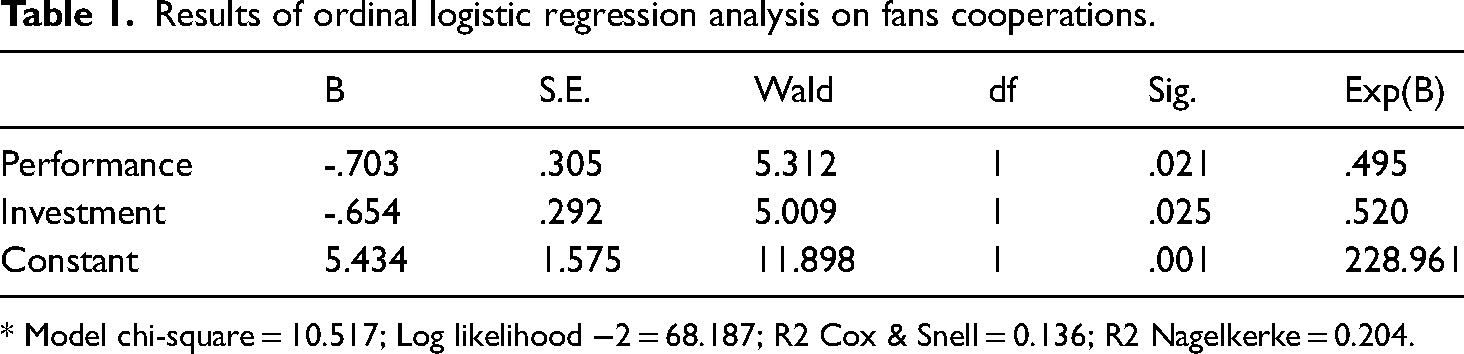
* Model chi-square = 10.517; Log likelihood −2 = 68.187; R2 Cox & Snell = 0.136; R2 Nagelkerke = 0.204.
The variable INVESTMENT (B = −0.654) also has a negative effect; therefore, the more experts perceive a market-oriented relationship between fans and clubs, the lower the degree of cooperation tends to be. That means that the likelihood of cooperation of antagonistic fans increases when fans exhibit a traditional emotional investment in their club. As already described, a traditional relationship has a positive effect on rivalries, too. The findings indicate that fans of the traditional type tend to have more intense rivalry, while simultaneously tend to cooperate with antagonistic fans. Consequently, rivalry and cooperation are manifestations of the same kind of fandom.
The adjusted model exhibits an r2 of 0.204, implying that it explains only 20% of the variance of the dependent variable, ‘the existence or absence of fan cooperations’. A sample of greater size may allow for the inclusion of additional significant variables, including those related to group size. The latter are described as relevant in literature on antagonistic cooperation, but they do not appear to have a significant influence on the model. Furthermore, the probability of cooperation may be influenced by a multitude of factors related to broader social issues and the club community. These include factors like experience of past events, communication barriers, emotionally resonating events or leadership dynamics. Despite its limited explanatory power, the results encourage reflection on the topic. To further analyse the data, we ran two additional logistic regression models: one including exclusively cases from Europe and Latin America (sig. 0.00 and R2 = 0.222) and another including cases from Africa, Asia, and North America (sig. 0.533 and R2 = 0.046) to identify the effect of traditional vs emerging football regions. In both subsamples, the effects of INVSTMENT (traditional regions: B = −1.002; emerging regions: B = −0.198) and PERFORMANCE (traditional regions: B = −0.816; emerging regions: B = −0.364) remain qualitatively similar, although their magnitudes differ. This suggests that the findings are not driven solely by European and Latin American cases, even if the effect of the independent variables is bigger in these regions.
Additionally, we looked at the means of the 15 variables of the non-cooperating cases and compared them to those of the cooperating cases. The non-coperating group consists of four responses related to African countries, one to Latin America, five to Europe, four to Asia, and one to North America. Looking at the general characteristics (loyalty, emotional investment, intensity of rivalries, being political and being critical) relevant differences could only be identified for emotional investment, with non-cooperating cases being in mean 0.54 more consumer oriented on a 5-point Likert scale, which is in line with the regression. Interestingly, those fans are described as having 0.3 less influence in footballs governance in general. Looking at the reasons for activism, political issues (0.47) and performance (0.63) are in mean more relevant in the non-cooperating cases, while only the latter is statistically significant in the regression. Variables of reasons more related to fans living world like governance (−0.51), security (−0.67), atmosphere (−0.52) and experience (tickets, kick-off times) (−0.65) are in mean considered as less relevant as in cooperating cases. However, these differences have not been significant in the regression.
The analysis of the responses to open questions regarding the reasons for cooperation may offer additional insights. In 58 cases, cooperation was reported and three experts describe two reasons, which are considered as separate cases in the analysis. Thus, all qualitative responses were coded and analysed. In six cases, the cause remained unidentified, while in one case, the qualitative description was too general to be useful. In another case, the expert was unaware of the relevant parameters, such as belonging. The following analysis excluded these eight cases. The remaining 53 qualitative responses were coded into six categories. The category of politics (n = 13; 25%) includes reasons related to developments in society and the political ideologies. The category governance/AMF (n = 9; 17%) summarises cases related to developments in football, including its dynamics of commercialisation. Repression (n = 15; 28%) is related to security measures. The category disaster (n = 5; 9%) includes people who are victims of incidents, such as floods or tragedies in stadiums, that are not related to police activities. The category national team (n = 3; 6%) refers to situations where coalitions are established to provide support for the national team. Finally, the category alliances (n = 8; 15%) includes cooperations based on personal or (illegal) business connections. At first, we used a different name for this group, but we later decided to use the term alliances from Kossakowski (2021) because we saw that our cases were very similar to the examples he gave.
The findings indicate that perceived repression is the most prevalent explanation for cooperation. Repression is associated with a perceived threat to relevant elements of the supporter, particularly those with a traditional orientation. This is similar to the category governance. This may provide a rationale for the outcomes observed in the regression analysis on fan investment. As both reasons are in opposition to the needs of traditional fans and had been described as a major issue of fan activism (Kossakowski and Ludvigsen, 2025; Numerato, 2018).
What does cooperation look like?
The following section analyses variables on characteristics of the cooperations. The relationship between reasons for cooperation and belonging was tested using a chi-square test because both are nominal variables. The test results (X2 = 0.39, Fischer's exact test; p < .001) indicate a statistical connection between the reasons for cooperation (described in 5.2) and belonging. In the case of the categories repression and governance as reasons, all belongings were described as belonging as fans. An example is French football fans united struggle against league and state authorities on conditions of attending to the games. Many cases classified by a belonging as fans of a specific group are parallel characterised by alliances as reason for cooperation. An example is fans of the German teams Bayern München and VfL Bochum united since the 1970's caused by personal contacts. Many cases of belonging as citizens are related to politics. In Uruguay , for example, each May the 20th, civil organisations remember the victims of the countries dictatorship (1973–1985) including the antagonistic groups Banda del Parque (Club Nacional de Football) and Barra Ámsterdam (Club Atlético Peñarol).
Inspired by Schlee (2004) and Kossakowski (2021), relations between reasons for cooperation and group size were analysed. The regression analysis indicates that the group size variables (numbers of group members) do not show any significant results. Furthermore, we coded group size in the cases of cooperation as a bivariate variable, either a few groups cooperating (2 to 4) and to more or all groups in the country. Given that all variables are nominal, the application of a chi-square test was once again necessary. In this context, again no statistically significant results were identified. Additionally, the statistical relation between belonging and group size was tested by chi-square and showed significant and strong results (χ2 = 17.38 Pearson chi-square and χ2 = . 0.39 Fischer chi-square, p < .001, Cramérs V = 0.56). Cooperations with a belonging characterised as fans of a specific group were all coded as few groups cooperating. An example are the fans of the Polish clubs Widzew Łódź, Wisła Kraków, Ruch Chorzów and Elana Toruń, nowadays infamous for a criminal business alliance. In cases where belonging was coded as belonging as fans, mostly many groups cooperate (22 out of 28 cases). One example is the cooperation of fans from nearly all Tunisian clubs, caused by the death of the Club Africain supporter Omar Labidi after a confrontation with security forces. Thirdly, when belonging was identified as belonging as citizens, no clear trend exists. A closer look at these cooperations reveals that the category includes cases related to different reasons. For instance, during a crowd clash, coded as disaster, at the Estadio Cuscatlán in El Salvador, fans of Alianza FC and CD Fas cooperated as first responders. In that case, only fans of two teams were present and therefore coded as few groups. In 2017, many fan groups cooperate after an earthquake in Mexico. This was also categorised as disaster and belonging as citizens. The specific given situations explain the broader varieties of involved groups of belonging as citizens. Parallel, the category of belonging as citizen includes cases with many fans cooperating, like in Ukraine, but also included cases, where cooperation is limited to fans of two teams from the specific region. The sample includes cases of supporters of East Bengal and Mohun Bagan cooperating to combat public corruption in Bengal (India); supporters of Ethiopia Bunna SC and Saint-George SA cooperating to challenge identity politics in Addis Ababa (Ethiopia). In these cases, only two fan groups participate in the broader protest, as only two major fan groups exist in the region. Again, whether few or many groups cooperate based on belonging as citizen is influenced by local conditions.
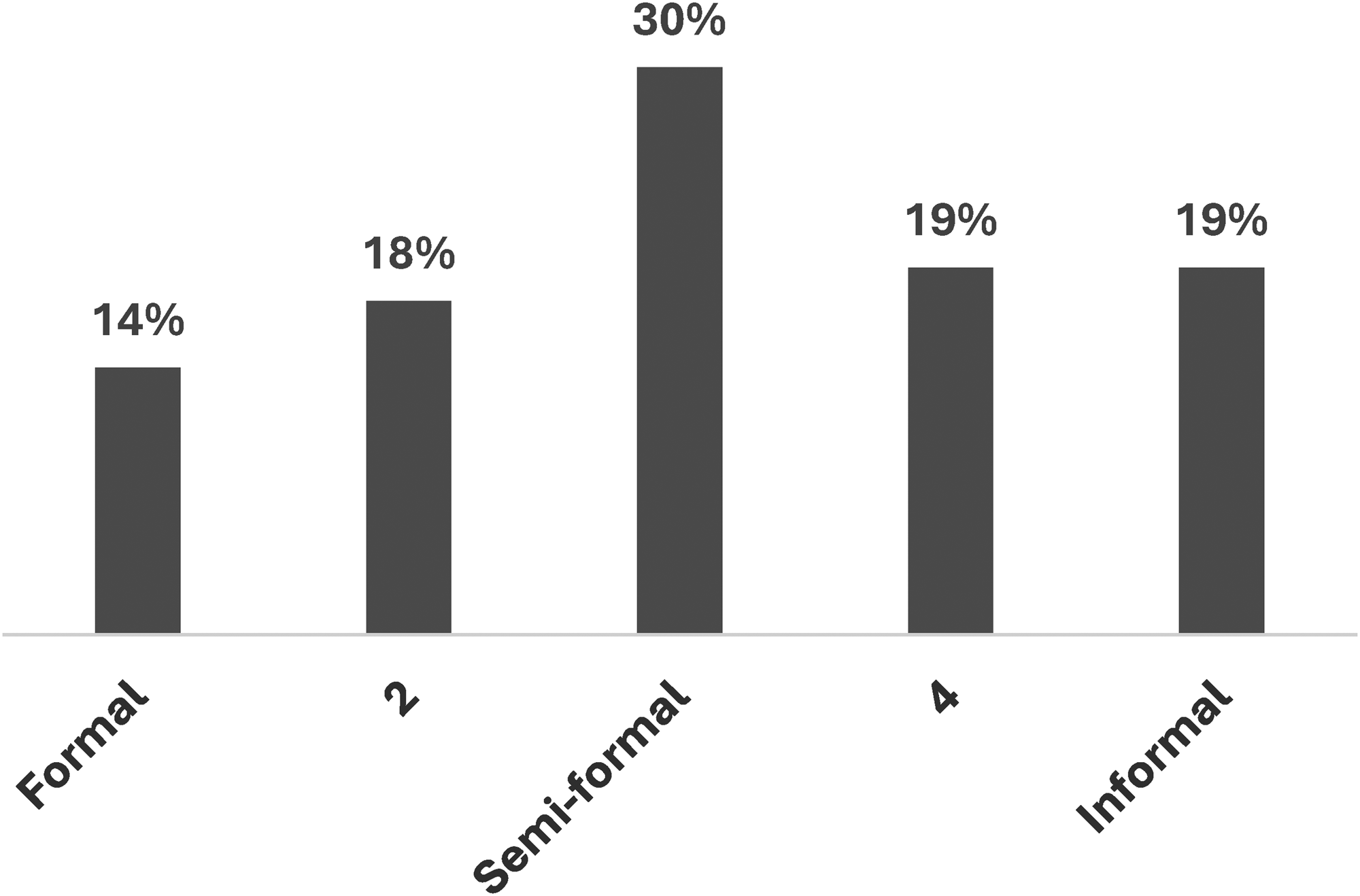
As outlined in the research by Cleland et al. (2018) and Kossakowski (2021), there are notable variations in the formal structure of fan cooperations. To explore this aspect, respondents were asked to rate the organisational structure of the cooperation on a five-point Likert scale from 1 official to 5 informal. Figure 4 presents the descriptive results.
Organisation (%).
As part of the testing process, the formality of the organisation was tested in relation to other parameters of cooperation. The level of organisation shows no significant results in relation to belonging, group size or reason for cooperation. However, two interesting findings should be mentioned. The cases of cooperation initiated by the national team demonstrate an informal organisational structure, with a mean score of 4.66 out of 5. The overall mean score for the study was 3.11. These informal organised cooperations to support the national team, described as deals by Kossakowski (2021), appear in multiple countries, as the data suggest. The cases with the highest degree of organisation (mean: 2.57) are those caused by repression, indicating the potential for sustained and structured cooperation in such contexts, like the Swedish Svenska Fotbollsupporterunionen. However, it is important to note that these results are not statistically significant.
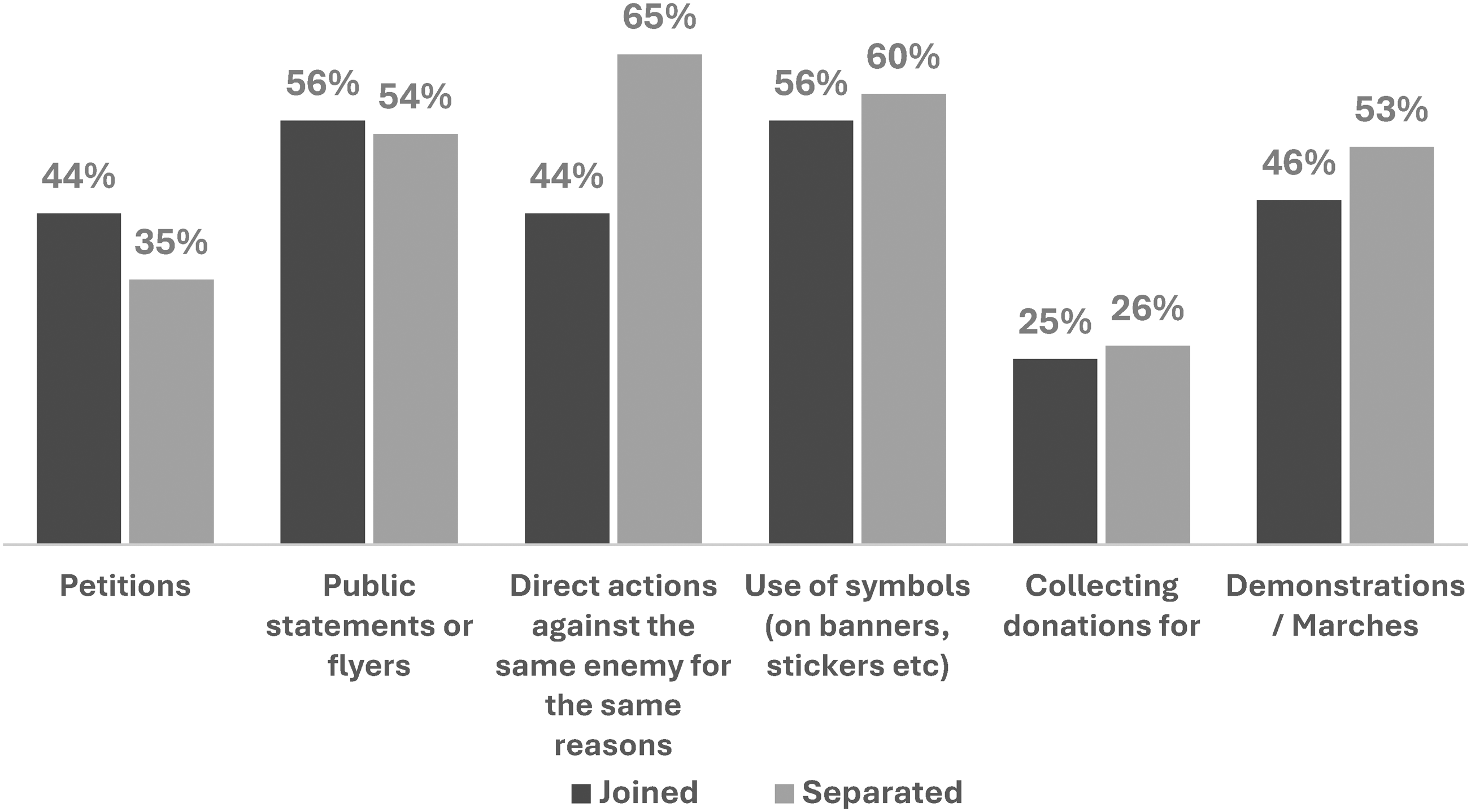
Finally, we analysed the tactics employed during the cooperation, based on the taxonomy of Cleland et al. (2018). The results show that united meetings are frequent during cooperations, as in 70% the experts reported them. As shown in Figure 5, most activities are done separately. Only public statements and petitions are mostly done united. These tactics usually need a lower level of trust, can be done across different locations. They strongly benefit from more participants. In contrast, joint direct actions often require the same locality and a higher degree of trust, which explains why separate actions are more prevalent. However, joint direct actions are evident in almost half of the cases.
Used tactics (% of yes).
A statistical model was used to analyse the correlation between the formality of organisation (measured on a 1–5 scale) and the use of joint versus separate tactics. As the measured tactics are closely related to social movement dynamics, only cases of cooperation driven by repression, politics or governance/AMF were included (N = 35). The following coding system was employed: 1 = joint activity, 0 = separate activity. Tactics not used were left unindexed. Finally, a mean was calculated for each case. The final score could range from 1 (cooperation in each tactic) to 0 (no reported joint tactics), with an overall mean of 0.58. The calculation of a correlation between both variables (Pearson r = −0.4077; p < 0.05; Spearman r = −0.3856; p < 0.05) demonstrates that a more formalised organisation of the cooperation is associated with a greater number of joint activities – at least according to the perception of the experts on both. This outcome is not surprising. However, no further correlation could be identified for the variable joined activity, similar to the organisational variable.
Discussion and conclusion
Previous research on football fans has primarily focused on the rivalry between supporters of different clubs. Some studies (Brandt et al., 2017; Kossakowski, 2021) have demonstrated that cooperation also exists among them and is relevant. Most publications describe fan cooperation as the exception rather than the norm, particularly because rivalry is considered as core element of fan identity. However, based on a sample of 50 countries and the expertise of 73 experts, this study presents the opposite: cooperation is a common form of interaction among football fans. The traditional orientations of fans are associated with an increased likelihood of cooperation. Parallel, fans with a more traditional orientation tend to exhibit more intense rivalries. This seemingly paradoxical situation can be explained by the greater cultural significance of football for these fans, which is expressed through both rivalry and cooperation. Both are expressions of fans’ complex social identity. So, rivalry and cooperation are not opposites. Our results show that they are two sides of the same coin.
Cooperation of fans is mostly triggered by reasons in football, as Numerato (2018) calls it. Of the analysed cases, 48% are related to security or governance/AMF. In these cases, the state authorities, federations and leagues are identified as the enemies. The fans are united by a belonging as fans in the scope of society (Brandt and Hertel, 2017). Traditional fans share values, norms and practices. They may unite to defend them, when they perceive them under threat. This predominantly occurs in the context of football and, to a lesser extent, in relation to more general social issues. However, the 26% of cases caused by politics remain significant.
The theoretical reflection addresses two approaches to explaining antagonistic cooperation. The first of these approaches is based on a rational choice model, using group size as a key parameter, while also considering the closeness of cooperating groups. The second approach focuses more on emotional resonance and a sense of belonging triggering cooperation. In consideration of the results obtained, it appears that the second approach may be more suitable for the investigation of fan cooperation. In our exploratory analysis, we found no evidence that group size significantly influences other aspects of cooperation. Only a relation between the involvement of ‘few vs many groups’ and belonging has been identified. The emotional category belonging is associated with reasons for cooperation and ‘few vs many’. The regression identified a traditional emotional investment significantly increasing the chance to cooperate. This suggests that emotions play a significant role in the formation of cooperation in context of football fans – beside all limitations. Generally, it is unsurprising that in football, a field strongly associated with emotions and the construction of belonging, both factors are highly relevant for rivalry and cooperation among fans. However, it is important to acknowledge that characteristics of fan cooperations may undermine the relevance of group size for cooperation. In most cases, fans are opposing state authorities, security forces or federation officials. In the event of encountering such powerful opponents, any affiliated fan group might be a welcome addition. Furthermore, when the loot consists of expanded rights for fans, all groups – whether they participate or not – ultimately benefit. The social dynamics in these cases are more complex than those observed in the group conflicts analysed by Schlee (2004, 2008). Therefore, group size and rational approaches may have an influence on cooperation, albeit non-measured in this study.
The present study also investigates practices during cooperation, based on Cleland et al. (2018). The results indicate a connection between the formality of the protest's organisation and the frequency of joint tactics. There are three potential explanations for this. First, an official fan umbrella organisation offers greater neutrality in terms of club affiliation. Cooperation with that organisation may be perceived as more neutral than direct cooperation with a rival. Second, in formal structures, trust is established among engaged supporters during the exchange process. The third possibility is that experts perceive cooperation and joint action as more formal.
The study provided several practical implications. The results indicate the potential for cooperation among fans and other social groups in the pursuit of shared goals. It is important for both supporters and supporter organisations to be aware of the potential tactic, which can be applied depending on their local conditions. Incidents generating a shared emotional resonance can function as a point of initiation, if they shape shared goals. State and sports authorities should consider the possibility that even bitter enemies might cooperate, for example when reforms create a specific emotional dynamic that could potentially result in a shared goal among fans. We are, however, somewhat sceptical about the long-term potential of these cooperative measures to prevent rivalry and violent riots among fans. In many investigated cases, the rivalry has not ended but rather been suppressed for a certain period. In relation to public opinion, our findings suggest that fandom is a multi-dimensional phenomenon. It is therefore not appropriate to describe them only as deviant subjects, based on our international panorama.
It is important to note some limitations that should be considered. The quality of the survey dependent on the subjective assessments of the experts involved. Consequently, the actions of fans are interpreted through the lens of local experts. It should be noted that not all experts were able to respond to every question, and some qualitative case descriptions lacked sufficient detail. As Knutsen et al. (2019) already noted, the number of experts available per case is an issue that should be addressed. For our project, the number of available experts was limited. When interpreting the results, it is important to consider the limited IRR in some cases. Despite the survey's objective to assess cooperation on a global scale, several countries are not represented, including less prominent countries but also some known for their vibrant fan cultures, for instance, Colombia and Tanzania. These contexts could offer valuable insights into fandom, but unfortunately they were not represented. More generally, experts from Europe are overrepresented in our sample, with 38 or 52% of the responses belonging to this region, although the authors invested time and effort to identify researchers from other regions. On the opposite side, Oceania was only represented by one response and North America by three responses. This Eurocentric sample might influence the results, but it also reflects the dynamics of social sciences investigating fandom. This field is dominated by researchers from Europe (Kasımoğlu, 2025) and Latin American, even though more publications have recently begun to investigate fandom in China. This dynamic is influenced by the relevance of fandom for society, which might explain limited number of studies from North America, but also from the academic landscape, where African and many Asian countries are still underrepresented and football fandom is highly relevant. Further research should address these blind spots to contribute to a more comprehensive understanding of fandom globally. The study follows a research design, relying on quantitative analysis of expert perceptions. In general, a quantitative design has limitations when it comes to capturing micro-dynamics and specific regional factors that influence cooperation. The sample consists only of 73 responses, which could be considered as sufficient for statistical analysis (Wild and Seber, 1999) but still small given the global dimension. The regression analysis demonstrated a low explanatory power of 20%, underscoring the necessity for further investigation into the factors that influence cooperation among football fans. It is crucial to acknowledge these limitations when interpreting the findings.
However, the results contribute to a broader and more nuanced understanding of cooperation among football fans. The incorporation of tactics into the analysis suggests the potential for further insightful investigations. In general, the results of football fans can be compared to the dynamics of antagonistic cooperation in other social settings. What are the similarities and differences in belonging, group size, organisational structure and tactics across various fields where opposing groups cooperate? Our results show that cooperation is common. But, in many countries no cooperation was reported. To deepen our understanding of antagonistic cooperation, it may be helpful to compare cases where fans collaborate with those where they do not. To ensure meaningful comparisons, the structures of the fan groups and the situations to which they respond should be as similar as possible. The global distribution of fans cooperation, as described in this article, justifies further investigation of antagonistic cooperation among them.
Footnotes
Acknowledgments
The authors would like to thank all colleagues from all over the world for participating in the survey.
Data availability
The data is available on request.
Declaration of conflicting interests
The authors declared no potential conflicts of interest with respect to the research, authorship, and/or publication of this article.
Funding
The author received the following financial support for the publication of this article: The open access publication of this article was enabled by the University of Bayreuth.
