



Abstract
People with disabilities do not have equal opportunities to participate in sports compared to mainstream athletes. To counteract this, the last few decades have seen growing efforts to mainstream parasports. This study investigated how underlying ableist norms shape opportunities and conditions for people with disabilities in the context of mainstreaming within Swedish sports. The method of data collection was 19 semi-structured interviews with para-athletes and parents (9 women and 10 men). After theory- and data-driven coding, ableism was applied as a conceptual lens. Findings show that the inherent comparative logic within sports triggers ableist manifestations and creates exclusionary practices towards para-athletes. For example, able-bodied ideals are internalized by para-athletes, influencing the way they perceive and value their athleticism. Conclusively, although comparisons of performance are an inextricable part of sports, the study highlights how mainstreaming contributes to emphasizing differences, thereby reinforcing ableist norms and limiting opportunities for para-athletes.
As demonstrated by scholars, people with disabilities do not have equal opportunities to participate in sports compared to people without disabilities (Elmose-Østerlund et al., 2019; Kiuppis, 2018; Klenk et al., 2019). Rather than being based on personal preference, the activity choices available to people with disabilities are often limited by external conditions imposed by the social environment (Brittain et al., 2020; Kiuppis, 2018). These limiting conditions are often underpinned by ableism, referring to excluding structures in society that center the able body as the norm and depict disabled bodies as being outside this norm (Campbell, 2009). Sports can constitute a specifically ableist environment due to the central role of the physical body in creating norms of how bodies should look and perform, making exclusionary practices and discourses of ableism particularly prominent (Peuravaara, 2015). As a result, the importance of facilitating people with disabilities’ equal conditions in sports has received increased attention in recent decades, and it is also recognized as a human right in the UN's Convention on the Rights of Persons with Disabilities (2006).
Many countries, such as Australia (Jeanes et al., 2018), England and Wales (Kitchin and Howe, 2014), France (Bouttet, 2016), Norway (Sørensen and Kahrs, 2006), Canada (Howe, 2007), and Sweden (Andersson et al., 2023), have therefore increasingly turned towards delivering parasports within an integrated sports system, rather than in separate parasport organizations. This process of mainstreaming involves restructuring the organization and delivery of parasport activities by transferring the organizational responsibility from parasport-specific organizations into the mainstream sports system. For example, this may involve transferring para-swimming from its parasport-specific federation to the mainstream swimming federation. In Sweden, a mainstreaming initiative is currently underway, aiming to “lead to full participation and create even better conditions for athletes, leaders, and clubs” (Parasport Sweden, 2023a). The Swedish parasport system includes sports for people with physical and intellectual disabilities as well as visual impairments on both recreational and elite levels, where this initiative involves a large-scale transfer of all parasports to their mainstream equivalents.
However, the general concept of mainstreaming can by itself be seen as rooted in the ableist belief that mainstream methods and institutions are superior to other settings (Campbell, 2009). Further, the way sports organizations and clubs interpret and implement inclusive initiatives, such as mainstreaming, is highly influenced by ableism (Christiaens and Brittain, 2023). Additionally, research indicates that most mainstreaming efforts have not achieved equal conditions. Instead, mainstreaming has shown to be a rationalization and effectivization of sports systems and structures (Kitchin and Howe, 2014). Mainstreaming thus risks leading to a state of organizational accommodation of parasports where people with disabilities are still marginalized (Howe, 2007), instead of being a means for two cultures to adopt and integrate each other's values (Kitchin and Howe, 2014). Mainstreaming has also been described as a largely rhetorical tool with few actual changes in practice (Thomas and Guett, 2014), risking that para-athletes assimilate to mainstream values (Sørensen and Kahrs, 2006). Furthermore, little is known about the process of mainstreaming (Kitchin et al., 2019), as research has primarily focused on outcomes (e.g., Kitchin and Howe, 2014; Sørensen and Kahrs, 2006).
Additionally, previous studies on similar mainstreaming processes have primarily focused on governing levels (e.g., Andersson et al., 2023; Sørensen and Kahrs, 2006), thereby limiting the understanding to merely an organizational perspective. This is problematic, as ableism operates not only at an organizational (institutional) level but also on an individual level (e.g., internalized) through interactions and self-perceptions, shaping the experiences of para-athletes in integrated sports settings (Ball and Haegele, 2024). Thus, para-athletes’ perspectives are needed to provide further views on mainstreaming (Kitchin and Howe, 2014) and to understand what restricts their opportunities for sports participation. Para-athletes’ voices are also key to reassess the normative assumption that mainstreaming is inherently good. This is important since “We cannot unconditionally assume that groups that are excluded from society and its mainstream institutions (including sport), will simply and unidimensionally benefit from their inclusion in sport when society has excluded and marginalized them in the first place” (Schaillée et al., 2019, 888).
Aim
This study aims to further the understanding of what restricts the sports participation of people with disabilities in the context of mainstreaming. More specifically, the study employs a lens of ableism to examine how intangible barriers may shape opportunities for participation and equal conditions. This will contribute to the scholarly field of disability sports by highlighting how an ableist perspective can be used to make inherent norms of sport, such as those of performance and physique, visible in the context of mainstreaming. Further, using the perspectives of para-athletes provides new insights regarding mainstreaming and its effects on normative assumptions within sports that can help reduce marginalization of people with disabilities within integrated sports systems.
Conceptualization of ableism
The concept of ableism can be understood both as an ideology, encompassing a network of attitudes, ideas, and beliefs, and as a research perspective or conceptual tool (Ball and Haegele, 2024). First, as an ideology, ableism refers to the valuation of able-bodiedness that is equated to a standard of normalcy and that devalues disability as a lesser state of being human (Campbell, 2009). As a result, it establishes the normative standards of ability against which people with disabilities are measured and valued (Wickman, 2007). There are several ways in which ableism can be manifested, such as through conscious and unconscious discriminatory actions against people with disabilities. Other ways are through negative assumptions and beliefs projected by people with disabilities onto themselves, and through regulations, policies, and physical conditions rooted in able-bodied norms. Campbell (2009) argues that a key feature of ableism is “a belief that impairment or disability (irrespective of ‘type’) is inherently negative and, should the opportunity present itself, be ameliorated, cured, or indeed eliminated” (p. 5). Second, as a research perspective, ableism has been proposed as applicable to investigate people with disabilities’ experiences of physical activity (Ball and Haegele, 2024; Brittain et al., 2020), where it elucidates the less tangible conditions in our cultures and knowledge systems that can be reasons for discrimination and exclusion (Campbell, 2009).
This study adopts ableism as a research perspective to make ableist ideologies visible and to understand invisible conditions of sports as experienced by para-athletes. A perspective of ableism in this study offers a lens through which normative assumptions of mainstreaming and disability can be brought to light, thereby creating awareness of the norms to which athletes’ values are often standardized. Further, rather than placing the focus on disabilities and disablism, using ableism as a perspective allows this study to investigate how discrimination and exclusion of people with disabilities are produced, how it operates, and how it is maintained (Campbell, 2009).
As Ball and Haegele (2024) show in their expansion of Campbell's (2009) work, ableism can be manifested in various ways, including indirect/normalized, direct/overt, internalized, and institutional/systemic ableism. This study employs an ableist perspective through a specific focus on these four manifestations to uncover how ableism, on both an organizational and individual level, and from a place both with and without intentions, constructs opportunities and conditions for people with disabilities.
Indirect ableism
Indirect ableism is manifested as unconscious behaviors not meant to cause harm, but that communicate negative assumptions concerning disability (Ball and Haegele, 2024). Also known as ignorant or well-meaning ableism, it is often manifested through verbal insulting expressions, such as “that's retarded” (Arroyo-Rojas et al., 2022). Ignorance and lack of experience among people without disabilities are often reasons for discriminatory practices towards para-athletes (Darcy and Taylor, 2009). For example, a common assumption is that people with disabilities do not care for elite sports but instead want to do sports for the fun of it, although many appreciate the competitive aspects of sports (Shields and Synnot, 2016; Wickman, 2007). Another example is idolizing portrayals of para-athletes in the media. Depictions of athletes with disabilities as “courageous” to have “overcome” their disabilities can reinforce negative stereotypes and perceptions of disability (Dean, 2024). While this narrative of performing past what is expected of people with disabilities appears empowering, it portrays disability as a shortcoming that should be overcome through hard work, emphasizing medical and “ableist rehabilitation” perspectives in sports (Falcous and Scott, 2023). This medical perspective of disability has shaped the emergence of parasports, primarily originating as rehabilitation and medical treatment, where the athletes were seen as patients (Apelmo, 2012). This medical perspective remains evident today, as disability is still often viewed as something that must be cured to fit into society (Arroyo-Rojas et al., 2022).
Direct ableism
Direct ableism refers to conscious actions of discrimination towards people with disabilities, such as not letting someone participate because of their disability (Ball and Haegele, 2024). It can also be expressed through an annoyance of dealing with disabilities or asking intrusive questions about someone's disability (Arroyo-Rojas et al., 2022). An example of direct ableism is found in Healy's (2022) study, which shows that people with visual impairments seldom receive responses regarding accessibility when reaching out to fitness centers. Hence, due to gatekeepers’ unwillingness to deal with disabilities, people with disabilities’ participation and service are restricted. Other directly discriminating behaviors, such as being stared at or feeling othered by people without disabilities, can act as barriers for people with disabilities to want to participate in mainstream environments (Ball and Haegele, 2024). People with disabilities’ experiences of staring, or critical looks, and whether it is perceived as direct or indirect, as judgmental, or even desirable, depend on the place and context. Some places are seen as “safe,” such as the home, and some are seen as ableist environments due to their notions of disabilities (Peuravaara, 2015). Hence, certain places, such as sports settings, can become ableist environments by making bodies visible as deviant due to current norms of how bodies should look and behave in that particular setting.
Internalized ableism
Internalized ableism refers to when an individual projects negative beliefs onto themself as a result of existing norms concerning disability, meaning that people with disabilities internalize the idea of disability as an inferior form of being (Ball and Haegele, 2024). Thus, ableist attitudes do not exist only in the mainstream environment but also within the disability community and among para-athletes (Brittain, 2004). Christiaens and Brittain (2023) describe a “persistent nature of ableism in the sports landscape” (p. 1060), negatively impacting the self-image of people with disabilities. Internalized ableism, as described by Campbell (2009), operates through two processes: dispersal and emulation.
Dispersal is a process in which people with disabilities distance themselves or others with disabilities from each other, creating hierarchies where each disability is ranked by the extent to which it is perceived as socially acceptable (Brittain et al., 2020). These hierarchies might be particularly prominent in competitive sports, where research shows that hierarchies within the Paralympic movement are heavily influenced by the effects of disabilities on sports performance (Mastro et al., 1996). Sherrill (1989) illustrates this hierarchy through interviews with elite para-athletes, who describe discriminatory behaviors among athletes with different disabilities. This creates a ranking structure where athletes with cerebral palsy, low in the hierarchy, are not accepted by athletes with amputations or spinal cord injuries, high in the hierarchy. Dispersal can thereby lead to perceiving the idea of mixing with other people with disabilities as something harmful and unwanted (Campbell, 2009). Mastro et al. (1996) further note that para-athletes’ preferences mirror those expressed by mainstream athletes, indicating internalization of norms from those at the top of the hierarchy.
Emulation means adopting ableist norms to resemble dominant standards, creating hierarchies where some disabilities deviate more from the norm (Brittain et al., 2020). In Norway, a primary challenge identified was that para-athletes were accepted in mainstream sports only if they conformed to existing mainstream majority norms (Sørensen and Kahrs, 2006). Additionally, the studies of mainstreaming of cricket in England and Wales highlighted adaptations of values and cultures in mainstream sports as challenges (Kitchin and Howe, 2014). Only para-athletes who showed elite performance potential and fit the norms of competition were allowed to participate in mainstream clubs, risking assimilation or emulation of people with disabilities. Certain norms within sports, such as those of physical abilities, act as facilitators of internalized ableism (Ball and Haegele, 2024). Consequently, the “able” (non-disabled) physique is the norm for performance and competition, and those people with disabilities who more closely align with this norm will be viewed as more desirable to include (Christiaens and Brittain, 2023).
Institutional ableism
The fourth manifestation of ableism refers to when access and equity of people with disabilities are restricted by organizational or systemic conditions, such as policies and regulations, physical barriers, or practices (Ball and Haegele, 2024). Much like other institutional prejudices, it often goes unnoticed and unquestioned by those without disabilities that benefit from the power-balance it creates (Arroyo-Rojas et al., 2022).
As for manifestations of institutional ableism, there is the issue of physical accessibility, where inaccessible equipment and routes are known barriers in sporting facilities (Christiaens and Brittain, 2023), as well as limitations in logistics and accessibility (DePauw and Gavron, 2005). There is also the inherent logic of sports, which is shaped by norms regarding the ranking of performances and competition (Fahlén and Karp, 2010). This logic of performance and competition can be seen to drive and maintain an acceptance of ableist views, where those further away from the norm will remain excluded or marginalized (Christiaens and Brittain, 2023). Furthermore, there are restricting conditions at a managerial level, including limited financial resources (Wicker and Breuer, 2014) and information about resources (DePauw and Gavron, 2005). At a managerial level, the competitive logic is also present among sports managers, leading to inclusive efforts, such as mainstreaming, with the aim of easing the coordination of sports (Kitchin and Howe, 2014). Ableist views of disability often underpin the interpretations of inclusion made by those responsible for its implementation in sports organizations and clubs, affecting people with disabilities’ opportunities to participate in sports (Christiaens and Brittain, 2023).
There is also the issue of separate or segregated versus mixed/integrated activities, which can both restrict and facilitate equal conditions. On one hand, separate settings have been shown to facilitate people with disabilities’ social interactions and sense of community (Klenk et al., 2019). Conversely, integrated settings have been found to benefit para-athletes with the potential for elite performance (Kitchin and Howe, 2014). Positioned between separate and fully integrated models is the approach of combining para- and mainstream competitions while keeping the competitive opportunities separate. This aims to showcase parasport and ensure equal treatment and resources (Peers et al., 2020). Nevertheless, critics argue that such practices may reduce the independence of disability communities and risk marginalizing para-athletes whose profiles diverge most from mainstream ideals, thereby limiting their opportunities (Howe, 2007; Peers et al., 2020).
Methods
This study is based on semi-structured interviews conducted within a larger research project that investigated opportunities and challenges in the mainstreaming of parasports across multiple organizational levels in Swedish sports (see [author]). It utilizes the dataset from the athlete level, characterized by a focus on both limiting and facilitating conditions in sports practice. The analysis placed a specific focus on ableist influences within those conditions.
Positionality
Positioned within an interpretivist paradigm with a relativist ontology and subjective epistemology (Burell and Morgan, 1985), the subjective experiences and views of the individuals involved in this study are crucial. It is therefore important to acknowledge that they are interpreted by me as a female author without disability. This made me an insider in gendered contexts but an outsider relative to disability experience, possibly affecting participant comfort and my assumptions about accessibility. Although I have been attentive to this, my position might even so result in (re)production of ableist assumptions in analysis and interpretation, where my positionality risks privilege narratives that align with institutional norms, such as framing resilience narratives as personal strength rather than responses to structural exclusion. To address these biases, I engaged in peer debriefing with colleagues experienced in research on marginalized groups in sports in general, and in disability research in particular, to challenge my interpretations and reviewed literature on ableism and positionality to critically interrogate my own standpoint.
Sample
The participants in this study were para-athletes and parents selected through purposive sampling. The athletes were active in three sports involved in the mainstreaming of parasports: athletics, floorball, and swimming. Different sports were included, as various settings, such as individual and team sports, can influence individuals’ interactions and social environments (Olvhøj et al., 2022; Wickman, 2007). Within each sport, two voluntary clubs were chosen to include training groups for athletes with different types of disabilities. The sample included athletes with intellectual and physical disabilities such as cognitive impairments, cerebral palsy and rheumatoid arthritis. Athletes were chosen with the help of coaches in the clubs, where the criteria included substantial experience of parasport participation, and considered both recreational and elite representation, as this is likely to impact experiences and sporting conditions, such as resources.
All athletes were informed about the possibility of having a support person present during the interview for social and/or communicative support. In all eight cases where a support person was present, the person was a parent of the athlete. In one case, a parent participated without the athlete, thereby acting as a spokesperson for the athlete in question.
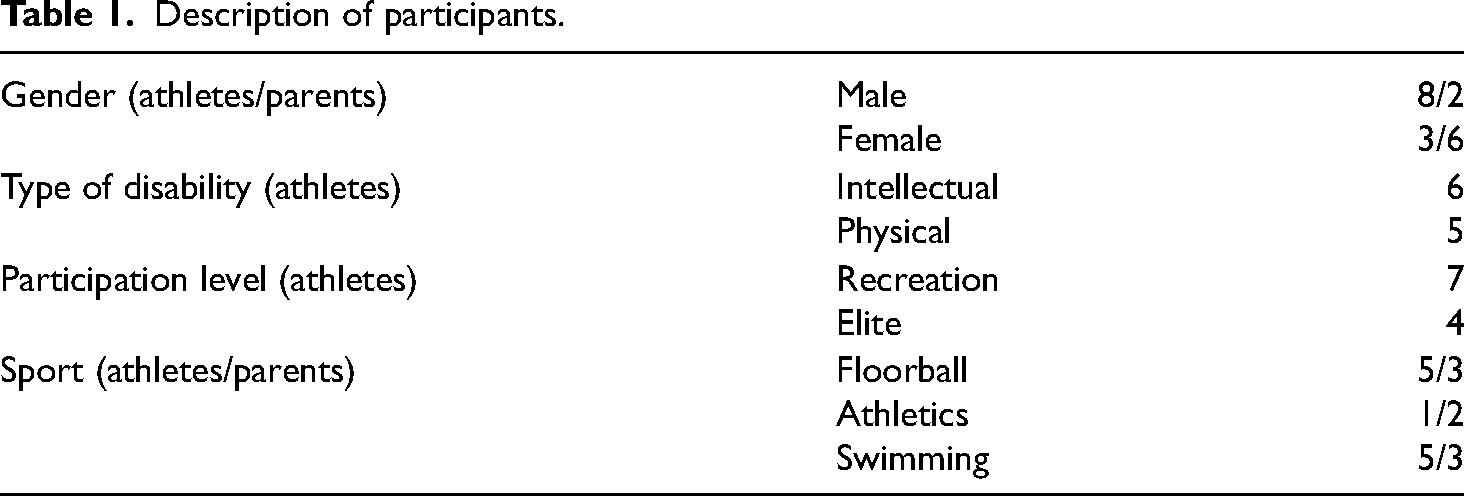
The sample consisted of a total of 19 participants (11 para-athletes and 8 parents) in 6 clubs (see Table 1). In accordance with the ethical approval, all participants were at least 16 years of age at the time of the interviews.
Description of participants.
Data collection and analysis
Two versions of the interview guide were constructed where one consisted of more simplified questions. This was done to offer extra clear communication when a need for this was identified. This was used in six of the interviews, where the interview guide was sent in advance to enable a sense of security before the interview. The interview guide was constructed based on the three themes of the participants' background, the mainstreaming process, and general inclusion and participation in sports.
Potential participants were informed about the project through their coaches before the interviewer made contact. Through a Research participant information letter, participants were informed about the project's purpose, their voluntary participation, confidentiality, and dissemination of the results. As written or oral confirmation of approval to participate, informed consent (Swedish Research Council, 2024) was submitted by all participants when scheduling the interview, and a second oral consent was given in connection with the interview, before recording started. Coaches also provided guidance on the most suitable source of communication for initial contact with the athletes. Potential needs regarding communication during interviews were discussed with parents and athletes. The interviews were conducted via video link and lasted between 20 minutes to 1 hour and 23 minutes. When a parent participated, they were interviewed first and then present as support during the athlete's interview. All interviews were conducted and transcribed manually by the author. To enable participants to control their narrative, they were allowed to read and edit the transcript. No such edits were made.
The analysis employed both theory- and data driven coding, allowing for both theoretical explanations of the participants’ experiences and an acknowledgment of the creative process of interpretation in understanding these experiences. First, ableism was used in a deductive manner against the material, where quotes were assigned predetermined codes consisting of the four manifestations: Indirect, Direct, Internalized, and Institutional. Then, subcoding (Saldaña, 2025) was carried out, where interrelated themes were constructed inductively within each manifestation. For example, within the predetermined code internalized ableism, a pattern of marginalizing language and expressions such as “normal” and “healthy” was constructed, constituting the subcode normative rhetoric. Quotes chosen to represent and exemplify manifestations and subcodes were then translated from Swedish to English and edited by the author for readability, if needed. The analysis was carried out using NVivo 12. Coding and translations were reviewed by colleagues to ensure accuracy.
Ethical considerations
This study is based on data from a research project approved by the Swedish Ethical Review Authority (Dnr 2020-05067). It is conducted in accordance with the Swedish Research Council's (2024) guidelines on good research practice.
The study's participants and their ability to consent in accordance with the Ethics Review Act (SFS 2003:460) is a question that warrants careful consideration. McDonald and Kidney (2012) argue that it should always be assumed that people with intellectual disabilities can give consent and that the opposite should only be considered if it is legally determined that a person cannot do so. The position of this study is to treat every participant in the same manner, regardless of disability, unless the law dictates otherwise. Additionally, this study agrees with “people first-language” as used by multiple authorities in the disability sport context (e.g., Parasport Sweden, 2023b).
Findings
The findings are presented according to the four manifestations of ableism, which, being inherently intertwined, sometimes overlap. Participants are here portrayed with reference to their selected sport since they, in this study, are to be viewed first and foremost as athletes.
Indirect ableism
The analysis identified two types of indirect ableism, namely stereotypical and well-meaning assumptions, entailing prejudiced expectations of para-athletes’ disabilities and athleticism. Regarding the first point, although most interviewees indicate that they feel supported by people in their clubs, there are several testimonies to the existence of stereotypical ideas about disabilities within sports in general, which para-athletes encounter in competitions and other sporting environments. Although with no harm intended, ableist prejudice and stereotypes can create a sense of discrimination through expecting disabilities to appear in specific ways, as expressed by swimmer 1: Since my disability is not visible, it is more of a surprise, like “Oh, are you a para-swimmer?” and then a big question mark on top of that. Just now in this competition, we apparently had a dedicated para dressing-room, and when I went up to the reception and asked where this dressing room was, she looked at me very strange before she showed me the way, because you can't tell. Interviewer: Other people expect disabilities to be visible? Yes, exactly, that it should be written on my forehead (…) it doesn't really happen in my club because I have been there quite long and they know that I am a para-athlete, but it's a lot like this in other contexts and other clubs.
As for well-meaning assumptions, several interviewees describe parasports as more of a hobby to engage in for enjoyment, rather than to compete and strive for elite performance. Floorball player 1 explains: In parasports, I would say that here you don't play go get anywhere in your career, here you play so everyone can feel that they get to participate and feel how it is to play a team sport (…) Interviewer: Do you think it's different, if we separate parasports from other sports, you said that you don't play to have a career, do you think that's something specific within parasports? Yeah, well I think parasports is really good when it comes to letting people feel how it is to be in a team, but then there are teams in parasports that treat their team as a team that aims high and will get far (…) they have players that can't play since they can't perform as everyone else (…) since it's parasports, everyone should play the same amount regardless.
Direct ableism
As for direct ableism, the analysis shows its manifestations of directly negative attitudes towards para-athletes through intrusive questions and staring and ableist environments. First, interviewees share experiences of direct ableism in the shape of intrusive questions (Arroyo-Rojas et al., 2022), seemingly stemming from a lack of knowledge and awareness of disabilities within the mainstream context. Floorball player 2 gives an example: Those that do not understand what parasport is, they might have said something inappropriate (…) made an unnecessary comment like “But why do you play that? Why are you like that?” and such things. It's because they don't understand the situation, that it is not wrong to play parasports, and when you have a disability, why should you hide that? And then they usually think, “God, how strange, luckily there are regular sports.” She feels that people are staring at her. When we are out on the town people stare at her, both kids, which I have an understanding for, kids can come up to her and “why are you in a wheelchair?”, you know, asking, and then she explains for them. But when you feel that adults are staring, almost like wait a minute, they are almost tripping over or into things, like, have you never seen anyone in a wheelchair? (…) Within para-swimming, sometimes they (mainstream swimmers) have been swimming together, so they have always seen the para-athletes since they were small (…) they have been next to each other the whole time, so I think that's why it's not so remarkable. Before, it could feel like para-swimming didn't have a very high status; we did our thing hidden away, and healthy-swimming got all the attention. But now, because of our integration, it has given a higher status to para-swimming and parasports in general.
However, these findings also support the idea of integrated sports being a “safe” environment for people with disabilities (Peuravaara, 2015) where a shared sports setting reduces the ableist view of disability as something unknown and strange, and integrated competitions can contribute to making parasports more visible (Peers et al., 2020). Although sports could be seen as an “unsafe” ableist environment with strong norms regarding desirable and deviant bodies (Peuravaara, 2015), integrated sports can be considered safe through including disabilities within the mainstream sports norm, avoiding ableist occurrences such as staring. A consequence of this is that mainstreaming might offer a safe environment for those being transferred into already integrated environments, while those athletes being the first to join their mainstream equivalent might face exclusionary behaviors in new ableist environments.
Internalized ableism
In the analysis, two illustrations of internalized ableism are visible in normative performance standards and normative rhetoric.
The internalization of normative performance standards made visible through the analysis shows how para-athletes value themselves according to mainstream norms. A parent to a swimmer explains that: It gets a little comparative when you within parasports come into the regular if you say so, these young people might not feel so skilful, you know what I mean? They get to feel a little less worthy when they come into the regular (…), it becomes performance, these young people feel that ´the regular ones perform quite a lot better than I do, am I bad then?´ And these thoughts are coming most of all for those such as my daughter that has a disability where, she's normal, I mean she looks normal, there is no difference between her in any way so she can feel that when it's included, it might be only her in her class and then she gets to meet those who are a swim-length better than her and then she gets this performance anxiety.
It is essential to view internalized ableism not as a cause of inequalities, but as a result of them (Campbell, 2009). The causes are instead restricting conditions, such as the logic of competition within mainstream sports. Just as in the previous quote, floorball player 2 here describes how the pressure of performance, stemming from sports’ inherent logic of competition, can be a gateway to internalized ableism: [Parasport] means a lot since for us that have disabilities and have difficulties fitting in and can feel different, and you play in a regular team and feel the pressure and everything, that's why I think it's good that there is this team for us and it means very much that you don't have to feel, well, that you have this “you should do this, you should be this good”, you kind of get to go in your own speed (…) I thought you compared yourself too much (in a mainstream group) and I felt I couldn't do certain drills because it went so fast and it was difficult.
Internalized ableism is also seen through normative rhetorics where para-athletes use specific wording and concepts, such as referring to mainstream sports and athletes as “healthy,” “normal,” and “regular.” It is also seen in how they express themselves regarding their values as athletes in relation to mainstream athletes and other types of disabilities. The following quotes from two swimmers exemplify this: The healthy swimmers have no need for us to be included with them (Swimmer 3). I was swimming in regular, regular is not the right word, but in another group that was not a para group (…) I have swum in regular groups, now I say regular but, other groups as well (Swimmer 5).
Within the realm of rhetoric, dispersal also presents itself where those with physical disabilities emphasize their differences from those with intellectual disabilities, for example, when answering the question if they have been treated any differently than others, where athlete 1 explains: No, it's been cool, but I don't have any, what's it called, brain-disability or something, I have a physical one, not psychological, so it's been cool.
Institutional ableism
Concerning the more organizational and systemic occurrences of ableism, the analysis brings forth knowledge and competence, resources, and prerogative of interpretation.
Regarding knowledge and competence, in line with previous research, the data show a mainstream approach to organizing and management, accompanied by a lack of experience and understanding of parasport, which leads to exclusionary practices (Darcy and Taylor, 2009; DePauw and Gavron, 2005). Swimmer 3 describes their experiences of integrated competitions where knowledge regarding para-classifications has not been transferred to the organizers, leading to unjust results for para-athletes: When we have been in competitions that have just started this integration, for example they don't know how this 1000-point-system works that we have within para-swimming that is based on each world record. It says in the invitation that they will use the system and then they don't know how it works so then everyone competes with regular times and that becomes wrong. Yeah, we have experienced that quite a lot of times.
Even if we have come a long way, there is still a difference, just such a thing as prize money, in competitions, it is almost zero for the para-athletes. I'm sure it has to do with the fact that we are not as many para-swimmers as mainstream-swimmers, and the resources to offer equal price money is probably non existing, but it gives us a lower status (…) And when there are competitions, we are not offered to swim all of the distances, the federation decides a few distances that we can choose between while the healthy swimmers they get to swim all distances.
Financial resources have previously been identified as a limiting condition (Wicker and Breuer, 2014), and these results also demonstrate how this type of institutional ableism hinders para-athletes’ equal access to conditions and participation. It also highlights the risk of para-athletes becoming less independent and receiving fewer opportunities in competitions that have integrated environments, while maintaining separate competitions through the classification of parasports (Howe, 2007; Peers et al., 2020). However, the same swimmer, 3, also argues that mainstreaming can help some of these issues, where mainstream NSOs have better financial resources: My experience is that the opportunity to get out and compete internationally has improved since we are in the Swedish Swimming Federation, and they have more resources and opportunities to get us to competitions than we might have had otherwise. I was in the Nordic championships last year, we went with the regular national team so to say, and it is big for us since we haven't been part of anything like this before, getting to go on these competitions is very developing for us. Between men and women, it is still not equal within sports, even though you belong to the same football federation, the difference between men and women are very big. If you haven't managed to get equality after all these years, and now you are going into a huge umbrella organization, how big of a piece will go to parasport? (Parent, swimming). What I believe could be negative is if the expert competence disappears, that they (para-athletes) end up in such a big context that they are forgotten about and are not being prioritized because it's a small group that is somehow forgotten (Parent, athletics).
Conclusion
This study has investigated how para-athletes and their parents experience opportunities and conditions within their sports participation in a mainstreaming context. When viewed through the lens of ableism, it is evident that underlying norms of abilities, both within the process of mainstreaming and the environment of mainstream sports, are manifested and shape these experiences. As such, this study contributes to the understanding of how exclusionary practices of people with disabilities are produced and maintained within sports, as well as to an understanding of mainstreaming as a process.
The analysis shows that intangible barriers of ableist norms are primarily manifested through constant comparisons of abilities. Comparisons of actual sports performance (e.g., who is the fastest), status/values (e.g., prize money), and physical norms (e.g., visible disabilities) are recurrent throughout the interviews. The comparative logic of measuring abilities is a natural part of sport, emanating from the logic of competition inherent in the sporting context (Fahlén and Karp, 2010). Hence, this is not necessarily parasport-specific, but rather a constant presence within sports in general. This is important to observe since over-emphasizing issues seemingly related to disabilities, when they might be generic issues, risks further marginalization of people with disabilities.
However, comparisons are reinforced by differences, where mainstreaming has a reinforcing effect, impacting people with disabilities’ sports participation. An effect of organizationally placing para-athletes with mainstream athletes is that they are exposed to the same restrictive conditions. Where para-athletes might have previously experienced more adapted conditions in a parasport-specific setting, mainstreaming sets different conditions in motion, triggering comparisons and thereby manifestations of ableism. Therefore, this study extends existing knowledge by demonstrating that mainstreaming plays a role in both challenging and producing and maintaining ableist norms of performance, through reinforcing the comparative logic for para-athletes within integrated environments. Through this, the findings also contribute to furthering the ongoing debate on integrated or separate environments, a key question in discussions of equality-making efforts within sports.
The overall contribution of this study is that it adds to the questioning of the normative idea that mainstreaming is superior and inherently beneficial for everyone, and especially for para-athletes. Whether the goal of mainstreaming is equal or equitable conditions for people with disabilities becomes a crucial question here. Distinguishing between striving for the same conditions for people with disabilities, or for equivalent, might make the difference between whether mainstreaming will contribute to actual improvement of para-athletes’ sporting experiences or if mainstreaming will remain a simple rationalization of sports systems.
Limitations
Lastly, this study has its limitations. First, it is necessary to acknowledge that having parents present during interviews may have limited the answers of the athletes. Second, the sample lacks representatives with visual impairments, which, due to the implications of internalized ableism and hierarchies among para-athletes, could have uncovered further experiences and ableist manifestations. To understand and counteract these hierarchies, suggestions for future research are to include athletes with diverse disabilities and sporting experiences while examining whether forms of ableism may be present. As ableism allows for an intersectional approach to ability, not strictly limited to the study of disabilities, it could provide a valuable perspective for investigating how the logic of performance and competition among both para-athletes and mainstream athletes affects the internalization of norms. This would allow for comparisons between para- and mainstream sport and thereby further the understanding of parasport-specific challenges in order to prevent wrongful depictions and further marginalizations of people with disabilities from a research perspective.
Footnotes
Consent to participate/consent for publication
All participants were both informed and given verbal or written consent regarding participation and the purposes and dissemination of the study and its results in accordance with the ethical approval and guidelines of the Swedish Research Council. Written consents have been saved, and verbal consent has been noted with date and time for consent.
Data availability
The data are part of a PhD project, and they will be part of future analyses and publications; thus, they cannot be shared at the moment.
Declaration of conflicting interests
The author declared no potential conflicts of interest with respect to the research, authorship, and/or publication of this article.
Ethical considerations
This study is based on material that is part of a larger study, which has been reviewed and approved by the Swedish Ethical Review Authority (Dnr 2020–05067).
Funding
The author disclosed receipt of the following financial support for the research, authorship, and/or publication of this article: This work was supported by the Forskningsrådet om Hälsa, Arbetsliv och Välfärd (grant number 2018–01759).
