



Abstract
Achieving athletic and educational goals, maintaining well-being, and leading a ‘balanced’ private life are key ambitions promoted in dual career policy. Yet, for young student-athletes, these holistic intentions are blurred by demands to train more, recover efficiently, and remain academically competitive. Drawing on Foucault's concept of power/knowledge and focus-group interviews with 25 student-athletes (aged 15–16), we examine the forms of knowledge through which young student-athletes regulate their free time. Our analysis shows that student-athletes predominantly reproduce dual career discourses that position time efficiency as an ethical solution to balancing sport and school. For those acting upon bio-scientific expertise about recovery, balance was achieved through reduction rather than redistribution, either by lowering educational expectations or by eliminating activities deemed wasteful. At the same time, health introduced alternative power/knowledge relations that could legitimise small acts of disruption. We argue that opportunities for such disruption easily become unequally distributed, shaped by institutional legitimation, talent status, and access to credible rationales. These findings raise questions about what version of the young athlete dual career policy helps to produce – and at what cost.
Dual career, broadly defined as the combination of sport and education or work, has become a dominant policy discourse and knowledge regime in contemporary talent development (Stambulova and Wylleman, 2019). Promoted through policy documents such as the EU guidelines on Dual Career of Athletes (European-Commission, 2013), this agenda calls for holistic approaches that enable young athletes to combine sport and education successfully (Stambulova et al., 2024). Yet, beneath its inclusive and developmental rhetoric, the dual career agenda also introduces specific rationalities of government; techniques and norms that render student-athletes responsible for optimising their own lives across multiple performance domains (Burlot et al., 2018; Mateu et al., 2024; Ronkainen et al., 2021).
In Norway, these rationalities have recently extended into lower secondary education, where 13–16-year-old students can now attend subsidised private sport schools designed to integrate athletic and academic development. This marks a shift in how early talent development pathways are structured, raising questions about how young people are encouraged to build agency through assuming responsibility for their long-term development as self-supporting (Belling et al., 2023). While several studies in sport psychology and medicine have focused on providing preventative solutions for how student-athletes can cope with stress, recovery, injuries, and performance (e.g. Heiestad et al., 2025; Storm et al., 2021), fewer have examined why certain norms of persistence and self-discipline become accepted as truths, and how these shape student-athletes’ everyday practice and sense of self (Belling, 2025; Brown, 2016).
Despite increasing recognition of the messy nature of dual career development and its vulnerability to many and varied related pressures (Olesen and Gregersen, 2022), a sociological analysis of this messiness remains under-developed. Much of the existing scholarship relies on retrospective and psychological accounts to identify functional and dysfunctional personal and environmental features (e.g. Aquilina, 2013; Brown et al., 2015; Hauser et al., 2025; Sæther et al., 2022; Storm et al., 2021). Consequently, a host of knowledges and practices are repeated in cycles, with little epistemological attention given to the unequal access athletes have to construct their dual career pathways in alignment with social norms. For instance, deeply embedded yet often overlooked gender discourses within dual career policies and practices shape student-athletes’ motivations, career aspirations, decision-making, and overall well-being (Kavoura and Ryba, 2020; Ronkainen et al., 2021; Ryba et al., 2021). Moreover, recent socio-cultural research has begun to problematise the ideal student-athlete as a self-regulating, efficient, and autonomous subject who strives to control his/her fate (Kavoura and Ryba, 2020; Ryba et al., 2021). These studies reveal how dual career discourses privilege those who perform a willingness to maintain ambitious development goals, and take responsibility in matters of development and motivation (Skrubbeltrang et al., 2016). Yet, we know little about how different discourses operate among younger student-athletes who are still in the formative stages of developing their sense of self, and who experience dual career expectations through school institutions rather than elite academies.
In this study, we take a Foucauldian approach to explore how power/knowledge relations shape young student-athletes’ negotiation of their free time – a crucial but often overlooked dimension of the dual career lifestyle. Drawing on Foucault's conceptualisation of discourse as a historically contingent practice that define what can be said, known, and done (Foucault, 1998/2020), we understand power/knowledge as co-constitutive forces that produce taken-for-granted assumptions about how the balance between sport and education can be enacted in practice. Rather than treating free time as a neutral space, we investigate how it provides student-athletes opportunities to govern themselves and adopt or resist knowledge in their engagement with the dual career lifestyle. In doing so, we ask: Through which forms of knowledge about balancing athlete development and education do student-athletes regulate their free time practices?
Since new athlete development practices and talent pathways increasingly rely on advanced procedures designed to control and to minimise risk, and to normalise the athletic performing body (Denison et al., 2019), it is important to trace and challenge the discourses that shape how student-athletes construct ‘truths’ about what their bodies can achieve and how athlete commitment ‘should’ be interwoven with other aspects of life. This study provides a novel contribution to dual career research by suggesting an alternative reading of why something that appear relatively straightforward, such as the need for student-athletes to follow expert advice, can instead result in confusion, resistance, frustration, or deviance. It challenges instrumental views of ‘balance’ and opens possibilities for rethinking what ethical and sustainable dual career support might entail.
Power/knowledge relations and discursive practices
A Foucauldian reading of sports coaching and athlete development positions power, knowledge, and truth as inextricably intertwined, operating and circulating through discourses (Avner et al., 2025). Foucault defined discourse as: the ensemble of more or less regulated, more or less deliberate, more or less finalized ways of doing things, through which can be seen both what was constituted as real for those who sought to think it and manage it and the way in which the latter constituted themselves as subjects capable of knowing, analyzing, and ultimately altering reality (Foucault, 1998/2020: 463).
Viewed this way, discourse is both constituted by and constitutive of the relations between action and thought, knowledge and practice, power and truth (Foucault, 1982; Foucault, 1982/2020). Consequently, we do not approach the sport-education balance as a universal or stable phenomenon. Instead, we are interested in the conditions of possibility, or more specifically, the interplay of knowledge regimes that enable student-athletes to recognise themselves, and to be recognised by others, as capable or incapable of arranging their free time in acceptable ways. For example, contemporary expertise about the intersections of female biology, holistic development, and education demonstrates how discursive coaching practices produce both constraints and opportunities for young women in sport (Saarinen et al., 2023).
Discursive practices are thus woven into power/knowledge relations that determine who can speak with authority about balance and recovery, and determine how time and energy should be managed across different social and personal settings. For Foucault (1982), power is not primarily repressive but productive: subjecting oneself to power/knowledge relations is the very condition through which agency becomes possible. As Mol (2002: 38–41) reminds us, people's identities do not precede their enactments, but are constituted in and through them; identity is something done, continuously practiced through pervasive and mundane acts [that] make people what they are.
All individuals participate, albeit unequally, in the (re)production and transformation of discourse. The ways they are constituted as subjects through discursive practices shape not only their thoughts and feelings but also determine which subjects become privileged or marginalised, and influence who gains access to authority and resources (Foucault, 1998/2020). Deconstructing these power relations is therefore essential for exposing the often-unintended effects that arise when bodies and behaviours are invested with particular patterns of belief and habit (e.g. Mills et al., 2020).
Foucault succinctly argued in one of his later interviews that resistance does not exist outside power but operates within its very relations: […] in power relations there is necessarily the possibility for resistance because if there were no possibility of resistance (of violent resistance, flight, deception, strategies capable of reversing the situation), there would be no power relations at all (Foucault, 1984/2020: 292).
Understanding resistance in this way compels a critical reconsideration of how power is exercised and reconfigured within existing relations (Markula, 2004). In our analysis, this orientation allows us to attend not only to how student-athletes are subjected to discursive practice of athletic and educational commitments, but also to how they subtly contest or reorient these everyday practices through norms of self-care that takes its place ‘between’ institutions. Drawing on this understanding of the inter-relation between power, knowledge, and subjectivity, we examine the forms of knowledge about balancing athletic development and education that circulate within student-athletes’ socio-cultural contexts. Given the tendency for holistic development policies to privilege individualised solutions over structural ones, we argue that uncovering the current rules and conditions through which student-athletes make sense of and negotiate their dual career pathways can open alternative and potential more nuanced ways of conceptualising ‘optimal balance’.
Methodology
In this paper, aligned with our post-structuralist theorising, we approach knowledge and meaning as constructed through the interaction between participants and researchers, recognising that knowledge production is contingent upon social, historical, and political contexts, and the impossibility of an objective or ‘true’ way reality can be brought into existence (Markula and Silk, 2011). Stemming from this onto-epistemological position, we do not treat interviews as neutral reflections of pre-existing experiences, but as discursive spaces in which participants actively negotiate and articulate their understandings from the positions made available to them. Researcher reflexivity, thick descriptions of student-athletes’ talk, and personal engagement with high-performance sport and education are therefore viewed as crucial means of deepening our understanding of the power relations that shape the social worlds of student-athletes (Smith and McGannon, 2018).
The research setting: Norwegian lower secondary sports schools
The Norwegian approach to talent development differs markedly from the elite sport systems and academy-based models common in many non-Scandinavian countries (Andersen et al., 2015). At its core are sports school programmes designed to support young peoples’ dual ambitions by combining athletic and academic development. These programmes operate independently yet maintain close cooperation with clubs, sport federations, and regional or national teams (Bjørndal and Gjesdal, 2020).
There are over 20 lower secondary sports schools in Norway, enrolling more than 4000 students aged 12 to 16 years (grades 8–10). These schools are privately run but publicly subsidised, receiving 85% of their funding from the government, and must follow the national lower secondary curriculum. What distinguishes them from other schools is the integration of academic aims with athletic development across three interconnected curricula: (a) physical activity and health, (b) physical education, and (c) youth athlete development. Students typically train four mornings per week, between 8 and 10 AM, in 75-min sessions in addition to their club activities. While these sessions serve an educational purpose beyond a purely athletic one, they are tied to the broader goals of fostering general athletic capacity, sport-specific skills, and the routines and mindsets deemed essential for long-term success (Øydna et al., 2024).
The research process
This study forms part of a longitudinal research project and the first author's doctoral work. She conducted fieldwork at one lower secondary sports school between autumn 2022 and spring 2024. She generated the empirical material through multiple methods, including document analysis, participant observations, fieldnotes, informal conversations, and semi-structured interviews. For this paper, we draw on focus-group interviews with 25 student-athletes (aged 15–16) from three 10th grade classes from one lower secondary sport school. Focus group provides a dynamic space for interaction (Smith and Sparkes, 2016), where participants can explore, negotiate, and sometimes contest differing perspectives on how to balance sport, education, and personal life. Moreover, by inviting only student-athletes from this school, we could situate their accounts within the wider body of empirical material generated through the first author's fieldwork. The stories presented are therefore deeply specific and local. Yet, it is precisely this contextual specificity that we believe enables their broader resonance, offering the insights generated to speak beyond this particular setting.
We obtained informed consent from all participants and, where applicable, from parents or guardians of those under 15. Participants were informed that they could exclude any information from the transcripts. We used pseudonyms and anonymised all references to coaches, teachers, or peers. The research adhered to the Declaration of Helsinki's ethical guidelines for human participants.
We purposefully organised the participants into six groups of four to five student-athletes (see Supplemental materials). A school coach assisted with purposeful selection based on the following criteria: (a) same gender, (b) similar levels of sporting and/or academic commitment, (c) representation of different sports, and (d) an established rapport among group members. These criteria helped both comfort and variation across discussions.
A pilot interview with two female student-athletes from another sports school informed the phrasing of the questions and the development of two case scenarios (available upon request). The first author conducted all focus groups, each lasting 50–70 min. The interviews began by inviting reflections on what participants had learned about athlete development during their 3 years at the school, followed by two scenarios designed to prompt about responsibility and prioritisation. The first scenario addressed difficulties in adhering to recovery routines, while the second explored tensions between schoolwork and sleep. Subsequent probing questions encouraged participants to elaborate on how they negotiated competing demands.
The interviews were conducted during a pivotal time in participants’ lives as they prepared to apply to upper secondary schools. 1 This process can have heightened their focus on academic performance and time management. All sessions were held at the school, without teachers or coaches present. Each interview was audio-recorded and transcribed verbatim by the first author.
Analysis
Guided by Bacchi and Bonham's (2016) approach to Foucault-informed post-structural interview analysis, we conducted a theory-driven analysis to explore how student-athletes engaged with discursive practices and positioned themselves within them. The first author noted various statements related to how participants understood and enacted the norms and responsibilities of navigating dual career pathways, particularly regarding their free time. These statements were grouped according to dominant norms of meaning related to athlete development (e.g. eat enough food), education (e.g. get good grades), and social life (e.g. ‘we don’t party’) and linked to the situations in which these norms were practiced (e.g. at home, in the car, or before training). This process illustrated how student-athletes’ daily schedules regulated and disciplined their free time.
Next, we examined how these articulations enabled student-athletes to position themselves in relation to competing demands: that is prioritising both sport and education, privileging sport over education, or privileging education over sport. These positions were fluid and situational, shifting as participants navigated different dilemmas. Through iterative movement between empirical material, Foucauldian theory, and existing literature (McGannon, 2016), we synthesised three discursive premises underpinning how balance was constructed: (a) evoking efficiency to meet expectations, (b) reducing the to-do list to protect recovery, and (c) deliberately resisting or reinterpreting expert advice. These constructions were then related to the institutional conditions and power relations that shaped student-athletes’ capacity to adopt or resist knowledge in their engagement with the dual career lifestyle.
The research team used each other as ‘critical friends’, challenging and refining one another's interpretations (Smith and McGannon, 2018). Reflexivity was central throughout the process. The first author's long-term experience of balancing high-performance sport and higher education made her acutely aware of her own assumptions regarding time- and energy management. These reflections informed the interpretation of how participants made sense of competing demands. Where appropriate, interview extracts in the findings and interpretations section illustrate the co-construction of meaning between researchers and participants. The second author's expertise in theorising talent as a relational phenomenon added depth and integrity to the analysis. The third author, an experienced dual career researcher, contributed to the methodology and was central to interpreting the findings and shaping the study's implications. The fourth author, with extensive academic and practical experience in the Norwegian sport system, enriched our contextual understanding and interpretations. All authors contributed to reviewing and editing the manuscript.
Findings and discussion
The aim of this research was to examine the forms of knowledge through which student-athletes make sense of and regulate their free time. More specifically, we sought to explore how power/knowledge relations shape the possibilities for enacting (and resisting) different balancing strategies, and how young student-athletes act upon these relations in their free time. On this basis, we discuss the effects of dominant knowledge regimes on how free time and responsibility is enacted in everyday life.
The discussion that follows is organised around three main inter-related sections: (a) performance matters: balancing through efficiency, (b) recovery matters: balancing through reduction, and (c) health matters: balancing through covert resistance. We chose this structure to illustrate the conditions that shape student-athletes understanding of dual career expectations, and how these power/knowledge relations configure what it means to ‘take responsibility’ in matters of athletic development, educational achievement, private life, and health.
Performance matters: balancing through efficiency
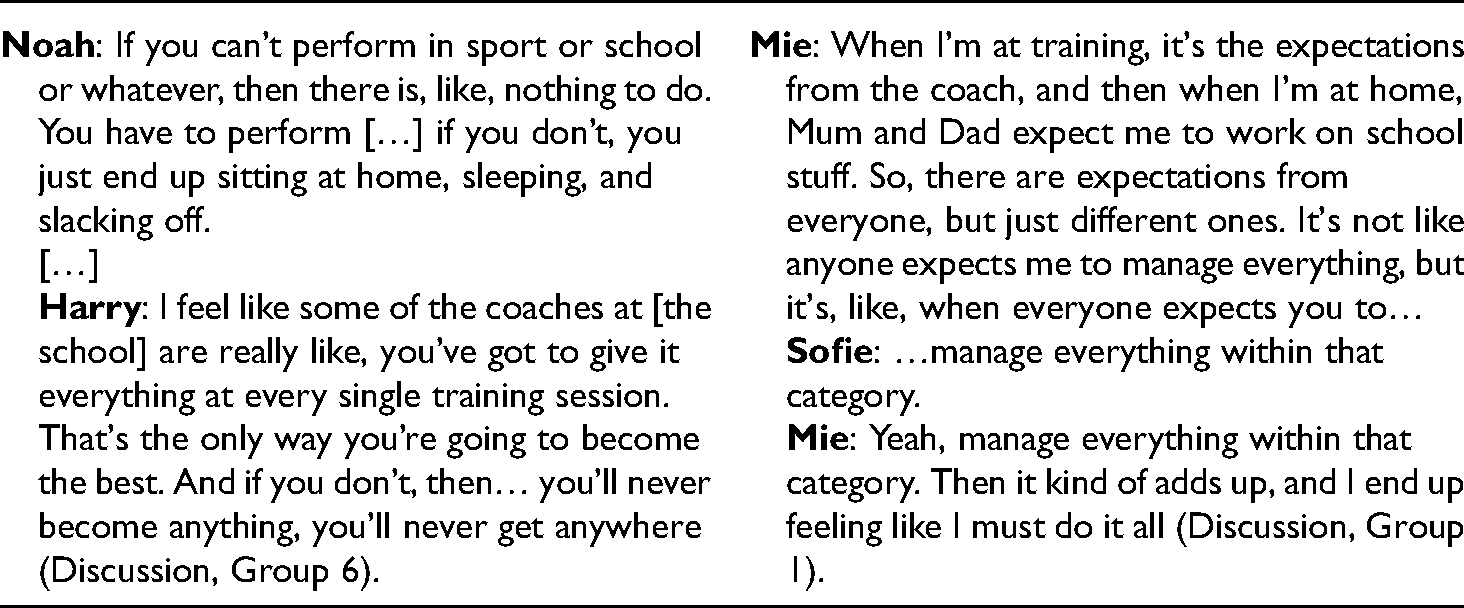
For most student-athletes, performance demands constituted an unquestioned and enduring ‘truth’ within sport and education. The discursive practices through which they sought to ‘manage everything within that category’ positioned particular understandings of athletic commitment and academic diligence as morally and socially legitimate forms of striving (Eriksen, 2022; Øydna et al., 2025). Within the prevailing institutional logic, success was imagined as the outcome of disciplined self-management: to secure a team position or gain admission to the desired school, one had to devote adequate time and effort to each pursuit. Consequently, the student-athletes continued to act upon themselves to complete their to-do list, even during supposed moments of rest. The following discussion between Anna, Mie, Sofie, and the interviewer illustrates how these norms were articulated and embodied in everyday life: Yes, there's a lot you need to get done. Then you also have to go to training, and you also have to make sure to eat and drink enough, and sleep. You kind of have to make sure you get everything done, in a short amount of time. But what do you do if it piles up? What strategies do you use, for example? I just make a list. You have time in your everyday life if you just use it right, and then you manage to fit things in here and there. So, if you know what to do, and are a bit efficient, then it's possible to make it work. (Discussion, Group 1).
The student-athletes approached the organisation of their free time as both malleable and instrumental, assigning status to efficiency and effort as solutions for managing competing demands. They acted upon time as a scarce and measurable resource, and thus questions of how to structure the day and prioritise the ‘right’ activities at the ‘right’ time became central to their ongoing self-governance. This orientation is illustrated by the reflections of Edward, from group 2, who explained: I think I can get better at planning how to get home quickly after a late training session. I’ve talked a little bit about this with [Coach B – a school coach]. I can start to, for example, make myself a small snack that I can have after training and then eat in the car. And then go straight home and just go to bed. Because I have a lot of time before training, when I can pack my bag for tomorrow and all that stuff. So, I don’t have to do it after I get back from training.
Time management practices, such as creating to-do lists and scheduling tasks, are widely promoted by sport psychology experts as core competencies for student-athletes navigating the dual career lifestyle (e.g. Linnér et al., 2021; Stambulova et al., 2015). Edward's account, and his reference to coach B’s guidance, illustrates how these practices are institutionalised within the sports school, functioning as normalised standards for what it means to be a ‘good’ and responsible student-athlete. This mirrors earlier research showing how dual career environments encourage student-athletes to build agency through individual autonomy and self-responsibility over collective or structural solutions (Skrubbeltrang et al., 2016).
Read through Foucault's later writings on technologies of the self (Foucault, 1982/2020), the student-athletes’ effort to optimise and plan their daily lives can be seen as ethical practices or attempts to fashion themselves into competent and morally worthy subjects. Yet, as Thing et al. (2015) remind us, this ‘busyness strategy’ offers little room for idleness or critique, thereby narrowing what it means to live a ‘good’ and balanced personal life.
Recovery matters: balancing through reduction
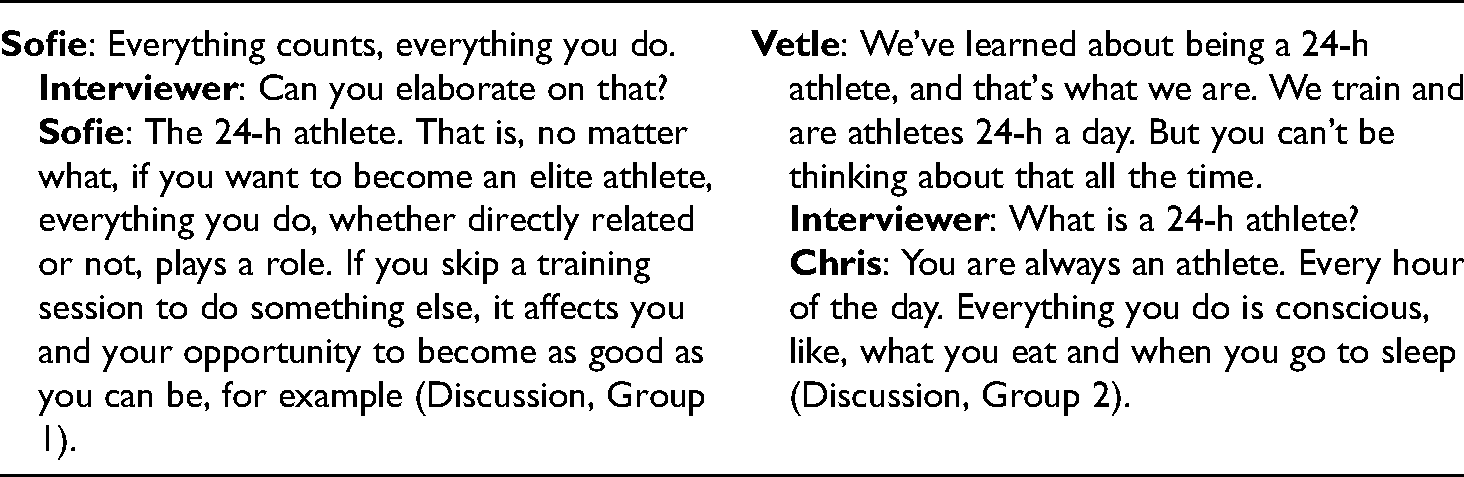
The statements in the extracts above are part of the network of discursive practices that position specific understandings of long-term development and health within the true. National actors such as Olympiatoppen 2 have institutionalised the concept of the ‘24-h athlete’ to normalise the idea that, while athletes need not think about sport every waking moment, they should nonetheless organise their daily lives in accordance with a broader plan for maximising sporting performance (Hjelseth and Telseth, 2023). Norwegian lower secondary sports schools have adapted this rationale to guide young athletes in governing themselves through the logic of long-term athletic development (Øydna et al., 2024).
This norm reinforces a bio-scientific and functionalist understanding of energy management, grounded in the principle that energy intake should correspond to output (Lang, 2015). For student-athletes who subjected themselves to this norm, decisions about energy management and recovery become moralised acts of self-regulation. As Bella (group 5) said: ‘It depends on what you’re doing the next day, you know… considering what you’ve done the days before, whether you have energy or not’. Such reflections exemplify how the imperative to manage energy consciously becomes a moral requirement, shaping how athletes interpret responsibility and success.
This moral demand was particularly evident among those aspiring to, or already positioned within, high-performance youth environments. Here, the capacity to act upon such expert knowledge signified maturity and legitimacy within the broader performance discourses (Augestad, 2024). For example, Mie, a talented footballer from group 1 who earlier emphasised efficiency as a strategy for managing demands, redefined her role as a responsible student-athlete by acting upon expert knowledge of energy management: Do you have any downtime at all? You often have, like, if you have training right after school or in the evening, then there are usually a few hours in between when you can relax a bit. But if you also use that time for schoolwork every day, it can get a bit much. So, you have to be careful. Or at least I think it becomes way too much [several other participants voiced their agreement]. So, that's not possible. I’d rather relax a bit. (Discussion, Group 1).
By incorporating athletic performance preparation into their everyday routines, student-athletes attached themselves to norms for optimised recovery. The act of governing the athletic self was mainly enabled through the practice of monitoring dietary intake and sleep. This governance should not be taken as a matter of external coercion but rather as ethical attempts to keep one's developmental progress in check (Augestad, 2024). Yet, as the following extract illustrates, this moral economy of risk and responsibility also produces tension. Harry, a footballer from group 6, described his relation to expert advice on optimised preparation as one marked by both obligation and distress: I end up trying to sleep after school. Gather as much energy [as possible] to be able to go to training. But the problem with that is that then the days start to merge into one. You hardly get a break. You must always do something. Because I feel that you must sleep. Then it is a duty. I must take a power nap after school if I’m going to be able to go to training. So, it's like, on your to-do list? Yes, it is. So, doing nothing becomes doing something. (Discussion, Group 6).
Harry's statement, that ‘It is a duty […] doing nothing becomes doing something’, captures the affective forces of performance pressures produced within talent development environments. Indeed, even pleasurable activities like rest become restrictive and negatively impact athletes when valued solely for their functionality and contribution to gaining a competitive advantage. Within the power/knowledge relations reproduced in talent development environments, such as through selection processes focused on physical potential and attributes of coachability (Kilger and Jonsson, 2017), it becomes increasingly difficult to claim authority as a committed athlete without submitting to the technologies of self that constitute the disciplined, self-regulating body (Ojala, 2020).
As Foucault (1984/2020) reminds us, resistance does not stand outside of power but operates within its very relations. Moments of compliance or withdrawal are not oppositional but part of the same dynamic through which individuals both reproduce and reconfigure the norms governing them. In the next section, we explore these negotiations between discipline, freedom and pleasure, and examine how student-athletes’ practices of self-care and enjoyment become moments of resistance to maintain a sense of balance and coherence in everyday life.
Health matters: balancing through covert resistance
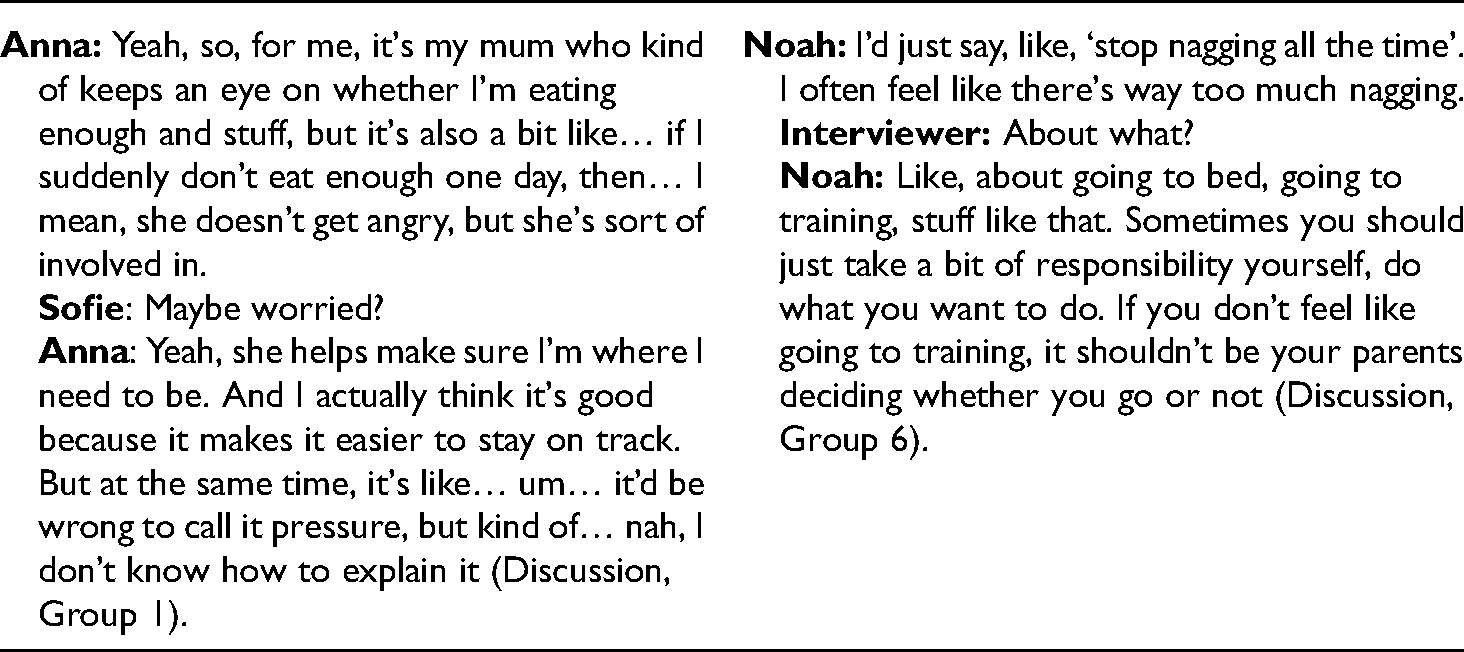
The extracts above illustrate how external surveillance operates through practices of care (see Gearity et al., 2023). By directing critique towards adults’ interference in their choices, both Anna and Noah participated in discursive practices that located recovery simultaneously as a matter of personal autonomy and as a site of subtle domination by external authorities. In this way, balancing athletic and academic demands becomes intertwined with humanistic identity norms that emphasise respect for individual choice and self-determination, as well as with psychological discourses in which health extends beyond the biomedical notion of a functional body to encompass mental well-being, coping, agency, and quality of life.
Time management practices exemplify the belief that time is a resource available for individual control. Yet, for many student-athletes, this belief remains unattainable (Cosh and Tully, 2014). Those who positioned themselves as passive in designing their schedules often described a lack of free time, constructed as moments not already structured by institutional or parental expectations. This tension surfaced clearly in a discussion between Bella and Henny, facilitated by the interviewer and Alice in group 5. Here, they questioned the fairness of being evaluated according to standards of efficiency that were impossible to meet and, in doing so, enacted small but meaningful forms of resistance. Through these micro-practices, such as disregarding expert advice about sleep, they sought to reclaim brief moments of agency within an otherwise tightly governed existence: Is it fair, though? That you get corrected [about sleep and food routines] Yeah, but … (gets interrupted) They’re just trying to look out for us, really. Yeah, they mean well. But at the same time… On Tuesdays and Wednesdays, my training ends at 9 PM, and I live in the city, so I’m not home until around 9:45. Then I shower, so I’m not in bed until around 11:30. Things take time, right? You can’t really help it. You have to shower and to eat after training. I can’t just skip it; that would be wrong, too. I get scolded at home quite a bit – especially yesterday and the day before – because I went to bed too late. But I’m trying to fix that. We’ve been taught about it since 8th grade, but it's still hard sometimes. I need some me-time in the evening [several other interview participants voiced their agreement], just to gather myself a bit, like, ‘okay, this day is over, now I can relax a bit’. Because if I get home at 8:45 and tried to go to bed at 9:30; it would feel like the next day just started right away, like I didn’t get to gather my thoughts and relax. And that really affects the mental side, too. (Discussion, Group 5).
The student-athletes often rationalised their coaches’ monitoring of training quality and recovery as expressions of care since they helped them become athletes. Yet, this uncritical acceptance also seemed to complicate their ability to establish clear boundaries around when and where they could alleviate the emotional labour of maintaining consistency in time – and energy management. A common rhetoric among both male and female participants emphasised not ‘overthinking’ or ‘overcomplicating’ these matters: I care about what I eat, but… it's not like I overthink it if I have some sweets or drink a soda or something. It doesn’t really matter to me (Vetle, Group 2). I do think about such things, sleep and food and so on, but one shouldn’t overcomplicate it too much. Because then, like you said, you end up not getting enough sleep and you just get stressed (Mie, Group 1).
This simultaneous accommodation of disciplinary practices (keeping recovery under surveillance) and resistance to them (avoiding obsessiveness) illustrates a distinct process of subjectification. The student-athletes positioned themselves as caring and responsible individuals, attentive to long-term performance and well-being through practices of optimal recovery, yet sought to avoid an overly serious approach that could attract critique for jeopardising mental health (Ronkainen et al., 2021). Balancing, then, appears less about strict compliance with institutional codes of conduct and more about locating social and psychological spaces where they can momentarily step outside the confines of their athletic identity (Roderick and Allen-Collinson, 2020).
However, many student-athletes chose to conceal such resistance, employing the language of physical health to justify their deviations when interacting with school coaches and thereby avoid correction. Within current debates in Norwegian talent development concerning the ‘vulnerability’ of youth athletes’ health, this served as a more legitimate explanation. Some even managed to redefine responsible practice to include the reduction of training hours. For example, George, a footballer from group 6 who had struggled with injuries, questioned the physical demands of his lifestyle and was supported by his coaches in designing a more flexible schedule that allowed him to spend more time with friends: I didn’t have much contact with my friends in 8th and 9th grade. Because I was very tired in the afternoons. So instead of going out with them, I stayed home and watched a series on Netflix. That's the worst part, really. That I maybe lost a bit of contact with them. But I’ve gotten better at reconnecting with them now. I have become better at managing my training load. Can I ask what you mean by that? Did you get better at managing your load? No, I have cut down some training sessions. I have talked with the coaches at school and the coaches at my club. And we have agreed that, if there are some days where I feel a bit off, then I can either not train as hard or, in some cases, take the day off. (Discussion, Group 6).
We do not know whether George was considered a ‘talent’, whether that status changed over time, or whether his coaches continued to believe in his potential and granted him access to developmental resources (Skrubbeltrang et al., 2021). What is important to underscore, however, is that his case illustrate a strategy made possible not solely through individual agency but as a form of structural resistance embedded within the sports school's organisational culture (Henriksen et al., 2020). Such arrangements can create spaces where young athletes are enabled to reinterpret responsibility and meaningful sport participation beyond the imperative of optimisation. We therefore argue that sport schools can play a pivotal role in broadening student-athletes’ perspectives, particularly given their limited opportunities to encounter alternative discourses and practices outside the tightly regulated rhythms of everyday sport life.
Concluding thoughts
In this study, we explored the forms of knowledge through which young student-athletes regulated their free time in the context of dual career expectations. Our analysis shows that student-athletes predominantly mobilised discursive resources that reproduce dual career practices, foregrounding compatibility between sport and education and positioning efficiency as the ethical solution to balancing them (Kavoura and Ryba, 2020; Stambulova and Wylleman, 2019). When acting upon bio-scientific knowledge of recovery, balance was achieved through reduction rather than redistribution, either by lowering their academic expectations or by eliminating activities deemed to waste energy. Taken together, these ways of knowing are sustained by power relations that legitimise time optimisation and performance investment as the moral core of being a ‘responsible’ student-athlete.
Importantly, simply becoming more efficient was regularly voiced as insufficient for achieving a well-rounded everyday life, revealing how optimisation of time and energy alone can fail to open up meaningful alternatives for some student-athletes.
At the same time, the local emphasis on health introduced another regime of truth that could be strategically used to justify ‘reprieve’, and thereby served a contingent site for small resistances. We argue that this capacity hinges on institutional legitimation (e.g. coach-endorsed schedule flexibility), the athlete's situated status within the talent hierarchy, and access to discursive resources (particularly the ability to mobilise ‘health’ as a legitimate rationale for reprieve). This means that opportunities to step back or slow down easily become unequally distributed – not simply individual choices.
We recognise limitations in our approach. First, the study was conducted at a private school located in a resource-rich area. It is therefore likely that many of the student-athletes come from relatively high socio-economic backgrounds, where parents are not only engaged in sport but also closely involved in monitoring their children's health and academic achievements (Eriksen et al., 2024; Krogh and Madsen, 2023; Saarinen et al., 2025; Skrubbeltrang et al., 2020). In contrast to studies involving older athletes, all participants in this study lived at home, where many everyday responsibilities, such as food preparation and household tasks, were largely managed on their behalf. While the study touches upon experiences of academic pressure, this remains an area requiring further exploration. Specifically, future research could more closely examine the student-athletes’ academic positioning and how they navigate and enact legitimacy within the educational system (Hilt et al., 2024).
Second, although a more detailed analysis of gender differences could have been conducted, this lay beyond the scope of the present study. This decision reflects the observation that much of the existing critical scholarship on dual careers among younger student-athletes already offers sustained and nuanced engagement with gendered perspectives (e.g. Kavoura and Ryba, 2020; Ryba et al., 2021; Saarinen et al., 2023). Nevertheless, such gendered and structural conditions are likely to shape participants’ experiences of free time and everyday responsibilities. Future research could therefore explore how these differentiations influence the uneven distribution of agency, particularly in relation to accessing, enacting, and questioning optimisation routines.
Our findings also have practical implications. Treating recovery and free time primarily as instruments for performance may close off young athletes’ possibilities for imagining alternative futures (Ronkainen and Ryba, 2018). Rather than adding more corrective knowledging within the same optimisation logic, practices that widen the discursive resources available to them may better support recovery and sustain participation. This could be done, for example, through creating opportunities for open discussion between student-athletes and adults (coaches, parents, etc.), and through reflecting on the ways that certain practices, values, and beliefs might be linked to instrumentalised forms of care for some young people. Schools and clubs might also consider how legitimacy is conferred: ‘doing balance well’ need not be synonymous with high workload tolerance or the moralisation of efficiency.
Ultimately, our analysis raises a broader philosophical question for dual career research and practice: what version of the young athlete is being produced – and at what cost? If a dual career support simply refines the individualistic ethics of optimisation, then the field risk reduces the very pressures it claims to mitigate (Mills et al., 2024). A more ambitious version of ‘support’ could involve creating conditions where young people can meaningfully step outside the developmental rationalities that bind them. Without that, balance remains less a practice of freedom than another technique of power.
Supplemental Material
sj-docx-1-irs-10.1177_10126902261426777 - Supplemental material for ‘I would have studied while I showered’: A Foucauldian reading of how young student-athletes regulate their free time
Supplemental material, sj-docx-1-irs-10.1177_10126902261426777 for ‘I would have studied while I showered’: A Foucauldian reading of how young student-athletes regulate their free time by Marie Loka Øydna, Jens Christian Nielsen, Milla Saarinen and Christian Thue Bjørndal in International Review for the Sociology of Sport
Footnotes
Consent to participate and consent for publication
Informed consent for participation and publication was obtained in writing from all participants.
Data availability statement
The data is available from the first author upon request.
Declaration of conflicting interests
The authors declared no potential conflicts of interest with respect to the research, authorship, and/or publication of this article.
Ethical considerations
The study received ethical approval from both the Norwegian Agency for Shared Services in Education and Research (reference number 618455) and the university's Ethics Board.
Funding
The authors disclosed receipt of the following financial support for the research, authorship, and/or publication of this article: This research was supported by the Norwegian Research Council (grant number 326532).

Supplemental material
Supplemental material for this article is available online.
Notes
References
Supplementary Material
Please find the following supplemental material available below.
For Open Access articles published under a Creative Commons License, all supplemental material carries the same license as the article it is associated with.
For non-Open Access articles published, all supplemental material carries a non-exclusive license, and permission requests for re-use of supplemental material or any part of supplemental material shall be sent directly to the copyright owner as specified in the copyright notice associated with the article.
