




Abstract
Women's professional hockey in North America has historically faced financial instability, leading to the dissolution of leagues such as the National Women's Hockey League and the Canadian Women's Hockey League. The Professional Women's Hockey League (PWHL) emerged in August 2023 and was marketed as a “first of its kind” women's professional league, focusing on sustainability and built on core values of inclusivity, community, and longevity. This study aimed to analyze the role of fan engagement and responses to the PWHL to better understand the factors contributing to its early success, specifically through online discourse. A mixed-methods content analysis was employed, guided by Mehrabian and Russell's Stimulus–Organism–Response paradigm. The research examined posts and comments on the official PWHL Instagram page (@thepwhlofficial) from 1 January 2024 to 31 December 2024. Data collection involved a two-stage process: initial categorization of posts and quantitative measurement of fan engagement, followed by a thematic analysis. Two overarching themes emerged: (1) League Legacy and Achievements and (2) Community Engagement and Social Justice. These findings suggest a model for the development and sustainability of women's professional sports that prioritizes social values, community building, and longevity over traditional sports paradigms.
Keywords
Women's professional hockey in North America has historically faced financial instability, leading to the dissolution of leagues such as the National Women's Hockey League (NWHL; 2015–2023) and the Canadian Women's Hockey League (CWHL; 2007–2019). The Professional Women's Hockey League (PWHL) emerged in August 2023 and was quickly marketed as a first-of-its-kind women's professional league focused on sustainability and built on core values of inclusivity, community, and longevity (Professional Women's Hockey League Players Association, n.d.). The league experienced historic success in its inaugural season, with sold-out arenas and record-breaking viewership. Notably, the league set a viewership record of 2.9 million across Canadian networks in its inaugural game (McLellan, 2024b) and set an attendance record for women's professional hockey with 21,105 fans (Whyno and Wawrow, 2024). The purpose of this study was to analyze fan responses to the PWHL to understand the factors contributing to the league's success during its inaugural year of play. Specifically, through a content analysis of posts and comments on the official PWHL Instagram page (@thepwhlofficial), this study aimed to identify common themes in online discourse. By uncovering these themes, the research sought to highlight the underlying factors that may have contributed to the PWHL's rapid development into a successful professional league. The distinct connection between fan values—such as gender empowerment, diversity, inclusion, and emotional engagement—and league success serves as a critical theoretical foundation for this study. Social media platforms like Instagram, which are prevalent in modern engagement, enable a deeper understanding of consumer behaviour and brand interactions. Businesses utilize these platforms for marketing, and they also provide a direct channel for consumers to interact with brands. This real-time interaction offers a unique opportunity that may have contributed to the PWHL's early success. Utilizing Instagram for this content analysis enabled direct observation of fan engagement and reactions.
The present study examines fan engagement with the PWHL to understand the factors contributing to its early success and potential sustainability. This research contributes to the literature on women's professional sports and fan-based engagement by highlighting how social values, community building, and perceived league longevity shape fan responses and engagement patterns. The PWHL's stated core values—emphasizing community, inclusivity, and growth—appear closely aligned with the priorities of its fanbase. To investigate these dynamics, a mixed-methods content analysis was conducted, guided by Mehrabian and Russell's (1974) Stimulus–Organism–Response (SOR) paradigm. The analysis focused on posts and comments from the official PWHL Instagram page (@thepwhlofficial) between 1 January 2024 and 31 December 2024. Data collection followed a two-stage process: first, posts were qualitatively categorized and fan engagement quantitatively measured; second, a thematic analysis was conducted on comments from the categories with the highest engagement. Key findings showed that “League Legacy and Achievements” had the highest average engagement per post, while “Community Engagement and Social Justice” generated the highest total engagement. These results suggest a model for the development and sustainability of women's professional sports that prioritizes social values, community building, and perceived longevity over traditional sports paradigms.
The evolving history of women's professional sport
The professionalization of women's sports globally has been a slow and uneven process, shaped by cultural norms, logistical challenges, and uneven institutional support (Paloian, 2012). Historically, certain sports—such as tennis—were first played by women in the late 1800s with little money and limited media attention. Tennis was often perceived as a “feminine sport” due to its lack of physical contact and its alignment with traditional notions of femininity (Luczyski, 2019). However, it was not until the mid-twentieth century that formal organizational structures and influential figures emerged, enabling true professionalization. Tennis achieved significant professional and financial success in the 1970s when Billie Jean King and the “Original 9” founded the Virginia Slims Circuit and the Women's Tennis Association (WTA), leveraging existing infrastructure, a global fanbase, and early broadcast partnerships (Martin et al., 2017). The WTA's sustained financial viability was attributed to its “competitive balance,” which ensures diverse winners and keeps matches exciting and unpredictable rather than dominated by just a few celebrities (Sadat, 2023; WTA Staff, 2017). While there are other examples of women's professional sport success (e.g. golf, basketball, and, more recently, football/soccer), tennis serves as an important example of the historical position of women's professional sport and the potential to carve out economic success and stability in a male-dominated market. Moreover, after retiring from professional tennis, Billie Jean King continued to leave a lasting impression on women's sports, offering her expertise and investing in the development of other women's professional sports, including the PWHL, as discussed later.
Unlike individual sports like tennis and golf, team sports have historically faced greater social opposition, often characterized as “too masculine and inappropriate for women” (Grossman, 2013). In addition to social discrimination, these sports also require substantial financial investment due to high logistical costs, including travel, large venues, scheduling complexities, and multiple players. Consequently, widespread media coverage, sponsorship, and full professionalization for women's team sports were considerably delayed (O’Brien et al., 2023). For these reasons, the trajectory of women's professional hockey in North America has been marked by persistent challenges, primarily financial instability and the collapse of multiple leagues. Prior to the PWHL, iterations such as the NWHL and the CWHL struggled to establish sustainable business models. Both leagues competed for top talent and viewership, maintaining similar levels of competition and audience. The NWHL was notable as the first to pay its players, with reported salaries ranging from $10,000 to $25,000 (Hemming, 2015). The CWHL followed suit in 2017, offering players stipends ranging from $2000 to $10,000 (Spencer, 2019). However, the CWHL ultimately ceased operations in 2019 due to an unstable business model (Spencer, 2019), poor ticket sales, insufficient sponsorship, and a lack of consistent television coverage (Strashin, 2019). A critical factor in its demise was its status as a Registered Canadian Amateur Athletic Association (RCAAA). The RCAAA is a status for some non-profit organizations in Canada that promote amateur athletics nationwide as their exclusive purpose and function, and it provides them with funding (Whelan, 2019). Unfortunately, it imposes strict limitations on player compensation, restricting it to athletics-related expenses. Without generating sufficient revenue from ticket sales and sponsorships, the CWHL could not afford to revoke its RCAAA status and offer competitive salaries, leading to its closure (Whelan, 2019). This historical context underscores the systemic financial and structural barriers that have impeded the growth of women's professional hockey. Past league failures established a crucial backdrop, highlighting the specific problems the PWHL was strategically designed to address, particularly sustainability and player agency.
The Professional Women's Hockey Players Association (PWHPA) emerged from this challenging environment, comprising over 300 professional and semi-professional women's hockey players from North America and Europe (including Finland, Czechia, and Switzerland). Notably, many North American players came from both the CWHL and the NWHL, with top NWHL players leaving their league—which was still active—to join the PWHPA in support of its mission. These athletes banded together and used social media to vow not to play in a North American professional hockey league until a sustainable, economically viable league existed (Whyno and Wawrow, 2019). Their activism included the player-run “Dream Gap Tour,” which successfully garnered sponsorship and public support. This period of player-led advocacy was pivotal, demonstrating a collective demand for a league that prioritized the long-term well-being and professionalization of its athletes. This player-driven movement culminated in a significant development: the Premier Hockey Federation (formerly NWHL) was acquired by Billie Jean King and the Mark Walter group. The acquisition led to a historic Collective Bargaining Agreement (CBA) between Billie Jean King and the Mark Walter group and the PWHPA (Hernandez, 2023). In August 2023, the PWHL was officially announced and now operates as a syndicate league (or “single entity league”), in which the league itself is owned equally and collectively by all teams and is financially backed by investors who invest in the league as a whole, rather than in individual teams (Jordan, 2001). This business model has been attractive to new professional sports leagues (for example, the Women's National Basketball Association (WNBA) was originally a syndicate league) seeking to operate within or around dominant professional sports by exerting complete control over all league operations, including salaries, marketing, competitive balance, and brand image (Jordan, 2001). Brand image has been particularly strategic for the PWHL, whose stated core values of inclusivity, community, electricity, responsibility, opportunity, and longevity directly address the shortcomings of previous leagues and align with the demands of the PWHPA. In its first season, the PWHL witnessed immediate and historic success, marked by sold-out arenas and numerous viewership and attendance records for women's professional hockey. In their second season, the PWHL saw a 27% increase in overall average attendance, 100% growth in merchandise, a 50% increase in league and team partnerships, and a 68% increase in social/digital engagement from season one to season two (Professional Women's Hockey League, 2025). This triumph positions the PWHL's success not as an isolated event but as a direct response to systemic issues and as an alignment with the aspirations of both players and a burgeoning fanbase.
Fan engagement in women's professional sports and media
In recent years, there has been significant growth in women's sports worldwide, with leagues like the Women's Super League (WSL) and the WNBA exceeding expectations and requiring venue changes to accommodate increased demand (Broughton, 2025). Researchers have begun documenting the proliferation and success of professional leagues, including the unique fan engagement these leagues are garnering. For example, Leslie-Walker and Mulvenna (2022) and Clarke et al. (2022) have analyzed differences in male and female spectator motivations. They found that fans of women's teams were more highly motivated by athletes’ physical skill, whereas fans of men's teams were more highly motivated by achievement and winning (Clarke et al., 2022). Additionally, fan loyalty was found to be more symbolic for male fans, whereas social atmosphere and entertainment were stronger motivators for female fans (Leslie-Walker and Mulvenna, 2022). Influenced by sociocultural norms, the cultures within each sport and the ways fans engage with both the sport and the media may also differ. Symons et al. (2025) argue that consumers are motivated to engage with media platforms and content that satisfy their personal desires or affective needs. As such, fans seek content that is not just a replication of media coverage of men's sport, but content they are passionate about, find entertaining, and that connects to their specific needs and interests as fans of women's sport. This interaction with like-minded sports fans fosters a sense of community and identity, strengthening consumers’ feelings of belonging and engagement.
Similarly, a common motivating factor driving fan engagement in many studies was gender empowerment. In a study on team identification, motives, and behaviours, Clarke et al. (2022) found that support for social change and gender equality was consistent among women sports fans and teams. Guest and Luijten (2017) critique the perceived conflict between promoting women's sports as a political cause and promoting them for athletic ability and quality of play. Their research identified that Portland Thorns fans of the National Women's Soccer League (NWSL) emphasized the value of both high-quality soccer and women's empowerment as equal dimensions of fandom that could coexist. Similarly, Leslie-Walker and Mulvenna (2022) interviewed fans of Manchester City Women's Football Club in the WSL who expressed a sense of responsibility to support women's soccer. As fans of both the sport and the club, their presence communicated a commitment to the community being built, where fans feel personal, intrinsic motivation to engage with their teams, the league, and the sport. Guest and Luijten's (2017) research on the Portland Thorns supports this, as fans stated that atmosphere and supporters’ culture were what they enjoyed most about being a Thorns fan. They felt that creating and maintaining a supportive community and an overall positive atmosphere were most important for fostering a thriving women's sport community, driving fan engagement, and sustaining spectatorship.
Finally, other research has identified the importance of social media in providing audiences with higher levels of entertainment and increased opportunities to engage with their favourite teams beyond the playing field (Dakroub et al., 2023; Yadav et al., 2023). Yadav et al. (2023) highlight the importance of fan–team interaction, which can be strengthened through more informal and bidirectional exchanges. Social media platforms like Instagram have provided a more accessible forum for two-way communication, where players can showcase their brands by directly engaging with their fanbase. Bidirectional engagement through social media enables fans to interact with content that reflects athletes’ core personas, suggesting that authenticity—or perceived authenticity—increases engagement.
Methodology and methods
This study employed a mixed-methods content analysis to examine online discourse on the PWHL's official Instagram page (@thepwhlofficial). The primary objective was to identify common themes in fan responses and highlight the underlying factors that contributed to the league's notable success in its inaugural year. According to Kainer et al. (2024), Instagram is a large and successful global social media platform that is becoming increasingly central to information distribution and can be an effective way for brands to communicate with consumers. In its inaugural season, the PWHL played its first game just months after the league's announcement. The PWHL's Instagram account reached over 1 million followers and generated more than 238 million impressions in its inaugural season (McLellan, 2024a), followed by a 68% increase in engagement across league and team platforms in the subsequent season (Professional Women's Hockey League, 2025). Instagram became its most popular platform for engaging with viewers, posting content that included information about scheduling, tickets, merchandise, and where to watch games, alongside regular league updates. The @thepwhlofficial Instagram page was selected as the study site because it enabled systematic collection of fan reactions and measurement of engagement following the inaugural game. Thus, the PWHL's official Instagram provided a robust means to analyze a wide range of responses and assess consumers’ direct reactions to stimuli presented by the league itself.
To analyze content on the PWHL Instagram platform, we drew on Instagram content analysis studies by Kainer et al. (2024) and Lister et al. (2024). The methodologies from both studies were transferable to our research and helped guide our approach to assessing PWHL fan responses. We drew on Lister et al.'s (2024) approach to guide our identification of high-engagement content categories, adapting their procedures to account for differences in platform features and data availability. We coded and categorized posts based on their appearance in the PWHL's account feed over 1 year and identified the top-performing categories. Lister and colleagues (2024) analyzed the top 200 posts for three hashtags at two time points, using Instagram's top posts, and then coded them into content categories. Since the “top posts” feature is not available in an Instagram account's feed, we collected data on likes and comments and categorized posts across a 1-year time to establish top posts and areas of increased engagement. Due to the volume of data collected, we analyzed comments from the posts with increased engagement among the top two categories. For further analysis of the highest-performing post categories and of posts with above-average engagement, we drew on the methods used by Kainer et al. (2024). In their study, they used Mehrabian and Russell's (1974) SOR paradigm (Figure 1) to understand how stimuli on the @discovercotton Instagram page influenced consumer behaviour and organizational responses over 1 year. This approach proved highly effective, as it enabled us to examine content over a broad time period, categorize it, and identify posts with above-average engagement to identify the themes most important to PWHL consumers. While Kainer et al. (2024) provided the theoretical foundation through the SOR framework, Lister et al. (2024) informed the procedural logic for identifying and categorizing high-engagement posts within an Instagram-based content analysis.
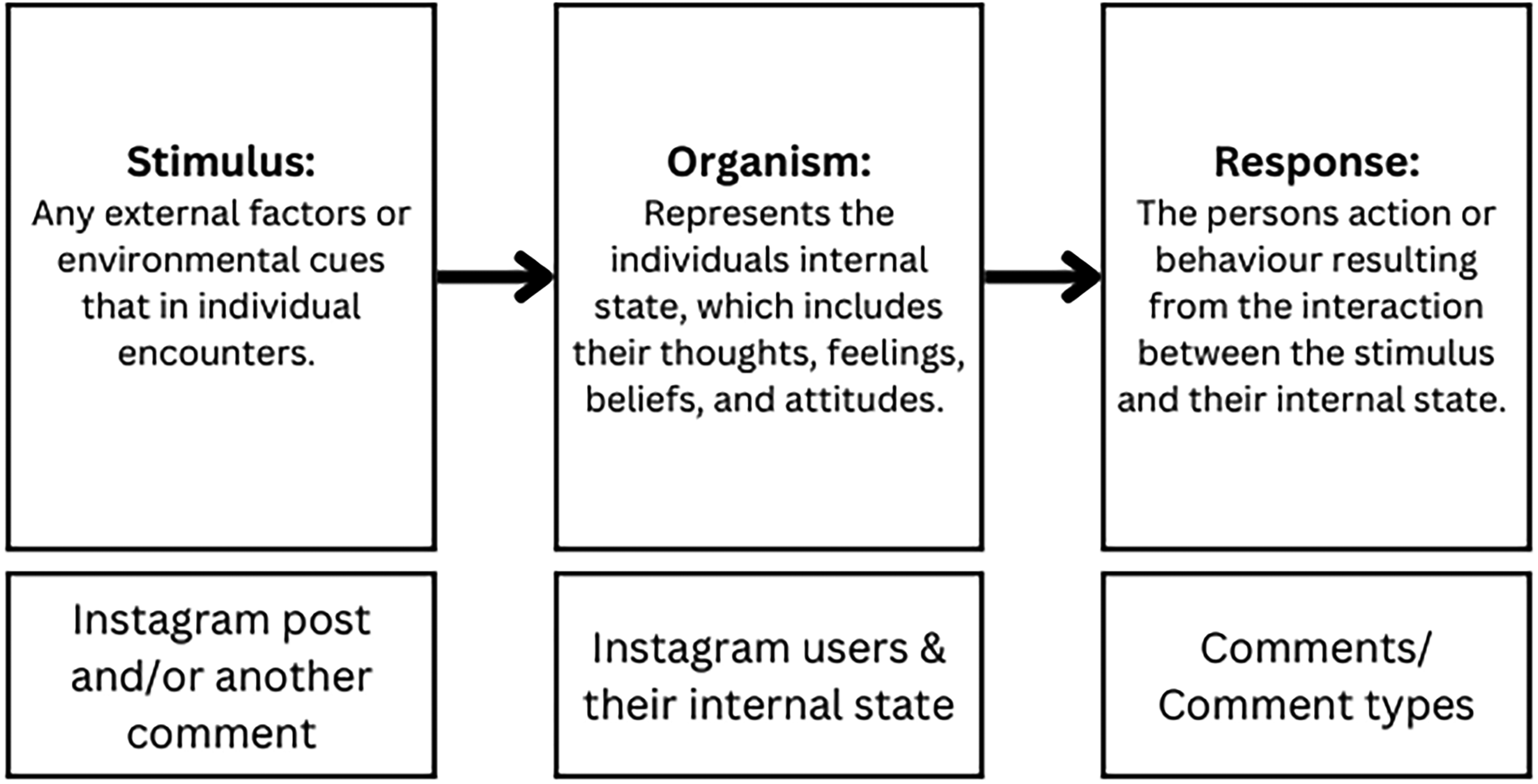
Stimulus–Organism–Response paradigm (Mehrabian and Russell, 1974).
The SOR paradigm guided our approach to understanding how different PWHL Instagram posts, in combination with the internal states (thoughts, feelings, beliefs) of the user, affect engagement and consumer behavioural responses. In this study, the components of the SOR paradigm are as follows: the stimulus (S) refers to external factors or environmental cues encountered by an individual. For this research, we categorized various types of posts on the PWHL's official Instagram as distinct stimuli. While Instagram posts were the primary focus, other external factors—such as attending games, news coverage, or personal experiences with the league—could also influence the user's response to a post. The individual interacting with the PWHL Instagram posts is the Organism (O), encompassing their internal state, thoughts, beliefs, feelings, values, and preexisting perceptions, which mediate how they perceive and interpret the presented stimuli, shaping their response (R). The response refers to the observable reactions or behaviours that result from the interaction between the stimulus and the organism (Kainer et al., 2024). On Instagram, responses can range from passive actions like scrolling or liking to more active engagements such as leaving a comment. This study specifically focused on comments as a key indicator of response, with a comment assumed to signify a greater response, indicating a more significant effect on a person's internal state and a deeper level of engagement. For example, someone who had supported past professional or semi-professional leagues may see a post about a new attendance record, perceive it positively as growth, and respond by liking the post or expressing their support in the comments. Conversely, someone else could see the same post and perceive it negatively, based on their beliefs, values, and perceptions, and respond negatively or not at all.
Data collection
The research design was structured into two distinct stages to ensure both breadth and depth in the analysis. Stage one focused on quantitatively categorizing all posts and measuring their engagement metrics, providing an overview of the content. Stage two involved a more intensive, qualitative thematic analysis of comments from the categories with the highest levels of fan engagement. This approach allowed for a more targeted and efficient qualitative analysis: Stage 1 identified where the most significant fan engagement occurred (i.e. which types of stimuli were most effective), while Stage 2 focused on what was being said within those highly engaged areas, providing rich data on the organism's internal states and responses. Data collection for this study was conducted throughout January 2025, gathering all posts published on the @thepwhlofficial Instagram page from 1 January 2024 until 31 December 2024. The process was executed in two sequential stages to systematically capture and analyze fan engagement.
Stage one: Categorizing and measuring engagement
In the initial stage, a comprehensive dataset was compiled by recording the number of likes and comments for every post within the specified timeframe and entering this data into an Excel spreadsheet. This quantitative data served as the primary measurement of engagement. Each post was systematically categorized based on its dominant theme. There are six distinct post categories: Community Engagement & Social Justice, League Legacy & Achievements, Player Profile, Player Performance, League Updates, and Promotions & Advertisements. Community Engagement & Social Justice posts featured interactions with fans, fan spotlights, community events, and content addressing social justice issues. League Legacy & Achievements posts highlighted accomplishments and records set by players or the league itself, as well as posts that reflected the league's historical impact on women's hockey. Player Profile posts showcased players’ personalities beyond their athletic roles. Examples included “walk-in outfits,” behind-the-scenes content, and features that provided insight into the individuals rather than solely the athletes. Player Performance posts focus on player-specific achievements, such as statistics, highlights, player-of-the-week awards, and first goals or shutouts. League Updates posts included team and league-guide informational posts, such as scheduling, logistical updates, season summaries, standings, and announcements regarding “take over tour” games. Promotions & Advertisements posts featured content related to sponsored partnerships and advertisements, with the primary focus on the product rather than the players or individuals involved. A total of 1440 posts were identified across the six categories, accumulating 8,221,853 likes and 56,280 comments during the analyzed period. This stage was critical for quantitatively identifying the two post categories that demonstrated the highest levels of engagement, which were then selected for in-depth qualitative analysis in Stage Two.
Stage two: Analysis of comments
The second stage of data collection focused on a qualitative analysis of comments from the two categories identified with the highest engagement: “League Legacy & Achievements” (highest average engagement per post) and “Community Engagement & Social Justice” (highest total engagement). Posts in the
To maintain focus on relevant discourse, several exclusion criteria were applied to the comment dataset. Comments about other post categories (such as player performance, promotions, or league updates) were filtered out to ensure direct relevance to the target stimuli. Comments related to the “player profile” category were retained only if they were closely associated with themes observed in the analyzed posts and appeared relevant to the specific stimuli under examination. Posts that were collaborations with @thepwhlofficial but not originally posted by the official account were entirely excluded from the dataset. This ensured that the analyzed comments were direct reactions to content originating from the PWHL itself. Finally, generic comments that lacked significant meaning beyond general support (e.g. “amazing,” “fantastic,” or emojis) were filtered out, reducing the dataset's size and facilitating a deeper, more meaningful thematic analysis of fan responses.
Results
Stage 1: Categorizing and measuring engagement
The initial stage of data collection involved categorizing all posts on the @thepwhlofficial Instagram page and quantifying their engagement. A total of 1440 posts were analyzed from 1 January 2024 to 31 December 2024. These posts garnered 8,221,853 likes and 56,280 comments across the six defined categories. Table 1 provides an overview of total fan engagement metrics for each post category, showing the overall interaction volume for each content area.
Overall engagement by post category (1 January 2024–31 December 2024).
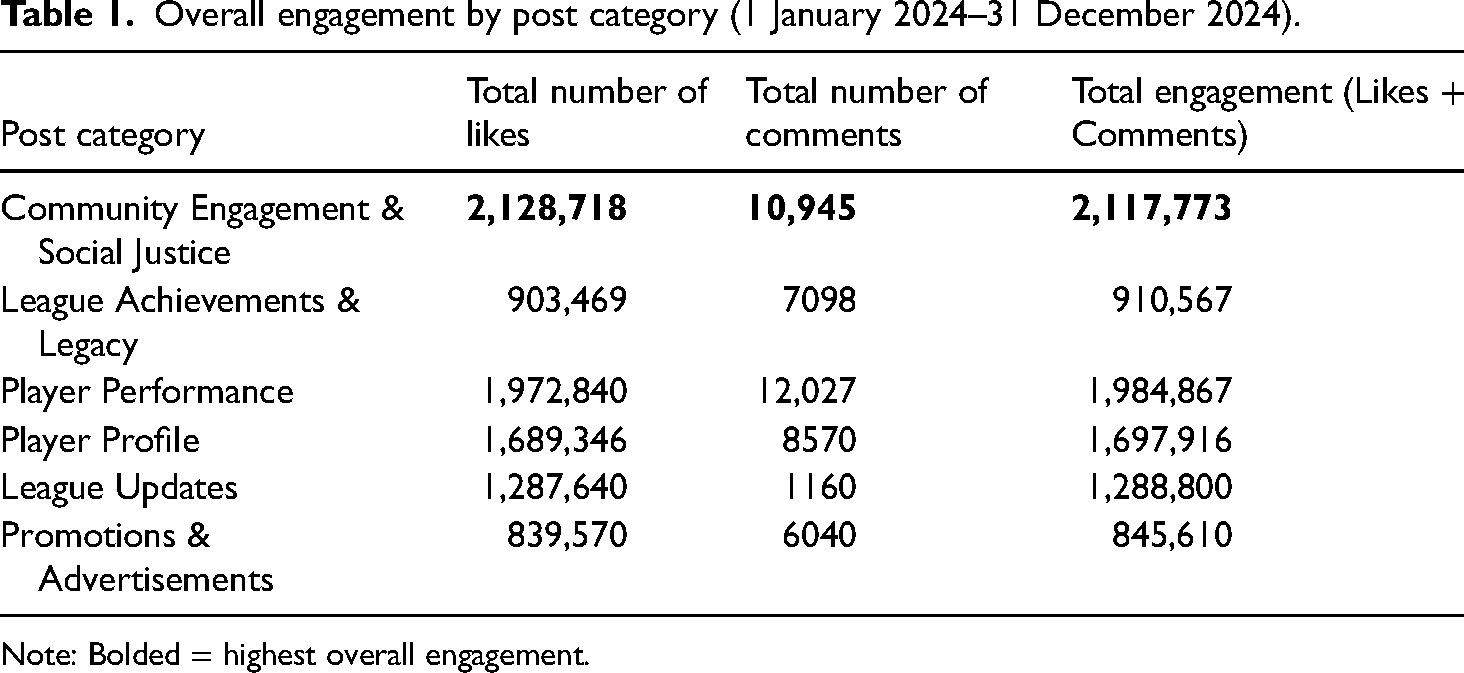
Note: Bolded = highest overall engagement.
As shown in Table 1, the “Community Engagement & Social Justice” category exhibited the highest total engagement, demonstrating broad appeal and success in capturing the audience's attention and interaction. While total engagement provides a measure of overall reach, average engagement per post offers a more nuanced understanding of content effectiveness by normalizing the data by the number of posts in each category. Table 2 presents the average metrics, revealing which types of posts were most efficient at generating interaction, specifically comments.
Average engagement and comments per post category (1 January 2024–31 December 2024).
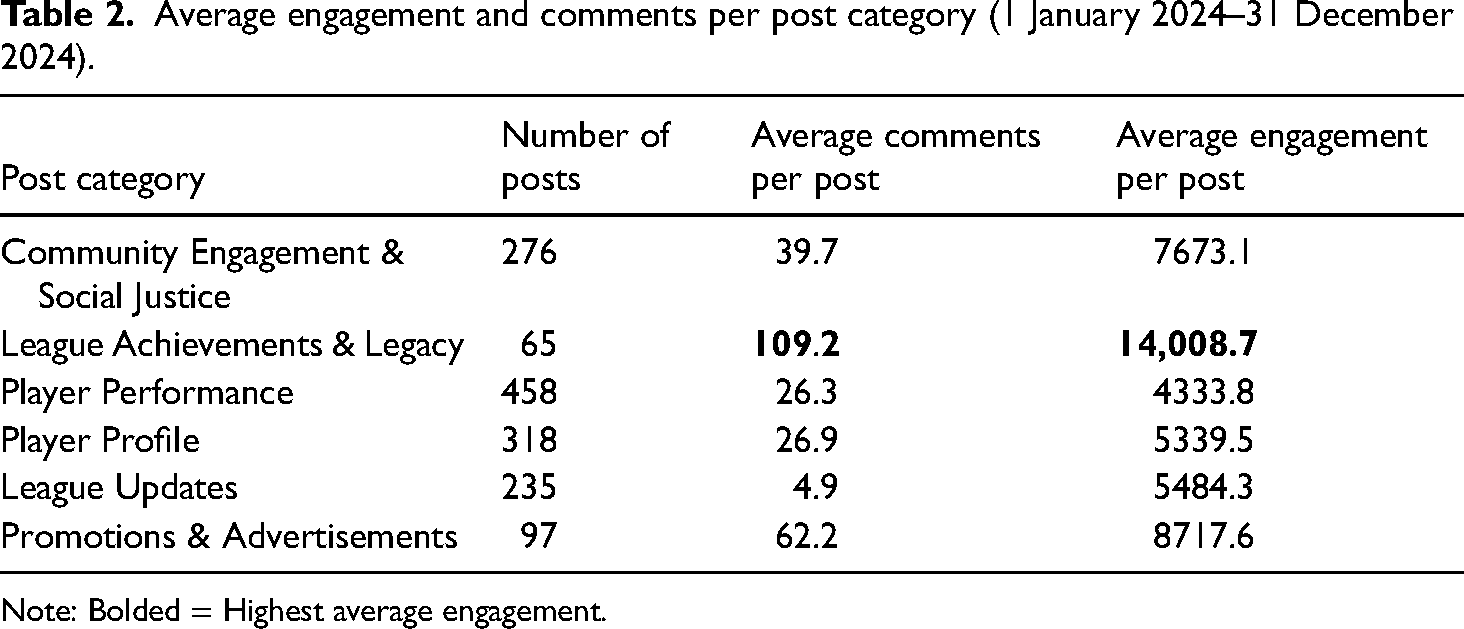
Note: Bolded = Highest average engagement.
Table 2 highlights that “League Achievements & Legacy” posts generated the highest average comments per post (109.2) and the highest average engagement per post (14,008.7). This demonstrates that while “Community Engagement & Social Justice” had the highest total engagement across many posts, “League Achievements & Legacy” posts were especially effective at provoking deeper responses and discussions from the audience on a per-post basis.
Stage two: Analysis of comments
Comments from the “League Legacy & Achievements” and “Community Engagement & Social Justice” categories were analyzed separately, and a thematic analysis was conducted to uncover common patterns among PWHL fans.
Category 1: League achievements and legacy
The “League Achievements and Legacy” category had the highest engagement per post (MLeague Achievements and Legacy = 109; MOverall Average = 38), demonstrating that these posts likely drew more attention from PWHL Instagram followers and reached wider audiences. A total of 481 comments were analyzed, revealing five main themes: (1) making history, (2) empowerment & idols, (3) atmosphere & community, (4) support for the PWHL, and (5) mention of other leagues, Table 3.
Thematic analysis of fan comments in “League Legacy & Achievements” category.
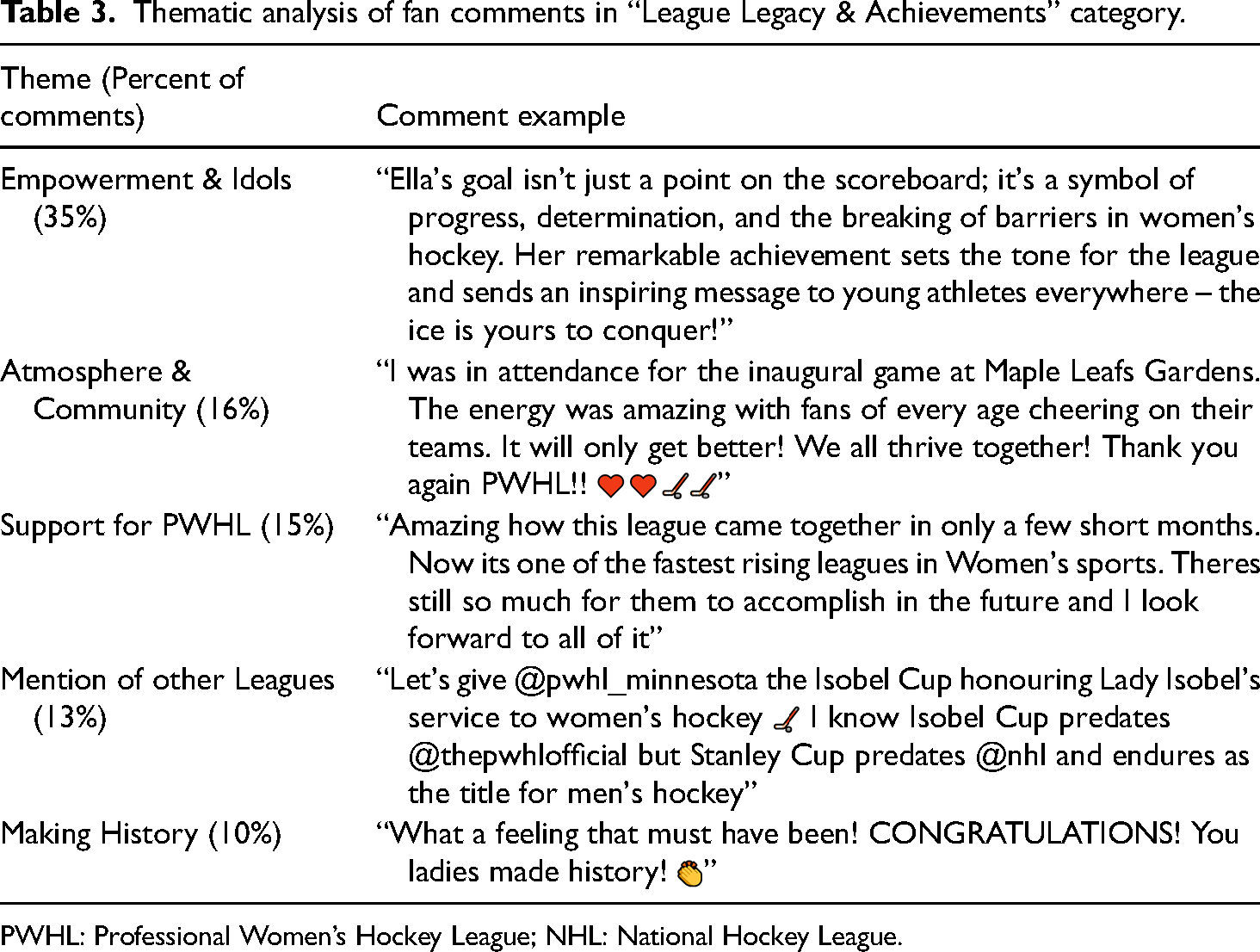
PWHL: Professional Women’s Hockey League; NHL: National Hockey League.
Empowerment and idols
The theme of empowerment and the importance of idols was the most dominant, with over a third (35%) of the analyzed comments focusing on women's empowerment. Fans consistently viewed the players as empowering figures and role models for young children, providing a tangible league for aspiring athletes to dream of joining. Comments frequently reflected a sense of pride in the players, demonstrating not only support for the sport but also emotional investment in the players and what they represent. Additionally, a significant number of comments advocated for players to receive deserved recognition and resources, including better pay, larger venues, improved equipment, and continued opportunities for growth and success. Fans are not simply consuming a sport; they are deeply invested in the social progress and representation that the players and the league embody, aligning directly with the values of gender empowerment and diversity. The PWHL players serve as a powerful stimulus for fans, especially young girls, representing aspirations and breaking barriers, and eliciting a strong emotional response of pride and advocacy from the fanbase.
Atmosphere and community
The atmosphere and energy at the games accounted for 16% of comments, with fans describing it as “electric,” “magic,” a “celebration,” or a strong “sense of community” among fans both at the games and online. Fans recounted their experiences as “unforgettable,” characterized by “amazing” energy, and often referred to the events as a “party.” These descriptions reveal a deeper emotional reaction to the games beyond simple enjoyment. Comments that referenced the community often expressed a sense of pride in being part of the crowd or collective. This suggests internal feelings of unity among fans, which can foster greater engagement and a stronger sense of belonging, whether attending games or interacting online. The experiential and communal aspects of the PWHL suggest that the league is successfully cultivating a strong sense of belonging—a key psychological factor in fan attraction. The league's social environment is a significant draw for fans, as the PWHL's efforts to create inclusive, vibrant events directly contribute to positive fan experiences.
Support for the Professional Women's Hockey League
Support for the PWHL made up 15% of comments, expressing deep gratitude towards the league and all individuals involved in its creation. Fans expressed excitement about the league's future growth and aspirations for its potential expansion. There was a deep sense of appreciation and gratitude for the organization, and strong support for the new rules implemented in the inaugural season, such as the “jailbreak” goal (where a player with a minor penalty is freed if their team scores a shorthanded goal) and increased body contact. Fans also actively encouraged the league to continue its efforts by adding more innovative rules and considering expansion to additional cities. This theme indicated a high level of trust and optimism in the league's trajectory and leadership. Fans are active proponents, advocating specific rule changes and expansion, suggesting a belief in the league's long-term viability. This confidence continues to grow, as expansion teams in Vancouver and Seattle have been announced and are set to join the PWHL for the 2025–2026 season.
Mention of other leagues
A notable portion of comments drew comparisons between the PWHL and other professional sports leagues, including the National Hockey League (NHL), the WNBA, and past women's hockey leagues like the NWHL/PHF and the CWHL. Most of these comparisons were positive, with comments highlighting the PWHL's inaugural game drawing more viewers than the NHL Winter Classic and the PWHL selling out Montreal's Bell Centre faster than the Montreal Canadiens. Some comments also referenced past PHF or CWHL teams, expressing a desire to revive or rekindle a team like the Calgary Inferno (CWHL) or the Buffalo Beauts (PHF). Some comments were negative or neutral, suggesting the PWHL is a novelty that will fade, but these comments were minimal, with only three linked to this theme. The overwhelmingly positive comparisons, even against established male leagues, suggest a strong sense of validation and pride in the PWHL's early achievements. Fans perceive the PWHL as a legitimate and successful entity in its own right, actively challenging existing sports hierarchies and dismissing criticisms of its novelty.
Making history
Although only a smaller percentage (10%) of comments were directly connected to the league's identity as a “first of its kind,” these comments expressed joy and a deep emotional attachment to witnessing historical moments, particularly those from the inaugural game on 1 January 2024. Fans reflected on the experience of being present for the first goal, the first game, and the breaking of viewership records for women's professional hockey on the first day of league play. This emotional attachment to “history being made” suggests that fans perceive themselves as active participants in a culturally significant movement, fostering a deep bond with the league.
Category 2: Community engagement and social justice
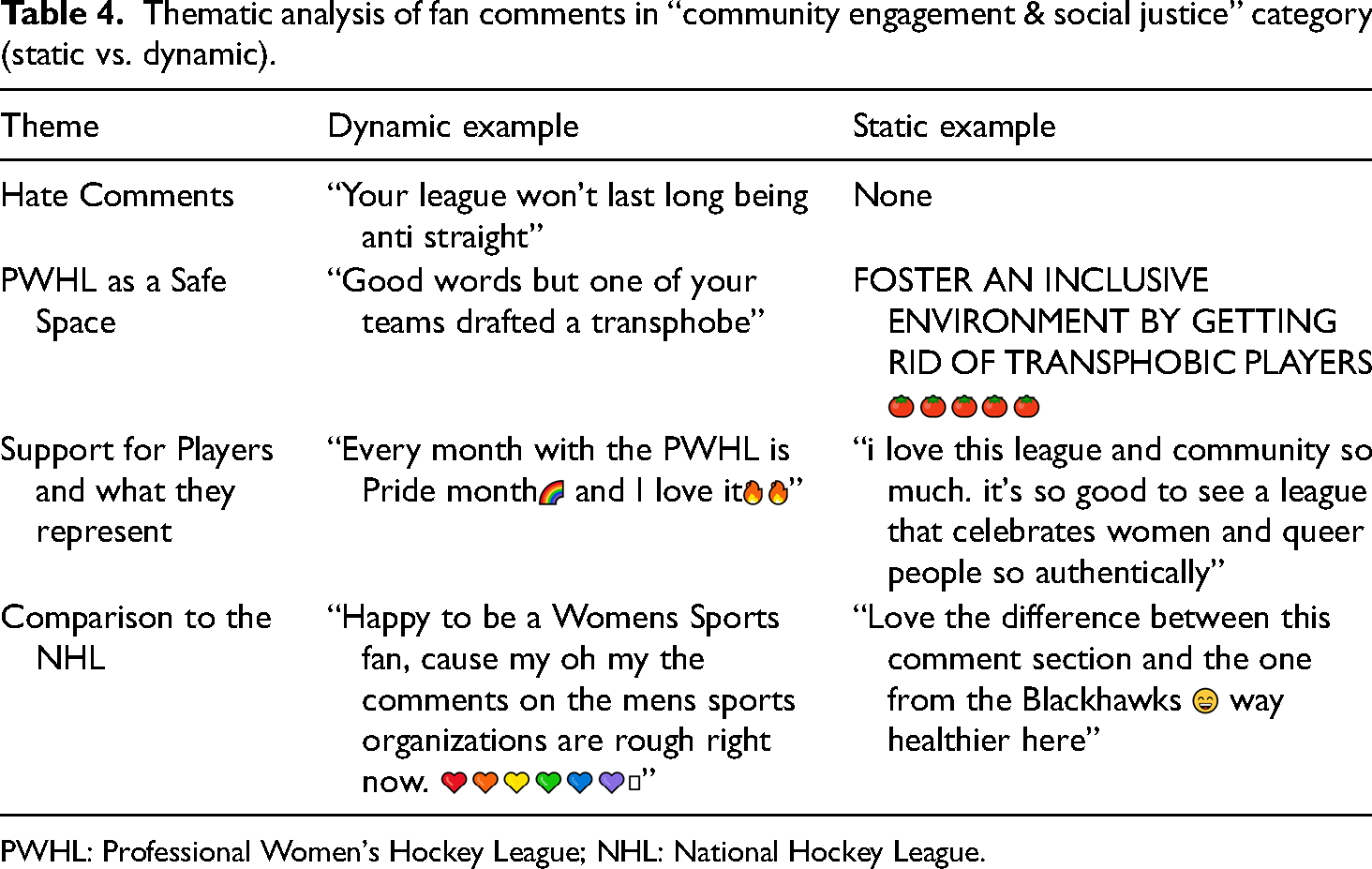
The “Community Engagement and Social Justice” category had the highest total number of likes and overall engagement. Fans demonstrated a strong positive response to posts featuring positive interactions with the community and to social justice initiatives around the league, notably LGBTQIA + pride events. Comments in this category were analyzed to distinguish between static and dynamic responses, better capturing the interactive nature of the discourse, Table 4.
Thematic analysis of fan comments in “community engagement & social justice” category (static vs. dynamic).
PWHL: Professional Women's Hockey League; NHL: National Hockey League.
By comparing the prevalence of static versus dynamic responses, we gained a deeper understanding of engagement patterns. All instances of hate comments (33% of dynamic comments in this category) were exclusively dynamic, meaning that whenever a hateful comment was posted, other users always replied, actively defending the individuals or groups targeted. Conversely, negative comments that remained static were minimal and generally pertained to a controversial draft pick or keeping politics out of hockey, rather than being directly hateful toward other people or groups. This signifies a highly self-regulating and protective community, with the fanbase actively working to maintain the “safe space” in response to negative stimuli.
In contrast, the theme that garnered the highest total number of comments across both static and dynamic categories was “Support for Players and What They Represent.” This theme accounted for 43% of static comments and 18% of dynamic comments, underscoring its importance to fans. Many of these comments expressed support for players representing underrepresented communities, with a large percentage also related to gender empowerment—mirroring comments in the “League Achievements and Legacy” category. This indicates that the PWHL's commitment to social justice and its players’ identities deeply resonate with its fanbase.
Another theme that prompted an increase in dynamic responses compared to static ones was the “PWHL as a safe space.” Comments within this theme
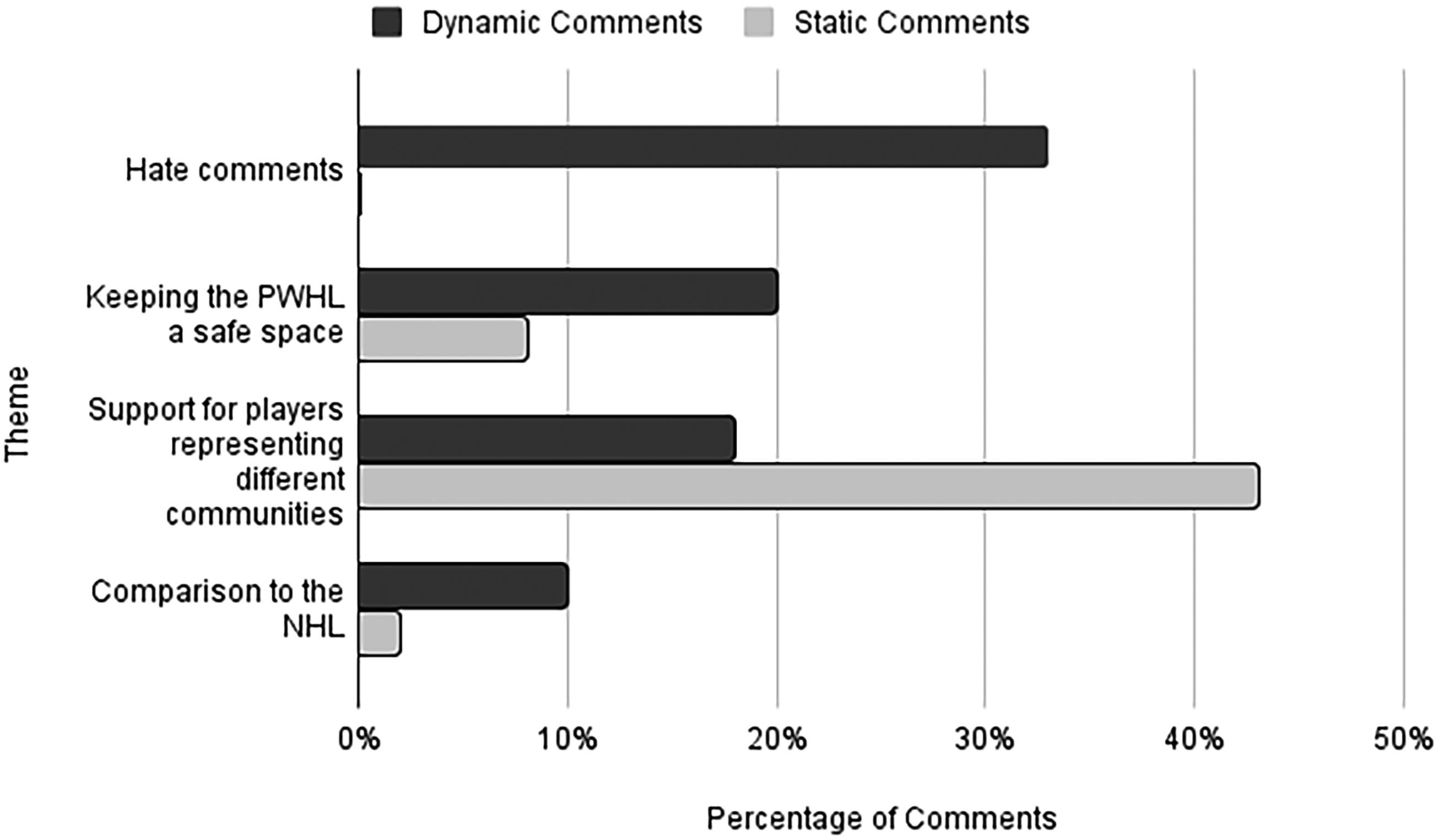
Bar graph comparing the percentage of dynamic vs static comments for each theme found in the community engagement & social justice post category.
Discussion
The success of the PWHL's inaugural season can be attributed to many factors, but its accessibility and visibility were important to fans. Unlike previous women's hockey leagues, which were less accessible to viewers, leading to a lack of awareness of game schedules and, if any, viewing options, the PWHL proactively addressed these issues through its Instagram presence. The strategic pinning of posts, such as a beginner's guide to the PWHL, current standings, and weekly schedules, demonstrates their commitment to making information easily accessible for both new and existing fans. While not all of these posts were included in our analysis, they are worth noting because they point to a different level of accessibility within the league, lowering barriers to entry for new fans, fostering interest, and providing an understanding of the league. It also provides fans with a quick and easy way to find out where to watch their teams play, making information that was once difficult to find much easier to access. Additionally, despite an increase in women's sports media coverage from 5% to 15% from 2019 to 2022, women's sports remain underreported in the media (Darvin, 2024). For many fans, there remains a disconnect, as this limited media coverage has affected the level of engagement they can have with their favourite leagues and teams (Symons et al., 2025). The PWHL seems to have addressed this need through providing league updates on their social media pages and through the acquisition of the “Jocks in Jills” podcast, which not only reports league news and scores but also interviews players to share their stories to elevate fan engagement through storytelling (Professional Women's Hockey League, 2024). Participation in storytelling, or the sharing of lived experiences, has been found to be a motivating factor for women engaging with sports media platforms (Symons et al., 2025). It is reported that sharing a wide variety of lived experiences contributes to greater feelings of inclusion, belonging, and community among fans, which was similarly detected in the PWHL posts in the “Player Profile” and “Community Engagement and Social Justice” categories.
Moreover, this study's analysis of fan comments on the PWHL's Instagram page revealed two overarching factors that stood out as defining contributors to the league's success: (1) the perception that the PWHL and its fanbase represent and stand for, more than just a game; and (2) the critical importance of sustainability in increasing success. There was an extremely high level of importance placed on social justice, as seen in comments on the PWHL Instagram page. Whether it be through strong expressions of female empowerment, collective responses to and defence against hate comments, or advocacy for the PWHL as a safe and inclusive space. The PWHL fans’ active participation in defending the league's values and holding others accountable in the comment sections demonstrates a powerful sense of unity and collective identity, creating a strong sense of belonging among fans. This strong sense of community and shared values aligns with findings in other women's sports, where fan motivation is driven by emphasizing inclusion, diversity, and community (Guest and Luijten, 2017). The presence of themes such as player empowerment and what they represent, along with gender empowerment, was highly prevalent across both analyzed categories. This demonstrates a fan culture that resonates with past research suggesting that successful women's sports leagues would thrive when their culture reflects values central to women's sports rather than trying to recreate a product similar to men's sports (Fasting, 1987). The PWHL, as a women's hockey league advocated for and fought for by the PWHPA, inherently challenges “hockeynormativity” (Ryan, 2021), which suggests hockey is dominantly white, male, and heteronormative. This opposition to dominant forms of hockey has enabled the PWHL to cultivate a unique culture deeply aligned with its players’ and fans’ beliefs 1 . As found by Guest and Luijten (2017), Portland Thorns fans (NWSL) were motivated by a hybrid of conventional and alternative models of fandom, noting that the combination of quality setting for good soccer, opportunities to support and empower women, an emphasis on inclusion and diversity and the feelings of communal emotional engagement, were key themes that contributed to fan motivation among the thorns fanbase, which as an organization had the highest attendance rates in the NWSL at the time. Similar themes were observed in our study, which found a high percentage of responses supporting and empowering women, not only as players but also as people and the communities they represent. This shows that, for many fans, the PWHL represents more than just hockey.
Themes indicating that the league provides young players with new possibilities for their future careers in sports, ones that were not possible before, and expressions of support for the league as a monumental, history-making accomplishment in women's hockey, constituted large percentages of the engagement. This is a similar finding to what Leslie-Walker and Mulvenna (2022) reported in their study on elite women's hockey, where many fans reflected back on the lack of opportunities and role models when they were young, but are now enjoying seeing players interact with young fans and the growth of the game as adults (Leslie-Walker and Mulvenna, 2022). While the PWHL is still new, its unparalleled success is proving more promising than that of past leagues, and fans seem to be responding positively. Prior to the PWHL, there was never a league where young girls could see a future for themselves, getting paid a livable wage. The PWHL, with its CBA and ability to pay players wages that eliminate the need for second jobs, has fundamentally altered this narrative. This shift is clearly reflected in fan comments, with children at games holding signs that read, “My future job is a professional hockey player.” The emergence of such aspirations, and the widespread fan commentary asking for league expansions to their cities even in the first season, are direct reflections of the league's perceived economic viability and its outpouring of success.
Additionally, the thematic analysis revealed strong connections to common psychological influences on sport fans’ attraction, including a sense of belonging, emotional release, achievement, and social connection. With fans actively defending safe spaces online, expressing the positive and electric energy experienced in the arenas, recognizing the achievements in women's hockey that the league represents, and reflecting on the strong community that has been built. These factors likely contributed to the overwhelmingly positive responses to the league and its success to date. It is the alignment between fans’ interests and the league's core principles that creates greater attachment and loyalty among PWHL fans.
Conclusion
The PWHL saw early success in its inaugural season, selling out arenas and setting various attendance records for women's hockey. It is important to note that the league enjoys much greater visibility than its predecessors, and increased fan engagement has directly contributed to higher viewership. The most dominant factor driving fan engagement in our analysis was the strong alignment between fan interests and the league's core principles. A profound sense of social justice also emerged as a unifying force among fans. This was demonstrated through high engagement on social justice related posts and through the active role fans played in holding both individuals and the league accountable in comment sections. This collective commitment to shared values, such as inclusivity and empowerment, contributed to a sense of community both inside and outside the arenas. The electric atmosphere and energy at games further reinforce this communal bond, demonstrating that the PWHL is cultivating a powerful environment where fans feel a strong sense of belonging and purpose. These factors increase engagement and lead to continued buy-in from fans, which adds to the league's sustainability. The league's commitment to these principles, as well as to livable wages for players, has also led to positive reactions from fans. This further demonstrates how alignment of values between the league and fans can foster greater feelings of community and belonging, increasing positive affect among fans and leading to higher engagement. While more research is needed on fan engagement in professional women's sports, the PWHL serves as an important example of how fan engagement can be positively affected by emphasizing values of inclusion, community, and sustainability.
Footnotes
Acknowledgements
We thank Lexi Mcleod for her contribution to the research and writing of the section on the history of women's professional sport.
Declaration of conflicting interests
The authors declared no potential conflicts of interest with respect to the research, authorship, and/or publication of this article.
Ethical considerations
There are no human participants in this article and informed consent is not required.
Funding
The authors received no financial support for the research, authorship, and/or publication of this article. (“Authors received: Significance and symbolism - Wisdom Library”)
