




Abstract
Sport mega-events such as the Olympic Games can bring both socio-economic benefits and environmental risks to hosts. While literature on the environmental impacts of mega-events has focused on contemporary capitalism and its human-centred imperatives as causal sources of environmental degradation, analysis remains relatively indifferent to how people at the scene view the outcomes of these events. Drawing upon two competing environmental ethics (anthropocentrism and ecocentrism) as conceptual tools, this paper examines how young people from the hosting areas of Pyeongchang 2018 interpret the relative significance of the developmental benefits and environmental damages. Semi-structured interviews with 15 local young people reveal three dimensions of their anthropocentric views: (a) valuing nature based on human circumstances, (b) perceiving developmental benefits as tangible but environmental impacts as distant and (c) viewing the Olympics as a means to address regional inequalities in development. Given that the predominance of anthropocentric thinking among young people derives from the region's long-standing underdevelopment, this paper argues that understanding anthropocentric views provides a crucial foundation for addressing environmental challenges. As environmental problems are inherently social and require collective action, human needs and frustrations should be considered and addressed for environmentalism to achieve meaningful impact and gain momentum in contemporary society.
Introduction
The United Nations (UN) Framework Convention on Climate Change (2020) invites the sporting sector to demonstrate climate leadership by minimising overall environmental impact and raising awareness about the need for climate action. The International Olympic Committee (IOC), among many sporting organisations across the world, is a leading body that holds initiatives to challenge environmental issues through collaboration with the UN (IOC, 2024a). However, the Olympics, their large-scale signature events, create various types of environmental impacts, such as carbon emissions (Ito et al., 2022), waste production and resource use (IOC, 1997). More particularly, the Winter Games are more likely to cause greater environmental damage than the summer editions of the Games, mainly due to facility construction that requires ecosystem manipulation (e.g., logging) (Cantelon and Letters, 2000).
The 2018 Winter Olympics, which took place in three areas (Pyeongchang, Jeongseon and Gangneung) in Gangwon Province, South Korea (hereafter Korea), also had significant environmental impacts. For instance, among the 12 competition venues, six were newly built from scratch, and the rest underwent significant improvement or expansion work. The Korean media criticised the event venues’ construction for the 17-day Olympics as environmentally damaging, noting that the facilities would emit carbon during and after the Games with no substantial offset measures in place (Kim, 2016). The construction of the Pyeongchang Olympic Sliding Centre was marked by illegal felling of trees in protected forest areas (Choi, 2014), and building the Jeongseon Alpine Centre involved clearing parts of Mount Gariwang, a forest that had been preserved for 500 years. These actions seemed in stark contrast to the Games’ environmental agenda – e.g., tackling climate change, maintaining biodiversity and the health of the ecosystem – outlined in the bid document (Lee et al., 2018).
One of the main motivations for hosting the event was the region's longing to overcome its historic economic and infrastructural underdevelopment due mainly to its geography. Situated in northeastern South Korea, Gangwon Province is mostly made up of mountains (approximately 95%) (Gangwon Province, n.d.). Environmental regulations to protect the mountainous region have hindered development 1 and business in the province, with the exception of a few industries (e.g., mining 2 and tourism), leading to limited job opportunities. In addition, as the province shares the Military Demarcation Line with North Korea, a large part of the province has been excluded from development (Kwon, 2022).
Gangwon Province had been bidding since 2003 to host the Olympics, as they were seen as an enabler of regional development that would have otherwise been impossible (Gu, 2017). Local residents and governments supported hosting largely due to the projected financial gains in the region, such as increased production impact (approximately US$3.98 billion) and employment (for 72,963 people) (Jeon, 2003). In addition, it was expected that the province would benefit from infrastructural development, such as the new construction of carriageways and high-speed train rails, called KTX (Korea Train eXpress), that connect Gangwon's counties and cities to the national capital, Seoul (Cho, 2010). After the 2018 Games, Gangwon was depicted as a beneficiary of the Games’ legacy (i.e., population influx, increased investment, etc.) (Seo, 2018), which would ultimately improve local lives.
However, local perceptions of the Olympics’ impacts remain relatively underexplored. Among local residents, young people will inevitably and enduringly experience not only the economic and social transformation, but also long-term environmental consequences. Indeed, as Corner et al. (2015: 523) pointed out, with respect to climate change, young people will likely be the most affected by ‘the legacy of decisions made by older generations’. Moreover, research suggests that young people's environmental views can be shaped by the context in which they are located (Boeve-de Pauw and Van Petegem, 2010). For these reasons, the voices of local young people are important, yet largely remain unheard. This article examines local interpretations of the environmental trade-offs by listening to young people from the host communities.
To investigate local young people's viewpoints, this study utilises the lenses of environmental ethics: ecocentrism (that nature has its own intrinsic value) and anthropocentrism (that nature holds value only when it can serve human purposes). Drawing upon these differing views, this paper addresses the following question: How do young people from the Pyeongchang 2018 Winter Olympics host areas retrospectively interpret the relative significance of the Games’ (economic) developmental contributions and environmental consequences? Analysing data from interviews with local young people, this paper demonstrates that their predominantly anthropocentric views are shaped by the region's underdevelopment, which they believe limits their quality of life and life prospects.
This paper begins by introducing the contrasting views of ecocentrism and anthropocentrism. It then reviews literature on sport environmentalism, drawing on the two conceptual tools to identify knowledge gaps. After describing the research methods, the findings/discussion sections present three dimensions in which the anthropocentric environmental views of Gangwon's young people manifest. The paper concludes by discussing the implications of the findings more broadly and arguing that, because humans commonly make sense of the world from a human-centred perspective, understanding the roots of anthropocentrism can provide a socially grounded basis for collective action, thereby making radical environmental initiatives more feasible.
Ecocentrism and anthropocentrism
While there is no universal definition of environmentalism, it is generally understood as a movement to reduce human impacts on nature (Dauvergne, 2009). However, people hold varying opinions on how environmental issues should be addressed or what should be prioritised (Dauvergne, 2009). As noted above, among various environmental ideologies, an established typology is the distinction between ‘ecocentrism’ and ‘anthropocentrism’ (Eckersley, 1992; Kortenkamp and Moore, 2001). People with an ecocentric ideology prioritise the moral consideration of nature for the intrinsic value it holds, regardless of whether it is useful to humans (Kortenkamp and Moore, 2001). In tackling environmental concerns, humans are not only able to, but also duty-bound to devote efforts to making changes (Gray et al., 2018). For ecocentrists, nature and all its constituent elements have the right not to be exploited and depleted by humans. Humans are just one part of nature.
Conversely, anthropocentrists believe that ‘there is a clear and morally relevant dividing line between humankind and the rest of nature’, since ‘humankind is the only or principal source of value’ (Eckersley, 1992: 51). Although it may not seem ecologically ideal, this assumption is understandable given the inherently self-centred nature of human existence. Anthropocentrism is literally a human(anthropo)-centred(centrism) perspective. Therefore, anthropocentrists view nature as a means to human ends and also suggest that non-humans can be used to solve human concerns, approaches which ecocentrists would regard as exploitation (Pepper, 1996). It also justifies human decisions about which aspects of nature should be protected or exploited based on human needs.
Because of such human-centredness, anthropocentrism is often misunderstood as entirely disregarding the environment. However, this seemingly anti-environmental position can lead to environmental preservation as human welfare ultimately depends on natural systems (Hayward, 1997). For instance, as climate change poses a direct threat to human welfare, people with an anthropocentric perspective would be motivated to reduce emissions because the changed climate may limit resource availability and undermine public health. In the end, most of what we know and try to protect as ‘nature’ (e.g., biosystem, water, air, etc.) is likely a result of the centuries-long human-centred transformation. However, anthropocentric motivation tends to result in concrete action only when environmental action is perceived to yield greater benefits than pursuing short-term gains (Kopnina et al., 2018). This tendency, grounded in a utilitarian view of nature, means that such evaluations may be contingent on broader social, material and institutional contexts. The next section considers how these ideologies have shaped and been reflected in scholarly discourse on the environmental aspects of sport and sport mega-events.
Sport and the environment: towards a more holistic approach
In line with growing concerns about anthropogenic climate change, scholars have increasingly worked at the intersection of sport and the environment (Lenskyj, 1998; Samuel and Stubbs, 2012; Szto and Wilson, 2023; Trendafilova et al., 2022). Among them, those with ecocentric perspectives have advocated respectful attitudes towards nature (Booth, 2024). For instance, Thorpe et al. (2021: 370) claimed that new materialist approaches recognise the agency of non-humans, opening ‘new ways of knowing human and nonhuman sporting entanglements with the environment’. That is, elements of sporting environments are not static, but function as agentic participants in human–nonhuman interactions. Another ecocentric perspective can be observed in Indigenous relationships with nature, which is based on relational principles such as ‘respect, coexistence, cooperation, honor, thanksgiving, reciprocity, balance and harmony’ (McGregor, 2004: 389). Consequently, scholars have also argued for the inclusion of Indigenous knowledge of nature within environmental discourse around the Olympics (Valiyeva et al., 2024).
In the practice of hosting sport mega-events, ecocentric ideals are rarely realised. As these events are often justified as a means of attracting capital to host areas, the anticipation of socio-economic progress frequently hinders ecocentric thinking (Giulianotti, 2016; Hall, 2012). Accordingly, several studies have challenged anthropocentric environmental discourses employed by hosts (Cantelon and Letters, 2000; Kim and Chung, 2018; Lenskyj, 1998; Millington et al., 2018). For Lenskyj (1998), the environmental discourse surrounding the Sydney 2000 Olympics reflects a light green approach, in which nature is treated instrumentally (Curry, 2011). Light green environmentalism represents a form of anthropocentrism where the consideration for non-humans depends on their relevance to human interests (Curry, 2011). In contrast, dark green ethics regard non-human beings as objects of ethical concern, allowing non-human interests to prevail over human interests. (Curry, 2011). Lenskyj (1998) criticised the Games’ environmental initiatives as driven more by concerns about public image and economic rationales – such as cost reduction and financial returns – than genuine concern for ecological well-being, suggesting that nature was valued mainly for its utility.
The instrumentalisation of nature by event organisers and host governments also manifests as managerial approaches to environmental issues. These approaches generally reframe nature as manageable by humans, often relegating it to a secondary status in the pursuit of growth. They align with eco-modernism, which posits that economic development and environmental preservation are compatible through the management of nature with increased efficiency. Eco-modernist discourses feature the belief that advanced technology can effectively address environmental issues, thereby enabling our society to continue growing (Carolan, 2004). Millington et al. (2018) argued that the eco-modernist narrative portrayed the construction of a golf course for Rio 2016 in a formerly protected area as ecological improvement, because of its environmentally considerate design (e.g., aligning construction with natural contours and increased vegetation). A similar pattern appears in Kim and Chung's (2018) analysis of Pyeongchang 2018. They pointed out that, in the preparation process for the Games, ‘scientific and technocratic discourses work to reconfigure environmental issues as more easily solvable’ (Kim and Chung, 2018: 5). The problem is that, while such eco-modernist approaches to environmental issues are presented as rational, the question of whether such approaches are genuinely eco-friendly is seldom asked (Wilson and Millington, 2013). These eco-modernist narratives fundamentally contrast with ecocentrism, which maintains that human dominance over non-humans is unjustified, even when exercised through less harmful, technology-based managerial approaches.
While organisers, media and state actors often mobilise anthropocentric environmentalism, anthropocentric thinking among the general public remains underexplored, despite some indications of its presence. For example, Yoon's (2020) study explored how residents in Jeongseon (mostly over 60), a host area of the Pyeongchang 2018 Games, came to consent to the development of an alpine ski venue, despite the environmental cost of bulldozing sections of Mount Gariwang. According to Yoon (2020: 683), having this venue in their underdeveloped town was perceived as an opportunity for overdue socio-economic development, constraining local residents’ choice to either ‘destroy nature and get the development’ they feel they ‘are due, or nothing changes’. What remains unclear is whether anthropocentric reasoning continues to shape the views of younger generations who have witnessed the development projects firsthand and are now living with their consequences.
It is also important to reconsider the framing of anthropocentrism, given its influence at practical and academic levels. As literature suggests, anthropocentric reasoning (e.g., eco-modernism) underpins how event hosts address environmental issues. However, even studies that criticise anthropocentrism may ultimately retain a human-centred perspective. For instance, Cantelon and Letters (2000), who criticised the IOC media's managerial framing of ecological disruption at Albertville 1992, also acknowledged that interventions in nature could be positive when tied to ecological improvement. Given that anthropocentric reasoning functions as an institutional norm operating at different levels, its operating conditions and consequences should be scrutinised to advance environmental politics. If we regard ecocentrism as the ideal environmentalism and anthropocentrism as inherently illegitimate, we risk overlooking the contexts and forms in which anthropocentric thinking manifests. Therefore, this paper seeks to understand young people's responses as value judgments made within lived realities, drawing upon the two conceptual tools: ecocentrism and anthropocentrism.
Methods
To capture context-specific and nuanced perspectives of young people on the 2018 Olympics’ impact, semi-structured interviews were conducted with 15 young people, including five from each host area: Pyeongchang, Jeongseon and Gangneung (see Table 1 for participant information). Purposive sampling was employed with several main inclusion criteria: people who (a) were born in or at least spent their young life (e.g., school days) in one of the host areas and consider the area their hometown, (b) still have family members there if they had moved away and (c) were in the UN's definition of the youth age group (15 to 24), during the period of the Pyeongchang 2018 Winter Olympics (9–25 February 2018) (UN, n.d.). The first and second criteria allowed responses that reflect not only the recent situations and local sentiments in participants’ hometowns but also the key area of interest in this research: namely, any environmental, urban and economic changes between the pre- and post-Games periods.
A list of interviewees.
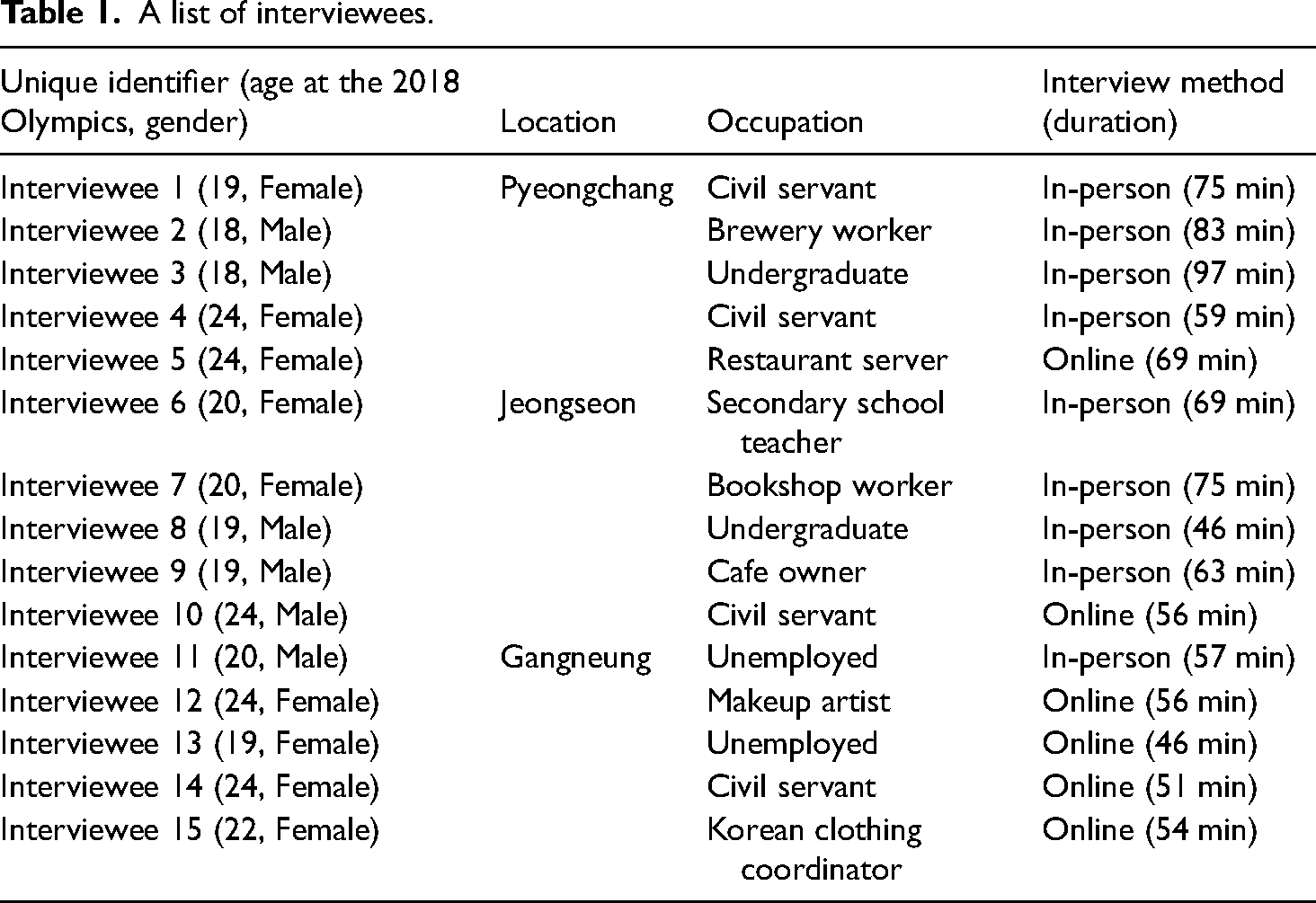
Ethics approval was obtained from the first author's affiliated institution before commencing the fieldwork. Participants were recruited in multiple ways. The initial recruitment process began with the first author's personal contact, who was born in Pyeongchang and served as a gatekeeper, introducing acquaintances from her hometown. Snowball sampling was employed to reach out to potential participants (Sparkes and Smith, 2014). When it was no longer possible to proceed with snowballing, recruitment notices were posted on each host council and city's website. It is important to note that snowball sampling was smoother in Pyeongchang and Jeongseon 3 , with populations of 40,509 and 33,761, respectively (as of July 2024), than in Gangneung, which has 208,251 residents. Accordingly, most participants from Pyeongchang and Jeongseon were recruited via referrals, whereas participants from Gangneung were reached through online recruitment posts.
The interviews were conducted from February to April 2024 across Korea, as some participants had relocated to larger cities for employment or higher education. Some participants from Pyeongchang and Jeongseon had relocated to Gangneung, the third most populous city in Gangwon Province. Of the 15 interviews conducted, 9 were in-person (at locations convenient for participants) and 6 were video calls at participants’ request (KakaoTalk or Skype). Interview questions were designed to explore how the young people: (a) perceived the benefits of development in the areas before and after the 2018 Winter Games, (b) interpreted the 2018 Olympics-related environmental impacts and related criticism and (c) considered whether the Games’ economic gains justify the environmental costs. The interviews lasted between 46 and 97 min. The audio-recorded interviews were transcribed utilising a speech-to-text converter (Clova Note), which was followed by an accuracy check by the first author.
Following Braun and Clarke's (2019) guidelines, reflexive thematic analysis was conducted to analyse the collected data. This enabled an understanding of personal experiences in relation to broader social structures and ideologies (Clarke and Braun, 2017). First, the transcripts were thoroughly reviewed. In order to identify patterns within the views held by interviewees from different areas, each interview transcript was labelled by location. Data were then inductively coded to capture the meaning that may be relevant to the research. Codes included, for instance: short-term economic impact, necessity for economic growth and development, regional economic disparities, seriousness of climate change and so on. Codes relevant to each other, such as ‘necessity for economic growth and development’ and ‘regional economic disparities’, were then clustered into the provisional theme ‘unfairness of criticising the 2018 Games’. In the process of developing codes into finalised themes, codes and themes were actively (re)interpreted in relation to this paper's research questions and the theoretical frameworks employed. In this regard, the conceptual frameworks allowed the researchers to translate the research participants’ opinions on economic development and environmental protection into various versions and variants of two environmental ideologies. Specifically, drawing upon initial interpretations of participants’ accounts as reflecting anthropocentric thinking, researchers refined the categorisation of these views into three dimensions of anthropocentrism, which ultimately became the finalised themes. Similarly, following these steps, the provisional theme ‘unfairness of criticising the 2018 Games’ was developed into the finalised theme ‘Socio-political dimension: ‘we deserve what others have’. Overall, young people largely favoured development over environmental protection.
Gangwon's young people in favour of development: harsh socio-economic conditions at play
All interviewees expressed explicitly positive views on development in the areas, which contrasts with the progressive view of many young climate leaders globally. Underneath their pro-development perspectives was a widespread sense of socio-economic underdevelopment in the region and the belief that growing up in their hometown limits life opportunities. An interviewee mentioned: ‘Every high school student's goal is to leave Jeongseon after graduation, as most of them have no choice but to leave. It is just what it is, whether your plan is to get a job or to go to university’ (Interviewee 7). The regional gap in education and job opportunities shapes their life trajectories. Gangwon Province had the highest outflow of people in their 20s among all provinces in Korea as of 2023, while a survey conducted among those who left the province revealed that 88% of respondents relocated to seek employment (Hong, 2024). An interviewee from Jeongseon suggested that the reason for the rural exodus of young people is not confined to finding jobs: When I was a kid, my dad always encouraged me to move to a bigger city after becoming an adult. He was afraid that if I stayed in Jeongseon, I’d have no idea how the real world works. Thinking back on it now, he was right. And I would say the same to my sons and daughters. Compared to big cities like Seoul, there is no good education or modern infrastructure. (Interviewee 9) At first, I wondered if hosting the Olympics would cause serious environmental destruction in our county, because environmental activists opposed the development of Mount Gariwang, but as I saw things unfold, I started thinking maybe it's not such a big deal after all. And no one in our age group talked about the environment after the Games.
The themes outlined below highlight three main ways in which participants’ anthropocentric views were manifested. As all participants supported Olympics-led development, their reasons reflect a different dimension of anthropocentrism. First, the region is too underdeveloped for them to afford to recognise the intrinsic value of nature (the ethical dimension). Second, growth and development are perceived as more tangible than environmental degradation (the perceptual dimension). Third, having long lived with subpar socio-economic conditions and limited control over nature, they come to frame development as rightful and regard environmentalist critiques of development as unfair (the socio-political dimension).
Ethical dimension: ‘our natural environment is overabundant’
Interview participants generally considered the surrounding natural environment as overabundant, suggesting that they assign value to nature based on human needs. For instance, Interviewee 10 stated, ‘We're always surrounded by mountains, like with Gariwang Mountain. Damaging one mountain didn’t really feel like a big deal’. Interviewee 2 shared a similar view by noting, ‘You’ve probably noticed on your way into town. There are mountains everywhere. Cutting a bit off here wouldn’t even make a dent’. Their responses somewhat align with the perspectives found in Yoon's (2020) research on local citizens’ pre-Games perceptions of the 2018 Games-related development in Mount Gariwang. Contrary to environmental activists’ claims, locals living near the mountain did not view its ecosystem as sacred but were instead more concerned about how the development disrupted their everyday use of the mountain (Yoon, 2020). The utilitarian view of nature persisted beyond the Olympic period.
One participant mentioned her hometown's ‘pristine’ environment, but only to emphasise its role in sustaining the local tourism economy: To be honest, the complaints about the logging are absurd [giggles]. We had some felling in our area, but with that amount, Pyeongchang is still a clean area. I often go to Seoul to hang out during weekends, and the air quality is still totally different. … But there should be no further felling. Never, ever. It's so obvious that tourists are coming to enjoy the scenery of Pyeongchang's nature, and we shouldn’t let them down. (Interviewee 1)
Ecocentrists would regard such instrumental views of nature as an ethical failure. However, to move beyond the ethical debate of right vs. wrong, it is important to understand how ethical viewpoints are formed. Ethics positions humans as principal agents of moral judgement, making human perception ‘a non-optional starting point’ for any ethical framework, including ecocentrism (Boddice, 2011: 13). This is not to deny the integrity of ecocentrism, but to highlight that individuals’ ethical standpoints can be shaped by social conditions. For those whose life opportunities are constrained, ecocentric ideals, which do not offer a vision for their future, may seem unrealistic. Natural elements, then, become resources to be negotiated, rather than sacred entities. In contrast, urban and affluent populations, who are far removed from these realities, may hold a more idealistic or romanticised relationship with nature. As Thomas (2022) noted, capitalism functions as an oppressive system that exploits both nature and people. That is, the capability to live up to ecocentric ideals is unevenly distributed across social classes. While ecocentrism tends to be regarded as an ethical ideal, its normative prescriptions can inadvertently privilege those who can afford it.
Perceptual dimension: ‘developmental benefits are close and environmental impacts are far’
Although every interviewee generally considered the environmental crisis (particularly global warming) a pressing issue, many expressed that developmental changes driven by the Olympics, particularly in transportation and road infrastructure, have been more tangible and were thus perceived as more significant.
Palpable benefits at hand
Young people highlighted two main benefits of hosting Pyeongchang 2018: urban legacy and economic legacy (IOC, 2012). Many interviewees agreed that Gangneung received the most economic benefit from the Olympics-led infrastructural development – particularly the launch of the KTX and the construction and improvement of expressways. As the coastal city had long been one of the most popular tourist destinations in Gangwon Province, the improved accessibility drew an increased influx of visitors. This led to a buoyant local economy (Choi, 2023), which was most strikingly observed in the surge in property prices: After the Olympics, Gangneung's property value has gone up in general. I bought an apartment, which was used as an athlete village during the Games, at around KR₩ 170,000,000 (approximately US$126,000), and the current price has more than doubled even though my apartment is not located in the city centre. … in a way, I think that I made a very good choice in my life. It would have taken a very long time for me to have that money by just saving. (Interviewee 12) Jeongseon is so backward that only limited medical treatment is available. Before the launch of the KTX, as far as I know, villagers used to hire a bus together to get to bigger areas for outpatient treatments, or they’d often just give up. … Actually, my mum was quite sick once. She could go regularly to a large hospital in Seoul for treatment. Every time I accompanied her as a daughter, I was just thankful that we had the KTX station. That was one of the main reasons I rented a flat near the KTX station in Seoul when I first relocated. (Interviewee 7)
A sense of distance towards environmental impacts
Despite the documentation of various environmental impacts of sporting events (e.g., carbon emissions, resource use, generation of waste, and ecosystem manipulation), most of the interviewees’ statements on the 2018 Pyeongchang Olympics’ environmental impacts were focused on tree cutting. This is perhaps because the logging in Mount Gariwang attracted and still attracts wide media attention, rendering the issue the most prominent and serious, while other types of harm were not as visually apparent and therefore less tangible.
While the cumulative effects of the ecological disruption may lead to serious consequences in the long run, interviewees only mentioned that even the tree cuttings would not affect their generation. Interviewee 8 replied, ‘I didn’t feel that loggings reduced the oxygen in the air, nor did it degrade the air quality’. Interviewee 6 also expressed that the accumulation of such environmental damages would not have an immediate effect: ‘Although it's true that we have bulldozed some parts of Mount Gariwang, we cannot actually feel any environmental impacts caused by the logging. It may be that those impacts are accumulated and affect the next generation, though’.
Perspectival anthropocentrism in social contexts
What lies at the root of their asymmetrical perception of developmental and environmental impacts is what Ferré (1994) called ‘perspectival anthropocentrism’: humans are bound to hold a human viewpoint. It means that ‘we literally can do no other than see from our own point of view’ (Ferré, 1994: 72). Therefore, any environmental change can only be accessed via human senses. Yet, we often ‘cannot see, hear, taste, touch or smell’ environmental impacts (Adam, 1998: 9), even though their consequences exist regardless of the limits of human sensory capabilities. Since the Games, environmental activists have pointed to repeated landslides on Gariwang Mountain (S. Park, 2024b). Indeed, this led to the evacuation of six local households just three months after the Olympics’ closing ceremony (Nam, 2022).
Although all humans perceive the world through similar ontological constraints, what is given urgency or neglected varies across cultures and lived experiences – hence different reactions to environmental crises across the globe. That participants viewed environmental consequences as distant suggests that their experiences of tangible development may have influenced how they interpret environmental risks. Indeed, most acknowledged that environmental damage (primarily tree cutting) had occurred in the region. This response aligns with the argument that people often remain inactive in the face of urgent ecological problems because procrastination does not significantly worsen the situation, making it ‘easy not to feel pressed’ (Andreou, 2007: 241). In this regard, interviewees perhaps chose to ignore reality, as they prioritise short-term gains. More importantly, such procrastination may continue until it is too late to restore the environmental damage (Andreou, 2007), which might explain how humans have ended up with anthropogenic climate change. This procrastination, which risks human existence, contrasts sharply with Indigenous environmentalism. For example, the Aboriginal and Torres Strait Islander communities in Australia tend to equally value economic and environmental sustainability, rather than downplaying ecological concerns in pursuit of immediate benefits (Throsby and Petetskaya, 2016). Such values lead to alternative practices that challenge the pervasive growth-oriented politics; when the Yolngu people of Eastern Arnhem Land in Australia seek economic opportunities, they also attend to maintaining their capital stocks, including lands (Throsby and Petetskaya, 2016). Essentially, they pursue economic activities as a means to ‘maintenance’ rather than ‘growth’ (Throsby and Petetskaya, 2016), representing ‘human possibility of sustainability’ (Ødemark, 2019: 3773). Taken together, interviewees’ procrastination reflects a symptom of hegemonic industrialism, which fosters ‘the expectation of an ever-growing material standard of living’ (Kidner, 2014: 472). Ultimately, in the case of local young people, human-centredness is shaped into selective recognition of the Olympics’ impacts.
Socio-political dimension: ‘we deserve what others have’
While the first and second themes demonstrate how participants perceive and assign value to nature, this sub-section turns to their assertion of developmental rights. It explores how anthropocentric reasoning emerges from the distributive injustice of developmental opportunities and environmental responsibilities.
Rightful development justifying environmental cost
For ecocentric thinkers such as Kopnina et al. (2018), the problem lies not in who is entitled to consume, but in the total amount consumed, even if social inequality is reduced in the process of redistribution. Yet, for local young people, ecocentric ideals are viewed as alien to the local realities. For many, hosting the Olympics represented not just a common development project, but an overdue correction of regional marginalisation. Thus, environmental cost was not ignored, but accepted as the price of, or a necessary evil for, catching up to bigger cities’ standard of living. Interviewee 2's remark exemplifies this point of view: Our natural environment could be compromised for the sake of development. None of it [development] would’ve happened without the Olympics. … I reckon the people kicking up a fuss about the loggings regarding the Olympics must be outsiders. I wish they would come here and see for themselves what life's like in the area where there has been no development. It wasn’t good to have negatively influenced the environment. But the road construction and having a KTX station were necessary. If we miss that kind of opportunity, we don’t know when the next will come around. Just like my parents’ house in Jeongseon, redevelopment talks have been ongoing for 20 years, but nothing has happened. (Interviewee 7)
The above statements collectively raise a revealing question: in a context where structural exclusion from development has long existed, and where the socio-economic system does not support their future, could these young people have prioritised – or even recognised – the importance of environmental sustainability? In their circumstances, enhancing the quality of their lives may be more pressing than achieving environmental sustainability, irrespective of whether the development was truly effective relative to the environmental cost. Nonetheless, since the environmental damage in the region may have global impacts, local support for development should also be considered within a broader global context. Certainly, there are socio-economically more marginalised populations worldwide which are likely to suffer more severely from the consequences of global warming, – and the pursuit of justice in the local context may inadvertently exacerbate global climate injustice.
We shouldn’t always be the ones to sacrifice
Some even expressed resentment towards criticism of the environmental impact of the 2018 Games. This was because they see environmental damage concomitant with the Olympics as marginal compared to the extent of the damage caused by other big cities’ development. Although they accept a certain degree of environmental harm, they reveal an anthropocentric perspective that the rights to capitalise on nature are unequally distributed. Indeed, one interviewee used an analogy of the hypocrisy in international climate politics: Even though the Olympics in my county have resulted in environmental damage, I don’t think the degree of degradation would’ve been greater than the degradation caused by the development of larger cities. Then, stopping the development of rural areas under the name of environmental protection is a selfish idea. People in Jeongseon shouldn’t have to live like cavemen. … We have the right to enjoy the things that people in Seoul do. It's like how the U.S. and European countries, which achieved their development by emitting carbon, now tell developing countries not to develop under the name of environmental protection. (Interviewee 1) By the way, I am not really fussed about the climate emissions from the Games. Aren’t we already emitting a crazy amount of carbon in our everyday lives? Let's say that the 2018 Olympics emitted 10 units while we emit 100 units elsewhere. … Then, it's bizarre to blame the Games only, I think. It's more logical to focus on the bigger sources of emissions. (Interviewee 11)
Reflected in these statements is a recognition that environmental responsibility falls more heavily on their already marginalised communities. This suggests that the universal application of environmental ideals may reinforce social inequalities (Stoddart et al., 2022). For instance, when environmental restrictions target high-emission vehicles, low-income individuals with older vehicles might be disproportionately affected, as they often cannot afford to purchase a new car with fewer emissions. Thus, they would criticise environmentalism as being ‘inequitable’ (Scott, 2022), particularly towards poor people, while favouring the wealthy (Wenz, 2007).
Taken together, their voices reveal how such ideals lose legitimacy in certain circumstances. Therefore, it is essential to understand why people adopt anthropocentric perspectives in developing a more inclusive and balanced approach. This may apply across local and global contexts; for instance, given the amount of emissions of developed nations so far, blaming developing countries for climate change entrenches global inequality by restricting latecomers’ use of resources (Agarwal and Narain, 2012). In a similar vein, Interviewee 9 stressed the social inequality in which the region is restricted from benefiting from its natural environment when he stated, ‘In general, Gangwon Province is making too much sacrifice.’ Reflected here is a power structure embedded in contemporary environmental discourse, which largely favours powerful regions and states while ‘kicking away the ladder’ by denying similar actions to developing regions. As Sayer (2014: 339) put it, ‘no one likes to be the sucker, making sacrifices so that others can carry on as usual’. As discussed so far, anthropocentrism is not inherently detrimental, but how it manifests is socially conditioned. In this study, anthropocentrism is viewed less as an ethical failure and more as a political voice that can highlight the unequal power structure.
Conclusion
This paper examined how young people from the Pyeongchang 2018 Winter Olympics host areas look back on the Games’ impact on (economic) development and environmental changes in the areas. Data have shown that they place greater importance on financial gains and infrastructural changes from the Games. Specifically, our analysis revealed three dimensions in which young people's anthropocentric views manifested: (a) they value nature based on human needs and experience, (b) they perceive tangible economic and developmental benefits as more directly relevant to them than environmental impacts and (c) they frame development as a means to redress socio-economic inequalities and view the access to, and exploitation of, natural resources as a legitimate strategy for development. These findings showed how young people's anthropocentrism – across its ethical, perceptual and socio-political dimensions – is shaped by social conditions.
While existing literature tends to criticise such anthropocentric ways of thinking as one of the key drivers of Olympic-related environmental issues (Lenskyj, 1998), this study highlights the merits of understanding anthropocentric perspectives in tackling environmental challenges. This is because environmental issues are not only produced but also addressed by humans, and addressing the issues requires coordination, if not consensus, among individuals with ontological and perceptual differences. In this regard, ecocentrism remains limited in terms of understanding the fact that environmentalism is fundamentally a social issue, intertwined with complex social realities such as inequalities. For example, such viewpoints are unlikely to gain local young people's sympathy as long as the structural disparities in development and access to nature remain unaddressed. Moreover, although ecocentrism offers compelling ethical claims counteracting anthropogenic climate change, when viewed in isolation, these can perpetuate unequal power relations. Thus, criticising young people for prioritising development over environmental protection, without acknowledging the social conditions that shape their largely anthropocentric assumptions, risks individualising responsibility and leaving the broader capitalist structures accelerating climate change unchallenged.
In this context, addressing social problems based on human needs does not necessarily represent environmental harm; rather, it may sometimes pave the way for ecocentrism. This is not to argue that anthropocentrism itself offers a linear progression towards structural change. Instead, this paper suggests that recognising how social conditions drive people to anthropocentrism may enable more inclusive environmental politics. This, in turn, may create conditions in which an ecocentric approach becomes more viable.
Olympic bids often seek to appeal for public support through their framing as development projects, while the subsequent delivery of the event leaves significant environmental impacts. The responses of participants indicate that hosting the Winter Olympics, which usually takes place in rural areas, can reinforce an anthropocentric mindset among local residents as they expect to receive the benefits promised in the hosting bid. This suggests the structural shaping of anthropocentric attitudes towards the Olympics – promises of development prompt local people to associate the event with human benefits, especially when they are hungry for development. In other words, the anthropocentric perspectives in this study are a result of the interplay between economically disadvantaged and growth-hungry social settings, and the potential (and promise) of the Olympics as a development project. More importantly, local young people, the emerging generation and thus an important stakeholder group, seem to be no exception. Their views reported here may be more relevant given that Pyeongchang is also being considered one of the fixed, rotating host cities of the future Winter Olympics due to global warming and the IOC's environmental agenda (IOC, 2024b; Latham-Coyle, 2023).
Sport environmentalism is an emerging field of study, with researchers predominantly focusing on how environmental damage is caused and can be prevented or mitigated in the sporting sector. Although the green tide is desirable, the unintended outcomes of universally imposing ecocentric tenets should also be considered. In this regard, the key lessons from the findings of this research are that anthropocentrism, as a conceptual tool, enables us to not only recognise how social inequalities hinder environmental thinking, but also understand the fact that it is unavoidable to consider human needs in the social process of addressing environmental concerns.
Footnotes
Declaration of conflicting interests
The authors declared no potential conflicts of interest with respect to the research, authorship, and/or publication of this article.
Ethics approval
Ethics approval was granted by Loughborough University, UK.
Funding
The authors disclosed receipt of the following financial support for the research, authorship, and/or publication of this article: This work was supported by the IOC Olympic Studies Centre [2024 PhD Students and Early Career Academics Research Grant].
