



Abstract
This article explores the production of knowledge on doping and anti-doping through the lens of the sociology of science, focusing on themes such as epistemic communities and the cumulativity of knowledge. Using a corpus of 177 scientific papers authored by 211 researchers, we examine what sociology reveals—and overlooks doping and anti-doping, identifying existing knowledge gaps and areas for further exploration. Our inquiry refines key questions: can researchers in this field be considered part of an epistemic community with shared beliefs and practices? Additionally, does knowledge produced in this domain accumulate over time? Findings highlight the fragmented nature of sociological contributions, with limited theoretical coherence, significant compartmentalization of approaches, and regional disparities concentrated in Northern Europe and North America. Clusters of researchers with shared topics and methodologies exist, but evidence of cumulative knowledge across subfields remains scarce. To address these challenges, we advocate the creation of an anti-doping observatory to catalog research, foster collaboration, and align academic contributions with institutional needs. This initiative aims to enhance both the sociology of science and the impact of anti-doping efforts.
Highlights
Social science research on doping shows limited coherence and knowledge accumulation.
Regional disparities in doping research are concentrated in Europe and North America.
Researchers form clusters by topics but lack integration across subfields.
An anti-doping observatory could catalogue research and foster interdisciplinary efforts.
The current anti-doping system has several unique characteristics. These features can be questioned, including the contingent choices made by the protagonists. Among them is the atypical status of the World Anti-Doping Agency (WADA), a private Swiss foundation funded by both the sports movement and governments. It is also noteworthy that it is UNESCO, rather than the WHO, that provides intergovernmental legitimacy to the World Anti-Doping Code (the Code), even though public health concerns are the primary justification for state intervention.
Given the specific nature of this issue, one might wonder whether research on doping and anti-doping also possesses particular characteristics. This leads to a reflective questioning of the very researchers working on this topic. In other words, we can examine both the contribution of doping and anti-doping studies to the social sciences and the contribution of sociology to the fight against doping.
This article aims to analyze academic production as the outcome of researchers’ work. This approach addresses multiple important issues. At a first level, we will attempt to identify what these disciplines say (and do not say) about doping and anti-doping. What knowledge exists, and what areas do researchers focus? These questions intersect both with scientific activity and with the needs expressed by anti-doping stakeholders, who sometimes require knowledge that calls for the involvement of social sciences. However, this engagement is very recent. Initial measures to combat doping date back to the 1920s for the sports movement and to the 1960s for public authorities. In those early years, the requests made to the academic community were addressed to physiologists, endocrinologists, biochemists, and legal experts. The first writings by social science researchers did not originate from demands within the sports world and took a critical stance, denouncing sports themselves and the institutions that organize them (Brohm, 1992), celebrating the cult of performance (Ehrenberg, 1991), 1 or analyzing practices far removed from the sporting ideal (Hoberman, 1992). Setting these early works aside, is it possible to assess the current state of knowledge?
To answer this question, it is necessary to build a corpus and explore the literature. This approach is generally shared among researchers. Our proposal, however, is somewhat different. On the one hand, it seems feasible to systematize this collection of texts by creating an observatory that could benefit both researchers and anti-doping policy stakeholders. On the other hand, we can also take this corpus as an object of study itself, thereby reflexively questioning the role of the academic world within what stakeholders sometimes refer to as the “ecosystem” of anti-doping efforts. This reflexive approach lies at the intersection of a tradition in the sociology of science that focuses on academic production because it is at the heart of scientific activity, and a “pragmatic” approach, which strives to analyze the consequences of actions—and thus, notably, the effects of scientists’ work both within the academic arena and in how their work is appropriated.
This approach seeks to examine how the actors (both scientists and those involved in the matter) explore and connect phenomena, strive to make them intelligible, question their consequences, envision futures, and work towards their realization (Chateauraynaud, 1998). In other words, it is a matter of understanding how they conduct their inquiry (Dewey, 1938) to grasp the world, while ensuring the implementation of its transformation, within a timeframe that seems relevant to them.
The creation of an observatory serves several objectives. From the standpoint of stakeholder needs, it will provide the necessary resources to quickly get up to speed on a case by drawing on its historical depth. From the perspective of the sociology of transformations, the observatory contributes to the understanding of the evolution of doping practices and the political work to regulate them.
However, in the short term, the compilation of a corpus of texts allows for a preliminary focus on the activity of a category of actors—researchers—more specifically on their output: this is what this article proposes to analyze. The aim is to identify the existence of communities or collectives, the forms of cooperation, and the product of their work, which could be used by agents involved in the anti-doping fight. This amounts to invoking the sociology of science through two concepts: epistemic community and cumulativity.
Theoretical background: The perspective of the sociology of science
This branch of sociology is rarely invoked in sports research, except by a few authors (e.g., Collinet & Terral, 2006; Terral, Collinet & Delalandre, 2009). To our knowledge, it has never been applied to doping issues. Two concepts seem particularly relevant to answer our question. The first is that of “epistemic community.” Holzner and his co-authors (Holzner, 1969; Holzner and Salmon-Cox, 1977; Holzner and Marx, 1979) defined “epistemic communities” as work communities where epistemic criteria take precedence over other interests or orientations to impose a scientific viewpoint. In the 1990s, this concept was generally applied to political organization, particularly in international relations (Adler and Haas, 1992). The concept refers to a network of professionals with recognized expertise and competence in a specific field, and a claim to authority regarding the knowledge relevant to policies (Haas, 1992). According to Haas (1992), epistemic communities have:
A common set of normative beliefs and principles that provide a value-based justification for the social actions of the community's members; Shared beliefs about causalities, derived from their analysis of practices that lead to or contribute to a central set of problems in their field, and that serve as the basis for elucidating the multiple links between possible political actions and desired outcomes; Common notions of validity—i.e., intersubjective criteria, defined internally, for weighing and validating knowledge in their area of expertise; and A common political enterprise—i.e., a set of shared practices associated with a set of problems toward which their professional competence is directed […].
This conceptualization by Haas, while pivotal in political science, has its roots in, and clarifies the link to, the “New Sociology of Science"—initiated by Fleck in 1935 (1981) with his concept of “thought collective” and by Kuhn (1962) with that of “paradigm”. This connection would later inspire, from a Latourian perspective, an approach to scientific practices (Latour and WooIgar, 1979, Latour, 1987). Akrich (2010) proposes distinguishing between the “community of practice” and the “epistemic community,” preferring the notion of “community of experience” to examine the foundation on which other exchanges are built. According to Meyer and Molyneux-Hodgson (2011), who trace and analyze all this literature, an epistemic community is a collective of people with expertise in a given field, expertise that is notably manifested through recognized skills, legitimacy, and authority in the production of knowledge. This review of questions leads us to refine our inquiry: can we consider all researchers working on doping and anti-doping efforts as part of an epistemic community? A community of experience? More specifically, can we identify common beliefs among researchers working on doping regarding the role of social sciences, causal links, the validity of statements related to shared modes of proof, and a political purpose in scientific practices? Furthermore, we must ask: Does the knowledge produced by this diverse field ultimately converge, or does it remain fragmented?
The question of the cumulativity of knowledge
Another approach in the sociology of science involves examining whether knowledge produced by the social sciences can or cannot accumulate over time within a discipline. Citing Merton, Passeron (1991: p. 364) argues that sociology does not, and cannot, take the form of cumulative knowledge, that is, knowledge organized by a theoretical paradigm that structures the accumulated knowledge. In a famous article, Abbott (2006) questions a paradox: how can we witness both the profusion of surveys and the data they generate, on the one hand, and the segmentation of knowledge into large theories that seem to oppose one another? The author's proposal is to empirically question the notion of “cumulativity” by multiplying empirical approaches across several American sociology journals, before addressing more theoretical considerations by emphasizing that cumulativity does not have the same meaning depending on researchers’ careers; what matters would be more related to the sense of building knowledge throughout their lives. It is the empirical part that could be useful in our own study, and it seems heuristic to follow this approach to trace the trajectories of citations, topics studied, and research programs. From this perspective, a relevant entry into the corpus involves identifying how a theory gains success, how a viewpoint manages to impose itself in the debate, and how an approach becomes shared. Regarding social science research on doping, it is therefore important to identify the theories, theses, and methods of analysis that persist —at least for a time— by being systematically discussed or refined.
Methodology
To this end, we constructed a corpus (see Appendix) by selecting scientific articles on doping based on specific criteria aimed at ensuring the relevance and coherence of the works examined. We chose to restrict our temporal scope to publications from 2003 to 2023. This period was deliberately selected due to significant changes in the anti-doping landscape, marked by the creation of WADA in 1999 and the publication of the Code in 2003. Although collaborations between countries and federations already existed, it was from the implementation of the Code that the process of harmonizing anti-doping regulations became effective (Hanstad, Skille & Loland, 2010). Furthermore, our temporal choice is supported by a literature review conducted by Patrick Mignon in 2002, which provides a solid foundation for understanding the scientific literature on doping up to this pivotal date.
Regarding the nature of the included works, our analysis focuses exclusively on sociological studies. We deliberately excluded psychosocial studies due to notable differences in the underlying theories and methodologies, which are specific to psychology or closely related fields. 2 Similarly, works directly addressing the prevalence of doping were excluded, as their objectives and approaches are more aligned with an epidemiological approach rather than our sociological and historical orientation (we did not find any texts directly situated within social epidemiology). 3
However, the classification of individual articles remains intrinsically debatable, as several papers lie at the boundaries between disciplines. We hesitated, for instance, about whether to include articles rooted in philosophy or ethics. We deemed it pertinent to do so when the authors’ approaches directly interrogate social processes involving actors in doping or anti-doping—for example, when they critically examine arguments put forth by WADA or the ways in which ethics are invoked.
Another criterion guiding the constitution of the corpus relates to the type of documents selected. We restricted our analysis to scientific articles published in academic journals. This decision excludes reports, commentaries, and opinion articles, even though some articles claiming a sociological approach are still marked by an “essayistic” tendency.
For the writing of this scientific article, an exhaustive search was conducted across various databases specialized in social sciences. 4 Since we intend to use a text analysis software to analyze the corpus more rigorously, we had to limit our corpus to English. The Prospero software (Chateauraynaud, 2003) is capable of analyzing corpora in English, French, Spanish, or Portuguese, but for now, it cannot work with a multilingual corpus.
Designed and developed by Francis Chateauraynaud and Jean-Pierre Charriau, the software PROSPERO© (PROgramme de Sociologie Pragmatique Expérimentale et Réflexive sur Ordinateur) was built by combining the contributions of textual statistics (frequency and multiple co-occurrence calculations), linguistics (analysis of statements and discursive sequences), artificial intelligence (reasoning and inference systems), network analysis (association and graph calculations), and cognitive sociology (study of coding and interpretation processes). It specifically allows for the analysis of the temporal dimensions of the corpus, meaning it is possible to put an entity, an argumentative form, or a critique into historical context. Moreover, it is also possible to identify, using markers, time modulations, gradational phenomena or ruptures, returns to the past, or projections into the future.
It has been used in several works in the sociology of science, particularly by analyzing publications in sports sciences as the object of study (Collinet et al., 2013), which enabled the creation of categories, 5 collections, 6 and fictional entities 7 tailored to the scientific literature. In another publication, which was based on a corpus of research reports funded by WADA as part of its Social Science Research Grant, Trabal (2014) created other concepts that helped enrich indexing strategies to describe the field of doping and anti-doping efforts. This article led to the adaptation of the software's analytical framework and the creation of additional categories, collections, and fictional entities, which will be described as we present our results.
It is with this tool and the Pajek graphing software (de Nooy, Mrvar & Batagelj, 2018) that we studied a corpus consisting of 177 texts, written by 211 authors, and published in 60 journals.
To carry out our objective, we will first examine researchers specializing in doping and anti-doping, highlighting our observations on their collaborations, their citation practices, and their formation as a social group. We will then analyze the production of knowledge in this field, questioning its cumulative nature through three axes: studies on the consumption and consumers of AAS, public policies, and issues related to the whereabouts system.
Results and discussion
Researchers on doping and anti-doping
Collaborations
This first section examines collaborations between researchers, focusing on patterns of co-authorship. Using Pajek network visualization program, we generated the graph presented in Figure 1 (see below).
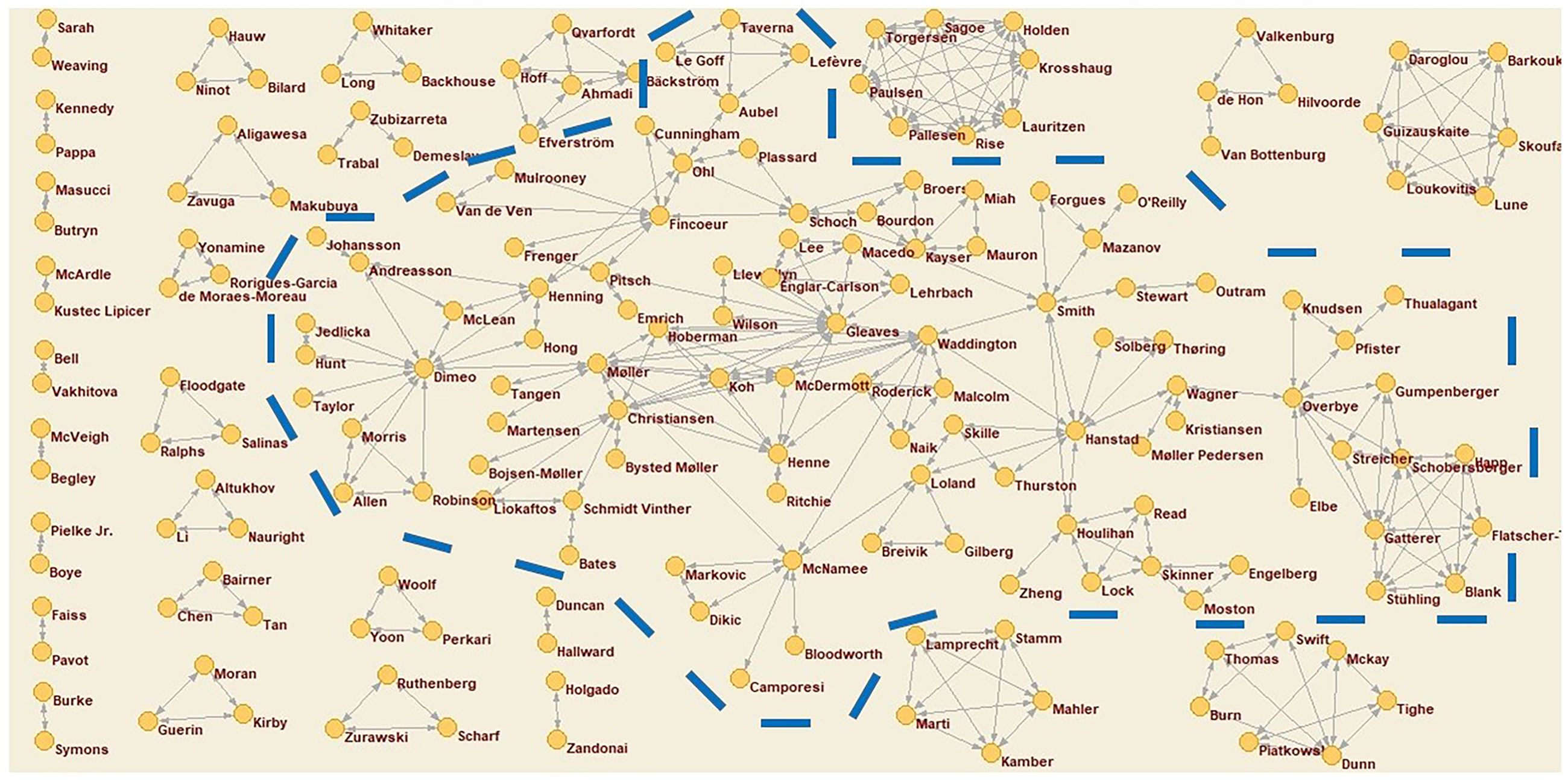
Image showing co-authorship in our corpus.
The graph maps the research groups that publish together. It shows pairs of co-authors (on the left), teams of 3 to 5 or even 6 authors who regularly publish together (with pairs emerging from this group), as well as inter-university and even international collaboration groups. They are identified by the fact that authors have their own network, but one of their connections also has a network. Researchers like McNamee collaborate with four people (Marlovic, Dikic, Comporesi, and Bloodworth) but also with two authors, Loland and Christiansen, who themselves have a well-established network. All the researchers within the space bounded by the dashed line can be considered a central core of collaborations. To access it, a researcher would only need to collaborate with a member of this space. Notably, many of these central authors are affiliated with the INDR network, an international initiative dedicated to doping research, which appears to act as a primary catalyst for these collaborations. While this graph effectively maps the formal ties of co-authorship, it can only hint at the underlying socialities and informal networks that facilitate them. A subsequent phase of this research, employing interview surveys, would be necessary to analyze the precise genesis of these collaborations and the social dynamics at play within this central core.”
Intercitation: A central group
We now turn to a different type of analysis, focusing on co-citations. The following image explores which authors are cited together within the same sentence, revealing not just direct collaborations but intellectual connections between their work. These associations often reflect shared research objects, theories, or methodologies (Figure 2).
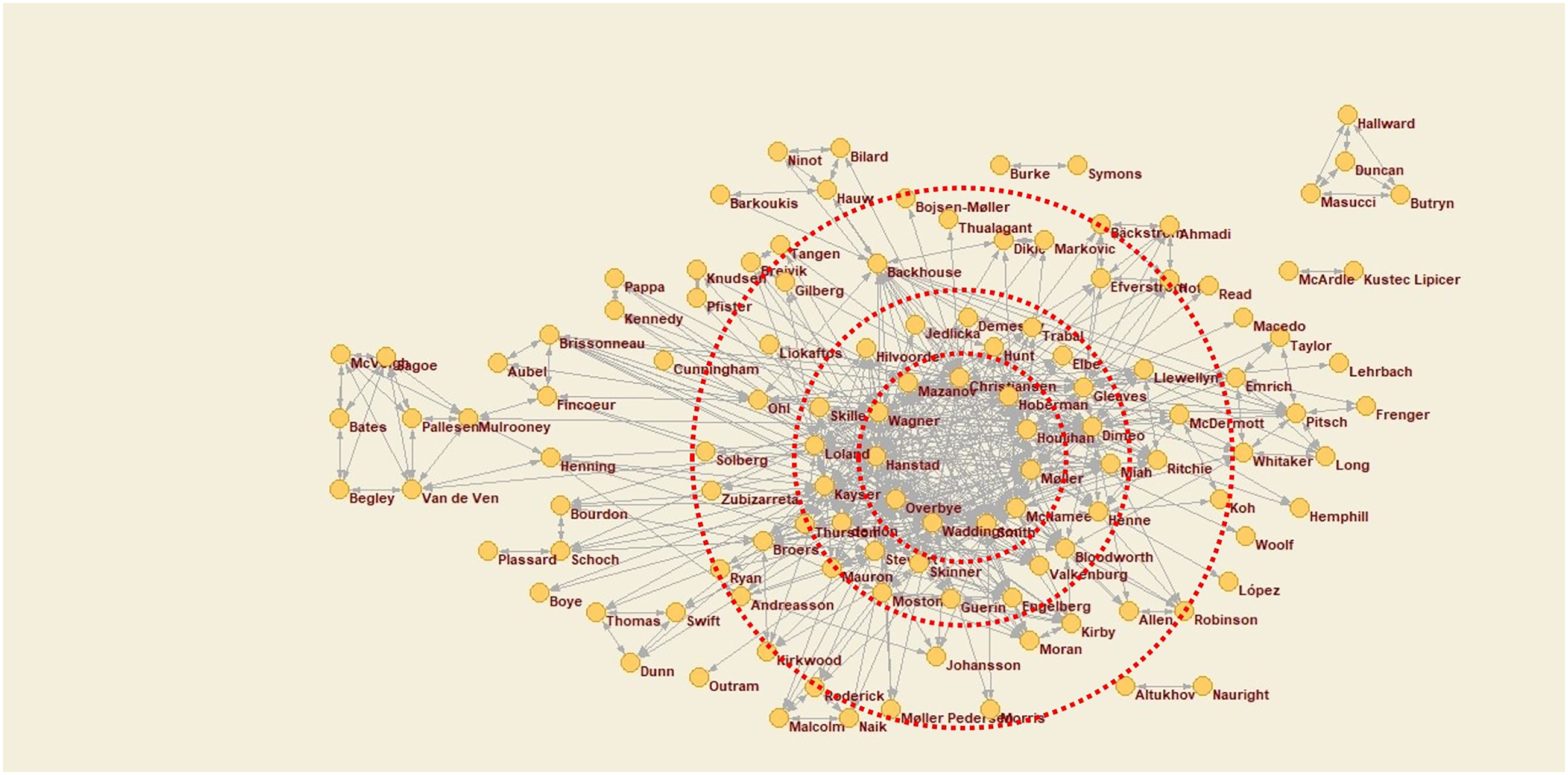
Graph showing co-citation of authors in the same sentence in our corpus.
According to the graph, to be fully recognized in this community, one must be cited in connection with researchers from the central core. The citation graph can be read as several concentric circles. The innermost circle contains authors who are almost always cited because they are linked to nearly all the others (one cannot cite an author in a statement without citing them as well). To a lesser extent, this also applies to the second and third circles. It is interesting to examine the more peripheral clusters. The lack of connection to the central core means that their citation is linked to a specific reason or is in some way detached from the contributions of other authors. Let us consider the case of Ninot, Bilard, and Hauw: these are three psychologists whose contributions are thus more marginal within a socio-historical corpus. What connects them to the other authors is Backhouse. This means that when a researcher cites the three mentioned psychologists in a statement, they also cite Backhouse, a researcher who primarily publishes in social psychology on various aspects of the anti-doping. The fact that she is cited in our corpus shows its interdisciplinary nature.
We can also look at articles that are never cited, 17 in total. One might imagine that they were published in journals that are not read by other researchers. This is not the case: by creating a sub-corpus, it is noted that the 17 articles are published in the same journals where other authors also publish: Performance Enhancement & Health (four of them), International Journal of Sport Policy and Politics (two of them), Harm Reduction Journal, International Journal of Drug Policy, etc.
If we reason in terms of authors, we note that 19% of the authors are never cited. This appears to be a significant proportion (these are authors from the corpus, which suggests that reviewers considered their contributions sufficiently interesting to be published), but it is difficult to interpret this value (we do not have comparisons with other sociological corpora). These could be young researchers, or authors who have recently published (and therefore have not yet been cited), or colleagues marginalized by the central group of popular authors who prefer to cite each other and are not particularly curious about authors who are not involved in the arenas of a community. We cannot answer these questions by studying the corpus alone. Only a survey using more traditional methodologies (interviews), could address these questions.
Epistemic community
Studying a social group attempting to build knowledge on a specific issue, requires examining what they share. Following Abbott (2006), we sought to determine whether paradigms were shared, as this allows us to question both the existence of an epistemic community and the cumulativity of knowledge (the stacking of empirical data interrogating the same models would be an interesting indicator). The lexicometric operation is relatively straightforward, because a collection of social science authors has been in place for many years, subdivided into sub-collections (“classics”, contemporary sociologists, authors of social philosophy, etc.). The main challenge lies in homonyms: for example, “Smith” can refer to a well-known and frequently cited author in the corpus (Andy Smith) but also appears in the collection of classic authors as a reference to Adam Smith, who authored “An Inquiry into the Nature and Causes of the Wealth of Nations” in 1776. Similarly, Jason Cohen is an author in the corpus, but the name “Cohen” might also refer to a contemporary American sociologist, a football player, a rugby player, or even a tennis player. We decided to exclude these names—and other potential homonyms—from the list of social science authors.
A first observation reveals that these authors are rarely cited: 22 texts in the corpus do not reference any of them. Notably, sociology seems to be reduced —at least from the perspective of theoretical underpinnings— to Foucault, Linton, Weber, Park, Hughes, Durkheim, and few more contemporary authors: Elias, Goffman, Bourdieu, and Becker. 8 Beyond the relatively low citation rates for an academic corpus focused on the social sciences, the list itself is noteworthy. When examining which authors reference these sociologists, distinct “schools of thought” emerge. It is necessary acknowledging that it is possible to draw on these traditions without explicitly citing names like Elias, Goffman, or Bourdieu. Therefore, to further explore and refine this observation, we created categories for these approaches. This involved cataloging the lexicon associated with each tradition: for Elias, terms like “configuration”, “game models”, and “complex social processes”; for interactionism, terms such as “labelling theory” and “collective action”, along with other authors tied to this perspective; and for Bourdieu, concepts like “habitus”, “social fields”, and “social hierarchy”. It is noteworthy that these traditions are predominantly employed by the same group of authors. For instance, the Eliasian approach is primarily used by authors such as Waddington, Hanstad, and Smith. Interactionism is frequently employed by Plassard, Ohl, and Fincoeur, who (along with Schoch) also extensively use the Bourdieusian perspective. Pragmatic sociology is predominantly discussed by Trabal, Demeslay, and Zubizarreta, whereas the lexicon of social philosophy is prominently featured in the works of Loland, McNamee, and Møller. Interestingly, there appears to be an “institutional effect”, as these traditions overlap significantly with university teams working on this subject (e.g., Aarhus, Oslo, Lausanne, and Nanterre).
The description of the social group's activity involves examining an essential aspect of the authors’ work: their methods of exploring reality. To this end, we used a collection developed in a previous study (Collinet et al., 2013) that catalogues the various methods employed in the social sciences. Interviews are the most frequently mentioned method, with 468 occurrences, while case studies are cited only 78 times, and questionnaires appear 39 times. The term “corpus” is referenced 30 times. In terms of methodologies, statistical methods are the most frequently mentioned, appearing 120 times, followed by content and/or discourse analysis or thematic analysis, which are cited 55 times.
These data should be interpreted cautiously, as interviews may refer to those conducted by journalists (cited by the authors), questionnaires might originate from institutions assessing compliance with normative tools, and the use of statistics could stem from analyses of data published by WADA. It is also noteworthy that historians’ approaches (archives, corpus analysis) are relatively rare. The invocation of these methods varies significantly, and distinguishing between methods genuinely employed by social science researchers and their commentary on stakeholders’ methodologies remains challenging. However, we can state that eight texts do not utilize any method from this collection.
Thus, the corpus does not truly reflect an epistemic community engaged in discussions of methodology or theory. Instead, it reveals research groups that interact to varying degrees. The question becomes whether, and on what subjects, these groups align or diverge in their pursuit of knowledge production.
Knowledge production: Can we speak of cumulativity?
While the goal of a comprehensive sociology of science work on doping and anti-doping knowledge would be to map the place occupied by specific theories and chart their systematic discussion and refinement over time, achieving this depth in analysis requires a distinct and often long-term study, which falls outside the scope of this initial work. Therefore, the present article undertakes a crucial preliminary and exploratory step towards that goal.
We approach the question of cumulativeness in two complementary ways. The first involves examining lists of entities that appear most frequently in the corpus, potentially grouping them to transcend the limitations of lexicometry by attributing them semantic meaning. This includes grouping terms based on synonymy (e.g., consolidating the various graphical forms referring to the World Anti-Doping Agency) or metonymy (e.g., grouping terms like “Law,” “Rules,” “Legal basis,” or “International treaties” under the broader category 9 of “Laws and Rights*”) to capture the set of activities they refer to. The second approach considers that researchers, like all stakeholders, possess knowledge about doping and anti-doping and can thus examine the processes structuring the stakeholders’ activities. For instance, starting with the mechanisms organized by WADA—mechanisms that, like all systems, aim to regulate environments (Foucault, 1971)—one can investigate to what extent these mechanisms engage or involve researchers.
Combining these two approaches, we can review the list of key entities that appear in the scientific articles in order to evaluate the objects that have been studied, with the particular objective of assessing the extent to which they are shared. We can also list and study the sociological theories that authors rely upon, as well as the data collection and data analysis methods that have been used.
The list of the most common entities (by number of appearences) clearly reflects the world of sports (“sport”, ATHLETES@, “performance”, THE-COACH@, COMPETITION@ 10 ), its organization (IOC@, SPORTING-MOVEMENT@), doping (“use”, “substances”, DOPING@, DRUGS@) and its effects (with references to “health*”), as well as anti-doping (DOPING-CONTROL@, “rule”, PROOF@), especially through the institutions and mechanisms organizing it (WADA@, WADC@). Part of the lexicon refers to research activities, though it is not always clear whether it pertains to the work of the authors in the corpus or to expertise requests made by anti-doping institutions.
Each of these entities could undoubtedly be the subject of more detailed study. 11 For this paper, we test the concept of cumulativeness and, simultaneously, examine the potential existence of a epistemic communities by focusing on three distinct topics: a specific category of substances (Anabolic Androgenic Steroids or AAS), an object that constitutes a disciplinary field (Public policies) and a system marked by a restriction of freedom (the Whereabouts system).
Consumption and consumers of AAS
Anabolic-androgenic steroids (AAS) occupy a significant place in the corpus. To measure their prevalence, we grouped all graphical forms referencing anabolic agents, steroids, anabolic steroids, or anabolic-androgenic steroids. However, we decided to exclude the names of specific molecules or substances (e.g., nandrolone, clenbuterol) as these indicate individual cases rather than broader discussions about consumers and the consumption of such products. This grouping revealed 1365 occurrences spread across 118 texts, which represent two-thirds of the papers of the corpus. The temporal distribution of this entity is relatively consistent, with variations tied to authors who frequently reference this subject (e.g., Christiansen et al., 2016, mention AAS in 113 times; McVeigh and Begley, 2016, 69 times). It is interesting to note that these two authors are also the most cited when discussing these substances.
The concept of “primary actor” in the Prospero software allows us identifying papers where a particular entity, in our case AAS, is one of the main focus of the text. There are 25 such texts, which we analyzed more specifically as a sub-corpus. In the earliest text (Waddington, 2003; see Figure 3 below), the discussion primarily revolves around sports medicine and the Dubin Commission (see the list in the upper right part). Notably, the study shows that when authors focus primarily on AAS, they tend to discuss anti-doping activities only marginally (see the list in the lower right part).
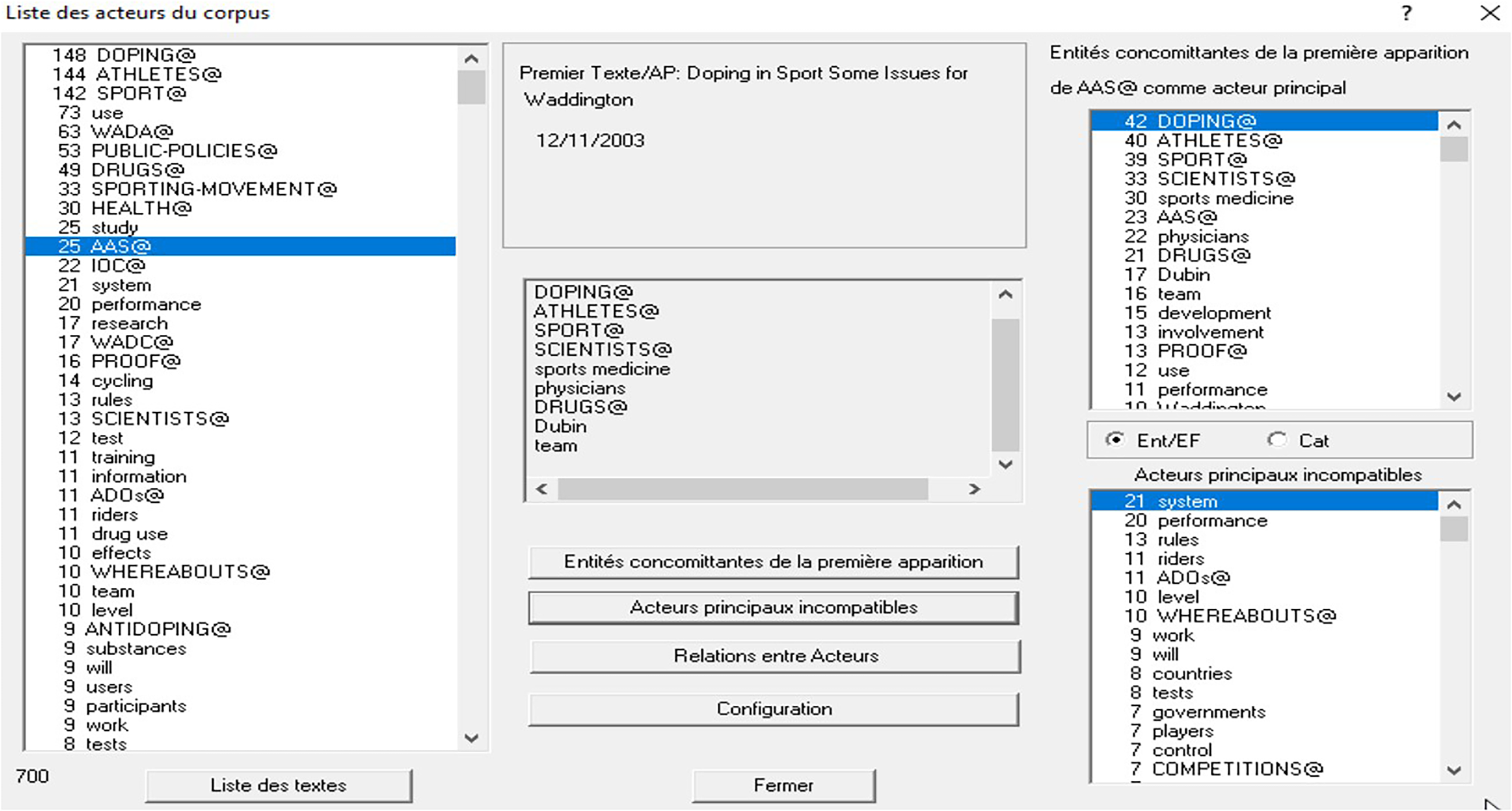
List of the network associated with the entity AAS in Waddington's (2003) paper.
We can then examine what these authors share beyond their interest in AAS. Among the 25 texts, 24 employ sociological vocabulary: 12 use a philosophical and ethical approach, 8 align with the interactionist tradition, 8 draw from a pragmatic lexicon, 6 are inspired by a Bourdieusian approach, and 3 reference an Eliasian perspective.
An epistemic community is also characterized by the sharing or discussion of methodologies. It is noteworthy that 24 of the 25 texts mention at least one method from the social sciences: the corpus references interviews 79 times, case studies 12 times, and some statistical tools. It can be inferred that the authors of this sub-corpus predominantly employ qualitative approaches, aligned with specific theoretical traditions and sociological concepts. Interestingly, most of these researchers are based at universities in Northern Europe, with their studies primarily focusing on countries in this region. In this sub-corpus, England or the United Kingdom is mentioned 86 times, Sweden 47 and Denmark 44. Predictably, English, Danish, and Swedish researchers conduct their fieldwork predominantly within their own countries, a context where public policies targeting gym-goers are already established.
What is somewhat surprising, however, is that the “political domain*” category 12 ranks only 21st in this sub-corpus (compared to 13th in the entire corpus). The relatively low significance of the category referencing politics (as well as the category indicating denunciation and critique) suggests that this group aligns more closely with a “community of sharing” or a “community of experience” (Akrich, 2010) than with an epistemic community. We argue this based on Meyer and Molyneux-Hodgson's (2011) assertion that the concept of an epistemic community is tied to either a problem that policymakers must address (which prompts the involvement of researchers to provide guidance for public action) or to criticism regarding a specific issue (when the social sciences serve as a means to challenge political matters).
Public policies
The collection of public policies appear prominently in the list of entities when ordered by occurrence. Present in 160 texts out of the 177, almost all colleagues discuss public policies (only researchers from Brazil, Uganda, and New Zealand do not mention them). When discussing public policies, the most frequently cited authors are Houlihan, Handstad, Møller, and Dimeo, and the term that appears most frequently in the social sciences lexicon is “legitimacy”. This would indicate that the most discussed issue in anti-doping policies concerns the problem of their legitimacy.
We can observe that the most important terms most often associated with public policies are sport, doping, athletes, WADA and the Code, drugs, the sporting and Olympic movement, and health. Issues related to implementation, evaluation, and development are quite prominent. It is also relevant to examine the list of countries mentioned in the same sentences as public policies (Table 1).
List of countries mentioned in the same sentence as words that form the collection Public policy.
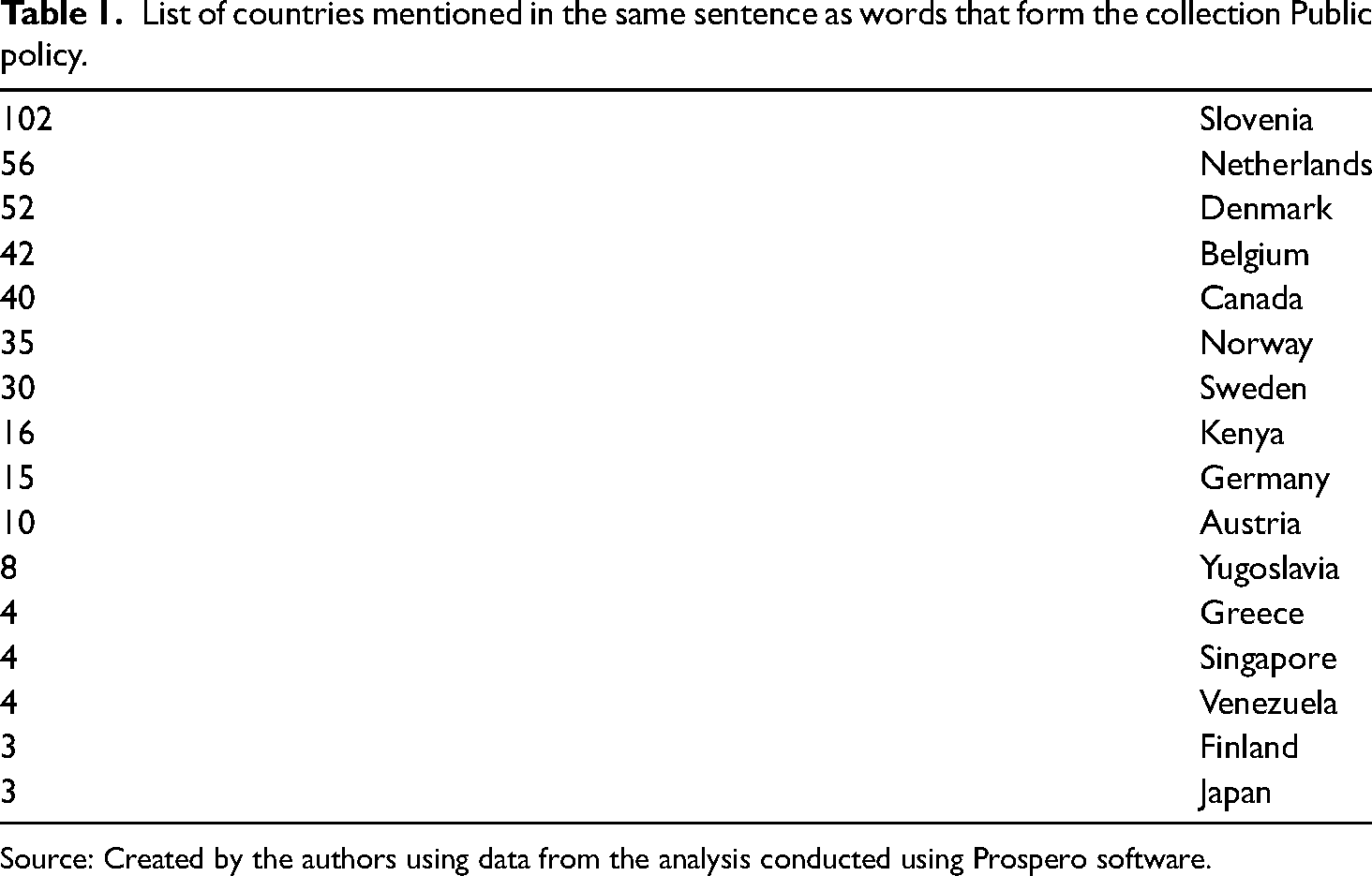
Source: Created by the authors using data from the analysis conducted using Prospero software.
The high position of Slovenia can be explained by the fact that the text, written by a Slovenian and a colleague, focuses on Slovenian anti-doping policies.
We can also examine the temporal deployment of occurrences (Figure 4).
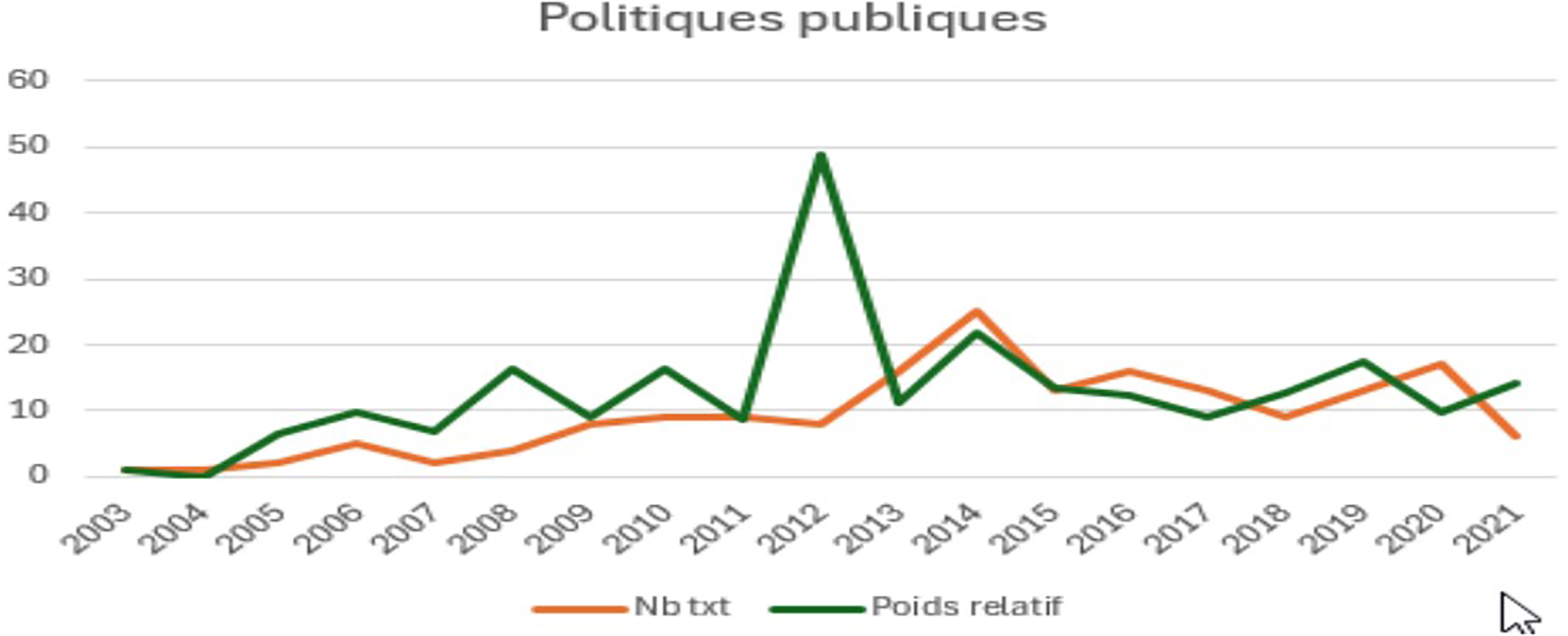
Temporal deployment of occurrences of words from the collection public policy.
It should be noted that the emergence of discussions on this topic is not linked to the introduction of the Code (although one might have expected a delay): in fact, the WADA Code is discussed globally and rarely in a specific version. The variations are more explainable by the release of a series of specialized papers on this issue, whose almost-synchronous publication seems contingent.
We can therefore consider that public policies bring together researchers over time (temporal variations seem contingent), around fairly classic concepts, drawing on European contexts (reflecting, by the way, the geographical origins of the researchers). Public policies are mostly mentioned in the corpus as contextual elements to address politics (to critique) or to relate the description to the situation marked by national anti-doping policy, or to invoke the major principles of democracy, rather than to support an analysis derived from political sociology (terms like “path dependency” appear only 4 times, the national assembly or parliament only twice). Therefore, we could argue that this does not seem to be an epistemic community truly discussing politics as a disciplinary field; it appears more as a descriptive element aimed at contextualizing the analyses produced.
Whereabouts system
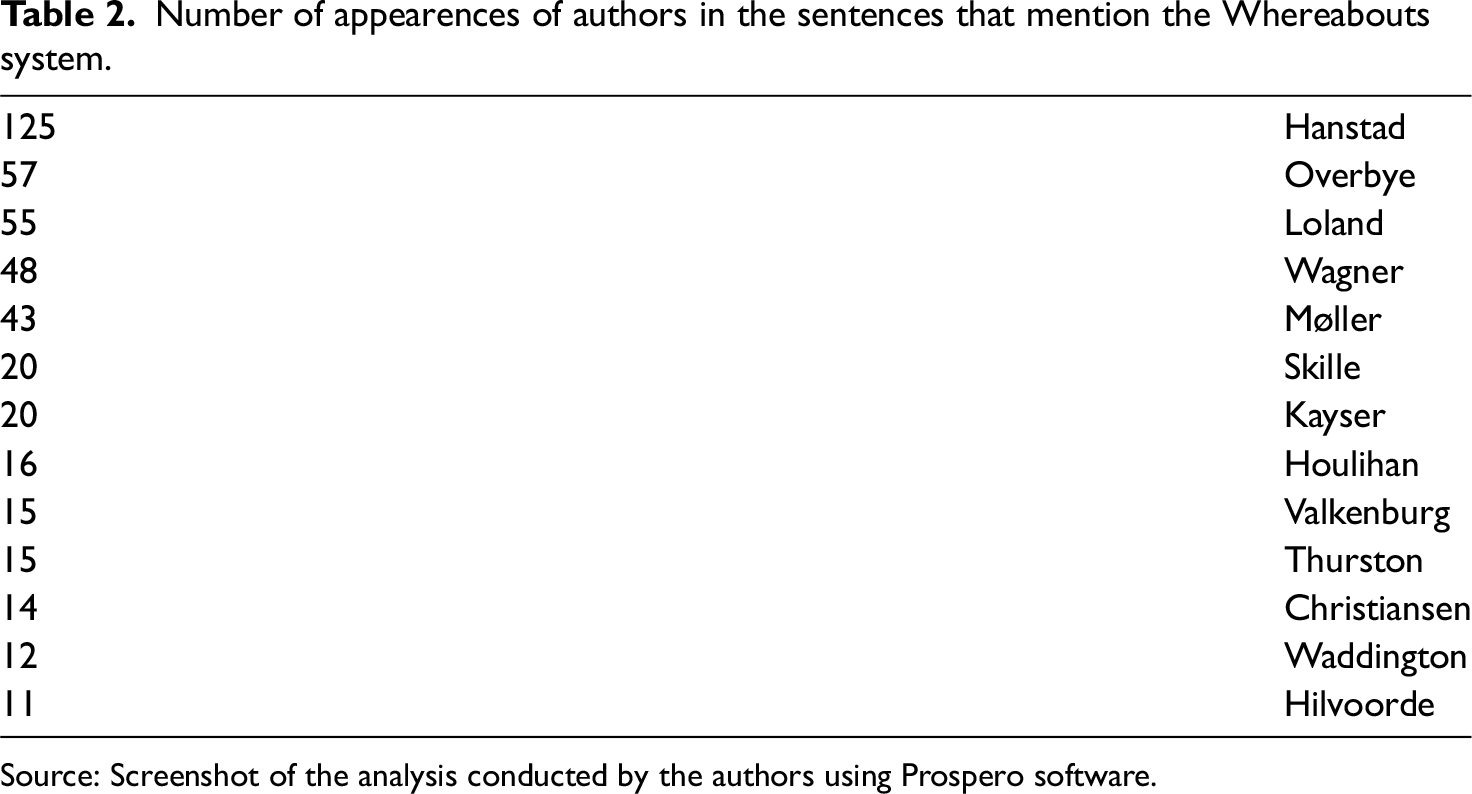
The issue of Whereabouts system is also a highly discussed topic, but here it is addressed by a small group of authors: 60 authors mention it in 63 texts. Overbye, Wagner, Valkenburg, de Hon, Hillvorde, Hanstad, Skille, and Loland are the authors who discuss it the most. They are also the most cited if we only take into consideration sentences where they appear together with Whereabouts system (Table 2).
Number of appearences of authors in the sentences that mention the Whereabouts system.
Source: Screenshot of the analysis conducted by the authors using Prospero software.
If we examine the origin of these authors writing about the Whereabouts system, we will see that five countries are significantly overrepresented (Table 3):
Countries of origin of the first authors of the papers mentioning the Whereabouts system (the number represents the total sum of mentions).
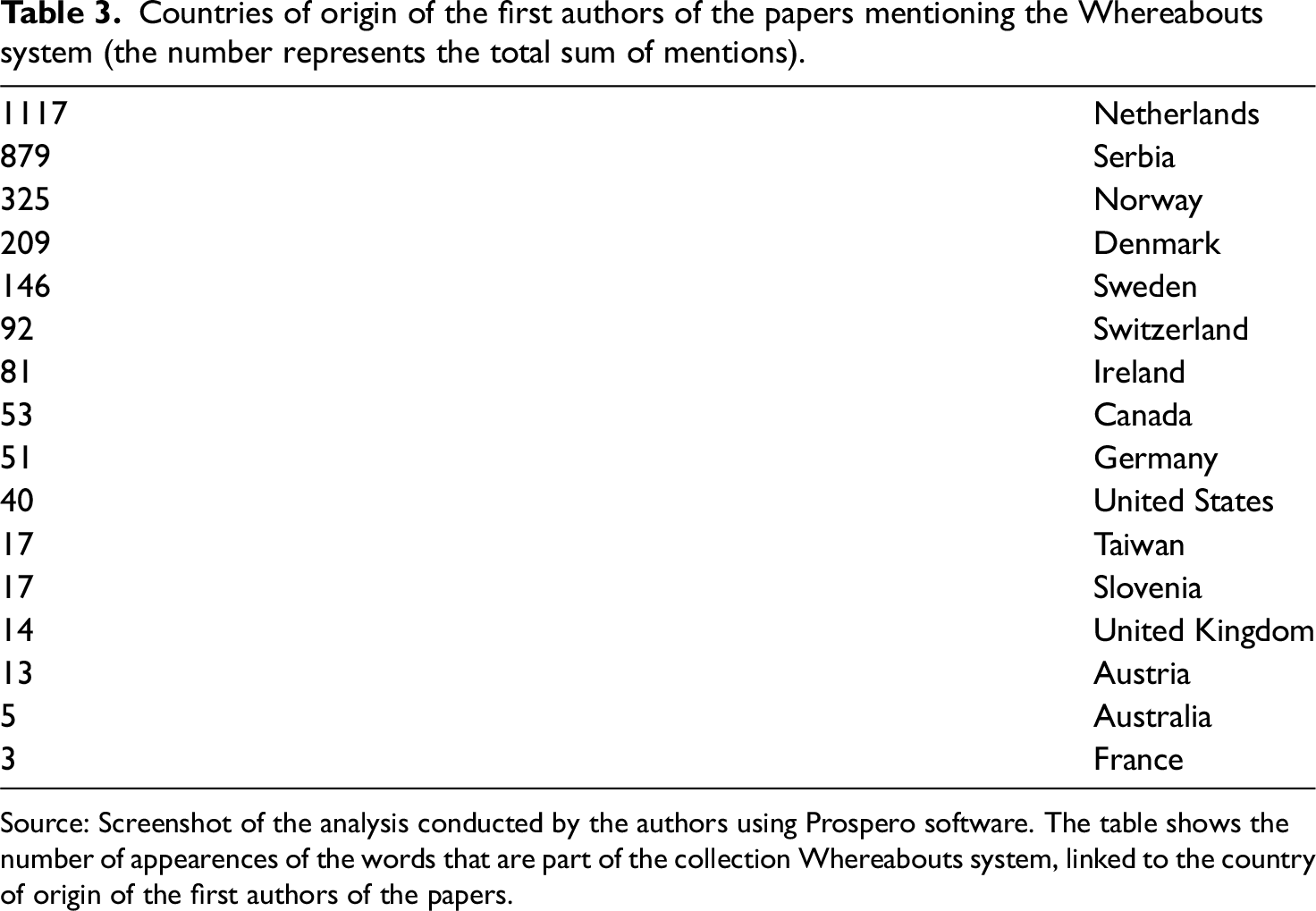
Source: Screenshot of the analysis conducted by the authors using Prospero software. The table shows the number of appearences of the words that are part of the collection Whereabouts system, linked to the country of origin of the first authors of the papers.
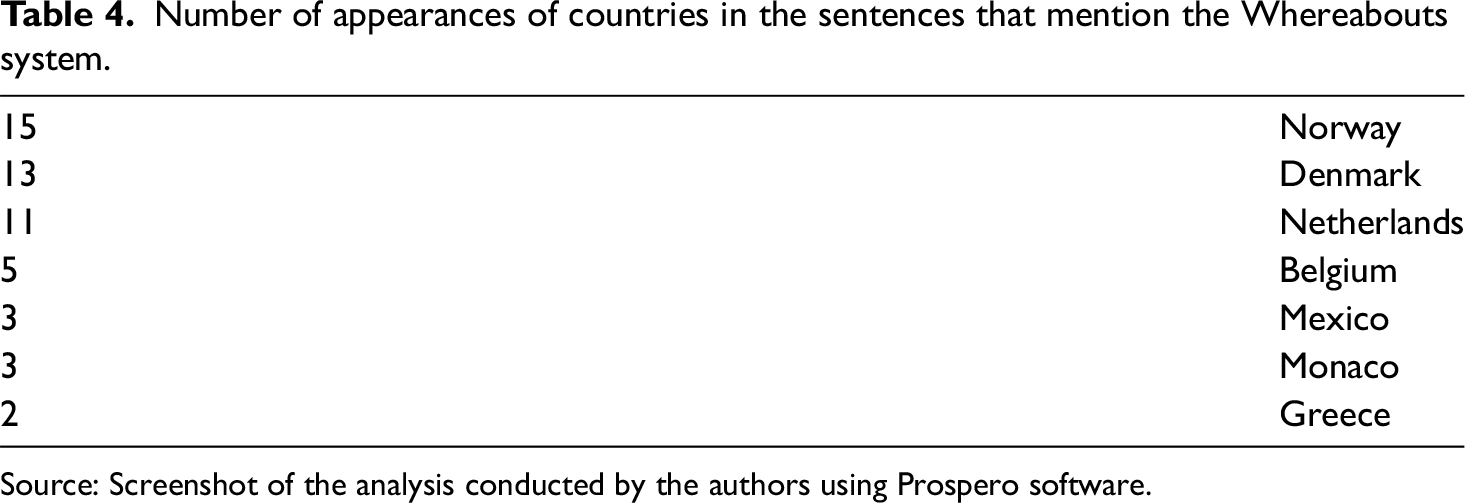
One may question this observation. Does it mean that the laws and culture in these countries are more sensitive to privacy issues? To answer this question, we can first examine whether the countries of the authors appear mentioned in the same statements as the Whereabouts system (Table 4).
Number of appearances of countries in the sentences that mention the Whereabouts system.
Source: Screenshot of the analysis conducted by the authors using Prospero software.
Three countries are notably prominent, corresponding to those hosting research centers that focus extensively on these questions. These few indicators align. A small group of researchers from a handful of countries studies this issue and is systematically cited when it is mentioned (as are the countries themselves).
We can identify the associated themes—and, indirectly, the points of discussion—when talking about the Whereabouts system. In descending order of categories influenced by the issue of the Whereabouts system, we find the categories “Testing-investigation*” in 30 texts (the majority of statements refer to the range of constraints imposed on athletes), “Construction of factuality*” in 26 texts (factuality, through descriptions of the materiality of the procedure and the elements on which it is based), “Privacy*” issues in 19 texts, the lexicon of “Social sciences*” in 15 texts (with words like attitude and legitimacy appearing most frequently), and vocabulary related to the legal domain. Curiously, the critical dimension is relatively weak, or more precisely, concentrated on a few texts.
On this theme, it is another arrangement that helps understand the researchers’ activity. A very technical system (the obligations of a small group of athletes require a precise description if one wants to understand how it works) is also very emblematic (it involves a strong restriction of freedom for this population). While a third of the texts in the corpus mention this topic, only 10 place it at the center of the article's discussions (these are the texts in which the location is a central actor). Among them, only half mention ADAMS (exactly 5 texts), the platform on which the concerned athletes must declare their whereabouts. This suggests that the group of researchers studying the Whereabouts system is a micro-community of researchers almost exclusively from Northern Europe, who work on this system, often drawing descriptions from their own countries.
Conclusion
The study of this corpus of 177 texts aimed to question the activity of researchers working on doping, which can be examined both within the framework of the sociology of science and the analysis of anti-doping efforts, as academics are among the key stakeholders.
From the perspective of the sociology of science, it should be noted that we identified 211 researchers, which is a small number globally (although we must keep in mind that we only considered English-language publications—some researchers likely work and publish in other languages). However, it is also a significant number because some of them are highly productive. It is important to note that almost all of them are from Northern Europe and North America. One might be surprised that several publications are poorly grounded in theoretical models. A portion of the texts do not reference social science literature (12% of the texts do not cite any of the classic authors in social sciences). There are many articles that present empirical data analyzed in isolation, without reference to a historical or sociological discussion.
When questioning the concept of epistemic community, it seems that the authors form more “clusters.” We can indeed identify groups of varying sizes that bring together academics who share approaches (Eliasian, Bourdieusian, interactionist, pragmatic), and topics: in Lausanne, the focus is mainly on sports institutions and cycling; in Aarhus, on consumption and consumers; in Norway, on WADA and ethics; in Nanterre, on public policies and international comparisons, etc. However, some collaborations and the circulation of researchers limit this conclusion. It is also worth noting the presence of a few very well-known (star) authors who transcend this partition and appear central in citation analysis.
We have studied some unifying topics (AAS, public policies, the question of the Whereabouts system), but it remains difficult to talk about the cumulative nature of knowledge. It can also be noted that the approaches are highly compartmentalized (AAS or the Whereabouts system are discussed, but with little reference to public policies).
All these elements suggest that there is not yet a real structure to doping research. However, further analysis is needed to examine whether certain topics or themes may be structuring; so far, we have not identified any.
This leads us to question the links between these researchers and anti-doping institutions. This question would require a more traditional investigation, with interviews or questionnaires. The analysis of research “reports” could help identify collaborations. This present analysis is less a contribution to that question than an inquiry into the role and position of social sciences. It is often criticized that these disciplines are sidelined by institutions and policymakers, and we share this criticism. However, we can also ask, in a self-critical movement, what our disciplines offer and what they can present. There is no real epistemic community, and our research remains fragmented. For this reason, we advocate the idea of an observatory that would catalogue the contributions of different research teams, present what the scientific community knows and does not know, and propose research programs aimed at structuring research. The purpose here is to suggest collaborations for this observatory, whose goal lies both in contributing to the sociology of science and in promoting our research activities to institutions.
Footnotes
Declaration of conflicting interests
The authors declared no potential conflicts of interest with respect to the research, authorship, and/or publication of this article.
Funding
The authors received no financial support for the research, authorship, and/or publication of this article.

Notes
Appendix: List of articles in the corpus

| Authors | Year of publication | Journal | Title |
|---|---|---|---|
| Allen, Morris, Dimeo, Robinson | 2017 | International Journal of Sports Science & Coaching | Precipitating or prohibiting factor: Coaches’ perceptions of their role and actions in anti-doping |
| Altukhov, Li, Nauright | 2019 | Sport in Society | Sport and doping: from WADA's monopoly to collective arrangements and new model of antidoping |
| Altukhov, Nauright | 2018 | Sport in Society | The New Sporting Cold War Implications of the Russian doping allegations for international relations and sport |
| Anderson | 2011 | The American College of Sports Medicine | Evaluating the Athlete's Claim of an Unintentional Positive Urine Drug Test |
| Andreasson, Henning | 2018 | Performance Enhancement & Health | Glocal fitness doping: Policy, practice and prevention in the United States and Sweden |
| Andreasson, Johansson | 2015 | Sport in Society | Online doping. The new self-help culture of ethnopharmacology |
| Aubel, Lefèvre, Le Goff, Taverna | 2018 | Journal of Science and Medicine in Sport | Doping risk and career turning points in male elite road cycling (2005–2016) |
| Aubel, Ohl | 2014 | International Journal of Drug Policy | An alternative approach to the prevention of doping in cycling |
| Aust, Krieger | 2018 | Journal of Qualitative Research in Sports Studies | Communicating in crisis: The International Association of Athletics Federations’ public responses to athletics’ doping crisis |
| Avsiyevich | 2017 | Bulletin of National Academy of Sciences of the Republic of Kazakhstan | The use of doping in power sports in Kazakhstan: Status of the problem and solution |
| Bates, Schmidt-Vinther | 2021 | Performance Enhancement & Health | Applying insights from implementation and intervention science to improve the evidence base on image and performance-enhancing drugs (IPEDs) interventions |
| Bilard, Ninot, Hauw | 2010 | Substance Use & Misuse | Motives for Illicit Use of Doping Substances Among Athletes Calling a National Antidoping Phone-Help Service: An Exploratory Study |
| Blank, Flatscher-Thöni, Gatterer, Happ, Schobersberger, Stühlinger | 2021 | Journal of Risk and Financial Management | Doping Sanctions in Sport: Knowledge and Perception of (Legal) Consequences of Doping—An Explorative Study in Austria |
| Bloodworth, McNamee | 2009 | International Journal of Drug Policy | Clean Olympians? Doping and anti-doping: The views of talented young British athletes |
| Bojsen-Møller, Vest Christiansen | 2009 | Scandinavian Journal of Medicine and Science in Sports | Use of performance- and image-enhancing substances among recreational athletes: A quantitative analysis of inquiries submitted to the Danish anti-doping authorities |
| Bourdon, Schoch, Broers, Kayser | 2015 | Performance Enhancement & Health | French speaking athletes’ experience and perception regarding the whereabouts reporting system and therapeutic use exemptions |
| Brissonneau | 2010 | Journal of Physical Education and Sport | Doping in France (1960–2000): American and Eastern Bloc Influences |
| Camporesi, McNamee | 2014 | Philosophy, Ethics, and Humanities in Medicine | Performance enhancement, elite athletes and anti doping governance: comparing human guinea pigs in pharmaceutical research and professional sports |
| Christiansen | 2014 | Sport in History | The Legacy of Festina: Patterns of Drug Use in European Cycling Since 1998 |
| Christiansen, Bojsen-Møller | 2012 | Performance Enhancement & Health | “Will steroids kill me if I use them once?” A qualitative analysis of inquiries submitted to the Danish anti-doping authorities |
| Christiansen, Bysted Møller | 2016 | Performance Enhancement & Health | Who is more skilful? Doping and its implication on the validity, morality and significance of the sporting test |
| Christiansen, Gleaves | 2014 | Performance Enhancement & Health | What do the humanities (really) know about doping? |
| Christiansen, Schmidt-Vinther, Liokaftos | 2016 | Drugs: Education, Prevention and Policy | Outline of a typology of men's use of anabolic androgenic steroids in fitness and strength training environments |
| de Hon, Van Bottenburg | 2017 | Substance Use & Misuse | True Dopers or Negligent Athletes? An Analysis of Anti-Doping Rule Violations Reported to the World Anti-Doping Agency 2010–2012 |
| Dikic, Samardzic-Markovic, McNamee | 2011 | German Journal of Sports Medicine | On the Efficacy of WADAs Whereabouts Policy: Between Filing Failures and Missed Tests |
| Dimeo | 2016 | Performance Enhancement & Health | The myth of clean sport and its unintended consequences |
| Dimeo, Taylor | 2013 | Drugs: Education, Prevention & Policy | Monitoring drug use in sport: The contrast between official statistics and other evidence |
| Dunn, Thomas, Swift, Burn | 2010 | International Journal of Drug Policy | Drug testing in sport: The attitudes and experiences of elite athletes |
| Efverström, Ahmadi, Hoff, Bäckström | 2016 | International Journal of Sport Policy and Politics | Anti-doping and legitimacy: an international survey of elite athletes’ perceptions |
| Efverström, Bäckström, Ahmadi, Hoff | 2016 | Performance Enhancement & Health | Contexts and conditions for a level playing field: Elite athletes’ perspectives on anti-doping in practice |
| Elbe, Overbye | 2013 | International Journal of Sport Policy and Politics | Urine doping controls: the athletes’ perspective |
| Engelberg, Moston, Skinner | 2014 | Sport Management Review | The final frontier of anti-doping: A study of athletes who have committed doping violations |
| Englar-Carlson, Gleaves, Macedo, Lee | 2016 | Performance Enhancement & Health | What about the clean athletes? The need for positive psychology in anti-doping research |
| Faiss, Pavot | 2020 | Frontiers in Sports and Active Living | Examining the Current and Future Scientific Field of Antidoping Cheaters Should Never Win |
| Fincoeur, Cunningham, Ohl | 2018 | Performance Enhancement & Health | I am a poor lonesome rider. Help! I could dope |
| Fincoeur, Frenger, Pitsch | 2014 | Performance Enhancement & Health | Does one play with the athletes’ health in the name of ethics? |
| Fincoeur, Henning, Ohl | 2020 | Performance Enhancement & Health | Fifty shades of grey? On the concept of grey zones in elite cycling |
| Fincoeur, Van de Ven, Mulrooney | 2014 | Trends in Organized Crime | The symbiotic evolution of anti-doping and supply chains of doping substances: how criminal networks may benefit from anti-doping policy |
| Forgues, Mazanov, Smith | 2017 | Performance Enhancement & Health | The paradox of human milk doping for anti-doping |
| Gatterer | 2020 | Performance Enhancement & Health | The status quo before the International Standard for Education: Elite adolescent athletes’ perceptions of anti-doping education |
| Gatterer, Gumpenberger, Overbye, Streicher, Schobersberger, Blank | 2019 | Journal of Sport and Health Science | An evaluation of prevention initiatives by 53 national anti-doping organizations: Achievements and limitations |
| Gilberg, Breivik, Loland | 2007 | Sport in Society | Anti-doping in Sport: The Norwegian Perspective |
| Gleaves | 2010 | Sport, Ethics and Philosophy | No Harm, No Foul? Justifying Bans On Safe Performance-Enhancing Drugs |
| Gleaves | 2014 | The International Journal of the History of Sport | Manufactured Dope. How the 1984 US Olympic Cycling Team Rewrote the Rules on Drugs in Sports |
| Gleaves | 2017 | The American Journal of Bioethics | Biometrics and Antidoping Enforcement in Professional Sport |
| Gleaves | 2018 | The American Journal of Bioethics | Where's the Merit in That? Limits to Employing the Natural in Antidoping Ethics |
| Gleaves, Christiansen | 2019 | International Journal of Sport Policy and Politics | Athletes’ perspectives on WADA and the code: a review and analysis |
| Gleaves, Llewellyn | 2013 | The International Journal of the History of Sport | Sport, Drugs and Amateurism: Tracing the Real Cultural Origins of Anti-Doping Rules in International Sport |
| Hallward, Duncan | 2016 | Journal of Applied Sport Psychology | A Qualitative Exploration of Athletes’ Past Experiences With Doping Prevention Education |
| Hanstad | 2008 | European Sport Management Quarterly | Drug Scandal and Organizational Change within the International Ski Federation: A Figurational Approach |
| Hanstad, Houlihan | 2014 | International Journal of Sport Policy and Politics | Strengthening global anti-doping policy through bilateral collaboration: the example of Norway and China |
| Hanstad, Loland | 2009 | European Journal of Sport Science | Elite athletes’ duty to provide information on their whereabouts: Justifiable antidoping work or an indefensible surveillance regime? |
| Hanstad, Skille, Loland | 2010 | Sport in Society | Harmonization of Anti-Doping Work: Myth or Reality ? |
| Hanstad, Skille, Thurston | 2009 | Lucius & Lucius | Elite Athletes’ Perspectives on Providing Whereabouts Information: A Survey of Athletes in the Norwegian Registered Testing Pool |
| Hanstad, Smith, Waddington | 2008 | International Review for the Sociology of Sport | The Establishment of the World Anti-Doping Agency |
| Hanstad, Waddington | 2009 | Perspectives in Public Health | Sport, health and drugs: a critical re-examination of some key issues and problems |
| Hemphill | 2009 | Sport in Society | Performance enhancement and drug control in sport: ethical considerations |
| Henne | 2010 | Political and Legal Anthropology Review | WADA, the Promises of Law and the Landscapes of Antidoping Regulation |
| Henne, Koh, McDermott | 2013 | Performance Enhancement & Health | Coherence of drug policy in sports: Illicit inclusions and illegal inconsistencies |
| Henning | 2014 | Surveillance and Society | (Self-)Surveillance, Anti-Doping, and Health in Non-Elite Road Running |
| Henning | 2016 | Drugs: Education, Prevention and Policy | Challenges to promoting health for amateur athletes through anti-doping policy |
| Henning, Andreasson | 2019 | Communication & Sport | “Yay, Another Lady Starting a Log!”: Women's Fitness Doping and the Gendered Space of an Online Doping Forum |
| Henning, Dimeo | 2015 | Performance Enhancement & Health | The complexities of anti-doping violations: A case study of sanctioned cases in all performance levels of USA cycling |
| Henning, Dimeo | 2015 | Drugs: Education, Prevention and Policy | Questions of fairness and anti-doping in US cycling: The contrasting experiences of professionals and amateurs |
| Henning, Dimeo | 2019 | International Journal of Drug Policy | The new front in the war on doping: Amateur athletes |
| Henning, McLean, Andreasson, Dimeo | 2020 | International Journal of Drug Policy | Risk and enabling environments in sport: Systematic doping as harm reduction |
| Hoberman | 2014 | Performance Enhancement & Health | How much do we (really) know about anti-doping education? |
| Hoff | 2012 | Performance Enhancement & Health | Doping, risk and abuse: An interview study of elite athletes with a history of steroid use |
| Hong, Henning, Dimeo | 2020 | Performance Enhancement & Health | Life after doping—A cross-country analysis of organisational support for sanctioned athletes |
| Houlihan | 2012 | Taylor & Francis Group in European Sport Management Quarterly Repository | Sport policy convergence: a ramework for analysis |
| Houlihan | 2013 | Sport Management Review | Achieving compliance in international anti-doping policy: An analysis of the 2009 World Anti-Doping Code |
| Houlihan, Bloyce, Smith | 2014 | International Journal of Sport Policy and Politics | Developing the research agenda in sport policy |
| Houlihan, Hanstad | 2018 | International Journal of Sport Policy and Politics | The effectiveness of the World Anti-Doping Agency: developing a framework for analysis |
| Houlihan, Zheng | 2014 | International Journal of Sport Policy and Politics | Small states: sport and politics at the margin |
| Hunt, Dimeo, Jedlicka | 2012 | Performance Enhancement & Health | The historical roots of today's problems: A critical appraisal of the international anti-doping movement. |
| Hyun | 2016 | East Asian Science, Technology and Society: An International Journal | Asians-a Doping-Friendly Race? Antidoping Research and Popular Discourse on Race in the Postgenomic Era |
| Jessica K. Foschi | 2006 | Duke Journal of Comparative & International Law | A constant battle: The evolving challenges in the interational fight against doping in sport |
| Johnson, Butryn, Masucci | 2013 | Sport in Society | A focus group analysis of the US and Canadian female triathletes’ knowledge of doping |
| Kayser | 2020 | Performance Enhancement & Health | Why are placebos not on WADA's prohibited list? |
| Kayser, Mauron, Miah | 2007 | BMC Medical Ethics | Current anti-doping policy: a critical appraisal |
| Kayser, Smith | 2006 | BMJ | Globalisation of anti-doping: the reverse side of the medal |
| Kirby, Moran, Guerin | 2011 | International Journal of Sport Policy and Politics | A qualitative analysis of the experiences of elite athletes who have admitted to doping for performance enhancement |
| Kirkwood | 2014 | Quest | Considering Harm Reduction as the Future of Doping Control Policy in International Sport |
| Kondo | 2006 | Sport in Society | The Japanese Debate Surrounding the Doping Ban: The Application of the Harm Principle |
| Krieger | 2016 | Performance Enhancement & Health | Intended. Underrated. Disputed. The IOC Medical Commission's “Subcommission on Doping and Biochemistry in Sport” between 1980 and 1988 |
| Krugers, van Bottenburg | 2021 | International Journal of Sport Policy and Politics | Sample collection as a social process: the influence of interaction between doping control officers and athletes on the implementation of anti-doping policy |
| Kustec Lipicer, McArdle | 2012 | International Journal of Sport Policy and Politics | National law, domestic governance and global policy: a case study of antidoping policy in Sl |
| Llewellyn, Gleaves, Wilson | 2015 | The International Journal of the History of Sport | The historical legacy of the 1984 Los Angeles Olympic Games |
| Loland, Hoppeler | 2011 | European Journal of Sport Science | Justifying anti-doping: The fair opportunity principle and the biology of performance enhancement |
| Loland, McNamee | 2019 | International Journal of Sport Policy and Politics | The ‘spirit of sport’, WADAs code review, and the search for an overlapping consensus |
| López | 2011 | Sport in History | The Invention of a ‘Drug of Mass Destruction’: Deconstructing the EPO Myth. |
| López | 2012 | International Review for the Sociology of Sport | Creating fear : The social construction of human Growth Hormone as a dangerous doping drug |
| López | 2013 | International Journal of Sport Policy | Creating fear: the ‘doping deaths’, risk communication and the anti-doping campaign |
| López | 2017 | Drugs: Education, Prevention and Policy | From needle phobia to doping phobia: Can the fear of injections help us understand anti-dopism? |
| Macedo, Englar-Carlson, Lehrbach, Gleaves | 2017 | Sport, Ethics and Philosophy | Moral Communities in Anti-Doping Policy: A Response to Bowers and Paternoster |
| Malcolm, Waddington | 2006 | International Review of Modern Sociology | The use of performance- enhancing drugs in European Football |
| Malcolm, Waddington | 2008 | Soccer and Society | No systematic doping in Football: Critical review |
| Marie Overbye | 2017 | International Journal of Drug Policy | An (un)desirable trade of harms? How elite athletes might react to medically supervised ‘doping’ and their considerations of side-effects in this situation |
| Martensen, Moller | 2016 | Drugs: Education, Prevention and Policy | More money – better anti-doping? |
| Masucci, Butryn, Johnson | 2019 | Performance Enhancement & Health | Knowledge and perceptions of doping practices and anti-doping education among elite North American female triathletes |
| Mazanov | 2009 | Sport in Society | Towards a social science of drugs in sport |
| Mazanov, O'Reilly | 2014 | International Journal of Drug Policy | The Implications of Anti-Doping on High Performance Sport Human Resources Management |
| McNamee | 2012 | Asian Bioethics Review | The Spirit of Sport and the Medicalisation of Anti-Doping:Empirical and Normative Ethics |
| McNamee, Tarasti | 2010 | Journal of Medical Ethics | Juridical and ethical peculiarities in doping policy |
| McVeigh, Begley | 2016 | Drugs: Education, Prevention and Policy | Anabolic steroids in the UK: an increasing issue for public health |
| Burke, Symons | 2015 | Journal of the Phylosophy of Sport | Anti-doping policies and the Gay Games: Morgan's treatment-enhancement distinction in action |
| Møller | 2013 | The International Journal of the History of Sport | Who Guards the Guardians? |
| Møller | 2016 | Performance Enhancement & Health | The road to hell is paved with good intentions—A critical evaluation of WADA's anti-doping campaign |
| Møller, Dimeo | 2013 | International Journal of Sport Policy and Politics | Anti-doping – the end of sport |
| Moston, Engelberg, Skinner | 2014 | International Journal of Sport Policy and Politics | Athletes’ and coaches’ perceptions of deterrents to performance-enhancing drug use |
| Muwonge, Zavuga, Aligawesa, Makubuya | 2017 | Journal of the International Society of Sports Nutrition | Nutritional supplement practices of professional Ugandan athletes: a crosssectional stud |
| Ohl, Fincoeur, Schoch | 2020 | Cultural Sociology | Fight Against Doping as a Fight Againt Social Performance: The Case of the 2015–2016 Russian Anti-Doping Crisis |
| Ohl, Schoch, Fincoeur | 2020 | International Review for the Sociology of Sport | The toxic doxa of “clean sport” and IOC's and WADA's quest for credibility |
| Outram, Stewart | 2015 | International Journal of Drug Policy | Condemning and condoning: Elite amateur cyclists’ perspectives on drug use and professional cycling |
| Overbye | 2015 | Sport Management Review | Doping control in sport: An investigation of how elite athletes perceive and trust the functioning of the doping testing system in their sport |
| Overbye, Knudsen, Pfister | 2013 | Performance Enhancement & Health | To dope or not to dope: Elite athletes’ perceptions of doping deterrents and incentives |
| Overbye, Wagner | 2013 | International Journal of Sport Policy and Politics | Experiences, attitudes and trust: an inquiry into elite athletes’ perception of the whereabouts reporting system |
| Overbye, Wagner | 2013 | International Journal of Drug Policy | Between medical treatment and performance enhancement: An investigation of how elite athletes experience Therapeutic Use Exemptions |
| Pappa, Kennedy | 2012 | International Review for the Sociology of Sport | It was my thought… he made it a reality: Normalization and responsibility in athletes’ accounts of performanceenhancing drug use |
| Park | 2005 | Cultural Studies - Critical Methodologies | Governing Doped Bodies: The world Anti-Doping Agency and the Global Culture of Surveillance |
| Pitsch | 2009 | European Journal of Sport Science | “The science of doping” revisited: Fallacies of the current anti-doping regime |
| Pitsch | 2014 | Performance Enhancement & Health | Tacit premises and assumptions in anti-doping research |
| Pitsch, Emrich | 2011 | International Review for the Sociology of Sport | The Frequency of Doping in Elite Sport - Results of a Replication Study. |
| Pitsch, Gleaves | 2020 | Sport, Ethics and Philosophy | If You’re Not First, You’re Last: Are the Empirical Premises Correct in the Ethics of Anti-Doping? |
| Plassard, Ohl, Schoch | 2020 | International Review for the Sociology of Sport | Cycling alone: team Sky's difficult quest for credibility during the 2015 Tour de France |
| Qvarfordt, Ahmadi, Bäckström, Hoff | 2019 | Sport in Society | Limitations and duties: elite athletes’ perceptions of compliance with anti-doping rules |
| Qvarfordt, Hoff, Backstrom, Ahmadi | 2019 | Performance Enhancement & Health | From fighting the bad to protecting the good: legitimation strategies in WADA's athlete guides |
| Read, Skinner, Lock, Houlihan | 2020 | Performance Enhancement & Health | Balancing mission creep, means, effectiveness and legitimacy at theWorld Anti-Doping Agency |
| Ritchie | 2014 | Performance Enhancement & Health | The construction of a policy: The World Anti-Doping code's “spirit of sport” clause" |
| Ritchie | 2014 | The International Journal of the Sport | Pierre de Coubertin, Doped ‘Amateurs’ and the ‘Spirit of Sport’: The Role of Mythology in Olympic Anti-Doping Policies |
| Ritchie, Henne | 2018 | Journal of Criminological Research, Policy and Practice | Amateurism, scientific control, and crime: historical fluctuations in anti-doping discourses in sport |
| Pielke Jr., Boye | 2019 | International Journal of Sport Policy and Politics | Scientific integrity and anti-doping regulation |
| Ryan | 2015 | International Journal of Sport Policy and Politics | Doping and anti-doping: the excesses of enterprise and the tyranny of transparency |
| Sagoe, Holden, Rise, Torgersen, Paulsen, Krosshaug, Lauritzen, Pallesen | 2016 | Performance Enhancement & Health | Doping prevention through anti-doping education and practical strength training: The Hercules program |
| Salinas, Floodgate, Ralphs | 2019 | International Journal of Drug Policy | Polydrug use and polydrug markets amongst image and performance enhancing drug users: Implications for harm reduction interventions and drug policy |
| Sarah, Weaving | 2014 | Surveillance and Society | From Silence to Surveillance: Examining the Aftermath of a Canadian University Doping Scandal |
| Scharf, Zurawski, Ruthenberg | 2018 | Performance Enhancement & Health | Negotiating privacy. Athletes’ assessment and knowledge of the ADAMS |
| Scott Jedlicka | 2014 | International Journal of Sport Policy and Politics | The normative discourse of anti-doping policy |
| Seear | 2014 | Performance Enhancement & Health | What do we really know about doping ‘effects’? An argument for doping effects as co-constituted ‘phenomena’ |
| Skoufa, Daroglou, Loukovitis, Lunde, Guizauskaité, Barkoukis | 2022 | Performance Enhancement & Health | Football players’ preferences for anti-doping education: A cross-country study |
| Smith, Stewart | 2015 | Harm Reduction Journal | Why the war on drugs in sport will never be won |
| Solberg, Hanstad, Thøring | 2010 | International Journal of Sports Marketing and Sponsorship | Doping in elite sport – do the fans care? Public opinion on the consequences of doping scandals |
| Stamm, Lamprecht, Kamber, Marti, Mahler | 2008 | Journal of Sports Sciences | The public perception of doping in sport in Switzerland, 1995–2004 |
| Stanley | 2021 | Communication & Sport | Mediatization and Doping: Investigating the Interplay in News Framing of Rider/Doping Suspicion During the Tour de France |
| Stewart, Smith | 2010 | International Review for the Sociology of sport | The role of ideology in shaping drug use regulation in Australian sport |
| Sumner | 2017 | International Sport Law Journal | The spirit of sport: the case for criminalisation of doping in the UK |
| Tan, Bairner, Chen | 2020 | International Review for the Sociology of Sport | Managing compliance with the World Anti-Doping Code: China's strategies and their implications |
| Tangen, Møller | 2017 | Sport in Society | Scandinavian exceptionalism in anti-doping within sport: rooted in ideologies of social welfare and paternalism? |
| Thualagant, Pfister | 2012 | Performance Enhancement and Health | The fight against fitness doping in sports clubs – Political discourses and strategies in Denmark |
| Tighe, Dunn, Mckay, Piatkowski | 2017 | Harm Reduction Journal | Information sought, information shared: Exploring performance and image enhancing drug user-facilitated harm reduction information in online forums |
| Trabal | 2015 | Eä - Journal of Medical Humanities & Social Studies of Science and Technology | Doping Oneself Cautiously – A Critical Approach of Healthism |
| Trabal | 2015 | European Journal of Social Sciences | The Fight against Doping in Sport as a Sociology Issue – Construction of a Research Programme |
| Trabal, Zubizarreta | 2020 | Performance Enhancement & Health | A proposal for theoretical and empirical extension of the sociology ofanti-doping |
| Turnock | 2019 | Performance Enhancement & Health | Inside a steroid ‘brewing’ and supply operation in South-West England: An ‘ethnographic narrative case study’ |
| Vakhitova, Bell | 2018 | Crime Prevention and Community Safety | A script analysis of the role of athletes’ support networks as social facilitators in doping in sport |
| Valkenburg, de Hon, Hilvoorde | 2013 | International Journal of Drug Policy | Doping control, providing whereabouts and the importance of privacy for elite athletes |
| Van de Ven | 2015 | Performance Enhancement & Health | Blurred lines: Anti-doping, national policies, and the performance and image enhancing drug (PIED) market in Belgium and The Netherlands |
| Waddington | 2016 | Performance Enhancement and Health | Theorising unintended consequences of anti-doping policy |
| Waddington | 2003 | Facta universitatis | Doping in Sport: Some Issues for Medical Practitioners |
| Waddington | 2006 | Sport in History | Changing Patterns of Drug Use in British Sport from the 1960s |
| Waddington | 2010 | International Journal of Sport Policy and Politics | Surveillance and control in sport: a sociologist looks at the WADA whereabouts system. |
| Waddington, Christiansen, Gleaves, Hoberman, Møller | 2013 | Performance Enhancement & Health | Recreational drug use and sport: Time for a WADA rethink? |
| Waddington, Christiansen, Gleaves, Hoberman, Møller | 2013 | Performance Enhancement & Health | Comment on Henne, Koh and McDermott |
| Waddington, Malcolm, Roderick, Naik | 2005 | British Journal of Sports Medicine | Drug use in English professional football |
| Waddington, Møller | 2014 | Asian Bioethics Review | Cannabis Use and the Spirit of Sport: A Response to Mike McNamee |
| Wagner | 2011 | European Sport Management Quarterly | Towards the Construction of the World Anti-Doping Agency: Analyzing the Approaches of FIFA and the IAAF to Doping in Sport |
| Wagner | 2014 | International Journal of Sport Policy and Politics | The World Anti-Doping Agency: constructing a hybrid organisation in permanent stress (dis)order? |
| Wagner, Hanstad | 2011 | International Journal of Sport Policy and Politics | Scandinavian perspective on doping- a comparative policy analysis in relation to the international process of institutionalizing anti-doping |
| Wagner, Kristiansen | 2019 | Nordicom Review | The Fall of the Queen of Nordic Skiing A comparative analysis of the Swedish and Norwegian media coverage of the Therese Johaug scandal |
| Wagner, Møller-Pedersen | 2013 | Sport Management Review | The IOC and the doping issue—An institutional discursive approach to organizational identity construction |
| Whitaker, Backhouse, Long | 2017 | Performance Enhancement & Health | Doping vulnerabilities, rationalisations and contestations: The lived experience of national level athletes |
| Woolf | 2020 | Performance Enhancement & Health | An examination of anti-doping education initiatives from an educational perspective: Insights and recommendations for improved educational design |
| Woolf, Yoon, Perkari | 2021 | Performance Enhancement & Health | Fighting and doping: Professional mixed martial artists experience and exposure to performance-enhancing substances and supplements |
| Yonamine, Rodrigues-Garcia, de Moraes-Moreau | 2004 | Sports Med | Non-intentional doping in sports |
| Zandonai, Holgado | 2020 | Performance Enhancement & Health | Doping in tennis, where we are and where we should be going? |
| Zubizarreta, Demeslay | 2020 | Performance Enhancement & Health | Power relationships between the world anti-doping agency and national anti-doping agencies and their effects on anti-doping |