




Abstract
Research increasingly focuses on intersectionality to advance existing approaches to equity, diversity, and inclusion (EDI) in sport. Intersectionality is a complex concept that has been defined and operationalized in various ways. Using a systematic review comprising 41 peer-reviewed publications, this paper examines the extent to which and how research on EDI in sport engages with intersectional thinking and practice. The authors used three theory-informed approaches to evaluate the intersectionality characteristics of the literature, attending to intersectionality categorization, styles, and modes of engagement. The findings show a recent increase in the use of the language of intersectionality in research on EDI in sport, especially since 2018. Most of the published scholarship is situated in the Global North and is predominantly qualitative. The findings suggest that intersectionality is more than a buzzword and is increasingly taken seriously in this research field, theoretically and empirically. There is room for greater engagement with intersectional research methodology and with calls for intersectionality as critical praxis.
Introduction
It is well established in sociology and other disciplines, such as education, psychology, and public health, that awareness of and attention to intersectionality is crucial for addressing social inequalities and promoting social justice. As an analytical lens, intersectionality has a long lineage within Black feminist traditions dating back to the mid-nineteenth century. Long before the term “intersectionality” existed, Black women activists and scholars like Sojourner Truth, Anna Julia Cooper, and the Combahee River Collective were articulating how race, gender, and class intersected to create unique forms of oppression (e.g. Ray, 2022). These activists and scholars challenged both the women's suffrage movement, which often excluded Black women, and civil rights movements that frequently centered on Black men's experiences. Intersectionality is considered a key tenet within critical race theory, which began as a movement in the law and legal studies, but rapidly spread beyond that discipline (Delgado and Stefancic, 2000). Intersectionality has been transformative in equity scholarship and activism by fundamentally changing how we understand and address systems of oppression.
The analysis of intersectionality has evolved since the term was coined by Black feminist scholars in the late 1980s, most notably Crenshaw (1989, 1991), to the point where an interdisciplinary field of theory and research, called intersectionality studies (Cho et al., 2013), has emerged and matured. Its premise of intersections among inequalities and a matrix of domination (Collins, 2000) opens a plethora of theoretical, methodological, and political questions that some consider “a frontier for sociologists to explore” (Ferree, 2018: 132). As Robinson (2016: 477) observes, intersectionality “has moved in, through, and beyond sociology while remaining central to some of the field's most pressing questions about the workings of power.”
The popularity of intersectionality as an intellectual and political project raises critical questions, such as how to ensure that intersectionality is more than a buzzword and taken seriously in research through rigorous intersectional analysis (Pape et al., 2023). For example, in health research, the focus has primarily been on the micro-level of experiences of social inequalities with little attention to how intersecting structural forces shape these experiences of marginalization, power, and privilege (Lapalme et al., 2020). Grzanka (2020) asks how scholars can move beyond so-called “weak” work on intersectionality that fails to do more than account for multiple dimensions of identity, towards a more transformative approach. With regard to the latter, the field of intersectionality studies has been critiqued for transforming the concept of intersectionality “into a product of the neoliberal academy rather than the helpmeet for social justice it was meant to be” (Davis, 2020: 114). Crenshaw (2011) herself has expressed concerns about distorted or careless readings of the original conceptualization of intersectionality.
Reflecting intersectionality's “mainstreaming as a household theory” (Robinson, 2016: 477) and its travels from its point of origin in the United States Black feminist theory to the shores of Europe and other parts of the world (Davis, 2020), there has been growing engagement with the concept of intersectionality in research on equity, diversity, and inclusion (EDI) in sport. This engagement emanates from a recognition that current sport policy approaches are inadequate at addressing the multilayered and systemic exclusion that marginalized populations experience within sporting contexts (Gardner et al., 2023; Peers et al., 2023). While the use of intersectionality in sport sociology, sport psychology, and sport management is not altogether new (Carter-Francique, 2017; Norwood, 2019; Seal, 2012), recent years have seen scholars and policymakers increasingly advocate for the use of intersectionality theory (Bennett et al., 2022; Kriger et al., 2022; Peers et al., 2023; Trussell et al., 2024) to engage with the “complex process of multiple interlocking systems of oppression and privilege shaped by intersections of individual's social categories” (Lim et al., 2021: 1). This has been particularly pertinent in research on EDI in sport, where intersectional dynamics help explain why some diversity initiatives succeed for certain groups while failing others. This comprehensive understanding is essential for developing effective, inclusive policies and programs that address the real, lived experiences of all athletes rather than assuming that single-axis solutions will work for everyone. It is for this reason that this systematic review focuses specifically on appraising how the notion of intersectionality has been employed in research on EDI in sport, and the implications thereof.
Echoing researchers’ calls for greater engagement with intersectionality theory, some governing bodies and advocacy groups seek to advance intersectional thinking and practice in sport. For example, whereas in the late 2010s researchers still identified the predominance of a “siloed” or “additive” approach to EDI in Australian sport policy (Spaaij et al., 2018), by 2024 the Australian Sports Commission (ASC), the government agency responsible for investing in and supporting all levels of sport in Australia, had launched a national intersectionality framework, entitled “An all inclusive approach to governance and leadership in Australian sport.” This policy framework seeks to embed intersectional thinking into leadership and governance processes to create sporting environments that are inclusive, equitable, and responsive. There seems to be an increasing use of the term intersectionality in sport policies, strategies, reports, action plans, and grant schemes. For example, intersectionality was the official topic of the authoritative 2024 Diversity and Inclusion in Sport Forum, whose framing question was: “What is intersectionality, and how can sport use the concept?” (CMSport, 2024). A few years earlier, the not-for-profit organization Canadian Women & Sport published an online resource on intersectionality in which it explained: Intersectionality is a concept that can help policymakers and sport programmers understand how different types of discrimination – like racism, homophobia, and ableism – combine to prevent some women and girls from participating in sport. Intersectionality is important in advancing gender equity in sport because one solution may not work for ALL women and girls. If we don’t acknowledge this, we risk building more barriers to true equity (Canadian Women & Sport, 2024).
This paper aims to assess how research on EDI in sport engages with intersectional thinking and practice. Such a stocktake of the relevant literature is timely, considering the relatively late adoption of intersectionality theory in research on EDI in sport. Watson et al. (2018) caution that researchers should be aware of the complexity of intersectionality; for example, how it “poses difficult questions […] to take on and be accountable for and it should not be mistaken for some sort of all-encompassing account of the heterogeneity of gendered experiences” (Watson et al., 2018: 329). Therefore, before describing the systematic literature review process, the next section provides a brief overview of the conceptual framework that has informed our review.
Framing intersectionality
Interest in intersectionality arose out of a critique of gender-based and race-based research and activism for failing to account for lived experience at neglected points of intersection—ones that tended to reflect multiple subordinate locations as opposed to dominant or mixed locations (McCall, 2005). Intersectionality is concerned with how multiple systems of oppression (i.e. racism, sexism, heteronormativity, classism, and ableism) “simultaneously reinforce and constitute one another to maintain existing stratification hierarchies across categories” (Robinson, 2016: 478). A key theoretical shift that intersectionality theory facilitates is from an additive approach to oppression (e.g. black + woman + queer = more oppressed than white + woman + heterosexual) to the “multiplicative” effect of interlocking systems of oppression (Robinson, 2016).
McCall (2005) and others have drawn attention to the complexity that arises when studying intersectionality. There have been three predominant approaches to dealing with the problem of categorization: intercategorical, intracategorical, and anticategorical. These approaches are defined principally in terms of their stance toward categories, that is, “how they understand and use analytical categories to explore the complexity of intersectionality in social life” (McCall, 2005: 1773). Intracategorical complexity “inaugurated the study of intersectionality,” and falls conceptually between the intercategorical approach, which uses categories strategically, and the anticategorical approach, which rejects categories (McCall, 2005: 1773). The intracategorical approach requires that scholars provisionally adopt existing analytical categories, such as gender and race/ethnicity, to document relationships of inequality among social groups and changing configurations of inequality along multiple and conflicting dimensions. McCall (2005: 1774) notes that authors working with an intracategorical approach tend to “focus on particular social groups at neglected points of intersection […] in order to reveal the complexity of lived experience within such groups.”
Intercategorical complexity considers the nature of the relationships among social groups and how they are changing, rather than the definition or representation of such groups. An intercategorical approach requires the provisional use of categories, which are treated as dynamic and socially constructed. Finally, anticategorical complexity rejects and deconstructs analytical categories of social position altogether. McCall (2005) points out that authors may employ this approach because they believe in “its radical potential to alter social practices—to free individuals and social groups from the normative fix of a hegemonic order and to enable a politics that is at once more complex and inclusive” (p. 1777). McCall's (2005) argument is useful for assessing how authors manage the complexity that arises in and between the categories of “intersecting” identities, which is centered in intersectional research.
Complementing McCall's (2005) insights into the complexity of categorization, Choo and Ferree (2010) offer a valuable way to analyze the study of intersectionality by focusing not on categories but rather “styles” of understanding intersectionality in practice. A group-centered style emphasizes multiple marginalized groups in the research process. In contrast, a process-centered style focuses on interaction effects, focusing primarily on context and comparison at the intersections as revealing structural processes organizing power. Finally, a system-centered style views intersectionality as a complex system, decentering any one process (e.g. gender, race/ethnicity, class, sexuality, ability) without any primary effect or hierarchy.
Cho et al. (2013) provide a third analytical focus. They suggest that reading for the ways that researchers engage with intersectionality can fall under three broad strategies. The first engagement strategy is as an analytical tool, whereby researchers adopt an intersectional lens to capture contextual dynamics of power (in ways that may align with an intra-, inter-, or anticategorical approach to categorization and a group-, process-, or system-centered style). The second way to engage intersectionality is as a discursive investigation of intersectionality as theory and methodology. The third engagement strategy is praxis, that is, an action orientation towards redressing inequalities. Cho et al. (2013: 786–800) argue that “both in its earliest articulations and in its subsequent travels, praxis has been a key site of intersectional critique and intervention,” and that “a praxis orientation demands that the realm of practice always already inform the work of theorists.”
Earlier, this paper mentioned the need to ensure that intersectionality is more than a buzzword and is taken seriously in research through rigorous intersectional analysis. The systematic review and theory-informed analysis that follows explores how scholars have addressed the diverse ways in which intersectionality has been defined and operationalized. In so doing, the paper highlights the ongoing dilemmas and complexities associated with intersectional analysis and praxis (e.g. McCall, 2005; Walby et al., 2012).
Methodology
To address the research purpose, the authors carried out a systematic literature review adopting as our methodological framework the Preferred Reporting Items for Systematic Reviews and Meta-Analyses guidelines for systematic reviews (Moher et al., 2009). Systematic reviews offer a structured process of published data analysis, providing an organized overview of available knowledge and indicating possible gaps in research. In systematizing the review process, several steps were taken with regard to the literature search, inclusion and exclusion criteria, and eligibility, which are described next.
The literature search consulted four databases as the primary data sources, namely, EBSCO, Scopus, SPORTDiscus, and Web of Science. To counteract some of the databases’ limitations, additional sources were added through manual searches, as outlined in Figure 1. The databases were searched without language restrictions between 1 January 1989 and 31 December 2022. The year 1989 was chosen as the start date to coincide with the first explicit use of the term intersectionality in the scientific literature (Crenshaw, 1989). It is acknowledged, however, that there is a historical lineage and context to the concept of intersectionality, both before and beyond the explicit usage of this term (Carbado et al., 2013; Davis, 2020; Ray, 2022). The reference lists and bibliographies of all the included publications were searched by hand, and some additional studies relevant to the review were included manually as a separate step (see Figure 1).
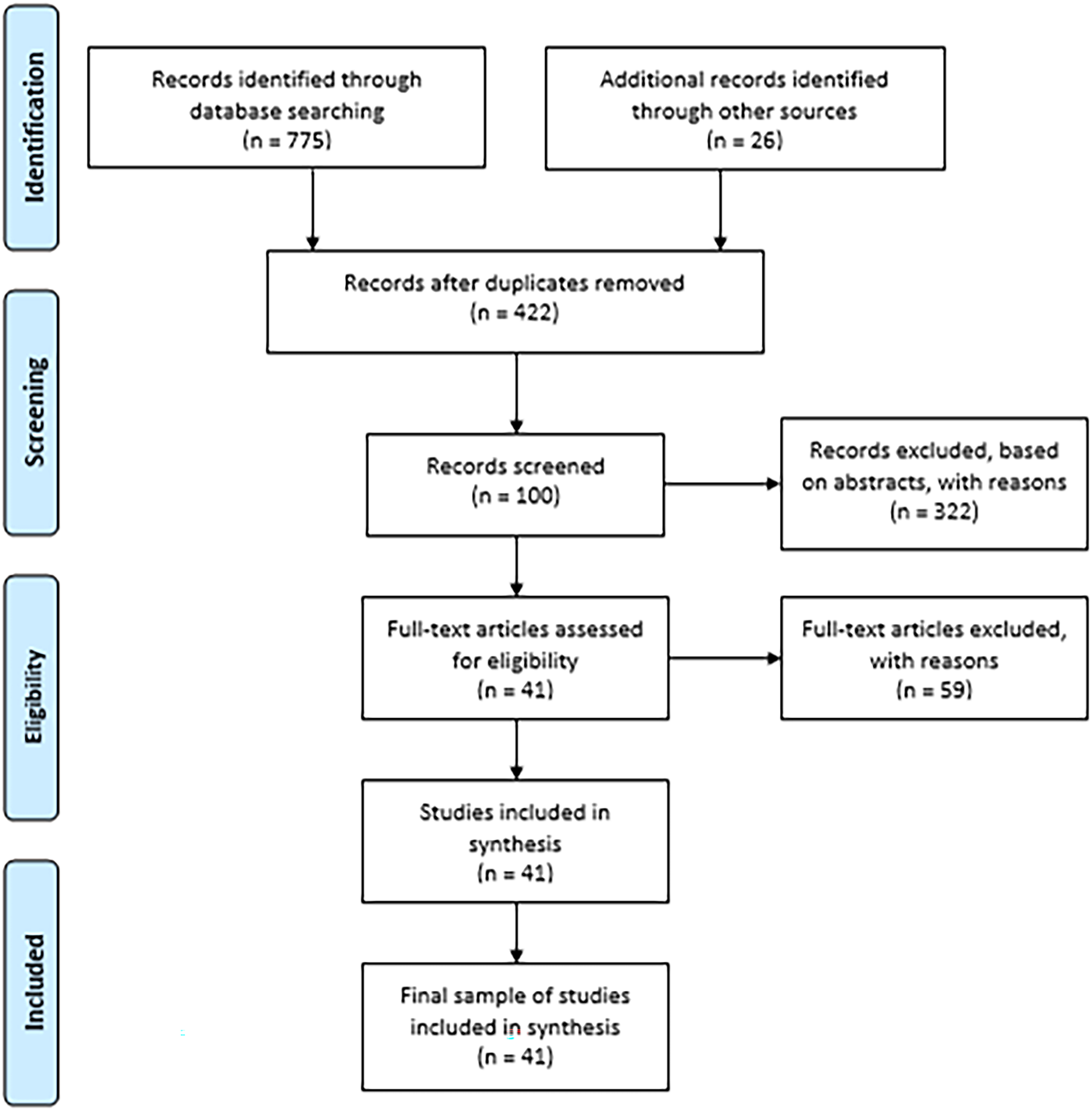
Systematic review.
Inclusion and exclusion criteria were broadly defined. The search included peer-reviewed publications in all languages that explicitly referred to intersectional thinking and practice, which could include intersectional theories, methodologies, or positionalities. Commentaries that did not present original data or analysis were excluded. Abstracts and conference papers were also excluded, as was gray literature such as policy documents and industry research reports, which are the subject of a parallel research project currently undertaken by the research team.
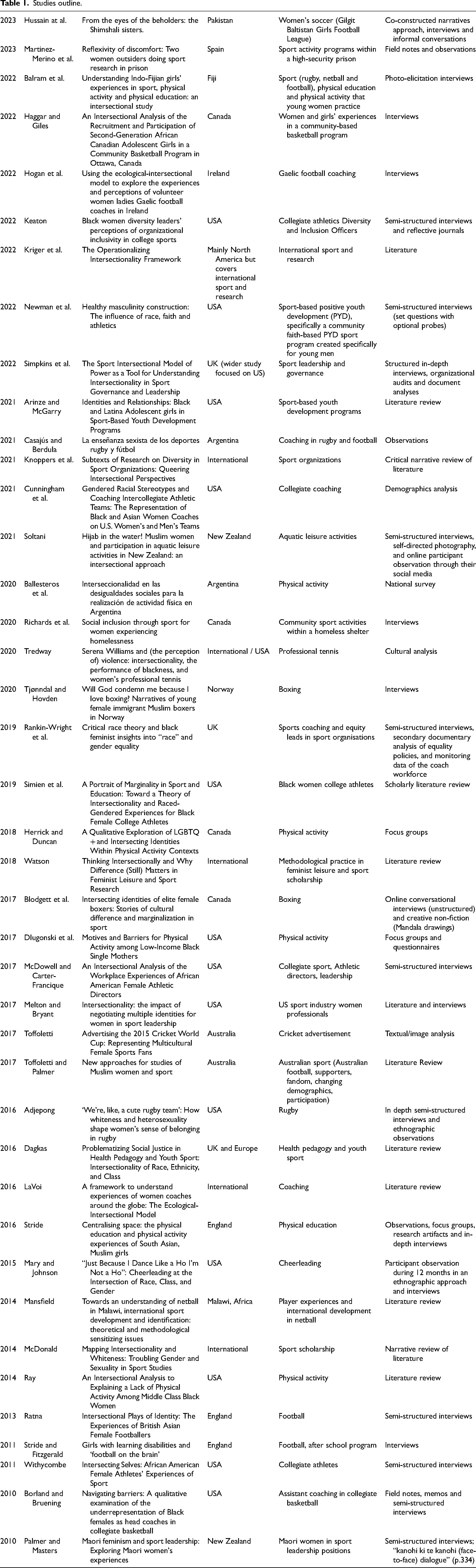
For eligibility, our search strategy considered title, abstract, and keywords for the term combinations of “sport” OR “athletes,” AND “intersectional*”. The search terms were deliberately broad to ensure comprehensive coverage of the scientific literature relevant to EDI in sport (even where those studies did not explicitly use the terms “equity,” “diversity,” and “inclusion”). The hits for each database were recorded and imported into a Word file. The steps followed were, first, to exclude/retain papers at title, removing duplicates; second, to exclude/retain papers at abstract; and third, to add papers from references, excluding commentaries (review papers). Figure 1 presents a flow diagram of the literature retrieval and filtering process. The final sample comprised 41 publications that met the inclusion criteria. The studies are outlined in Table 1.
Studies outline.
Next, the papers in the final sample were coded across 46 variables using a spreadsheet matrix and working in partnership with all authors to ensure inter-coder reliability. The matrix included sections on bibliographic details and study overview (five variables); study, setting, and sample (18 variables); ethics (three variables); data collection, analysis, and potential researcher bias (12 variables); policy and practice implications (five variables); and intersectionality study characteristics (three final variables). Thirty-eight of these variables were based on the Evaluation Tool for Qualitative Studies, which provides a template of key questions for critically appraising qualitative research studies (Long and Godfrey, 2004).
For the intersectionality study characteristics, the aforementioned three theory-informed codes were used to determine intersectionality categorization, “styles,” and engagement. First, it was assessed how authors categorized intersectional identities or experiences, following McCall (2005). Next, taking inspiration from Choo and Ferree (2010), the authors appraised the studies’ styles of understanding intersectionality in practice. Finally, following Cho et al. (2013), the research team analyzed the data to identify how the studies in the sample engaged with intersectionality, classifying such engagement as an analytical strategy, a discursive investigation of intersectionality as theory and methodology, or as critical praxis.
Three members of the research team conducted the coding (Fabiana, Ramon, and Ellanor). The coders compared and discussed their coding through a series of meetings and written communications, which allowed them to establish both consistency and consensus regarding the interpretation of the data. The analytical procedures yielded a rich comparative assessment of the 41 publications. The data entered in the matrix was qualitative (i.e. textual), but comparison across the sample allowed for some quantification of the qualitative data through descriptive statistics for several variables concerning characteristics of the literature, such as the year of publication, study locations/settings, theoretical frameworks and research methods used, and how intersectionality categories are employed in the studies. The quantified findings for these variables are integrated into the qualitative analysis in the remainder of this paper. The next section turns our attention to the main findings of the analysis.
Results
Characteristics of the literature
The final sample of 41 publications was highly diverse yet revealed some important patterns of similarity and convergence. The first finding is that all studies were published since 2010, with more than half (n = 22) published between 2018 and 2022. This indicates a recent increase in the use of the language of intersectionality in this field of research, despite the term being coined decades earlier (Crenshaw, 1989). This trend in the literature on sport appears largely consistent with, and developing at a similar pace to, the growing popularity of intersectionality in other disciplines and fields of study, including psychology (Grzanka, 2020) and public health (Lapalme et al., 2020).
The geographical locations of the studies in the sample were somewhat diverse yet largely confined to the Global North. Canada and the United States were the main locations of the studies (46 per cent). Australia and New Zealand were represented as significant research sites, with a comparatively large focus on First Nations culture and experience (e.g. Palmer and Masters, 2010). Argentina, Malawi, Fiji, Pakistan, and various European countries (e.g. Ireland, Norway, United Kingdom) also featured as research sites in the literature. A few studies were described by their authors or interpreted by us as having an international or transnational scope. Research on intersectionality in sport is thus found on all continents, albeit with a strong overrepresentation of the Global North. One explanation for this may be that the conditions to carry out and publish research, and to be publicly critical about exploitation and unfairness, may be a privilege that is more accessible for scholars in the Global North.
The literature covers a wide range of subjects, such as sport for development, youth sport, university/college sport, elite sport, and recreational sport. The publications address the perspectives of athletes, young people connected to sport, coaches in different sports, sports leaders and administrators, and fans. To a large extent, the literature echoes what Watson and Scraton (2013) call the dominant “genderraceclass” focus of intersectionality. In addition to showing what the studies focus on and the perspectives they center, there was a lack of positionality statements in the publications, which may affect the reading of the data, as knowing researchers’ stances helps to understand the way data are interpreted. The dominant research foci are first summarized, followed by the findings on reflexivity and positionality.
Black females (the term used by the authors in the referred studies) were central “categories” in different research studies, both as head coaches (Simien et al., 2019) and as college athletes (Borland and Bruening, 2010). Race/ethnicity and gender were prominent foci in research on intersectionality, for example, in a study of the motivation and barriers to physical activity for low-income single mothers (Dlugonski et al., 2017). Gender without race/ethnicity considerations was also examined in research focused on sport leadership in general (e.g. Melton and Bryant, 2017; Palmer and Masters, 2010), while race remained in the background in research on sport in a high-security prison (Martinez-Merino et al., 2023). Gender combined with religion was relevant to the experience of Muslim women boxers (Tjonndal and Hovden, 2021), Muslim women in Australian sport (Toffoletti and Palmer, 2017), swimming in New Zealand (Soltani, 2021), and South-Asian Muslim girls (Stride, 2016), even though religion also was researched in relation to masculinity (Newman et al., 2023). Girls with learning disabilities were the focus of a study by Stride and Fitzgerald (2011), while Haggar and Giles (2022) were interested in girls’ experiences of overlapping oppressions who participated in a community sports program.
In relation to the methods and procedures used to collect data, researchers opted primarily for interviews. However, several papers (approximately 30 per cent) used a multi-method approach that combined interviews with alternative methods such as document analysis (Simpkins et al., 2022), reflective journals (Keaton, 2022), and self-directed photography and online participant observation through social media (Soltani, 2021) (see Table 1). Stride (2016) employed a three-phase approach, comprising observations, focus groups and research artifacts, and finally, interviews. Arinze and McGarry (2021) relied on peer experiences and peer influence. Blodgett et al. (2017) and Balram et al. (2022) employed creative non-fiction mandalas with the participants during online and photo-elicitation interviews. Blodgett et al. (2017: 7) explored “the intersecting sociocultural identities of female boxers on the Women's Canadian National Boxing Team and how these identities connect to various experiences of exclusion and marginalization within the sport context.” In turn, Balram et al. (2022) sought to illuminate Indo-Fijian girls’ experiences of recreational sport and physical activity. The approaches taken by the authors showed creative ways to facilitate participants’ expression of their experiences. Hussain et al.'s (2023) study is a case in point, applying a co-constructed narrative approach to report interviews and informal conversations. Hussain et al.'s (2023: 632) specific goal was “to explore the lived experiences of two sport managers belonging to a vulnerable segment from Pakistan.” While creativity was not a primary lens through which the works were selected and analyzed, this was highlighted as a strength since it stood out as a methodological innovation within intersectionality research.
Theoretically, most of the studies (85 per cent) adopted intersectionality theory, while others focused on critical race theory, sometimes in combination with feminist theories, e.g. transnational feminist theory (Toffoletti and Palmer, 2017) and intersectional feminism (Toffoletti, 2017). LaVoi's (2016) study stands out for its development of a specific model (The Ecological Intersectional Model), which was subsequently used by Hogan et al. (2022). Blodgett et al. (2017) mixed an intersectional lens with social constructionism and a cultural sport psychology approach, while Keaton (2022) combined intersectionality with hermeneutic phenomenology. Knoppers et al. (2021) followed a Foucauldian framework, and Stride (2016) and Tredway (2020) employed middle-ground theorizing as the matrix of domination following Patricia Hill Collins (2000). Intersectionality as a methodology/framework was of interest mainly to Kriger et al. (2022), Watson et al. (2018), LaVoi (2016), and Dagkas (2016). As one of their study objectives, Kriger et al. (2022) provided a framework for the importance of intersectionality research while advocating for social justice for young people in sport. This is highlighted because the operationalizing intersectionality framework inverts Hill Collins's (2009) matrix of domination (see also Sisneros et al., 2008, for a model that centers privilege), which shows the position of those privileged through overlapping systems of oppression at the center and those oppressed through the same systems at the margins. Kriger et al. (2022: 5) discuss “the complex phenomenon of multiple interlocking systems of oppression and privilege shaped by intersections of individuals’ social positionalities.” Importantly, they propose an embodied approach to intersectionality and dismantling systems of oppression from within, which resonates with our interest in embodiment, a missing topic in most studies.
Although not expanded across the studies, it is noted that embodiment and different ways of knowing could work as approaches aiming at EDI's critical praxis in sport. For instance, Indigenous ways of knowing can be employed as holistic, non-normative practices, considering historical remarks and bodies as knowledgeable (Kovack, 2009). Embodiment theory takes the body as central, dynamic and plural, made of the interactions with the environment, in an interconnected way. Most sports come into life through embodied performances; bodily interactions rely on several intersections of lived experiences that reproduce (the lack of) EDI. Nonetheless, the primary focus of this review is intersectionality.
Intersectionality categorization, styles, and engagement
How is intersectionality categorized in the literature?
To examine how intersectional identities or experiences are categorized in the studies, the review draws on McCall's (2005) distinction between intracategorical, intercategorical, and anticategorical complexity as outlined in the introduction. Most of the studies (65 per cent) fit within the intracategorical approach, focusing primarily on a combination of oppressions based on gender and race/ethnicity, with social class, religion, sexuality, disability, and culture less commonly centered in the literature. Age and ageism were notably absent from the categories centered in the studies. Studies that used an intracategorical approach often focused on one specific “group” with more than two social categories (e.g. Black women). This focus predominantly concentrated on the micro-level of experiences of social inequalities, with less (explicit) attention being paid to how intersecting structural forces shaped these experiences. The most common methodological approach for studying intercategorical complexity within the sample was the intensive qualitative study of single “groups” through case studies (e.g. Cunningham et al., 2021; Ray, 2014; Withycombe, 2011).
An intercategorical approach was less common among the publications in this review but was evident in Adjepong's (2016: 209) study, which focused on “how race and sexuality mutually inform the ways women experience their sense of belonging in sport.” This study is intercategorical in its exploration of the dynamics (i.e. rearrangements for discrimination to prevail) of race/ethnicity and how whiteness is reproduced, reproduces oppression, and marginalizes the oppressed, thus preventing belonging.
Somewhat expectedly, the anti-categorical approach is rare in research on intersectionality in sport, with Watson's (2018) reflections on what it means to develop intersectional methodological practice in feminist leisure and sport scholarship possibly getting the closest. Overall, it is yet unclear how the anticategorical approach may benefit this field of research, due to a dearth of methodological and empirical applications in the existing literature.
Not all intersectional research can be neatly classified into one of the three approaches (McCall, 2005). These different approaches to complexity exist on a spectrum, and researchers tend to move across intra-, inter-, and anticategorical accounts. As Watson et al. (2018: 329) observe, “the challenge, through the design, implementation and analysis of our research material, is not to categorize […] experiences, rather it is to contextualize those experiences.” Therefore, two additional questions were used to probe more deeply into the literature. The relevant findings are discussed in the next section.
How is intersectionality understood or framed in research practice?
As indicated in the introduction, Choo and Ferree (2010) have offered a valuable typology of three styles of understanding and framing intersectionality in research practice: group-centered; process-centered; and system-centered. Studies applying an intracategorical approach tended to frame intersectionality as relational and process-centered, somewhat expanding a group-centered approach but not to a system-centered view. Intercategorical studies did not present a pattern of group-centered framing of intersectionality in practice but employed any of the three possibilities: group-, process-, or system-centered. Many studies in the sample (48 per cent) appeared to use a combination of two styles, with process- and system-centered styles being the most common (70 per cent of those combining styles). For example, Melton and Bryant (2017), whose paper addresses how the intersections of multiple marginalized social identities impact women's experiences and opportunities in sport, took a process- and system-centered approach with a critical eye to representational, political, and structural intersectionality (Crenshaw, 1991), as did Soltani (2021), with power as a central organizing principle. Soltani's (2021: 810) paper aimed to explore “the ways Muslim women take to (non)participation in aquatic leisure activities at the crossroads of their religious, gender, migrant and cultural identities with wider relations of power.” Ratna's (2013) style was more group-centered but exhibited elements of a process-centered approach by discussing the importance of space/structures and the subsequent effects on identity, in addition to focusing on the agency of the group within structures and their management of identities. Ratna's (2013: 1) specific goal was to “elucidate the intersectional plays of identity in and through the cultural spaces of women's football.”
How does the literature engage intersectionality?
Cho et al. (2013) distinguish three engagement strategies in which researchers deploy intersectionality: analytical tools; discursive investigation of theory and methodology; and critical praxis. Most of the studies in the sample (80 per cent) used an analytical engagement strategy. To point out a few articles on different forms of engagement with theory, Mansfield (2014) engaged with intersectionality as an analytical strategy by applying an intersectional frame of analysis to seek to understand the development of netball in Malawi, while Kriger et al. (2022) took a discursive investigation of the intersectionality both as theory and methodology in order to develop their “operationalizing intersectionality framework.” This initiative was led by a working group, formed to guide the E-Alliance (a Canadian knowledge-sharing hub) in how to put intersectional approaches into practice in sport research, activities, and operations. Kriger et al. (2022: 3) explain how “the group generated the framework through a collective compilation of our lived and academic learnings related to critical race studies, queer theory, embodiment theory, sociology, disability justice studies, physical cultural studies, anthropology, fat studies, and health studies.” The authors consider “the operationalizing intersectionality framework is a guiding tool that can facilitate intersectional approaches to the practice of sport psychology” (Kriger et al., 2022: 4). Martinez-Merino et al. (2023), in turn, combined the two previous approaches (analytical strategy and discursive investigation) to reflect on the discomforts of being outsiders carrying out research in a prison context. They looked at imprisoned women and their relationship with sports and physical activity, “from an intersectional […] self-reflective perspective and multilinear point of view” (Martinez-Merino et al., 2023: 851).
Keaton (2022) engaged with critical praxis through intersectionality to inform their work. Keaton sought to engage in critical inquiry and praxis to fully use intersectionality and unpack the systems Black women in sports navigate. The study focused on the leadership of Black women in Athletic Diversity and Inclusion Officer (ADIO) positions and “examined how their racial and gender identity informed their perceptions of organizational inclusivity” (Keaton, 2022: 1). Finally, Rankin-Wright et al. (2019) combined critical praxis and analytical strategy in action-oriented research aimed at the policy implications of their insights into race and gender equality. Specifically, they were interested in applying theoretical ideas to “contribute towards strengthening ‘race’ and gender equality and diversity agendas within sport organizations” (Rankin-Wright et al., 2019: 1112). Arinze and McGarry (2021) engaged in critical praxis with a discursive investigation of intersectionality as theory and methodology. They advocated for action-oriented research in a process of co-creation of real change for, in this case, Black and Latina adolescent girls in sport-based youth development programs. They found that their approach was powerful because it utilizes intersectionality (intersections of race/ethnicity, sex, and gender) to understand the peer-to-peer experiences of Black and Latina girls in sport-based youth development programs, suggesting a framework for future research. They came up with strong suggestions for researchers.
Conclusion
This paper set out to assess the extent to which and ways in which research on EDI in sport engages with intersectional thinking and practice. The results show a recent increase in the use of the language of intersectionality in this field of research, especially since 2018. Most of the published scholarship is situated in the Global North and is predominantly qualitative. The findings further suggest that intersectionality is more than a buzzword and is increasingly taken seriously in this field of research, both theoretically and empirically. The development of some intersectionality frameworks for critical analysis of sport, especially the work of Kriger et al. (2022), is a case in point and is taken increasingly seriously in research through rigorous intersectional analysis.
As our analysis has shown, there is growing attention given to intersectionality to advance existing approaches to EDI in sport. The findings presented in this paper, especially the knowledge gaps identified, can inform future research focusing on bringing intersectionality into practice. Specifically, researchers are encouraged to adopt intersectional methodologies and not just the concept of intersectionality. The findings also highlight the opportunities for greater critical praxis in/through intersectional research. It seems that unless it is operationalized through a critical praxis lens, the notion of intersectionality holds limited potential. Intersectional research design should be varied and encourage creative, collective, collaborative, and action-oriented approaches similar to some of the studies highlighted in this review. Moreover, researchers should consider how intersectionality theory can be utilized to develop and answer research questions that are explicitly intersectional in nature. This could include questions that center the voices and agency of marginalized communities while explicitly examining how research participants are not just subjects of study, but active agents of change who use their intersectional knowledge to transform sport systems and structures. Examples of such research questions might be: How do LGBTQI + athletes of color and their allies develop and implement intersectional advocacy strategies within their sport organizations, and what measurable shifts in organizational culture and practice result from these change efforts? How can Black and Latinx young people from low-income communities co-design and implement culturally responsive youth sport programs that address their intersectional barriers, and what systemic changes emerge from this community-led process?
It was expected that many papers would state authors’ positionalities since a lack of a clear stance could lead to a neutral discourse, which can work against advocacy for equity. The fact that almost all papers lacked clear positionality statements arguably signaled the limited (explicit) use of intersectionality as a methodology. However, there was a stronger proposition of a theoretical lens through which to look at issues in sports, analyzing them as complex, tangled variables. This approach has repercussions for intersectional thinking and possibly (hopefully) intersectional practice. It could be argued that intersectional methodologies, supported by explicit critical reflections on researcher positionality, would contribute to making intersectional research practice more achievable. On the other hand, it is acknowledged that positionality is not standardized across written publications, and alternative ways of self-positioning should be honored. Thus, it can be suggested that researchers may follow similar co-creative and participatory processes to allow people engaging in research to offer their views and have their voices amply documented. Yet, it would be valuable to see more scholars adopting an intersectionality framework and lens through efforts directed at disruptive ways of conducting and reporting research, e.g. through storytelling and community engagement. While not all scholars view sport and its participants/stakeholders intersectionally, a focus on embodiment and various ways of knowing, usually in non-normative ways, could function to make EDI a critical praxis in sport.
Sport is an insightful setting for intersectional analysis, partly because of its embodied educative and emancipatory potential, whereby participants can become conscious through their embodied practice about social issues they face. However, there is still a gap in existing research on intersectionality in EDI in sport, which largely neglects embodiment. The review findings suggest the need for greater conceptualization and operationalization of embodiment in this field of research, with embodiment becoming more centered in intersectional methodologies and analyses. Inspiration can be drawn from Rice et al. (2020), who, in a different context, note the need to “recognize and better account for bodies at the intersections and press the field of intersectionality studies to consider new ways of conceptualizing intersectionality to account for the complexity of embodiment.”
Beyond academic analysis, scholars are encouraged to engage in intersectional research that can catalyze collective action towards changing structures and enable more sports participants to become agents for the change they want. This is not a neoliberal approach (McRobbie, 2015) but aligned with the critical praxis component of intersectionality studies (Cho et al., 2013). As noted, praxis has been a key component of scholarship on intersectionality from its earliest articulations. It provides a way to engage in the call to “do,” for example, to help turn education spaces such as sport into environments that empower people instead of reproducing social injustices. It is recognized that in the contemporary political environment, engaging in critical praxis is likely to be met with disinformation, backlash, and White male identity politics (Ray, 2022). There are no easy answers to how best to navigate challenging political and institutional dynamics. We encourage researchers to build on insights from Black feminist and critical race scholars and activists who recognized that successful critical praxis requires coalition building and the forging of solidarities across difference. From an intersectional perspective, a coalitional approach must not conflate or ignore intra-group differences (Crenshaw, 1991), as this would risk marginalizing the positions of fellow researchers. It is hoped that the findings of this review can help inform the development of a collective research agenda and greater cross-institutional collaboration for advancing intersectional thinking and practice in EDI in sport.
Footnotes
Declaration of conflicting interests
The authors declared no potential conflicts of interest with respect to the research, authorship, and/or publication of this article.
Funding
The authors received no financial support for the research, authorship, and/or publication of this article.
