




Abstract
Previous sociological research on sport in prisons has primarily focused on the male prison population. Against this background, this article deals with sport in women's prisons and analyzes qualitative studies published in English and German since the turn of the millennium in the form of a systematic review. The focus is on how incarcerated women experience and reflect on sport in prison and what meanings they attach to sport, according to previous studies. The aim of the review is to present overarching, recurring findings on this question. Through a systematic literature search in the databases Web of Science, ERIC, and SURF, we identified 13 qualitative studies that met our inclusion criteria. At a superordinate level, our comparative analysis shows that imprisoned women have contrasting perceptions of sport in prison. On the one hand, some imprisoned women experience sport in an extremely positive way, insofar as: (a) through sport, they gain health-promoting experiences; (b) sport helps them to cope with imprisonment; and (c) through sport, they gain self-esteem-boosting experiences and perceive personal development. Sport therefore proves to be a positive experiential space in some cases. On the other hand, sport is sometimes experienced negatively by imprisoned women insofar as: (a) they experience interpersonal and emotional tensions; (b) they experience body-image discomfort and trauma associated with participating in sport; and (c) they have to accept unpleasant structures and male ideas of sport. Sport therefore also proves to be a negative experiential space in some cases. Our review provides evidence that incarcerated women experience sport in prison in a much more negative way than men and at the same time provides background information for the low level of sport participation among imprisoned women reported in previous studies. Important implications for the implementation of sports programs in women's prisons can be derived from our findings.
Introduction
Given that the number of women imprisoned worldwide has increased by almost 60% since 2000, more than 740,000 women are now incarcerated in penal institutions throughout the world (Fair and Walmsley, 2022). Current studies from various countries show that some incarcerated women are regularly active in sport, although they do not participate in sport to the same extent as incarcerated men (De Marco and Meek, 2022; Meek, 2014; Martinez-Merino et al., 2017), and levels of physical activity in the women's estate varies dramatically across different establishments (Lewis and Meek, 2012). Numerous studies have been published in which the sports experiences of imprisoned individuals have been reconstructed (e.g., Parker, Meek and Lewis, 2014; Norman and Andrews, 2019; Müller, 2024; Libbrecht et al., 2024; Martinez-Merino et al., 2019; Martos-García et al., 2009a). However, sociological research on prison sport has primarily focused on sport in male prisons (Müller and Mutz, 2019), with few studies focusing exclusively on sport in women's prisons (e.g., Edmondson et al., 2024; Martinez-Merino et al., 2017; 2019; Meek and Lewis, 2014). Against this background, this article deals with sport and exercise in women's prisons and summarizes qualitative studies published in English and German since the turn of the millennium in the form of a systematic review. The focus is on the question of how incarcerated women experience and reflect on sport in prison and what meanings they attach to sport in prison according to previous studies. We will also reflect on the similarities and differences in the meanings that men in prison attach to sport. Because prison sport from a subject-oriented perspective is the focus of the literature review, only studies based on the qualitative paradigm are included. Qualitative studies are defined in this paper as research that makes use of qualitative data collection methods such as interviews and observations and aims to understand meaning or reconstruct subjective perspectives (Flick et al., 2004; Sandelowski and Barroso, 2007).
The aim of our study is, on the one hand, to review the qualitative studies on prison sport from the perspective of incarcerated women and to present overarching, recurring findings on the prison sport experiences based on the individual studies. On the other hand, our study aims to identify research desiderata and to provide impetus for future research. One advantage of our review is that the findings of individual studies can be compared and summarized at a higher level of abstraction, as we include both the raw data contained in the studies (especially interview quotations) and the authors’ interpretations in our analysis. This is a key distinguishing feature of our review in comparison with the only systematic literature review on sport in women's prisons of which we are aware (Martinez-Merino et al., 2017).
The relevance of the topic arises from the fact that sport and exercise are an integral part of everyday prison life in many countries—for example in England, Germany, and Canada (Meek, 2014; Müller and Mutz, 2019; Norman, 2017)—and that criminal justice authorities link societal and educational goals such as rehabilitation and health education to sport (e.g., HM Prison and Probation Service, 2011; Ministry of Justice of Lower Saxony, 2014; Schröder, 2015). Reconstructing the subjective perspectives of those who participate in prison sport makes it possible to relate their sporting experiences to the societal and educational goals externally attributed to sport (Müller, 2024). Of course, our review cannot replace systematic evaluations of the effectiveness of corresponding programs. However, our review can at least investigate what meanings incarcerated women attach to sport in prison according to previous studies.
Methods
Design and search strategy
Our study was designed as a systematic literature review of qualitative studies (Butler et al., 2016; Jones, 2004; Paterson et al., 2001). Essentially, the aim of such a literature review is to summarize the available studies on the basis of previous qualitative findings on a topic in such a way that common, overarching findings emerge. This approach has the advantage of producing new findings that are neither so strongly related to a few interviews or individual cases nor so strongly dependent on the interpretations of individual researchers (Butler et al., 2016; Jones, 2004; Paterson et al., 2001). The analysis is based on two types of data: Firstly, the interview quotations and observations documented in the articles (primary data), and secondly, the interpretations presented by the researchers in the respective articles (secondary data) (Toye et al., 2014). The consideration of primary and secondary data in the analysis is described in the literature as advantageous and extremely beneficial, as it enables a conditional detachment from the authors’ interpretations (Butler, Hall and Copnell, 2016). In the context of a qualitative review, a comparative analysis can be conducted, whereby context-independent findings can be generated (Butler et al., 2016). With regard to the present review, cross-national and cross-institutional findings can thus be generated, that is, findings that not so strongly depend on the peculiarities of one group of imprisoned people, one prison, or one country. Such context-independent findings have an extended claim to validity. At the same time, a qualitative review generates “meanings that extend well beyond the available body of research” (Paterson et al., 2001, 2).
For the present review, the social and sports sciences databases Web of Science, ERIC, and SURF were selected and searched in September 2024 for previously published qualitative studies on incarcerated women's sport experiences in prison. We wanted to base our review on current findings, so the search was limited to publications from the year 2000 onward. In the English databases Web of Science and ERIC, we used the keywords “sport” or “physical activity” or “exercise” in combination with the terms “prison” or “jail” or “detainee” or “captive” or “offender” or “felon” or “inmate” or “convict” or “remand” or “probation” or “incarcerated.” In the German database SURF, the terms “Sport” or “körperliche Aktivität” or “Bewegung” were combined with the keywords “Strafvollzug” or “Justizvollzug” or “Haft” or “Gefängnis” or “Inhaftierte” or “Insasse” or “Insassin” or “Gefangene” or “Verurteilte.”
In our review, we only took into account scholarly articles published in journals with a double-blind peer review procedure, whereas we deliberately excluded university papers, book chapters, and anthologies to guarantee a high scientific standard of the contributions. Conceptual papers and monographs (dissertations) were also excluded. The inclusion criteria for the review were that the studies (a) should deal with sport or exercise in prison, (b) should be methodologically related to the qualitative paradigm, (c) should, among other things, reconstruct the perspective of incarcerated women, (d) should have been published between 2000 and 2024, and (e) should be written in English or German.
Selection process
First, all potentially relevant scientific articles were identified (step 1: identification). Figure 1 shows a flow chart that details the selection process. The search in the three databases resulted in a total of 3408 hits. In an initial preselection, duplicates were sorted out before the article titles and (where necessary) abstracts were screened (step 2: screening). On the basis of irrelevant titles and abstracts as well as duplicates, n = 3361 studies were excluded. As a result, n = 47 articles remained, which were read as full texts and checked for eligibility against the inclusion criteria (step 3: eligibility). In some studies, women in prison were represented in the sample, although it was not clear from the interview quotations exactly which ones were from women. These studies were taken into account when the corresponding authors provided information on the gender of the interviewees cited in the article at the request of the first author. This was the case in one study (Wangmo et al., 2018). 1 In total, 13 studies were identified that met all inclusion criteria (step 4: inclusion). 2
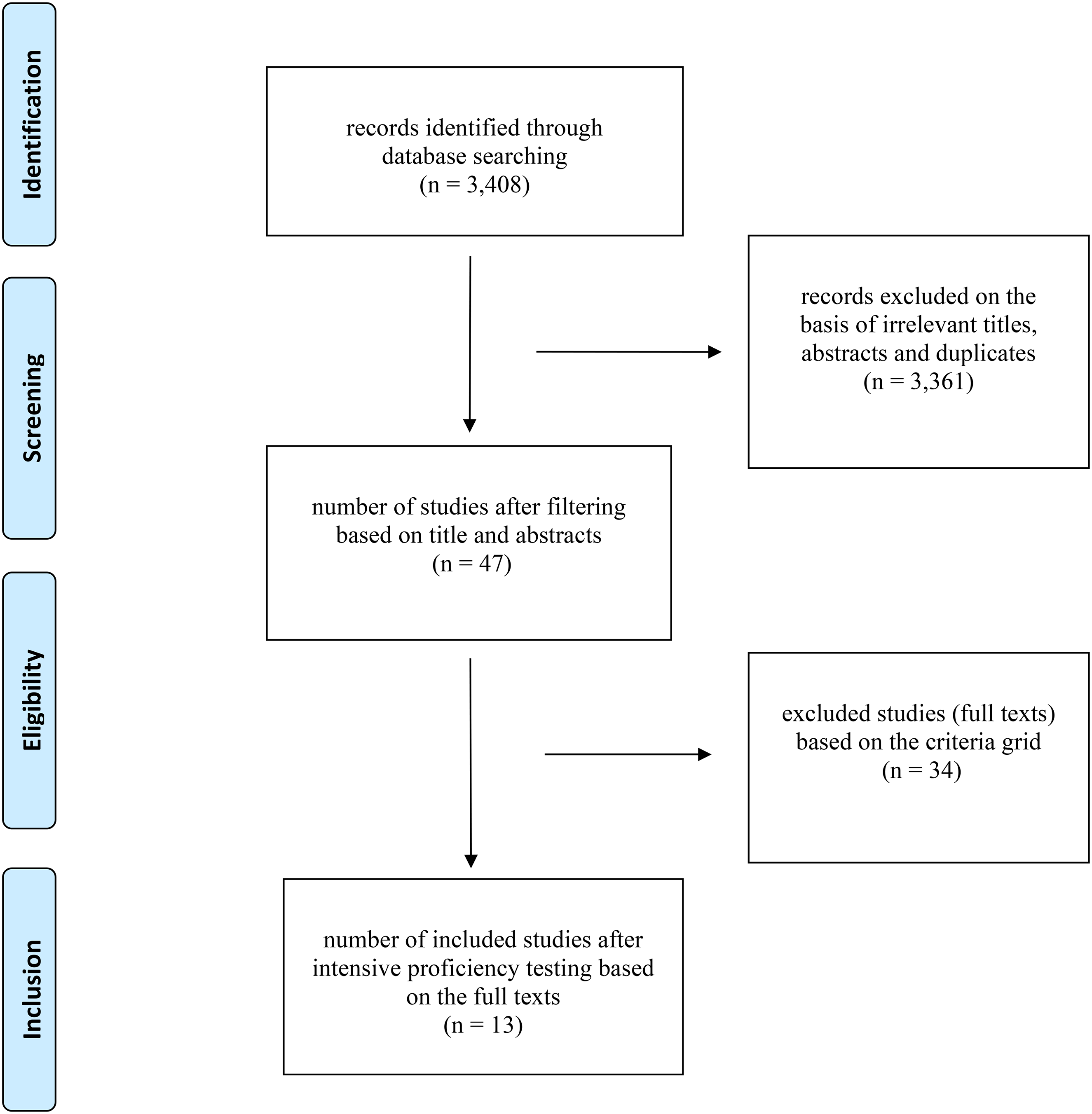
Processual study selection according to PRISMA (Moher et al., 2015).
Structuring of the studies
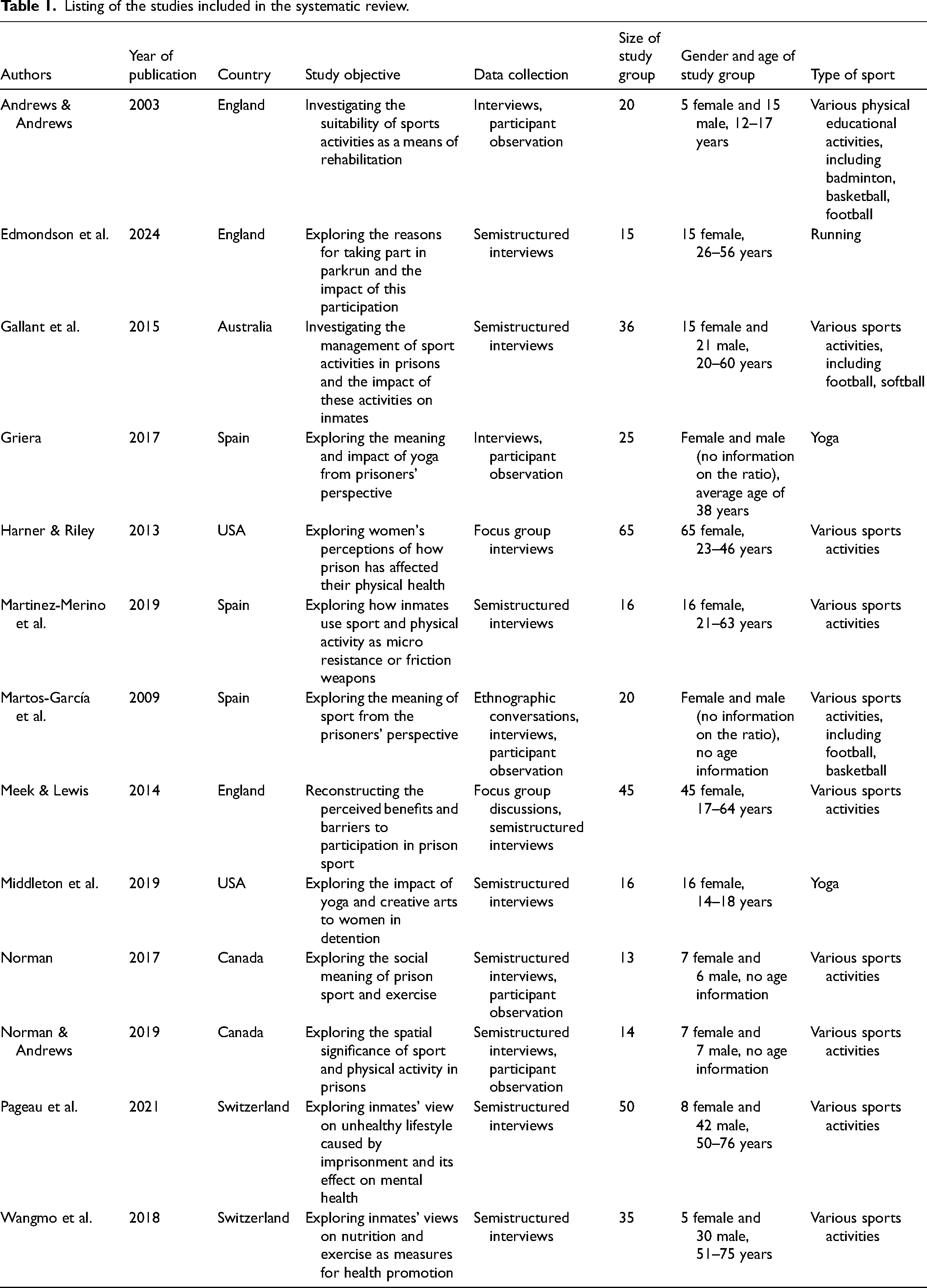
The included studies were listed in alphabetical order according to the names of the authors and entered into a table containing the year of publication, country, aim of the study, data collection method, size of the study group, description of the study group (gender and age) and the type of sport (see Table 1). The study groups within the individual studies are partly very different: In four studies, the study group (also) consists of formerly imprisoned women (Martinez-Merino et al., 2019; Meek and Lewis, 2014; Norman, 2017; Norman and Andrews, 2019), in two studies it consists exclusively of adolescents 3 (Andrews and Andrews, 2003; Middleton et al., 2019) and in two studies it consists exclusively of older women over 50 years of age (Pageau et al., 2021; Wangmo et al., 2018).
Listing of the studies included in the systematic review.
Data extraction and analysis
In the first step, after thoroughly reading the articles, we marked and extracted the passages relevant to our research question. The extracted data was then analyzed in a three-stage process: first, the primary and secondary data were coded, concepts were developed, and finally, superordinate categories were developed on the basis of comparisons between the studies (Thomas and Harden, 2008). We analyzed these data using content analysis (Dixon-Woods et al., 2005). In coding, particular attention was paid to the primary data, in which the imprisoned women discussed their perspectives on their sport experiences in prison, and to the secondary data, in which the study authors reconstructed or described the women's sport experiences, including the typical meanings attached to them. The aim of the analysis was—as previously mentioned—to identify recurring findings on the experiences and meanings of sport and exercise in prison from the perspective of imprisoned women and, based on this, to generate overarching findings or summarize them at a higher level of abstraction (Munn et al., 2014).
The results section is structured around the categories and findings we have identified. In order to make our presentation of primary and secondary data clear, we explicitly state whether it is a quotation from interviewees (primary data), a resulting interpretation by the study authors (secondary data), or our own interpretations based on a comparative analysis of the studies or rather data (see also Müller and Böhlke, 2023).
Results
At a superordinate level, our comparative analysis of the primary and secondary data shows that imprisoned women have very contrasting perceptions of sport in prison. On the one hand, some imprisoned women experience sport in an extremely positive way, insofar as: (a) through sport, they gain health-promoting experiences; (b) sport helps them to cope with imprisonment; and (c) through sport, they gain self-esteem-boosting experiences and perceive personal development. Sport therefore proves to be a positive experiential space in some cases. On the other hand, sport is sometimes experienced negatively by imprisoned women insofar as: (a) they experience interpersonal and emotional tensions; (b) they experience body-image discomfort and trauma associated with participating in sport; and (c) they have to accept unpleasant structures and male ideas of sport. Sport therefore also proves to be a negative experiential space in some cases. The two main categories identified, including the subcategories, are presented in detail as follows.
Sport as a positive experiential space
Taking into account all studies included in the review, it is evident that sport in prison is of great importance to a number of incarcerated women. Accordingly, a woman interviewed by Edmondson et al. (2024, 19) describes sport as “an anchor” that gives stability and another interviewee from this study describes sport as “a godsend.” One incarcerated woman interviewed in another study (Martinez-Merino et al., 2019, 19) perceives sport as a “healthy drug.” Another interviewee in another study associates exercise in prison with the value it possesses: “I like exercise because of its many benefits” (Martos-García et al., 2009a, 84). We interpret these statements as an expression of the positive experience of sport by the women interviewed.
By analyzing the included studies, we were able to identify a total of three topics that are associated with the benefits and positive perceptions of sport. These topics, which we will describe in more detail below, are evident to varying degrees in 9 of the 13 studies (Edmondson et al., 2024; Gallant et al., 2015; Griera, 2017; Martos-García et al., 2009a; Meek & Lewis, 2014; Middleton et al., 2019; Norman and Andrews, 2019; Wangmo et al., 2018).
Gaining health-promoting experiences
A strikingly high number of the women interviewed in the studies associate sport with their physical, mental, and social health and attribute sport with the potential to promote their health: In 8 of the 13 studies (Edmondson et al., 2024; Gallant et al., 2015; Griera, 2017; Martinez-Merino et al., 2019; Martos-García et al., 2009a; Meek and Lewis, 2014; Middleton et al., 2019; Norman and Andrews, 2019; Wangmo et al., 2018), the health benefits of sport are addressed more or less directly, with different types of sport included. Some of the women interviewed refer specifically to yoga and its positive effect on their mental and physical health. For example, one woman interviewed by Griera (2017, 95) says “Yoga enables me to gain mental balance. Yoga has already helped me to overcome hypertension.” And one of those interviewed by Middleton et al. (2019, 18) says, referring to skills learned in a prison yoga class, “When I’m mad I take deep breaths. Yoga really helps me calm down.” In turn, a woman interviewed by Meek and Lewis (2014, 159) attributes her weight loss to regular sports activities, which she believes play an important role in her physical health: “I put on two stone when I first came in but I have almost lost it all now just by coming here [gym].” The mental health benefits of sport mentioned by many women include above all the reduction of stress. Accordingly, different studies quote women who claim that sport “reduces my stress…” (Gallant et al., 2015, 51) or that “…the sport relaxes …” (Martos-García et al., 2009a, 84).
In the study conducted by Norman and Andrews (2019, 461), the sports facilities are perceived by imprisoned women as quiet and recreational spaces, so mental recovery can be associated not only with the sports activity itself but also with the sports setting: “… we don’t have it [yoga] in the gym because the gym is too big, so we have it in the chapel. That's the only quiet place [in the prison].” This leads to the conclusion that the respective sports facilities have a major influence on some women's perceptions in the context of sport. Additionally, with regard to social health, one woman interviewed by Gallant et al. (2015, 51) addresses the benefits of sport: “My social interactions have definitely changed. I was actually really, really, really, really quiet in here, I kept to myself, I didn’t interact with anyone really, and yeah that's definitely helped in that regard.” In this context, some women see exercising as a trigger for such positive changes, leading to an increase in the feeling of social connectedness associated with social health.
Coping with imprisonment
The women interviewed in the studies also very frequently associate sport with the negative consequences and burdens of imprisonment: the deprivation of liberty and autonomy, the loss of a sense of security and the feeling of monotony, boredom, and social isolation are some of the “pains of imprisonment” described in the prison sociology literature (e.g., Crewe, 2011; Goffman, 1961; Haggerty and Bucerius, 2020; Johnson and Toch, 1982; Liebling and Maruna, 2005; Sykes, 1958). Many of the women interviewed in the studies (Edmondson et al., 2024; Gallant et al., 2015; Griera, 2017; Martinez-Merino et al., 2019; Martos-García et al., 2009a; Meek and Lewis, 2014) experience sport as a help in coping with the “pains of imprisonment” (Sykes, 1958).
Against the background of their data, Meek and Lewis (2014, 157) ascribe sport as “an important function in coping with the psychological consequences of imprisonment.” In accordance with this, one of the women interviewed by Martinez-Merino et al. (2019, 20) says: “It [sport] makes the sentence lighter. It was an immense help to me. Because when I did sport, the days seemed to pass more quickly.” The monotony and boredom typical of everyday prison life and the possibility of escaping this through sport is also addressed by an interviewee in the study by Gallant et al. (2015, 51), who says: “I just hope it [the sports program] stays cause’ otherwise the girls will have nothing to do … they’ll be sitting there doing nothing and just bore their life away.” Other imprisoned women experience sport as a moment of freedom, saying that “it [sport] set me free” (Edmondson et al., 2024, 16).
Additionally, one incarcerated woman experiences self-determination in sport, which is normally very limited in prison: “… I control my own body” (Martinez-Merino et al., 2019, 22). For other women, on the other hand, sport proves to be an opportunity to establish social contacts and reduce the feeling of social isolation: “… you get to know other people. In the sports hall, I have known people that have given me a lot, and they are good friendships” (Martos-García et al., 2009a, 83). The study by Martinez-Merino and collegues (2019, 25) also addresses the benefits of sport with regard to the fear of other imprisoned women, which—as mentioned above—is one of the pains of imprisonment. One interviewee in this study says that some women do sport primarily to show others “Look here! Here I am and I’m strong, I do sport, so don’t mess with me, right? So, respect me.” In this sense, some imprisoned women attach particular meaning to sport in this hostile environment. However, this meaning of sport is not addressed in the other studies included in our review.
Some women experience sport as an aid to coping with imprisonment in all respects: “Whatever problem I’ve got I go to the gym and workout, it really works for me” (Meek and Lewis, 2014, 157). In one case, the relationships developed with the physical education (PE) officers are particularly described as special and helpful: “… they [PE officers] take your circumstances into consideration … They were my rocks, if I had a problem I would go to them rather than my personal officer” (Meek and Lewis, 2014, 162). The imprisoned women therefore not only attach great importance to the sporting activity itself, but also to social relationships and social interactions in sport.
Gaining self-esteem-boosting experiences and perceiving personal development
For some imprisoned women, sport is a field of activity in which they can gain self-esteem and perceive positive developments in their own behavior. Against this background, one woman reports her experience in sport of achieving self-imposed goals and gaining self-esteem as a result: “You’ve got a goal at the end of every week, you can try and better your time. I love that” (Edmondson et al., 2024, 14). One young woman interviewed by Middleton et al. (2019, 18) proudly recounts that she was able to change existing negative images of herself in the context of a yoga intervention: “I can lift myself off the ground in crow pose. Never thought I would be able to do it.” In line with this, in another study, the authors themselves concluded that taking part in sport and physical activities had “challenged previous negative views they [imprisoned women] had held of themselves” (Meek and Lewis, 2014, 158).
Also with regard to a running intervention, one interviewee talks about self-esteem-boosting experiences: “Yeah, it [parkrun] has definitely lifted my self-esteem and my confidence and kind of belief in myself” (Edmondson et al., 2024, 17). In another study (Martinez-Merino et al., 2019, 3), the authors point out the opportunity for the women they interviewed “to regain some autonomy and identity” in sport. In our view, this opportunity also proves to be an aspect of self-esteem enhancement. It can be seen that the self-esteem-boosting experiences reported in five studies (Andrews and Andrews, 2003; Edmondson et al., 2024; Martinez-Merino et al., 2019; Meek and Lewis, 2014; Middleton et al., 2019) are primarily based on the women's perceived increase in their sporting and athletic skills.
The interview quotations presented so far show that the interviewees themselves associate sport with an increase in self-esteem so we can speak of a subjective self-perception. Such positive perceptions and developments are also reflected by some of the women interviewed with regard to their own behavior—for example, a woman interviewed by Gallant et al. (2015, 51) says: “It helps us when we’ve got something to work towards, well then it [sport] helps us to be good.” She thus associates sport with rehabilitation, just as a woman interviewed by Griera (2017, 95), who refers to the emotion regulation she learned in yoga: “Yoga also helps me to control my emotions. Now more than ever I need my emotions not to overwhelm me. I am going to be released very soon after 11 years in jail.” Some of the women even notice a comprehensive personal development as a result of the sport: “My way of thinking and perspective have changed. The way I do things now makes me feel like I’ve matured. The outcomes of what I do are different” (Middleton et al., 2019, 17).
The study by Meek and Lewis (2014, 160) in particular also mentions qualifications and skills acquired in sport that lead to perceived personal development. For example, one formerly imprisoned woman says: “I got a job as a chiropractic assistant, I learned a lot of knowledge on the sports course that applies to my job now.” On a deeper level of interpretation, the interview quotations thus show that the women implicitly attach an important societal significance to sport in prison. However, another study (Martinez-Merino et al., 2019, 22) also shows that for some women, sport is to a certain extent used by imprisoned women specifically for impression management: Based on the interview data, the authors of the study describe the extent to which “sport and physical activity have a positive impact on the evaluation of a prisoner's behavior.”
Sport as a negative experiential space
The findings presented so far, according to which sport proves to be a positive experiential space for some imprisoned women, are contrasted by the finding that sport also represents a negative experiential space for some imprisoned women. As mentioned above, the women's perception of sport is therefore quite different. Accordingly, one of the women interviewed in a study points out that “for women, it [sport] is the bottom of the list of what they want to do in here” (Meek and Lewis, 2014, 166). Some of the women interviewed openly express their rejection of sport: “It is compulsory to do sport. If not, you get sanctioned … you are almost never released from sport. Though I just don’t like it anymore” (Pageau et al., 2021, 5). Another young woman puts it even more drastically: “I end up hating it [sport]” (Middleton et al., 2019, 16). By analyzing the included studies, a total of three themes could be identified that are related to the negative perception of sport, which is addressed more or less extensively in nine of the thirteen studies (Andrews and Andrews, 2003; Harner and Riley, 2013; Martos-García et al., 2009a; Meek and Lewis, 2014; Middleton et al., 2019; Norman, 2017; Norman and Andrews, 2019; Pageau et al., 2021; Wangmo et al., 2018).
Experiencing interpersonal and emotional tensions
In three included studies (Andrews and Andrews, 2003; Norman, 2017; Norman and Andrews, 2019), conflicts and hierarchy struggles among imprisoned women and between imprisoned women and sports educators are addressed on different levels, which are associated with the experience of interpersonal and emotional tensions. In the study by Andrews and Andrews (2003, 538), interactions observed and experienced by the researchers are described in great detail, illustrating these tensions. The focus is on two imprisoned young women who, as a result of their own loss of control, throw the sports equipment at the opponent (in this case the researcher), and irreparably demolish it. This shows that sport is not (in the sense of a catharsis effect) the place of controlled pressure release, but sometimes rather the place where interpersonal and emotional tensions arise, which are released directly and uncontrollably. On a deeper level of analysis, it can be seen that sport fuels aggression on the part of some imprisoned women (often due to perceived sporting deficits), which is associated with negative emotions. The interpersonal tensions become perceptible above all through the use of abusive language directed at the interaction partners, which is observable in the study by Andrews and Andrews (2003) and which is also an expression of negative emotions.
Furthermore, the studies by Norman (2017) and Norman and Andrews (2019) in particular point to the “aggressive competition for the very limited availability of exercise equipment and the development of social hierarchies that determined who had access to certain spaces and equipment” (Norman, 2017, 606). According to one interviewee: “[Fitness equipment] is monopolized by certain people in many cases … So the other [inmates] don’t get access to the equipment and can’t exercise” (Norman, 2017, 607). This aggressive competition for limited sports equipment also implies the emergence of interpersonal and emotional tensions, which can be read as negative experiences in the context of sport.
Experiencing body-image discomfort and trauma
Similar to sport outside prison, displaying the body is also a constitutive component of sport inside prison. Displaying their own body is an unpleasant circumstance for some of the women interviewed and observed in the studies (Andrews and Andrews, 2003; Meek and Lewis, 2014; Middleton et al., 2019). Middleton et al. (2019, 16), for example, observed this: “The girls expressed difficulty with some of the poses, in particular, downward dog. We observed their discomfort and resistance to this specific pose as likely due to the pose's physical exposure and the vulnerability associated with its shape.” In line with this, a woman interviewed by Meek and Lewis (2014, 164) says: “Women are conscious about people watching them when they are exercising, they are paranoid about what people think and worry about people standing around chatting and watching, which isn’t helpful.” This perception is also consistent with the observation by Andrews and Andrews (2003, 542), who summarize on the basis of their data that many incarcerated young women “detest” or “hate” those typical sports situations in which their physicality and abilities are commented on by others. It is particularly problematic that—as some of the study authors themselves summarize (e.g., Andrews and Andrews, 2003, 542)—the sports context promotes the fear of social comparison in many women, although the competitive nature of sport is often deliberately pushed into the background by sports staff.
Having to accept unpleasant structures and male ideas of sport
Regardless of whether the women interviewed are imprisoned in women-only prisons or in mixed prisons with men and women, they (at least implicitly) point out that sport in prison is oriented toward male ideas of sport—although a few temporary interventions, such as yoga, which seems to reflect a female idea of sport, are offered at least in some prisons. At the same time, this addresses unpleasant structures of sport. An interviewee of Martos-García et al. (2009a, 89) expresses this: “Women are discriminated against here. We are partly to blame. It is hard to motivate ourselves [to practice sport] if someone doesn’t help you. It has been an effort to gain some time for us to have a women's activity in the hall on Friday afternoons. They don’t consider this a worthwhile addition … We are marginalized.” Two women interviewed by Harner and Riley (2013, 796) mention similar experiences: One interviewee says “There are not enough opportunities to be in the wellness class. They don’t actively promote in-cell exercise” and another interviewee says “I don’t have the activities that kept me physically active.” The lack of female sports staff is also reflected as problematic. One woman interviewed by Meek and Lewis (2014, 165) says: “The fact we don’t have a female PE officer puts some people off, for example, the Muslim women.”
Older incarcerated women in particular, on whom two studies focus (Pageau et al., 2021; Wangmo et al., 2018), are bothered by the structures of sport that do not meet their expectations: “… when it is in the gym … I can’t go to this weight room, because there's music continuously. Full volume … you have to shout at each other in there. So, I know a lot of women now, who don’t go to the weight room in here, because of this music” (Pageau et al., 2021, 4). In addition to the organization of the sport, the content is also criticized and, in many cases, the institution-organized sports activities are consequently avoided: “The last half an hour, they play volleyball and that isn’t exactly my game. It includes a lot of jumping and bouncing and so on and like I said not exactly my thing. But I compensate by doing yoga and relaxation in my room” (Wangmo et al., 2018, 357). With regard to the studies included in this review, it can therefore be concluded that older women prisoners primarily experience sport in a negative way and that the organization of sporting activities does not meet their expectations.
Discussion and conclusion
The aim of this article was to identify qualitative studies on sport in women's prisons published since the turn of the millennium through a systematic literature search, to summarize these identified studies by means of a systematic review and to present overarching, recurring findings on the sports experiences from incarcerated women's perspective. Building on this, the aim was to identify research desiderata and provide impetus for future studies. The review focused on the question of how incarcerated women experience sport during incarceration and what meanings they attach to sport in prison.
We identified a total of 13 qualitative studies that met our inclusion criteria. Based on these studies, our review was able to show that incarcerated women have very contrasting perceptions of sport in prison: For some of the imprisoned women, sport is a (very) positive experiential space, insofar as they gain health-promoting experiences in sport, sport helps them to some extent to cope with imprisonment and many women gain self-esteem-boosting experiences in sport and perceive personal development. For another part of the imprisoned women, however, sport proves to be a negative experiential space, insofar as some women experience interpersonal and emotional tensions in sport, some experience body-image discomfort and trauma, and unpleasant structures and male ideas of sport have to be accepted. The negative experiences can be read in part as reasons for the low level of sport participation among imprisoned women reported in previous studies (e.g., Meek, 2014; Camplain et al., 2022).
Particularly, in comparison with studies in which the meanings of prison sport were reconstructed exclusively from the perspective of imprisoned men (Meek and Lewis, 2014; Müller and Mutz, 2022; Müller, 2024; Johnsen, 2001), the present review shows that the meanings attached to prison sport overlap to some extent between imprisoned women and men, but that the experiences of sport in prison also differ to some extent between the genders: Finally, it can be seen that imprisoned women functionalize prison sport as a coping strategy in a similar way as imprisoned men (Müller and Mutz, 2019). In addition, some qualitative studies on sport in men's prisons also describe incarcerated men experiencing sport as a way of (re)building self-esteem and self-confidence (e.g., Bahlo et al., 2022; Johnsen, 2001; Müller, 2024). However, the negative experiences in the context of sport visible in our review seem to be significantly less present among incarcerated men—or negative experiences in the context of sport are simply less discussed in the studies on men's imprisonment. Exceptions are, for example, the studies by Norman (2017) as well as Norman and Andrews (2019). Furthermore, in contrast to men, incarcerated women appear to be less keen to demonstrate strength and deter fellow inmates through the muscular body developed in weight training, as is the case in male prisons (Baumer and Meek, 2018; Müller and Mutz, 2022). In other words, women apparently associate sport in prison less strongly with the social hierarchy behind bars, and more with relational factors. The health benefits of sport, which are not quite as significant for men or are addressed less strongly in the qualitative studies (Müller and Mutz, 2019), also appear to be more relevant for incarcerated women.
The cross-national findings of our review expand the very limited scientific knowledge to date on the experience of sport from the perspective of imprisoned women (Martinez-Merino et al., 2017). However, our review shows that in a period of almost 25 years, only 13 studies could be identified in which the sports experiences of imprisoned women were (at least partially) reconstructed using qualitative methods. With regard to the German-speaking countries, a distinct lack of research is evident: We were unable to identify any study published in the German language from Germany or Austria; only two studies (published in the English language) from Switzerland could be found (Pageau et al., 2021; Wangmo et al., 2018). However, in both studies, sport and exercise are only marginally addressed; the studies can rather be assigned to the field of prisoner health. In contrast, there are more extensive findings from Spain and England in particular (we were able to identify three studies from each country). Given that sport in Germany is included in all prison laws of the federal states, but no study from Germany on the experience of prison sport could be identified within our review, the question arises as to why sport in women's prisons is not taken into account in German research—especially since sport in German prisons is considered to have a rehabilitation function (Schröder, 2015).
In comparison with the only systematic review on sport in women's prisons that we know of (Martinez-Merino et al., 2017), our review includes eight recent studies that are not included in that review (Edmondson et al., 2024; Griera, 2017; Martinez-Merino et al., 2019; Middleton et al., 2019; Norman, 2017; Norman and Andrews, 2019; Pageau et al., 2021; Wangmo et al., 2018). This means that our review not only pursues a different objective but is also based on different data—especially as we only included qualitative studies, most of which were published after 2017. The novelty of our review lies in the fact that we included primary and secondary data in our analyses and were able to generate findings that have a broader claim to validity: Finally, the review refers to studies from a total of six different countries and around 200 interviews with incarcerated women. For a qualitative research project, this is not only an above average study group, but above all enables us to identify more general trends beyond the specifics of individual cases.
With regard to our methodological approach and the findings we generated, some reflections are necessary: Firstly, our review is essentially not based on a compilation of previous findings on the experience of sport in women's prisons (in the sense of a reproduction of the findings) but on the analysis of primary data (the interview quotations and observations documented in the articles) and secondary data (the interpretations presented by the researchers in the respective articles). This provides the opportunity to generate findings at a higher level of abstraction (Butler et al., 2016; Toye et al., 2014). However, this approach also entails a certain risk of misinterpreting the primary data, as they are selective and are usually only quoted in excerpts in the respective studies (Paterson et al., 2001). A very sensitive and attentive analysis of the two types of data was therefore extremely important to us. It was advantageous that we were able to discuss and exchange our analyses within the author collective.
Secondly, it must be emphasized at this point that although a total of 13 studies were included in our review, they were not integrated into our analyses in equal (or at least similar) proportions. This is due to the fact that five studies (Harner and Riley, 2013; Norman, 2017; Norman and Andrews, 2019; Pageau et al., 2021; Wangmo et al., 2018) only selectively addressed incarcerated women and their sporting experiences. Our review therefore shows a slight overrepresentation of the other eight studies (in terms of the number of interview quotations). This point must be taken into account when interpreting the findings. Nevertheless, the findings structured by us reflect all previous findings from the studies included in this review.
Thirdly, it must be taken into account that in our systematic literature search, we only looked for studies that were published in English and German. This is a limitation of our study, as we are aware that some qualitative studies on sport in women's prisons have been published in Spanish (e.g., Martín-González et al., 2019a; 2019b; 2020; Martos-García et al., 2009b). In the abstract of one of these articles by Martín-González and collegues (2019a), it can be read, for example, that the physical activities “constituted a new way of socialising for imprisoned women.” However, we were unable to include these studies in our review due to a lack of knowledge of the Spanish language. Given that we analyzed research only in two languages future research could benefit from reviewing literature published in additional languages, to better understand sport and women's incarceration globally.
Reflecting on the findings of our review, the overall conclusion is that sport is extremely important to some imprisoned women and that they attach different meanings to sport that are related to the conditions and experience of imprisonment. For these women, sport, with its structural framework conditions, and relational opportunities, fulfils a distinct need (e.g., Edmondson et al., 2024). In contrast, however, there is another group of incarcerated women who largely avoid sport or develop an aversion to sport, which is partly related to the structural conditions of sport in prison (Martinez-Merino et al., 2017; Meek and Lewis, 2014). Our review indicates that this very contrasting perception of sport is evident across countries. It can be concluded from this that imprisoned women have very different needs in the context of sport, but that the heterogeneity of imprisoned women is apparently not yet sufficiently taken into account in the development and delivery of sports programs. This seems to be better achieved in male prisons (Müller and Mutz, 2019; Martos-García et al., 2009a). From our findings, it can be concluded that the sports activities offered in women's prisons need to be adapted (even) more to the very different individual needs of women in prison: This should be urgently taken into account when planning the content and didactic preparation of sports programs. Finally, sport in prison should be an accessible and positive experiential space for all incarcerated women.
Footnotes
Declaration of conflicting interests
The author(s) declared no potential conflicts of interest with respect to the research, authorship, and/or publication of this article.
Funding
The author(s) received no financial support for the research, authorship, and/or publication of this article.
