




Abstract
Menstruation has been interpreted, across many societies, as a symbol of impurity and of women's unsuitability for sport. In Scotland, menstruation remains surrounded by taboo and stigma, where women face expectations of continual bodily management to ensure that menstruation remains socially hidden. Yet, within the last decade, there has been an increasing momentum of elite female athletes acknowledging and speaking publicly about menstruation, challenging its taboo position in sport. This article will explore the meanings that Scottish female karate practitioners attach to menstruation within karate settings, and the extent to which they resist or reinforce stigmatising narratives of menstruation. Data is drawn from semi-structured interviews with 10 female Scottish Karate practitioners aged between 18 and 48 years old. Findings suggest that new narratives of empowered menstruation are echoed within the female karate practitioners’ reflections, where female karate practitioners are caught between both perceiving periods as disgusting and embarrassing, and simultaneously desiring to resist such narratives and reconstruct periods as ‘normal’ and healthy. In highlighting the meanings attached to menstruation in Scottish Karate, this article provides a distinct contribution to understanding contemporary meanings attached to menstruation in sport as they collide and intertwine with the expansion of feminist discourses.
Introduction
Menstruation has, in many cultures across the world, been interpreted as a symbol of impurity, inferiority and of women's unsuitability for sport (Hargreaves, 1994). The menstrual ‘frailty myth’ drawn from historical medical discourses assumes that menstruation drains women of finite energy (Hargreaves, 1994), whereby physical activity and sports practice are seen to threaten the reproductive functions of the female body by competing for women's energy. Simultaneously, menstruation is assumed to leave women and girls with little energy to engage in physical activity. In turn, the frailty myth of menstruation is used to position women's bodies as unsuitable for sport (Hargreaves, 1994; Weaving, 2017).
Whilst such medical discourses are no longer commonplace in western medicine, the notion of menstruation as severely reducing women's sporting energies lingers on (Weaving, 2017). Whilst sports science research shows a mixture of positive, negative and neutral effects of menstruation on sports performance, with no clear overall impact (Carmichael et al., 2021), research on women and girls’ perceptions of menstruation consistently demonstrates that many women and girls perceive their performance to be negatively impacted by menstruation (Armour et al., 2020; Brown et al., 2021; Findlay et al., 2020; Verhoef et al., 2021). Research on elite female athletes in the United Kingdom found that 60% often miss training sessions due to their periods (BBC Sport, 2020). Menstruation is experienced by some as an ‘injury’ to the athletic body (Armour et al., 2020; Findlay et al., 2020; Höök et al., 2021; Moreno-Black and Vallianatos, 2005). When viewed as an injury, menstruation is marked as a temporary impairment to their sporting performance that female athletes must navigate and ultimately seek to control (Moreno-Black and Vallianatos, 2005).
Existing research also suggests that menstruation is felt by many women, girls and coaches to be a taboo topic in sports settings (Armour et al., 2020; Brown et al., 2021; Findlay et al., 2020; Kolic et al., 2024; Verhoef et al., 2021; Zipp and Hyde, 2024) whereby women and girls often view the management of their menstruation in sport as a responsibility that they must engage in alone (Brown et al., 2021). Kolic et al. (2024) and Moreno-Black and Vallianatos (2005) suggest that women and girls view menstruation in sports settings as something to be controlled, contained and made invisible (Kolic et al., 2024; Moreno-Black and Vallianatos, 2005). As a result, some women avoid physical activity entirely during menstruation (Kolic et al., 2021), or put significant effort into altering their sporting practices to keep menstrual blood invisible, such as wearing dark clothing, taking frequent trips to the toilet to check that they have not leaked blood and choosing to exercise in locations that avoid the gaze of others (Kolic et al., 2024; Moreno-Black and Vallianatos, 2005). The stigma of menstruation negatively impacts the likelihood of women and girls discussing menstruation and menstrual issues with their coaches (Brown et al., 2021; Verhoef et al., 2021; Zipp and Hyde, 2024).
There is a growing body of literature that amplifies the lived experiences of menstruation for female athletes. However, there is only a small body of sociological literature on menstruation in sport, drawing on Goffman's work on stigma (i.e. Kolic et al., 2024) and Foucault's Panopticon (i.e. Zipp and Hyde, 2024) to illuminate menstrual management strategies of menstruating athletes. The meanings that athletes apply to menstruation, which underpin such management and interactions, are not explicitly explored in contemporary literature on menstruation in sport. Since the seminal work of Hargreaves (1994) on the influence of historical medical discourses of menstruation on interpretations of female athletes capacities, there has been an expansion of popular feminist discourses in Western societies alongside ‘post-feminist’ backlash (Banet-Weiser et al., 2020; Przybylo and Fahs, 2020) that makes the context for understanding issues of women's bodies, menstruation and the meanings applied to them, quite different. Additionally, in 2021 Scotland became the first country in the world to enshrine in law a legal right to free menstrual products (Scottish Government, 2022). As such, it is a significant time to explore the meanings applied to menstruation in sport in Scotland.
Much work on the contemporary meanings that women, girls, trans and nonbinary menstruators attach to menstruation in contexts outside of sport explore the role of medical discourses, media discourses and peer relations in shaping menstrual meanings. The menstrual cycle is presented in medical understandings as a central defining feature of the ‘healthy’ female body (Hassan, 2016). Martin (2001) suggests that Western medical discourses frame menstruation in the language of frailty, failure (to conceive), unproductivity, waste and degeneration. In contrast, medical discourses frame the male reproductive system, and specifically sperm, as active, strong and productive (Martin, 2001). As such, medical discourses mediate ideas of menstruation as a disruptively negative yet central aspect of the female body, and consequently, of women's bodies as subordinate to the ‘productive’ male body.
Within media contexts, menstrual blood and experiences are rarely depicted, despite being a regular experience for a significant percentage of the population (Rosewarne, 2012). When menstruation is depicted, it is often via the characterisation of women as the ‘menstrual monster’ – emotional, irrational, angry and bound to their unruly body (Persdotter, 2020). Persdotter (2020) suggests that the ‘menstrual monster’ positions menstruating women as ‘other’ to ideas of the normative, non-menstruating, body. In examining adverts for menstrual products between the 1930s and 2010s, Quint (2019) suggests that menstruation is consistently framed as shameful across this time period through the use of words such as ‘secret’, ‘discreet’, and ‘conceal’. Narratives of women's empowerment are increasingly used within menstrual product marketing (Przybylo and Fahs, 2020), yet this empowerment remains predicated on concealing menstruation (Røstvik, 2022). Bobel and Fahs (2020) suggest that the menstrual product industries deployment of narratives of women's empowerment is a form of ‘respectability politics’ that positions the concealment of menstrual blood as a right. In doing so, such media and marketing continues to reinforce menstrual blood as shameful, dirty and taboo. Together, such representations denote menstrual blood as a ‘stigma marker’ (Johnston-Robledo and Chrisler, 2020) that mark those who visually (or verbally) leak menstrual blood as deficient in body and character.
Negative discourses of menstruation found within Western marketing, media and medical education, provide a problematic base for women and girls to understand menstruation, their bodies and womanhood. The work of Jackson and Falmagne (2013) and Jackson (2019) argues that dominant narratives of menstruation lead young women and girls to objectify and disassociate menstruation from their sense of self and their bodies. Their participants often referred to menstruation as ‘it’ – something that happened to girls – rather than being an intrinsic part of themselves and their bodies. Jackson (2019) suggests that menstruation is experienced by young women as an enemy that disrupts, and is the antithesis to, their ‘normal’ self. Even when explicitly asked to consider positive aspects of menstruation, women and girls struggle to identify such positives (Fahs, 2020). The positives that women and girls identify centre on not being pregnant, signifying a healthy body, and, for some, creating a (largely unspoken) connection between themselves and other women or girls (Fahs, 2020; Martin, 2001). As such, negative discourses of menstruation dominate the meanings women and girls attach to their menstruation.
This article will explore the meanings Scottish female karate practitioners attach to menstruation within karate settings, and the extent to which they resist or reinforce prevalent discourses that mark menstruation as disgusting and taboo, drawing on the work of Douglas (1966) and Shildrick (2015). Karate is a martial art-come-sport that holds particular challenges for negotiations of menstruation as firstly, the uniform is white, which enables blood to show easily. Secondly, karate is practiced mixed-sex, where women will menstruate in the presence of men whom menstruation is often particularly hidden from. In highlighting the meanings attached to menstruation in Scottish Karate, this article provides a distinct contribution for understanding contemporary meanings attached to menstruation in sport as they collide and intertwine with the expansion of feminist discourses.
Theoretical frame
To analyse the meanings that Scottish karate practitioners apply to menstruation in karate settings, this article draws on the theoretical work of Mary Douglas on purity and ‘dirt’ (1966) and Margrit Shildrick on ‘leaky bodies’ (2015). Douglas (1966) suggests the status of ‘dirt’ within a given society sits contrary to ideas of purity and is applied to matter that demonstrates disrespect for societal conventions and the social order. What is deemed as ‘dirt’ is not fixed, but rather is socially determined and negotiated. Douglas suggests that menstrual blood is considered a form of dirt in many societies. Shildrick (2015) suggests that the ‘leakiness’ of women's bodies, partly represented by their capacity for menstruation, is interpreted to subordinate women and their bodies in relation to men's.
Both works view bodily leaks and ‘dirt’ as central, and deviant, to Western social order and moral structures. Shildrick (2015) suggests that the moral orders and ethics in the western world are underpinned by Enlightenment values that have been developed in accordance to men, with the exclusion of women and women's bodies. The moral framework is dualistically structured, valuing rationality, objectivity and control, and marking as deviant or subordinate emotions, subjectivity and openness, where the former are attributed to men and men's bodies, and the latter to women and women's bodies. Shildrick suggests that leaks demonstrate the flawed conceptualisation of fixed categories and boundaries that are so important to Enlightenment's masculine ontology and epistemology. As such, leaks, including menstrual leaks, threaten the moral order and the performance of a controlled and contained masculine idealised body (MacDonald, 2007).
Douglas (1966) suggests that the moral orders of societies are structured around what is considered dirty, profane and deviant, and what is considered clean, sacred and morally right, whereby the body becomes a site for contending moral worth. Social taboos are a key mechanism of social control which codes certain bodily practices as ‘dirty’, and thus shameful, to limit actions that challenge the social, moral, order. Douglas suggests that menstruation is marked as dirty and taboo in many societies, whereby moral worth is organised around the successful bodily concealment of menstruation. Moffat and Pickering (2019) suggest that ‘menstrual etiquette’ emerges as a set of social rules and practices to conceal menstruation and thus maintain the social order. The responsibility for maintaining menstrual etiquette is positioned as women's individual responsibility (Moffat and Pickering, 2019), where failure to conceal menstruation can pollute individual women as deviant, dirty and shameful.
By drawing on Douglas’ (1966) and Shildrick's (2015) work, menstruation can be theorised as leaky dirt that is deviant to the masculinist moral bodily order and the idealised body in western societies. Yet, as the social order and societal conventions are always in motion and can be collectively renegotiated, a change in meanings applied to menstruation is possible. In exploring the meanings that karate practitioners apply to menstruation, this article explores the tensions, continuity and challenges to menstruations’ status as dirt in sporting practice.
Methodology
Research paradigm
This research adopted a feminist interpretivist paradigm to explore how meanings of menstruation are understood and negotiated within karate settings. This paradigm acknowledged and sought to address the under-representation of women's lives experiences and perspectives within academic research (Hesse-Biber, 2012) through exploring women's subjective interpretations of menstruation. This position embraced feminist research principles of acknowledging the positionality of the researcher inevitably intertwined in the research process, alongside seeking to foment social change to improve the lives of women (Hesse-Biber, 2012). My position as a female karate practitioner and Karate Scotland Director for Women and Girls Interests informed the motivations for this research study, underpinned by a desire to understand and improve karate practitioners’ experiences of menstruation, with access to mechanisms to advocate for change.
Sample and recruitment
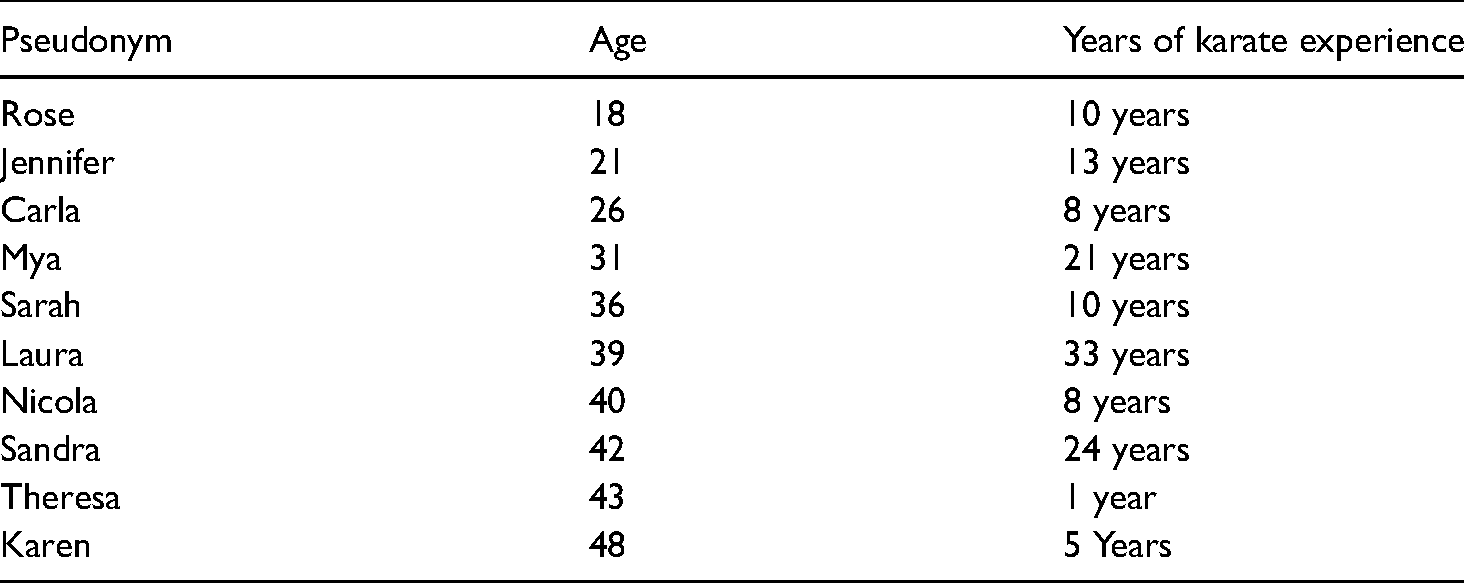
After receiving ethical approval from the authors’ university ethics committee, interviewees were recruited from a survey on menstrual experiences in karate (179 participants), which formed the first part of the research project. The survey was distributed online via the website and social media pages of the Scottish Karate governing body – Karate Scotland – and then shared on social media 35 times. Through the survey participants could register their interest in taking part in a semi-structured interview. To take part in the interview, participants had to be 16 years or older, identify as a female, trans-male, or nonbinary individual who menstruates, and currently participate in karate in Scotland. In total, 20 respondents indicated that they were interested in being interviewed, and were emailed a participant information sheet and consent form to review before deciding whether to take part. Of the initial 20 responses, 10 confirmed their participation and were interviewed, 5 did not reply, and 5 indicated their interest to participate after the data collection period had ended. The relatively low number of survey participants choosing to indicate an interest in taking part in an interview could be for several reasons including research fatigue after participating in the survey; not noticing the link to indicate an interest in taking part in an interview in the survey debrief; and feelings of embarrassment or shame related to discussing menstruation. Given the depth of data generated, it was not deemed necessary to seek further participants.
Data collection
Semi-structured interviews were conducted to explore the meanings that female karate practitioners apply to menstruation. In total, 10 semi-structured interviews were conducted comprising 12 h and 39 min of interview, resulting in 138 pages of interview transcript. Interviews lasted between 63 and 89 min. Interview questions were broadly grouped under three themes: first menstrual experiences, menstrual experiences at karate and the ‘ideal’ menstruation at karate. The questions purposively sought to explore positive and negative experiences of menstruation. Given the dominance of negative narratives of menstruation in western society, to ask about positive menstrual experiences and positive menstrual futures is, as suggested by Fahs (2020), a critical feminist intervention that enables the opportunity to think of menstruation beyond the dominant narrative. Participants were encouraged to consider and discuss positive menstrual experiences via questions such as ‘is there anything about having a period that you like?’ ‘could you tell me about a positive experience of having a period at karate?’ and ‘do you think that there are any benefits or positives about having a period ay karate?’. To further consider ways in which menstruation may not necessarily be considered problematic, interviewees were also asked to consider ‘what would an ideal period at karate look like?’.
The interviews took place via the online conferencing software ‘zoom’. Online interviews were chosen as the ability for interviewees to take part in an interview at home has been suggested to enable interviewees to feel more comfortable during the interview (Jenner and Myers, 2019). As menstruation is often felt to be a taboo topic, the distance between interviewer and interviewee afforded by online interviews, alongside the comfort of interviewees being able to take part in the interview at home, was deemed useful to enable participants in discuss menstruation. Given the researcher's position as a karate practitioner whom some of the survey participants may know, or meet at a karate event, participants were given the option to choose whether to be interviewed by the lead researcher or the research assistant. All 10 chose to be interviewed by the lead researcher.
Interviews were transcribed verbatim. Nonverbal moments in the interview, such as silences and laughter, were noted in the interview transcripts, as these moments can reveal important aspects of menstrual narratives, such as discomfort and uncertainty (Jackson and Falmagne, 2013). Quint (2019) suggests that humour and laughter are often used as techniques to mask anxiety in discussing menstruation, and as such, laughter was important to record within the transcripts.
Data analysis
To analyse the data, a thematic narrative analysis approach was adopted. Thematic narrative analysis combines elements of both thematic and narrative analysis to identify common occurrences of ‘the told’ (rather than structural elements) of participant's stories across cases (Ronkainen et al., 2016). For this study, meanings attached to menstruation comprise of ‘the told’ to be examined. The analysis drew on the thematic analysis process outlined by Braun and Clarke (2006) and adapted by Ronkainen et al. (2016). Initially, the transcripts were read through twice to develop familiarity with the data and to generate initial inductive codes reflective to how participants framed their menstrual experiences. The initial codes were then grouped into overarching themes and subthemes reflective to the menstrual meanings denoted – this included overarching themes of dirt, injury and naturally good – and exploring core narrative elements associated with each theme, such as the ways in which participants associated themselves or not with particular understandings of menstruation, and how they navigated between contrasting meanings of menstruation. In particular, the narrative thematic analysis sought to explore how female karate practitioners discursively develop the meanings that they attribute to menstruation. As such, thematic narrative analysis not only identifies what meanings female karate practitioners apply to menstruation – that comprise the key themes – but also the narrative journey taken to express such meanings.
Findings and discussion
Although there were a variety of meanings that women and girls applied to menstruation within karate, there were three prominent interpretations of menstruation in karate settings that emerged through participant interviews: menstruation as dirty; menstruation as weakness; and menstruation a positive ‘natural’ process. Most participants moved between these differing, sometimes conflicting, meanings at different points within their narrative journey, suggesting menstruations status within karate settings is complex and layered. This section will first explore karate practitioners’ conceptions of menstruation as a form of ‘dirt’, before discussing menstruation as a symbol of weakness, and finally discussing positive interpretations of menstruation.
Menstrual blood as dirt
Despite the variety of meanings that women and girls applied to menstruation within karate, framing all meanings was an overall interpretation of menstruation as a taboo experience to be hidden within karate settings: I thought I was quite, kind of, alright with these things (periods), but I definitely still have these feelings that I should hide it and that it's not ok. (Theresa, 43 years old) I think that's just the old sort of British public thing of where things (menstruation) are very closed, and things don’t get talked about really… You know? Erm, and I think that we’re still of that opinion that these things (menstruation) shouldn’t be talked about so a lot of people don’t bring it up or anything like that. (Sarah, 36 years old)
Participants above illustrate their sense that there is a social rule that menstruation should be hidden both verbally and visually in karate settings. The presence of this unspoken social convention suggests that menstruation does indeed hold the status of ‘dirt’ (Douglas, 1966) – as something disruptive to the social order, and thus must be concealed. The use of the word ‘things’ to describe menstruation in both quotes further illustrates participants own discomfort or uncertainty of how, or whether it is acceptable to, discuss menstruation. This discursive technique exemplifies the embodied social convention to hide menstruation in reflection to dominant negative menstrual discourses. Such actions signify a deep embodiment of the notion of menstruation as dirt.
Much like the findings of Kolic et al. (2024) and Zipp and Hyde (2024) in their studies on women's physical activity and swimming respectively, all interviewees expressed a discomfort in discussing menstruation at karate, and even more so they worried about leaking menstrual blood onto their clothing. Interviewees were particularly concerned about men and boys seeing, smelling or overhearing discussions of menstruation within karate classes: I’ll say to the girls if we’re sparring and we’re all together, if you see anything (menstrual blood), tell me *laughing*. And they’ll do the same to me… I just know that I just would not want that to happen (leaking menstrual blood at karate), I just would not want people to see it. Girls, yeah cause’ they can tell me, and I’ll go and sort it out, but not the men or boys. (Nicola, 40 years old) I’m always paranoid about leaking. It is a normal thing isn’t it, but in a class half full of men, I would be mortified if that happened. (Karen, 48 years old)
The quotes above display tensions in the meanings that Nicola and Karen apply to menstruation – whether it is ‘normal’ or mortifyingly shameful. Concerns for leaking blood in front of men was marked by most participants as the most significant way in which menstruation impacted their karate experience. The amplified concerns to hide menstruation from men suggest that menstruation is positioned as a dirt that is women's responsibility to manage and eradicate. Simultaneously, women's bodies are denoted as inherently shameful by their leaky capacity for menstruation that marks their bodies as uncontrolled (Shildrick, 2015). Thus, the presentation of a ‘controlled’ non-menstruating karate body is desired. The quotes suggest that uncontrollable menstrual leaks might not be felt as shameful, or deviant to the social order, in an all-women setting.
The concealment of menstrual blood forms part of karate practitioners’ menstrual etiquette (Moffat and Pickering, 2019). Moffat and Pickering (2019) suggest that, in the absence of adequate supportive menstrual infrastructure and policies, menstruators take on the ‘burden’ of maintaining menstrual etiquette. The quote from Nicola suggests that menstrual etiquette in karate is a shared collective practice amongst women and girls. Given the disproportionately male population of Scottish karate practitioners, interviewee's attempts to contain and conceal menstrual blood at karate involved significant planning (including considerations of what clothing to wear, what spare clothing should be taken and which period product(s) to use) and bodily monitoring.
In reflecting on why they engage in practices to hide their menstrual blood, some interviewees demonstrated an interpretation of menstrual blood as unhygienic: This is really gross, but say, sort of, someone had a faecal stain on their trousers and people noticed… It's that sort of, like, you’re not clean and you’ve not got control of things if that makes sense. (Theresa, 43 years old) Sandra: If it (menstrual blood) was on my suit I would’ve left. Researcher: And why is that? I know that sounds daft to ask, but could you explain why? Sandra: Cause’ I would’ve felt dirty. I would’ve felt that I needed to go get washed. I would’ve had a wash in the toilets and stuff but if it was on my suit I would’ve went a wee bit further. It could’ve maybe been on my legs a wee bit more, and I would’ve just wanted to go get washed.
The quotes above equate menstrual blood with unhygienic faeces and other dirt that needs to be cleaned. Within their narratives they demonstrate a feeling of shame towards visible menstrual blood. This suggests that within karate settings the concealment of menstrual blood is central to menstrual etiquette (Moffat and Pickering, 2019) and central to presenting a respectable body. The outcome of breaking the menstrual etiquette, in Sandra's case, is that she felt that she would have to leave the karate class, thus limiting her abilities to train.
Some interviewees found it difficult to articulate why they hide their menstrual blood, or why they would not want others at karate to see their menstrual blood. Often their reflections demonstrated conflicting ideas of what menstrual blood means: I don’t think anyone would think anything bad, nobody's going to go ‘manky bitch, she's not wearing a tampon today’, you would think ‘aw that's a wee shame’. Like, do you know what I mean? Nobody is horrible about it but, yeah… It's not a fear of people being like ‘eww’, it's just you don’t want to be wandering about like that (with menstrual blood showing) … I don’t know. (Mya, 31 years old)
The quote from Mya demonstrates that whilst she feels that there is a clear social convention that she should not train with menstrual blood leaks on her clothing, there is uncertainty of the agreed collective meaning surrounding menstruation in karate settings underpinning this convention. Mya presents multiple conflicting ideas of what menstrual blood could mean in a karate setting – disgusting, not disgusting or a misfortune deserving of empathy – with difficulty in identifying which of these options she feels fits best.
Menstruation as weakness
Narratives of menstruation as a form of weakness also emerged in women's narratives of menstruation in karate. Menstrual symptoms such as cramps, fatigue and headaches left some interviewees feeling both physically weak in their bodies, and psychologically weak for feeling such symptoms: I would feel a bit weak (letting a coach know that her period is affecting her) and you sort of feel like you’re making a fuss over something that every woman experiences on a regular basis… I don’t know whether he would think I was weak or whether it's me. It feels a bit pathetic, so basically, I feel utterly horrible about myself (during a period), I can’t get off the couch, it doesn’t feel very ‘karate’. (Theresa, 43 years old)
Theresa discursively creates a separation between her notion of herself as a karate practitioner, and her menstruating body that echoes the ways in which Jackson and Falmagne (2013) and Jackson (2019) found young women to disassociate from their menstruating bodies. Here, the menstruating karate body is positioned as subordinately distinct from the ‘normal’, non-menstruating karate body.
Similarly to the research of Moreno-Black and Vallianatos (2005), some karate practitioners viewed menstruation as an injury or impairment to their performance: It's (periods) not something that's really spoken about with coaches and stuff like that. I don’t know, it's hard to, cause when you’re training you want to fight through anything – if you have a broken hand, you’ll still want to find a way. It's the same… (with periods). (Carla, 26 years old) I remember thinking at the time, I just felt a bit uncomfortable, and if I didn’t have my period I might’ve done a bit better. I lost in the bronze medal match for the third place, and I just wonder, you know, if I’d felt a bit better then you know, I could’ve got that bronze… I don’t know. (Laura, 39 years old)
When viewed as an injury, menstruation is marked as a temporary impairment to their sporting performance that female athletes must navigate and ultimately seek to control to ‘find a way’ through (Moreno-Black and Vallianatos, 2005). Here, the menstruating karate body is marked as an injured body in comparison to a normative, non-menstruating, body. This interpretation echoes earlier medical ideas that marked the female body as unsuitable for sport (Hargreaves, 1994). The connotations between menstruation and injury also evoke the shared experiences of physical pain across both phenomena, and the expectation that karate practitioners must train through pain. Training through injury and pain is embedded within the ideological framework of many sports (Hughes and Coakley, 1991). As such, menstrual pain is experienced as another form of pain that interviewees felt they had to endure to maintain their sporting identity.
Yet, despite the embodied experience of menstruation being framed as an impairment or injury, visible menstrual blood was seen as distinctly different to blood from an injury: Researcher: Is it different getting blood from a burst nose or something on your suit at karate than period blood on your suit? Karen: Yup, I would say so… Because that's (having a burst nose) part and parcel of the sport that you’re doing. I don’t want a burst nose, but it is part of the sport…And if I had a burst nose, like, the guys would be like ‘yes, well done’ – you know? Researcher: And would period blood be celebrated like that? Karen: *Laughing* No! Definitely not.
The above demonstrates not only that menstrual blood is seen as different to other forms of bleeding in karate, but that it is also not seen as ‘part of the sport’ in the ways that blood from injuries are. Interviewees suggested that blood from an injury is accepted, normalised and sometimes glorified as a symbol of the embodiment of the sports ethic to sacrifice the body for sporting success (Hughes and Coakley, 1991). Whilst menstrual blood could also be interpreted to symbolise training through pain, in contrast, Karen suggests that menstrual blood is felt to be an abnormal and unwelcome substance in karate settings, representative of Douglas’ (1966) conception of dirt as ‘matter out of place’. Both forms of bleeding visibly mark the karate suit in similar ways but are granted hierarchically different symbolic status. This positions menstrual blood, and by association women's bodies, as outside of the idealised sporting body.
Some interviewees resisted the idea of menstrual symptoms as an injury that could or should impact their performance. When discussing menstrual symptoms experienced during karate training, Karen (48 years old) stated: ‘We’re women eh? You just get on with it’. On the one hand, Karen's quote positions menstruation as something that is expected to be challenging and that women must ‘get on with’ without support or acknowledgement. On the other, it suggests that women are resilient, strong and able to ‘get on with’ karate despite physical impacts of menstruation. The quote positions menstruation as one of multiple inequalities that women experience. Rather than denoting menstruation as a symbol of weakness, the quote positions menstruation as an inequality that women overcome in the absence of structural policies and procedures to support sports participation during menstruation. The ‘burden’ to overcome menstrual symptoms is placed as a responsibility of those who menstruate (Moffat and Pickering, 2019).
Within this theme, karate practitioners’ narratives of menstruation as injury, or not, expressed tensions around acknowledging the symptoms of the menstruating body without falling into a biological reductionism that marked their bodies as inherently weak. These tensions point to broader tensions in how the ‘natural’ female body is understood in a ‘post-feminist’ society.
Positive interpretations of menstruation
Interviewees did identify a range of positive interpretations of menstruation, that challenge overarching negative societal discourses of menstruation. Much like findings of Fahs (2020) with a non-sporting population, the most prominent positive of menstruation that interviewees discussed was that menstruation symbolised a healthy female body: You know your body is, like, healthy and doing what it needs to do, I think. Cause, like, doing sports effects your body so much and your body goes through so much wear and tear over time like injuries and concussions and whatever… But at least you know one part of your body is working well *laughing*. Doing what it needs to do and that your body's going through its natural processes, which is good. (Carla, 26 years old)
Within the context of sport, where the body is subjected to physical demands and risks, menstruation is seen as a positive sign of a healthy body. The experience of regular menstruation through sporting practice refutes lingering medical myths as outlined by Hargreaves (1994) of the incompatibility of sport and women's reproductive functions. The term ‘natural’ was frequently used by interviewees when discussing menstruation and tied into notions of the healthy body. The use of the term natural often came before, or after, discussing menstrual stigmas: I don’t know why but I just feel like it's (menstruation) just not something that would be appropriate to speak about at karate. Which I don’t know why cause it's such a natural thing and it literally happens to everybody. (Rose, 18 years old)
This quote from Rose illustrates a tension between existing narratives of menstruation as dirt and taboo, alongside her own interpretation of menstruation as ‘natural’. The frequency with which interviewees discussed menstruation as ‘natural’ in response to also discussing menstruation as disgusting or taboo demonstrates a fight against a solely negative menstrual narrative.
For some women, their ability to train through their menstrual symptoms was a source of pride: I have had times where I’ve just come away and felt really, it sounds stupid, but felt actually really quite empowered and kind of quite pleased with myself. I was haemorrhaging through that class and nobody else was *laughing*. I managed it anyway and I sort of feel quite good about it - which sounds sort of stupid. (Theresa, 43 years old)
Interpretations such as Theresa's resist narratives of menstruation as a symbol of weakness. Theresa's menstruation experience in karate is directly drawn on to inform her reflections of herself as someone who can overcome and work through challenges. As such, menstruation within karate can be ascribed meanings of strength and resilience. Such interpretations echo emerging feminist discourses in contemporary advertisements of menstrual products (Przybylo and Fahs, 2020). Menstruation was also positively seen as facilitating aggression to perform well when sparring: I’ve got a lot more aggression when I’m fighting. If somebody hits me, I’m like ‘right hen, you’re getting it’ because like you’ve got that aggression inside you. (Rose, 18 years old).
The quote from Rose adopts a common menstrual narrative – of menstruating women as being emotionally aggressive (Persdotter, 2020) – but, in the context of karate, changes the value applied to menstruation from a negative to a positive. Such an interpretation positions menstruation as a positive source of aggression that women harness to improve their karate practice.
Conclusion
This article makes a significant contribution to understanding menstruation in sporting practices by demonstrating the often-conflicting meanings that women karate practitioners apply to menstruation. Whilst previous research on menstruation in sport highlights the impact of menstruation on sporting experiences (Armour et al., 2020; Brown et al., 2021; Findlay et al., 2020; Kolic et al., 2021, 2024; Moreno-Black and Vallianatos, 2005), coach interactions surrounding menstruation (Armour et al., 2020; Brown et al., 2021; Clarke et al., 2021; Hook et al., 2021; Verhoef et al., 2021; Zipp and Hyde, 2024), and menstrual barriers to participating in relation to these two areas, resolving the issues that such research highlights requires understanding the meanings that menstruators attach to menstruation that underpin their experiences and interactions in sport settings. Understanding and addressing the meanings attached to menstruation is central to informing effective strategies for creating positive sporting environments for those who menstruate.
This article contributes to the literature on menstruation in sport by identifying the meanings attached to menstruation within karate in Scotland, and by demonstrating the contentious fragility of menstruation's status as ‘dirt’ (Douglas, 1966). This article demonstrates that women karate practitioners hold a mixture of positive and negative meanings of menstruation as dirt, weakness, strength and health. On the one hand, the ‘taboo’, invisibility and silence of menstruation in karate settings demonstrates that it does hold, to some degree, a status as dirt in line with Douglas’ definition. The amplified concerns to hide menstruation from men suggest that menstruation is positioned as a dirt that is women's responsibility to manage and conceal via menstrual etiquette practices (Moffat and Pickering, 2019). The social order that menstrual etiquette practices in karate maintain is thus an order centred on men's comfort from menstrual ‘dirt’. The desired invisibility of menstruation within karate settings, and its association with injury, privileges and normalises the non-menstruating body. Just as Shildrick (2015) suggests that the ‘leakiness’ of menstruation marks the female body as morally inferior to the idealised, male, body, the leakiness of menstruation is also seen as external, and inferior, to the ideal karate body.
On the other hand, significantly, this research found that many women in karate would like to challenge, resist, or move past dominant narratives that mark menstruation as dirt. Discourses of female empowerment and an empowered menstruation are echoed within karate practitioners’ narratives. The presence of positive interpretations of menstruation refutes the notion of menstruation as dirt, and the subordination of ‘leaky’ bodies, if only at the individual level. These findings suggest that there is a desire to challenge the status of menstruation as dirt and redefine the social conventions surrounding menstruation within karate settings, but this desire has not, yet, been turned into collective practice.
The meanings that women and girls applied to menstruation within karate settings thus expressed tensions between simultaneously viewing menstruation as a form of ‘dirt’ (Douglas, 1966), and a desire to challenge such ideas of menstruation, where ideas of menstruation as disgusting and healthy, of weakness and of strength, collided. Discourses of menstruation as dirt and feminist discourses that seek to acknowledge and value women's bodies are expressed in karate women's menstrual narratives, simultaneously framing the way that Scottish karate practitioners apply meaning to their menstrual experiences. The contradictions in the meanings that women applied to menstruation reflect an uncertainty of the agreed collective meanings of menstruation in karate. Yet, the co-existence of both narratives of menstruation disrupts the hegemony of dirt as the meaning-making frame for understanding menstruation, opening up potential for menstruating bodies to be valued as ‘normal’ sporting bodies.
Recommendations for practice and future research
To challenge menstruations’ status as dirt, and support positive meanings of menstruation within karate (and other sports) settings, governing bodies, clubs and coaches could: make clear their interest in supporting practitioners through menstruation; ask their members to share their perspectives on what could improve their experiences of training during menstruation; and communicate some of the positives of menstruation for karate training in-person and/or on club/governing body social media pages. These are initial steps that can act to break the taboo of menstruation.
Given the relatively small amount of sociological literature on menstruation in sport, there is much scope for future research. This research has focused on the perspectives of a sample of women karate practitioners who identify as female. Much of the meaning-making of participants in this study centred around considerations of what their predominantly male training partners and coaches may think about menstruation. Thus, to address the meanings attached to menstruation within male dominant sports, future research should explore the meanings that men and gender diverse athletes apply to menstruation within sports settings that, together with cis women's perspectives, underpin and inform menstrual etiquette in male-dominant sports contexts. To enable positive environments for menstruation in sport, future research would also benefit from examining the meanings attached to menstruation across sports with different gendered compositions, to ascertain how the gendered settings impact menstrual meaning making.
Footnotes
Acknowledgements
I would like to thank all those who took part in the research and shared their menstrual stories, and Karate Scotland for assisting with participant recruitment. I would also like to thank Leisure Studies Association for funding this research.
Ethical approval and informed consent
Ethical approval was granted by the University of the West of Scotland School of Education and Social Sciences Ethics Committee. I confirm that all data represented in this article was collected with informed consent.
Declaration of conflicting interests
The author declared no potential conflicts of interest with respect to the research, authorship, and/or publication of this article.
Funding
The author disclosed receipt of the following financial support for the research, authorship, and/or publication of this article: This research was funded by the Leisure Studies Association Research & Enterprise Development Fund.
