




Abstract
For many young women, their relationships with fitness, health and the body are shaped by unrealistic beauty ideals. Body image scholars have long focused on the impacts of the media and more recently, social media, on the way young women experience body satisfaction. This research investigates the lived experiences of young women in Aotearoa New Zealand, in relation to the social media trend of the ‘glow up’ as it connects to body transformation, beauty practices and fitness culture. This article draws upon a thematic analysis of focus groups with 15 young women (18–25 years) living in Aotearoa New Zealand. Engaging with feminist writings on the ‘body project’, including those drawing upon postfeminism and affect theories, our analysis reveals how the ‘glow up imperative’ powerfully combines ‘body positivity’ discourses with transformational trends (i.e., ‘fitspo’ and ‘makeover’) in highly affective ways, prompting many young women to feel guilt or shame (‘ugly feelings’) when they are unable to achieve or maintain the time, financial and energetic investments required for, a successful ‘glow up’. In so doing, we reveal that while the ‘glow up’ trend is often presented as an empowering trend for young women, it is promoting another unrealistic standard that can prompt negative feelings and ffects. Evenfor those who are critical of the negative effects of the ‘glow up imperative’, they were unable to escape its reach, thus highlighting the power of such pervasive social media trends on young women. The first to document the affects of the ‘glow up imperative’ on young women, this paper highlights the need for feminist research that explores how young women's fitness practices and embodied experiences of health, beauty, and ‘successful’ femininity continue to be (re)shaped by social media trends, and connected to a range of consumption practices.
Feminist scholars have investigated a range of neoliberal imperatives such as ‘body work’ (Coffey, 2016), ‘fitspiration’ (Toffoletti and Thorpe, 2021), and transformational imperatives (Gill, 2007; Riley et al., 2023) that are impacting young women's relationships with their bodies, health, and gendered subjectivities (Camacho-Miñano et al., 2019). The ‘glow up’ is a recent social media trend that is also affecting young women's embodied experiences but has yet to garner scholarly consideration. To ‘glow up’ is to undergo a significant physical transformation, seemingly to increase one’s feelings of self-love and appreciation. The ‘glow up’ is often referred to in conjunction with improving one's physical appearance or aesthetic but it can also be applied in terms of one's personal and professional achievement such as self-growth and career. The term was especially popularised by social media influencers in the fitness, wellness, and beauty industries posting ‘before/after’ photos during the pandemic. Searching the term ‘glow up’ on social media platforms Instagram, YouTube, and TikTok presents unlimited picture and video content of (typically) young women undergoing surgeries, beauty treatments, or providing advice to their followers on how to achieve the ‘glow up’ themselves.
While the ‘glow up’ is a cultural phenomenon, herein we develop the concept of the ‘glow up imperative’. In so doing, we take inspiration from feminist literature on ‘body work’ (Coffey, 2016), ‘post-feminist transformation imperative’ (Riley and Evans, 2018), and the ‘positivity imperative’ (Thorpe et al., 2024), and particularly feminist scholarship on the pressures and expectations (the imperatives) on young women to strive towards unrealistic body and lifestyle ideals of constant self-improvement. The word ‘imperative’ is used frequently across this literature, and herein we take up such vocabulary in coining the term the ‘glow up imperative’ to refer to the all-pervasive pressures and expectations on young women to transform their bodies and identities through a range of lifestyle changes (i.e., fitness, nutrition, beauty practices). In particular, we draw upon a reflexive thematic analysis of focus group and interview data with 15 young women to highlight how the ‘glow up’ imperative is impacting their fitness lifestyles and feelings about themselves. Guided by a post-structuralist feminist lens, our analysis identifies the power of such discourses on young women, as well as acknowledging their agency in navigating such pressures and expectations (Willett and Etowa, 2023). Yet it also reveals the power of this address to interpellate women even when they experience it as harmful and are critical of the ‘glow up’ trend, highlighting the pervasiveness of such imperatives.
Literature and conceptual framework: the gendered body project, social media and the transformation imperative
Over recent decades, a significant body of feminist literature has drawn upon a range of theoretical perspectives and methods to examine the pressures on women to transform and change their bodies for health, beauty, and success in the context of neoliberal healthism (Markula, 2001; Riley et al., 2023). Healthism refers to the social pressures and expectations on each individual to be responsible for maintaining their own health, and the assumption that ‘good’ neoliberal citizens should actively participate in self-monitoring practices including diet, exercise and weight-management interventions (Beltrán-Carrillo et al., 2023). Those who do not engage in this behaviour are believed to be ‘irresponsible, lazy, and lacking self-discipline’ (Crawford, 1980, as referenced in Beltrán-Carrillo et al., 2023: 298). Such messages are often directly targeted at women through an array of media from magazines to apps (Lupton, 2016). Often referred to as ‘the body project’ imperative, marketing initiatives frame products and lifestyles as ‘helping’ or ‘empowering’ women to transform their bodies, and thus their chances for a happy, fulfilled and successful life. Yet inherent in such discourses is the assumption that women have something ‘wrong’ with them that needs to be immediately corrected, solved, and beautified. Coffey (2016) refers to this as ‘body work’ and suggests that this embodied labour is practised in efforts to achieve the strict and largely unrealistic body ideals presented in contemporary society.
Feminist scholars have offered nuanced insights into the concept of body transformation or drastic makeover (Gill, 2007; Riley et al., 2023). In so doing, many draw upon the postfeminist sensibility, a ‘noncoherent set of ideas about femininity, embodiment, and empowerment circulating across a range of media’ that work in powerful ways to ‘inform women's sense of self’ (Riley et al., 2017: 1). For example, Gill (2007) and Riley et al. (2023) have explored the ‘change yourself’ transformation imperative perpetuated in makeover-based television programmes, which promise contestants inner happiness and confidence through changing their appearance. Riley et al. (2023: 50) state that the transformation imperative has become a ‘normative expectation’, particularly for women, and though it presents itself as ‘empowering’ it works only to encourage self-objectification.
Social media and the gendered body project
Building upon decades of feminist research examining the pressures on young women (mostly teens to mid-twenties) to ‘aspire’ towards (often unrealistic) versions of success (Harris, 2004; McRobbie, 2015), a growing body of scholarship is focused on the pressures on young women to transform their bodies in the context of social media (Camacho-Miñano et al., 2019; Coffey, 2016, 2021; Rich, 2024). For example, Jong and Drummond (2016) found through their online ethnography of social media sites, that health and fitness content placed the onus on the individual to constantly work on themselves, stay fit, and manage their body weight. The messaging on these sites suggests that if an individual does this, then they might be considered a ‘good global citizen’ (Jong and Drummond, 2016: 763).
Building upon previous media work (i.e., magazines, television), various feminist scholars have engaged with postfeminist sensibilities to examine the powerful and contradictory discourses operating on and through social media. Writing of such body image pressures in the context of neoliberalism, healthism and postfeminism, Rich (2018: 739) highlights the ways social media pressures encourage young women to engage in self-surveillance, monitoring, regulating and disciplining of their own bodies, with an expectation to ‘reinvent themselves and adapt to constant change’ through both body work and consumption practices. As well as revealing the negative impacts on young women's body image, the postfeminist sensibility is not without opportunities for resistance.
Rich (2018) also reveals the pedagogical possibilities inherent in the ways young women are engaging with social media. Similarly, Gill (2023) proposes that many young people, particularly girls, experience social media in visceral and paradoxical ways. She acknowledges that young people are aware of the harms of social media but often feel ‘trapped’ within complex online and offline relational webs. Hence, they can feel obliged to find their own strategies to create a safer space such as unfollowing harmful social media influencers, rather than asking questions about the responsibilities of systems and organisations to protect and support young people to develop healthy relationships with their bodies. Both Rich (2018) and Gill (2023) call for greater acknowledgement of young women's agency in navigating these powerful, gendered transformation imperatives.
Feminist and media scholars are also increasingly interested in the online ‘body positivity’ trend for young women (Cohen et al., 2021; Riley et al., 2023). The aim of this trend is to encourage women to embrace their bodies and resist normative feminine body ideals. However, Cohen et al. (2021) found that even though the movement can have positive effects on young women's well-being and body satisfaction, it can also exacerbate existing body image issues because the movement still has an overt focus on one's appearance. As we reveal in this paper, body positivity discourses are being reappropriated in the ‘glow up’ trend, reframing unrealistic body ideals and lifestyles in ‘empowering’ and ‘positive’ discourses.
While some scholars have examined young women's social media within the context of postfeminism, others are engaging a range of theoretical and methodological approaches, including feminist new materialism, to examine the relational, affective and embodied dimensions of young women's social media interactions. For example, Coffey (2021) has engaged in extensive research on how social media exacerbates ‘ugly feelings’ (i.e., guilt, shame) among young people, negatively impacting their relationships with their bodies. Also taking inspiration from feminist new materialisms, Rich (2024) uses the term ‘body disaffection’ to describe the way young people negatively experience body image pressures due to the relentless and narrow ideals they see posted daily on social media.
With Rich (2024), Ringrose et al. (2024) have suggested that body disaffection, shame, and even sexual abuse, have increased since the global pandemic when young people spent extensive periods of time on social media and health and fitness apps for escapism, connection and entertainment. A recent study of young women in Aotearoa New Zealand similarly highlighted the highly affective and embodied relations young women experienced through their social media engagement during the pandemic, including rage, frustration, guilt and shame, as well as their agency in resisting such all-consuming pressures and expectations to work on their bodies through fitness and lifestyle practices (Thorpe et al., 2024). According to the authors, the young women also navigated complex feelings amidst a context of performative positivity both online and in their everyday pandemic lives.
Not only are young women expected to conform to highly unattainable aesthetic ideals, but they must also adhere to positivity imperatives in their quest for perfection. A recent study by Calder-Dawe and colleagues (2024: 1) exploring the affective practices of eight women (21–35 years) influencers living in New Zealand showed persistent positivity as integral to their Instagram practices, with ‘optimism and resilience’ modelled in ‘emotion-laden styles and standpoints’. Building on work that considers the ‘feeling rules of postfeminist cultures’, and drawing upon interviews with body positivity advocates, Hill (2024: 1) reveals the ‘unique affective entanglements, and contradictions’ inherent in social media and body image relations. In so doing, she offers nuanced insights into the ‘difficult bind’ experienced by social media users who are actively ‘negotiating frustration, exhaustion and “ugly feelings” with the opportunities body positivity affords—affirmation, community, and togetherness’ (Hill, 2024: 1). Arguably, the ‘glow up imperative’ is entangled in a similar contradictory network of affects.
Importantly, there are both gendered and racialized discourses operating on and through social media that impact young women's feelings about their bodies. As Kennedy (2020: 1072) highlights, during the pandemic TikTok started to be dominated by ‘white, slim, normatively attractive feminine girl stars’, with algorithms and metrics working to ‘make invisible those subjects judged not to fit the ideals of young white femininity’. As Thorpe and colleagues (2024: 12) write, the online ‘visibilities of young, thin, White women on social media surfaced tensions and feelings of discomfort, frustration and dissatisfaction among some young women who did not see themselves in such representations’. Importantly, as some feminist scholars have highlighted, young women influencers, particularly those in the health, fitness and wellness industry, continue to reinforce body ideals based on heteronormative, white femininities.
However, in recent research by Nemani and Thorpe (2023), it has been discovered that Māori and Pacific young women are actively navigating pressures to conform to body ideals based predominantly on the heteronormative aesthetic of the young, toned white women. Through focus groups, the authors explain how the young Indigenous women in their study were drawing upon cultural ways of knowing to embrace more holistic understandings of their bodies and rejecting social media trends that prioritise young white femininities. In so doing, the authors make a valuable contribution to the ‘body positivity’ literature, highlighting how young Māori and Pacific women are navigating social media ideals by drawing strength from cultural ways of knowing the body.
Young women and ‘fitspo’
A growing body of feminist scholarship is focused on the fitness experiences of women, and the role of social media on women's embodied experiences of health, beauty, femininity, and success. The motivation to treat the body as a fitness project is further reinforced through the social media trend of ‘fitspiration’ (or ‘fitspo’) which is used to ‘encourage and inspire people to exercise’ (Toffoletti and Thorpe, 2021: 822). Various scholars have contextualised the rise of ‘fitspo’ within postfeminist sensibilities which frame women as ‘flawed but fixable’, but only through extensive body work and consumption practices (Riley and Evans, 2018). For example, in their examination of the digital communities surrounding the popular fitness influencer, Kayla Itsines, Toffoletti and Thorpe (2021) identify the varied ways women engage in digital and embodied processes of aspiring towards the unrealistic lean, toned and strong feminine ideal, while simultaneously supporting others in their own fitness journeys.
Focusing particularly on the impact of online fitness trends on young women, Camacho-Miñano et al. (2019) used a participatory approach involving focus groups and semi-structured interviews to gain deeper insights into how teenage girls engaged with ‘fitspo’ content on Instagram. They found that young women engage in this content to learn more about fitness and their bodies, but they are also vulnerable to body ideals. While such online trends can inspire and motivate young women to become involved in fitness, they can also encourage compulsive exercise and eating behaviours. Pryde and Prichard (2022) also argue that while ‘fitspo’ may be framed through discourses of empowerment and relentless positivity, it can cause young women to engage in constant self-monitoring and comparison, due to the focus on body ideals.
In this paper we build upon and extend feminist research on the body project, and the role of social media on young women's body transformation, negative and positive affect, and ‘fitspo’ imperatives, with a focus on the recent social media trend of the ‘glow up’. Taking inspiration from the feminist literature engaged above, we examine the embodied, affective and relational aspects of the ‘glow up’ imperative, as well as young women's (limited) agency in navigating gendered pressures to monitor, discipline, consume and ‘perfect’ their bodies and selves in a world where they are always never enough.
Methodology
Our methodological approach is guided by the feminist post-structural values of ethically and carefully creating safe and supportive spaces for young women's voices and attending to the multiplicities of their embodied experiences (Willett and Etowa, 2023). In this paper, we draw upon focus groups and individual semi-structured interviews with 15 young women to gain more nuanced insights into young women's lived experiences of fitness.
With ethical approval from the University of Waikato, we set out to recruit young women living in Aotearoa New Zealand who consider themselves to be pursuing a fitness lifestyle. Social media was chosen as the main form of participant recruitment since the target demographic of this research project spends considerable amounts of time on social media, particularly Instagram (Brown and Tiggemann, 2020). When participants reached out to express an interest in the research, we then offered the option of participating in either a focus group or an interview. We gave this option recognizing that for some young women, this could be a sensitive subject evoking strong feelings and/or highly personalised experience. Most young women chose to participate in a focus group, preferring a group setting. However, some elected the individual interview option as they were unable to make the focus group date or location.
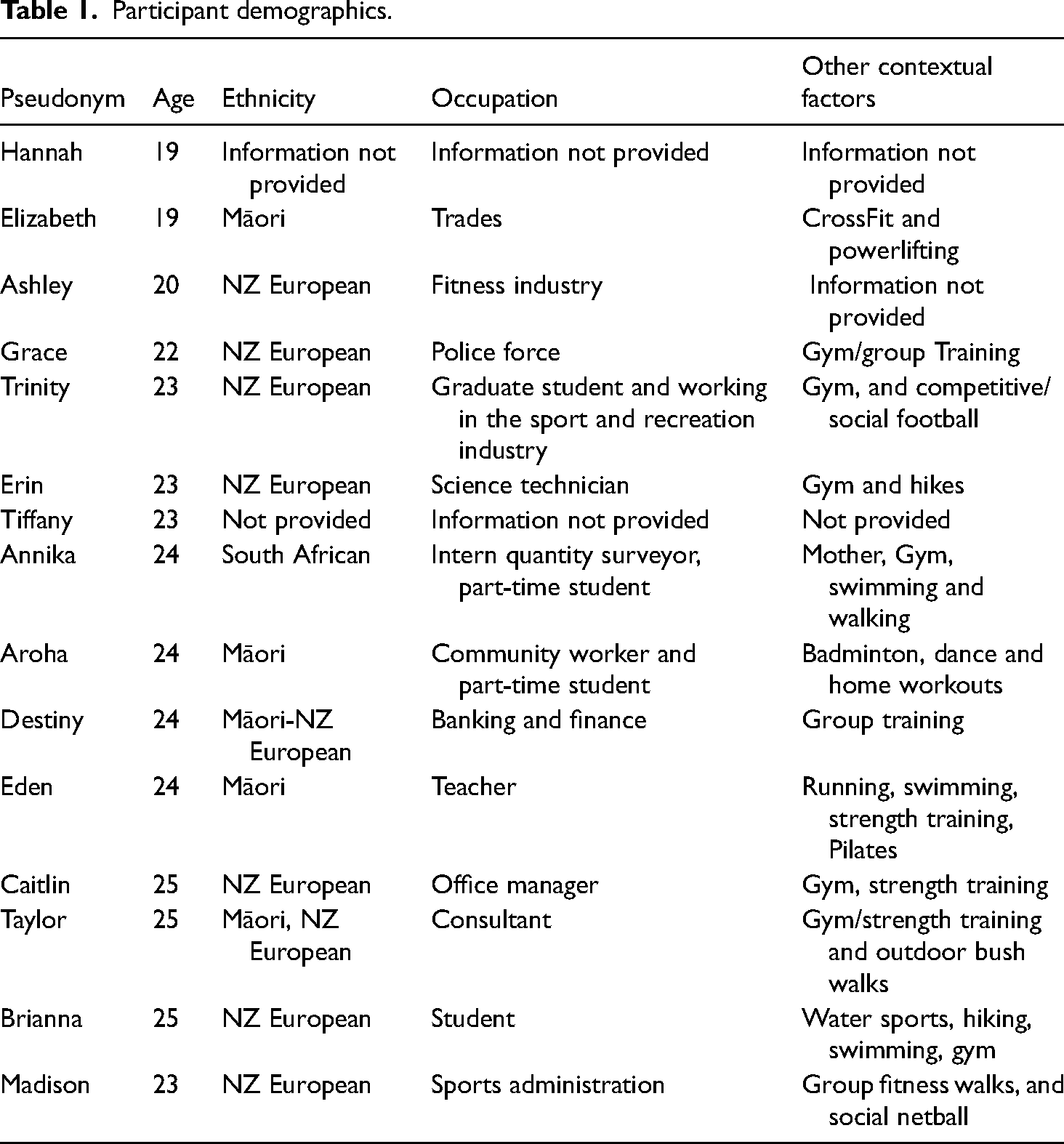
Participants in the focus groups and interviews included 15 young women aged between 19 and 25 years old (see Table 1). All participants identified as women and as being interested in a health and fitness lifestyle. Due to the geographical and logistical limits of the research team, we conducted three focus groups and three interviews in three North Island cities (Hamilton, Tauranga, and Wellington).
Participant demographics.
We used the same semi-structured interview guide for both the focus groups and interviews. A series of 14 questions were asked and aimed to understand how young women experience fitness culture, body image, and their thoughts about whether young women feel pressured to adhere to beauty standards and body ideals. The focus groups (particularly those where the young women knew each other) often fostered robust discussion among the participants, whereas the interviews offered deeper and more highly personalised discussions to emerge. All focus groups and interviews were audio-recorded and then transcribed by the first author. In our efforts to protect the identities of participants, we use pseudonyms throughout.
We adopted a reflexive thematic analysis approach (Braun and Clarke, 2024). The first author is a young fitness professional herself and led the data collection and analysis. As a senior feminist scholar of sport and fitness, the second author provided methodological and analysis support and feedback throughout the process. Our thematic analysis approach involved the first author familiarising herself with the transcripts, developing initial codes and then themes, with support from the second author throughout. We then brought the key themes into dialogue with feminist literature on the neoliberal aspirational, transformational and body project to develop the ‘glow up imperative’ concept, and the impact this trend has on young women's relationships with their bodies, and understandings of health, fitness, and overall lifestyles. Through this analysis, we tuned into some of the contradictions in their experiences, particularly how some young women are critically aware of the harmful impacts of the ‘glow up’ yet still feel compelled to engage with this trend.
Our sample includes some cultural diversity with Māori (3) and mixed ethnicity (Māori-Pākehā/NZ European) (2) participants. However, we note that culture and ethnicity did not emerge as strong themes in our analysis. As white presenting (Māori-Pākehā) (Kurghan) and Pākehā (Thorpe) researchers, we recognize that our own positionalities may have limited how much participants of Māori or mixed ethnicity were willing to share about how their cultural ways of knowing the body, health and well-being intersect (or come into conflict with) the ‘glow up imperative’. In particular, as a white presenting interviewer in a predominantly white glow-up world, we may not have heard Māori stories because ethnicity was not a central issue in this particular context. There were certainly traces of cultural differences, but our methodology did not allow for an in-depth analysis of cultural ways of knowing the ‘glow up imperative’. We consider this a limitation of the research and signpost this as an important area for future research.
Analysis: young women and the ‘glow up imperative’
Herein we organise our findings into three key sections, firstly documenting the range of practices the young women are engaging in as they seek to achieve a ‘glow up’. Secondly, we examine the ‘ugly feelings’ the glow up trend surfaces in young women. Finally, we highlight some young women's awareness of the harm of the ‘glow up’ trend, and their efforts to protect themselves by navigating such pressures. Throughout our analysis we draw upon feminist scholarship on the body project, body transformation imperatives (i.e., ‘Fitspo’, makeover), and writings on social media and affect (including ugly feelings and body positivity) to reveal the ‘glow up’ trend as an intensification of previous discourses operating on and through young women's bodies in the context of neoliberal healthism and postfeminism.
In pursuit of the ‘glow up’
The relentlessly demanding ‘glow up’ trend encourages young women to engage in ‘body work’ practices such as attending the gym and restricting their diet, purchasing the latest fashion trends, or engaging in an array of beauty practices, to achieve a successful ‘glow up’. Others spoke to the ‘glow up’ trend as involving a series of activities (i.e., reading, journaling) alongside beauty and fitness practices.
According to the young women in our study, the ‘glow up’ requires an individual to maintain a highly disciplined approach towards health and fitness. Several of the participants defined ‘glowing up’ as staying fit and adhering to ‘slim fit’ ideals (Wiklund et al., 2019). As soon as the word ‘glow up’ was mentioned during a focus group, Erin responded: ‘It's always [centred around] weight loss’. Striving for a ‘glow up’ that incorporates unrealistic body ideals typically shapes the type of fitness practises the young women choose to engage in. Various participants described the importance of social media fitness trends (including ‘Fitspo’), and the pressures they felt to follow such trends if they wanted to ‘see results’: I think … online things like TikTok trends … like that ‘3-10-30’ or treadmill challenge. I’m like … I must … do that exact thing because that’s what gets the results …. A lot of things go viral and everyone's like ‘I have to do that’ (Erin) Celebrities and … people that are cool at the time [like Chloe Ting] … influence the way we want to look [and] the way we exercise. (Eden) One of my favourites is ‘Oh May’… She is amazing. But every time she pops up [on my Instagram], she's strong, she's lifting, she's hot, she's got the bod, she's got everything and I’m just like, ‘Oh my gosh’, she makes me … want to work hard, get hot and just do it maybe for external validation … for the aesthetic of it. (Aroha)
These responses demonstrate the impact of online fitness trends (e.g., treadmill challenge) and fitness influencers (e.g., Chloe Ting, Oh May) in prompting the affective response of desire to engage in an array of health and beauty practices to achieve a similar ‘aesthetic’, and the chance of similar forms of ‘external validation’. Importantly, the aesthetic the young women were aspiring towards is not just to be thin and toned, but to achieve the hour-glass shape with muscles and curves in the ‘right’ places (Brice and Thorpe, 2021).
Achieving a ‘glow up’ requires extensive ‘body work’ (Coffey, 2016) as well as the purchase of specific products such as the latest fashions in activewear (e.g., ‘short shorts’). For example, Aroha, identifies having high quality activewear as important to obtain the ‘fit girl’ look, stating ‘there's this whole total aesthetic about being a “fit girly” … From the lifestyle (to) … even what they’re wearing.’ As this quote suggests, the ‘fit girl’ lifestyle is not just about engaging in regular exercise for body transformation, but also a range of highly consumptive practices (Brice and Thorpe, 2020). To achieve a perfect, ‘glowing’ appearance, young women are also encouraged to purchase a range of beauty products, from skincare or cosmetic products, to cosmetic treatments and surgeries. As well as calling for young women to engage in a range of practices from beauty therapy (i.e., lip kits, tanning, eyelash extensions, teeth whitening), the ‘glow up imperative’ also encourages young women to consider more costly, extreme, and often dangerous treatments and surgeries (e.g., the ‘Brazilian Butt lift’, breast enhancement). Participants regularly commented that they felt compelled to spend excessive amounts of money on beauty treatments if they desired a successful ‘glow up’: You can’t get to … that perfect standard without spending so much money … it's like so many of my friends … they get their hair professionally done, they get their lashes and their brows done and their nails and they’re like 17. (Hannah)
Aroha, another focus group participant, explains: ‘I have gone and had treatments, whether that's facials, body hair removal, and I know that in certain environments, that is… the expectation.’ Aroha summarises the requirements of the ‘glow up’ trend, stating that consuming costly beauty treatments such as facials and body hair removal is imperative for a young woman to achieve a successful ‘glow up’ transformation.
Drawing upon postfeminism, various scholars have discussed the blurring of health and beauty (Gill, 2007; Riley et al., 2023) in contemporary body transformation projects. Our research builds upon and extends this work, revealing the ‘glow up imperative’ as an intensification of work on body and appearance related to social media and a proliferation of related products (clothing, makeup, beauty treatments). Much like the ‘fitspo’ movement, the ‘glow up imperative’ encourages young women to invest emotional, physical, and financial resources into the relentless pursuit of aesthetic transformation. But, as our analysis reveals, the ‘glow up’ imperative goes beyond women's fitness practices, also encouraging a wider array of consumption, health, beauty, and lifestyle practices.
Furthermore, the ‘glow up imperative’ is intentionally targeted at young women. Indeed, the young women in our study repeatedly referred to a relentless pursuit of unrealistic feminine ideals, even when they couldn’t afford the high costs of gym memberships, the latest fashion, and expensive beauty treatments. Such sentiments of striving for ‘that perfect standard’ echo earlier work by McRobbie (2015), who argued that young women are encouraged by society to constantly strive for perfection, and fear failure of not living up to such ideals. Continuing, McRobbie (2015: 718) developed the concept of the ‘Top Girl’ to refer to the pressures on young women to become ‘ideal subjects of female success’, and to persistently strive for ‘a perfectible self’. Arguably, the ‘glow up’ imperative might be seen as the contemporary version of the ‘Top Girl’, highlighting the evolving pressures on young women to engage in resource-intensive aspirational and aesthetic labour in the context of neoliberalism, healthism and body transformation.
The ‘glow up imperative’ and ‘ugly feelings’
The ‘glow up’ imperative has such intensely regimented and disciplined requirements that it understandably causes significant distress and feelings of pressure in many young women. The ‘glow up’ (falsely) promises young women happiness, fulfilment, and inner self-confidence if they can achieve and maintain the significant physical and aesthetic transformation. However, the findings of this study show that those who are seeking to achieve a ‘glow up’ often end up feeling worse about themselves. In this section, we build upon feminist scholarship on ‘ugly feelings’ to explore how the ‘glow up’ surfaces negative affects–feelings, emotions, embodied reactions–impacting young women's mental well-being through constant social comparison and seeking of external acknowledgement and approval.
The participants in this study who had pursued a ‘glow up’ all demonstrated experiencing greater levels of body dissatisfaction after attempting this trend. One focus group participant, Erin, explained how she received the most compliments about her body when she had applied the ‘glow up’ but was going through mental health issues: It's hard when you get … the most compliments when … your body looks the best. It's … hard when … that's when you felt really shit and you were doing all these toxic things but everyone's like ‘You look great, keep it up!’ And it's like do you really want me to keep it up? Like, you have no idea how people get to that space, so I feel like it's important to compliment people as a whole like things like you’re glowing rather than like body focused comments.
Erin makes a crucial point that though externally someone may seem fit and healthy once they have achieved a ‘glow up’, they may be suffering internally and engaging in ‘toxic things’ that are harming their health and well-being. Erin's comments are further revealing of another paradox, in that pursuing a dramatic glow up can be harmful, but there is a widespread silencing of this harm because of the social value placed in looking good. Such silencing is damaging, however, because it can limit women's ability to acknowledge or speak of the harm, thus making it more difficult for young women to free themselves from its allure.
Unfortunately, harmful behaviours were commonplace amongst many participants, from starving themselves, constantly monitoring their progress, and over-exercising. Though these problems are widely acknowledged as highly prevalent for young women, the responsibility is still placed on the individual to solve these problems. Markula (2001) notes how women's health magazines provide help and support for eating disorders, but they still only use models who represent body ideals for their photo content. This is reflected in online content depicting the ‘glow up’ trend which almost exclusively presents a narrow aesthetic ideal while simultaneously framing such imagery in ‘body positivity’ discourses, telling the audience to love and appreciate themselves as they are but to desire and aspire towards something else entirely. The ‘glow up’ trend is riddled with such inconsistencies, such that women turn the blame on themselves when they are unable to achieve the promised success and happiness through the glow-up process.
Another important aspect of the ‘glow up imperative’ is that it is an elusive goal, and one can and should always be doing more in their efforts to achieve and/or maintain the aesthetic ideal. Some young women acknowledged that small transformations were not enough, and to achieve ‘a big’ or ‘successful’ glow up required a sustained commitment to highly disciplined fitness and lifestyle practices, and most importantly, that the transformation was so ‘big’ that others took note: I feel like every now and again, you’ll get your hair done, or you get your nails done and … that's a big positive thing. Or ... you go to the gym, and then you might have a body scan and they’re like, ‘Oh, you’ve done so much to improve’. And I feel like that's really good, but obviously you just get busy … and then those small things don’t actually add up to make a big positive change, like you’ve had a big ‘glow up’ (Brianna).
In such comments we further see the blurring of health and beauty practices and products, both of which can offer fleeting positive affective responses (‘feel really good’). While engaging in small practices (i.e., getting hair or nails done, or going to the gym) might make one feel temporarily better, it is not sufficient to achieve the full, desired effect. Rather, young women are longing for a ‘big’ and ‘successful’ ‘glow up’, preferably one that others notice and approve of. It is in a drastic transformation that the allure of the more powerful glow up affects (pride, joy and happiness) hide, but of course those positive feelings are elusive and largely unobtainable.
For other women, it was a fear of failure that motivated their ongoing pursuit of the ‘glow up’ ideals: I do … notice when I am putting on weight or ... losing muscle tone … and I'm like, ‘oh, okay, I need to … get back into my routine of going to the gym a couple of times a week’. (Madison) It's all or nothing … you think, ‘oh, to be doing well, I should go to the gym, three to five days this week and I should have done this…’, but yeah, it's not always gonna happen. (Erin)
In such comments we hear of the ‘need’ to get ‘back into my routine’ and to ‘go to the gym’, and if one has not been able to maintain these practices it can surface negative feelings, ‘Oh, I haven’t been to the gym, so I’m failing’ (Erin). While the allure of the positive affective responses promised by the ‘glow up imperative’ are strong, for many, their efforts are more powerfully motivated by the desire to avoid ‘ugly feelings’ (shame, guilt, failure).
Feelings of failure and frustration were prevalent among young women who embodied high levels of stress in their (sometimes unsuccessful) efforts to maintain the highly disciplined work of their everyday ‘glow up’ routine alongside their other commitments (i.e., work, studies): I just feel like it's really hard … to get into routine. And there's a lot of pressure to keep doing like day after day, keep going, go to the gym, go to work, do your study, do all of this. I was doing reasonably well (at the) beginning of this year, I even signed up for some PT sessions and I was like ‘yeah!’ And then I had endometriosis surgery [and] some family issues, then I started studying. And I just couldn’t get back into the routine and even still now … I’m struggling in my head every day, like I have to go to the gym, I have to have this routine, I need to do exercise. But I don’t, because I’m so exhausted. But then I feel so guilty and exhausted and … depressed. I need to do this for my mental health and my general happiness as stress relief, but [then it becomes] something that has to be done and then it looks like a task list, and you don’t want to do it. (Taylor)
The ‘glow up’ trend consumed Taylor to the point where trying to apply it in her life became like another ‘task list’ that she did not want to do, making exercise no longer enjoyable or meaningful. It is worth noting again how many imperatives are mentioned here (‘need to’ and ‘have to’), demonstrating the intense pressure many of these young women experience in their daily lives to consistently adhere to these trends. In this way, the ‘glow up’ trend draws similarities to resilience and aspirational discourses that are persistently pressed onto young women and how these discourses then become internalised as self-discipline and negative affect (i.e., guilt, frustration, failure). Arguably, the ‘glow up imperative’ is ‘notes on the perfect’ intensified, the discursive pressures of the ‘Top Girl’ reframed in the context of social media (McRobbie, 2015).
Another consequence of the ‘glow up’ trend is that it can encourage social comparison and therefore higher levels of self-objectification. Being constantly exposed to content featuring ‘fit girl’ bodies or flawless and glowing skin causes many young women to compare themselves to celebrities or social media influencers, or even their own peers: We can say as much as we want like, ‘I’m … so happy in my own body’, [but] I’m always gonna look at someone and be like, ‘fuck she looks good. I wanna look like that. How am I gonna do that?’ And then naturally you do … think … ‘Okay, if she's doing that maybe I should start’ which can be a good and a bad thing. You can take inspiration from it … and if you’re in a positive space about it, then it can be great. But if you’re using it to … compare and then beat yourself up about it, then it can be dangerous. (Tiffany)
Here Tiffany explores the ‘two sides’ to the ‘glow up’ trend that is cloaked in body positivity discourse (‘so happy in my own body’), but also encourages social comparison (‘I wanna look like that’). While the ‘glow up imperative’ can act as a source of motivation, it also causes young women to compare themselves to others, setting their self-worth on unrealistic ideals. As explained by Goodyear et al. (2022), young women often use social media platforms such as Instagram as a pedagogical tool to learn about health, well-being, and fitness. Yet these social networking sites can also drive social comparison in young women to the point where some adopt unhealthy behaviours such as disordered eating in their efforts to replicate the body ideals represented on social media.
While the ‘glow up imperative’ offers promises of increased feelings of inner self-confidence, the participants in our study expressed that trying to adhere to the ‘glow up’ requirements caused them to feel worse about their own bodies. For example, Taylor described the the ‘ugly feelings’ that were evoked through her pursuit of a ‘glow up’: I always imagine [that] I’m gonna stop posting to social media and … I’m gonna have this massive ‘glow up’ and no one's gonna see me for months and I’m just gonna come out looking super hot. And you do that for a couple of months, and you get into a routine, and then you just stop and get nowhere. And then you feel really shit about it because you’re like, ‘No, I planned to do this now!’ But … in reality, you just look the way that you always look, but you feel like you’ve gotten worse … I almost feel like to be able to get where I want to be, where society makes me think I want to be, I need to make myself depressed, so that I do all the things that made me lose weight. And that's kind of this mental battle and being like, do I start doing all these things that I know are really bad for me so that I can lose weight? Or do I keep living my life and I’m actually happy, but I don’t look the way I want?
Herein we see how the body becomes a project to be endlessly worked on in the hopes of achieving happiness (Gill, 2007; Riley et al., 2023), but when unsuccessful can evoke a range of negative affects (‘feel really shit’, ‘depressed’). Taylor also seems to suggest that the ‘glow up imperative’ is most powerful when young women are vulnerable, and notes a desire to manipulate her own emotions to help motivate unhealthy body transformation practices (‘I need to make myself depressed, so that I do all the things that made me lose weight’). Another focus group participant, Aroha, recalled a similar experience: During that state of ‘glow up’, I was kind of navigating heartbreak and all of these things. Even though I looked really appealing to how I would say, for my own visuals, the inside was not okay, mentally. So now, when I think about myself now and my mental state, I feel really, really happy. But there's always that disconnect between the two [sides] of your mental state, and the fact that you have to look like that, but every time I think about when I was in my ‘glow up’ … I just think [back to] the mental health aspect.
There are similarities here between Aroha and Taylor's glow up experiences. Both women turned to the ‘glow up’ as a strategy to cope with their personal stress (i.e., relationship breakups), or as an opportunity to ‘bounce back’ from the adversity in their life and regain a sense of control and self-worth, however, both found the ‘glow up’ trend exacerbated their mental health struggles. A dangerous paradox exists here in that the ‘glow up’ trend on social media offers false promises of happiness, including through the appropriation of ‘body positivity’ discourses, but for many, it surfaces a range of ‘ugly feelings’ and deepens body dissatisfaction and discontent.
Young women's critique of the ‘glow up’
Some young women in this study presented a critical lens of the ‘glow up’ trend, either actively navigating these pressures to minimise harm on themselves and/or others, reinterpreting what it means to ‘glow up’, or dismissing the trend altogether: For me ‘glow up’ is … way more than just how you look. [It includes] these people [who] have had great opportunities at uni … and then they’ve got a good job. But then the ‘glow up’ trend kind of reduces it to how they look rather than their achievements in life, so that kind of irks me a bit … just feels like we’re all getting pulled into this cult where we all need to be the same and … it really creates a clique sense of if you’re not in, then you’re out!
Here, Madison questions the ‘glow up’ trend, referring to it as a highly exclusionary ‘cult’ that does not allow for individuality. Continuing, she expresses her frustration at how ‘glowing up’ is predominantly associated with improving one's appearance, rather than academic or career success. Some young women were also very aware of how they were targeted through advertisements, particularly on social media, and actively chose to resist such discourses: I feel it's almost like toxic productivity, like you’ve got to plan your day to the minute, and you’ve got to follow it. [But] you’ve gotta think about what you’ve sacrificed to do that like, I could go to the gym every single night, but then I might miss a dinner with my friends … [I am working on] not feeling guilty about having dinner and cocktails, and redefin[ing] what success and being healthy is, ‘cause sometimes it is having a burger and a cocktail with your friends rather than saying ‘I can’t come because I have to be good’ or whatever.
Here Erin demonstrates a critical understanding of the pressures the ‘glow up’ trend places on young women to ‘be good’, but this means limiting social opportunities that may bring joy and connections. She uses the term ‘toxic productivity’ to express how unrealistic and damaging the ‘glow up’ trend is for young women to the point where it becomes a form of highly disciplined financial, emotional, and physical labour. Erin describes her efforts to actively resist the power of ‘glow up’ discourses, working to reject feelings of guilt when she prioritises food and social pleasures. Hannah, another focus group participant, shares a critical lens on the ‘glow up’ trend: I definitely agree with the ‘all or nothing’ and … the unrealistic-ness of having a rigid routine … I often see people doing challenges doing the same routine, especially morning routines … it's like, wake up at 6am and then read for 15 min and then do this. And … they’re all promoting this idea that if you do this routine that's how you achieve the aesthetic that they were promoting … but the routine would be your entire day. And … a routine like that, for me would drive me insane … it just wouldn’t work for me at all… and … promoting the idea of like you have to do all or nothing from 6am to 10pm this is your routine … every day and if you miss a day, then you failed.
The ‘glow up’ is presented on social media as a trend that is ‘empowering’ and accessible for anyone, particularly young women. However, these participants have demonstrated that their daily commitments (such as full-time work and study) can prevent them from being able to dedicate the time and energy required to pursue the intense conditions for achieving a ‘glow up’. Some young women, like Erin and Hannah, challenge and reject the ‘glow up’ discourse, acknowledging the ‘glow up’ as an all-consuming distraction from a more full and meaningful life. They also highlight the unspoken, but all-pervasive, discourse of ‘failure’ that is inherent in the ‘glow up imperative’; if one maintains their regime they are promised success and happiness, but if one does not maintain their adherence to these strict lifestyle regimes then negative affects (i.e., failure, guilt, shame) may be surfaced.
We found many of the young women experience the ‘glow up’ trend on a spectrum of feelings whereby they are critical of the trend, and simultaneously compelled to implement it continuously. This highlights how powerful and lasting the effects of trends such as the ‘glow up’ can be for young women. Even though young women are aware of the negative effects of this trend, and have even experienced these effects personally, many still turn to the ‘glow up’ trend as a solution to feeling beautiful and confident. Here we see powerful parallels with the earlier work of Markula (2004), who drew upon Foucault's technologies of self, to reveal the ways some women working in the fitness industry may become critical of powerful discourses and unrealistic body ideals, but even with such knowledge, continue to struggle to navigate these pressures and expectations. Similarly, research by Riley et al. (2023) shows that being critical of discourses does not protect oneself from being interpellated by those discourses.
Our findings show how the ‘glow up’ trend is so pervasive in young women's lives that even when they are aware of the damaging effects of this imperative, they struggle to escape it entirely, with most individually trying to find ways to minimise its harm in their own lives. For many of the young women, our research conversations were the first time they had publicly expressed their concerns about the ‘glow up’ trend, and they seemed to gain confidence in the realisation that some other young women were also concerned by the effects it was having on many young women in their social networks.
Conclusion
Drawing upon focus groups and interviews with 15 young women living in Aotearoa New Zealand, this paper has highlighted the incessant pressures experienced by young women who engage with fitness and beauty-related social media. Affected by the ‘glow up imperative’, young women in our study not only felt the pressure to adhere to fitness and beauty body ideals which are arguably more unattainable than ever (Wiklund et al., 2019), but they also ‘should’ be bettering themselves academically and career-wise (Harris, 2004; McRobbie, 2015) as well as through ceaselessly consuming expensive beauty products and treatments (Gill, 2007; Riley et al., 2023). For many, the ‘glow up’ requires high levels of emotional, physical, and financial investment (i.e., gym memberships, beauty products, clothing) that is not available to all young women. For some, striving for a ‘glow up’ can cause ‘toxic’, harmful, highly disciplined and obsessive behaviours. Ultimately, this study shows how the ‘glow up imperative’ is so much more than its fitness-oriented equivalent, ‘Fitspo’, because it extends its reach from fitness work into beauty treatments, fashion and everyday life.
Engaging with feminist writings on the ‘body project’, including those drawing upon postfeminism and affect theories, our analysis reveals how the ‘glow up imperative’ powerfully combines ‘body positivity’ discourses with transformational trends (i.e., ‘fitspo’ and ‘makeover’) in highly affective ways, prompting many young women to feel guilt or shame when they are unable to achieve, or maintain the time, financial and energetic investments required for, a successful ‘glow up’. In so doing, we reveal that while the ‘glow up’ trend is often presented as an empowering trend for young women, it is promoting another unrealistic standard that can prompt negative feelings and affects. Even for those who were critical of the negative effects of the ‘glow up imperative’, they were unable to escape its reach, thus highlighting the power of such pervasive social media trends on young women. Our research highlights the potential in more open discussions about how the ‘glow up’ trend is impacting young women's relationships with their bodies, and their mental well-being, moving from individualised reactions to more collective critique.
We conclude by calling for more research that explores how young women's fitness practices and embodied experiences of health, beauty, and ‘successful’ femininity, continue to be reshaped and intensified by social media trends, and are always connected to a range of consumption practices. While our research suggested similarities in how the ‘glow up imperative’ is impacting young women, future research would do well to adopt more intersectional approaches that focus on the ways young women from diverse cultural and ethnic positionalities make meaning of, and navigate, social media trends that continue to reinforce white feminine ideals and subjectivities (Nemani and Thorpe, 2023).
Footnotes
Acknowledgements
The authors acknowledge the young women who participated in their study, and express their gratitude for their time and generosity in sharing their experiences of the fitness lifestyle.
Data availability
The raw data (transcripts) are held privately by the first author. These transcripts are highly confidential, and under the ethics agreement of the university will not be made publicly available and must be destroyed after five years.
Declaration of conflicting interests
The authors declared no potential conflicts of interest with respect to the research, authorship, and/or publication of this article.
Ethical approval and informed consent statements
This project received ethical approval from the University of Waikato Human Ethics Committee (2023#26). All participants signed an informed consent to participate in this project, and for anonymised excerpts from their transcripts to be published.
Funding
The authors received no financial support for the research, authorship, and/or publication of this article.
